
A complete issue · 22 pages · 1902
Life — April 24, 1902
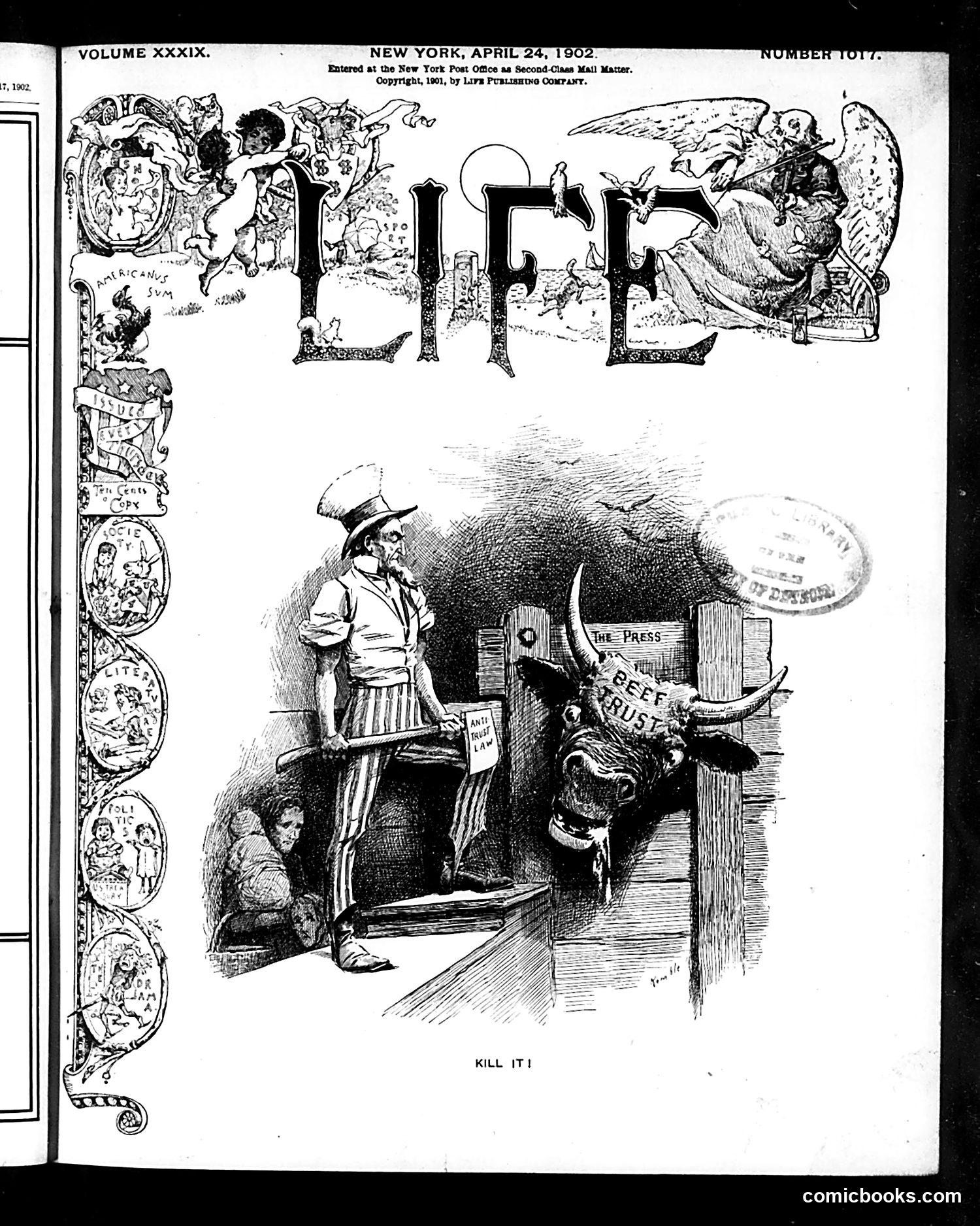
This political cartoon titled "Kill It!" depicts a figure in Uncle Sam attire confronting a large bull labeled "THE PRESS" and marked "BEEF TRUST." The cartoon satirizes efforts to suppress press criticism of monopolistic meat-packing industries—the "beef trust" that dominated American meat production. The figure appears to represent either government or corporate interests attempting to silence journalistic investigation. The bull's aggressive stance and the command to "kill it" suggest violent suppression of free speech. This likely references the meatpacking industry's attempts to intimidate or discredit press exposés of unsanitary conditions—issues that would soon become famous through Upton Sinclair's 1906 novel "The Jungle." The cartoon defends press freedom against corporate intimidation.
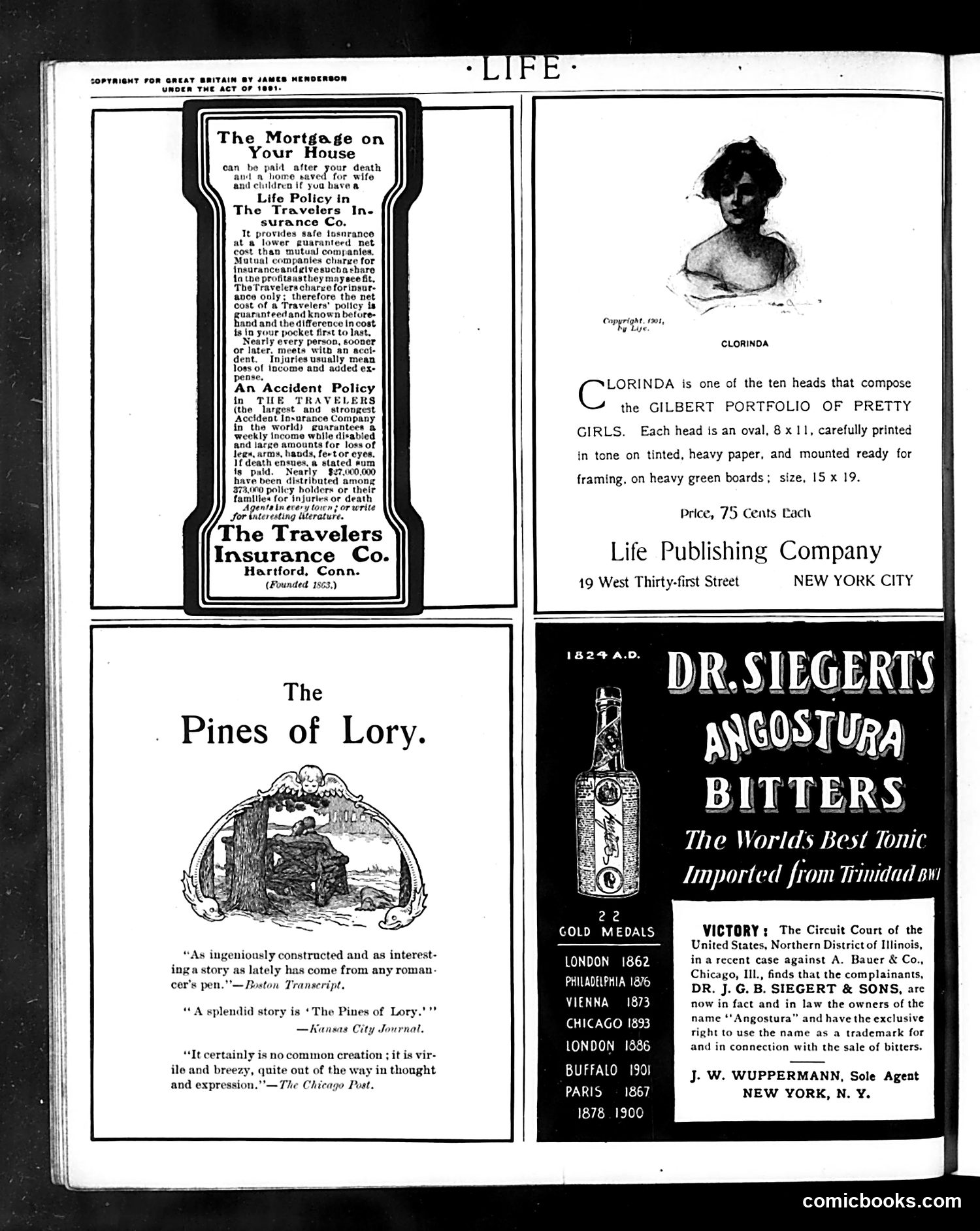
This page is **primarily advertising**, not political satire. It contains four distinct advertisements: 1. **The Travelers Insurance Co.** (top left): Promotes life insurance for homeowners, emphasizing financial protection for families. 2. **Gilbert Portfolio of Pretty Girls** (top right): Advertises affordable art prints (75 cents each) featuring portrait head "Clorinda," marketed as ready-to-frame décor. 3. **The Pines of Lory** (bottom left): Promotes a novel with positive contemporary reviews. 4. **Dr. Siegert's Angostura Bitters** (bottom right): Markets imported Trinidad bitters as "The World's Best Tonic," noting its legal victory against competitors. The page reflects early 20th-century consumer goods and services. No political cartoons or satirical commentary appears present—this is standard magazine advertising content.
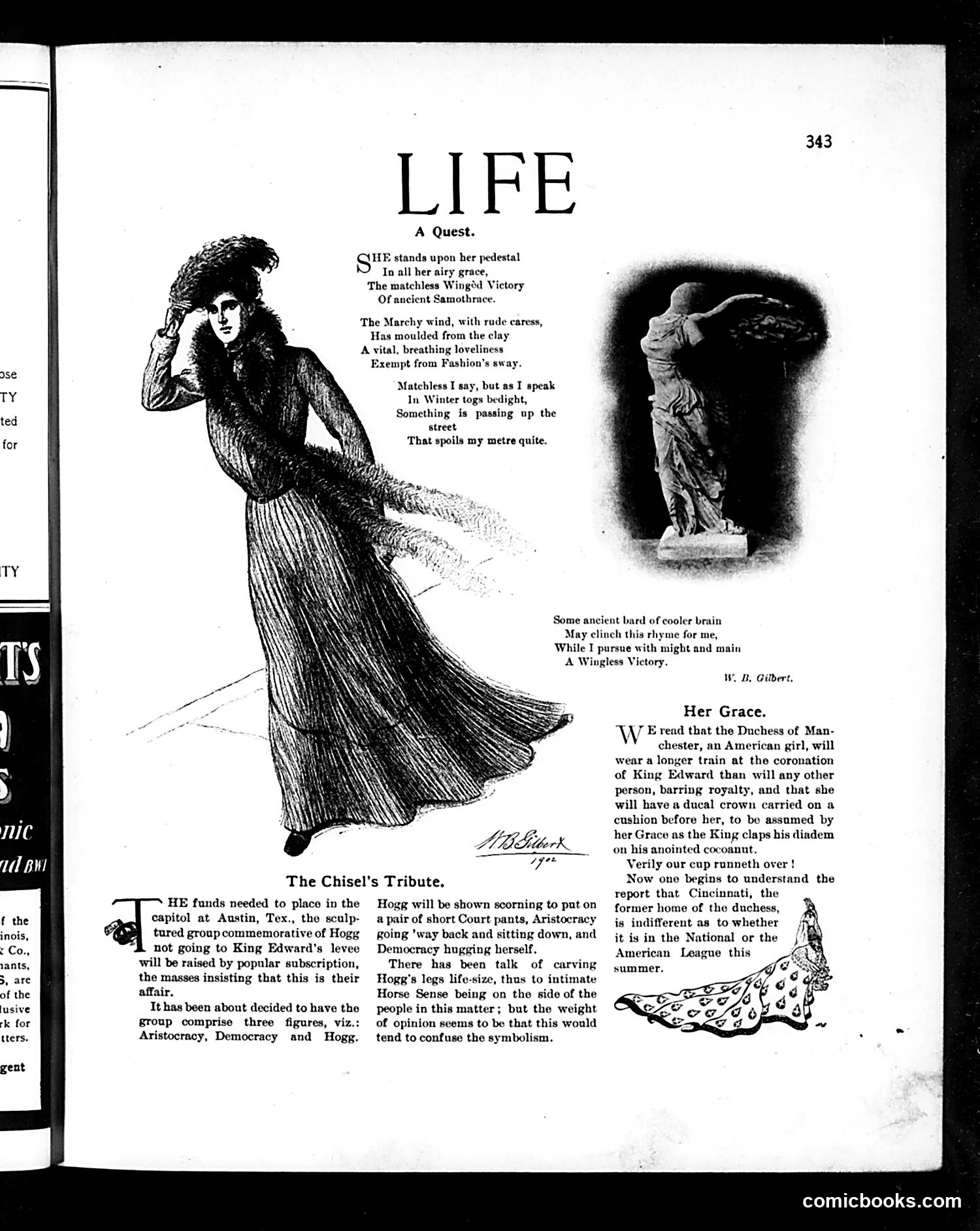
This page contains two distinct pieces: **"Life: A Quest"** (left) is a poem illustrated with an elegant woman in an elaborate gown, paired with a classical winged victory statue. The poem reflects on beauty, fashion, and life's pursuit. **"The Chisel's Tribute"** (bottom) discusses a fundraising effort for an Aristrocracy-Democracy-Hogg sculptural group commemorating King Edward VII. The satirical point appears to target the absurdity of combining these three concepts in one monument, with Hogg (likely a political figure) portrayed mockingly. The text suggests the symbolism seems confused—mixing monarchical tradition with democratic values. **"Her Grace"** (right) gossips about an American duchess (Duchess of Manchester) planning an unusually long coronation train, satirizing American wealth and social climbing in British aristocratic circles. The overall theme mocks both American social ambition and British political pretension.
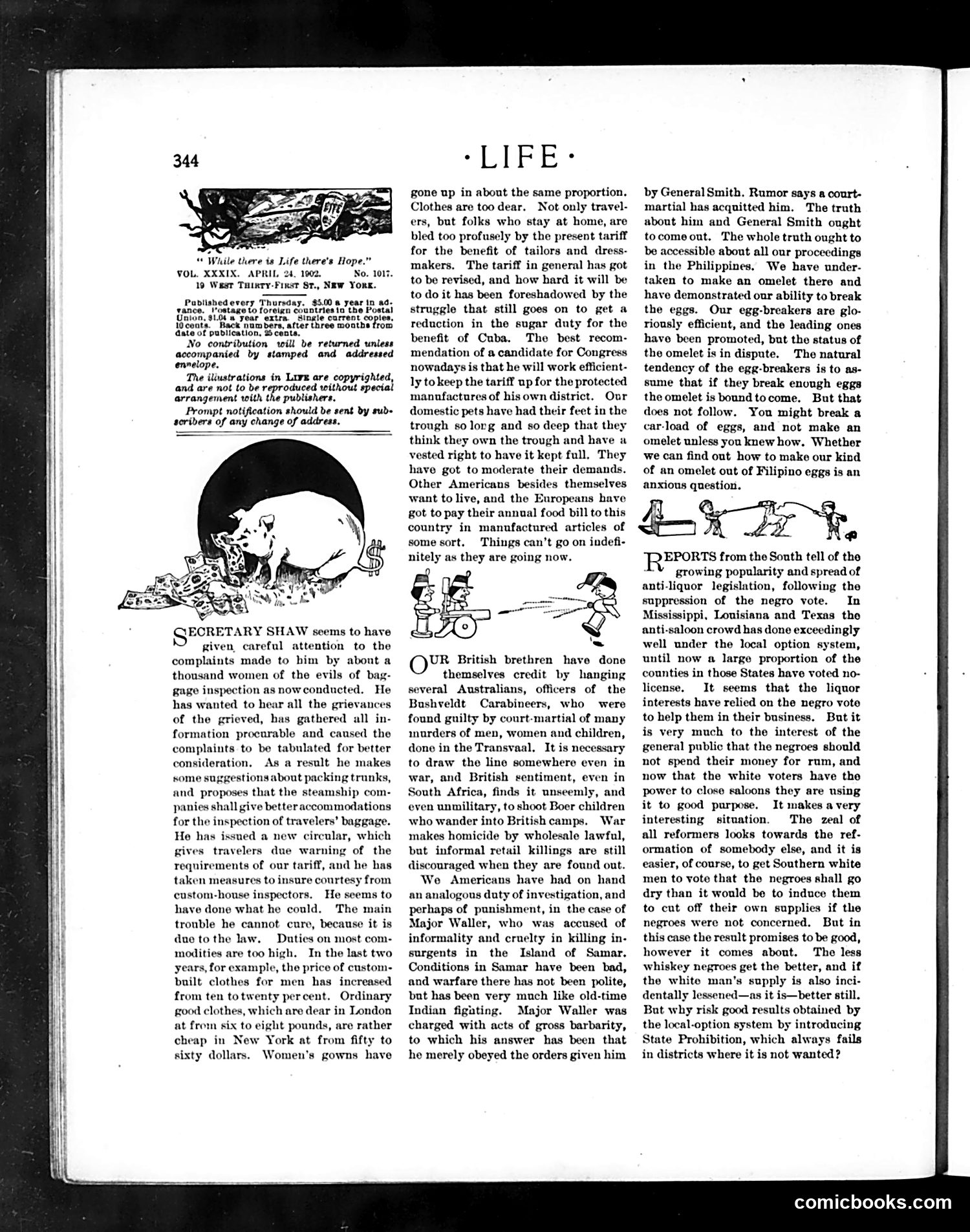
The main cartoon depicts a large pig lying in mud among money, illustrating the article's discussion of tariff protections and their economic effects. The text criticizes how American manufacturers have become complacent due to tariff protection—described as pigs grown fat and lazy in the mud of government support. The article addresses Secretary Shaw's efforts to address baggage inspection abuses and discusses trade relations with Britain. It references specific colonial incidents, including Major Waller's conduct in Samar during the Philippine conflict, using these as examples of imperial overreach. The satirical point: American businesses protected by tariffs have grown lazy and inefficient (like pampered pigs), while overseas imperial policies damage Britain's reputation through military misconduct.
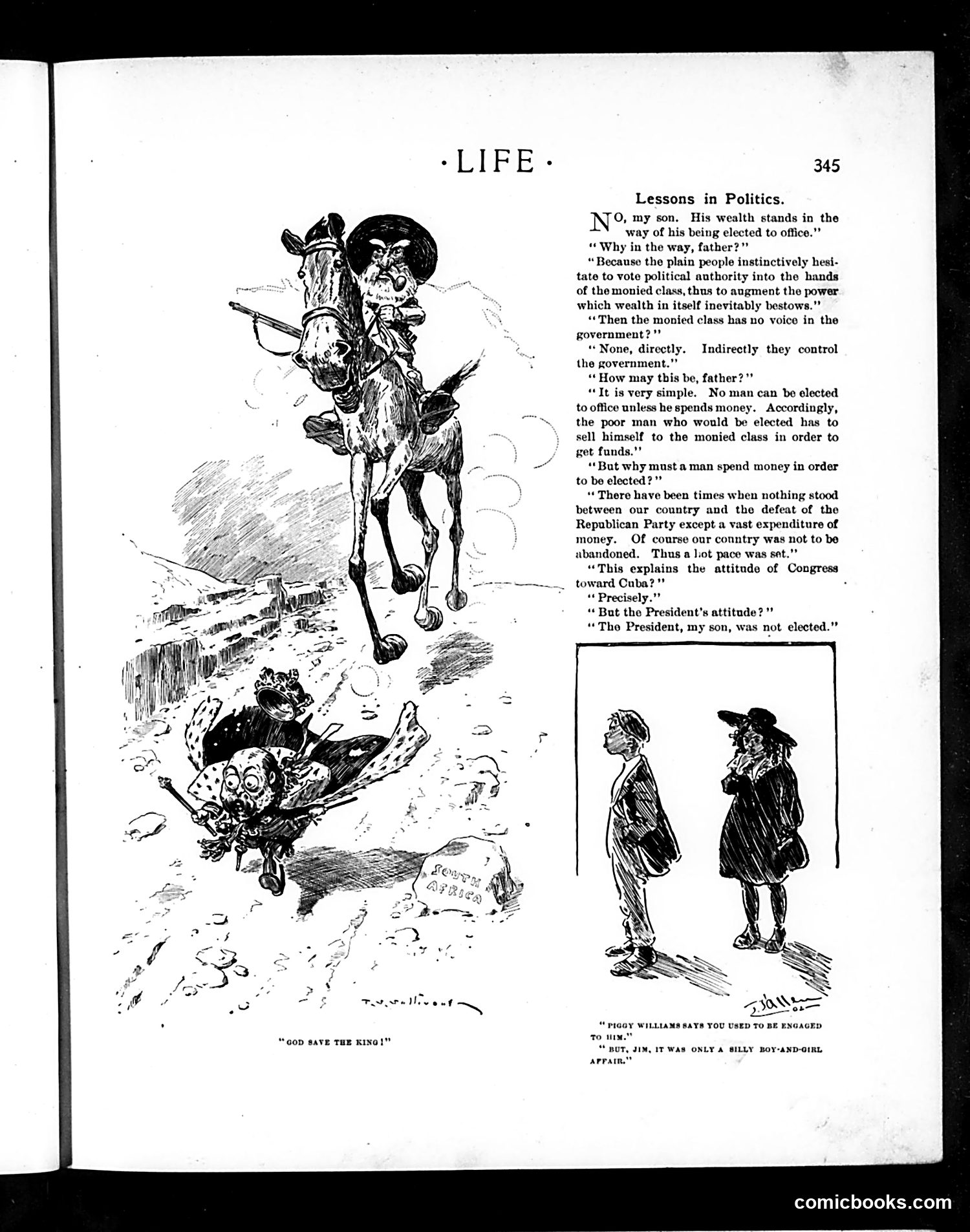
This page satirizes American political corruption through a dialogue between father and son. The father explains that wealth determines electoral success—poor candidates must sell themselves to the monied class to fund campaigns. He illustrates how the wealthy indirectly control government without holding office themselves. The large cartoon ("God Save the King!") depicts a horseman trampling a common person, likely representing how political authority serves wealthy interests over ordinary citizens. The lower cartoon shows two boys discussing Peggy Williams's broken engagement, with one noting it was "only a silly boy-and-girl affair"—possibly a separate satirical commentary on social pretense. Together, these pieces critique the systemic corruption linking wealth to political power in early 20th-century America.
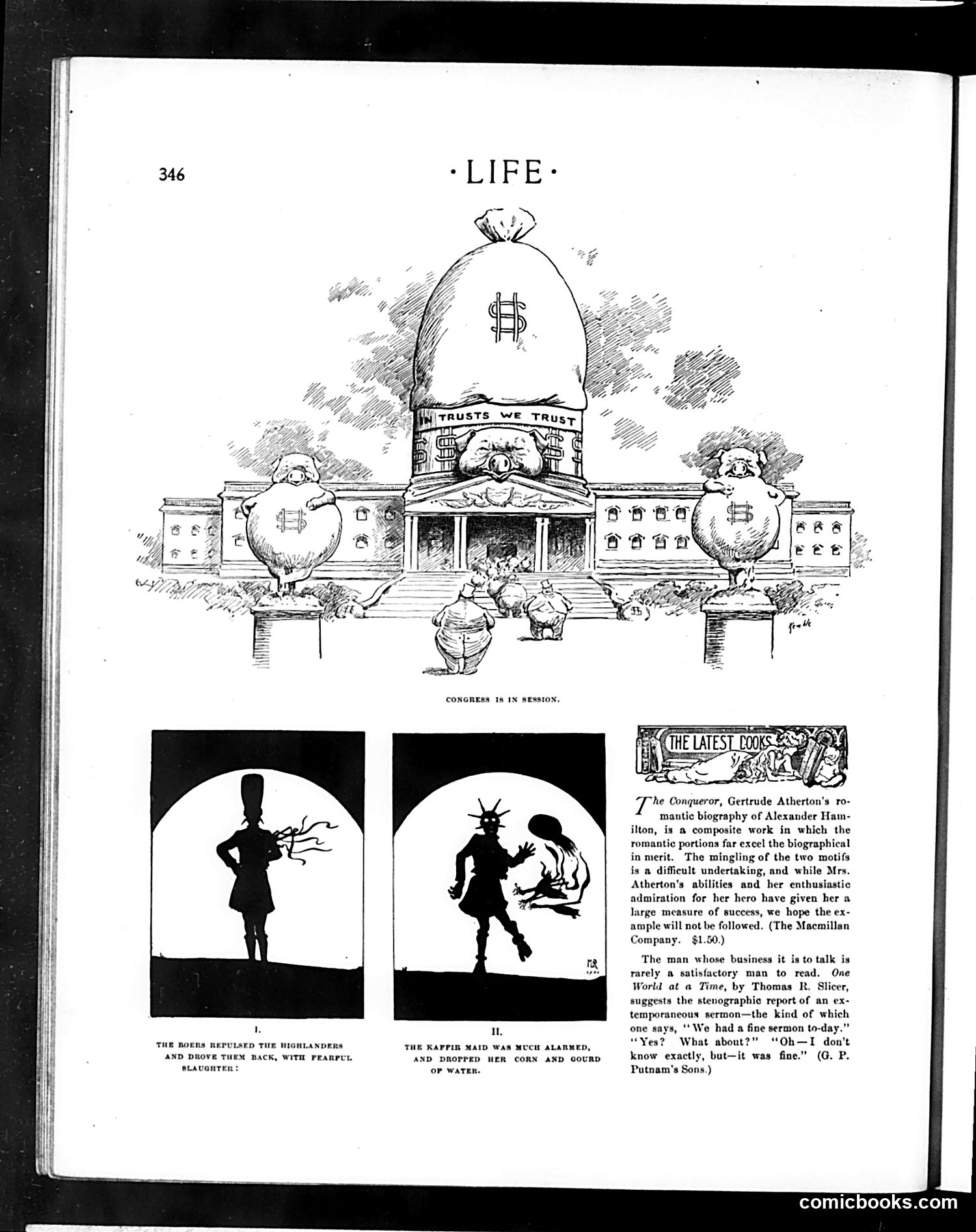
The main cartoon depicts a massive money bag labeled with a dollar sign, positioned above the U.S. Capitol building like a dome. Fat, rotund figures representing congressmen surround the structure. The caption "CONGRESS IS IN SESSION" suggests satirical criticism of legislators' perceived obsession with money and financial interests rather than governance. The silhouette panels below reference Scottish Highland history—likely commentary on political upheaval or conflict. The page also advertises "The Conqueror," a biography of Alexander Hamilton, and "One World at a Time," a book of sermons. The overall message: Congress is controlled by financial interests, depicted through exaggerated body imagery symbolizing greed and corruption.
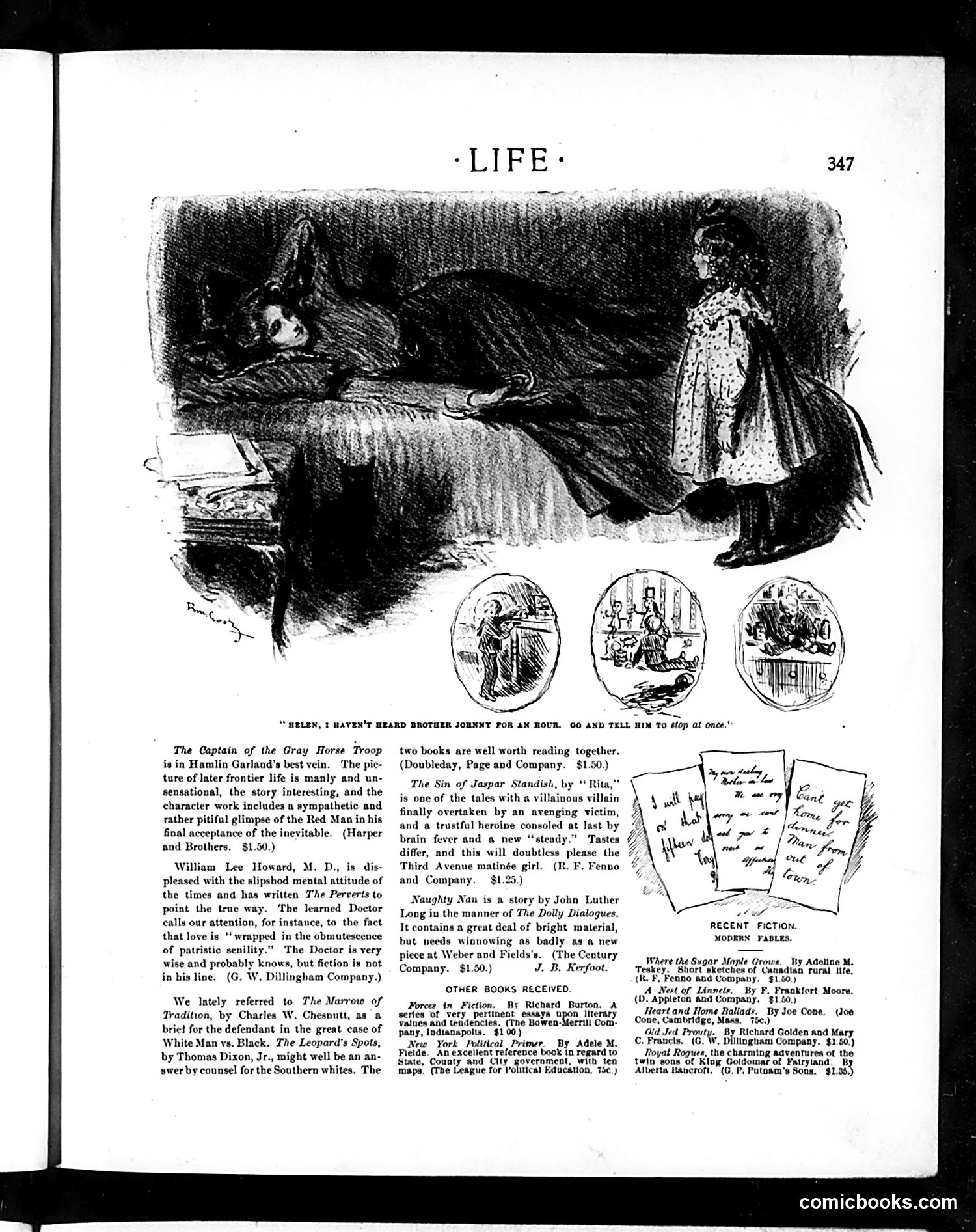
The main illustration depicts a bedroom scene with a woman reclining on a bed and a man standing beside it wearing a cape or cloak. The caption reads: "Helen, I haven't heard brother Johnny for a hour. Go and tell him to stop at once." This appears to be a domestic humor cartoon playing on a double entendre—the ambiguous phrasing of "stop at once" creates comedic confusion about what activity the brother should cease. The joke relies on Victorian-era propriety and the suggestiveness of the bedroom setting to create embarrassment for modern readers familiar with such innuendo. The page also contains book reviews and advertisements below the cartoon, typical of Life's format during this period as a literary and cultural commentary magazine.
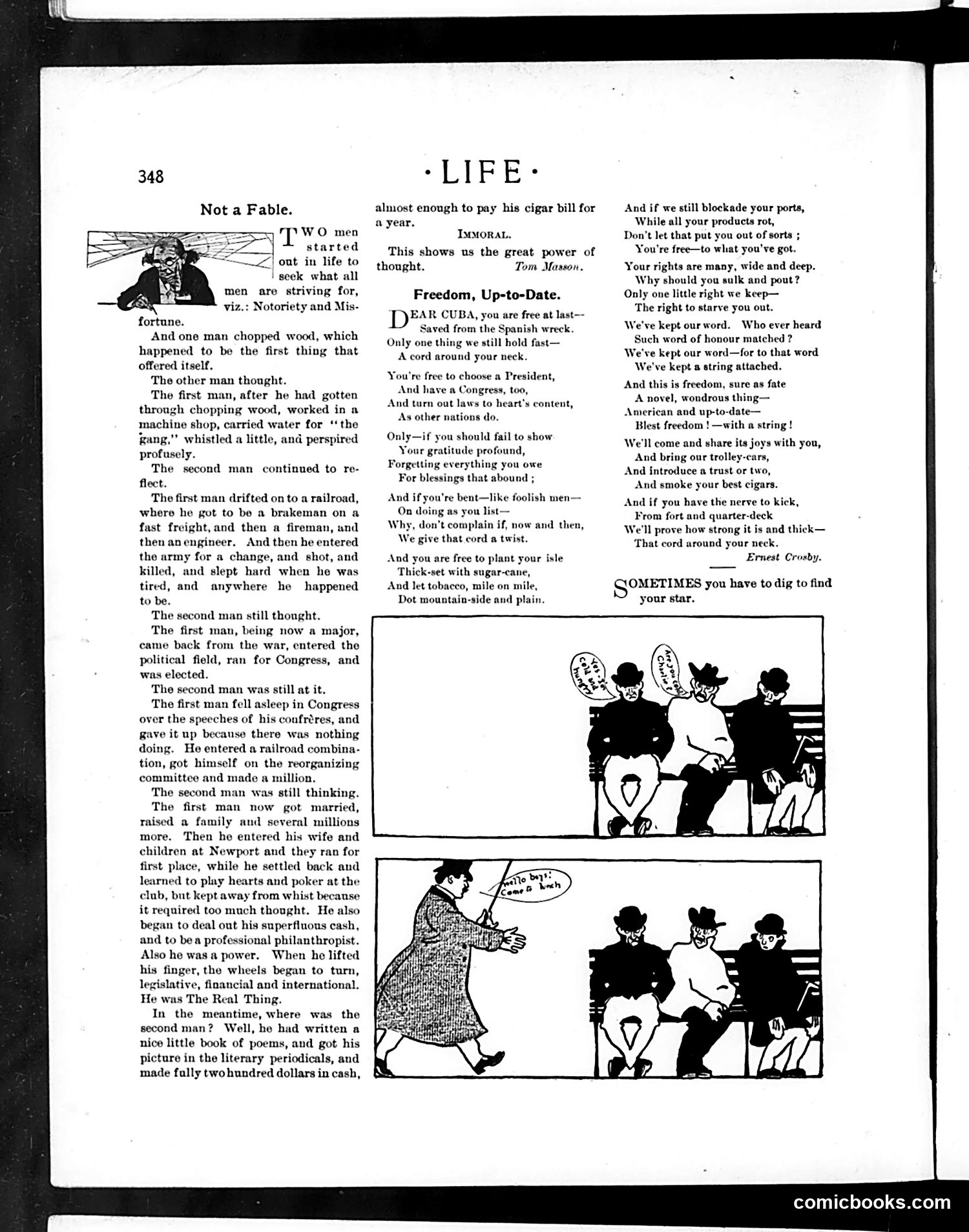
**Left section:** A satirical story contrasting two men's life trajectories. One pursues "Notoriety and Misfortune" through various failed ventures (chopping wood, machine shop, railroad work), while the other achieves success through sustained thought and strategic ambition—becoming a Congressman, businessman, and wealthy philanthropist. The moral: deliberate thinking versus passive action determines outcomes. **Right section:** "Freedom, Up-to-Date" appears to mock Cuba's post-Spanish independence (referenced as "saved from the Spanish wreck"). The poem sarcastically congratulates Cuba on newfound freedom while suggesting that political liberty means little without economic independence—citizens remain enslaved by debt ("a cord around your neck"), forced labor, and exploitation despite electing leaders. The cartoons show three well-dressed men observing common people, suggesting entrenched power persists unchanged.
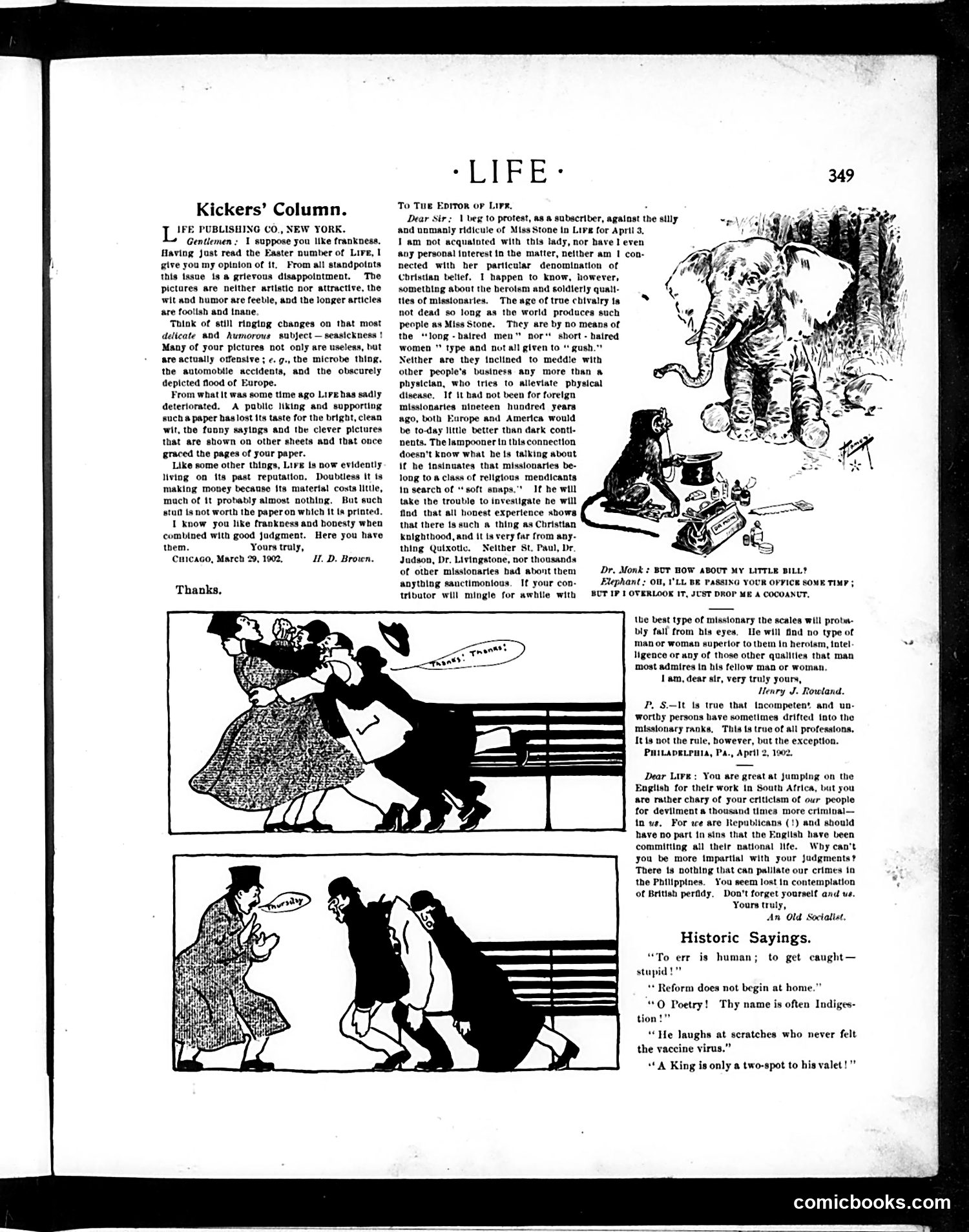
This page features **Kickers' Column**, a reader feedback section, with two editorial cartoons illustrating common social situations. The **top cartoon** shows a man and woman at a piano, with the woman appearing to play aggressively while the man recoils in discomfort—likely satirizing either amateur musical performances or awkward domestic moments. The **bottom cartoon** depicts a man confronting two women, possibly representing conflict over fashion, behavior, or social propriety—common Life magazine themes mocking social pretensions or generational clashes. The letters discuss missionary work, nationalism, and social criticism. One reader defends "Christian knighthood" and missionaries; another criticizes British imperialism in the Philippines. The **Historic Sayings** section at bottom contains witty aphorisms typical of early 1900s satirical magazines, poking fun at human folly and authority.
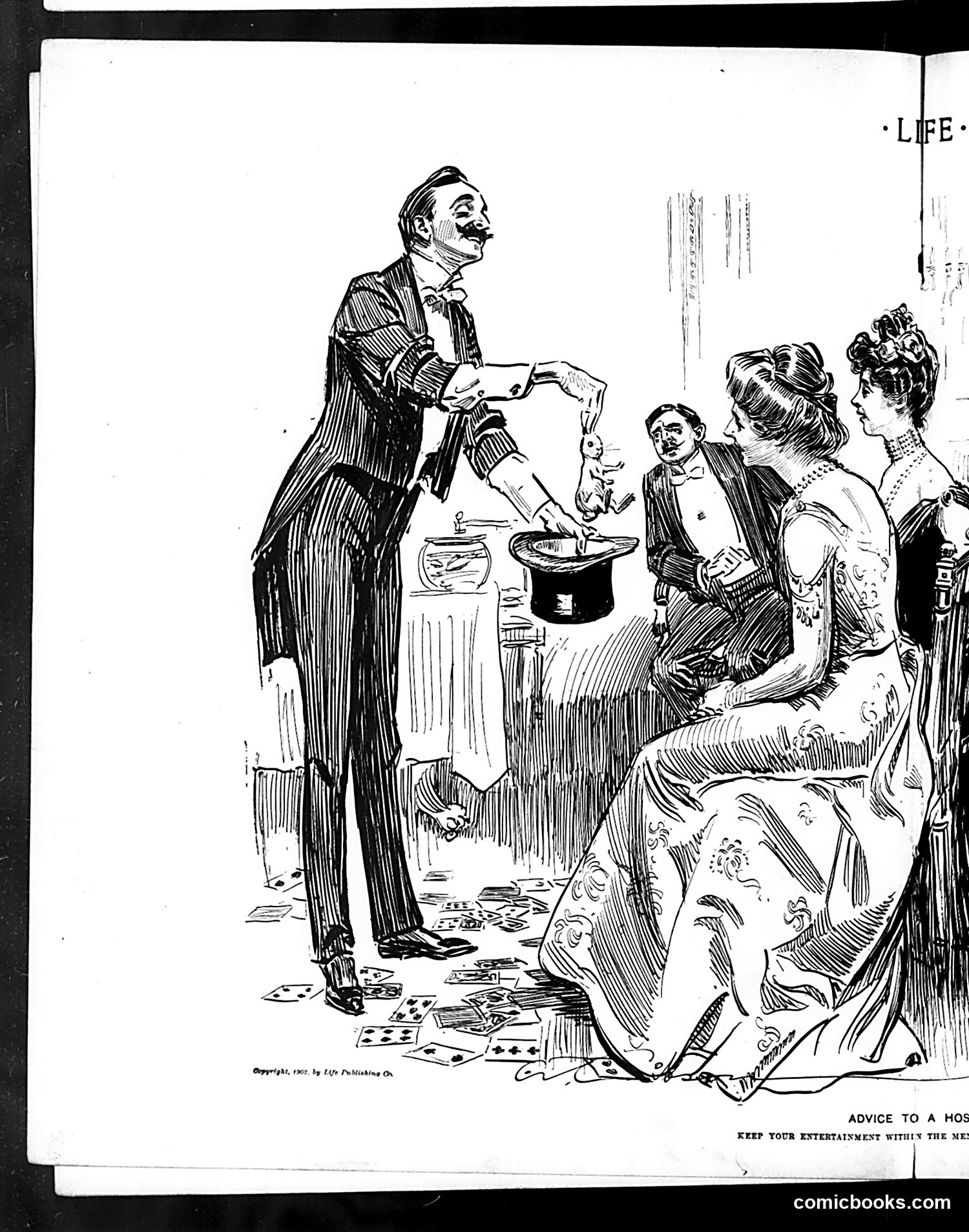
This satirical cartoon depicts a magician or entertainer performing card tricks for an audience of well-dressed socialites at what appears to be an upper-class gathering. Playing cards are scattered across the floor. The caption reads "KEEP YOUR ENTERTAINMENT WITHIN THE MEANS" (partially visible as "ADVICE TO A HOST / KEEP YOUR ENTERTAINMENT WITHIN THE ME[ANS]"). The satire critiques wealthy hosts who hire expensive entertainers beyond their financial means. The scattered cards suggest either the magician's performance or financial loss. The joke warns affluent society figures against overspending on lavish entertainment—a practical economic lesson for the leisure class, likely reflecting early 20th-century concerns about conspicuous consumption and financial prudence.
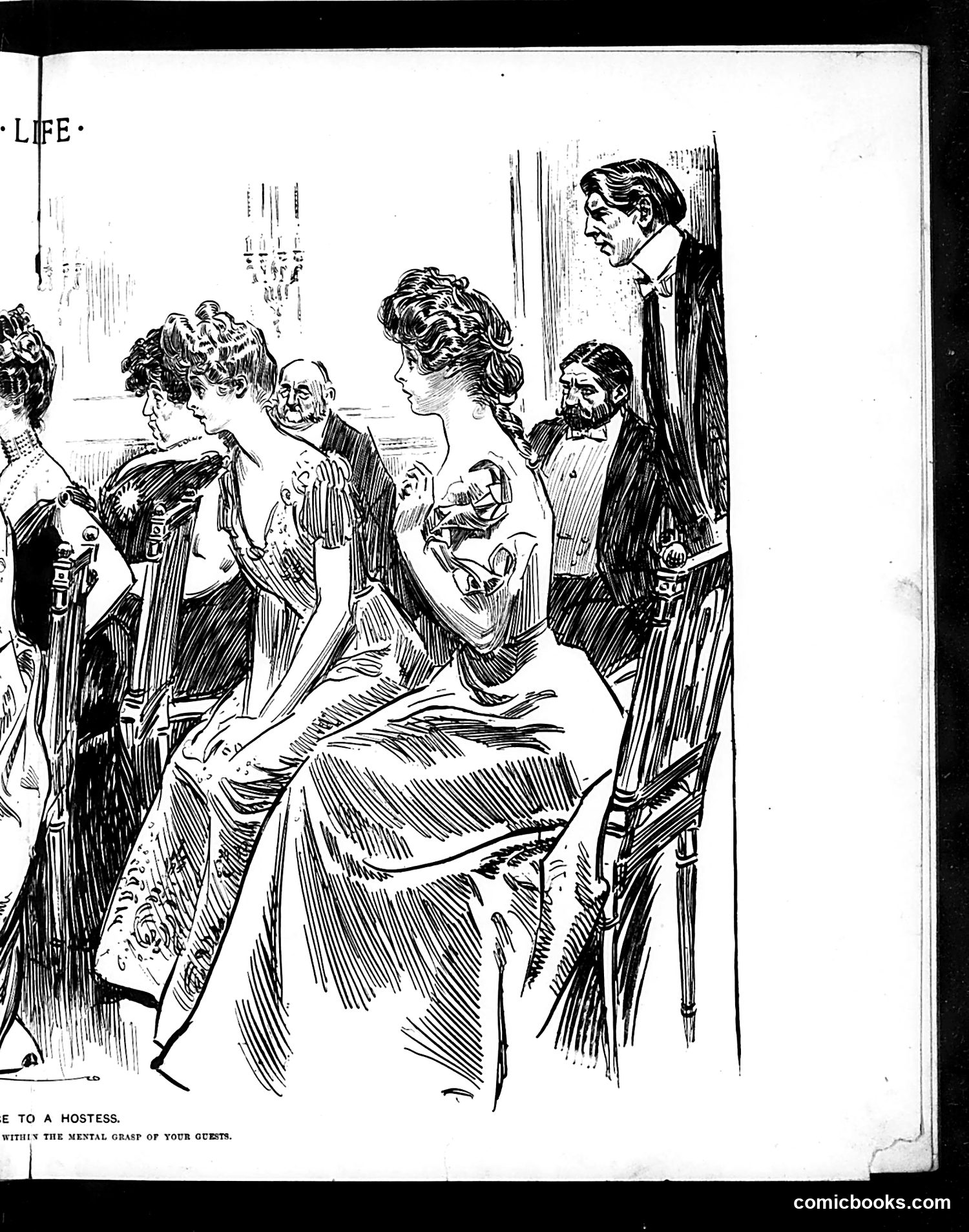
This illustration depicts an upper-class social gathering, likely from the early 20th century based on the styling and artistic technique. The caption references "A HOSTESS" and appears to offer etiquette advice about maintaining "THE MENTAL GRASP OF YOUR GUESTS." The scene shows a seated woman in elegant dress surrounded by standing men in formal attire. The satire appears to mock high-society dinner party dynamics—specifically, how a hostess should manage conversation and attention among her male guests. The composition suggests commentary on social performance, gender roles, and the artifice of polite society gatherings during this era. Without seeing the complete caption, the exact satirical point remains somewhat unclear, but it likely critiques either superficial socializing or specific expectations placed on women as hostesses.
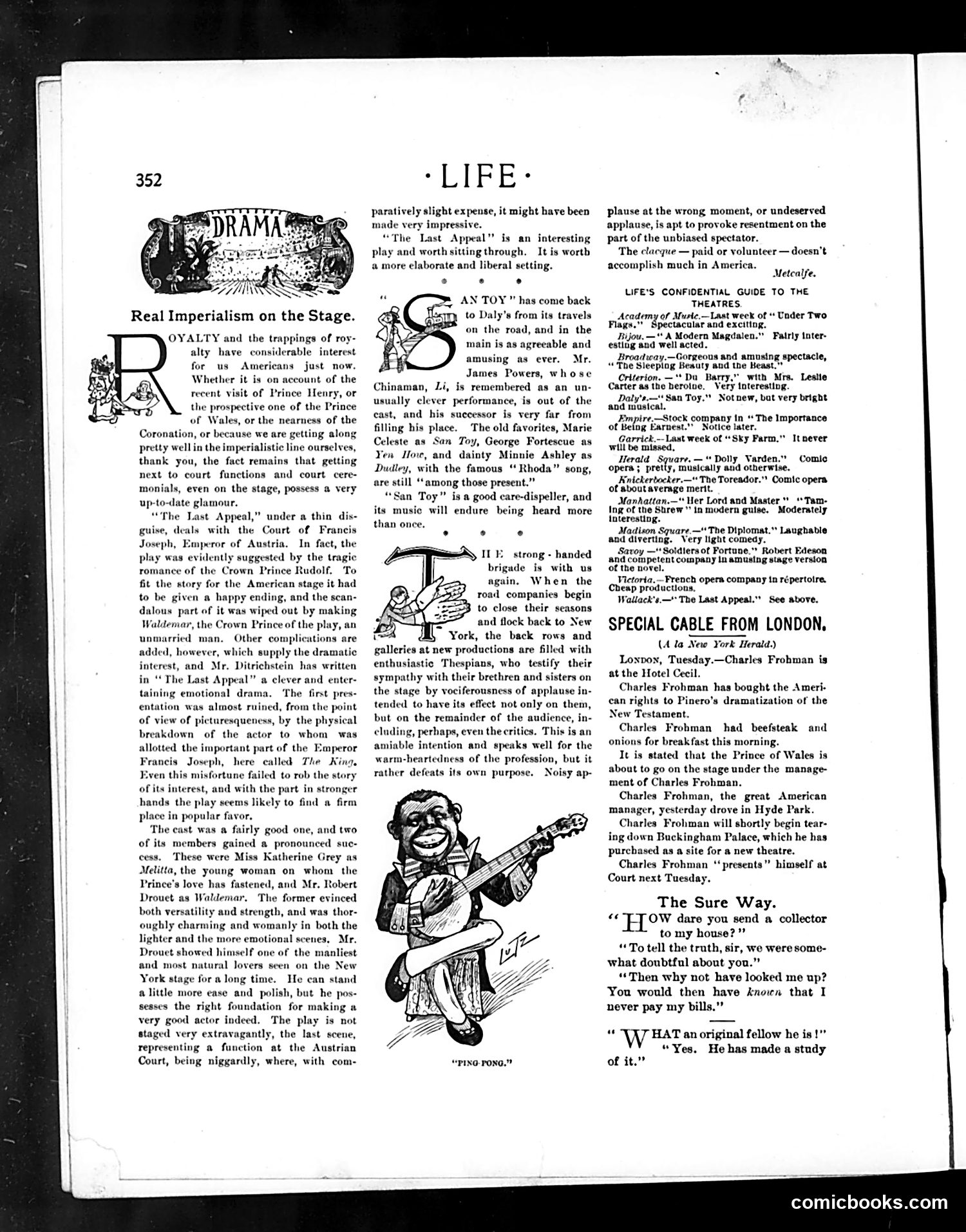
This page contains theater reviews and commentary. The main illustration labeled "PING PONG" depicts an Asian figure playing a stringed instrument, likely referencing the popular game/fad of the era. The text discusses "Real Imperialism on the Stage," reviewing theatrical productions including "The Last Appeal" and "San Toy." The reviews mention actor James Powers and actresses like Marie Celeste and Minnie Ashley performing in productions with Asian themes. A "Special Cable from London" reports on Charles Frohman's theatrical dealings, including his purchase of dramatization rights to the New Testament and a building for a new theater. The page concludes with "The Sure Way," a brief comedic dialogue about debt collection. The content reflects turn-of-the-century American theater and its fascination with Asian-themed productions.
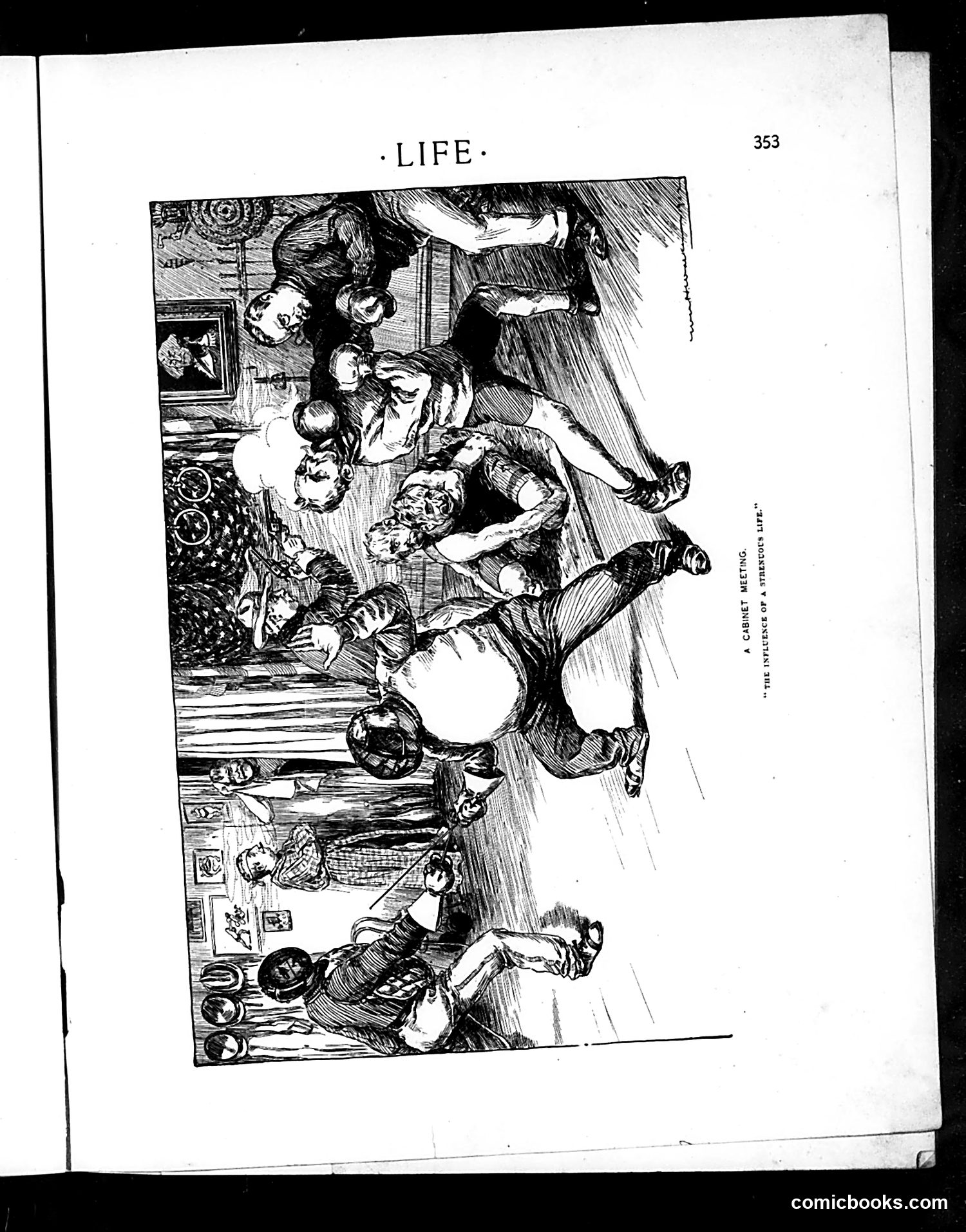
This satirical illustration appears to critique the concept of a "strenuous life"—likely referencing Theodore Roosevelt's famous philosophy emphasizing vigorous activity and outdoor pursuits. The cartoon depicts a chaotic domestic scene where children and adults engage in rough, energetic play and activity indoors, with toys, furniture, and household items scattered about in disorder. The satire suggests that adopting an ideology of constant strenuousness creates household chaos rather than improvement. The composition contrasts genteel Victorian domesticity with wild, uncontrolled physical activity, mocking the idea that such vigor translates positively to family life. The specific figures are unclear, but the crowded, tumultuous scene effectively conveys the cartoonist's skepticism toward this cultural ideal.
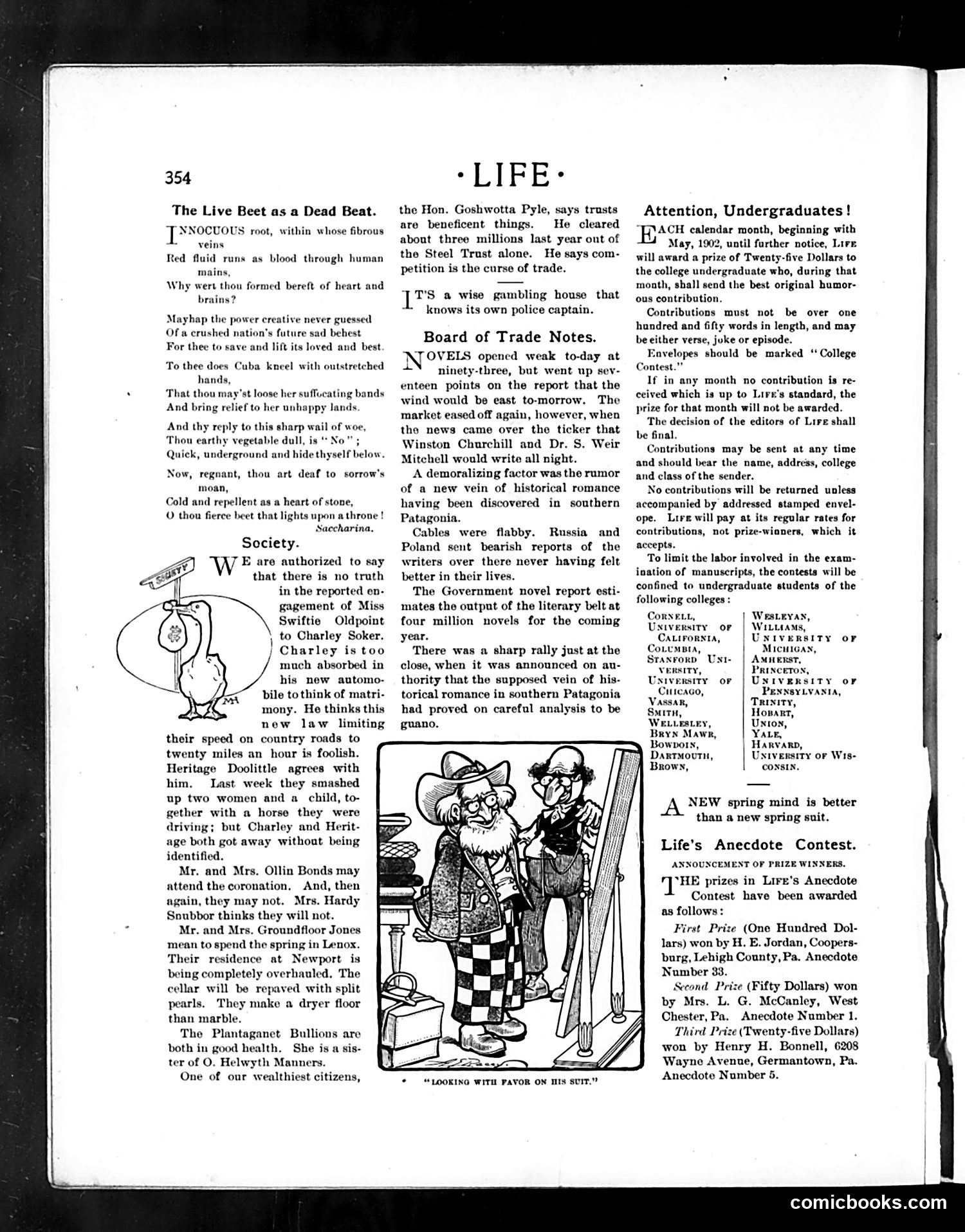
This Life magazine page (354) contains social satire targeting America's wealthy elite and monopolistic practices circa 1902. **Main Cartoon:** The illustration depicts two figures in what appears to be a suit of armor or formal dress, captioned "Looking with Favor on His Suit"—likely mocking either courtship pretensions or business dealings among the wealthy. **"The Live Beet as a Dead Beat":** This poem satirizes Cuban dependence on American trade (sugar beets) while America refuses humanitarian aid to the struggling island, treating it coldly despite Cuba's appeals. **"Board of Trade Notes":** This parodies financial reporting by treating novel-writing as a commodified market, with "novels" treated as trading commodities. The joke mocks both the proliferation of literature and speculative market absurdities. **Society Section:** Satirical gossip mocking wealthy socialites' moral indifference—specifically that wealthy drivers hit pedestrians ("two women and a child") without consequence, and their casual cruelty toward the poor (the Joneses' obscene display of wealth with pearl flooring). The overall tone attacks capitalist excess, monopolies, and aristocratic indifference to human suffering.
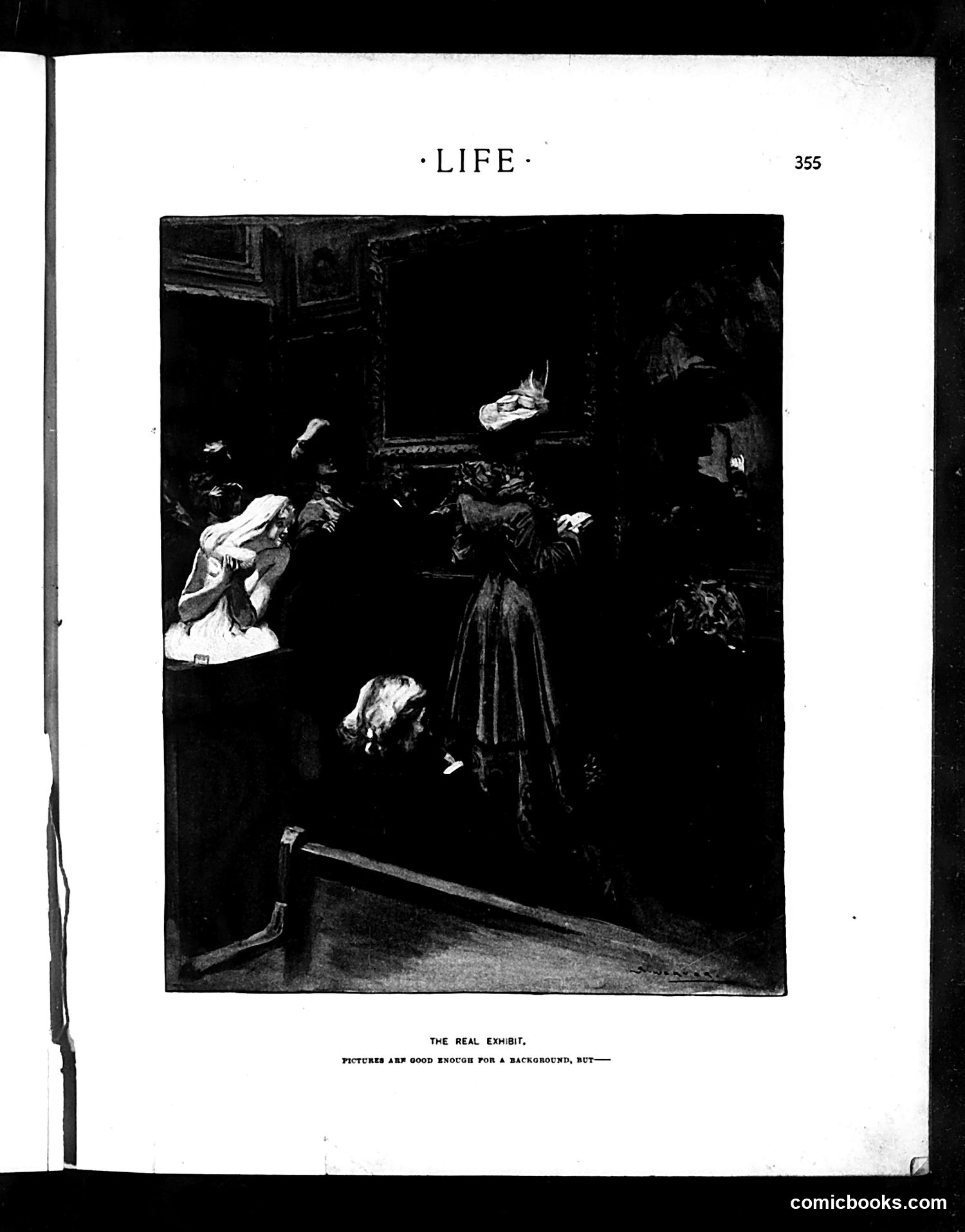
This satirical illustration critiques art exhibition practices. The caption suggests that while pictures serve as mere "background," the real spectacle is the *people viewing them*—their fashions, postures, and social behaviors. The scene depicts well-dressed visitors in an art gallery, rendered in dramatic chiaroscuro. The cartoon's humor lies in its inversion: instead of focusing on the artworks (barely visible in the upper portion), the artist makes the *viewers themselves* the subject of artistic scrutiny and satire. This reflects early 20th-century social satire about high culture and pretension—the notion that gallery-going was as much about social display and performance as aesthetic appreciation. The "real exhibit" being human vanity and fashionable society rather than the art itself.
This page features two distinct pieces: **Main Content: "All Hail the Microbe"** — A satirical poem mocking the late 19th/early 20th-century public anxiety over newly discovered microbes and bacteria. The joke targets the era's germ-panic: people obsessively sterilizing everything (water, food, ice, even oatmeal) in response to scientific discoveries about disease transmission. The repeated refrain "GO DOWN AND BOIL THE ICE" represents the absurd extremes of this fear-driven behavior. **Second Story: "Blind Bartimeus"** — A humorous retelling of a slave preacher's sermon comparing the biblical prophet Elijah's prayers to those of Bartimeus. The dialect-heavy text records the preacher's dramatic comparison of faith's power, using vernacular speech patterns typical of period entertainment literature. The page is primarily text-based commentary on contemporary anxieties and cultural attitudes, rather than traditional political cartooning.
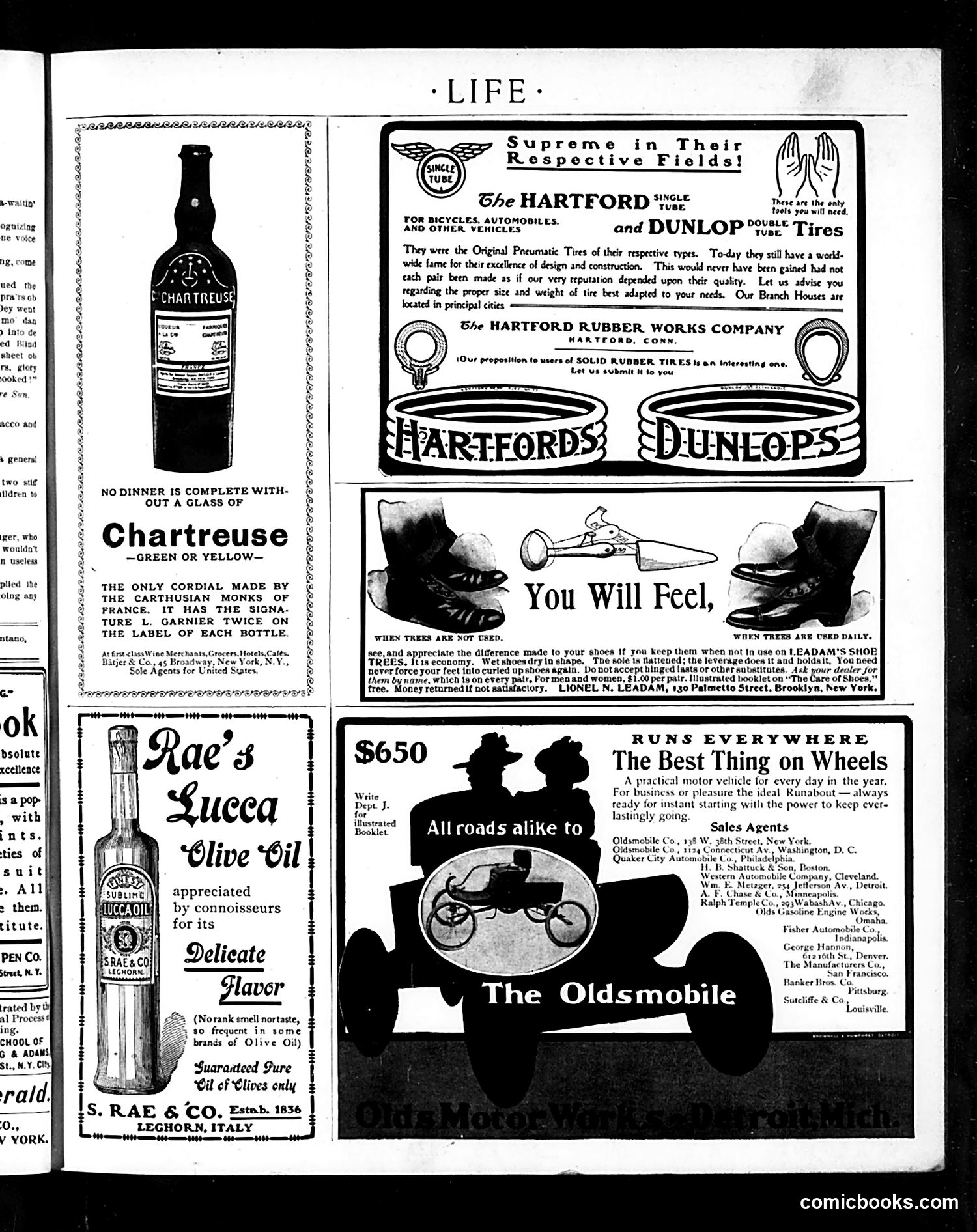
This page consists almost entirely of **advertisements**, not satirical cartoons. The content includes: **Product ads:** - Hartford and Dunlop tires (competing brands claiming superiority) - Chartreuse liqueur (marketed as made by Carthusian monks) - Rae's Lucca Olive Oil (Italian import) - Leadam's shoe trees (to maintain shoe shape) - The Oldsmobile automobile ("The Best Thing on Wheels") **The satire, if present, is subtle:** The Hartford/Dunlop tire ad's header—"Supreme in Their Respective Fields!"—appears mildly ironic, as these were direct competitors. The Oldsmobile ad's claim that "all roads alike to" their vehicle is typical period automobile marketing hyperbole. Overall, this is a **commercial page** from an early 1900s magazine. The ads reflect consumer products and emerging automobile culture of the era. There are no identifiable political cartoons or caricatures. Any humor derives from period marketing language rather than satirical commentary.
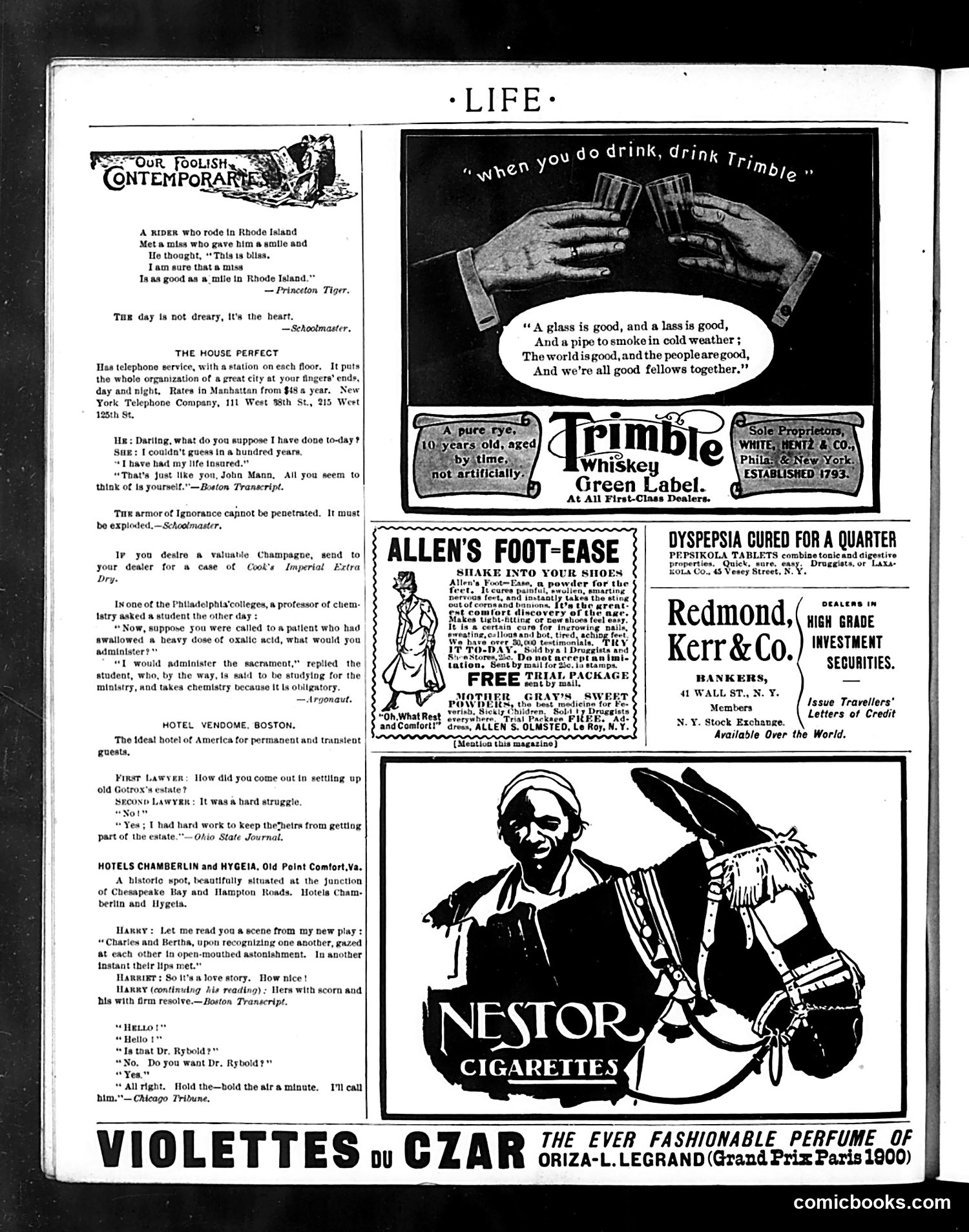
This is primarily an **advertising page** with scattered humorous fillers typical of early 1900s Life magazine. The main satirical content includes brief jokes mocking contemporary society: - **"The House Perfect"** satirizes newly wealthy New Yorkers boasting about telephone service as a status symbol - A dialogue where a wife criticizes her husband John Mann for being self-absorbed after he insures his life—social commentary on materialism and vanity - A college chemistry joke: when asked how to treat oxalic acid poisoning, a student replies he'd "administer the sacrament," mocking either religious hypocrisy or the student's incompetence The **Trimble Whiskey advertisement** features two hands toasting with the poem celebrating drinking and camaraderie—typical period advertising. Other ads promote **Nestor Cigarettes**, **Allen's Foot-Ease powder**, and various hotels and financial services. The humor throughout reflects turn-of-the-century concerns: status anxiety, marital discord, and educational pretension—but the satire is gentle rather than biting. The page captures early 1900s magazine culture blending commerce with light social commentary.
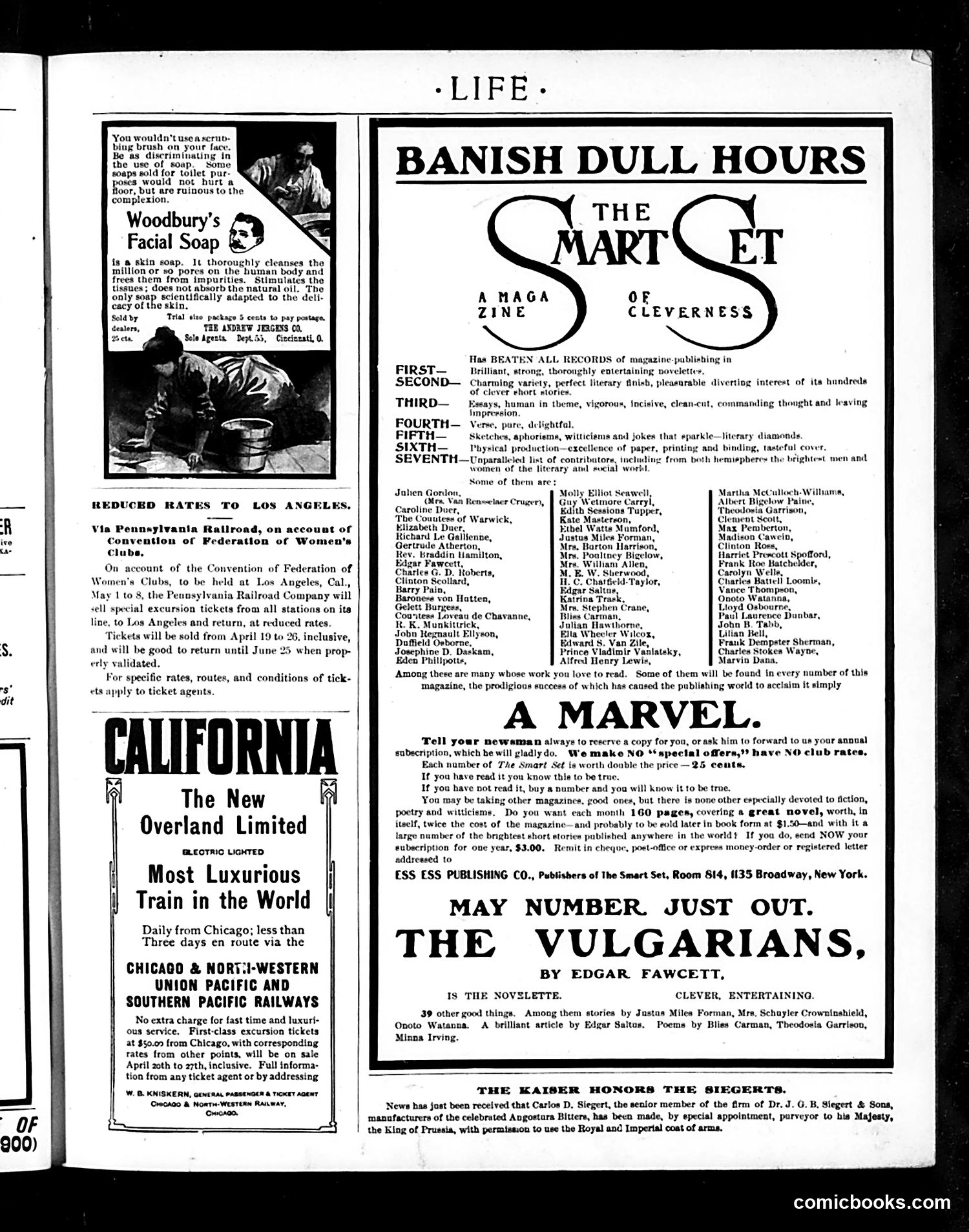
This page is primarily **advertising and promotional material** rather than political satire or comics. The main content includes: **Woodbury's Facial Soap advertisement** (left): A standard beauty product ad claiming scientific superiority for delicate skin. **"The Smart Set" magazine promotion** (center-right): Lists the magazine's seven claimed achievements in publishing, including "brilliant" novelettes and contributions from prominent literary figures of the era (names like Edgar Fawcett, Gertrude Atherton, and Gelett Burgess are visible). **Travel and rail advertisements**: Pennsylvania Railroad reduced rates to Los Angeles for a Women's Club convention, and the "California Overland Limited" train advertisement. **"The Vulgurians" novelette advertisement**: Edgar Fawcett's story, promoted as "clever, entertaining." There is **no political cartoon or satire** on this page. It's a typical early-1900s magazine layout mixing classified advertisements with house promotions. The "Smart Set" promotion itself is the primary content—essentially an ad for a competitor magazine.
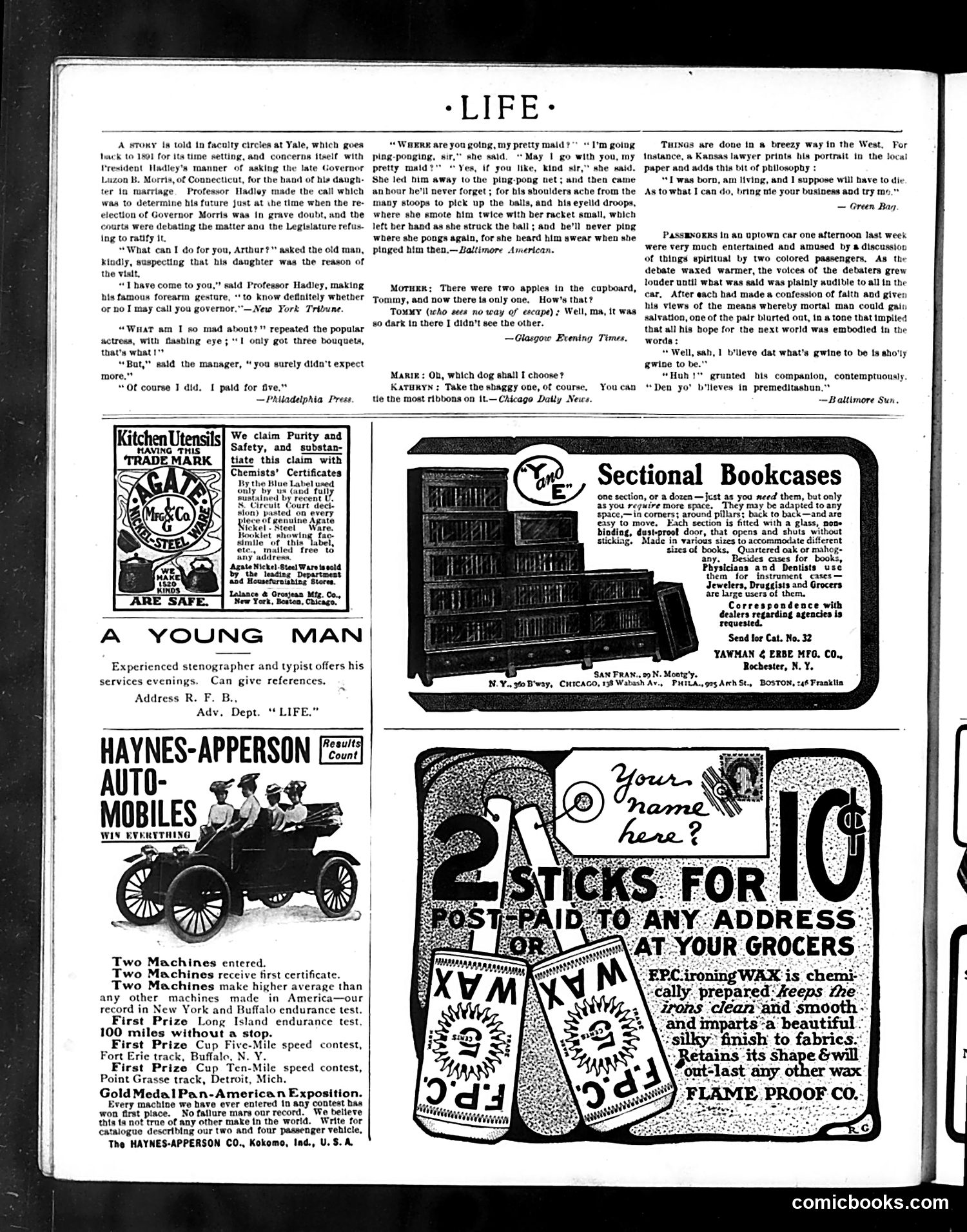
This page from *Life* magazine consists mainly of brief satirical anecdotes and advertisements. The cartoons/jokes include stories mocking various figures: President Hadley of Yale timing a marriage proposal awkwardly around Governor Morris's political troubles; an actress who "paid for five" bouquets but received only three; a child caught eating apples and claiming darkness as excuse; and an exchange about dog ribbons. The most substantive content is a dialogue between two Black passengers debating religious philosophy in an uptown streetcar. One concludes fatalistic beliefs with "what's gwine to be ts sho'ly gwine to be" (what will be will surely be), which his companion mocks as "premeditasbun" (predestination). The humor appears to rest on dialect humor and perceived contradiction in the speaker's logic. The page is otherwise filled with period advertisements for automobiles (Haynes-Apperson), kitchen utensils, bookcases, and wax sticks.
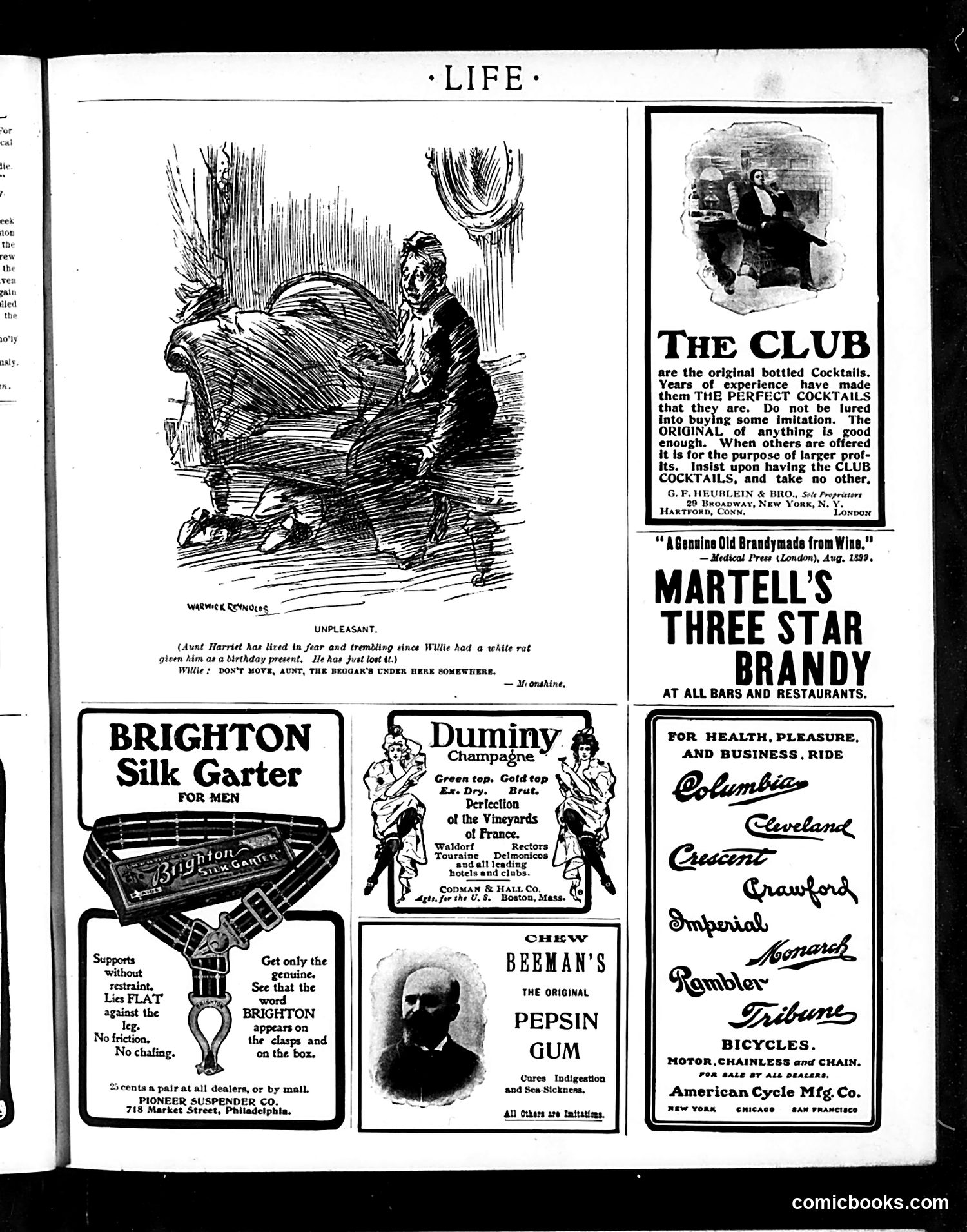
The main cartoon, titled "Unpleasant," depicts a domestic comedy scenario: Aunt Harriet fearfully stands while young Willie reassures her that a white rat (his lost birthday pet) is hiding "under here somewhere." The humor stems from the aunt's terror contrasting with Willie's casual attitude—a common theme in turn-of-the-century humor about nervous Victorian relatives confronted with children's pets or practical jokes. The cartoonist is credited as "Warwick Reynolds" (visible signature). The page is primarily **advertising**: silk garters, champagne, brandy, chewing gum, suspenders, and bicycles. These ads reflect early 1900s consumer products marketed to middle and upper-class readers. The satirical or political content appears minimal on this particular page—it's largely a humor illustration paired with period merchandise advertising typical of *Life* magazine's format during this era.
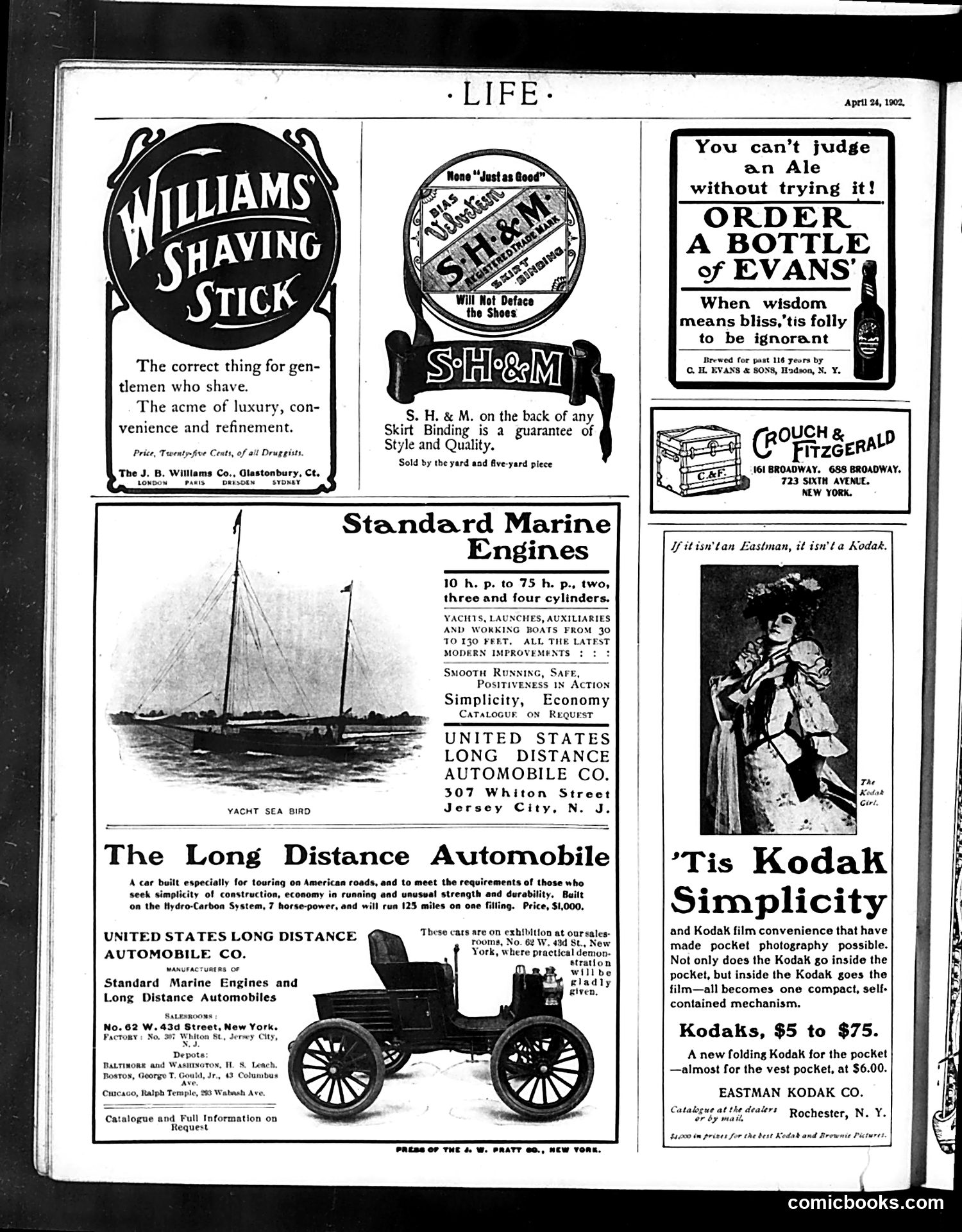
This is primarily an **advertising page** rather than editorial content or political satire. It features period product advertisements typical of early 1900s American commerce: **Key Advertisements:** - **Williams Shaving Stick**: Marketed as a luxury grooming product for gentlemen - **S.H. & M. Skirt Binding**: A textile/garment product sold by the yard - **Standard Marine Engines**: Industrial equipment for yachts and boats - **Long Distance Automobile**: A $1,000 touring car emphasizing durability and economy (7 horsepower, 125-mile range per fuel tank) - **Evans' Ale**: Beer advertisement claiming 116 years of brewing history - **Kodak Camera**: Promoting pocket-sized photography; prices $5-$75, with a new folding model at $6.00 The automobile and camera ads are most historically significant, showcasing early-1900s technological innovation. The Kodak slogan "If it isn't an Eastman, it isn't a Kodak" reflects Kodak's market dominance. There is **no visible political cartoon or satire** on this page.