
Life, 1902-04-24 · page 4 of 22
Life — April 24, 1902 — page 4: what you’re looking at
What you’re looking at
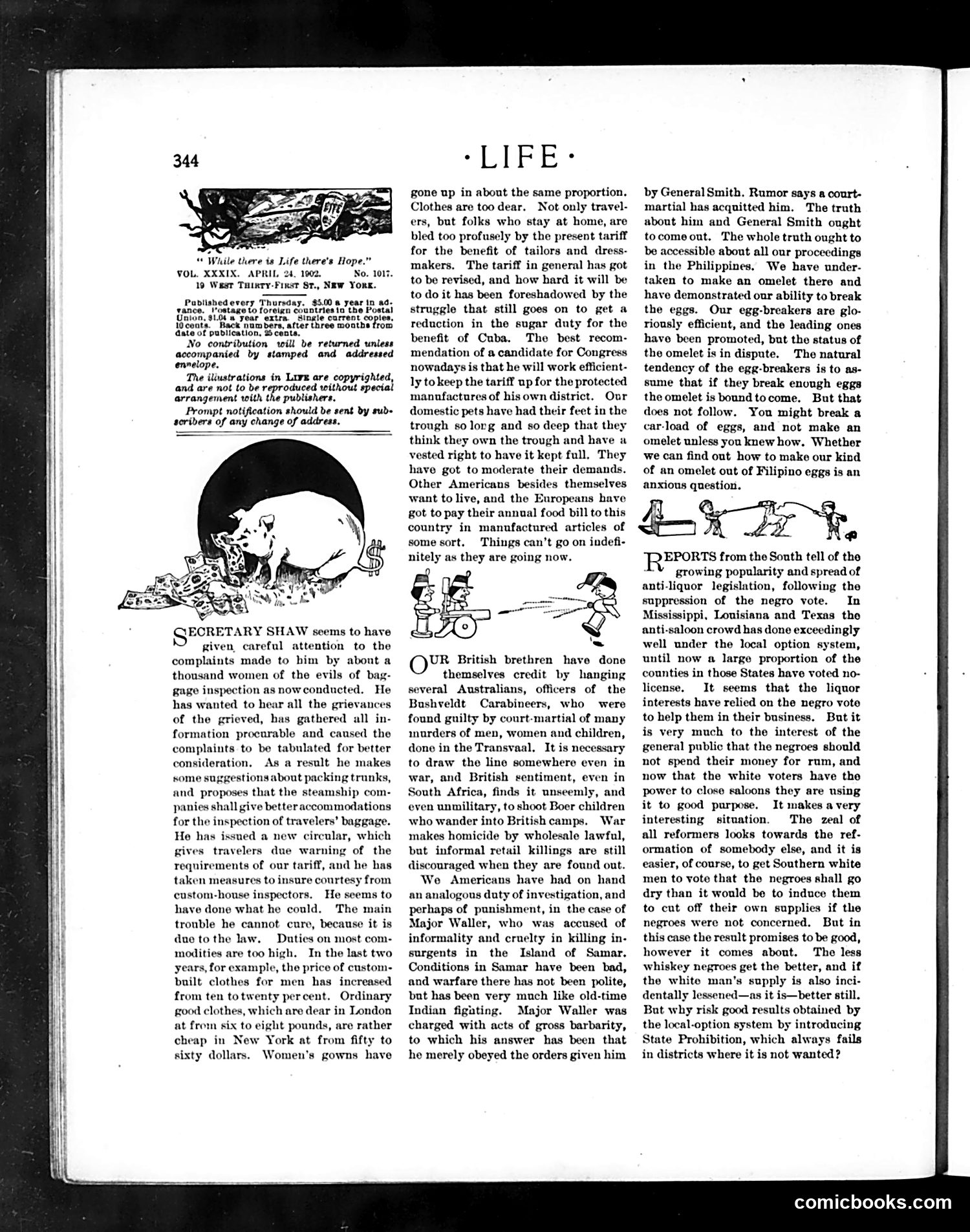
The main cartoon depicts a large pig lying in mud among money, illustrating the article's discussion of tariff protections and their economic effects. The text criticizes how American manufacturers have become complacent due to tariff protection—described as pigs grown fat and lazy in the mud of government support. The article addresses Secretary Shaw's efforts to address baggage inspection abuses and discusses trade relations with Britain. It references specific colonial incidents, including Major Waller's conduct in Samar during the Philippine conflict, using these as examples of imperial overreach. The satirical point: American businesses protected by tariffs have grown lazy and inefficient (like pampered pigs), while overseas imperial policies damage Britain's reputation through military misconduct.
📄 Transcribed text from this page (OCR, searchable)
Machine-transcribed from the original scan — historical spelling and the odd misread are preserved.
“ While there is Life there's Hope.” VOL. XXXIX. APRIL 24, 1902. No. 1017. 19 Wast Tuinry-Fiest St., New Yorke. Po every Thursday. $5.00 @ year in ad. vane tage to foreign countries io the Postal Union, $1.06 a year extra. Single current copies, Wconts. “Rack numbers, after three moathe fro: ate of publication, cents, No contribution will be returned unless accompanied by stamped and addressed ennelope. The illustrations in Lave are copyrighted, and are not to be reproduced without special arrangement with the publishers. Prompt notification should be sent by sud soribers of any change of address. acl GEORETARY SHAW seems to have given, careful attention to the complaints made to him by about a thousand women of the evils of bag- gage inspection as now conducted. He has wanted to hear all the grievances of the grieved, has gathered all in- formation procurable and caused the complaints to be tabulated for better consideration, As a result he makes some suggestions about packing trunks, and proposes that the steamship com- panies shall give better accommodations for the inspection of travelers’ baggage. He has issued a new circular, which gives travelers due warning of the requirements of our tariff, and he has taken measures to insure courtesy from custom-house inspectors. He seems to have done what he could, The main trouble he cannot cure, because it is due to the law. Duties on most com- modities are too high. In the last two years, for example, the price of custom- built clothes for men has increased from ten totwenty percent. Ordinary good clothes, which are dear in London at from six to eight pounds, are rather cheap in New York at from fifty to sixty dollars. Women's gowns have ‘LIFE : gone up in about the same proportion. Clothes are too dear. Not only travel- ers, but folks who stay at home, are bled too profusely by the present tariff for the benefit of tailors and dress- makers. The tariff in general has got to be revised, and how hard it will be to do it has been foreshadowed by the struggle that still goes on to get a reduction in the sugar duty for the benefit of Cuba. The best recom- mendation of a candidate for Congress nowadays is that he will work efficient- ly tokeep the tariff up for the protected manufactures of his own district. Our domestic pets have had their feet in the trough so lorg and so deep that they think they own the trough and have a vested right to have it kept full, They have got to moderate their demands. Other Americans besides themselves want to live, and the Europeans have got to pay their annual food bill to this country in manufactured articles of some sort. Things can’t go on indefi- nitely as they are going now. UR British brethren have done themselves credit by hanging several Australians, officers of the Bushveldt Carabineers, who were found guilty by court-martial of many murders of men, women and children, done in the Transvaal, It is necessary to draw the line somewhere even in war, and British sentiment, even in South Africa, finds it unseemly, and even unmilitary, to shoot Boer children who wander into British camps. War makes homicide by wholesale lawful, but informal retail killings are still discouraged when they are found out. We Americans have had on hand an analogous duty of investigation, and perhaps of punishment, in the case of Major Waller, who was accused of informality and cruelty in killing in- surgents in the Island of Samar. Conditions in Samar have been bad, and warfare there has not been polite, but has been very much like old-time Indian figating. Major Waller was charged with acts of gross barbarity, to which his answer has been that he merely obeyed the orders given him by General Smith, Rumor says a court- martial has acquitted him. The truth about him and General Smith ought tocomeout. The whole truth ought to be accessible about all our proceedings in the Philippines. We have under- taken to make an omelet thero and have demonstrated onr ability to break the eggs. Our egg-breakers are glo- riously efficient, and the leading ones have been promoted, but the status of the omelet is in dispute. The natural tendency of the egg-breakers is to as- sume that if they break enough eggs the omelet is boundtocome. But that does not follow. You might break a car-load of eggs, and not make an omelet unless you knew how. Whether we can find out how to make our kind of an omelet out of Filipino eggs is an anxious question. EPORTS from the South tell of the growing popularity and spread of anti-liquor legislation, following the suppression of the negro vote. In Mississippi, Lonisiana and Texas the anti-saloon crowd has done exceedingly well under the local option system, until now a large proportion of the counties in those States have voted no- license. It seems that the liquor interests have relied on the negro vote to help them in their business. But it is very much to the interest of the general public that the negroes should not spend their money for rum, and now that the white voters have the power to close saloons they are using it to good purpose. It makes avery interesting situation. The zeal of all reformers looks towards the ref- ormation of somebody else, and it is easier, of course, to get Southern white men to vote that the negroes shall go dry than it would be to induce them to cut off their own supplies if the negroes were not concerned. But in this case the result promises to be good, however it comes about. The less whiskey negroes get the better, and if the white man’s supply is also inci- dentally lessened—as it is—better still. But why risk good results obtained by the local-option system by introducing State Prohibition, which always fails in districts where it is not wanted? comicbooks.com