
A complete issue · 20 pages · 1902
Life — April 10, 1902
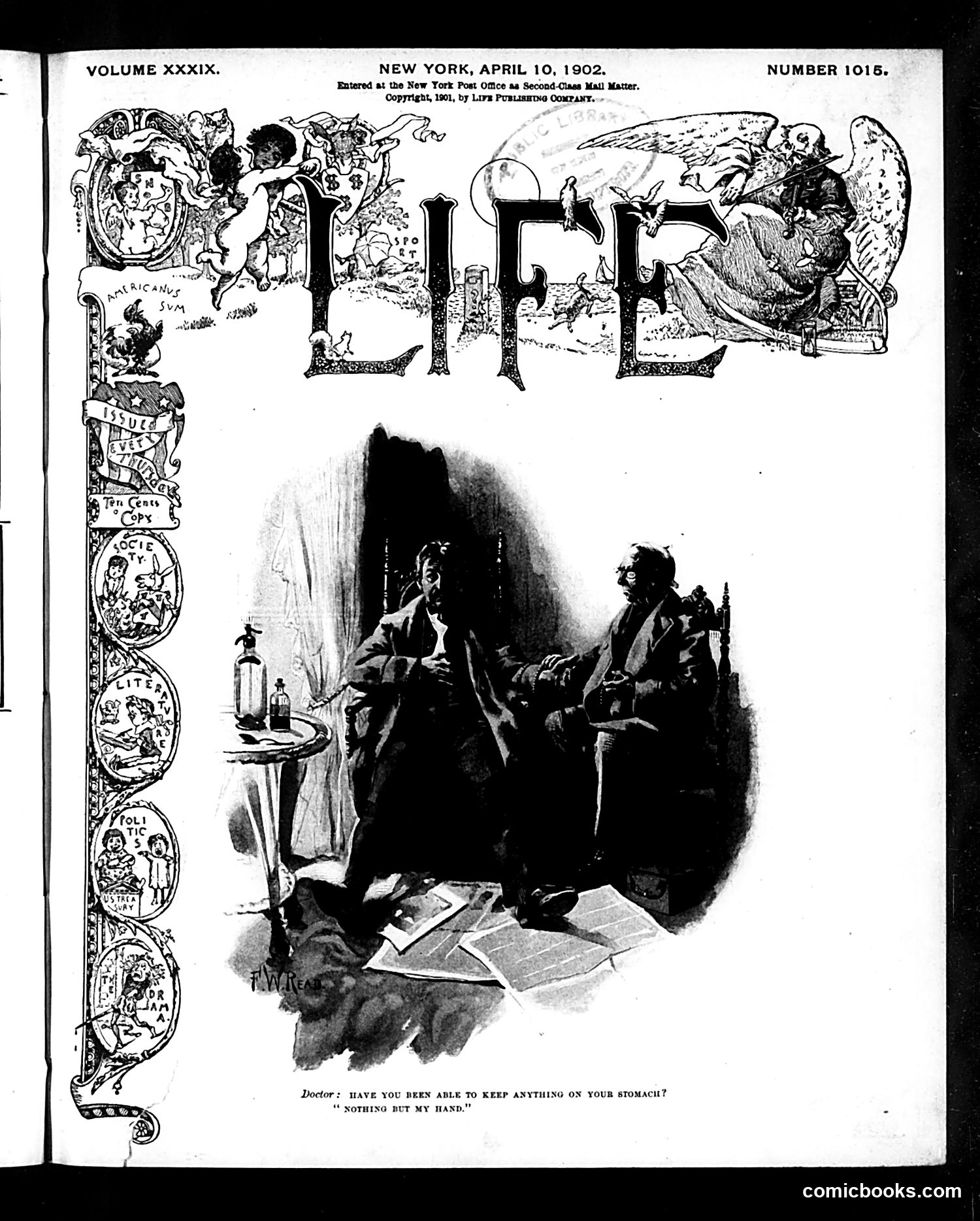
This page features a single cartoon depicting a doctor visiting a patient. The doctor asks: "Have you been able to keep anything on your stomach?" The patient replies: "Nothing but my hand." The joke appears to be about severe stomach illness or digestive distress—likely referencing a common ailment of the era. The patient's answer suggests nausea so severe that nothing stays in the stomach except perhaps their own hand pressing against it for relief. The ornate left border contains classical allegorical designs typical of Life's decorative style. The elaborate title treatment at top suggests this was a featured article or story in Volume XXXIX, Number 1015 of the publication.
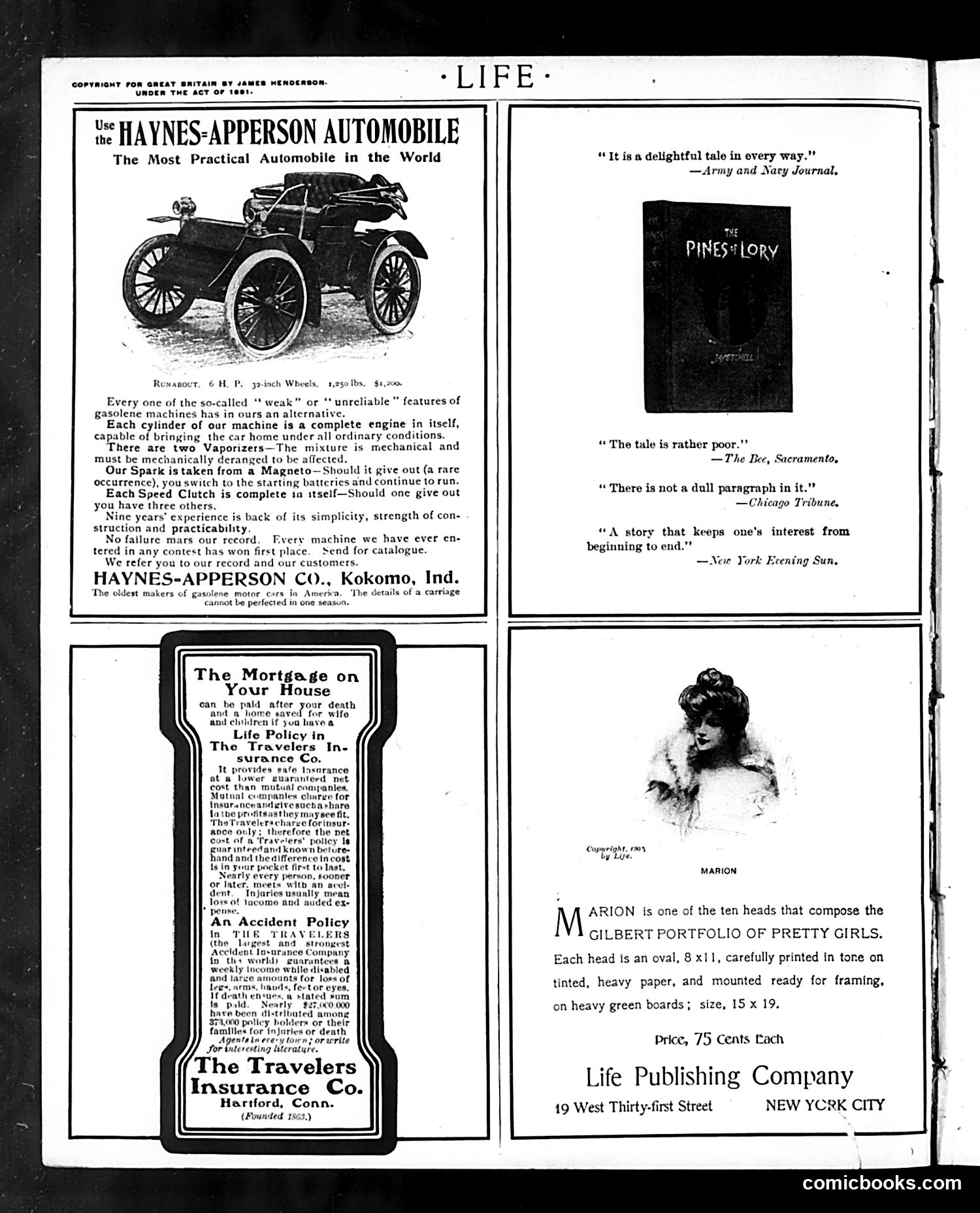
This page is **primarily advertising**, not political satire or editorial content. The left side features ads for the **Haynes-Apperson Automobile** (an early motorcar manufacturer) and **The Travelers Insurance Company** promoting life insurance policies. The right side advertises **"The Pines of Lory,"** a book praised by contemporary publications, and the **"Gilbert Portfolio of Pretty Girls"** — a collection of ten portrait prints of women, each 8x11 inches, priced at 75 cents. The featured portrait is labeled "Marion." There is **no political cartoon or satire** on this page. It represents typical early 20th-century Life magazine content: advertisements mixed with product promotions, reflecting consumer goods and services marketed to middle-class readers of that era.
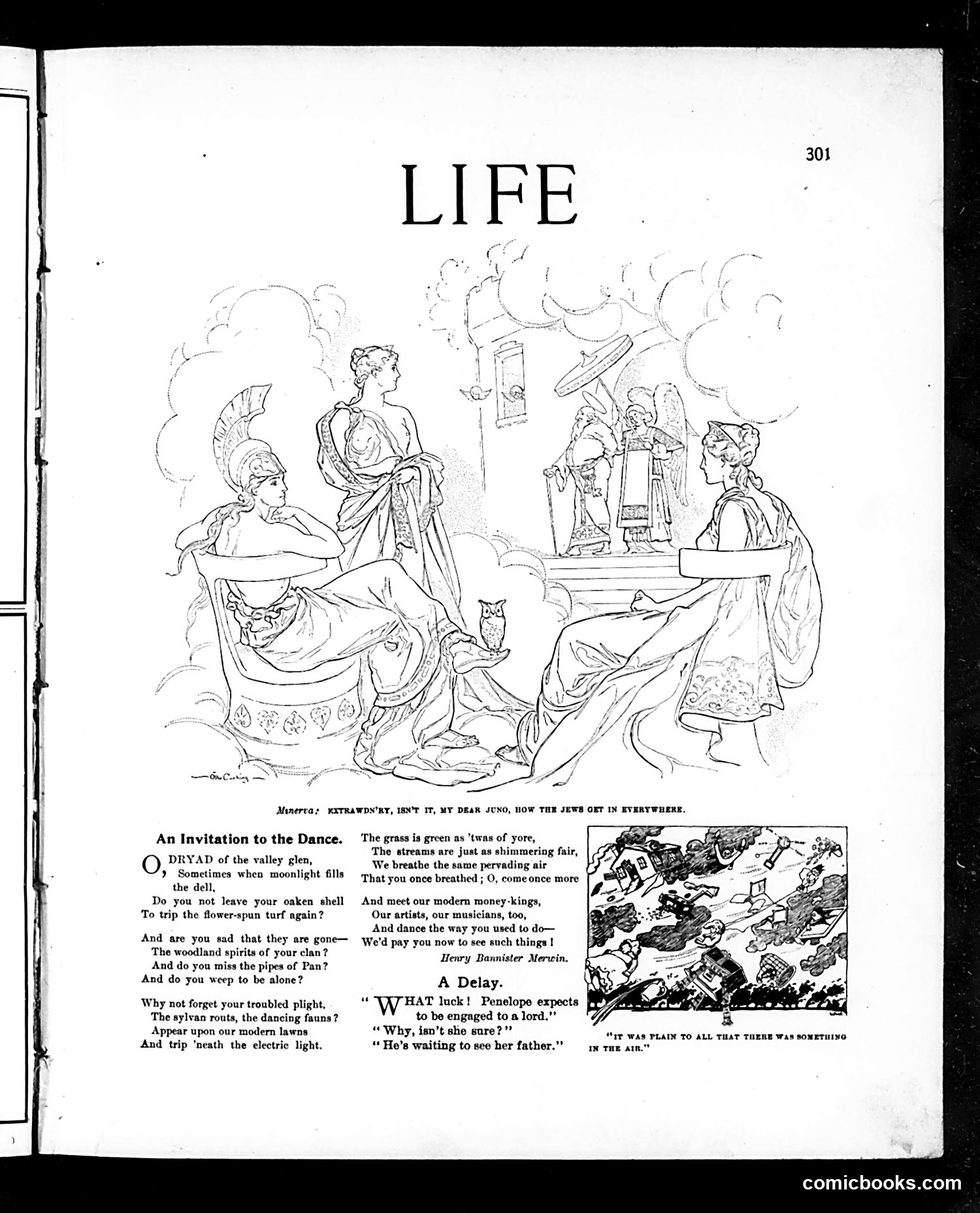
The top illustration depicts classical/mythological figures in clouds, likely representing "heavenly" or idealized realms—a common Life magazine visual metaphor for satirizing contemporary society. Below are three separate pieces: 1. **"An Invitation to the Dance"**: A poem mocking the artificiality of modern social life, contrasting "woodland spirits" and natural beauty with contemporary urban experience and materialism ("our modern money-kings"). 2. **"A Delay"**: A brief comedic exchange about Penelope expecting to marry a lord, but he's delayed meeting her father—apparently satirizing romantic or social pretensions. 3. **Right illustration**: Shows a cluttered domestic scene with caption "IT WAS PLAIN TO ALL THAT THERE WAS SOMETHING IN THE AIR"—likely satirizing household chaos or marital discord through visual exaggeration. The page uses classical allusions to mock modern American manners and materialism.
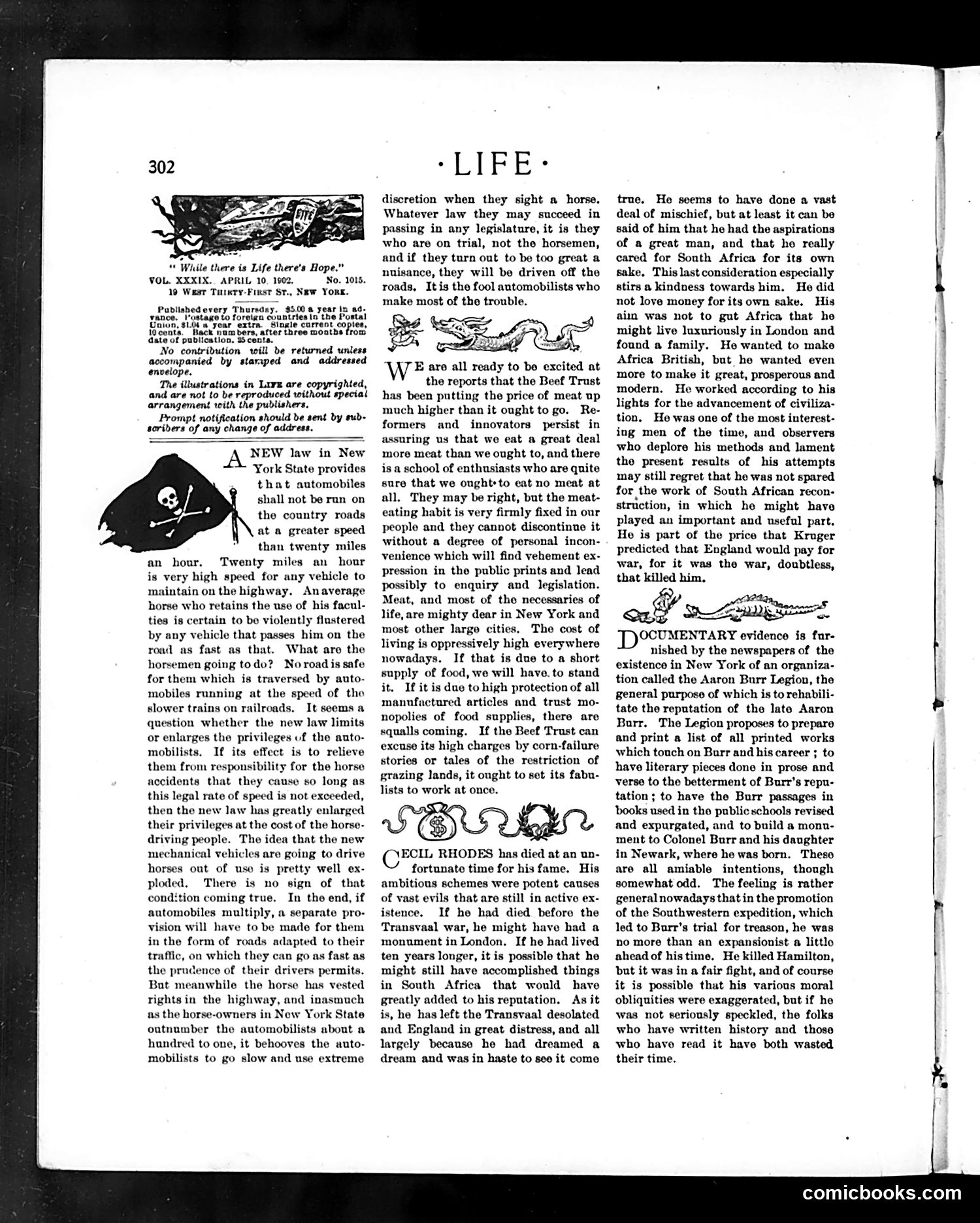
The page contains two distinct cartoons and editorial commentary: 1. **"While there is Life there's Hope"** (top): A skull and crossbones symbol, likely satirizing dangerous automobiles on roads—connecting to the editorial's discussion of speed limits and traffic safety. 2. **"A NEW law in New York State"** (left): Depicts automobiles as a threat to horses and road safety, mocking a proposed speed restriction law (twenty miles per hour). The skull imagery reinforces the danger theme. The accompanying editorials discuss the Beef Trust price-fixing scandal and Cecil Rhodes's death. The satire criticizes both the automobile industry's recklessness and corporate monopolies threatening consumers and public welfare—common Progressive Era concerns. The cartoons use dark humor and skulls to represent modern industrial dangers to traditional society.
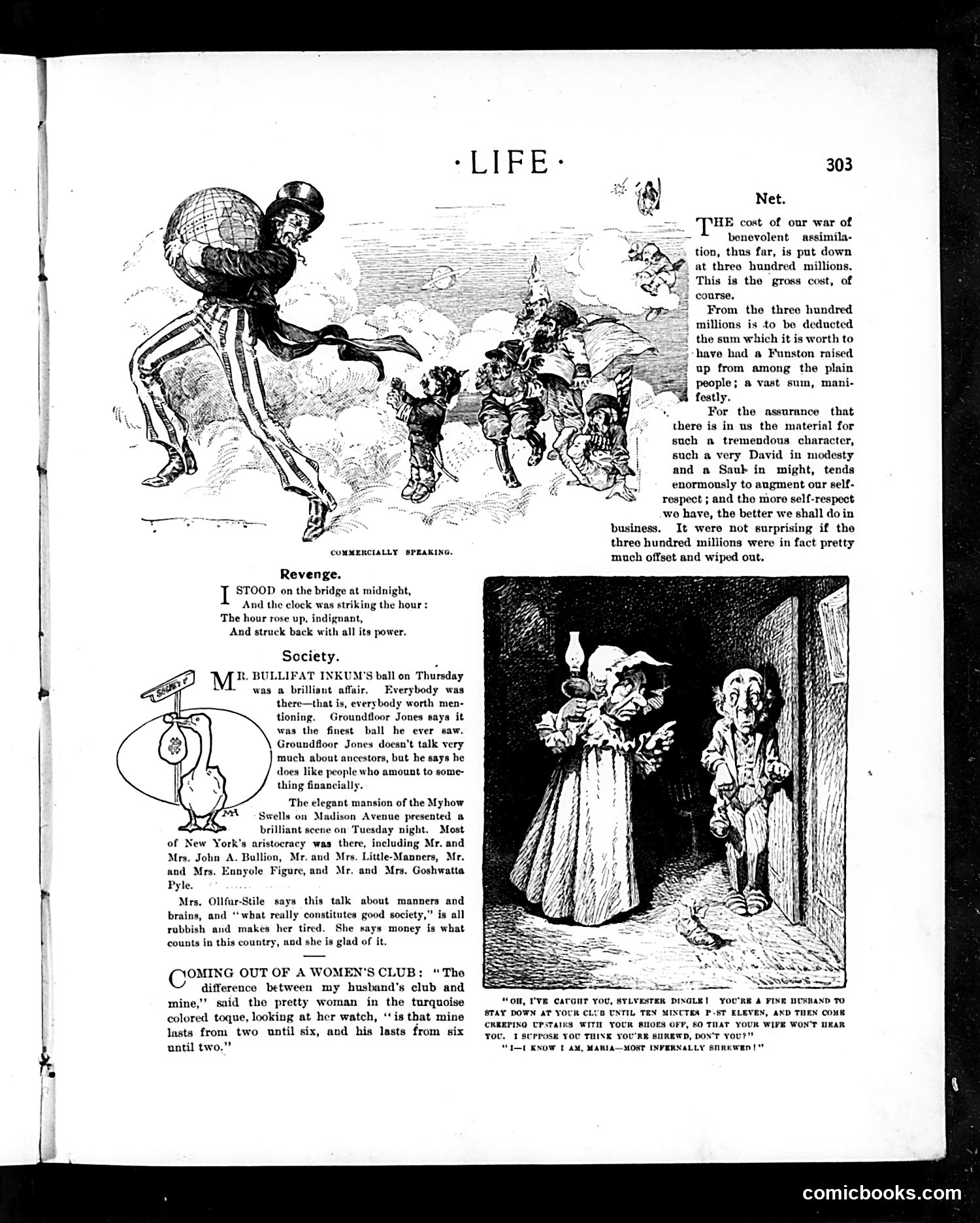
**Top Cartoon ("Commercially Speaking"):** A figure in Uncle Sam attire struggles to balance a globe while smaller figures below appear to be competing for it. This satirizes America's post-war financial burden—the text discusses the "$300 million" cost of "our war of benevolent assimilation," likely referring to the Philippine-American War (1899-1902). The satire questions whether the expense and effort justify the outcome. **"Revenge" Poem:** Brief verse about striking back at midnight, likely political commentary on reciprocal action or retaliation. **Society Section:** Gossip about high-society events, including Mr. Inkum's ball and the Myhow Swells mansion party. Satirizes New York aristocracy's social pretensions and superficiality. **Bottom Illustration:** A humorous domestic scene about club membership differences between husbands and wives—light social satire on marriage dynamics.
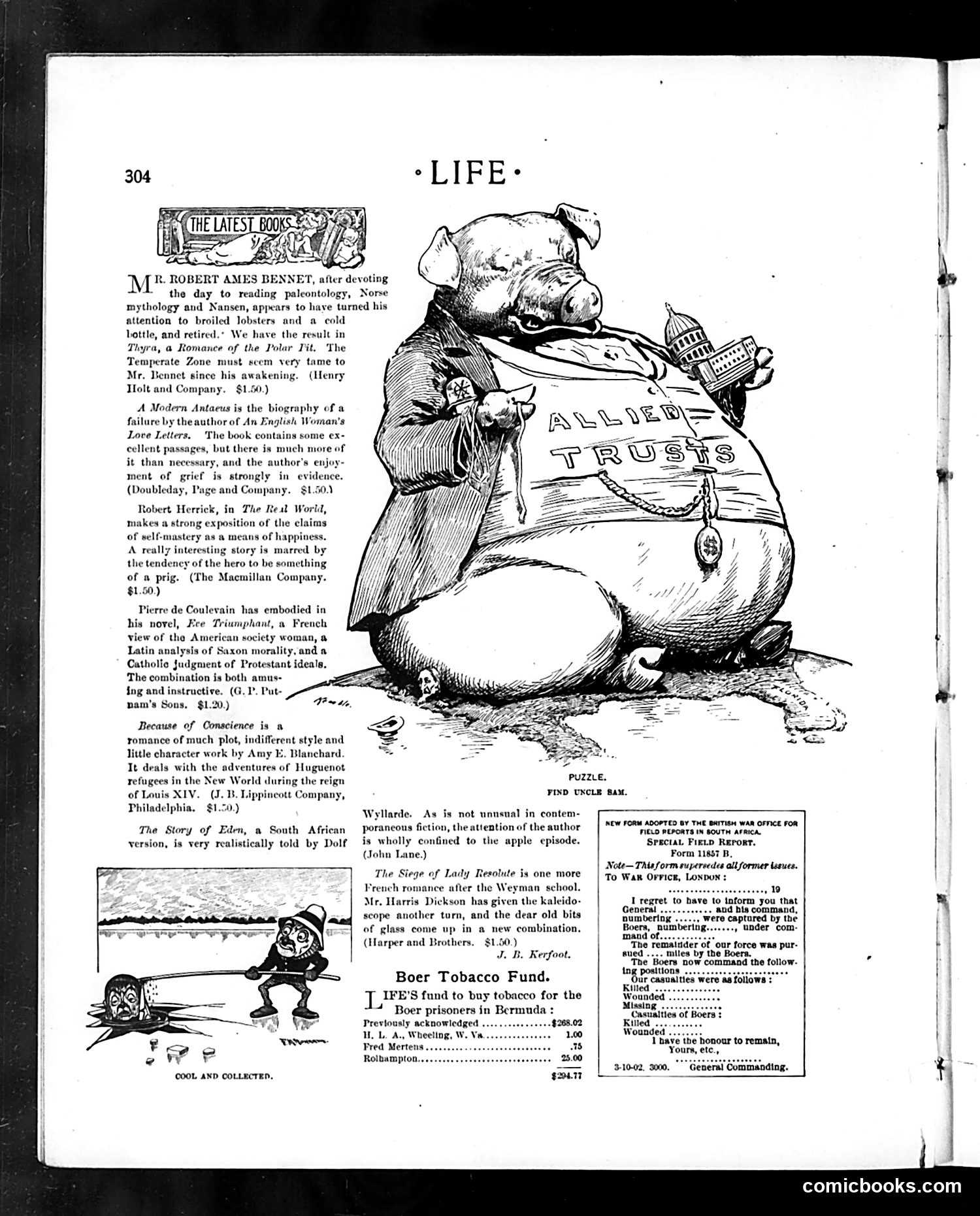
The main cartoon, titled "Puzzle: Find Uncle Sam," depicts Uncle Sam as an enormously fat pig wearing a suit and holding a document labeled "Allied Trusts." The pig is so obese it barely resembles a human figure, with only the characteristic clothing and hat remaining recognizable. The satire criticizes American corporate monopolies and trusts during the Allied period (likely WWI era). By reducing Uncle Sam to a grotesquely bloated pig, the cartoonist suggests that American commercial interests have become so dominant and corrupt that the nation's identity has been consumed by greed and corporate excess. The "puzzle" format invites readers to find the patriotic figure buried beneath capitalist excess—a sharp commentary on priorities.
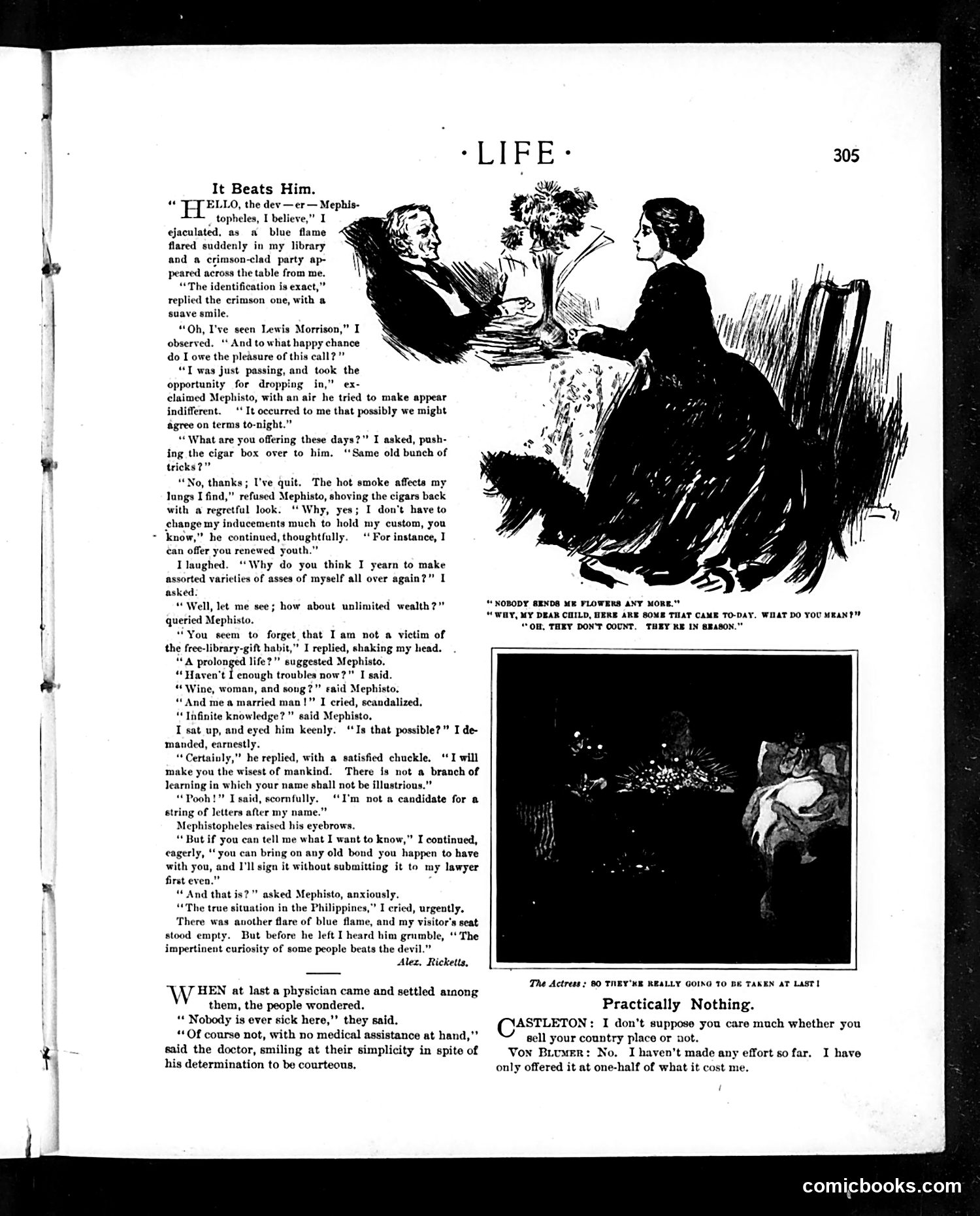
This page contains two satirical pieces. The main story, "It Beats Him," features a conversation between a character named Mephistopheles and the narrator about wealth and life choices. The satirical point mocks someone (likely a wealthy man) who brags about his financial success and worldly knowledge, only to be cut down by the narrator's witty observations about the emptiness of material accumulation. The accompanying illustration shows a well-dressed man and woman in conversation with a dog present, likely depicting the scene being described in the text. Below is a separate piece titled "Practically Nothing" featuring dialogue between characters named Castleton and Vox Blumer about selling a country property, satirizing wealthy landowners' indifference to significant financial losses.
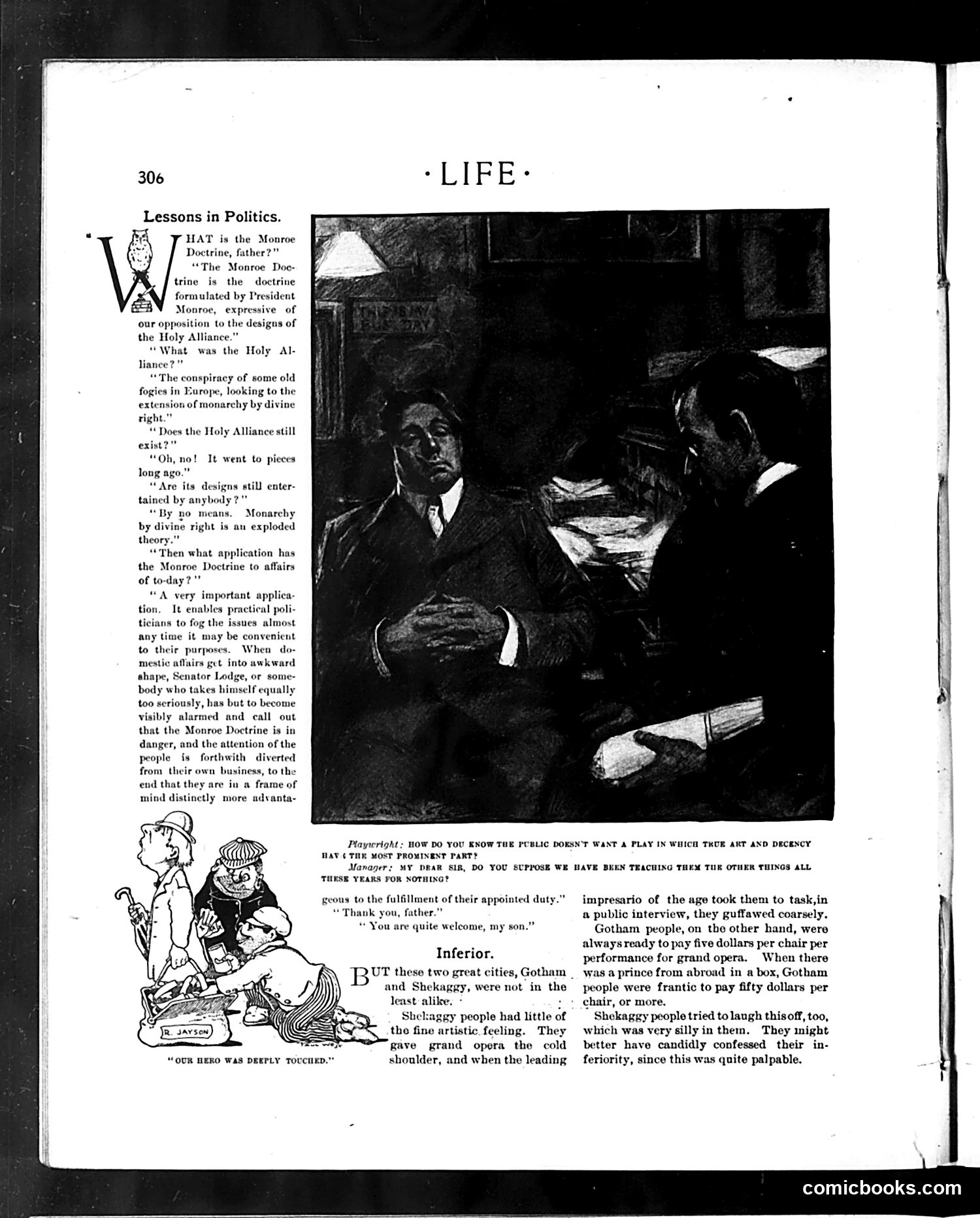
This page satirizes the **Monroe Doctrine** and its modern applications to American politics. The dialogue mocks how politicians invoke this 19th-century foreign policy principle to justify almost any action convenient to their purposes. The text suggests that figures like "Senator Lodge" cynically invoke the Monroe Doctrine to distract the public from domestic issues, keeping citizens focused on foreign affairs rather than their own problems. The lower section contrasts **Gotham** (New York) and **Shekaggy** (Chicago), mocking the latter's supposed cultural inferiority. It jokes that while wealthy New Yorkers paid premium prices for opera, Chicagoans were "silly" enough to laugh at such pretensions, confessing their actual lack of refined taste. The satire targets both elite cultural snobbery and working-class attitudes toward high art.
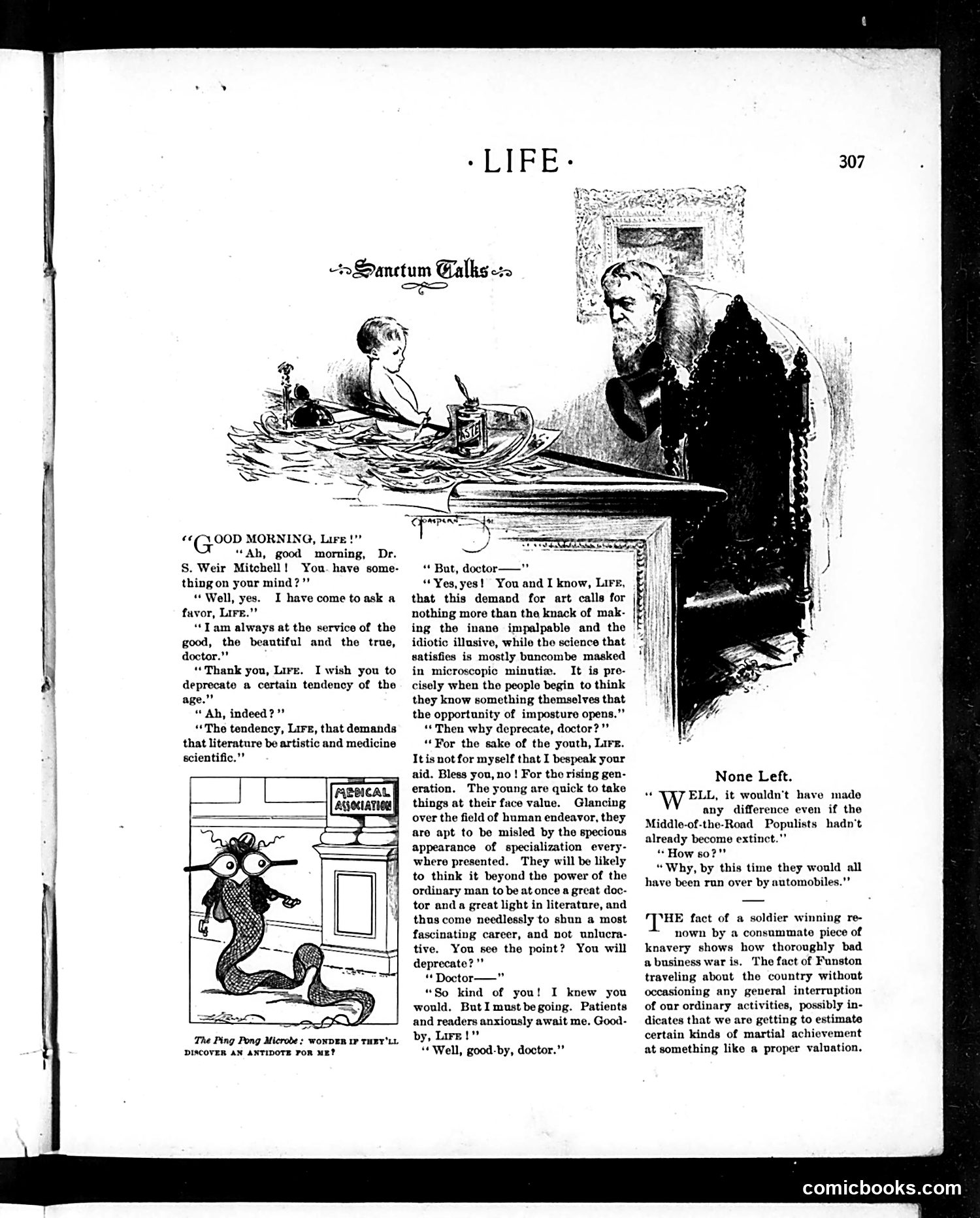
This satirical dialogue features **Dr. S. Weir Mitchell** (a prominent late-19th-century physician) meeting with "Life" personified. The doctor complains about modern medicine's tendency toward excessive specialization—particularly the "knack of making the insane imaginable and the idiotic illustrative." Mitchell argues that specialization misleads young doctors into thinking narrow expertise is more valuable than broad knowledge. He warns that practitioners will abandon medicine for supposedly more prestigious careers in art and literature. The cartoon below (the "Pong Pong Mermaid") appears to be a visual pun related to this critique—possibly mocking the bizarre or absurd directions specialized study can take. The satire targets the professionalization trend fragmenting medicine into disconnected subspecialties.
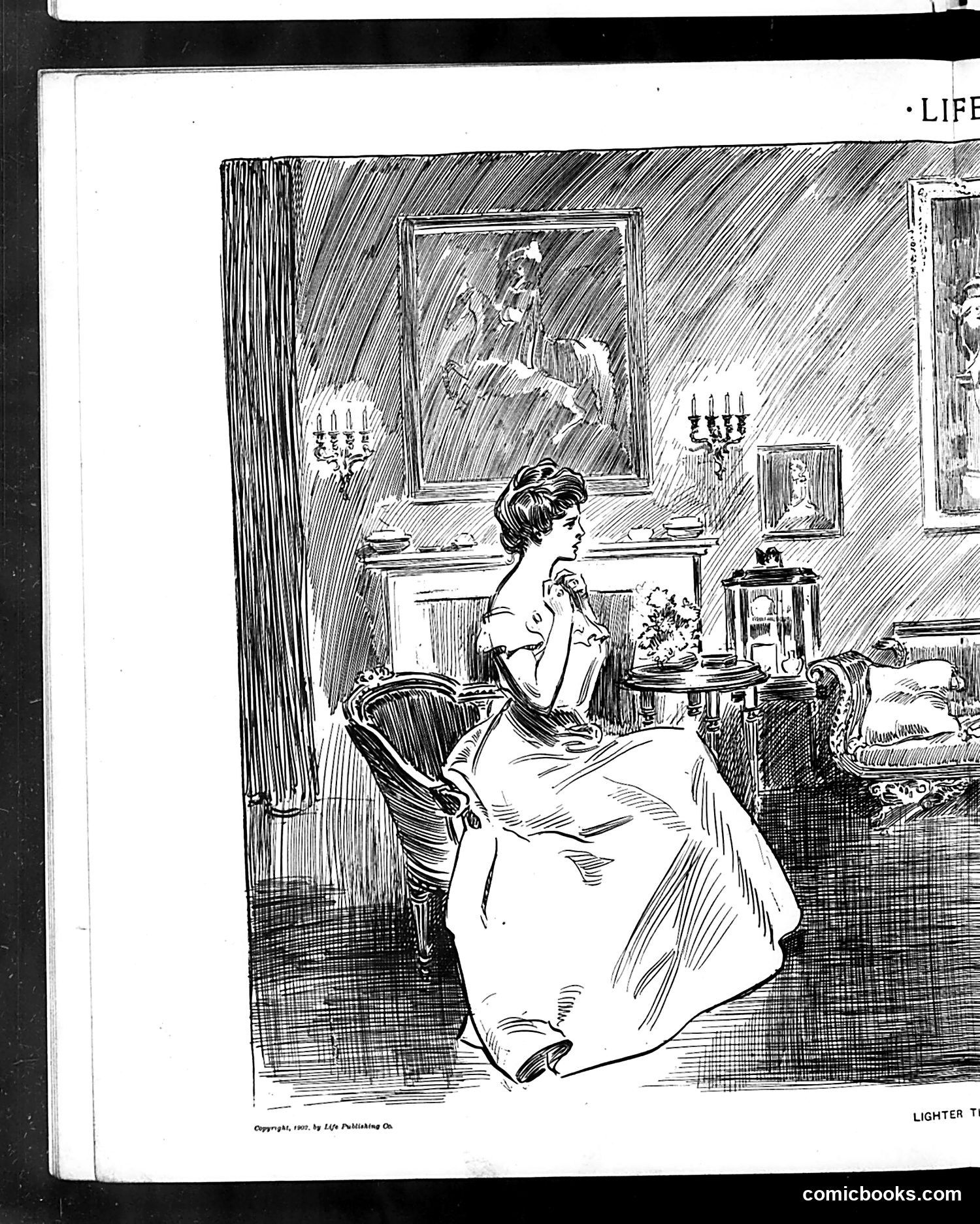
This is a pen-and-ink illustration from *Life* magazine (copyright 1907) depicting an elegant woman seated at her vanity in a luxurious bedroom. She's adjusting her appearance while gazing at a portrait above her mirror—likely of herself or an idealized version. The satire appears to target **female vanity and self-absorption** among the wealthy class. The ornate furnishings, candelabras, and decorative details emphasize her privileged status, while her focused attention on her reflection suggests preoccupation with appearance over substance. This reflects early 20th-century social commentary mocking the leisure-class woman's supposedly superficial concerns. The work exemplifies *Life* magazine's sophisticated humor critiquing American high society during the Edwardian era.
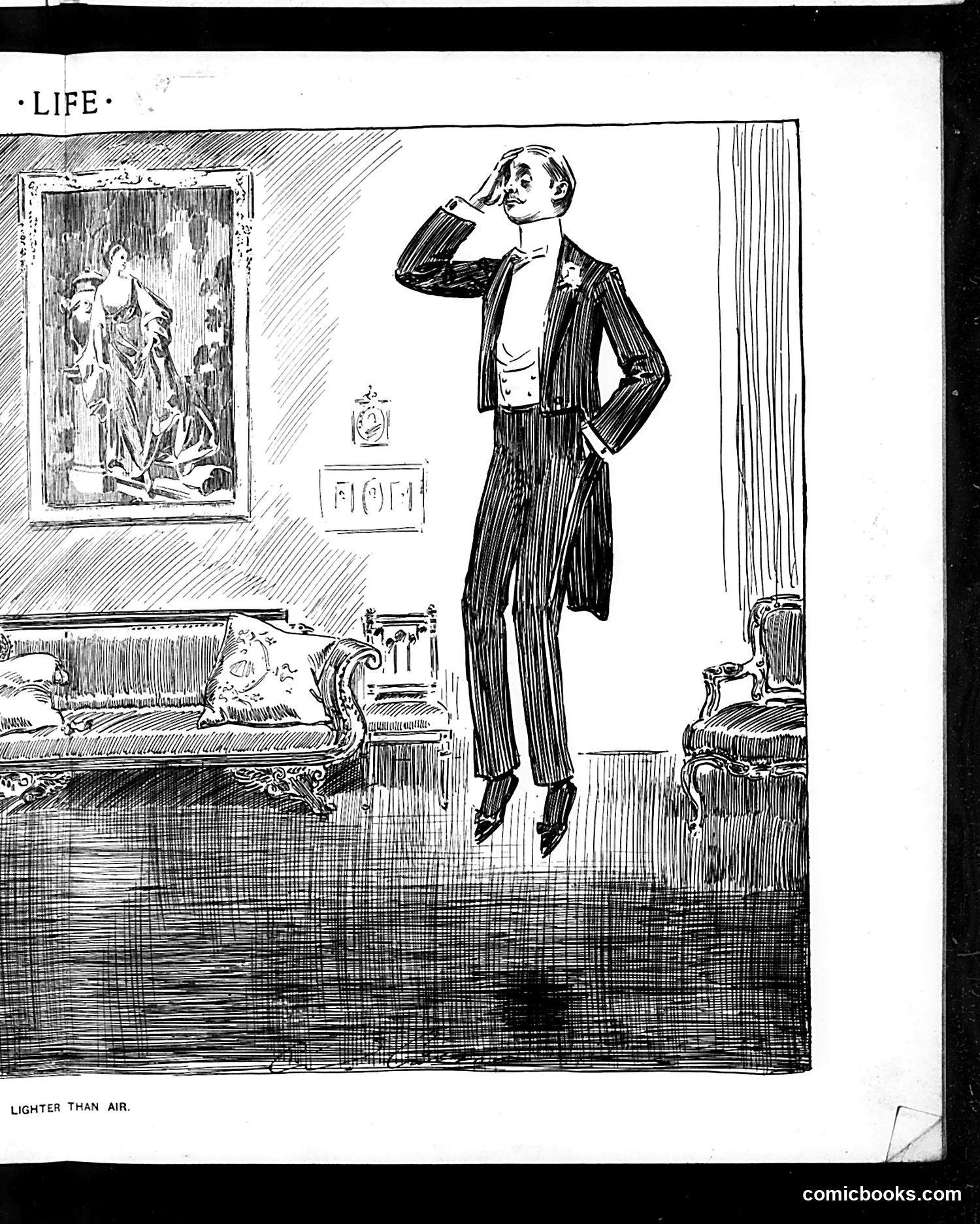
This cartoon satirizes a man who appears to be levitating or floating in his drawing room, defying gravity. The caption "Lighter Than Air" suggests the joke concerns his weightlessness—likely a pun on his character or social status. The setting shows fashionable furniture and a painting on the wall, indicating an upper-class interior. The man's pose—hand to his head in a thoughtful or bewildered gesture—suggests either vanity or confusion about his predicament. Without additional context or publication date, the specific target of satire remains unclear. This could mock fashionable pretension, vacuousness, or possibly a contemporary public figure whose reputation was considered insubstantial. The humor relies on the visual impossibility combined with the wordplay of the title.
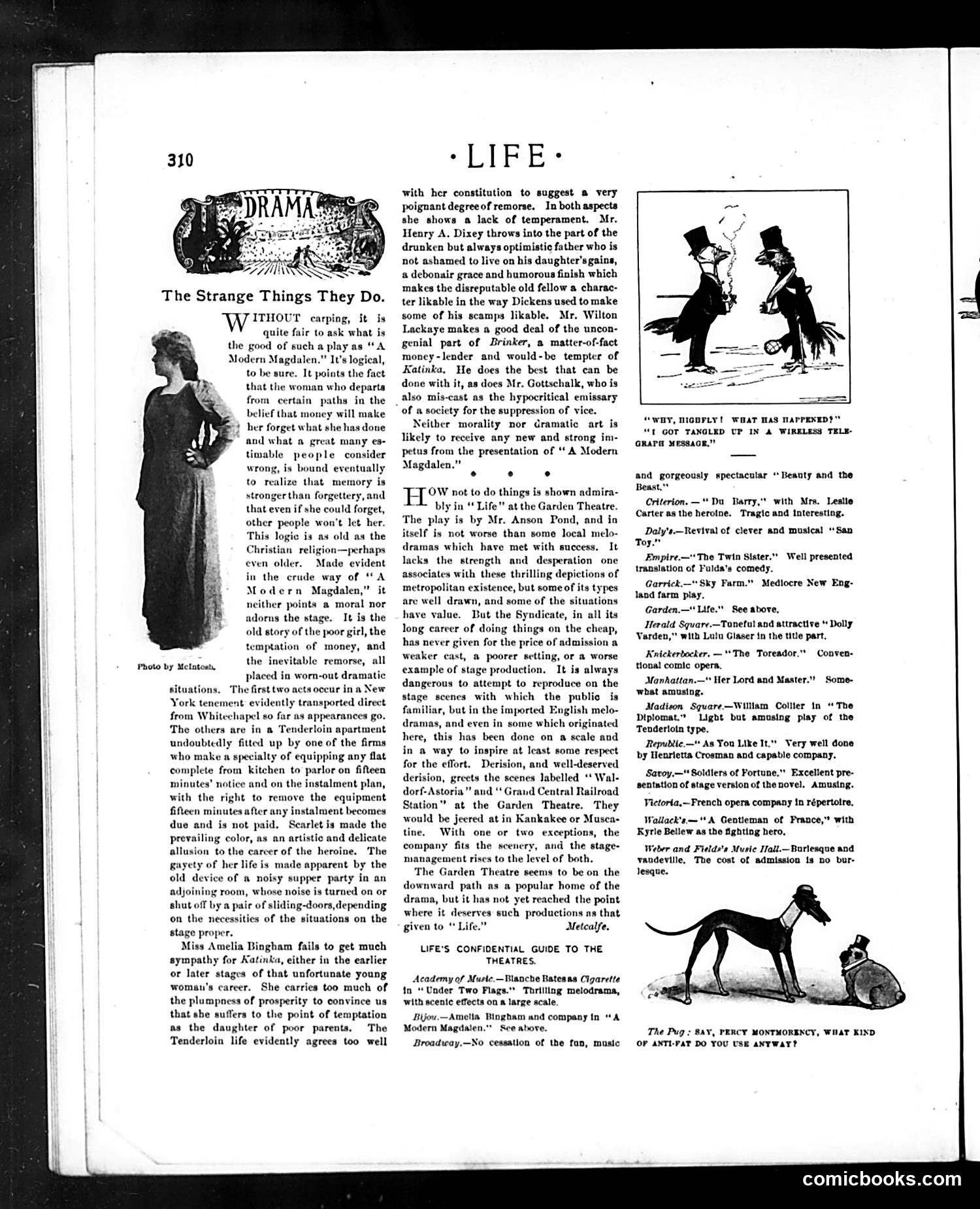
This page reviews theatrical productions, with the main cartoon depicting **two well-dressed gentlemen in top hats appearing to argue or quarrel over a small object** (possibly money or a contract). The caption reads: "I GOT TANGLED UP IN A WIRELESS TELEGRAM." The joke satirizes the emerging technology of wireless telegraphy—early radio communication—suggesting that miscommunication via this new technology caused a misunderstanding between the two men. The page's text discusses various theater productions including "A Modern Magdalen" and "Life," critiquing their dramatic merit and performances. The reviews suggest skepticism about whether these plays offer genuine theatrical value or merely exploit sensationalism. The cartoon's humor relies on blaming newfangled wireless technology for social confusion, a common satirical trope of the early 20th century.
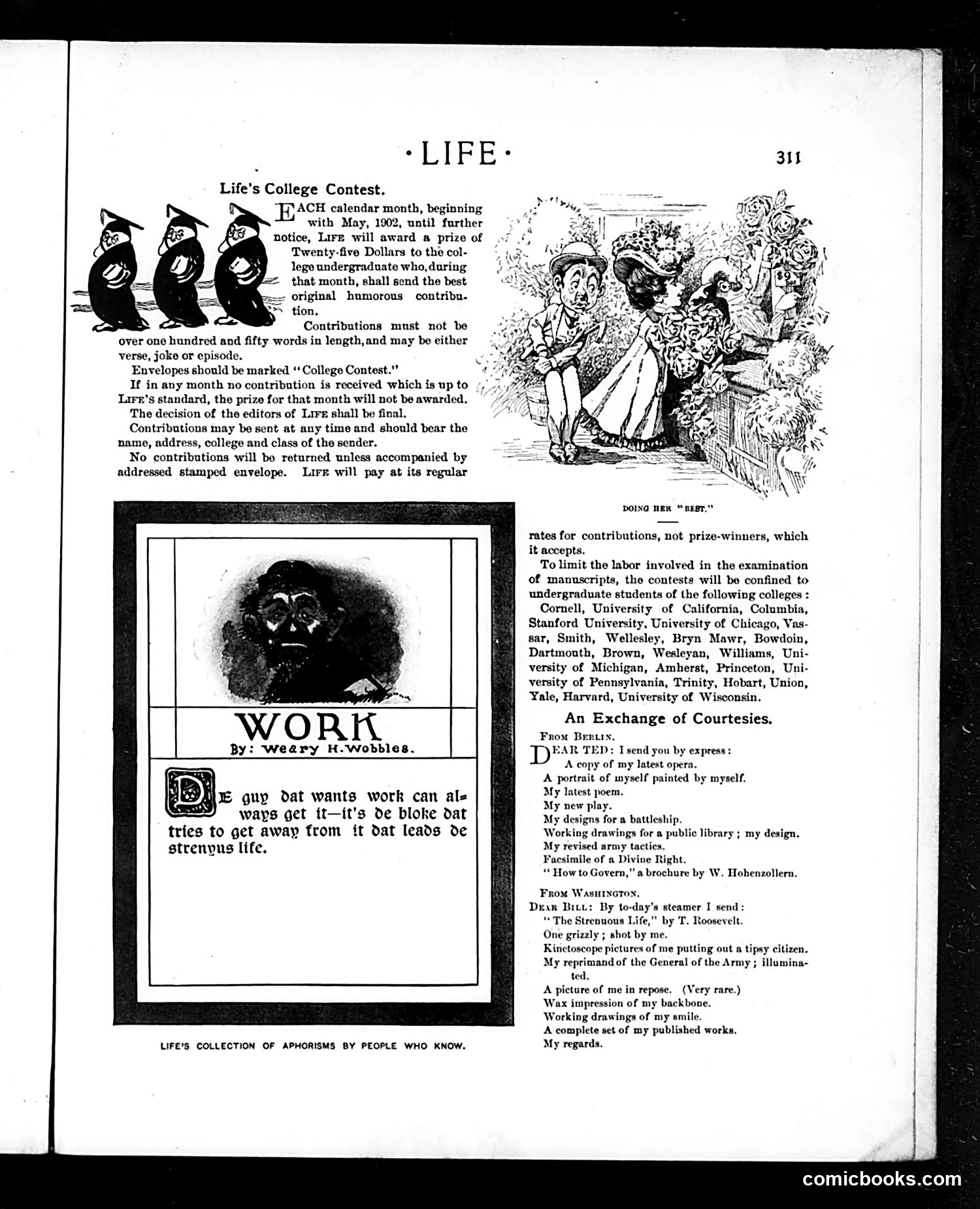
This page features Life's monthly college humor contest (offering $25 prizes) and satirical content mocking political figures. **"Work" by Weary H. Wobbles** presents a cynical aphorism: those who seek work find it easy, but those trying to *escape* work face life's hardships—a jab at the era's "strenuous life" ideology (likely referencing Theodore Roosevelt's popular philosophy). **"An Exchange of Courtesies"** is a satirical exchange between Berlin (the Kaiser) and Washington (Roosevelt). Each boasts absurdly about sending the other their latest accomplishments: the Kaiser sends operas, portraits, and treatises on divine right; Roosevelt sends his book *The Strenuous Life*, a dead grizzly bear he shot, and "kinectoscope pictures" of himself subduing a drunk citizen. The satire mocks both leaders' vanity and self-aggrandizement, suggesting they're equally ridiculous in their self-promotion and posturing. The "wax impression of my backbone" and "working drawings of my smile" particularly emphasize the absurd narcissism being lampooned.
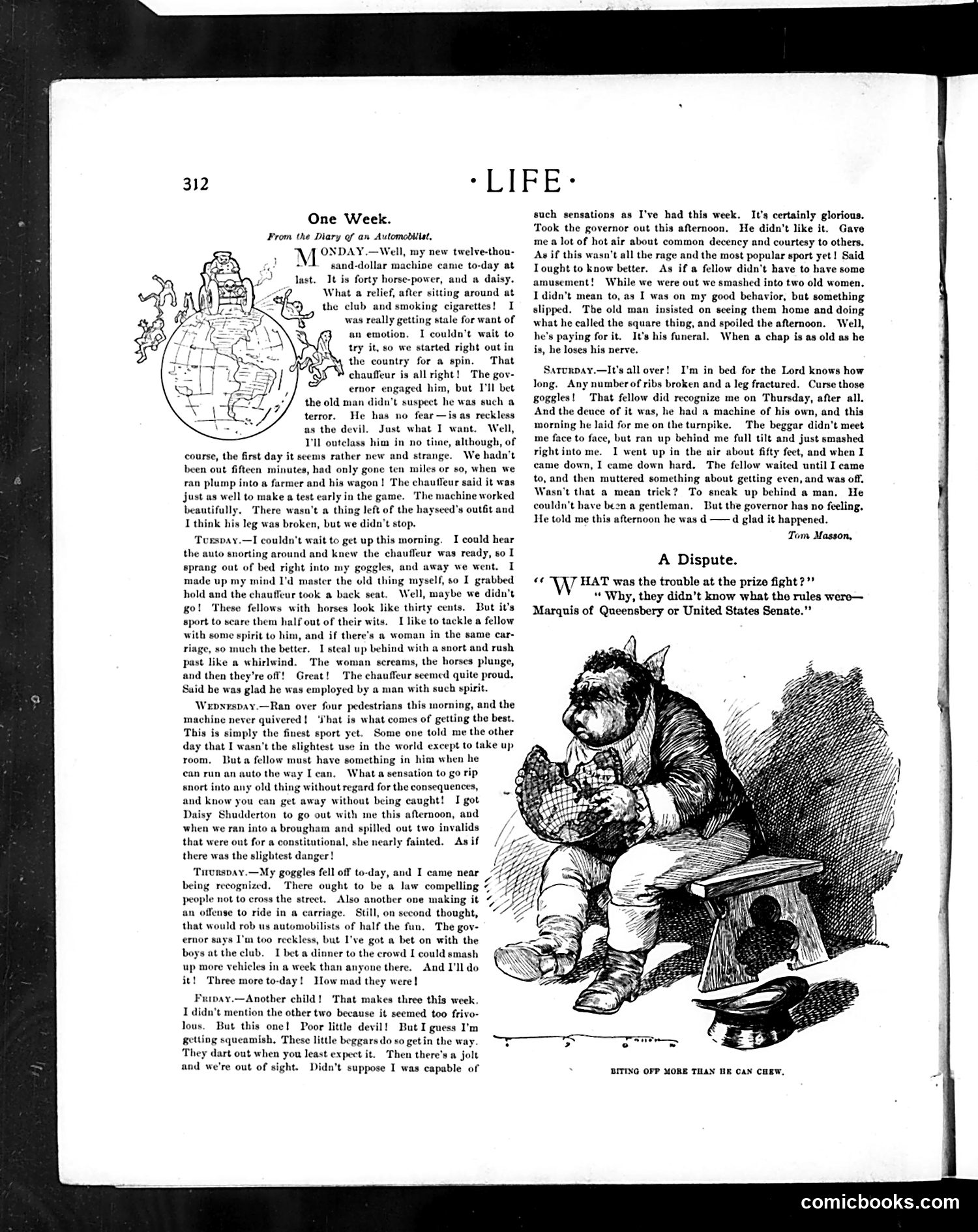
This page satirizes wealthy early automobile owners who recklessly endanger public safety. The diary format presents an unnamed rich motorist's smug account of a week terrorizing pedestrians, horses, and other vehicles with his expensive "twelve-thousand-dollar machine." The satire targets: **The figure**: A wealthy, arrogant automobilist who views driving as thrilling sport rather than a social responsibility. He's indifferent to casualties—a farmer's leg broken, four pedestrians hit, invalids injured, and a child killed. **The joke**: His casual cruelty and the complete absence of consequences or guilt. He bets colleagues on body counts and dismisses his father's moral objections as old-fashioned prudishness. The accompanying cartoon illustration (captioned "BITING OFF MORE THAN HE CAN CHEW") depicts an aggressive, overconfident driver, reinforcing the editorial message: early automobiles in hands of irresponsible wealthy owners posed genuine public danger, yet society's elite escaped accountability. This reflects genuine early-1900s anxieties about automobile safety and class privilege.
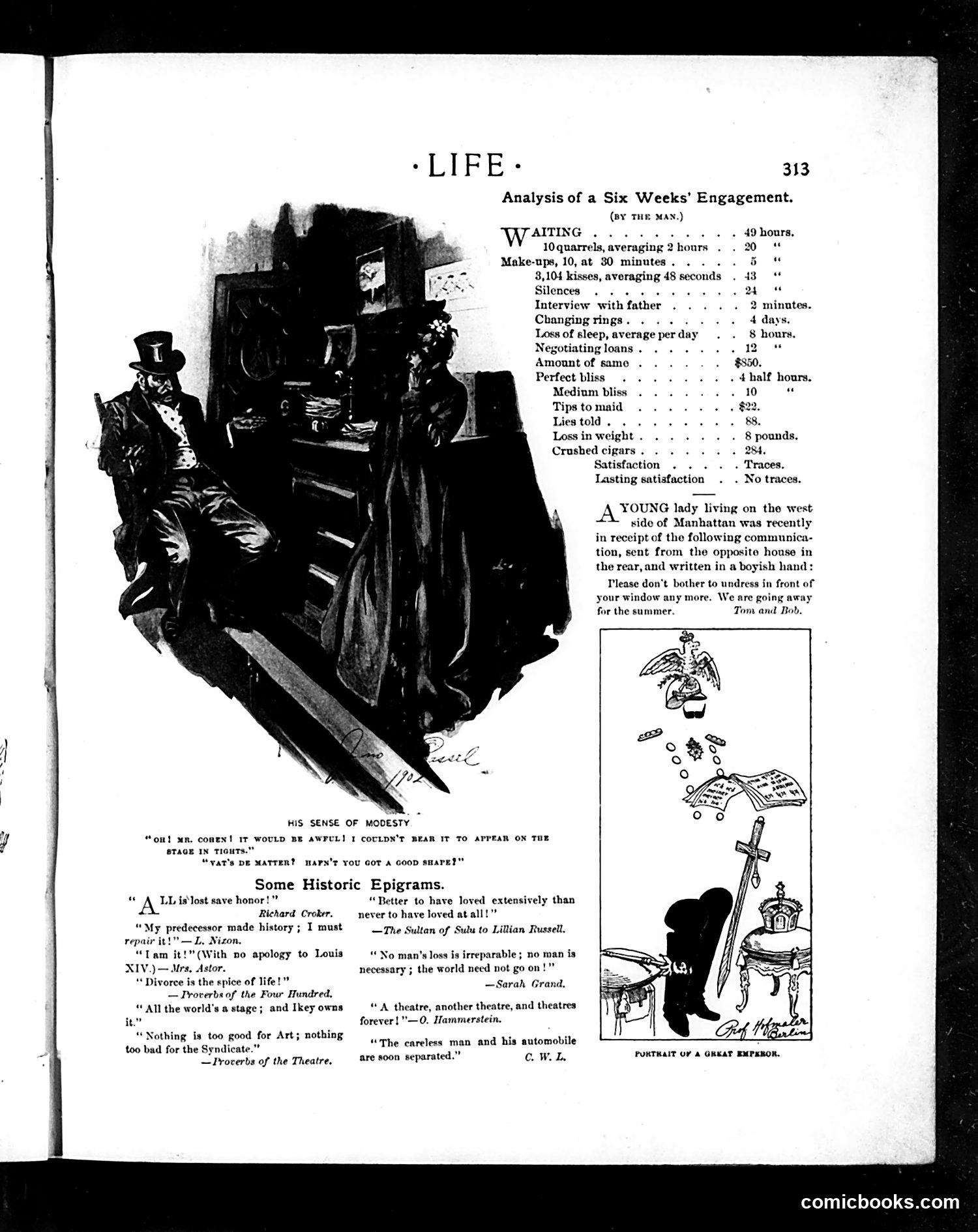
This page contains satirical humor typical of early 20th-century Life magazine: **Top Section**: "Analysis of a Six Weeks' Engagement (By the Man)" humorously quantifies a romantic engagement, listing waiting time, quarrels, kisses, and losses (sleep, weight, cigars). The joke is treating romance as a statistical/business problem, with the punchline being "Perfect bliss" lasts only half an hour while "Lasting satisfaction" leaves "No traces"—mocking male disillusionment with marriage. **Middle Cartoon**: A humorous neighbor note sent between Manhattan townhouses where a young woman is requested to stop undressing at her window during summer. The accompanying dialogue shows theatrical modesty concerns. **Bottom Section**: "Some Historic Epigrams" collects satirical quotes attributed to public figures (Richard Croker, Mrs. Astor, Sarah Grand, O. Hammerstein). These mock contemporary society figures and theatrical pretensions—particularly targeting wealthy New York society and the theater world's pomposity. The right illustration shows a "Great Emperor"—likely a caricature of a theatrical or political figure, though identity is unclear from the image alone.
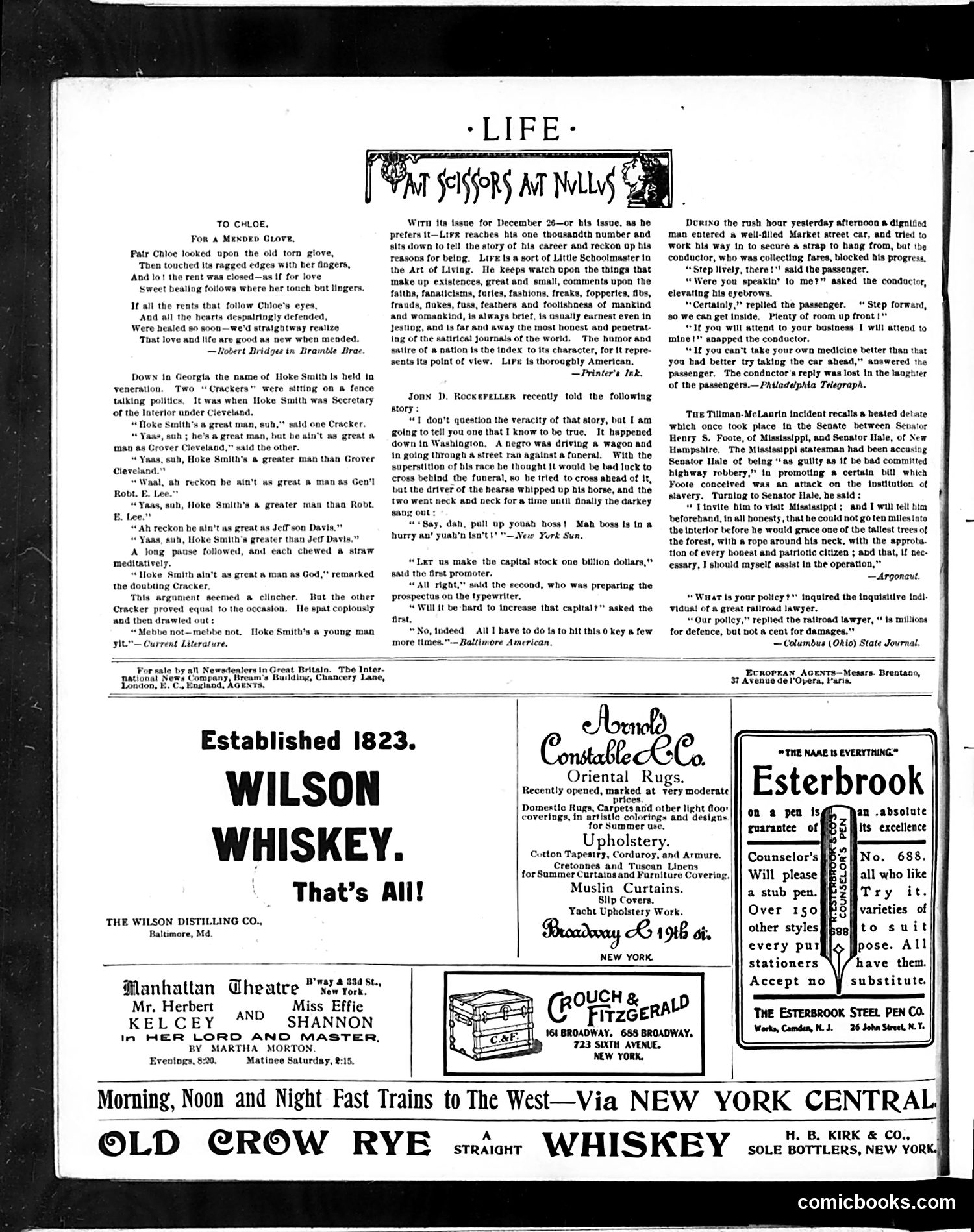
This page is primarily **advertising and miscellaneous content** rather than focused political cartoons. However, it contains several humor pieces: **"To Chloe"** is a sentimental poem about a woman's healing touch—not satirical. **The Hoke Smith anecdote** satirizes Southern reverence for politicians. Two Georgia "Crackers" (rural whites) engage in escalating hyperbole, comparing politician Hoke Smith favorably to Grover Cleveland, Robert E. Lee, and Jefferson Davis, before one admits "Hoke Smith ain't as great a man as God"—mocking excessive hero-worship and provincial thinking. **The Rockefeller story** about a Black wagon driver trying to cross a funeral procession plays on racial stereotypes about superstition, presented as humor. **Other brief jokes** include commentary on Life magazine's 1,000th issue and anecdotes about market-car conductors and stock promoters. The page is dominated by period **advertisements** for whiskey, theater, trains, and office supplies. The satirical content reflects turn-of-century attitudes toward race, region, and commerce that modern readers would find offensive.
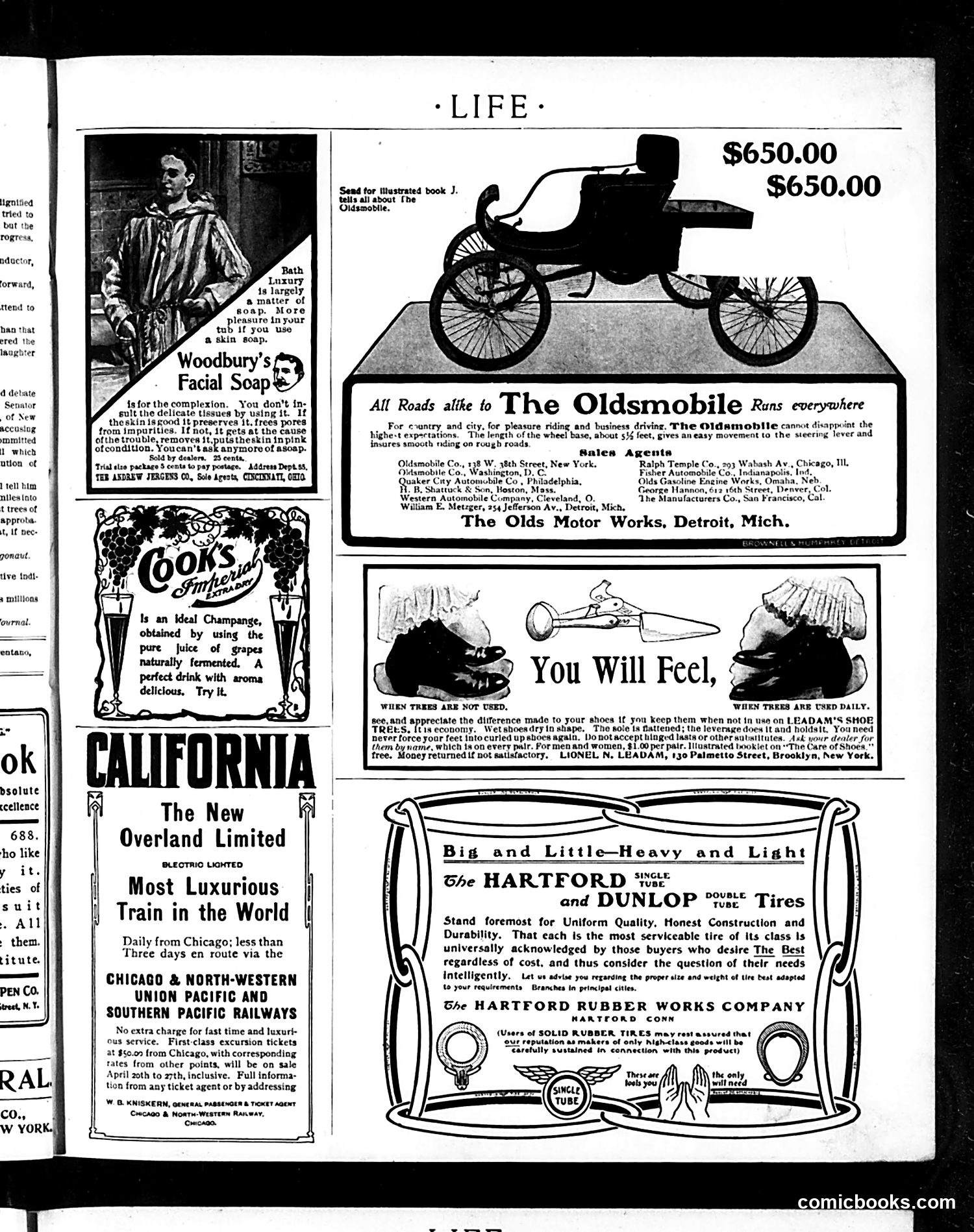
This page is primarily **advertising**, not satire or political commentary. It features early 1900s product advertisements including: - **Woodbury's Facial Soap** and **Cook's Imperial Champagne** (left column) - **The Oldsmobile** automobile ($650.00) - emphasizing its reliability "everywhere" with a silhouette image of an early motorcar - **California Overland Limited** train service - **Leadam's Shoe Trees** - a practical device to maintain shoe shape when not worn - **Hartford and Dunlop tire advertisements** The page reflects the commercial interests of Life magazine's affluent readership around the early 1900s: automobiles, luxury train travel, grooming products, and consumer goods. There is no apparent political cartoon or satirical content. The "Life" masthead indicates this is from the satirical magazine, but this particular page serves as a revenue-generating advertising section rather than editorial content.
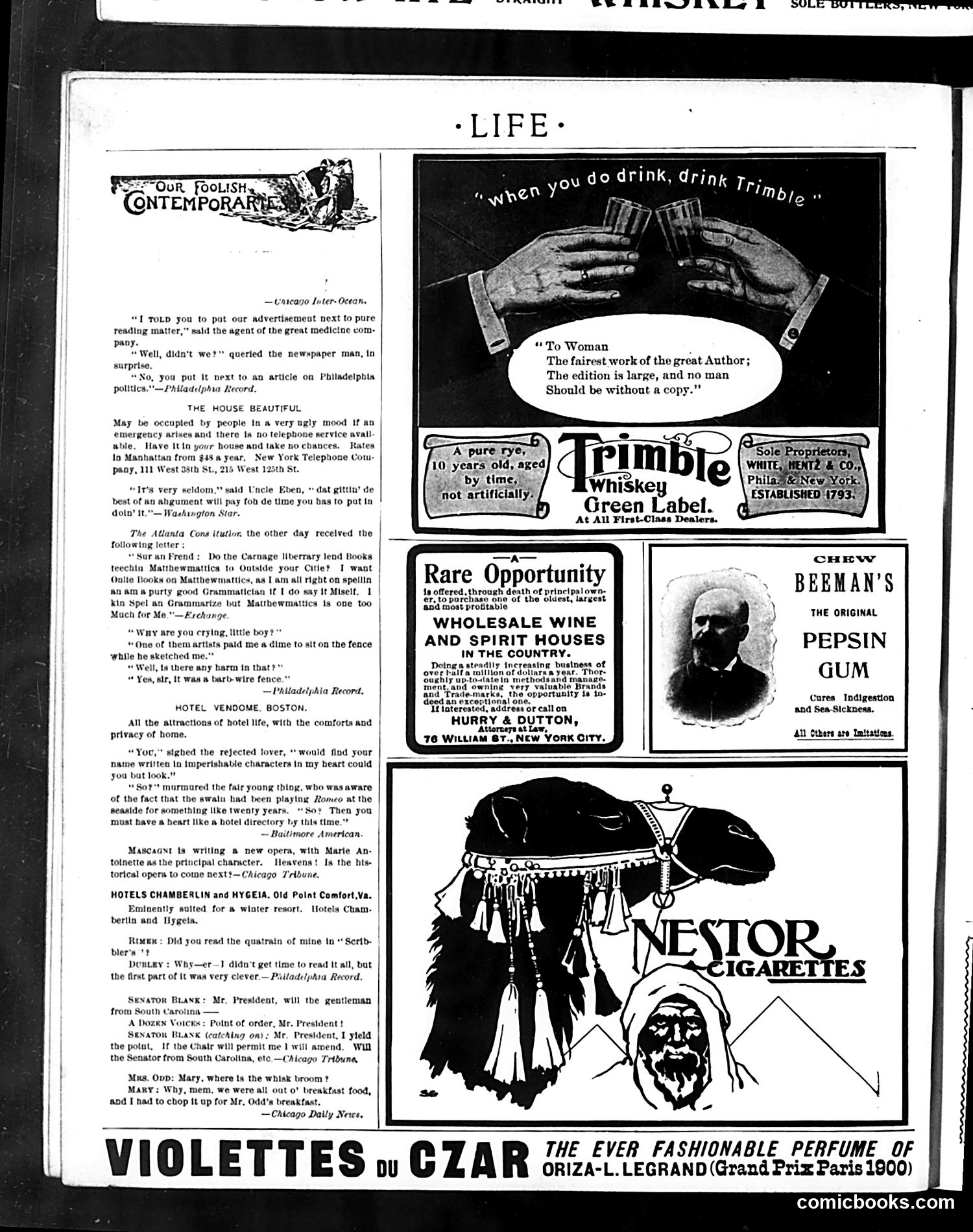
This page from *Life* magazine is primarily **advertisements and humor columns**, not political cartoons. The content reflects early 1900s American society: **Main Satire**: The opening "Our Foolish Contemporaries" section mocks newspapers for poor editorial placement—a medicine company complains their ad was placed next to an article on "Philadelphia politics," implying politics is as distasteful as advertising. **Humor pieces** include jokes about: rejected suitors, spelling-challenged letter-writers, and Congressional procedural absurdity (a senator yielding the floor repeatedly). **Advertisements** dominate: Trimble Whiskey, Beeman's Pepsin Gum, Nestor Cigarettes, and Violettes du Czar perfume. These ads target middle/upper-class consumers with claims of health benefits (gum for indigestion) and sophistication. **Context for modern readers**: The page reflects an era when alcohol and tobacco advertising was unregulated and often claimed medicinal properties. The humor is gentle, focused on linguistic mishaps and social awkwardness rather than sharp political critique.
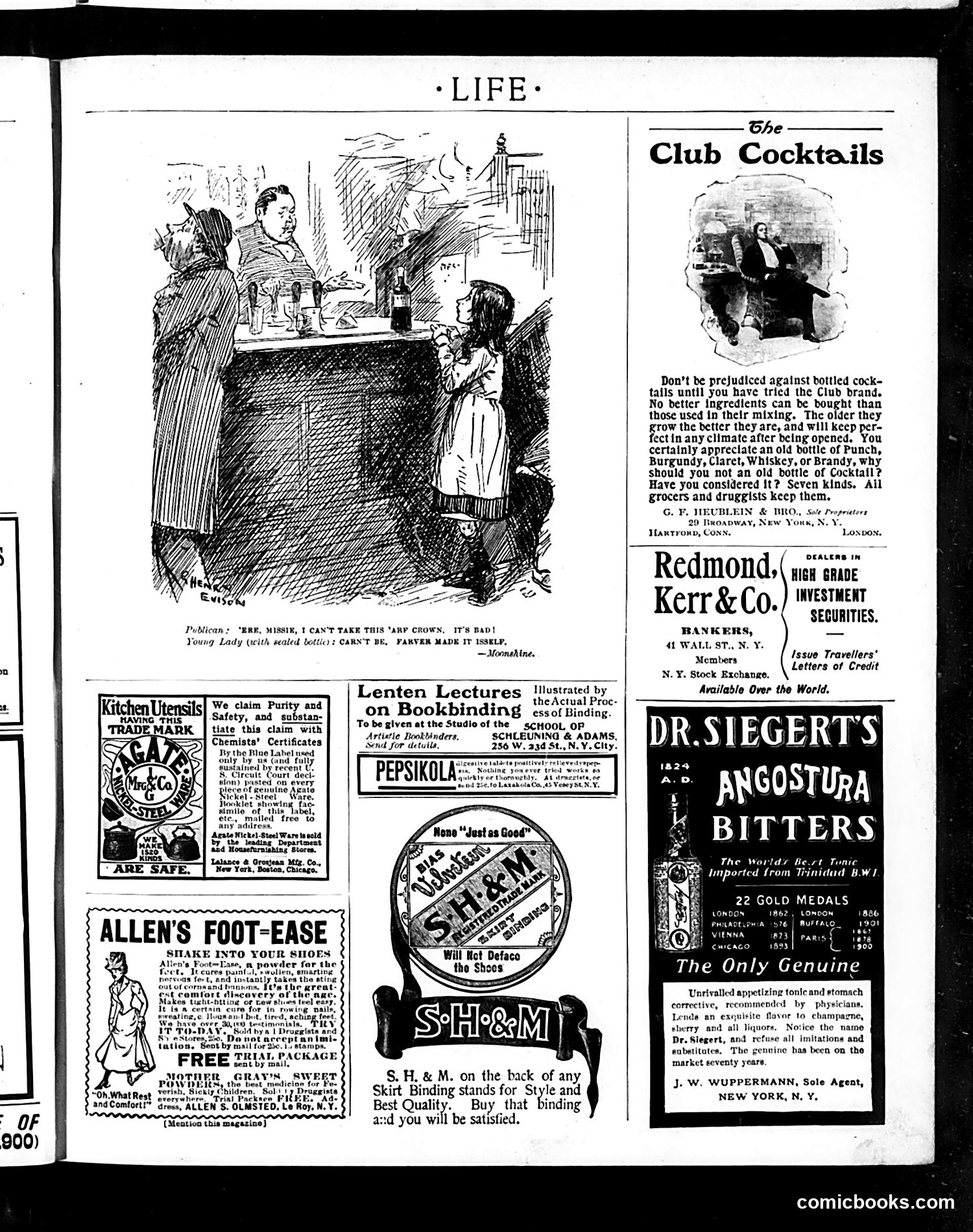
This page is primarily **advertisements** with one small cartoon at the top. The cartoon depicts a publican (bartender) refusing a customer's payment—an "arp crown" (a harp-marked coin). He claims it's "bad," but the young lady insists her father made it in 1835, so it must be genuine. The joke plays on the double meaning of "bad": the coin appears counterfeit or defaced, yet she defends it based on its age and origin. The satire mocks either **blind faith in old authority** or the **tendency to accept worn-out, damaged things simply because they're old**—a commentary on blind tradition versus practical reality. The rest of the page consists entirely of product advertisements (kitchen utensils, shoe powder, cocktails, bitters, banking services), typical of Life magazine's revenue model.
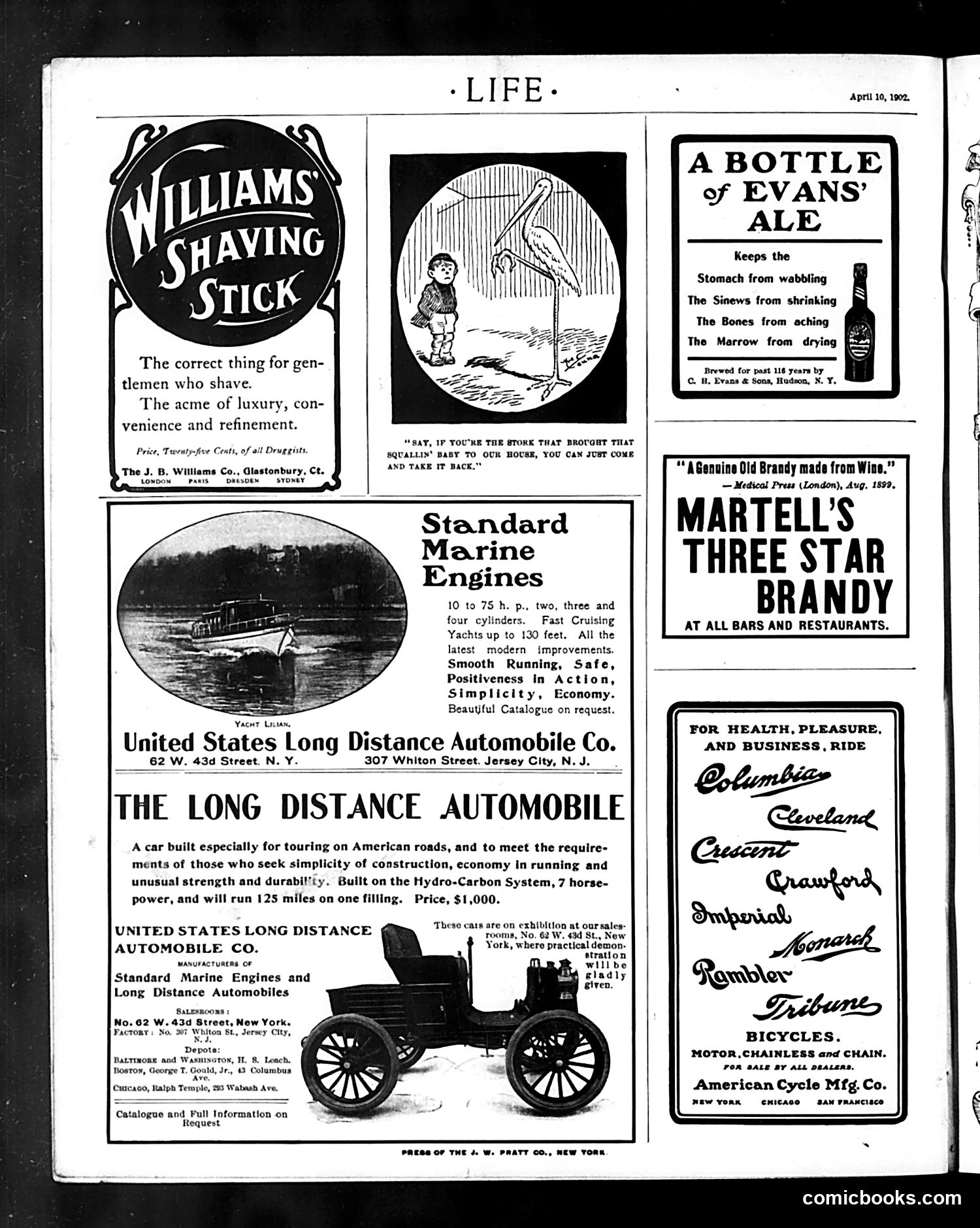
This page is primarily **advertising**, typical of Life magazine's revenue model. The one cartoon present depicts a frustrated father confronting a stork at his doorstep, saying if the stork brought the crying baby, it can take it back. This is a **humorous domestic complaint** about an unwanted newborn—a common joke format of the era playing on the stork myth of childbirth. The advertisements reflect early 1900s consumer goods: Williams Shaving Stick (grooming luxury), Standard Marine Engines (yachts), the Long Distance Automobile ($1,000—a luxury vehicle), Evans' Ale and Martell's Brandy (patent medicines marketed with health claims), and bicycles. The satirical edge is minimal here; this is primarily a **commercial publication** where advertiser revenue dominated editorial content. The stork cartoon's humor relies on the period's genteel approach to discussing childbirth indirectly.