
Life, 1902-04-10 · page 4 of 20
Life — April 10, 1902 — page 4: what you’re looking at
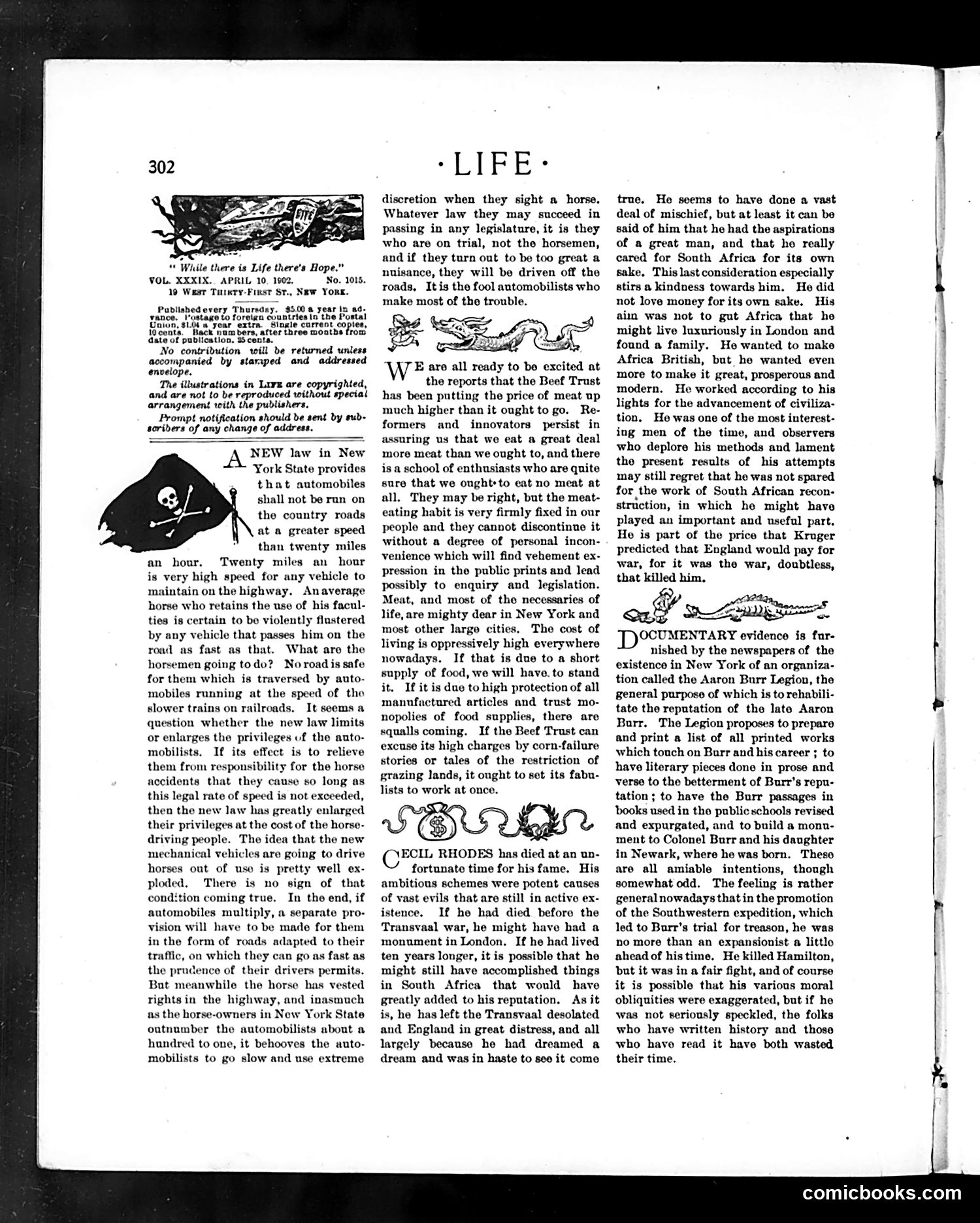
What you’re looking at
The page contains two distinct cartoons and editorial commentary: 1. **"While there is Life there's Hope"** (top): A skull and crossbones symbol, likely satirizing dangerous automobiles on roads—connecting to the editorial's discussion of speed limits and traffic safety. 2. **"A NEW law in New York State"** (left): Depicts automobiles as a threat to horses and road safety, mocking a proposed speed restriction law (twenty miles per hour). The skull imagery reinforces the danger theme. The accompanying editorials discuss the Beef Trust price-fixing scandal and Cecil Rhodes's death. The satire criticizes both the automobile industry's recklessness and corporate monopolies threatening consumers and public welfare—common Progressive Era concerns. The cartoons use dark humor and skulls to represent modern industrial dangers to traditional society.
📄 Transcribed text from this page (OCR, searchable)
Machine-transcribed from the original scan — historical spelling and the odd misread are preserved.
‘* While there is Life there's Hope.” VOL. XXXIX. APRIL 10. 1902. No. 1015. 19 Waar Tatkty-Finst St., New YORE. aoepapes, every Thursday. $5.00 & year in ad. oe. Mostage to foreign spanuries ia the Postal Union, s.ot'a year exten. ‘single current co pice, ieee Back nam bers, acter three moaths dato of publication, 3c No contribution will be returned unless accompanied by staraped and addressed envelope. The illustrations in Live are copyrighted, and are not to be reproduced without special arrangement twith the publishers, Prompt notification should be sent by sub- ibers of any change of address. NEW law in New York State provides that automobiles shall not be ran on the country roads at a greater speed than twenty miles an hour, Twenty miles an hour is very high speed for any vehicle to maintain on the highway. Anaverage horse who retains the use of his facul- ties is certain to be violently flustered by any vehicle that passes him on the road as fast as that. What aro the horsemen going todo? Noroadis safe for them which is traversed by auto- mobiles running at the speed of tho slower trains on railroads. It seems a question whether the new law limits or enlarges the privileges uf the auto- mobilists. If its effect is to relieve them from responsibility for the horse accidents that they cause so long as this legal rate of speed is not exceeded, then the new law has greatly enlarged their privileges at the cost of the horse- driving people. The idea that the new mechanical vehicles are going to drive horses out of uso is pretty well ex- ploded. There is no sign of that condition coming true. In the end, if automobiles multiply, a separate pro- vision will have to be made for them in the form of roads adapted to their traffic, on which they can go as fast as the prudence of their drivers permits. But meanwhile the horse has vested rights in the highway, and inasmuch as the horse-owners in New York State outnumber the automobilists about a hundred to one, it behooves the auto- mobilists to go slow and use extreme LIFE discretion when they sight a horse, Whatever law they may succeed in passing in any legislature, it is they who are on trial, not the horsemen, and if they turn out to be too great a nuisance, they will be driven off the roads, It is the fool automobilists who make most of the trouble. BSS V E are all ready to be excited at the reports that the Beef Trust has been putting the price of meat up much higher than it ought to go. Re- formers and innovators persist in assuring us that we eat a great deal more meat than we ought to, and there isa school of enthusiasts who are quite sure that we ought+to eat no meat at all. They may be right, but the meat- eating habit is very firmly fixed in our people and they cannot discontinue it without a degree of personal incon- venience which will find vehement ex- pression in the public prints and lead possibly to enquiry and. legislation. Meat, and most of the necessaries of life, are mighty dear in New York and most other large cities. The cost of living is oppressively high everywhere nowadays. If that is due to a short supply of food, we will have. to stand it. If it is due to high protection of all manufactured articles and trust mo- nopolies of food supplies, there are squalls coming. If the Beef Trust can excuse its high charges by corn-failure stories or tales of the restriction of grazing lands, it ought to set its fabu- lists to work at once. Cru RHODES has died at an un- fortunate time for his fame. His ambitious schemes were potent causes of vast evils that are still in activo ex- istence. If he had died before the Transvaal war, he might have had a monument in London. If he had lived ten years longer, it is possible that he might still have accomplished things in South Africa that would have greatly added to his reputation. As it is, he has left the Transvaal desolated and England in great distress, and all largely becauso he had dreamed a dream and was in haste to seo it come trae. He seems to have done a vast deal of mischief, but at least it can be said of him that he had the aspirations of a great man, and that ho really eared for South Africa for its own sake, This last consideration especially stirs a kindness towards him. He did not love money for its own sake, His aim was not to gut Africa that he might live luxuriously in London and found a family. He wanted to make Africa British, but he wanted even more to make it great, prosperous and modern. He worked according to his lights for the advancement of civiliza- tion, He was one of the most interest- ing men of the time, and observers who deplore his methods and lament the present results of his attempts may still regret that he was not spared. for the work of South African recon- struction, in which he might havo played an important and useful part. He is part of the price that Kruger predicted that England would pay for war, for it was the war, doubtless, that killed him, OCUMENTARY evidence is fur- nished by the newspapers of the existence in New York of an organiza- tion called the Aaron Burr Legion, the general purpose of which is to rehabili- tate the reputation of the late Aaron Barr. The Legion proposes to prepare and print a list of all printed works which touch on Burr and his career ; to have literary pieces done in prose and verse to the betterment of Burr’s repu- tation; to have the Burr passages in books used in the publicschools revised and expurgated, and to build a monu- ment to Colonel Burr and his daughter in Newark, where he was born. Theso are all amiable intentions, though somewhat odd. The feeling is rather general nowadays that in the promotion of the Southwestern expedition, which led to Barr's trial for treason, he was no more than an expansionist a littlo ahead of histime. He killed Hamilton, but it was in a fair fight, and of course it is possible that his various moral obliquities were exaggerated, but if he was not seriously speckled, the folks who have written history and those who havo read it have both wasted their time. comicbooks.com