
A complete issue · 20 pages · 1902
Life — March 13, 1902
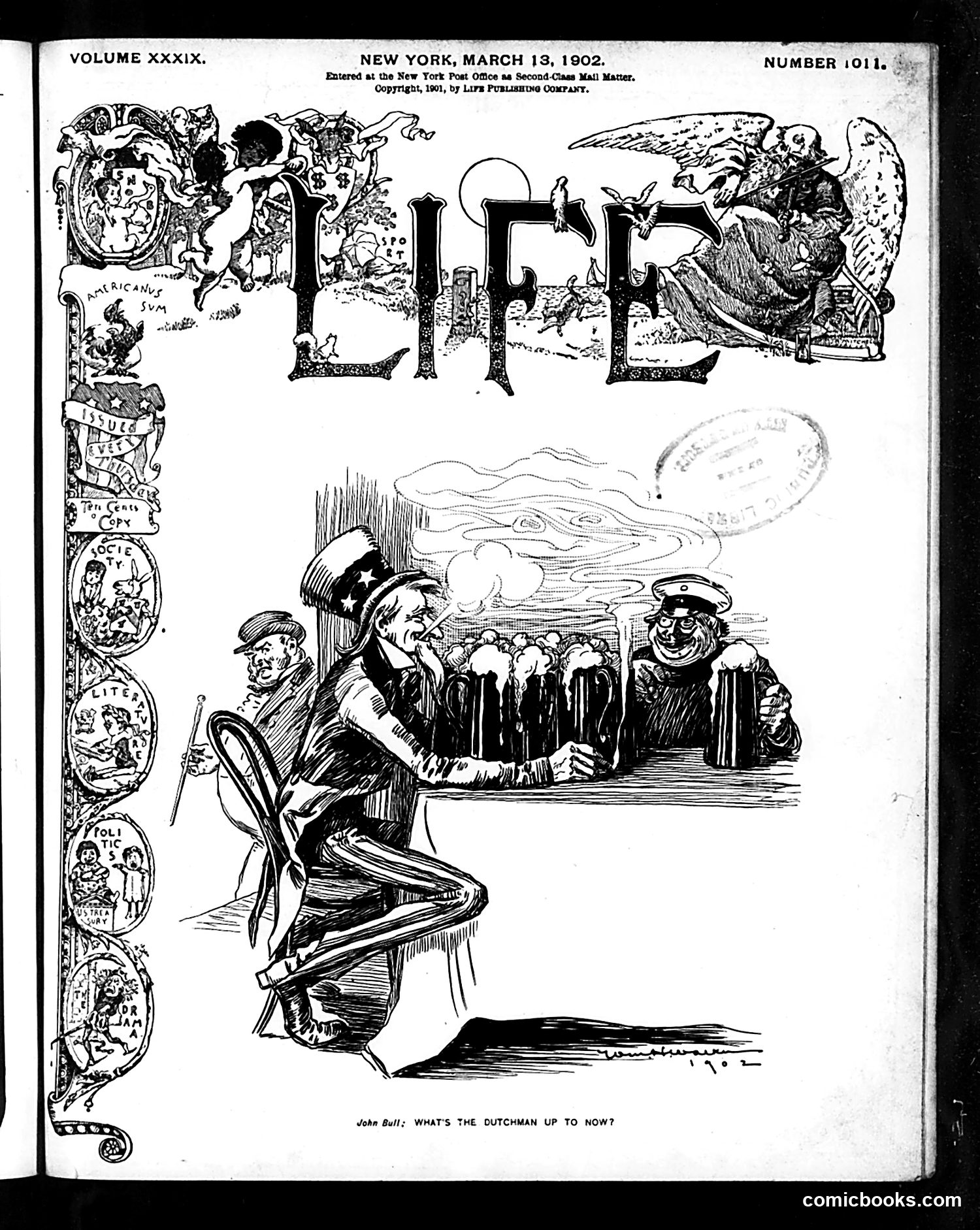
**Main Cartoon:** The bottom cartoon shows Uncle Sam (identifiable by his starred top hat) sitting at a bar with two bartenders, asking "WHAT'S THE DUTCHMAN UP TO NOW?" "The Dutchman" refers to **President Theodore Roosevelt**, whose nickname derived from his Dutch ancestry. The cartoon satirizes Roosevelt's unpredictability and active interventionism during his presidency. The bar setting suggests backroom political dealings or gossip. The elaborate decorative border on the left side contains small circular vignettes typical of Life's ornamental style from this era. The top illustration appears decorative/emblematic rather than a separate political cartoon, featuring classical design elements.
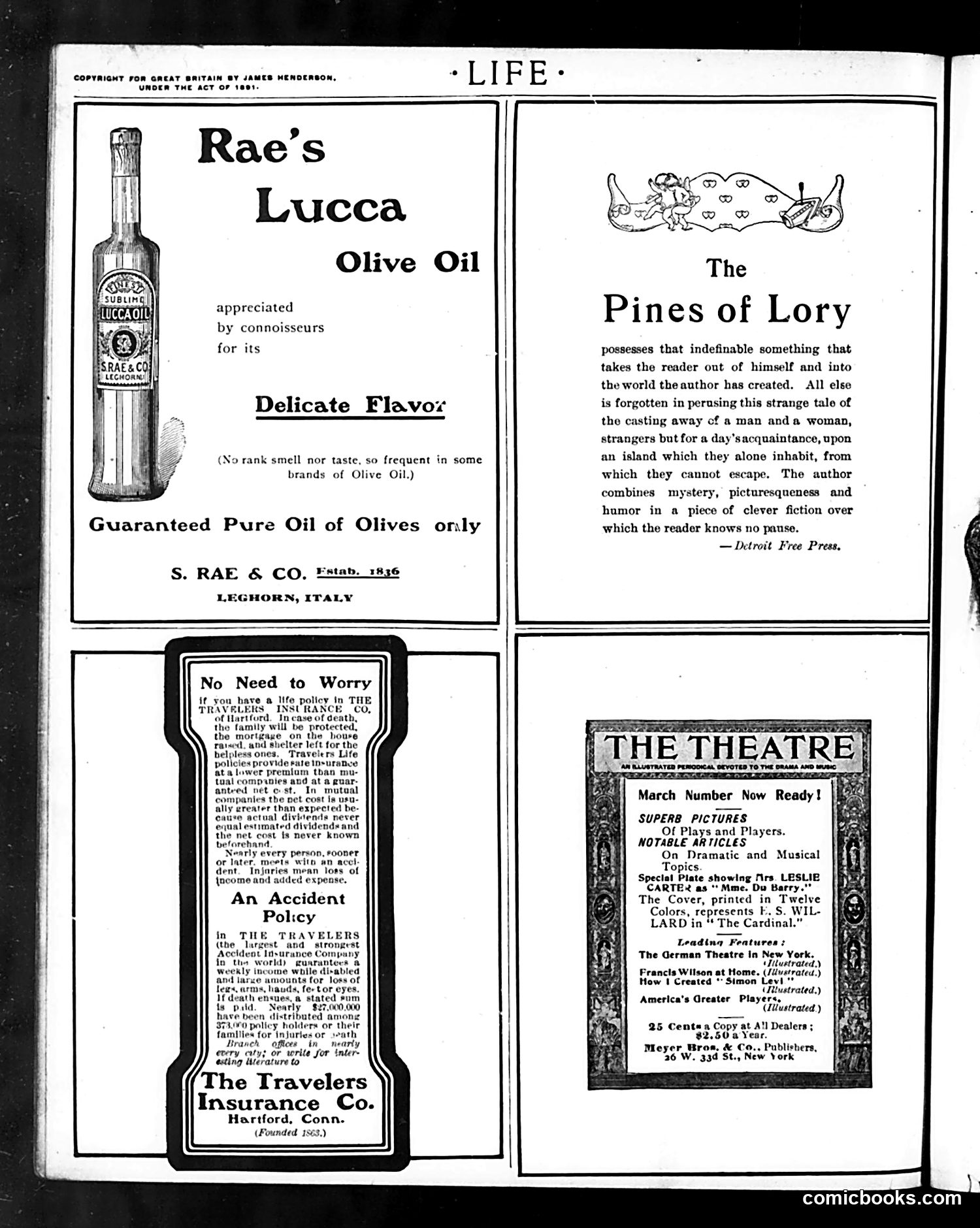
This page contains primarily **advertisements rather than satirical content**. The top left features an ad for **Rae's Lucca Olive Oil** from Leghorn, Italy, emphasizing its "delicate flavor" and purity. Below that is an insurance advertisement for **The Travelers Insurance Co.** of Hartford, Connecticut, promoting their accident policy with detailed coverage information. The top right contains a brief book review of **"The Pines of Lory,"** describing it as mysterious fiction about a man and woman stranded on an island, praised by the Detroit Free Press. The bottom right advertises **"The Theatre,"** a periodical, promoting its March issue featuring superb pictures of plays and players, plus articles about dramatic topics. It costs 25 cents and is published by Meyer Bros. & Co. in New York. No political satire or caricatures are present on this page.
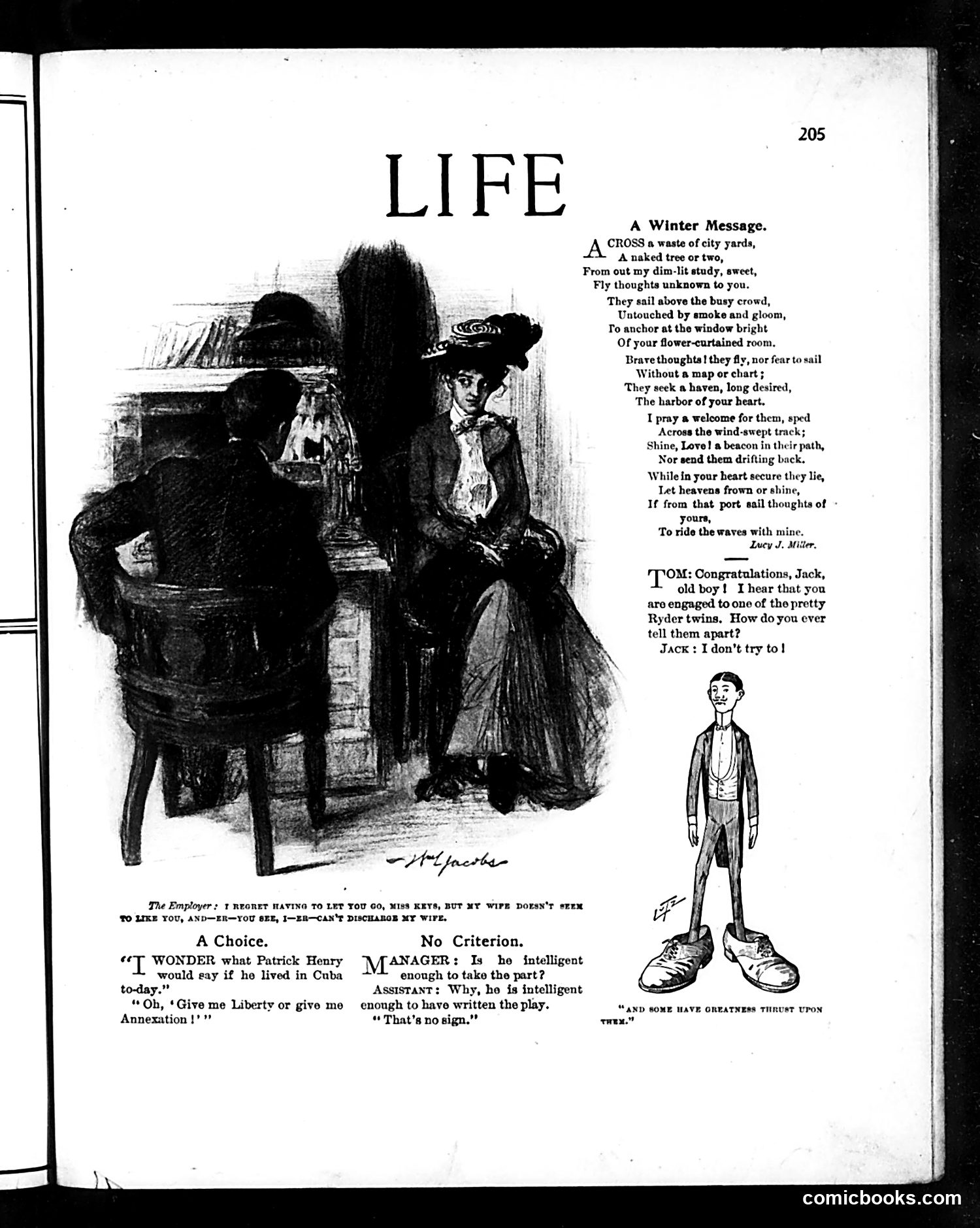
This page contains three distinct satirical pieces: **"A Winter Message"** (top): A poem by Zoey J. Miller addressing impoverished city dwellers, offering spiritual comfort ("Shine, Love!") rather than material aid—likely mocking wealthy philanthropists' patronizing approach to poverty. **Main Cartoon** (center): Depicts an employer firing a worker ("Miss Kents"), claiming his wife doesn't approve. The satire targets employer hypocrisy and arbitrary dismissals dressed in false courtesy. **"A Choice"** and **"No Criterion"** (bottom): Two brief exchanges mocking political discourse. The first questions whether Patrick Henry would accept Cuba; the second ridicules evaluating someone's intelligence based on theatrical ability—likely commentary on superficial political judgment. The illustrations are credited to Al Frueh. Overall, the page satirizes class relations, employment practices, and political superficiality.
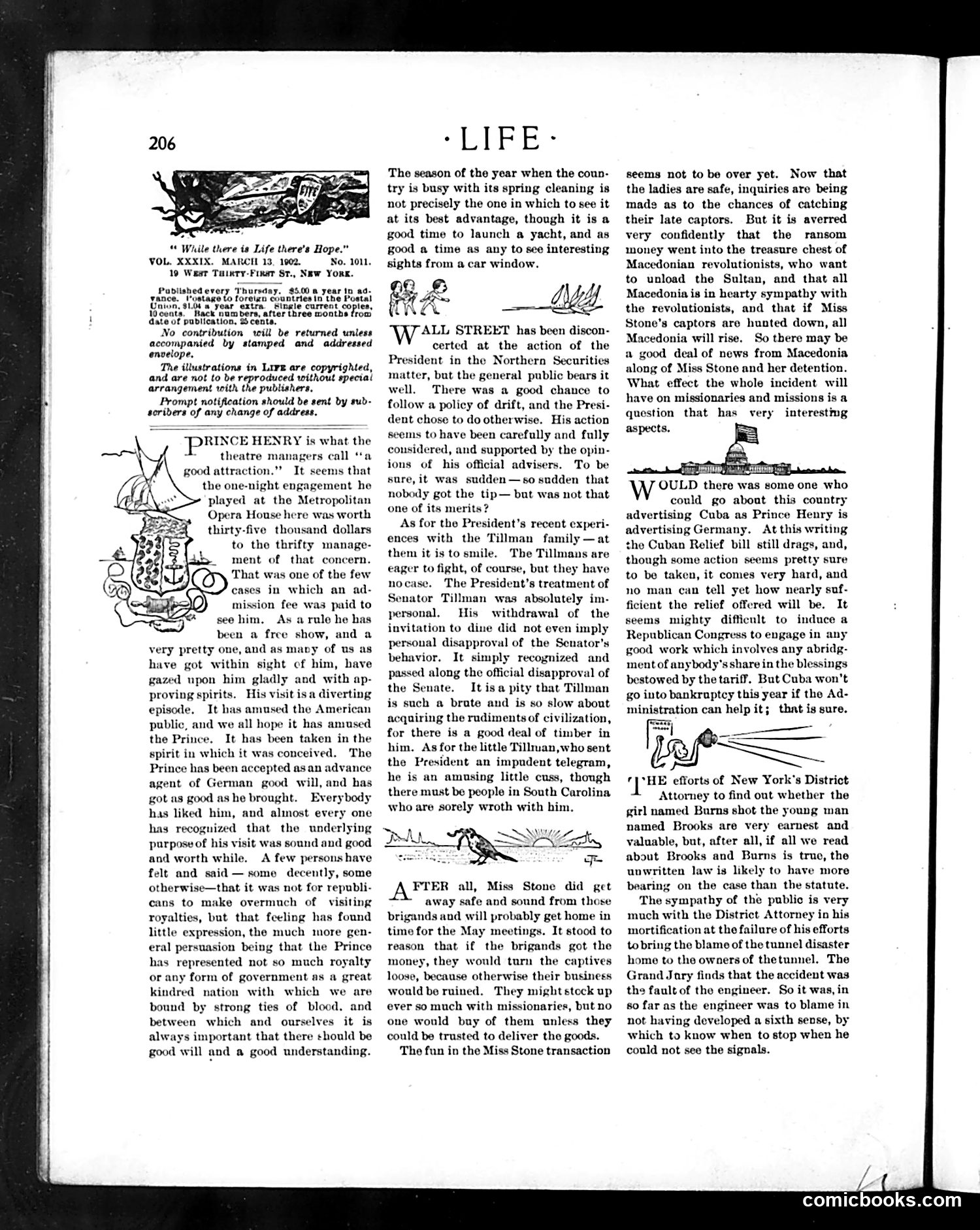
This page contains editorial commentary rather than a cartoon. The main illustration shows a theatrical mask/emblem, likely representing Life's satirical voice. The text discusses: 1. **Prince Henry of Prussia's visit** to America, praising his diplomatic conduct and noting his visit to the Metropolitan Opera House's thirty-five thousand dollar thrift management case. 2. **President Roosevelt's sudden dismissal of Senator Tillman**, which the writer supports as properly handled, though noting the Tillmans had been friendly with the President's family. 3. **The Miss Stone ransoming situation** — a missionary held captive in Macedonia whose release the text suggests involved brigands potentially becoming revolutionaries. 4. **The Barnes v. Brooks District Attorney case**, discussing an engineer's negligence in a canal disaster. The tone is broadly supportive of Roosevelt's decisiveness while commentary remains gossipy about social/diplomatic matters.
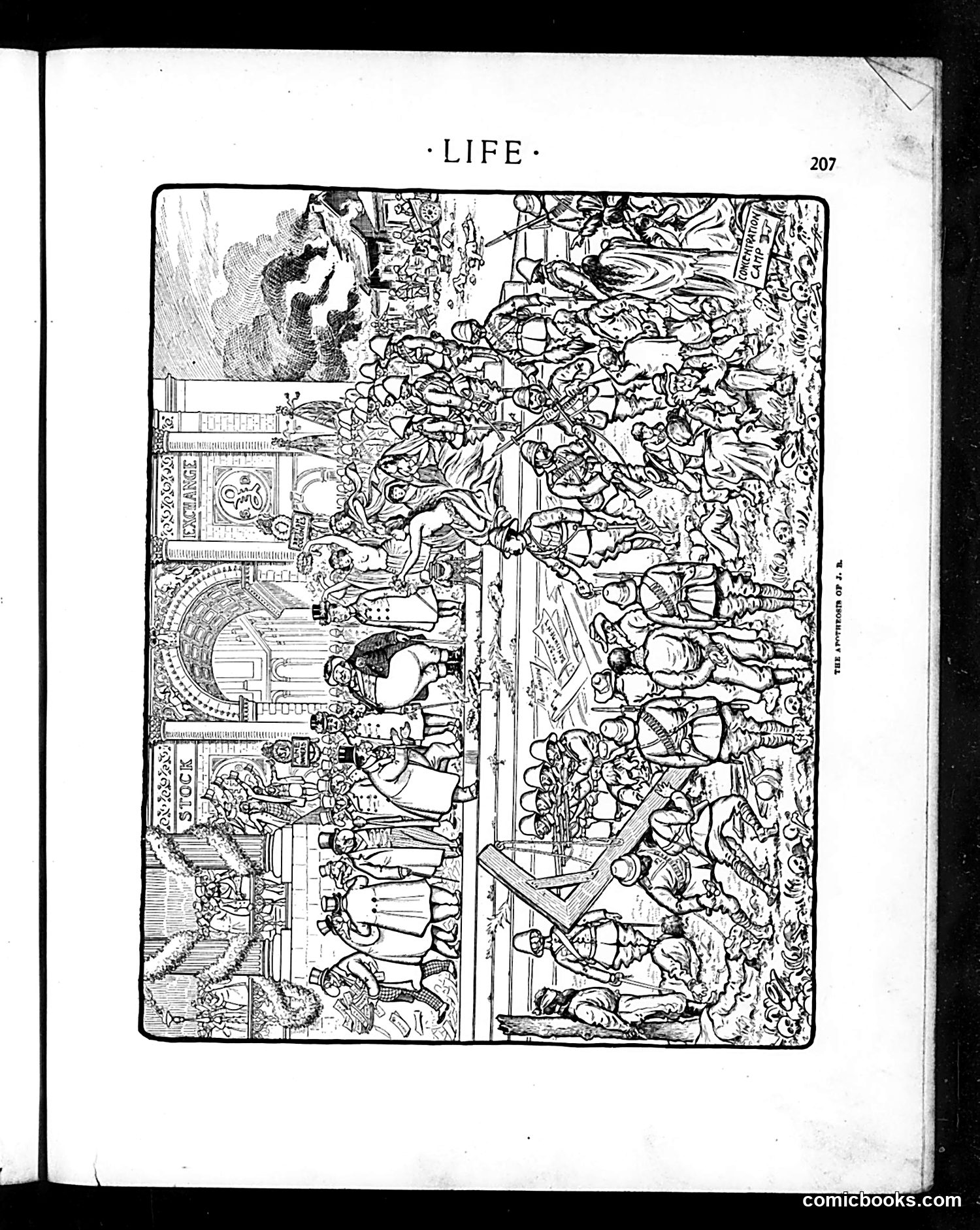
This page from *Life* magazine (page 207) contains a detailed satirical engraving depicting a crowded indoor scene. The image appears to show a grand hall or palace interior with elaborate architectural details on the left side. The right portion depicts numerous figures in period dress engaged in various activities—some appearing chaotic or comedic in nature. However, **I cannot reliably identify specific political or social references from the image alone**. The engraving style and density of figures suggest it's satirizing a particular historical event or social phenomenon, but without clearer legible text or captions identifying the scene, I cannot accurately explain which figures represent whom or what specific incident is being lampooned. The illustration's complexity suggests significant historical context that requires additional documentary evidence to interpret responsibly.
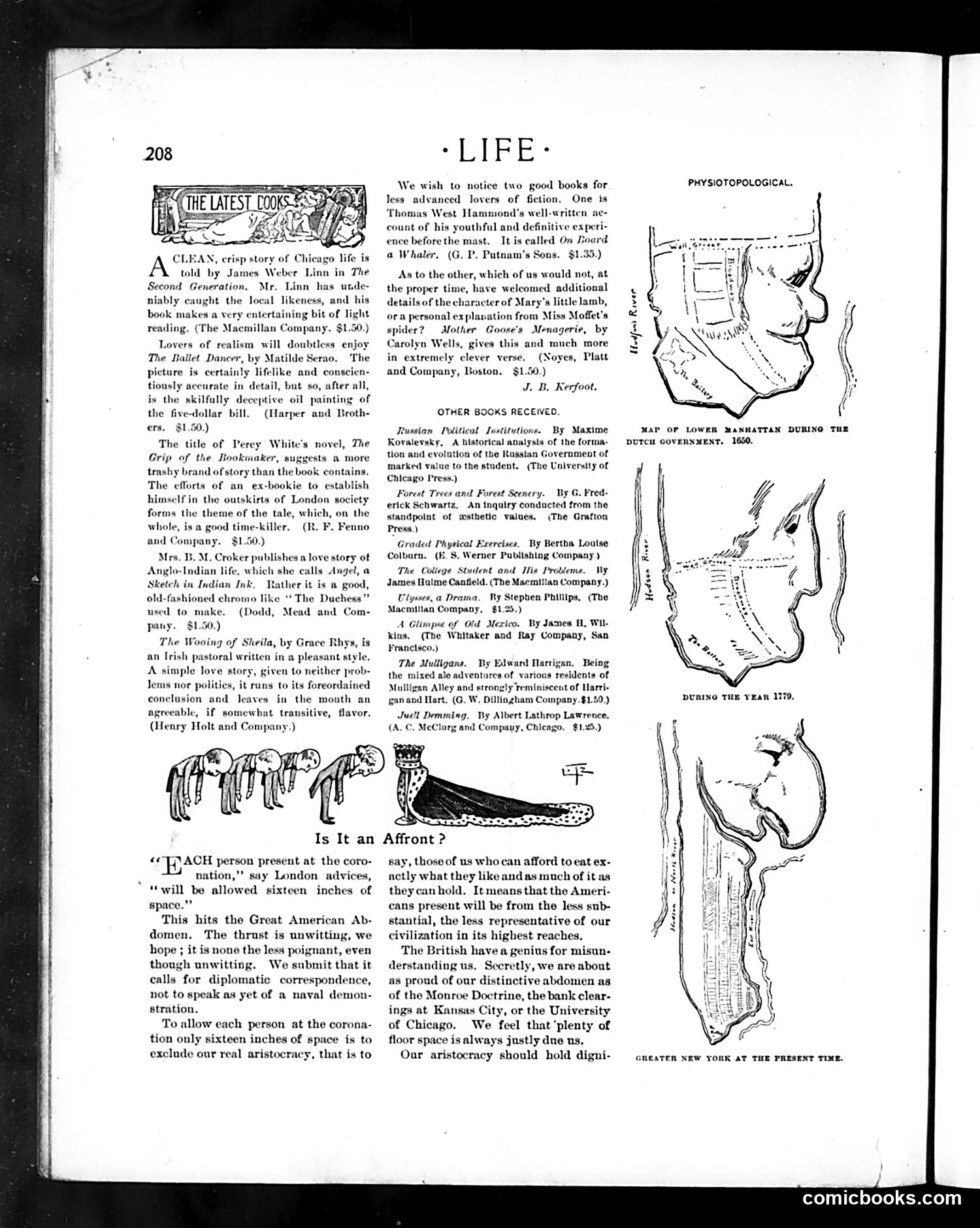
This cartoon satirizes British complaints about American seating arrangements at the coronation (likely King Edward VII's, 1902). The article mocks London's objection to allocating only "sixteen inches of space" per American attendee, calling this "an affront" to American dignity. The satire inverts the complaint: the piece argues Americans shouldn't be offended by tight quarters, since our supposedly "distinctive abdomen" (referencing American corpulence) means we're accustomed to taking up space anyway. It's a self-deprecating jab at American obesity, implying we have no right to complain about cramped seating given our notorious girth. The cartoon's caricatured figure reinforces this stereotype visually.
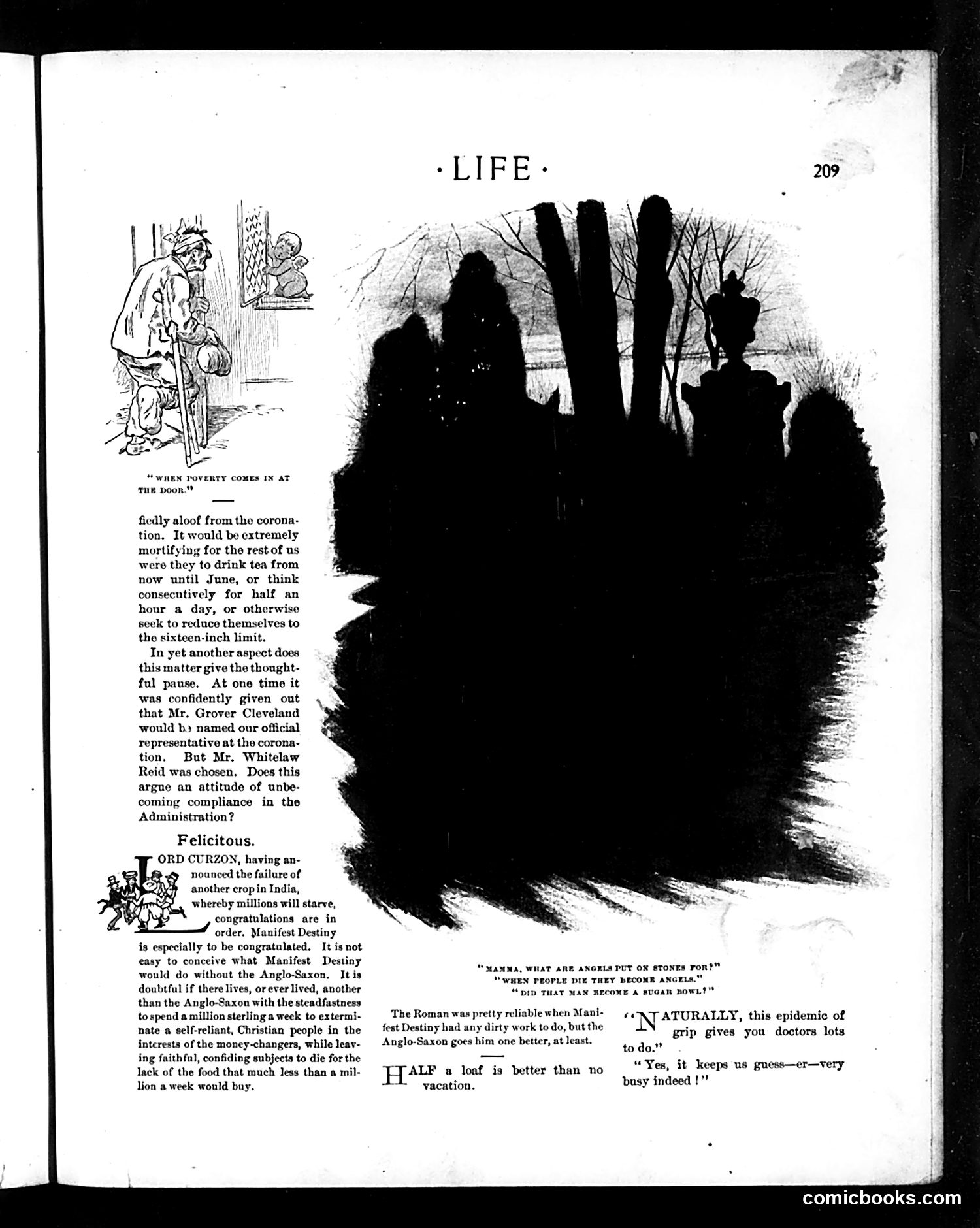
This page contains political satire about a coronation (likely British royal). The left cartoon shows a poor person at a door, captioned "When Poverty Comes in at the Door," accompanying text criticizing whether Britain's poor should endure economic hardship while officials debate coronation expenses. The main illustration depicts silhouetted figures, likely representing death or hardship, with captions about angels and "sugar" (a period euphemism). The dialogue mocks how the coronation distracted from serious social issues—specifically a famine in India announced by Lord Curzon. The satire's point: Britain celebrates royal pageantry while ignoring mass poverty at home and starvation abroad. This reflects turn-of-century tensions between imperial grandeur and social responsibility. The "grip" reference suggests the epidemic of indifference to human suffering.
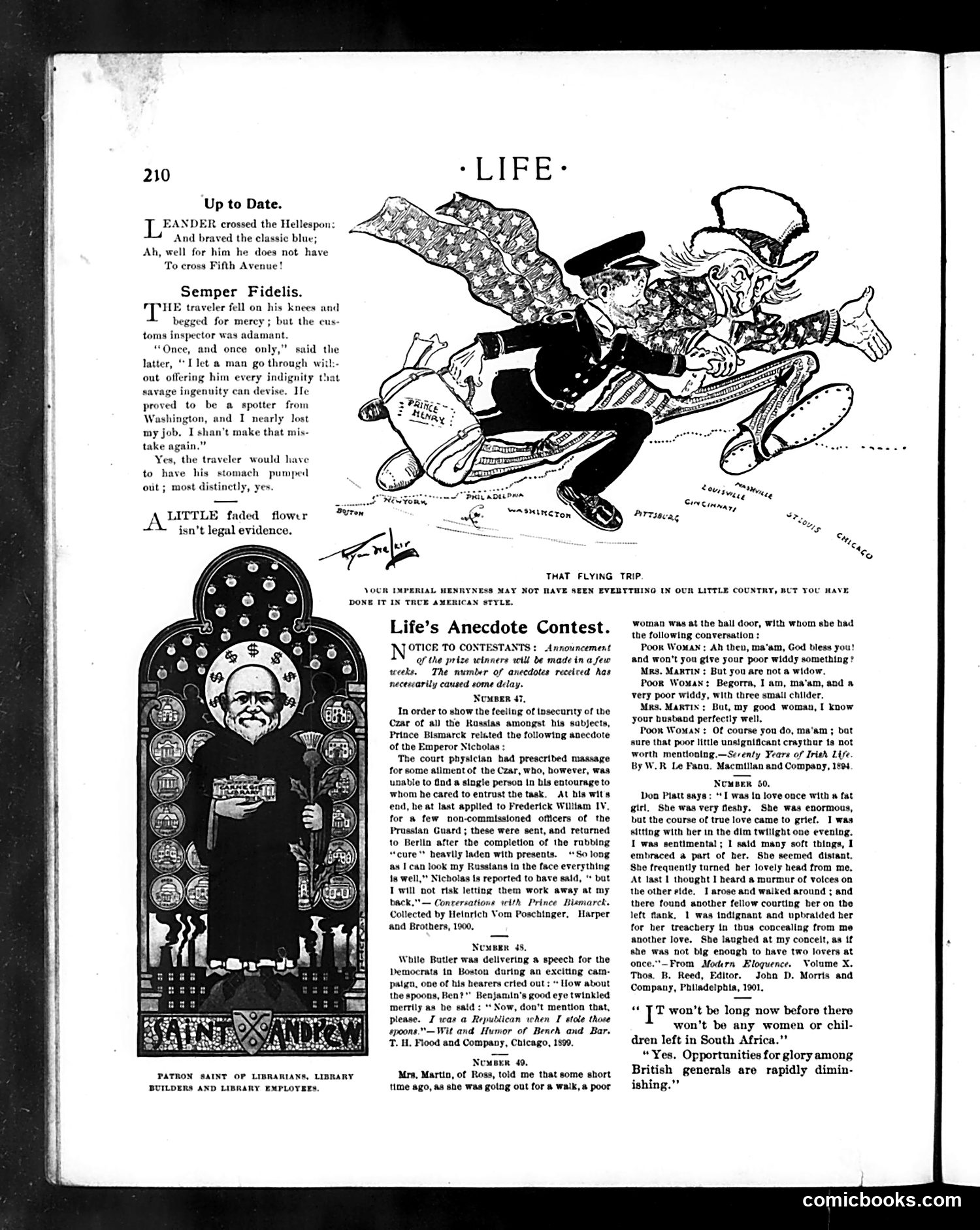
The page features satirical content about turn-of-the-century travel and social pretension. The main cartoon "That Flying Trip" depicts a caricatured figure in exaggerated mid-air pose, suggesting someone's boastful claims about adventurous travel are absurdly overblown. The accompanying anecdotes mock social climbing and dishonesty—particularly a story about Prince Bismarck and Russian nobility, where a court physician lies about treating the Czar to impress others. "Life's Anecdote Contest" solicits humorous stories from readers, with examples ridiculing poor women's pretentious speech patterns and a satirical piece mocking a man's sentimental story about lost love. The overall theme targets late-Victorian/Edwardian affectation: people fabricating impressive experiences or adopting false dignity to gain social status. The satire reflects Life's mission to expose and ridicule contemporary vanity and humbug.
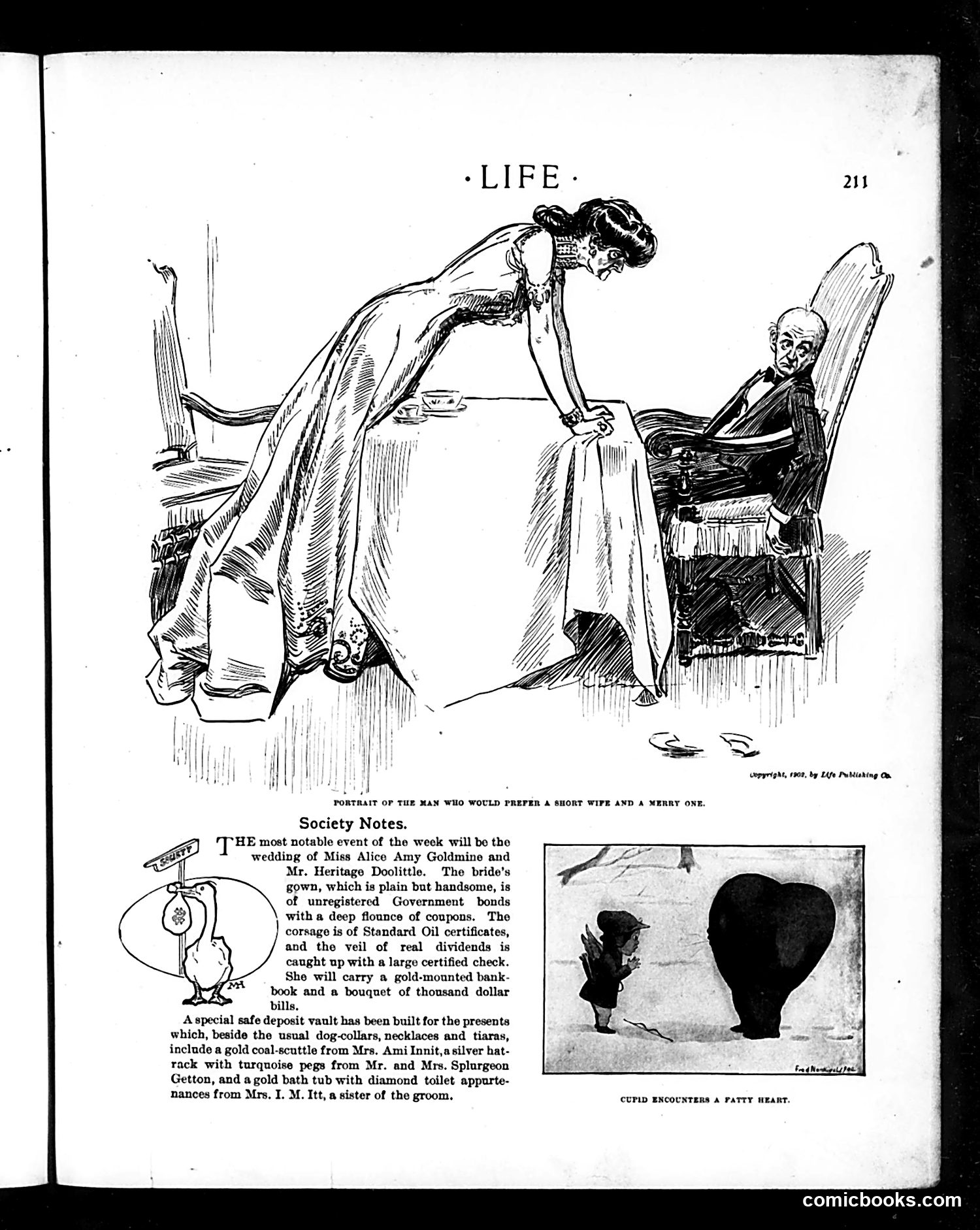
The top cartoon depicts a woman leaning toward a seated man with an exaggerated, flirtatious pose. The caption reads "PORTRAIT OF THE MAN WHO WOULD PREFER A SHORT WIFE AND A MERRY ONE." This is a genteel romantic satire about male preferences in marriage. The joke targets men who claim to want wives who are both physically small ("short") and cheerful ("merry")—suggesting such men are deluded or pursuing an impossible ideal. The woman's dramatic, almost acrobatic posture humorously illustrates the contortions required to satisfy such contradictory demands. The "Society Notes" section below announces an upcoming wedding for Miss Alice Amy Goldmine and Mr. Heritage Doolittle, satirizing wealthy marriages through obviously symbolic names suggesting money and aristocratic pretense. The small photograph ("Cupid Encounters a Patty Heart") is captioned but unclear in meaning.
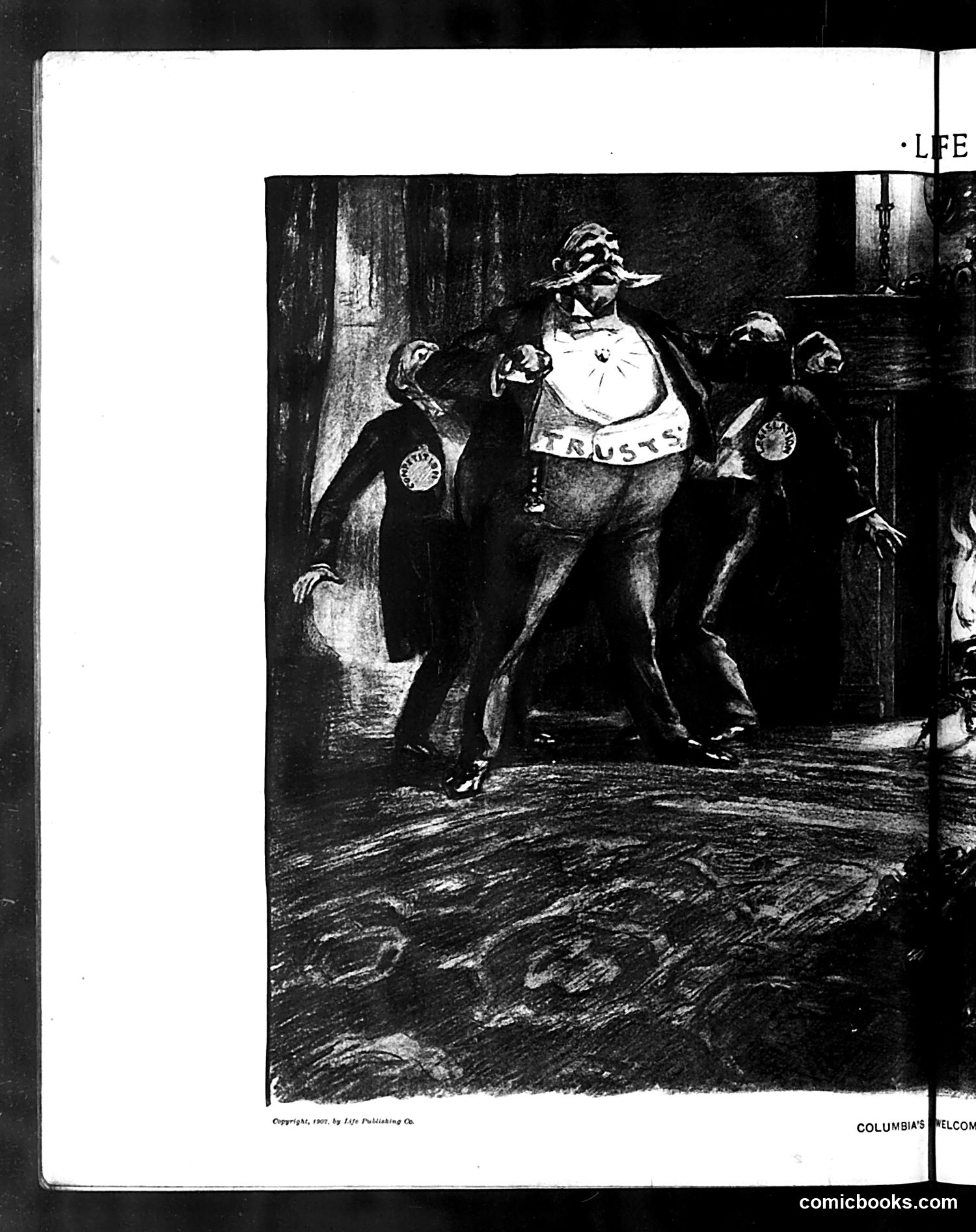
This appears to be a satirical cartoon from Life magazine (copyright 1907, per the visible text). The central figure is a rotund, well-dressed man labeled "TRUSTS" on his chest, surrounded by smaller figures who appear to be politicians or government officials. The cartoon critiques the power and influence of monopolistic business trusts during the Progressive Era. The smaller figures seem to be appealing to or deferring to the large "Trusts" character, suggesting that political leaders were controlled by or subservient to big business interests. This reflects early 1900s anxieties about corporate monopolies and their corrupting influence on American government—a key Progressive Era concern that motivated antitrust legislation and reform efforts.
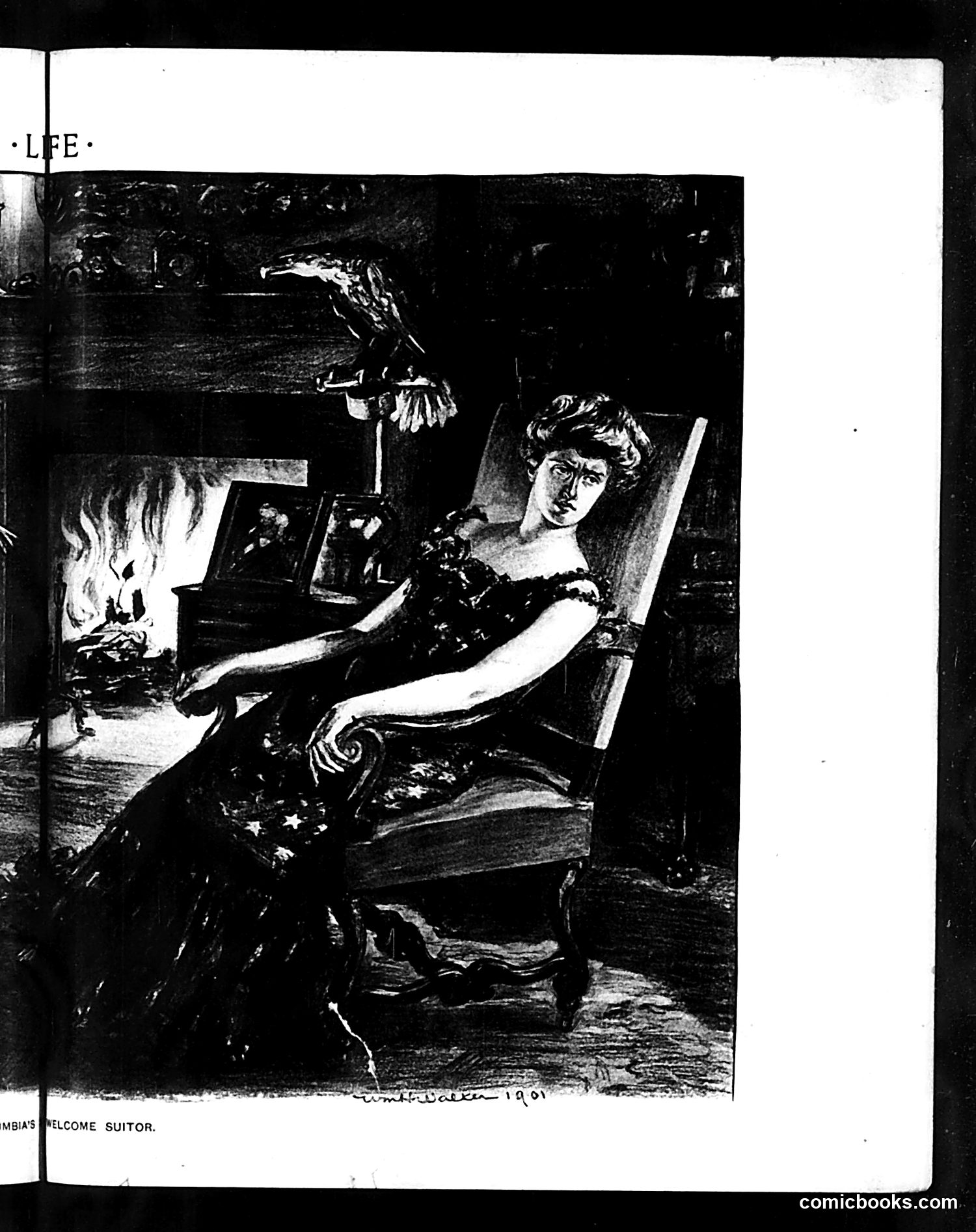
This appears to be a satirical illustration from Life magazine depicting a woman reclining by a fireplace, reading what seems to be a romantic or courtship-related document or letter. The title suggests commentary on courtship rituals. The woman's relaxed pose and the domestic setting (fireplace, comfortable chair) suggest she's at leisure, perhaps reviewing romantic correspondence. The "welcome suitor" reference indicates satire about dating or marriage prospects. Without additional context, the specific target of the satire—whether mocking women's romantic expectations, suitor behavior, or courting conventions of the era—remains somewhat unclear from the image alone, though the tone appears gently mocking of contemporary courtship practices.
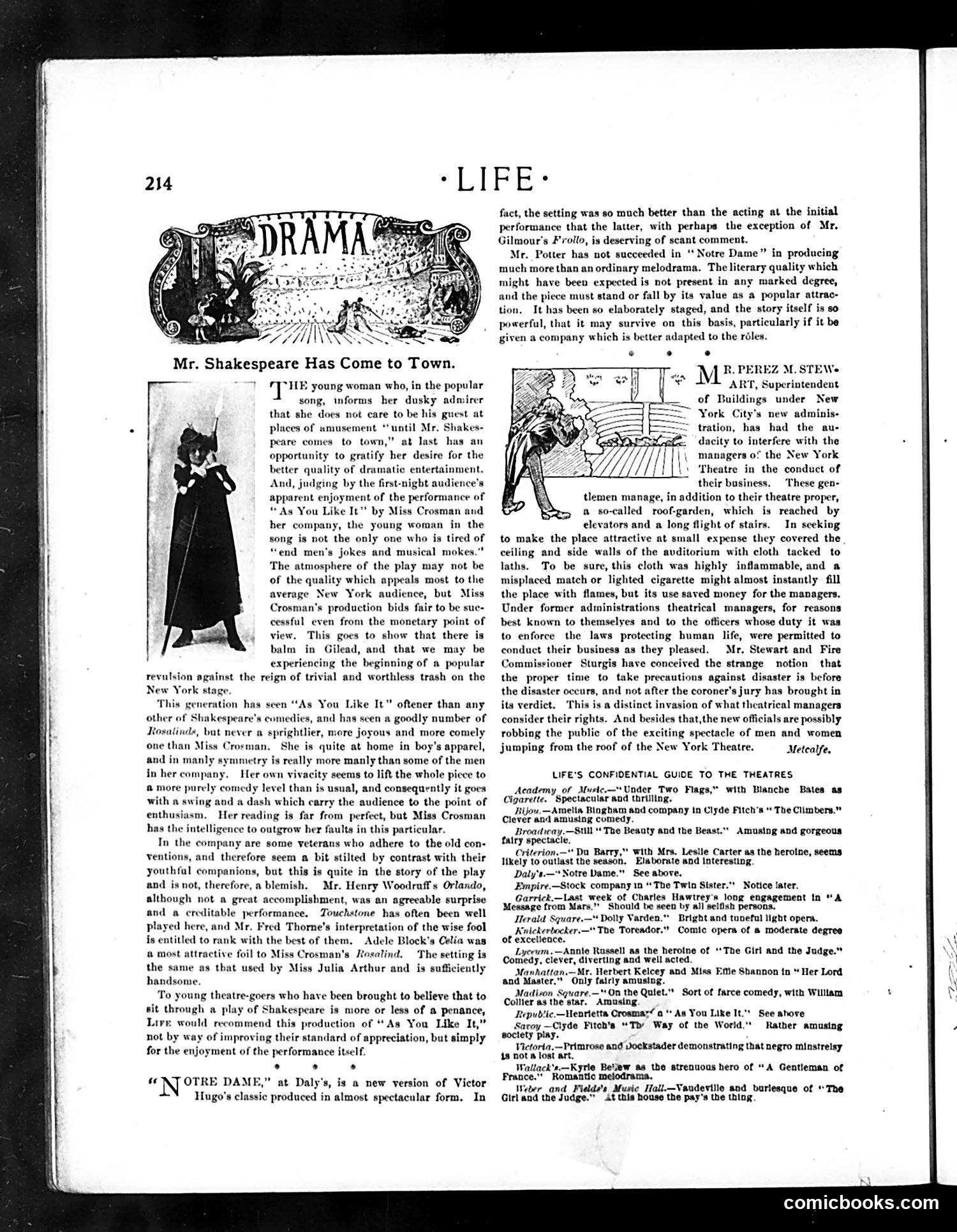
This page from *Life* magazine's "Drama" section reviews theatrical performances, primarily discussing Miss Crosman's performance in "As You Like It" by Shakespeare. The illustrated figure appears to be an actress in period costume, likely representing Miss Crosman in the play. The text argues that while the play itself is somewhat trivial and the staging ordinary, Crosman's talent elevates the production. The review suggests the actress brings sophistication to what would otherwise be unremarkable entertainment. The page also includes theatrical notices for other productions and a separate article about Mr. Perez M. Stewart discussing building code enforcement at New York theaters—a practical, non-satirical piece about theater safety regulations. There is no political satire evident on this page; it represents standard theater criticism and industry reporting.
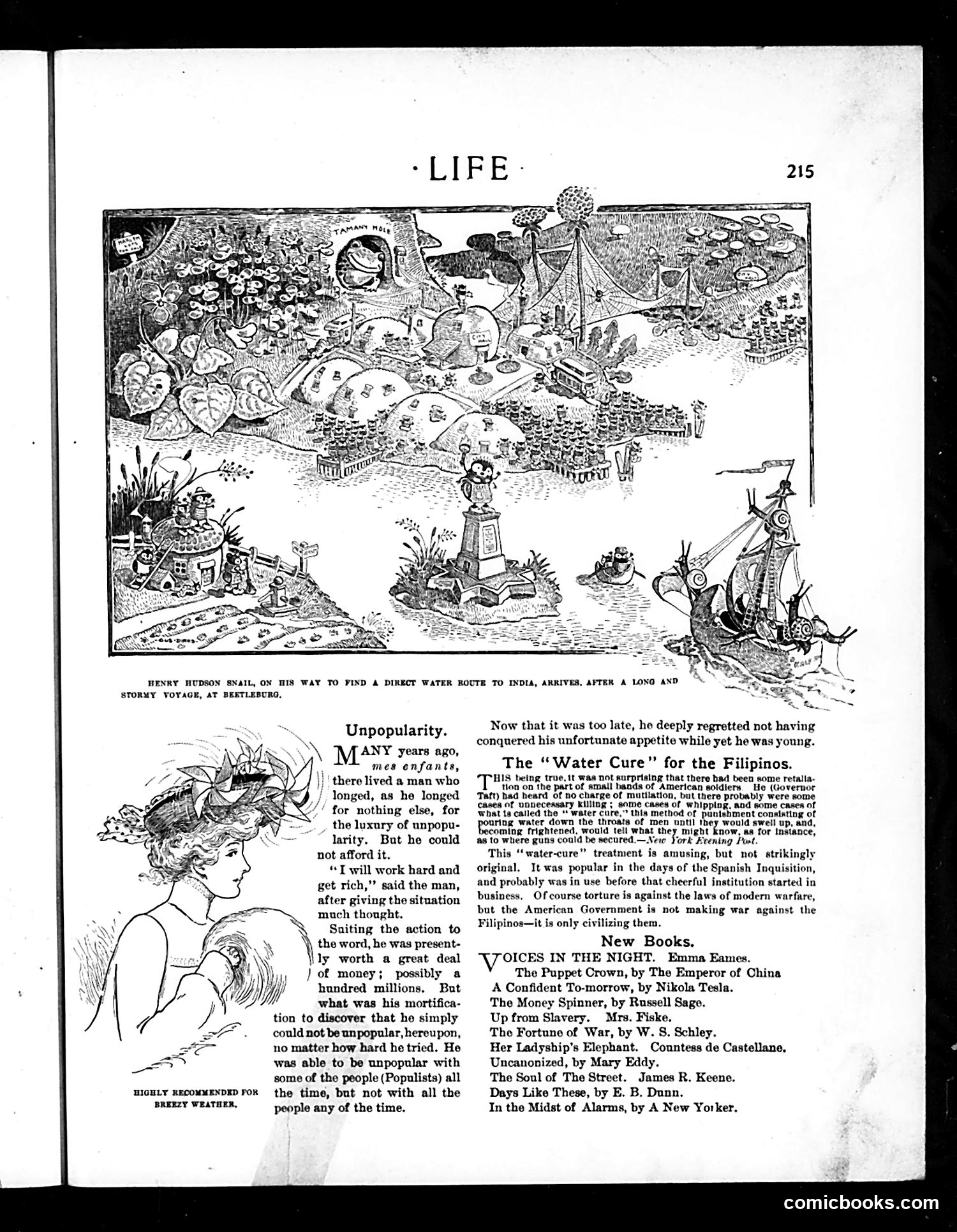
This page contains two satirical pieces: **"Henry Hudson Snail"** (top): A whimsical illustration mocking explorer Henry Hudson's voyage, reimagining him as a snail traveling to find a water route to India. This appears to be pure fantasy humor rather than political satire. **"Unpopularity"** (middle): A fable about a wealthy man who paradoxically cannot achieve unpopularity despite trying. The joke critiques wealthy industrialists (likely referencing "Populists" or the Populist movement opposing monopoly wealth), suggesting the rich remain popular regardless of their intentions. **"The 'Water Cure' for the Filipinos"** (bottom): This is direct political satire addressing American military conduct during the Philippine-American War. It sarcastically defends the "water cure" torture technique (waterboarding) used by U.S. soldiers against Filipino prisoners, comparing it to Spanish Inquisition methods. The author uses irony to condemn this practice, questioning whether the U.S. is truly "civilizing" the Philippines through torture.
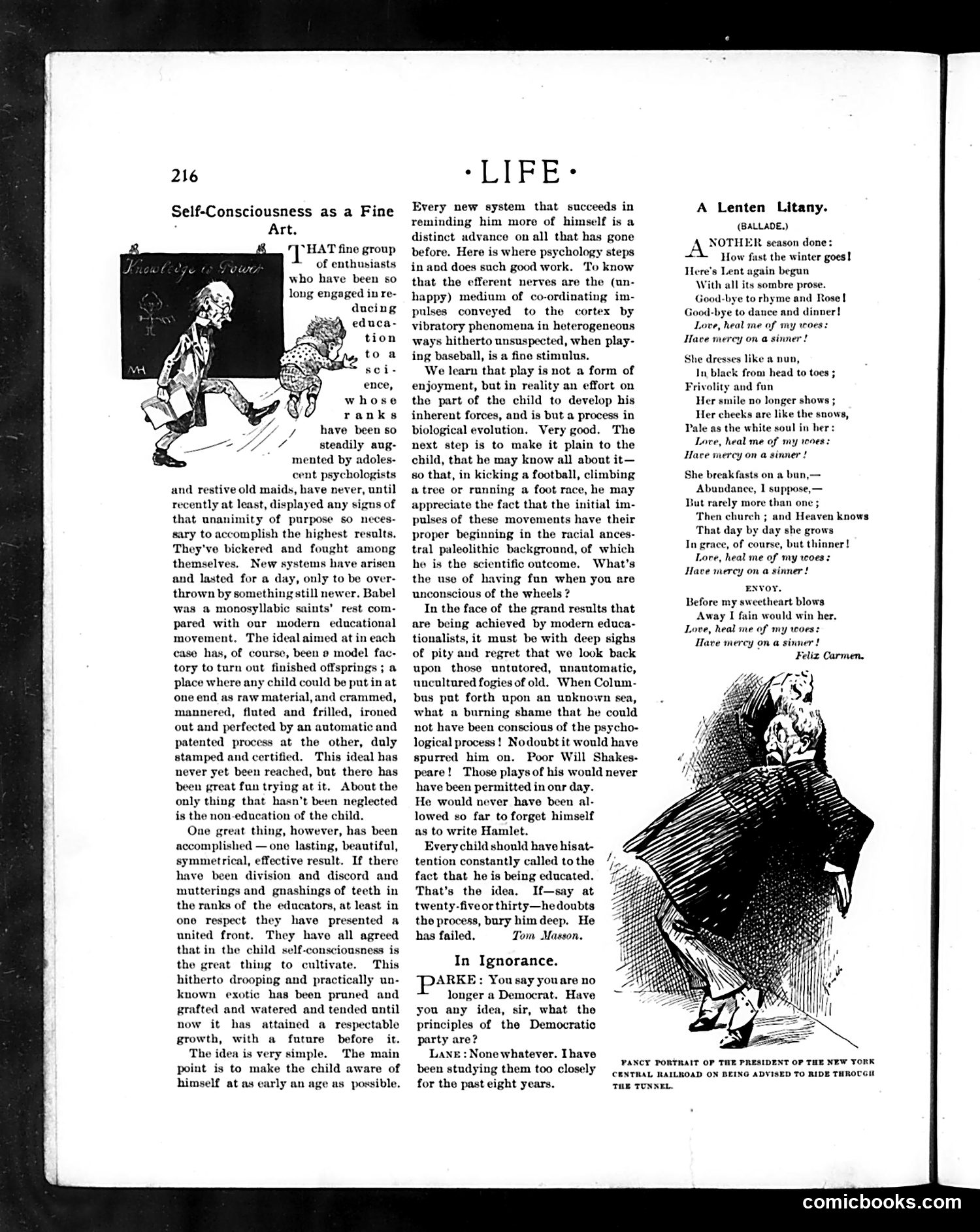
This page satirizes progressive education reform movements of the early 20th century. The main article "Self-Consciousness as a Fine Art" mocks educators who advocate making children hyper-aware of their own psychological and biological processes during play and learning. The satire targets educational theorists who believe children should understand the "scientific" mechanics behind their actions—that kicking a football requires consciousness of "racial ancestral paleolithic background" and neurological processes. The author ridicules this approach as absurd, arguing it destroys the natural joy of play and activity. The cartoon at bottom-right illustrates this absurdity: a figure appears distracted or self-conscious during simple activity, embodying the joke. The closing dialogue "In Ignorance" between characters named Darke and Lane continues the mockery, with Lane claiming to have studied Democratic principles "too closely for the past eight years" without understanding them—a parallel jab at over-intellectualization. The piece's wit lies in exaggerating progressive education's emphasis on self-awareness into an intellectual prison that paralyzes children with theory.
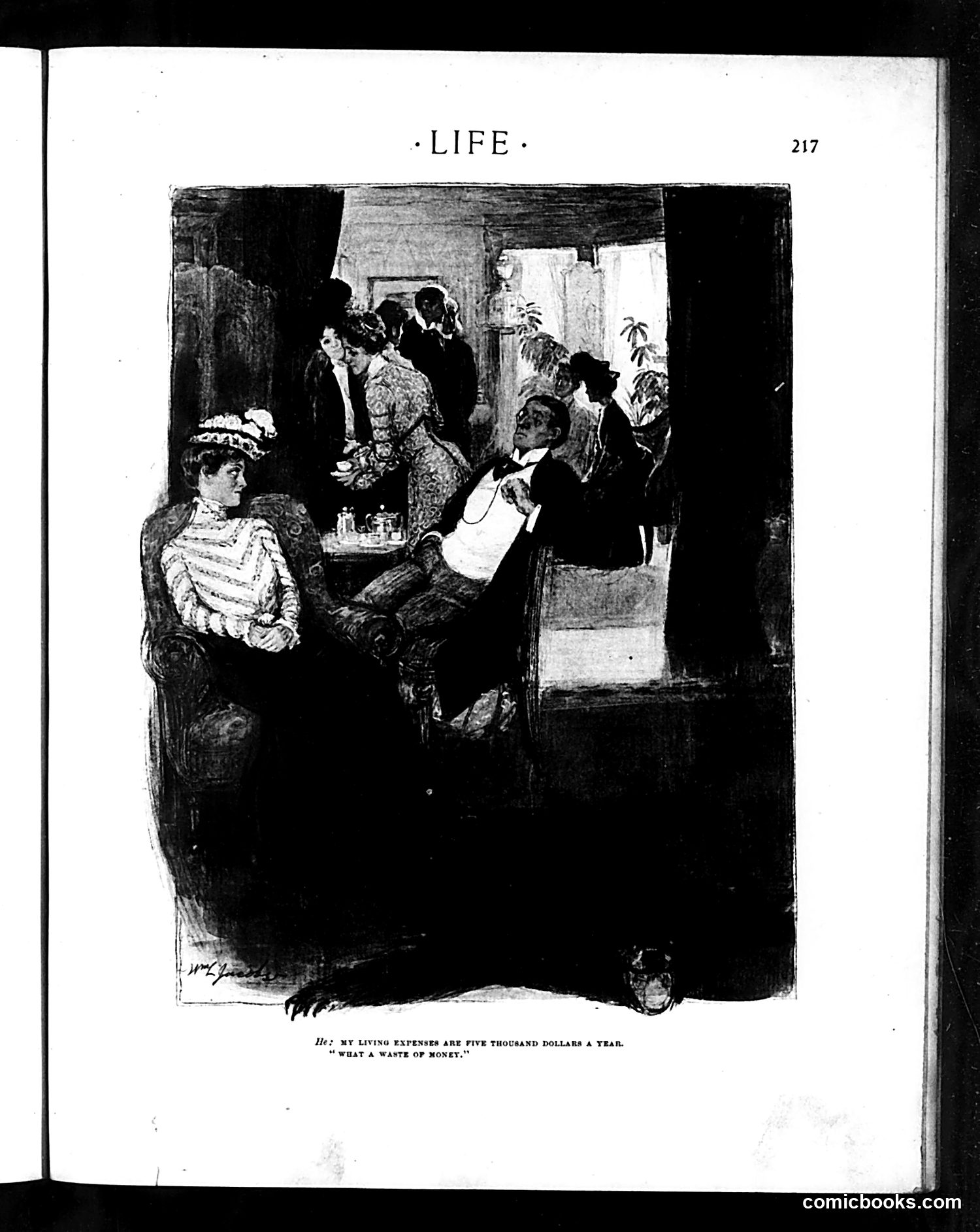
This is a satirical drawing depicting a social scene at what appears to be an upscale gathering or party. A well-dressed man claims his annual living expenses are five thousand dollars, prompting a woman's dismissive response: "What a waste of money." The satire targets wealthy individuals' obliviousness to their own extravagance. The man's boast about spending $5,000 yearly (substantial in the early 20th century) is meant to sound modest or reasonable to him, yet the woman's reaction exposes how frivolous and excessive such spending is—particularly given the economic realities of ordinary working people. The cartoon mocks both the man's self-deception about his lavish lifestyle and the absurdity of wealthy people judging financial prudence among themselves while spending vastly more than average Americans earned.
This page contains humorous content rather than political cartoons. The main satirical piece is a poem titled "Who?" (attributed to the Chicago Tribune) that mocks international diplomacy through personification. It presents Uncle Sam (America) asking various world powers—John Bull (Britain), the Kaiser (Germany), the Czar (Russia)—who his "real friend" is. Each claims credit for helping America in past conflicts, but when asked who is his friend "now," they all simultaneously declare themselves his friend, satirizing the self-interested opportunism of international relations and the hypocrisy of nations claiming friendship only when advantageous. The page also includes humorous excerpts from British schoolboys' exam papers (featuring absurdly wrong answers about history and literature) and anecdotes about Queen Wilhelmina and other figures, all designed to amuse through wit and irony rather than political commentary.
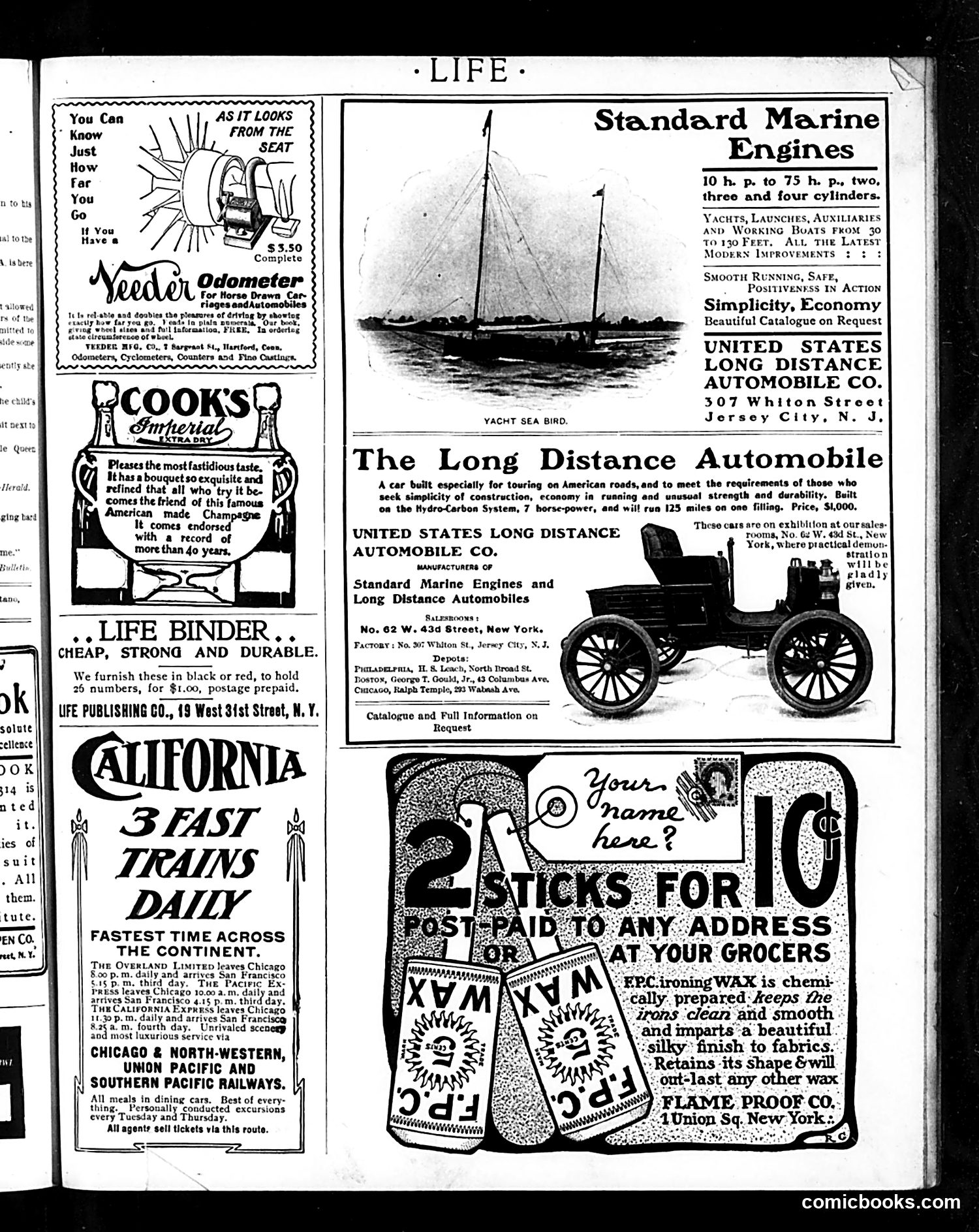
This page is primarily **advertising**, not satirical content. It contains commercial advertisements for early 1900s products and services: **Key advertisements:** - **Veeder Odometer**: A device measuring distance traveled, marketed to cyclists and early motorists - **Cook's Imperial Champagne**: American-made luxury beverage - **Life Binder**: Simple binding product for documents - **California Trains**: Railroad service advertising speed across the continent - **United States Long Distance Automobile**: A $1,000 touring car with 7 horsepower, emphasizing durability for American roads - **Marine Engines**: For yachts and boats - **WAX stickers and Flame Proof Co. products**: Household goods **Historical context for modern readers:** This reflects a transitional period when automobiles were luxury items competing with established rail travel. The emphasis on "long distance" and "durability" indicates early automotive skepticism—these were novel, unreliable machines. The page shows America's industrial optimism in the early 20th century, before automobiles became commonplace.
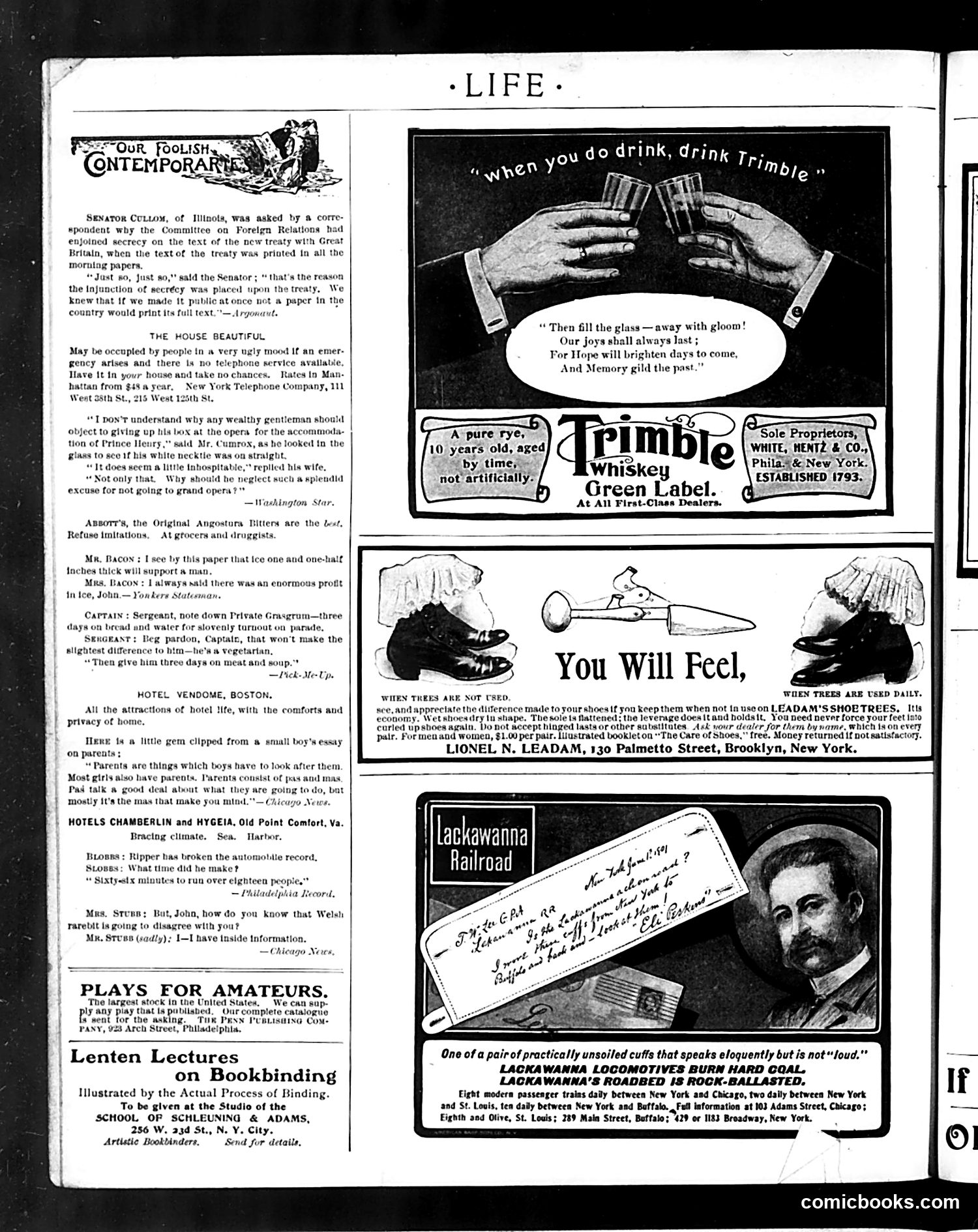
This page is primarily **advertisements and humor snippets** rather than political cartoons. The content reflects early 20th-century American life. The "Our Foolish Contemporaries" section mocks Senator Cullom of Illinois for the absurdity of the Foreign Relations Committee imposing secrecy on a treaty already printed in all newspapers—satirizing bureaucratic pretense and governmental contradictions. Other humor pieces target minor social absurdities: wealthy men objecting to giving opera boxes to visiting Prince Henry; confusion about ice thickness and vegetarian soldiers; Welsh rarebit disagreeing with digestion. The advertisements promote period products: Trimble Whiskey (with a sentimental drinking toast), Leadam's Shoe Trees, and the Lackawanna Railroad (featuring what appears to be a handwritten testimonial about coal-burning locomotives). The page reflects **pre-WWI American concerns**: diplomatic protocol, conspicuous consumption, new transportation technology, and consumer goods marketed through lifestyle aspirations.
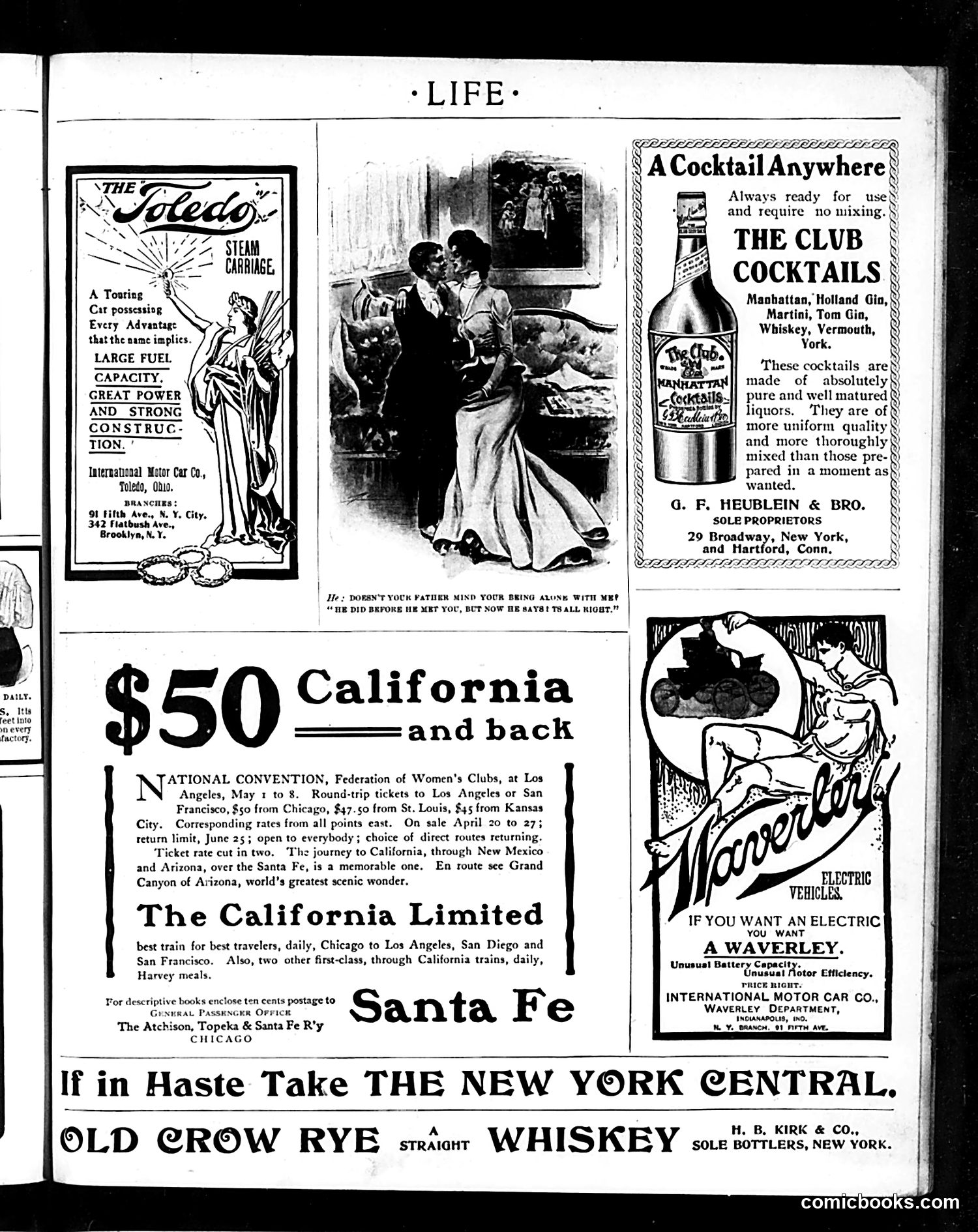
This page is primarily **advertising**, with one small cartoon at top-center. The cartoon depicts a young couple kissing while an older man (the woman's father, based on the caption) watches from a doorway. The joke's setup states the father previously objected to the man courting his daughter, but now approves—the caption suggests he's changed his mind after meeting the suitor, implying the young man has made a good impression or proven himself worthy. The page otherwise features ads for automobiles (Toledo Steam Carriage, International Motor Car Co., Waverley Electric Vehicles), railroad travel to California, cocktail products, and whiskey. These ads reflect early 1900s consumer culture and leisure travel aimed at middle/upper-class readers. The Santa Fe railway ad prominently advertises a women's club convention, suggesting Life's readership included educated women with disposable income.
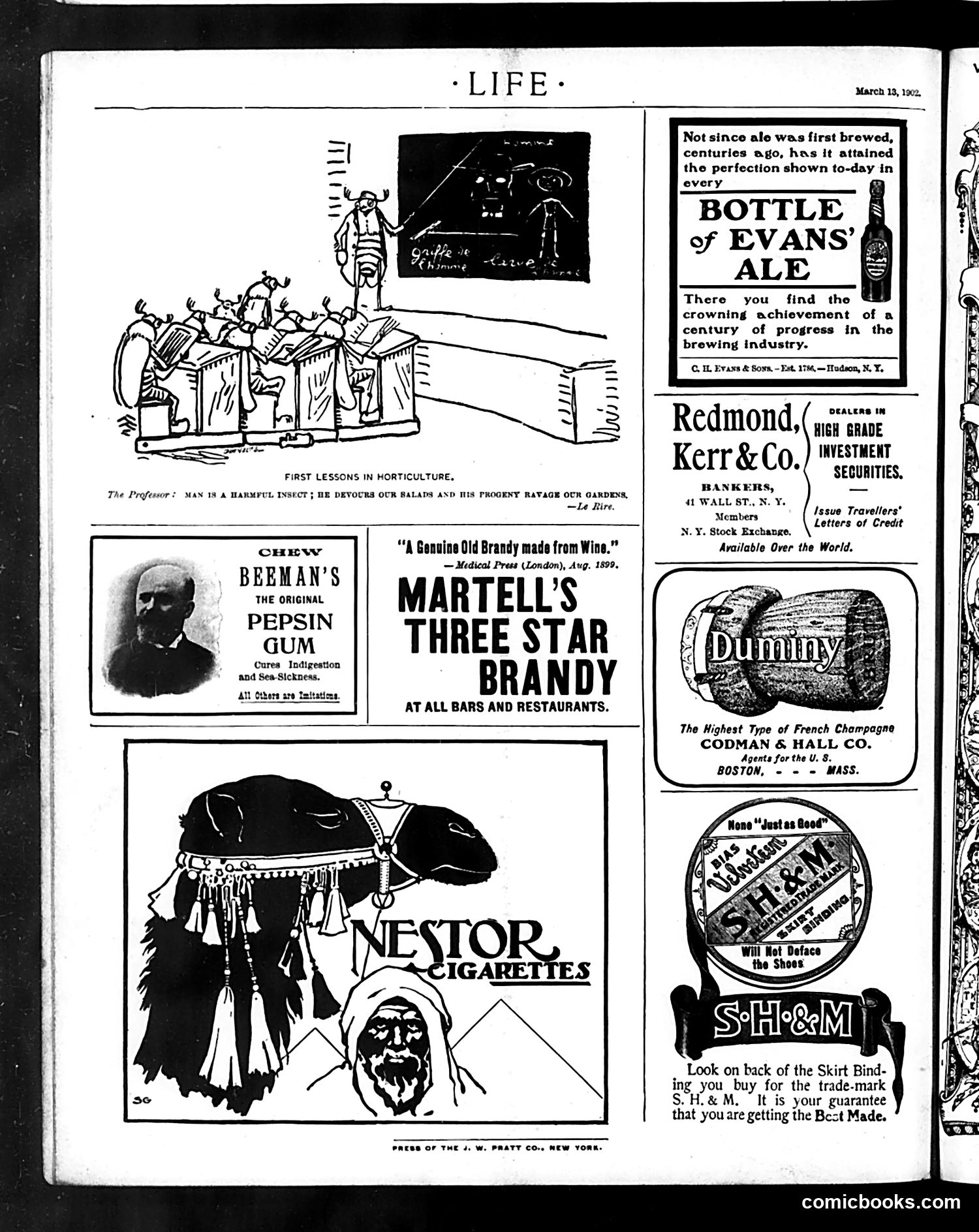
**Main Cartoon ("First Lessons in Horticulture"):** A satirical illustration from the French publication *Le Rire* shows a professor lecturing to students from atop an enormous insect, pointing to a blackboard diagram. The joke treats humans as harmful insects that destroy gardens and crops—inverting the typical hierarchy. It's a humorous inversion: rather than insects being pests to humans, *man* is portrayed as the destructive pest to nature. This reflects early-20th-century anxieties about industrial agriculture and humanity's relationship with the natural world. **Nestor Cigarettes Advertisement:** Features an ornately dressed camel (or similar beast) with decorative Middle Eastern-style trappings and a turbaned figure below, likely playing on orientalist exoticism popular in period advertising to market cigarettes as exotic/luxurious goods. **Remaining Content:** The page is predominantly **advertisements** for period products (brandy, ale, gum, champagne, investment securities, shoe binding), typical of *Life* magazine's revenue model.