
Life, 1902-03-13 · page 4 of 20
Life — March 13, 1902 — page 4: what you’re looking at
What you’re looking at
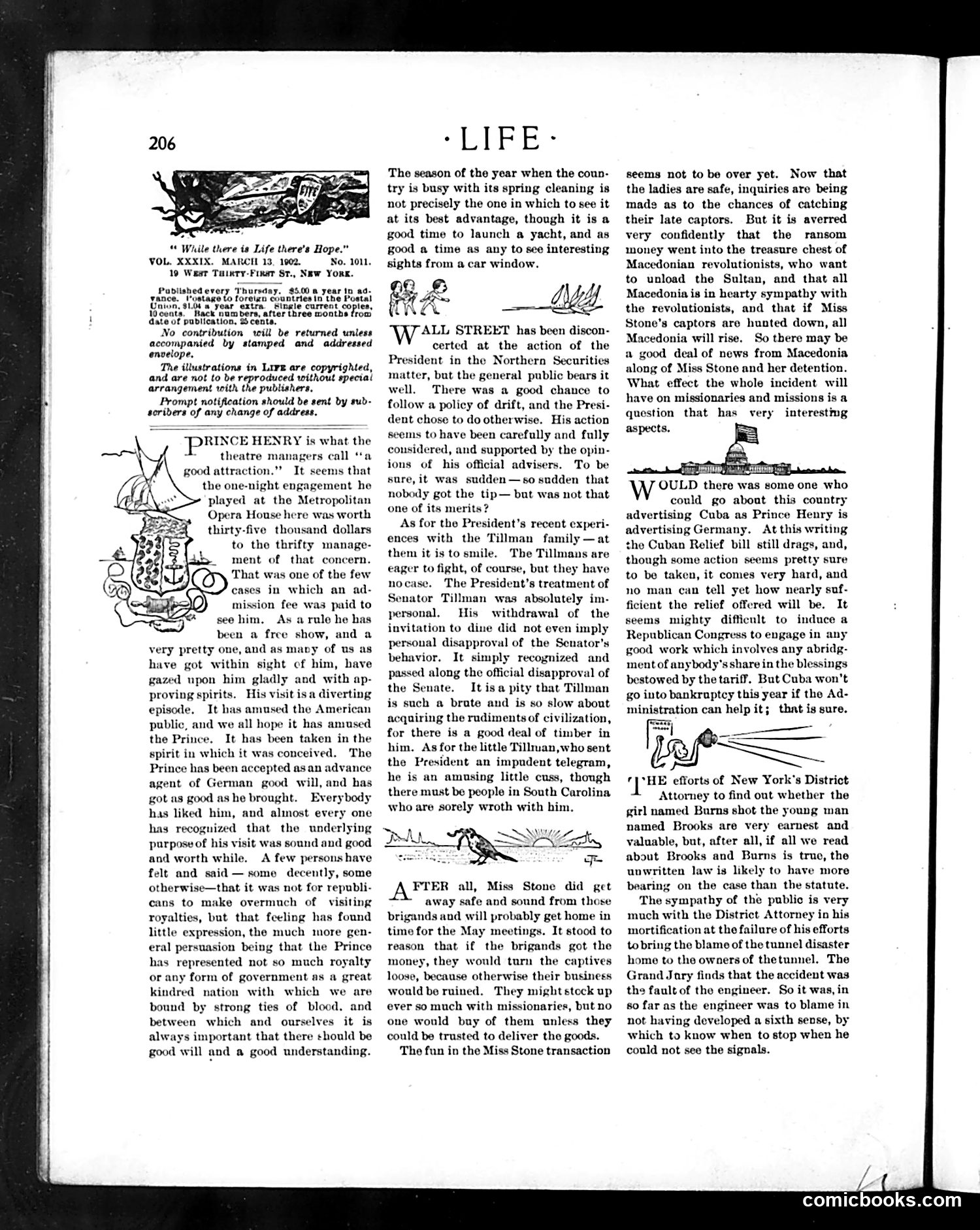
This page contains editorial commentary rather than a cartoon. The main illustration shows a theatrical mask/emblem, likely representing Life's satirical voice. The text discusses: 1. **Prince Henry of Prussia's visit** to America, praising his diplomatic conduct and noting his visit to the Metropolitan Opera House's thirty-five thousand dollar thrift management case. 2. **President Roosevelt's sudden dismissal of Senator Tillman**, which the writer supports as properly handled, though noting the Tillmans had been friendly with the President's family. 3. **The Miss Stone ransoming situation** — a missionary held captive in Macedonia whose release the text suggests involved brigands potentially becoming revolutionaries. 4. **The Barnes v. Brooks District Attorney case**, discussing an engineer's negligence in a canal disaster. The tone is broadly supportive of Roosevelt's decisiveness while commentary remains gossipy about social/diplomatic matters.
📄 Transcribed text from this page (OCR, searchable)
Machine-transcribed from the original scan — historical spelling and the odd misread are preserved.
“ While there is Life there’s Hop. VOL, XXXIX. MARCI 13, 1902, No. 1011. 19 Waar Tuixty-Finst St., New YORK. Pablished every Thursday. $5.00 a year tp ad. vance. Irostage (0 foreign countries in the Postal 1.00a year extra. single current copten, Weeats. Back numbers, after three months from date of publication, % cente, No contribution will be returned unless accompanied by stamped and addressed envelope. The illustrations in Live are copyrighted, and are not to be reproduced without special arrangement with the publishers. Prompt notification should be sent by sub- soribera of any change of address. RINCE HENRY is what the theatre managers call ‘a good attraction.’’ It seems that the one-night engagement he played at the Metropolitan Opera House here was worth thirty-five thousand dollars to the thrifty manage- ment of that concern. That was one of the few cases in which an ad- mission fee was paid to see him. As a rule he has been a free show, and a very pretty one, and as many of us as have got within sight of him, have gazed upon him gladly and with ap- proving spirits. His visit is a diverting episode. It has amused the American public, and we all hope it has amused the Prin It has been taken in the spirit in which it was conceived. The Prince has been accepted as an advance agent of German good will, and has got as good as he brought. Everybody has liked him, and almost every one has recognized that the underlying purpose of his visit was sound and good and worth while. A few persons have felt and said — some decently, some otherwise—that it was not for republi- cans to make overmuch of visiting royalties, but that feeling has found little expression, the much more gen- eral persuasion being that the Prince has represented not so much royalty or any form of government as a great kindred nation with which we are bound by strong ties of blood, and between which and ourselves it is alw mportant that there should be good will and a good understanding. - LIFE. - The season of the year when the coun- try is busy with its spring cleaning is not precisely the one in which to see it at its best advantage, though it is a good time to launch a yacht, and as good a time as any to see interesting sights from a car window. 12 & y) fe dy ALL STREET has been discon- certed at the action of the President in the Northern Securities matter, but the general public bears it well. There was a good chance to follow a policy of drift, and the Presi- dent chose to do otherwise. His action seems to have been carefully and fully considered, and supported by the opin- ions of his official advisers. To be sure, it was sudden—so sudden that nobody got the tip— but was not that one of its merits? As for the President’s recent experi- ences with the Tillman family —at them it is tosmile. The Tillmans are eager to fight, of course, but they have nocase. The President's treatment of Senator Tillman was absolutely im- personal, His withdrawal of the invitation to dine did not even imply personal disapproval of the Senator's behavior. It simply recognized and passed along the official disapproval of the Senate. It isa pity that Tillman is such a brate and is so slow about acquiring the rudiments of civilization, for there is a good deal of timber in him. As for the little Tillman,who sent the President an impudent telegram, he is an amusing little cuss, though there must be people in South Carolina who are sorely wroth with him. oa FTER all, Miss Stone did get away safe and sound from those brigands and will probably get home in time for the May meetings. It stood to reason that if the brigands got the money, they would turn the captives loose, because otherwise their business would be ruined. They might stock up ever so much with missionaries, but no one would buy of them unless they could be trusted to deliver the goods. The fun in the Miss Stone transaction seems not to be over yet. Now that the ladies are safe, inquiries are being made as to the chances of catching their late captors. But it is averred very confidently that the ransom money went into the treasure chest of Macedonian revolutionists, who want to unload the Sultan, and that all Macedonia is in hearty sympathy with the revolutionists, and that if Miss Stone's captors are hunted down, all Macedonia will rise. So there may be a good deal of news from Macedonia along of Miss Stone and her detention. What effect the whole incident will have on missionaries and missions is a question that has very interestmg could go about this country advertising Cuba as Prince Henry is advertising Germany, At this writing the Cuban Relief bill still drags, and, though some action seems pretty sure to be taken, it comes very hard, and no man can tell yet how nearly suf- ficient the relief offered will be. It seems mighty difficult to induce a Republican Congress to engage in any good work which involves any abridg- mentof anybody’sshare in the blessings bestowed by the tariff, But Cuba won't go into bankruptcy this year if the Ad- ministration can help it; that is sure. ‘| °HE efforts of New York's District Attorney to find out whether the girl named Burns shot the young man named Brooks are very earnest and valuable, but, after all, if all we read about Brooks and Burns is true, the unwritten law is likely to have more bearing on the case than the statute. The sympathy of the public is very much with the District Attorney in his mortification at the failure of his efforts to bring the blame of the tunnel disaster home to the owners of thetunnel, The Grand Jary finds that the accident was the fault of the engineer. So it was, in so far as the engineer was to blame in not having developed a sixth sense, by which to know when to stop when he could not see the signals. comicbooks.com