
Life, 1902-03-13 · page 12 of 20
Life — March 13, 1902 — page 12: what you’re looking at
What you’re looking at
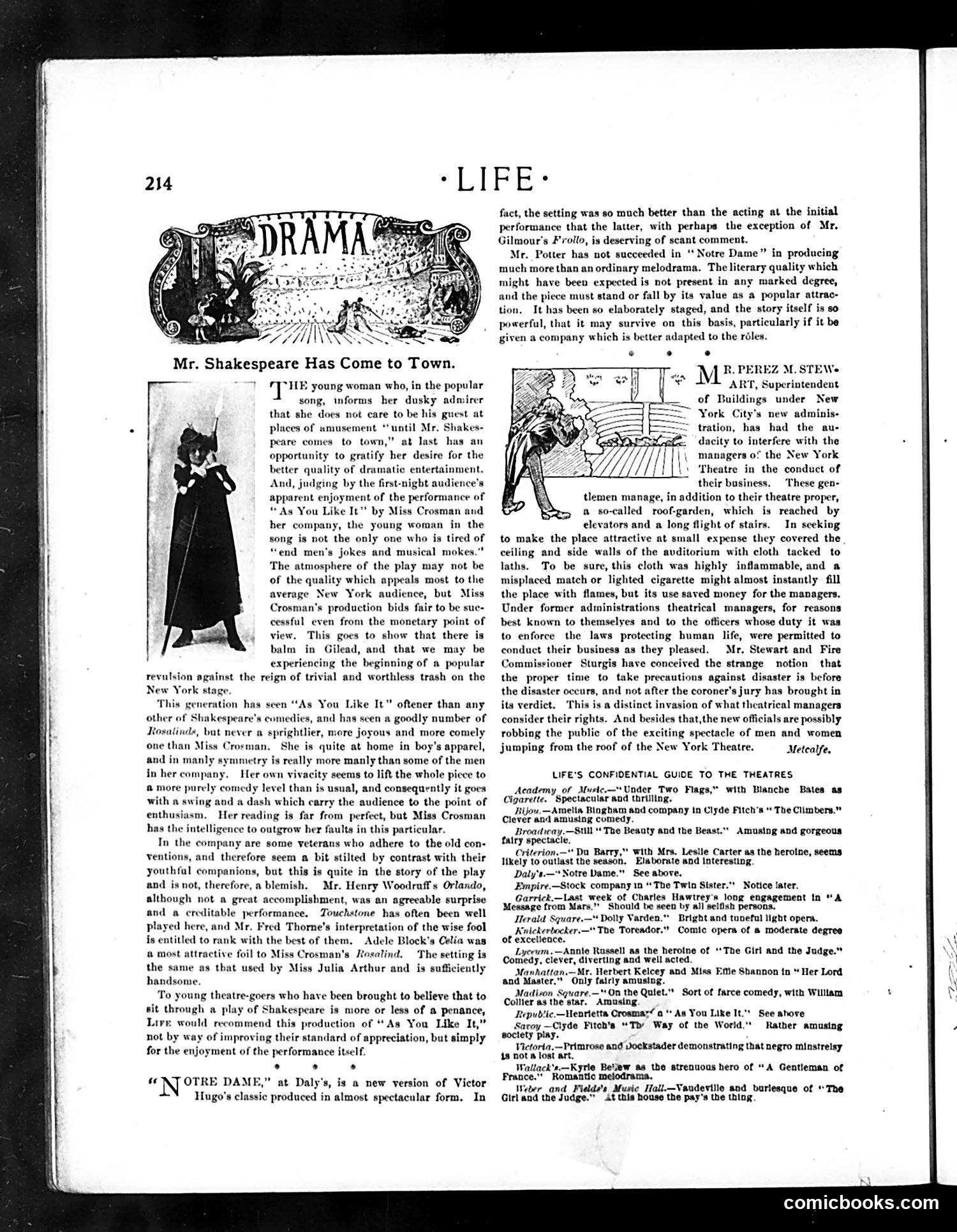
This page from *Life* magazine's "Drama" section reviews theatrical performances, primarily discussing Miss Crosman's performance in "As You Like It" by Shakespeare. The illustrated figure appears to be an actress in period costume, likely representing Miss Crosman in the play. The text argues that while the play itself is somewhat trivial and the staging ordinary, Crosman's talent elevates the production. The review suggests the actress brings sophistication to what would otherwise be unremarkable entertainment. The page also includes theatrical notices for other productions and a separate article about Mr. Perez M. Stewart discussing building code enforcement at New York theaters—a practical, non-satirical piece about theater safety regulations. There is no political satire evident on this page; it represents standard theater criticism and industry reporting.
📄 Transcribed text from this page (OCR, searchable)
Machine-transcribed from the original scan — historical spelling and the odd misread are preserved.
“LIFE: Mr. Shakespeare Has Come to Town. = | TP HE young woman who, in the popular song, informs her dusky admirer that she does not care to be his guest at places of umusement “until Mr. Shakes- peare comes to town,” at last has an opportunity to gratify her desire for the better quality of dramatic entertainment. And, judging by the first-night audience's Apparent enjoyment of the performance of “As You Like It” by Miss Crosman and her company, the young woman in the song is not the only one who is tired of “end men’s jokes and musical mokes.” The atmosphere of the play may not be of the quality which appeals most to the average New York audience, but Miss Crosman’s production bids fair to be suc- cessful even from the monetary point of This goes to show that there is balm in Gilead, and that we may be experiencing the beginning of a popular revulsion against the reign of trivial and worthless trash on the New York stage. This generation has seen ‘As You Like It” oftener than any other of Shakespeare's comedies, and has seen a goodly number of Rosatints, but never a sprightlier, more joyous and more comely one than Miss Crosman, She is quite at home in boy's apparel, and in manly symmetry is really more manly than some of the men in her company. Her own vivacity seems to lift the whole piece to @ more purely comedy level than is usual, and consequently it goes with a swing and a dash which carry the audience to the point of enthusiasm. Her reading is far from perfect, but Miss Crosman has the intelligence to outgrow her faults in this particular. In the company are some veterans who adhere to the old con- ventions, and therefore seem a bit stilted by contrast with their youthful companions, but this is quite in the story of the play and isnot, therefore, a blemish. Mr. Henry Woodraff's Orlando, although not a gi accomplishment, was an agreeable surprise and a creditable performance, Touchstone has often been well played here, and Mr. Fred Thorne’s interpretation of the wise fool is entitled to rank with the best of them, Adele Block's Celia was @ most attractive foil to Miss Crosman's Rosalind, The setting is the same as that used by Miss Julia Arthur and is sufficiently handsome. To young theatre-goers who have been brought to believe that to sit through a play of Shakespeare is more or less of a penance, Live. would recommend this production of “As You Like It,” not by way of improving their standard of appreciation, but simply for the enjoyment of the performance itself. . ° . XJ OTRE DAME,” at Daly's, is a new version of Victor Hugo's classic produced in almost spectacular form. In view, i fact, the setting was so much better than the acting at the initial performance that the latter, with perhaps the exception of Mr. Gilmour's Frolio, is deserving of scant comment. Mr. Potter has not succeeded in ‘Notre Dame” in producing much more than an ordinary melodrama. The literary quality which might have been expected is not present in any marked degree, and the piece must stand or fall by its value as a popular attrac- tion. It has been so elaborately staged, and the story itself is so powerful, that it may survive on this basis, particularly if it be given a company which is better adapted to the réles. . . in M R. PEREZ M. STEWe =: ART, Superintendent of Buildings under New York City’s new adminis- tration, has had the au- dacity to interfere with the managers of the New York ‘Theatre in the conduct of their business, These gen- tlemen manage, in addition to their theatre proper, a so-called roof-garden, which is reached by elevators and a long flight of stairs. In seeking to make the place attractive at small expense they covered the ceiling and side walls of the auditorium with cloth tacked to laths. To be sure, this cloth was highly inflammable, and a misplaced match or lighted cigarette might almost instantly fill the place with flames, but its use saved money for the managers. Under former administrations theatrical managers, for reasons best known to themselyes and to the officers whose duty it was to enforce the laws protecting human life, were permitted to conduct their business as they pleased. Mr. Stewart and Fire Commissioner Sturgis have conceived the strange notion that the proper time to take precautions against disaster is before the disaster occurs, and not after the coroner's jury has brought in its verdict. This is a distinct invasion of what theatrical managers consider their rights. And besides that,the new officials are possibly robbing the public of the exciting spectacle of men and women jumping from the roof of the New York Theatre. Metealfe, LIFE'S CONFIDENTIAL GUIDE TO THE THEATRES Academy of Musie.—" Under Two Flags,” with Blanche Bates as Cigarette. Speciacular and thrilling. Riou.—Amelta Bingham and company in Clyde Fitch's “The Climbers.” Clever and amusing comedy, Broadway.—Sull “ The Beauty and the Beast." Amusing and gorgeous fairy spectacle, Criterion.—" Du Barry," with Mra, Lesile Carter as the heroine, seems likely to outiast the season, Elaborate and Interesting. Daty's.—* Notre Dame." See above. Empire.—Stock company 1n “The Twin Sister." Notice tater. Garrick.—Last week of Charles Hawtrey’s long engagement in “A Message from Mars." Should be seen by all selfish persons. Herald Square.— Dolly Varden." Bright and tuneful light opera. Knickertocker.—" The Toreador.” Comic opera of @ moderate degree of excellence. Lycrum.—Annie Rassell as the heroine of “The Girl and the Judge.” Comedy, clever, diverting and well acted. Manhattan.—Mr. Herbert Kelcey and Miss EMe Shannon tn “Her Lord and Master.” Only fairly amusing. Madison Square.—"On the Quiet." Sort of farce comedy, with William Colller as the star. Amusing. Republic. —Henrietta Crosmazé a‘ As You Like It." See above Saroy —Ciyde Fitch's “Thy Way of the World." Rather amusing soctety play. Victorta.—Primrose and Dockstader demonstrating that negro minstrelsy ts not a lost art. Wallack's.—Kyrle Belew as the strenuous hero of “A Gentleman of France.” Romantic melodrama. Weber and Fielde’s Music Hall.—Vaudeville and bariesque of “The Girl and the Judge." At this house the pay's the thing. comicbooks.com