
A complete issue · 20 pages · 1902
Life — February 6, 1902
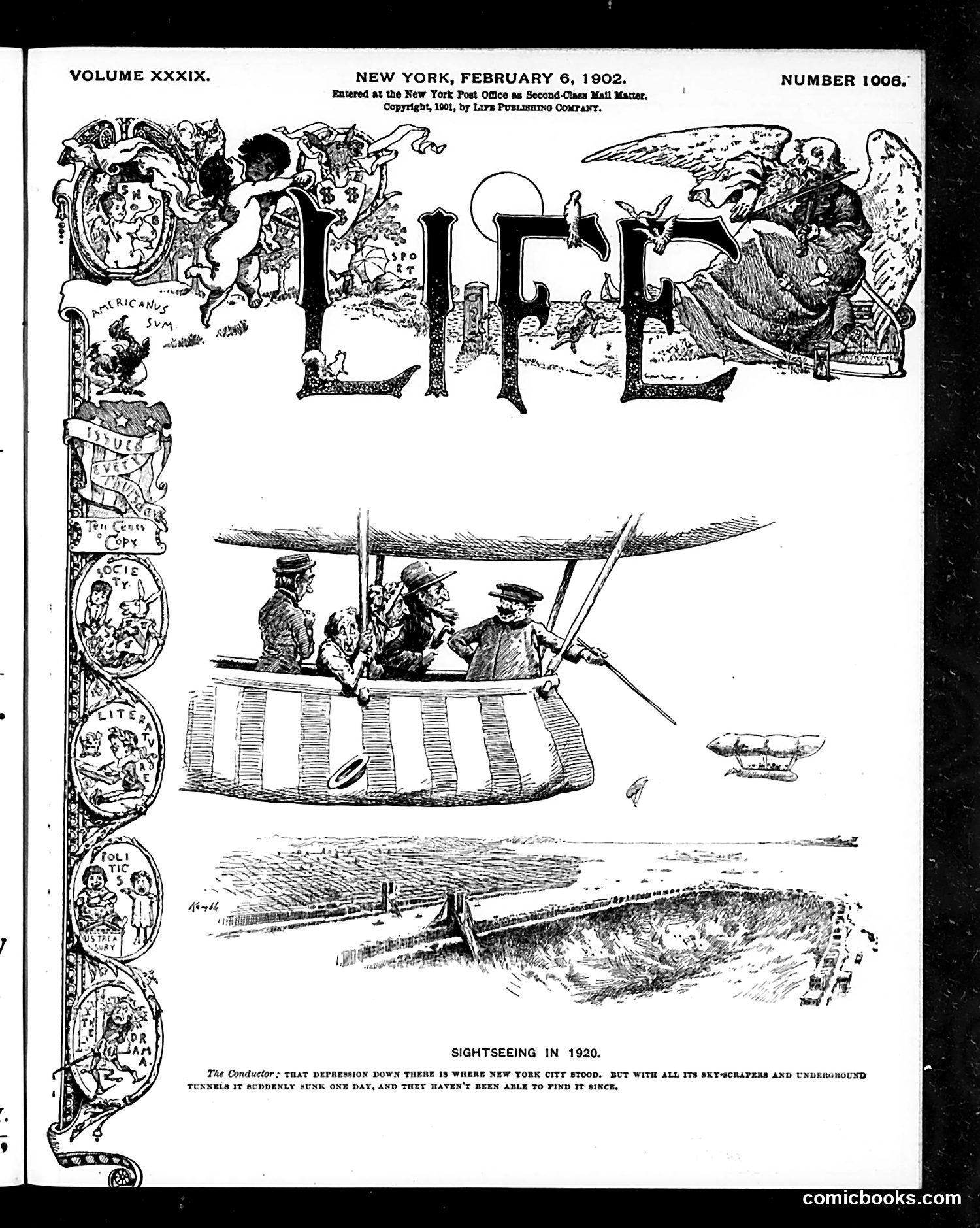
This satirical cartoon imagines future tourism in 1920, depicting visitors in a boat viewing the **ruins of New York City**—specifically where skyscrapers once stood. The conductor's caption explains: depression will destroy the city, and though New York will eventually rebuild with new skyscrapers and underground tunnels, they suddenly disappear, leaving tourists sightseeing among empty ruins. The satire critiques **turn-of-the-century anxieties** about economic cycles and urban instability. The 1902 publication date places this during a period of financial uncertainty, and the cartoon mocks contemporary fears that American prosperity and growth might be temporary. The joke suggests New York's vaunted permanence and modernity could vanish as suddenly as it emerged.
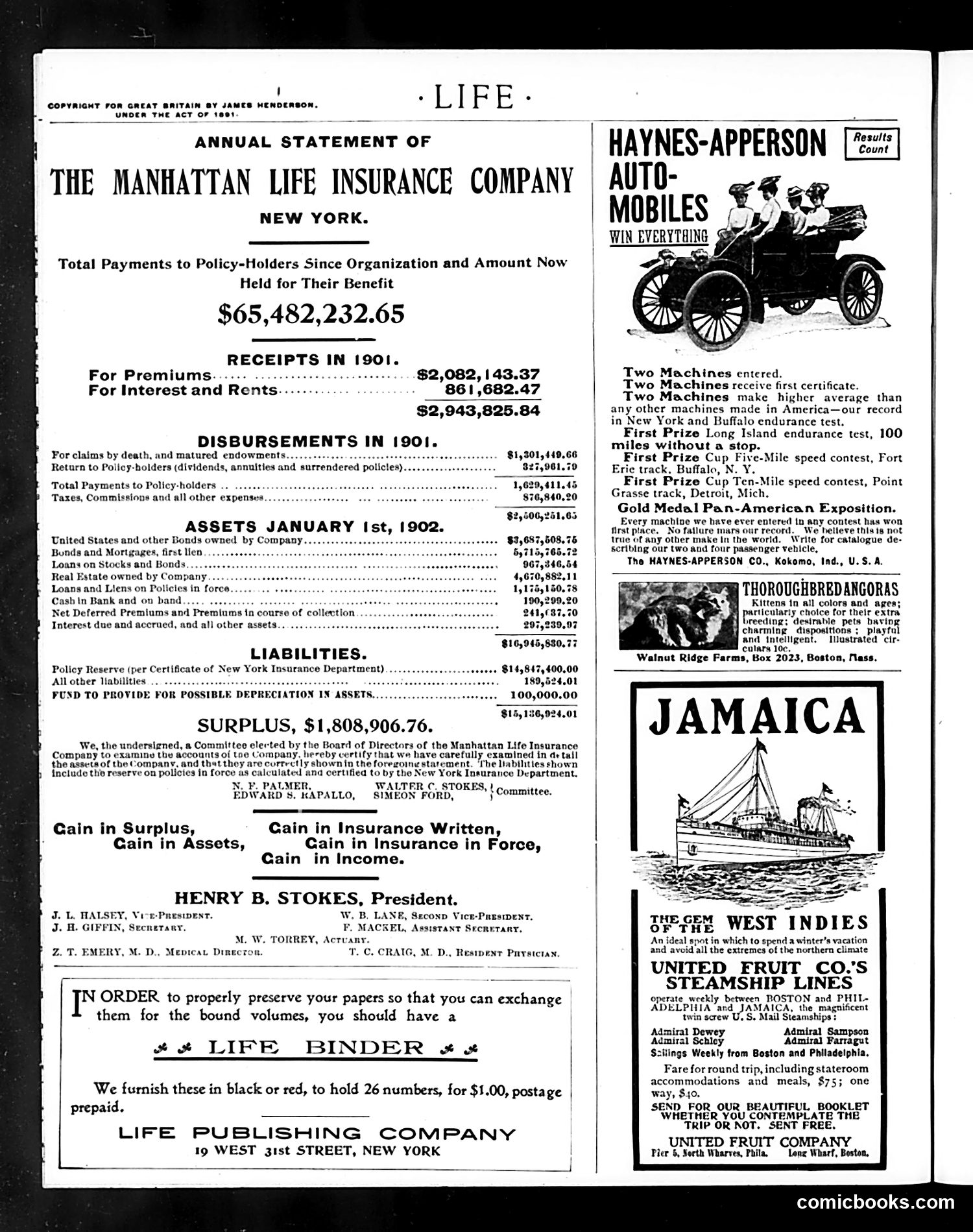
This page is primarily **financial and commercial content**, not political satire. The left side features The Manhattan Life Insurance Company's annual financial statement for 1901, showing assets of $16,945,880.77 and surplus of $1,808,906.76. The right side contains period advertisements: - **Haynes-Apperson Automobiles** promoting early motorcar racing victories - **Thoroughbred Angoras** (goat breeding) - **Jamaica** and **United Fruit Company Steamship Lines** advertising Caribbean travel There is no political cartoon on this page. The content reflects early 1900s commerce: insurance industry growth, emerging automobile technology, and expanding tropical fruit trade—all representing American economic expansion of that era.
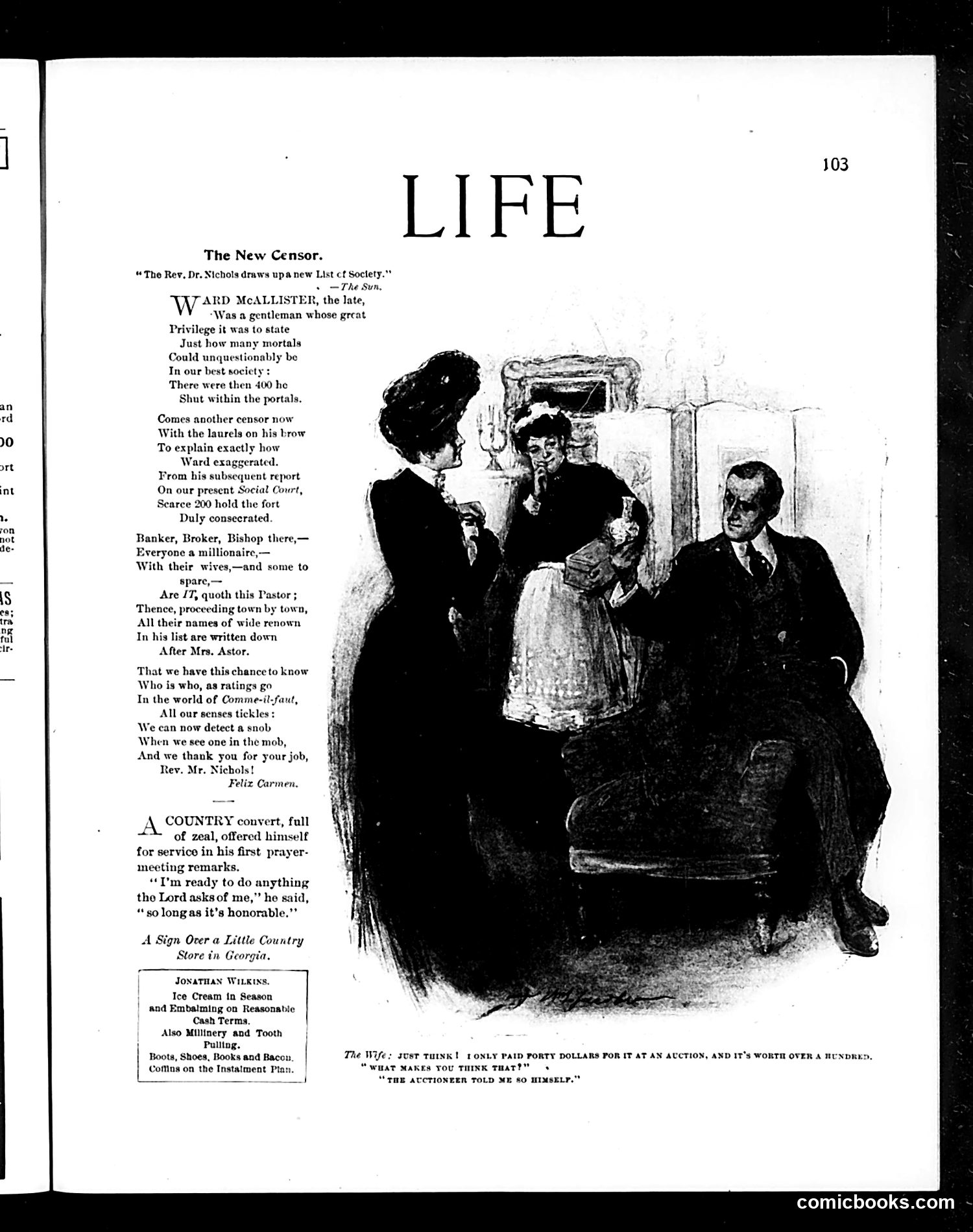
This page satirizes **Rev. Dr. Nichols**, who apparently created a controversial "List of Society" that scandalized high society by publicly naming prominent citizens. **"The New Censor"** poem mocks Nichols for presuming to judge who belongs in "best society"—a privilege traditionally held by social arbiters like Mrs. Astor (the actual arbiter of New York high society). The poem suggests Nichols overstepped by exposing society's hypocrisy: bankers, brokers, and bishops with dubious reputations. **The illustration** shows three men examining what appears to be Nichols's list, with dialogue about its revelations. The satire criticizes both Nichols's presumption and society's pretense—suggesting his "censorship" actually exposed uncomfortable truths about who actually comprises the elite.
This page contains editorial commentary on Philippine independence and Cuban annexation, circa early 1900s. The text discusses President Schurman's views on Filipino readiness for self-government, debating whether three years of fighting has unified the archipelago sufficiently. A secondary article addresses the Sunday liquor question in New York—specifically whether saloons should close on Sundays. The Raines law is mentioned as contentious, with legislators apparently proposing amendments. The decorative illustrations appear to be generic period ornaments rather than specific political caricatures. The page is primarily text-based editorial content addressing contemporary imperial and domestic policy debates, with no identifiable satirical cartoon figures visible.
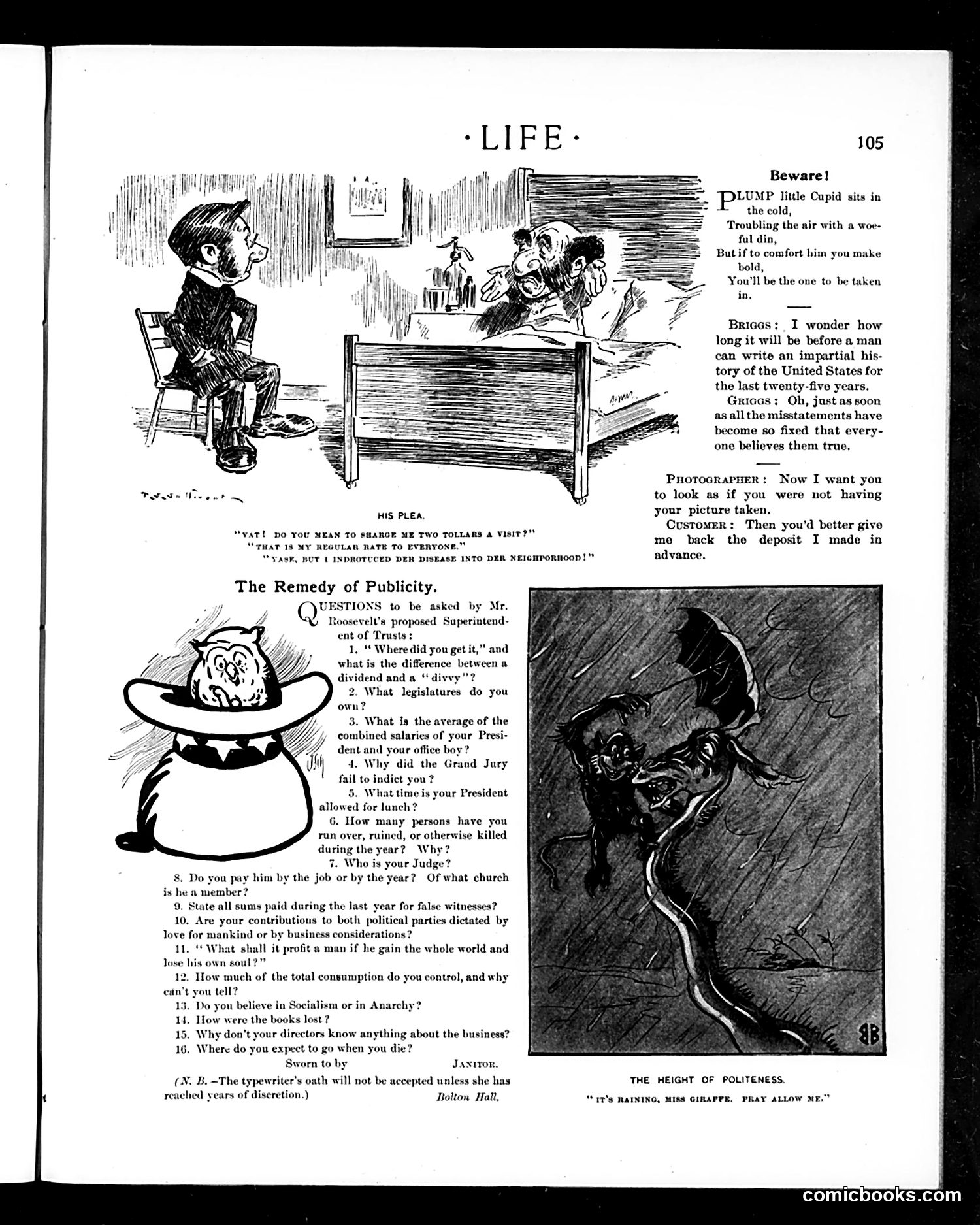
**"His Plea"** (top cartoon): A man seeks a loan from what appears to be a banker or creditor, attempting to negotiate favorable terms. The dialogue mocks the desperate borrower's negotiating position—he asks for a two-dollar loan at a "regular rate" while the creditor responds with an inflated rate, then warns about introducing disease into the neighborhood. This satirizes predatory lending practices and the power imbalance between debtors and financial institutions. **"The Remedy of Publicity"** (center): Lists 16 questions for Roosevelt's proposed "Superintendent of Trusts," grilling them on financial disclosures, ethics, and control of monopolies. The cartoon (a figure in a pot) symbolizes scrutiny of corporate corruption. This reflects Progressive Era demands for government transparency and regulation of large business trusts.
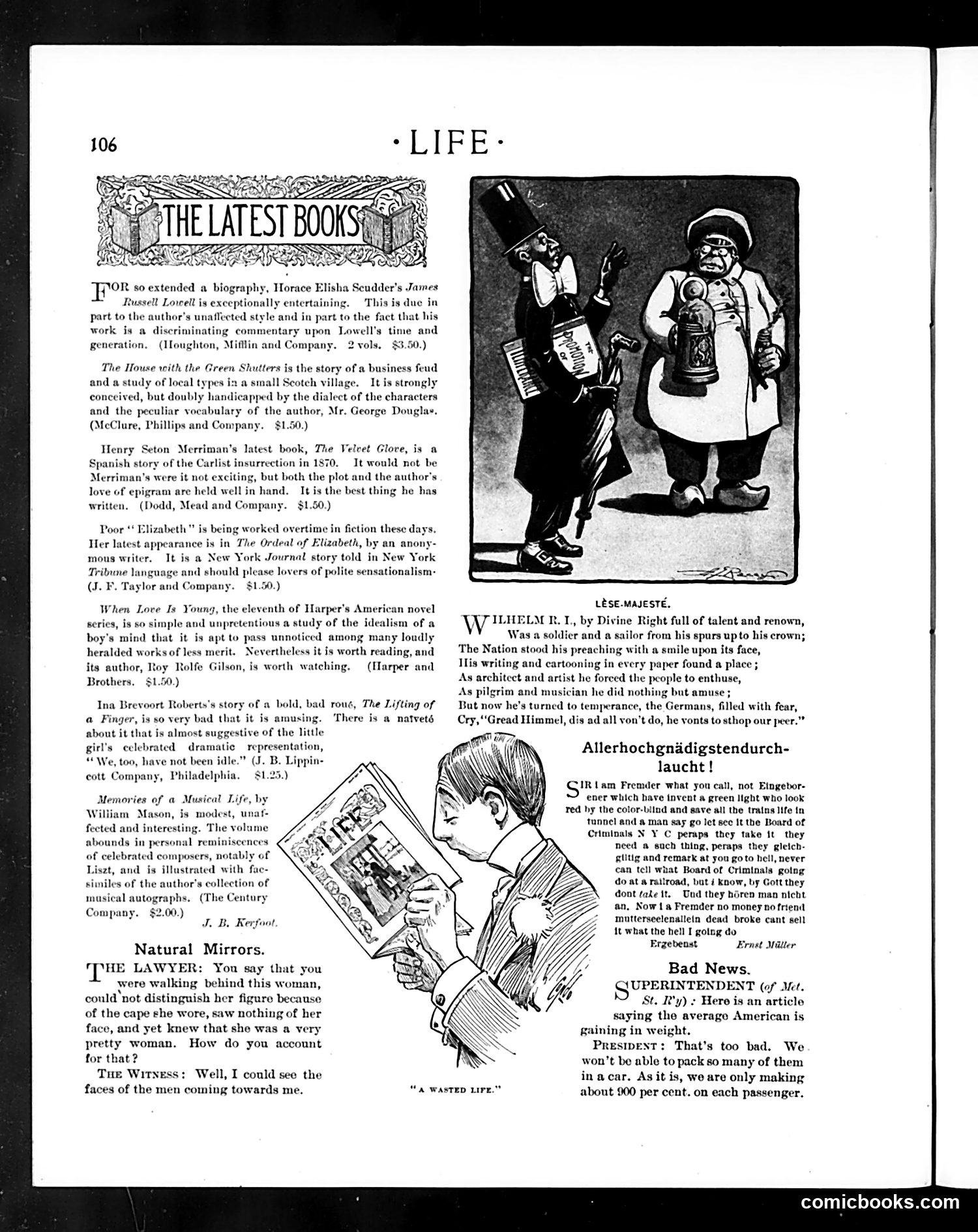
This page contains book reviews and two separate cartoons/jokes. **"Lèse-Majesté" cartoon** (top right): Shows a figure in formal dress being confronted by what appears to be a street vendor or common person. The French title suggests the joke involves violation of dignity or royal/social standing. **"A Wasted Life" illustration** (center): Depicts a boy reading a pulp magazine labeled "LIFE," satirizing how young people waste time on sensational reading material rather than improving themselves. **"Bad News" joke** (bottom): A superintendent reports that American beverages are gaining weight; the president responds they can only pack 300 percent more passengers per car—satirizing overcrowding and the strain on transportation infrastructure, likely post-WWI. The page is primarily book reviews with satirical commentary on contemporary American society.
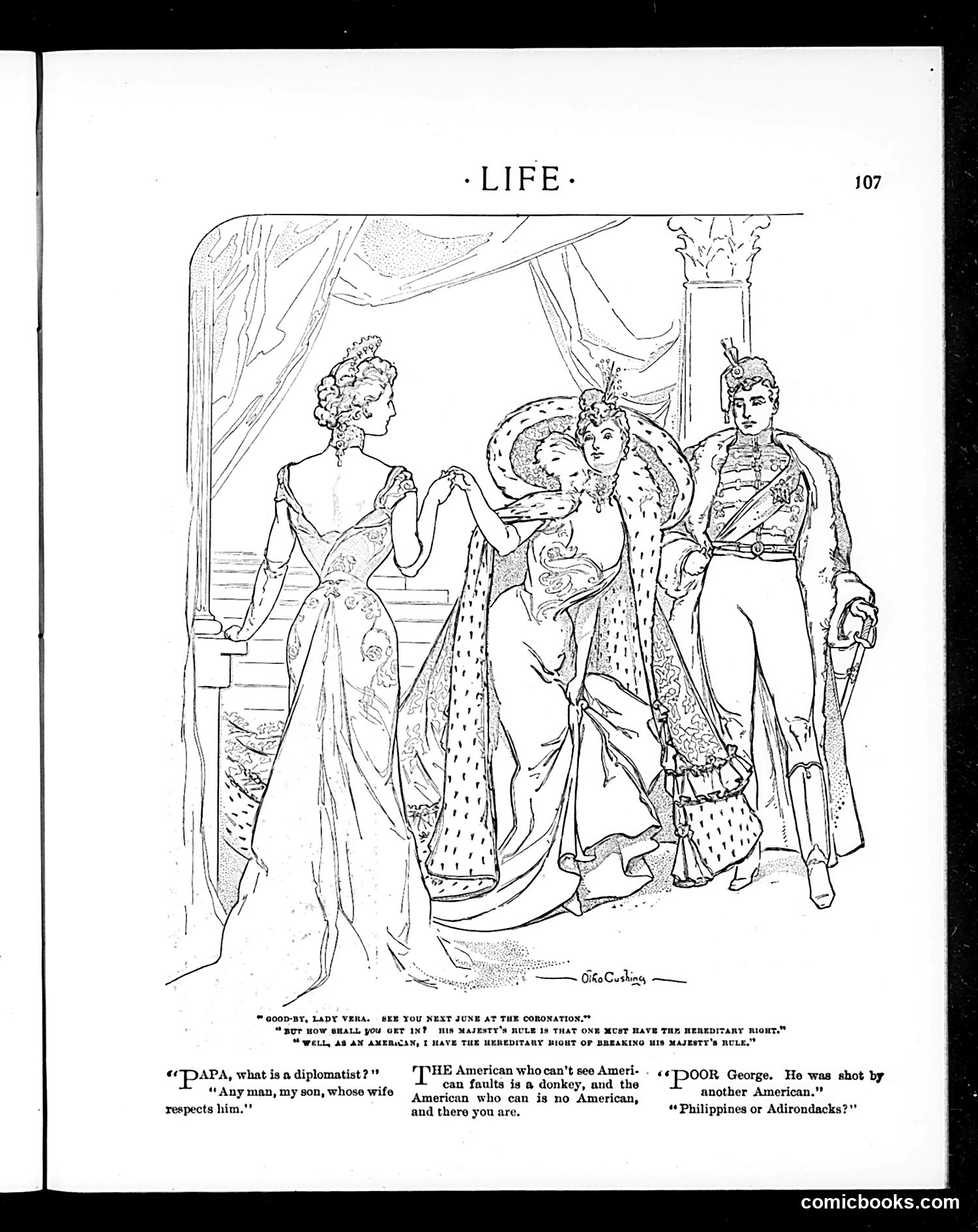
This page contains a satirical illustration depicting aristocratic or royal figures in elegant dress at what appears to be a formal social event. The dialogue jokes center on American identity and class attitudes. The main cartoon mocks diplomatic pretension, with a quip about diplomats being "any man, my son, whose wife respects him." Additional jokes reference Americans criticizing other Americans as "donkeys," and a "Poor George" who was "shot by another American" in the "Philippines or Adirondacks"—likely conflating foreign military conflicts with domestic gun violence to satirize American violence and imperialism. The satire appears to critique upper-class snobbery, American imperialism, and the contradiction between civilized social pretense and crude American behavior.
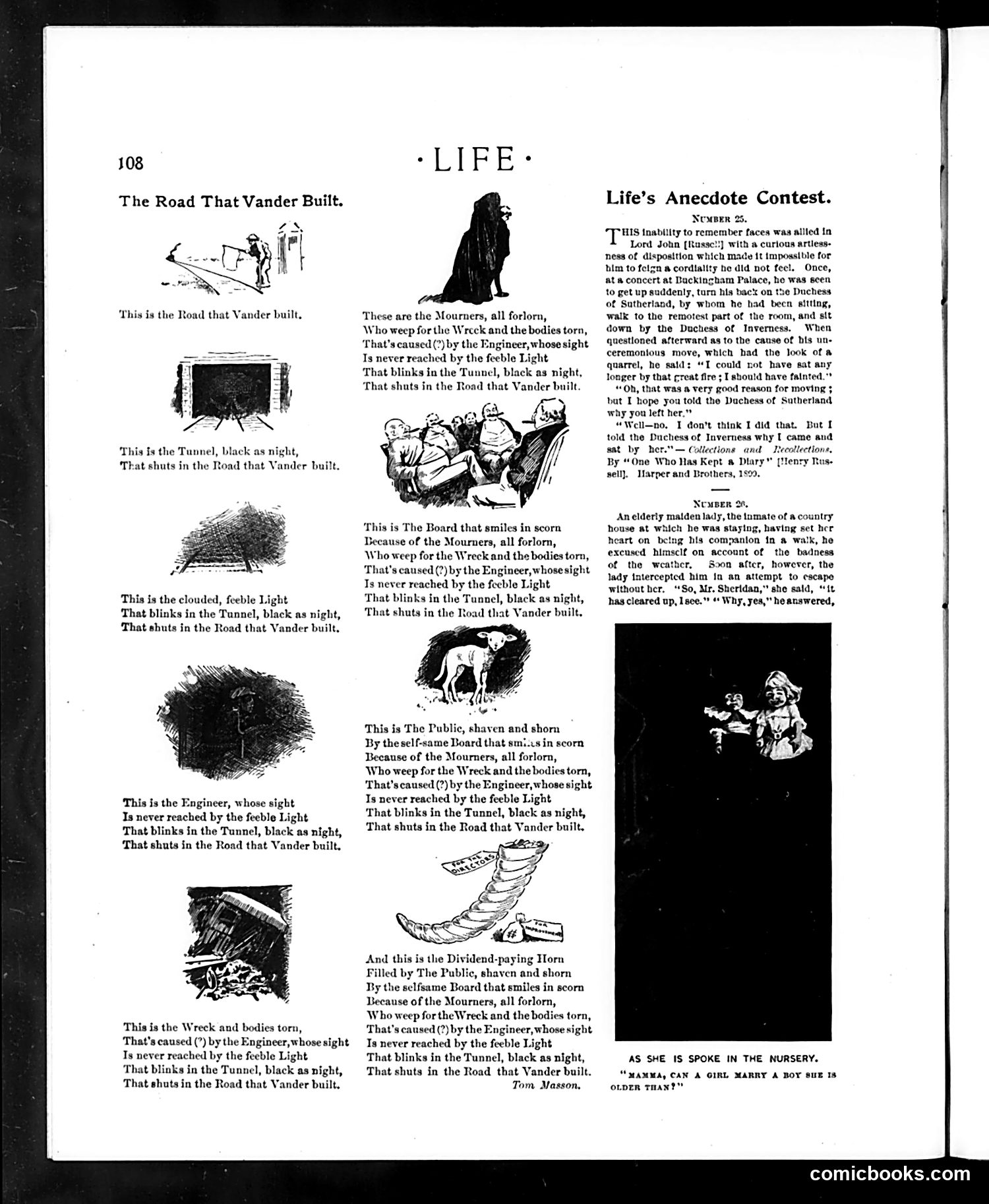
This is a satirical poem structured like "The House That Jack Built," with illustrations of infrastructure elements (road, tunnel, light, engineer, wreck). The repetitive verse structure mocks responsibility and causation in a railway disaster. The satire appears to target **Cornelius Vanderbilt** (referenced as "Vander"), a railroad magnate. The poem traces a chain of blame: the engineer's negligence causes a wreck, enabled by a faulty light in a tunnel, which is part of Vanderbilt's road. By mimicking the nursery rhyme format, the satire suggests that responsibility for the disaster flows upward through the system—ultimately to the railroad owner who prioritizes profit over safety. The right column's "Anecdote Contest" contains unrelated anecdotes.
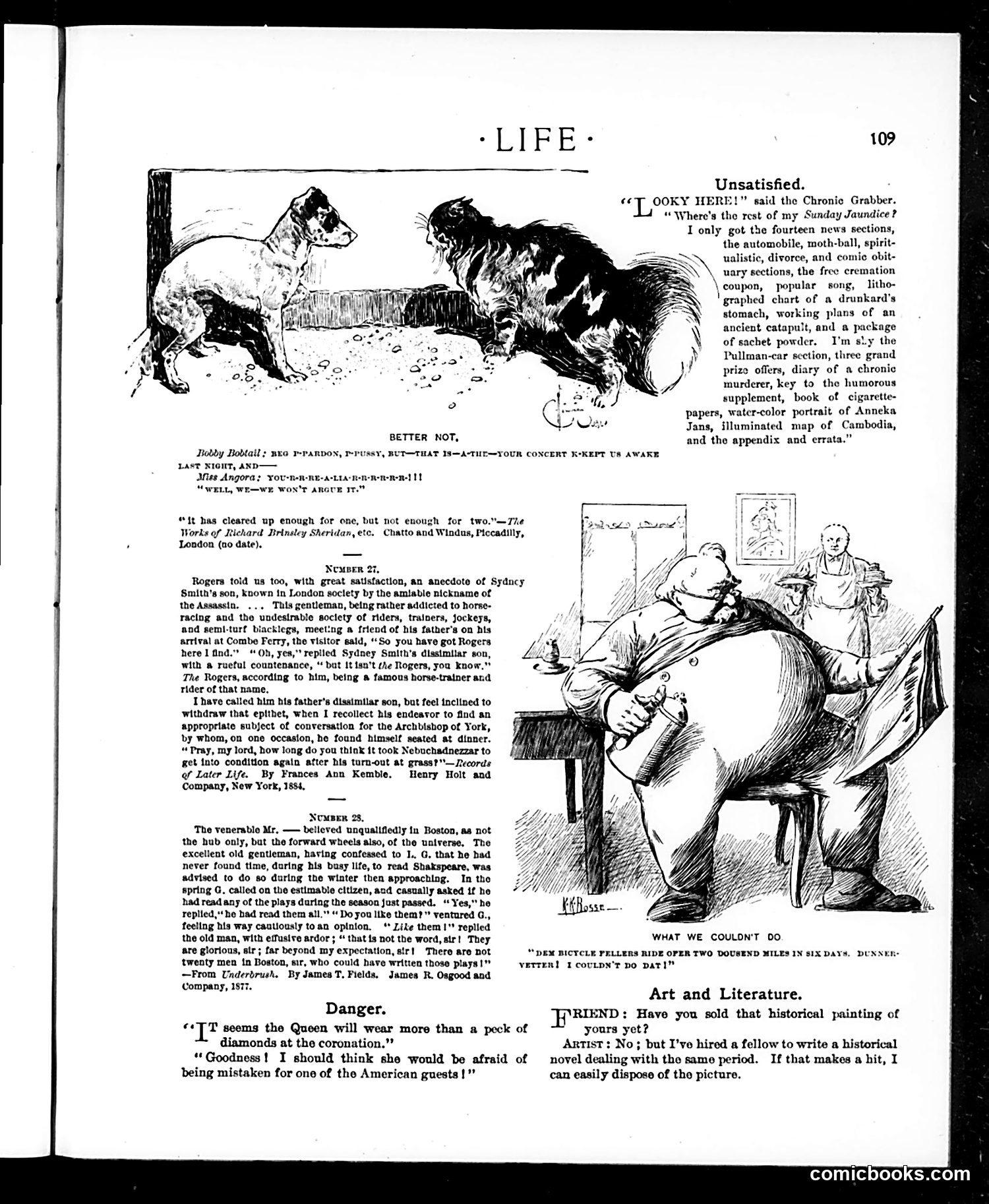
This *Life* magazine page contains three distinct humor pieces: 1. **"Better Not"** (top): A cartoon showing two dogs encountering each other, with text referencing a missed concert and a complaint about Sunday newspapers containing too many specialized sections (automobile, sports, occult, divorce news, etc.). The joke satirizes newspaper bloat. 2. **"Unsatisfied"** (right column): A "Chronic Grabber" complains about receiving only fourteen newspaper sections instead of more, listing absurd items like "key to the humorous supplement" and "water-color portrait of Anneka Jans." 3. **"What We Couldn't Do"** (bottom right): A cartoon about bicycle riders covering two miles in six days—satirizing either poor athletic performance or the absurdity of boasting about minimal achievement. The page also includes a brief dialogue about historical paintings and novels.
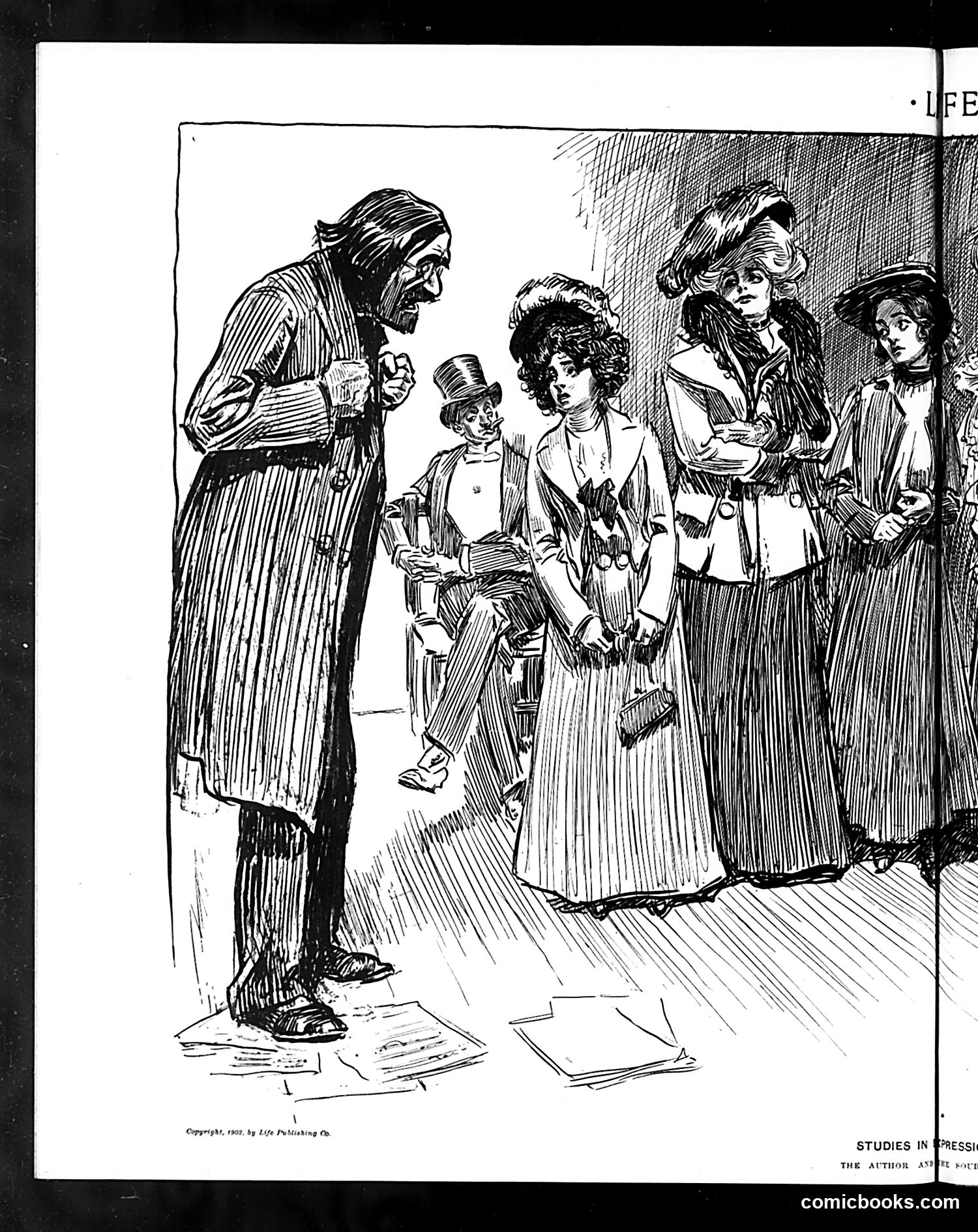
This cartoon depicts what appears to be a publishing or literary scene from early 1900s America. An tall, thin man (likely an editor or publisher) stands addressing a group of five women, with scattered papers on the floor. The women's fashionable hats and clothing suggest they're society figures or aspiring writers. The satire likely targets women's increasing involvement in publishing and literature during this era—a topic Life magazine frequently mocked. The scattered papers and the women's expressions suggest either rejection of their work or condescension from the male authority figure. The cartoon satirizes either women's literary ambitions or perhaps the "New Woman" movement of the period, poking fun at female participation in intellectual/professional spheres traditionally dominated by men.
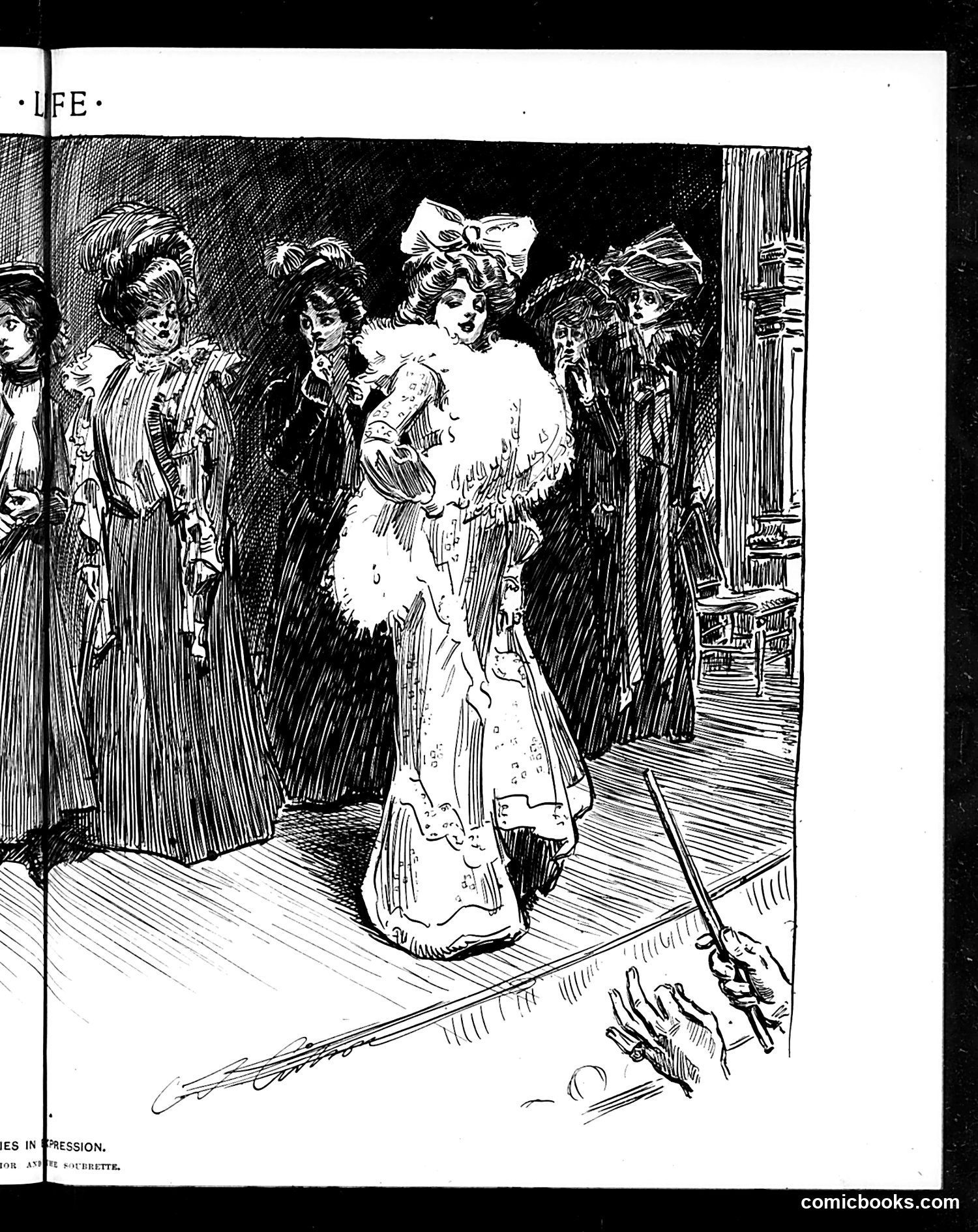
This is a satirical illustration from *Life* magazine showing a social scene of elegantly dressed women and men at what appears to be a formal gathering or salon. The central figure is a woman in a white gown with a prominent bow, positioned prominently among onlookers in dark formal wear. The exact satirical point is unclear from the image alone, though the composition suggests commentary on high society, social pretension, or fashionable culture of the Edwardian era (roughly 1900s-1910s based on the clothing styles). The positioning and the crowd's attention to the central figure may mock either excessive fashion consciousness or social climbing behavior. Without clearer OCR text or a visible caption, the specific targets of satire remain uncertain.
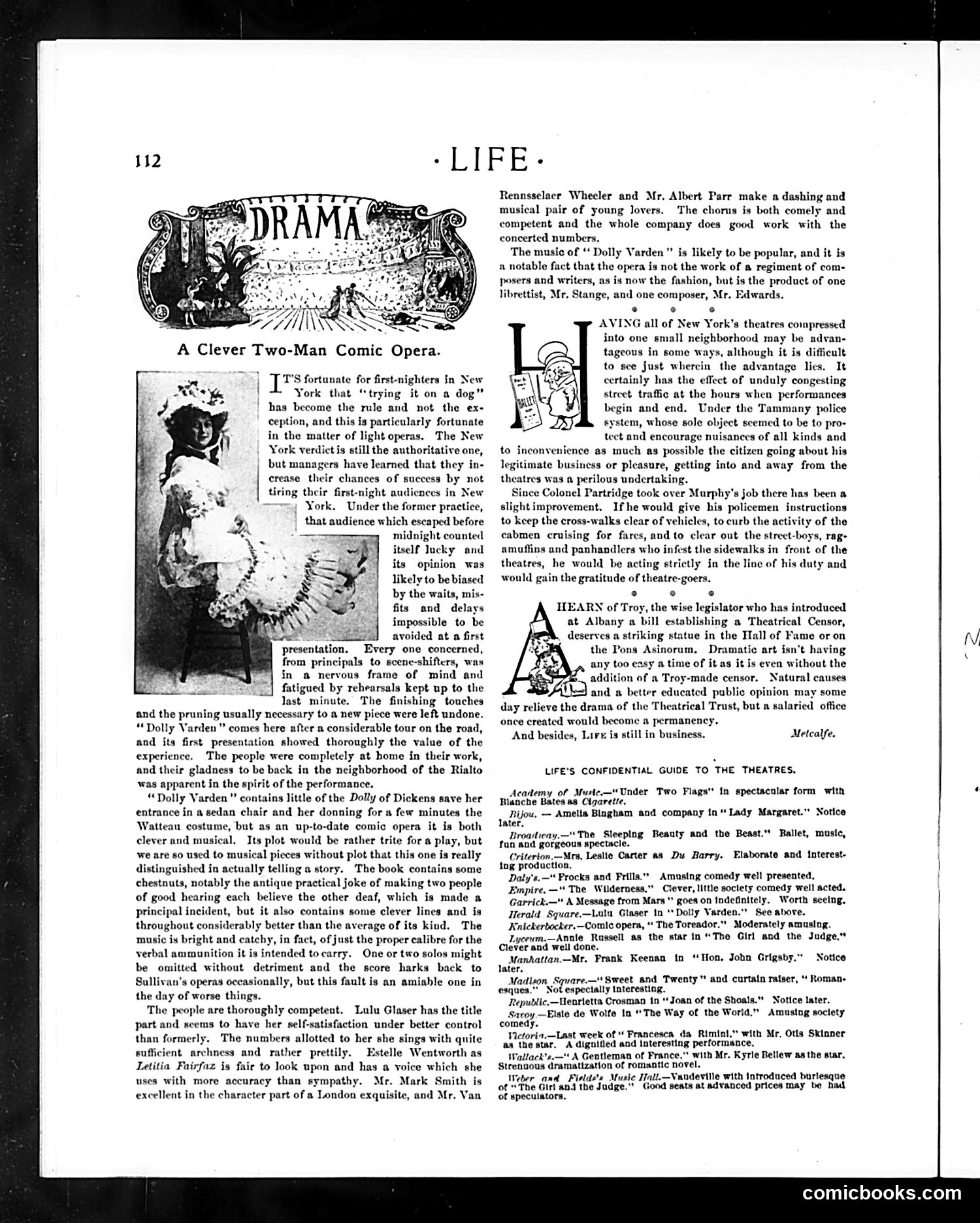
This page reviews "Dolly Varden," described as "A Clever Two-Man Comic Opera." The article praises the opera's musical numbers and the competent performances of Reinschieler Wheeler and Albert Parr as "young lovers." The accompanying illustration shows two male performers in elaborate Victorian-era costumes and makeup, likely depicting a scene from the operetta. The text emphasizes the opera's success with New York audiences and notes that the work was produced by Mr. Stange, credited as both librettist and composer. The review highlights strong performances by the ensemble cast. The page also contains theater reviews in "Life's Confidential Guide to the Theatres," covering various Broadway productions of the era with brief, often witty commentary on their merits.
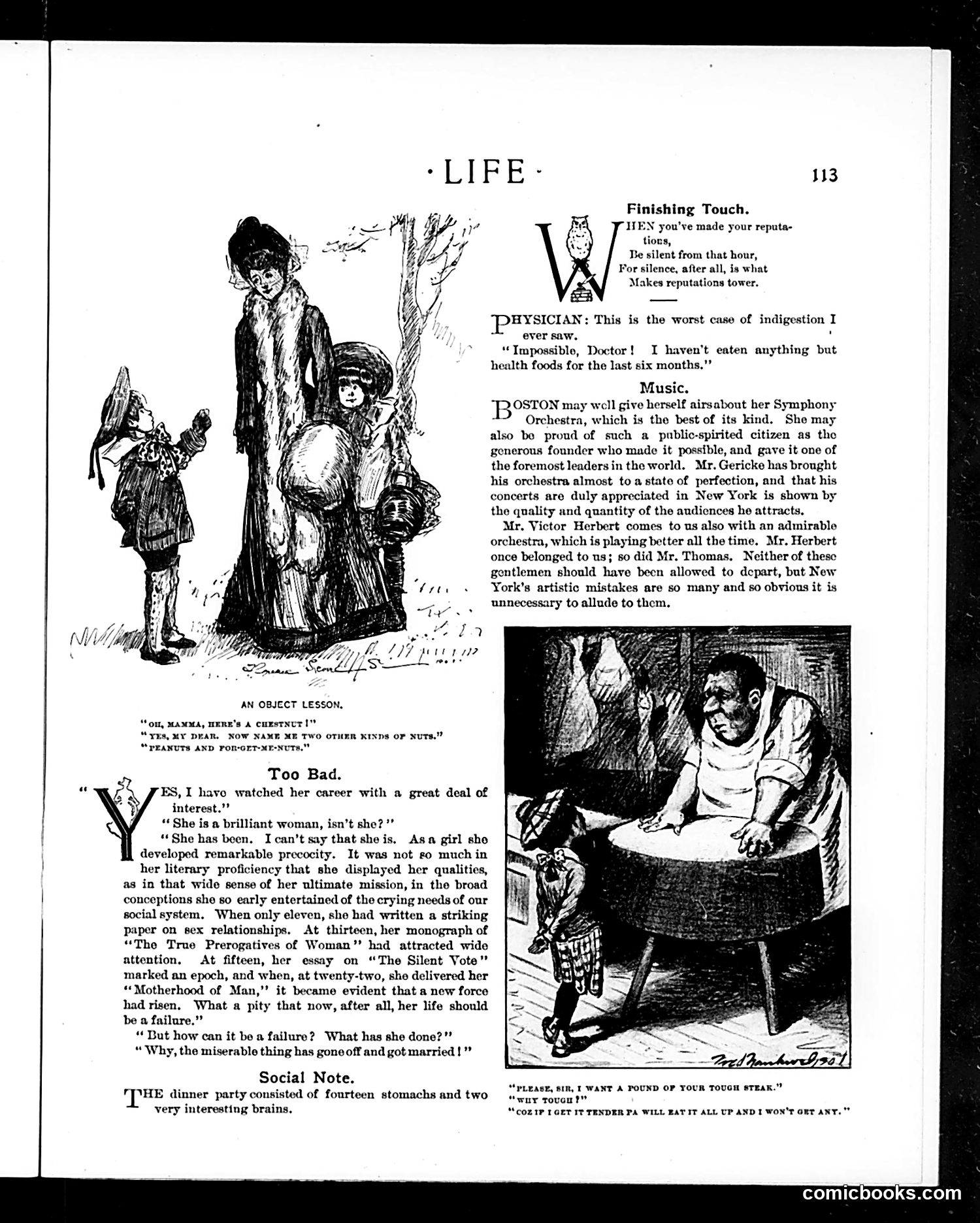
This page contains several satirical pieces targeting social hypocrisy and changing values: **"Too Bad"** mocks the paradox of female education and ambition. A brilliant woman who published feminist essays at eleven, wrote about "The True Prerogatives of Woman" at thirteen, and delivered "Motherhood of Man" at twenty-two is deemed a "failure" simply because she married. The satire exposes how society praised women's intellectual achievements only to devalue them once they fulfilled traditional domestic roles. **"Social Note"** sarcastically reduces a dinner party to "fourteen stomachs and two very interesting brains"—suggesting most attendees were intellectually empty socialites. The **health-food indigestion joke** ridicules the era's health-food fads, implying obsessive dietary restrictions actually cause illness rather than prevent it. The **steak cartoon** depicts working-class humor about tough meat, with someone wanting inedible steak so their father will chew it thoroughly enough to digest. This reflects class-based comedy about poverty and poor nutrition. Overall, Life targets snobbery, women's limited autonomy despite education, fashionable food trends, and class disparities—typical early-20th-century satirical targets.
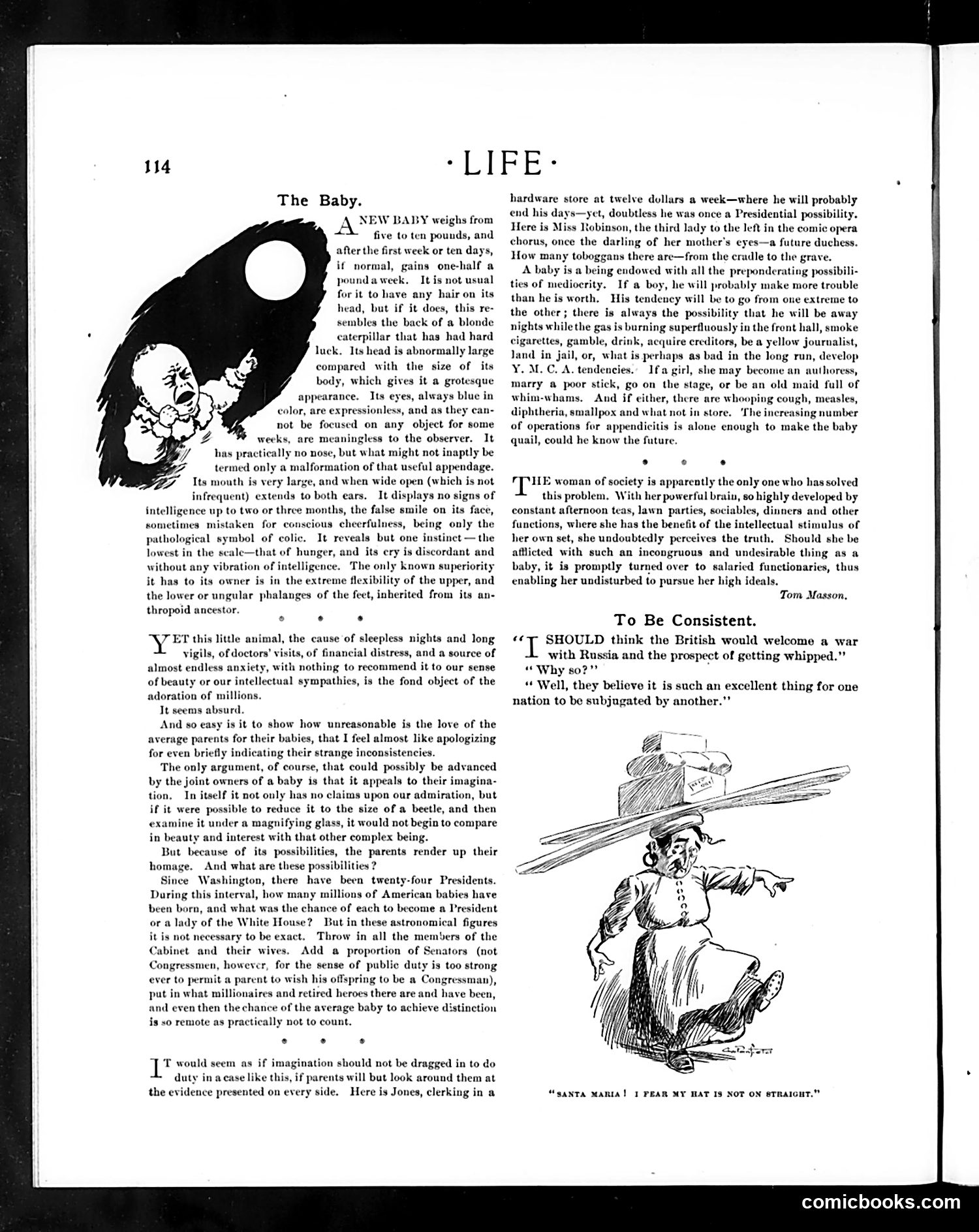
This page satirizes parental delusion about their infants' futures. The article opens with brutally unflattering physical descriptions of newborns—large heads, expressionless eyes, no intelligence, characterized as resembling "a blonde caterpillar that has had hard luck." The satire's target: parents' irrational, intense adoration of these unpromising creatures. The author then mocks parental fantasies by calculating absurdly low odds that any baby will become President, Cabinet member, Senator, or millionaire. He cites "twenty-four Presidents" since Washington and argues statistically that babies face "toboggans...from the cradle to the grave"—metaphorically, their inevitable slide into mediocrity. The accompanying cartoon (right) shows Santa Maria complaining her hat "is not on straight," a lighter visual joke about domestic chaos. The piece's message: parents' hopeful imaginings about their children's potential grandeur are delusional when empirical evidence—Jones the hardware clerk, Miss Robinson the chorus girl—demonstrates most people achieve ordinariness, not distinction.
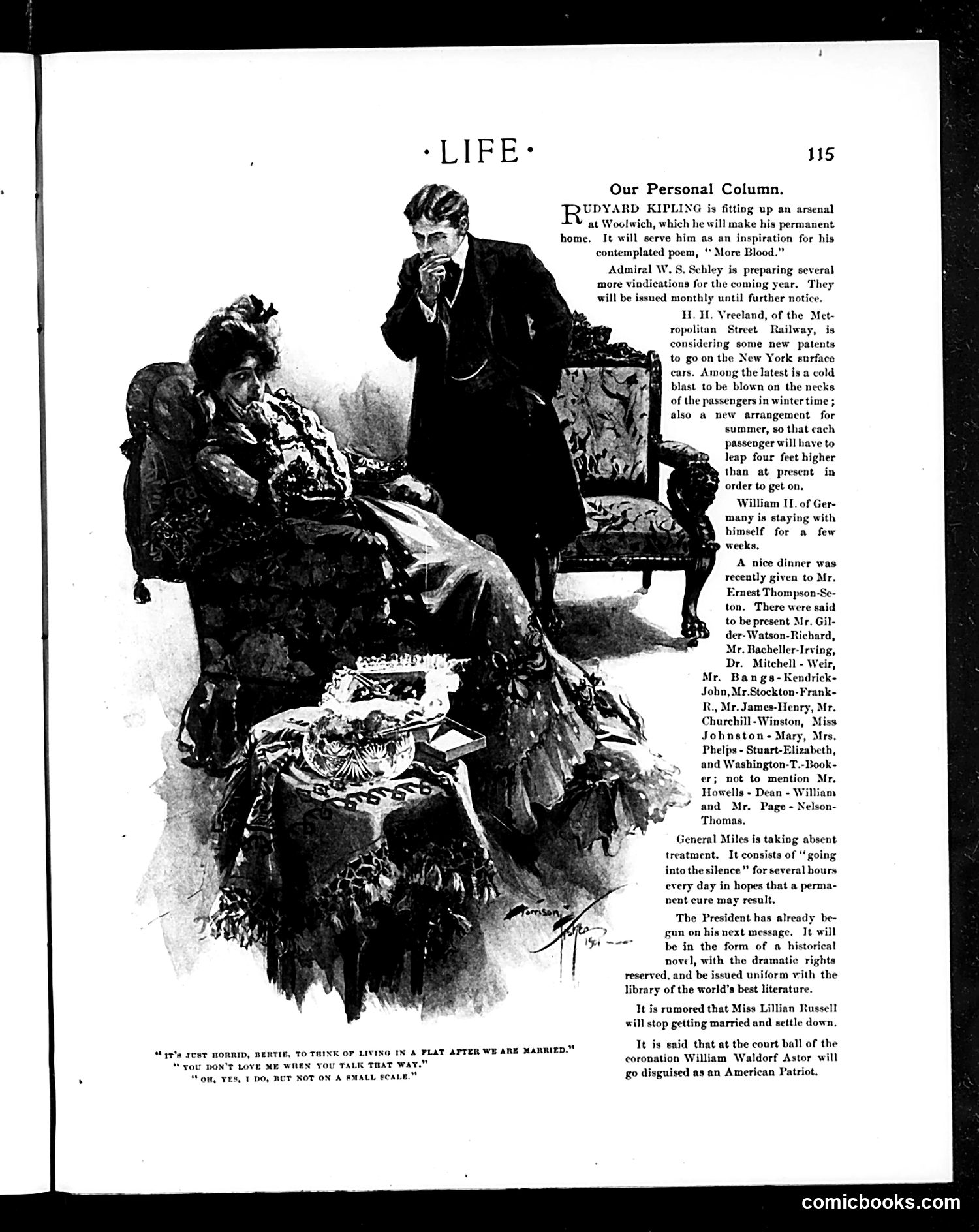
This page from Life magazine (page 115) contains two forms of satire: **The Main Cartoon:** depicts a domestic argument between a husband and wife. The husband complains about living in a flat (apartment) after marriage, saying "I'm just horrified, Bertie, to think of living in a flat after we are married." The wife responds that he doesn't love her when he talks that way, and he replies "Oh yes, I do, but not on a small scale"—a joke about their cramped living quarters limiting his romantic affections. **"Our Personal Column":** consists of brief, satirical gossip-style items mocking contemporary public figures: Rudyard Kipling (setting up an "arsenal" for poetry inspiration), Admiral Schley (issuing repeated "vindications"), transit executive Vreeland (proposing absurd subway improvements), and various celebrities. The humor relies on exaggerated, absurdist descriptions of what these well-known figures are supposedly doing. The satire targets both marital domestic comedy and celebrity culture through ridicule and absurdist humor typical of early 1900s American satire magazines.
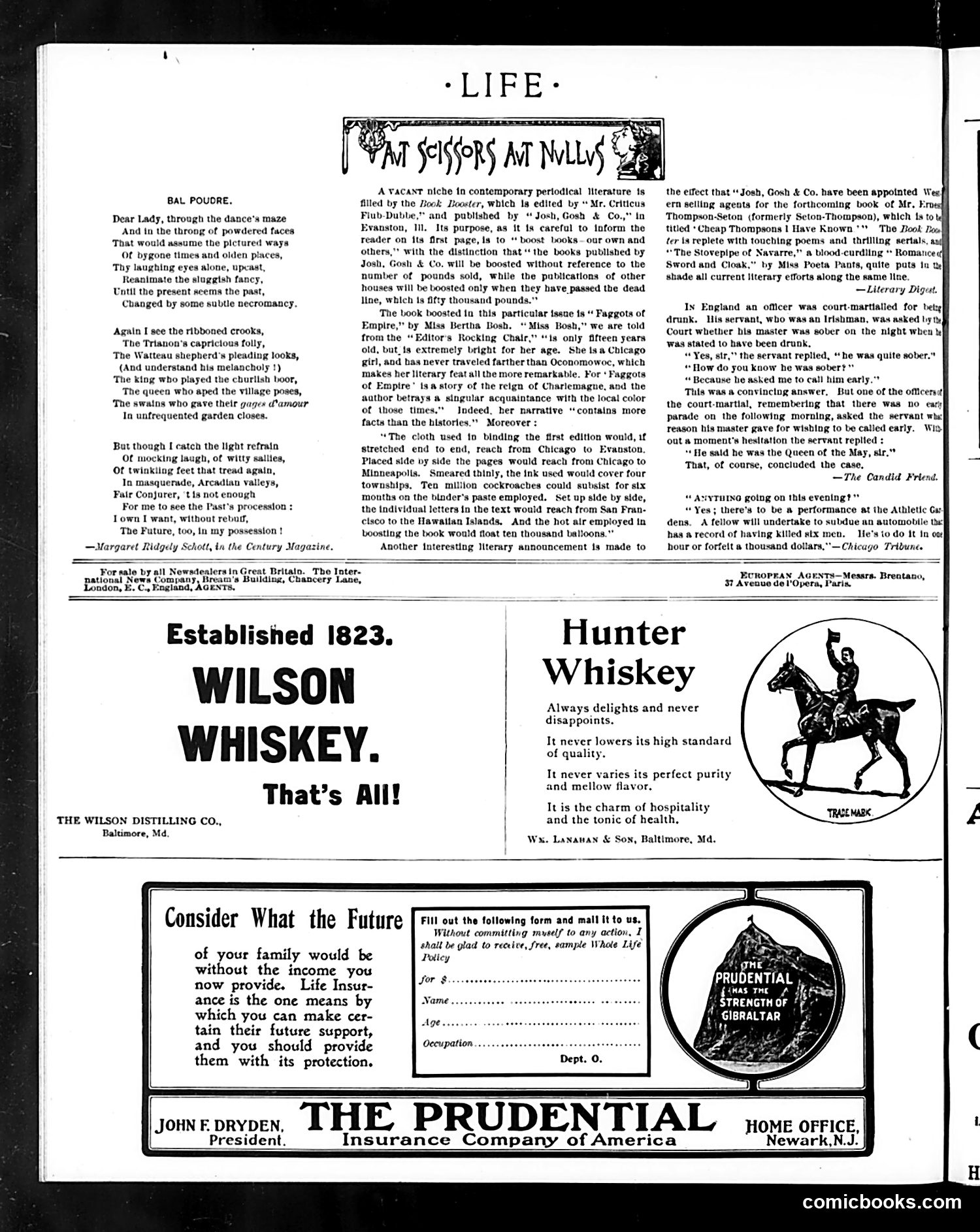
This page is primarily **advertising and literary content**, not political satire. The main feature is a poem by Margaret Ridgely Schott about a masquerade ball, contrasting the romantic past with modern desires. Below sits satirical content mocking the "Book Booster"—a fictional publication edited by "Mr. Criticus Flub-Dubve" that absurdly inflates mediocre books' importance. The satire targets literary hype: a 15-year-old Chicago girl's novel about Charlemagne is promoted with ridiculous hyperbole (ink could cover townships, cloth binding could stretch to Minneapolis). This lampoons contemporary publishing's exaggerated marketing tactics and the literary world's tendency toward puffery. The page also includes period whiskey advertisements (Wilson, Hunter) and a Prudential Insurance ad—typical 1900s-era magazine fare. An anecdote about a drunk officer's Irish servant provides light humor but carries no deeper political meaning.
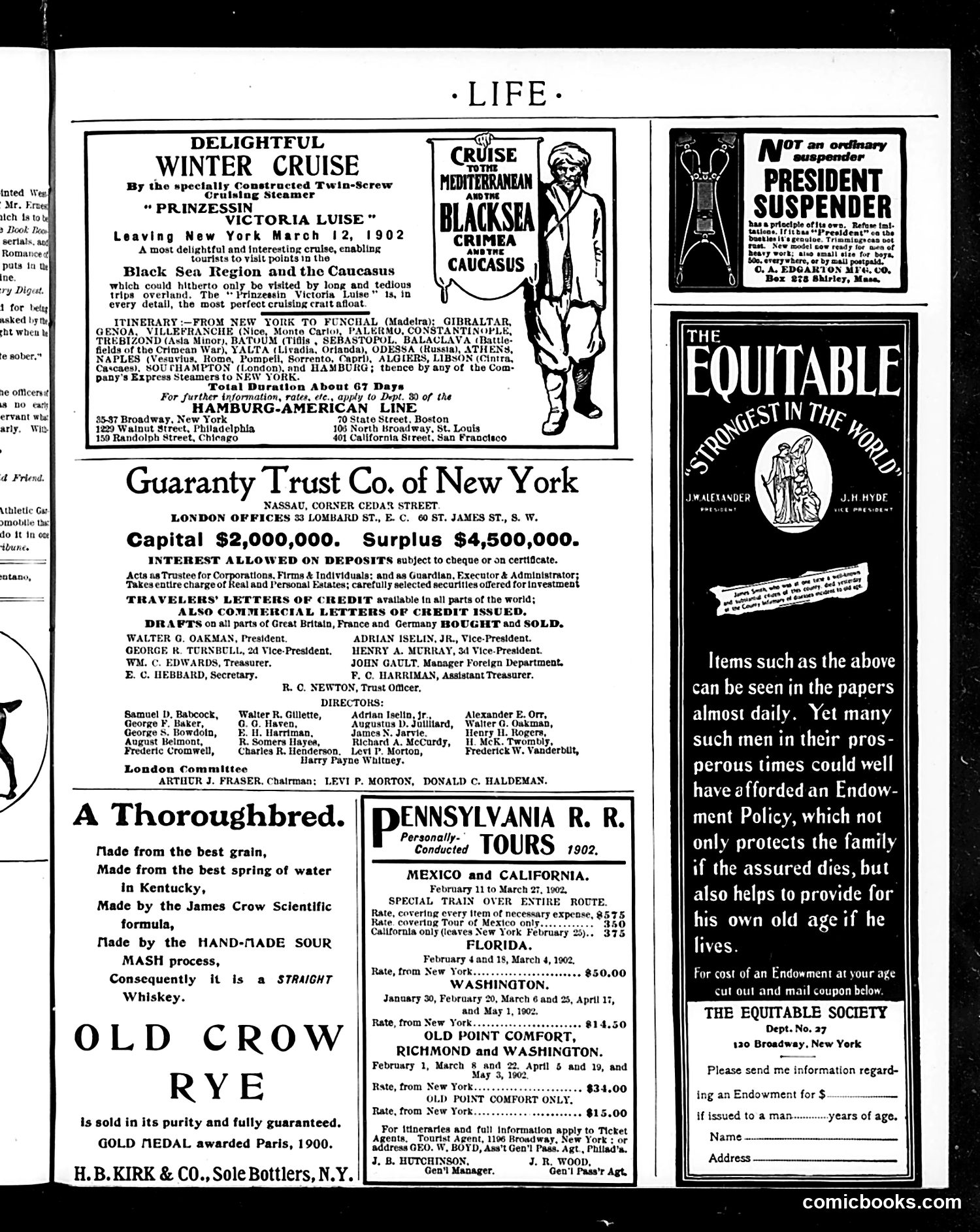
This page is primarily **advertisements and travel notices** from 1902, with one small political cartoon. ## The Cartoon The "President Suspender" cartoon shows a suspender (braces) device labeled as "not an ordinary suspender" — this is **satirizing President Theodore Roosevelt** as a mechanical device. The joke appears to mock Roosevelt as being artificially "constructed" or artificially holding things together, rather than a natural leader. Given Roosevelt's relatively recent accession to the presidency (after McKinley's 1901 assassination), the satire likely questions his legitimacy or suggests he's a manufactured political solution rather than an organic choice. ## Advertisements The page features luxury travel cruises (Black Sea steamship), banking services (Guaranty Trust), railroad tours, and whiskey. These ads target wealthy readers — the audience Life assumed could afford expensive vacations and financial services. The sidebar promoting "Endowment Policy" insurance speaks to Life's satirical point: wealthy men who spend lavishly on luxuries could afford life insurance to protect their families.
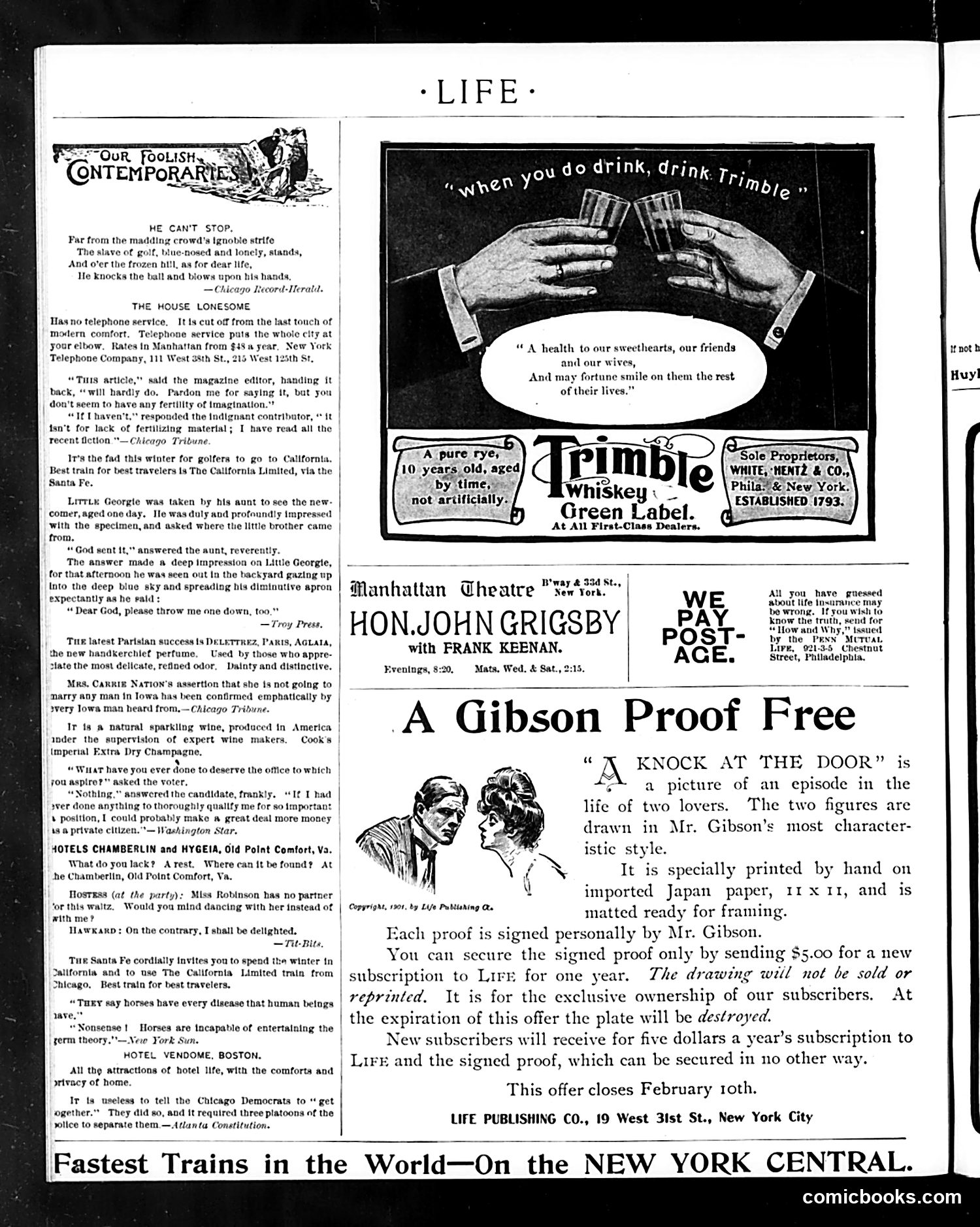
This page from *Life* magazine (appears to be early 1900s) contains satirical commentary on contemporary American life and culture, mixed with advertisements. **Main Satirical Content:** The "Our Foolish Contemporaries" section mocks current social trends: golfers obsessed with the sport even in winter, a house without telephone service (presented as absurdly outdated), and editorial complaints about lack of originality in submitted articles. A joke about a child expecting God to deliver a baby brother like the previous one shows humor at innocent misunderstanding. **Notable Reference:** Carrie Nation (the temperance activist) is mocked for swearing off Iowa men—the joke being that Iowa men universally rejected her claims, suggesting her anti-marriage stance was unnecessary. **Advertisements:** Trimble Whiskey, Manhattan Theatre performances, and various services dominate the page. A prominent Gibson Girl proof offer promotes subscriptions to *Life* magazine itself. The overall tone reflects *Life*'s satirical stance toward modern inconveniences, foolish fads, and social pretensions of the era.
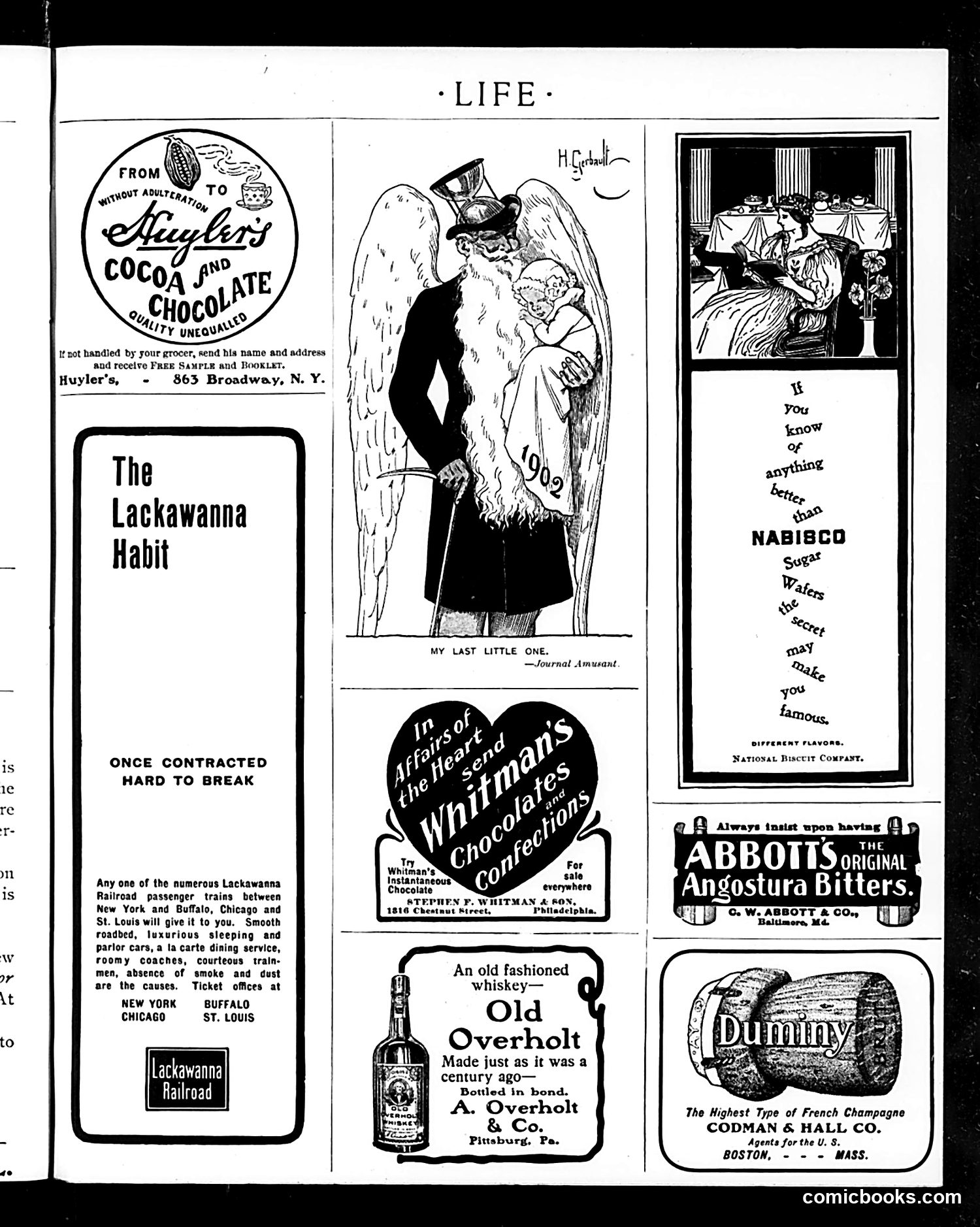
This is primarily an **advertising page** from Life magazine, not a political cartoon. It contains six product advertisements arranged around one satirical illustration. The central cartoon—captioned "My Last Little One" (credited to *Journal Amusant*)—depicts **Death as a skeletal figure in a top hat, holding a baby**, representing infant mortality. This reflects the era's high child death rates and was common satirical imagery of the period. The surrounding ads promote luxury goods typical of early 1900s America: Huyler's cocoa, Lackawanna Railroad (emphasizing comfort and safety), Whitman's chocolates, Old Overholt whiskey, Abbott's Angostura Bitters, and Codman & Hall champagne. The juxtaposition is darkly ironic: the grim reaper illustration sits amid advertisements for consumer goods and leisure travel, creating an unintended commentary on mortality and materialism—though this may be coincidental layout rather than intentional editorial statement.
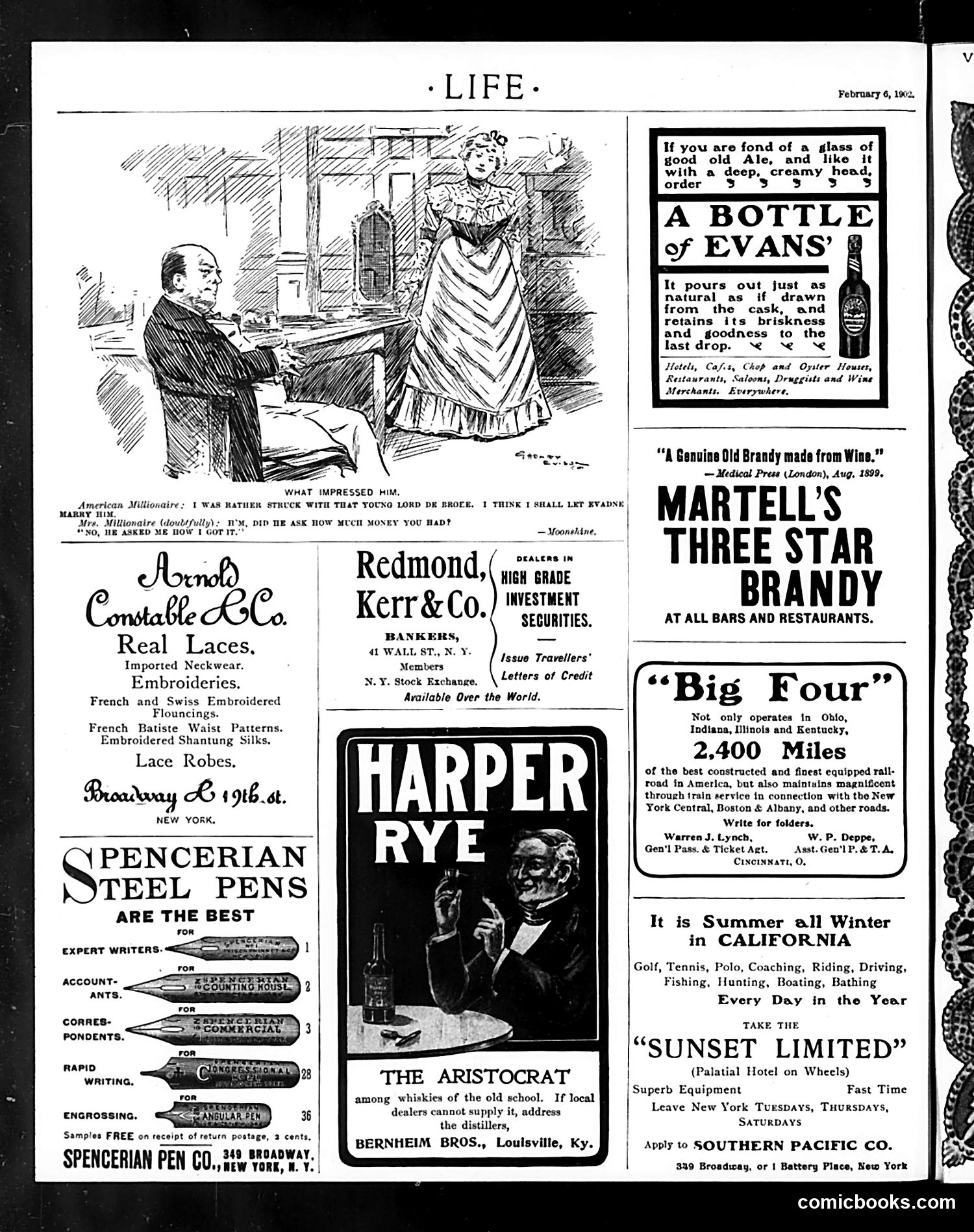
This cartoon satirizes the transatlantic marriage market of the Edwardian era. An American millionaire's wife expresses doubt about a potential match with "Lord de Broke" (a pun suggesting an impoverished British nobleman). The joke hinges on class pretension: the wife assumes the nobleman was interested in her husband's *money*—the typical motive for such marriages. But the lord instead asked how the millionaire *acquired* his wealth, implying he sought to understand the man's character and business acumen rather than simply pursue fortune. The satire cuts both ways: it mocks American wealth as crass and transactional, while simultaneously suggesting the British aristocracy values something deeper than mere dollars. The caption credits "Moonshine," implying this is a fanciful, unrealistic scenario—a nobleman caring about anything but money would indeed be fantasy.