
Life, 1902-02-06 · page 4 of 20
Life — February 6, 1902 — page 4: what you’re looking at
What you’re looking at
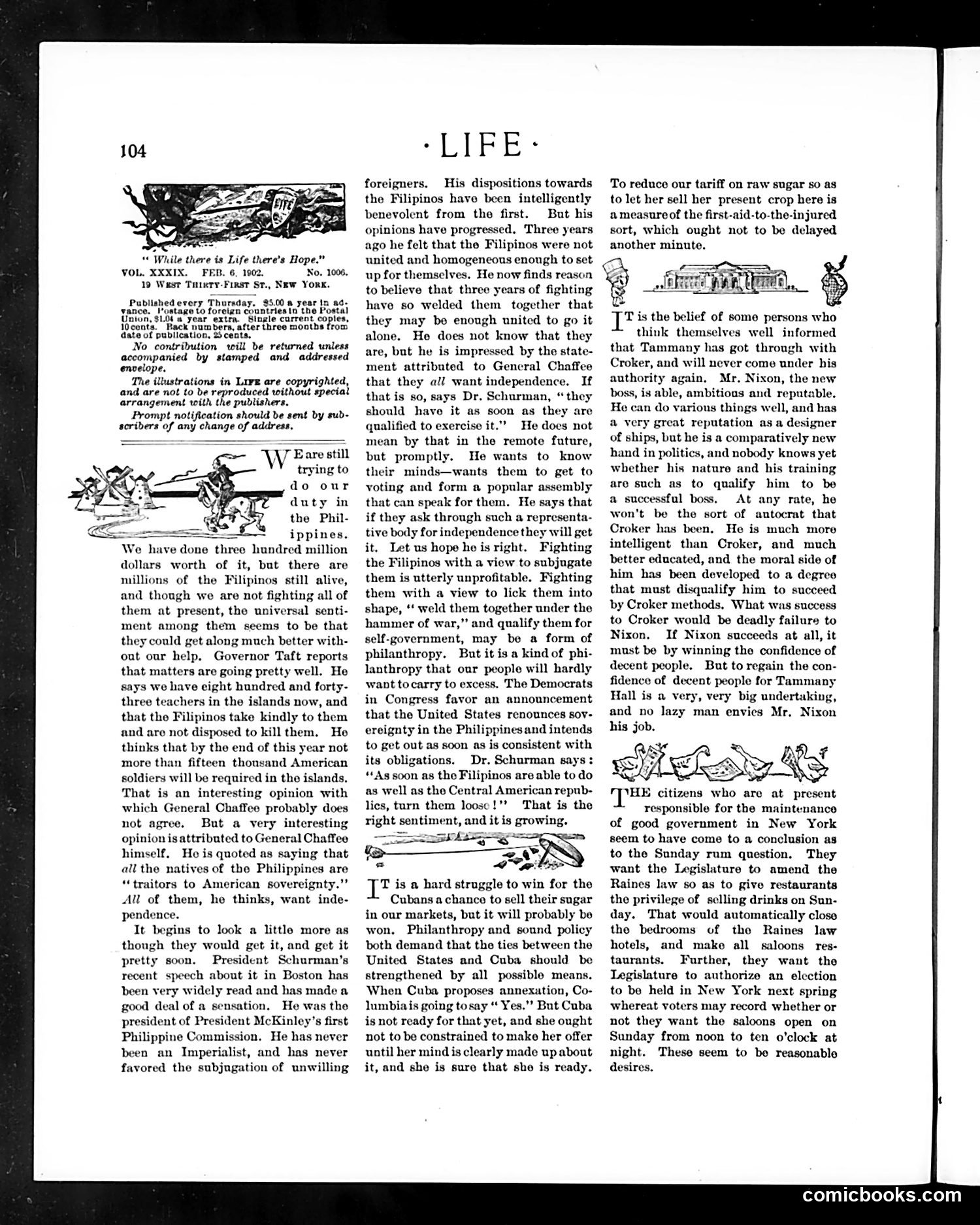
This page contains editorial commentary on Philippine independence and Cuban annexation, circa early 1900s. The text discusses President Schurman's views on Filipino readiness for self-government, debating whether three years of fighting has unified the archipelago sufficiently. A secondary article addresses the Sunday liquor question in New York—specifically whether saloons should close on Sundays. The Raines law is mentioned as contentious, with legislators apparently proposing amendments. The decorative illustrations appear to be generic period ornaments rather than specific political caricatures. The page is primarily text-based editorial content addressing contemporary imperial and domestic policy debates, with no identifiable satirical cartoon figures visible.
📄 Transcribed text from this page (OCR, searchable)
Machine-transcribed from the original scan — historical spelling and the odd misread are preserved.
“* While there is Life there’s Hope.” VOL. XXXIX. FEB. 6, 1902, No, 1006. 19 West Taixty-Finst Sr., New York. peablished every ‘Thuraday. $5.00 8 year in ac. ance. Hostage to foreign countries tn the Postal Union, site year extra. ‘Single current copies, JOconts. “Rack numbers, after three months from ate of publication, 2 cents, No contribution will be returned unless accompanied by stamped and addressed envelope. The illustrations in Lire are copyrighted, and are not to be reproduced without special arrangement with the publishers. Prompt notification should be sent by sud- scribers of any change of address, \ 7 Eare still trying to do our duty in the Phil- ippines, We have done three hundred million dollars worth of it, but there are millions of the Filipinos still alive, and though we are not fighting all of them at present, the universal senti- ment among them seems to be that they could get along much better with- out our help, Governor Taft reports that matters are going pretty well. He says we have eight hundred and forty- three teachers in the islands now, and that the Filipinos take kindly to them and aro not disposed to killthem. He thinks that by the end of this year not more than fifteen thousand American soldiers will be required in the islands. That is an interesting opinion with which General Chaffee probably does not agree. But a very interesting opinion isattributed to General Chaffee himself. He is quoted as saying that all the natives of the Philippines are “traitors to American sovereignty.” All of them, he thinks, want inde- pendence. It begins to look a little more as though they would get it, and get it pretty soon. President Schurman'’s recent speech about it in Boston has been very widely read and has made a good deal of a sensation, He was the president of President McKinley’s first Philippine Commission. He has never been an Imperialist, and has never favored the subjugation of unwilling LIFE foreigners. His dispositions towards the Filipinos have been intelligently benevolent from the first. But his opinions have progressed. Three years ago he felt that the Filipinos were not united and homogeneous enough to set up for themselves. He now finds reason to believe that three years of fighting have so welded them together that they may bo enough united to go it alone. He does not know that they are, but he is impressed by the state- ment attributed to Gencral Chaffee that they all want independence. If that is so, says Dr. Schurman, “they should have it as soon as they are qualified to exercise it." He does not mean by that in the remote future, but promptly. He wants to know their minds—wants them to get to yoting and form a popular assembly that can speak for them. He says that if they ask through such a representa- tive body for independence they will get it. Let us hope he is right. Fighting the Filipinos with a view to subjugate them is utterly unprofitable. Fighting them with a view to lick them into shape, “ weld them together under the hammer of war,”’ and qualify them for self-government, may be a form of philanthropy. But it is a kind of phi- lanthropy that our people will hardly want tocarry to excess. The Democrats in Congress favor an announcement that the United States renounces sov- ereignty in the Philippines and intends to get out as soon as is consistent with its obligations. Dr. Schurman says: ‘As soon as the Filipinos are able to do as well as the Central American repub- lics, turn them loose!’? That is the right sentiment, and it is growing. : NY Jt is a hard struggle to win for the Cubans a chance to sell their sugar in our markets, but it will probably be won. Philanthropy and sound policy both demand that the ties between the United States and Cuba should be strengthened by all possible means. When Cuba proposes annexation, Co- lumbiais going tosay “ Yes.’’ But Cuba is not ready for that yet, and she ought not to be constrained to make her offer until her mind is clearly made up about it, and she is sure that sho is ready. To reduce our tariff on raw sugar so as to let her sell her present crop here is ameasureof the first-aid-to-the-injured sort, which ought not to be delayed another minute. @ aii jt is the belief of some persons who think themselves well informed that Tammany has got through with Croker, and will never come under his authority again, Mr, Nixon, the new boss, is able, ambitious and reputable. He can do various things well, and has a very great reputation as a designer of ships, but he is a comparatively new hand in politics, and nobody knows yet whether his nature and his training are such as to qualify him to be a successful boss. At any rate, he won't be the sort of autocrat that Croker has been, He is much more intelligent than Croker, and much better educated, and the moral side of him has been developed to a degree that must disqualify him to succeed by Croker methods, What was success to Croker would be deadly failure to Nixon. If Nixon succeeds at all, it must be by winning the confidence of decent people. But to regain the con- fidence of decent people for Tammany Hall is a very, very big undertaking, and no lazy man envics Mr. Nixon his job. irae T= citizens who are at present responsible for the maintenance z good government in New York seem to have come to a conclusion as to the Sunday rum question. They want the Legislature to amend the Raines law so as to give restaurants the privilege of selling drinks on Sun- day. That would automatically close the bedrooms of tho Raines law hotels, and make all saloons res- taurants. Further, they want the Iegislature to authorize an election to be held in New York next spring whereat voters may record whether or not they want the saloons open on Sunday from noon to ten o'clock at night. These seem to be reasonable desires. comicbooks.com