
A complete issue · 20 pages · 1902
Life — January 9, 1902
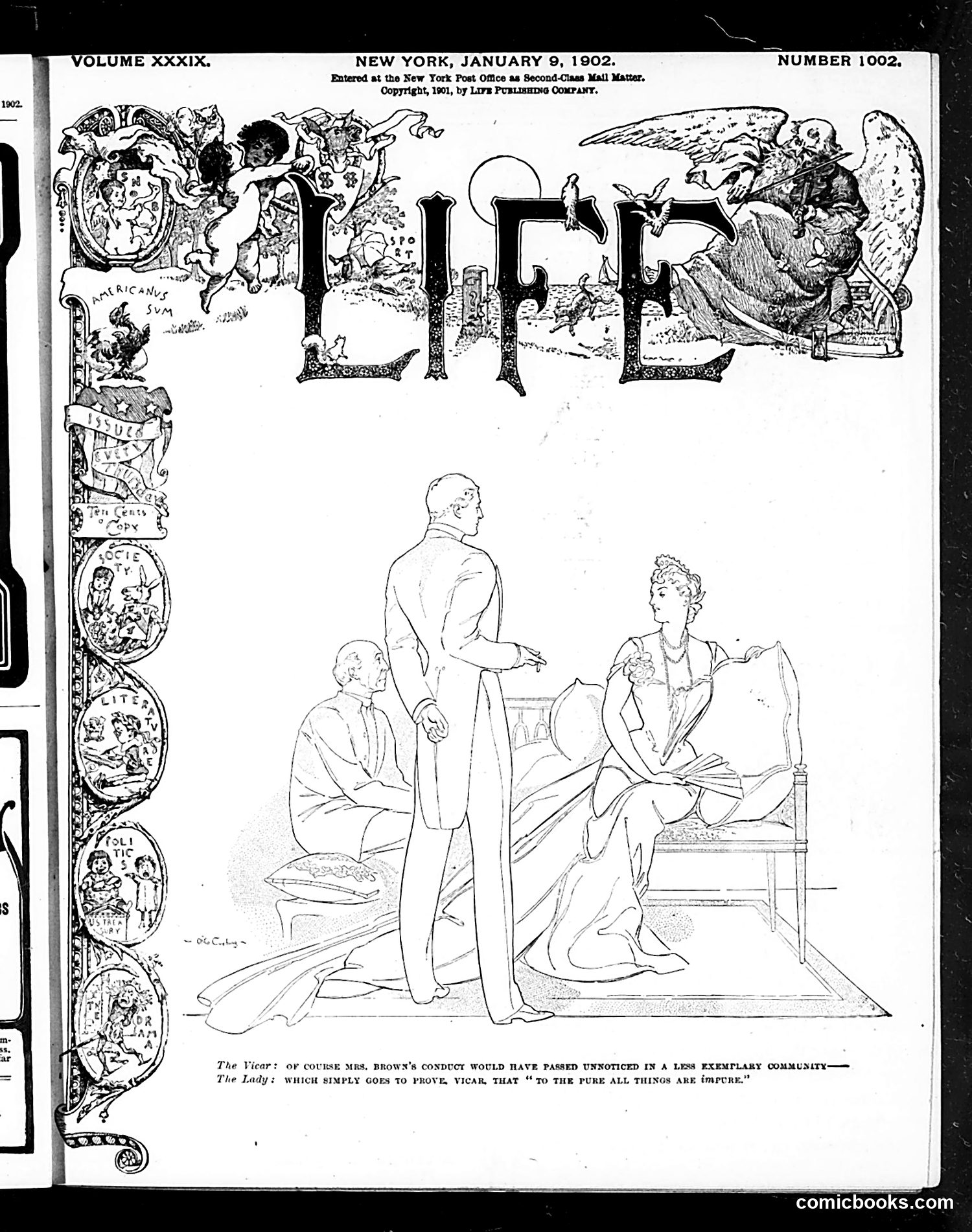
This page contains a satirical cartoon about clerical conduct and morality. The main illustration depicts three figures in what appears to be a private setting—two men and a woman in revealing dress. The caption reads: "The Vicar: of course Mrs. Brown's conduct would have passed unnoticed in a less exemplary community— The Lady: which simply goes to prove, vicar, that 'to the pure all things are impure.'" The satire targets Victorian hypocrisy—specifically, how a clergyman (vicar) judges others' moral behavior while himself appearing compromised by his presence in this intimate scene. The woman's response cleverly reverses his moralizing, suggesting his own impure thoughts reveal his judgment. The joke exposes the contradiction between Victorian religious propriety and actual conduct among the respectable classes.
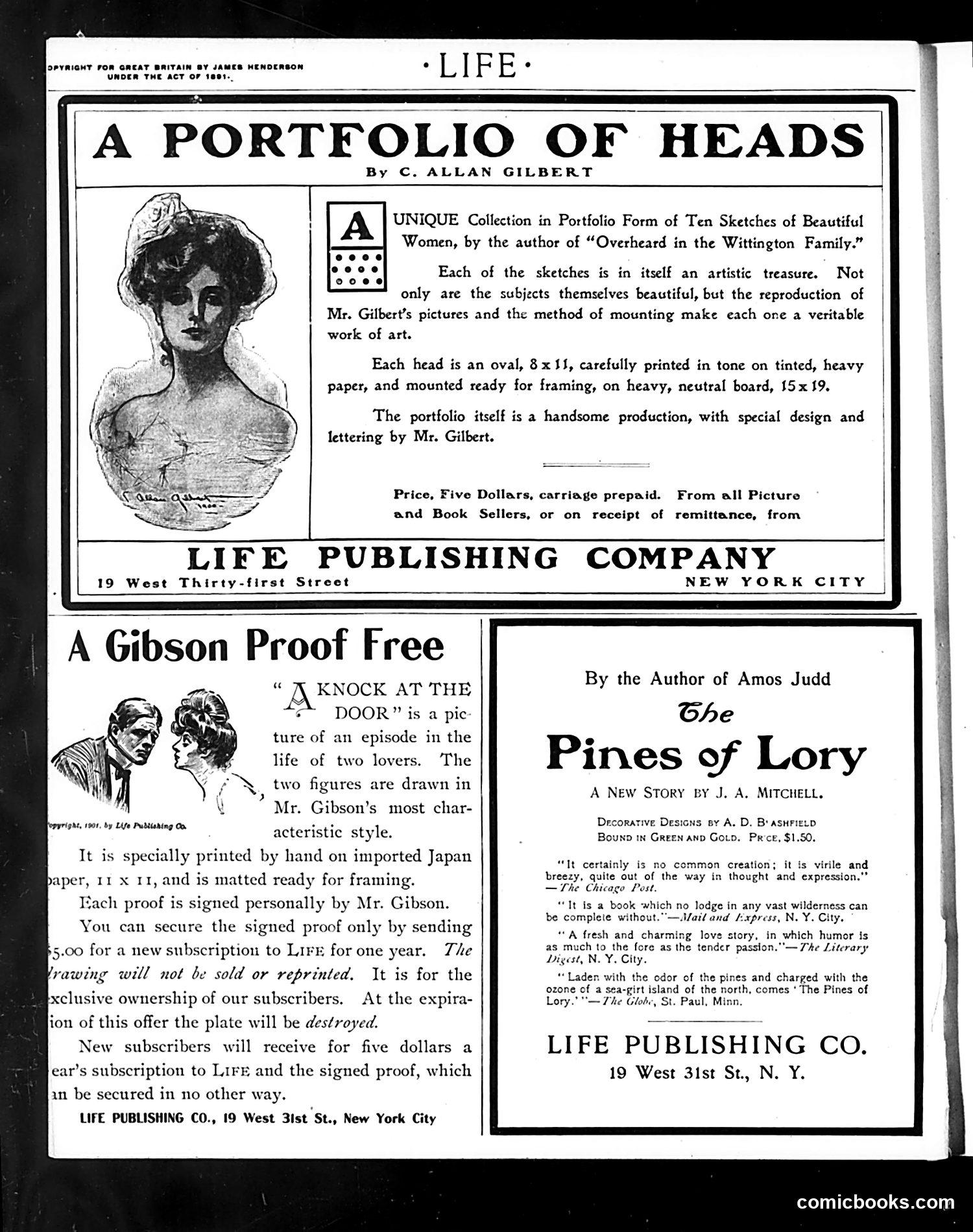
This page consists primarily of **advertisements** rather than satirical content. The top advertisement showcases "A Portfolio of Heads" by C. Allan Gilbert—ten portrait sketches of beautiful women, priced at five dollars. The middle section advertises "A Gibson Proof Free," featuring a Charles Dana Gibson illustration titled "A Knock at the Door" depicting two lovers. The bottom right advertises "The Pines of Lory," a new story by J.A. Mitchell with decorative designs. These are straightforward product promotions from Life Publishing Company, reflecting early 20th-century publishing practices. Gibson was a famous illustrator known for his "Gibson Girl" imagery. No political satire or social commentary appears on this particular page.
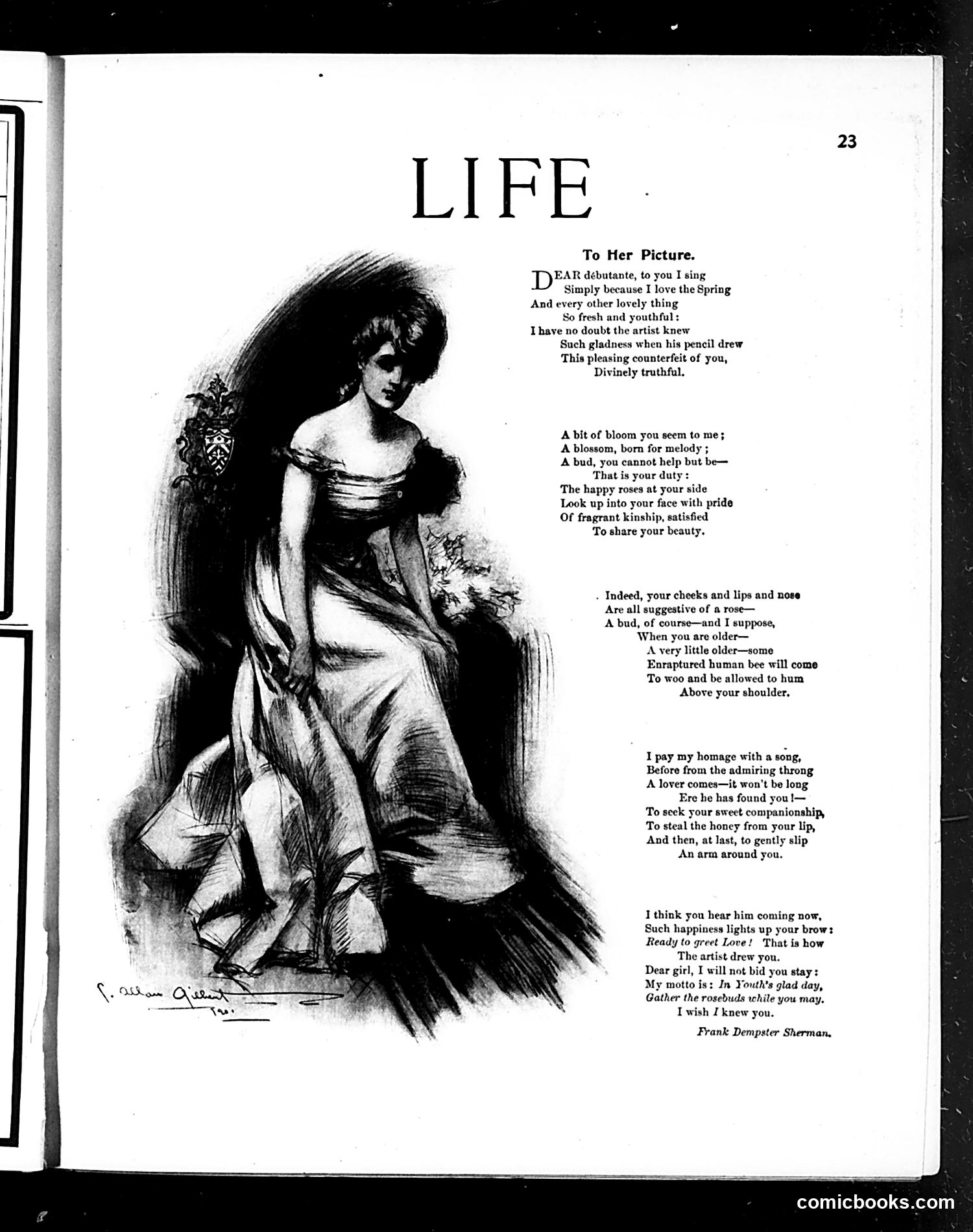
This page from *Life* magazine features a romantic poem titled "To Her Picture" by Frank Dempster Sherman, accompanied by an elegant charcoal sketch of a young woman in classical dress. The content is not satirical or political—it's a sincere literary contribution. The illustration depicts an idealized female figure with flowing hair and draped garments, rendered in a romanticized style typical of early 20th-century aesthetics. The poem celebrates youthful beauty and romantic love, addressing the subject as a "bloom" and expressing admiration for her appearance. This represents *Life*'s literary and artistic content alongside its better-known humor and satire. The page demonstrates the magazine's broader cultural scope beyond political commentary.
The page contains editorial commentary rather than prominent political cartoons. The main illustrated figure on the left appears to be a personified representation of "the new year" depicted as a woman at a spinning wheel—a common metaphor in early 1900s satirical magazines for fate or industry. The text discusses labor issues, manufacturing competitiveness, and America's colonial involvement in the Philippines. It critiques both capitalists and labor leaders, arguing their disputes harm national productivity. The commentary suggests the Philippines occupation requires better management and expresses skepticism about soldiers' performance there. The French Chamber of Deputies discussion concerns caricatures of foreign leaders—likely relating to diplomatic tensions of the period. The overall tone advocates for industrial harmony and practical governance.
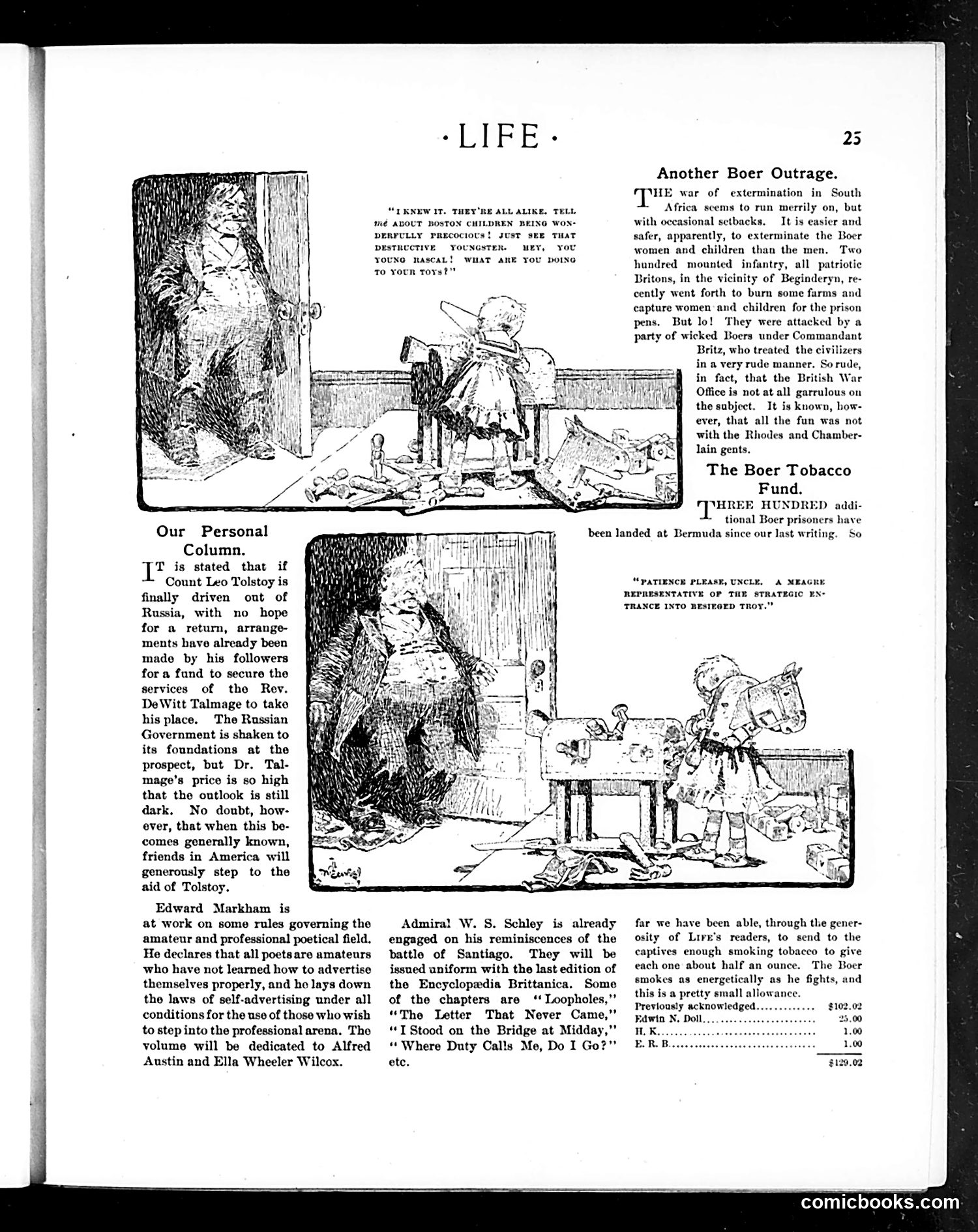
This page contains two political cartoons satirizing British conduct during the Boer War (South African conflict, 1899-1902). **Top cartoon:** A figure representing Britain—depicted as an elderly person in disheveled clothing—is confronted by a young soldier or representative. The caption criticizes Britain's destruction of Boer farms and civilian capture, mocking the justification offered ("they're all alive"). **Bottom cartoon:** Labeled "Patience Please, Uncle," appears to show a waiting or besieged figure, likely satirizing British military strategy or frustrations in the conflict. The accompanying article "Another Boer Outrage" describes British forces under Commandant Britz burning farms and imprisoning civilians—actions the magazine treats as scandalous. A separate section discusses fund-raising for Boer prisoners' tobacco, suggesting American sympathy for the Boer side against British imperialism.
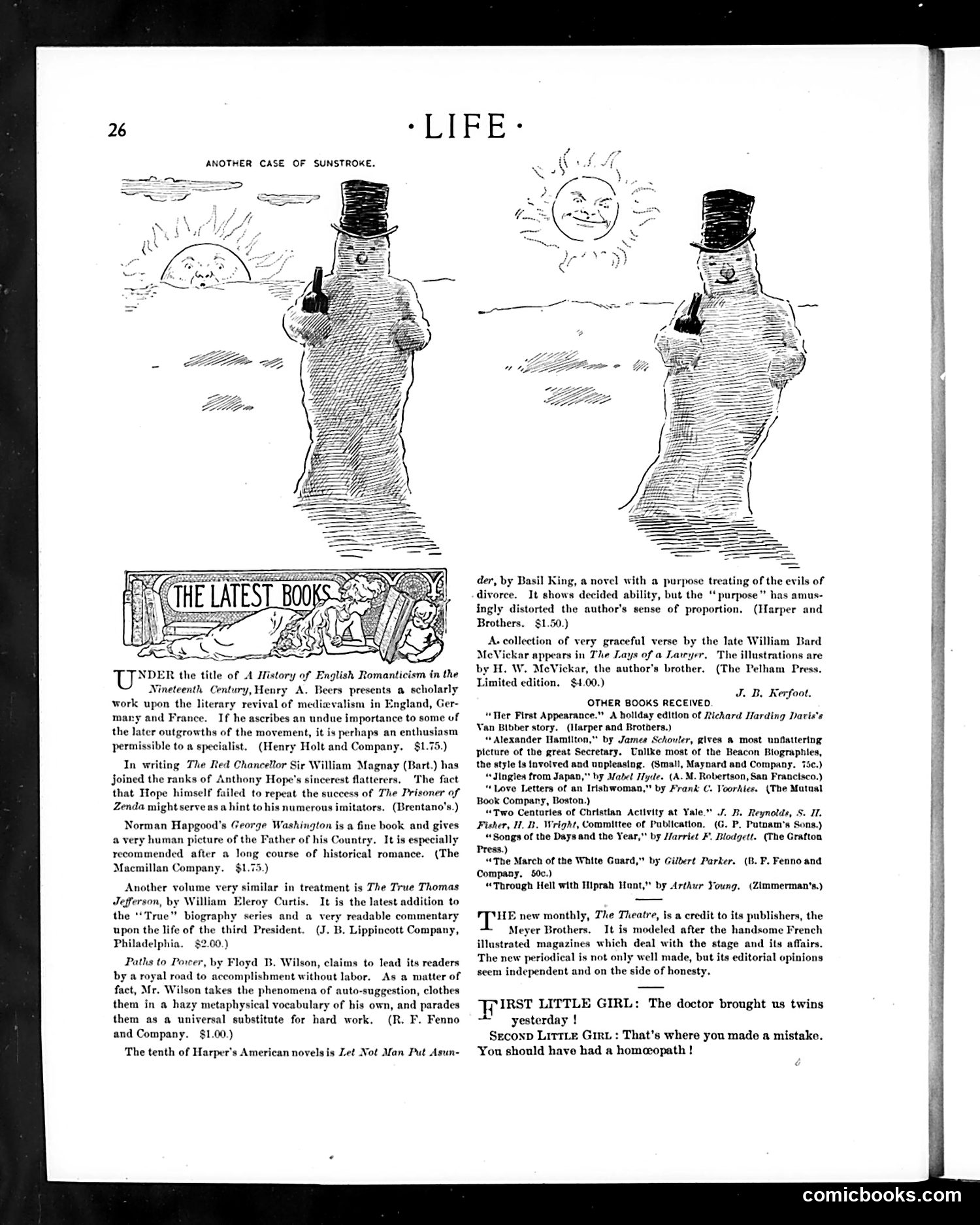
The cartoon shows two identical figures—snowmen wearing top hats—positioned under a smiling sun. Both appear to be melting or deteriorating, with one figure pointing upward at the sun. The title "Another Case of Sunstroke" is a visual pun. Rather than depicting a person suffering heat illness, the cartoon literally shows the sun "striking" (destroying) snowmen. The joke relies on anthropomorphizing the snowmen and playing on the double meaning of "sunstroke"—both medical condition and the sun's physical impact. This appears to be a straightforward gag cartoon rather than political satire. The humor derives from the literal interpretation of a common phrase and the inevitable outcome of snow meeting intense heat—a timeless, non-topical joke typical of Life magazine's lighter content.
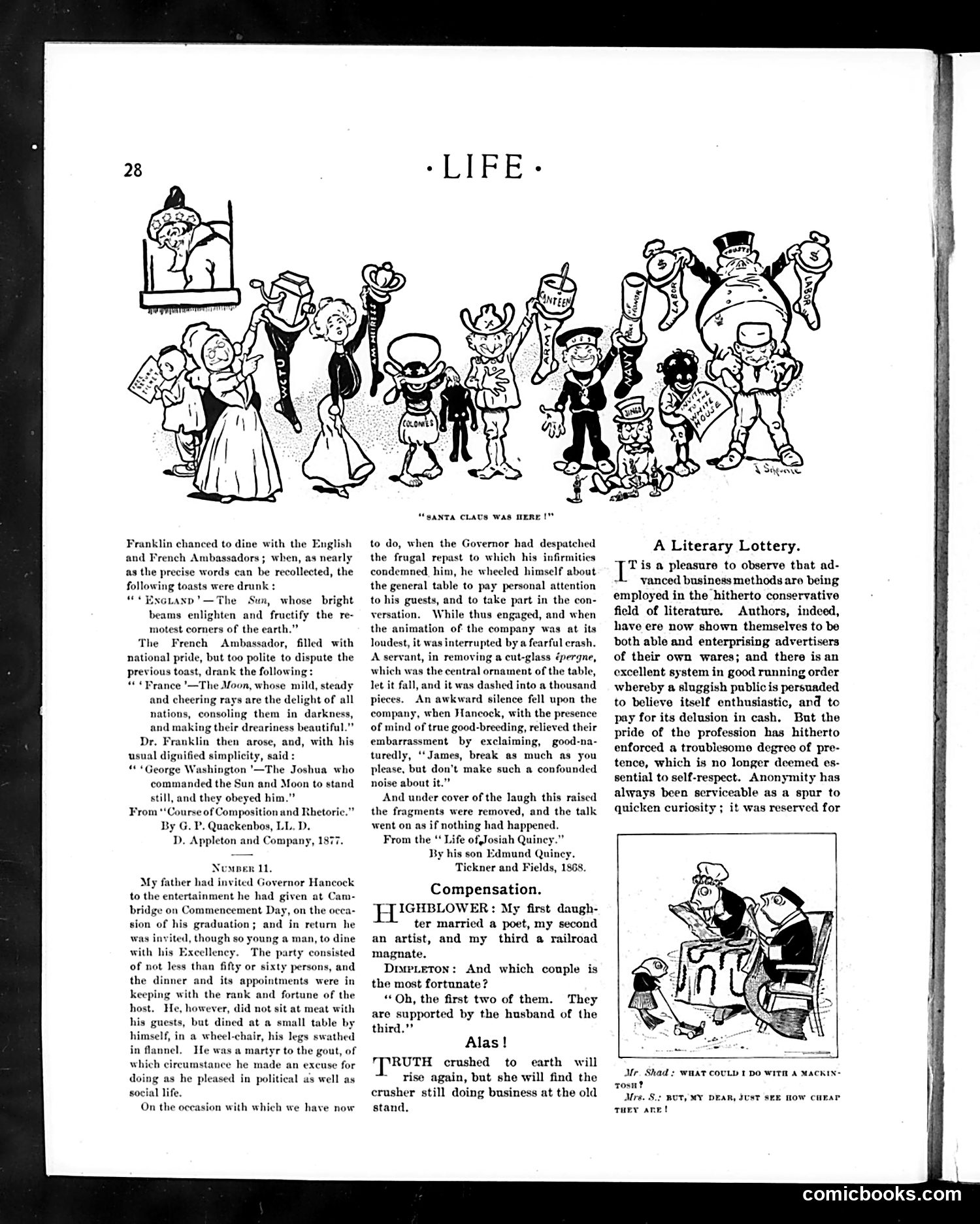
**Top illustration**: A large group cartoon showing various Victorian-era characters in festive dress, apparently celebrating Christmas together. The caption "Santa Claus Was Here!" suggests this depicts holiday revelry, likely from a literary anecdote. **Main text**: Humorous anecdotes about dinner parties and social gatherings among 19th-century gentlemen and ambassadors, emphasizing the importance of proper etiquette and good breeding in high society. **Lower cartoon**: A domestic scene showing a man in a chair with a woman standing nearby, discussing economics. The caption plays on the expense of supporting a wife—a common satirical target of the era, mocking both marriage and women's financial dependence. The page combines literary humor with social satire typical of Life's satirical commentary on Victorian society.
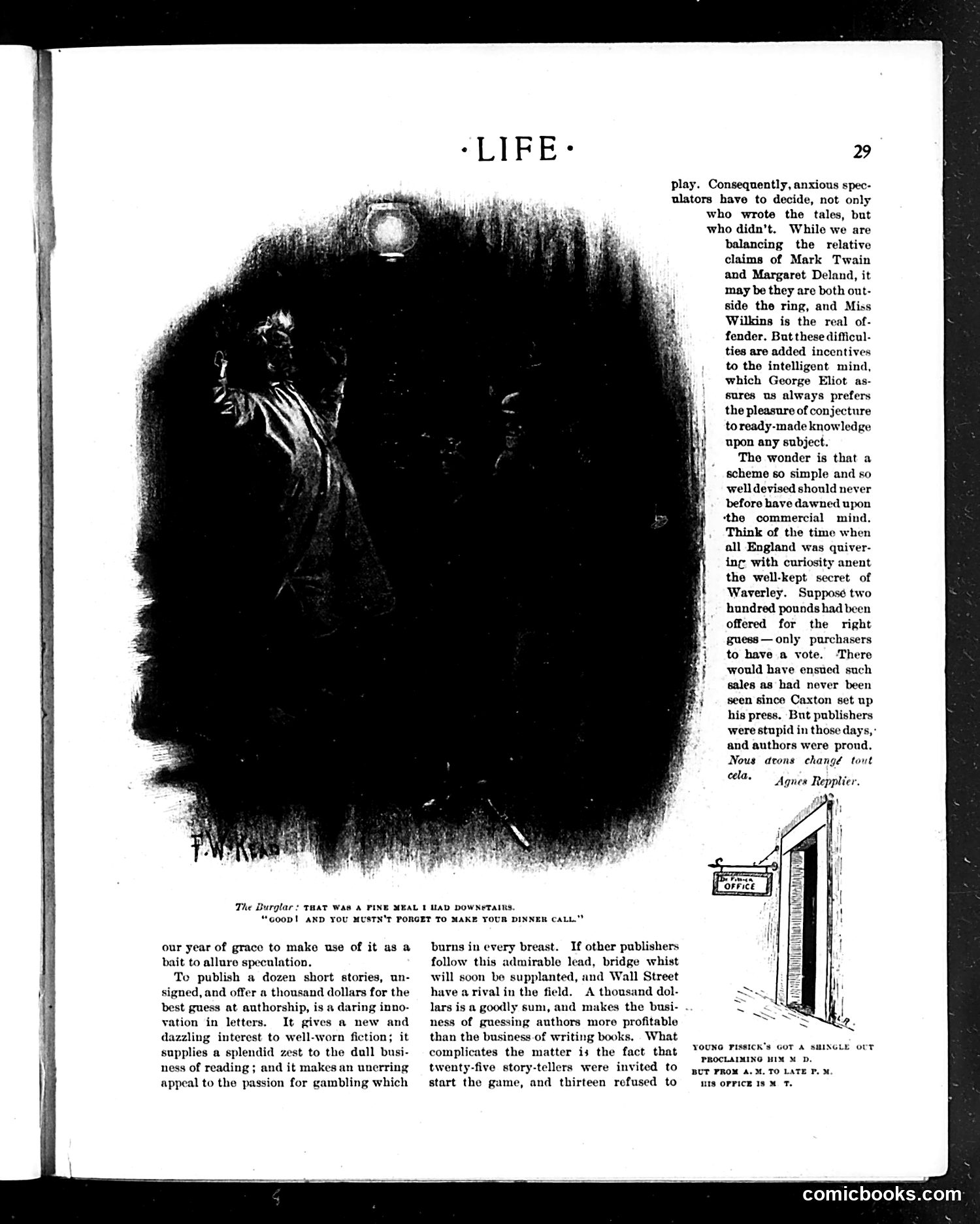
The main illustration depicts a figure in period dress (appears to be 18th or 19th century) looking at a moon or light source, labeled "The Burglar: 'THAT WAS A FINE MEAL I HAD DOWNSTAIRS. GOOD! AND YOU NEEDN'T FORGET TO MAKE YOUR DINNER CALL.'" This is a darkly humorous cartoon about a burglar complimenting his victims' meal after robbing them—a satirical jab at criminal audacity and entitled behavior. The adjacent text discusses the authorship of literary works (mentioning Mark Twain and Margaret Delaud regarding "Miss Wilkins"), and debates about publishing short stories as a commercial venture. A small separate cartoon shows someone at an office door, captioned about a "single out proclaiming him N.D." This appears commentary on the publishing industry's practices and author attribution disputes.
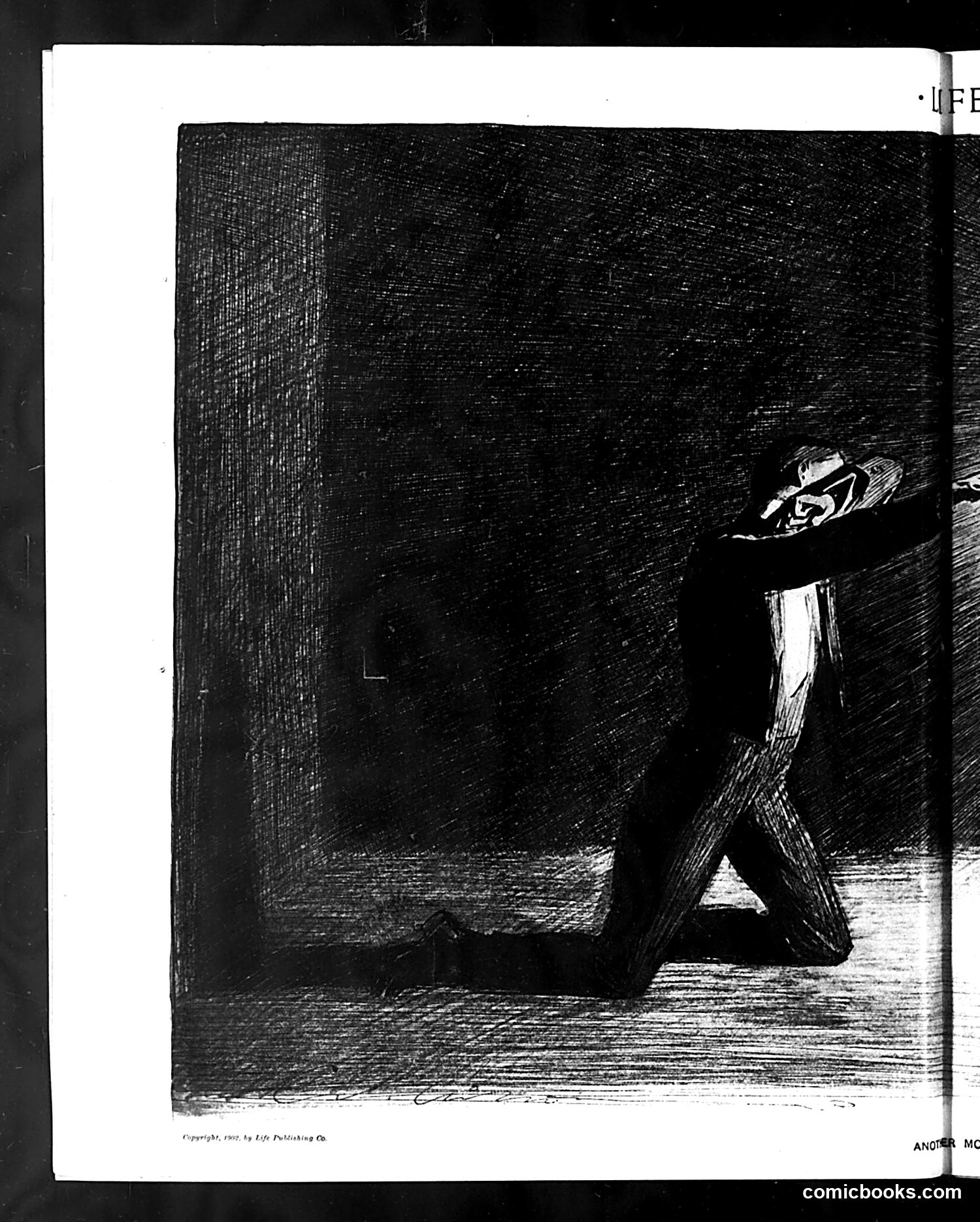
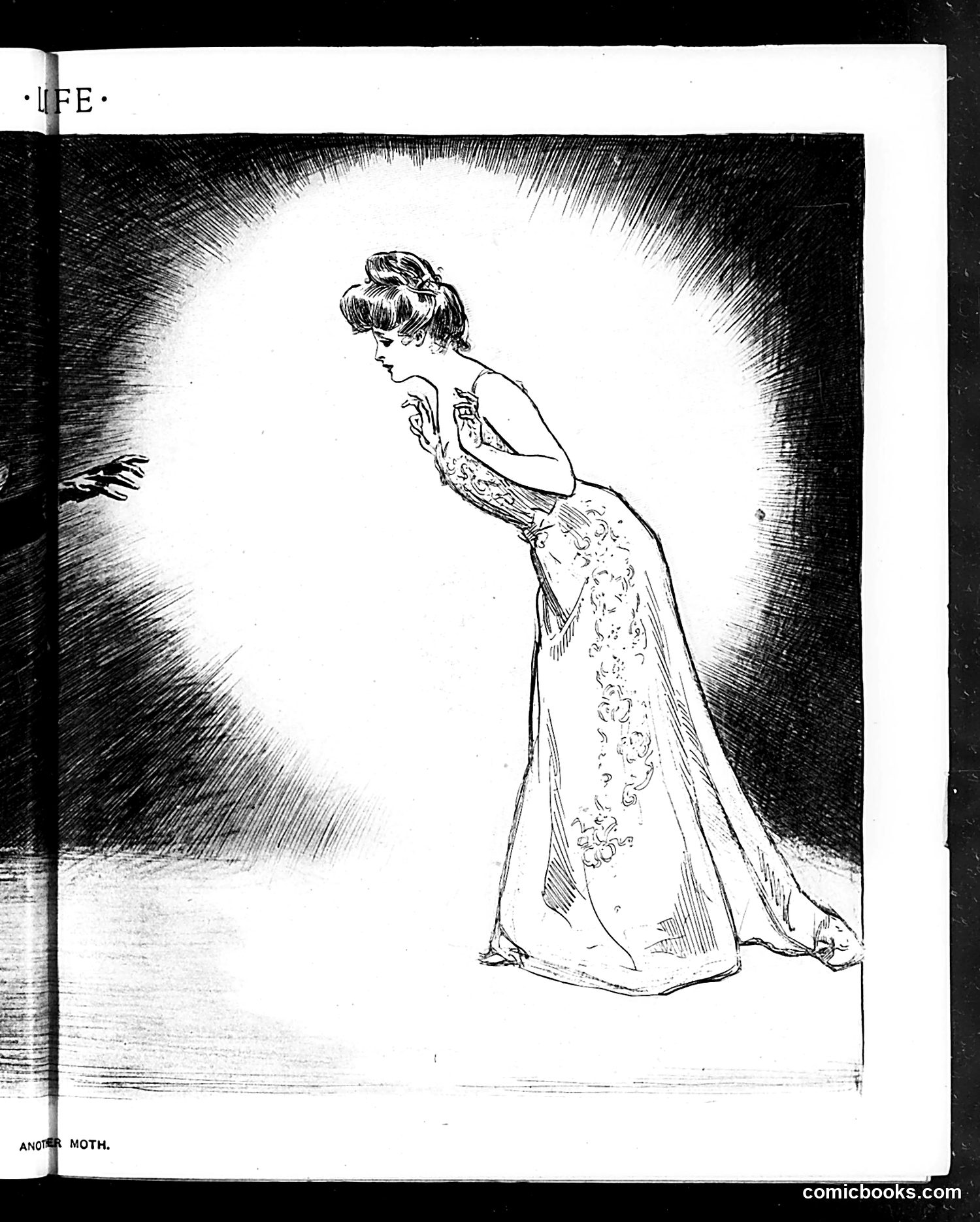
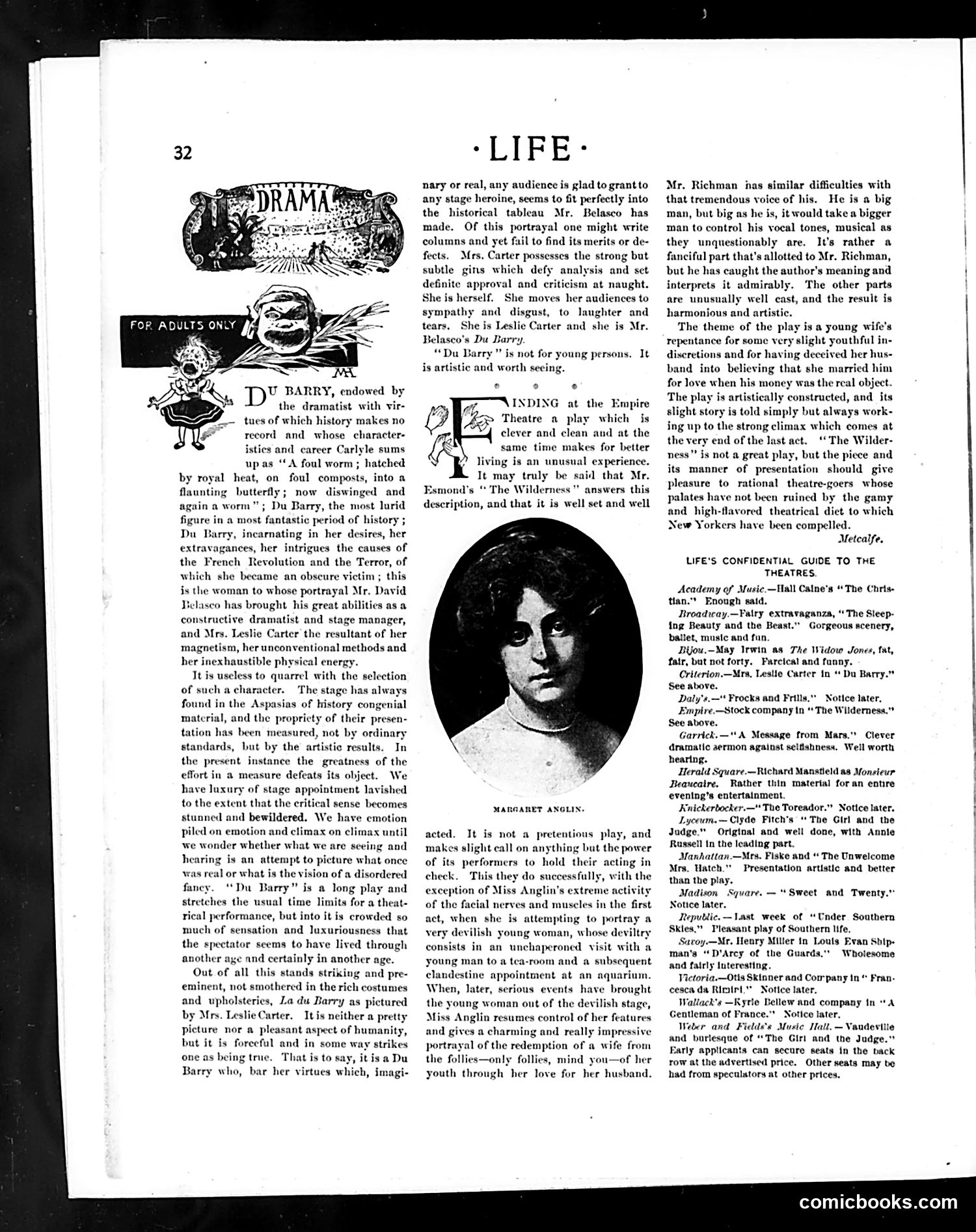
This page reviews theatrical productions, with particular focus on a play called "Du Barry" at an unspecified theatre. The small cartoon labeled "FOR ADULTS ONLY" depicts a cherubic figure, likely commenting on the play's adult themes. The review discusses the play's portrayal of Madame du Barry (the 18th-century French courtesan and mistress of King Louis XV), noting it contains "luxurious" stage appointments and deals with serious historical events including the French Revolution. The critic praises Leslie Carter's performance as du Barry, describing her acting as powerful and unconventional. The page also includes a photograph of what appears to be the lead actress and lists other current theatrical offerings in New York, making this a typical theatre review column from early 20th-century Life magazine.
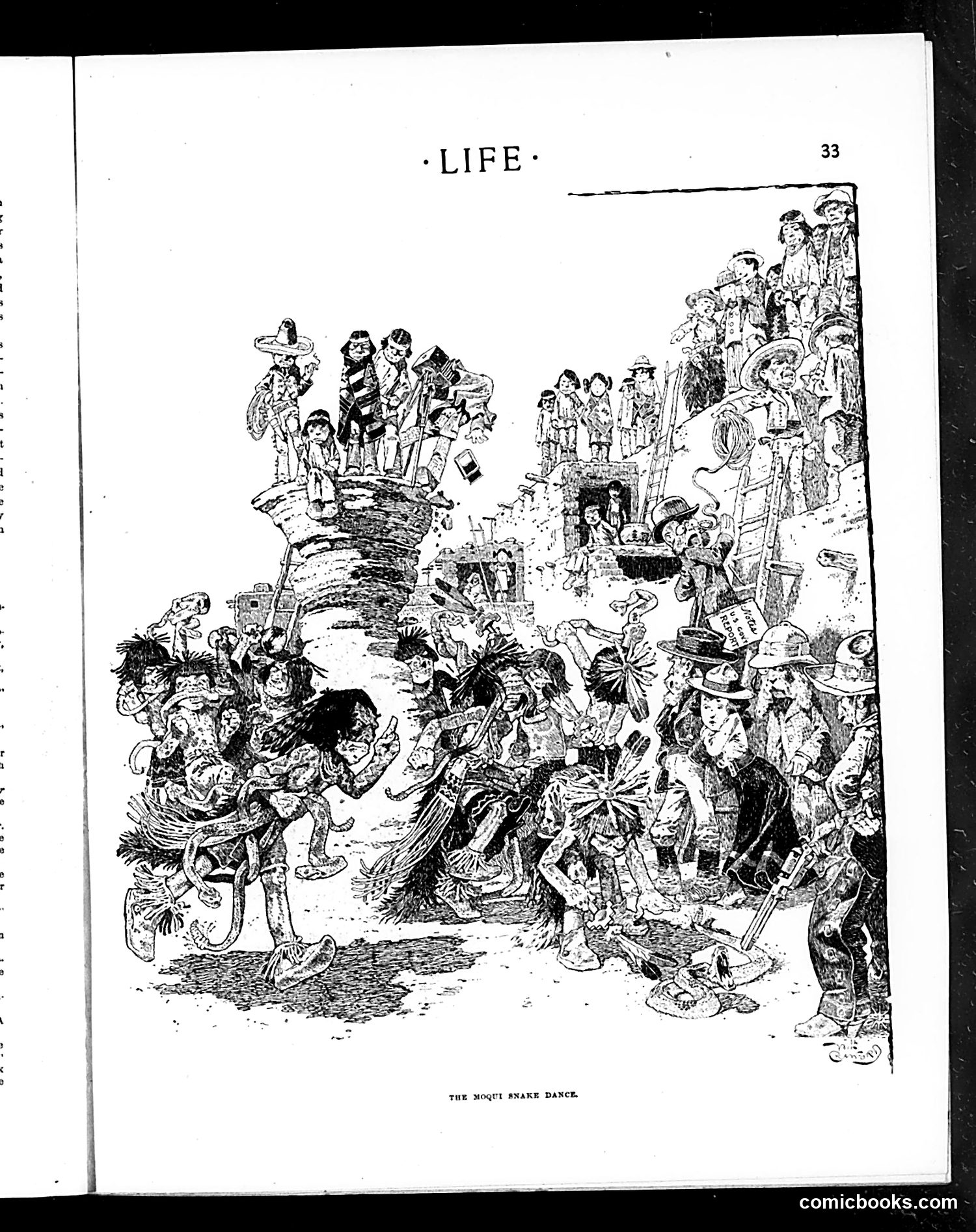
This satirical illustration depicts a chaotic scene labeled "The Moqui Snake Dance," referencing the actual Hopi (Moqui) ceremonial snake dance. The cartoon appears to mock this Native American religious ritual by presenting a grotesque, disorderly parody with exaggerated caricatures of both indigenous peoples and American figures (some wearing hats and formal dress) intermingled in confusion. The satire likely criticizes either: contemporary American fascination with "exotic" Native practices viewed as spectacle rather than sacred ceremony, or perhaps American interference with or misunderstanding of indigenous traditions. The tower of figures and chaotic composition emphasizes absurdity and disorder, transforming a meaningful cultural practice into carnival-like entertainment—a common editorial approach in late-19th/early-20th century American satirical magazines toward Native American subjects.
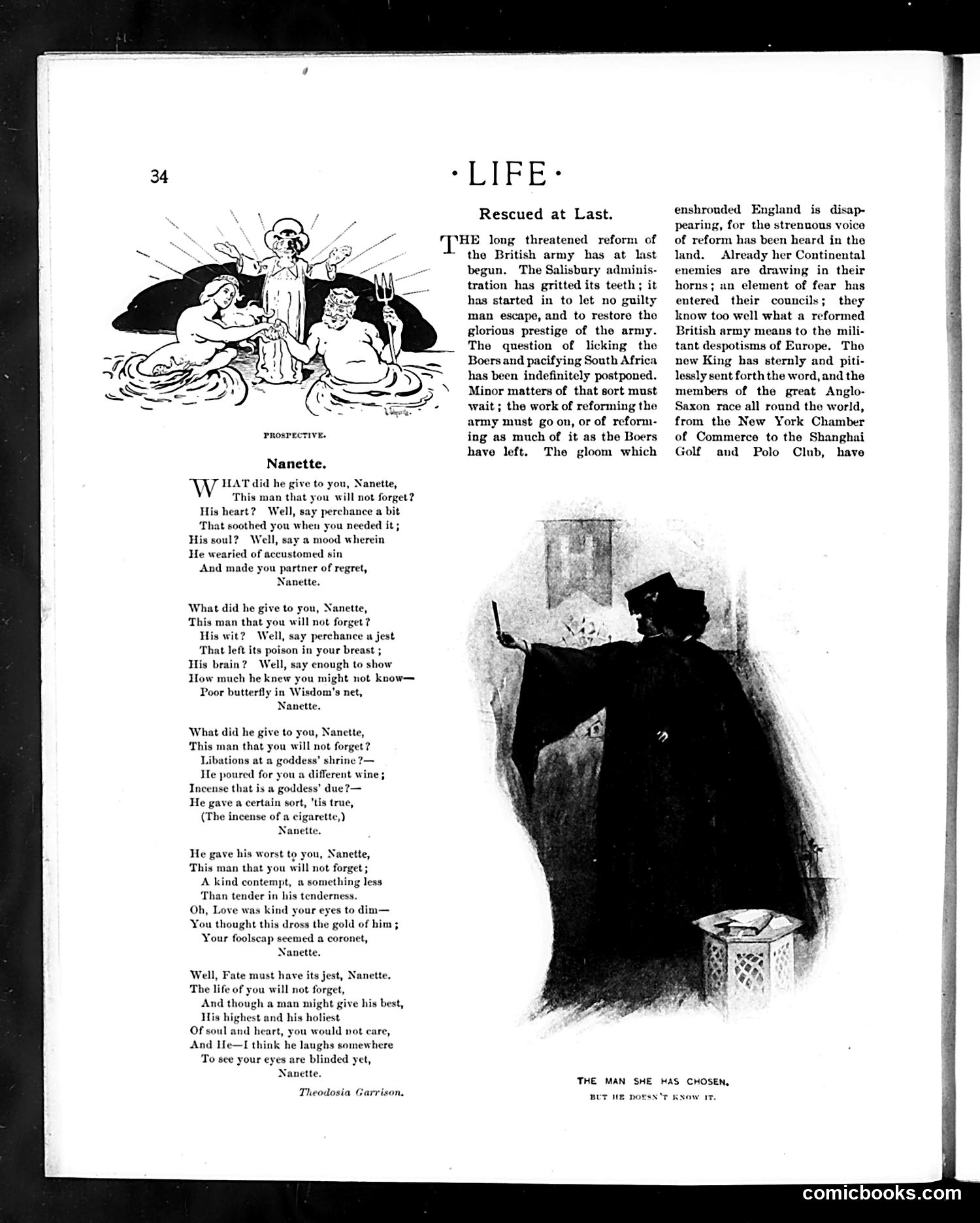
This page contains two distinct pieces: **"Nanette" (poem by Theodosia Garrison):** A cynical poem about a woman deceived by a man who gave her emotional crumbs—superficial charm, wit, and contempt—which she mistook for genuine love. The satire targets female romantic delusion. **"Rescued at Last" (editorial cartoon/commentary):** Political satire mocking British military reform efforts under the Salisbury administration. The piece sarcastically celebrates postponing the actual Boer War crisis to focus instead on internal army reorganization. It ridicules British triumphalism—suggesting even the "New York Chamber of Commerce" and "Shanghai Golf and Polo Club" celebrate this "reform," implying the British establishment worldwide celebrates symbolic gestures over real military effectiveness. The image (captioned "The Man She Has Chosen, But He Doesn't Know It") appears to show a silhouetted figure, likely representing Britain or its leadership making poor strategic choices.
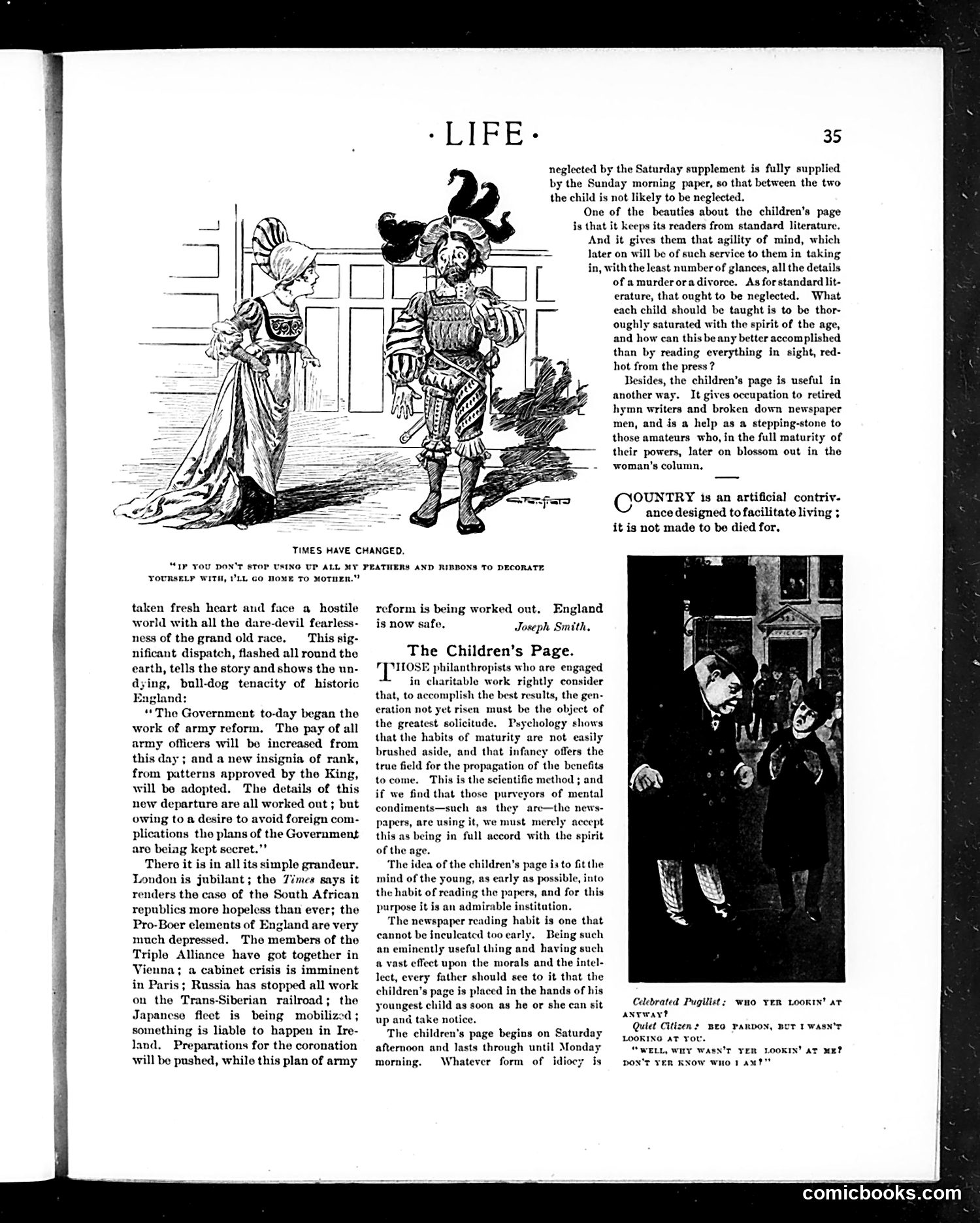
**The Main Cartoon ("Times Have Changed"):** A woman in elaborate Edwardian dress threatens to leave a foolish man if he doesn't stop her from using up feathers and ribbons for self-decoration. The satire mocks how social expectations have supposedly "changed"—the woman now claims independence while the man remains dependent on her threat to leave, reversing traditional power dynamics ironically. **"The Children's Page" Editorial:** This is scathing satire attacking newspapers' children's sections. The author mockingly praises how these pages train young minds to consume sensational newspaper content (murders, divorces) instead of "standard literature," deliberately cultivating newspaper-reading habits early. The satire exposes how papers use children's pages not to educate but to create lifelong readers addicted to gossip and scandal. He further notes these pages provide employment for failed writers—another jab at journalistic quality. Both pieces critique social pretense and newspaper sensationalism characteristic of early-1900s American satire.
This page contains primarily **humorous student essays** submitted to a London publication, showcasing the unintentional comedy of schoolchildren's writing. The pieces mock how children misunderstand or oversimplify complex topics—confusing "water" with "beer," describing marriage as "a lottery," and mixing logic hilariously (declaring sailors are "cannibals" because they eat sharks that eat dead bodies). The second major item profiles **Justice William Travers Jerome**, a New York judicial figure active in municipal reform. The anecdote—where Jerome purchases a lathe previously used to manufacture roulette wheels for illegal gambling operations—satirizes the irony of the Judge's anti-gambling crusade: the very tools of vice he raids against become his hobby equipment, suggesting the futility or performative nature of such "reforms." The page is otherwise **advertising**—whiskey, silk goods, and travel promotions typical of the era.
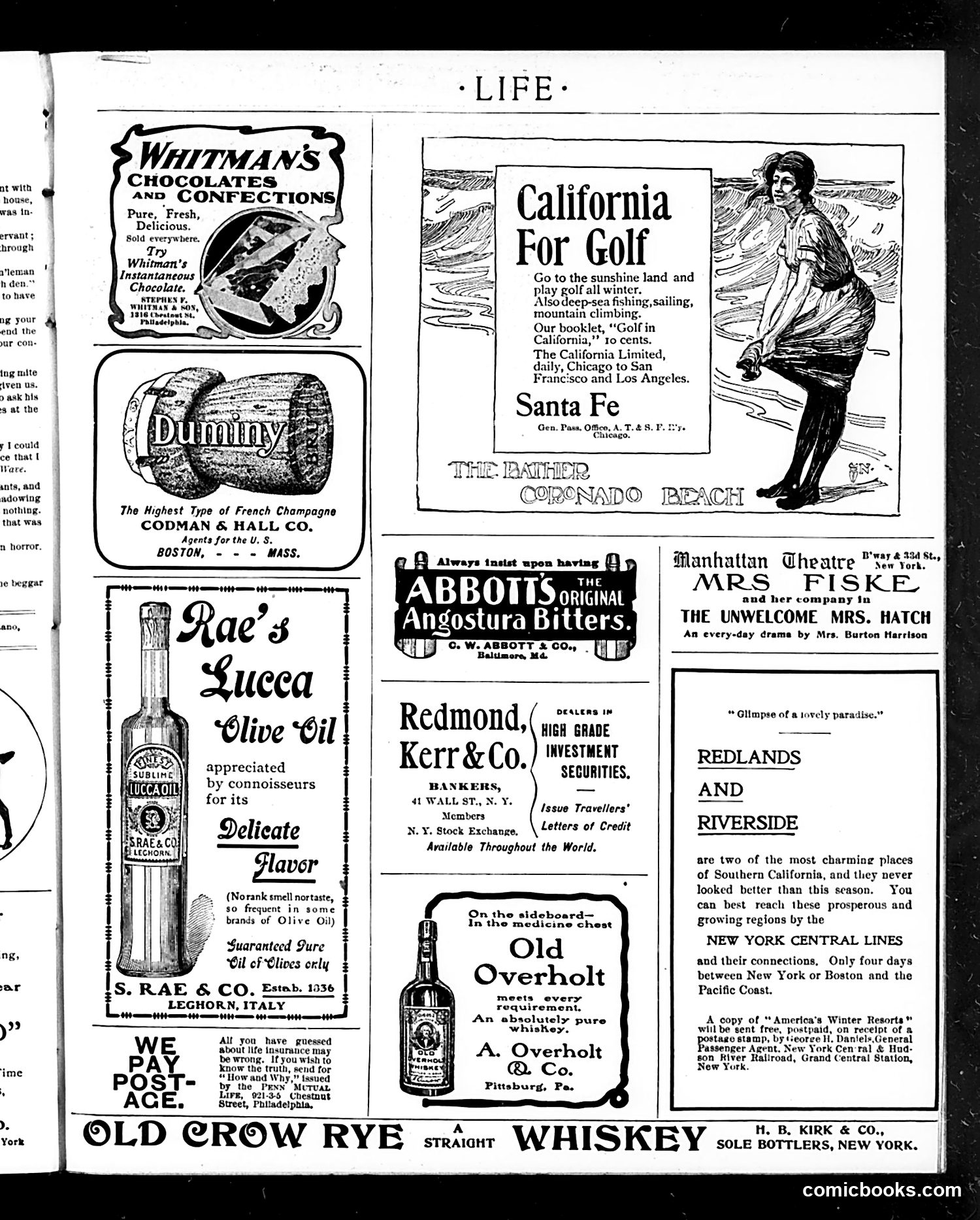
This is primarily an **advertising page** from Life magazine with minimal editorial content. The page contains product advertisements for luxury goods and travel services popular in the early 1900s. Notable ads include: - **Whitman's Chocolates** and **Duminy French Champagne** (food/beverage) - **Rae's Lucca Olive Oil** (imported Italian product marketed to "connoisseurs") - **Abbotts Angostura Bitters** and **Old Overholt Whiskey** (patent medicines/spirits—common in this era) - **Travel promotions** for California golf, the Santa Fe railroad, and Southern California resorts - **Financial services** (Redmond Kerr & Co. bankers) - **Manhattan Theatre** advertisement for "The Unwelcome Mrs. Hatch" - **Mutual Life Insurance** promotional text There are **no political cartoons or satirical content** visible. The sole illustration is a golfer in period dress advertising California travel. The page reflects Gilded Age consumer culture and leisure activities for wealthy readers.
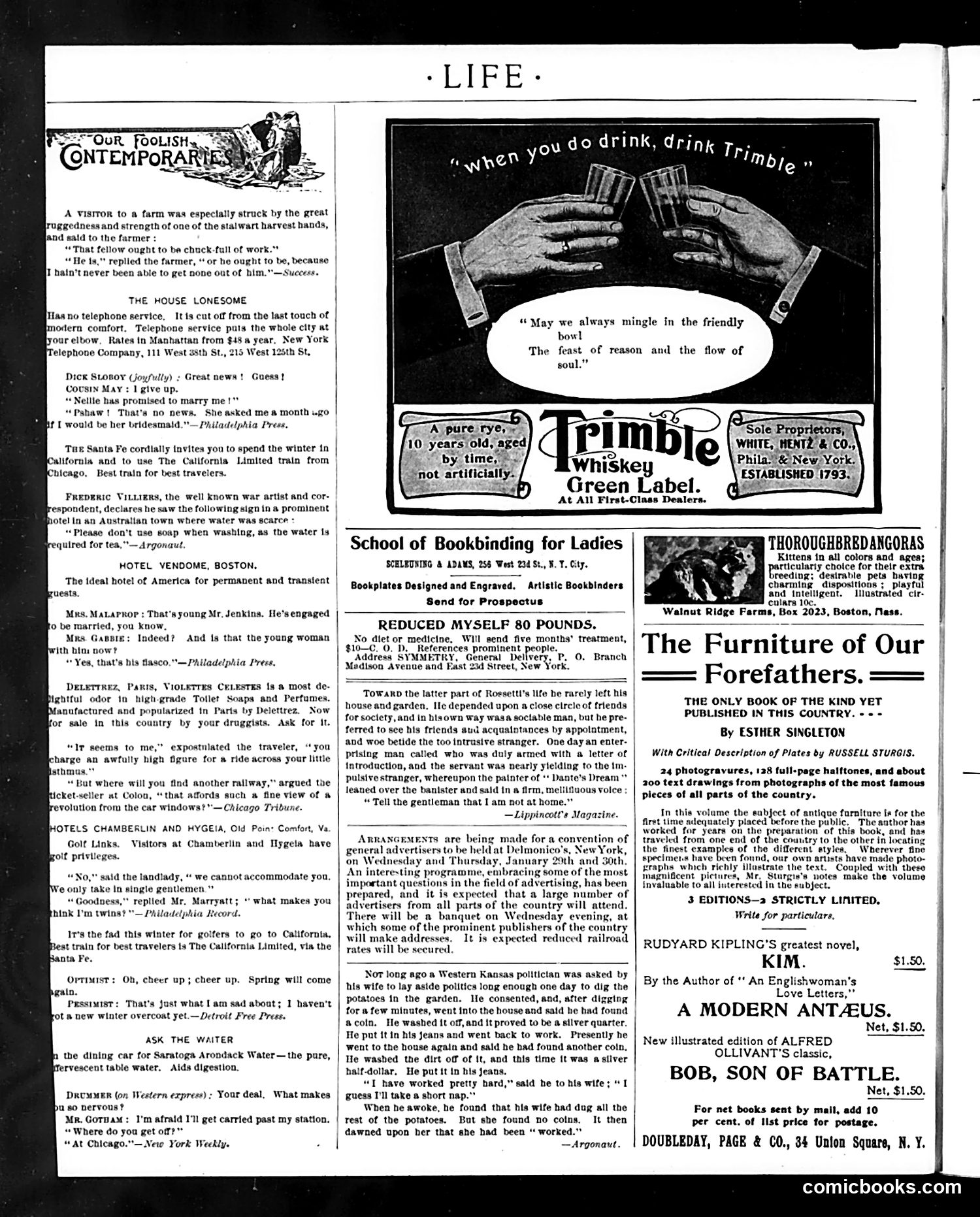
This is primarily a page of **advertisements and humorous anecdotes** rather than political cartooning. The single illustrated advertisement features **Trimble Whiskey**, showing two hands clinking glasses with text promoting drinking as social bonding ("the feast of reason and the flow of soul"). The text consists of brief, lighthearted jokes and stories addressing everyday concerns of the era: - Farm labor inefficiency - Telephone service as modern convenience - Engagements and weddings - Water scarcity in colonial outposts - Hotel accommodations - Winter travel to California **No identifiable political figures or satire appears**. The humor is gentle and domestic—mildly mocking social awkwardness, miscommunication, and modern anxieties. The advertisements (bookbinding classes, weight loss treatments, hotels) reflect early 1900s consumer culture. This represents *Life* magazine's lighter, entertainment-focused content rather than its more famous political satire.
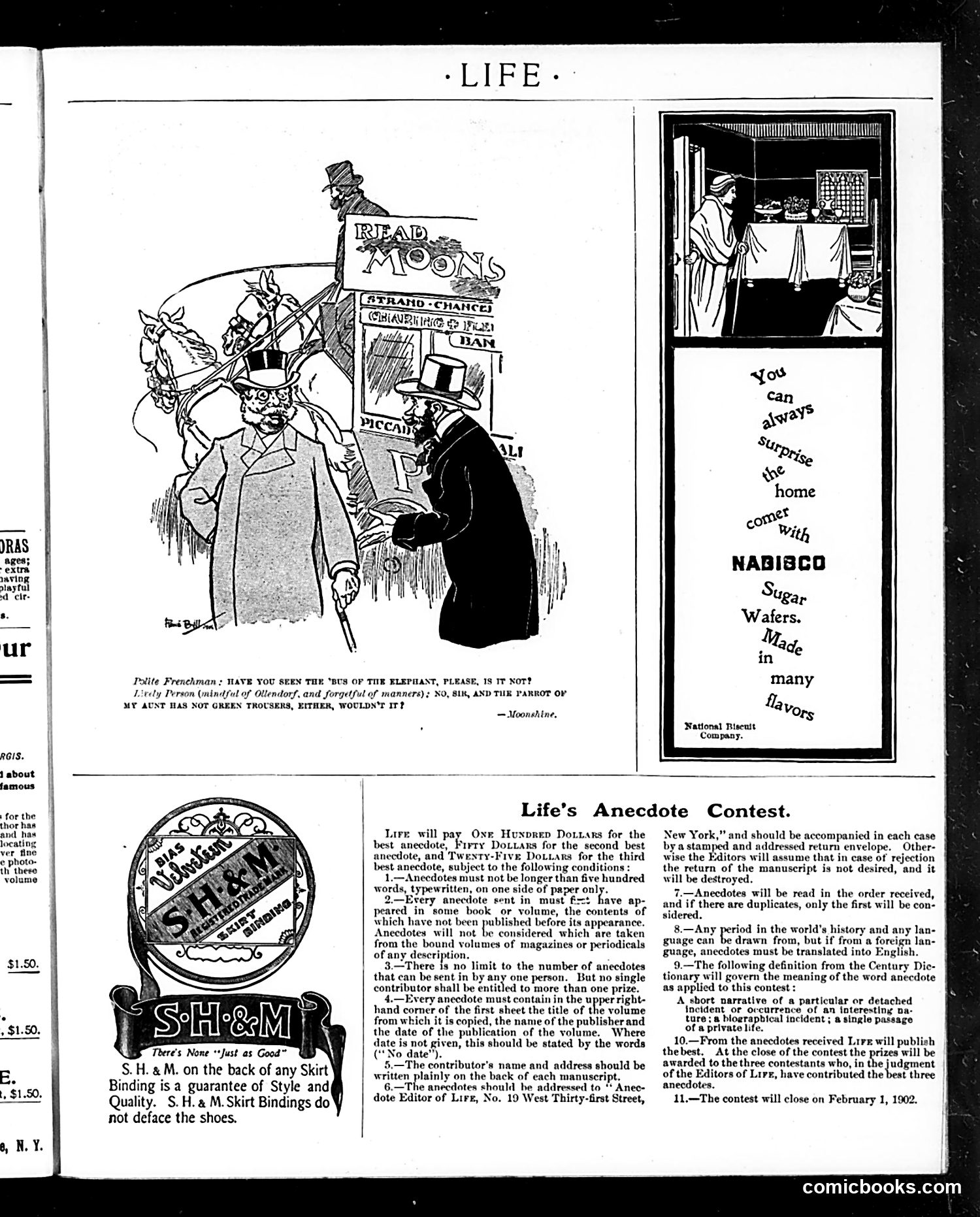
This page contains satirical and commercial content from an early 1900s American magazine. **Top Cartoon:** A caricatured gentleman in top hat confronts what appears to be a street vendor or promoter displaying "Read Moon's" products (likely a brand advertisement). The caption—credited to "Moonshine"—depicts a "Lively Person" rudely contradicting someone about their aunt's green trousers and a parrot, illustrating poor manners disguised as clever conversation. The satire mocks social pretension and people who prioritize showing off knowledge over politeness. **Main Content:** The page primarily features "Life's Anecdote Contest," offering cash prizes ($100, $50, $25) for previously published anecdotes submitted by readers. Detailed submission rules follow, including length restrictions (500 words maximum), sourcing requirements, and a February 1, 1902 deadline. **Advertisements:** Nabisco Sugar Wafers and S.H. & M. Skirt Bindings appear throughout, typical of period magazine monetization. The page blends humor, reader engagement contests, and advertising—standard Life magazine format of the era.
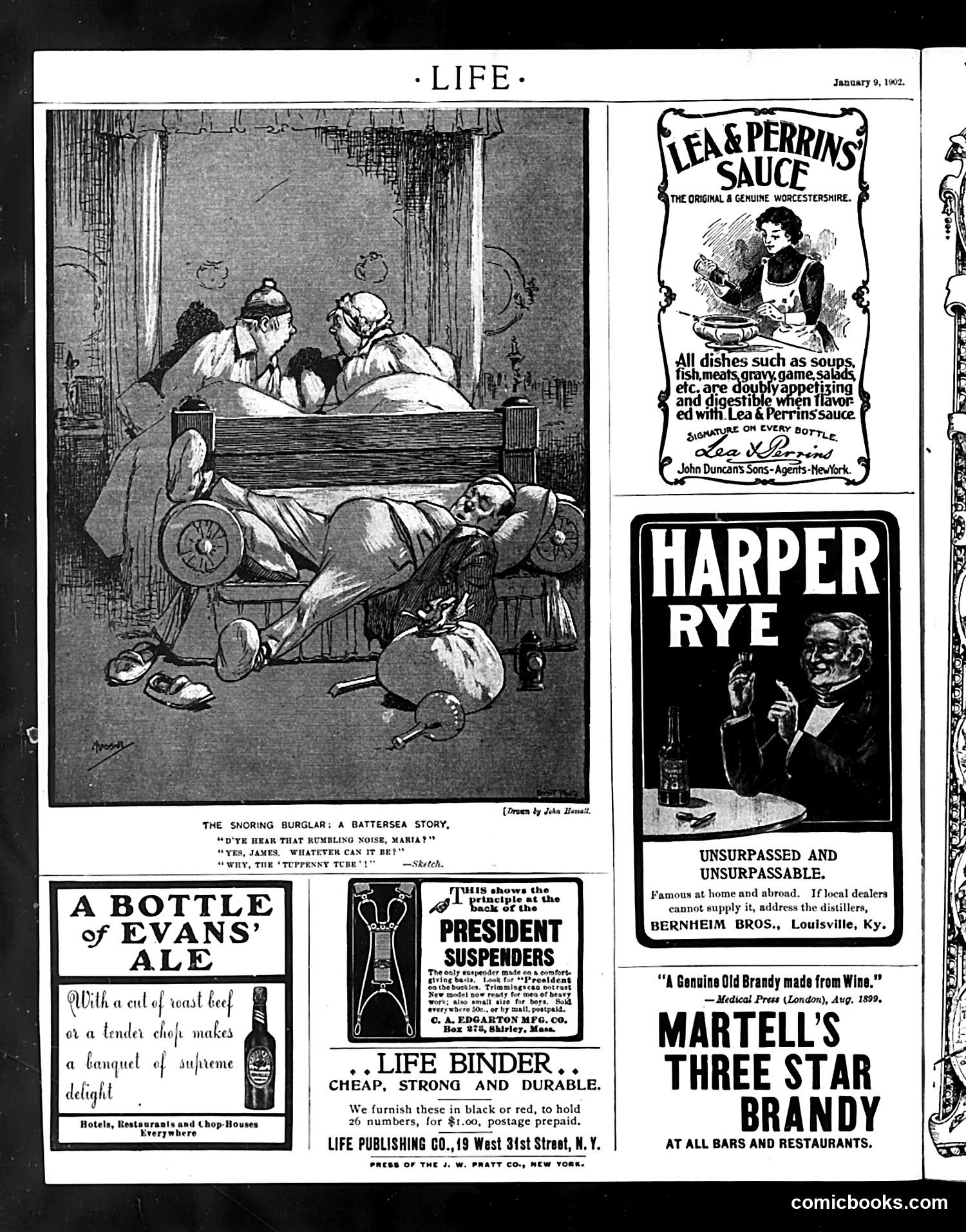
The main cartoon depicts a humorous domestic scene titled "The Snoring Burglar: A Battersea Story." It shows a burglar caught mid-heist in a bedroom, but the joke appears to be that he's been discovered snoring loudly enough to wake the household—hence the caption referencing "rumbling noise, Maria!" The illustration plays on the absurdity of an incompetent criminal whose noise gives him away. The surrounding content is primarily **advertising**—liquor and beverage brands common to early 1900s England and America: Evans' Ale, Harper Rye whiskey, Lea & Perrin's sauce, Martell's Brandy, and President Suspenders. These ads were typical revenue for *Life* magazine during this period. The cartoon's satire mocks petty criminality through slapstick, suggesting even burglars could be bumbling and self-defeating rather than genuinely threatening—a reassuring message for middle-class Victorian readers.