
Life, 1902-01-09 · page 12 of 20
Life — January 9, 1902 — page 12: what you’re looking at
What you’re looking at
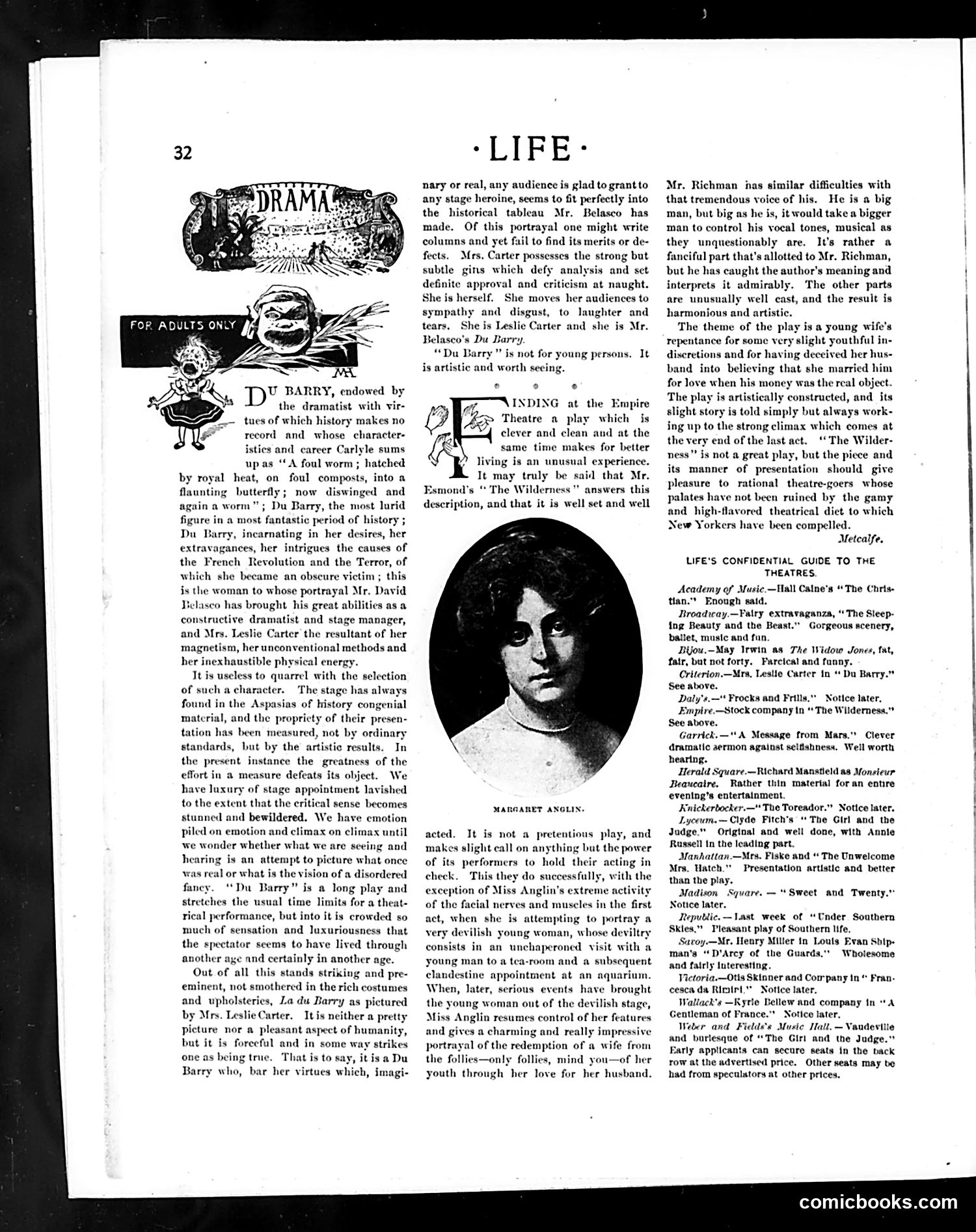
This page reviews theatrical productions, with particular focus on a play called "Du Barry" at an unspecified theatre. The small cartoon labeled "FOR ADULTS ONLY" depicts a cherubic figure, likely commenting on the play's adult themes. The review discusses the play's portrayal of Madame du Barry (the 18th-century French courtesan and mistress of King Louis XV), noting it contains "luxurious" stage appointments and deals with serious historical events including the French Revolution. The critic praises Leslie Carter's performance as du Barry, describing her acting as powerful and unconventional. The page also includes a photograph of what appears to be the lead actress and lists other current theatrical offerings in New York, making this a typical theatre review column from early 20th-century Life magazine.
📄 Transcribed text from this page (OCR, searchable)
Machine-transcribed from the original scan — historical spelling and the odd misread are preserved.
BARRY, endowed by the dramatist with vir- tues of which history makes no record and whose character- istics and career Carlyle sums upas ‘A foul worm ; hatched 1 heat, on foul composts, into a ng butterfly; now diswinged and again a worm"; Du Barry, the most lurid figure in a most fantastic period of history ; Du Barry, inearnating in her desires, her extravagances, her intrigues the causes of the French Revolution and the Terror, of which she became an obscure victim ; this is the woman to whose portrayal Mr. David Belasco has brought his great abilities as a constructive dramatist and stage manager, and Mrs. Leslie Carter the resultant of her magnetism, her unconventional methods and her inexhaustible physical energy. It is useless to quarrel with the selection of such acharacter. The stage has always found in the Aspasias of history congenial material, and the propricty of their presen- tation has been measured, not by ordinary standards, but by the artistic results. In the present instance the greatness of the effort in a measure defeats its object. We have luxury of stage appointment lavished to the extent that the critical sense becomes stunned and bewildered. We have emotion piled on emotion and climax on climax until we wonder whether what we are seeing and hearing is an attempt to picture what once lor what is the vision of a disordered “Du Barry” is a long play and stretches the usual time limits for a theat- rical performance, but into it is crowded so much of sensation and luxuriousness that the spectator seems to have lived through another age and certainly in another age. Out of all this stands striking and pre- eminent, not smothered in the rich costumes and upholsteri La du Barry as pictured by Mrs. LeslieCarter. It is neither a pretty picture nor a pleasant aspect of humanity, but it is forceful and in some way strikes one as being true. That is to say, it isa Du Barry who, bar her virtues which, imagi- an i eS D -LIFE- nary or real, any audience is glad to grantto any stage heroine, seems to fit perfectly into the historical tableau Mr. Belasco has made. Of this portrayal one might write columns and yet fail to find its merits or de- fects. Mrs. Carter possesses the strong but subtle gins which defy analysis and set definite approval and criticism at naught. She is herself. She moves her audiences to sympathy and disgust, to laughter and tears, She is Leslie Carter and she is Mr. Belasco’s Du Barry. “Du Barry” is not for young persons. It is artistic and worth seeing. e ° e INDING at the Empire écx> Theatre a play which is “4 clever and clean and at the same time makes for better living is an unusual experience. It may truly be said that Mr. Esmond’s “ The Wilderness” answers this description, and that it is well set and well MARGARET ANGLIN. acted. It is not a pretentious play, and makes slight call on anything but the power of its performers to hold their acting in check. This they do successfully, with the exception of Miss Anglin's extreme acti of the facial nerves and muscles in the first act, when she is attempting to portray a very devilish young woman, whose deviltry consists in an unchaperoned visit with a young man to a tea-room and a subsequent clandestine appointment at an aquarium. When, Jater, serious events have brought the young woman out of the devilish stage, Miss Anglin resumes control of her fe: and gives a charming and really i portrayal of the redemption of a wife from the follies—only follies, mind you—of her youth through her love for her husband. ‘Mr. Richman has similar difficulties with that tremendous voice of his. He is a big man, but big as he is, it would take a bigger man to control his vocal tones, musical as they unquestionably are. It’s rather a fanciful part that’s allotted to Mr. Richman, but he has caught the author's meaning and interprets it admirably. The other parts are unusually well cast, and the result is harmonious and artistic. ‘The theme of the play is a young wife's repentance for some slight youthful in- discretions and for having deceived her hus- band into believing that she married him for love when his money was the real object. The play is artistically constructed, and its slight story is told simply but always work- ing up to the strong climax which comes at the very end of the last act. ‘The Wilder- ness” js not a great play, but the piece and its manner of presentation should give pleasure to rational theatre-goers whose palates have not been ruined by the gamy and high-flavored theatrical diet to which New Yorkers have been compelled. Metcalfe, LIFE'S CONFIDENTIAL GUIDE TO THE THEATRES. Academy of Musie.—Mall Catne’s “The Chriss tian.’ Enough said. Broadway.—Fairy extravaganza, “The Sleep- ing Beauty and the Beast.” Gorgeous scenery, ballet, music and fun. BYou.—May Irwin as The Widow Jones, tat, fair, but not forty. Furcical and fanny. Criterion.—Mra, Lesile Carter in * Du Barry. See above. Daly's.—" Frocks and Frills," Notice later, Empire.—Stock company in “The Wilderness." See above. Garrick.—""A Message from Mars.” Clever dramatic aermon against selfishness, Well worth, hearing. Herat Square.—Richard Manstield as Monsieur Beaucaire, Rather thin matertal for an entre evening’s entertainment. Knickerbocker,—" The Toreador.” Notice later. Lyceum. —Clyde Fitch's “The Girl and the Judge." Original and well done, with Annie Russell tn the leading part. Manhattan. —Mra. Fiske and “ The Unwelcome Mrs, Hatch." Presentation artistle and better than the play. Madison Square. — “Sweet and Twenty. Notice later. Republic. Last week of “Under Southern Sktes,"" Pleasant play of Southern life, Saroy.—Mr, Henry Miller in Louls Evan Ship- man's “D'Arcy of the Guards." Wholesome and fatrly Interesting. Victoria.—Otis Skinner and Company in Fran- cesca da Rimirt.* Notice later. Watlack"s —Kyrte Bellew and company tn “A Gentleman of France. Notice later, Weber and Fields's Music Halt, —Vaudevitie and burlesque of “The Girl and the Judge.” Early applicants can secure seats in the back row at the advertised price. Other seats may be had from speculators at other prices. comicbooks.com