
Life, 1902-01-09 · page 4 of 20
Life — January 9, 1902 — page 4: what you’re looking at
What you’re looking at
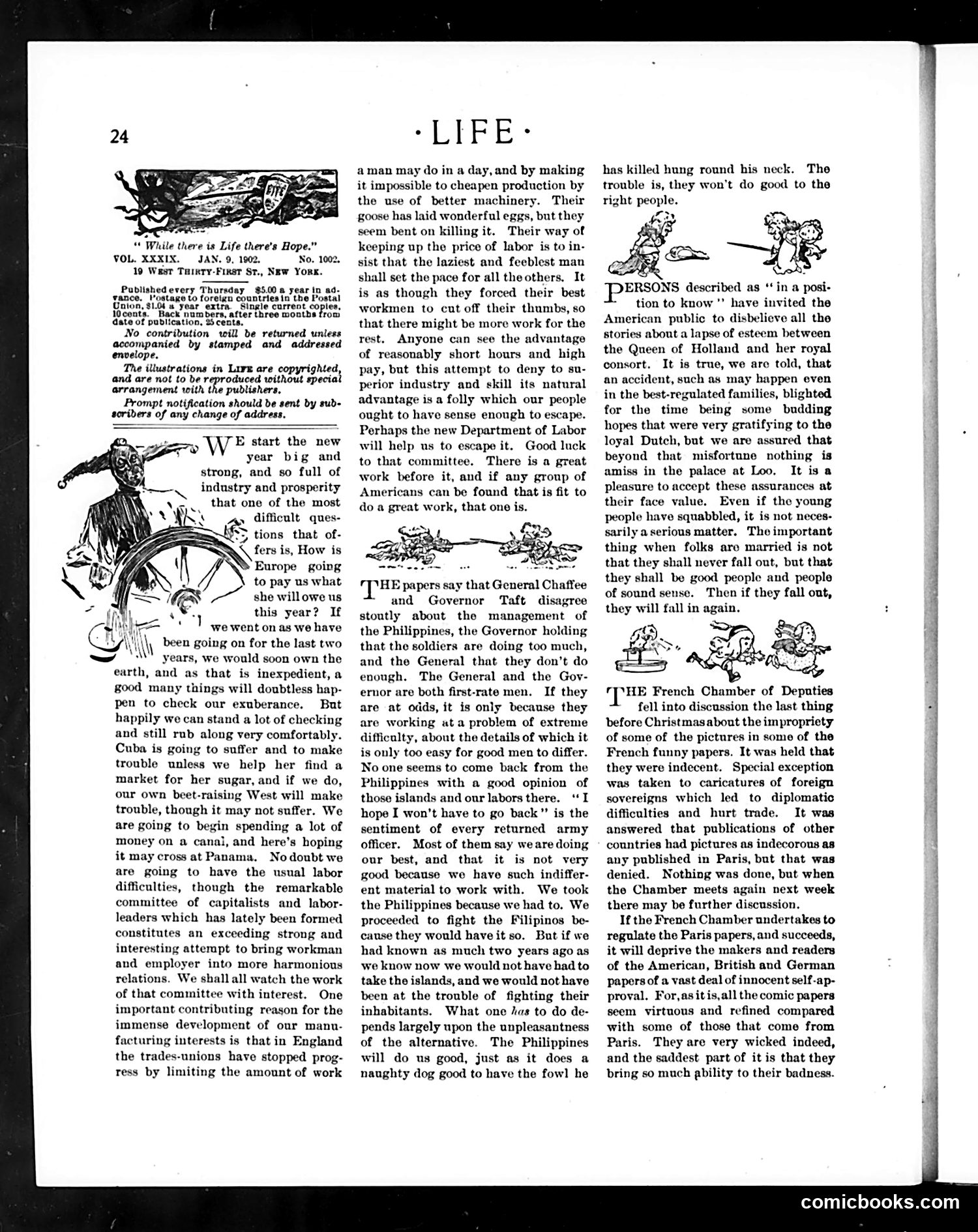
The page contains editorial commentary rather than prominent political cartoons. The main illustrated figure on the left appears to be a personified representation of "the new year" depicted as a woman at a spinning wheel—a common metaphor in early 1900s satirical magazines for fate or industry. The text discusses labor issues, manufacturing competitiveness, and America's colonial involvement in the Philippines. It critiques both capitalists and labor leaders, arguing their disputes harm national productivity. The commentary suggests the Philippines occupation requires better management and expresses skepticism about soldiers' performance there. The French Chamber of Deputies discussion concerns caricatures of foreign leaders—likely relating to diplomatic tensions of the period. The overall tone advocates for industrial harmony and practical governance.
📄 Transcribed text from this page (OCR, searchable)
Machine-transcribed from the original scan — historical spelling and the odd misread are preserved.
“« While there is Life there’s Hope.” VOL. XXXIX. JAN. 9, 1902. No. 1002, 19 West Taikty-Fixat St., NEW York. Publishedevery Thursday $5.00 a year in ad- vance. lrostage co foreign countries tn the Postal Caton. $1.04 4 year extra, Single current copies. ‘s. Back numbers, after three months from Gatoof publication, sscemta. No contribution will be returned unless accompanied by stamped and addressed envelope. The illustrations in Lure are copyrighted, and are not to be reproduced without speciat arrangement with the publishers, Prompt notification should be sent by sub- soribers of any change of address, JE start the new » W year big and strong, and so full of industry and prosperity that one of the most a difficult ques- "> tions that of- x fers is, How is Europe going to pay us what oe she willowe us = : this year? If UT + “T we went on as we have Ni \, been going on for the last two oN years, we would soon own the earth, and as that is inexpedient, a good many things will doubtless hap- pen to check our exuberance, But happily we can stand a lot of checking and still rub along very comfortably. Cuba is going to suffer and to make trouble unless we help her find a market for her sugar, and if we do, our own beet-raising West will make trouble, though it may not suffer. We are going to begin spending a lot of money on a canal, and here’s hoping it may cross at Panama. No doubt we are going to have the usual labor difficulties, though the remarkable committee of capitalists and labor- leaders which has lately been formed constitutes an exceeding strong and interesting attempt to bring workman and employer into more harmonious relations. We shall all watch the work of that committee with interest. One important contributing reason for the immense development of our manu- facturing interests is that in England the trades-unions have stopped prog- ress by limiting the amount of work LIFE aman may do in a day, and by making it impossible to cheapen production by the use of better machinery. Their goose has laid wonderful eggs, but they seem bent on killing it. Their way of keeping up the price of labor is to in- sist that the laziest and feeblest man shall set the pace for all the others. It is as though they forced their best workmen to cut off their thumbs, so that there might be more work for the rest. Anyone can see the advantage of reasonably short hours and high pay, but this attempt to deny to su- perior industry and skill its natural advantage is a folly which our people ought to have sense enough to escape. Perhaps the new Department of Labor will help us to escape it. Good luck to that committee. There is a great work before it, and if any group of Americans can be found that is fit to do a great work, that one is. THE papers say that General Chaffee and Governor Taft disagree stoutly about the management of the Philippines, the Governor holding that the soldiers are doing too much, and the General that they don’t do enough. The General and the Gov- ernor are both first-rate men. If they are at odds, it is only because they are working ata problem of extreme difficulty, about the details of which it is only too easy for good men to differ. No one seems to come back from the Philippines with a good opinion of those islands and our labors there. ‘I hope I won't have to go back” is the sentiment of every returned army officer. Most of them say we are doing our best, and that it is not very good because we have such indiffer- ent material to work with. We took the Philippines because we had to. We proceeded to fight the Filipinos be- cause they would have it so. But if we had known as much two years ago as we know now we would not have had to take the islands, and we would not have been at the trouble of fighting their inhabitants. What one /as to do de- pends largely upon the unpleasantness of the alternative. The Philippines will do us good, just as it does a naughty dog good to have the fowl] he has killed hung round his neck. The trouble is, they won't do good to the right people. Ko ERSONS described as ‘in a posi- tion to know "’ have invited the American public to disbelieve all the stories about a lapse of esteem between the Queen of Holland and her royal consort. It is true, we are told, that an accident, such as may happen even in the best-regulated families, blighted for the time being some budding hopes that were very gratifying to the loyal Dutch, but we are assured that beyond that misfortune nothing is amiss in the palace at Loo, It is a pleasure to accept these assurances at their face value. Even if the young people have squabbled, it is not neces- sarily a serious matter. The important thing when folks are married is not that they shall never fall out, but that they shall be good people and people of sound sense. Then if they fall out, they will fall in again. THE French Chamber of Deputies fell into discussion the last thing before Christmasabont the impropriety of some of the pictures in some of the French funny papers. It was held that they were indecent. Special exception was taken to caricatures of foreign sovereigns which led to diplomatic difficulties and hurt trade. It was answered that publications of other countries had pictures as indecorous as any published in Paris, but that was denied. Nothing was done, but when the Chamber meets again next week there may be further discussion. If the French Chamber undertakes to regulate the Paris papers, and succeeds, it will deprive the makers and readers of the American, British and German papers of a vast deal of innocent self-ap- proval. For,asitis,all the comic papers seem virtuous and refined compared with some of those that come from Paris. They are very wicked indeed, and the saddest part of it is that they bring so much ability to their badness. comicbooks.com (cst haa Dia hi a ail edt ant