
A complete issue · 33 pages · 1901
Life — December 26, 1901
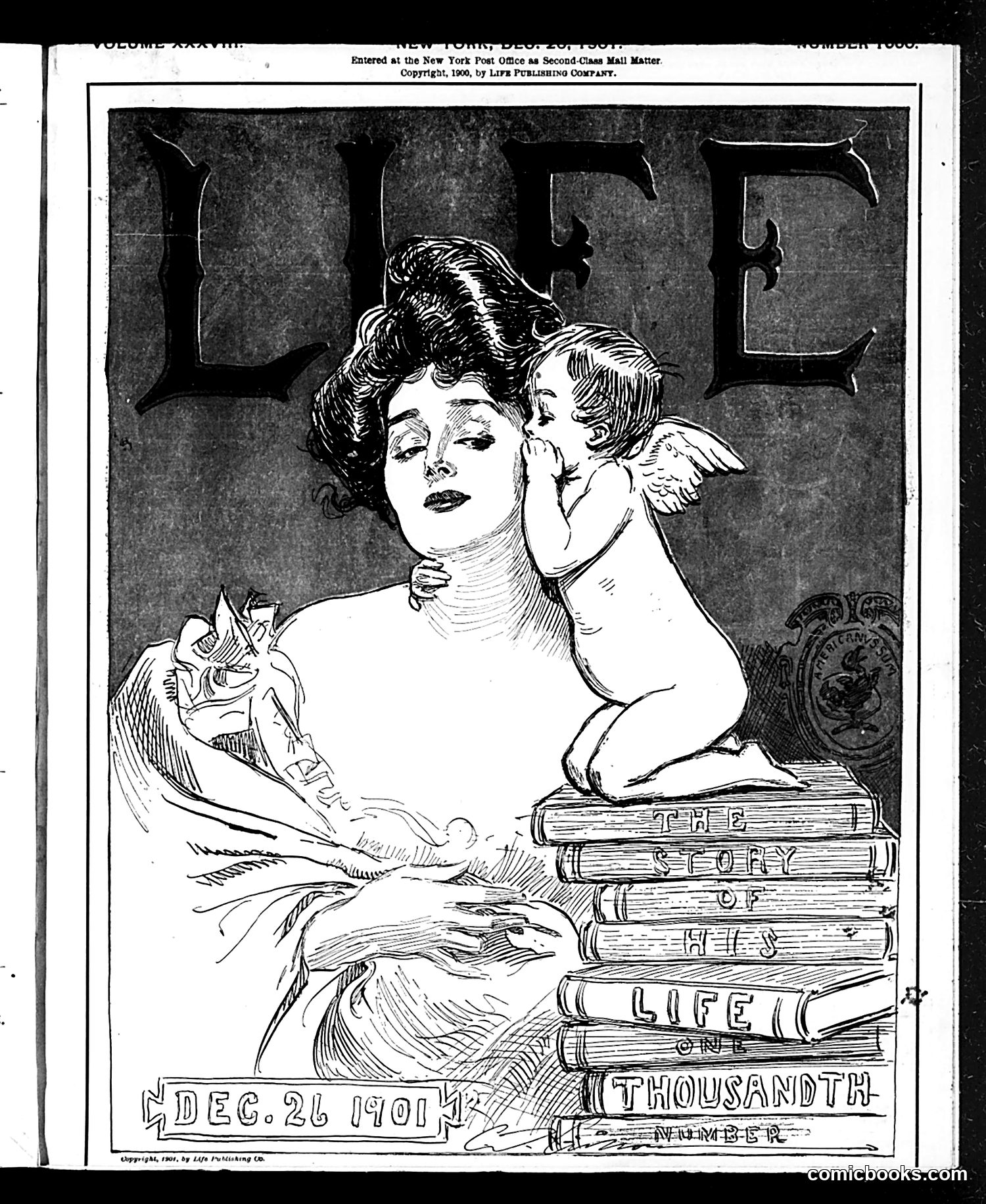
This cover illustrates a cherub (cupid) whispering to a fashionable Gibson Girl-style woman surrounded by stacked books labeled "The Story of His Life." The imagery plays on the popular "Gibson Girl" aesthetic—the idealized American woman of the early 1900s—combined with themes of romance and autobiography. The satire likely mocks the contemporary trend of celebrity memoirs and romantic literature flooding the market. The cherub's conspiratorial pose suggests manufactured sentiment or false romance being sold to readers. The woman's serene expression contrasts with the commercial nature of "his life story" as a packaged product, satirizing both the publishing industry's commercialization of personal narratives and the era's appetite for romantic stories about public figures.
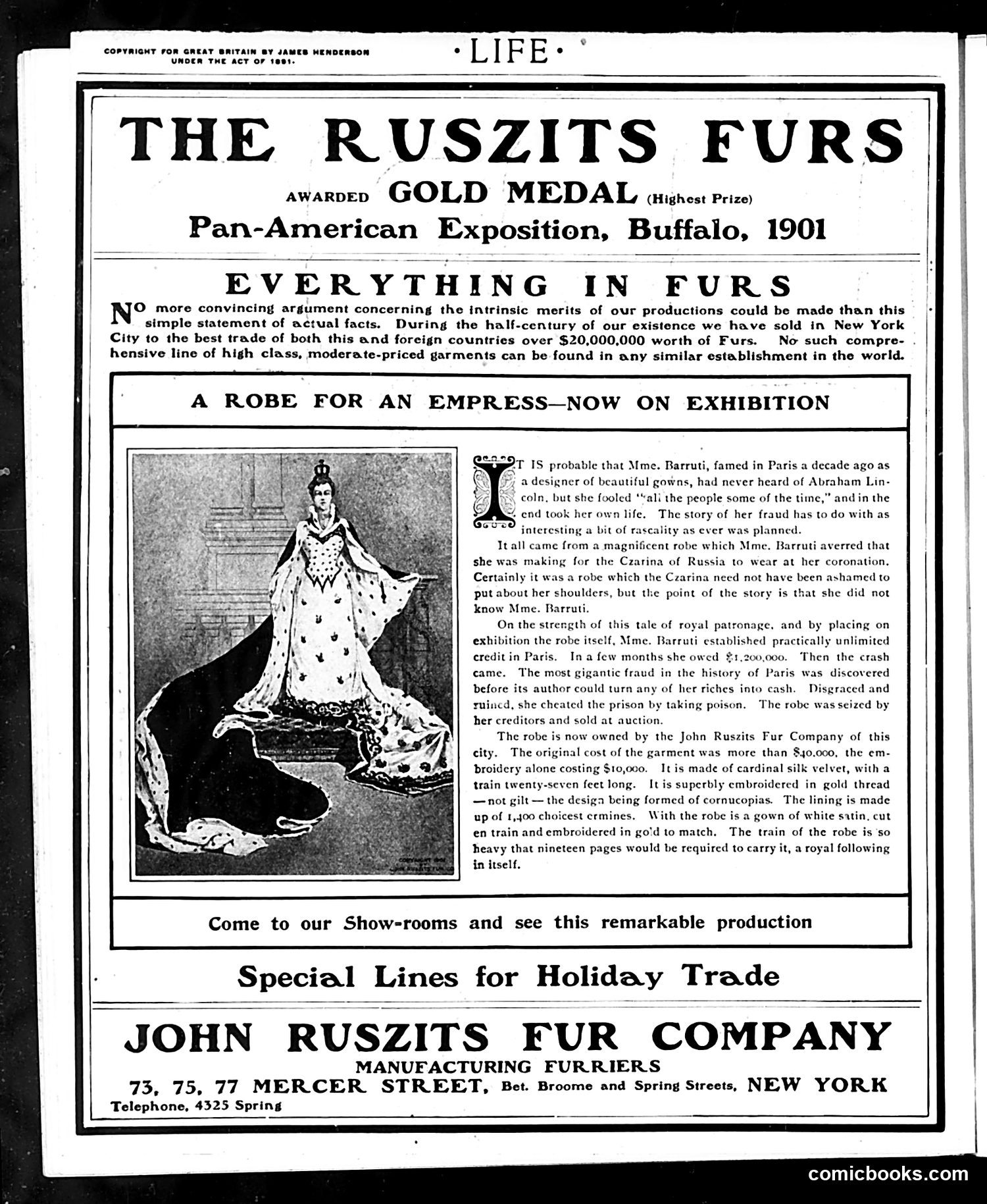
This page is primarily **advertising**, not satire or political commentary. It promotes the John Ruszits Fur Company's luxury goods. The central image shows an **empress in coronation robes**—likely the Russian Czarina, based on the text's reference to "Czarina of Russia." The accompanying story describes how designer Mme. Barruti claimed to have made a coronation robe for the Czarina, used this (false) prestige to establish credit in Paris, and defrauded creditors of £1,200,000 before being discovered and committing suicide. The advertisement's point: Ruszits fur company **now owns that seized robe**, which cost $10,000 in embroidery alone and has a 27-foot train. This real robe—allegedly connected to Russian royalty—serves as proof of the company's access to the finest materials and craftsmanship, lending them legitimacy and prestige to customers.
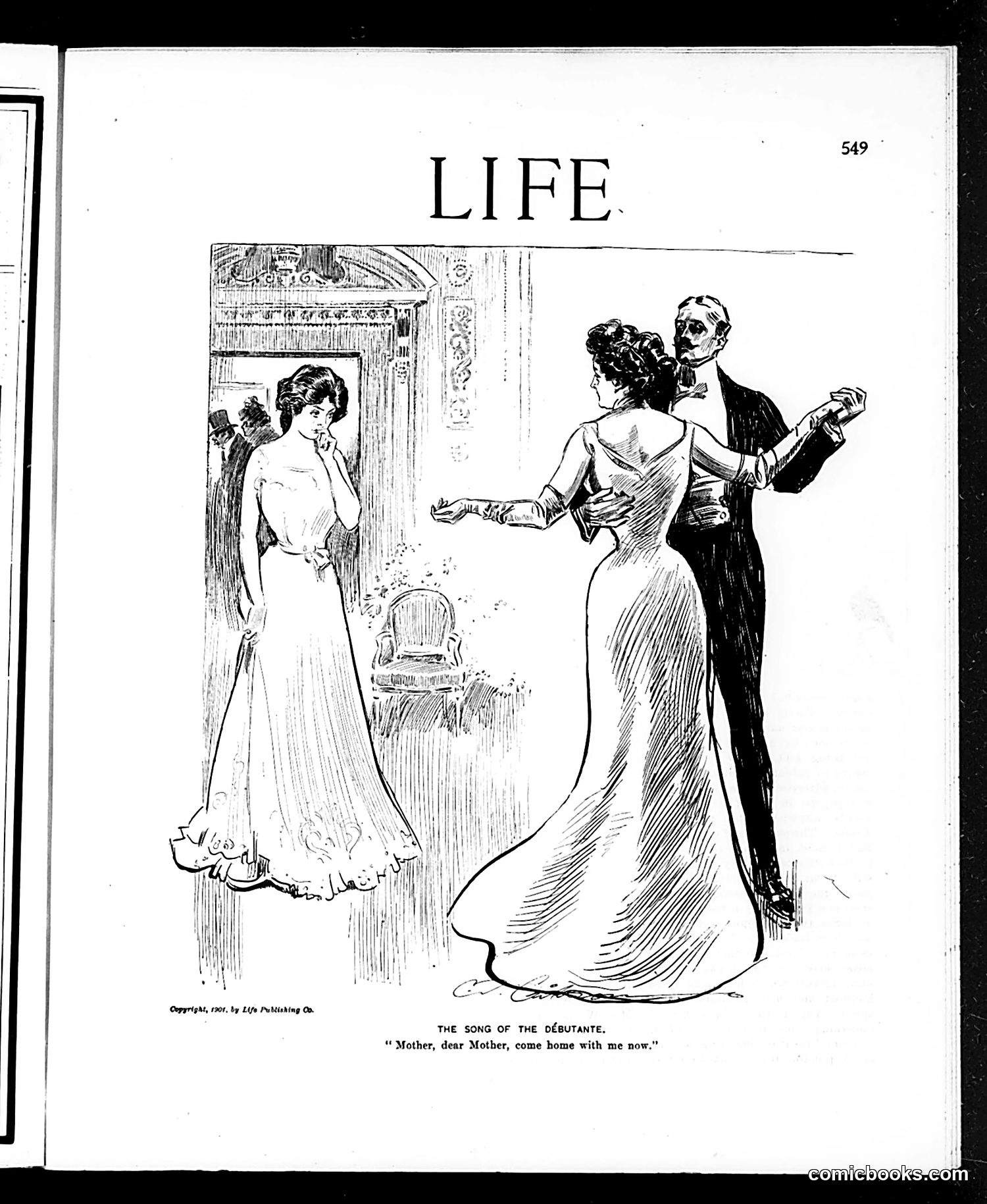
This satirical cartoon depicts a social scene from the early 1900s (copyright 1902, Life Publishing Co.). The title and caption—"Mother, dear Mother, come home with me now"—reference a popular sentimental song, likely "Home Sweet Home" or similar period tearjerker. The satire mocks the hypocrisy of wealthy society debutantes. While a young woman in an elegant gown pleads with her mother (visible in the doorway, appearing disapproving or weary) to return home, a gentleman escorts her forward, suggesting she's engaged in social activities her mother wouldn't approve of—dancing, flirtation, or romantic entanglement. The joke targets the contrast between proper Victorian domestic values and actual high-society behavior among privileged youth.
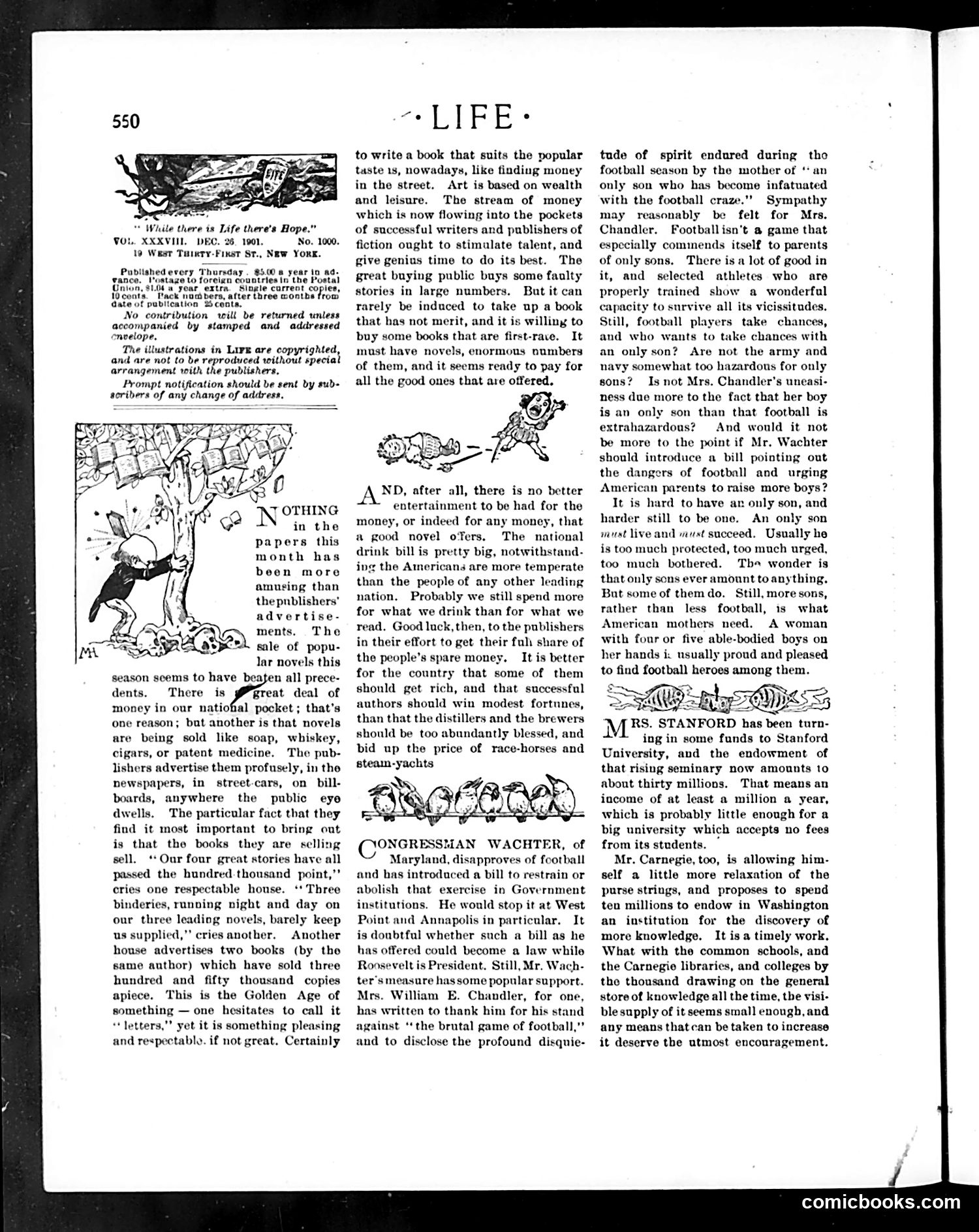
This page satirizes early 20th-century American publishing and social concerns. The text discusses how novels are now profitable commodities, with publishers seeking popular stories. There's criticism of Congress member Wachter (of Maryland) who introduced legislation to restrict football in government institutions, wanting to ban it at West Point and Annapolis. The author, Mrs. William E. Chandler, defends football against this "brutal game" characterization, arguing it builds character in boys and deserves encouragement rather than legal restriction. The small cartoons appear whimsical rather than pointed political commentary—decorative illustrations accompanying the text about publishing economics and football's social value. The satire targets both commercialized literature and paternalistic Congressional overreach into student athletics.
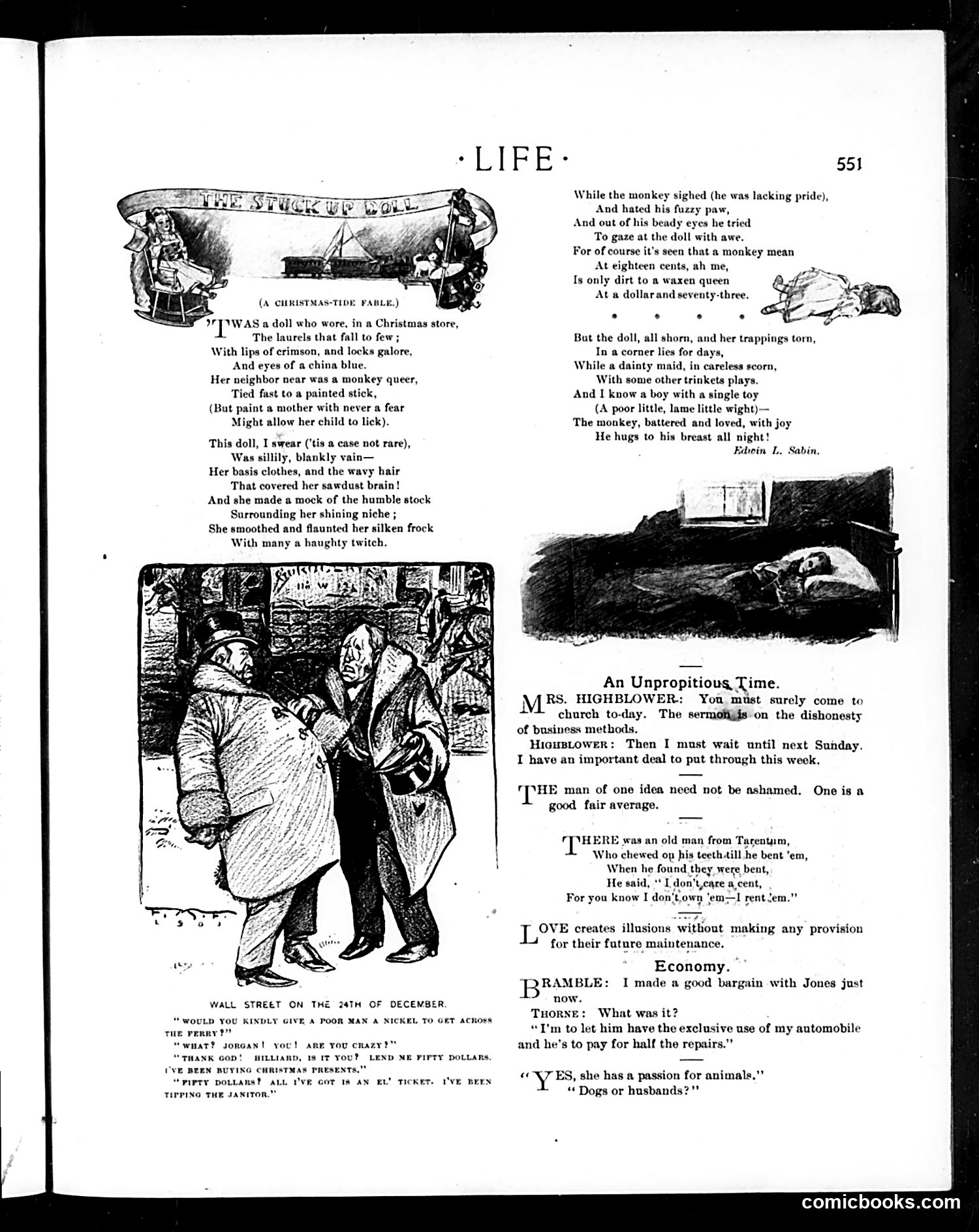
This page contains **literary and humorous content** rather than political cartoons. It features: 1. **"The Stuck-Up Doll"** — A Christmas-themed fable poem about a vain doll in a store who scorns a humble monkey toy, only to end up abandoned while the monkey is cherished by a child. The satire targets pride and materialism. 2. **Illustrations** accompany the poem, showing the doll's fate and the monkey's joy. 3. **Comic dialogues and brief humorous pieces** below, including "An Unpropitious Time" (about church attendance) and sections on business, old age, and animals. The page's humor relies on **observational satire about everyday life** — vanity, social pretension, and human contradiction — rather than specific political figures or events.
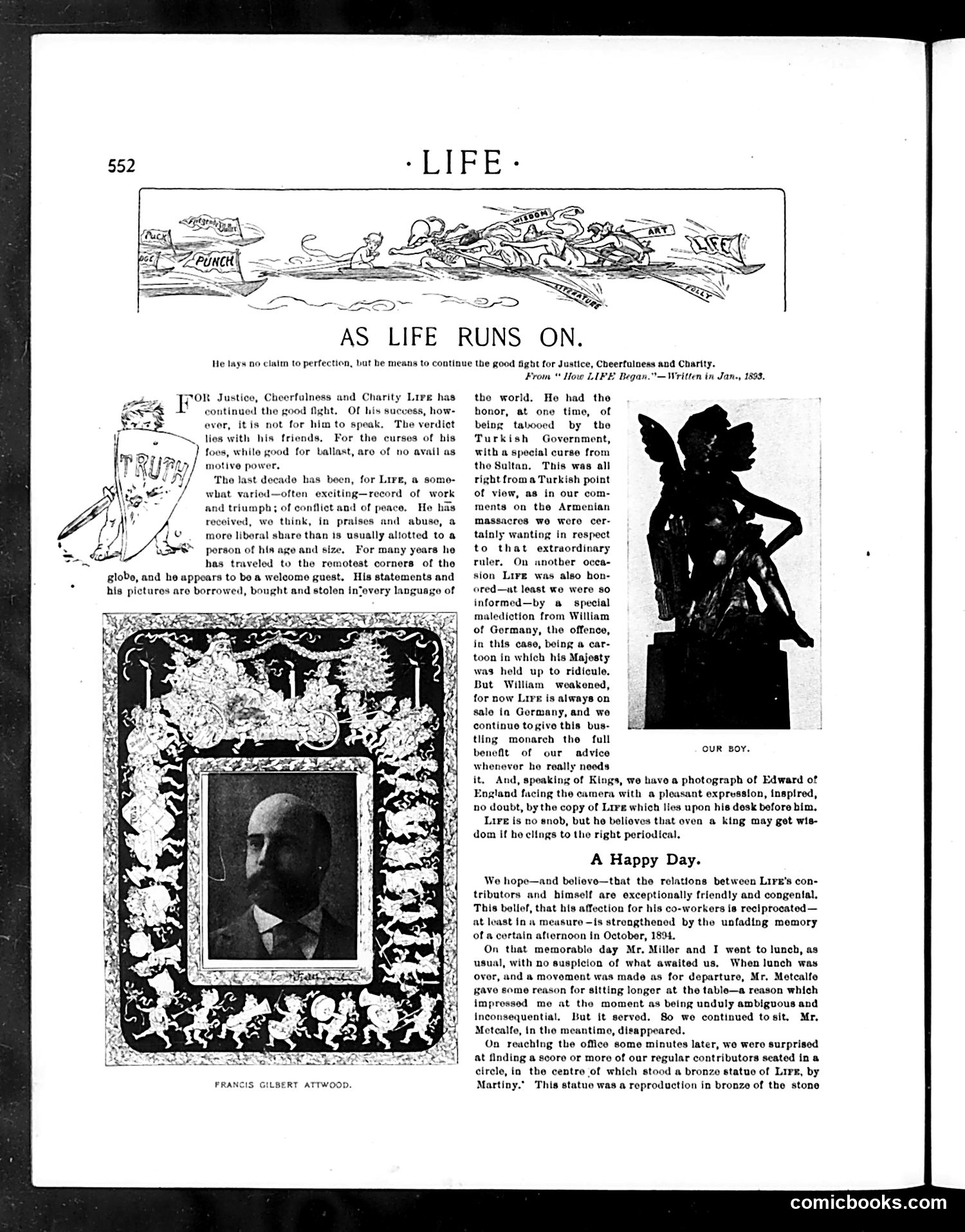
This page celebrates **Life magazine itself** rather than satirizing external figures. The masthead "AS LIFE RUNS ON" references the publication's ongoing mission for "Justice, Cheerfulness and Charity" (quoted from an 1833 source). The portrait shows **Francis Gilbert Atwood**, identified as a contributor. The accompanying article discusses Life's editorial relationships and philosophy, noting the magazine's widespread influence and borrowed content across "every language of the globe." A section titled "A Happy Day" describes an office visit, mentioning a bronze statue of Life by sculptor Martiny. The piece emphasizes Life's friendly relations with contributors and its commitment to its stated principles. This appears to be **house editorial content**—essentially Life promoting itself to readers rather than political satire.
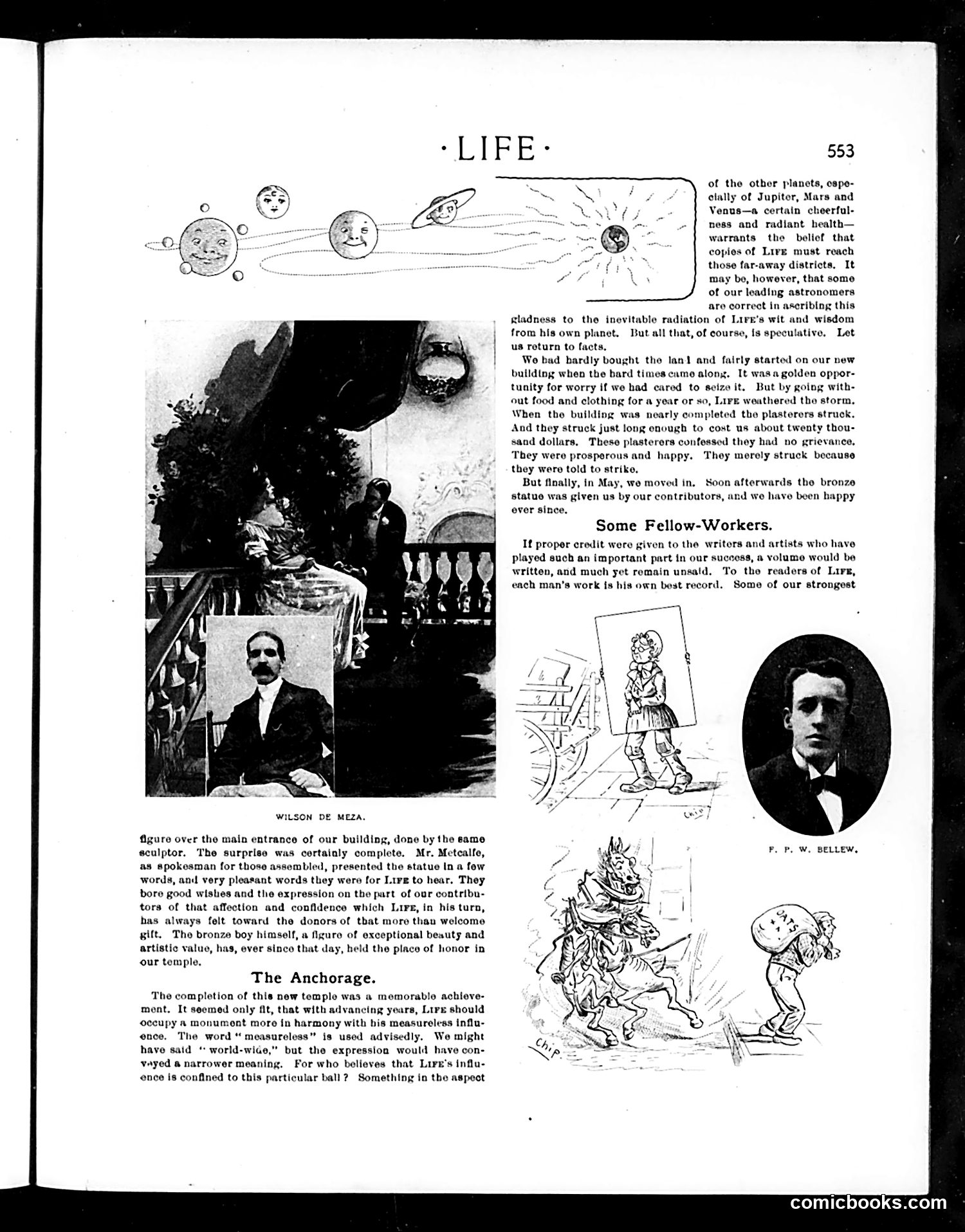
This page celebrates the completion of Life magazine's new building. The text describes financial hardship during construction—workers went unpaid for a year during economic difficulty, but the project ultimately succeeded through perseverance. **Key figures shown:** - **Wilson de Meza**: sculptor who created the bronze statue at the building's entrance - **F. P. W. Bellew**: likely an artist/contributor The decorative illustrations include sketches of figures and cartoons unrelated to the main narrative, typical of Life's satirical style. The diagram at the top depicting planetary orbits appears to reference Life's intellectual ambitions or influence. The overall message celebrates the magazine's resilience and the contributions of its creative team during challenging economic times.
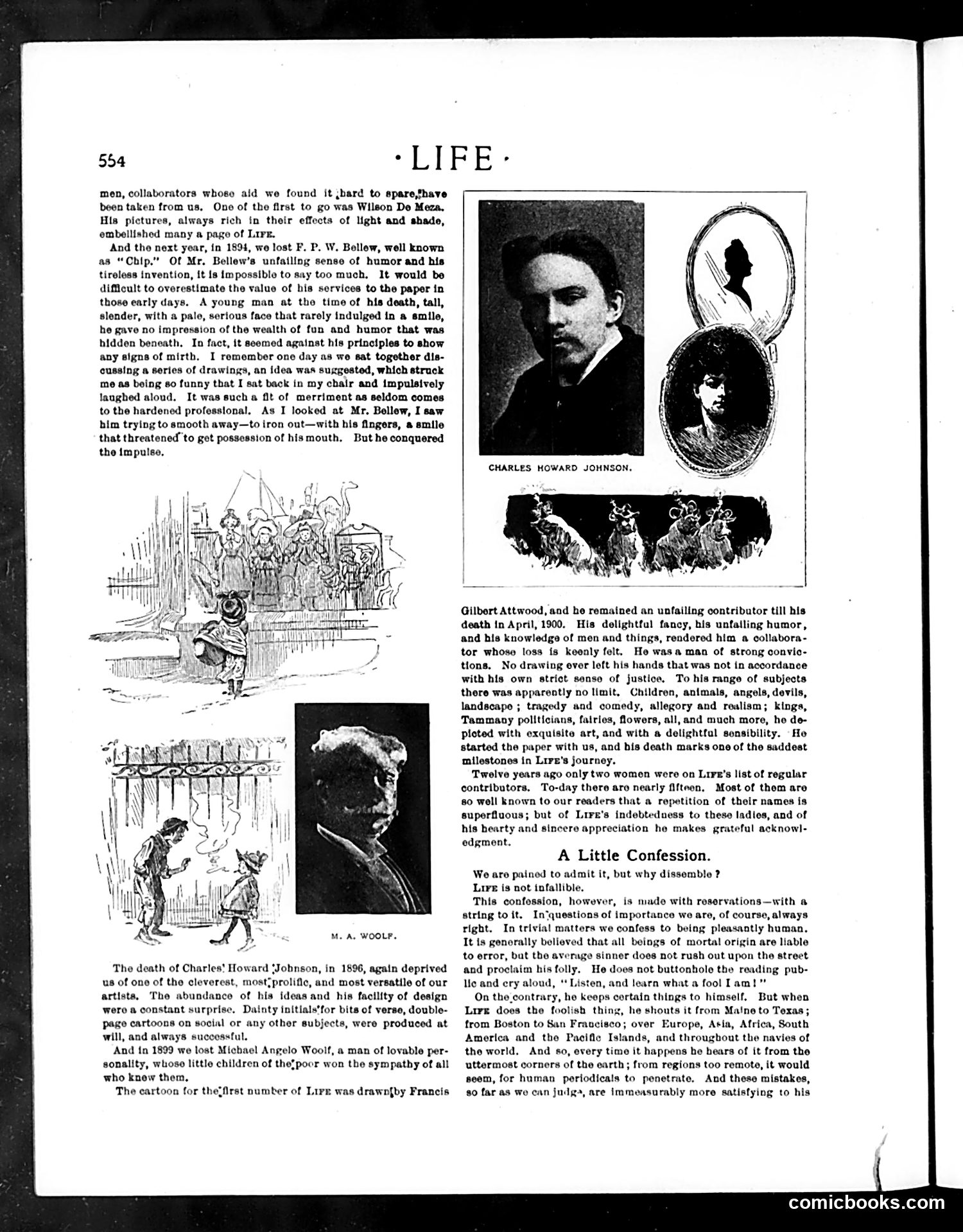
This page honors contributors to *Life* magazine who have died, specifically noting the 1896 death of **Charles Howard Johnson**, whose portrait appears at top. The text praises Johnson as a "clever, prolific, and versatile" artist whose cartoons and design work were "constantly surprising" and "always successful." The page also mentions **Michael Angelo Woolf** (whose portrait and sample cartoons are shown), described as having created beloved children's characters whose "little children of the poor won the sympathy of all who knew them." The cartoons visible show street scenes with working-class figures—typical of Woolf's subject matter depicting urban poor life. This appears to be a retrospective celebrating these illustrators' contributions to satirical journalism and social commentary through visual art in the late 19th century.
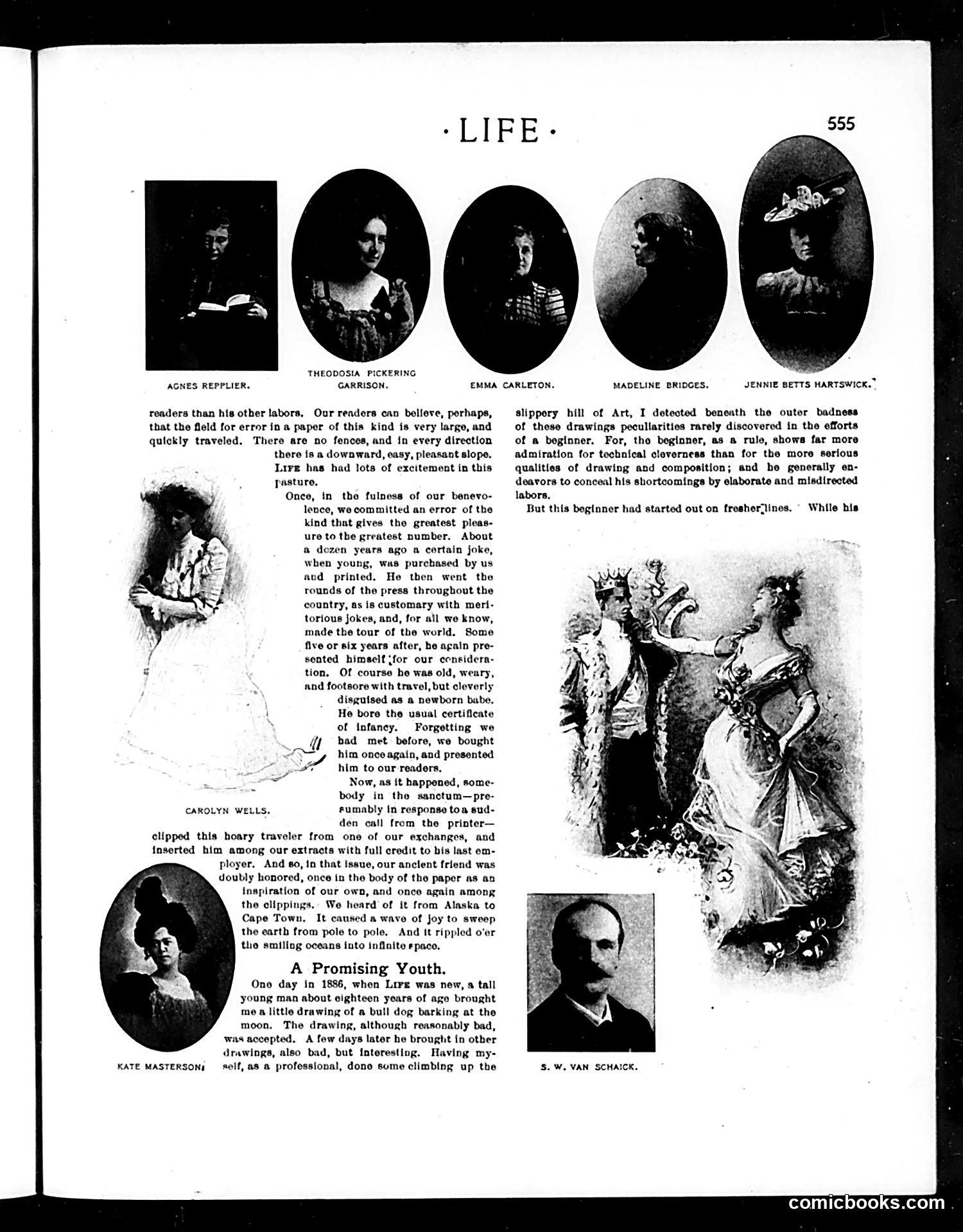
This page showcases portraits of five female artists (Agnes Repplier, Theodosia Pickering Garrison, Emma Carlton, Madeline Bridges, and Jennie Betts Hartswick) at the top, followed by sketches and biographical text. The editorial content discusses how *Life* magazine once published a beginner artist's work as a joke about a decade earlier. The artist later reappeared professionally, prompting the magazine to reconsider. The text humorously acknowledges this error while praising the artist's improvement and "fresher lines." Additional portraits of Carolyn Wells, Kate Masterson, and S.W. Van Schaick appear below, with a section titled "A Promising Youth" describing an 1886 anecdote about a young artist submitting a drawing of a bull dog. This appears to be a feature celebrating emerging American women artists and reflecting on *Life's* role in their careers.
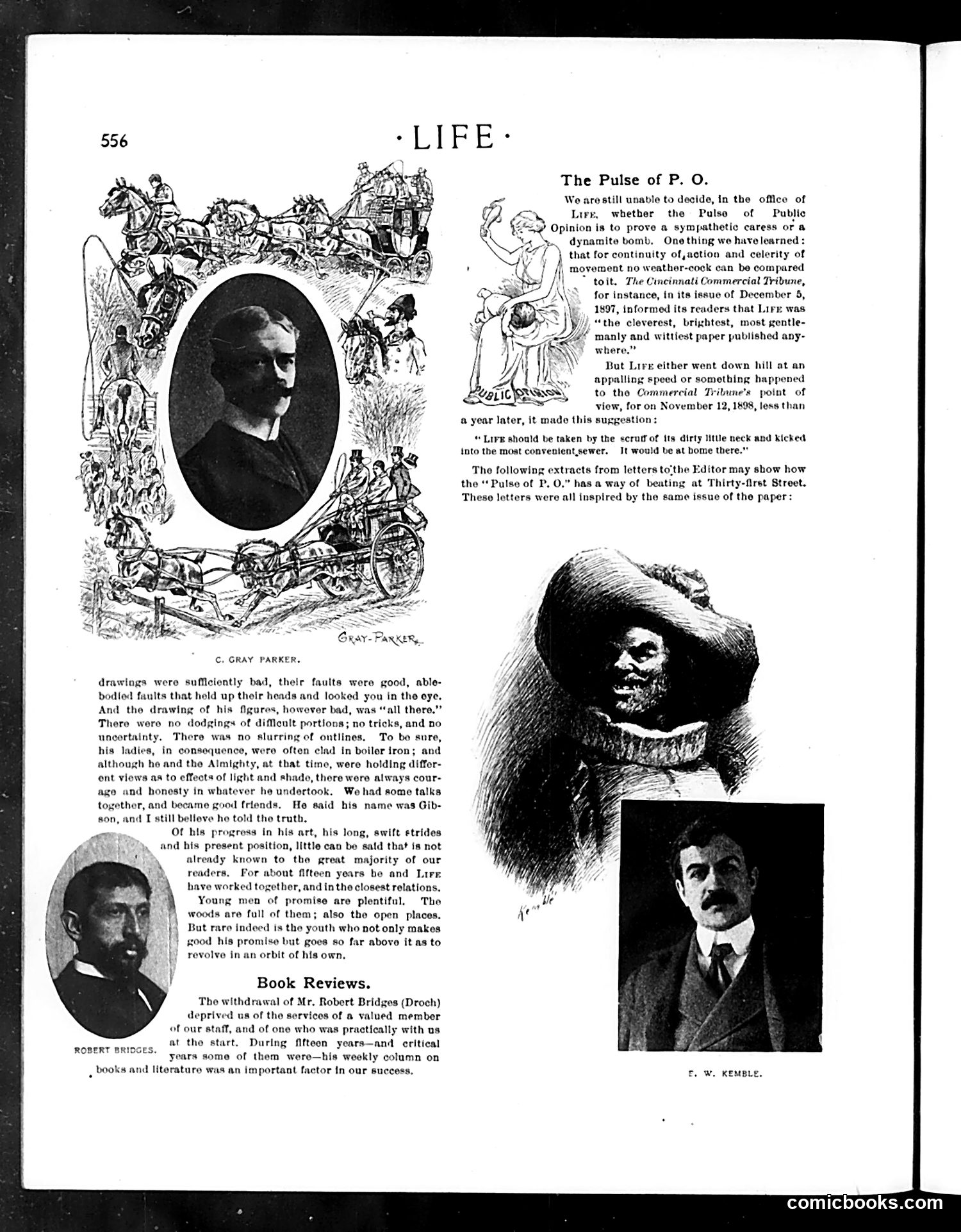
This page celebrates the vitality and longevity of Life magazine itself. The main oval portrait shows C. Gray Parker, Life's illustrator, surrounded by decorative vignettes depicting the magazine's characteristic subject matter—urban scenes, carriages, and social commentary. The text discusses Life's "Thirty-first Street" offices and reproduces critical praise from the Cincinnati Commercial Tribune (December 1897), calling Life "the cleverest, brightest, most gentlemanly and wittiest paper published anywhere." Below, under "Book Reviews," the page acknowledges Robert Bridges's fifteen-year contribution as a valued staff member whose weekly book column significantly influenced the magazine's success. The portraits of Bridges and F. W. Kemble appear to honor contributors to Life's cultural authority and sustained influence.
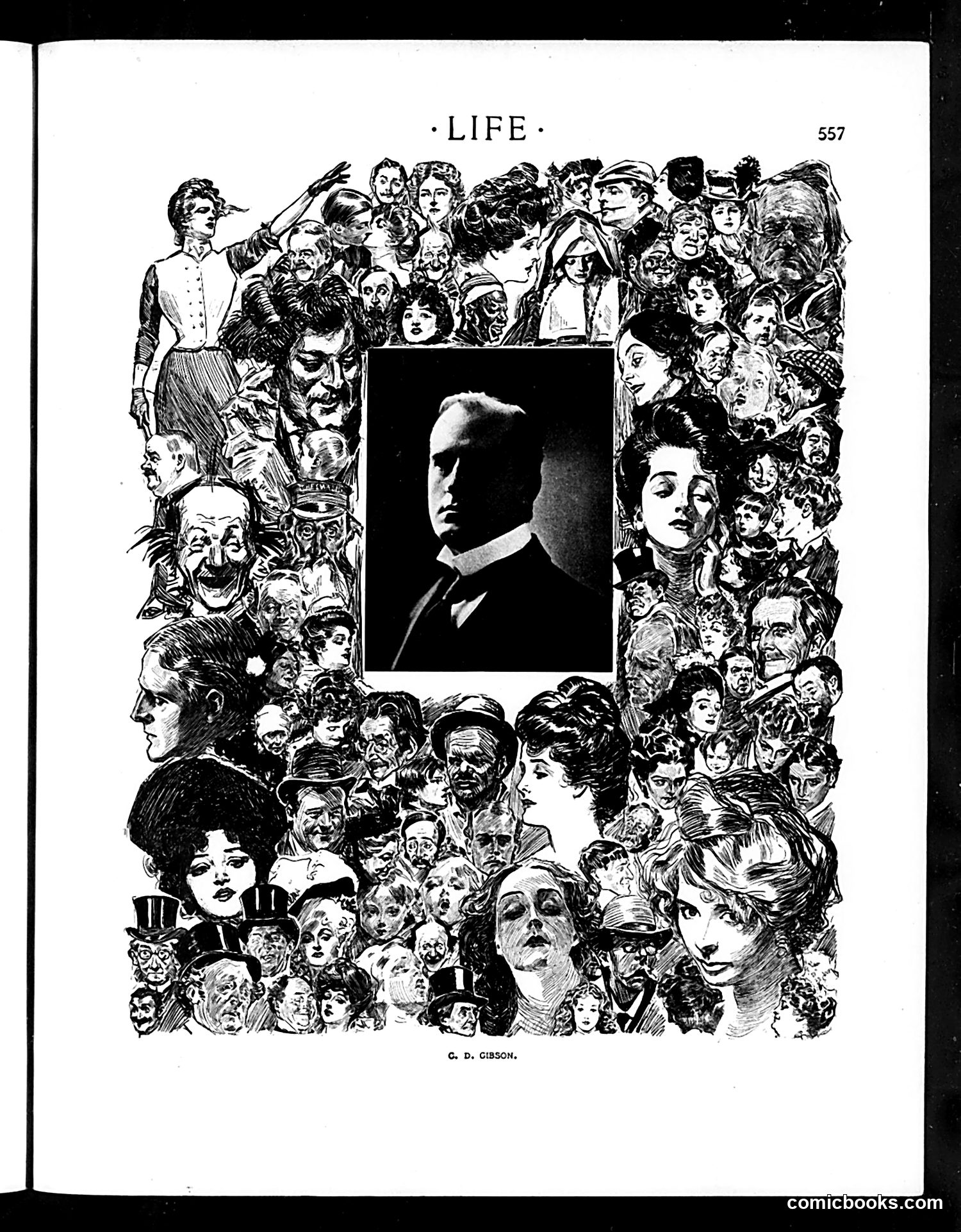
This is an illustrated cover or frontispiece by C.D. Gibson featuring a central photographic portrait of a bald man in profile, framed by an elaborate border of dozens of sketched faces—men, women, and children in various expressions and period dress (early 1900s style). The composition appears to celebrate or commemorate the central figure, surrounded by what may represent "all of humanity" or "all of society." Without being able to identify the specific individual from the photograph alone, the artistic intent seems to be portraying this person as significant or representative of broad social importance. The densely populated border suggests themes of democracy, public interest, or universal appeal—characteristic of Life magazine's satirical social commentary during this era.
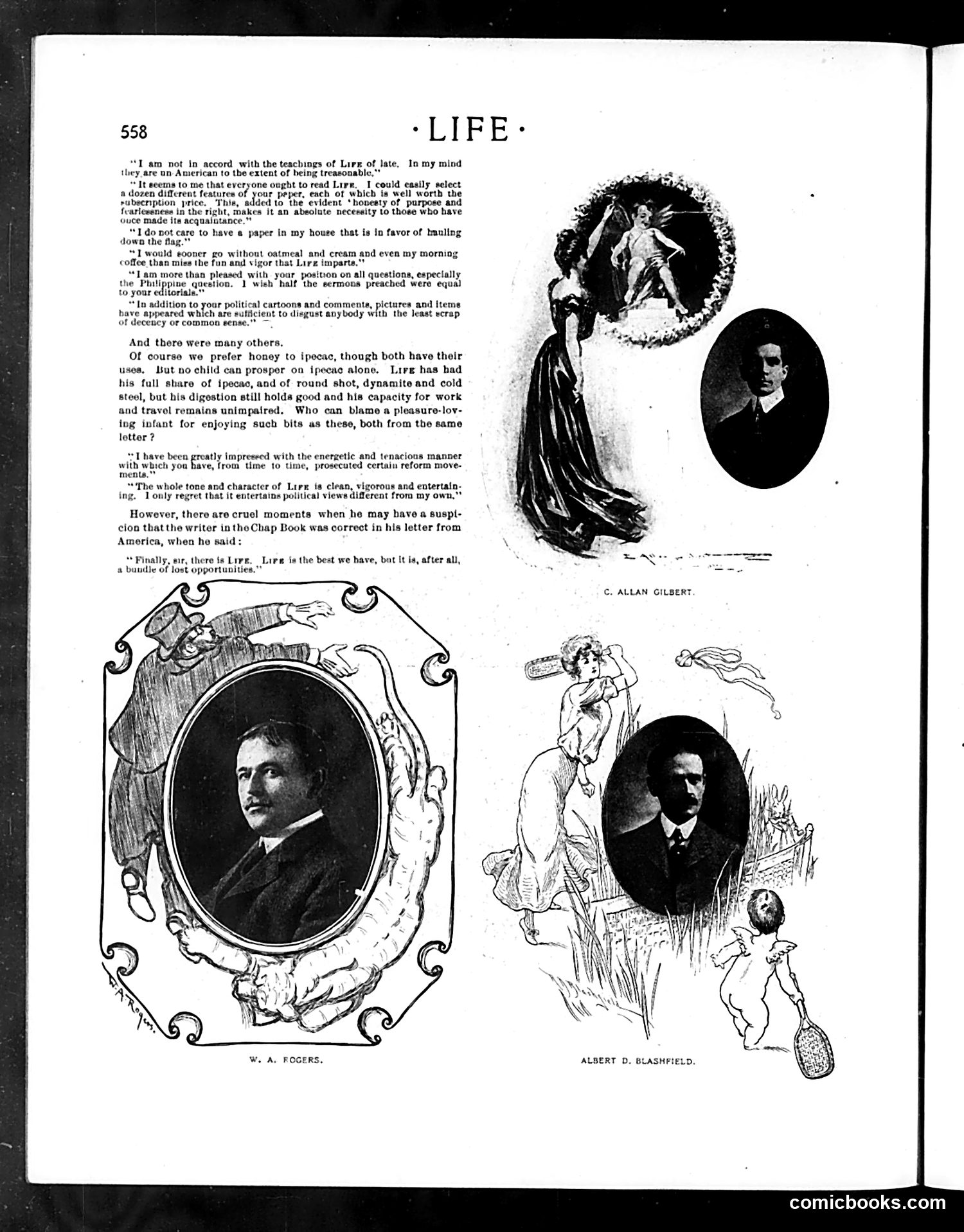
This *Life* magazine page (558) is an editorial discussion defending the publication itself against criticism. The text argues that *Life* has editorial independence, publishing what it deems appropriate regardless of outside pressure—specifically referencing criticism about Philippine coverage and complaints about "ipecac" (a purgative drug, likely used here metaphorically for harsh truths). The three portrait illustrations identify contributors or subjects: **C. Allan Gilbert** (top right), **W. A. Rogers** (bottom left), and **Albert D. Blashfield** (bottom right). These appear to be notable cartoonists or writers associated with the magazine. The decorative illustrations surrounding the portraits—including cherubs and allegorical figures—are typical *Life* magazine embellishments from this early 1900s era, adding visual interest rather than conveying specific political commentary.
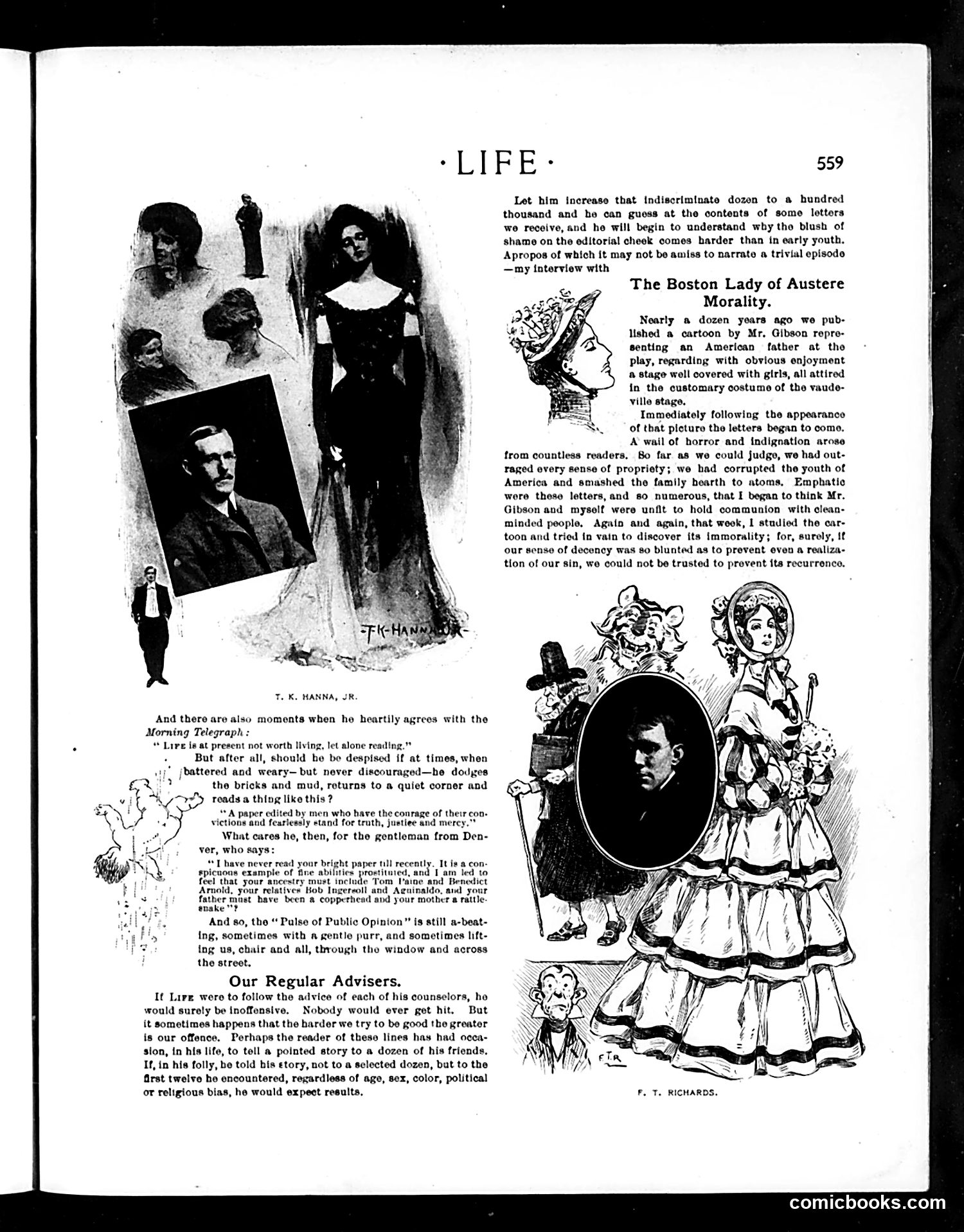
This page satirizes the moral outrage that Life magazine received from readers over a Charles Dana Gibson cartoon depicting an American father enjoying a vaudeville show featuring scantily-clad chorus girls. The editorial mocks the hypocrisy and excessive prudishness of letter-writers—particularly "the Boston Lady"—who condemned the magazine for corrupting American youth and family values. The satire's point: Life's editors genuinely couldn't identify what was immoral about the cartoon, yet received hundreds of irate letters attacking their morality. The piece argues that overzealous moral crusaders often cause more damage through their rigid judgment than the supposedly offensive content itself. The illustrated examples of abusive reader mail (including one comparing the editors to traitors and infidels) further ridicule the extreme and personal nature of these complaints, suggesting such moral panic is itself the real problem.
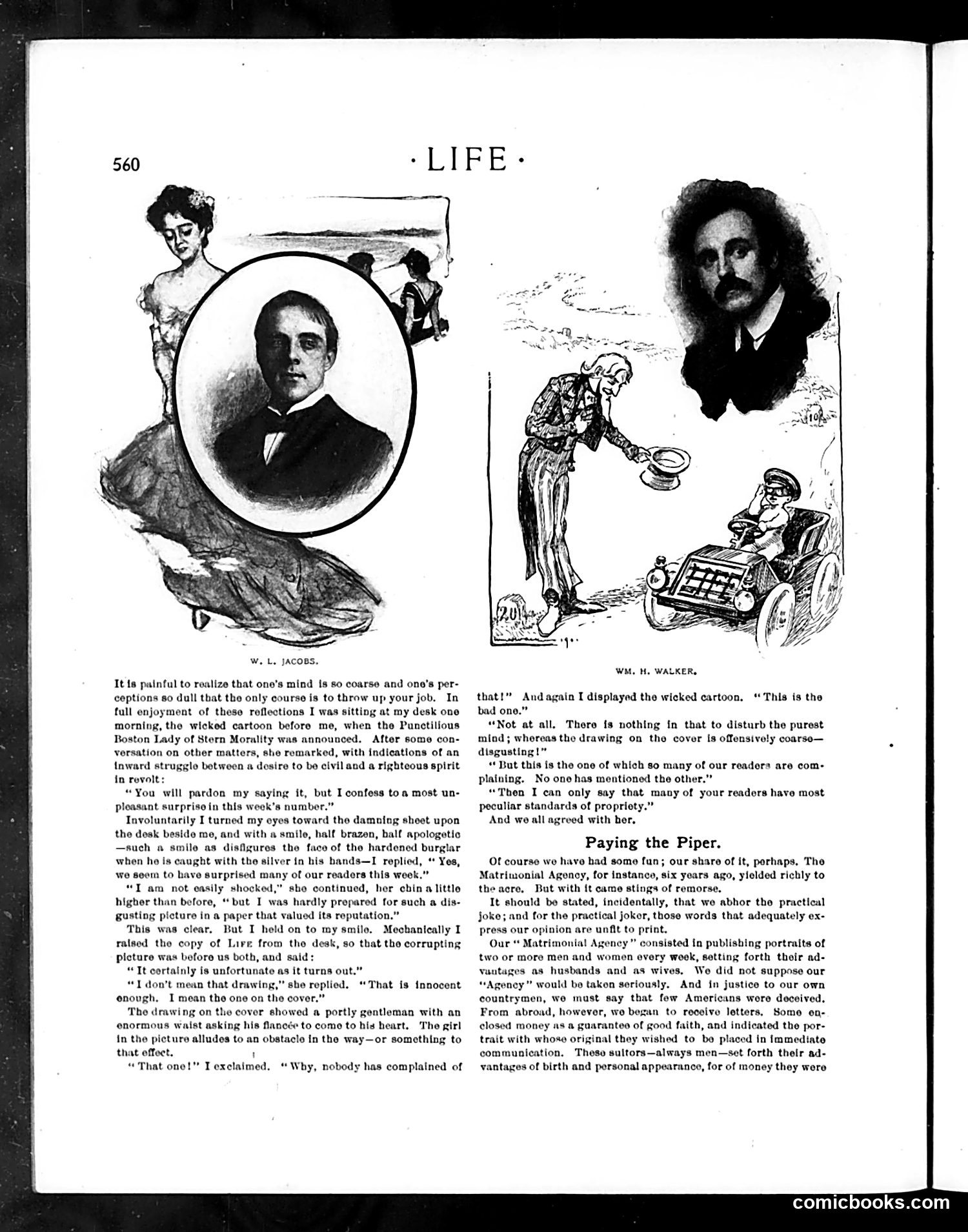
This page contains two satirical pieces about editorial judgment and reader complaints. The first piece (by W.L. Jacobs) depicts an editor's encounter with a prudish "Boston Lady of Stern Morality" who objects to a cartoon in that week's *Life*. The humor lies in the disconnect between what offends her and what *Life* itself considers objectionable: she complains about a cover cartoon showing a portly man with an "enormous waist" asking his fiancée to approach him (a mild romantic joke), while ignoring the truly "wicked cartoon" the editor considers problematic. The editor and lady ultimately agree she has peculiar standards—revealing how subjective morality and taste are. The second section, "Paying the Piper" (by W.M. Walker), describes *Life*'s past "Matrimonial Agency" feature: publishing portraits of men and women as potential matches. The editors assumed it was harmless satire, but it backfired when foreign readers took it seriously and sent money and earnest marriage proposals, viewing the featured men as genuine suitors seeking wives. Both pieces humorously document *Life's* editorial conflicts with readers over propriety and unintended consequences of satire.
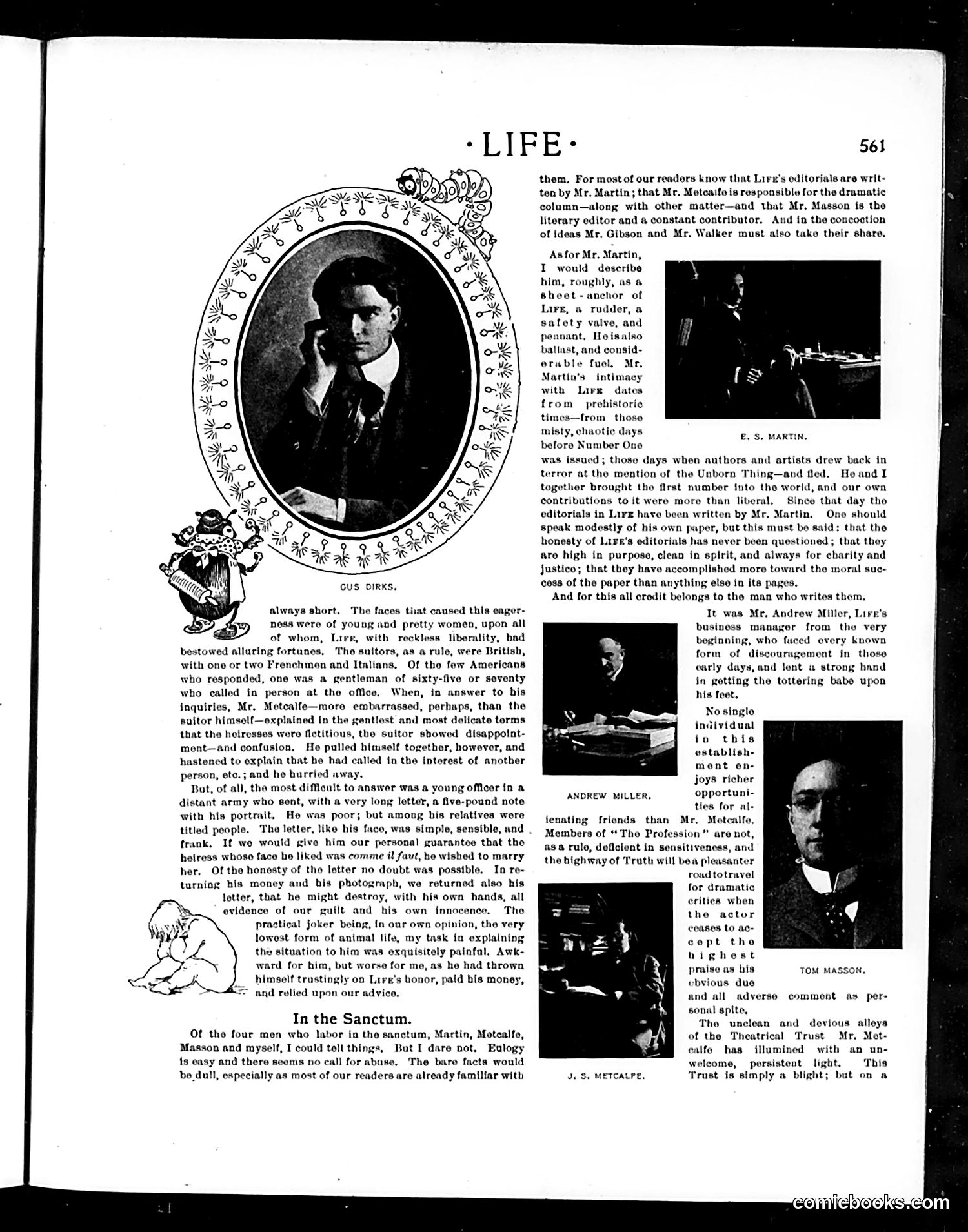
This page celebrates the editorial staff of *Life* magazine through portraits and biographical sketches. It's not primarily satirical but rather self-promotional—explaining the magazine's internal operations to readers. The text identifies key figures: **E.S. Martin** (writer of editorials), **J.S. Metcalfe** (dramatic column), **Tom Masson** (literary editor), and **Andrew Miller** (business manager). The author describes them as the creative force behind *Life*. Notably, the page includes an anecdote about a young military officer who responded to a fictitious heiress ad with genuine romantic interest and his own photograph—illustrating that *Life* ran satirical "lonely hearts" columns. The author expresses genuine embarrassment at deceiving this earnest suitor, suggesting even satirists maintained certain ethical boundaries. The page demonstrates *Life's* self-conscious identity as a publication built on collaborative wit and editorial integrity.
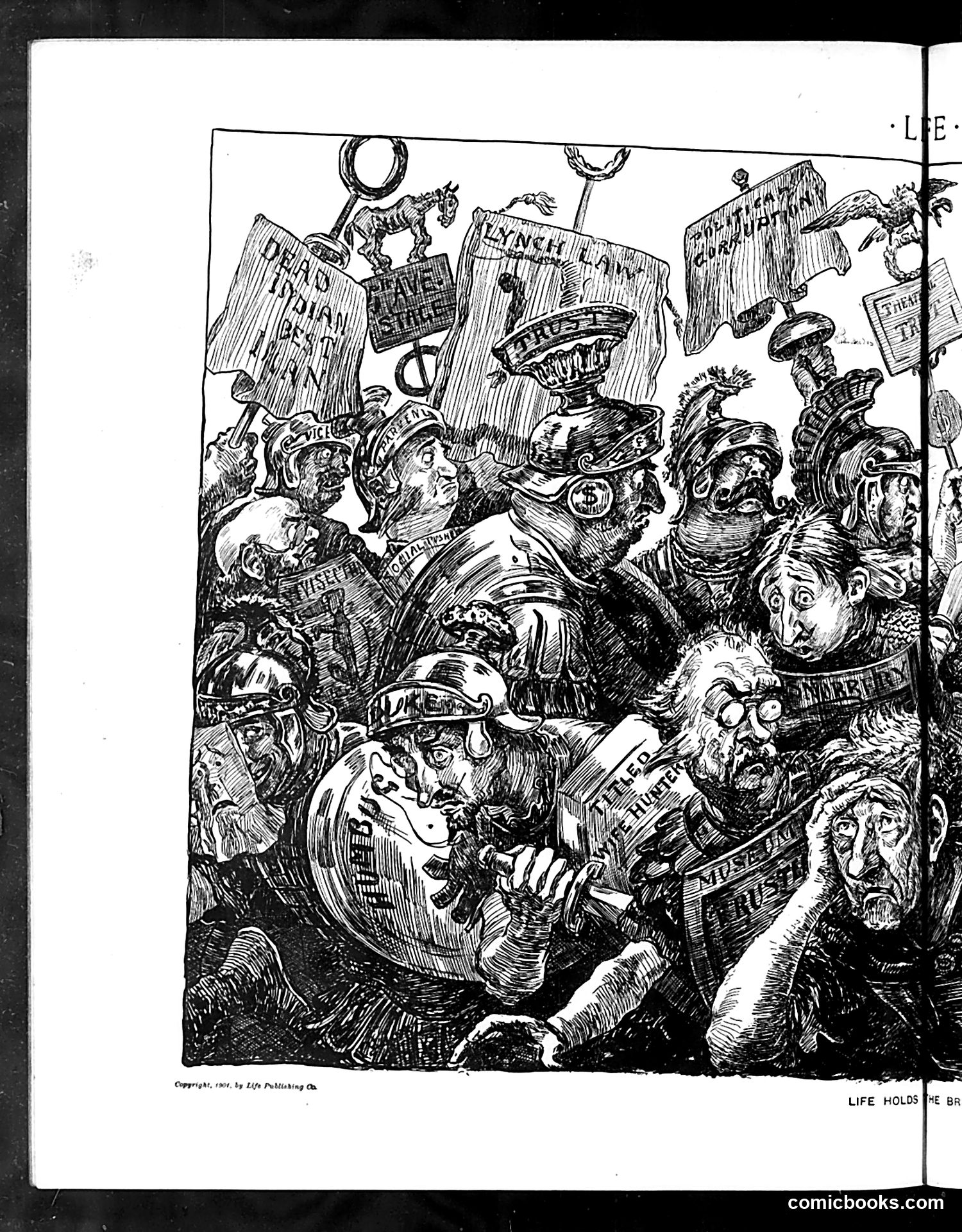
This is a densely packed satirical engraving depicting a chaotic military or political gathering. Multiple uniformed figures with exaggerated facial features wear helmets and military regalia, with various banners and flags visible overhead (including text that appears to reference "LYNCH," "GRATIAM," and other partially legible phrases). The style suggests late 19th-century American political satire. The caricatures and crowded composition imply commentary on military leadership, possibly corruption or incompetence. However, without clearer text visibility or additional context, the specific historical event or individuals being mocked remain unclear. The grotesque facial features were typical of period satirical art used to demean political opponents. The copyright notice indicates "Life Publishing Co."
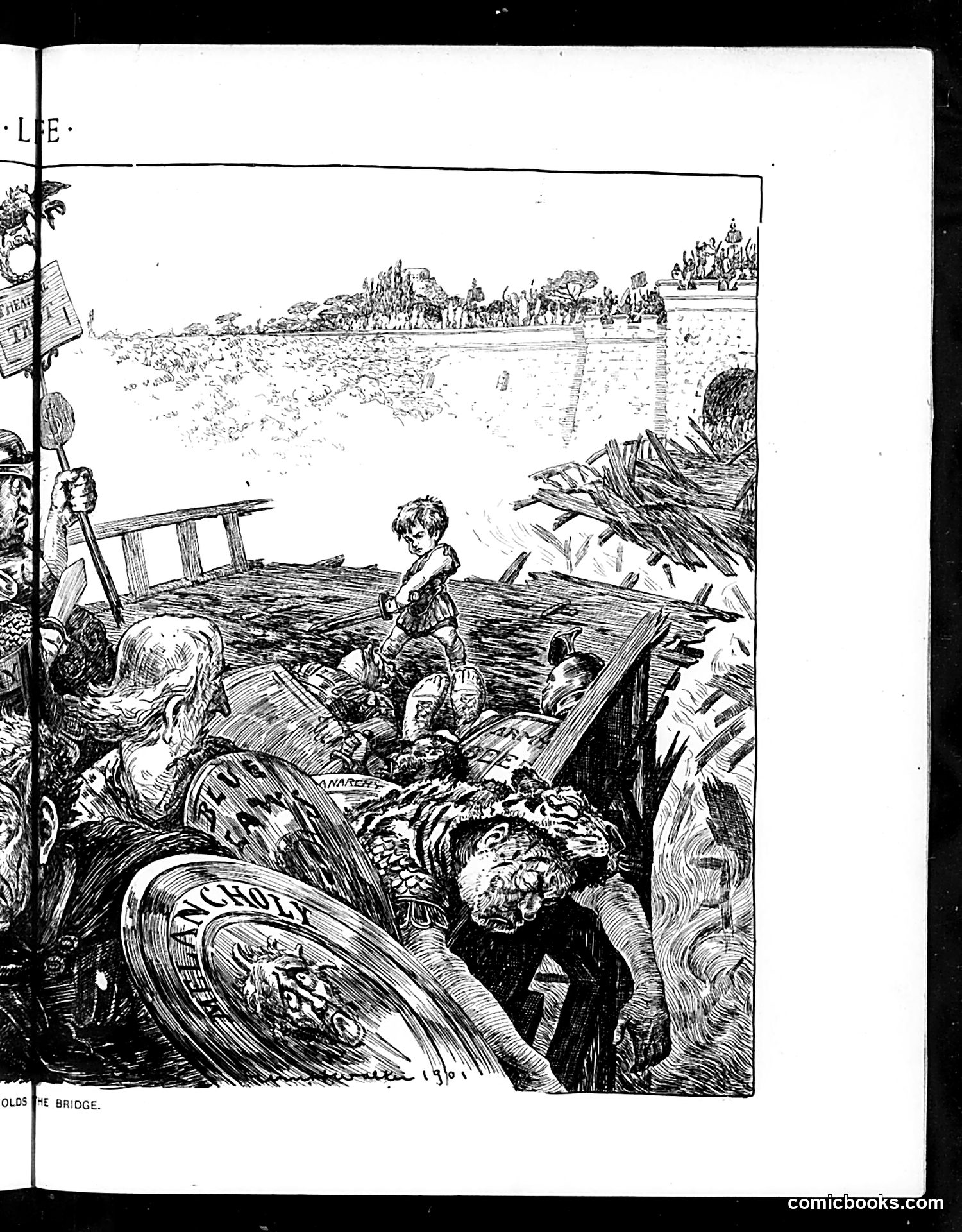
This appears to be an illustration from *Life* magazine showing a scene at what looks like an old bridge or waterfront structure. The image depicts several figures—adults and children—examining or gathered around large circular objects (possibly wheels or industrial equipment marked with text). The scene has a satirical quality typical of *Life*'s social commentary. Without clearer OCR text or visible date, the specific political reference is unclear, but the composition suggests commentary on either: industrial conditions, labor issues, or public infrastructure. The mix of well-dressed figures with working-class elements, combined with children present, may indicate satire about negligence, poverty, or social inequality. The style and composition suggest early 20th-century American satirical cartooning.
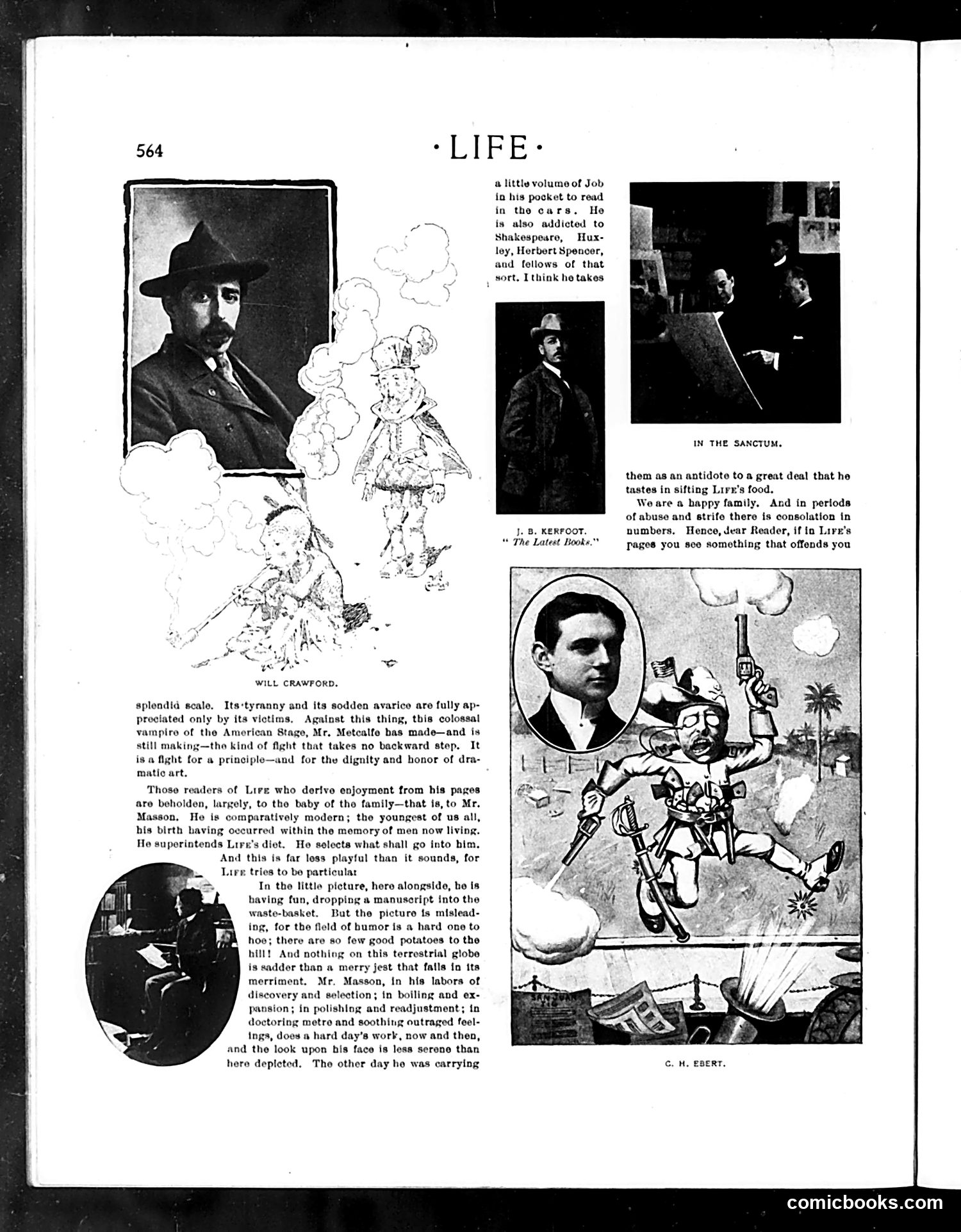
This page is a **meta-commentary on Life magazine itself**, explaining how the publication operates. The text introduces key staff members and their roles: - **J. B. Kerfoot** ("The Latest Books") handles literary content - **Will Crawford** is an illustrator - **Mr. Masdon** (the "baby of the family") serves as editor, curating what gets published—described as selecting Life's "diet" The cartoons illustrate this editorial function. One shows Masdon dropping a rejected manuscript into a waste-basket, humorously depicting the difficult work of choosing content. The text acknowledges this isn't truly playful work: finding genuinely good humor ("potatoes") is hard, and rejected jokes that "fail in merriment" are tragic. The page also defends **Mr. Metcalfe's** theatrical criticism as a principled stand against "tyranny and avarice" in American theater—framing Life's editorial mission as morally serious despite its satirical tone. Essentially, this is Life magazine explaining itself to readers: humor requires tough editorial judgment.
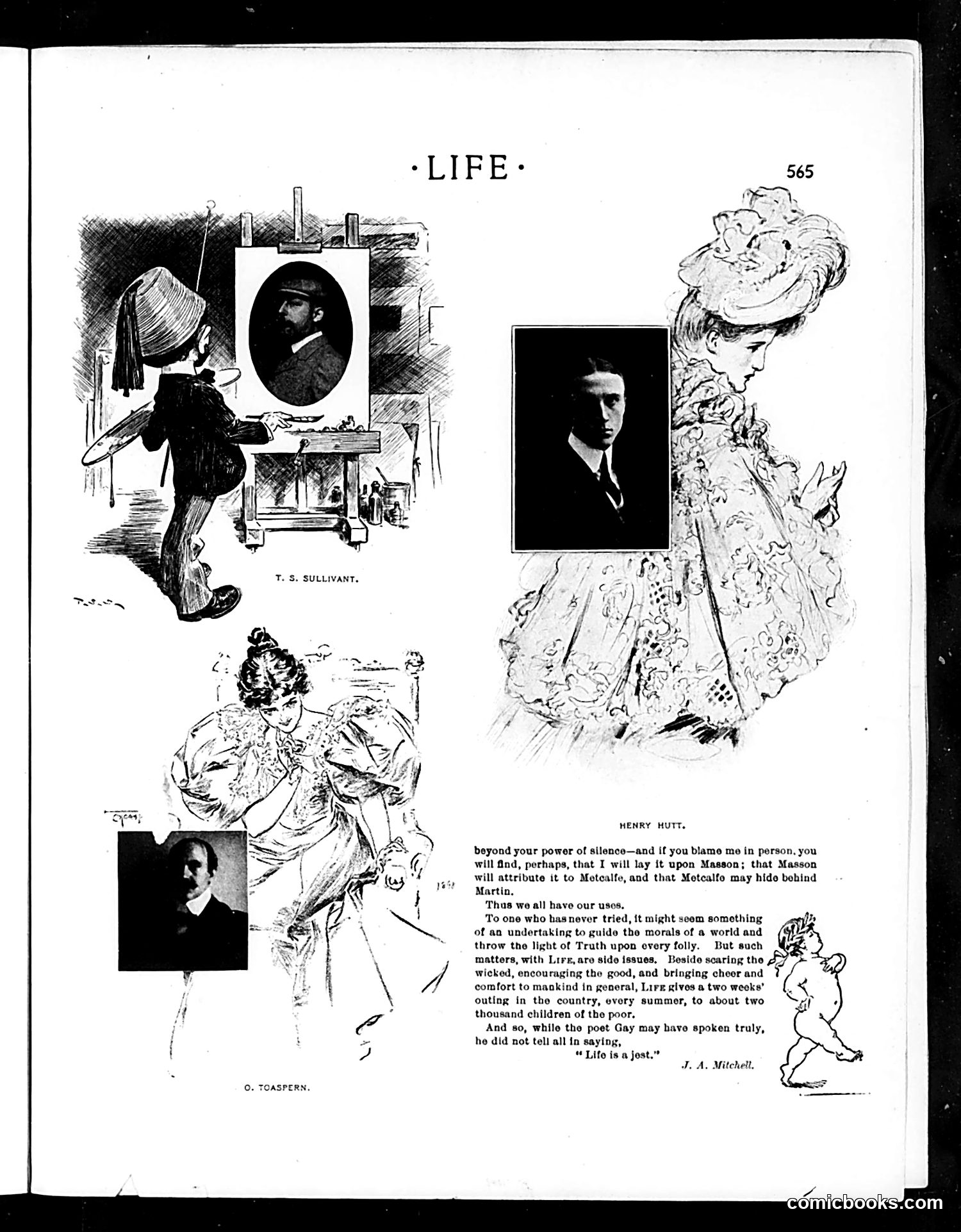
This page from *Life* magazine showcases satirical illustrations by prominent cartoonists T.S. Sullivant and O. Toaspern, with accompanying text by J.A. Mitchell (likely the magazine's editor). The central content is a humorous quote attributed to Henry Hutt, depicting a chain of responsibility-dodging: blame shifts from one person to another (Masson → Metcalfe → Martin), illustrating how accountability disappears in bureaucratic passing-the-buck. Mitchell's accompanying text defends *Life* magazine's moral and social mission, claiming it guides public morality while also providing charitable work—specifically, annual country outings for poor children. The piece concludes by quoting John Gay's maxim "Life is a jest," but argues *Life* does more than merely jest; it has serious social purpose. The illustrations are decorative examples of the magazine's satirical visual style, featuring fashionable figures and social commentary typical of early 20th-century American satire.
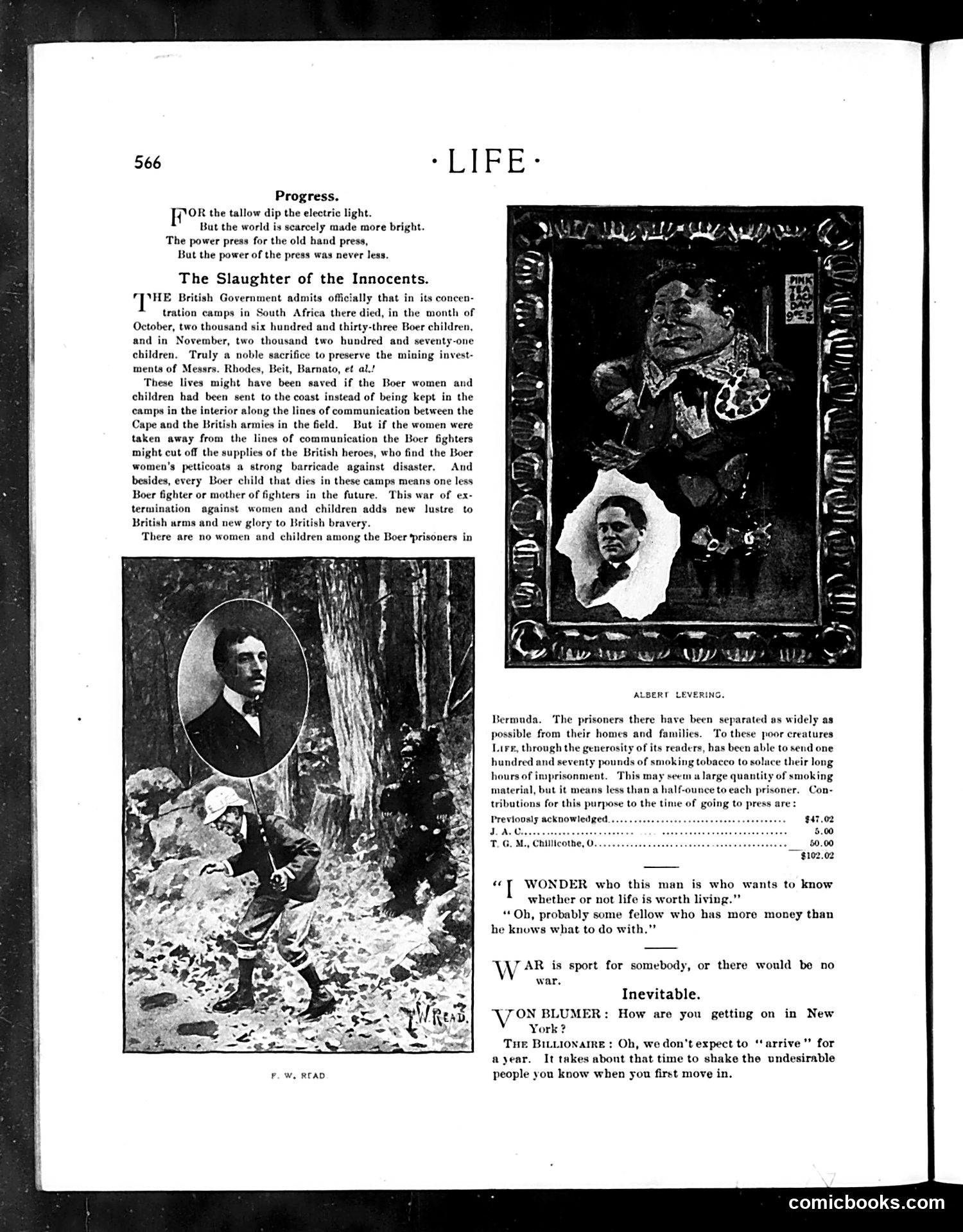
This page criticizes British conduct during the Second Boer War (1899-1902) in South Africa. **"The Slaughter of the Innocents"** article attacks the British government's concentration camps, where thousands of Boer (Dutch settler) children died—2,633 in October and 2,271 in November alone. The piece argues these deaths were preventable: women and children were kept in interior camps (rather than coastal safety) because their presence helped protect British supply lines. The author bitterly suggests each child's death represents one fewer future Boer fighter, implying deliberate extermination. The accompanying illustrations show Boer civilians, including one credited to F.W. Read. Below this, Life reports sending tobacco to Boer prisoners in Bermuda, soliciting reader donations—a humanitarian counterpoint to the camps criticism. The page's opening poem "Progress" suggests technological advancement hasn't improved human morality, setting the satirical tone for criticizing British imperial brutality as contrary to civilized values.
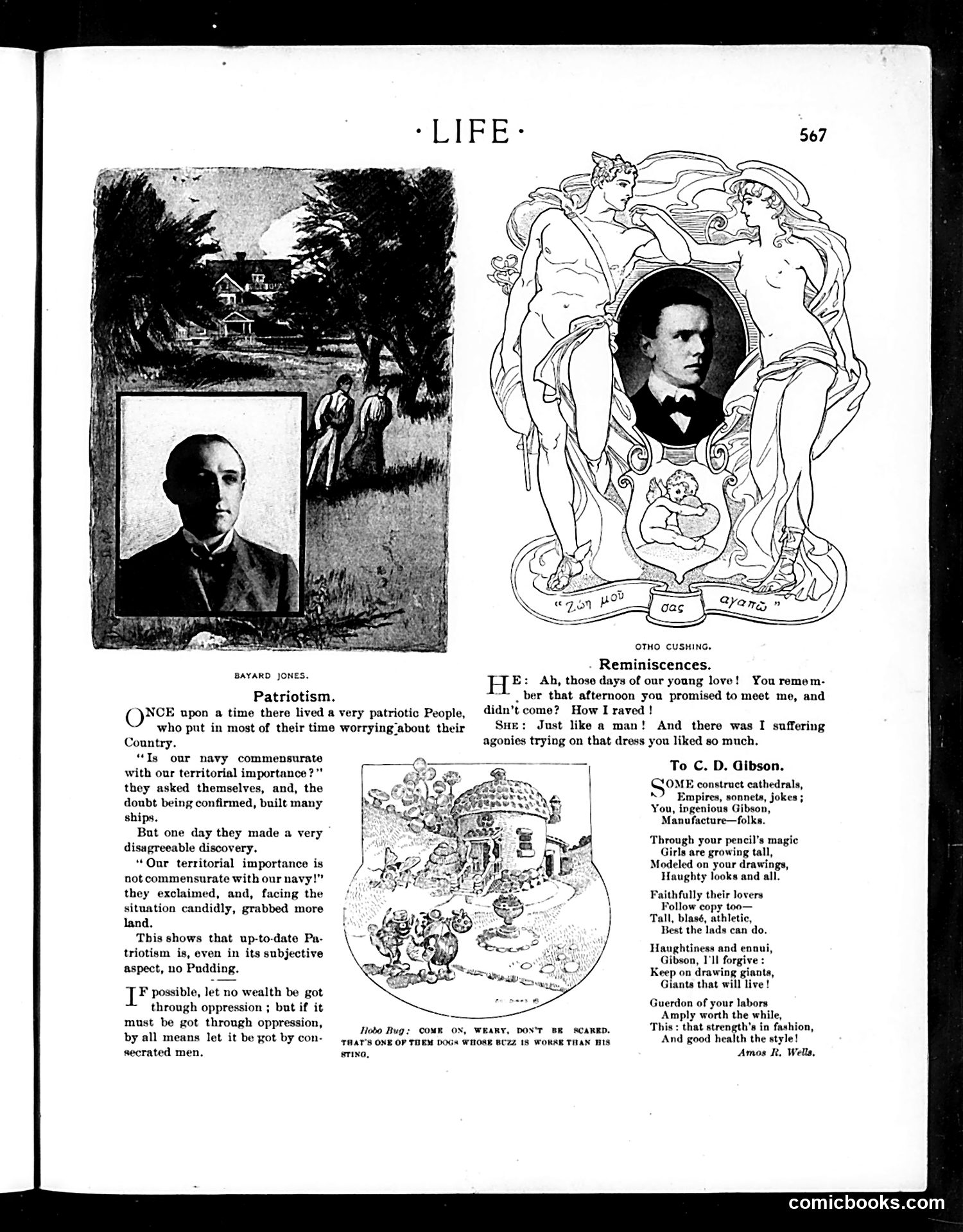
This page contains three distinct satirical pieces: **"Patriotism" by Bayard Jones** mocks nationalist excess. It ridicules a country that obsesses over naval power, builds ships to match "territorial importance," then conquers land to justify the navy's size—circular logic dressed as patriotism. The satire critiques how nations rationalize militarism and imperialism. **"Reminiscences" by Otho Cushing** is a brief romantic comedy sketch about a couple's miscommunication: he recalls her missing a date; she was actually home suffering through trying on an uncomfortable dress he'd admired. The humor lies in their mutual self-absorption and the gap between perception and reality. **"To C. D. Gibson"** is a poem praising illustrator C. D. Gibson, famous for creating the "Gibson Girl" ideal. The poem credits Gibson with literally shaping culture—his drawings of tall, athletic, blasé figures have influenced how real people dress and behave, making his artistic influence a form of cultural power worth celebrating.
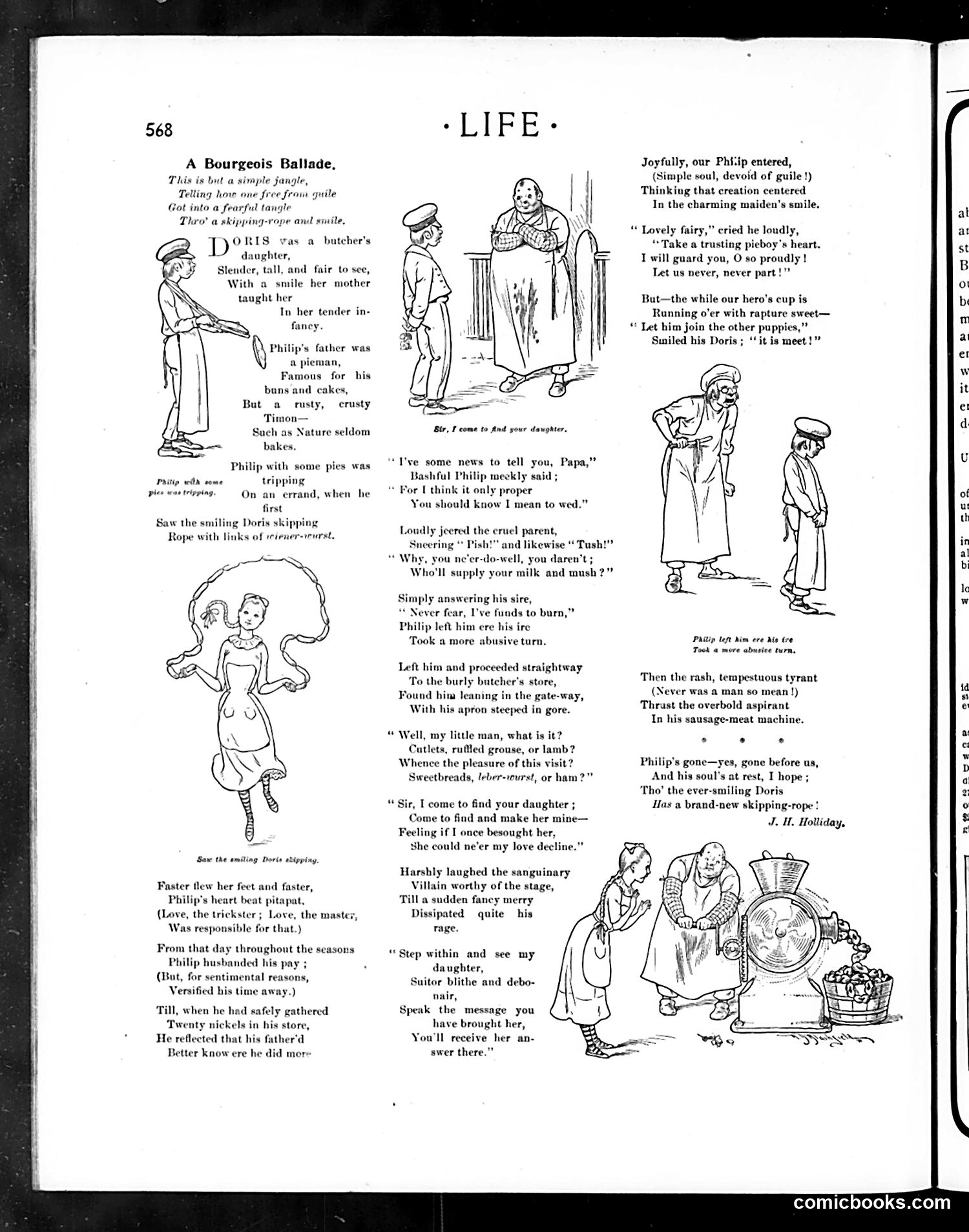
This is a darkly comic narrative poem satirizing working-class social aspiration and parental authority in the late 19th/early 20th century. **The plot:** Young Philip (son of a grumpy pie-maker) falls in love with Doris (butcher's daughter) while she skips rope. He saves money to marry her, but his father mocks him. Philip visits Doris's father to propose. The butcher seems amused and agrees—then reveals Doris doesn't love Philip. The butcher, enraged at this suitor's presumption, literally grinds him into sausage meat using his butcher equipment. The poem ends with Doris happily skipping with a new rope—presumably made from the sausages. **The satire:** This mocks both the sentimentality of working-class romance stories and the brutal class hierarchy of the era. The joke's dark violence reflects Victorian literature's contempt for "common" people's pretensions to love and marriage. The butcher's casual murder suggests that lower-class fathers control their daughters absolutely, and male workers have no rights to aspire beyond their station.
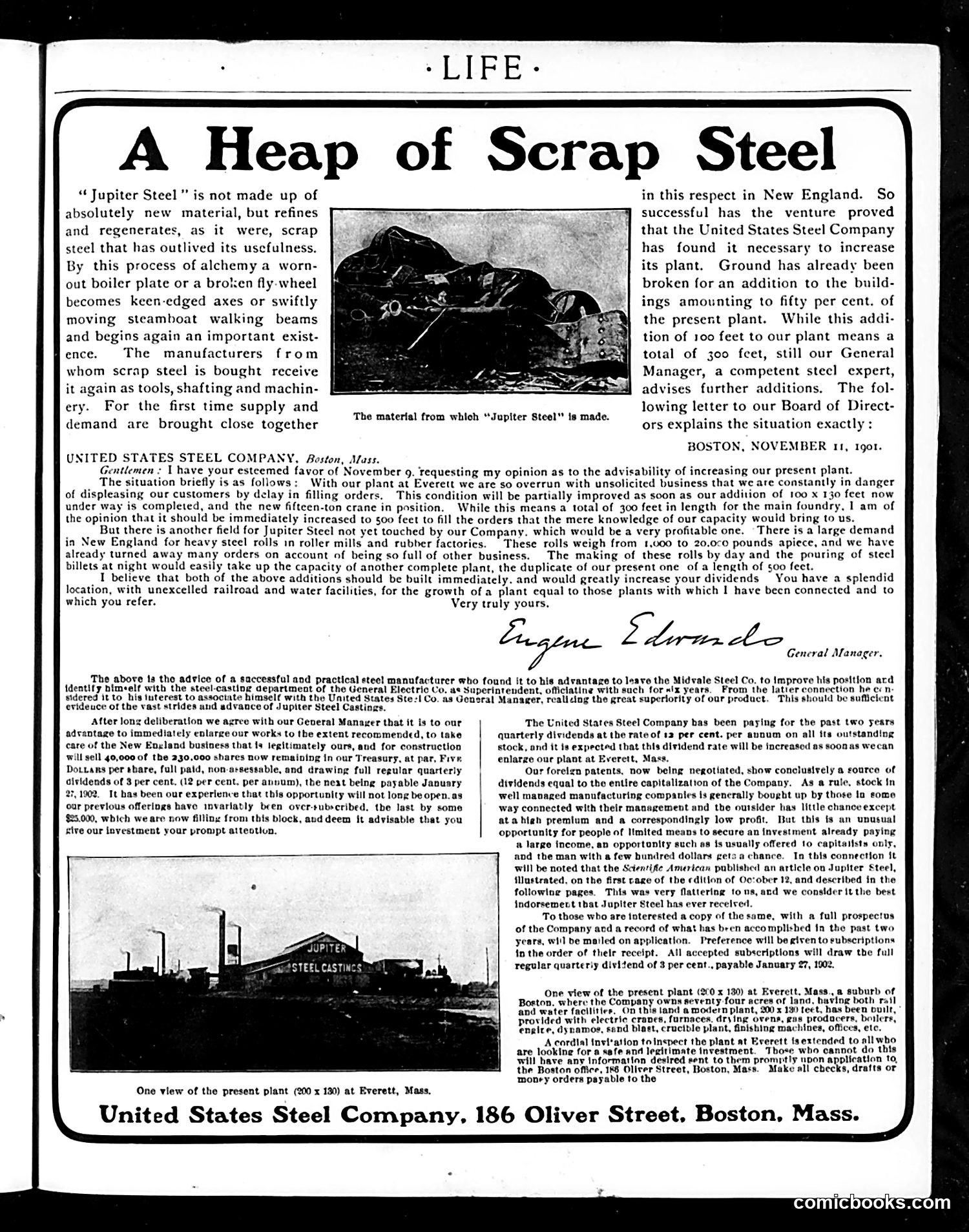
This is primarily **advertising disguised as editorial content** for the United States Steel Company's Boston plant, published November 11, 1901. The article describes "Jupiter Steel"—a brand name for steel recycled from scrap materials (worn boiler plates, broken machinery). It presents this as economically efficient: discarded industrial waste becomes reusable tools and parts, closing the supply-demand loop. The bulk of the page reproduces a letter from the plant's General Manager to the Board of Directors advocating for plant expansion at Everett, Massachusetts. He argues the facility is overwhelmed with orders and recommends immediately increasing capacity—particularly to manufacture heavy steel rolls for mills and factories, a profitable untapped market. The two photographs show the current and proposed expanded plant facilities. **The "point"** is not satirical or humorous—it's a corporate pitch disguised as news, using a General Manager's authority to justify expansion investment. Life magazine apparently ran such advertisements as legitimate-appearing content in this era.
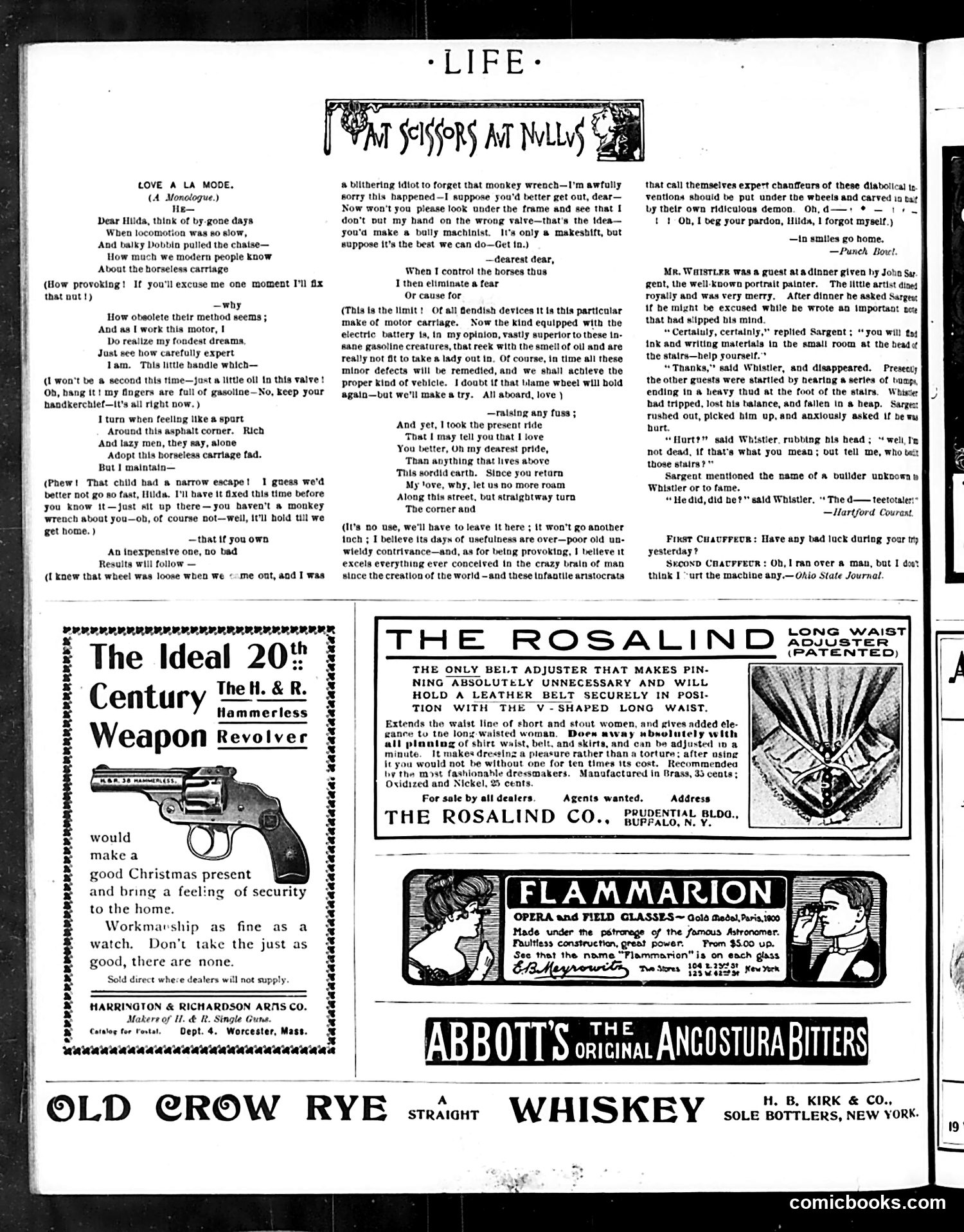
This page contains a satirical monologue titled "Love à la Mode" mocking early automobile culture. The unnamed male speaker attempts to romance "Hilda" while driving a temperamental gasoline-powered motorcar, constantly interrupting his romantic declarations with mechanical breakdowns—loose wheels, stuck valves, gasoline-stained hands, and engine failures. The satire targets the nouveau riche ("lazy men") adopting automobiles as status symbols while lacking competence to operate them. The speaker ironically claims expertise ("carefully expert") while bungling every task, revealing the automobile as unreliable, smelly, and dangerous—particularly compared to electric vehicles. The humor lies in the contrast between romantic intention and farcical reality: every declaration of love is punctuated by mechanical disasters and crude repairs, suggesting both the absurdity of early motoring and the pretension of those adopting this new technology without understanding it. The page also includes unrelated advertisements and a brief anecdote about painter Whistler at dinner.
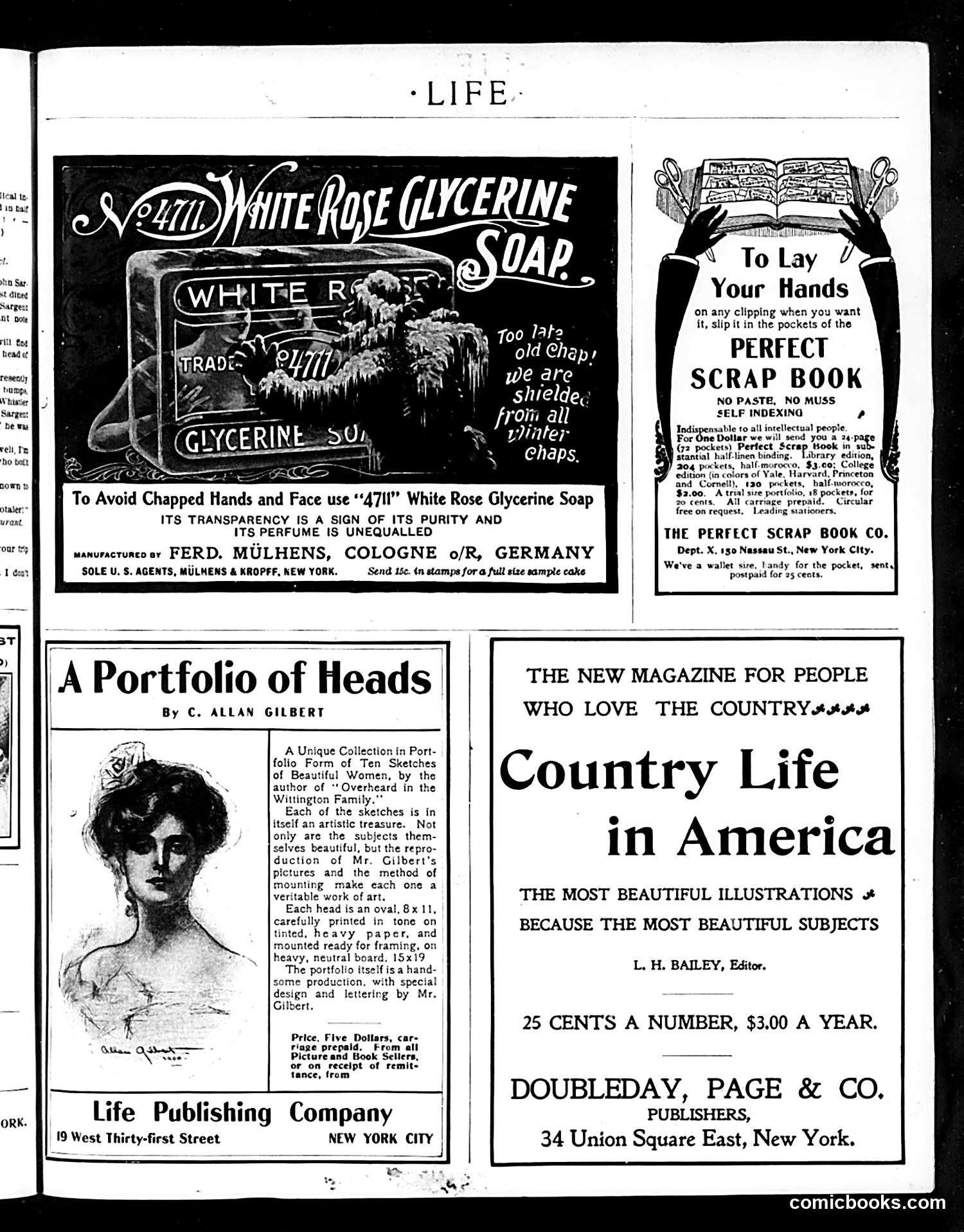
This page is primarily **advertising and promotional content** rather than political satire or comics. The ads include: - **White Rose Glycerine Soap** (German-made, emphasizing purity and perfection for preventing chapped skin) - **Perfect Scrap Book** (a self-indexing scrapbook requiring no paste) - **"A Portfolio of Heads"** by C. Allan Gilbert—sketches of beautiful women, priced at $5 - **Country Life in America** magazine (25 cents per issue, $3/year) There is **no political cartoon or satire visible**. The page reflects early 20th-century consumer culture: beauty products, leisure activities (scrapbooking, reading illustrated magazines), and artistic portfolios targeting affluent audiences. The emphasis on "beautiful women" and "country life" reflects period aesthetic values and class aspirations typical of Life magazine's advertising.
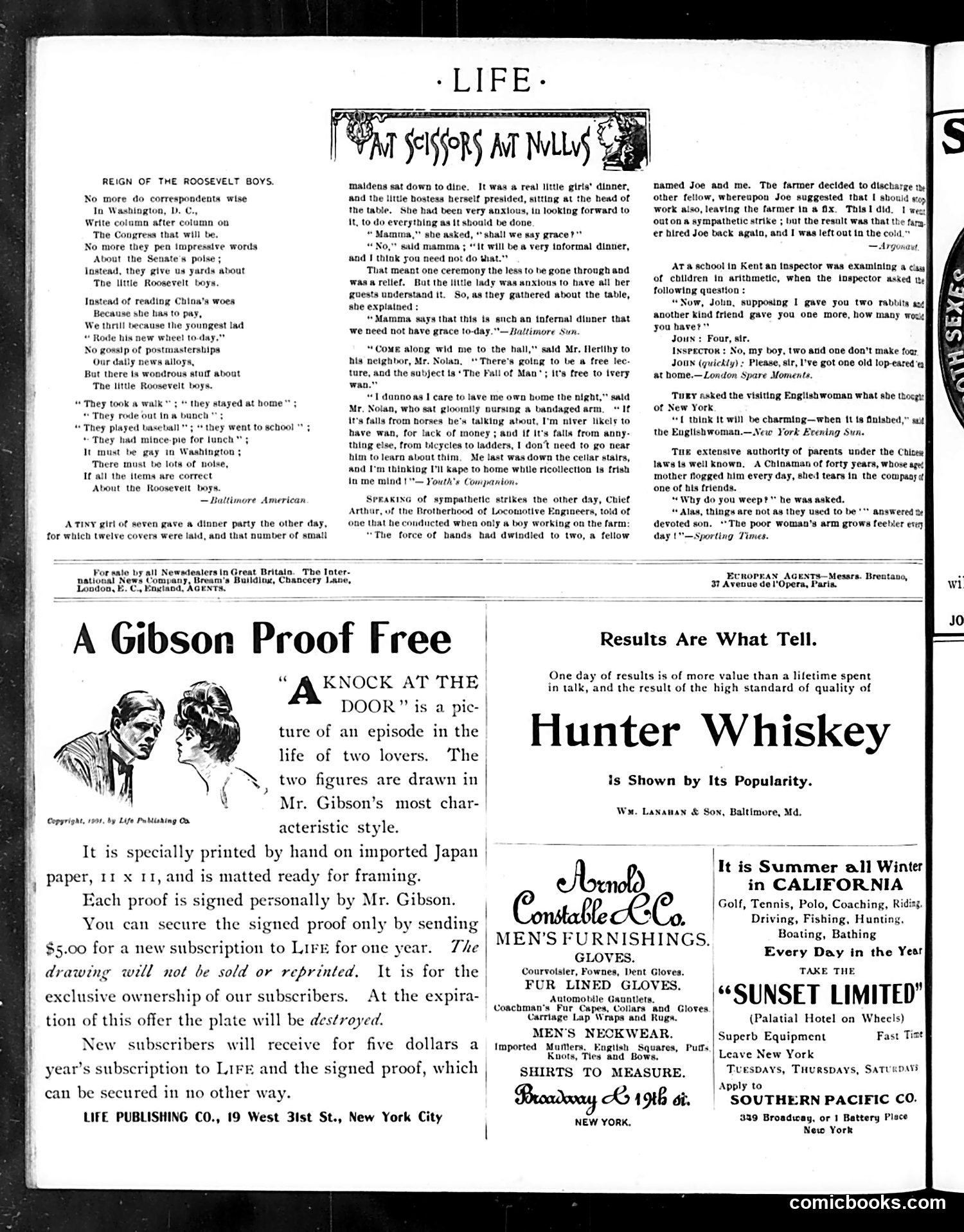
This page contains three distinct satirical pieces: **"Reign of the Roosevelt Boys"** (poem): Satirizes American newspaper coverage during Theodore Roosevelt's presidency. The joke is that political correspondents in Washington, D.C. have abandoned serious reporting on Congress and the Senate to instead obsess over trivial daily activities of Roosevelt's children—what they ate, rode, or played. It mocks the media's sensationalism and loss of journalistic priorities. **The "Infernal Dinner" anecdote**: A child's innocent malapropism—she misunderstands her mother's word "informal" as "infernal," creating unintentional comedy when explaining to guests why grace won't be said. **The "Sympathetic Strikes" anecdote**: A humorous brief story about a neighbor reluctant to attend a lecture because his repeated accidents (falls from stairs, bicycles, ladders) make him feel he doesn't need instruction on "the Fall of Man." The page is otherwise filled with period advertisements and a Gibson illustration promotion, not political commentary.
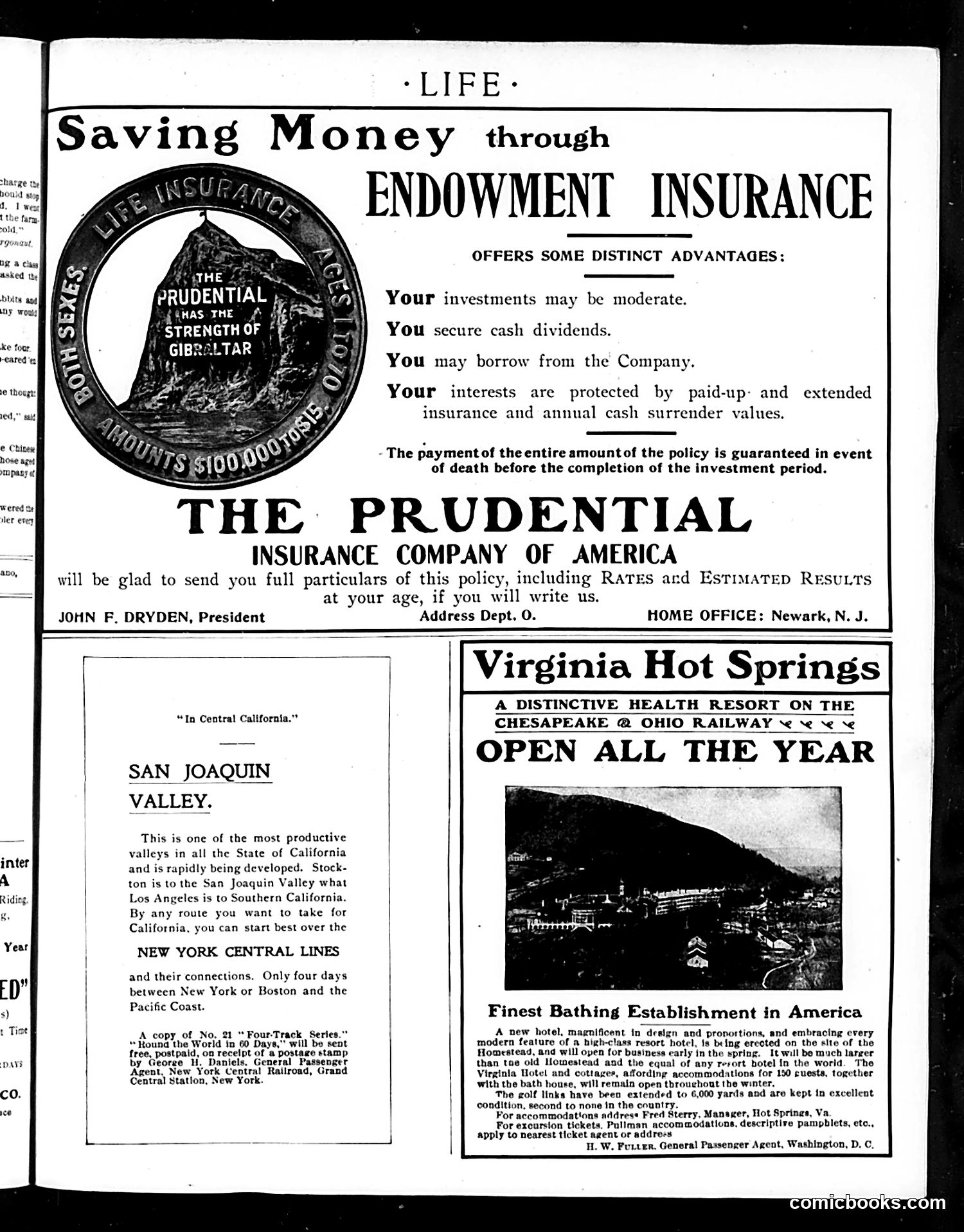
This is primarily an **advertising page**, not satirical content. It contains three distinct advertisements from the early 1900s: 1. **Prudential Insurance**: Markets endowment life insurance as a savings vehicle, emphasizing moderate investment, cash dividends, borrowing options, and death benefits. The company seal references Gibraltar's strength as a metaphor for reliability. 2. **San Joaquin Valley (California)**: Promotes rail travel via the New York Central Lines to California's agricultural heartland, positioning Stockton as a developing hub comparable to Los Angeles. 3. **Virginia Hot Springs Resort**: Advertises a new luxury hotel opening on the Chesapeake & Ohio Railway, marketed as "Finest Bathing Establishment in America" with golf, accommodations for 150 guests, and year-round operation. These ads reflect early-20th-century American consumer culture: financial products, westward expansion/development, and leisure tourism for the affluent. There is no political satire present on this page.
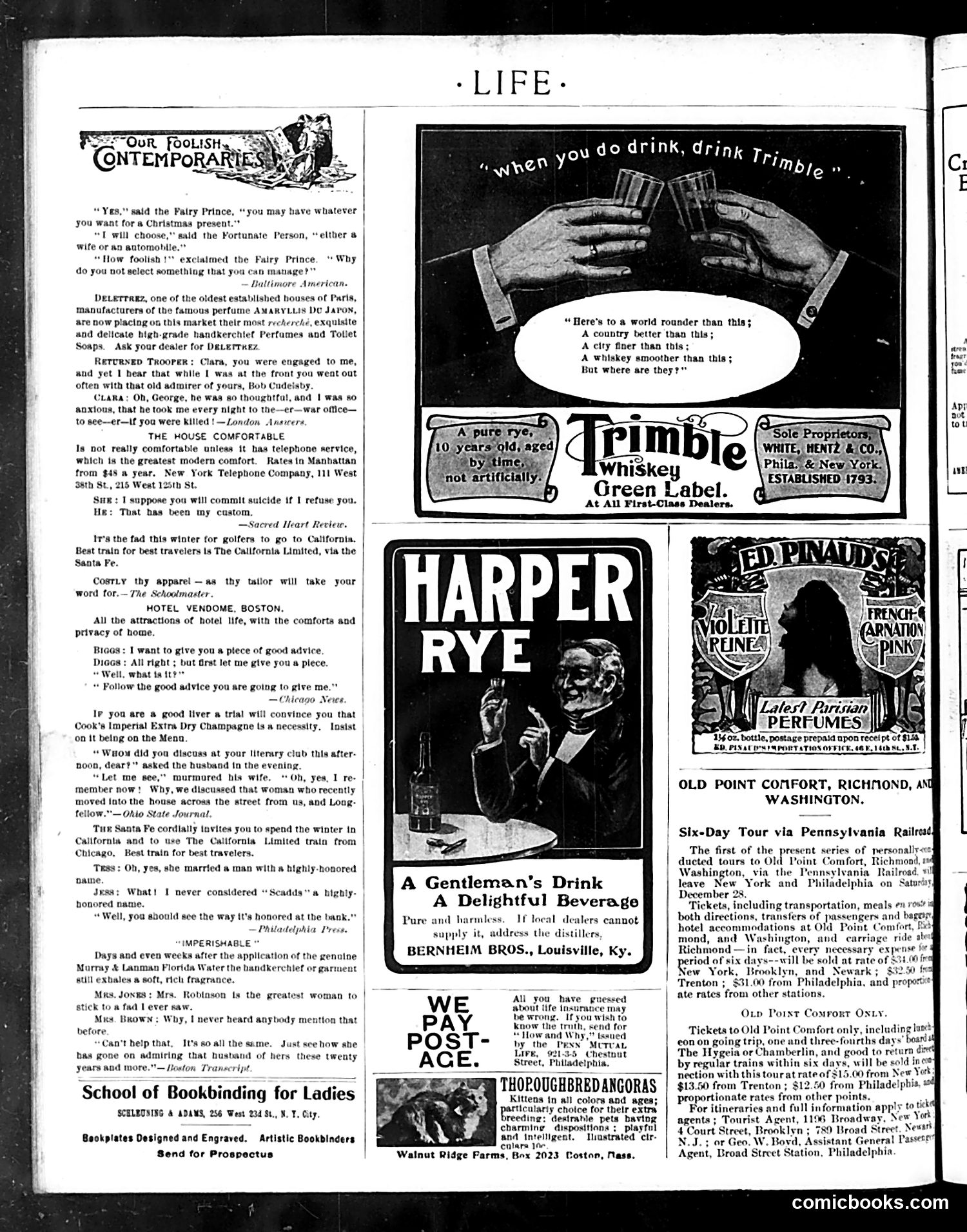
This page from *Life* magazine consists primarily of **advertisements and brief humorous anecdotes** rather than political cartoons. The content includes: **Satirical humor pieces** poking fun at contemporary social dynamics—a Fairy Prince tale mocking men's poor choices between wives and automobiles; a "returned trooper" joke about a woman's wartime infidelity disguised as patriotic concern; and observations about marriage and human nature. **Product advertisements** dominate the page, promoting perfumes (Delettrez), whiskey (Trimble, Harper Rye, Bernheim Bros.), champagne, and services like telephone installation and railroad travel. The **whiskey ads** are notable for their marketing approach—depicting gentlemen's hands clinking glasses and emphasizing quality and refinement rather than intoxication. This reflects early 20th-century advertising before stricter alcohol regulations. The humor is mild, domestic-focused satire aimed at middle-class readers. There is **no apparent political cartooning** on this page—it's primarily a commercial and entertainment publication mixing advertisements with light social comedy.
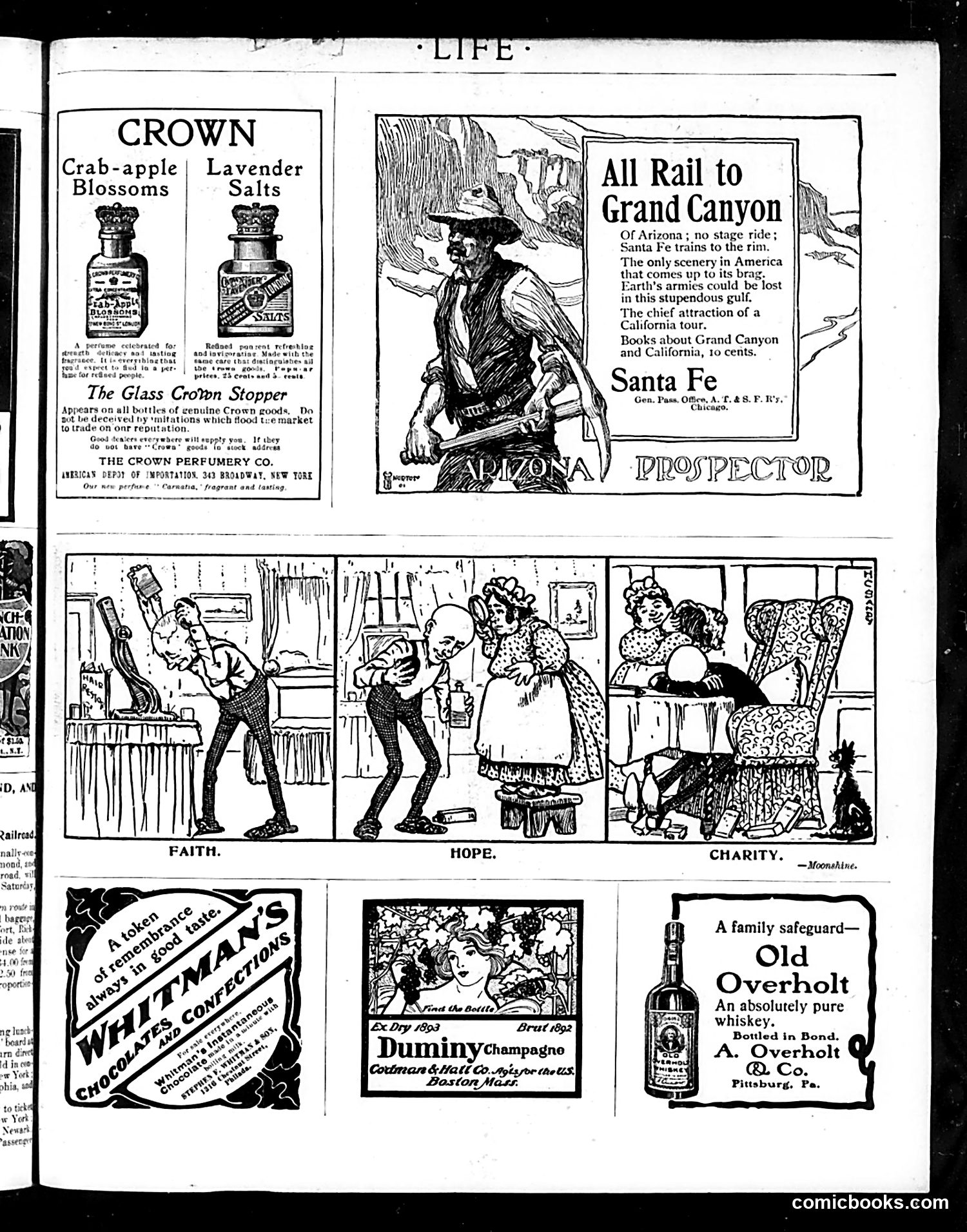
This page is primarily **advertising**, with one satirical cartoon. The main comic is a three-panel sequence labeled "FAITH," "HOPE," and "CHARITY"—referencing the Christian virtues. Each panel depicts a man in increasingly exaggerated physical distress: first straining at a shelf, then doubled over in pain, finally collapsed in a chair while a woman tends to him. The humor is dark slapstick about male suffering, likely commenting on domestic life or marital hardship. The advertisements include Crown perfumes, a Grand Canyon travel promotion, Whitman's chocolates, Duminy champagne, and Old Overholt whiskey. These represent typical early-20th-century luxury goods marketed to affluent readers. The cartoon's satirical point appears to be a cynical take on the "three virtues"—suggesting that in modern life, faith, hope, and charity manifest as physical pain and domestic burden rather than spiritual uplift. The juxtaposition with advertisements for indulgences adds ironic commentary on materialism versus moral ideals.
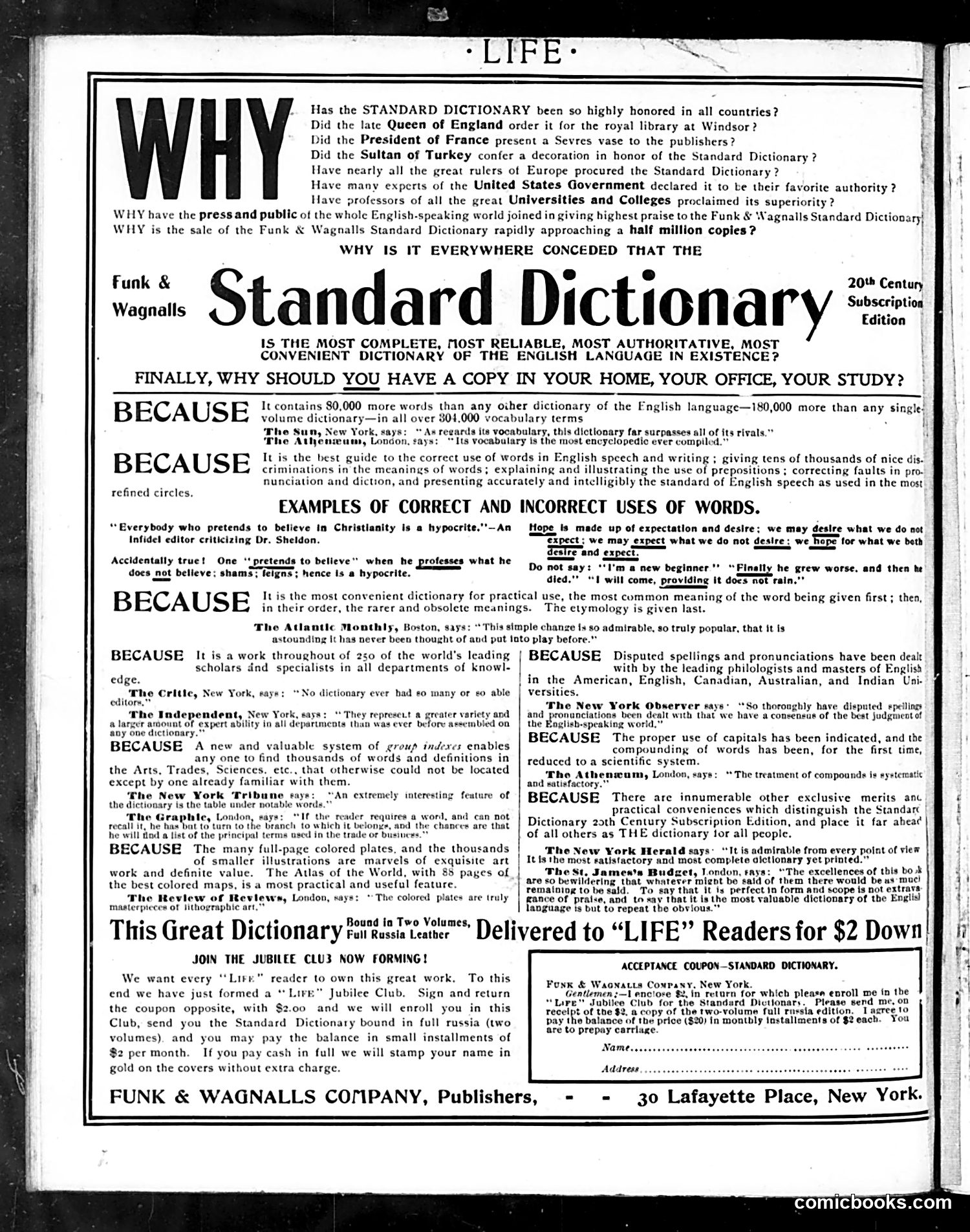
This page is primarily a **commercial advertisement**, not a satirical cartoon. It's a promotional piece for the Funk & Wagnalls Standard Dictionary (20th Century Subscription Edition), published in *Life* magazine. The advertisement uses a rhetorical strategy common to early 20th-century marketing: it poses a series of rhetorical questions claiming the dictionary has been honored by world leaders (Queen of England, President of France, Sultan of Turkey) and endorsed by major institutions and newspapers. This appeal to authority and prestige was meant to convince readers of the dictionary's superiority. The page includes testimonials from publications like *The Sun*, *The Athenaeum*, and *The New York Tribune* praising its comprehensiveness (80,000 more words than competitors) and practical utility. Below this marketing copy is an acceptance coupon offering the two-volume dictionary for $2 down as part of a "Jubilee Club," with installment payments of $2 monthly. There is **no satire or political commentary** visible here—it is straightforward advertising copy typical of the era.
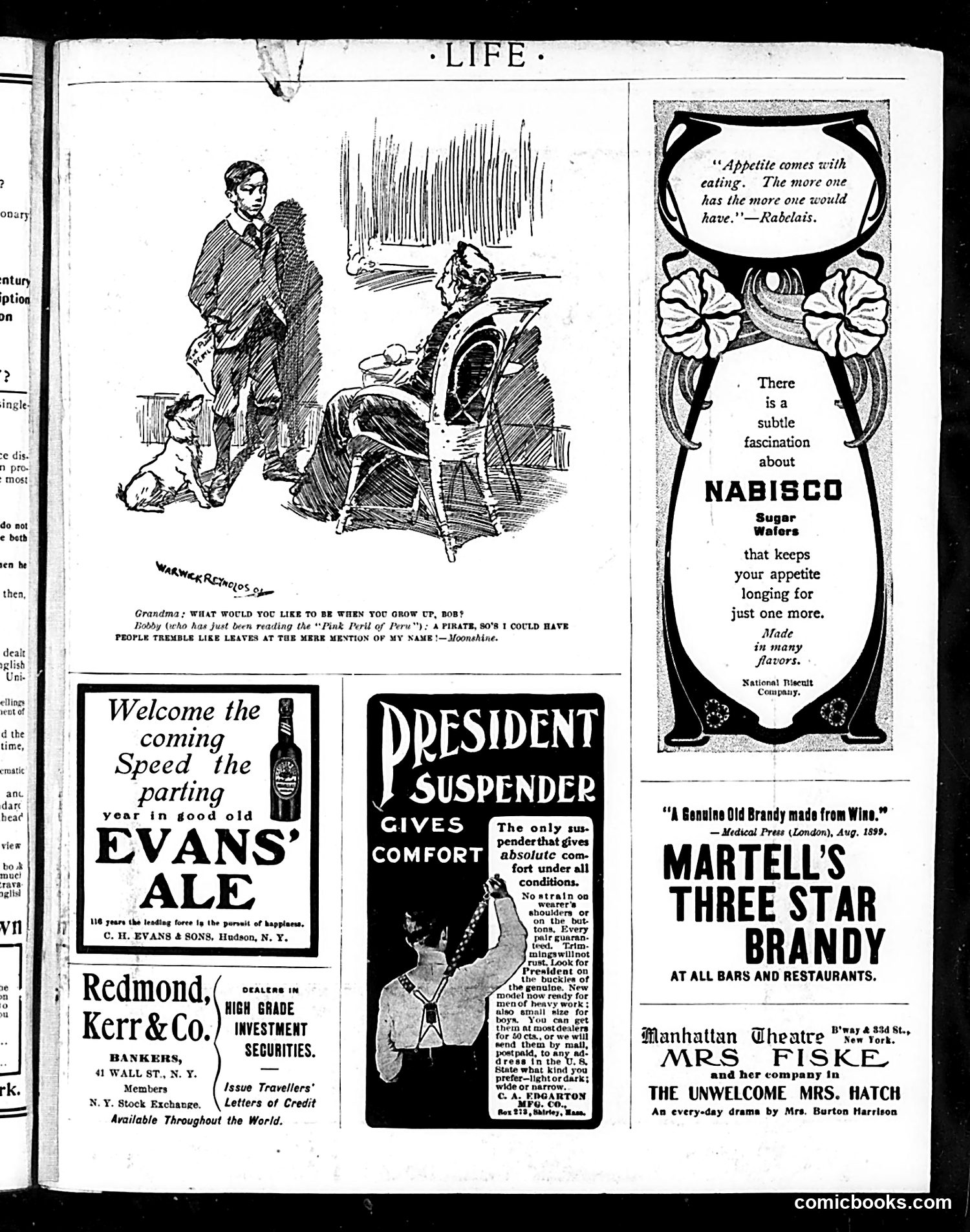
The main cartoon depicts a child named Bobby who has been reading "The Pink Peril of Peru" (likely a sensationalist adventure story) telling his grandmother he wants to become a pirate when he grows up—so people will "tremble like leaves" at the mere mention of his name. The satire targets two things: the popular dime novels and adventure stories marketed to children, which glorified outlaws and criminals, and childhood aspirations shaped by such lurid fiction. The grandmother's bemused reaction underscores the concern that these cheap publications were corrupting young minds with criminal fantasies. This reflects genuine late-19th/early-20th century anxieties about mass-market literature's influence on youth morality—a recurring moral panic of the era. The page is otherwise filled with period advertisements for alcohol, financial services, and consumer goods.
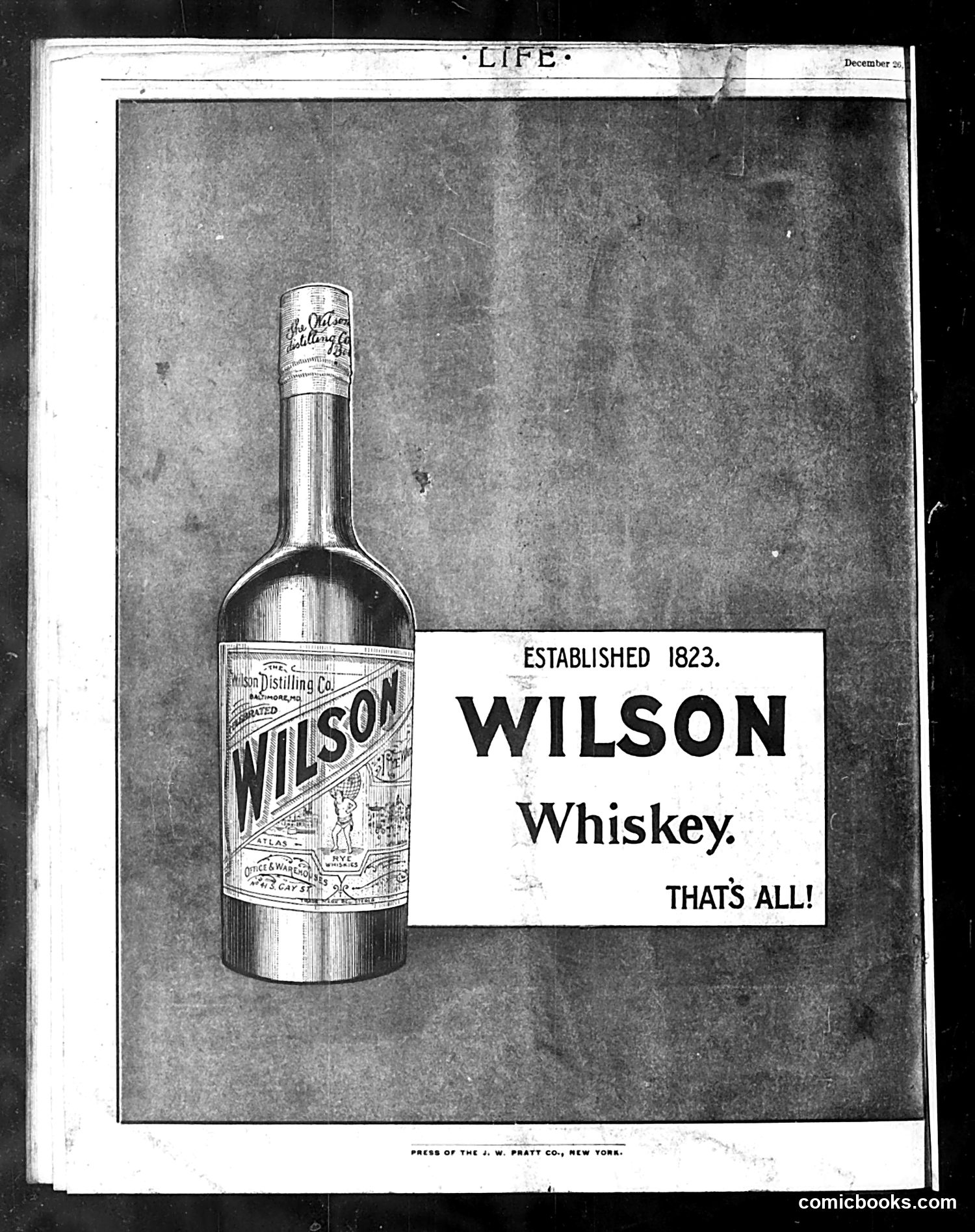
This is a **whiskey advertisement**, not political satire. The page shows a bottle of Wilson Whiskey, established 1823, with the tagline "THAT'S ALL!" The ad appears in *Life* magazine (dated December 28, likely early 1900s based on the styling). The simple message—featuring just the product and minimal text—suggests the brand's confidence in its reputation and longevity. "That's all!" implies the whiskey needs no elaborate pitch; its 80+ year history speaks for itself. This represents straightforward early-20th-century advertising before regulatory restrictions on alcohol marketing. There is no cartoon or political commentary present—merely a commercial product endorsement in a magazine known for humor and satire.

I cannot reliably interpret this image. The page appears to be almost entirely black or heavily degraded, with only a white border visible on the left side and the "comicbooks.com" watermark at the bottom right. The OCR text provided ("2 | Mosel") is minimal and unclear. While this is identified as a page from *Life* magazine, I cannot discern any cartoon figures, caricatures, political references, or satirical content from the image itself. The degradation or scanning quality makes it impossible to read text or identify specific commentary that would explain the satire to a modern reader. To properly analyze this page's historical and satirical meaning, a clearer image would be necessary.