
Life, 1901-12-26 · page 4 of 33
Life — December 26, 1901 — page 4: what you’re looking at
What you’re looking at
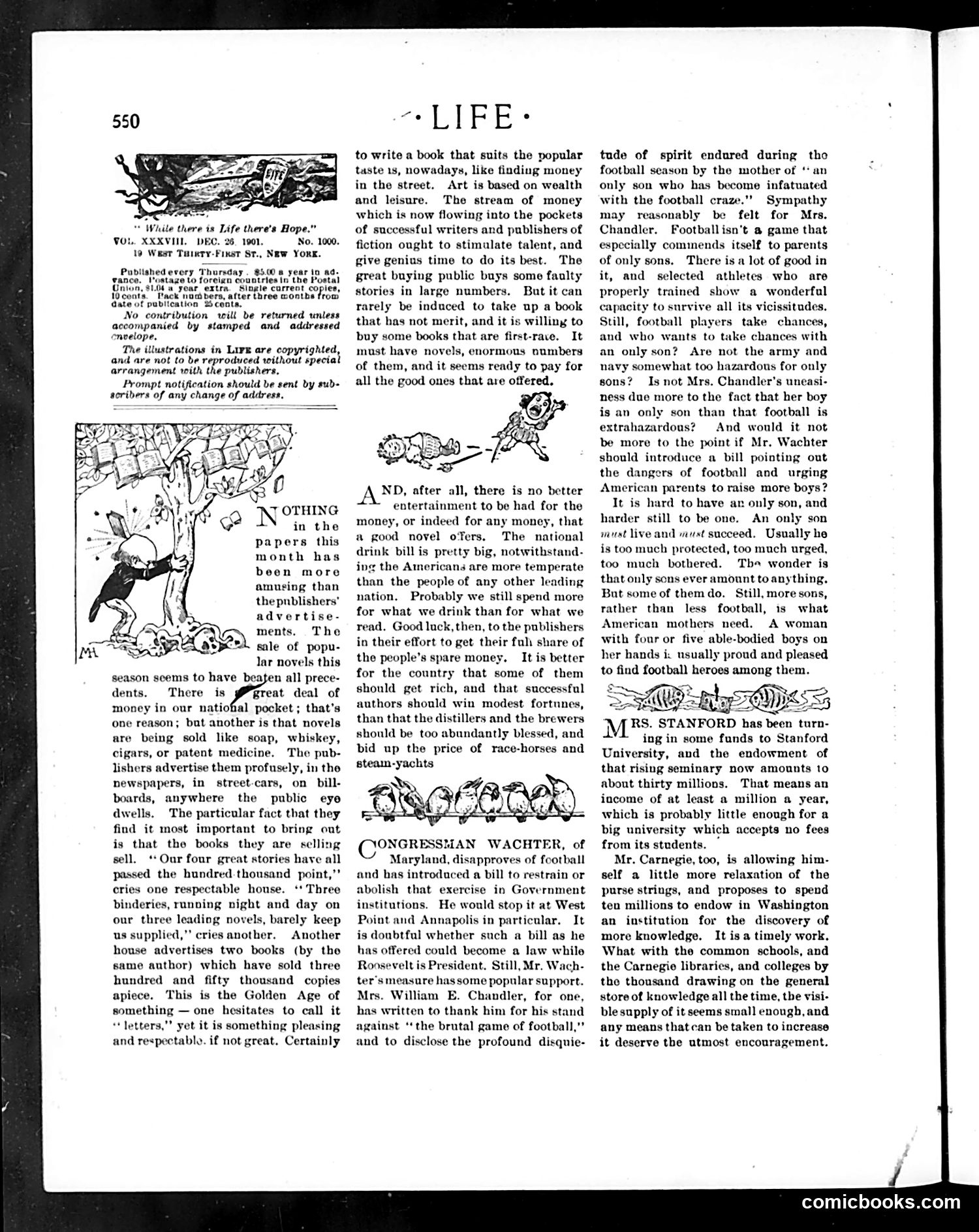
This page satirizes early 20th-century American publishing and social concerns. The text discusses how novels are now profitable commodities, with publishers seeking popular stories. There's criticism of Congress member Wachter (of Maryland) who introduced legislation to restrict football in government institutions, wanting to ban it at West Point and Annapolis. The author, Mrs. William E. Chandler, defends football against this "brutal game" characterization, arguing it builds character in boys and deserves encouragement rather than legal restriction. The small cartoons appear whimsical rather than pointed political commentary—decorative illustrations accompanying the text about publishing economics and football's social value. The satire targets both commercialized literature and paternalistic Congressional overreach into student athletics.
📄 Transcribed text from this page (OCR, searchable)
Machine-transcribed from the original scan — historical spelling and the odd misread are preserved.
While there is Life there's Hope.” VOL. XXXVIIL DEC. 26. 1901, No. 1000. 19 Was Tu1ety-Fixst St., NEW YORK. edevory Thursday . $5.00 8 year in ad- stage to foreign countries In the Postal Single current copies, nord er three months from, Gate of publication cents. No contribution will be returned unless accompanied by stamped and addressed envelope, The illustrations in Lure are copyrighted, and are not to be reproduced without special arrangement with the publishers, Prompt notification should be sent by sub- acribers of any change of address. 7 OTHING in the papers this month has been more amusing than thepnblishers’ advertise- ments. The "A. sale of popu- lar novels this season seems to have beagen all prece- dents. There is en deal of money in our natiohal pocket; that's one reason; but another is that novels are being sold like soap, whiskey, cigars, or patent medicine. The pub- lishers advertise them profusely, in the newspapers, in street-cars, on bill- boards, anywhere the public eye dwells, The particular fact that they find it most important to bring out is that the books they are selling sell, ‘Our four great stories have all passed the hundred thousand t,”” cries one respectable house. ** Three binderies, running night and day on our three leading novels, barely keep us supplied,” cries another. Another house advertises two books (by tho same author) which have sold three hundred and fifty thousand copies apiece. This is the Golden Age of something — one hesitates to call it “letters,” yet it is something pleasing and respectablo. if not great. Certainly “LTE * to write a book that suits the popular taste 1s, nowadays, like finding money in the street. Art is based on wealth and leisure. The stream of money which is now flowing into the pockets of successful writers and publishers of fiction ought to stimulate talent, and give genius time to do its best. The great buying public buys some faulty stories in large numbers. But it can rarely be induced to take up a book that has not merit, and it is willing to buy some books that are first-rave. It must have novels, enormous numbers of them, and it seems ready to pay for all the good ones that are offered. A D, after all, there is no better entertainment to be had for the money, or indeed for any money, that a good novel ofers, The national drink billis pretty big, notwithstand- ing the Americans are more temperate than the people of any other leading nation. Probably we still spend more for what we drink than for what we read. Good luck, then, to the publishers in their effort to get their ful share of the people’s spare money. It is better for the country that some of them should get rich, and that successful authors should win modest fortunes, than that the distillers and the brewers should be too abundantly blessed, and bid up the price of race-horses and ONGRESSMAN WACHTER, of Maryland, disapproves of football and has introduced a bill to restrain or abolish that exercise in Government institutions. He would stop it at West Point and Annapolis in particular. It is doubtful whether such a bill as he has offered could become a law while Roosevelt is President. Still, Mr. Wach- ter’s measure hassome popular support. Mrs. William E. Chandler, for one, has written to thank him for his stand against “the brutal game of football,”’ and to disclose the profound disquie- tude of spirit endured during tho football season by the mother of “an only son who has become infatuated with the football craze.""| Sympathy may reasonably be felt for Mrs. Chandler. Footballisn’t a game that especially commends itself to parents of only sons. There is a lot of good in it, and selected athletes who are properly trained show a wonderful capacity to survive all its vicissitudes. Still, football players take chances, and who wants to take chances with an only son? Are not the army and na omewhat too hazardous for only sons? Is not Mrs. Chandler's uneasi- ness due more to the fact that her boy is an only son than that football is extrahazardous? And would it not be more to the point if Mr, Wachter should introduce a bill pointing out the dangers of football and urging American parents to raise more boys? It is hard to have ar only son, and harder still to be one. An only son muat live and must succeed. Usually he is too much protected, too much urged, too much bothered. Tbe wonder is that only sons ever amount to anything, But some of them do. Still, more sons, rather than less football, 1s what American mothers need. A woman with four or five able-bodied boys on her hands i: usually proud and pleased to find football heroes among them. RS. STANFORD has been turn- Bt ing in some funds to Stanford University, and the endowment of that rising seminary now amounts to about thirty millions. That means an iacome of at least a million a year, which is probably little enough for a big university which accepts no fees from its students. Mr. Carnegie, too, is allowing him- self a little more relaxation of the purse strings, and proposes to spend ten millions to endow in Washington an institution for the discovery of more knowledge. It is a timely work. What with the common schools, and the Carnegie libraries, and colleges by the thousand drawing on the general store of knowledge all the time, the visi- ble supply of it seems small enough, and any means thatcan be taken to increase it deserve the atmost encouragement. comicbooks.com