
A complete issue · 20 pages · 1901
Life — November 7, 1901
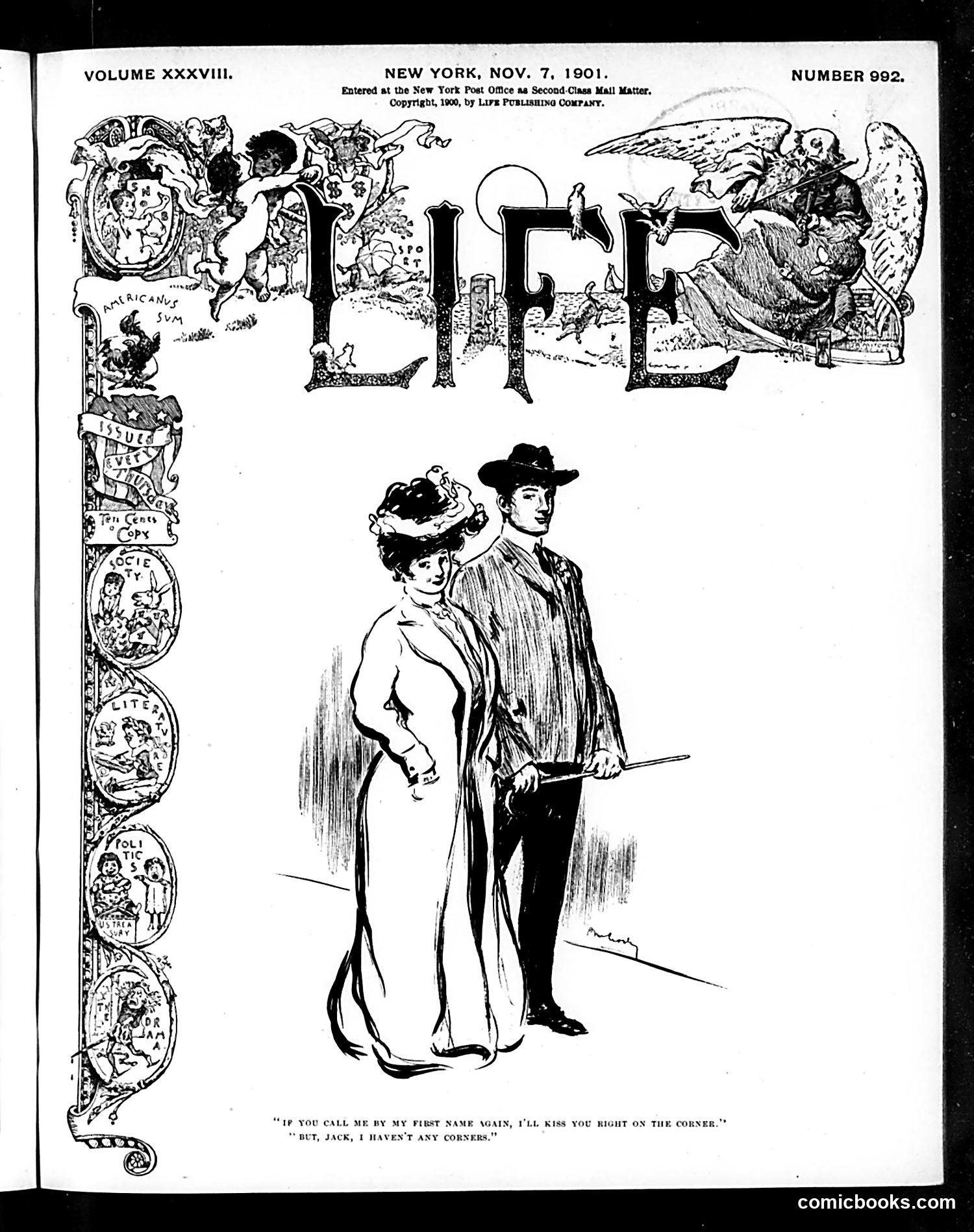
This page features a romantic illustration with dialogue below: "If you call me by my first name again, I'll kiss you right on the corner." / "But, Jack, I haven't any corners." The cartoon appears to be a humorous flirtation scene between a well-dressed couple. The woman's comment about having "no corners" is a witty double entendre—she's making a playful, suggestive remark about her rounded feminine figure in contrast to the angular male form. This represents typical early 1900s satirical humor about courtship and gender differences, employing coded language acceptable to the era's audience while maintaining a veneer of respectability. The ornate decorative border and classical header design are characteristic of Life's aesthetic during this period.
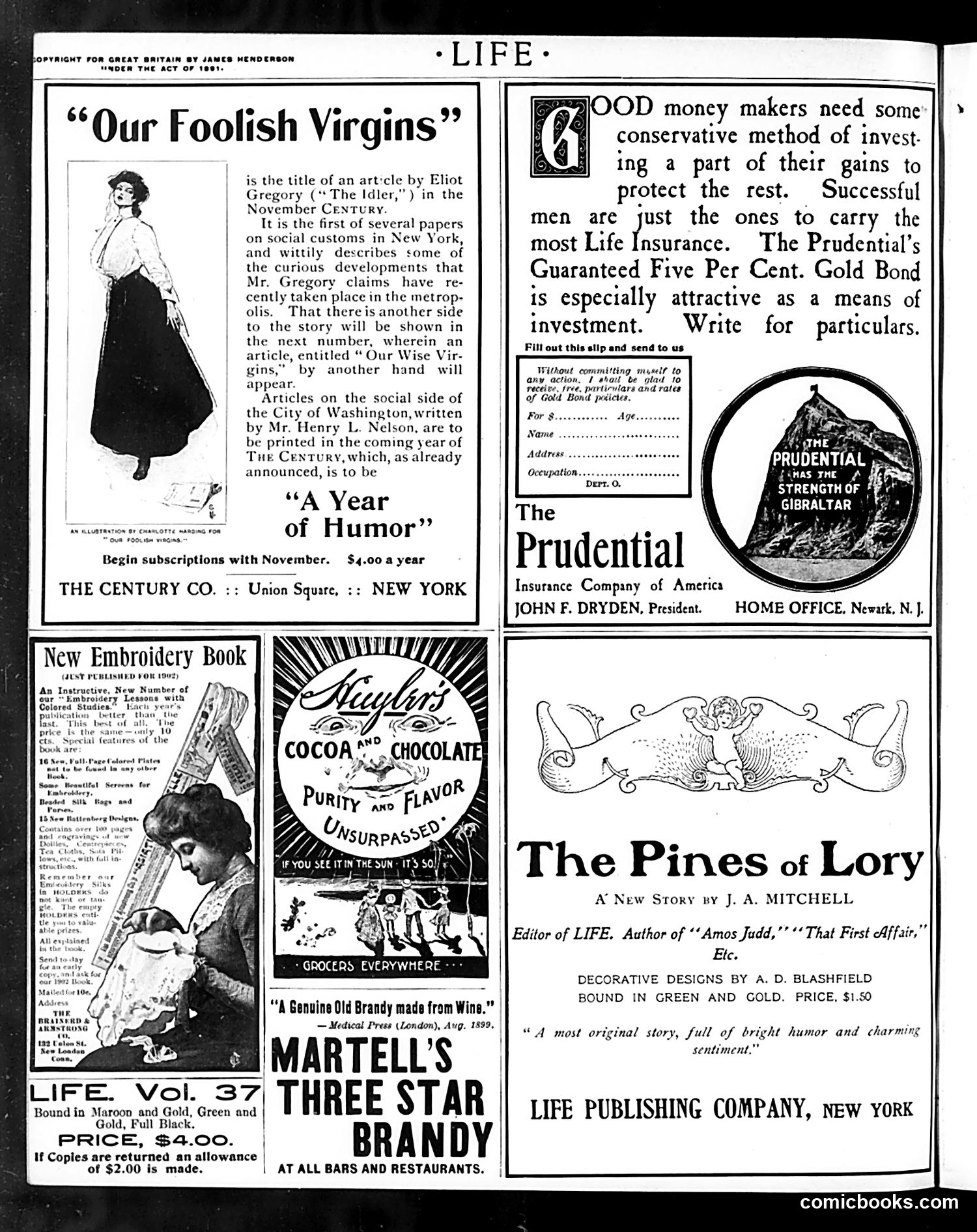
This page is primarily **advertising and promotional content** rather than political satire. The main elements include: **"Our Foolish Virgins"** - An article by Eliot Gregory advertised in *The Century* magazine, promising social commentary on New York customs, with a companion piece called "A Year of Humor." **Product advertisements** dominate: Prudential Insurance (Gold Bonds), Shaylor's Cocoa and Chocolate, Martell's Three Star Brandy, and a New Embroidery Book. **"The Pines of Lory"** - A new story by J.A. Mitchell (Life's editor), described as "full of bright humor and charming sentiment." The page reflects early 1900s consumer culture and literary promotions rather than political commentary. The "foolish virgins" reference appears social rather than explicitly satirical.
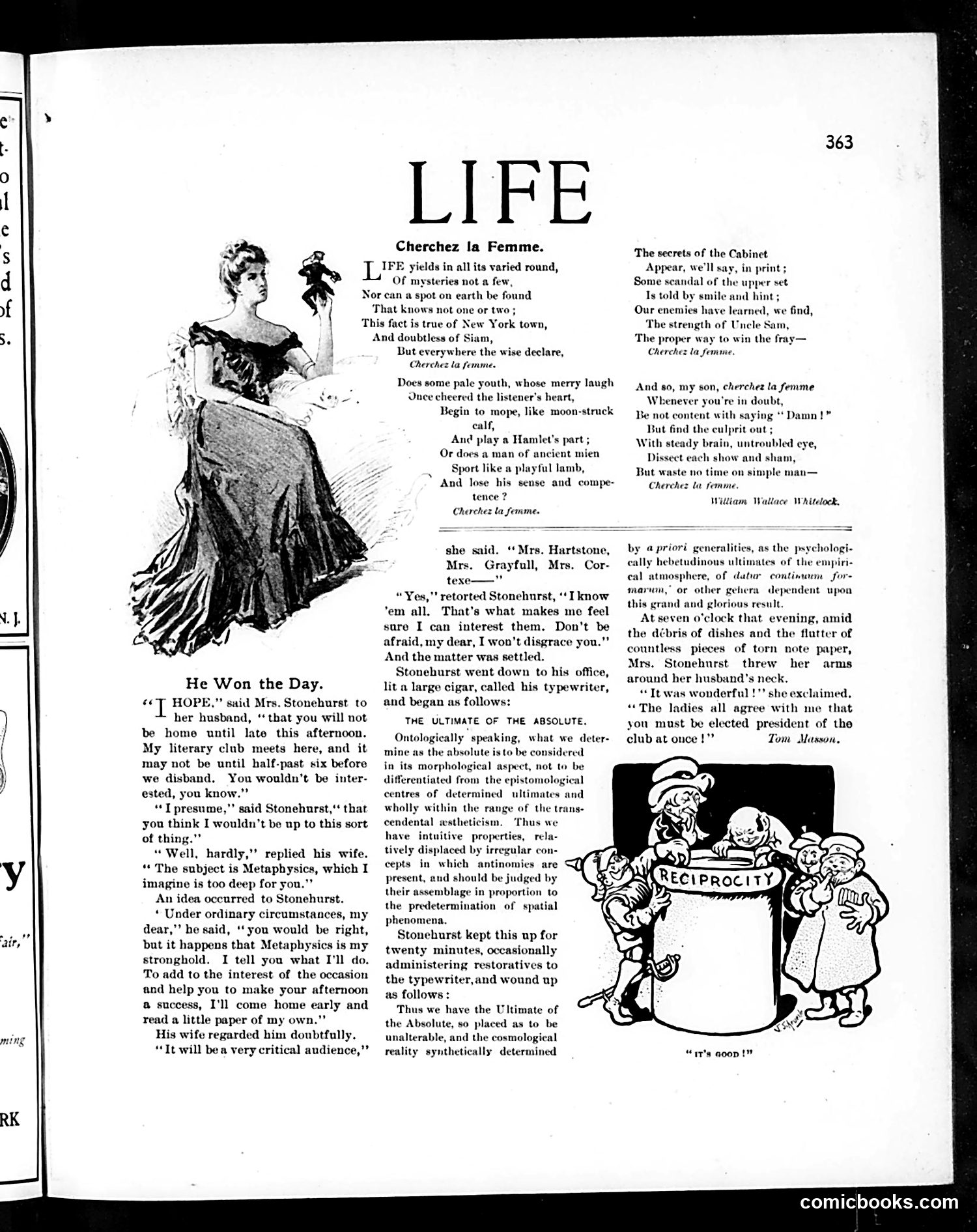
This page satirizes marital dynamics and intellectual pretension. The main narrative, "He Won the Day," depicts Mr. Stonehurst attempting to impress his wife by discussing Metaphysics—claiming he'll read "a little paper of my own" to settle an afternoon dispute. His wife responds skeptically that it will be "a very critical audience." The satire targets pompous husbands who use abstract philosophical jargon to dominate domestic arguments. Stonehurst's lengthy exposition about "the Ultimate of the Absolute" and "morphological aspects" is presented as absurd intellectual posturing designed to win through obscurity rather than logic. The cartoon's title "It's noon!" (bottom right) suggests the humor: while Stonehurst pontificates endlessly, practical reality (lunch time) passes unheeded—his victory is hollow.
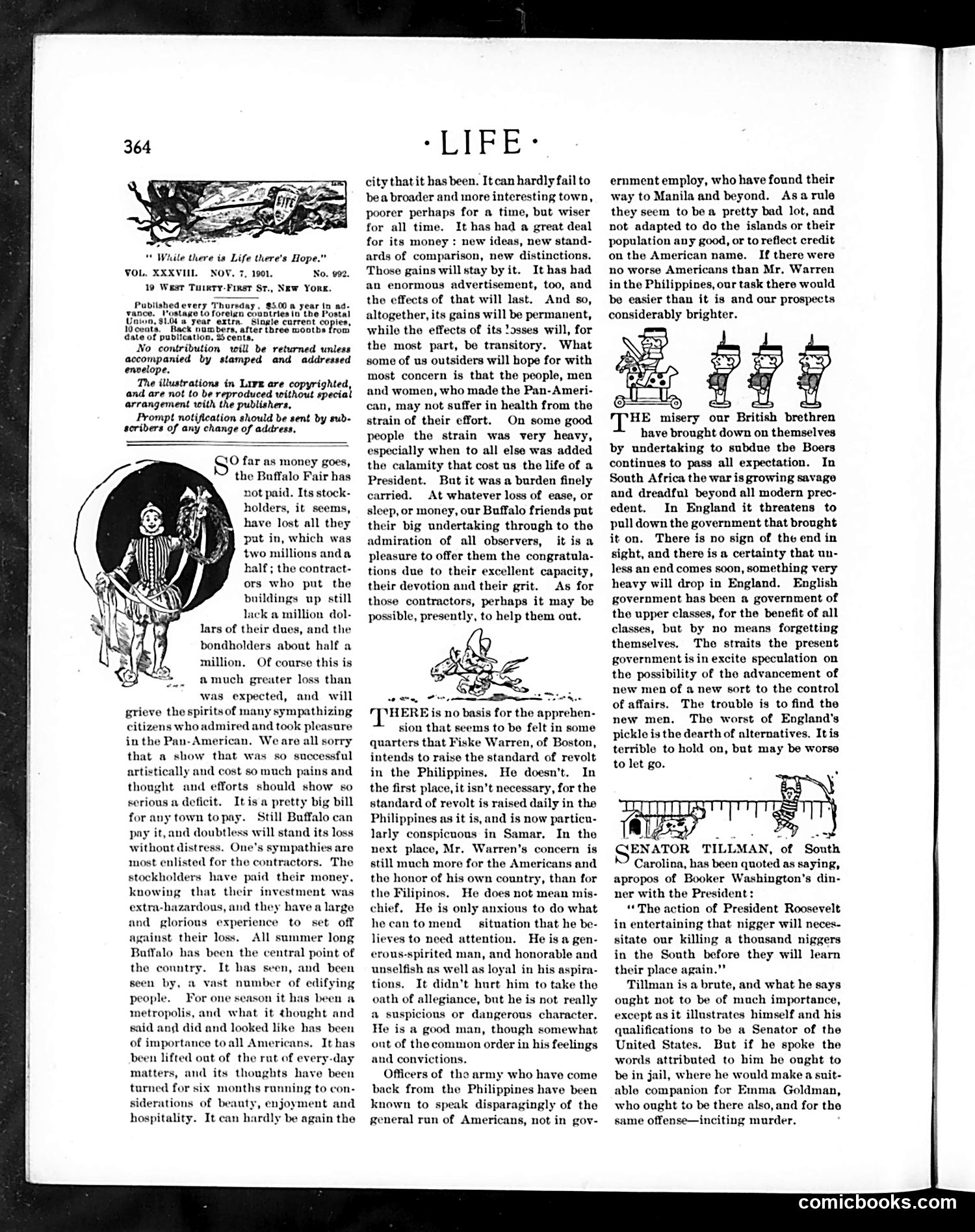
This page contains political commentary about American imperialism in the Philippines and domestic politics circa early 1900s. **Main cartoon (left):** Depicts Buffalo as a figure carrying money, referencing the "Buffalo Fair" mentioned in text. The illustration appears to satirize economic losses from the Pan-American Exposition. **Right column commentary:** Discusses Fuke Warren of Boston, who advocates raising "the standard of revolt in the Philippines." The text criticizes American military conduct there while defending President Roosevelt's actions as honorable, contrasting this with concerns about British imperialism in South Africa. **Bottom section:** References Senator Tillman of South Carolina, characterizing him as crude and noting his controversial remarks about African Americans and comparing him unfavorably to Emma Goldman. The page reflects turn-of-the-century American anxieties about imperial overreach and domestic racial politics.
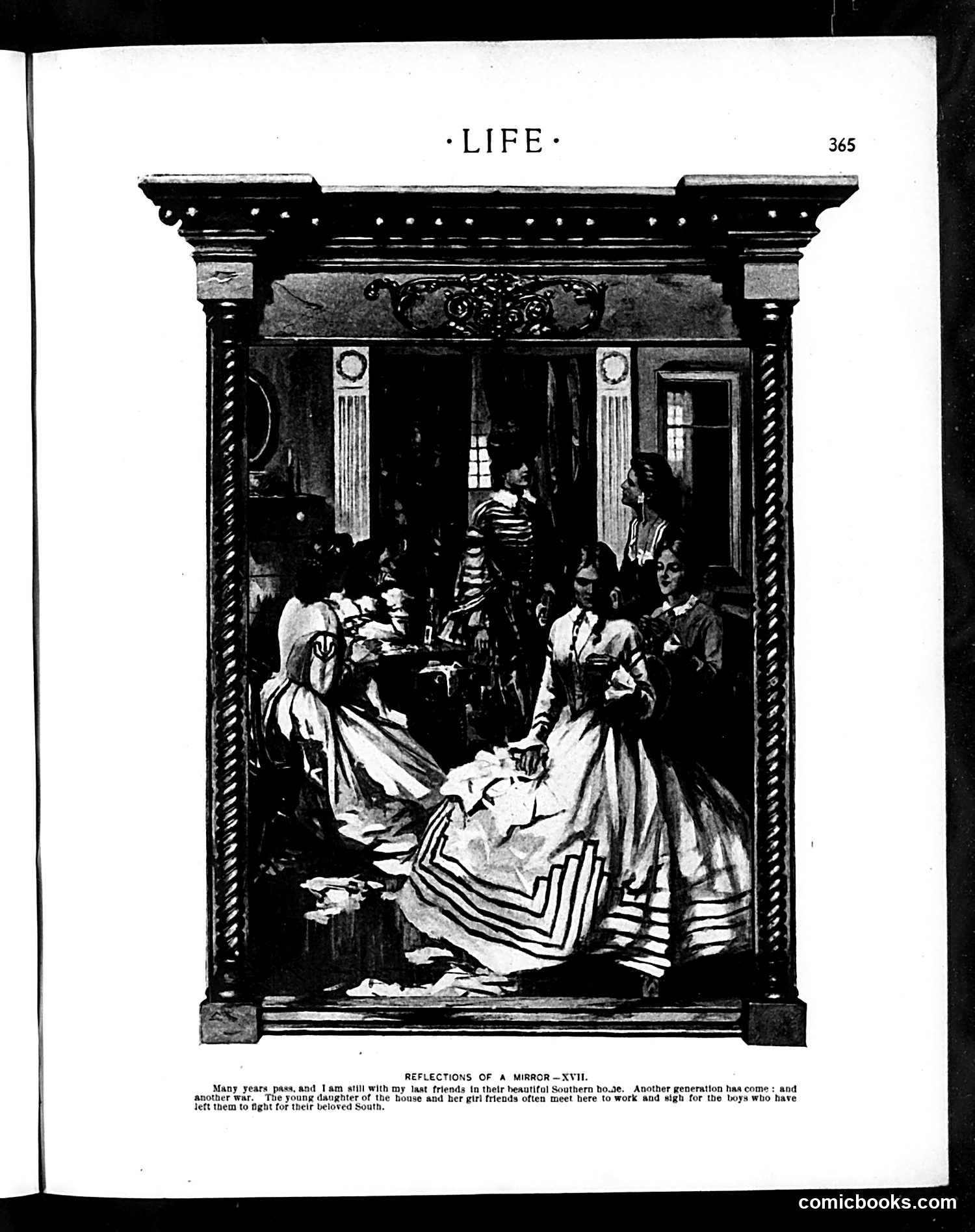
This is a satirical illustration titled "Reflections of a Mirror - XVII," depicting women gathered indoors, apparently at a social gathering or work meeting. The caption references "the beautiful Southern belle" and mentions young women working while "boys who have left them to fight for their beloved South." The satire appears to address the American Civil War era, specifically critiquing Southern women's roles during wartime. The illustration suggests women meeting to support the war effort—likely knitting, sewing supplies, or organizing relief efforts for soldiers. The caption's tone implies irony about romanticized Southern femininity contrasted with the harsh realities of war and separation from male family members fighting in combat.
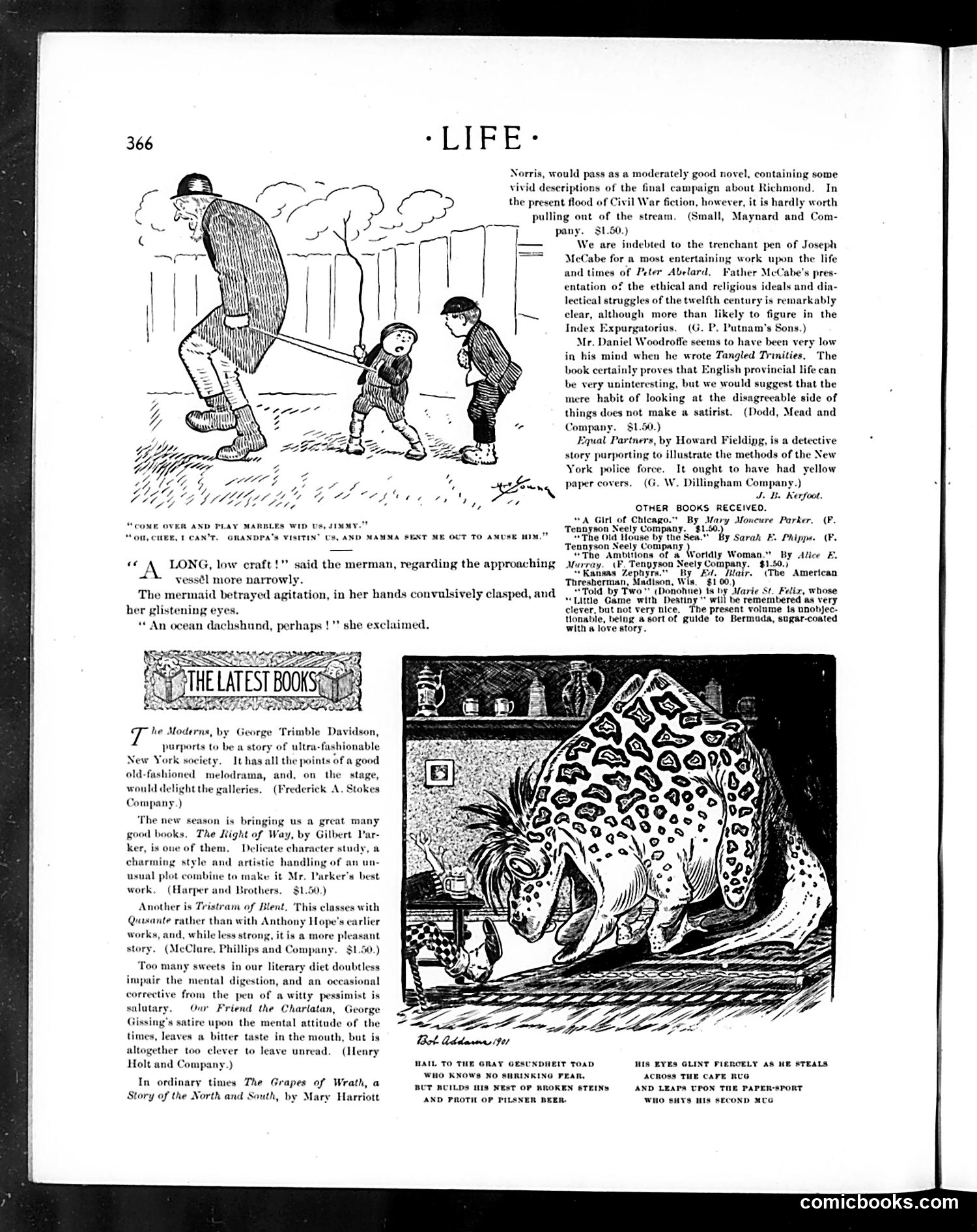
The top cartoon depicts an adult man playing baseball with two young boys. The caption reads: "COME OVER AND PLAY WITH US, JIMMY" / "OH, CHEE, I CAN'T. GRANDPA'S VISITIN' US, AND MAMMA SENT ME OUT TO 'MUSE HIM.'" **The joke:** An adult is stuck entertaining his visiting grandfather rather than enjoying leisure time with peers. The humor satirizes the obligation to entertain elderly relatives during visits—a relatable domestic inconvenience. The lower illustration shows a pig, likely a prizefighter or competitor based on the boxing-related caption text below it. The remainder of the page contains book reviews under "The Latest Books," discussing contemporary novels. The content is primarily literary criticism rather than political satire.
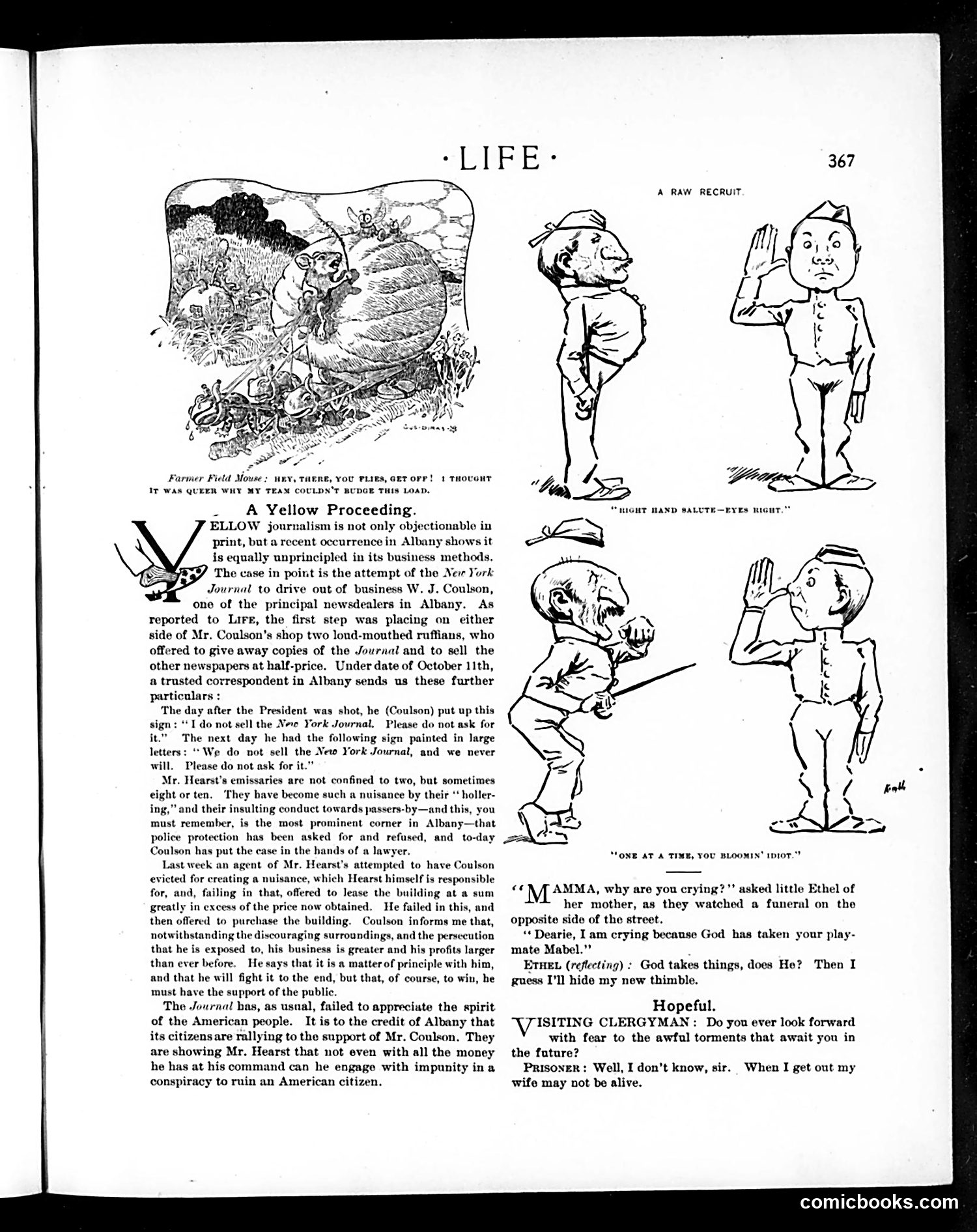
This page satirizes **William Randolph Hearst's New York Journal** and its ruthless business tactics against competitor newspapers. The text describes how the Journal's owner (identified as W.J. Coulson in the article) attempted to drive out the Journal's competition in Albany by placing hand-distributors offering free copies and undercutting prices. The article criticizes this as "yellow journalism"—unethical newspaper practices. It notes Hearst's emissaries became such nuisances through harassment that Coulson faced legal action for creating a public nuisance. The cartoon sketches on the right labeled "A Raw Recruit" mock the aggressive, pushy newspaper distributors through exaggerated caricature. This reflects broader Progressive Era concerns about monopolistic business practices and journalistic ethics.
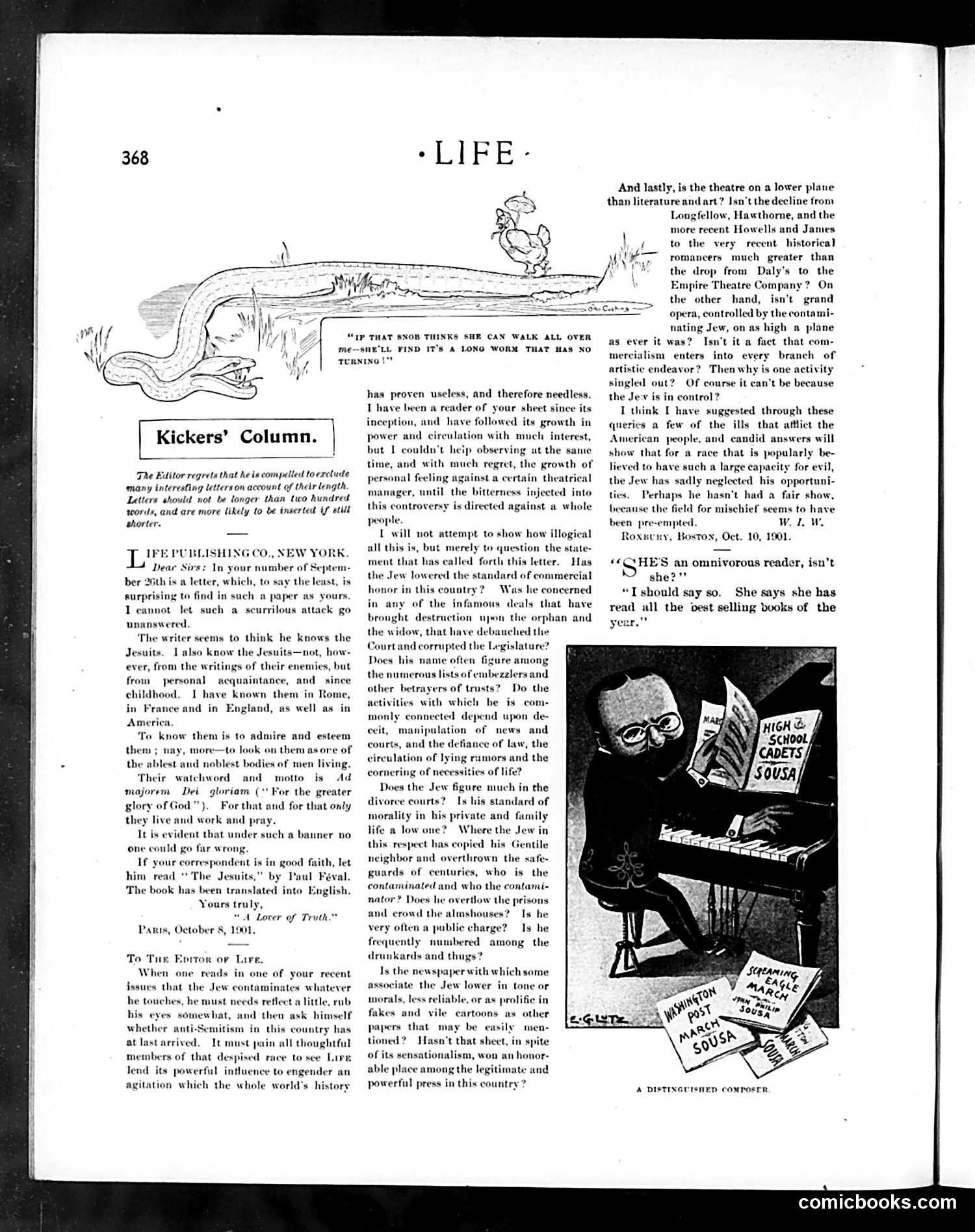
This page contains the "Kickers' Column," a letters section where readers debate anti-Semitic stereotypes in American culture and media. The main cartoon (signed E.G. Lutz) depicts a caricatured Jewish figure at a piano, surrounded by sheet music and publications labeled "High School Cadets" and "Sousa" (referring to composer John Philip Sousa). The figure is captioned "A Distinguished Composer," which appears to be satirical mockery. The letters discuss whether Jewish people are portrayed negatively in newspapers, theater, and popular culture—whether they're depicted as controlling finance, manipulating courts, or associated with criminal activity. One writer defends Jewish people's contributions; another questions their representation in American institutions. This reflects early 1900s anti-Semitic debates and stereotyping in mainstream American media.
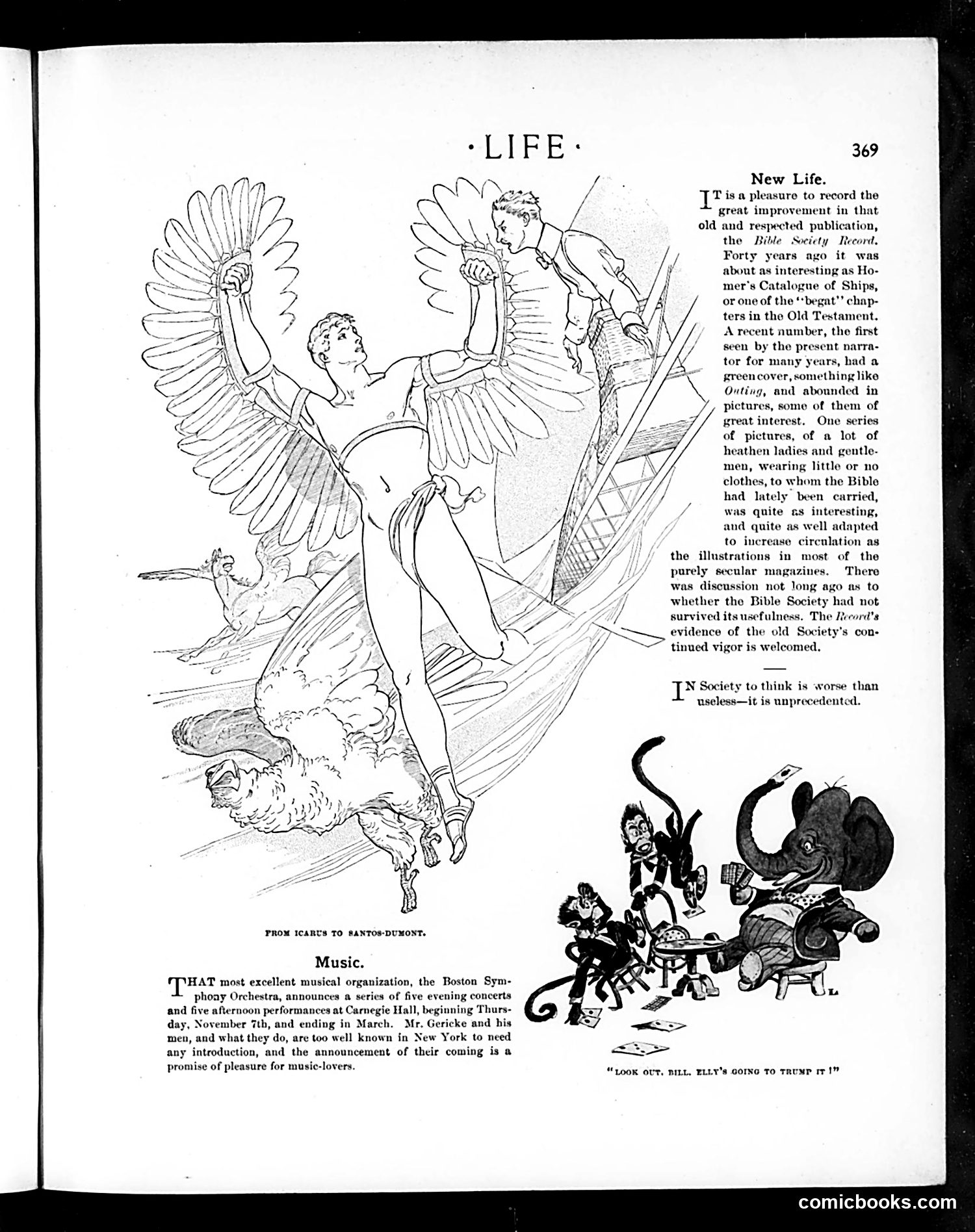
**Top Illustration ("From Icarus to Rantos-Dumont"):** This allegorical drawing depicts winged figures in classical and modern dress, likely referencing the evolution of human flight aspirations. The caption suggests comparison between mythological flight (Icarus) and contemporary aviation pioneers (Rantos-Dumont appears to reference Alberto Santos-Dumont, early aviation experimenter). The satire compares ancient legends with modern technological ambition. **Bottom Cartoon:** A comedic scene showing what appears to be animals or fantastical creatures in formal dress around a table, with the caption "Look out, Bill: Elly's going to trump it!" The joke plays on card-game terminology, suggesting social/domestic humor among anthropomorphized characters. The page also discusses the Boston Symphony Orchestra and Bible Society publications, indicating this is a general interest magazine covering culture and society.
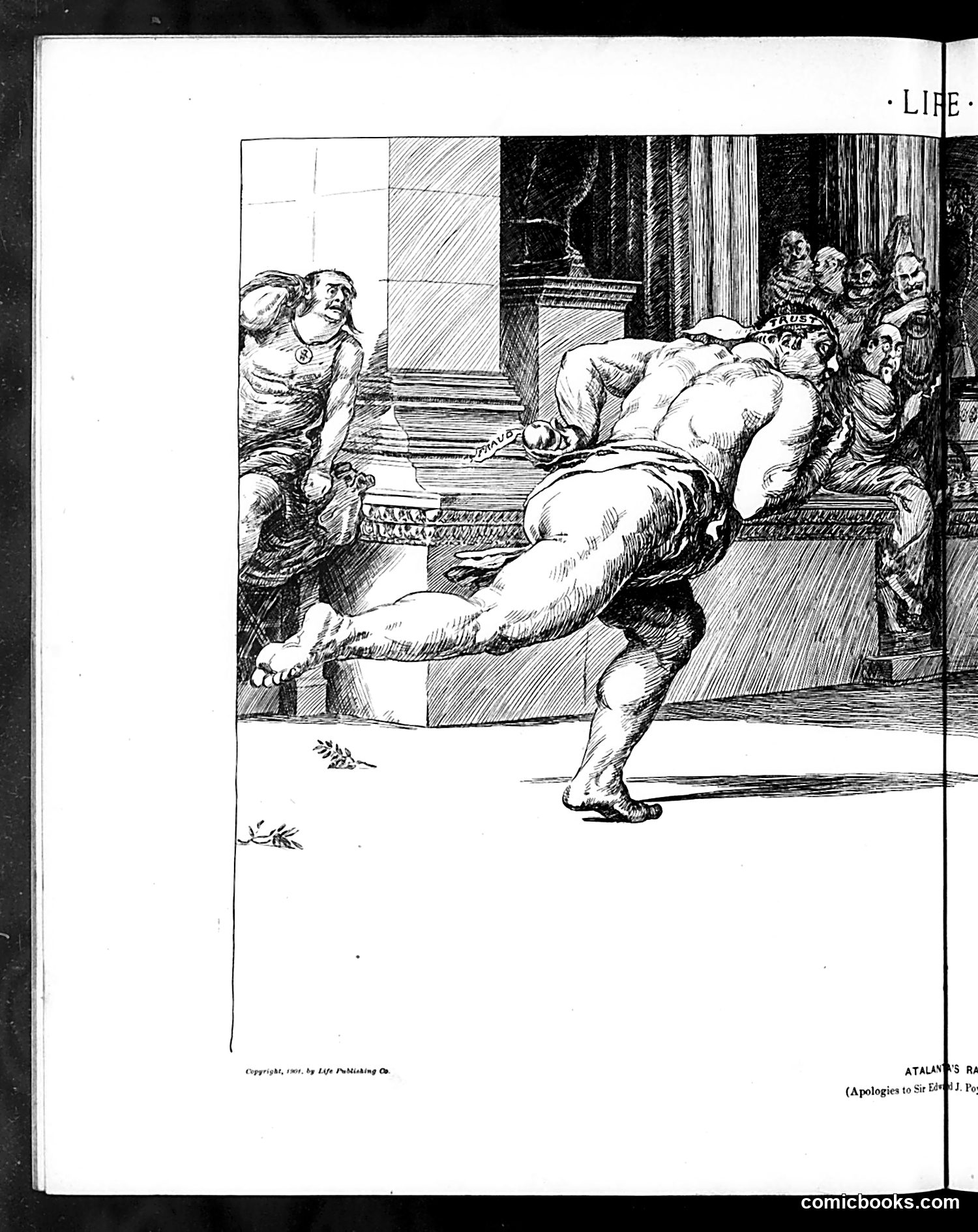
This appears to be a classical or mythological scene rather than a political cartoon. The image depicts what seems to be an athletic or gladiatorial competition, possibly referencing ancient Greek or Roman games. A muscular male figure performs an acrobatic feat (possibly a backflip or athletic display) before an audience of spectators seated in an amphitheater-style setting. The OCR text references "ATALANTA'S RA[CE]" and "(Apologies to Sir [Edward?] P[oynton?])" - suggesting this is a satirical reimagining of the classical myth of Atalanta. The humor likely lies in depicting this ancient legend in an exaggerated or irreverent manner, though the exact satirical point remains unclear without more context about the contemporary reference or artist's intent.
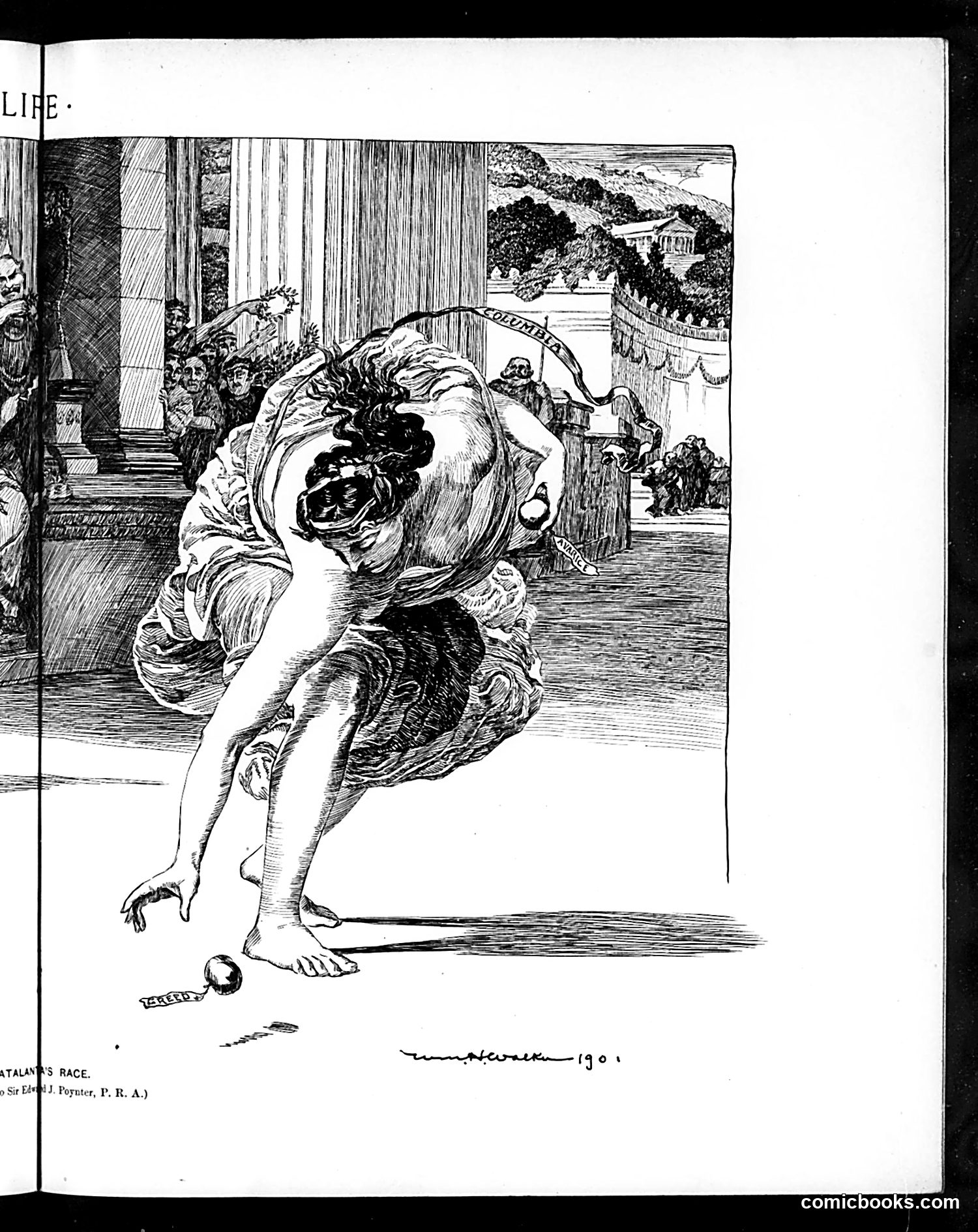
This political cartoon depicts a figure in classical dress bent over backwards in an exaggerated contortion, reaching toward a small spherical object on the ground. The title references the Greek myth of Atalanta, who could only be caught in a race by a suitor who distracted her with golden apples. The cartoon appears to satirize a political figure or movement of 1901 America, suggesting they are being distracted or diverted from their actual goals by something trivial or deceptive. The classical allusion implies the subject is being foolishly led astray, much like Atalanta abandoning her race. The elaborate classical setting in the background emphasizes the ironic comparison between mythological dignity and the figure's undignified position. The specific political reference remains unclear without additional context.
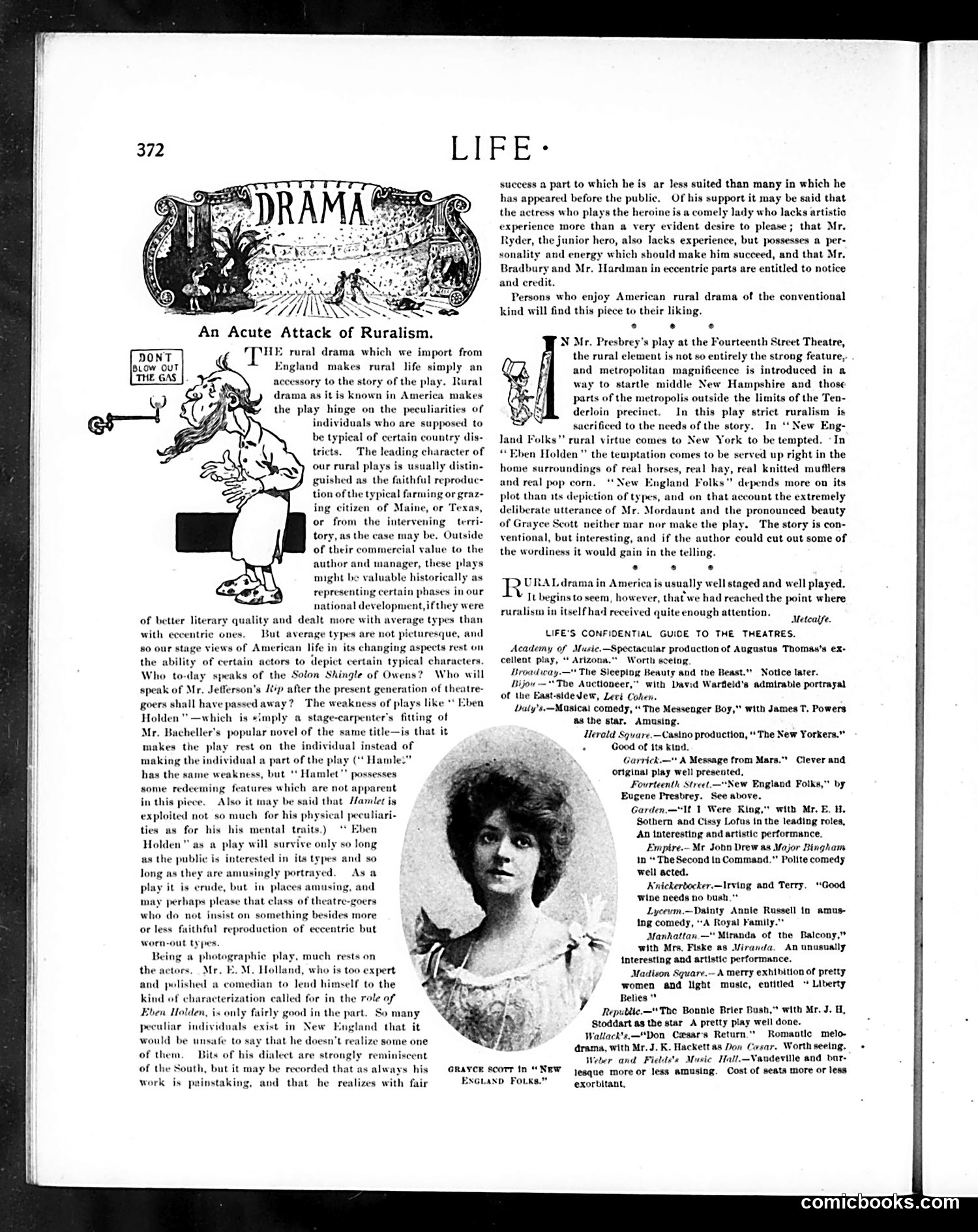
This cartoon satirizes American rural drama—stage plays set in the countryside. The caricatured figure (labeled "Don't slow out the girl") appears to represent the stock "rural character" type common in theatrical productions of the era. The accompanying article criticizes how playwrights portrayed rural life as quaint and simple for metropolitan audiences. It argues such plays relied on exaggerated stereotypes rather than authentic depiction. The article praises "New England Folks" for avoiding this clichéd approach, noting it depends more on genuine character development than on "types." The satire targets both playwrights who exploited rural subject matter superficially and urban audiences who consumed these stereotypical portrayals uncritically.
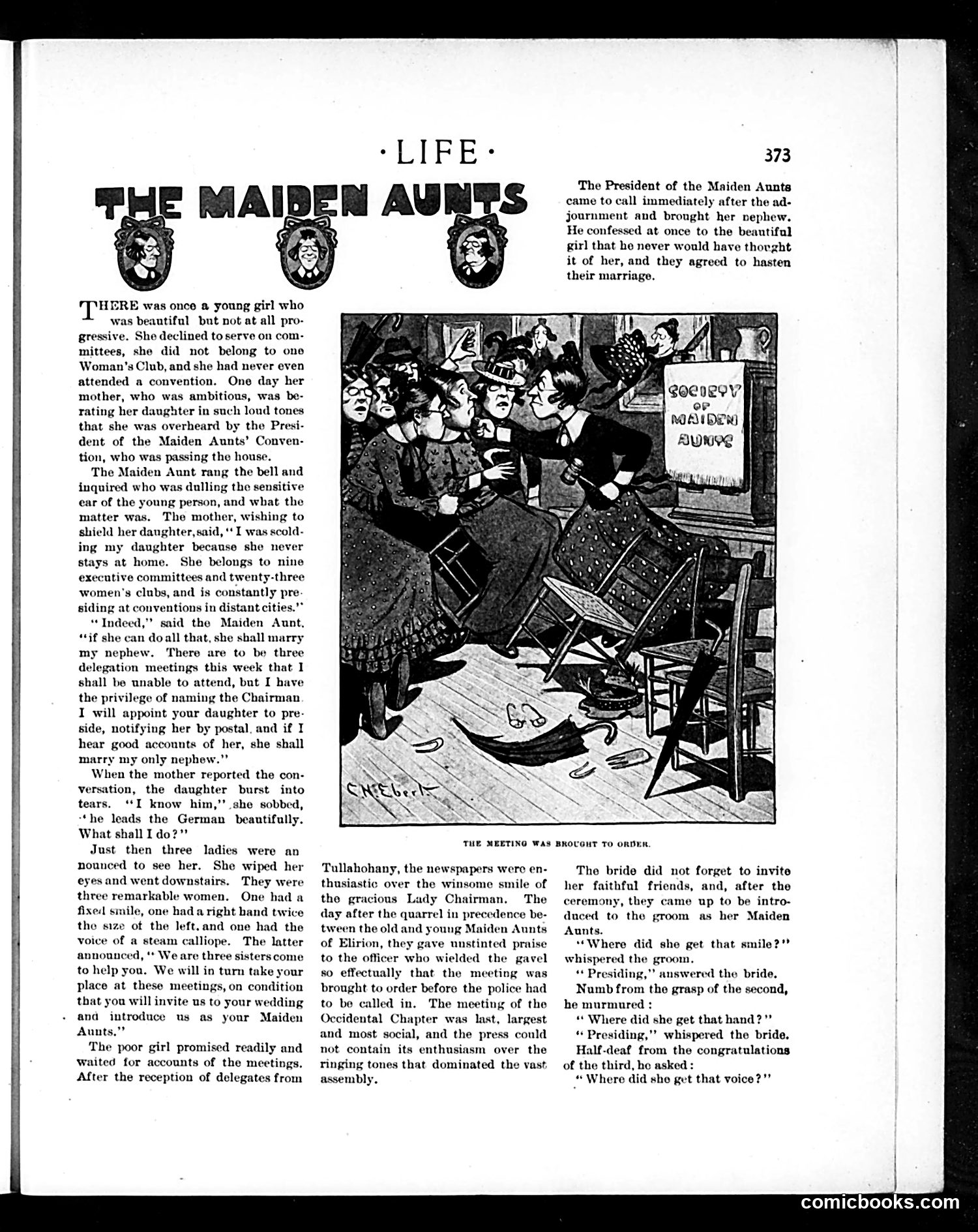
This is a satirical story mocking women's organizational culture in early 20th-century America. A young woman avoids club and committee work, but her mother lies about her involvement to secure a wealthy marriage proposal from a Maiden Aunt's nephew. The joke: three eccentric women (identifiable by exaggerated features—an unnaturally wide smile, an oversized hand, and a booming voice) substitute for the girl at meetings. Their extreme characteristics—the fixed smile, powerful grip, and loud voice—prove so effective that newspapers praise the mysterious "Lady Chairman." The satire targets both women's convention culture (treated as absurd and performative) and the groom's superficiality: he only marries the girl after being duped, then discovers her "accomplishments" are merely side effects of the eccentric substitutes' physical peculiarities, not her own qualities.
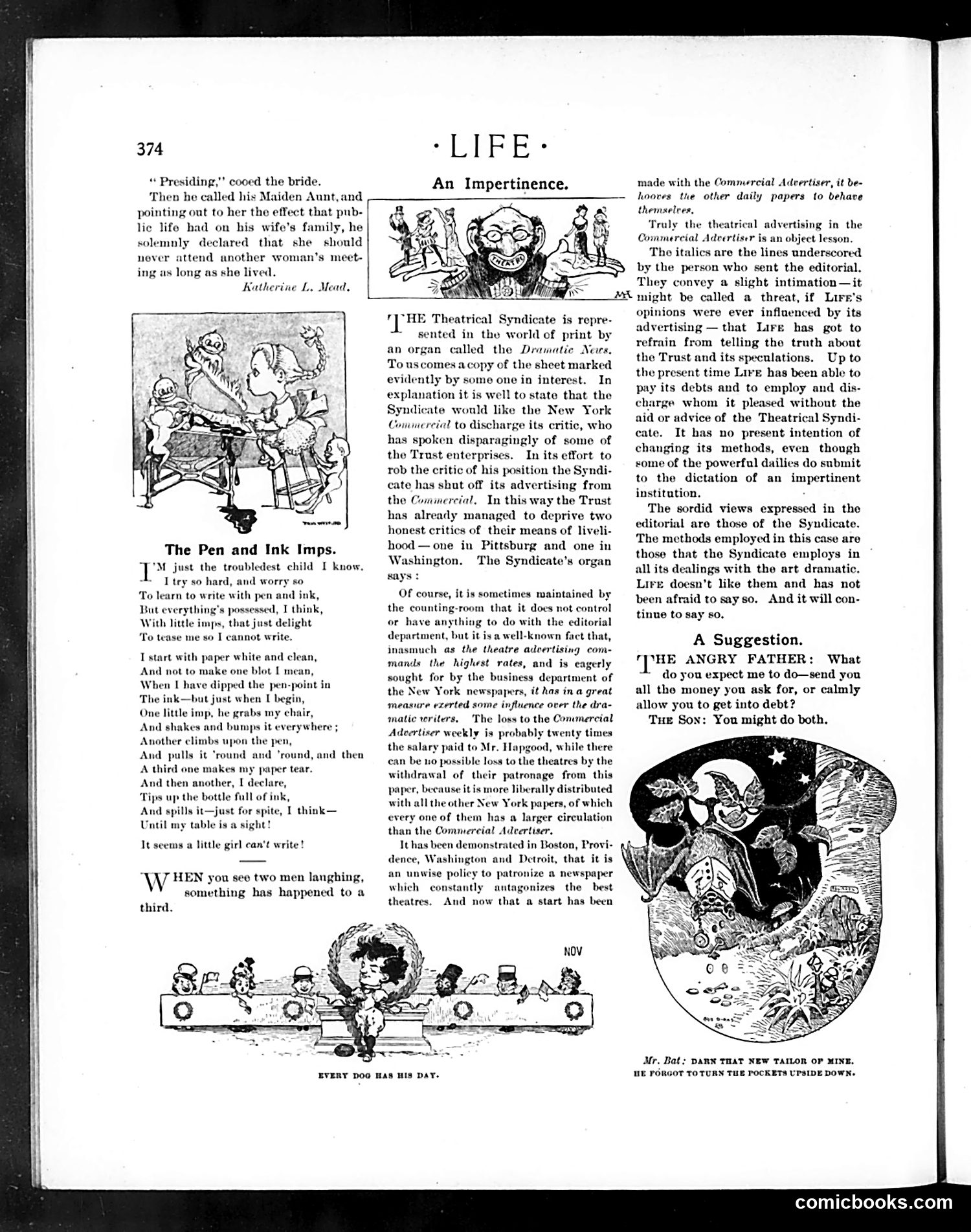
This article attacks the **Theatrical Syndicate** (a powerful monopoly controlling American theaters) for attempting to suppress critical theater reviews through economic intimidation. **The situation:** The Syndicate pressured the *Commercial Advertiser* newspaper to fire its theater critic by withdrawing lucrative advertising revenue. Life's editor identifies this as extortion—a threat disguised as "business advice" from the *Dramatic News* (the Syndicate's mouthpiece). **The satire:** Life publishes the Syndicate's own words in italics to expose their crude threat: behave, or face financial ruin. The magazine defends editorial independence, arguing that Life can afford to criticize the Trust without advertising revenue because its readers support it—unlike papers dependent on theater ads. **The point:** This illustrates how monopolies used economic power to control press coverage. Life presents itself as the principled exception, refusing advertiser pressure while other major newspapers capitulate to the Syndicate's "dictation."
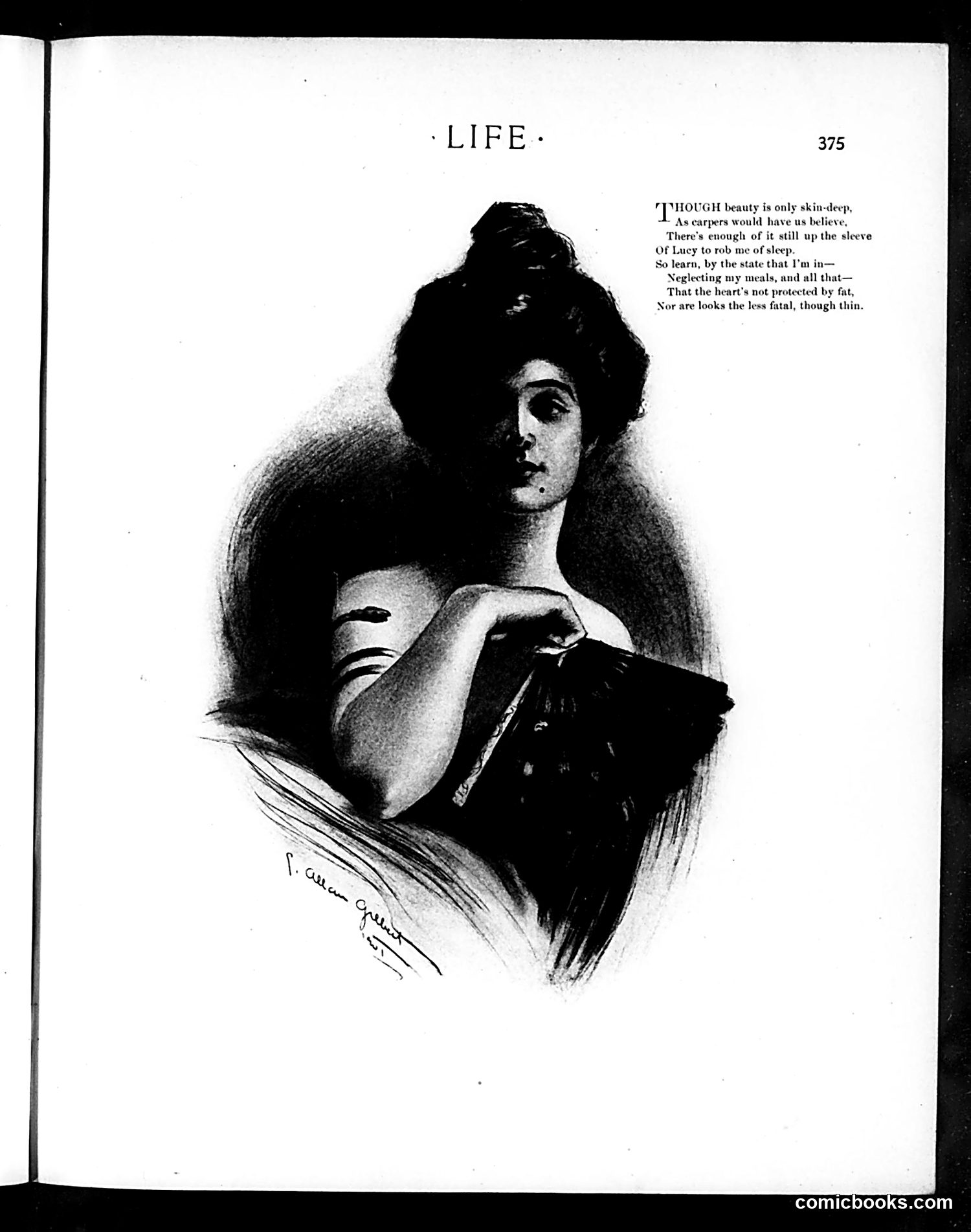
This is an illustration accompanying a poem about romantic infatuation. The image shows a woman (identified as "Lucy" in the text) depicted in an idealized, romantic style typical of early 20th-century Life magazine aesthetics. The accompanying verse humorously presents a man's admission that he's fallen for Lucy despite—or perhaps because of—her physical appearance. The poem satirizes the conventional wisdom that "beauty is only skin-deep" by suggesting that superficial attractiveness has real emotional power, leaving him neglecting meals and sleep. The joke plays on the tension between rational dismissal of physical beauty's importance and its actual influence on human behavior. The illustrated signature appears to be the artist's mark.
This page contains primarily **poetry and prose fiction** rather than political cartoons. The main content is "The Stage Villain," a satirical poem mocking melodramatic theater conventions—specifically the stock character of the mustachioed, villainous schemer with exaggerated evil traits. The satire targets how predictable and artificial these theatrical villains are: they're everywhere, constantly plotting, yet always caught when the curtain falls. The joke is that modern detective work has made such obvious villainy obsolete. The second piece, "The Ways of the Golf Girl," satirizes the emerging phenomenon of female competitive golfers and the obsessive training culture surrounding them—complete with trainers, masseurs, and betting syndicates monitoring their every move. The remainder is **advertising**: Wilson Whiskey, Esterbrook pens, Ypsilanti underwear, and Vigoral beef drink. This was typical Life magazine format—mixing satirical content with commercial appeals.
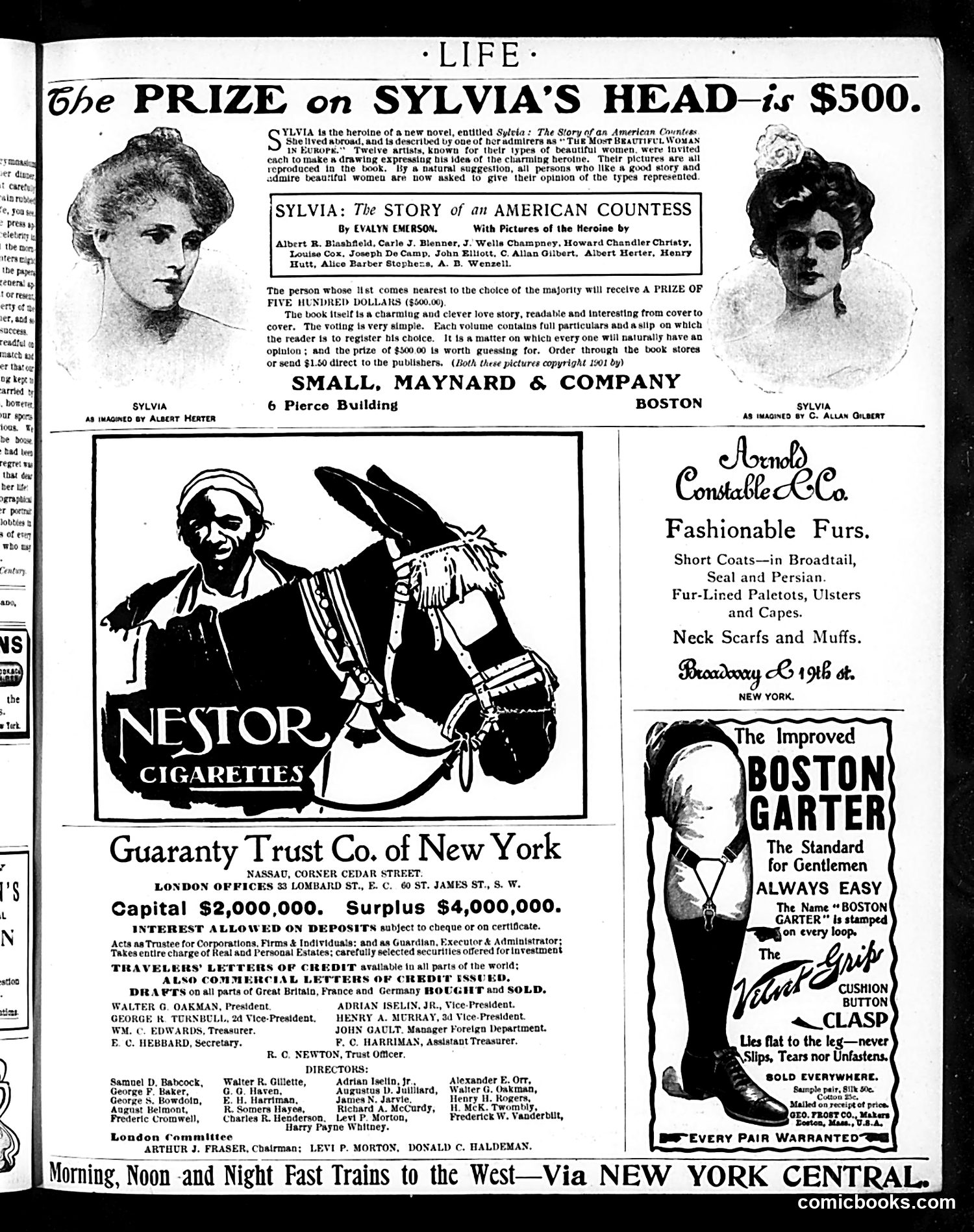
This is primarily an **advertising and promotional page**, not a political cartoon. The main content announces a $500 prize contest for *Sylvia: The Story of an American Countess*, a new novel by Evalyn Emerson. **The Contest:** Twelve prominent illustrators (including Howard Chandler Christy and Albert Herter) each drew their interpretation of "Sylvia," the book's heroine, described as "the most beautiful woman in Europe." Readers vote on which artistic interpretation they prefer; whoever's choice matches the majority wins $500. **The Satire/Point:** The implicit joke is the absurdity of crowdsourcing aesthetic judgment—the notion that beauty is democratically determinable through popular vote. It also humorously capitalizes on contemporary fascination with illustrated "Gibson Girl"-style feminine ideals. **Supporting Content:** The page includes advertisements for Nestor Cigarettes, fashionable furs, and Boston Garters, plus banking information for Guaranty Trust Co. These reflect typical early-1900s magazine monetization.
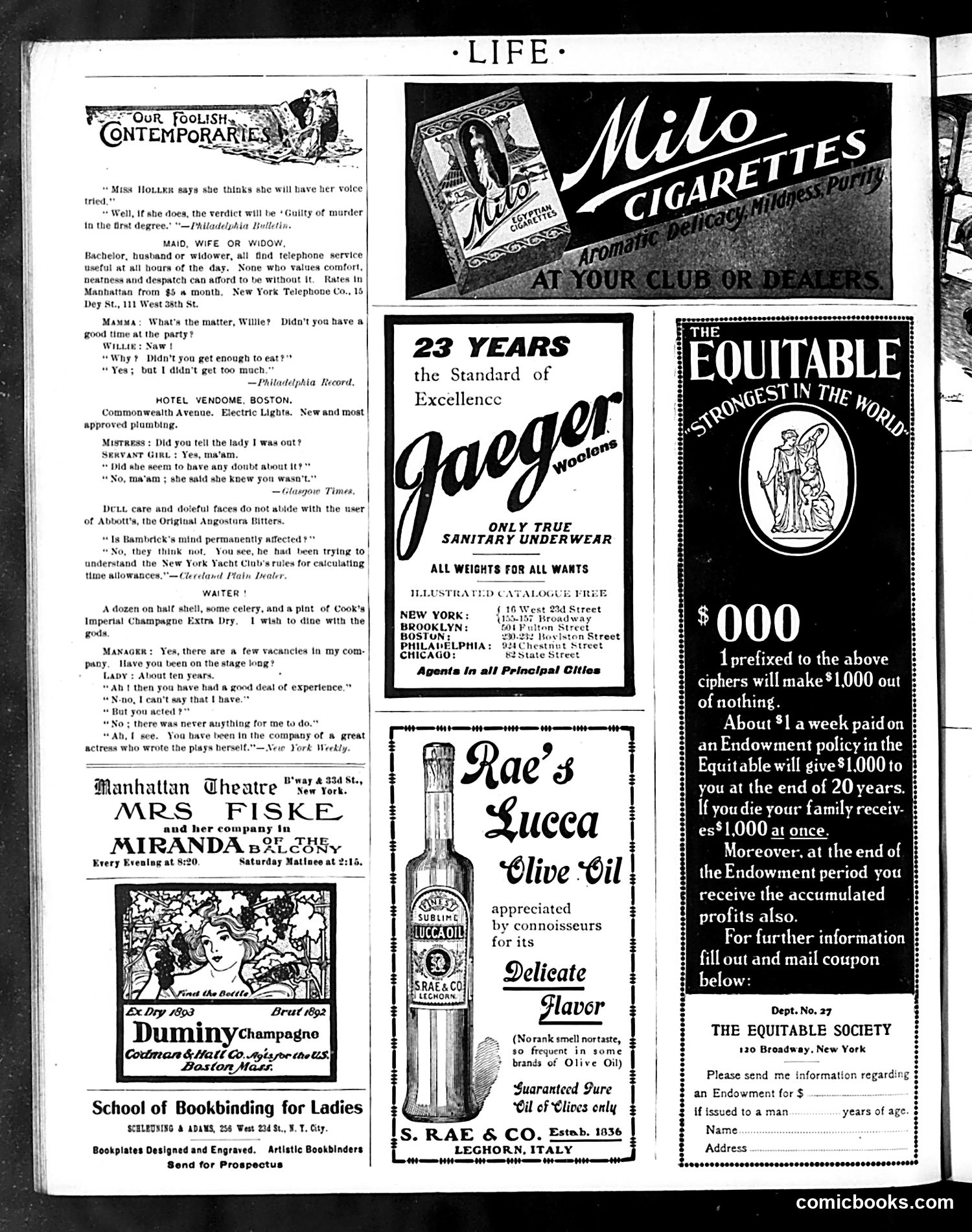
This page from *Life* magazine consists primarily of a humor section mocking contemporary public figures and social situations. The main cartoon strip, "Our Foolish Contemporaries," presents brief satirical dialogues. **Key content:** The opening joke references "Miss Holler" (likely a pun on a real person's name) wanting her "voice tried"—with the Philadelphia Bulletin darkly joking the verdict would be "guilty of murder in the first degree," implying her voice is unbearably bad. Other vignettes mock familiar scenarios: servants lying about their employer's availability, nouveau-riche diners ordering ostentatiously, struggling actresses with no stage experience, and confused club members misunderstanding yacht-racing rules. **The satire targets:** pretension, incompetence, class aspiration, and the gap between reality and appearance in Edwardian society. The page also advertises period services (telephone, hotels, theatrical productions) and consumer products typical of early 20th-century life.
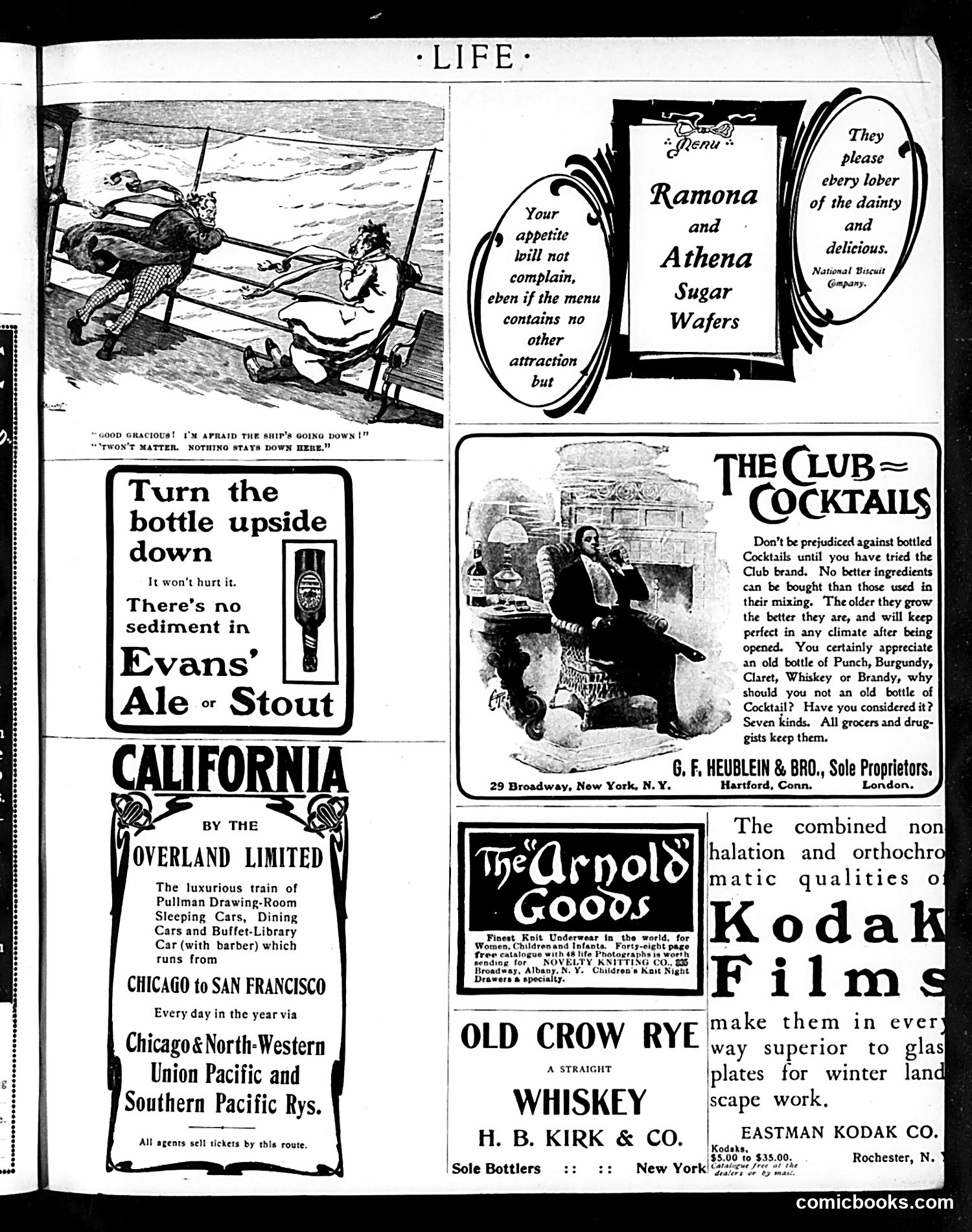
This page is primarily **advertising**, typical of early 20th-century magazines. The single cartoon at top-left depicts sailors during rough seas—one fearfully warns "the ship's going down," while another dismissively responds "won't matter, nothing stays down here," likely a crude joke about seasickness and vomiting. The advertisements reflect period products and concerns: Evans' Ale emphasizes its lack of sediment (a quality issue in older beverages); Ramona and Athena Sugar Wafers target middle-class consumers; The Club Cocktails promotes pre-mixed bottled cocktails as convenient and respectable; the Overland Limited advertises luxury train travel between Chicago and San Francisco; Old Crow Rye and Kodak Films round out the luxury/consumer goods marketed. The page captures Prohibition-era anxieties (alcoholic beverages openly advertised) and early advertising's focus on product purity and shelf-stability—novel concerns for consumers of that era.
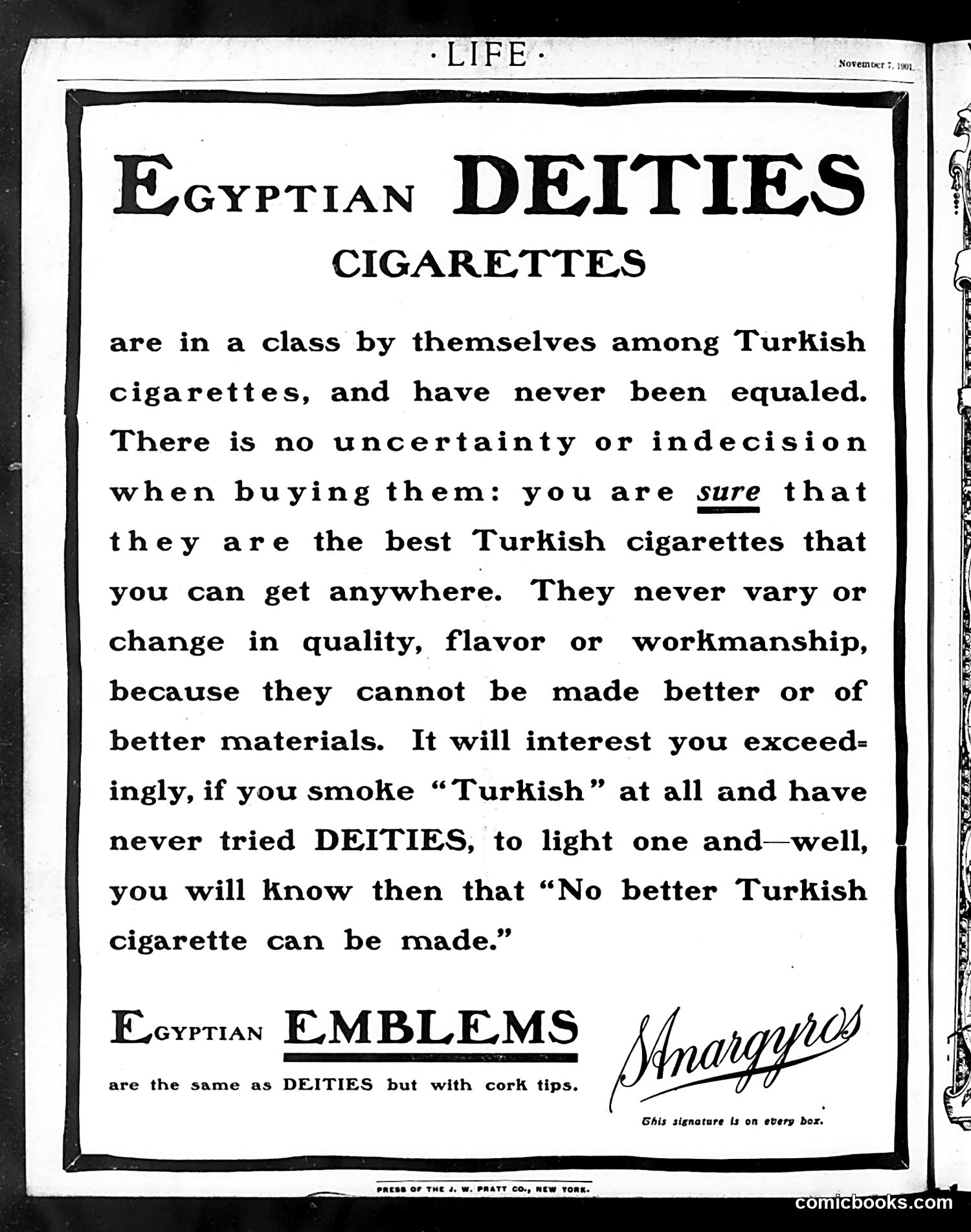
The page is a product advertisement for Egyptian Deities cigarettes (and a variant called Egyptian Emblems with cork tips), published in *Life* magazine on November 7, 1901. The ads use inflated marketing language typical of the era—claiming the product is unsurpassed in quality and consistency, with the catchphrase "No better Turkish cigarette can be made." The word "Deities" in the title appears chosen simply for brand appeal and grandiosity, not to reference actual Egyptian gods or make any deeper point. The signature "Smaargos" belongs to the cigarette manufacturer or distributor. This represents early 20th-century tobacco advertising before modern health warnings, when such hyperbolic quality claims were standard marketing practice.