
Life, 1901-11-07 · page 12 of 20
Life — November 7, 1901 — page 12: what you’re looking at
What you’re looking at
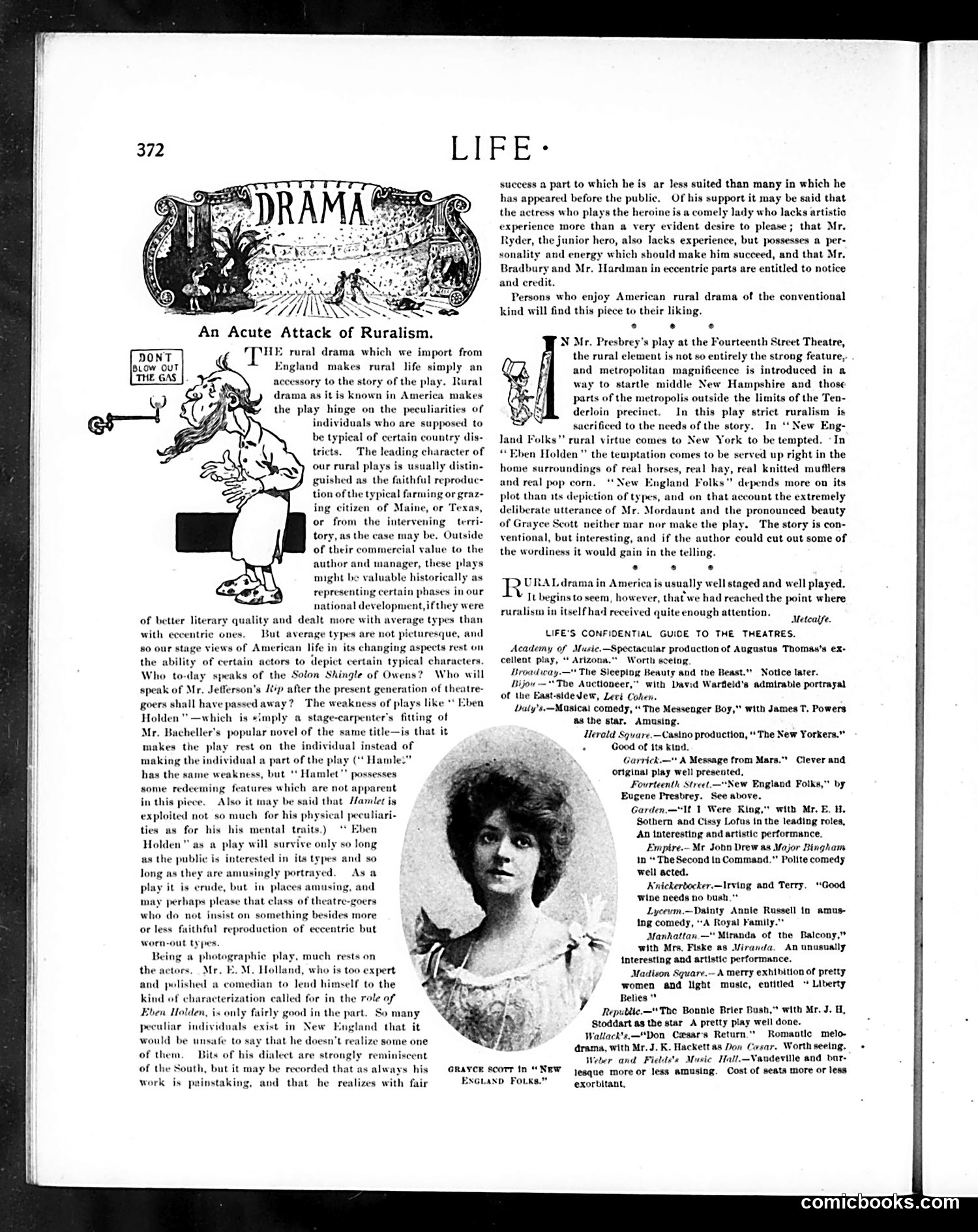
This cartoon satirizes American rural drama—stage plays set in the countryside. The caricatured figure (labeled "Don't slow out the girl") appears to represent the stock "rural character" type common in theatrical productions of the era. The accompanying article criticizes how playwrights portrayed rural life as quaint and simple for metropolitan audiences. It argues such plays relied on exaggerated stereotypes rather than authentic depiction. The article praises "New England Folks" for avoiding this clichéd approach, noting it depends more on genuine character development than on "types." The satire targets both playwrights who exploited rural subject matter superficially and urban audiences who consumed these stereotypical portrayals uncritically.
📄 Transcribed text from this page (OCR, searchable)
Machine-transcribed from the original scan — historical spelling and the odd misread are preserved.
LIFE An Acute Attack of Ruralism. TP HE rural drama which we import from England makes rural life simply an accessory to the story of the play. Rural drama as itis known in America makes the play hinge on the peculiarities of individuals who are supposed to be typical of certain country dis- tricts. The leading character of our rural plays is usually distin- guished as the faithful reproduc- tion of the typical farming or graz~ ing citizen of M or from the intervening tory, as the case may be, Outside of their commercial value to the author and manager, these plays might be valuable historically as representing certain phases i national development, ifthey were of better literary quality and dealt more with average types than with ¢ But ave ypes are not picturesque, and 80 our sta the abil or Texas, rri- our tric ones. of certain actors to depict certain typical characters. y speaks of the Solon Shingle of Owens? Who will speak of Mr. Jefferson's Kip after the present generation of theatre- goers shall have passed away? The weakness of plays like “ Eben Holden —which is simply a stage-carpenter's fitting of Mr. Bacheller’s popular novel of the same title—is that it makes the play rest on the individual instead of making the individual a part of the play (* Hamle:” has the same weakness, but “ Hamlet some redeeming features which are not apparent in th exploited not so much for his physical peculiari- ties as for his his mental traits.) ‘ Eben Hold so long as the public is interested in its types and so Jong as they are amusingly port Asa play it is ¢ but in places may perhaps please that class ¢ who do not insist on something besides more or less faithful reproduction of eccentric but worn-out types. Being a photographic play, much rests on the actors. Mr. E.M. Holland, who is too expert and polished a comedian to lend himself to the kind of chara ion called for in the role of Eben Holden, is only fairly good in the part. So many peculiar individuals exist in New England that it would be unsafe to say that he doesn’t realize some one Bits of his dialect are strongly reminiscent of the South, but it may be recorded that as always his work is painstaking, and that he realizes with fair Es possesses: of them ORaYcE ScorT in “Naw .AND FOLKS.” success a part to which he is ar less suited than many in which he has appeared before the public. Of his support it may be said that the actress who plays the heroine is a comely lady who lacks artistic experience more than a very evident desire to please; that Mr. ler, the junior hero, also lacks experience, but possesses a per- sonality and energy which should make him succeed, and that Mr. Bradbury and Mr. Hardman in eccentric parts are entitled to notice and credit. crican rural drama of the conventional kind will find this piece to their liking. ° . ° N Mr. Presbr play at the Fourteenth Street Theatre, the rural element is not so entirely the strong feature, and metropolitan magnificence is introduced in a way to startle middle New Hampshire and those parts of the metropolis outside the limits of the Ten- derloin precinet. In this play strict ruralism is sacrificed to the needs of the story. In ‘*New Eng- land Folks” rural virtue comes to New York to be tempted. “In “Eben Holden" the temptation comes to be served up right in the home surroundings of real horses, real hay, real knitted mufilers and real pop corn. ‘New England Folks" depends more on its plot than ats depiction of types, and on that account the extremely deliberate utterance of Mr. Mordaunt and the pronounced beauty of Grayce Scott neither mar nor make the play. ‘The story is con- ventional, but interesting, and if the author could cut out some of the wordiness it would gain in the telling. . * ° PRCHAL drama in America is usually well staged and well played. It begins to seem, however, that we had reached the point where ruralisma in itself had received quite enough attention. Metcalfe. LIFE'S CONFIDENTIAL GUIDE TO THE THEATRES. Academy of Muste.—Spectacular production of Augustus Thomas's ex- cellent play, “ Arizona.” Worth sceing. Broadiay.—" The Sleeping Beauty and the Beast." Notice later. Bijou ~The Auctioneer,” with David Warfeld’s admirable portrayal of the East-aldevew, Leri Cohen. Yaty’s—Masical comedy, “The Messenger Boy,” with James T. Powers. ‘as the star, Amusing. Herold Sqvare.—Casino production, “The New Yorkers." + Good of tts kind, Garrick.—"" A Message from Mars.” original play well presented, Fourteenth Strat.—"New England Folks,” by Eugene Presbrey. See above. Carden—"It 1 Were King,” with Mr. E. i. Sothern and Cissy Lofus in the leading roles, An fateresting and artistic performance. Empire. Mr Jobn Drew as Major Bingham in“ TheSecond in Command." Polite comedy well acted. Knickertocker.—Irving and Terry. wine needs no bush.” Lycevm.—Dainty Annie Russell 12 amus- ing comedy, “A Royal Family."" Manhattan —" Miranda of the Balcony,” with Mrs, Fiske a8 Miranda. An unusually interesting and artistic performance. Madison Square. A merry exhibition of pretty women and light music, entitled * Liberty Belies Republie—"The Bonnle Brier Bush,” with Mr. J. H, Stoddart as the star A pretty piay well done. Watlack's,—"Don Cssar's Return. Romantic melo- drama, with Mr.J.K. Hackett as Don Cosar. Worth seeing. Weber and Fields's Music Hall.—Vaudeville and bar- lesque more or less amusing. Cost of seats more or less exorbitant. Clever and “Good & comicbooks.com