
A complete issue · 20 pages · 1901
Life — October 10, 1901
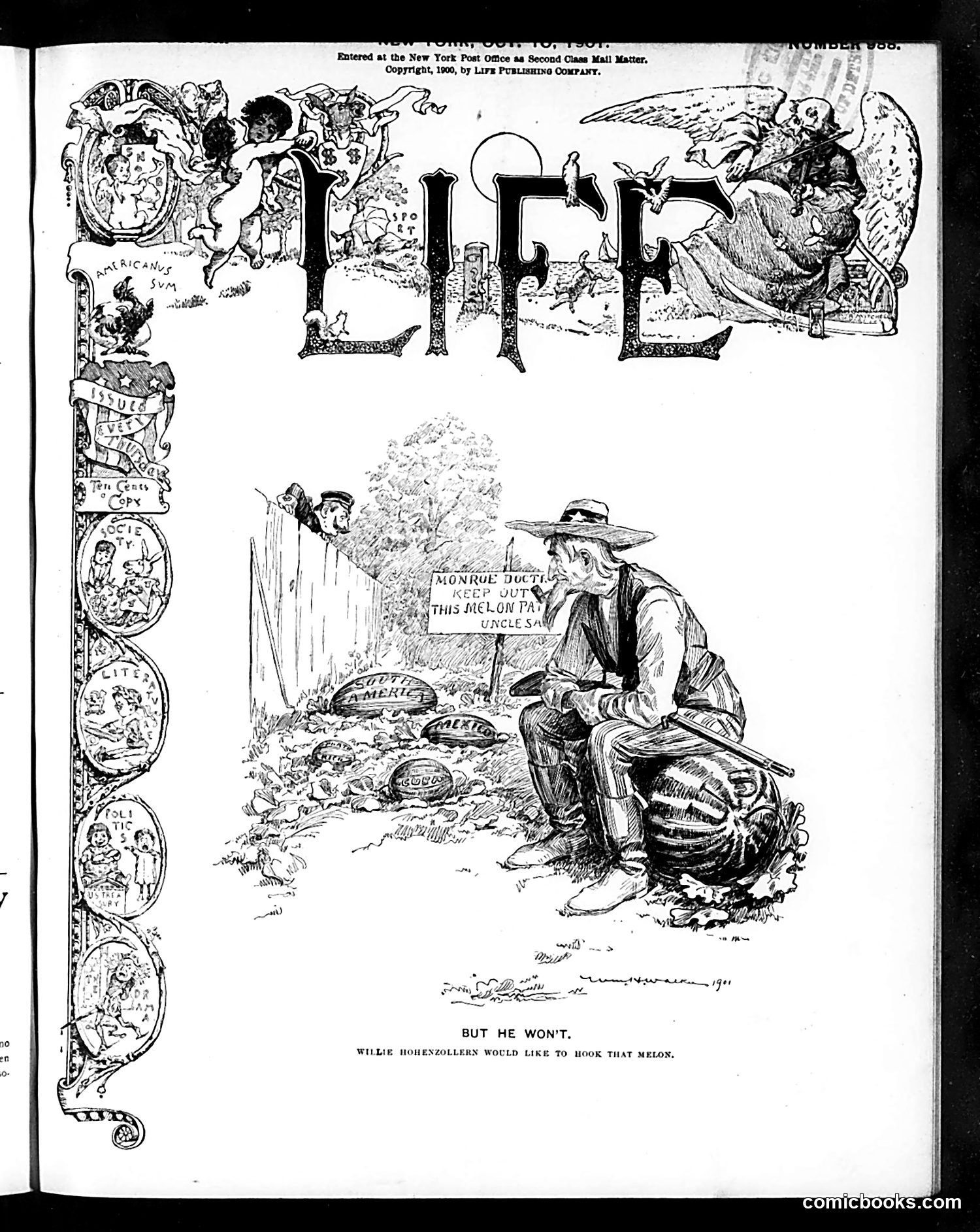
This cartoon satirizes **Willie Hohenzollern** (German Kaiser Wilhelm II) attempting to steal melons from Monroe Doctrine territory—representing American interests in the Western Hemisphere. The sign reads "Monroe Doctrine Keep Out / This Melon Pa / Uncle Sam," warning against foreign interference in the Americas. The old farmer figure (representing Uncle Sam/America) sits guard, suggesting readiness to defend the region from German expansion. The satire comments on early 20th-century tensions between Germany and America regarding colonial ambitions and spheres of influence. The melon—a valuable commodity—symbolizes contested territorial or economic control. This reflects pre-World War I anxieties about German imperial ambitions challenging American dominance in the Western Hemisphere under the Monroe Doctrine principle.
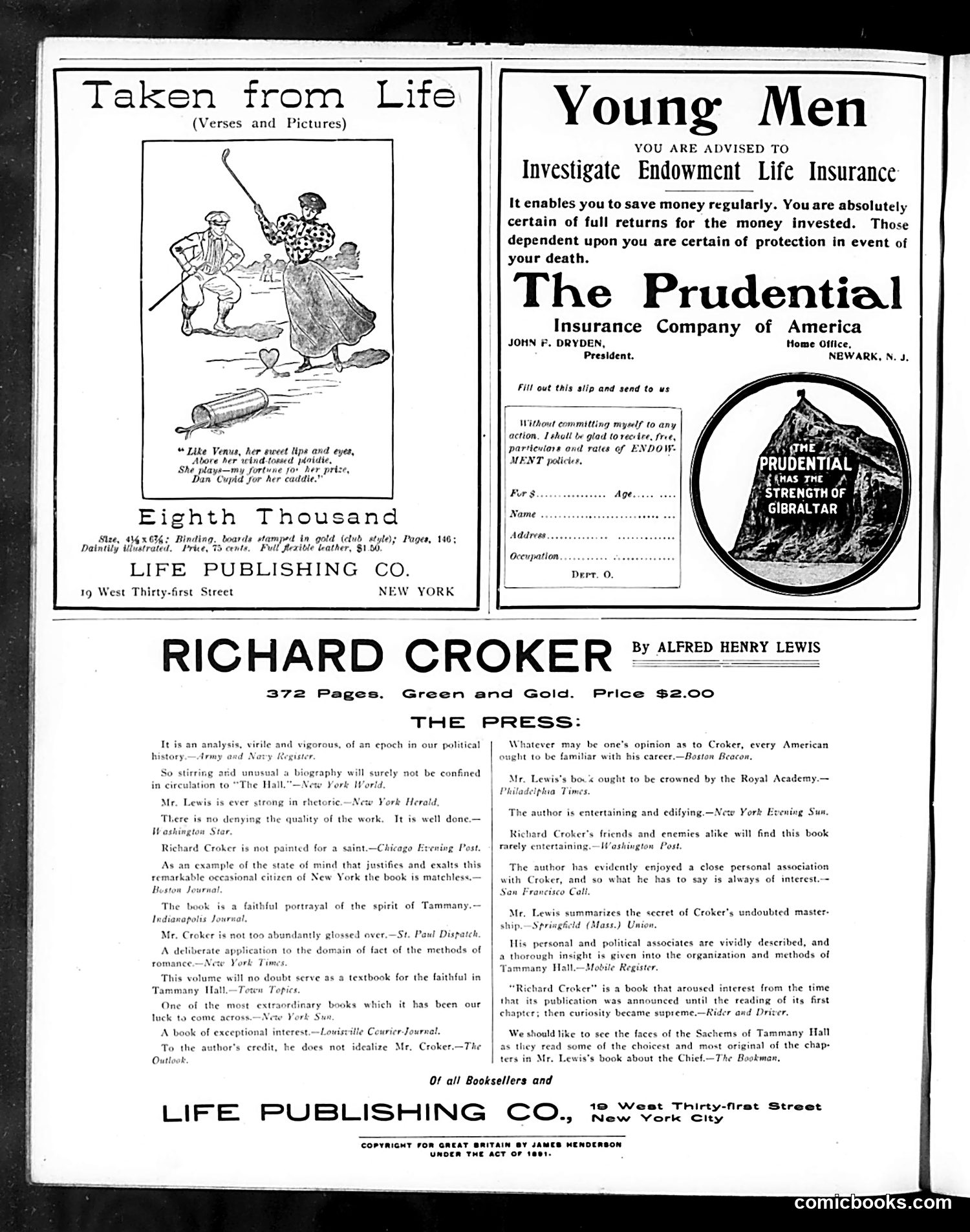
The left panel shows a couple in romantic pursuit—a man chasing a woman who's fleeing. The caption quotes Cupid apologizing for his "careless" arrow work, suggesting the man is an undesirable suitor. This appears to be a gentle satire on romantic mismatches or unrequited love. The right side is dominated by advertisements: Life Publishing Co. promotes "Taken from Life" (their book), and The Prudential Insurance Company solicits young men for endowment life insurance. The magazine page primarily serves as a vehicle for book and insurance advertising rather than political commentary. The cartoon itself offers light social humor about courtship rather than substantive satire on identifiable public figures or events.
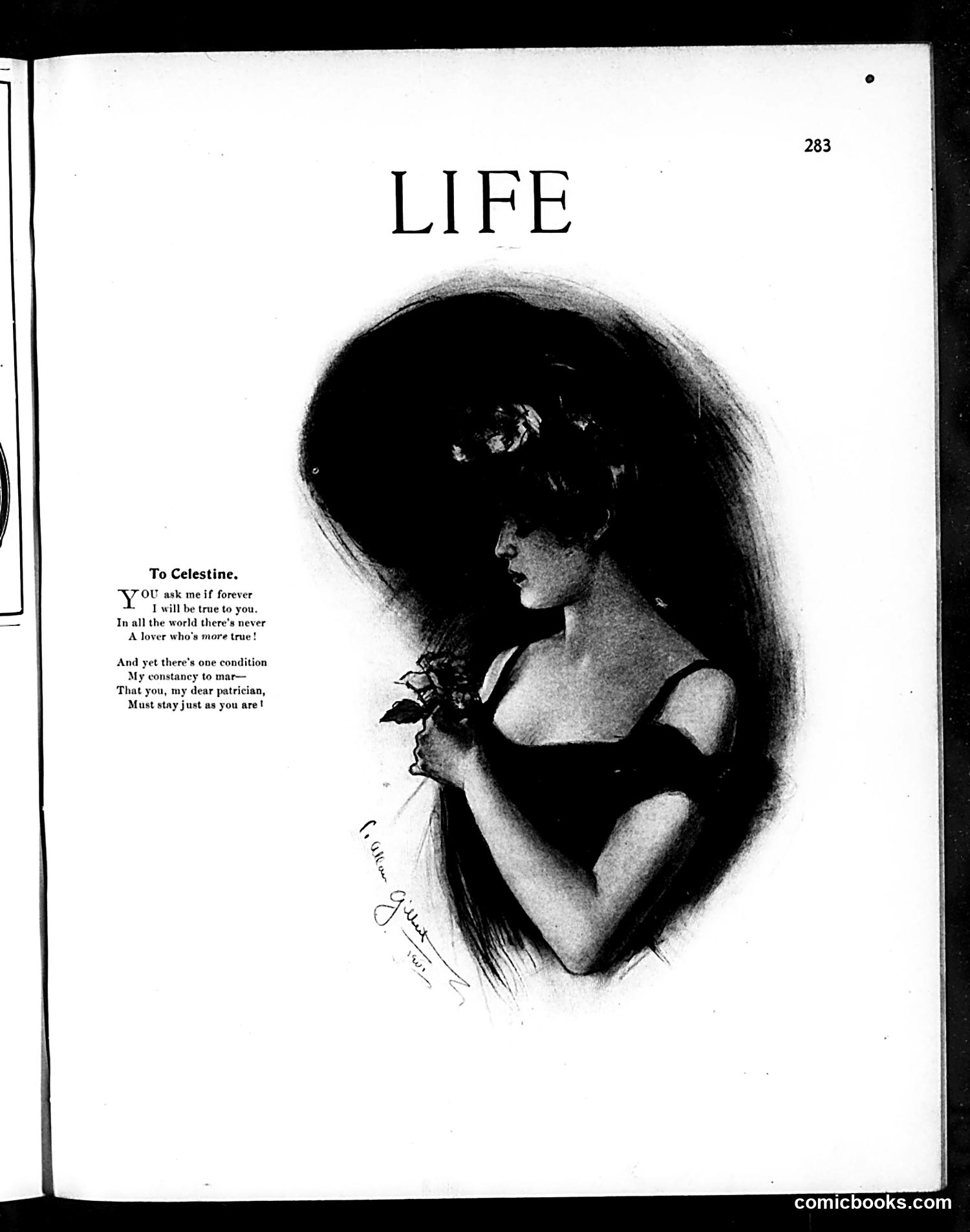
This page from *Life* magazine (page 283) features a romantic illustration titled "To Celestine" rather than political satire. The image shows a woman in profile holding a rose, accompanied by a poem addressing a recipient named Celestine. The poem expresses devotion and eternal faithfulness, with a conditional statement: the speaker promises constancy on the condition that "you, my dear patrician, / Must stay just as you are!" This appears to be sentimental romantic content rather than political commentary or satire. The illustration style—a soft pencil portrait—and the intimate nature of the verse suggest this is decorative/romantic material typical of early 20th-century magazine content, rather than satirical commentary on public figures or events. The signature at the bottom indicates the artist's name, though it's not entirely clear from the image.
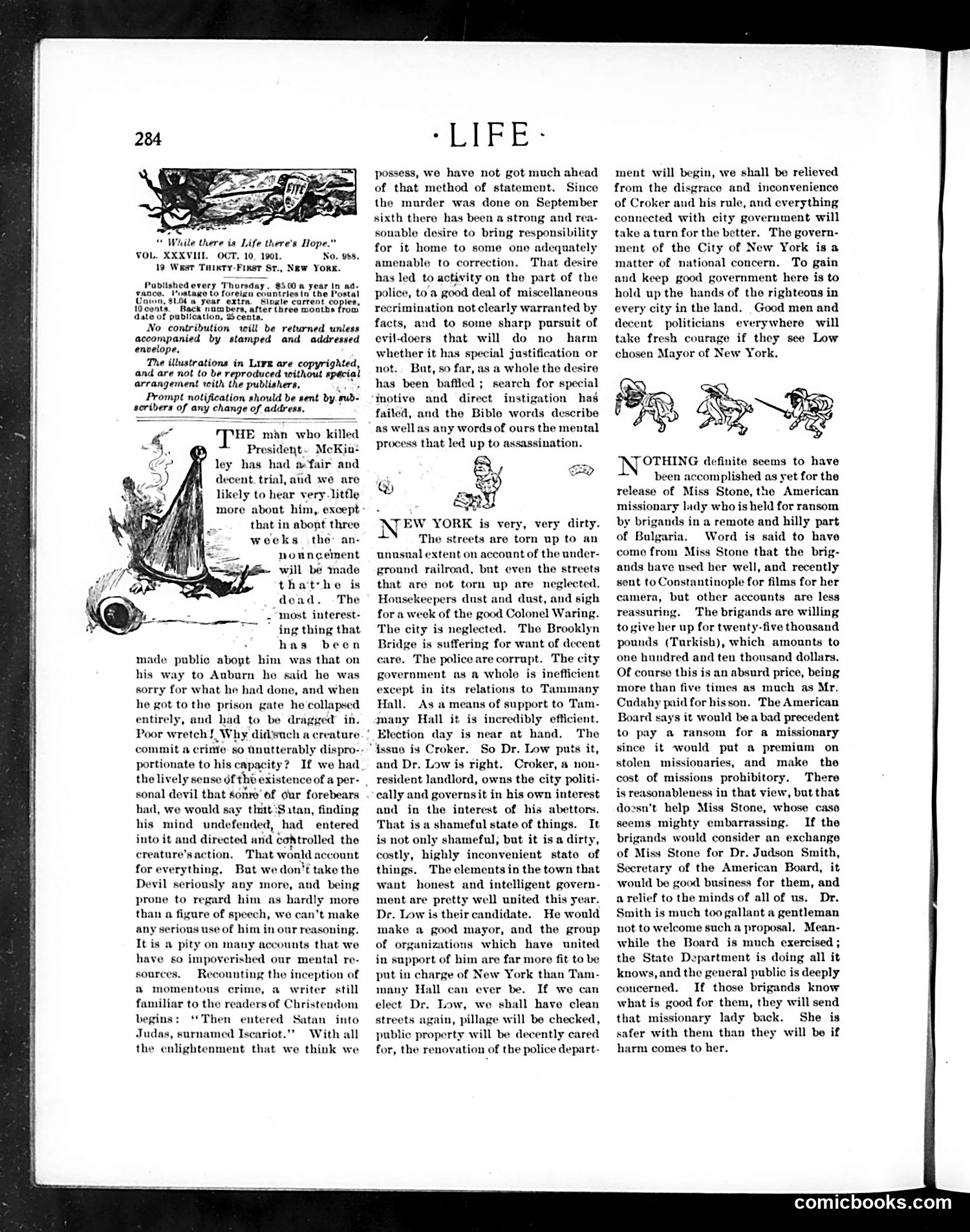
This page critiques New York City's corrupt municipal government under Police Commissioner John Gould (referenced as "Croker," likely Boss Richard Croker of Tammany Hall). The left cartoon depicts a demonic figure labeled "Satan" entering "Judas, surnamed Leariot"—biblical references to corruption and betrayal in city governance. The text condemns the city's filthy streets, ineffective police, and corrupt administration. It discusses Mayor Low as a potential reform candidate against the Democratic machine. The piece sarcastically notes that even brigands holding Miss Stone (an American missionary kidnapped in Bulgaria) ransom for ransom money would be safer than trusting NYC's government to recover her. The satire attacks systemic municipal incompetence and moral failure in early 1900s New York politics.
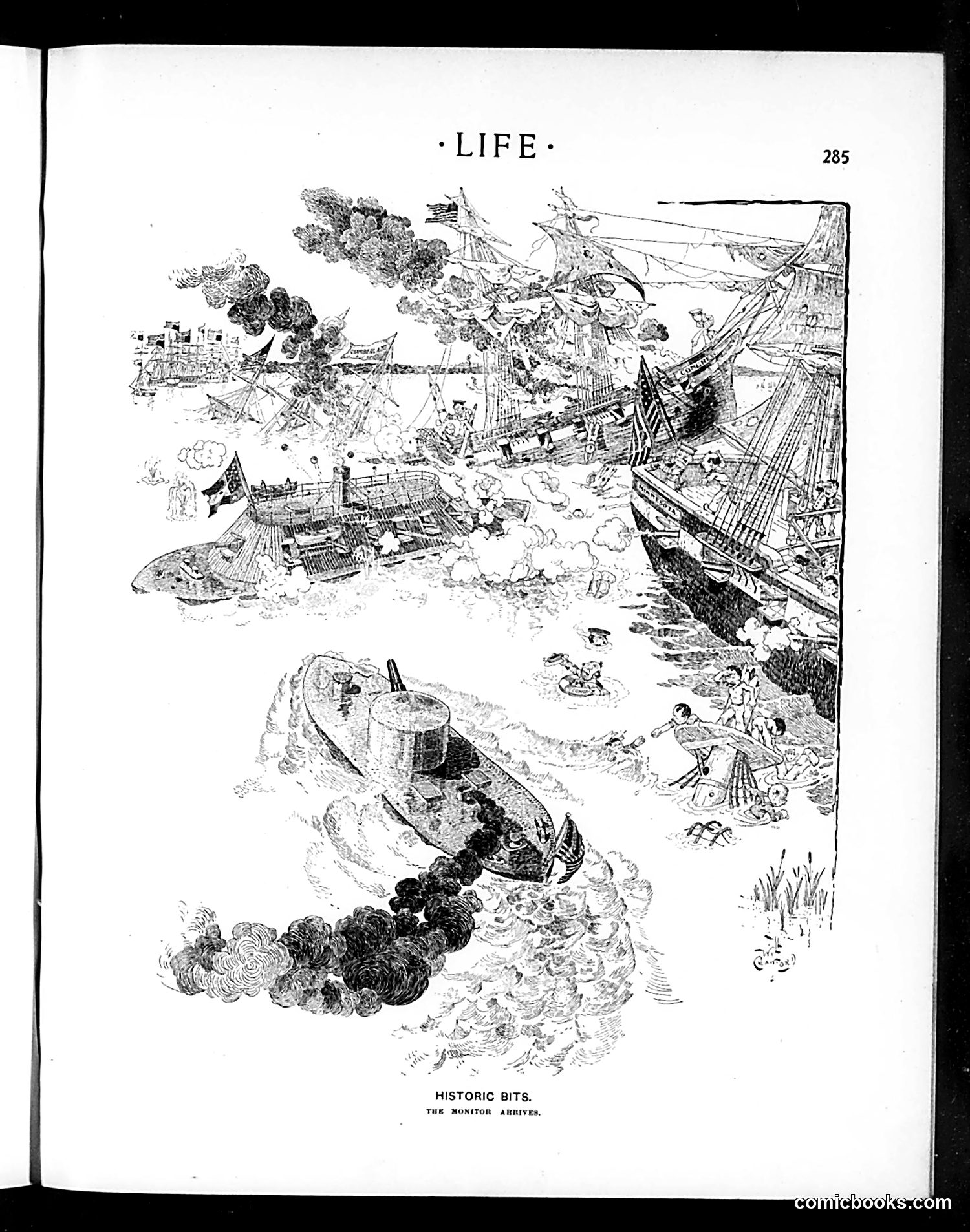
This illustration depicts the arrival of the USS Monitor, the Union's revolutionary ironclad warship, during the American Civil War. The detailed sketch shows the Monitor's distinctive low profile and rotating turret among traditional wooden sailing vessels and coastal fortifications. The satire likely comments on the dramatic technological shift the Monitor represented—its arrival made conventional wooden warships obsolete almost overnight. The chaotic scene with multiple vessels suggests the disruption this innovation caused to established naval power. For Civil War readers, this would have resonated as a pivotal moment: the Monitor's 1862 battle against the Confederate ironclad CSS Virginia fundamentally changed naval warfare strategy. The title "Historic Bits" frames this as a significant historical event worthy of satirical commemoration.
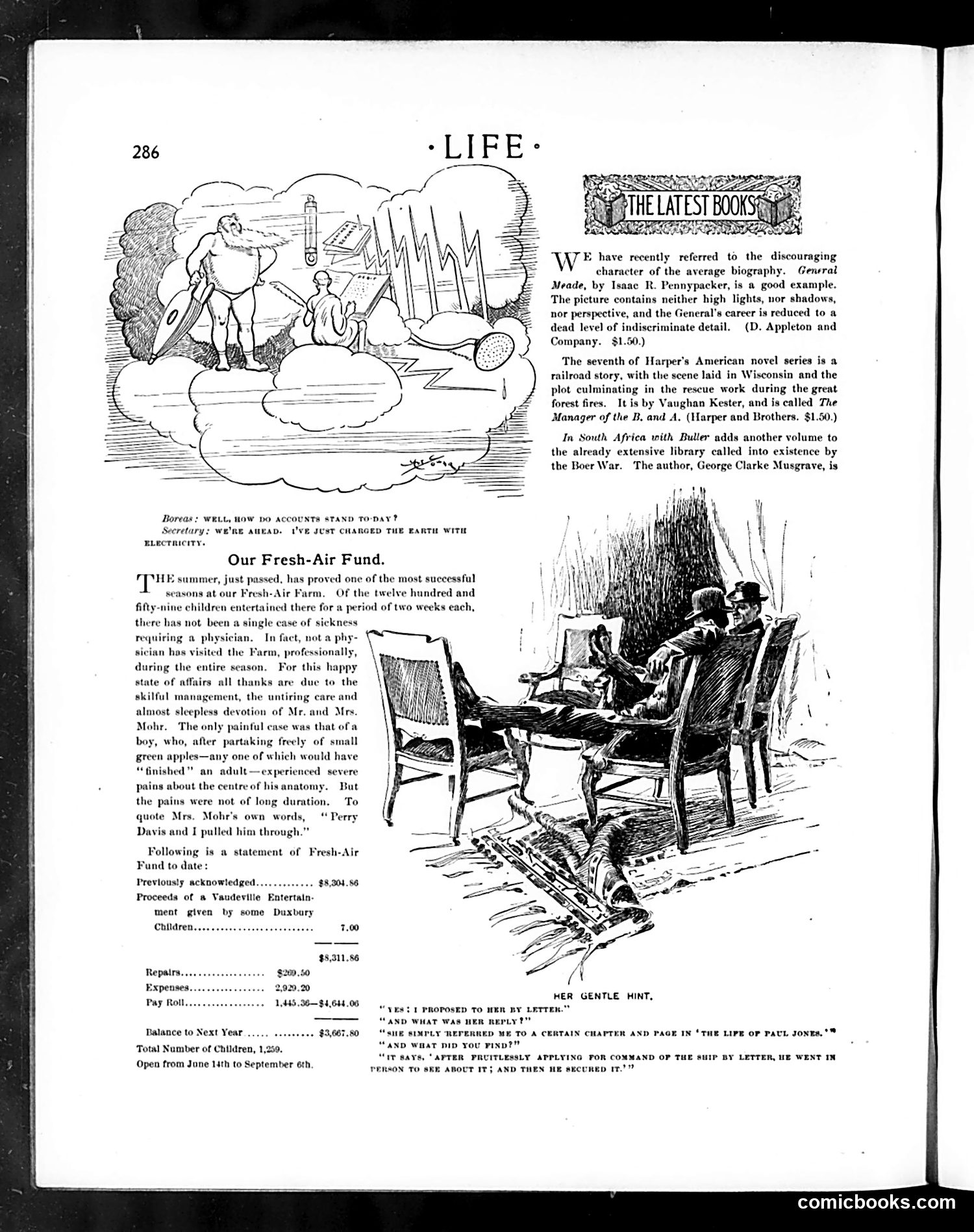
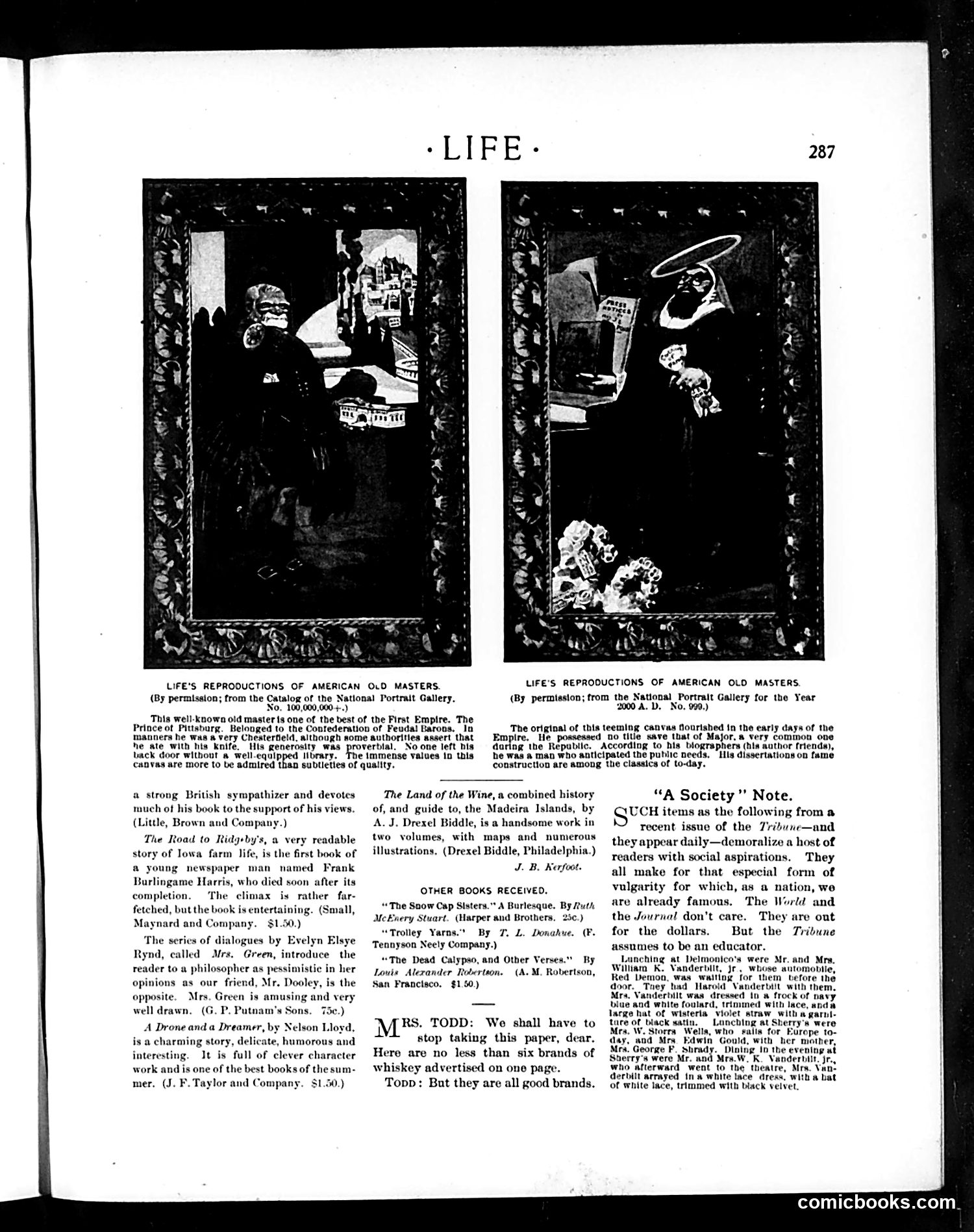
This page from *Life* magazine reproduces two paintings by American Old Masters from the National Portrait Gallery, presented as satirical commentary on American society and politics. The left image appears to depict a colonial-era interior scene with figures in period dress, while the right image shows what seems to be a figure in formal attire with cherubs or putti below—possibly a neoclassical or allegorical work. The accompanying text discusses various books received, including titles like "The Snow Cap Sisters" and "Trolley Yarns," followed by a humorous exchange between Mrs. Todd and Todd about whiskey advertising brands appearing on a single page. The satire appears directed at consumer culture and advertising excess rather than specific political figures. Without clearer image resolution or additional context, the precise satirical targets remain somewhat unclear.
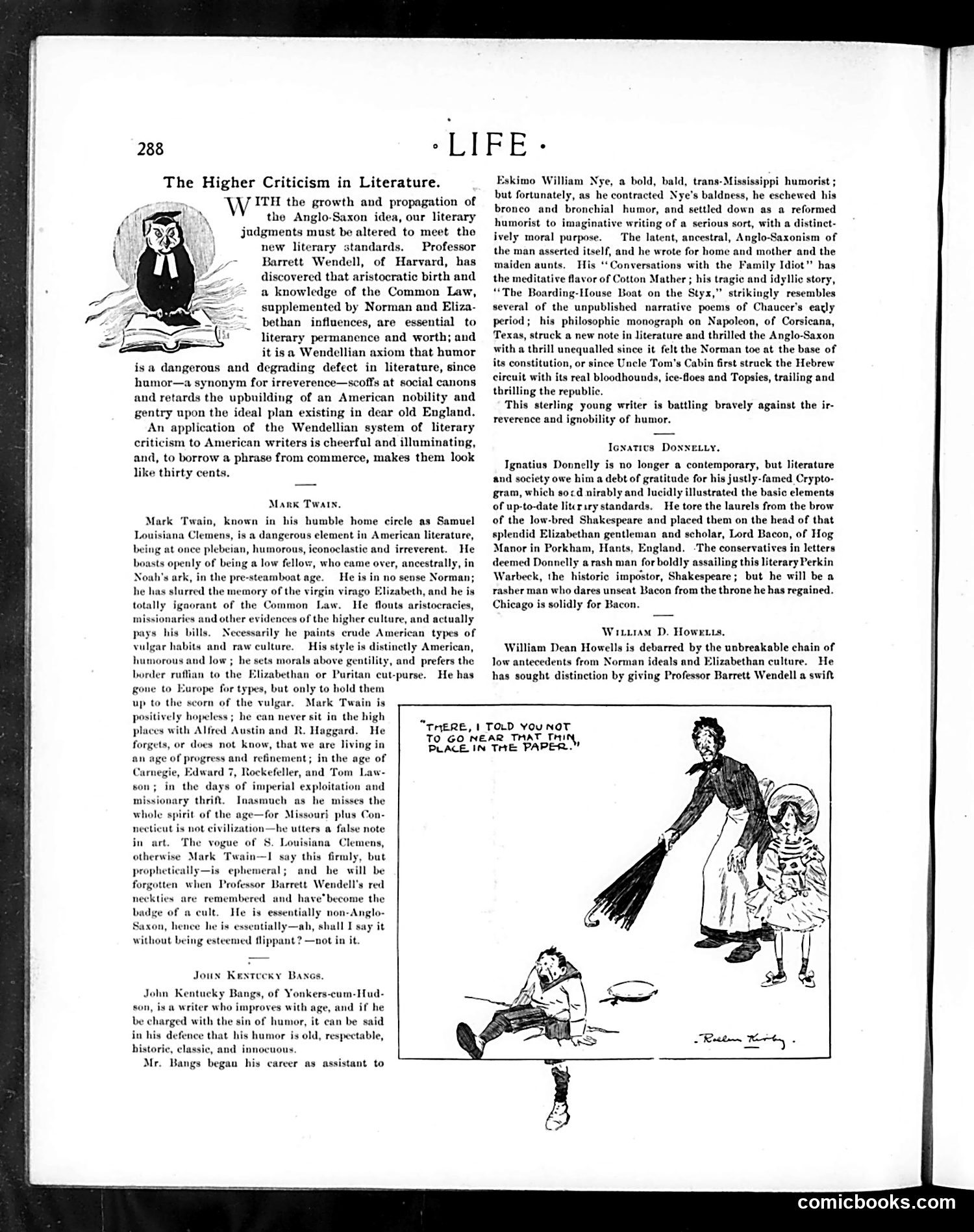
This page critiques American literary criticism and writers. The main article, "The Higher Criticism in Literature," argues that applying rigorous scholarly standards to American writers degrades their work and national pride. The cartoon illustrates this debate through domestic scenes. The dialogue bubble reads: "There! Go near that man, place in the papers," suggesting someone directing a child toward a man—likely satirizing how critics publicly attack or expose writers. The page discusses specific writers including Mark Twain, whom the text defends as distinctly American despite his "vulgar" style. The satire targets literary snobs who judge American writers by European standards, suggesting such criticism is unfair and damages national cultural reputation.
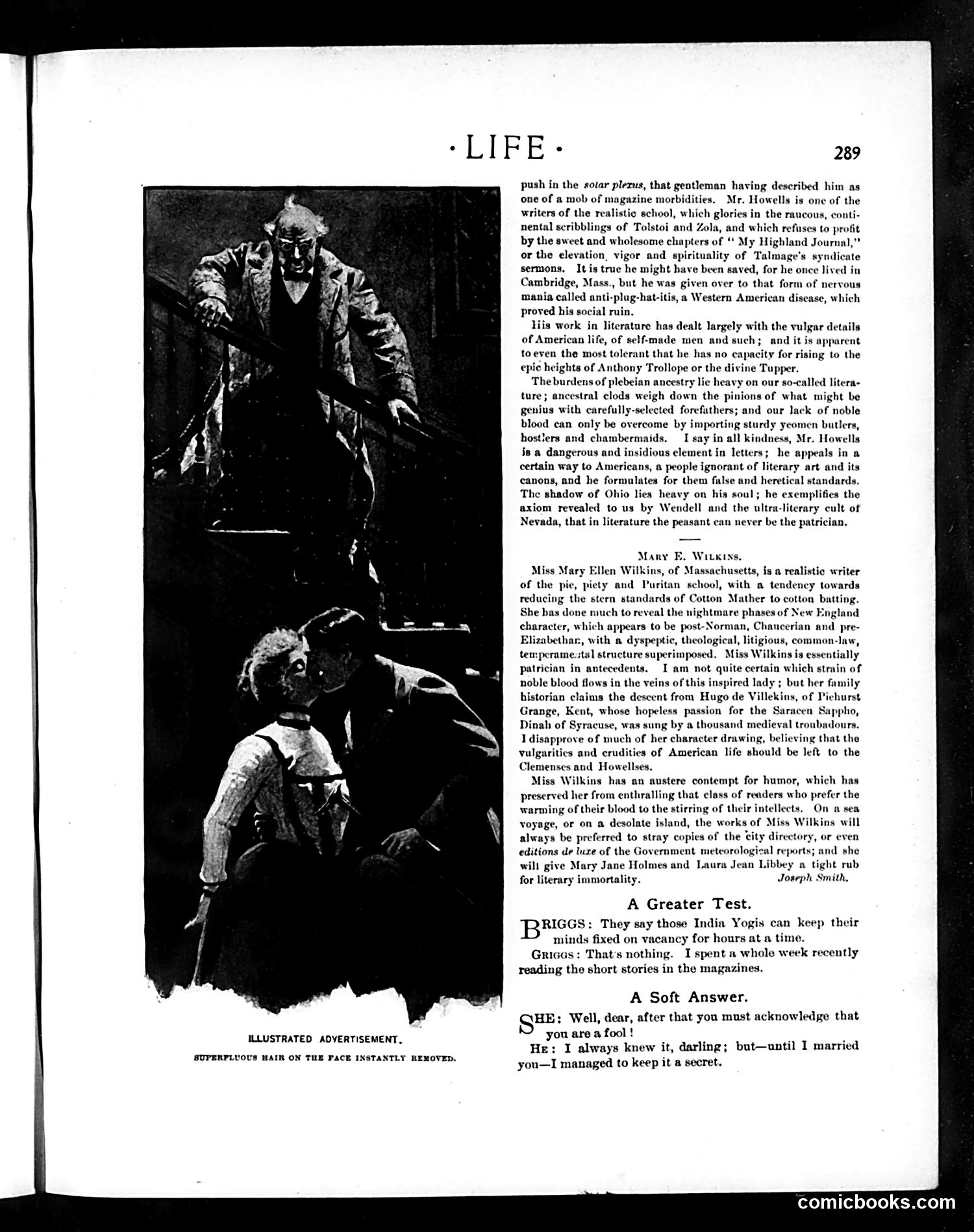
This page contains **literary criticism and humor**, not political cartooning. The left side features an illustrated advertisement captioned "SUPERFLUOUS HAIR ON THE FACE INSTANTLY REMOVED"—showing a dramatic before-and-after transformation, likely for a depilatory product. The text discusses writer **Mary E. Wilkins** (Miss Mary Ellen Wilkins of Massachusetts), praised as a realist writer in the Puritan school. The author critiques her character-drawing and argues her work should focus on American life's vulgarity rather than noble blood lineage. Below are two joke sections: "A Greater Test" contrasts Indian Yogis with magazine short-story reading, and "A Soft Answer" presents a domestic humor exchange about foolishness and marriage secrecy. This is **literary criticism and light humor**, not political satire.
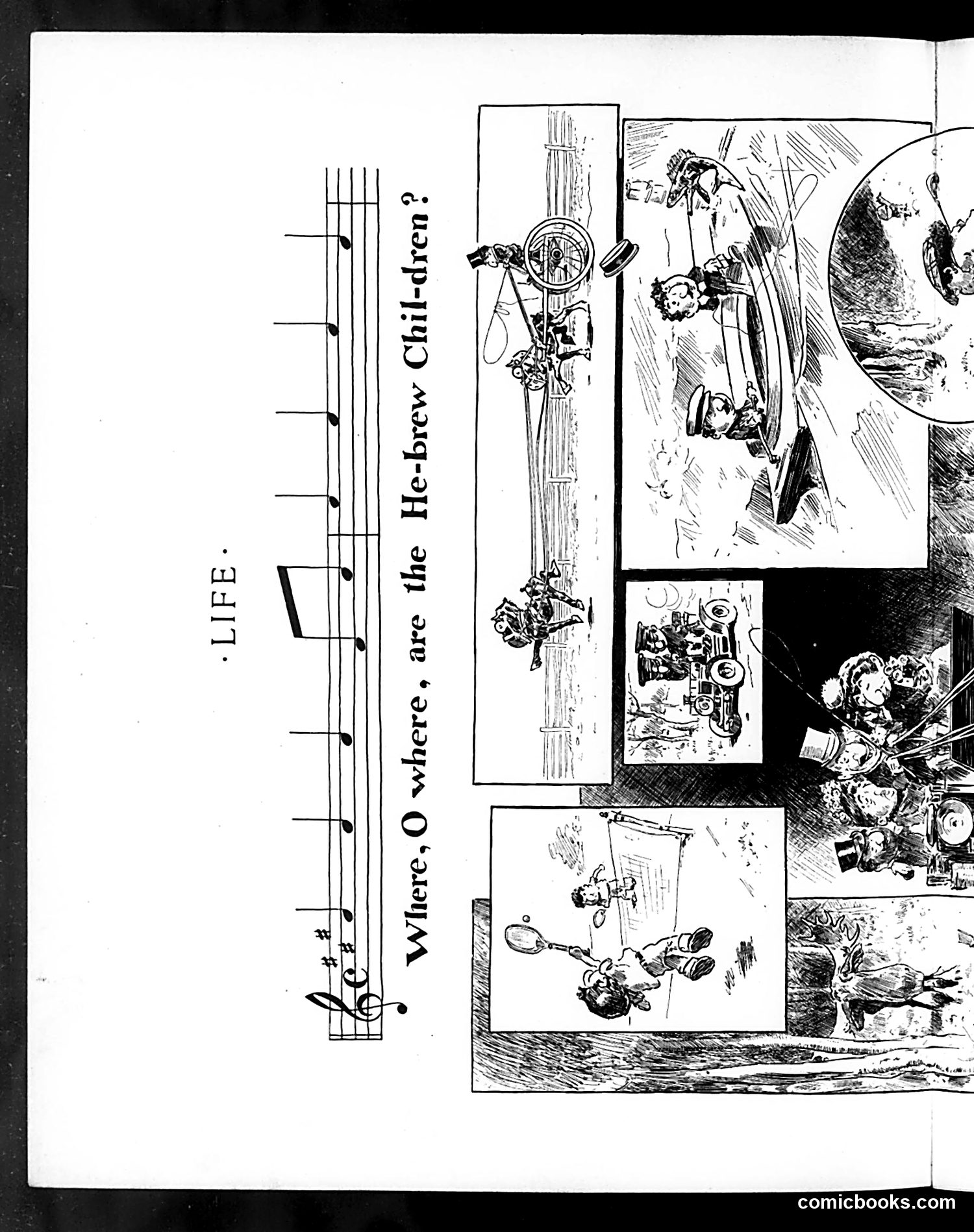
This page presents a satirical cartoon with the heading referencing a children's nursery rhyme ("Where, O where, has my little dog gone?"). The multiple panels appear to depict children engaged in various activities—riding bicycles, playing with toys, and appearing in domestic scenes. The title's substitution of "He-brew" for "little" suggests this is anti-Semitic satire targeting Jewish children or families, likely from the early-to-mid 20th century. The cartoon appears to mock or question where Jewish children spend their time, possibly implying stereotype-based criticism of Jewish cultural or religious practices. The crude visual style and layout are typical of Life magazine's satirical approach during this period, though the content reflects prejudices now recognized as offensive.
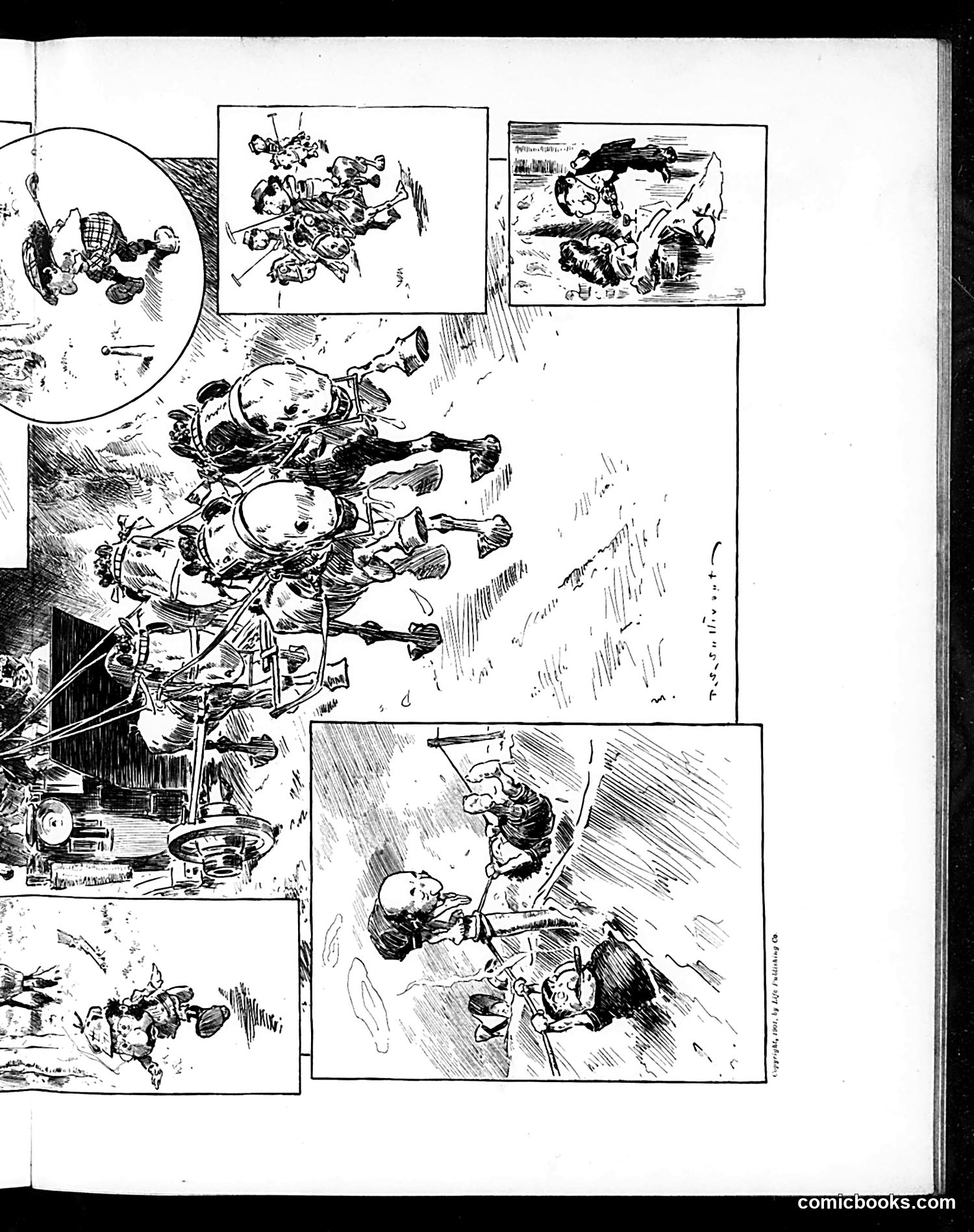
This appears to be a multi-panel satirical comic from *Life* magazine depicting chaos and mayhem. The central image shows rotund figures in formal dress (with round bellies prominently featured) engaged in violent slapstick action—tumbling, fighting, and causing destruction with various implements and objects scattered about. The smaller panels above and below show related scenes of pandemonium and physical comedy. The style and exaggerated caricature suggest this mocks political or social figures, likely contemporary to the publication. However, **without readable text labels or clear identifying features, I cannot definitively name the specific figures or pinpoint the exact political reference**. The satire appears to target pompous authority figures or politicians engaged in undignified chaos, using physical comedy to mock their behavior.
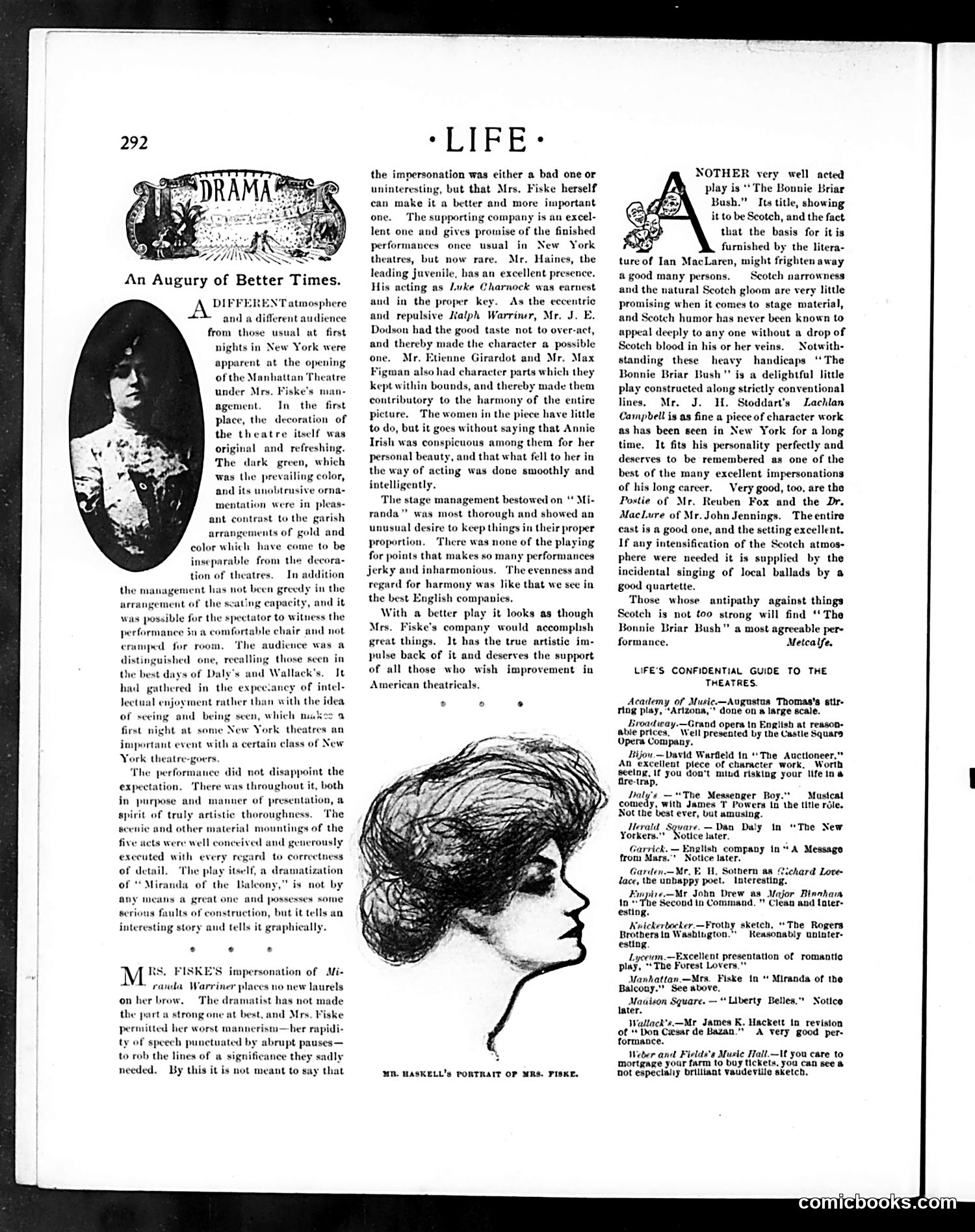
This is a theatre review page (numbered 292) from Life magazine's drama section. The main content critiques a production of "Miranda" at the Manhattan Theatre under Mrs. Fiske's management. The page features a portrait sketch (by W.R. Haskell) of Mrs. Fiske herself, a prominent stage actress of the era. The review praises the production's artistic merit, scenic design, and ensemble acting, though notes Mrs. Fiske's dramatic style as somewhat mannered. The right column contains "Life's Confidential Guide to the Theatres"—brief capsule reviews of other current Broadway productions, mixing praise and gentle mockery of various shows and performers. This represents Life magazine's early role as a cultural arbiter of American theatre and taste.
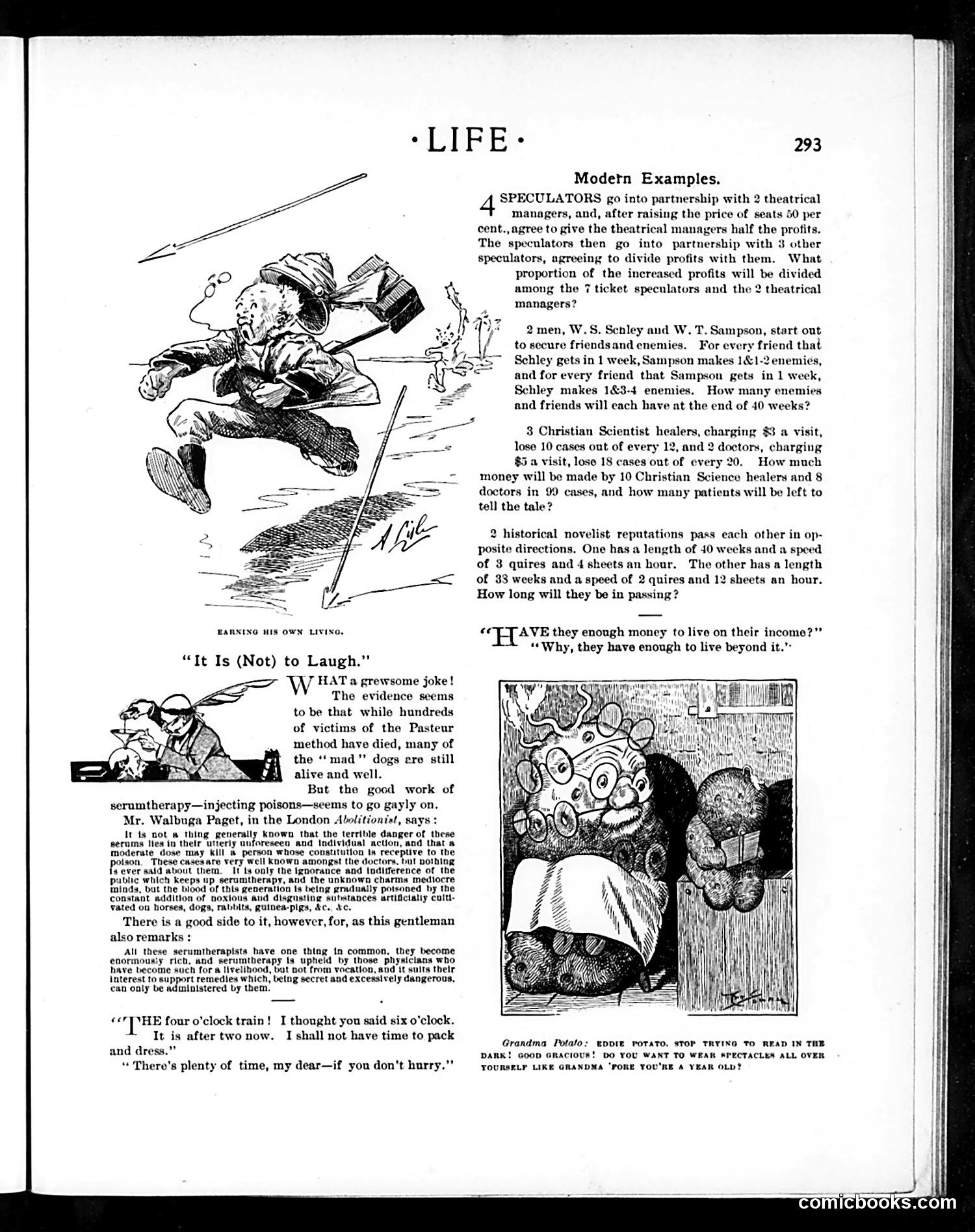
The main cartoon "Earning His Own Living" depicts a man frantically juggling work obligations—likely representing the struggle of ordinary people to survive economically. The accompanying text critiques the Pasteur rabies treatment method, citing a London Abolitionist article claiming that while rabies victims died from the serum, some "mad" dogs survived. The satire's edge: the treatment persists because doctors grow "enormously rich" administering it, prioritizing profit over patient safety and evidence. Below are math problems satirizing contemporary public figures and fads—including Schley and Sampson (likely Spanish-American War military figures) and Christian Scientists—through absurdist scenarios highlighting their perceived ridiculousness or hypocrisy. The bottom cartoon shows a domestic scene with "Grandma Potato" scolding a child about reading in dim light, suggesting old-fashioned parental anxiety about eyesight.
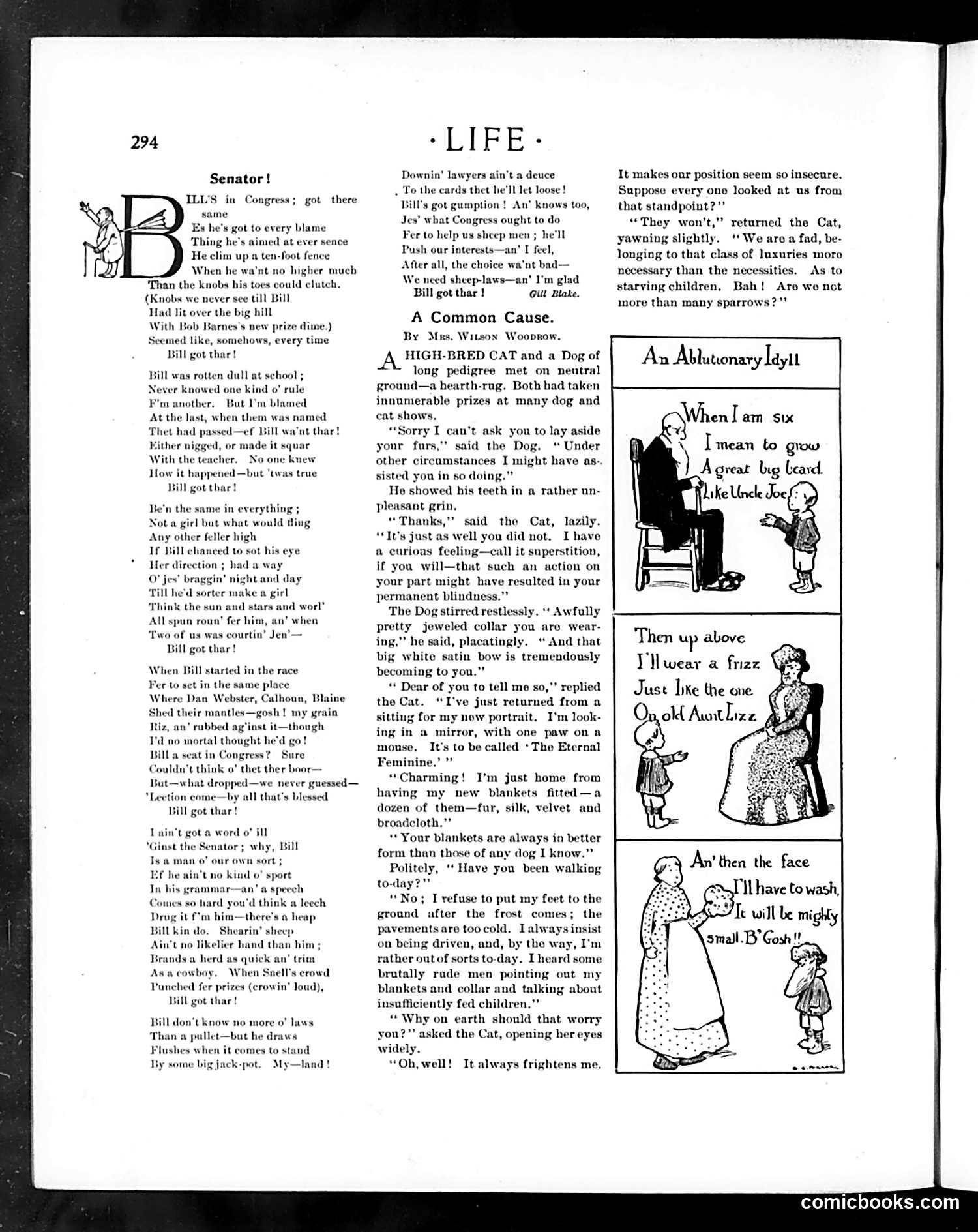
**"Senator!"** (left column): A rural dialect poem satirizing how an incompetent but ambitious man named Bill succeeds in politics despite his ignorance. The narrator, speaking in backwoods vernacular, catalogs Bill's failures—he's "rotten dull at school," knows no grammar or laws—yet somehow always "gets thar," including to Congress. The satire targets class anxieties: uneducated rural voters elevating an unqualified man to high office, possibly referencing late 19th-century American political corruption and the rise of populist politicians. **"A Common Cause"** (center/right): A dialogue between a pampered high-bred Cat and Dog. Both wear luxury items (jeweled collars, silk blankets) and discuss their privileged lives while the Dog expresses concern about "brutally rude men" criticizing them for inadequate care of "insufficiently fed children." The satire mocks wealthy elites who are anxious about working-class criticism of their extravagance, yet remain fundamentally indifferent to poverty. The "common cause" appears to be shared class interests between these natural rivals. **"An Abolitionary Idyll"** (right): A separate illustrated vignette about childhood ambitions.
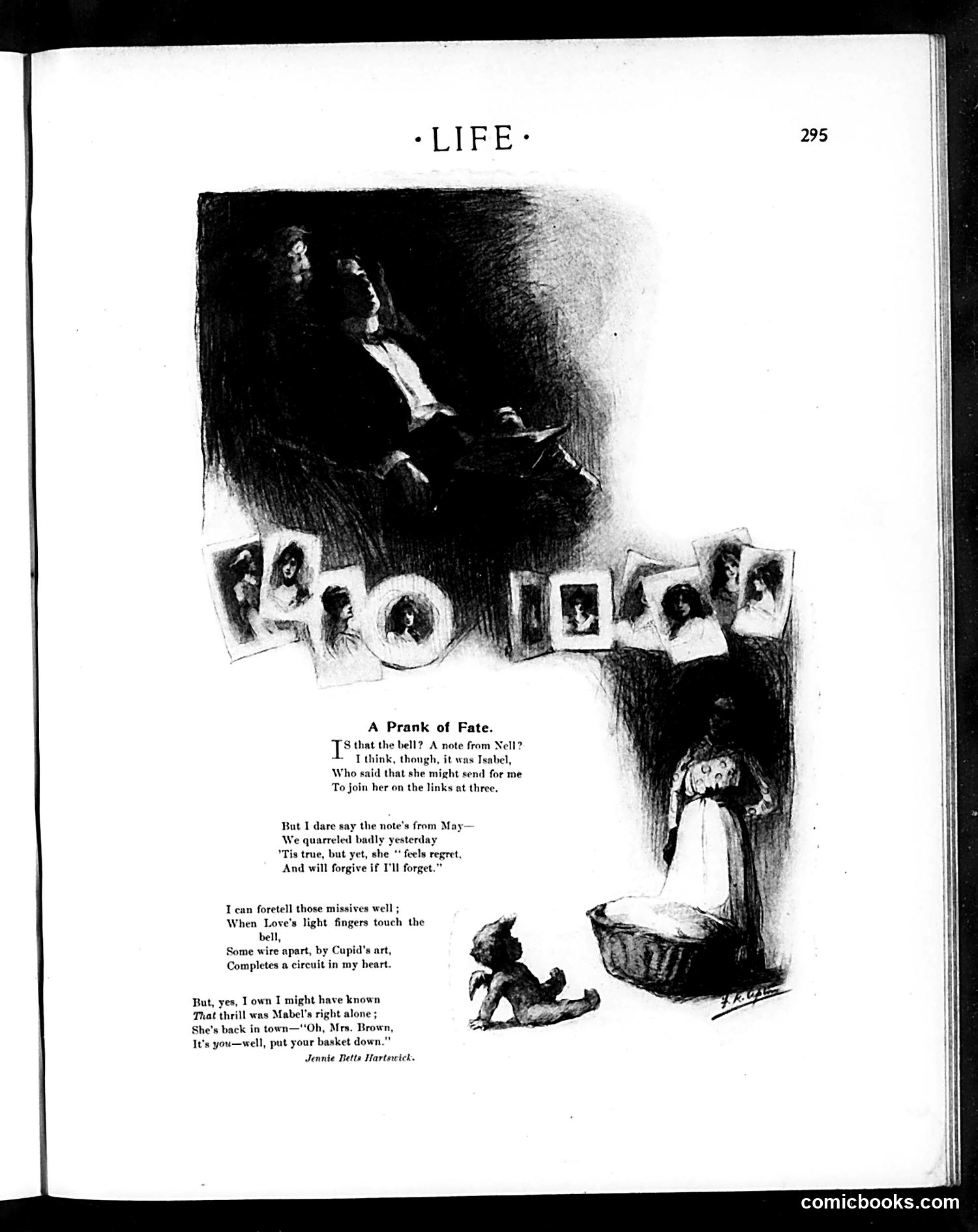
This is a humorous poem by Jennie Betts Hartwick accompanying sketch artwork about romantic confusion and miscommunication. The scenario depicts a man receiving a doorbell ring and obsessively speculating about which woman—Nell, Isabel, or May—has sent for him. His romantic anticipation builds as he imagines love's "light fingers" triggering his heart like an electrical circuit. The punchline reveals the actual visitor is neither a romantic interest nor the mysterious women he fantasized about, but rather his housekeeper Mrs. Brown delivering groceries, telling him to put down her basket. The satire mocks male vanity and romantic delusion—the contrast between his elaborate, self-centered fantasy and mundane reality. The electrical/circuit metaphor playfully captures turn-of-the-century fascination with new technology, here applied to matters of the heart.
This page is primarily **advertising and announcements**, not political satire. The main content consists of three humorous short stories typical of Life's satirical humor magazine format: 1. **"Laura, Is Your Heart Free?"** — A comedic story mocking sentimental Victorian romance. A lovestruck young man attempts to confess his feelings but keeps getting distracted by influenza and a handwritten note, ultimately fleeing in embarrassment. The satire targets overwrought romantic declarations. 2. **Lewice Turieux anecdote** — A practical joke story where a theater prankster orchestrates fake weeping during a play, creating a chain reaction by passing around a handkerchief, undermining the actor's dramatic performance. 3. **The little girl's witticism** — A brief humorous anecdote comparing a child's innocent remark to essayist Leigh Hunt's clever wordplay about hot weather. The page also contains **period advertisements** (Wilson Whiskey, Esterbrook Steel Pens) and an announcement about Life's upcoming Christmas issue. No identifiable political figures or events are referenced.
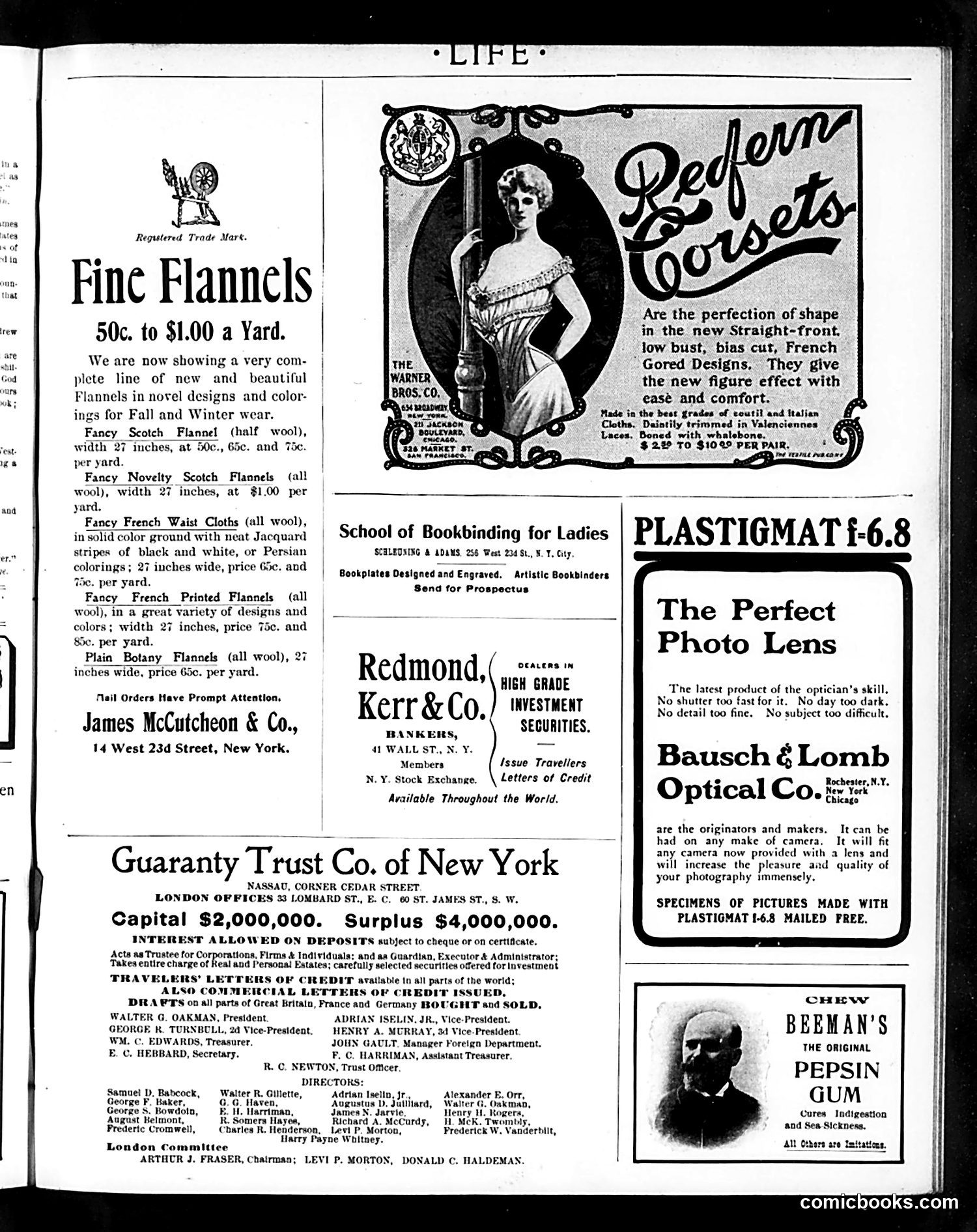
This is primarily a **advertising page** from Life magazine, not a political cartoon. The page contains commercial advertisements for various products and services typical of the early 20th century. The main advertised items include: - **Fine Flannels** by James McCutcheon & Co. (fabric retailer) - **Redform Corsets** (the only illustrated ad, showing a woman in a corset) - **Financial services** (Guaranty Trust Co., Redmond Kerr & Co. bankers) - **Photography equipment** (Bausch & Lomb optical lens) - **Beeman's Pepsin Gum** (digestive aid) - **Bookbinding school** for women The Redform Corsets ad emphasizes the fashionable "straight-front, low bust" silhouette popular at the time, marketed as providing "shape" and "comfort." There is **no political satire or cartoon content** on this page—it is straightforward commercial advertising reflecting consumer goods and services of the period.
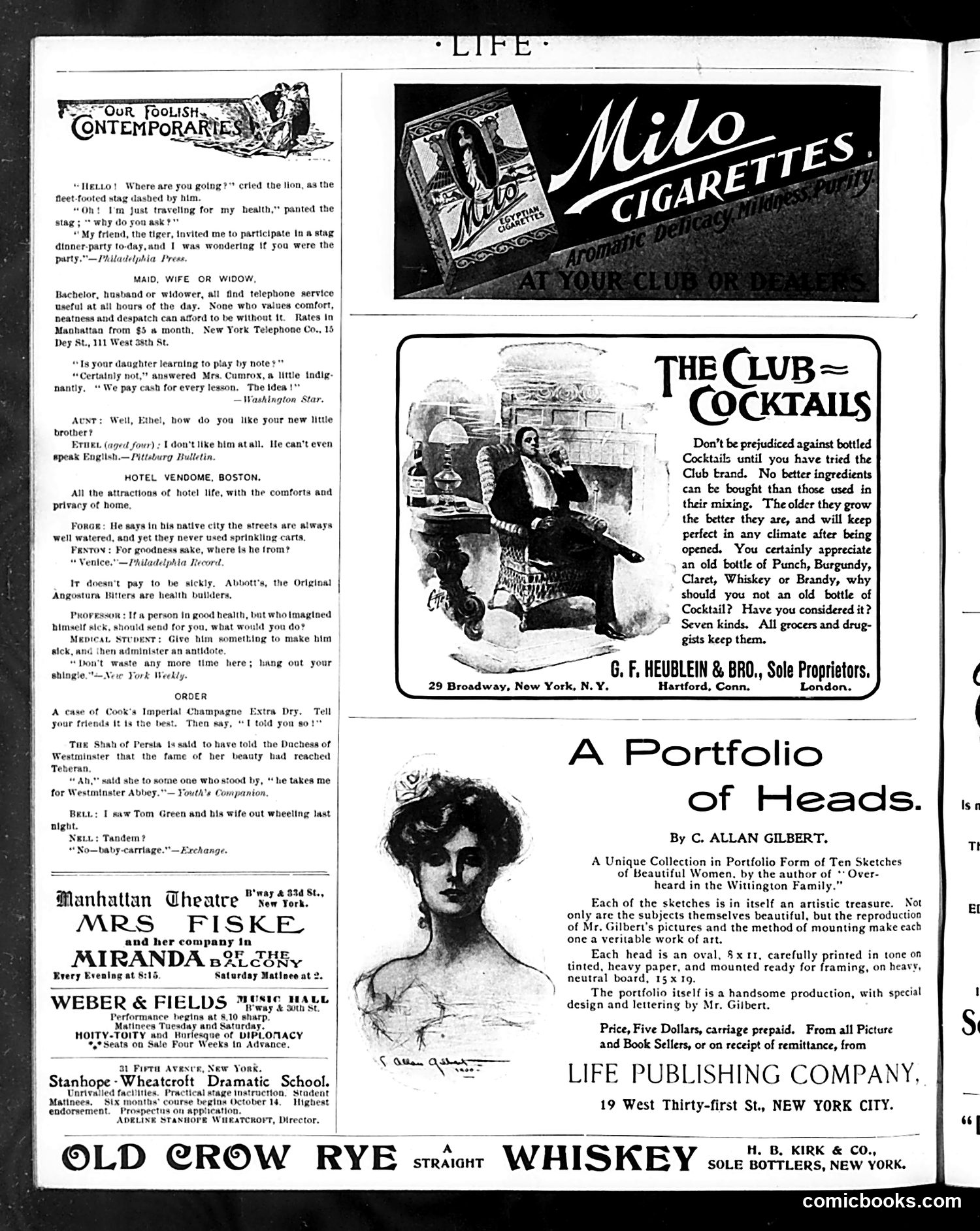
This is primarily an **advertising and humor page** from Life magazine, not a political cartoon. The content consists of short jokes and advertisements typical of early 1900s American magazines. **The "Foolish Contemporaries" section** (top left) contains brief satirical anecdotes mocking human behavior. The stag/tiger joke plays on miscommunication about dinner invitations—humor based on wordplay rather than political commentary. The remaining items are **advertisements and social humor**: telephone service ads, hotel promotions, brief jokes about daughters learning music, babies speaking English, and Persian royalty. These reflect period anxieties and class consciousness. **Notable advertisements** include Milo Cigarettes, Club Cocktails (pre-Prohibition), Old Crow Whiskey, and theater notices featuring Mrs. Fiske. The page's **main feature** is a promotion for C. Allan Gilbert's "Portfolio of Heads"—artistic portraits of women. The humor and advertisements reflect upper-middle-class urban life and consumer culture of the early 20th century, with no significant political satire.
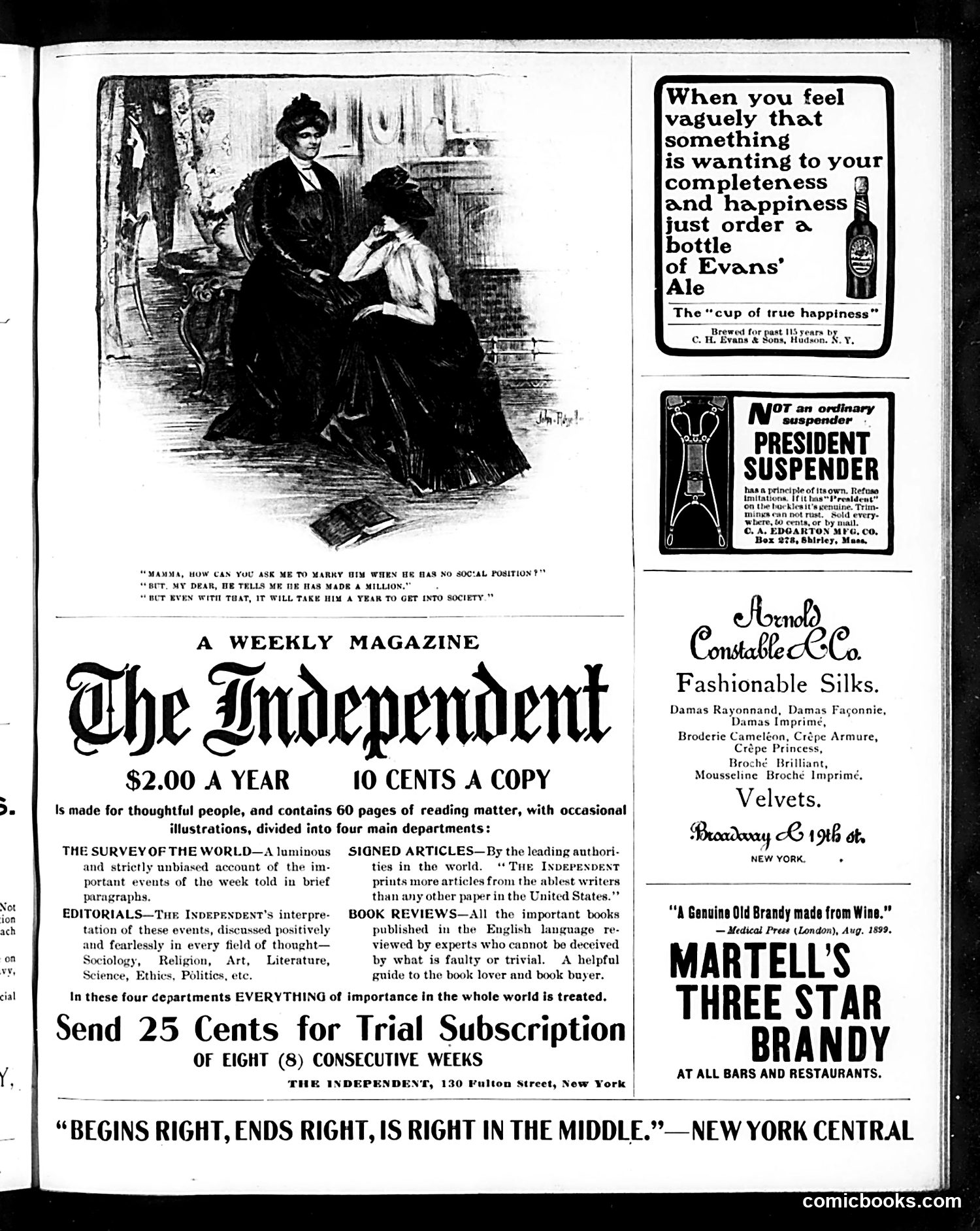
The main cartoon satirizes wealthy nouveau riche society in early 1900s America. A mother and daughter discuss a marriage proposal from a man who "made a million" dollars. The mother rejects him despite his wealth, saying it will take "a year to get into society"—mocking the old-money establishment's snobbish gatekeeping of high society. The joke targets class pretension: mere wealth cannot instantly buy social status; aristocratic acceptance requires time and pedigree. It reflects tensions between industrial-era self-made millionaires and inherited-wealth elites who guarded exclusive social circles. The page itself is primarily advertising for *The Independent* magazine (subscription offer) alongside period product ads (ale, brandy, fashionable silks), typical of early 20th-century publication layouts.
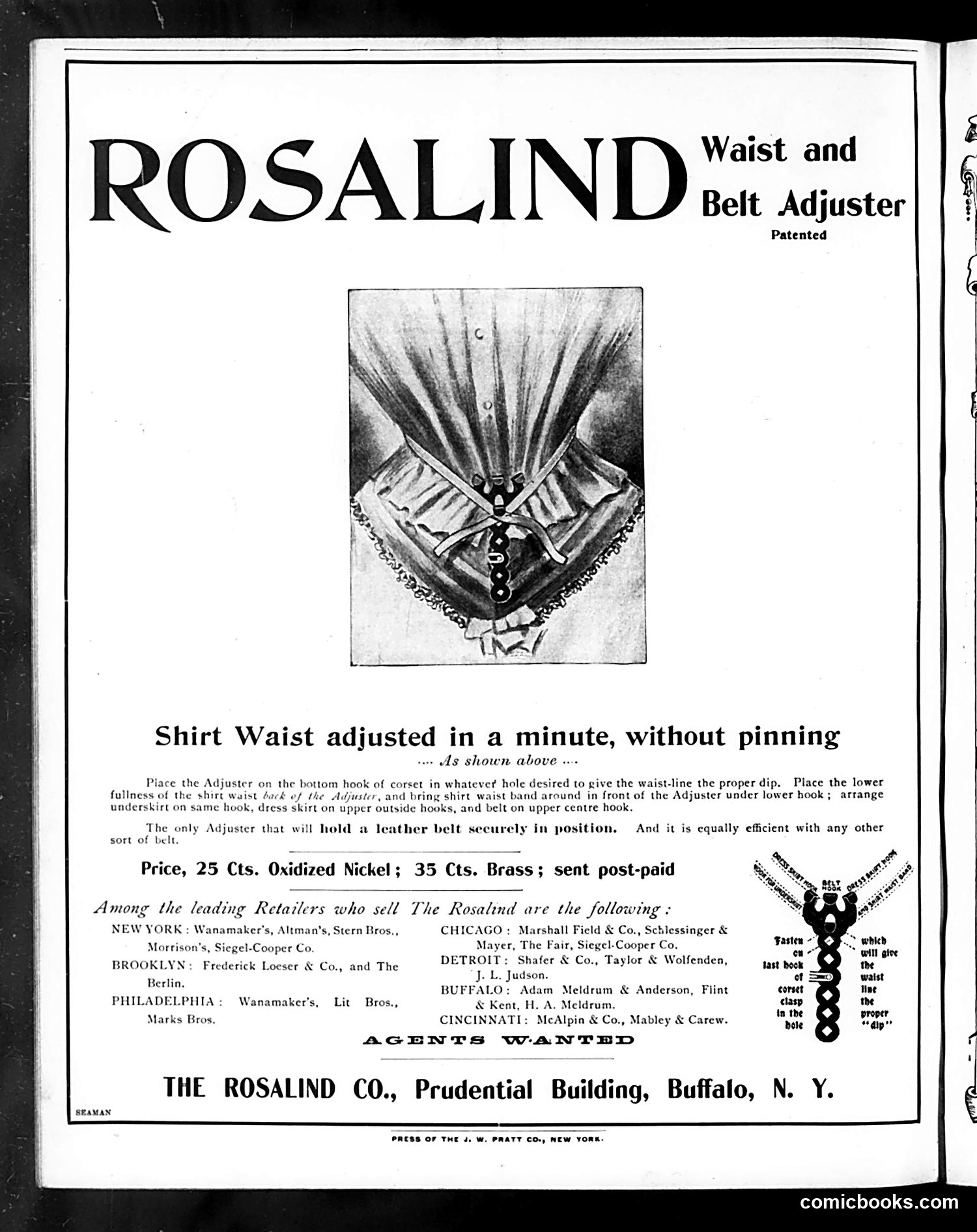
This is a **product advertisement**, not a cartoon or satire. It promotes a patented device designed to adjust women's corset waistlines and hold belts in place without pinning—a practical solution for the tight-laced fashion of the early 1900s. The central image shows the mechanical adjuster attached to a corset, with straps or fabric extending upward. The text emphasizes convenience: "adjusted in a minute, without pinning," addressing a genuine frustration of women's fashion at the time. The advertisement lists major department stores (Wanamaker's, Marshall Field & Co., etc.) as retailers and seeks agents. Pricing is modest (25-35 cents). The page reflects the era's fashion constraints—elaborate undergarments requiring specialized hardware to function properly—rather than any satirical critique. This is straightforward commercial messaging targeting women who wore corsets.