
Life, 1901-10-10 · page 8 of 20
Life — October 10, 1901 — page 8: what you’re looking at
What you’re looking at
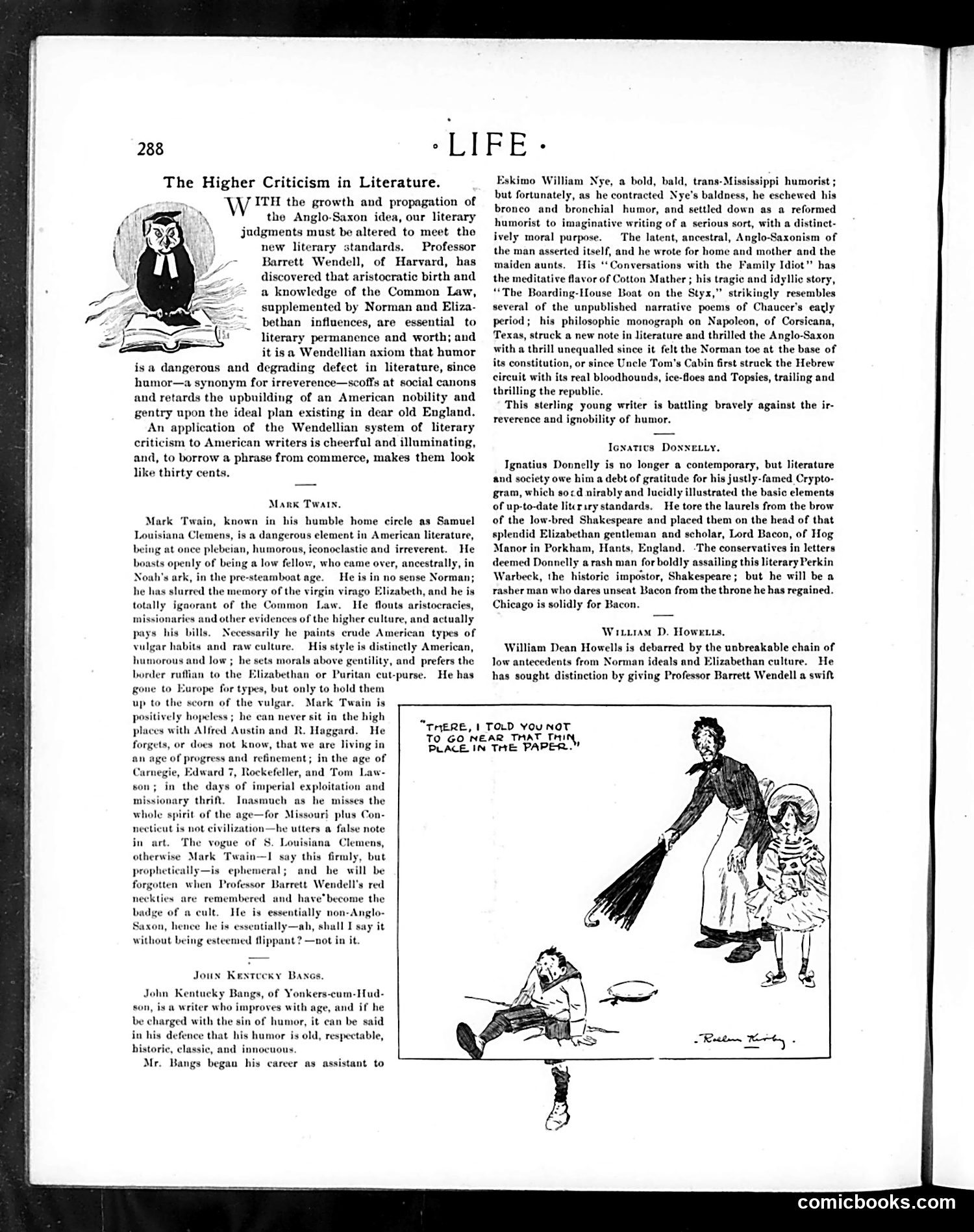
This page critiques American literary criticism and writers. The main article, "The Higher Criticism in Literature," argues that applying rigorous scholarly standards to American writers degrades their work and national pride. The cartoon illustrates this debate through domestic scenes. The dialogue bubble reads: "There! Go near that man, place in the papers," suggesting someone directing a child toward a man—likely satirizing how critics publicly attack or expose writers. The page discusses specific writers including Mark Twain, whom the text defends as distinctly American despite his "vulgar" style. The satire targets literary snobs who judge American writers by European standards, suggesting such criticism is unfair and damages national cultural reputation.
📄 Transcribed text from this page (OCR, searchable)
Machine-transcribed from the original scan — historical spelling and the odd misread are preserved.
288 The Higher Criticism in Literature. W ITH the growth and propagation of LEN the Anglo-Saxon idea, our literary judgments must be altered to meet tho new literary standards. Professor Barrett Wendell, of Harvard, has discovered that aristocratic birth and a knowledge of the Common Law, supplemented by Norman and Eliza- bethan influences, are essential to literary permanence and worth; and it isa Wendellian axiom that humor isa dangerous and degrading defect in literature, since humor—a synonym for irreverence—scoffs at social canons and retards the upbuilding of an American nobility and gentry upon the ideal plan existing in dear old England. An application of the Wendellian system of literary criticism to American writers is cheerful and illuminating, and, to borrow a phrase from commerce, makes them look like thirty cents. Mark Twain, ‘k Twain, known in his humble home circle as Samuel jana Clemens, is a dangerous element in American literature, being at once plebeian, humorous, iconoclastic and irreverent. He boasts openly of being a low fellow, who came over, ancesteally, in Noah's ark, in the pre-steamboat age. He is in no sense Norman; he has slurred the memory of the virgin virago Elizabeth, and he is totally igaorant of the Common Law. He flouts aristocracies, and other evidences of the higher culture, and actually r Ils. Necessarily he paints crude American types of vulgar habits and raw culture. His style is distinctly American, humorous and low ; he sets morals above gentility, and prefers the border ruffian to the Elizabethan or Puritan cut-purse. He has gone to Europe for types, but only to hold them -LIFE- Eskimo William Nye, a bold, bald, trans-Mississippi humorist ; but fortunately, as he contracted Nye’s baldness, he eschewed his bronco and bronchial humor, and settled down as a reformed humorist to imaginative writing of a serious sort, with a distinct- ively moral purpose. The latent, ancestral, Anglo-Saxonism of the man asserted itself, and he wrote for home and mother and the maiden aunts. His ‘‘Conversations with the Family Idiot’ has the meditative flavor of Cotton Mather ; his tragic and idyllic story, “The Boarding-House Boat on the Styx,” strikingly resembles several of the unpublished narrative poems of Chaucer's early period; his philosophic monograph on Napoleon, of Corsicana, Texas, struck a new note in literature and thrilled the Anglo-Saxon with a thrill unequalled since it felt the Norman toe at the base of its constitution, or since Uncle Tom's Cabin first struck the Hebrew circuit with its real bloodhounds, ice-floes and Topsies, trailing and thrilling the republic. This sterling young writer is battling bravely against the ir- reverence and ignobility of humor. Ioxativs Doxnxetuy. Ignatius Donnelly is no longer a contemporary, but literature and society owe him a debt of gratitude for his justly-famed Crypto- gram, which socd nirably and lucidly illustrated the basic elements of up-to-date litcriry standards. He tore the laurels from the brow of the low-bred Shakespeare and placed them on the head of that splendid Elizabethan gentleman and scholar, Lord Bacon, of Hog Manor in Porkham, Hants, England. -The conservatives in letters deemed Donnelly arash man for boldly assailing this literary Perkin Warbeck, the historic impostor, Shakespeare; but he will be a rasher man who dares unseat Bacon from the throne he has regained. Chicago is solidly for Bacon. Wintiam D. Howes, William Dean Howells is debarred by the unbreakable chain of low antecedents from Norman ideals and Elizabethan culture. He has sought distinction by giving Professor Barrett Wendell a swift up to the scorn of the vulgar. Mark Twain is positively hopeless ; he can never sit in the high es with Alfred Austin and R. Haggard. He forgets, or does not know, that we are livit an age of progress and refinement; in the age of Carnegie, Edward 7, Rockefeller, and Tom Law- son; in the days of imperial exploit and missionary thrift. Inasmuch as he misses the whole spirit of the age—for Missouri plus Con- necticut is not civ tion—he utters a false note in art. The vogue of 8. Louisiana Clemens, otherwise Mark Twain—I say this firmly, but prophetically—is ephemeral; and he will be forgotten when Professor Barrett Wendell’s red neckties are remembered and have"become the badge of a cult. He is essentially non-Anglo- , hence he is essentially—ah, shall I say it without being esteemed flippant ? —not in it. Joux Kextecky Banos. John Kentucky Bangs, of Yonkers-cum-Hud- son, is a writer who improves with age, and if he be charged with the sin of humor, it can be said in his defence that his humor is old, respectable, historic, classic, and innocuous “THERE, | TOLD YouNOoT TO GO NEAR THAT TH PLACE IN THE PAPER Mr. Bangs began his career as assistant to comicbooks.com