
A complete issue · 20 pages · 1901
Life — September 19, 1901
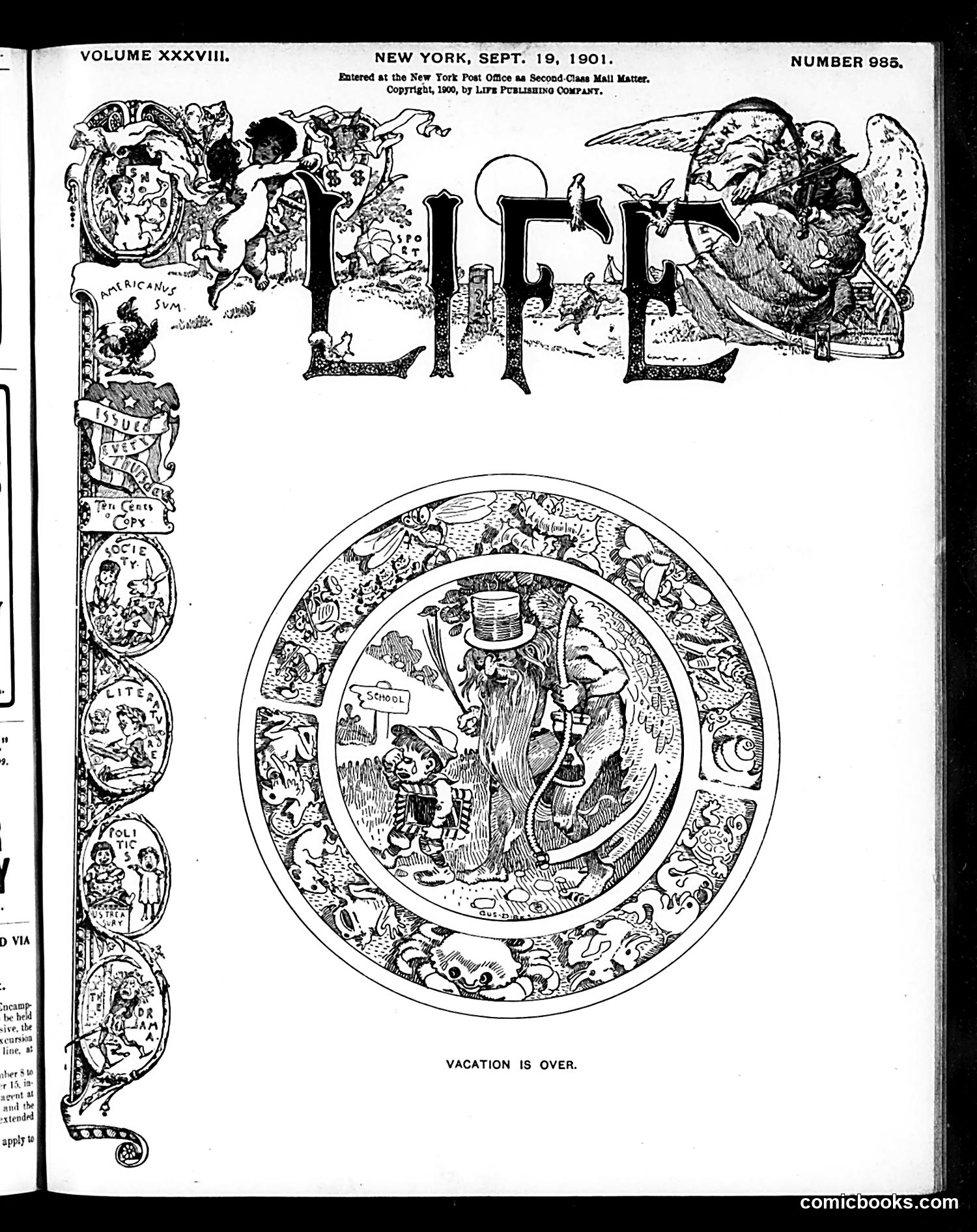
This page features the title "LIFE" with decorative illustrations and a circular vignette captioned "VACATION IS OVER." The circular illustration depicts what appears to be a bearded man (possibly representing a figure of authority or a well-known public personality) surrounded by cherubs and decorative elements in a classical style. The image suggests leisure and relaxation. The caption "VACATION IS OVER" indicates the cartoon comments on the end of summer break—likely referencing the return to work, school, or regular routines after Labor Day. The ornamental left border contains smaller vignettes with various scenes and figures, typical of Life magazine's decorative style. Without clearer context identifying specific individuals or events, the satire appears to address the bittersweet transition from vacation to resumed responsibilities in early September 1901.
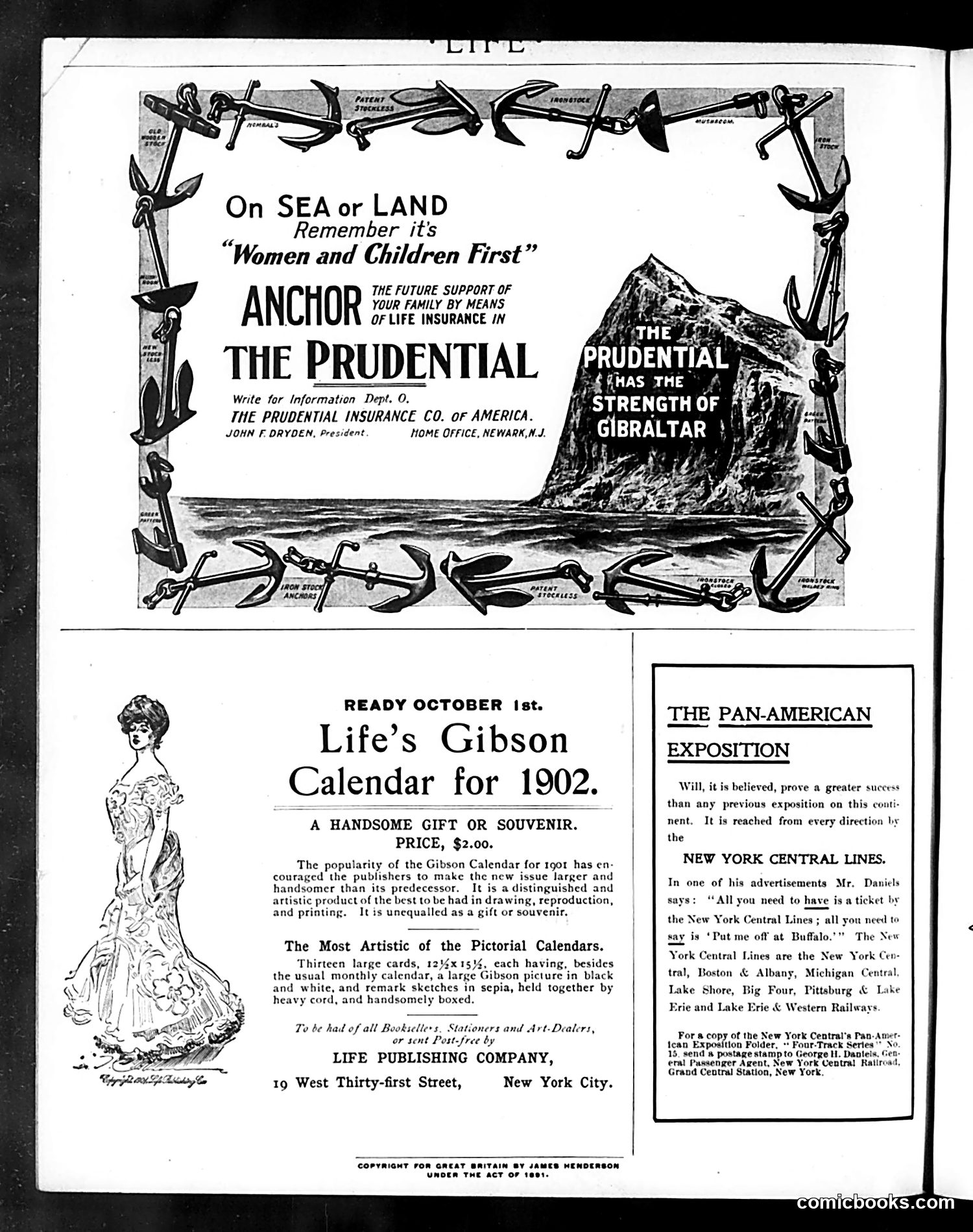
This page is primarily **advertising**, not satire or political commentary. The main advertisement promotes **Prudential Insurance** with the slogan "Women and Children First"—referencing maritime safety protocols. The image of Gibraltar symbolizes strength and stability, reassuring customers that Prudential will protect families' financial futures through life insurance. Below are two separate ads: one for **Life's Gibson Calendar for 1902** (featuring an elegant woman in period dress—likely referencing Charles Dana Gibson's "Gibson Girl" illustrations), marketed as a luxury gift; and another for the **Pan-American Exposition**, promoting the New York Central Lines railway as transportation to this major 1901-1902 world's fair. The page reflects early 1900s consumer culture and advertising strategies.
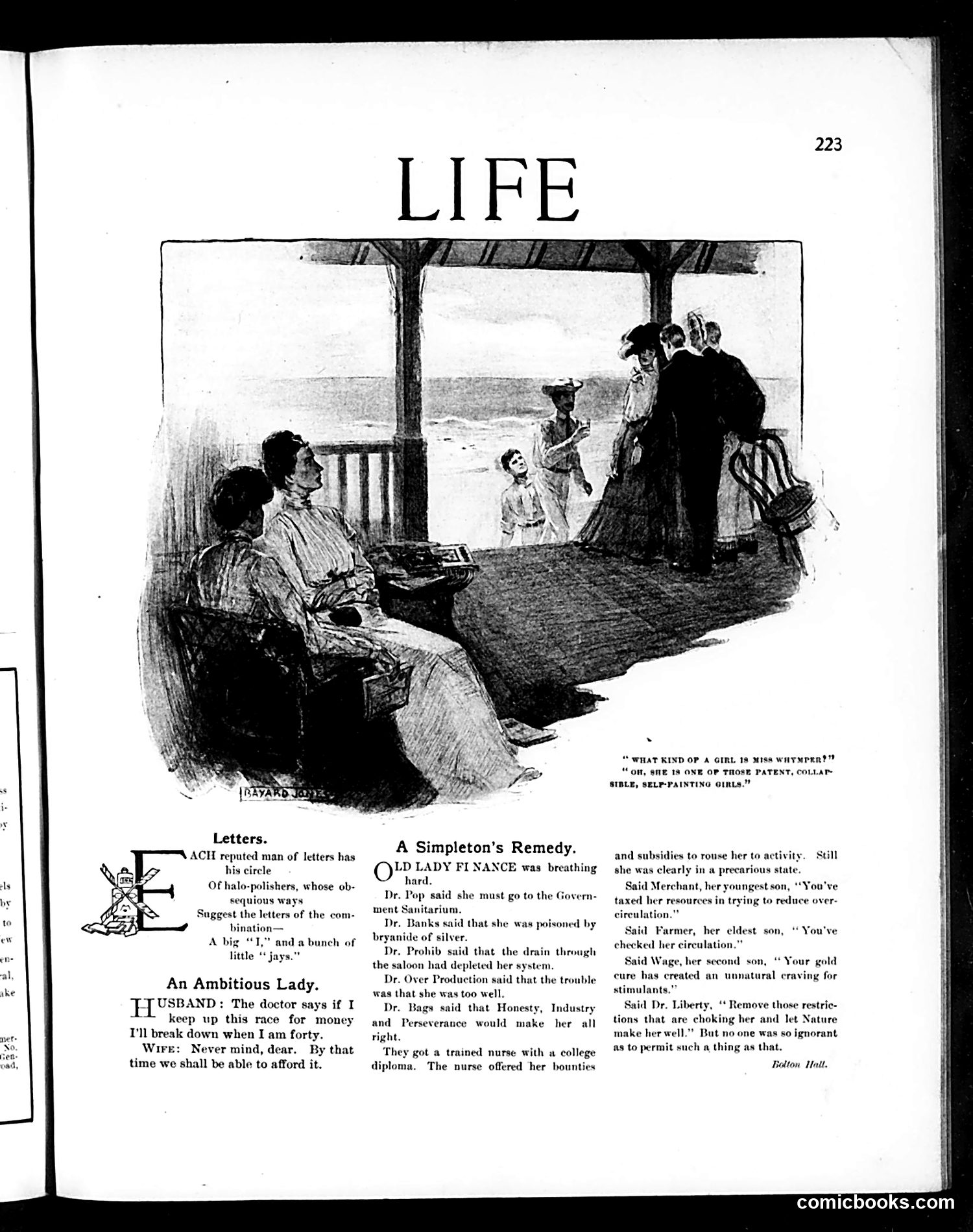
The main cartoon depicts a domestic scene on a porch overlooking water. A woman sits reading while children and other figures play nearby. The caption quotes dialogue about what makes a girl "miss whimsey" — suggesting criticism of overly proper, "self-painting girls." Below are three brief humor sections: **"Letters"** mocks readers' correspondence about social issues. **"An Ambitious Lady"** presents a domestic dispute where a husband refuses expensive spending, promising to "break down" financially by age forty. **"A Simpleton's Remedy"** satirizes medical advice for an ailing wealthy lady, with various doctors offering absurd diagnoses (poisoning by brymaide of silver, drain problems, overproduction). The joke mocks both incompetent physicians and hypochondriac patients of the era. The overall tone critiques social pretension and gender roles among the affluent.
This page contains satirical commentary on Mr. Lawson, apparently a wealthy businessman involved in yachting circles and newspaper ownership/advertising ventures. The text mocks his failed attempt to win the America's Cup yacht race and criticizes his substantial newspaper advertising spending (described as "a tremendous amount of advertising, which has cost Mr. Lawson comparatively little"). The small illustrations appear to be generic decorative vignettes rather than specific political cartoons. The main satire ridicules Lawson as someone who throws money at problems—yachting competitions and advertising—believing wealth alone ensures success. The editorial tone suggests readers would recognize Lawson as a notorious figure of the period, though his specific identity requires external historical verification.
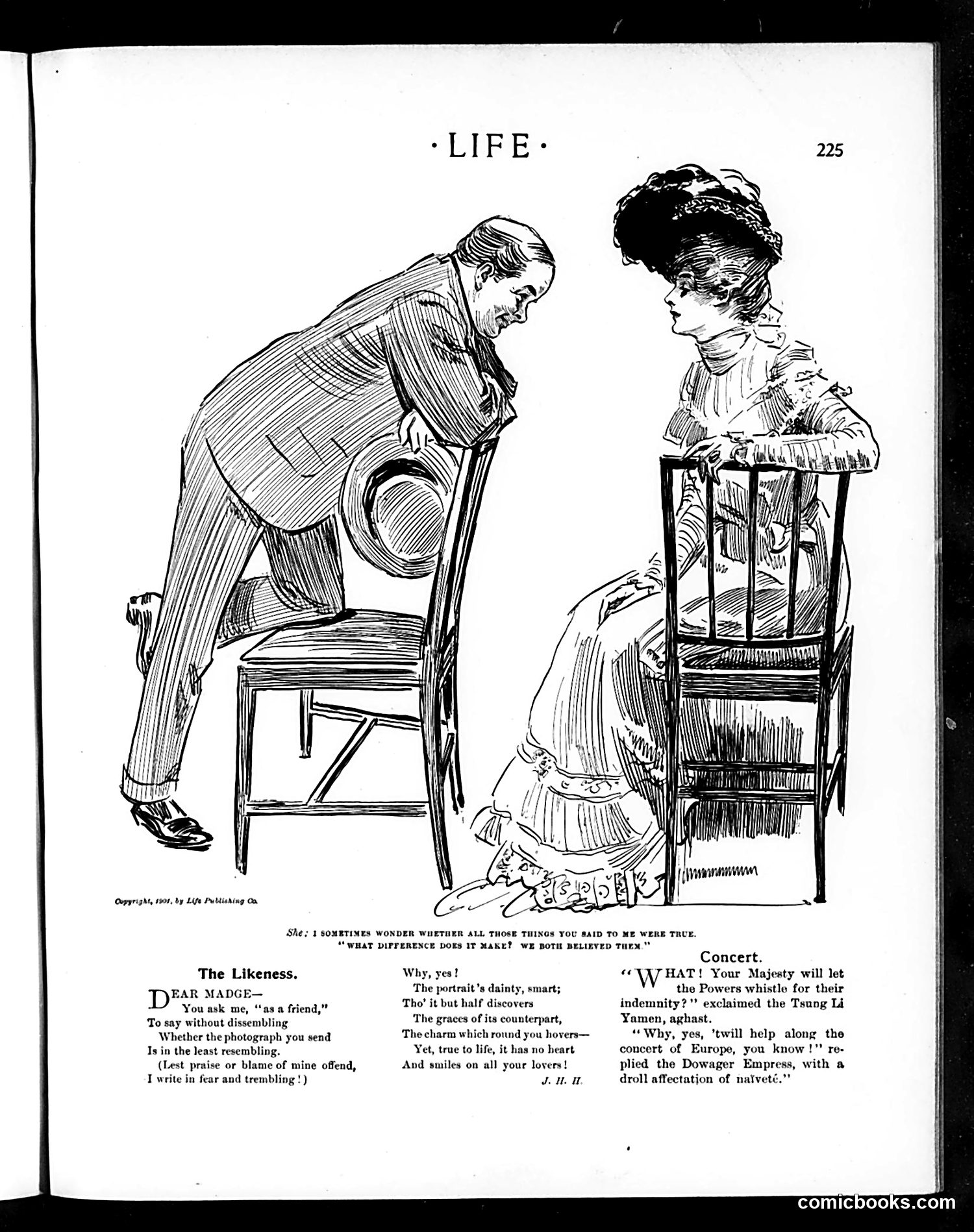
This page contains two satirical pieces from early 20th-century Life magazine: **"The Likeness"** mocks someone (addressed as "Dear Madge") for sending an unflattering photograph. The poem suggests the portrait is so poor it doesn't capture the subject's actual charm and grace—implying the photograph reveals unflattering truths the subject wishes hidden. **"Concert"** depicts a man leaning over to speak with a seated woman. The dialogue references a concert of Europe and mentions the "Dowager Empress" and "Tsaung La Yamen," suggesting diplomatic or political matters involving imperial Russia or Asia. The man's deferential posture and "affected malveté" suggest he's either flattering her or discussing serious international affairs with calculated charm. Both pieces satirize social pretense and artifice.
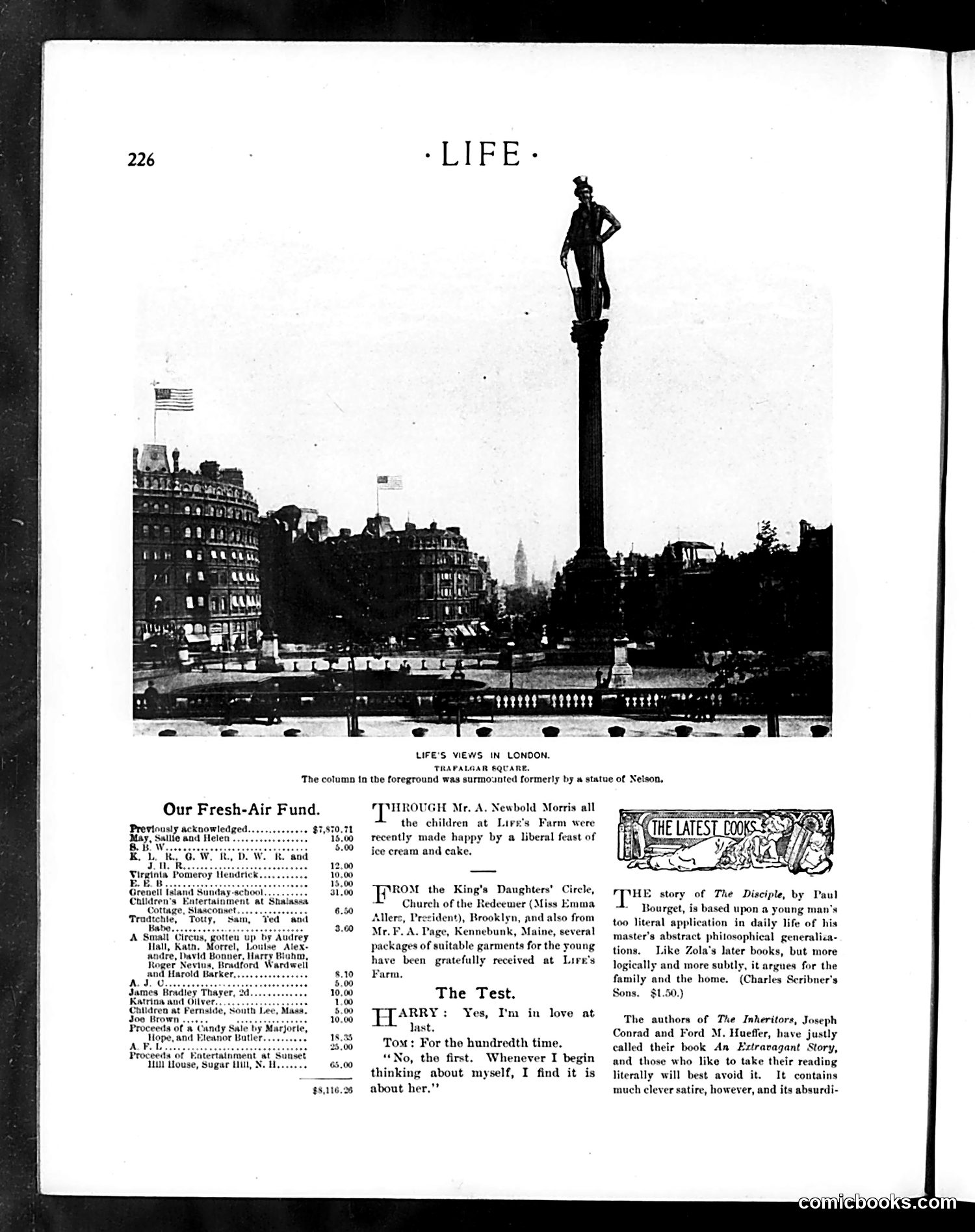
This page features **Trafalgar Square, London** - specifically Nelson's Column, the iconic monument topped with a statue of Admiral Nelson. The image shows the famous London landmark with period buildings and an American flag visible. The page is primarily devoted to **"Our Fresh-Air Fund,"** a charitable fundraising section listing donors and amounts contributed to send children to Life's Farm for recreation and meals. Below is a dialogue titled **"The Test,"** featuring characters Harry and Tom discussing romantic feelings, apparently a humorous short piece about love and self-reflection. The right column advertises books, including *The Disciple* by Paul Bourget and *The Interlopers* by Joseph Conrad. This appears to be a **standard magazine issue mixing charitable fundraising, light humor, and book advertisements** rather than political satire.
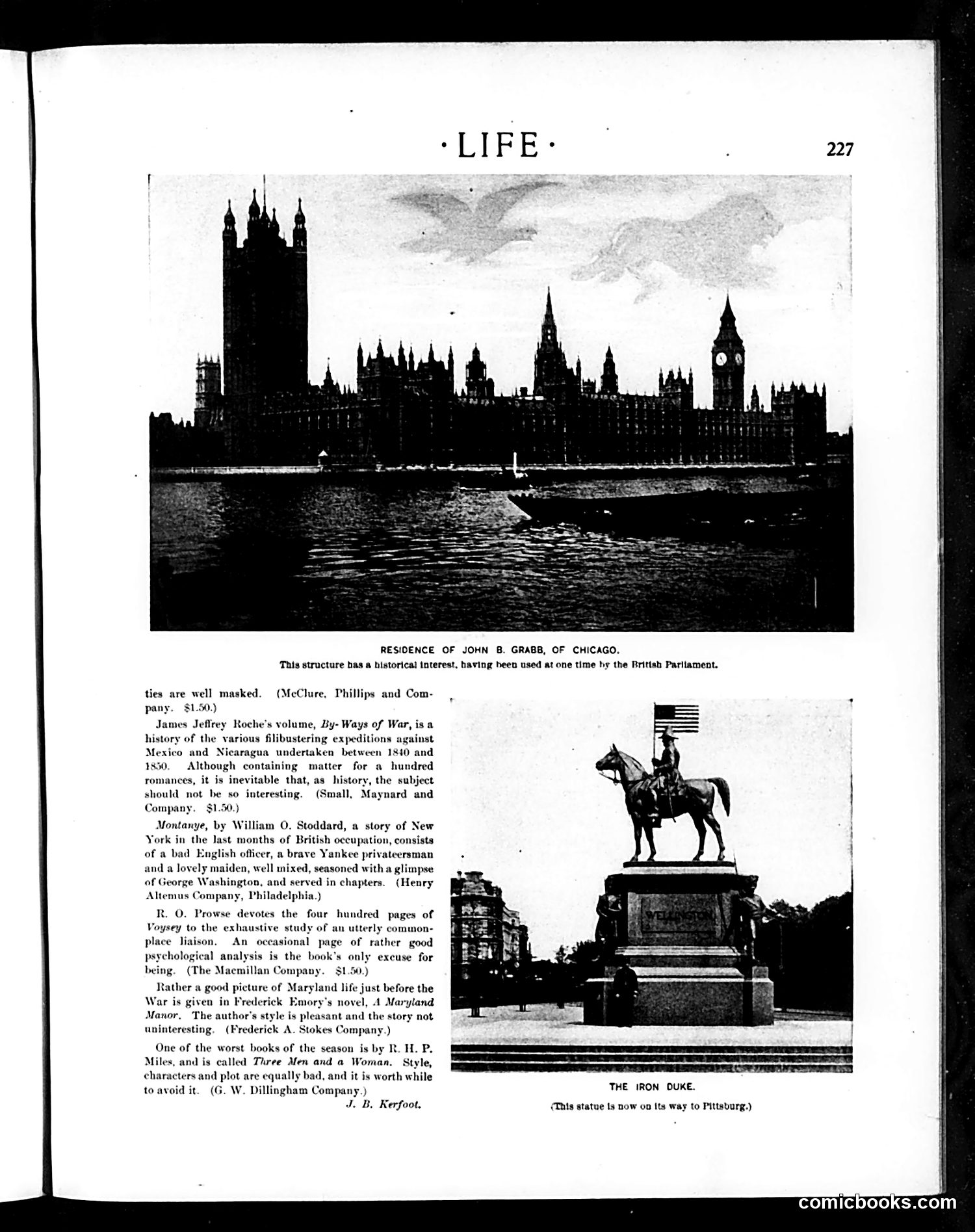
This page features a photograph of **The Iron Duke statue** with a caption noting it "is now on its way to Pittsburgh." The statue depicts an equestrian figure with an American flag, representing a military leader (likely from the American Civil War era, given the uniform and flag style). The image shows the monument on what appears to be a transport platform or cart. The context suggests this is documenting the relocation of a notable historical statue. Without the magazine's date visible, the specific political significance of moving this statue is unclear, though such relocations often reflected changing public sentiment about historical figures or were practical matters of urban development and monument placement. The page's primary content is book reviews, with the statue serving as a secondary illustration.
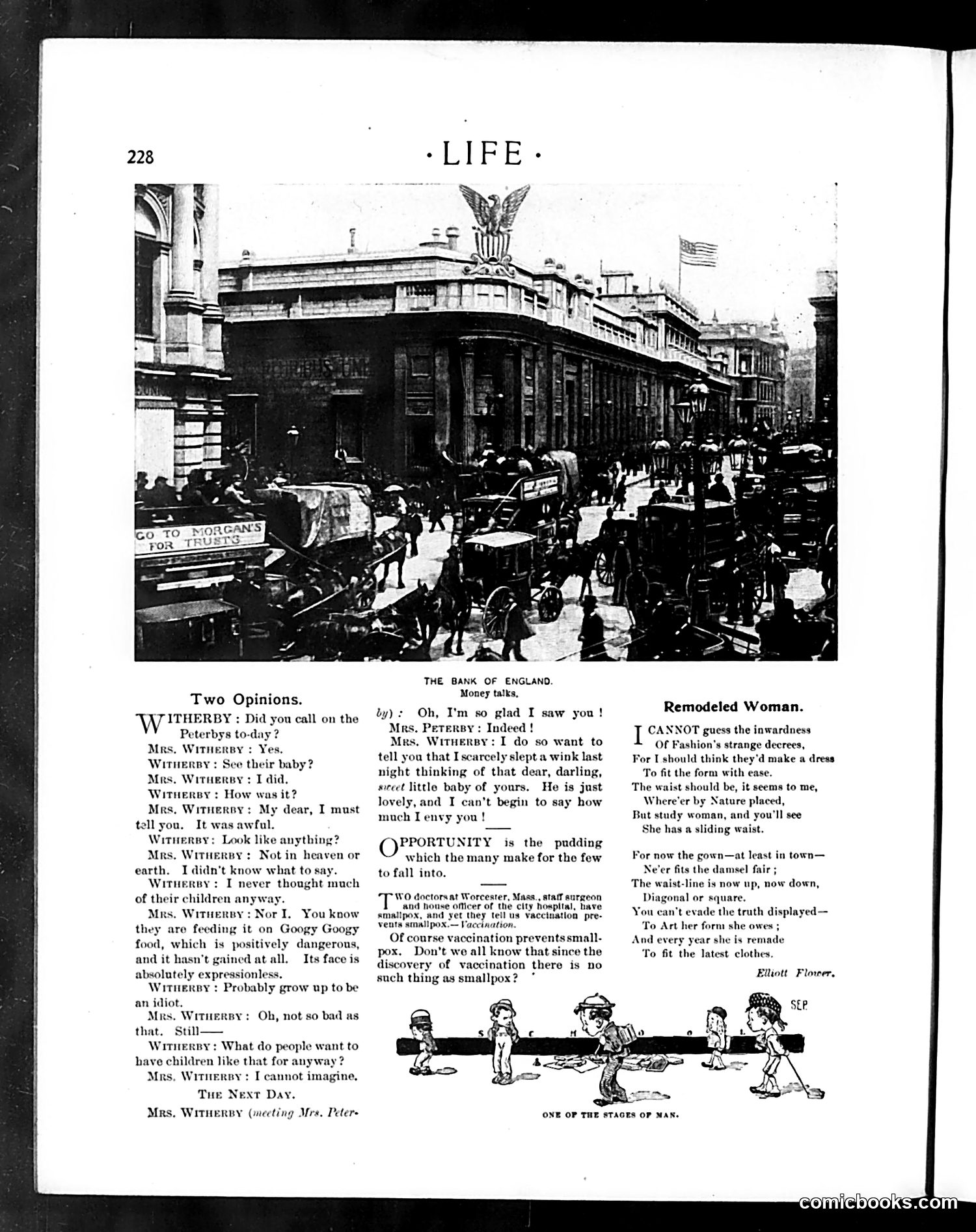
**Main Image:** A photograph of the Bank of England building with horse-drawn carts and pedestrians in front—labeled "Money talks." **Left Column - "Two Opinions":** A satirical dialogue between Mrs. Withberry and Witherby about their baby. Witherby brags the child is thriving on "Gooey Googy Food," though it's malnourished. Mrs. Withberry sarcastically counters that it will "grow up to be an idiot." The joke mocks parents who delude themselves about their children's welfare despite obvious neglect. **Right Column - "Remodeled Woman":** A poem by Elliott Flower criticizing women's changing fashion (lowered waistlines, altered silhouettes). It's satirical commentary on how fashion reformers/"sturdy women" claim to improve women's forms through dress, when they've actually just rearranged the same body underneath. **Bottom:** Small cartoon titled "One of the Stages of Man"—shows children playing, likely depicting childhood.
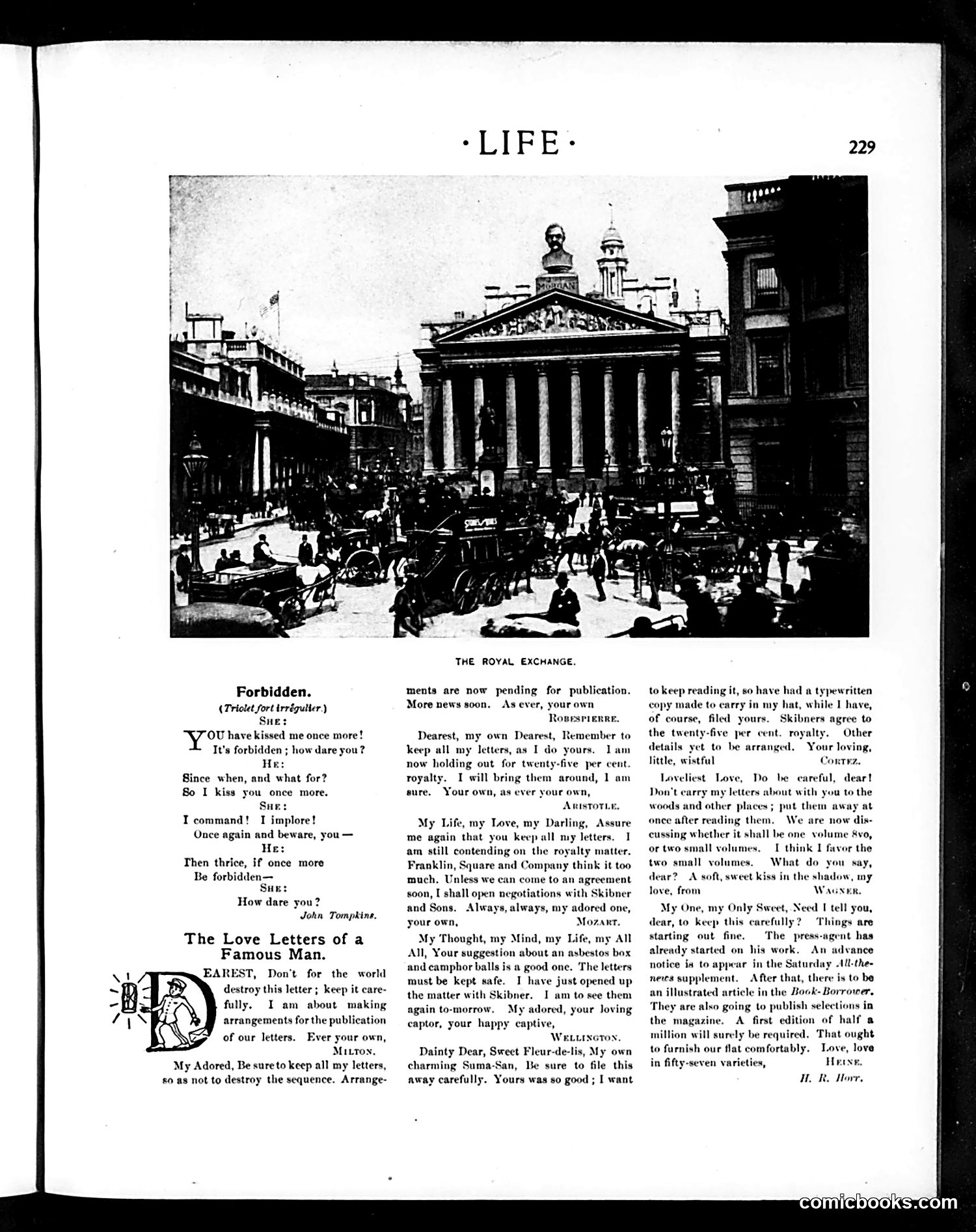
This page features a photograph of the Royal Exchange in London (a famous financial building) at the top, followed by two literary pieces: a short dialogue titled "Forbidden" and a longer section called "The Love Letters of a Famous Man." The content appears to be satirical correspondence rather than political cartoon. The texts mock romantic correspondence and formal letter-writing conventions of the era through exaggerated dialogue and purported "love letters." The ornate initial letter "D" and period typography suggest this is from an early 20th-century publication. Without identifying specific historical figures named in the OCR text, the piece satirizes pretentious literary and romantic expression common to the period. The juxtaposition with the Royal Exchange photograph suggests commentary on London society and culture.
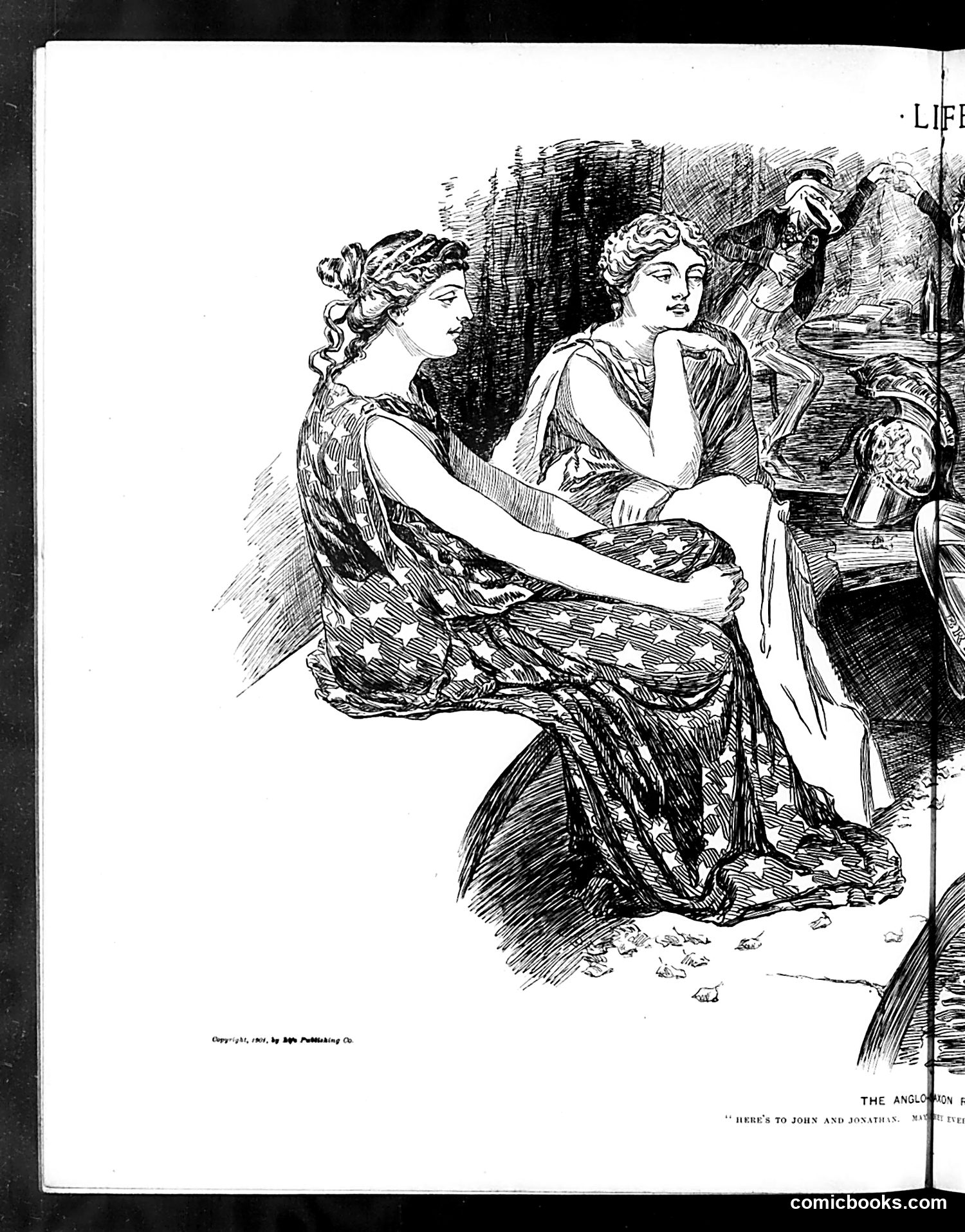
This page from Life magazine (copyright 1907, per the footer) contains an illustration titled "Here's to John and Jonathan," visible at the bottom right. The sketch depicts two elegantly dressed women in Edwardian-era clothing, seated together in an intimate pose. The reference to "John and Jonathan" likely alludes to the biblical story of David and Jonathan's deep friendship, here applied sarcastically to a pair of women. This appears to be satirizing female companionship or homosocial bonds between women in early 1900s society—a subject Life frequently treated with knowing humor. The elaborate clothing and refined setting suggest upper-class women, while the suggestive positioning and witty caption imply the magazine is making a pointed joke about the nature of their relationship.
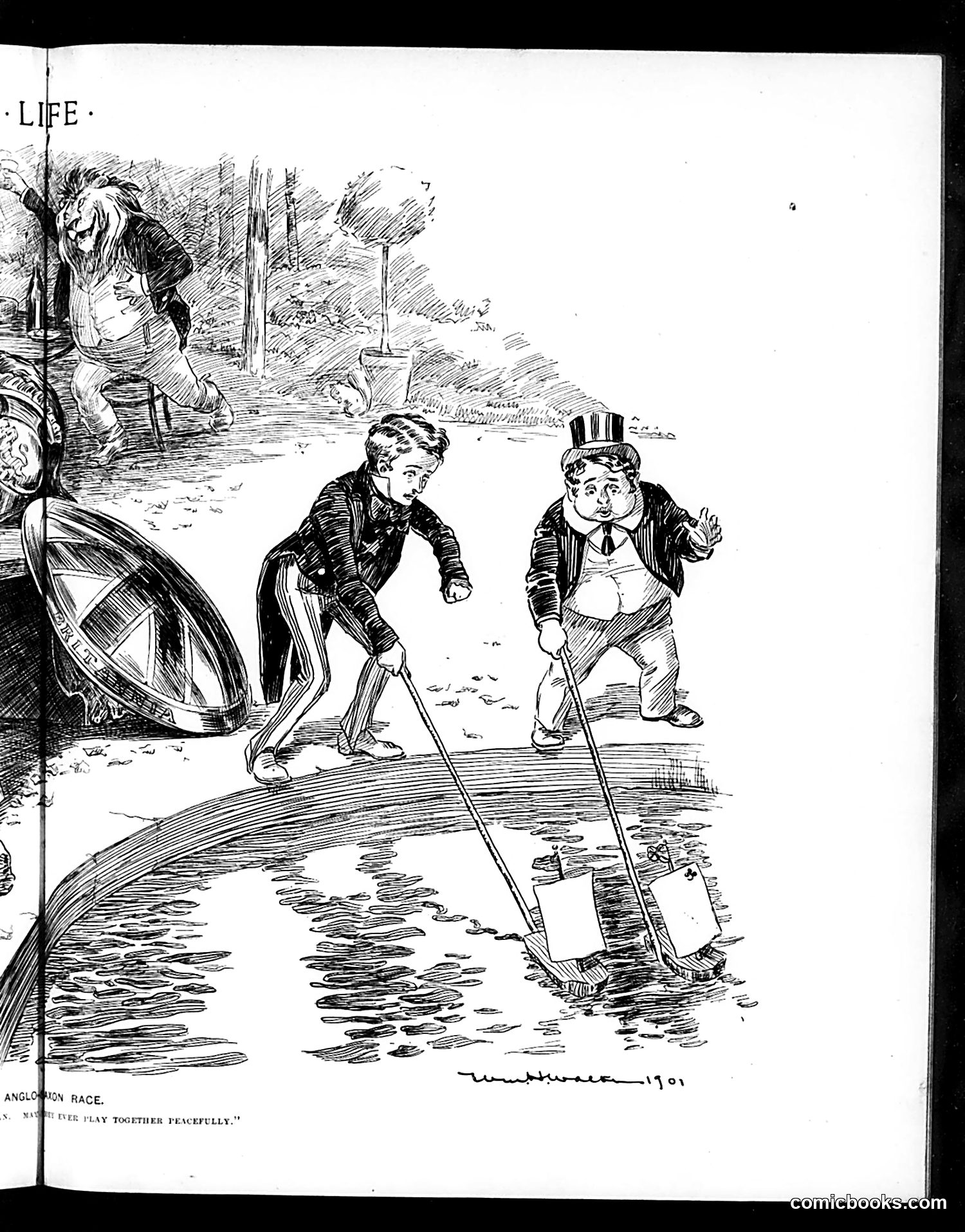
This is a political cartoon titled "Anglo-Saxon Race" with the caption "Brothers play together peacefully." It depicts two men with exaggerated facial features ice-skating or moving across water with poles, watched by a figure in the background. The satire appears to target Anglo-Saxon racial claims and international relations, likely British-American cooperation. The caption's ironic reference to "brothers" playing "peacefully" suggests the cartoon mocks the notion of harmonious Anglo-Saxon unity, possibly critiquing imperialist rhetoric or geopolitical tensions between Britain and America presented as fraternal alliance. The crude caricatures and dated 1901 signature reflect Life magazine's satirical style of that era. Without additional context about specific 1901 events, the exact political reference remains unclear.
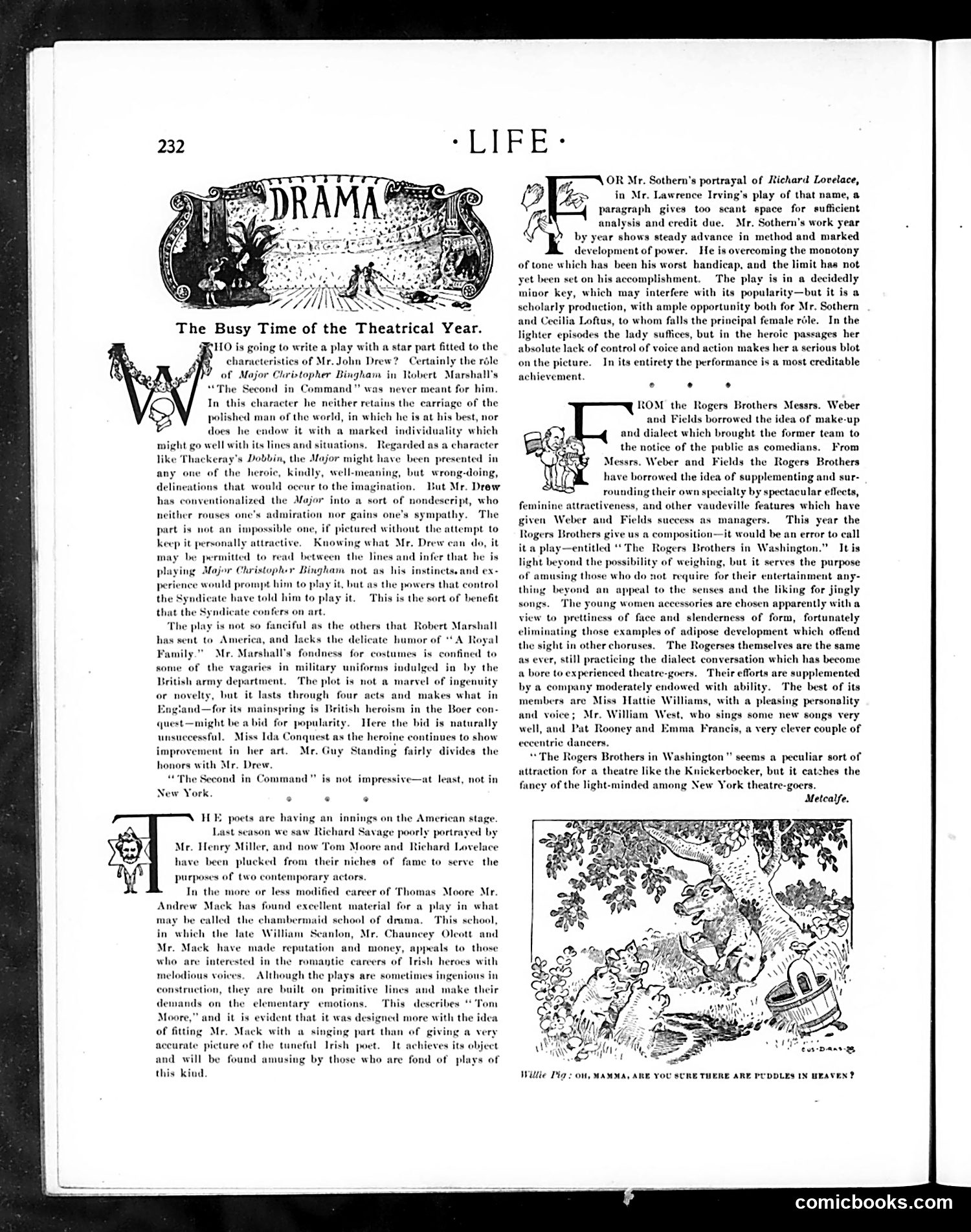
This page contains drama reviews rather than political cartoons. The main content discusses theatrical productions of the era, including: **"The Busy Time of the Theatrical Year"** - Reviews contemporary plays, including works featuring Major Christopher Bougham and a piece titled "A Royal Family." **Key references:** - Richard Lovelace portrait by Mr. Sothern in Lawrence Irving's play - Rogers Brothers comedy acts and their productions - References to actors like Henry Miller and Tom Moore The small illustration at bottom shows a whimsical scene with text "WILLIE PIG: OH, MAMMA, ARE YOU SURE THERE ARE PUDDLES IN HEAVEN?" - likely a humorous commentary on children's naive questions. This appears to be entertainment journalism documenting New York's theatrical scene rather than satirical political content. The humor is theatrical and domestic rather than political.
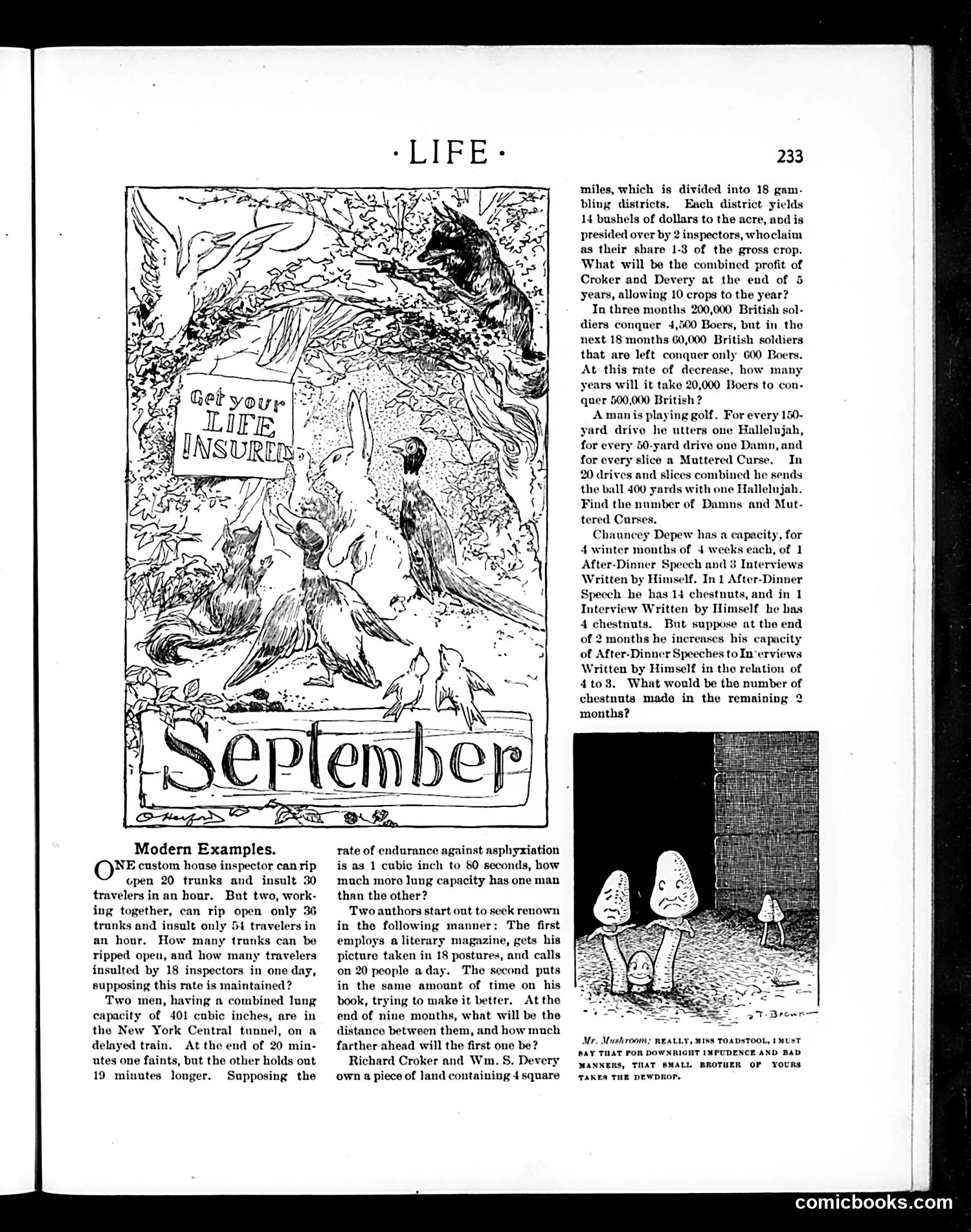
This page satirizes contemporary American corruption and incompetence through mock math problems. The "examples" target: 1. **Customs inspectors** — mocking their rudeness and inefficiency toward travelers 2. **New York Central tunnel conditions** — criticizing dangerous air quality on delayed trains 3. **Self-promoting authors** — contrasting publicity-seekers with serious writers 4. **Croker and Devery** — real NYC political figures (Tammany Hall associates) running gambling districts and skimming profits through corrupt inspectors 5. **The Boer War** — questioning British military effectiveness in South Africa 6. **Chauncey Depew** — a famous after-dinner speaker, mocked for recycling the same stale jokes ("chestnuts") The small cartoon below shows mushroom characters, likely satirizing pretentious or foolish behavior. The satire's point: American institutions are riddled with corruption, incompetence, and hypocrisy disguised as sophistication.
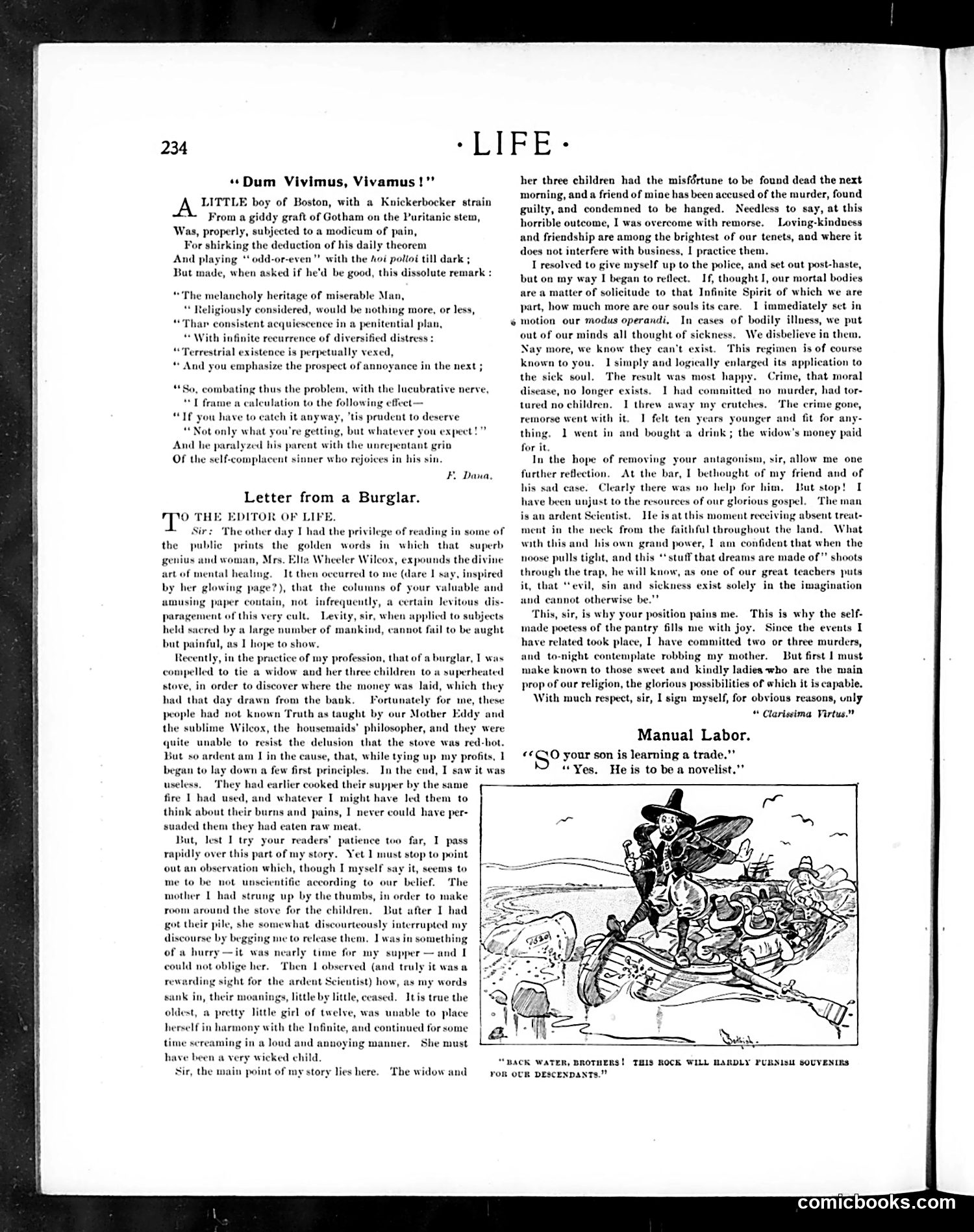
This page satirizes **Christian Science and "New Thought" mental healing movements** popular in the late 19th/early 20th century, particularly targeting **Mary Baker Eddy** (founder of Christian Science) and **Ella Wheeler Wilcox** (popular poet who promoted positive thinking). The opening poem mocks a precocious Boston boy who uses philosophical arguments to justify misbehavior—a light setup for the heavier satire below. The "Letter from a Burglar" is bitter satire: the writer claims to have tortured a widow and her children by tying them to a hot stove, then argues that when his philosophical speeches caused them to stop complaining, it *proved* mental healing works. When the widow and children died and he was convicted of murder, he expresses "remorse"—but the joke is that the ideology itself is absurd and dangerous. The cartoon (bottom right) shows a farmer dismissing a boy's aspirations with practical common sense: "Back water, brothers! This rock will hardly furnish souvenirs for our descendants." **The satire's point:** These healing cults are fraudulent and potentially lethal when applied to real suffering.
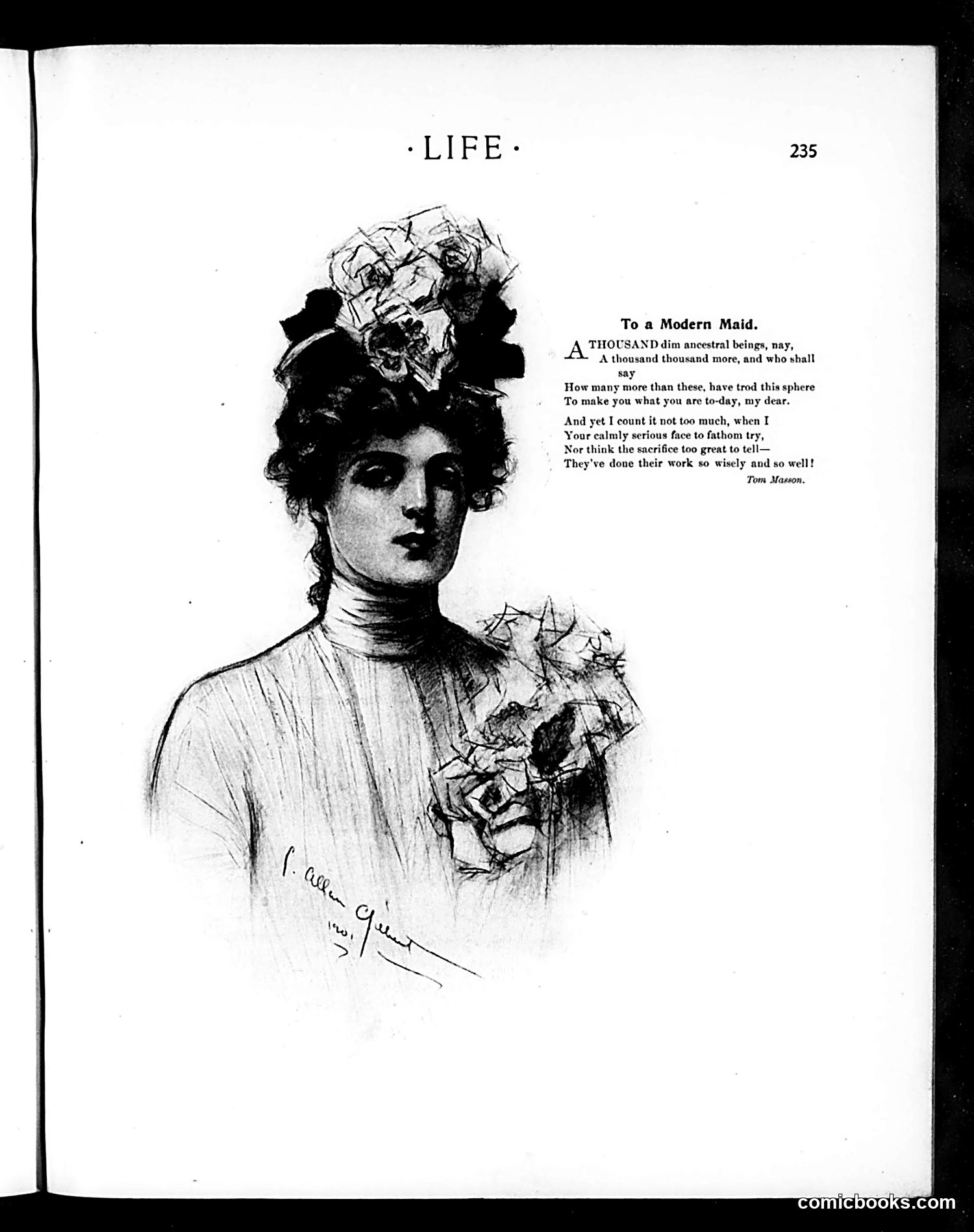
This page features a portrait illustration of a young woman in early 20th-century dress (high collar, fitted bodice with flowers) paired with a romantic poem by Tom Masson. The poem is a **complimentary tribute to modern womanhood**, suggesting that countless ancestral generations have labored to produce this particular refined young woman. The speaker marvels at her "calmly serious face" and declares their ancestors' efforts worthwhile—framing her existence as the culmination of human progress. Rather than satire, this appears to be **sincere sentimental verse** celebrating contemporary femininity and women's evolution. It reflects early 1900s attitudes romanticizing women as the refined product of civilization itself, though modern readers might find the paternalistic tone—crediting male ancestry for creating her—revealing of period gender assumptions. The elegant illustration and serious tone suggest *Life* magazine was showcasing quality poetry alongside its humor content.
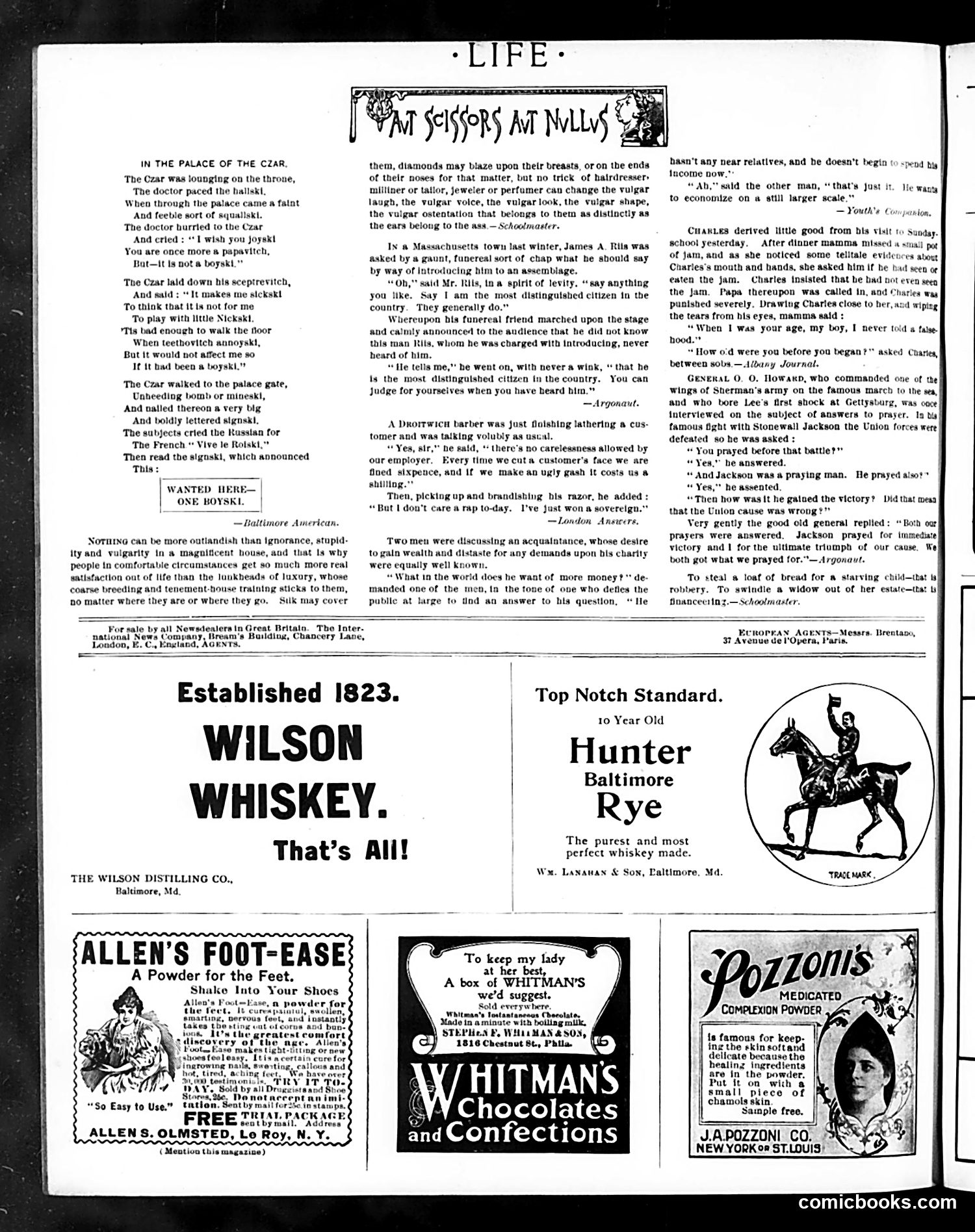
This page contains a satirical poem about **Czar Nicholas II of Russia**, mocking his disappointment at the birth of a daughter rather than a son. The piece uses exaggerated Russian-inflected English ("boyski," "papavitch") for comedic effect. The joke targets the Czar's obsession with producing a male heir to ensure dynastic succession. The humor lies in depicting him as so distraught that he posts a "WANTED" notice at the palace gates seeking a boy—treating the birth of a daughter as a national crisis warranting public advertisement. This reflects real historical anxieties: Nicholas II faced enormous pressure to produce a male heir. The poem satirizes both royal desperation for sons and the absurdity of patriarchal obsession with gender. The page also contains several unrelated humorous anecdotes about vanity, avarice, and moral hypocrisy, plus period advertisements for whiskey, foot powder, and cosmetics.
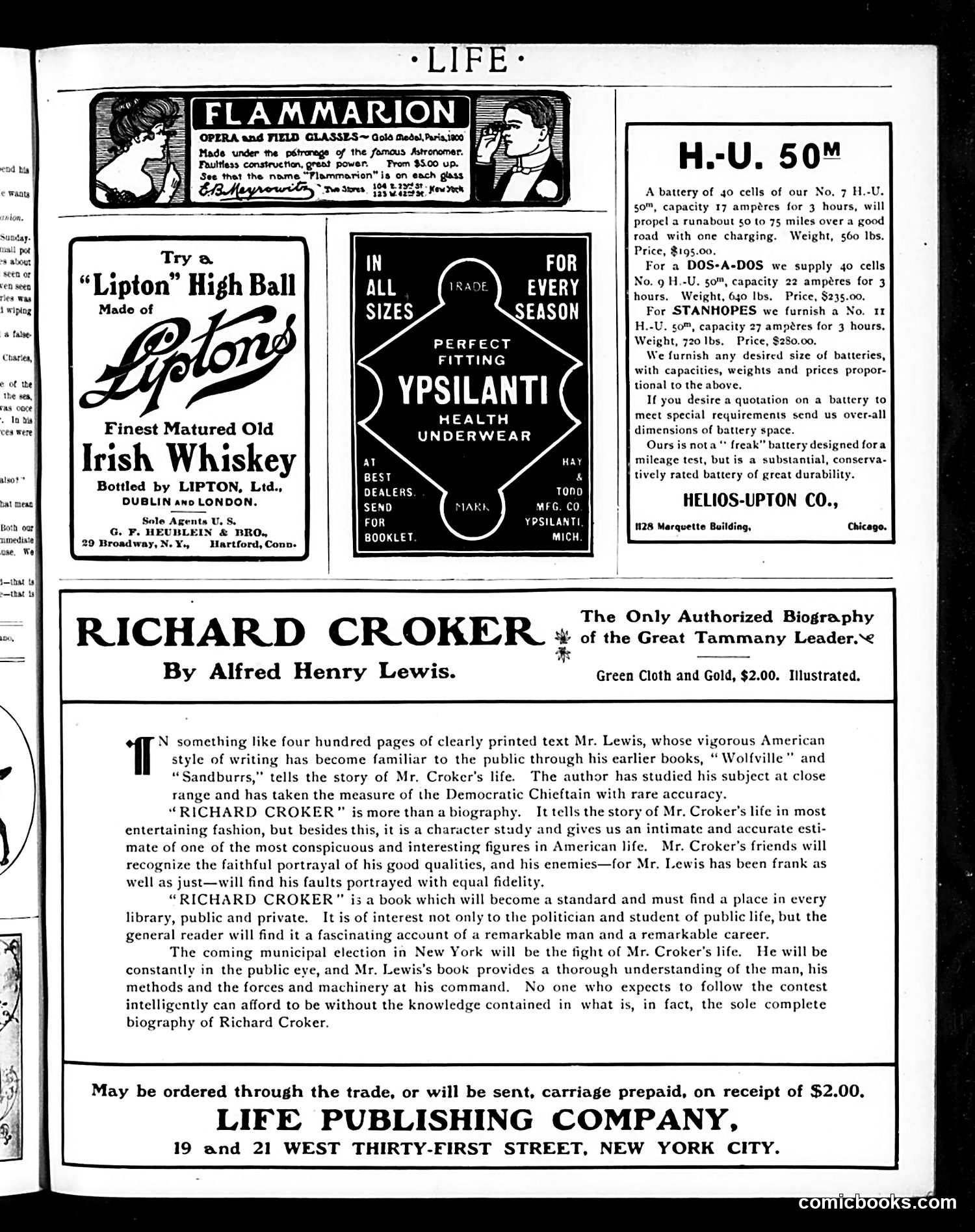
This page is **primarily advertising** with one substantial book promotion. The main content advertises Alfred Henry Lewis's biography of **Richard Croker**, the powerful Democratic boss of New York's Tammany Hall political machine. The book advertisement emphasizes Croker's prominence in an upcoming New York municipal election. It frames the biography as essential reading for understanding "the man, his methods and the forces and machinery at his command"—suggesting Croker wielded significant political power through Tammany Hall's notorious patronage system. The surrounding ads (whiskey, batteries, health underwear, optical glasses) are standard commercial fare. The reference to Croker as "Great Tammany Leader" signals he was a major American political figure of the era—though the advertisement avoids explicit criticism, implying readers should judge his character themselves through Lewis's "frank" portrayal of both "good qualities" and "faults."
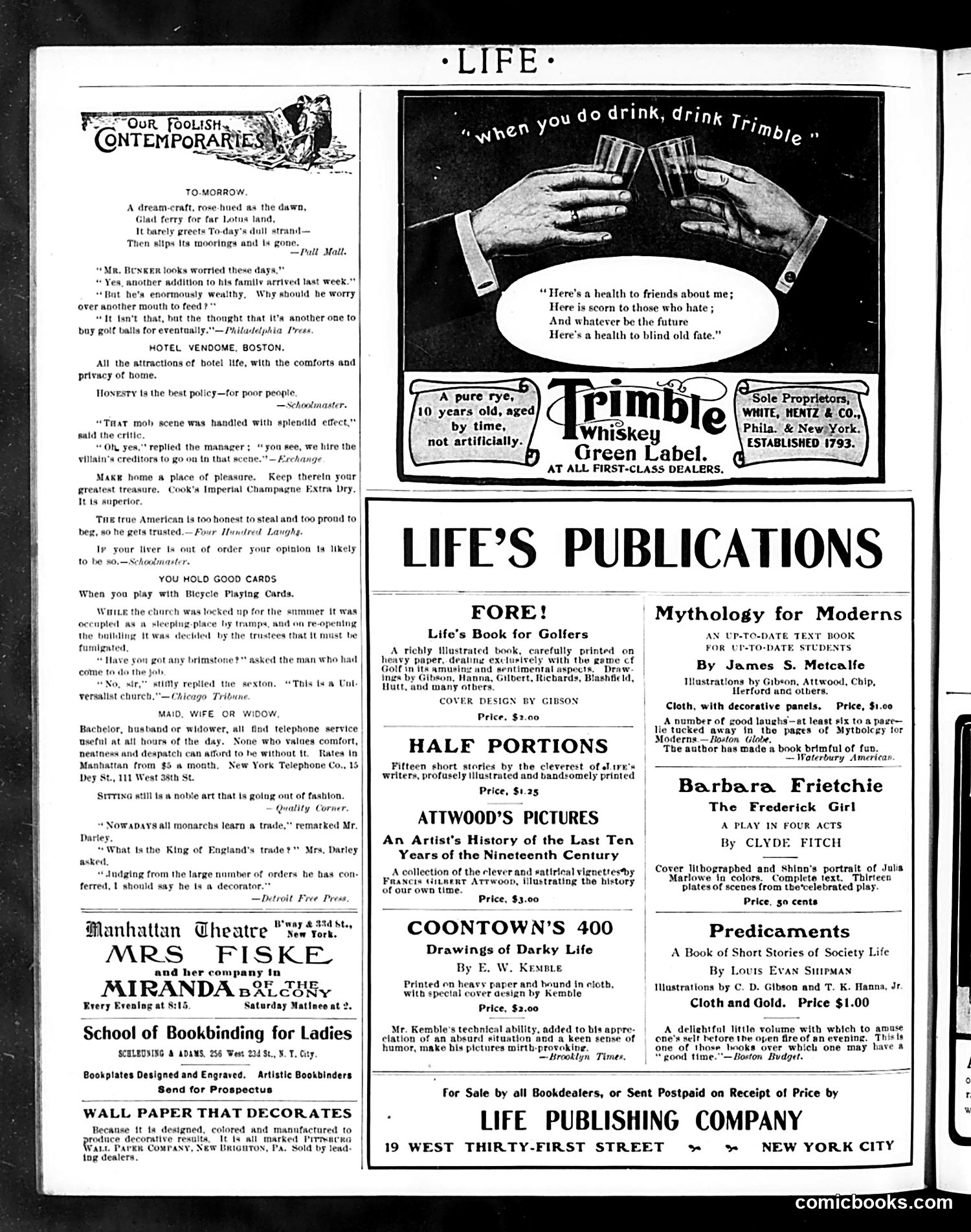
This page is primarily **advertisements and promotional content** for Life Publishing Company's books and related services, with several small satirical pieces interspersed. The main cartoon is a **Trimble Whiskey advertisement** showing two hands toasting, with a poem about drinking to "friends about me," those who "hate," and "blind old fate." This is straightforward liquor advertising using sentimental language. The scattered short humorous pieces are typical Life magazine fare: Mr. Bunker worries about buying golf balls for his new child (class satire), a church used as a vagrant shelter gets fumigated (social commentary on poverty), and a quip that England's king's "trade" is decorating (political humor about monarchy). The book advertisements showcase Life's own publications: golf instruction, short story collections, and E.W. Kemble's "Coontown's 400" (drawings of African American life—a title reflecting the era's casual racism). The page reflects early 20th-century concerns: wealth anxiety, class distinctions, and period attitudes toward race and immigration.
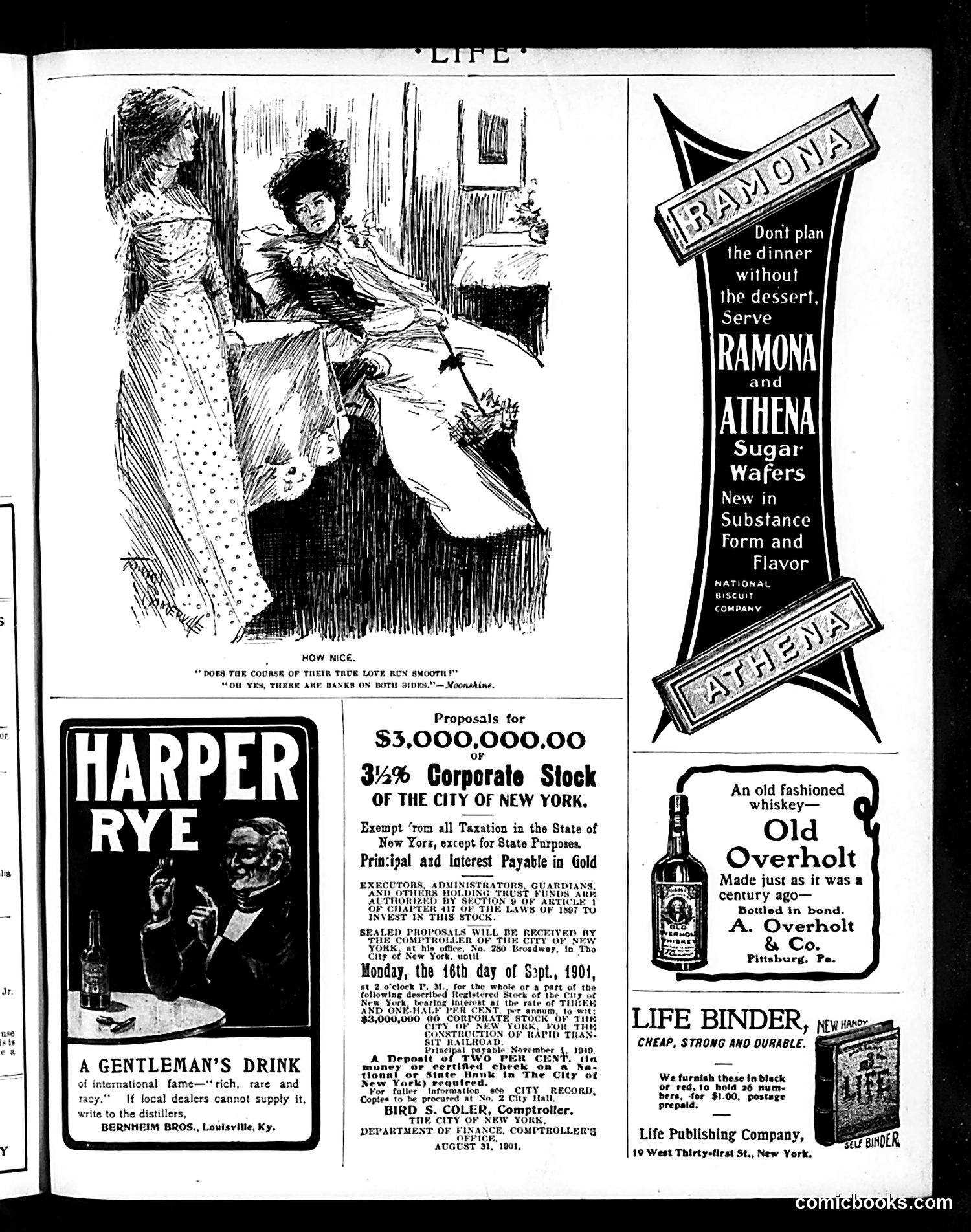
The main cartoon (top left) is a social satire titled "How Nice," depicting two women in conversation. The caption quotes a Moonshine joke: when asked if "the course of their true love run smooth" (a Shakespeare reference), one responds "Oh yes, there are banks on both sides." This is commentary on **marriage and money**: the joke implies that women's romantic choices are determined by financial security—the presence of "banks" (wealth) on both sides of the relationship. It satirizes the mercenary nature of upper-class courtship in the early 1900s, where matrimonial prospects were inseparable from economic status. The remainder of the page consists of **period advertisements** for Harper Rye whiskey, New York City corporate bonds, Ramona and Athena sugar wafers, Old Overholt whiskey, and a Life magazine binder—typical commercial content of the era, offering no additional satirical content.
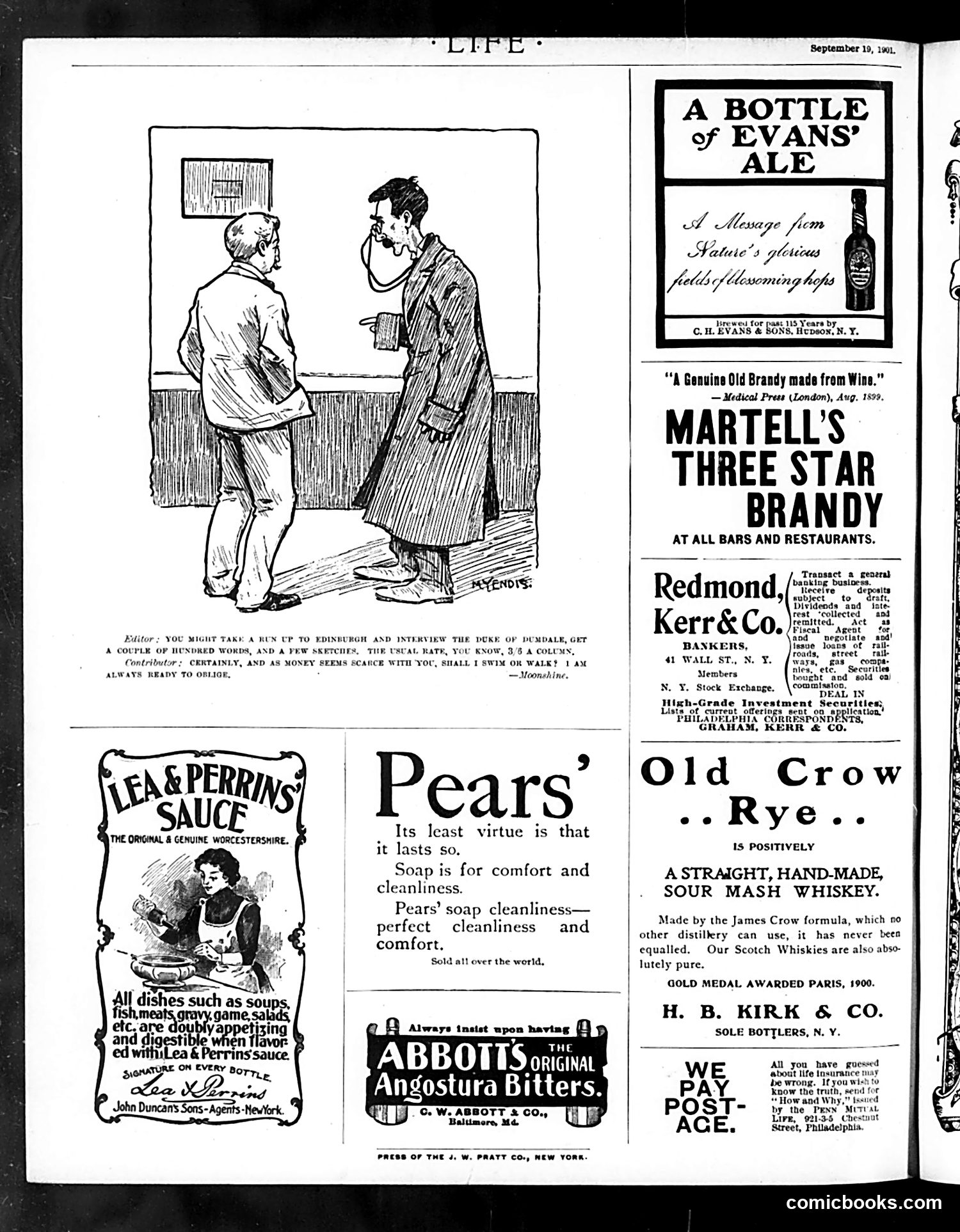
The main cartoon (top left) depicts an editor speaking with a contributor. The editor offers the contributor work: "a couple of hundred words, and a few sketches" for standard pay. The contributor responds by asking whether he should "swim or walk"—a humorous way of asking if the meager payment will cover his travel expenses to submit the work. The joke satirizes the poor compensation offered to freelance writers and illustrators, suggesting the payment is so inadequate that the contributor questions whether he can afford basic transportation to deliver his work. The page is otherwise filled with period advertisements for spirits, sauces, soaps, and financial services—typical of Life magazine's revenue model in 1901.