
Life, 1901-09-19 · page 12 of 20
Life — September 19, 1901 — page 12: what you’re looking at
What you’re looking at
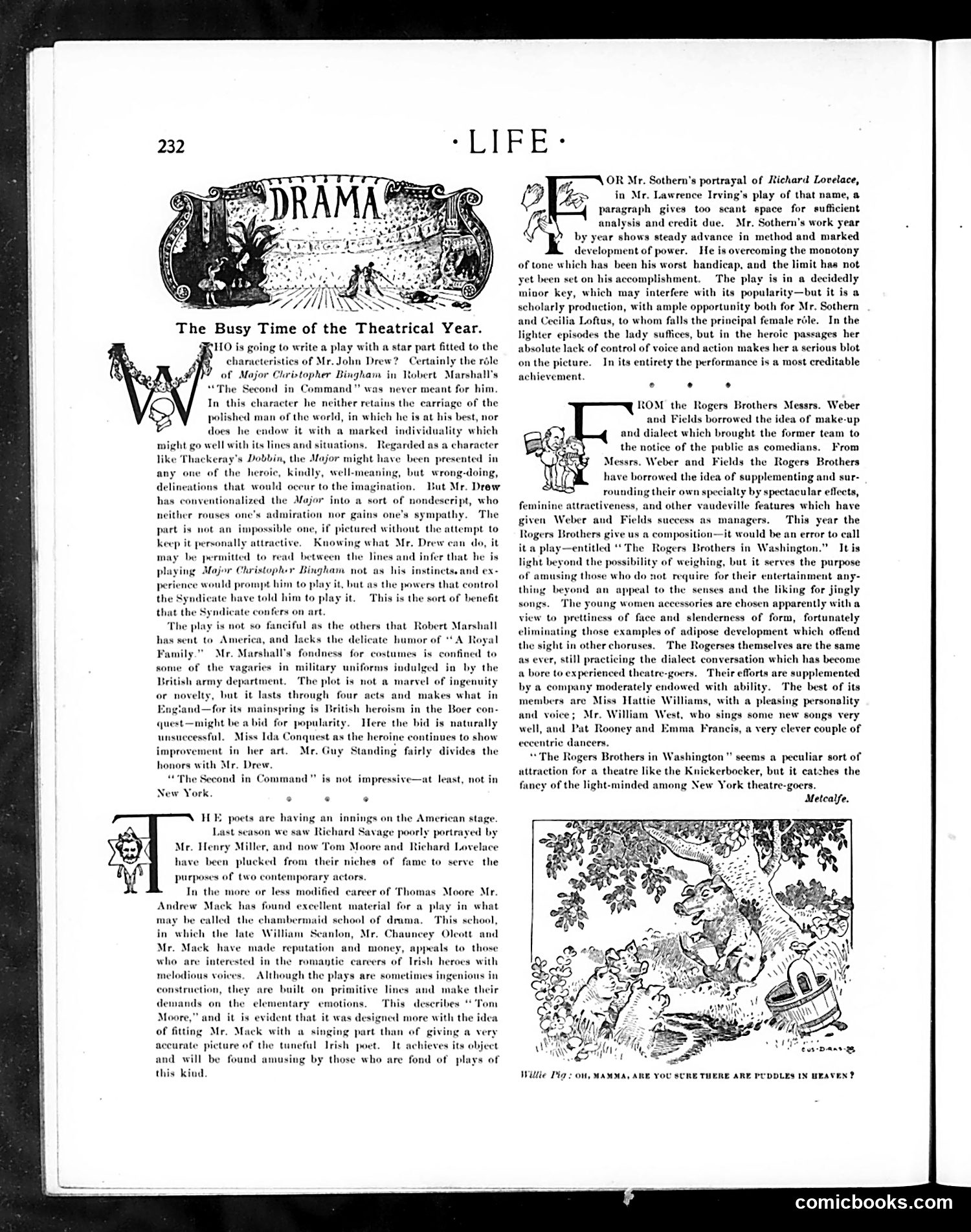
This page contains drama reviews rather than political cartoons. The main content discusses theatrical productions of the era, including: **"The Busy Time of the Theatrical Year"** - Reviews contemporary plays, including works featuring Major Christopher Bougham and a piece titled "A Royal Family." **Key references:** - Richard Lovelace portrait by Mr. Sothern in Lawrence Irving's play - Rogers Brothers comedy acts and their productions - References to actors like Henry Miller and Tom Moore The small illustration at bottom shows a whimsical scene with text "WILLIE PIG: OH, MAMMA, ARE YOU SURE THERE ARE PUDDLES IN HEAVEN?" - likely a humorous commentary on children's naive questions. This appears to be entertainment journalism documenting New York's theatrical scene rather than satirical political content. The humor is theatrical and domestic rather than political.
📄 Transcribed text from this page (OCR, searchable)
Machine-transcribed from the original scan — historical spelling and the odd misread are preserved.
<—~ The Busy Time of the Theatrical Year. 110 is going to write a play with a star part fitted to the characteristics of Mr. John Drew? Certainly the réle of Major Christopher Bingham in Wobert Marshall's “The Second in Command” was never meant for him. In this eh rhe neither retains the cari: of the polished ma f the world, in which he is at his best, nor does he endow it with a marked individuality which might go well with its lines and situations. I ded as a character ckeray’s Dobbin, the Major might have been presented in any one of the heroic, kindly, well- , but wrong-doing, would occur to the ima no, Dut Mr. Drew has co! ionalized the Major into a sort of nondescript, who neither rouses one’ i gains one’s sympathy. The i if pictured without the attempt to sonally attractive. Know may be permitted to read between the | playing Major Christopher Binghay 11d prompt him to pl delineations t g what Mr. Drew can do, it and infer that he is not as his instincts. and ex- y it, but as the powers that control il him to play it. This is the sort of benefit rs on art. ful as the others that Robert Marshall America, and lacks the delicate humor of “A Royal Family.” Mr. Marshall's fondness for some of the vagaries in military uniforms indulged in by the British army department. The plot is not a marvel of ingenuity ovelty, but it lasts through four acts and makes what in its mainspring is British heroism in the Boer con- id for popularity. Here the bid is naturally ontinues to show Mr. Guy Standing fairly divides the stumes ix confined to improvement in her art. honors with Mr. Drew. “ The Second in Command" is ot Impressive—at least, not in ° . ° poets are having an innings on the American stage. st season we saw Richard Savage poorly portrayed | the purposes of two ¢ In the more or less modified career of Thomas Moore Mr. Andrew Mack has found excellent material for a play in what may be called the chamt drama. This sche in which the late Wil lon, Mr. Chauncey Olcott and Mr. Mack have made reputation and money, appeals to those who are interested in the romantic carvers of Irish heroes with Although the pla are built on primitive lines lementary emotions. Moore,” and it is evident that it was d of fitting Mr. Mack with a singing -ture of the tuneful Trish poet. 1 will be found amusing by those who are fond of play this kind. rmaid school o nH Se are sometimes ingenious in nd make their describes ‘1 igned more with the idea melodious voices. construction, the: ands on the OR Mr. Sothern’s portrayal of Richard Lovelace, in Mr. Lawrence Irving's play of that name, a paragraph gives too scant space for sufficient analysis and credit due. Mr. Sothern’s work year year shows steady advance in method and marked development of power, He is overcoming the monotony of tone which has been his worst handicap, and the limit has not yet been set on his accomplishment. The play is in a decidedly minor key, which may interfere with its popularity—but it is a scholarly production, with ample opportunity both for Mr. Sothern and Cecilia Loftus, to whom falls the principal female role. In the lighter episodes the lady suffices, but in the heroic passages her absolute lack of control of voice and action makes her a serious blot on the picture. In its entirety the performance is a most creditable achievement ° . . ROM the Rogers Brothers Messrs. Weber and Fields borrowed the idea of make-up and dialect which brought the former team to the notice of the public as comedians, From Messrs. Weber and Fields the Rogers Brothers ve borrowed the idea of supplementing and sur- rounding their own specialty by spectacular eflects, ttractiveness, and other vaudeville features which have given Weber and F This year the Brothers give us a composition—it would be an error to call hington.” Itis the purpose ig those who do not require for their entertainment any- an appeal to the senses and the liking for jingly ung Women accessories are chosen apparently with a view to prettiness of face and slenderness of form, fortunately eliminating those examples of adipose development which offend the sight in other choruses. The Rogerses themselves are the same as ever, still practicing the dialect conversation which has become a bore to experienced theatre-goers. Their efforts are supplemented by a company moderately endowed with ability. ‘The best of its members are Miss Hattie Williams, with a pleasing personslity and voice; Mr. William West, who sings some new songs very well, and Pat Rooney and Emma Francis, a very clever couple of eccentrie dancers. The Rogers Brothers in Washington” seems a peculiar sort of ction for a theatre like the Knickerbocker, but it catches the cy of the light-minded among New York theatre-goers. Metcalfe. elds success as managers. The Rogers Brothers in V ARE YOU SURE THERE ARE PUDDLES IN HEAVEN ? comicbooks.com