
Life, 1901-09-19 · page 4 of 20
Life — September 19, 1901 — page 4: what you’re looking at
What you’re looking at
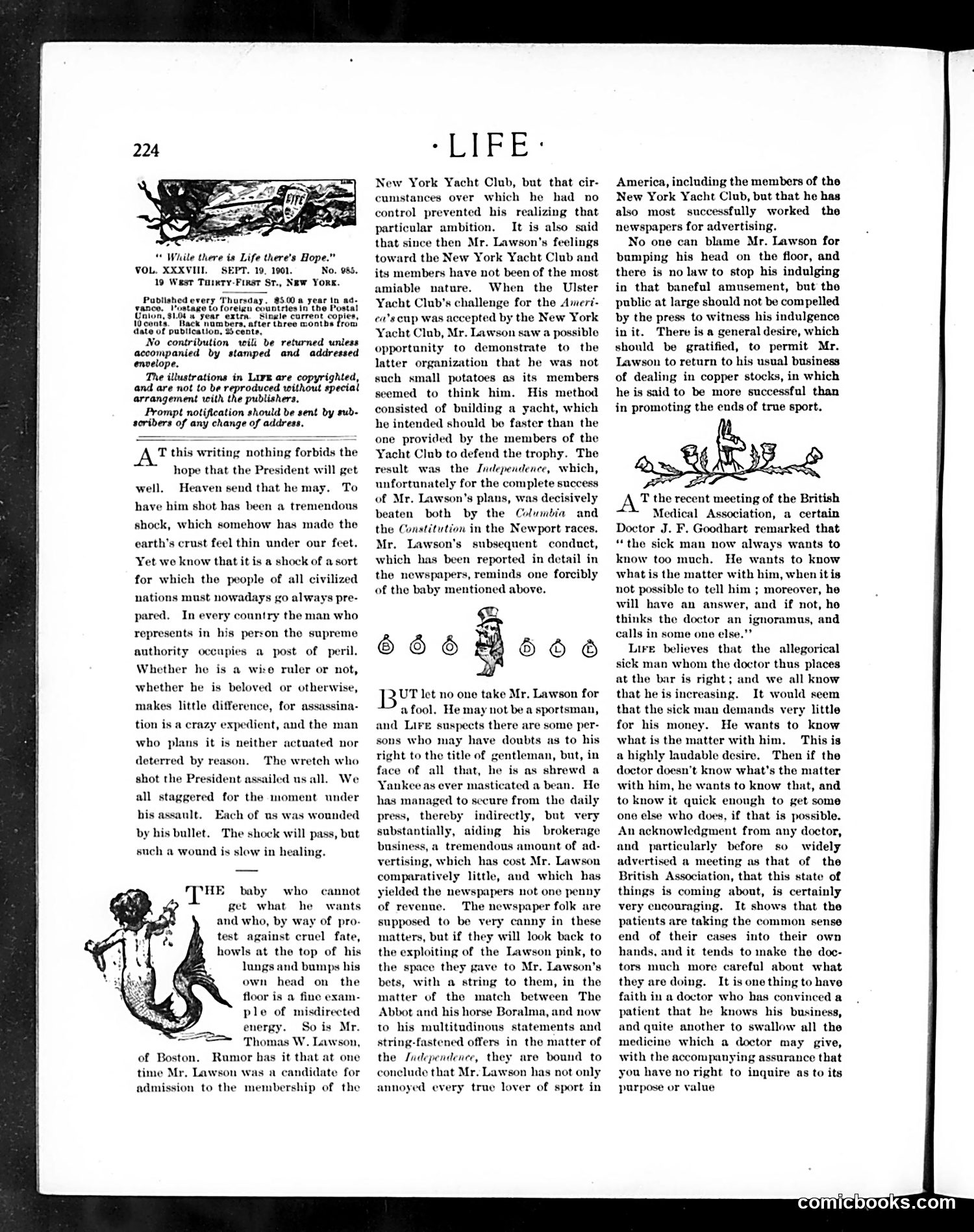
This page contains satirical commentary on Mr. Lawson, apparently a wealthy businessman involved in yachting circles and newspaper ownership/advertising ventures. The text mocks his failed attempt to win the America's Cup yacht race and criticizes his substantial newspaper advertising spending (described as "a tremendous amount of advertising, which has cost Mr. Lawson comparatively little"). The small illustrations appear to be generic decorative vignettes rather than specific political cartoons. The main satire ridicules Lawson as someone who throws money at problems—yachting competitions and advertising—believing wealth alone ensures success. The editorial tone suggests readers would recognize Lawson as a notorious figure of the period, though his specific identity requires external historical verification.
📄 Transcribed text from this page (OCR, searchable)
Machine-transcribed from the original scan — historical spelling and the odd misread are preserved.
“ While there is Life there’s Hope.” VOL. XXXVIIL 19, 1901. No. 985. 19 Wast Tainty-Finst St., NeW YORK. Published every Thursday. $5.00 a year in ad- vanco. ‘Iostage to foreign countries in the Postal ion, 1.04 4 year exten. "Single current copies, 0 conts. “Back numbers, after three months from date of publication, 3 ce No contribution wili be returned unless accompanied by stamped and addressed envelope. The illustrations in Lure are copyrighted, and are not to be reproduced without special arrangement with the publishers, Prompt notification should be sent by sub- soribers of any change of address, T this writing nothing forbids the hope that the President will get well. Heaven send that he may, To have him shot has been a tremendous shock, which somehow has made the earth's crust feel thin under our feet. Yet we know that it is a shock of a sort for which the people of all civilized nations must nowadays go always pre- pared, In every country the man who represents in his person the supreme authority occupies a post of peril. Whether he is a wire ruler or not, whether he is beloved or otherwise, makes little difference, for assassina- tion is a crazy expedient, and the man who plans it is neither actuated nor The wretch who We all staggered for the moment under deterred by reason. shot the President assailed us all. his assault. Each of us was wounded by his bullet. such a wound is slow in healing. baby who cannot ‘THE get what he wants and who, by way of pro- test against cruel fate, howls at the top of his lungs and bumps his own head on the floor is a fine exam- ple of misdirected energy. So is Mr. === Thomas W. Lawson, of Boston. Rumor has it that at one time Mr, Lawson was a candidate for admission to the membership of the The shock will pass, but LPI * New York Yacht Club, but that cir- cumstances over which he had no control prevented his realizing that particular ambitior It is also said that since then Mr. Lawson's feelings toward the New York Yacht Club and its members have not been of the most amiable nature. When the Ulster Yacht Club's challenge for the Ameri- ca’s cup was accepted by the New York Yacht Club, Mr. Lawson saw a possible opportunity to demonstrate to the latter organization that he was not such small potatoes as its members seemed to think him. His method consisted of building a yacht, which he intended should be faster than the one provided by the members of the Yacht Club to defend the trophy. The result was the Independence, which, unfortunately for the complete success of Mr. Lawson's plans, was decisively beaten both by the Columbia and the Constitution in the Newport races. Mr. Lawson's subsequent conduct, which has been reported in detail in the newspapers, reminds one forcibly of the baby mentioned above. 6 6 6 566 6 UT let no one take Mr. Lawson for a fool, He may not be a sportsman, and Lire suspects there are some per- sons who may have doubts as to his right to the title of gentleman, but, in face of all that, he is as shrewd a Yankee as ever masticated a bean. He has managed to secure from the daily s, thereby indirectly, but very antially, aiding his brokerage business, a tremendous amount of ad- vertising, which has cost Mr. Lawson comparatively little, and which has yielded the newspapers not one penny of revenue. The newspaper folk are supposed to be very canny in these matters, but if they will look back to the exploiting of the Lawson pink, to the space they to Mr. Lawson's bets, with a string to them, in the matter of the match between The Abbot and his horse Boralma, and now to his multitudinons statements and string-fastened offers in the matter of the Judependence, they are bound to conclude that Mr. Lawson has not only annoyed every true lover of sport in America, including the members of the New York Yacht Club, but that he has also most successfully worked the newspapers for advertising. No one can blame Mr. Lawson for bumping his head on the floor, and there is no law to stop his indulging in that baneful amusement, but the public at large should not be compelled by the press to witness his indulgence in it. There is a general desire, which should be gratified, to permit Mr. Lawson to return to his usual business of dealing in copper stocks, in which he is said to be more successful than in promoting the ends of true sport. AT the recent meeting of the British 4° Medical Association, a certain Doctor J. F. Goodhart remarked that “the sick man now always wants to know too much. He wants to know what is the matter with him, when it is not possible to tell him ; moreover, he will have an answer, and if not, ho thinks the doctor an ignoramus, and calls in some one else.”’ Lire believes that the allegorical sick man whom the doctor thus places at the bar is right; and we all know that he is increasing. It would seem that the sick man demands very little for his money. He wants to know what is the matter with him. This is a highly laudable desire. Then if the doctor doesn't know what's the matter with him, he wants to know that, and to know it quick enough to get some one else who does, if that is possible. An acknowledgment from any doctor, and particularly before so widely advertised a meeting as that of the British Association, that this state of things is coming about, is certainly very encouraging. It shows that the patients are taking the common sense end of their cases into their own hand: nd it tends to make the doc- tors much more careful about what they are doing. It is one thing to have faith in a doctor who bas convinced a patient that he knows his business, and quite another to swallow all the medicine which a doctor may give, with the accompanying assurance that you have no right to inquire as to its purpose or value