
A complete issue · 20 pages · 1901
Life — September 5, 1901
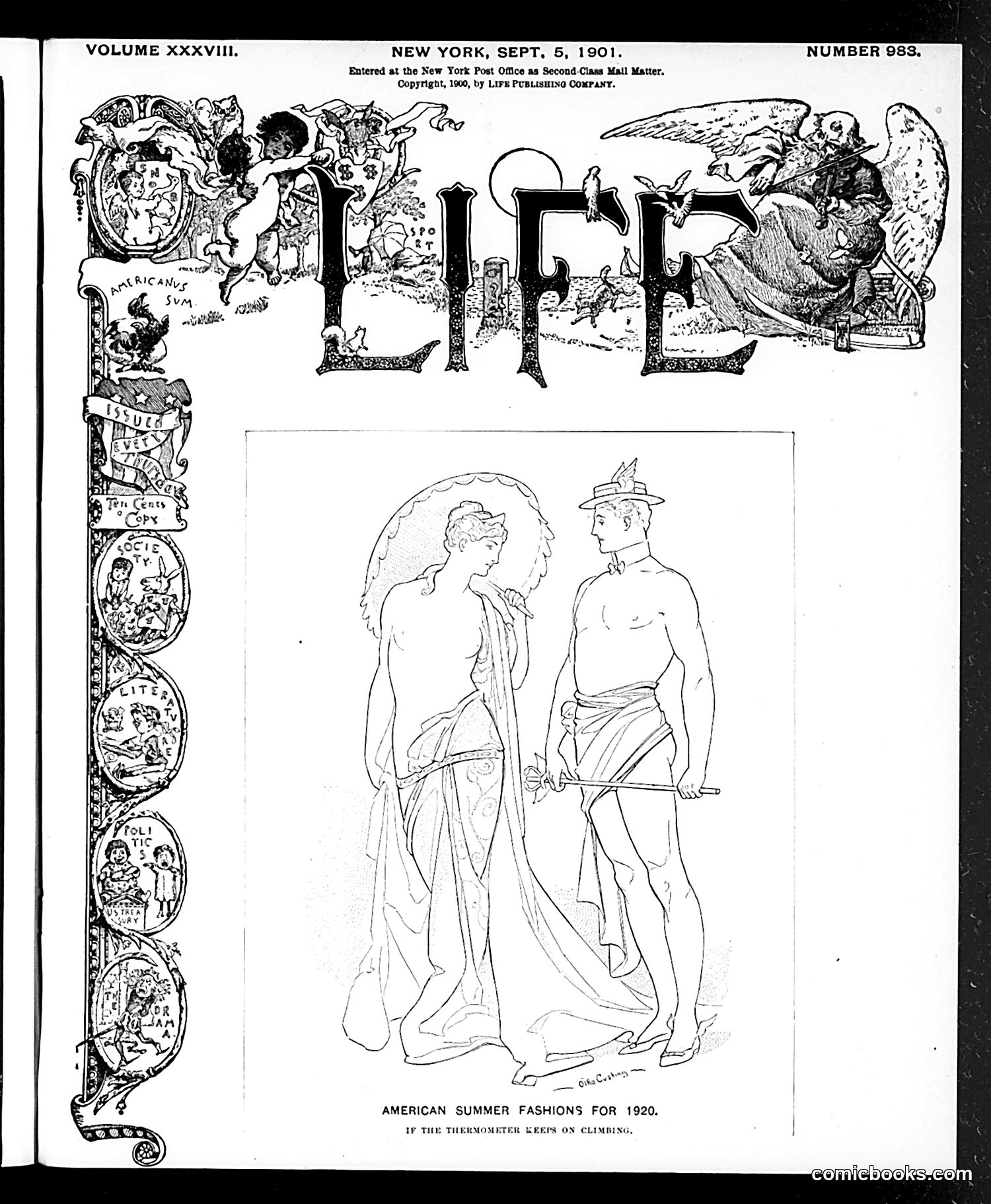
The main cartoon is titled "American Summer Fashions for 1920" with the subtitle "If the Thermometer Keeps on Climbing." This is a satirical prediction about future fashion trends. The illustration shows a woman and man dressed in minimal clothing—the woman in a draped shawl, the man shirtless with only a loincloth-style garment. The joke projects that if temperatures continue rising, summer fashions will become increasingly scanty by 1920. This reflects turn-of-the-century anxieties about climate change (possibly related to industrial development) and serves as social satire on modesty standards. The exaggerated prediction humorously suggests that practical adaptation to heat would eventually override Victorian propriety in dress codes.
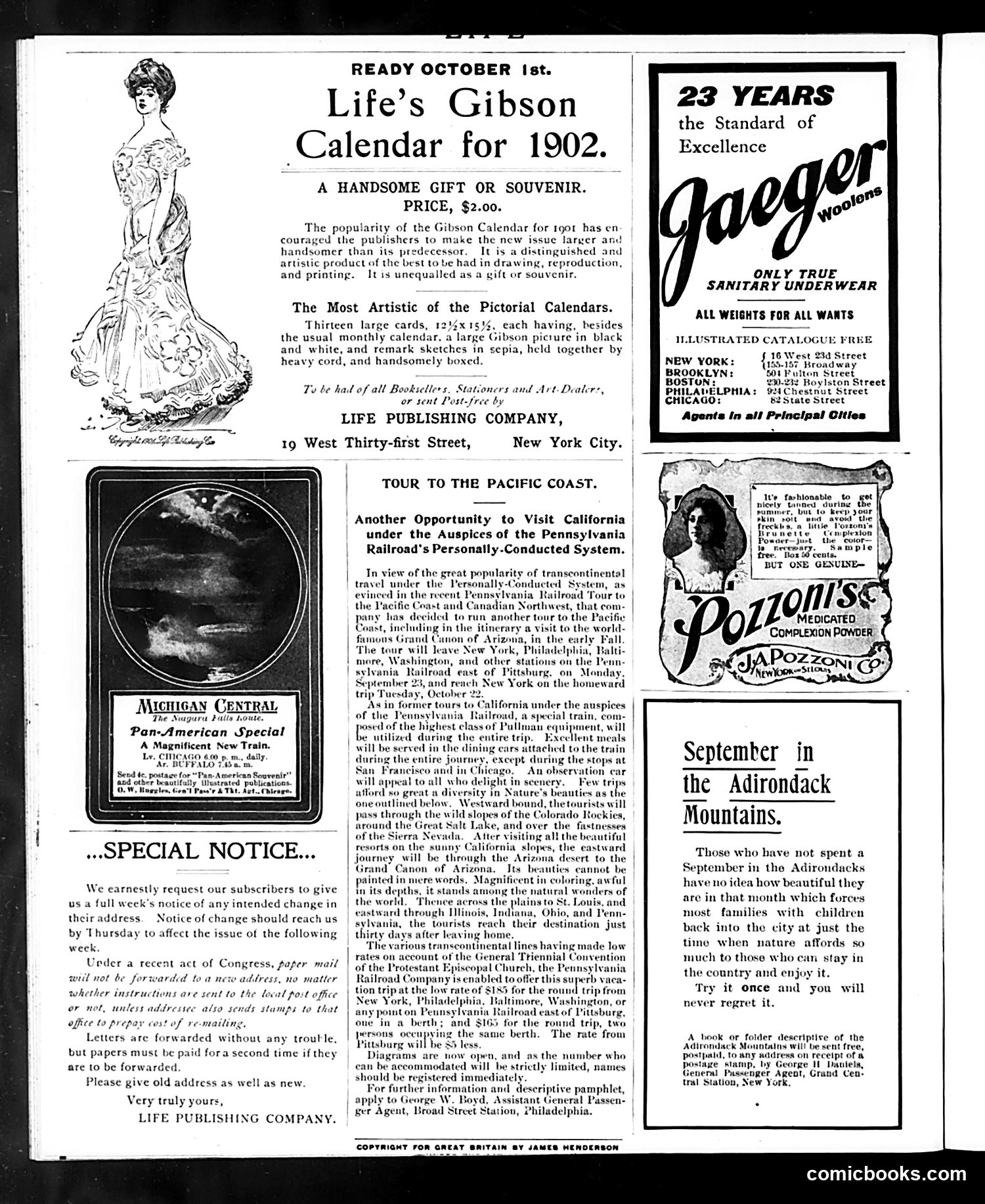
This page is primarily **advertising and commercial notices** rather than political satire. It contains: 1. **Life's Gibson Calendar advertisement** (top): Promotes a 1902 calendar featuring Charles Dana Gibson's famous illustrations of idealized women ("Gibson Girls"), priced at $2.00. 2. **Gaeger Woolens underwear ad** (right): Markets "sanitary underwear" available in multiple sizes. 3. **Pozzonl's Medicated Complexion Powder ad** (right): Period beauty product advertisement. 4. **Pennsylvania Railroad tour notice**: Announces a conducted tour to California departing September 23. 5. **Adirondack Mountains travel feature** (right): Encourages September vacations in upstate New York. 6. **Publisher's notice** (bottom left): Requests subscribers provide address change notice by Thursday for proper delivery. The page reflects early 1900s consumer culture and leisure travel marketing rather than editorial satire.
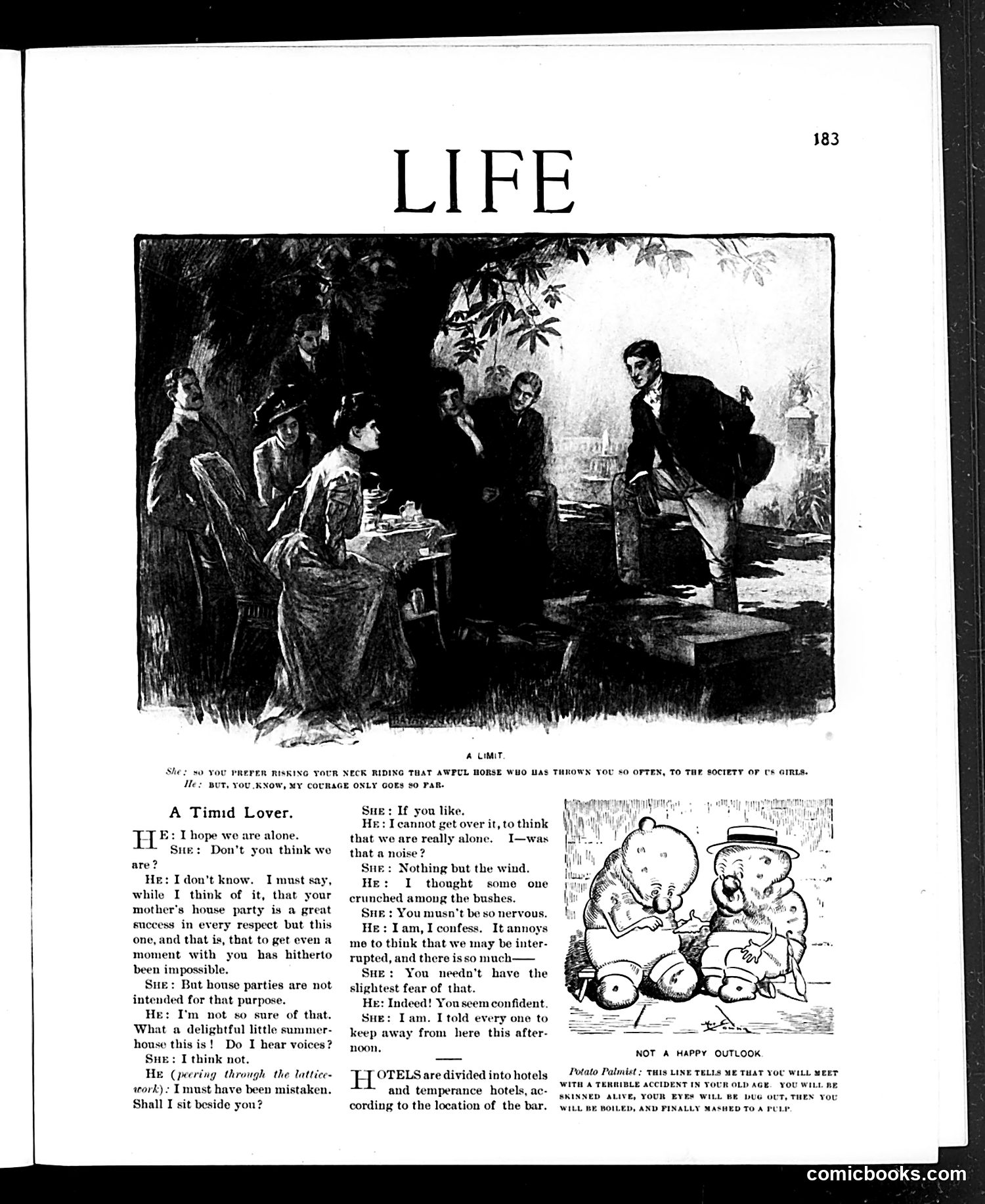
This page contains two distinct pieces: **"A Timid Lover"** (top): A dialogue-driven cartoon about a nervous suitor seeking reassurance from his beloved during a romantic moment outdoors. The humor derives from the man's anxious questioning and the woman's patient, slightly exasperated responses—a timeless dynamic mocking male insecurity in courtship. **"Not a Happy Outlook"** (bottom right): A cartoon depicting snowmen with a grim caption about meeting "a terrible accident in your old age." The "Potato Palmist" reading their fate suggests dark humor about mortality, likely satirizing fortune-telling trends popular in the era. The page also includes text about hotel classifications, appearing to be unrelated editorial content. The overall tone is lighthearted domestic humor typical of Life's satirical focus on American social customs and anxieties.
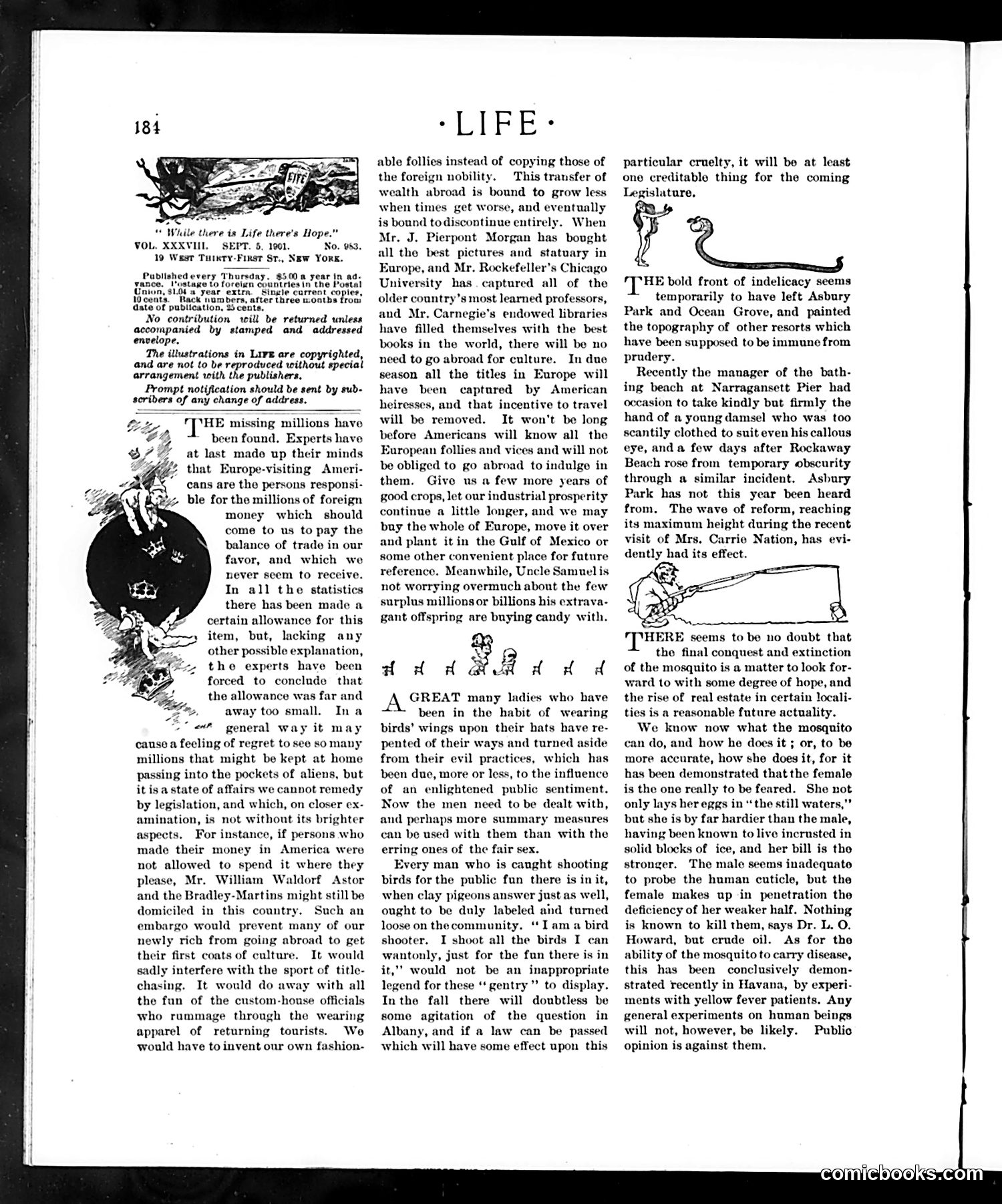
This page contains editorial commentary on American wealth and cultural acquisition. The text criticizes wealthy industrialists (Pierpont Morgan, Rockefeller, Carnegie are named) for buying up European art and antiquities, effectively depleting Europe of its cultural heritage. The cartoons illustrate this concern: one shows a figure extracting resources from Europe, suggesting America is "draining" the continent. Another depicts a woman in birds' wings—likely satirizing the fashionable trend of wearing feathered hats—criticizing both the practice and the casual cruelty it represents. The piece argues that such acquisition, while demonstrating American prosperity, reflects poor taste and removes incentive for Europeans to value their own culture. It's fundamentally a critique of American cultural imperialism and conspicuous consumption during the Gilded Age.
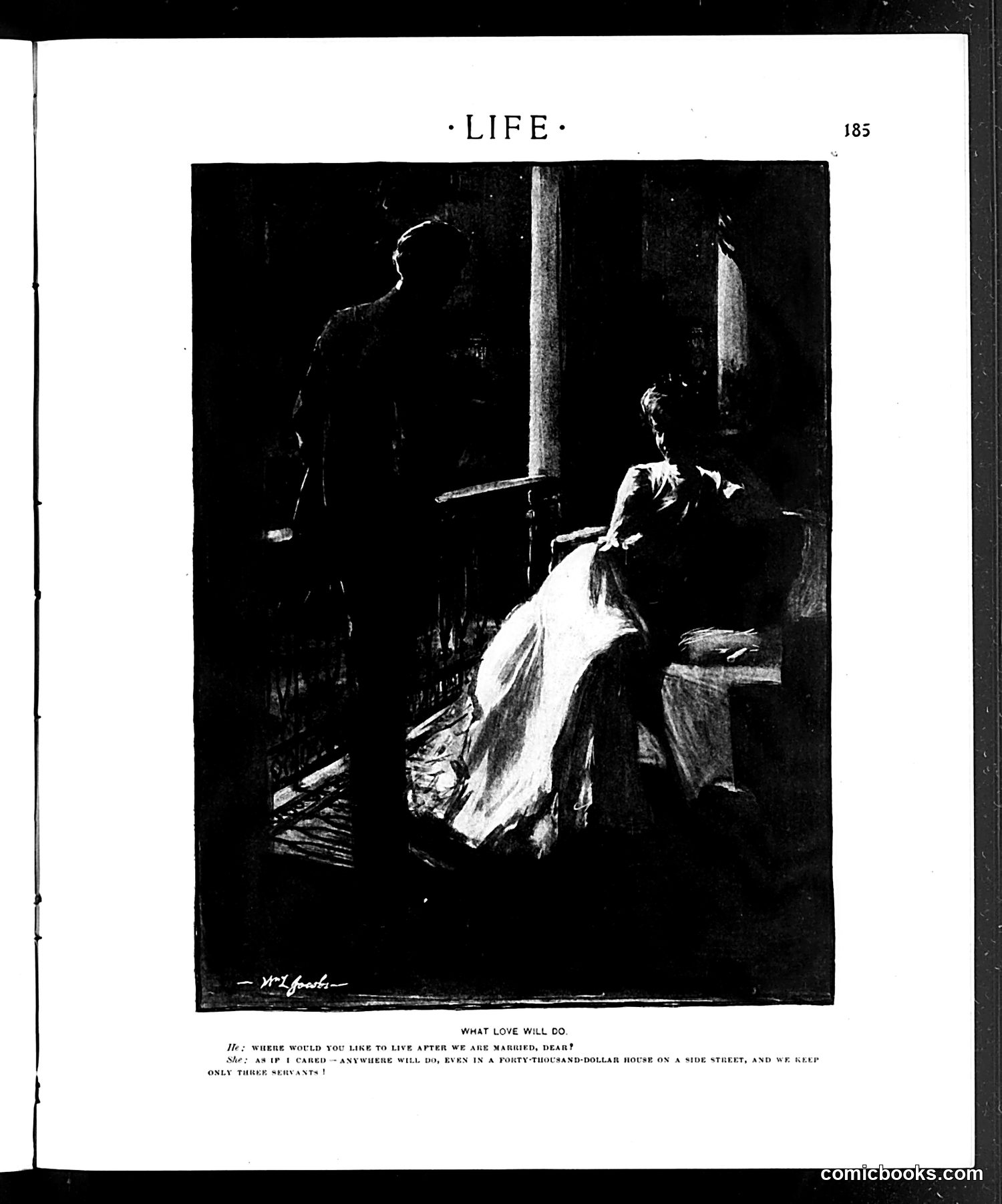
This satirical illustration depicts a romantic dialogue between a couple. The caption presents a conversation where he asks where they'd live after marriage, and she responds that she'd be content anywhere—even in a modest twenty-thousand-dollar house on a side street with only three servants. The satire targets upper-class assumptions about wealth and "modest" living. What the woman describes as humble (a substantial house requiring three servants) would be luxurious to most readers. The joke exposes the disconnect between wealthy people's concept of frugality and ordinary people's actual circumstances. The dramatic lighting and serious composition contrast humorously with the trivial, self-absorbed nature of their romantic concern.
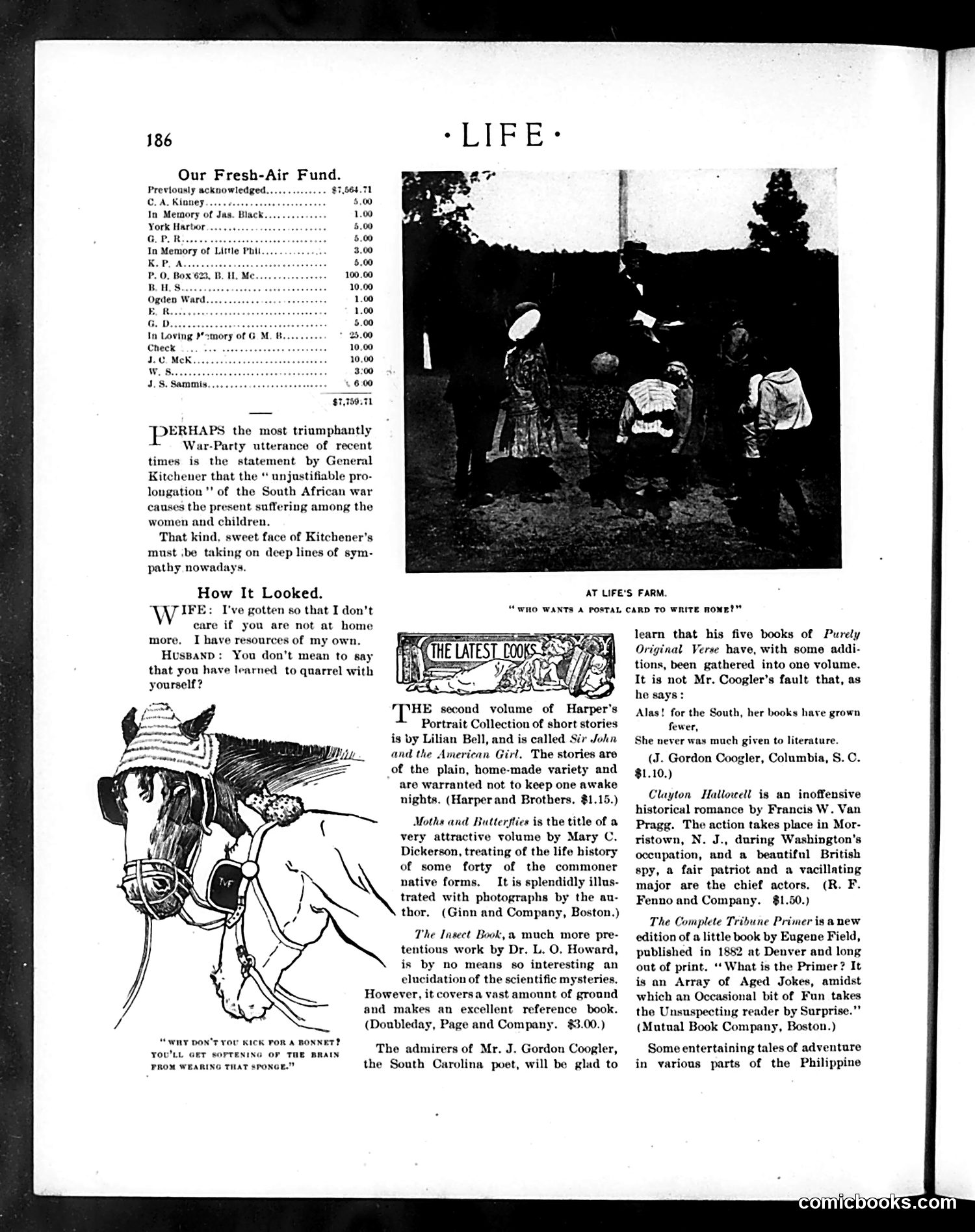
The page contains two distinct elements: **Left cartoon**: Shows a donkey wearing a bonnet with the caption "WHY DON'T YOU KICK FOR A BONNET? YOU'LL GET SOFTENING OF THE BRAIN FROM WEARING THAT SPONGE." This appears to be a nonsensical joke playing on absurdist humor rather than political satire—the humor derives from the ridiculous image and wordplay rather than contemporary events. **Right section**: Consists primarily of book reviews and literary notices, not political commentary. It discusses works like "Sir John and the American Girl" and "Moths and Butterflies." **Top photograph**: Shows people at what appears to be a farm setting, captioned "WHO WANTS A POSTAL CARD TO WRITE HOME?" This page is predominantly literary content with light humor rather than political satire typical of Life magazine's satirical tradition.
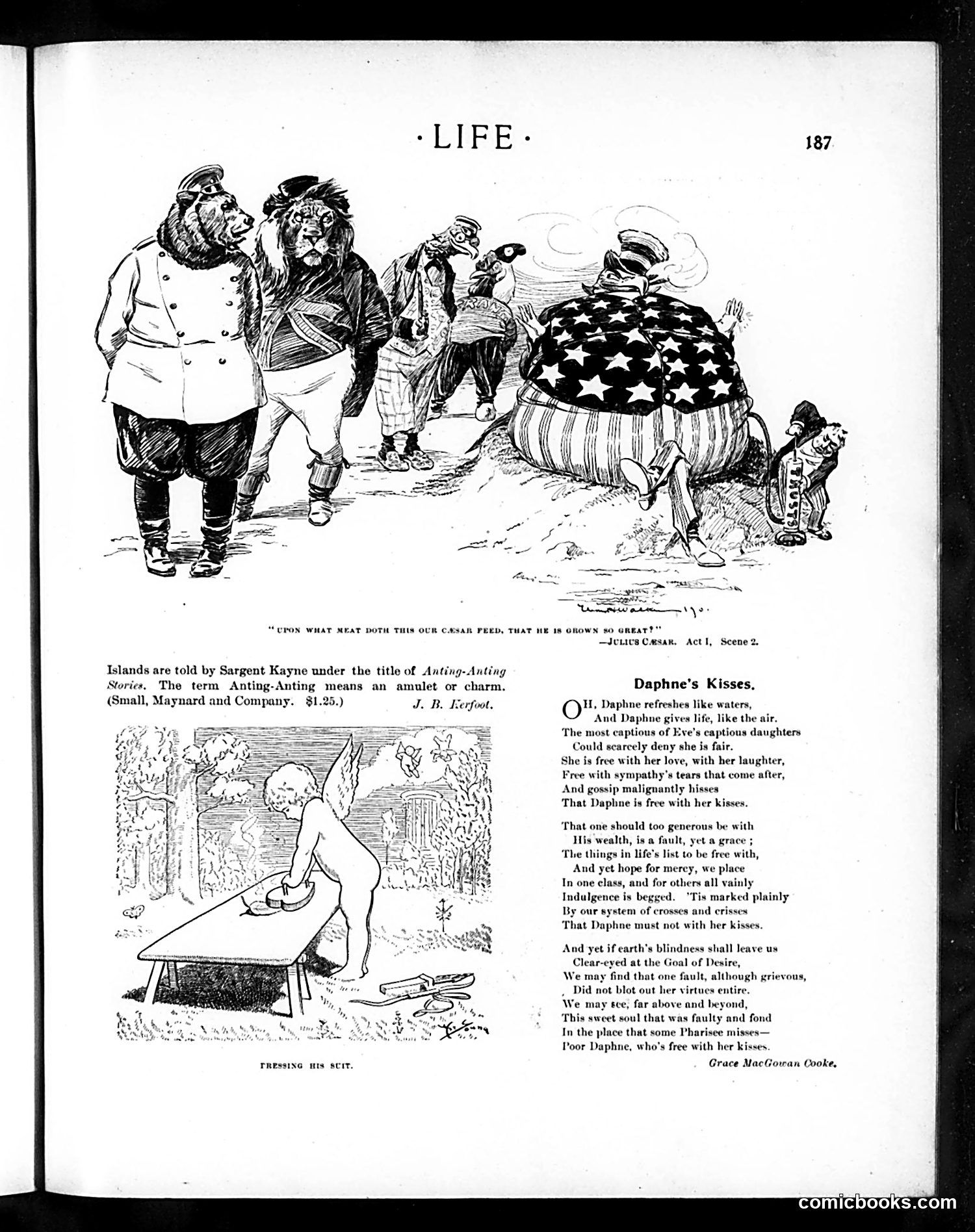
The top cartoon depicts figures gathered around a large bag decorated with American stars and stripes, illustrating a quote from Julius Caesar: "Upon what meat doth this our Caesar feed, that he is grown so great?" This references political power and consumption of resources—likely satirizing a contemporary political figure's influence or corruption. The bottom illustration, "Pressing His Suit," shows a man at a table with a woman, accompanying the poem "Daphne's Kisses" by Grace MacGowan Cooke. The verse critiques romantic pursuit and morality, suggesting the man's courtship is inappropriate or presumptuous. Both pieces appear to mock contemporary social and political behavior through classical and literary references, characteristic of *Life* magazine's satirical approach.
This page contains literary content rather than political cartoons. The main features are: 1. **"The Cap of Fortunatus"** - A Grimm fairy tale in verse about a magical traveling cap that grants wishes. 2. **"Life's Short Story Contest"** - Announcement of winners including works by Kate Jordan, Mrs. Robert S. Chase, and Cora A. Reedy. 3. **"A Happy Medium"** - A brief dialogue joke about marriage success. 4. **"Making Him Useful"** - A small cartoon at bottom showing a "Younger Brother" with caption about slides (unclear reference without seeing the image clearly). The page is primarily entertainment and literature rather than political satire. The only potentially satirical element is the marriage dialogue, which gently mocks the idea that successful marriages depend on meeting people you "really loved."
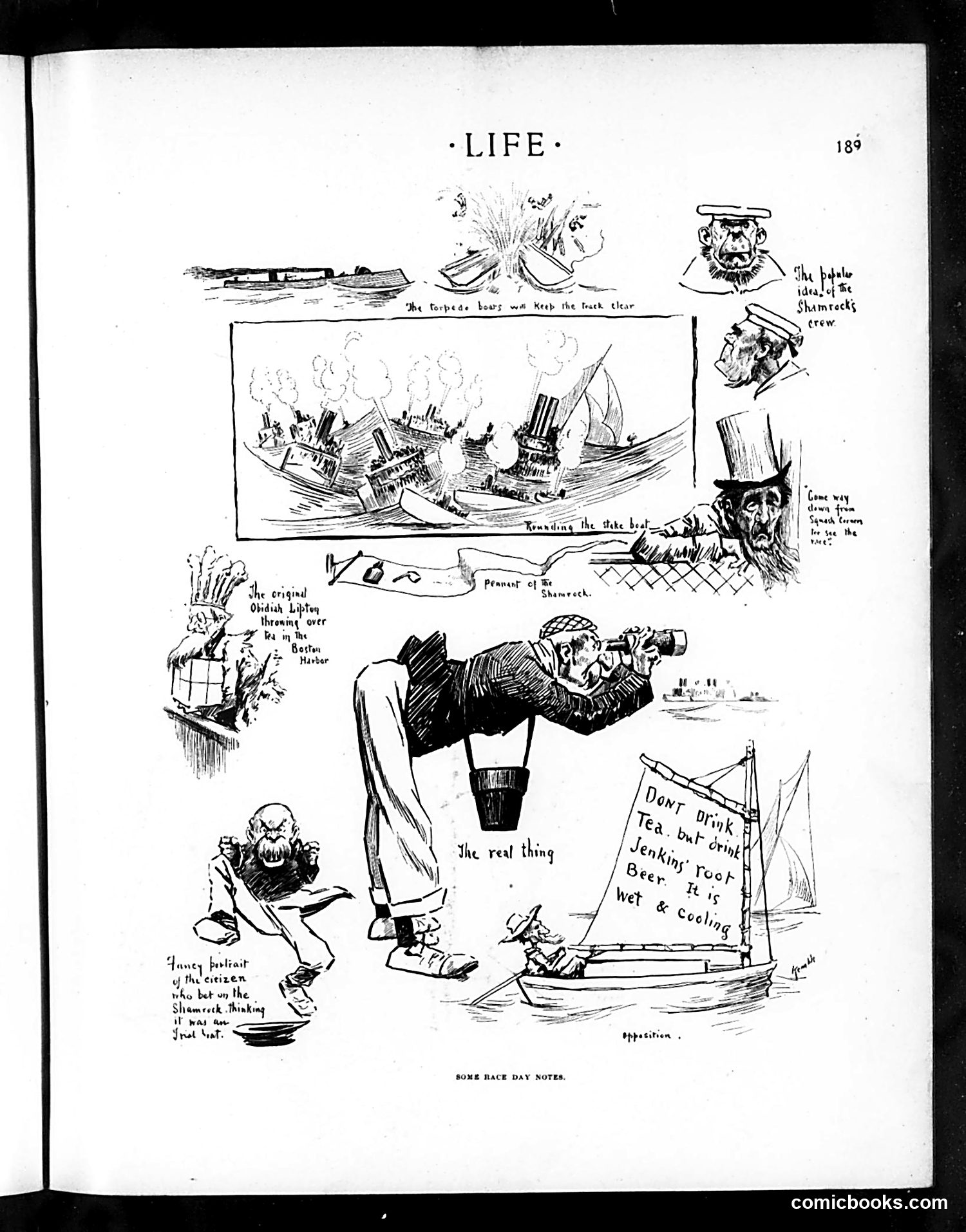
This page satirizes **yacht racing**, likely a prestigious Boston Harbor event. The sketches mock both the sport itself and its social pretensions: **Key elements:** - Top: Ships "boarding the stake boat" with exaggerated smoke and chaos - Center: A portly man using a telescope—"the real thing"—poking fun at enthusiasts' obsessive observation - Left: A disheveled figure labeled commentary on "critics who bet on the Shamrock" (likely the 1899 yacht race), suggesting poor judgment - Right: A boat with humorous rules: "Don't drink Tea but drink Jenkins Root Beer it is wet & cooling"—commercial mockery mixed with nautical culture The overall tone ridicules wealthy yacht enthusiasts' pretensions, their dubious betting habits, and crass commercial intrusions into gentleman's sport. The crude drawings emphasize the satirical rather than celebratory intent.
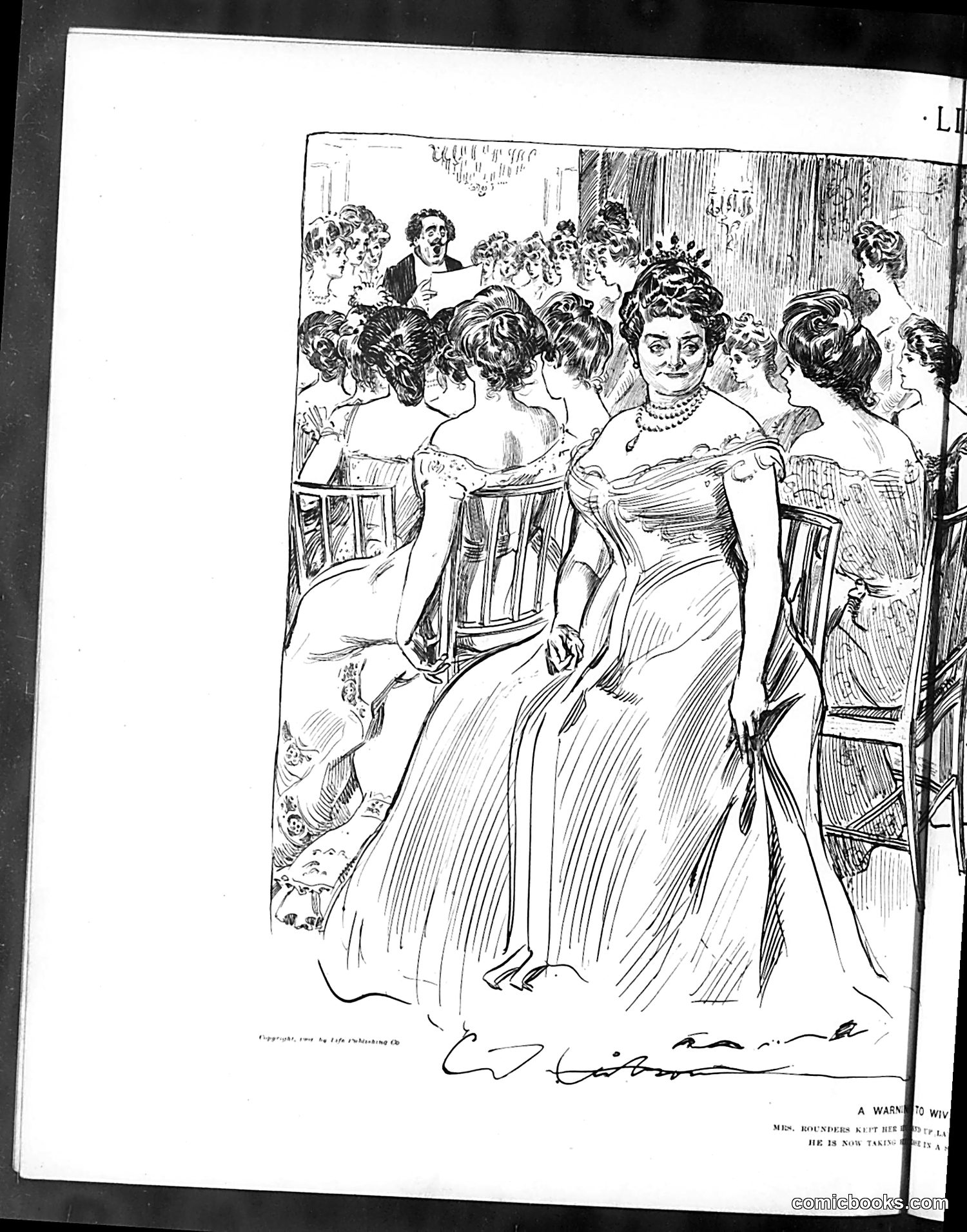
This sketch depicts a formal social gathering of elegantly dressed women in early 20th-century attire. The partially visible caption at bottom reads "A WARNING TO WHY / MISS ROUNDES KEPT HER..." with the rest cut off. The cartoon appears to satirize high society women at what looks like a salon or tea party. The detailed rendering of their elaborate gowns, hairstyles, and jewelry suggests commentary on the fashions and social pretensions of wealthy women of the era. Without the complete caption, the specific satirical target is unclear—it may reference gossip, social climbing, romantic entanglements, or concerns about unmarried women's behavior that were common subjects in *Life* magazine's social satire of that period. The phrase "a warning" suggests cautionary humor about female conduct in polite society.
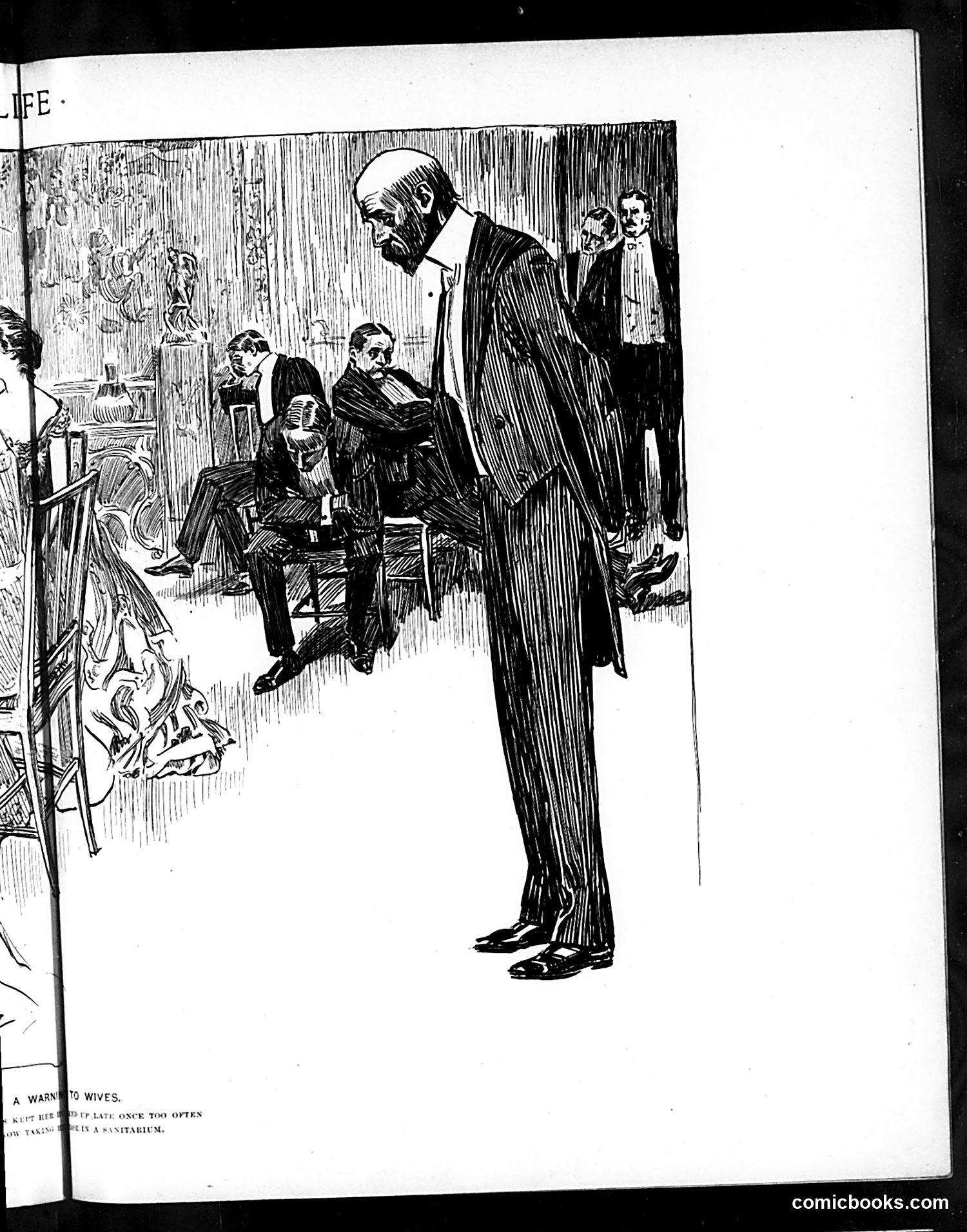
This appears to be a satirical illustration from *Life* magazine titled "A Warning to Wives." The OCR text is partially illegible, but the caption references wives being warned about something occurring "late once too often" and mentions "a sanitarium." The cartoon depicts a tall, elongated man in formal dress standing prominently in what appears to be an interior domestic scene, with several seated figures (likely family members) in the background. The exaggerated height and caricatured features suggest this is a specific public figure, though the identity is unclear from the image alone. The satire appears to mock husbands' behavior—possibly excessive drinking, late nights out, or other domestic transgressions—with the warning directed at wives about tolerating such conduct. The "sanitarium" reference suggests mental health or recovery themes common to early 20th-century satire.
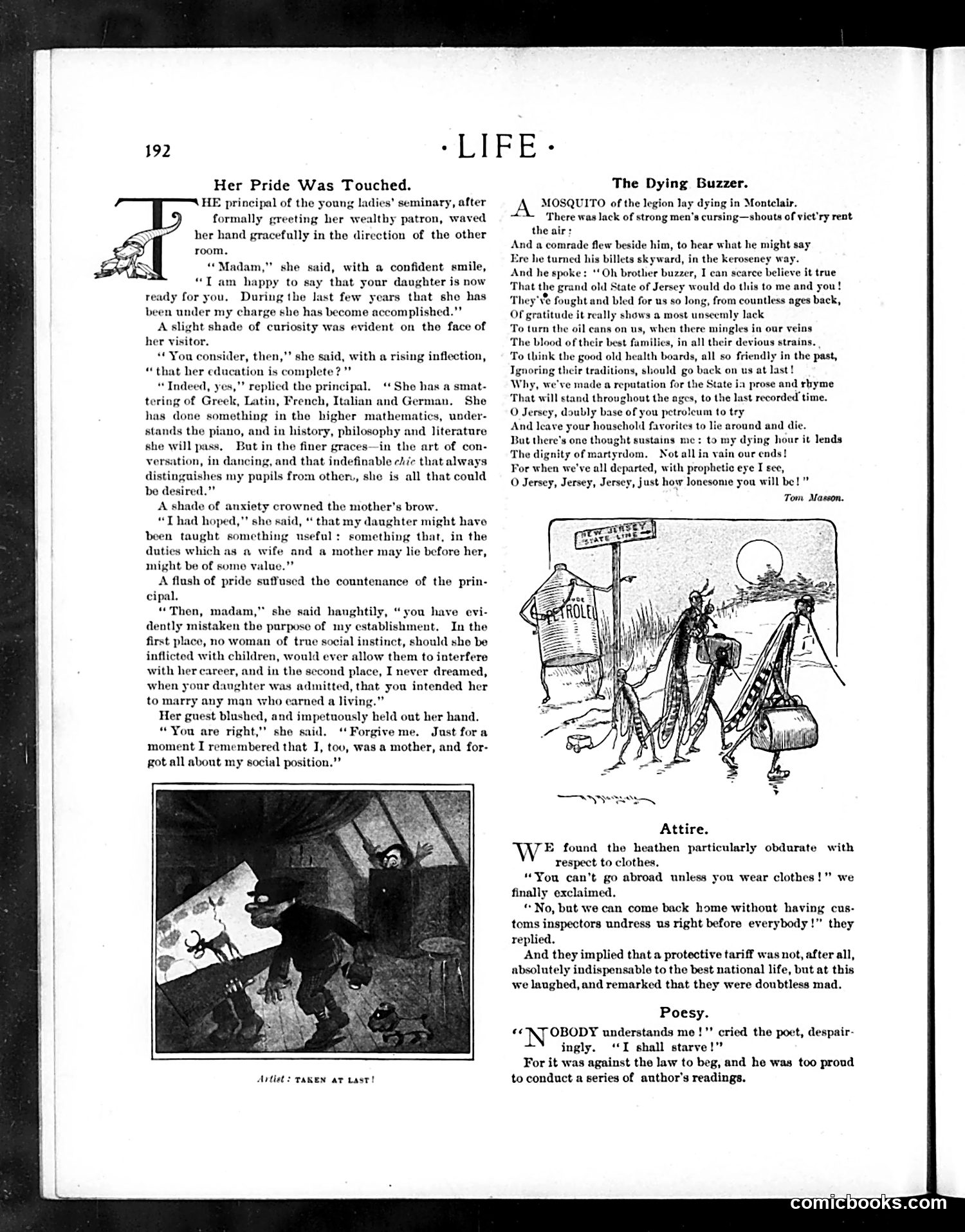
This satirical piece criticizes Jersey City's (or New Jersey's) political establishment during what appears to be a military conflict. The cartoon depicts a dying mosquito—a symbol for Jersey—with patriotic figures around it lamenting lost soldiers and broken traditions. The accompanying poem, attributed to Tom Mason, mocks Jersey's supposed contributions to national defense while suggesting local pride has become hollow. References to "the grand old State of Jersey" and accusations that they've "made a reputation for the Sleigh-ride and rhyme" suggest Jersey was known more for frivolous entertainment than serious civic duty. The satire targets perceived regional hypocrisy: Jersey politicians claim patriotic sacrifice while allegedly ignoring genuine military needs. The dying buzzer metaphor emphasizes weakness and irrelevance.
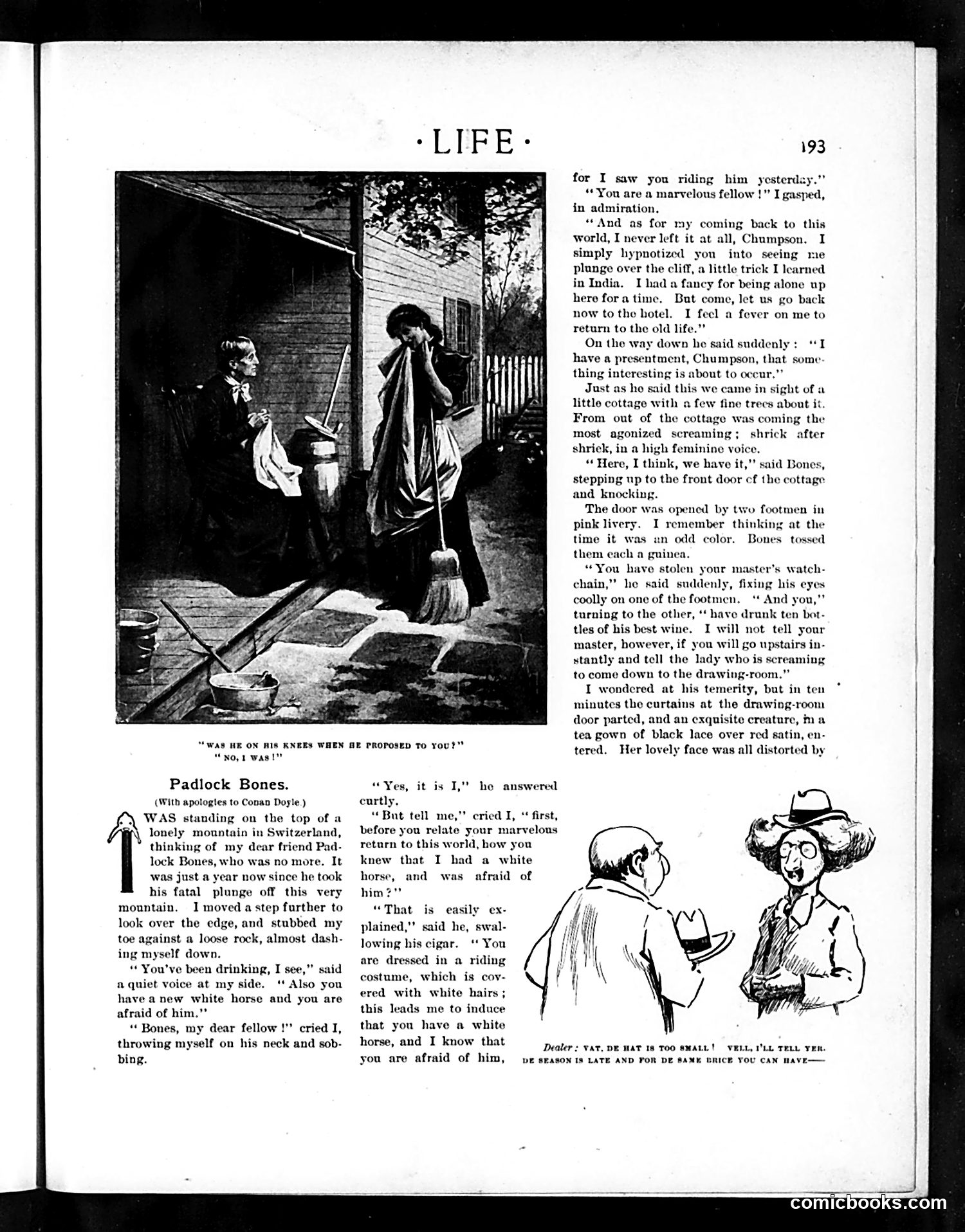
This is a humorous parody of Arthur Conan Doyle's Sherlock Holmes stories (note the subtitle "With apologies to Conan Doyle"). The main character, Padlock Bones, is a thinly-veiled Holmes spoof who deduces facts through observation—here, correctly identifying a friend's white horse and fear of it simply from white hairs on his riding clothes. The satire mocks Holmes's famous deductive method by having Bones apply it to mundane domestic details. The story then sets up a mystery involving screaming from a cottage, which Bones will presumably solve using similar over-the-top logical leaps. The bottom cartoon about a hat dealer appears unrelated—a separate, brief gag about seasonal pricing. This reflects early 20th-century Life magazine's frequent literary parodies, poking fun at the wildly popular Holmes detective formula.
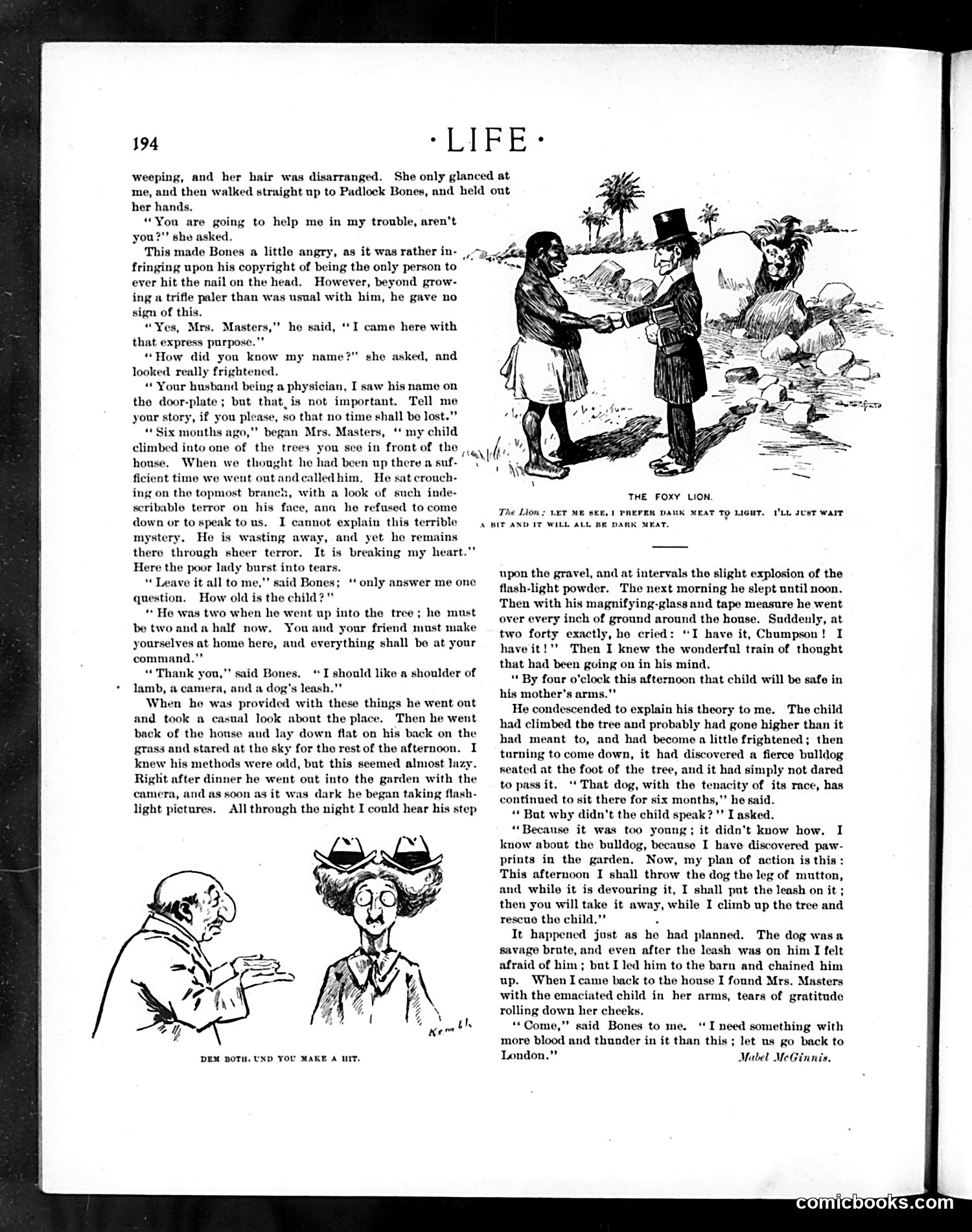
This page contains two distinct pieces of satirical content: **Main Story ("Padlock Bones" Mystery):** A Sherlock Holmes-style detective parody. "Bones" solves a baffling case—a child stuck in a tree for months in apparent terror—through supposedly brilliant deduction. His "solution" is comically absurd: a bulldog has been sitting at the tree's base for six months, preventing the toddler from descending. The satire mocks overly elaborate detective fiction where simple explanations are missed. **Bottom Cartoon ("The Foxy Lion"):** A political/social allegory. A lion (appearing to represent a predatory figure or nation) rationalizes consuming "dark meat" by claiming it will become "dark meat" anyway—circular logic used to justify exploitation. This likely satirizes imperialist or capitalist justifications for taking advantage of vulnerable populations. Both pieces use humor to critique pretentious reasoning and self-serving logic.
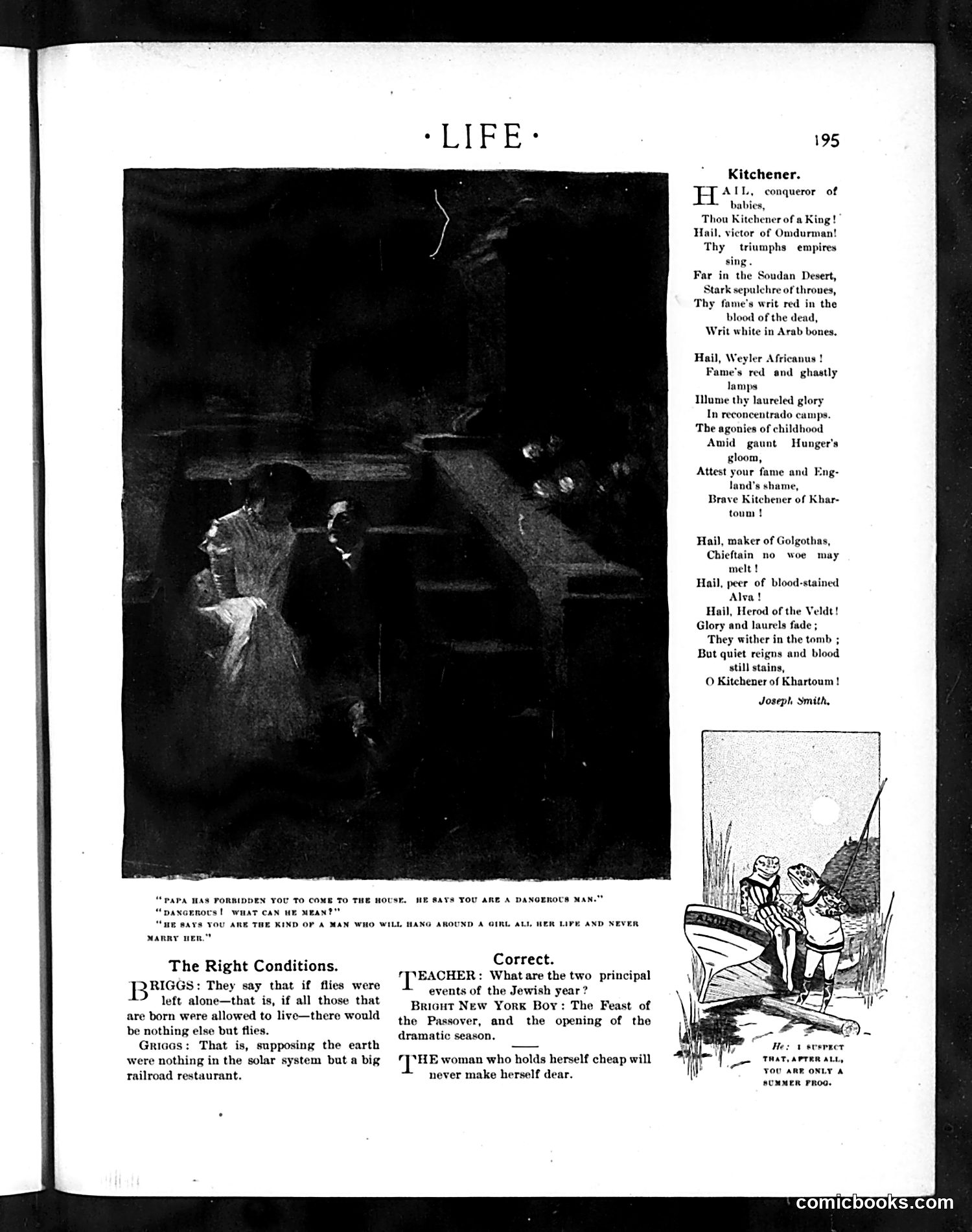
The main content is a scathing poem by Joseph Smith attacking **Lord Kitchener**, the British military commander, using mock-heroic language. The satire equates Kitchener's military victories with atrocities: his campaign in Sudan (Omdurman, Khartoum) is compared to the Spanish general Weyler's "reconcentrado camps" (concentration camps in Cuba) and biblical mass killers (Herod, the Duke of Alva). The poem sarcastically "praises" him while actually condemning the bloodshed and suffering caused by his campaigns, particularly among civilians and children. The accompanying dark photograph appears to show a military or colonial scene, reinforcing the critique. Below are three unrelated humor pieces: a domestic courtship joke, a logic puzzle about flies, and a Jewish holiday joke. These are typical magazine filler content rather than political commentary.
This page primarily contains **literary/editorial content rather than political cartoons**. The main piece, "To the Modern Heroine" (attributed to Celia Myrover Robinson), is **social satire critiquing changes in women's literature and behavior**. It nostalgically protests the "New Woman" trope dominating contemporary novels—the dashing, adventurous female hero who engages in masculine pursuits. The writer laments this shift from traditional femininity (swooning, gentleness, ringlets) and requests publishers return to stories about "tender, loving girls" focused on romance rather than adventure or war narratives. The second article describes a **schoolboy honor anecdote** illustrating that refusing to betray classmates, even under punishment, earns praise from authority figures—celebrating loyalty over obedience to interrogation. The remainder comprises **advertisements** for Wilson Whiskey, Ruinart Champagne, canoes, and boats—typical period product promotions. This reflects early 1900s debates about evolving gender roles and women's increasing independence through literature.
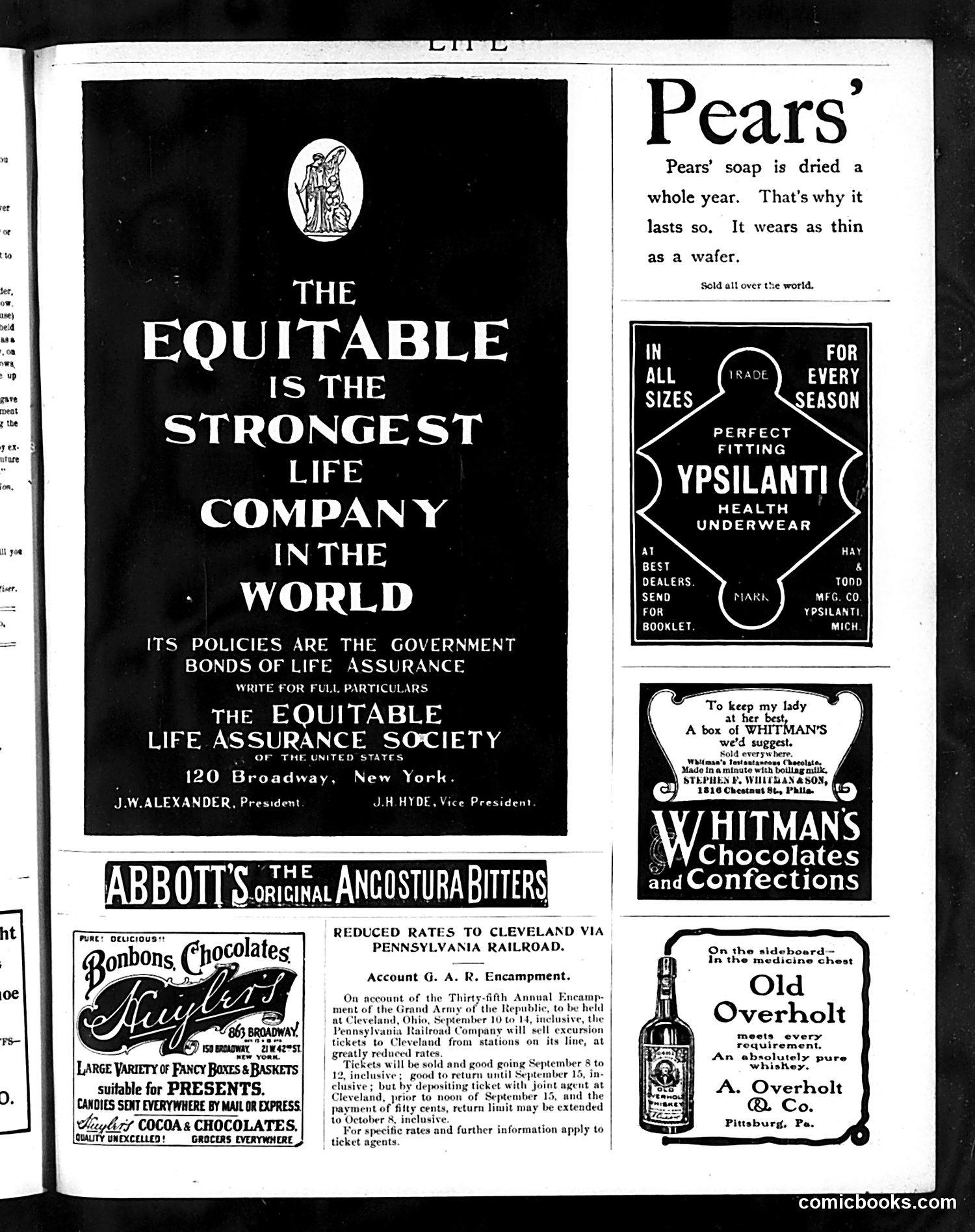
This is primarily an **advertising page**, not a satirical cartoon. The page contains vintage advertisements from approximately the early 1900s. The main content includes: - **Equitable Life Assurance Society** advertisement claiming to be "the strongest life company in the world," with contact information for New York headquarters - **Abbott's Angostura Bitters** and **Bonbons Chocolates** ads promoting fancy boxes suitable for gifts - **Pears' Soap** advertisement emphasizing durability ("wears as thin as a wafer") - **Ypsilanti Health Underwear** promotion - **Whitman's Chocolates** suggestion for keeping "my lady at her best" - **Old Overholt Whiskey** advertisement promoting purity - A notice about **reduced Pennsylvania Railroad rates** for a G.A.R. (Grand Army of the Republic) Encampment in Cleveland The page reflects early 20th-century consumer culture and advertising practices targeting middle to upper-class readers.
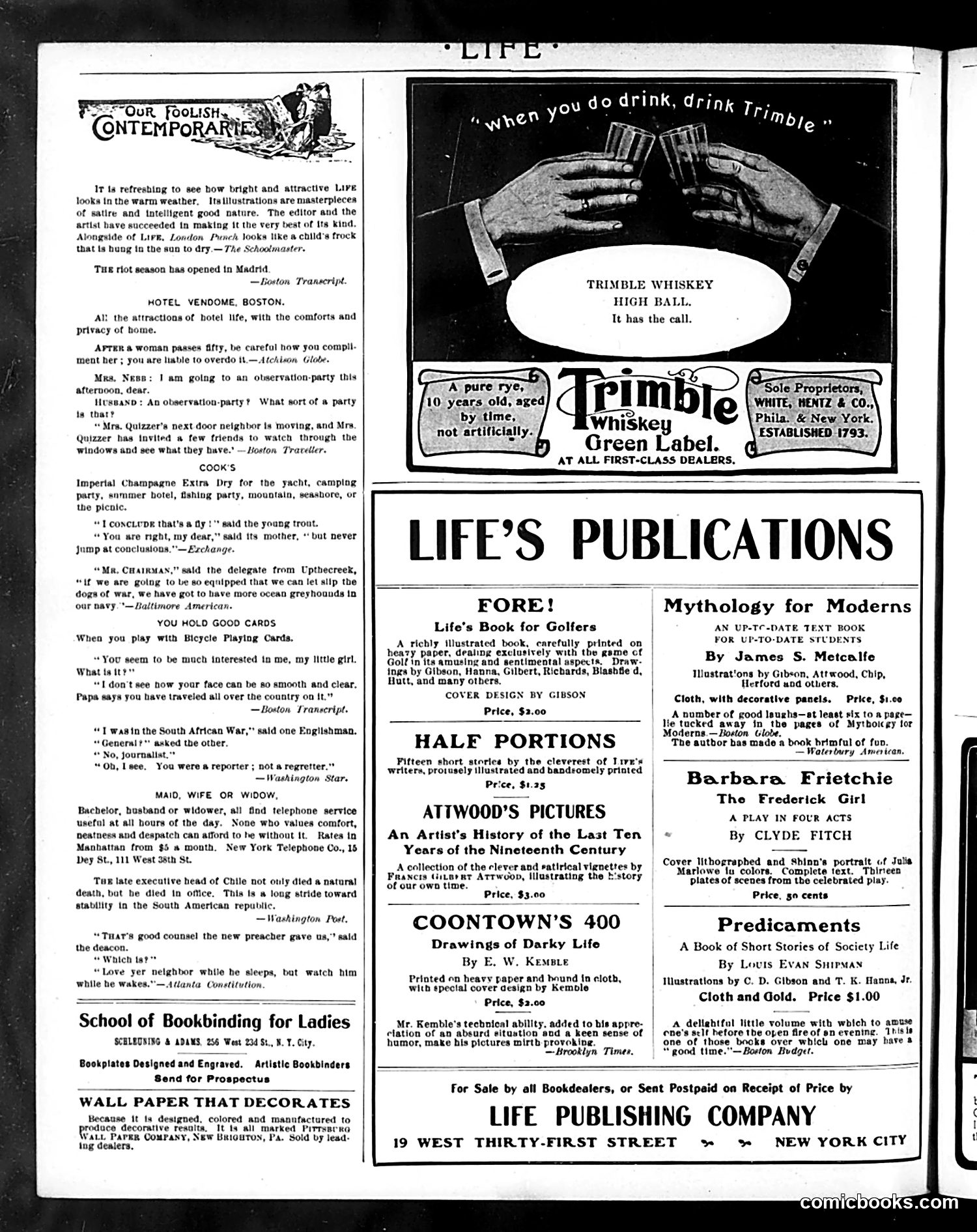
This page is primarily **advertising and promotional content** rather than editorial cartoons. The main elements are: **Satirical Snippets** (left column): Short jokes and observations mocking contemporary life—complimenting older women, marital dynamics, naval preparedness, and American political figures. These brief quips reflect turn-of-the-century American humor about social etiquette and domestic situations. **Central Advertisement**: A Trimble Whiskey ad featuring two hands toasting, with copy "When you do drink, drink Trimble"—typical period alcohol marketing. **Life's Publications** (bottom half): Advertisements for Life magazine's own books, including *Life's Book for Golfers* and collections of short stories, targeting educated, leisured readers. **Other Ads**: Cook's champagne, bicycles, telephone service, and bookbinding classes—reflecting consumer goods and services for upper-middle-class readers. The page captures *Life* magazine's format: mixing satirical social commentary with advertising, aimed at affluent readers interested in literature, leisure activities, and consumer goods.
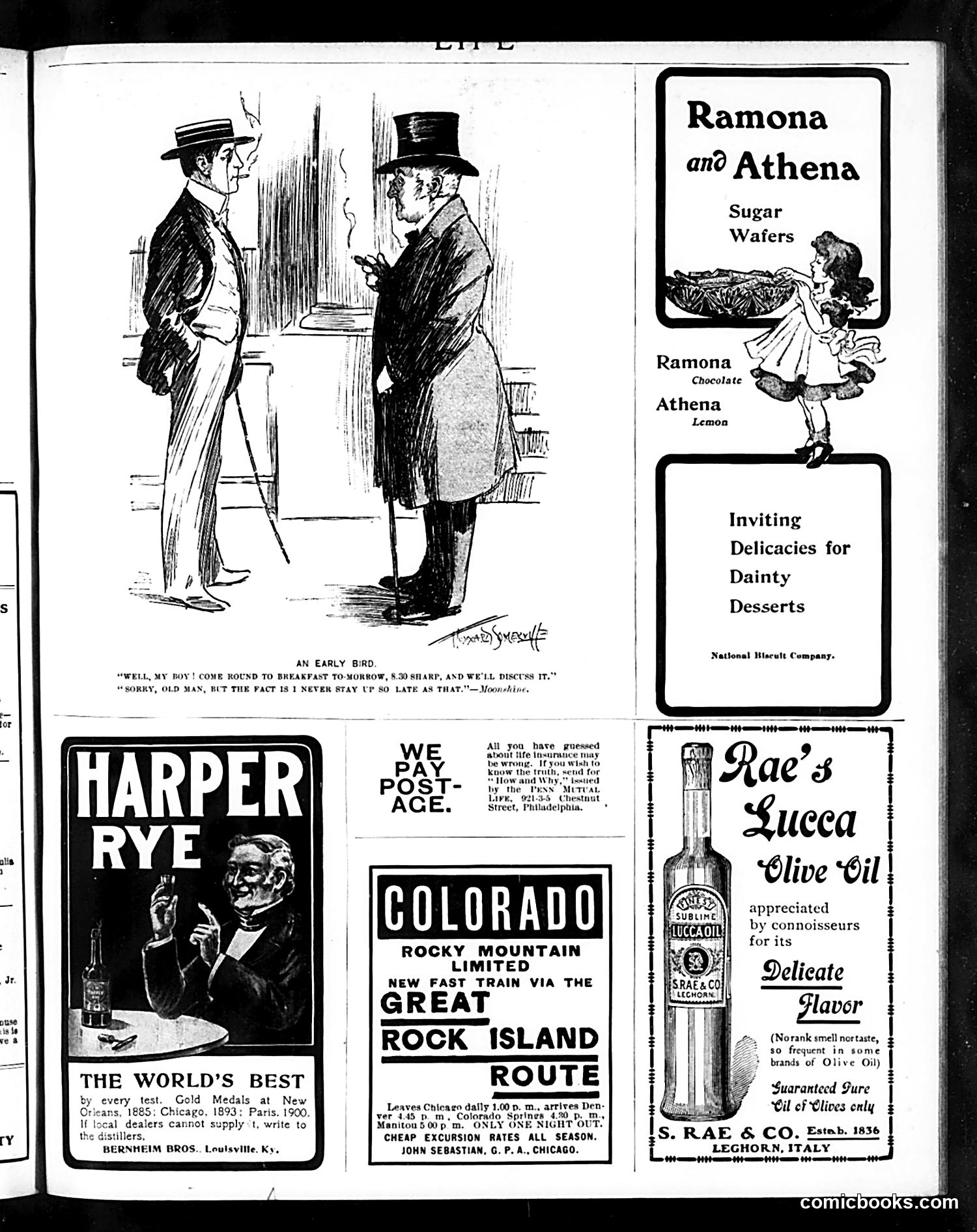
The cartoon depicts two gentlemen in formal dress—top hats and morning coats—engaged in a humorous exchange. One invites the other to breakfast at 8:50 a.m. ("sharp"), proposing they discuss some unspecified matter. The second man declines, claiming he "never stay up so late as that." The joke satirizes Victorian social conventions and the leisurely schedules of wealthy gentlemen. To stay awake until 8:50 a.m. would require staying up until what this character considers an unreasonably late hour—implying he's accustomed to sleeping extremely late into the morning, a marker of aristocratic idleness and privilege. The humor works by inverting expectations: what would be an early morning for most people becomes impossibly late for someone of sufficient leisure and means. The satirical point mocks upper-class decadence and the absurd extremes of gentlemen's indolence. The attribution to "Moonshine" indicates this is a humorous piece rather than political commentary.
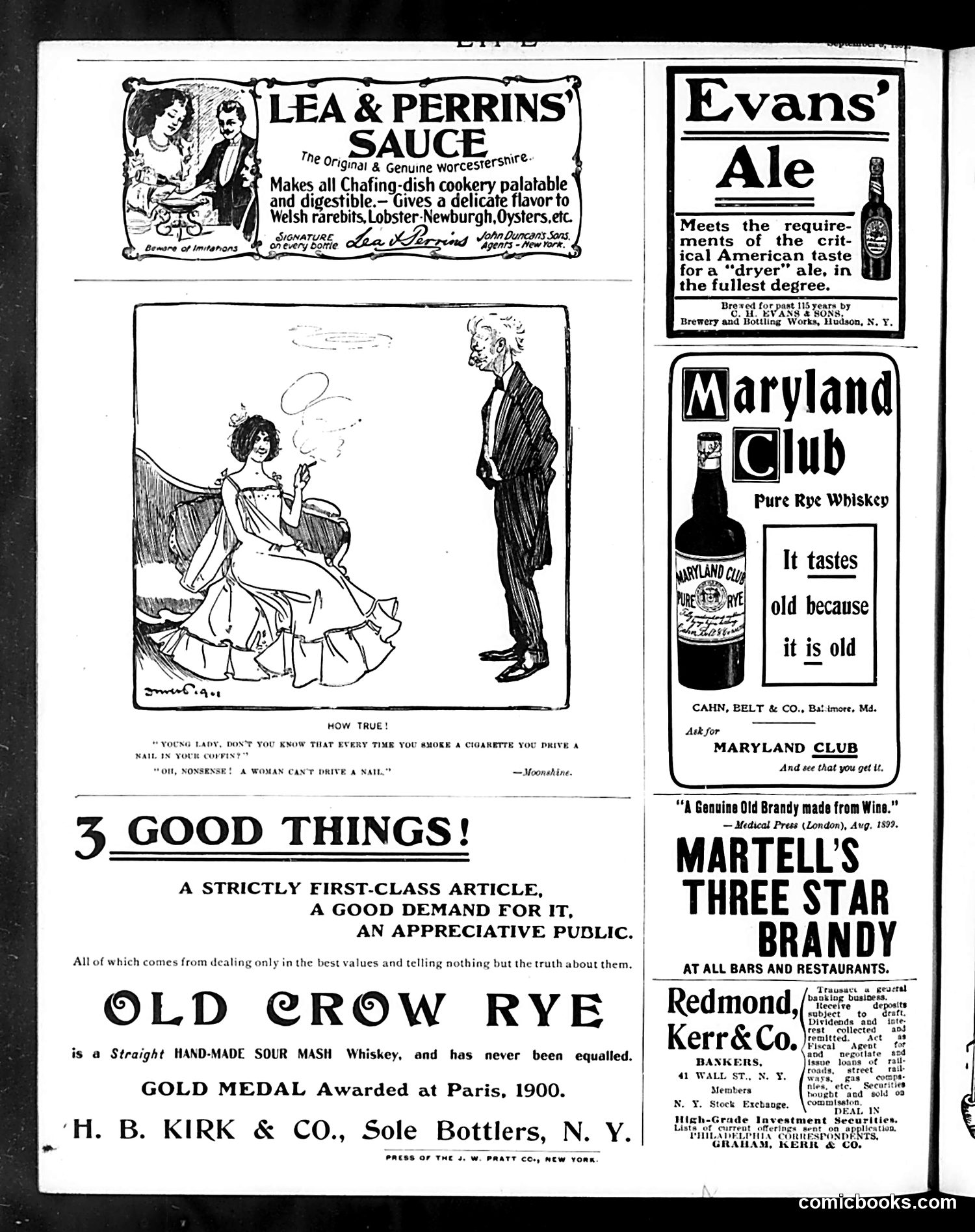
The main cartoon (labeled "HOW TRUE!") depicts a young woman smoking a cigarette while an older man warns her that "every time you smoke a cigarette you drive a nail in your coffin." Her response—"A woman can't drive a nail"—is the joke's punchline, playing on the double meaning of "drive" (both the cautionary phrase and the literal inability to hammer). This satirizes turn-of-the-century moral anxieties about women smoking, a newly visible social behavior. The cartoon mocks the hyperbolic warnings against female smoking by reducing the moral panic to absurdity: the concern isn't genuinely about health, but about propriety and women's proper domestic role. The remainder of the page consists entirely of **period liquor and condiment advertisements** (Lea & Perrins sauce, Old Crow Rye, Evans' Ale, Maryland Club whiskey, Martell brandy), with no additional editorial content or cartoons. This is typical advertising filler for Life magazine's pages.