
Life, 1901-09-05 · page 12 of 20
Life — September 5, 1901 — page 12: what you’re looking at
What you’re looking at
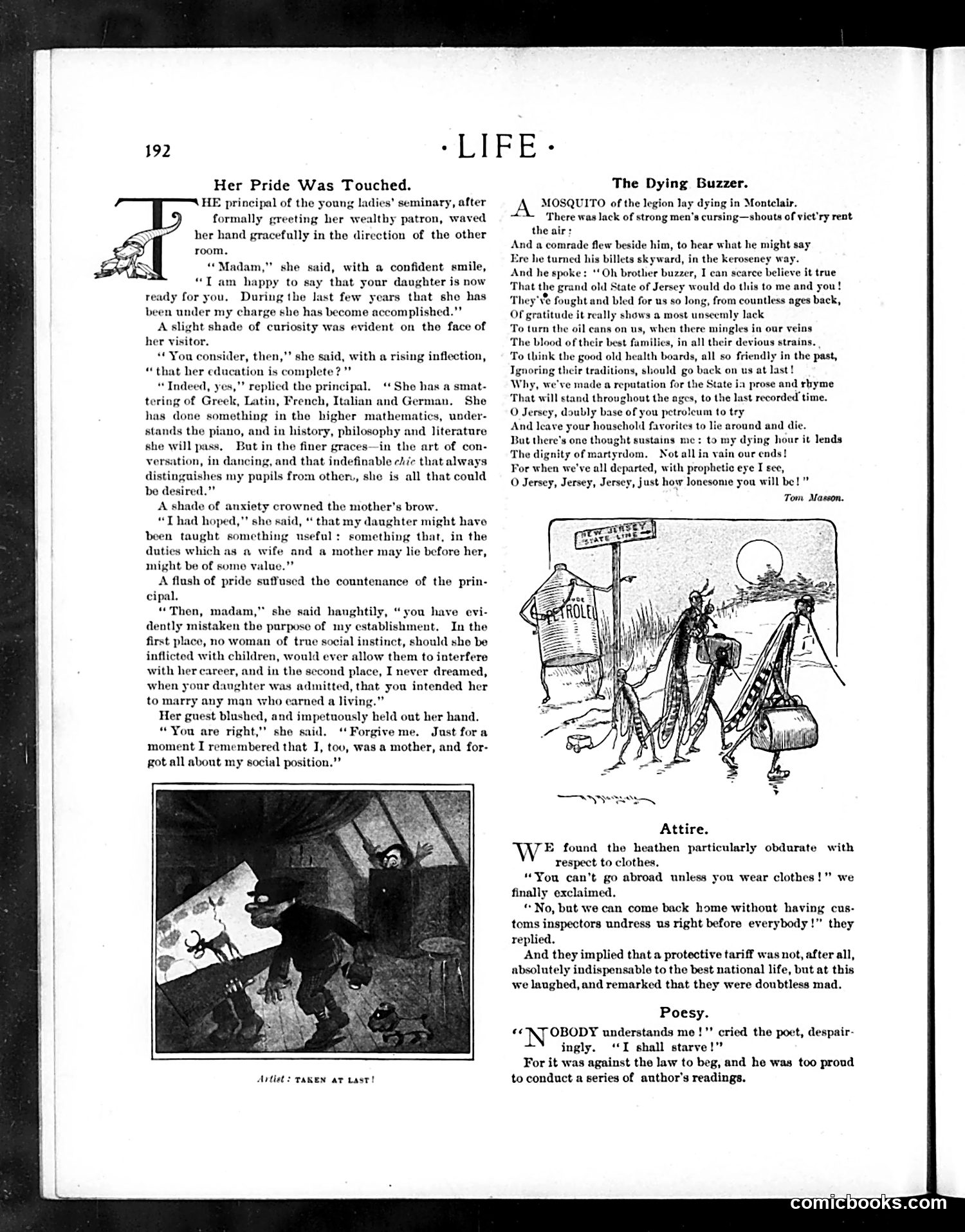
This satirical piece criticizes Jersey City's (or New Jersey's) political establishment during what appears to be a military conflict. The cartoon depicts a dying mosquito—a symbol for Jersey—with patriotic figures around it lamenting lost soldiers and broken traditions. The accompanying poem, attributed to Tom Mason, mocks Jersey's supposed contributions to national defense while suggesting local pride has become hollow. References to "the grand old State of Jersey" and accusations that they've "made a reputation for the Sleigh-ride and rhyme" suggest Jersey was known more for frivolous entertainment than serious civic duty. The satire targets perceived regional hypocrisy: Jersey politicians claim patriotic sacrifice while allegedly ignoring genuine military needs. The dying buzzer metaphor emphasizes weakness and irrelevance.
📄 Transcribed text from this page (OCR, searchable)
Machine-transcribed from the original scan — historical spelling and the odd misread are preserved.
“LIFE = Her Pride Was Touched. HE principal of the young ladies’ seminary, after formally greeting her wealthy patron, waved her hand gracefully in the direction of the other room. “Madam,” she said, with a confident smile, “Tam happy to say that your daughter is now ready for you. During the last few years that she has been under my charge she has become accomplished.” A slight shade of curiosity was evident on the face of her visitor. “You consider, then,"’ she said, with a rising inflection, “that her education is complete?” “Indeed, yes,” replied the principal.“ She has a smat- tering of Greek, Latin, French, Italian and German, She has done something in the higher mathematics, under- stands the piano, and in history, philosophy and literature she will pass, But in the finer graces—in the art of con- in dancing, and that indefinable chic that always hes my pupils from other., she is all that could versatior distin be desired. A shade of anxiety crowned the mother’s brow. “Thad hoped," she said, “ that my daughter might havo been taught something useful: something that, in the duties which as a wife and a mother may lie before her, might be of some value.”” A flash of pride suffused the countenance of the prin- cipal. “Then, madam,” she said haughtily, “you have evi- dently mistaken the purpose of ablishment. In the first place, no woman of true social instinct, should sho be inflicted with children, would ever allow them to interfere with her career, and in the second place, I never dreamed, when your daughter was admitted, that you intended her to marry any man who earned a living.” Her guest blushed, and impetuously held out her hand. “You are right,” she said. ‘Forgive me. Just fora moment I remembered that J, tov, was a mother, and for- got all about my social position.” Artist? TAREN at Last! The Dying Buzzer. A MOSQUITO of the legion lay dying in Montclair. There was lack of strong men’s cursing—shouts of vict'ry rent the air: And a comrade flew beside him, to hear what he might say Ere he tured his billets skyward, in the keroseney way. And he spoke: “Oh brother buzzer, I can se: he grand old State of Jersey would do this to me and you! ‘fought and bled for us so long, from countless ages back, Of gratitude it really shows a most unseemly lack To turn the oil cans on us, when there mingles in our veins The blood of their best famili in all their devious strains. To think the good old health boards, all so friendly in the past, Ignoring their traditions, should go back on us at last! Why, we've made a reputation for the State ia prose and rhyme ‘That will stand throughout the ages, to the last recorded time. O Jersey, doubly base of you petroleum to try And leave your houschold favorites to lie around and die. But there's one thought sustains me: to my dying hour it lends ‘The dignity of martyrdom. Not all ia vain our ends! For when we've all departed, with prophetic eye I see, O Jersey, Jersey, Jersey, just how lonesome you will be!” Tom Masson. SIS Attire. “WW & found tho heathen particularly obdarate with respect to clothes, “You can’t go abroad unless you wear clothes!" we finally exclaimed. “No, but we can come back home without having cus- toms inspectors undress us right before everybody!" they replied, And they implied that a protective tariff was not, after all, absolutely indispensable to the best national life, but at this we laughed, and remarked that they were doubtless mad. Poesy. «NY On0DY understands me !"’ cried the poet, despair- ingly. ‘I shall starve!” For it was against the law to beg, and he was too proud to conduct a series of author's readings.