
A complete issue · 20 pages · 1901
Life — August 29, 1901
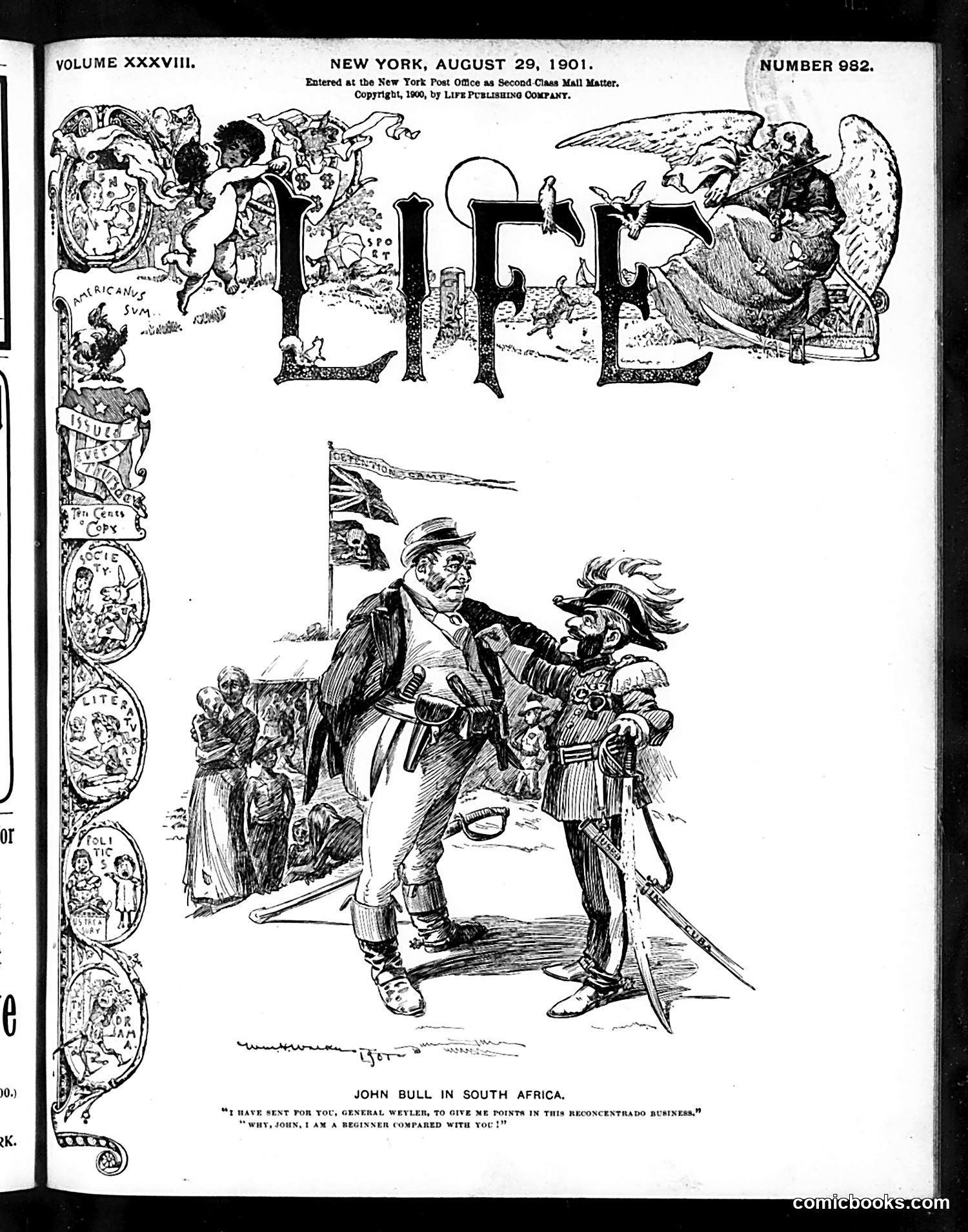
This is a political cartoon from *Life* magazine, August 29, 1901, during the Second Boer War (1899-1902). "John Bull" is the personified British Empire. The cartoon depicts a British military officer confronting what appears to be a Boer (Dutch-descended South African) soldier. The caption reads: "I have sent for you, General Wetler, to give me points in this reconcentrado business. Why, John, I am a beginner compared with you!" This sarcastically criticizes British tactics in South Africa—specifically the "reconcentrado" (concentration camp) strategy, where the British forcibly relocated Boer civilians. The satire suggests the British are learning brutal tactics from General Weyler, who infamously used concentration camps during the Cuban War of Independence. The cartoon attacks British military conduct as morally equivalent to Spanish colonialism.
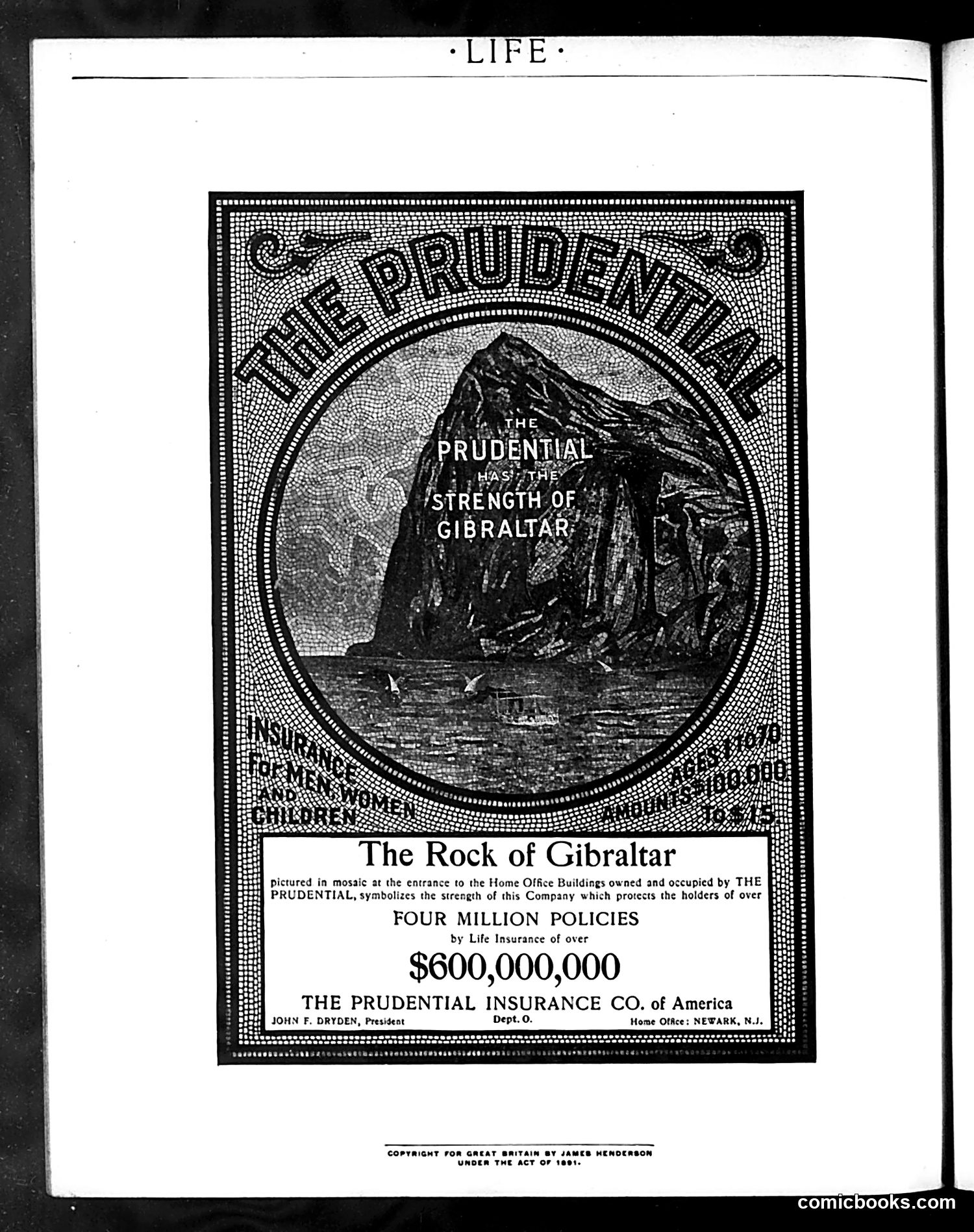
This is **not a cartoon or satire**—it's a straightforward insurance advertisement from *Life* magazine. The page features the Rock of Gibraltar as the central image, symbolizing strength and permanence. The ad promotes The Prudential Insurance Company of America, using Gibraltar as a metaphor for the company's stability and protective strength. The text explicitly states the image "symbolizes the strength of this Company which protects the holders of over FOUR MILLION POLICIES by Life Insurance of over $600,000,000." The company's president is identified as John F. Dryden, with headquarters in Newark, N.J. This represents early 20th-century corporate branding through classical symbolism—equating an insurance company's reliability with a famous natural fortress.
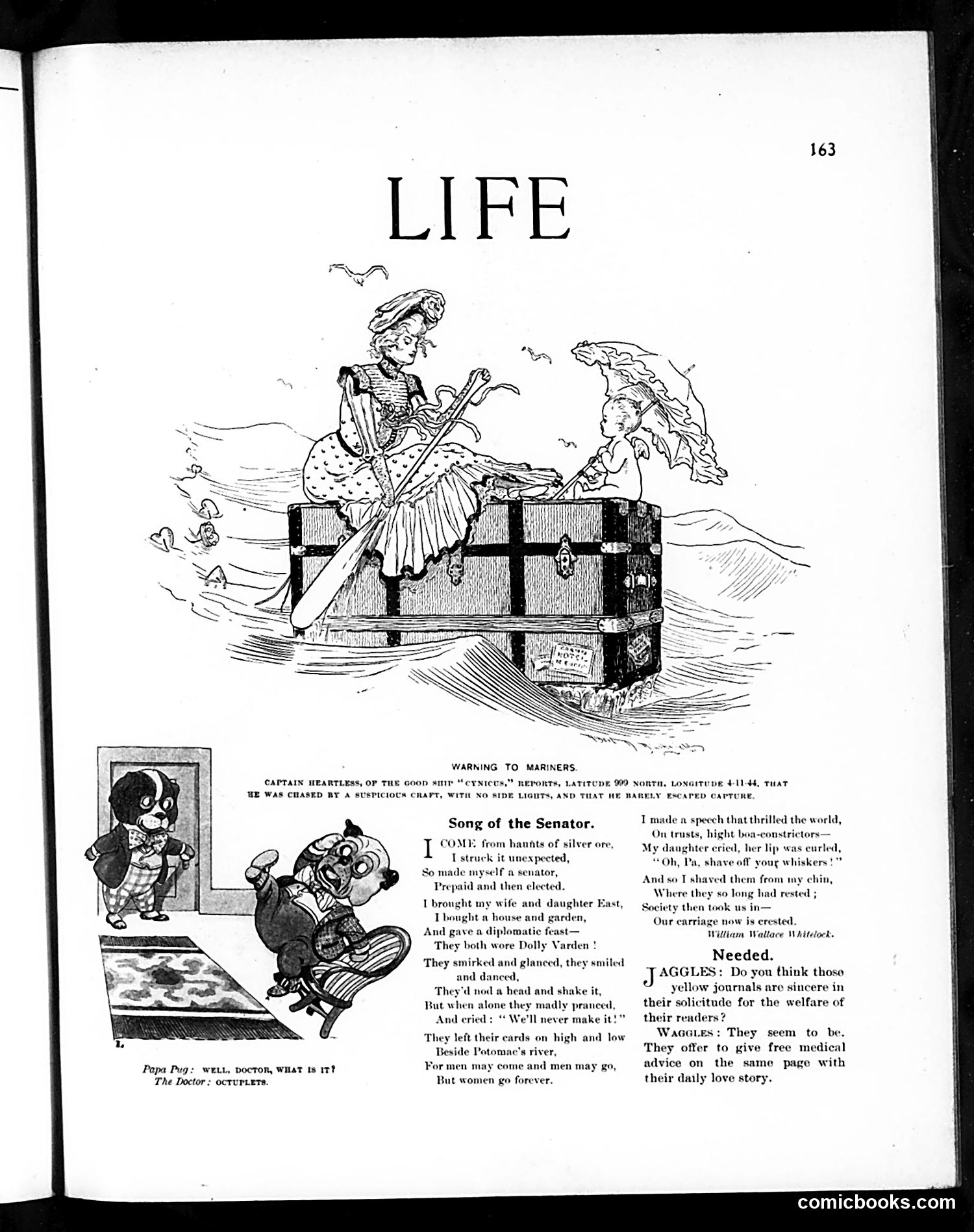
This page contains two distinct satirical pieces: **"Song of the Senator"** appears to mock a politician (likely a U.S. Senator) who has achieved wealth and status through corruption or manipulation. The narrative describes someone who "made a speech that thrilled the world," rose to political prominence, then purchased luxury goods (house, garden, diplomatic feast) while his wife and daughter benefited from this elevated social position. The final lines suggest hypocrisy: women "go forever" while men come and go—possibly critiquing the senator's moral inconsistency. **"Taggles" and the cartoon below satirize sensationalist journalism. The dialogue between "Papa Pug" and "The Doctor" (depicted as anthropomorphic dogs) mocks yellow journals that claim to offer sincere welfare advice while actually peddling entertainment disguised as medical guidance—a common criticism of late-19th/early-20th century tabloid newspapers.
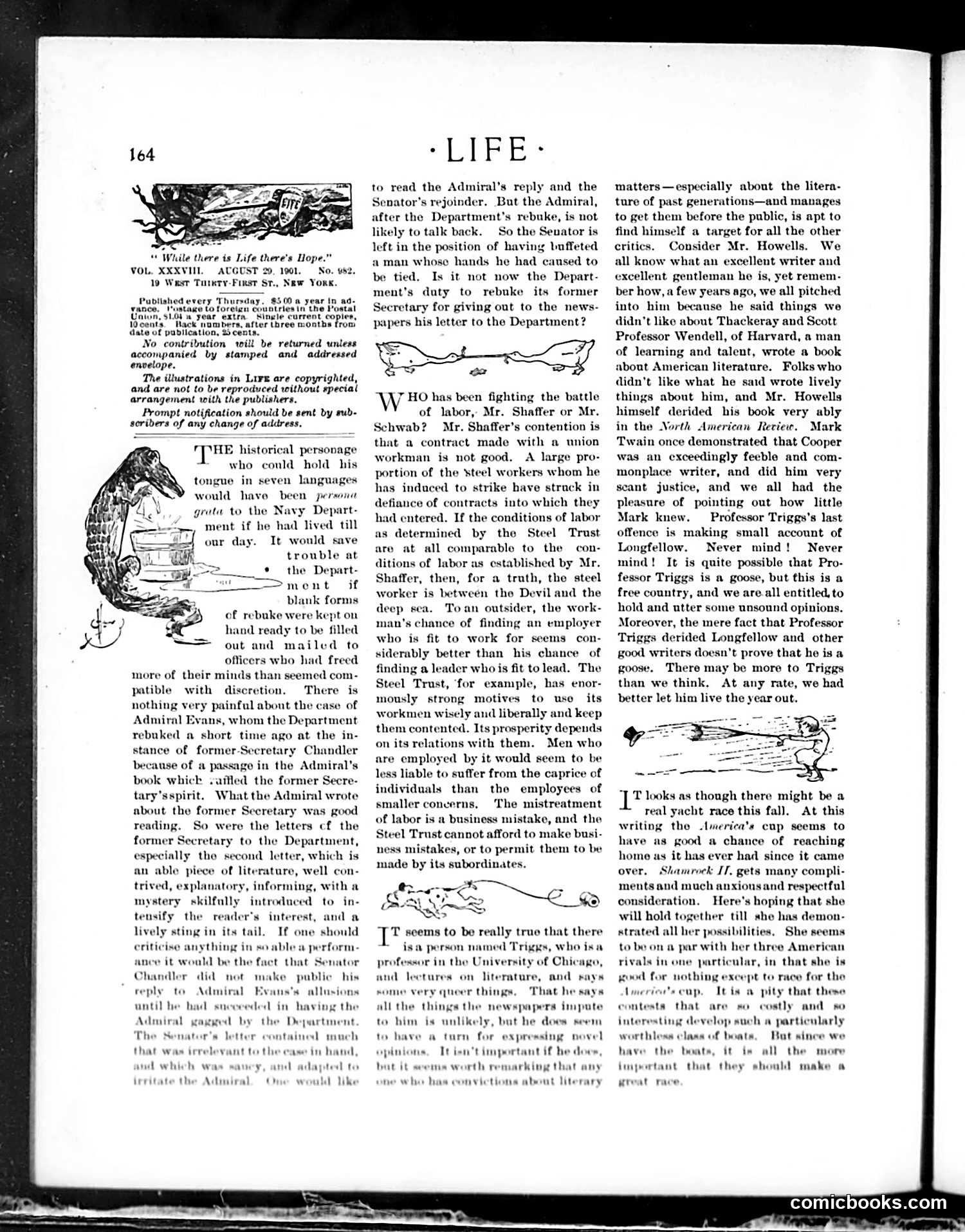
This page contains editorial commentary on labor disputes and literary criticism rather than traditional political cartoons. **Labor Dispute Cartoon (left):** A figure labeled as representing labor conflict appears to illustrate disputes between the Steel Trust and workmen. The text discusses whether steel workers striking against contract violations represent a genuine labor cause or are manipulated by outside agitators. **Literary Criticism Section (right):** The content critiques Professor Triggs of the University of Chicago for his negative reviews of American writers, particularly Mark Twain and Cooper. Life defends these authors against what it views as unfair academic dismissal. **Small Yacht Cartoon (bottom right):** References an upcoming yacht race (likely America's Cup), presenting it as a notable social event worth following. The page prioritizes political and cultural commentary over visual satire.
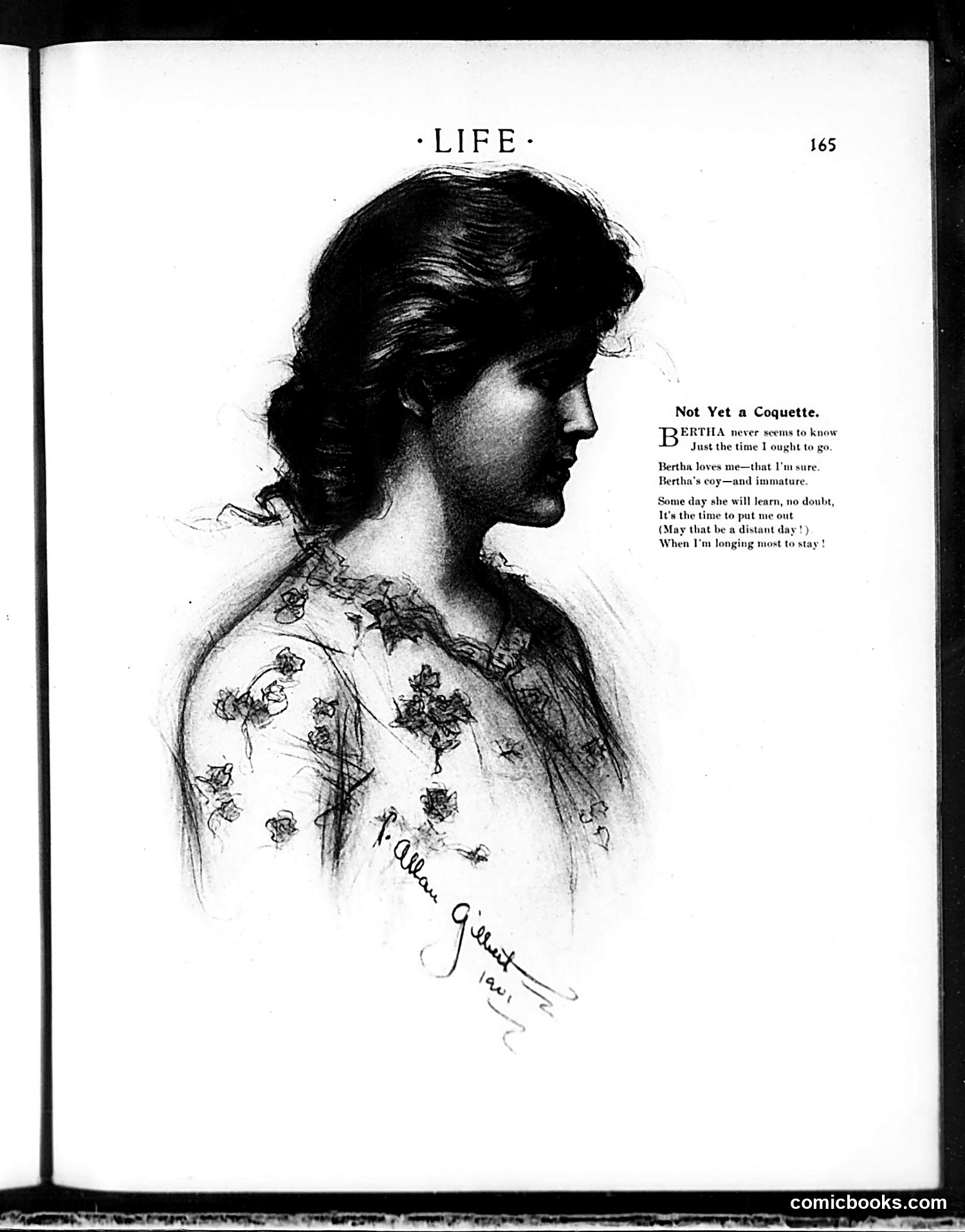
This page from *Life* magazine features a portrait sketch of a young woman in profile, wearing a floral-patterned garment. The accompanying poem expresses frustration with someone named Bertha, who apparently doesn't understand social timing or romantic convention. The speaker complains that Bertha is "coy" and "immature," suggesting she should recognize when it's appropriate to commit to a relationship ("put one out"). The satirical point targets young women who either feign innocence or genuinely lack social sophistication about courtship expectations—mocking both Bertha's immaturity and, implicitly, the rigid social rules governing women's romantic behavior in this era.
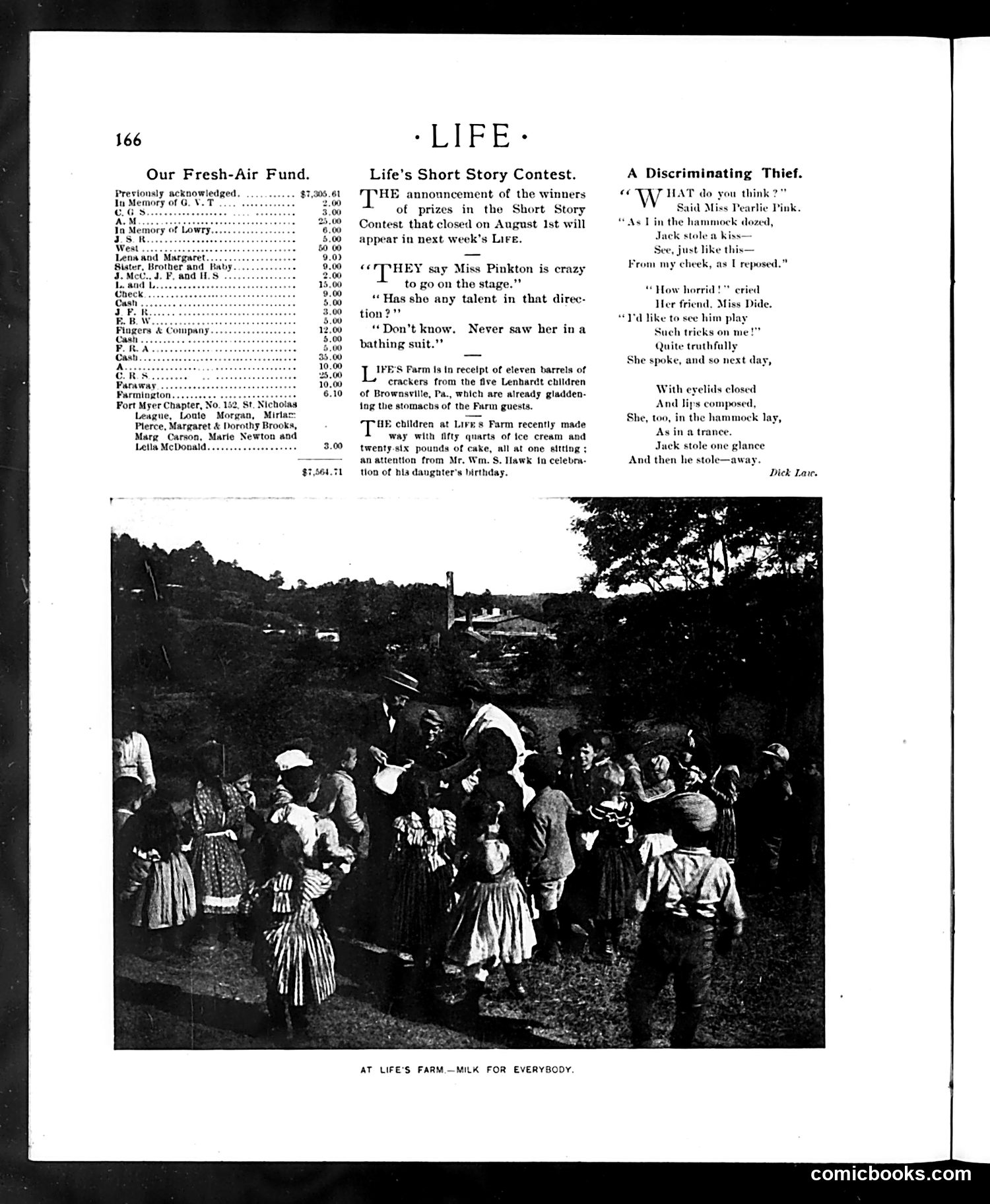
This page contains three distinct sections with no political cartoons: 1. **"Our Fresh-Air Fund"** - A donation list supporting a charitable program providing outdoor recreation for urban children, with contributors' names and amounts ($1-$15). 2. **"Life's Short Story Contest"** - An announcement about a fiction contest closing August 1st, with results to appear in next week's issue. 3. **"A Discriminating Thief"** - A humorous poem about Jack, who steals from a hammock, written by Dick Law. The verse describes his selective theft with comic timing. 4. **Photograph** - Shows children at Life's Farm in Brownsville, Pennsylvania, receiving ice cream and cake at a birthday celebration. The caption notes "Milk for Everybody," emphasizing the farm's community purpose. This is primarily charitable and literary content rather than political satire.
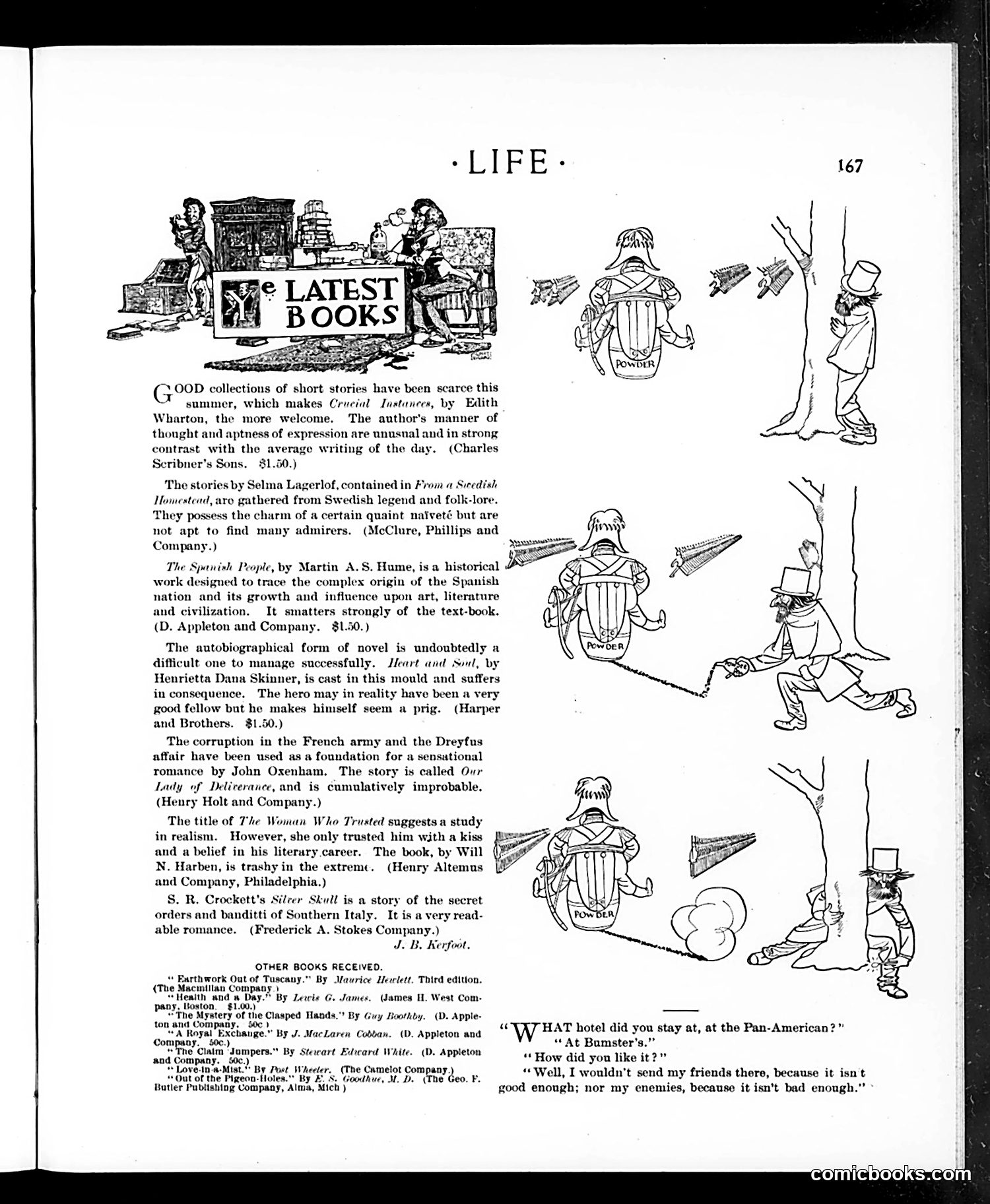
This page from *Life* magazine features a **"Latest Books" book review section** on the left, discussing recent literary releases by authors like Edith Wharton and Martin A. S. Hume. On the right is a **humorous cartoon strip** depicting a traveler with a large powder keg backpack encountering various mishaps—the keg repeatedly explodes or creates chaos as the character interacts with nature (trees, animals, other people). Below is a **joke dialogue** about hotel quality: a guest stayed at "Bamster's" hotel but wouldn't recommend it to friends or enemies alike, saying it's "not good enough" for either group—a backhanded insult suggesting the establishment is universally poor. The cartoon's humor relies on visual slapstick, while the dialogue uses ironic logic for comedic effect.
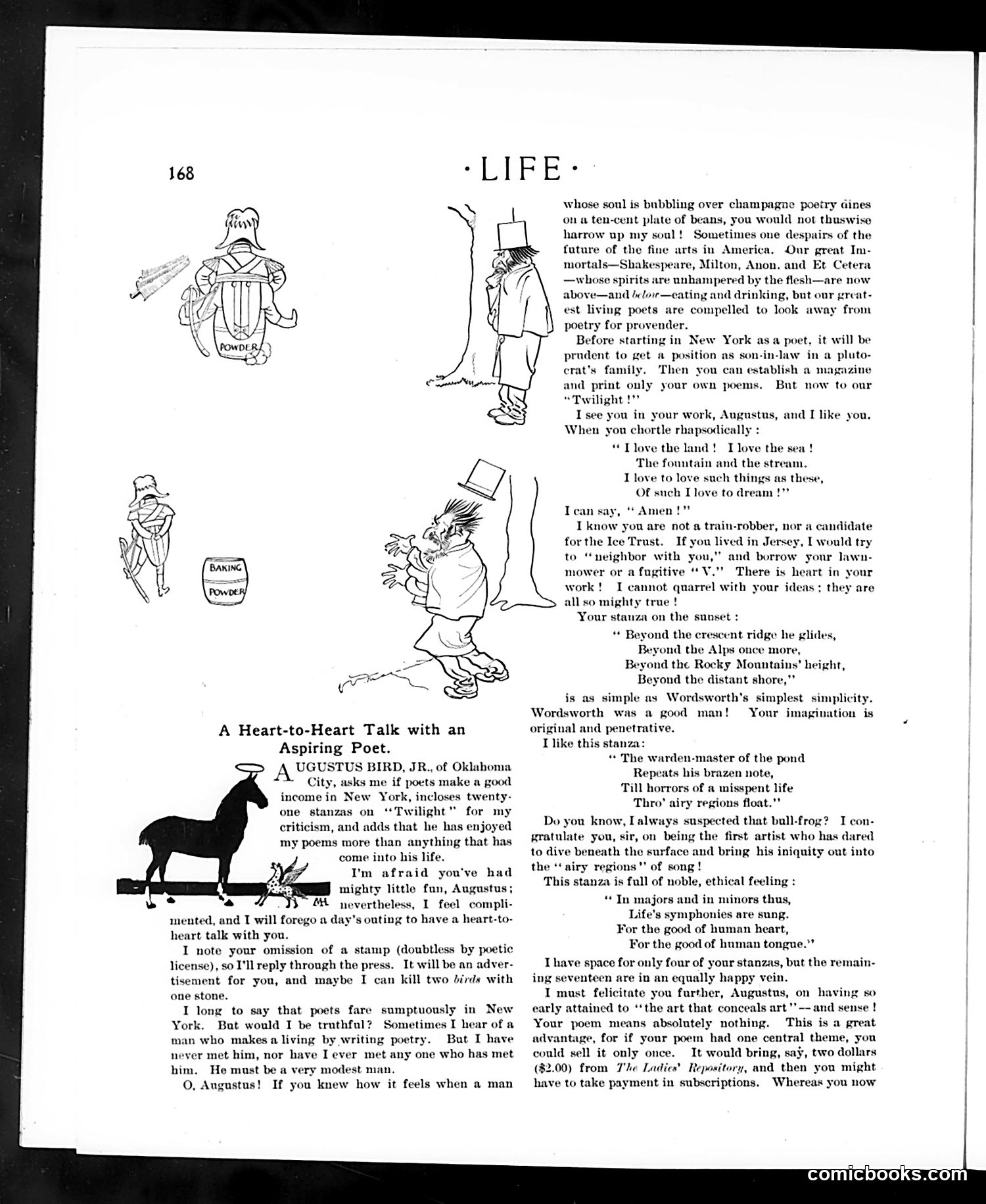
This satirical piece mocks the impracticality of pursuing poetry as a profession in America. The author (identified as Augustus Bird, Jr. of Oklahoma City) addresses a young poet named Augustas, offering blunt advice: poets cannot make a living in New York through poetry alone. The accompanying cartoons show figures labeled with items like "POWDER" and "BAKING POWDER," satirizing how poets must supplement income through commercial work unrelated to their art. The author warns that even great American poets struggled financially, suggesting aspiring poets should seek alternative employment—perhaps as photographers or in other trades—before attempting to establish a literary magazine. The satire targets the gap between artistic ambition and economic reality in early 20th-century America.
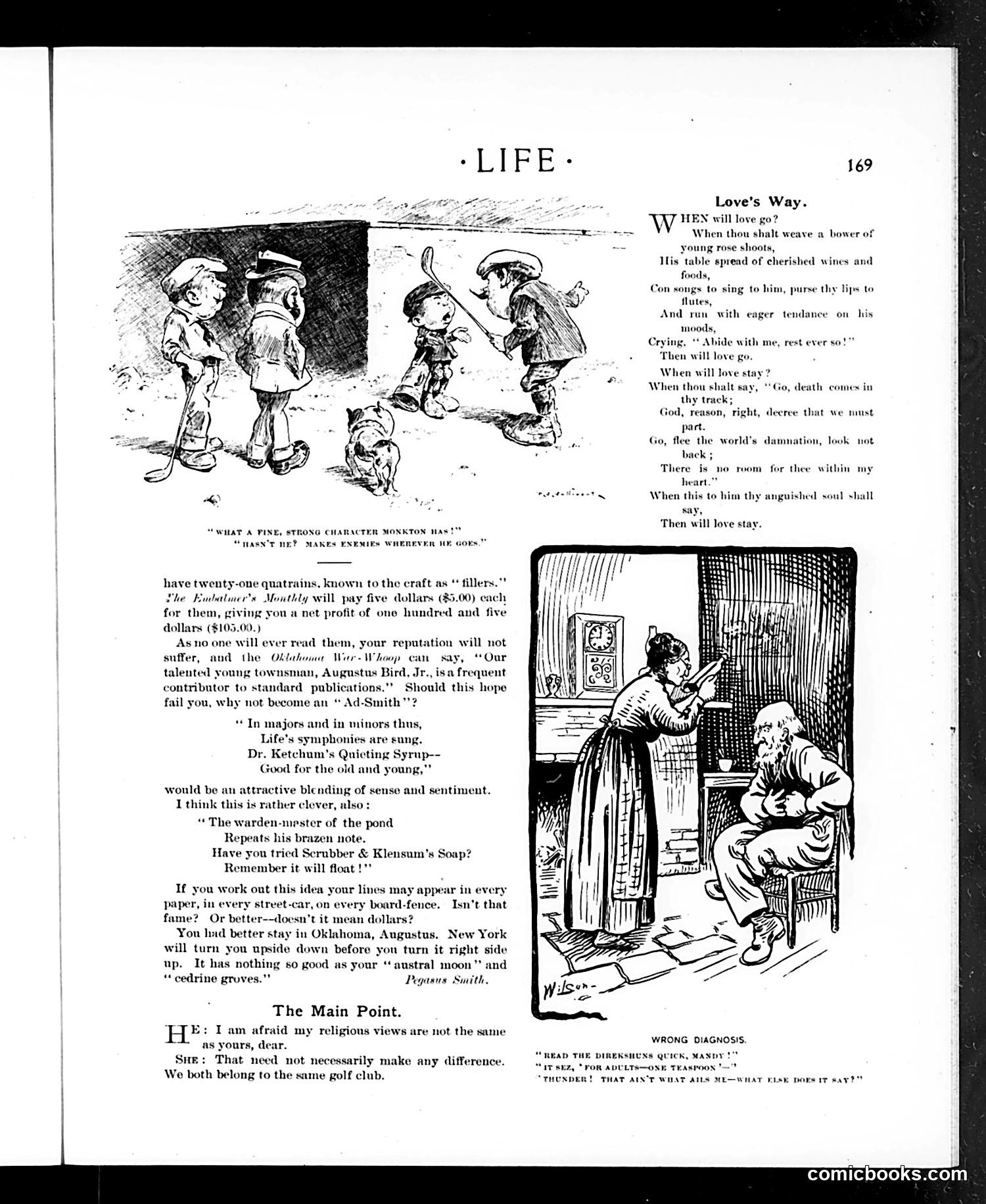
This page contains three distinct sections: 1. **"Love's Way"** — A sentimental poem about romantic devotion and separation, with accompanying illustration showing children playing with a dog. 2. **"What a Fine, Strong Character Monkton Has!"** — A satirical section mocking aspirational writers. It advises against pursuing writing in *Life* magazine, sarcastically suggesting the writer "Augustus Bird, Jr." should instead become an "Ad-Smith" (advertising writer). The satire targets young people with literary ambitions who chase publication in prestigious venues. 3. **"Wrong Diagnosis"** — A cartoon showing a woman confronting a man, with dialogue about a medical product (Dirkbush's Quick). The humor relies on miscommunication about the product's intended use. 4. **"The Main Point"** — A brief dialogue about religious differences being irrelevant compared to shared golf-club membership—satirizing how social class supersedes ideology.
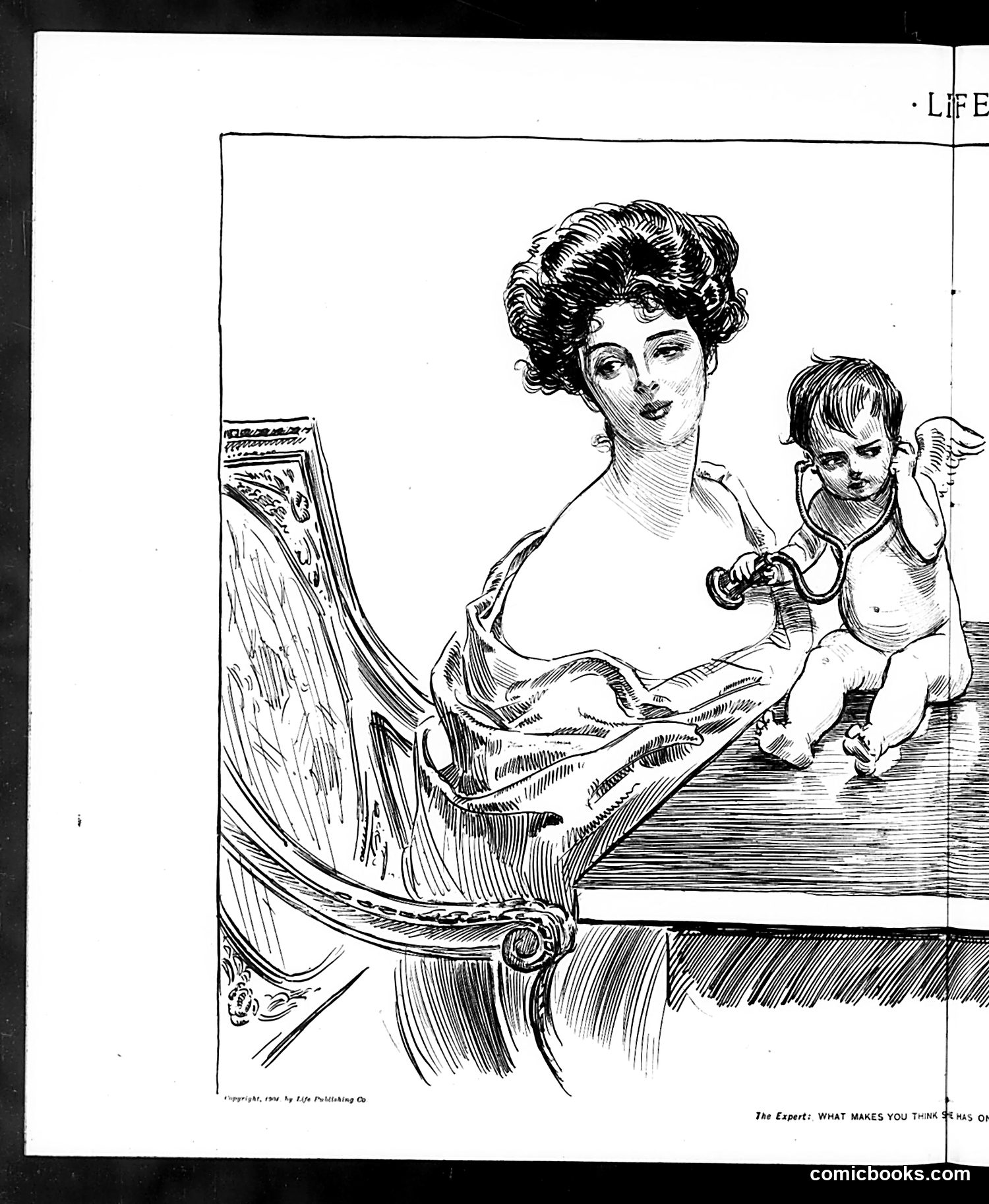
This appears to be an early 20th-century satirical illustration from *Life* magazine showing a well-dressed woman with an infant. The cartoon is titled "The Expert: What Makes You Think He Has On—" (text cut off). The satire likely concerns contemporary debates about child-rearing and parenting expertise. The woman's fashionable appearance and the incomplete caption suggest the joke involves questioning assumptions—possibly about whether the infant is properly dressed or clothed, or satirizing pretentious parenting advice from so-called "experts." The illustration's style and the "LIFE" watermark confirm this is from the publication's satirical period, when it frequently mocked social conventions, parenting trends, and the emerging culture of expert advice that influenced middle and upper-class American families.
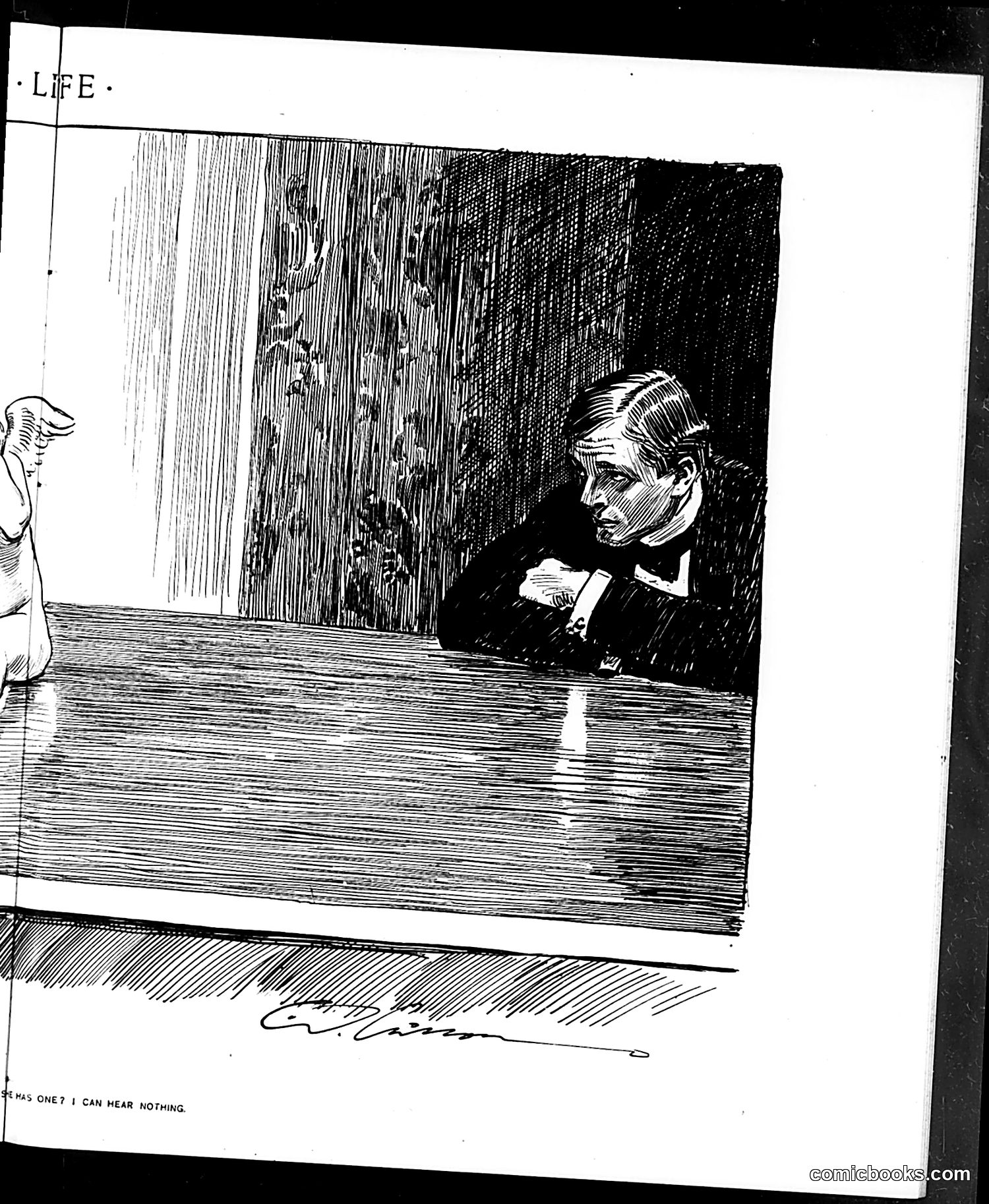
This Life magazine cartoon depicts a formally dressed man in formal attire (tuxedo and bow tie) sitting alone in what appears to be a theater or similar venue. The caption reads: "PARDON? I CAN HEAR NOTHING." The satire appears to target a wealthy or elite figure who is deliberately ignoring or refusing to acknowledge something—perhaps criticism, social problems, or unwelcome news from the outside world (suggested by the dark, textured background). The formal dress suggests high social status, while his claimed inability to "hear nothing" is ironic commentary on willful ignorance or selective deafness to societal concerns. Without additional context about the specific historical moment Life published this, the precise target remains unclear, though it's clearly mocking upper-class indifference.
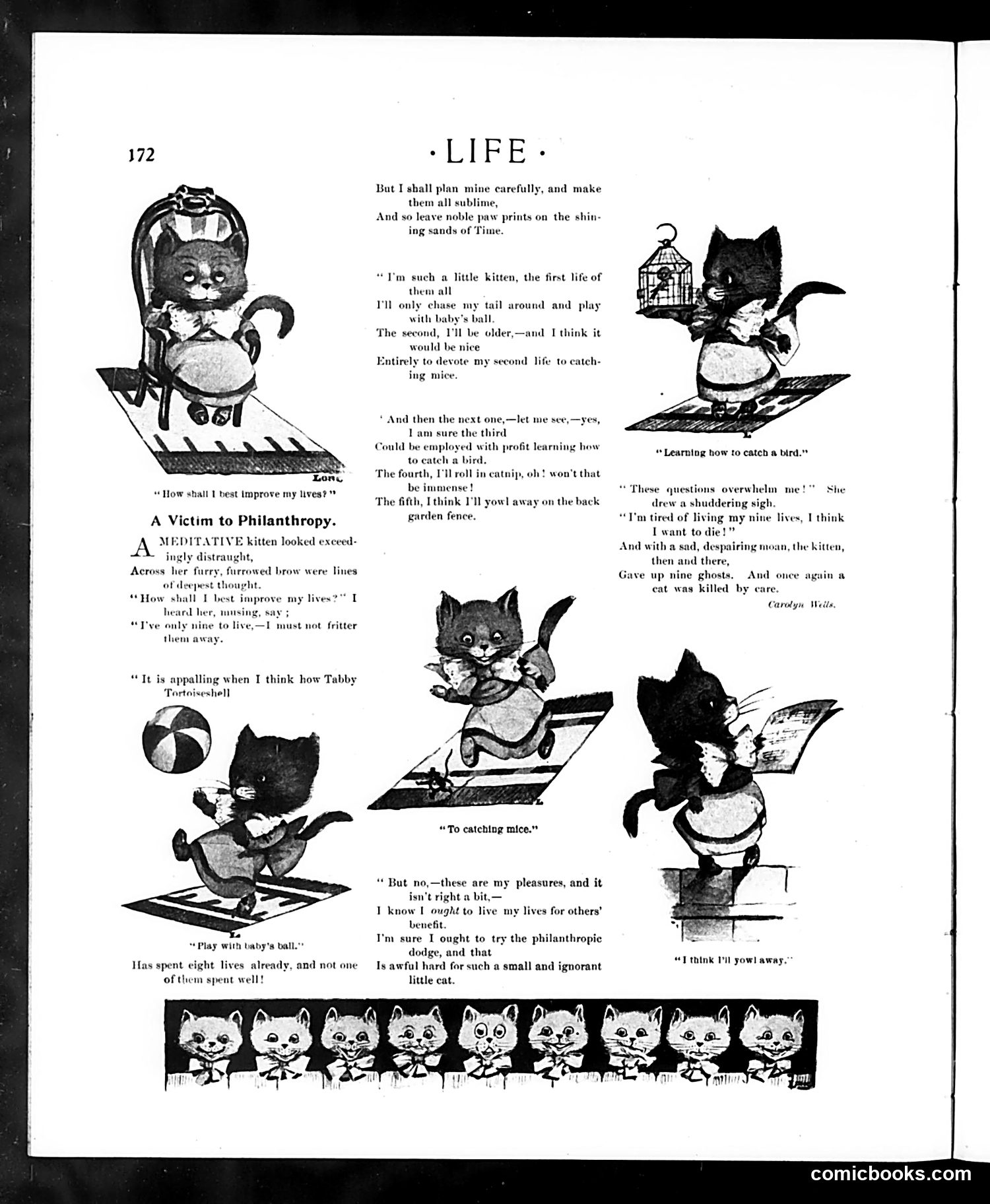
This satirical piece mocks a meditative kitten overwhelmed by guilt about wasting her nine lives. The cat has spent eight lives "not well," and now, burdened by philanthropic ideals, she torments herself with self-improvement schemes: devoting her second life to catching mice, her third to learning to catch birds, her fourth to "dying in captivity." The satire targets late 19th/early 20th-century *excessive* philanthropic moralizing—the pressure to constantly improve oneself and contribute to society. The kitten represents ordinary people crushed by unrealistic ethical demands. The punchline: she's "tired of living nine lives" and wants to die rather than endure another life of guilt-driven self-sacrifice. The final illustration of nine identical cat faces suggests her exhaustion is terminal.
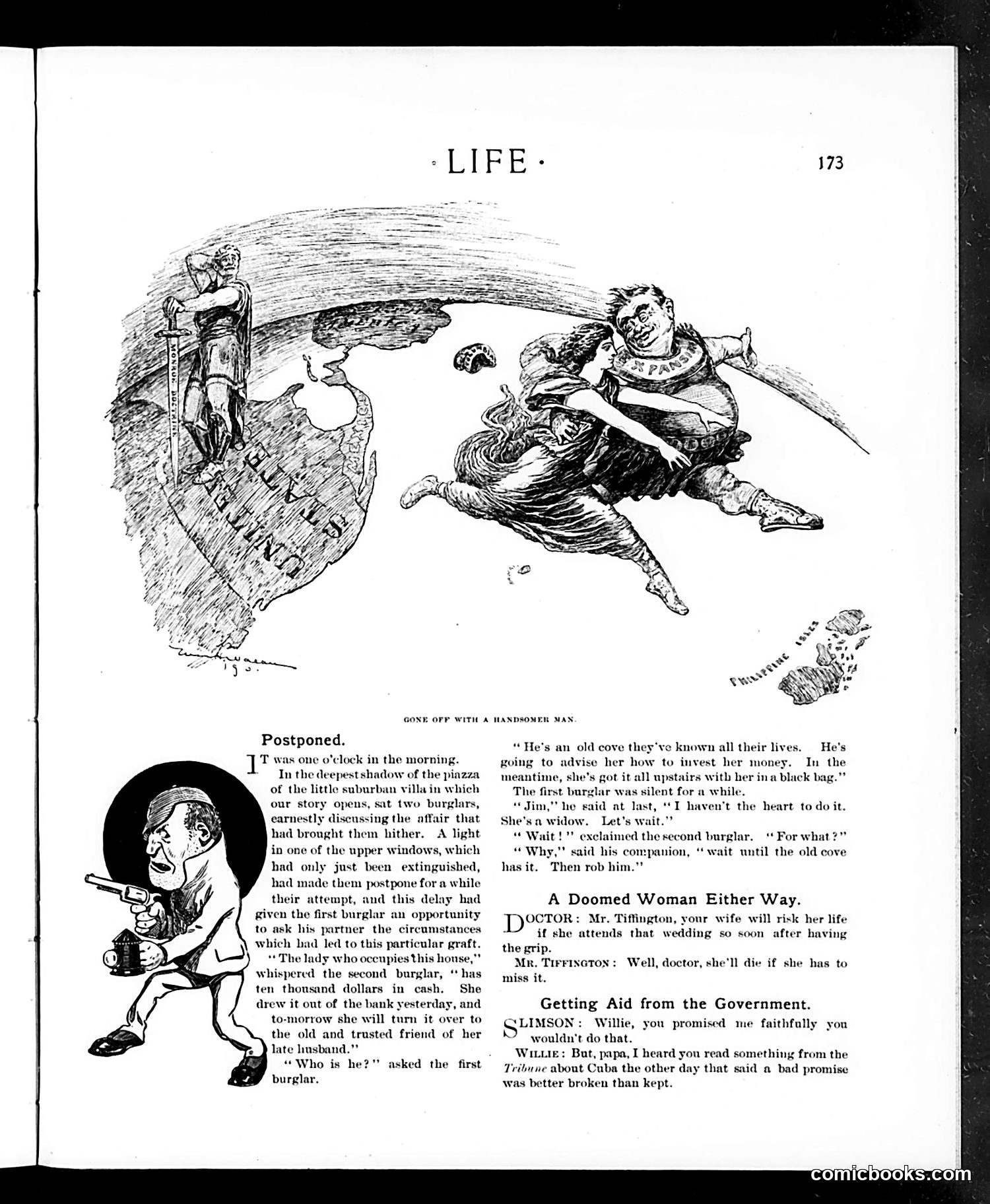
This Life magazine page contains three satirical pieces: **"Gone Off with a Handsomer Man"** (top): Two burglars debate robbing a widow of $10,000. The joke inverts typical morality—they feel sympathy for the widow but plan to rob her wealthy male advisor instead, apparently seeing it as more justified. **"Postponed"** (left cartoon): A caricatured burglar holds a gun, illustrating the main story above about delayed theft. **"A Doomed Woman Either Way"** (middle): A doctor warns a patient (Mr. Tiffington's wife) that attending a wedding after recovering from influenza ("the grip") risks her life. The husband says she'll die if she misses it—satirizing the social pressure on women to fulfill obligations regardless of health consequences. **"Getting Aid from the Government"** (bottom): A boy defends breaking a promise by citing something he read in the *Tribune* about Cuba, suggesting the government breaks promises too. This appears to reference American foreign policy regarding Cuba, mocking political hypocrisy. The page satirizes burglary ethics, women's constrained choices, and government dishonesty.
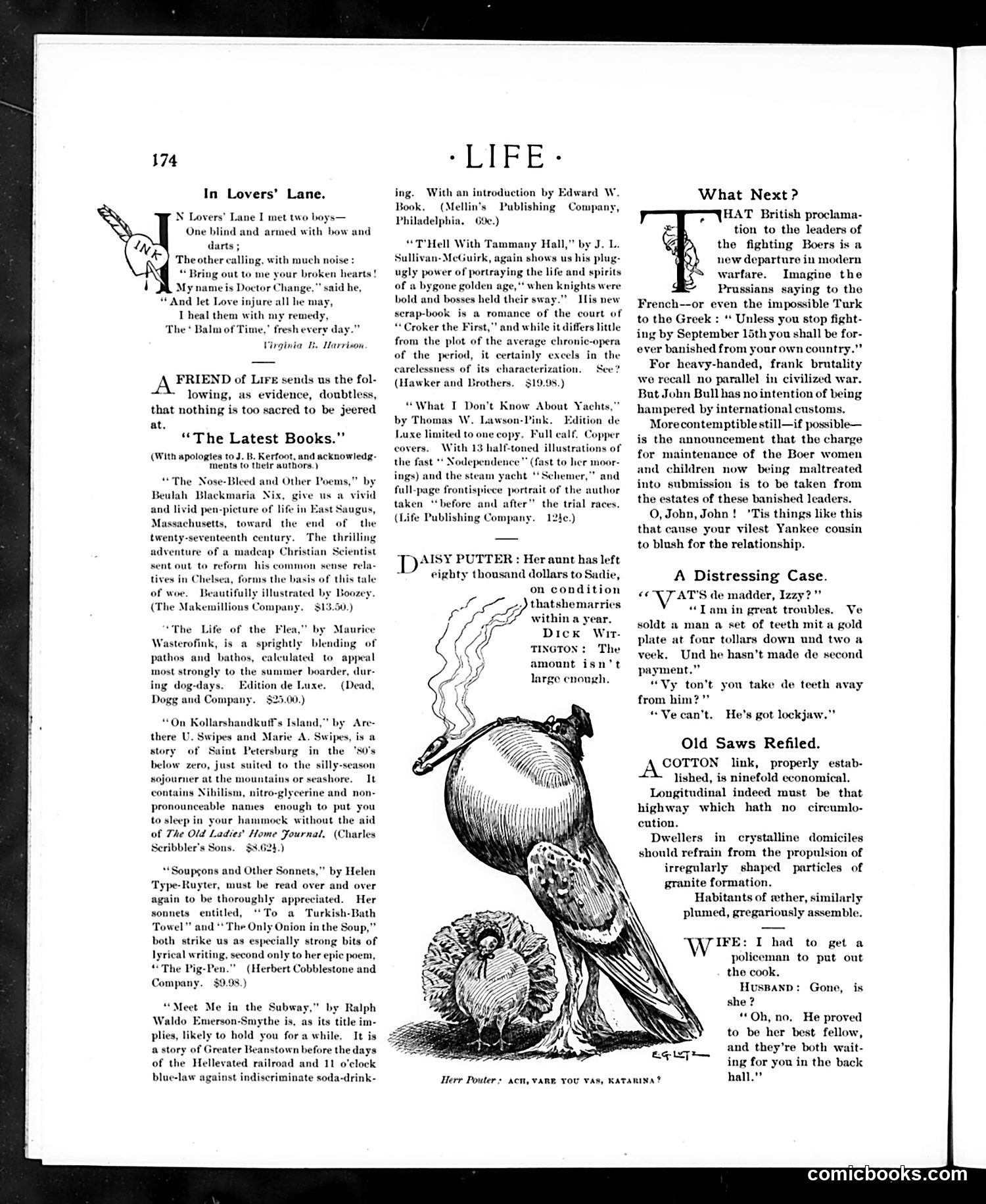
This page contains literary satire and humorous social commentary typical of Life magazine's style. The main content includes: **"The Latest Books"** section: Fake book reviews mocking pretentious or absurd contemporary literature with ridiculous titles like "The Nose-Bleed and Other Poems" and "To a Turkish-Bath Towel." This satirizes both overwrought literary pretension and publishers' willingness to print anything. **The central cartoon** depicts "Herr Putter" (a German character, indicated by the caption in German accent) with daisy flowers, likely satirizing sentimental German culture or possibly German diplomatic posturing. **"What Next?"** section: Criticizes British conduct toward Boer leaders during the Boer War, calling their ultimatum brutally heavy-handed and condemning Britain's disregard for "international customs"—contemporary critique of imperial warfare tactics. The page blends literary ridicule with political commentary on current events, characteristic of Life's satirical approach to American culture and international affairs.
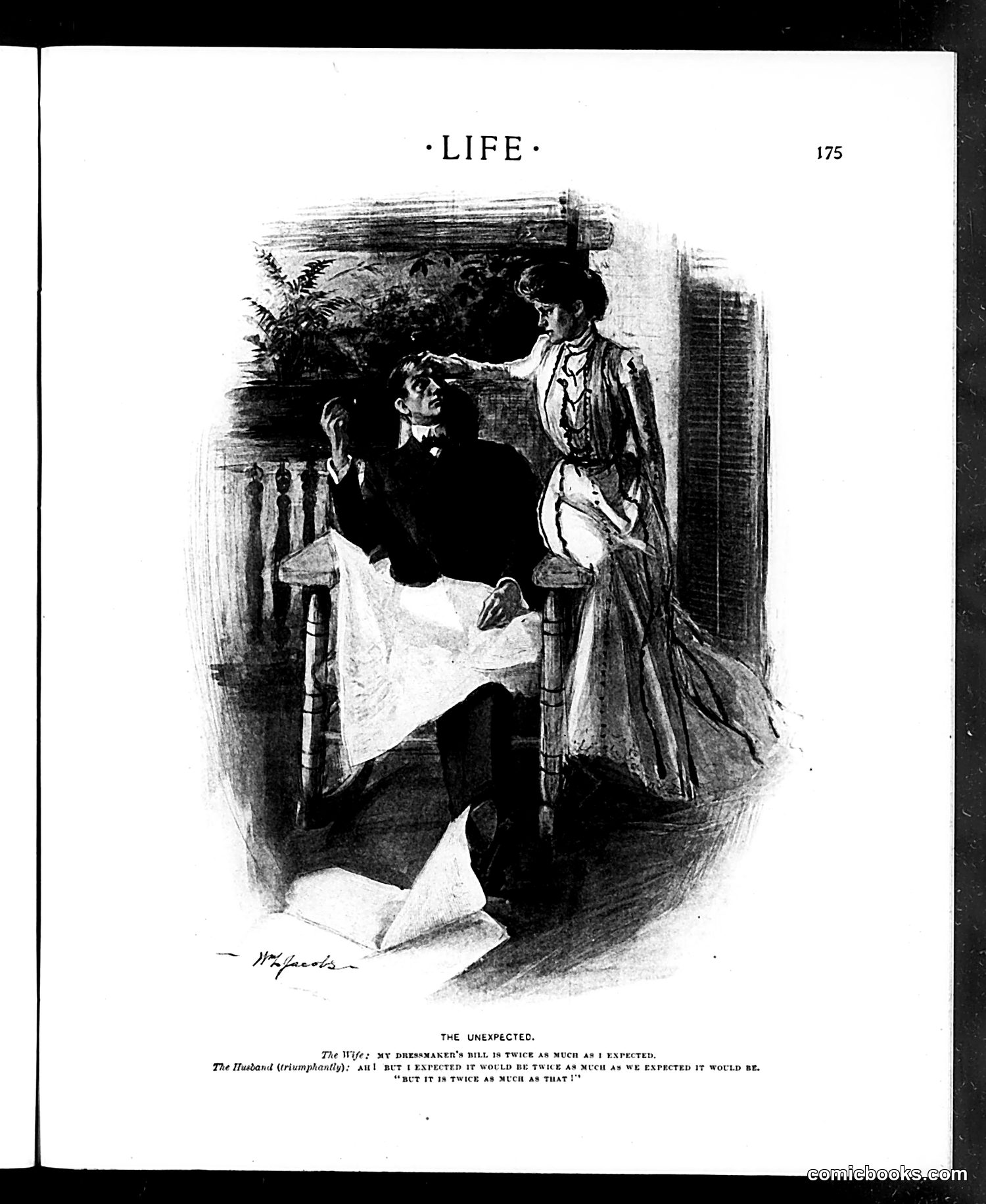
This is a domestic humor cartoon satirizing marital financial disputes. A husband sits receiving a dressmaker's bill from his wife, who complains it's double what she anticipated. The husband responds with circular logic: he'd already expected the bill to be twice their joint expectation—so the actual amount, being twice *that* inflated figure, matches his lowered expectations. The satire targets husbands' resignation to wives' spending habits. Rather than confronting the expense, the husband employs absurdist reasoning to avoid conflict, suggesting this was a common marital dynamic among the middle-class audience of *Life* magazine. The joke's appeal lay in recognizing this relatable tension between spouses over women's fashion expenses.
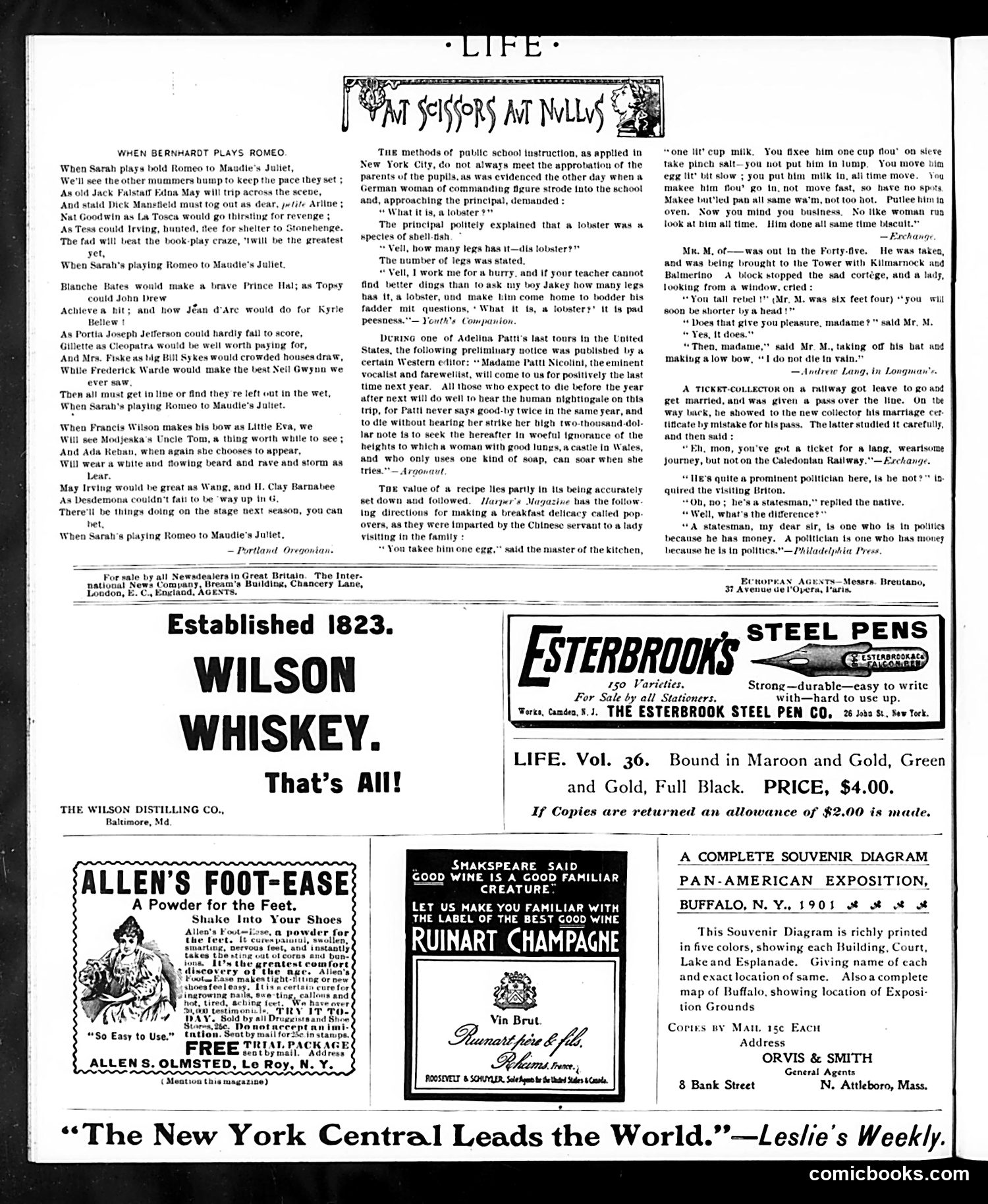
This page contains primarily **humorous verse and anecdotes** rather than political cartoons. ## Main Content: **"When Bernhardt Plays Romeo"** — A satirical poem imagining what happens when famous actress Sarah Bernhardt (playing Romeo) causes theatrical chaos. The joke is that other prominent actors of the era—Joseph Jefferson, Mrs. Fiske, Frederick Warde, and others—will all scramble to get stage roles, creating a competitive frenzy. The satire mocks both theatrical ambition and celebrity culture. **"At School"** — A humorous anecdote about a German immigrant mother confronting a school principal about lessons on lobster anatomy, complaining her son Jakey is wasting time instead of learning practical skills. **Adelina Patti anecdote** — A joke about the famous opera singer's farewell tours, suggesting she announces "last performances" so frequently that missing one means dying unprepared. The page also includes **period advertisements** for Wilson Whiskey, Esterbrook Steel Pens, and other products. No clear political agenda appears; the humor targets theatrical pretension and immigrant culture stereotypes typical of early 1900s American comedy.
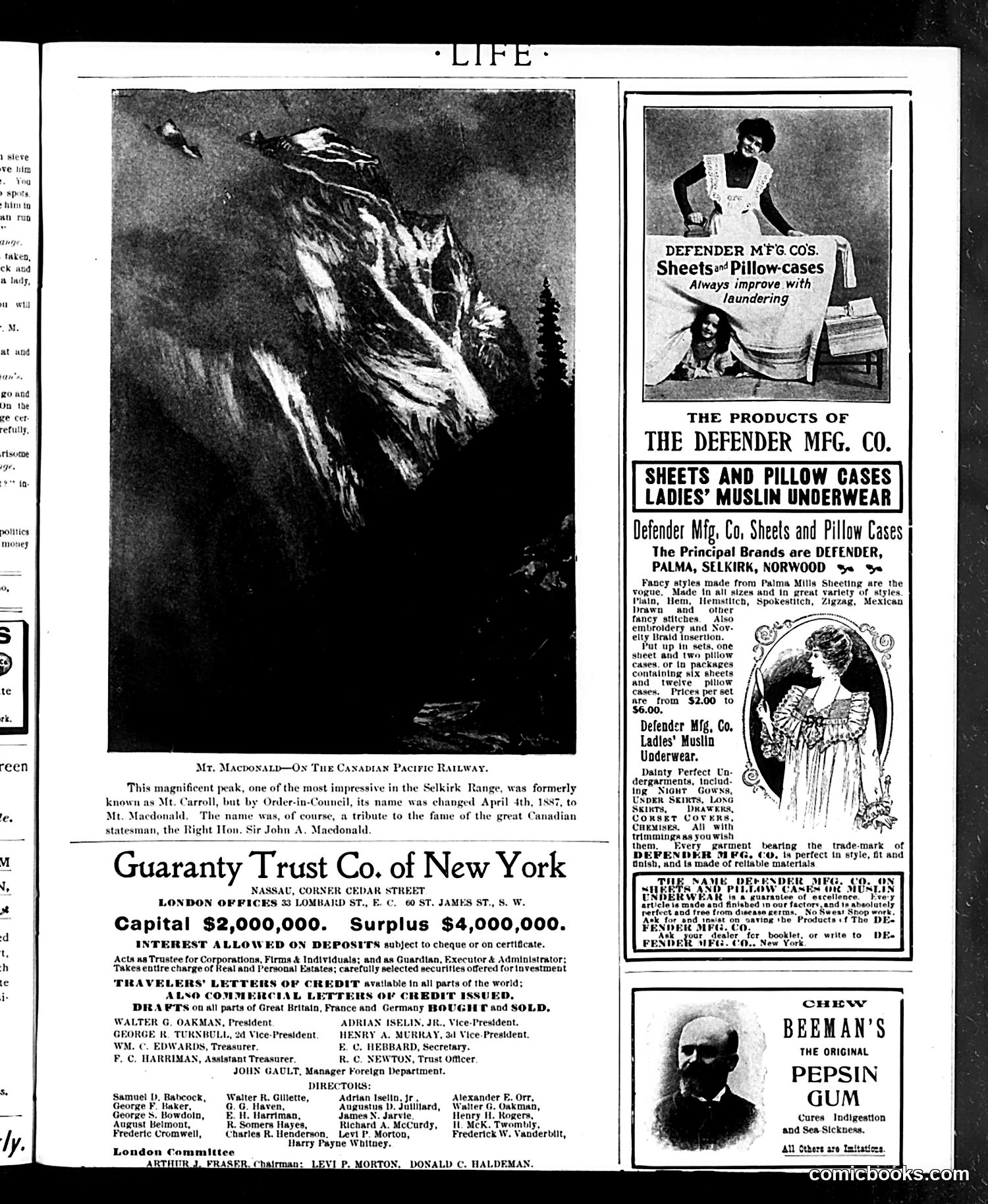
This page primarily contains **advertisements and business notices** rather than political satire. The large photograph shows Mt. Macdonald in the Canadian Pacific Railway's Selkirk Range—a mountain renamed in 1887 to honor Canadian statesman Sir John A. Macdonald. The advertisements include financial services (Guaranty Trust Co. of New York), household linens (Defender Mfg. Co. sheets and pillow cases), ladies' undergarments, and Beeman's Pepsin Gum. There is **no political cartoon visible** on this Life magazine page. It appears to be primarily a commercial/advertising section, with the mountain photograph serving as a scenic feature celebrating Canadian geography and the nation-building legacy of Macdonald. The page reflects how early Life magazine mixed editorial content with substantial advertising revenue.
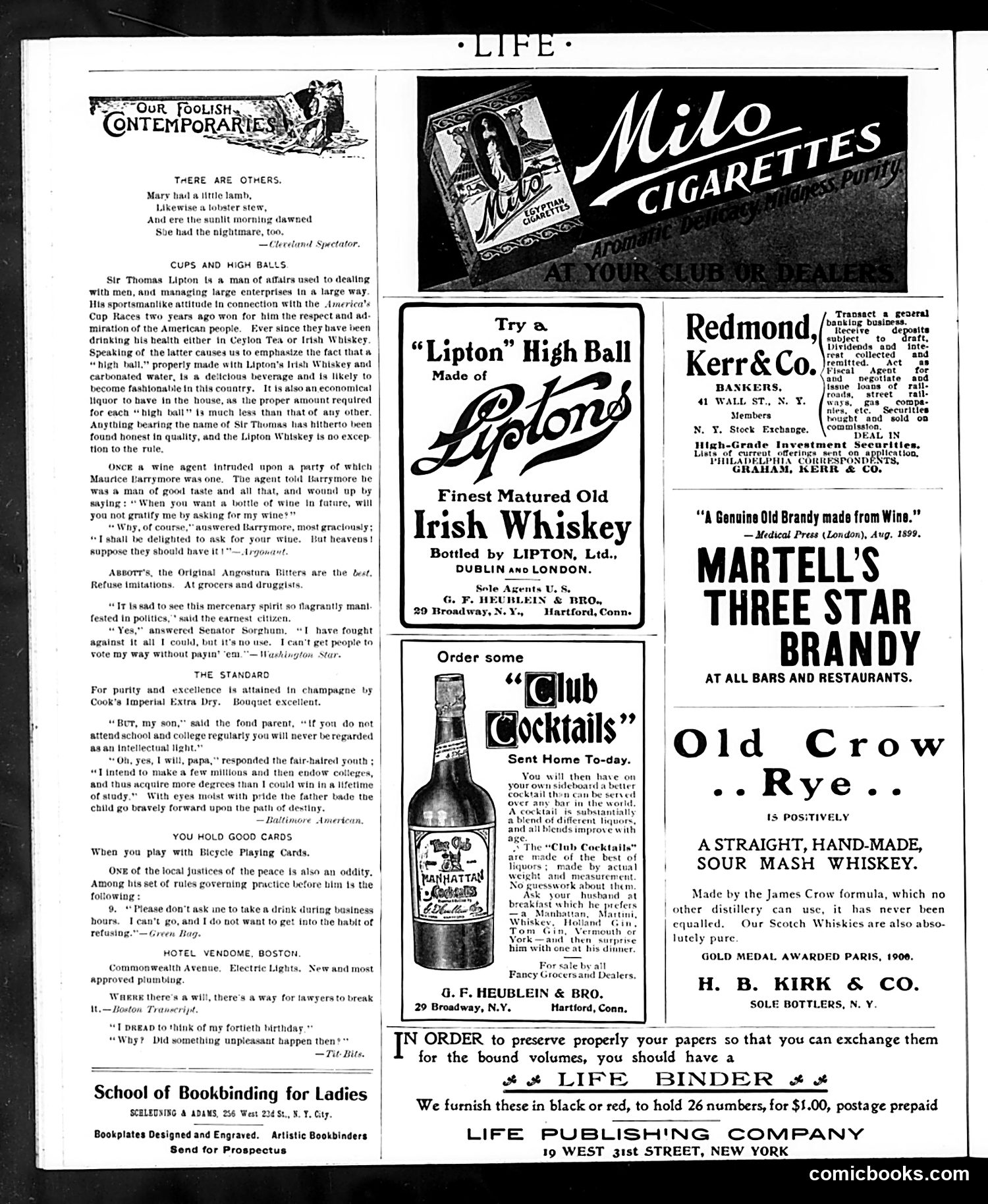
This page is primarily **advertisements interspersed with satirical commentary and jokes** rather than political cartoons. The cartoon content is minimal. The main satirical pieces are brief humorous anecdotes mocking contemporary attitudes: - A jab at **mercenary attitudes in politics** (politicians who must be bribed) - A father's pride that his son will skip education and just get rich enough to buy honorary degrees (satirizing nouveau riche pretension) - A judge who refuses drinks to avoid bad habits (mocking legalistic rigidity) The **dominant content is liquor advertising**—Lipton's Irish Whiskey, Martell Brandy, Old Crow Rye—taking advantage of the pre-Prohibition era. The text frames these drinks as fashionable, health-promoting refreshments. There's also **social climbing satire**: the Maurice Barrymore anecdote about a wine agent expecting gratitude for future business (exposing shallow social performance). The page reflects **Gilded Age anxieties** about wealth, status, and propriety, with ads capitalizing on aspirational consumption. This is primarily an advertising page with satirical margin notes rather than substantive political commentary.
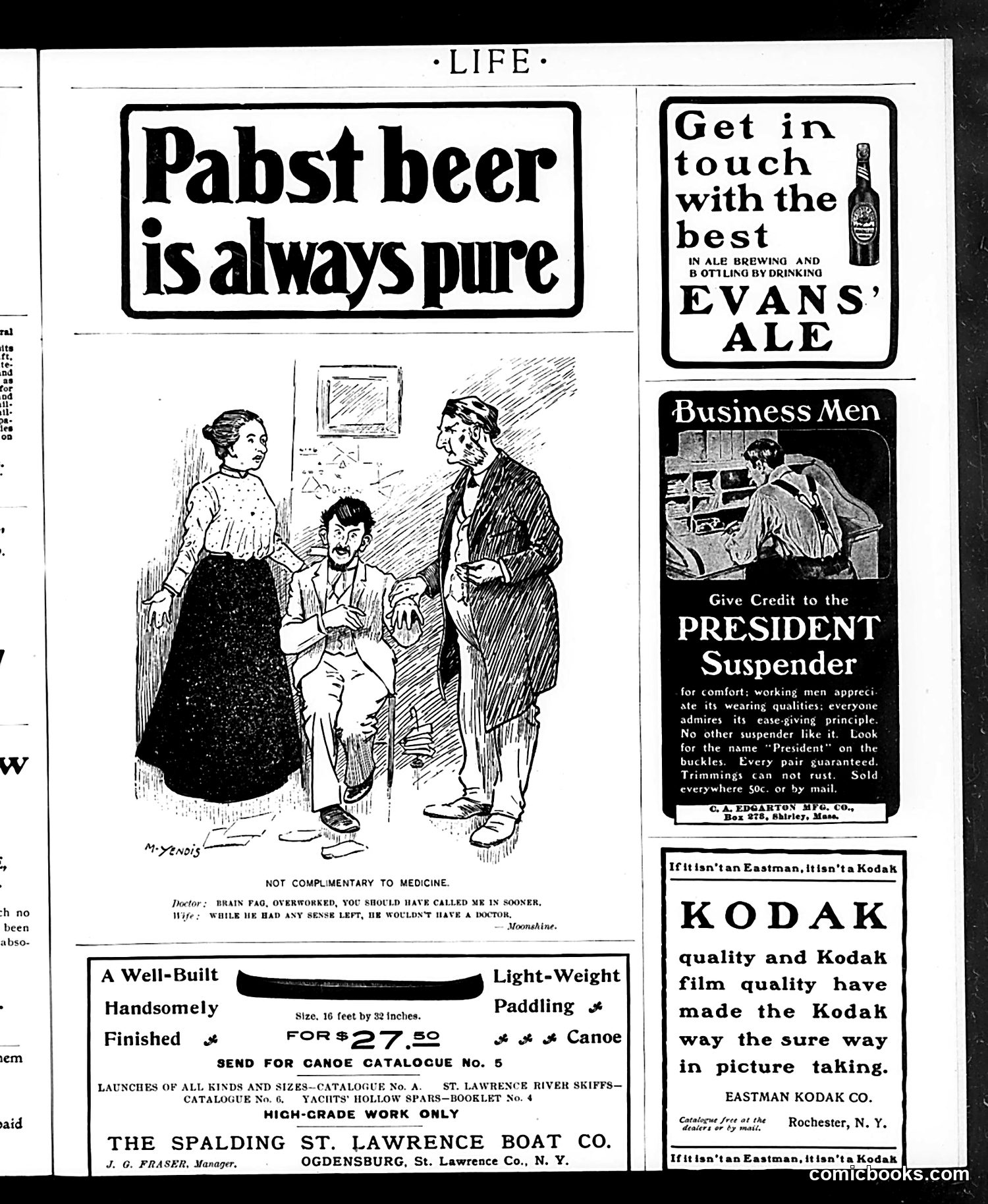
This page combines satirical cartoons with period advertisements (circa early 1900s). **Main Cartoon ("Not Complimentary to Medicine"):** A doctor tells a wife her overworked husband has "brain fag" and needs rest. She responds that while he had sense, he wouldn't have called a doctor—implying doctors are unreliable or unnecessary. The satire mocks both hypochondria and the medical profession's credibility during this era. The title suggests the cartoon criticizes medicine rather than endorses it. **Context:** This reflects early-20th-century skepticism toward doctors, who lacked modern scientific validation and were sometimes viewed as charlatans or unnecessary expenses for working people. **Advertisements:** The page includes typical period ads for Pabst beer (claiming purity), Evans' ale, suspenders, a canoe company, and Kodak film—standard commercial content with period-appropriate claims about product quality and reliability.
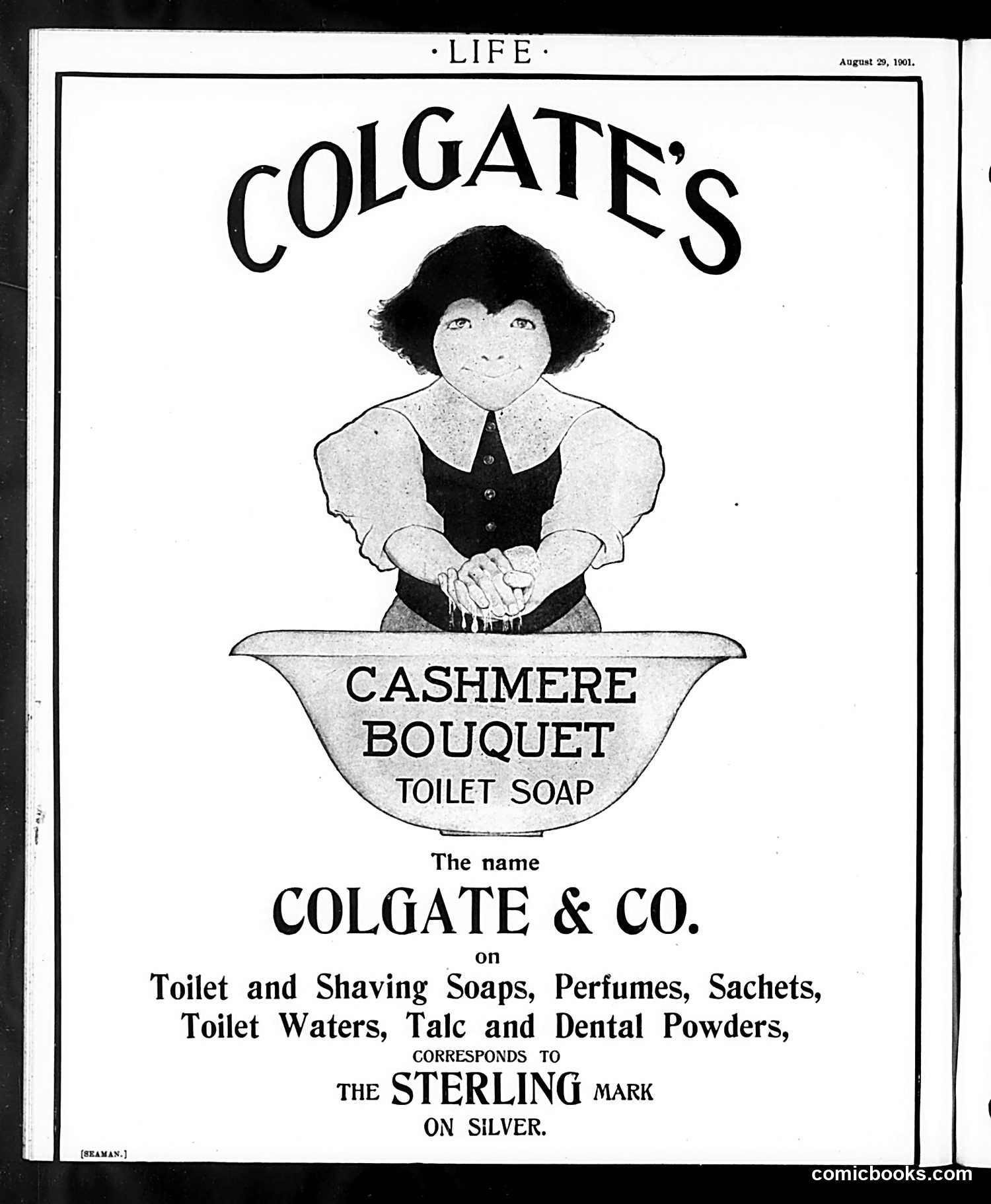
This is a **full-page advertisement**, not political satire. It promotes Colgate & Co.'s "Cashmere Bouquet" toilet soap, published in *Life* magazine on August 29, 1901. The ad features an illustrated woman with short dark hair and a large white collar, positioned above a decorative soap dish. The woman's simplified, idealized style reflects early-1900s commercial illustration aesthetics. The advertisement emphasizes that Colgate & Co.'s brand name on toiletries carries the same prestige and guarantee as a "Sterling mark on silver"—implying quality and authenticity. The product line listed includes soaps, perfumes, sachets, toilet waters, talc, and dental powders. There is no political message or satire here; this is straightforward consumer advertising from the period.