
Life, 1901-08-29 · page 8 of 20
Life — August 29, 1901 — page 8: what you’re looking at
What you’re looking at
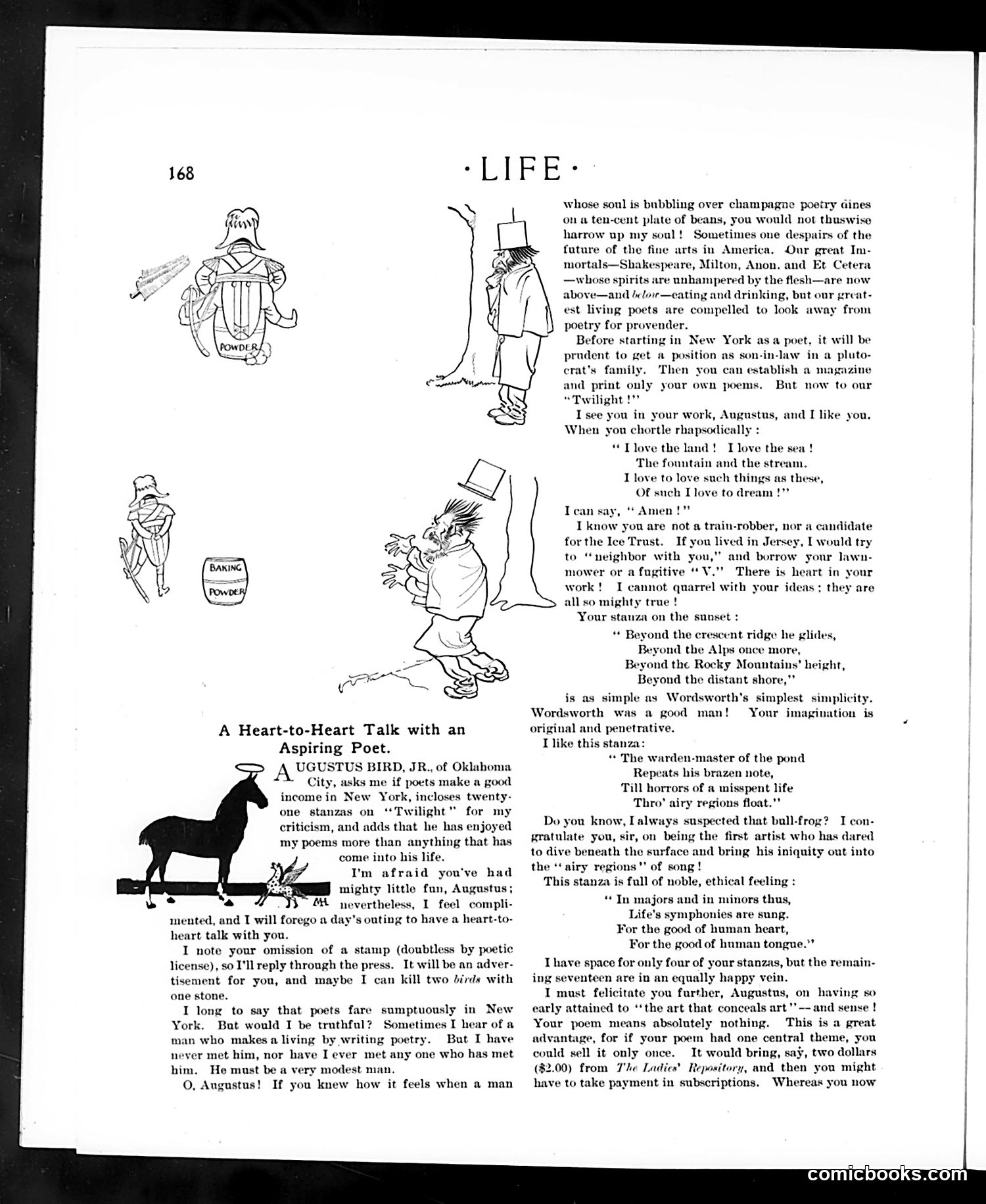
This satirical piece mocks the impracticality of pursuing poetry as a profession in America. The author (identified as Augustus Bird, Jr. of Oklahoma City) addresses a young poet named Augustas, offering blunt advice: poets cannot make a living in New York through poetry alone. The accompanying cartoons show figures labeled with items like "POWDER" and "BAKING POWDER," satirizing how poets must supplement income through commercial work unrelated to their art. The author warns that even great American poets struggled financially, suggesting aspiring poets should seek alternative employment—perhaps as photographers or in other trades—before attempting to establish a literary magazine. The satire targets the gap between artistic ambition and economic reality in early 20th-century America.
📄 Transcribed text from this page (OCR, searchable)
Machine-transcribed from the original scan — historical spelling and the odd misread are preserved.
A Heart-to-Heart Talk with an Aspiring Poet. = UGUSTUS BIRD, JR., of Oklahoma ~ City, asks me if poets make a good income in New York, incloses twenty- one stanzas on ‘ Twilight” for my criticism, and adds that he has enjoyed my poems more than anything that has come into his life. I'm afraid you've had mighty little fun, Augustus; 4 nevertheless, L feel compli- mented, and I will forego a day’s outing to have a heart-to- heart talk with you. I note your omission of a stamp (doubtless by poetic license), so I'll reply through the press. It will be an adver- tisement for you, and maybe I can kill two birds with one stone. I long to say that poets fare sumptuously in New York. But would I be truthful? Sometimes I hear of a man who makes a living by writing poetry. But I have never met him, nor have I ever met any one who has met him. He mast be a very modest man. O, Augustus! If you knew how it feels when a man "LIFE * whose soul is bubbling over champagne poetry dines on a ten-cent plate of beans, you would not thuswise Sometimes one despairs of the future of the fine arts in America. Our great Im- mortals—Shakespe: Tilton, Anon. and Et Cetera —whose spirits are unhampered by the flesh—are now above—and x lor—eating and drinking, but our great- est living poets are compelled to look away from poetry for provender. Before starting in New York prudent to get a position as son-in-law in a pluto- crat's family. Then you can establish a magazine and print only your own poems. But now to our “Twilight !"° Isee you in your work, Augustus, and I like you. When you chortle rhapsodically : “ Tlove the land! [love the sea! The fountain and the stream, 1 love to love such things as these, Of such T love to drea harrow up my soul ! a poet, it will be “Amen! I know you are not a train-robber, nor a candidate forthe Ice Trust. If you lived in Jersey, I would try to “neighbor with you,” and borrow your lawn- mower or a fugitive “*V.’" There is heart in your work! I cannot quarrel with your ideas ; they are all so mighty true ! Your stanza on the sun Beyond the crescent ridge he glides, Beyond the Alps once more, Beyond the Rocky Mountains Beyond the distant shore,” is as simple as Wordsworth’s simplest simplicity. Wordsworth was a good man! Your imagination is original and penetrative. Llike this stanza: “ The warden-master of the pond Repeats his brazen note, Till horrors of a misspent life Thro’ airy regions float."” Do you know, Ialways suspected that bull-frog? gratulate you, sir, on being the first artist who has dared to dive beneath the surface and bring his iniquity out into the “airy regions" of song! This stanza is full of noble, ethical feeling : “In majors and in minors thus, ihr, I con- Life's symphonies are sung. For the good of human heart, For the good of human tongue.”’ Ihave space for only four of your stanzas, but the remain- ing seventeen are in an equally happy vein. I must felicitate you further, Augustus, on having so early attained to ‘‘the art that conceals art and sense ! Your poem means absolutely nothing. This is a great advantage, for if your poem had one central theme, you could sell it only once. It would bring, say, two dollars (32.00) from The Ladies’ Repository, and then you might have to take payment in subscriptions. Whereas you now