
Life, 1901-08-29 · page 7 of 20
Life — August 29, 1901 — page 7: what you’re looking at
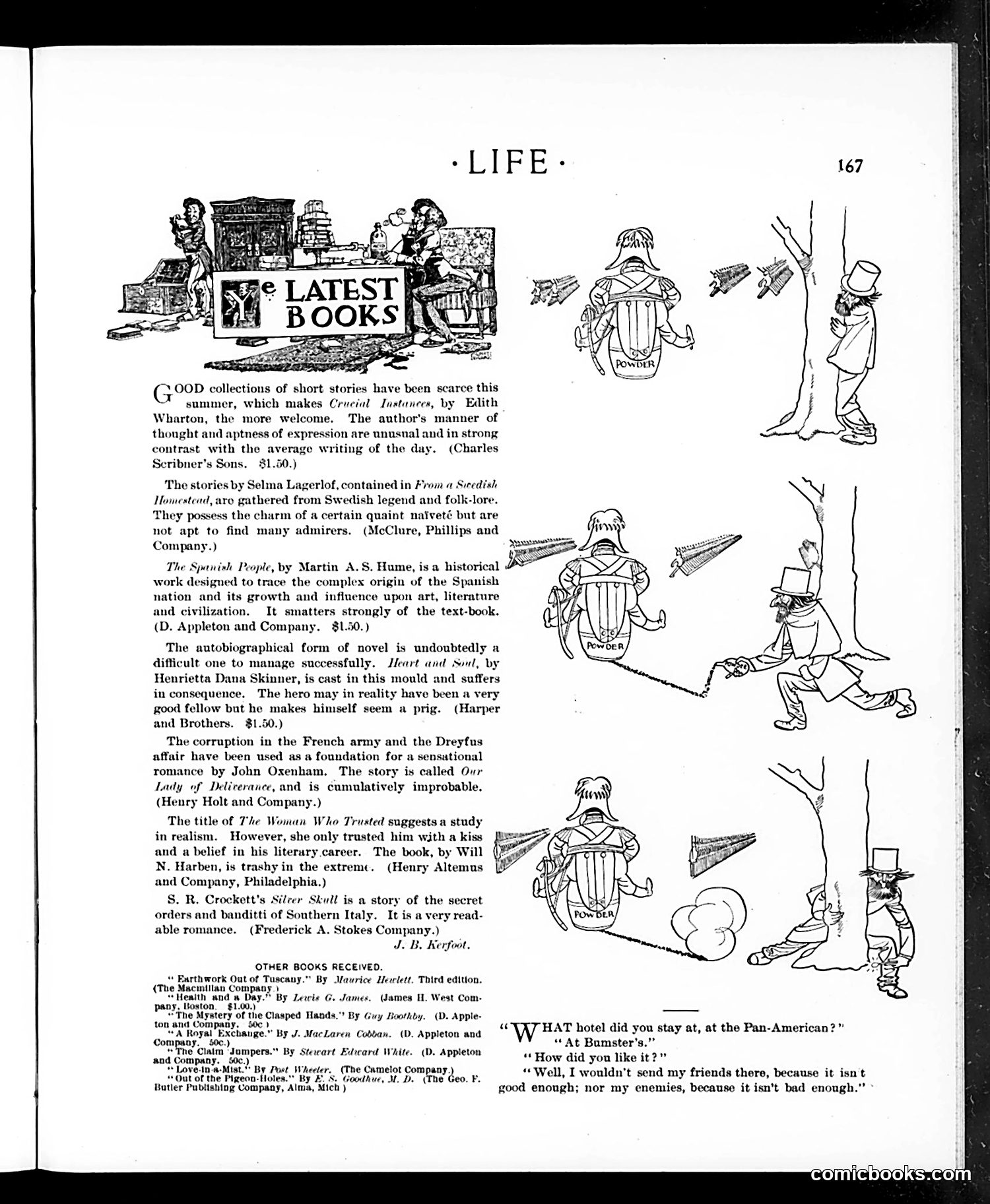
What you’re looking at
This page from *Life* magazine features a **"Latest Books" book review section** on the left, discussing recent literary releases by authors like Edith Wharton and Martin A. S. Hume. On the right is a **humorous cartoon strip** depicting a traveler with a large powder keg backpack encountering various mishaps—the keg repeatedly explodes or creates chaos as the character interacts with nature (trees, animals, other people). Below is a **joke dialogue** about hotel quality: a guest stayed at "Bamster's" hotel but wouldn't recommend it to friends or enemies alike, saying it's "not good enough" for either group—a backhanded insult suggesting the establishment is universally poor. The cartoon's humor relies on visual slapstick, while the dialogue uses ironic logic for comedic effect.
📄 Transcribed text from this page (OCR, searchable)
Machine-transcribed from the original scan — historical spelling and the odd misread are preserved.
G OOD collections of short stories have been scarce this summer, which makes Crucial Instances, by Edith Wharton, the more welcome, The author's manner of thought and aptness of expression are unusnal and in strong contrast with the average writing of the day. (Charles Scribner's Sons. $1.50.) The stories by Selma Lagerlof, contained in From a Siredish Homestead, aro gathered from Swedish legend and folk-lore. They possess the charm of a certain quaint natveté but are not apt to find many admirers. (McClure, Phillips and Company.) The Spanixh People, by Martin A.S. Hume, is a historical work designed to trace the complex origin of the Spanish nation and its growth and influence upon art, literature and civilization. It smatters strongly of the text-book. (D. Appleton and Company. $1.50.) The autobiographical form of novel is undoubtedly a difficult one to manage successfully, Jleart and Soul, by Henrietta Dana Skinner, is cast in this mould and suffers in consequence. The hero may in reality have been a very good fellow but he makes himself seem a prig. (Harper and Brothers. $1.50.) The corruption in the French army and the Dreyfus affair have been used as a foundation for a sensational romance by John Oxenham. The story is called Our Lady of Deliverance, and is cumulatively improbable. (Henry Holt and Company.) The title of The Woman Who Trusted suggests a study in realism. However, she only trusted him with a kiss and a belief in his literary.career. The book, by Will N. Harben, is trashy in the extreme. (Henry Altemus and Company, Philadelphia.) S. R. Crockett’s Sileer Skull is a story of the secret orders and banditti of Southern Italy. It is a very read- able romance. (Frederick A. Stokes Company.) J.B. Kerfoot, OTHER BOOKS RECEIVED. « Earthwork Out of Tuscany.” By Maurice Heirlett, Third edition. (The Maciniilan Company. Health and ® Day.” By Levis G. James. (ames H. West Com- foston. $1.00.) he Mystery of the Clasped Hands." By Guy Boothby. (D. Apple- ton and Company. _50¢ + “A Royal Exchange.” By J. MacLaren Cobtan. (D. Appleton and Company. 500.) «The Claim “Jumpers.” By Stewart Edvard White. (D. Appleton ‘and Company. | 50¢.) Love-tn-a-Mist."" By Post Wheeler. (The Camelot Company. «Out of the Pigeon-Holes."” By ES. Goodhue, M.D. (The Butler Publishing Company, Alma, Mich ) ow uaAT hotel did you stay at, at the Pan-American?” “At Bumster’s.”” “How did yon like it?" “Well, I wouldn't send my friends there, because it isn t good enongh; nor my enemies, because it isn't bad enough.”