
A complete issue · 20 pages · 1901
Life — June 20, 1901
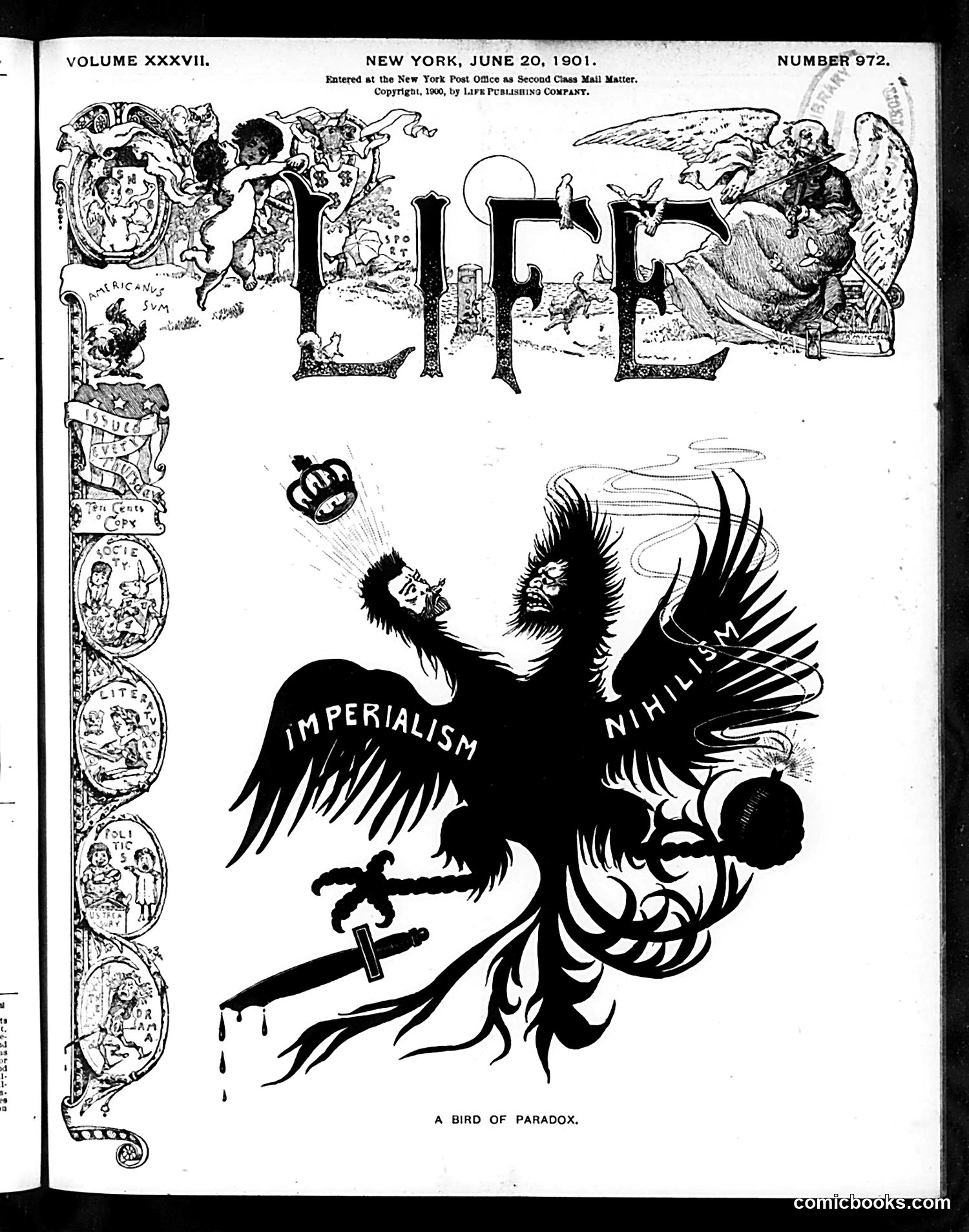
This political cartoon depicts a two-headed eagle labeled with "IMPERIALISM" and "NIHILISM"—seemingly contradictory ideologies. One head clutches a dagger dripping blood; the other grasps a bomb, referencing anarchist violence. A crown floats above, suggesting monarchy or imperial authority. The satire critiques what the cartoonist saw as a fundamental contradiction: imperial powers claiming to spread order and civilization while employing violent, destabilizing methods. The "paradox" title emphasizes the hypocrisy—imperialism and nihilism presented as inseparable twins despite their opposing stated goals. This reflects early 1900s debates about American imperialism following the Spanish-American War and anxieties about anarchist movements gaining traction in industrial nations.
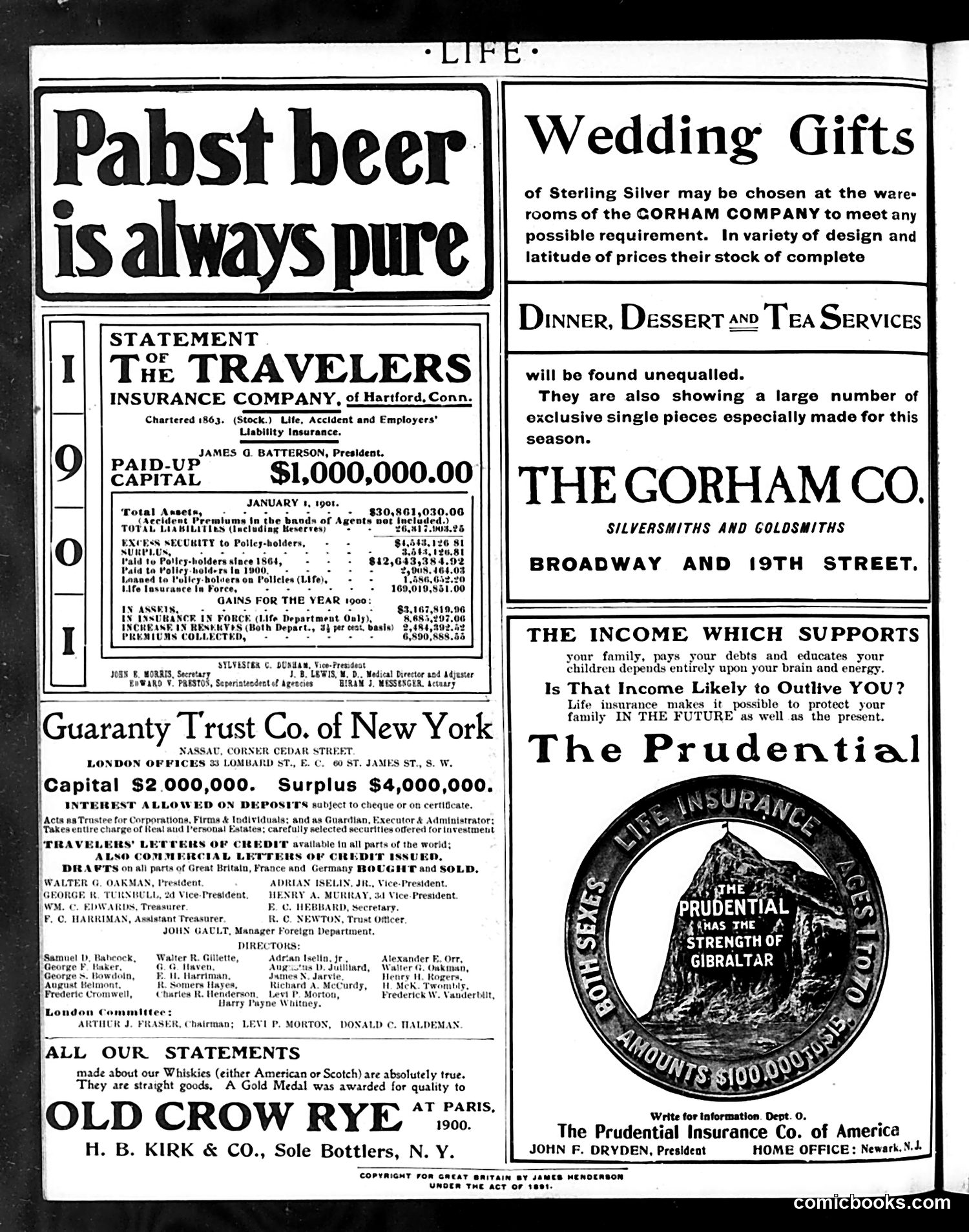
This page is **primarily advertising** from Life magazine's early 1900s era, not satirical content. The advertisements include: - **Pabst Beer** (top left) - a simple purity claim - **The Gorham Company** (right) - Sterling silver wedding gifts and tableware - **The Travelers Insurance Company** (left) - financial statement showing $1M capital - **Guaranty Trust Co.** - banking services - **Old Crow Rye whiskey** - claiming truthful advertising - **The Prudential Insurance Co.** (right) - life insurance featuring their famous Gibraltar Rock logo The only quasi-editorial element is Prudential's messaging about life insurance protecting family income—framed as practical financial advice rather than satire. This appears to be a standard advertising page from an early-20th-century magazine, reflecting period consumer products and financial services.
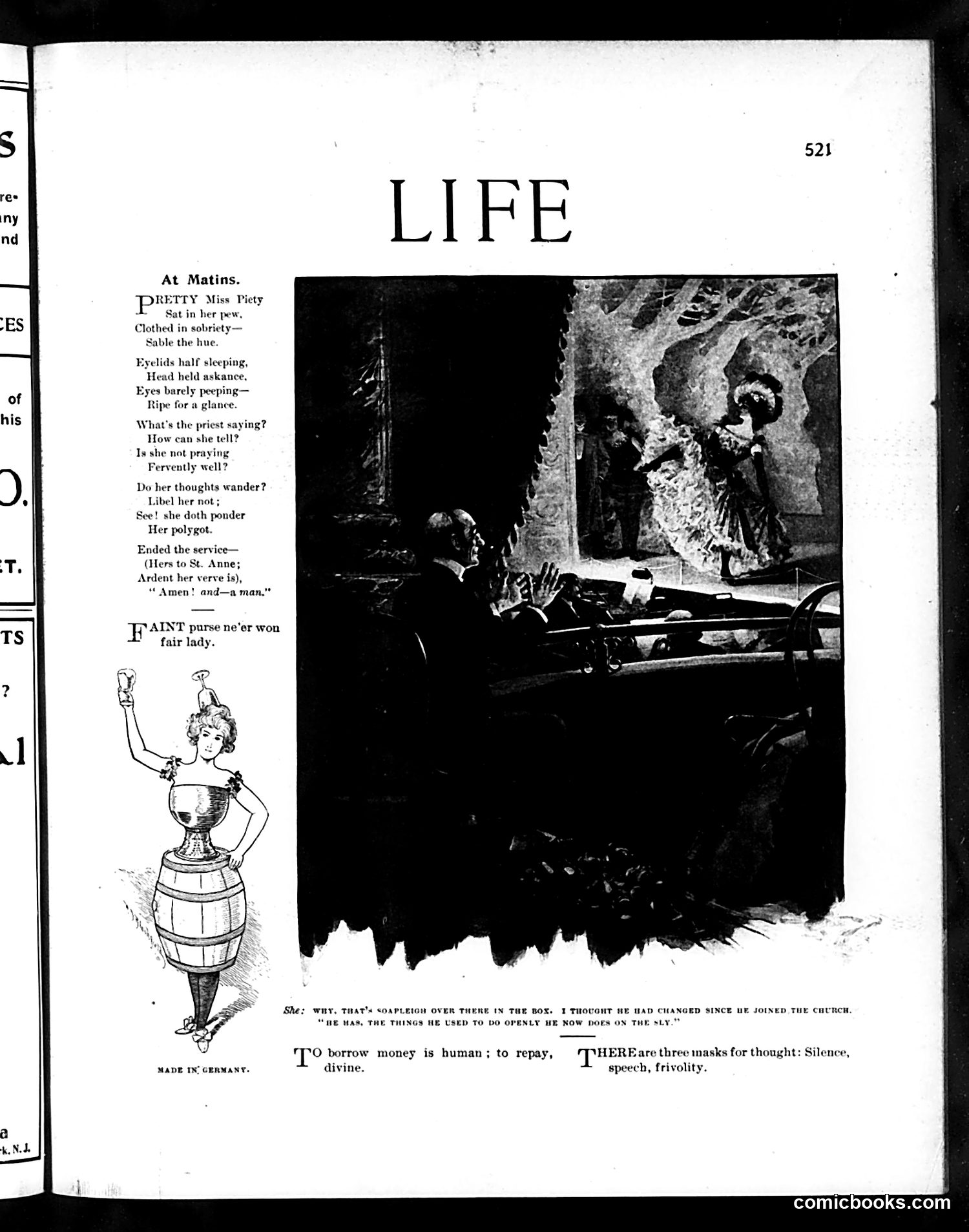
This page contains satirical content about religious hypocrisy. The poem "At Matins" (top left) depicts "Pretty Miss Piety" at church—outwardly pious with closed eyes and proper dress, yet inwardly distracted and vain, concerned with powder and appearance. The verse mocks her superficial devotion. The illustration below shows a woman as a barrel labeled "MADE IN GERMANY," holding a goblet—likely satirizing materialism or commercialism masquerading as virtue. The caption "Faint purse ne'er won fair lady" suggests criticism of financial or mercenary motivations. The photograph and accompanying caption about "Napleigh" reference someone's suspicious religious conversion coinciding with monetary gain—implying insincere faith motivated by self-interest rather than genuine belief.
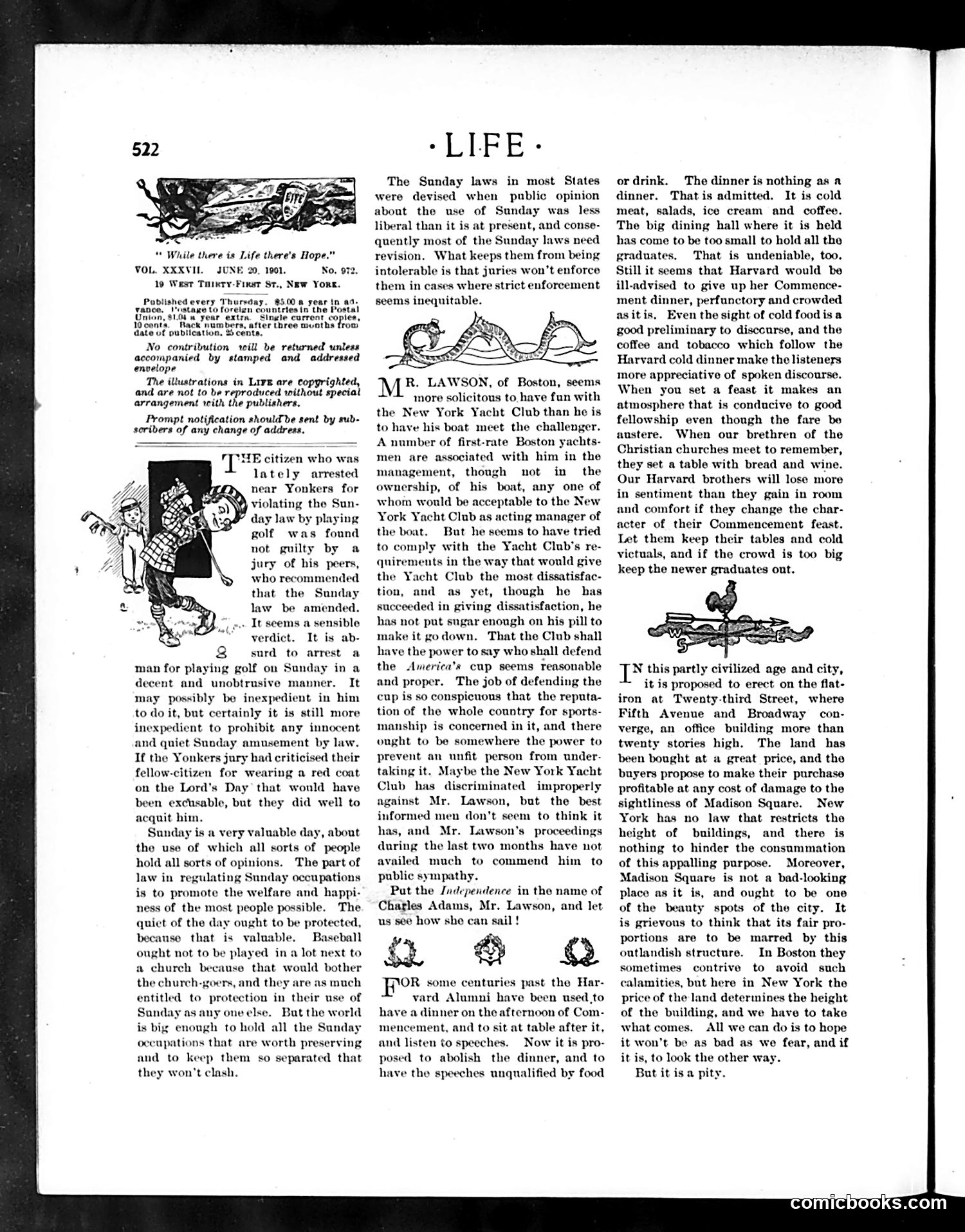
This page contains three separate satirical pieces about social customs and regulations: 1. **Sunday Laws Cartoon** (top left): A small illustration accompanies text criticizing strict Sunday observance laws. The cartoon appears to show someone being arrested, referencing a recent case of a man near Yonkers arrested for playing golf on Sunday. The author argues such laws are outdated and that juries won't enforce them—advocating for reform. 2. **Lawson/Yacht Club Piece** (center): Text discusses Mr. Lawson of Boston and the New York Yacht Club's management dispute over America's Cup defense. The piece critiques the Club's apparent unfair treatment of Lawson's boat selection. 3. **Madison Square Building Proposal** (bottom right): Commentary on a proposed office building at Twenty-third Street and Fifth Avenue, criticizing its planned height as potentially marring the neighborhood's character. The page reflects early 20th-century debates over regulation and aesthetics.
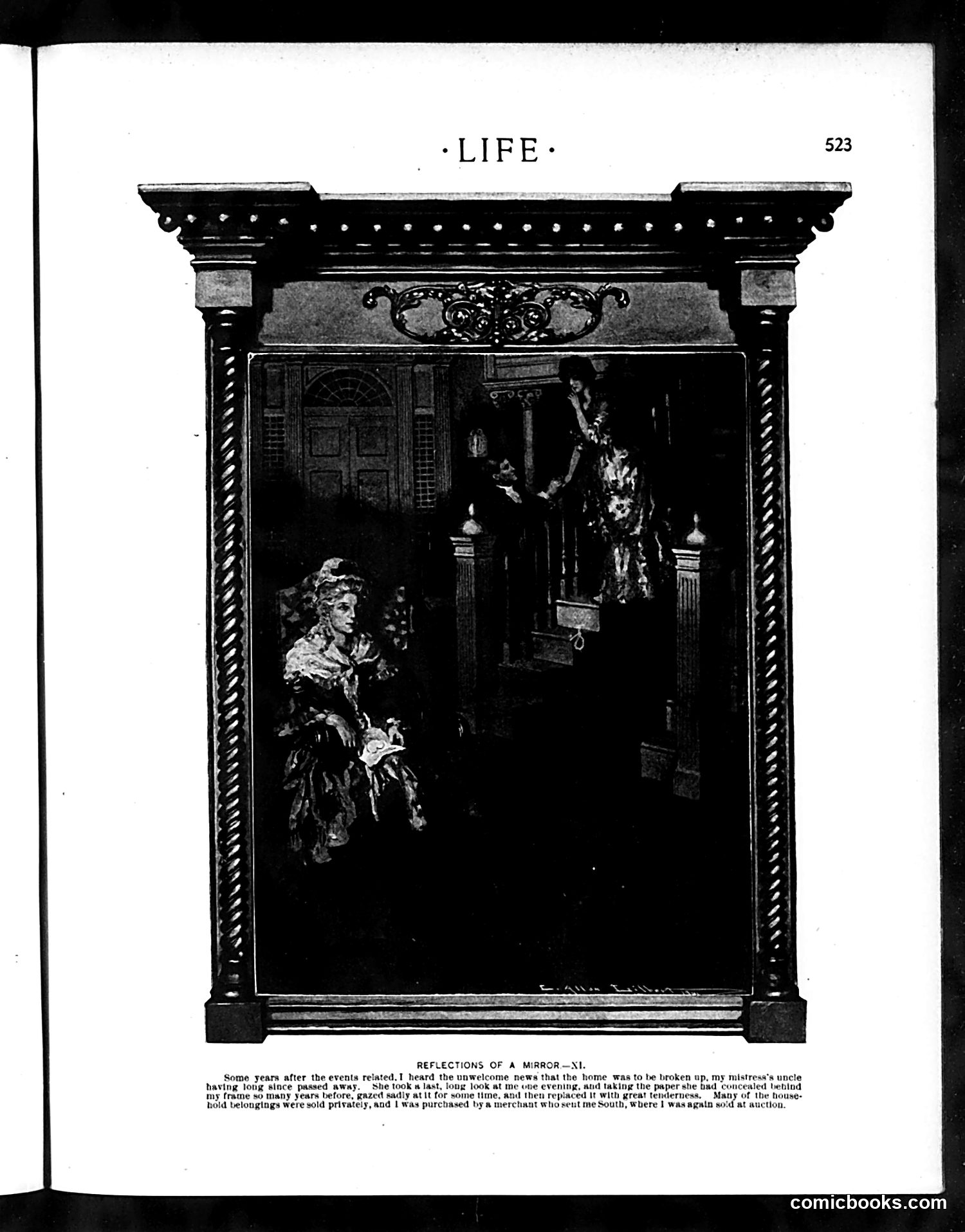
This illustration depicts a woman in an elegant interior, gazing at what appears to be a mirror or framed reflection. The accompanying text describes a nostalgic narrative: the narrator discovered unwelcome news that their home would be broken up, discovered their mistress's uncle had sold family items, and found their portrait replaced—which they had owned for years. They later repurchased it from a merchant. The satire critiques the transience of material possessions and domestic life among the wealthy. The "mirror" title suggests this piece reflects social commentary about ownership, loss, and the ironic nature of having to repurchase one's own belongings. It appears to be part of a serialized satirical column examining upper-class anxieties and the instability of wealth.
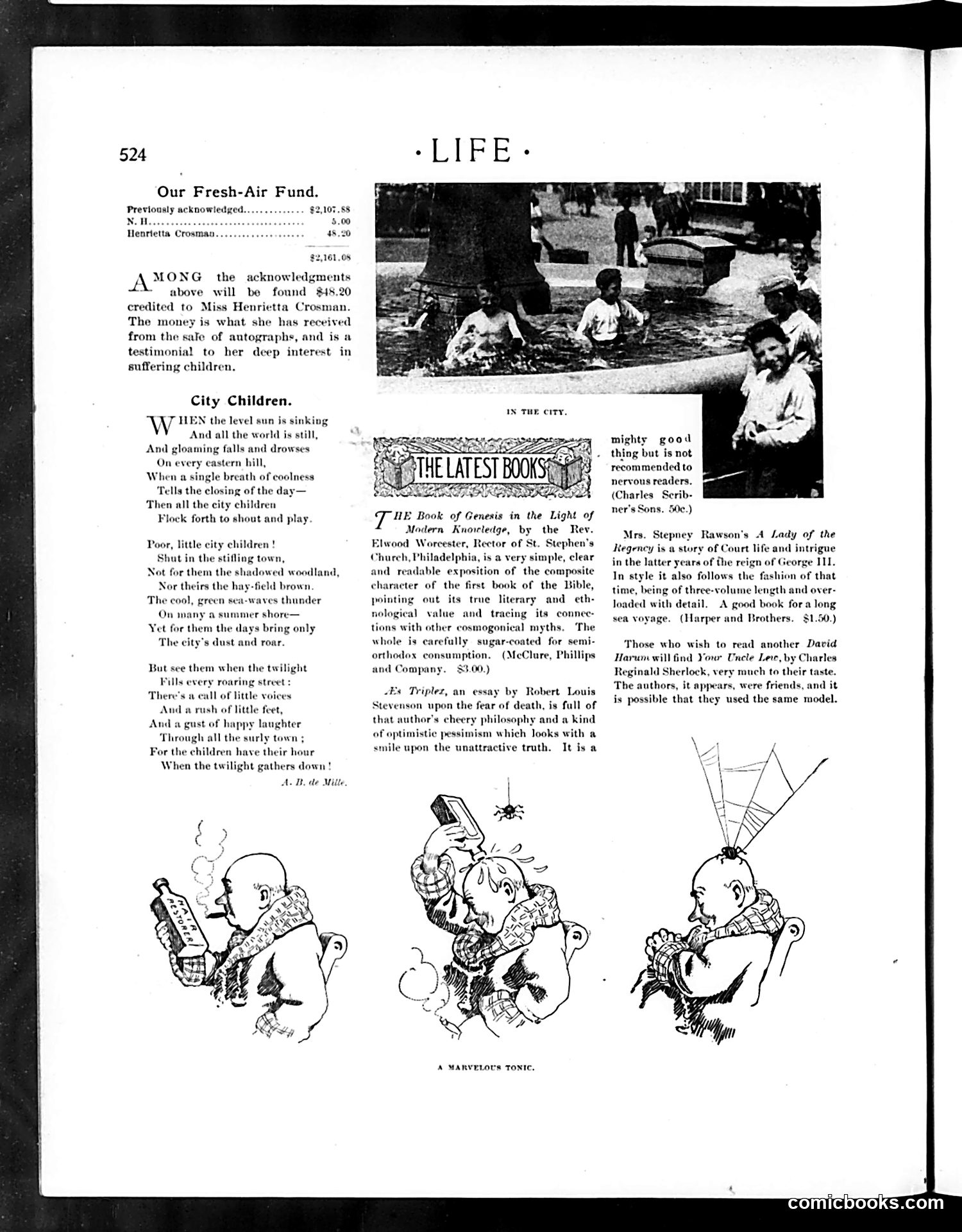
This page combines poetry, book reviews, and a political cartoon titled "A Marvelous Tonic." **The Cartoon:** Three sequential panels show a bald man in a chair experiencing increasingly exaggerated reactions—from contentment to violent upheaval to frantic distress. The progression suggests a satirical critique of some contemporary remedy or policy, using physical comedy to mock its claimed benefits versus actual consequences. **Context:** Without identifying the specific figure, the cartoon likely lampoons a popular "solution" to a social or political problem of the era. The title "A Marvelous Tonic" suggests ironic commentary on something presented as beneficial but depicted as chaotic and harmful. **Surrounding Content:** The page includes poetry about urban children and book reviews, situating this satire within Life magazine's typical blend of social commentary and literary criticism.
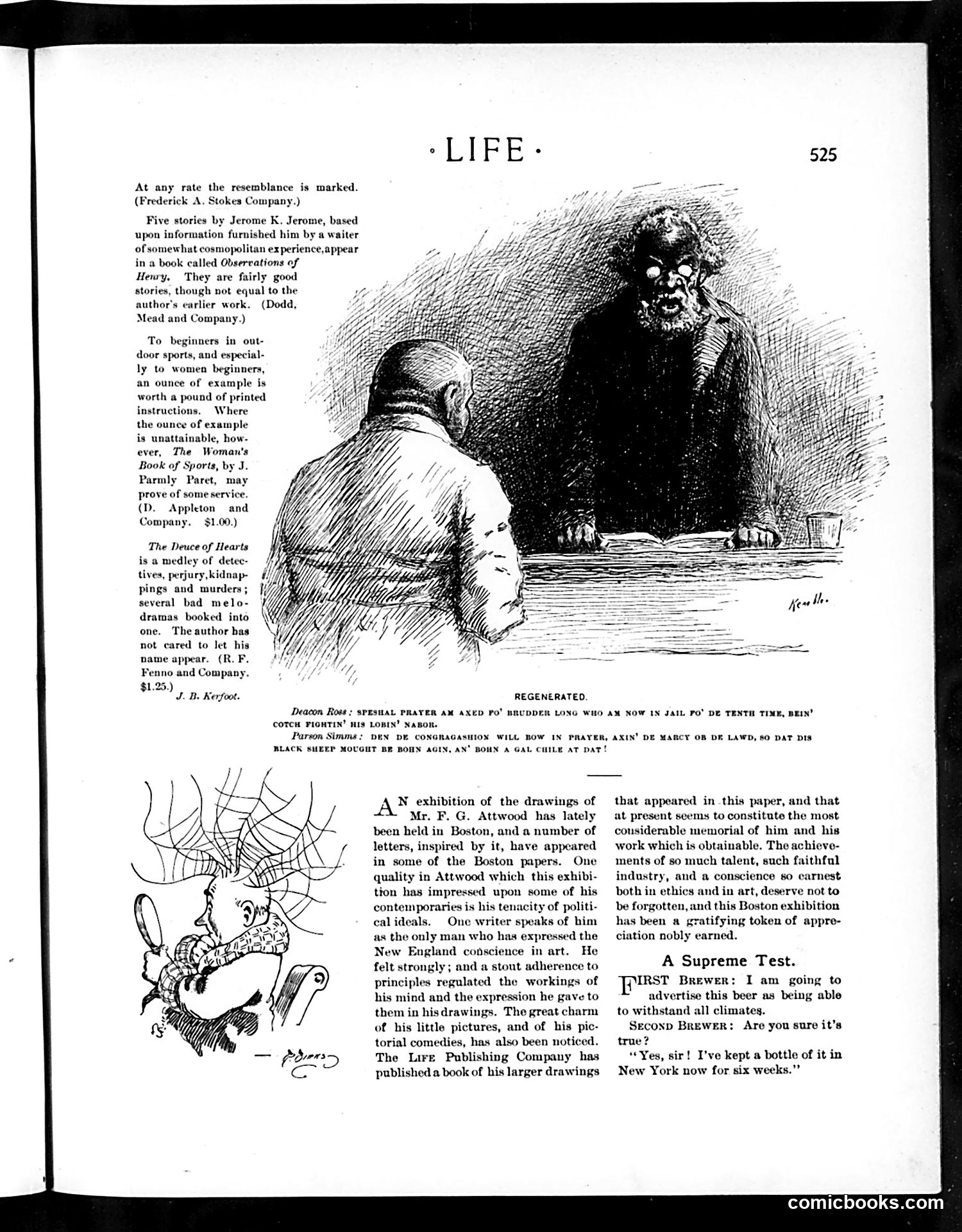
This page features satirical content about social reform and morality. The main cartoon titled "REGENERATED" depicts two figures in conversation, with the caption referencing prisoners and religious conversion—likely satirizing the notion that jail time and prayer could reform criminals. Below that is a section praising artist F.G. Attwood's Boston exhibition, noting his "tenacity of political ideals" and his ability to express "New England conscience" through satirical drawings. The text credits *Life* Publishing Company with publishing his larger works. At the bottom, "A Supreme Test" presents a humorous dialogue between two brewers debating whether beer could "withstand all climates," with one claiming to have kept a bottle stable in New York for six weeks—possibly satirizing product durability claims or alcohol consumption habits.
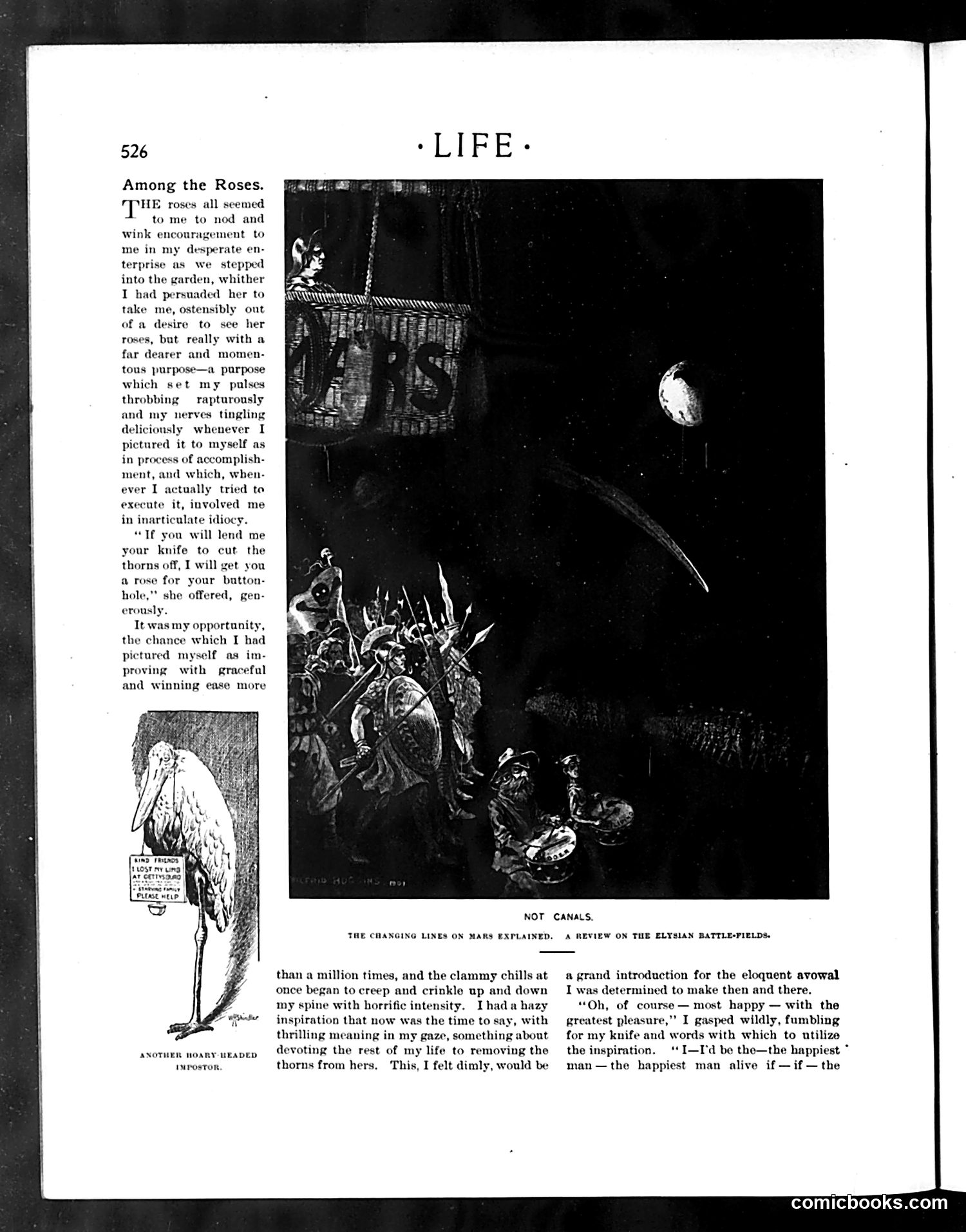
This page presents a fictional narrative titled "Among the Roses" paired with an illustration labeled "Not Canals: The Changing Lines on Mars Explained. A Review on the Elysian Battle-Fields." The text describes someone's scheme to impress a woman by cutting thorns from roses in her garden—an elaborate, somewhat ridiculous plan the narrator describes as involving "inarticular idiocy." The illustration appears to be satirical commentary on contemporary astronomical debates, specifically referencing Percival Lowell's controversial claims about canals on Mars (prominent scientific discussion of the era). The image shows what appears to be a fantastical Martian landscape with battle scenes, likely mocking the tendency to imagine elaborate, romantic scenarios based on limited astronomical observations—mirroring the narrator's own elaborate romantic delusions in the accompanying story.
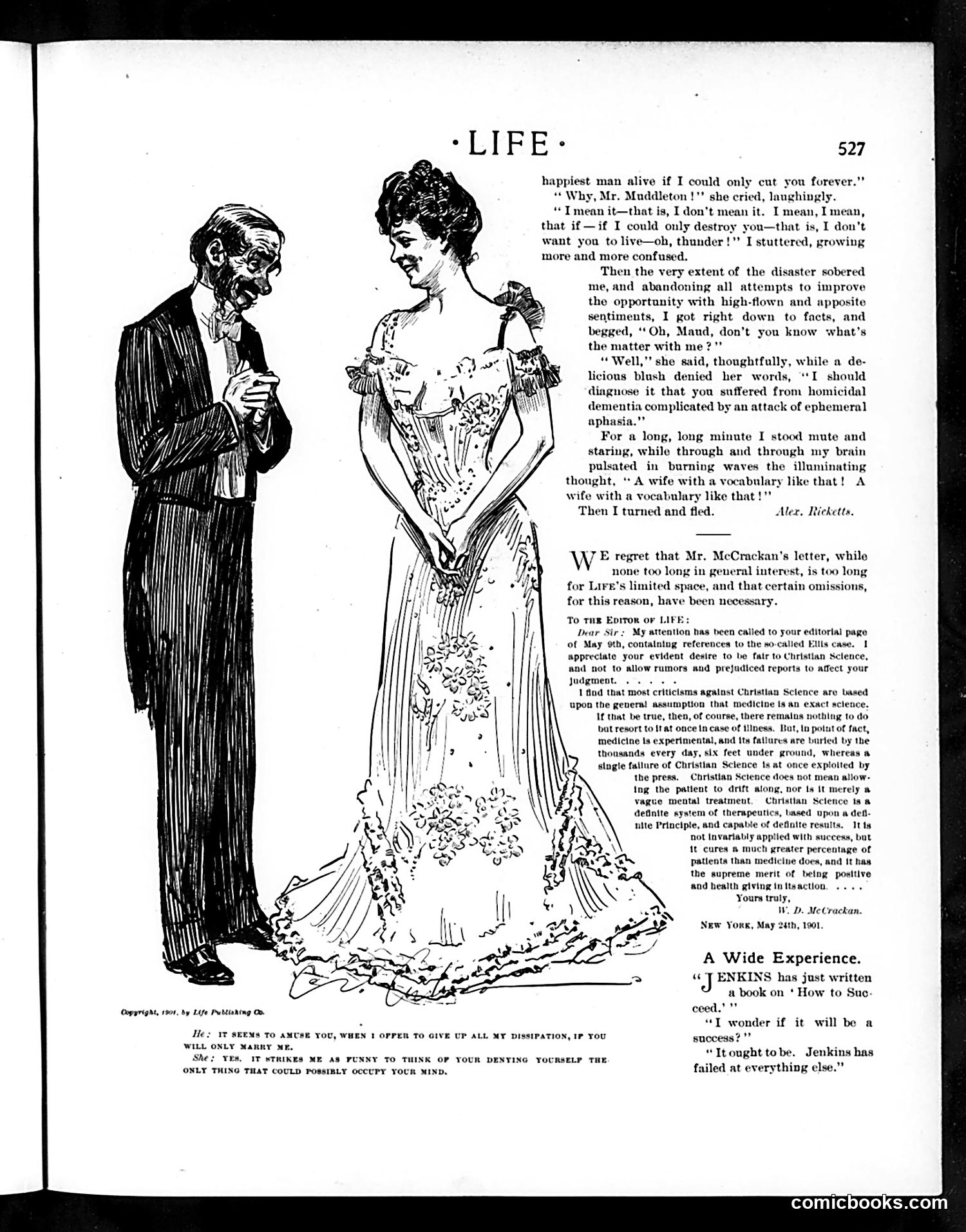
The main illustration depicts a social encounter between a man in formal dress and an elegantly gowned woman. The caption indicates the man is offering marriage while promising to "give up all my dissipation," with the woman's witty response about thinking of "something funny" to decline. The satire targets wealthy male suitors who frame marriage proposals around their own reformation rather than genuine affection. The woman's sardonic reply suggests such promises are both ridiculous and unconvincing as romantic arguments. Below, letters to the editor discuss Christian Science medical claims, debating whether it constitutes legitimate science. One correspondent argues Christian Science achieves superior healing results compared to conventional medicine. The page reflects early 1900s debates about religious healing practices versus modern medical science.
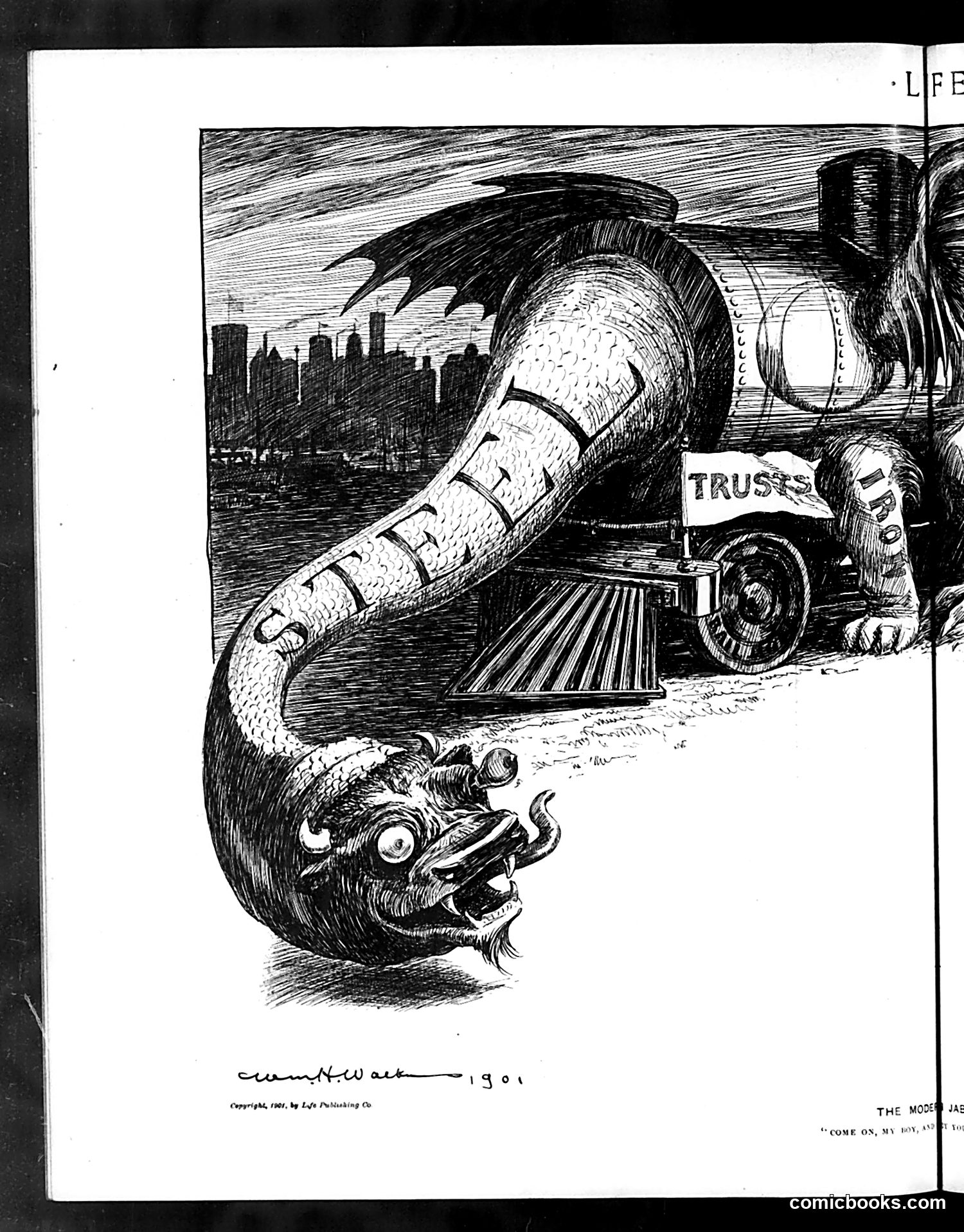
This 1901 Clifford Berryman cartoon depicts a grotesque demon or devil-like creature labeled "TRUSTS" emerging from a large pipe or tube. The creature is menacing what appears to be industrial/urban infrastructure in the background (the cityscape is visible). The satire targets the rise of corporate monopolies and trusts during the Gilded Age. The monstrous characterization of "trusts" reflects contemporary anxieties about massive business consolidations that were seen as threatening to fair competition and public welfare. The pipe imagery suggests these monopolies were being pumped into American society, poisoning it. This cartoon likely relates to Theodore Roosevelt's presidency (1901-1909), when trust-busting became a major political issue, presenting monopolies as dangerous creatures destroying the nation's economic health.
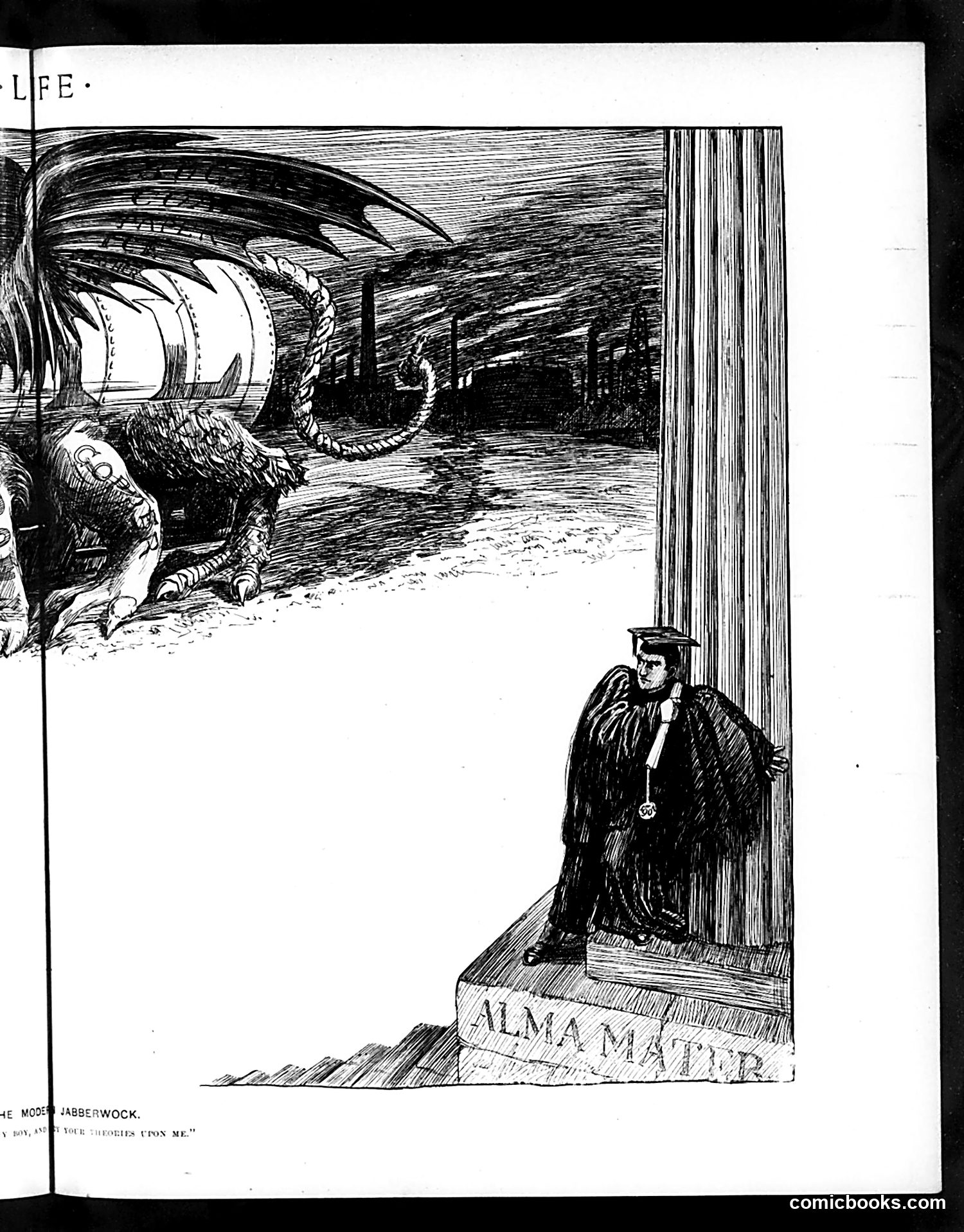
This appears to be a satirical illustration from *Life* magazine. The image shows a skeletal, robed figure (possibly representing Death or a grim reaper) standing on a pedestal labeled "ALMA MATER" (Latin for "nourishing mother," traditionally referring to one's university). The figure is positioned before an ominous scene featuring what appears to be a naval vessel or ship in distress in the background. The skeleton's presence on the university pedestal suggests dark satire about how educational institutions may be complicit in or promoting destructive outcomes—possibly military conflict or war. The exact historical context remains unclear without additional text or dating information, but the juxtaposition critiques the relationship between academia and violence or warfare. The skull imagery emphasizes death as the ultimate consequence being satirized.
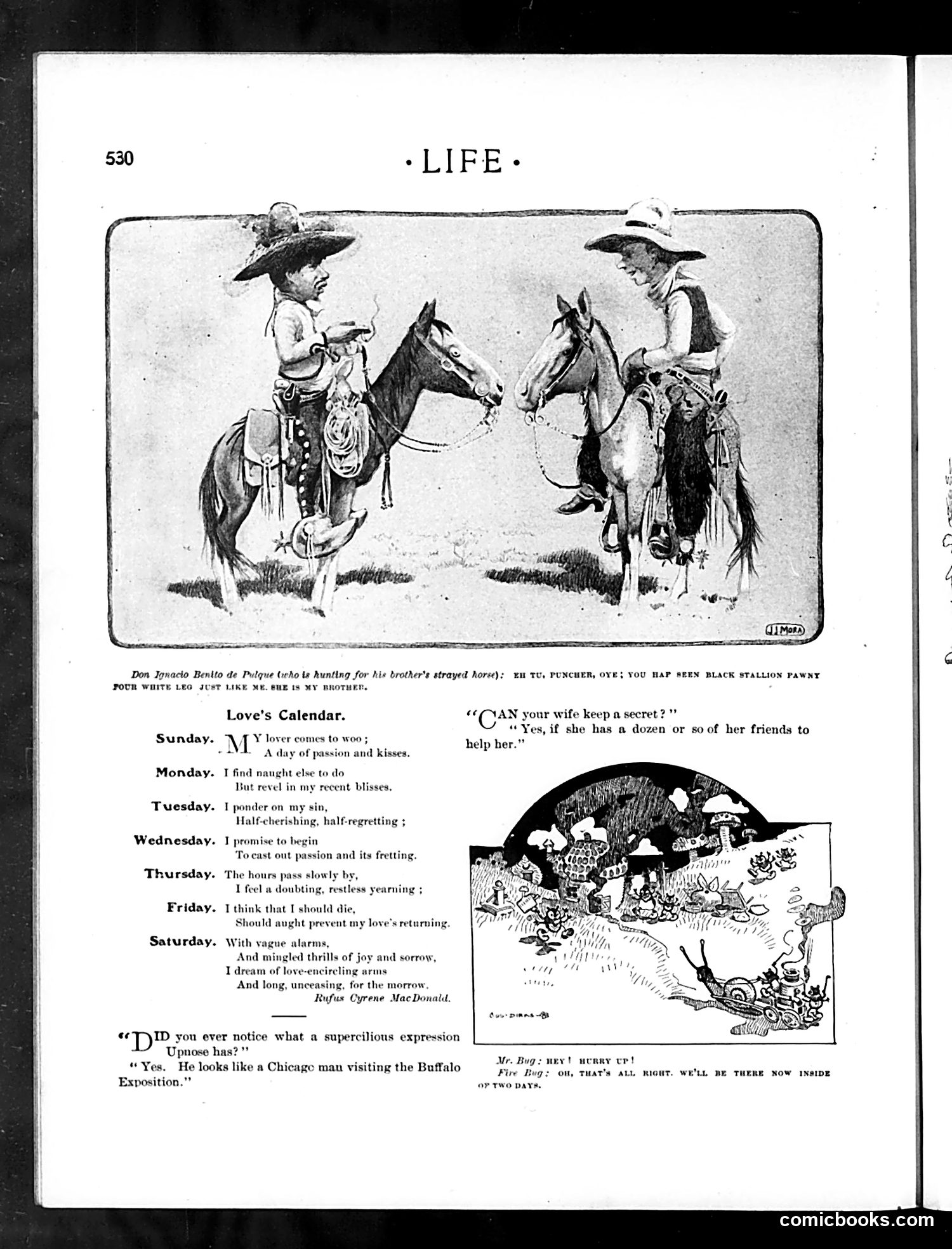
**Top Cartoon:** Shows two cowboys on horseback in what appears to be a Western standoff. The caption references "Don Ignacio Brillo de Polque" hunting for his brother's "strayed horse," establishing a humorous Western scenario with Spanish-language character names, likely satirizing romantic or adventure fiction tropes popular at the time. **"Love's Calendar":** A weekly breakdown of romantic sentiments (Sunday through Saturday), presenting idealized but increasingly conflicted attitudes toward love—moving from passion through doubt to melancholy resignation. This satirizes the predictable emotional cycles in romantic literature. **Additional Cartoons:** Include domestic humor (the "secret" joke about wives and gossip) and a woodland scene with what appears to be social commentary, though specifics are unclear from the image alone. The page overall mocks sentimental romance conventions through gentle satire.
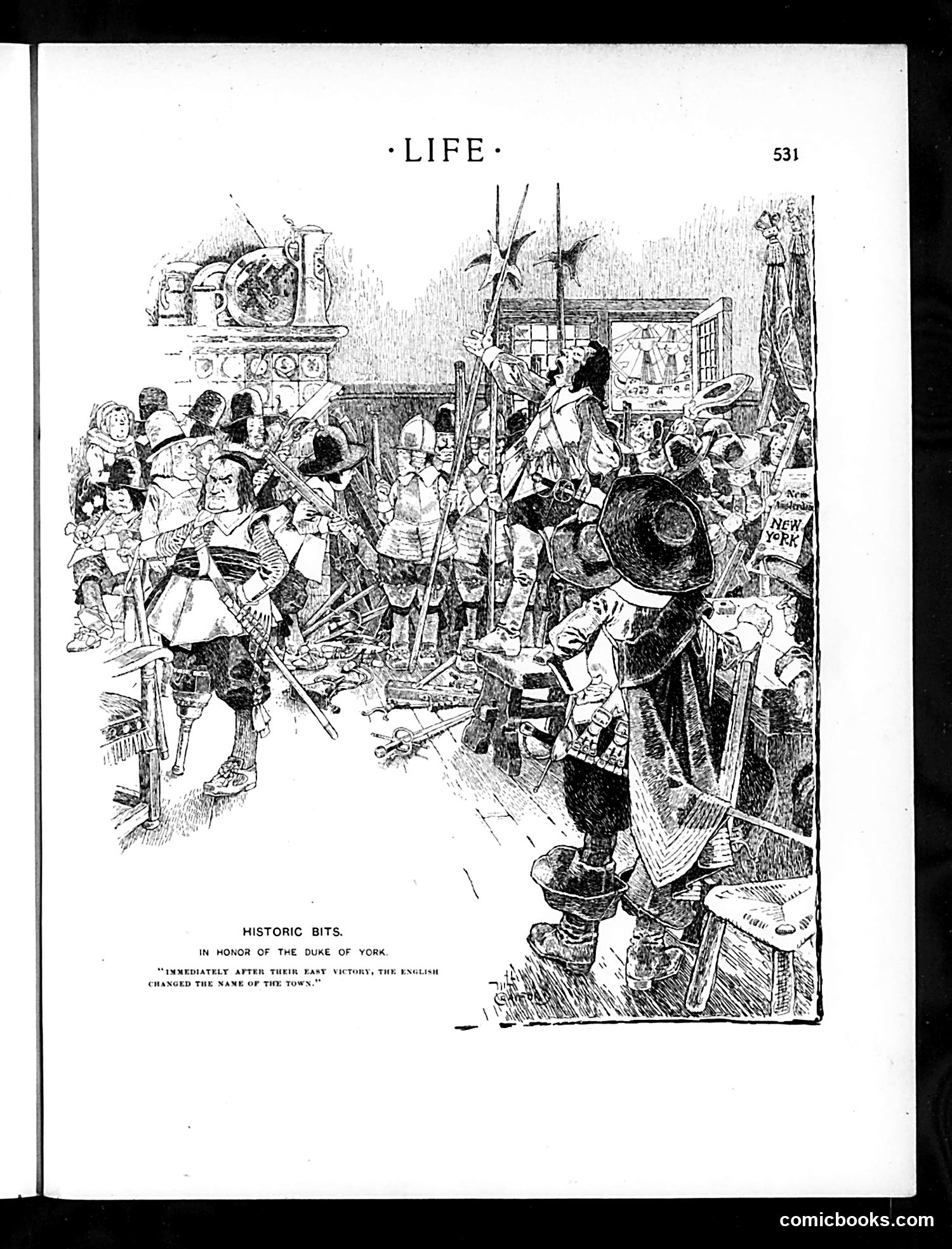
This cartoon satirizes the renaming of New York. The caption references the Duke of York and indicates that after an English military victory, they renamed a town in his honor—this alludes to the historical 1664 English capture of the Dutch settlement New Amsterdam, which they renamed New York. The chaotic scene depicts a crowd of soldiers and colonists celebrating amid weapons and military equipment. The satire appears to mock the practice of victor nations imposing their own naming conventions on conquered territories as a display of dominance and cultural assertion. The crowded, raucous composition emphasizes the somewhat absurd pageantry surrounding this administrative act—reducing geopolitical conquest to a simple name change.
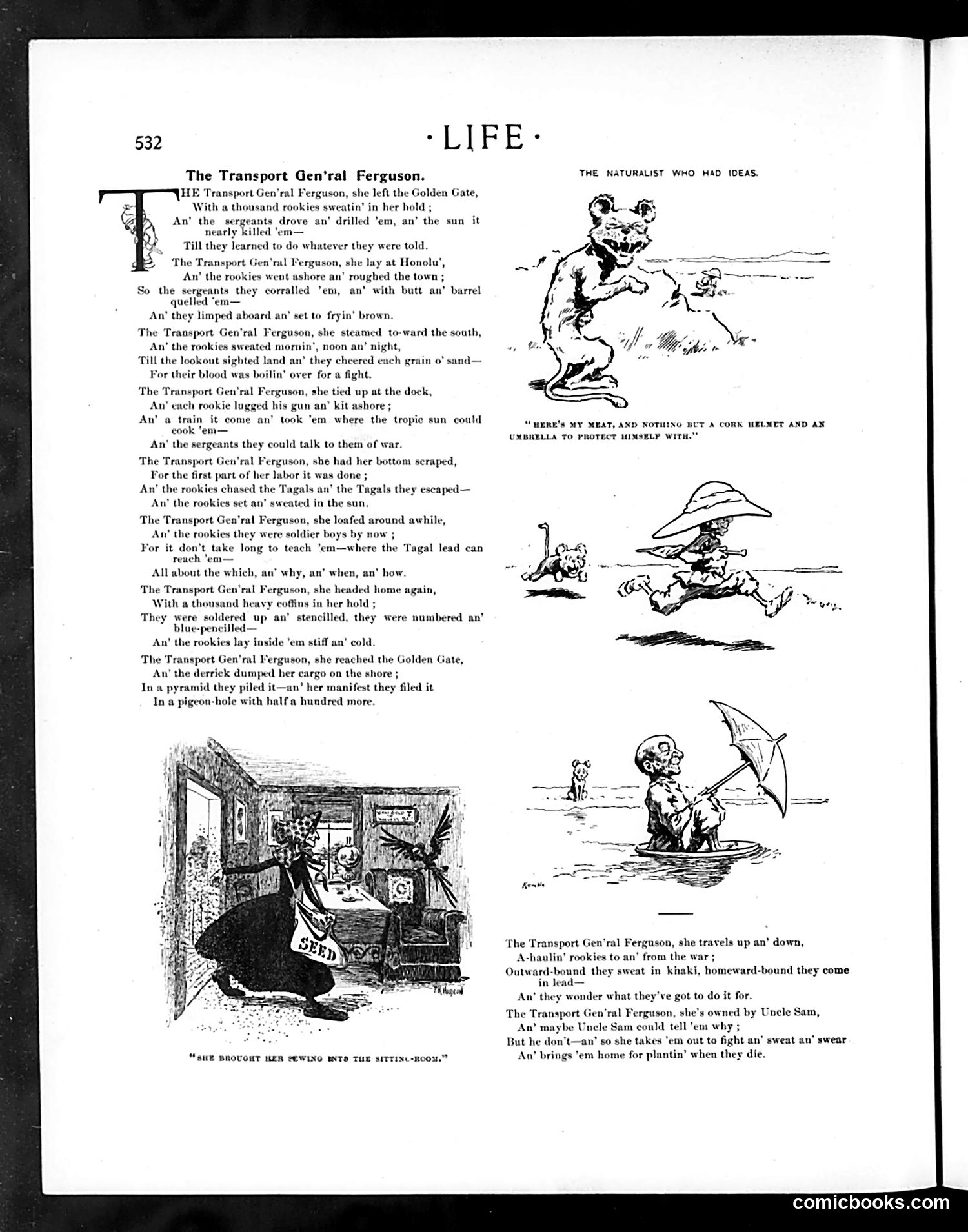
This page satirizes the Philippine-American War (1899-1902) through the ballad of the "Transport Gen'ral Ferguson," a military transport ship. The poem traces American "rookies" (inexperienced soldiers) from San Francisco through Hawaii to the Philippines, where they fight Filipino insurgents called "Tagals." The satire's bitter edge emerges in the final stanzas: soldiers are reduced to cargo—numbered, stencilled, and returned home "stiff an' cold" (dead). The closing couplet is cutting: Uncle Sam transports them out to "fight an' sweat an' swear," then brings them home "for plantin' when they die." The right-side cartoons titled "The Naturalist Who Had Ideas" appear to mock someone's naive observations about warfare—the figure with umbrella and cork helmet suggests an unprepared civilian. **Overall message**: Life magazine criticized the war's waste of American lives and questioned the government's motives for continuing it.
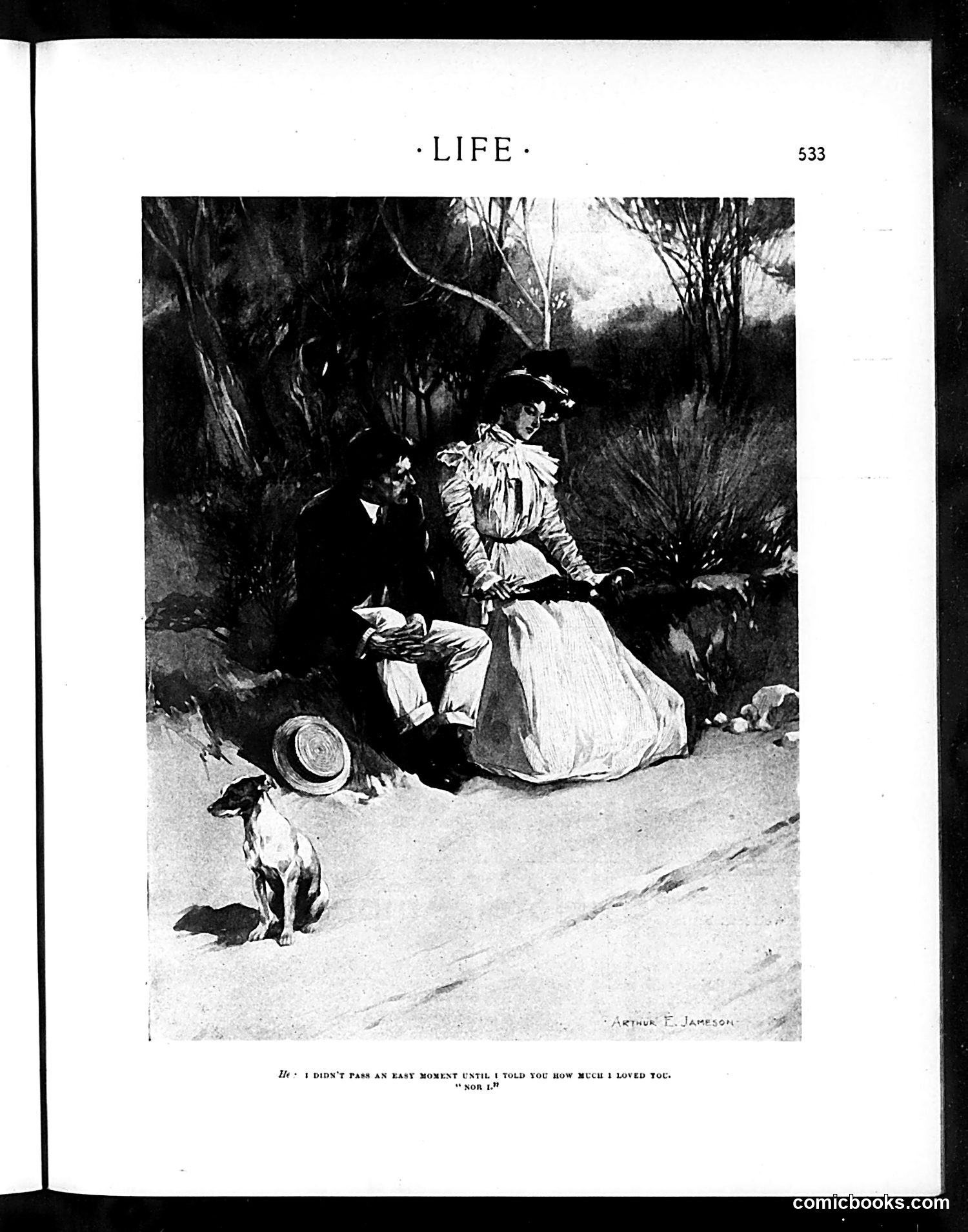
This page from *Life* magazine features an illustration by Arthur F. Jameson depicting a romantic scene. A couple sits together outdoors under trees, with a small dog nearby. The man holds a hat and appears to be confessing his feelings to the woman in a full-sleeved dress. The caption reads: "He: 'I didn't pass an easy moment until I told you how much I loved you.'" (The "Non L.M." appears to be a publication mark.) This is a sentimental romantic vignette rather than political satire—a common genre in *Life* magazine, which published both humorous commentary and genteel romantic imagery. It depicts a marriage proposal or confession scene, poking gentle fun at male anxiety and emotional vulnerability. The illustration captures the earnest romanticism typical of early-to-mid 20th century popular magazines.
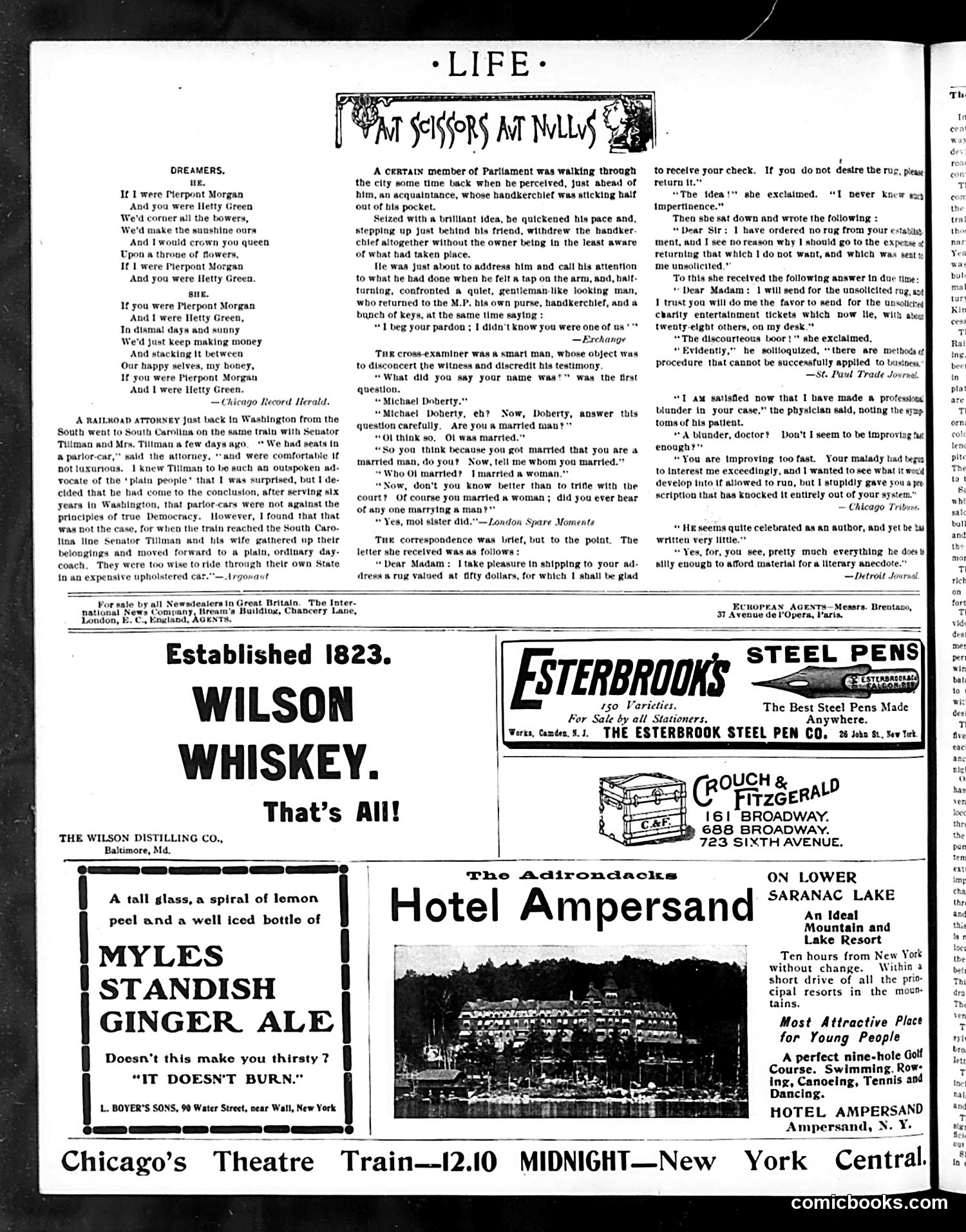
This page is primarily **advertising and humorous anecdotes** rather than political cartoons. The content includes: 1. **"Dreamers" poem** comparing wealth to Pierpont Morgan and Hetty Green—contemporary American millionaires used as symbols of extreme wealth. 2. **Senator Tillman anecdote**: Satirizes Senator Benjamin Tillman of South Carolina as a populist hypocrite. He publicly championed "plain people" but maintained middle-class comfort until returning to his home state, where he moved to a day-coach to maintain his democratic image. The joke: his principles were performative. 3. **Pickpocket story**: A Member of Parliament unknowingly steals from someone who steals from him—mutual thieves recognizing each other's craft with "I didn't know you were one of us." 4. **Legal cross-examination**: Mock-serious wordplay where a lawyer's trick questions about marriage backfire. 5. **Rug correspondence**: A woman refuses unsolicited goods and refuses to return them; the sender retaliates by keeping unwanted theater tickets on his desk. The **advertisements** (Wilson Whiskey, Esterbrook Pens, Hotel Ampersand) occupy significant space.
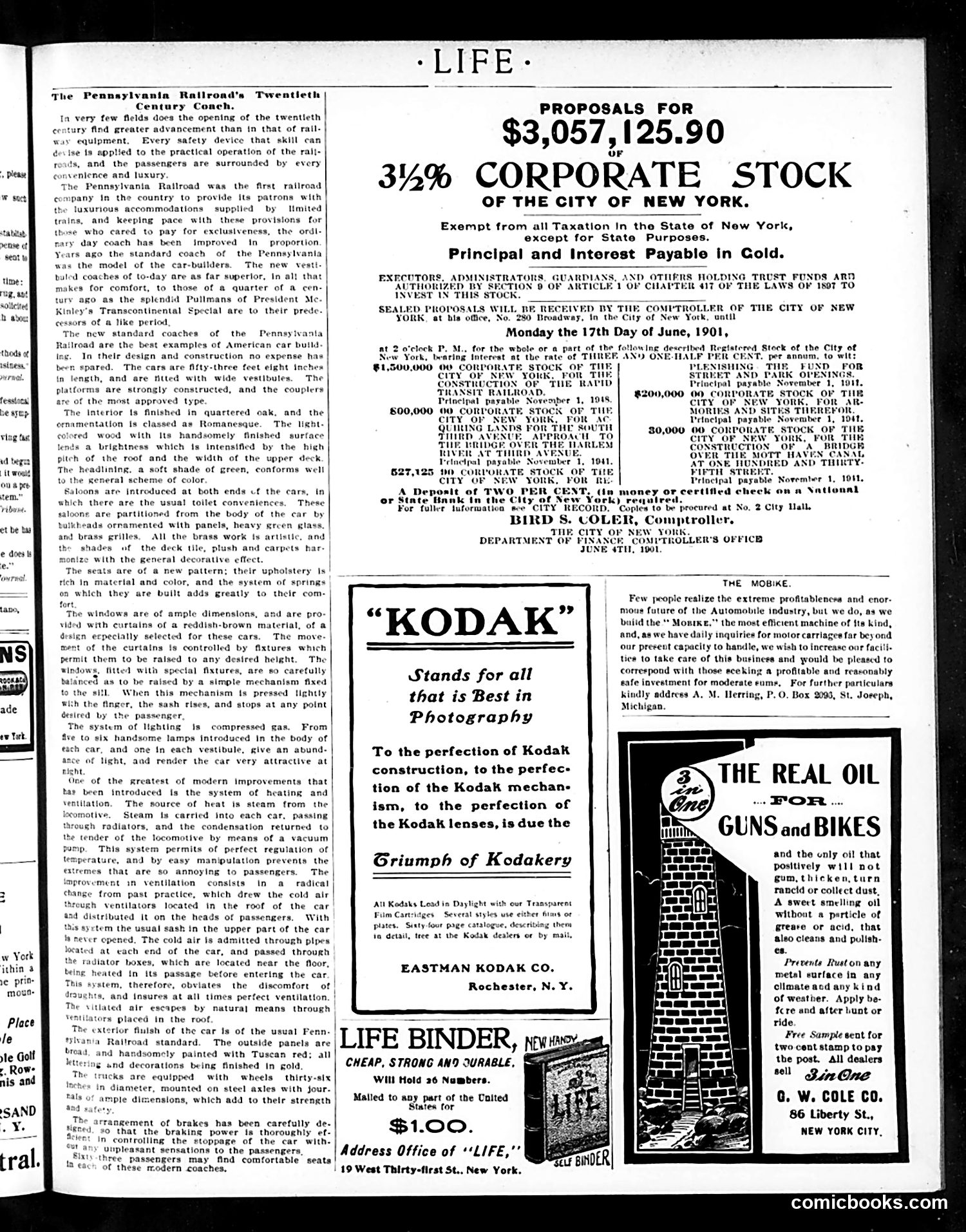
This page is primarily **advertising and promotional content**, not satirical cartoons. It features: 1. **Main article**: A detailed description of the Pennsylvania Railroad's new "Twentieth Century Coach," praising its luxurious design, safety features, and modern amenities (steam heating, compressed gas lighting, improved ventilation). 2. **Corporate stock proposal**: An announcement for $3,057,125.90 in New York City corporate stock at 3½%, exempt from state taxation. 3. **Product advertisements**: Including Kodak cameras ("Stands for all that is Best in Photography"), a Life Binder, and oil for guns and bikes. The page reflects early 1900s consumer culture and industrial progress. There is **no political satire or cartoon content visible**—rather, it showcases how Life magazine (founded as humor/satire) was transitioning to include substantial advertising and straightforward business announcements alongside editorial content.
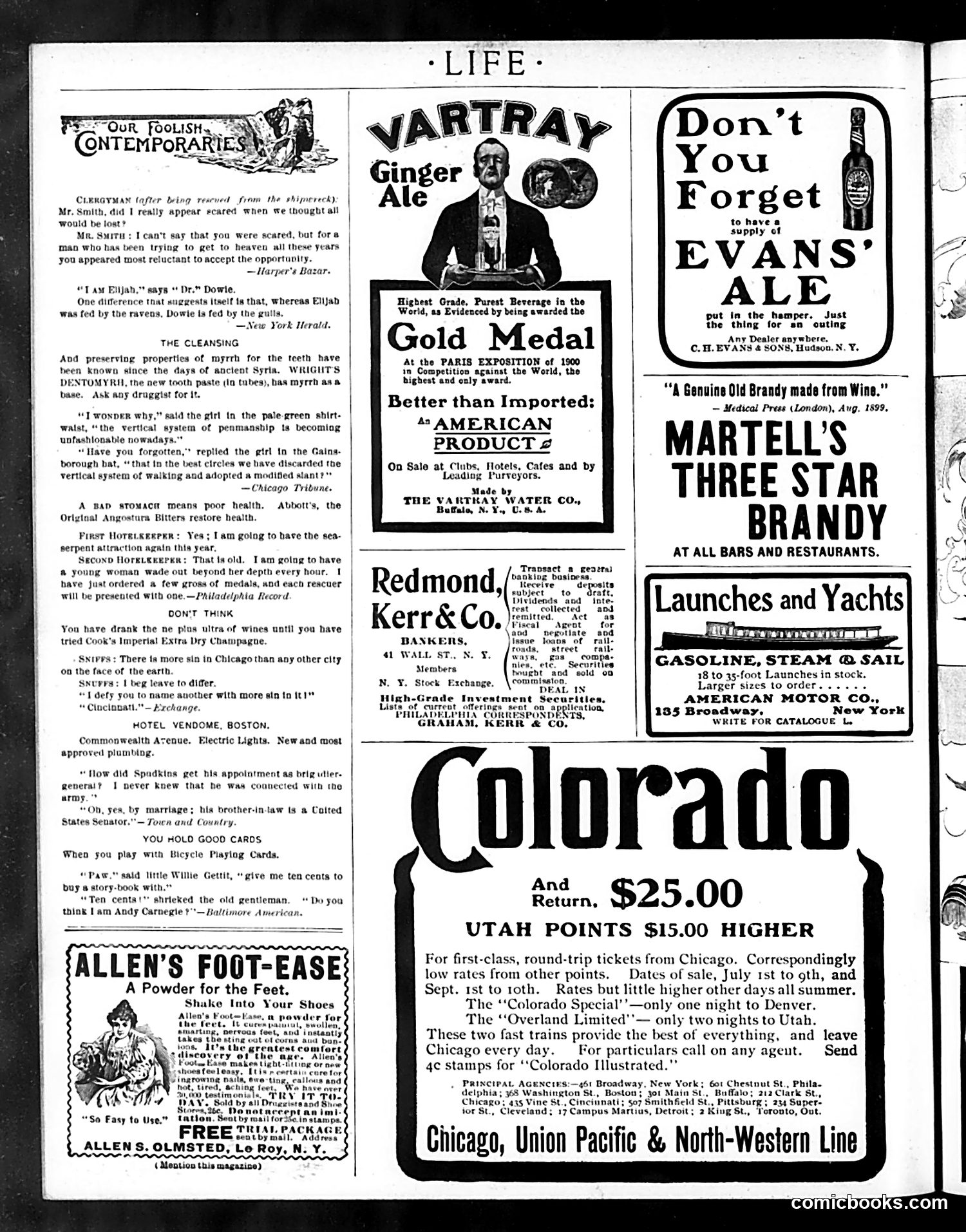
This is primarily a **page of advertisements and brief humorous anecdotes**, not a political cartoon. The "Our Foolish Contemporaries" section reprints short, satirical jokes from other publications, mostly poking fun at everyday social situations: - A clergyman reluctant to accept heaven despite decades of seeking it - A preacher (Dowie) compared unfavorably to the biblical prophet Elijah - Silly observations about fashion and urban life in Chicago - A hotel owner's absurd solution to attractions (repeatedly endangering swimmers) - Social climbing through military appointment via marriage to a senator's relative The humor is mild, focused on **human absurdity and hypocrisy** rather than partisan politics. The surrounding advertisements (for Varntray Ginger Ale, Evans' Ale, Martell's Brandy, and travel) show this is a magazine aimed at upper-class readers with disposable income for luxury goods and leisure travel. The tone is lighthearted and genteel—typical of *Life* magazine's satirical voice during this period.
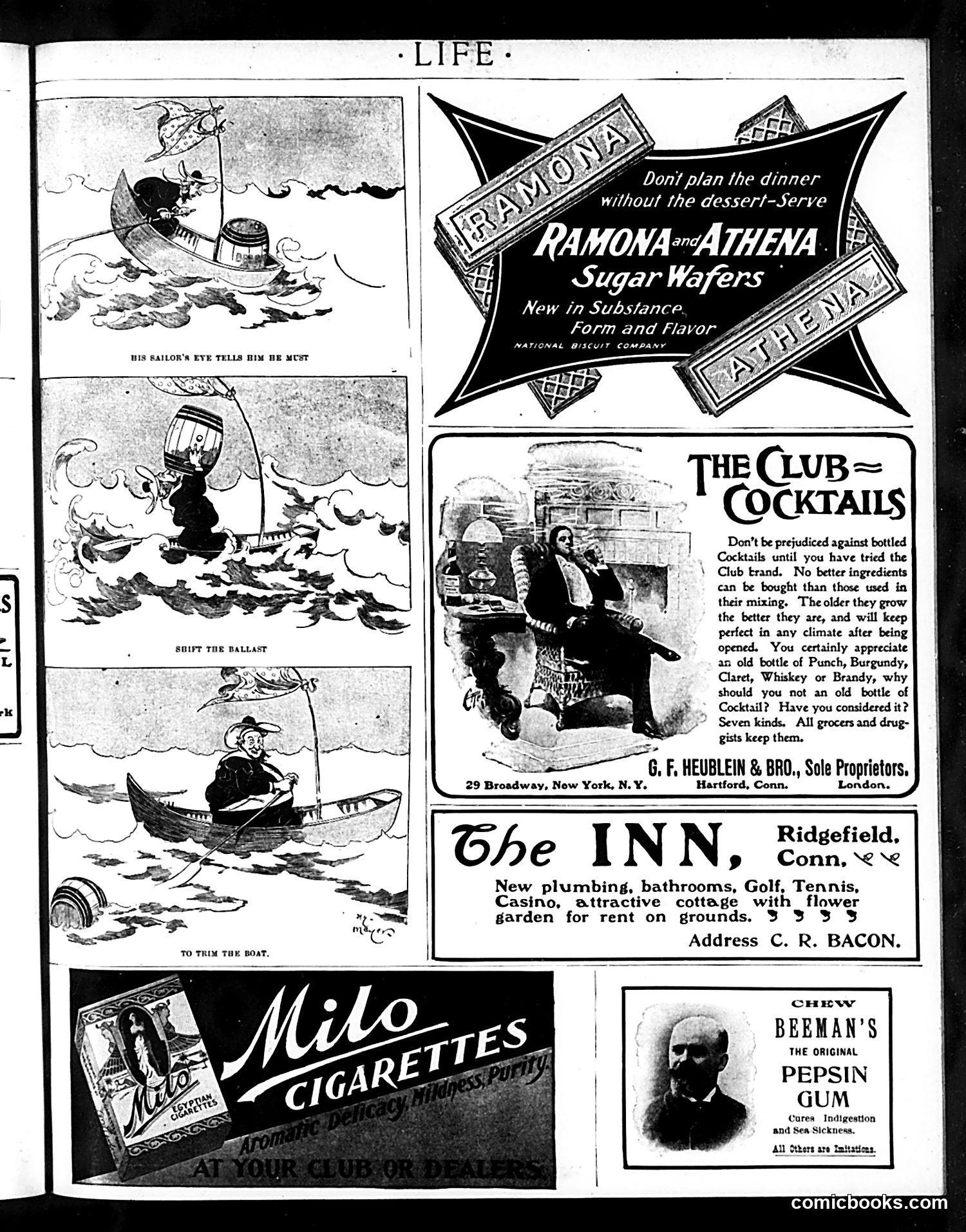
This is primarily an **advertising page** with a small comic strip on the left. The three-panel nautical cartoon (captions: "His Sailor's Eye Tells Him He Must," "Shift the Ballast," "To Trim the Boat") appears to be a visual pun about maritime navigation, likely using sailing terminology as double entendre—typical of Life's satirical humor style. The advertisements are straightforward period promotions: Ramona and Athena Sugar Wafers, Club brand pre-mixed cocktails (noteworthy as bottled cocktails were a novelty), The Inn resort in Ridgefield Connecticut, Milo Cigarettes, Beeman's Pepsin Gum, and The Club Cocktails again. The Club Cocktails ad is most historically notable—it defensively argues against prejudice toward bottled cocktails, suggesting this was a contested innovation in early 20th-century drinking culture. The page reflects consumer goods and leisure activities targeting middle-to-upper-class readers of that era.
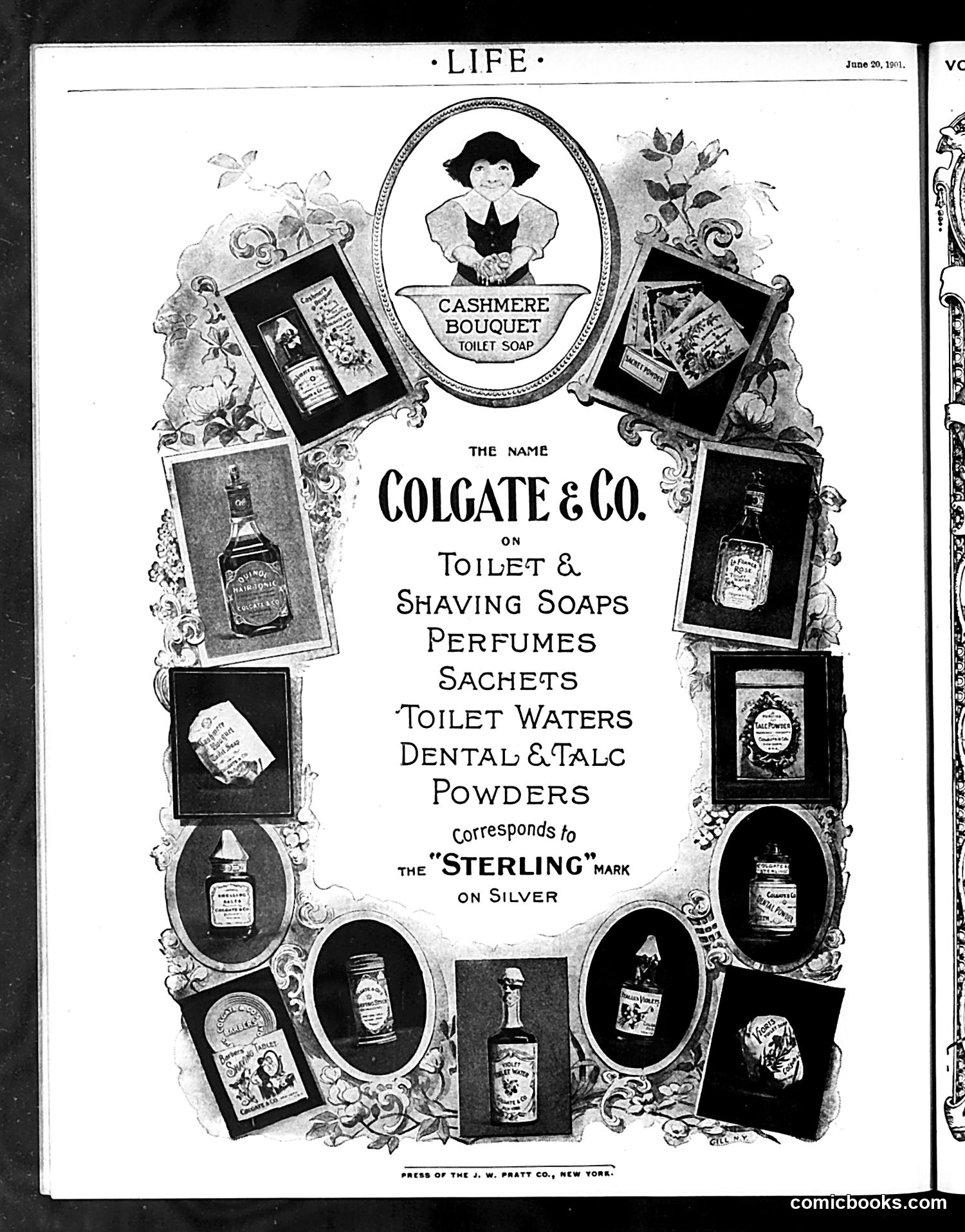
This is not a cartoon or satire—it's a straightforward **product advertisement** for Colgate & Co., a major toiletries manufacturer. The page showcases their range of products (soaps, perfumes, powders, toilet waters) arranged decoratively around a central image of a woman's face labeled "Cashmere Bouquet Toilet Soap." The advertisement's key claim is that the Colgate & Co. name "corresponds to the 'Sterling' mark on Silver"—meaning their brand name carries equivalent prestige and guaranteed quality to the sterling silver hallmark. This was a common early 20th-century advertising strategy: establishing brand credibility by comparing a company's reputation to established quality standards. The ornate decorative border and product photographs reflect typical luxury advertising aesthetics of 1901.