
Life, 1901-06-20 · page 4 of 20
Life — June 20, 1901 — page 4: what you’re looking at
What you’re looking at
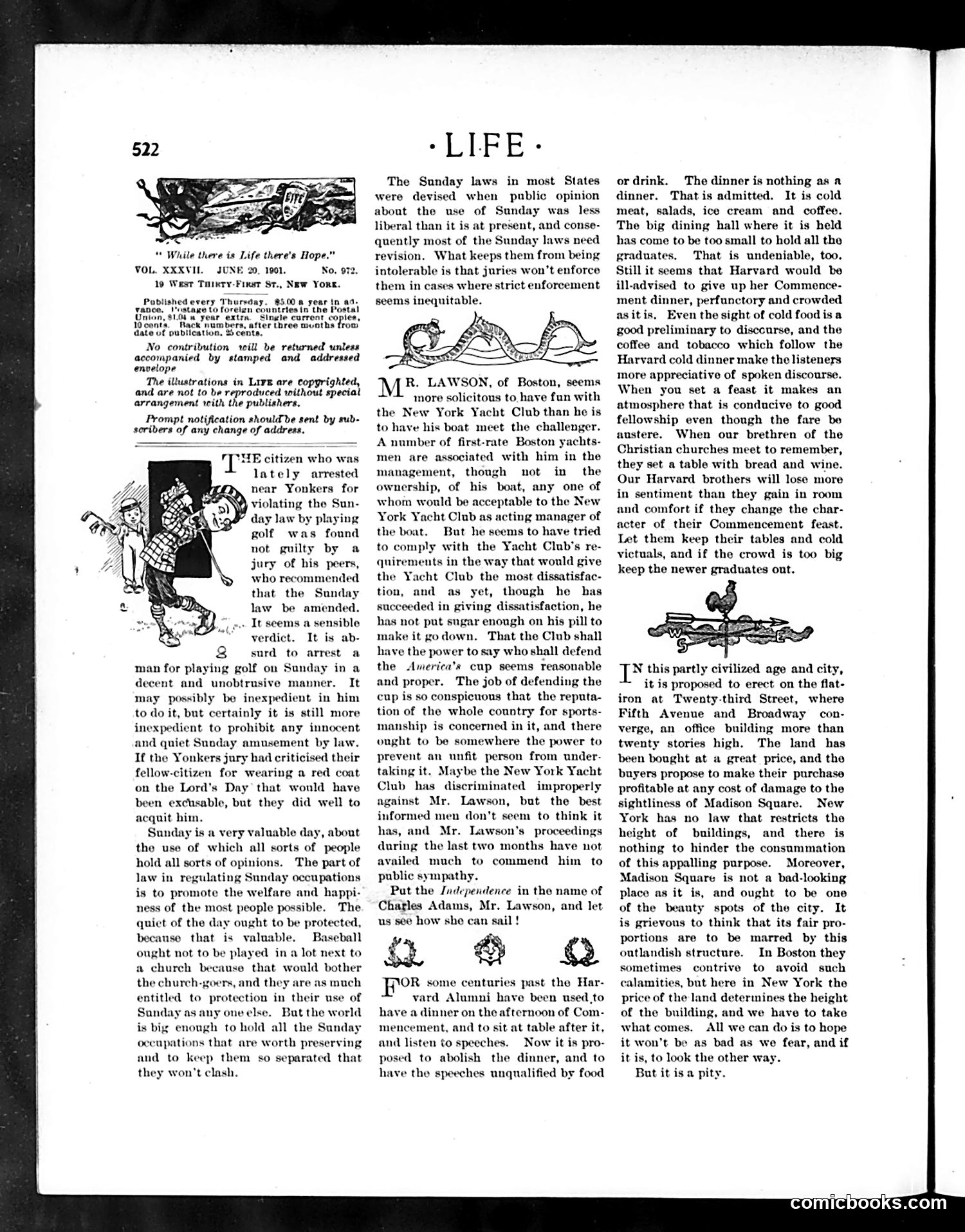
This page contains three separate satirical pieces about social customs and regulations: 1. **Sunday Laws Cartoon** (top left): A small illustration accompanies text criticizing strict Sunday observance laws. The cartoon appears to show someone being arrested, referencing a recent case of a man near Yonkers arrested for playing golf on Sunday. The author argues such laws are outdated and that juries won't enforce them—advocating for reform. 2. **Lawson/Yacht Club Piece** (center): Text discusses Mr. Lawson of Boston and the New York Yacht Club's management dispute over America's Cup defense. The piece critiques the Club's apparent unfair treatment of Lawson's boat selection. 3. **Madison Square Building Proposal** (bottom right): Commentary on a proposed office building at Twenty-third Street and Fifth Avenue, criticizing its planned height as potentially marring the neighborhood's character. The page reflects early 20th-century debates over regulation and aesthetics.
📄 Transcribed text from this page (OCR, searchable)
Machine-transcribed from the original scan — historical spelling and the odd misread are preserved.
“ While there is Life there's Hope.” VOL. XXXVI. JUNE 20. 1901. No. 19 West Taiery-Finst St., New Yore. Poblished every Thursday. 85.00 8 year in ad. Fance. ustage to foreign countries in the Postal Union, $1.04 4 year extra, | Single current copies, Rack numbers, after three munths from dale of publications ce No contribution will be returned unless accompanied by stamped and addressed envelope The illustrations in LrvE are copyrighted, and are not to be reproduced without special arrangement with the publishers. Prompt notification shouldbe sent by sub- seribers of any change of address. ‘TCE citizen who was lately arrested near Yonkers for violating the Sun- P day law by playing golf was found not guilty by a jury of his peers, who recommended that the Sunday law be amended. . It seems a sensible verdict. It is ab- surd to arrest a man for playing golf on Sunday in a decent and unobtrusive manner. It may possibly be inexpedient in him to do it, but certainly it is still more inexpedient to prohibit any innocent and quiet Suoday amusement by law. If the Yonkers jury had criticised their fellow-citizen for wearing a red coat on the Lord's Day that would have been excusable, but they did well to acquit him. Sunday is a very valuable day, about the use of which all sorts of people hold all sorts of opinions. The part of law in regulating Sunday occupations is to promote the welfare and happi- ness of the most people possible. The quict of the day ought to be protected, becanse that is valuable. Baseball ought not to be played ina lot next to a church because that would bother the church-yoers, and they are as much entitled to protection in their use of Sanday as any oneelse. But the world is big enough to hold all the Sunday occupations that are worth preserving and to keep them so separated that they won't clash. LIFE The Sunday laws in most States were devised when public opinion about the use of Sunday was less liberal than it is at present, and conse- quently most of the Sunday laws need revision. What keeps them from being intolerable is that juries won't enforce them in cases where strict enforcement seems inequitable. R, LAWSON, of Boston, seems more solicitous to. have fun with the New York Yacht Club than he is to have his boat meet the challenger. A number of first-rate Boston yachts- men are associated with him in the management, though not in the ownership, of his boat, any one of whom would be acceptable to the New York Yacht Club as acting manager of the boat. But he seems to have tried to comply with the Yacht Club's re- quirements in the way that would give the Yacht Club the most dissatisfac- tion, and as yet, though he has succeeded in giving dissatisfaction, he has not put sugar enough on his pill to make it godown. That the Club shall have the power to say who shall defend the America’s cup seems reasonable and proper. The job of defending the cup is so conspicuous that the reputa- tion of the whole country for sports- manship is concerned in it, and there ought to be somewhere the power to prevent an unfit person from under- taking it. Maybe the New York Yacht Club has discriminated improperly against Mr. Lawson, but the best informed men don’t seem to think it has, and Mr. Lawson's proceedings during the last two months have not availed much to commend him to public sympathy, Put the Jndependence in the name of Charles Adams, Mr. Lawson, and let us see how she can sail! OR some centuries past the Har- vard Alumni have been used to have a dinner on the afternoon of Com- mencement, and to sit at table after it, and listen to speeches. Now it is pro- posed to abolish the dinner, and to have the speeches unqualified by food ordrink. The dinner is nothing as a dinner. That is admitted. It is cold meat, salads, ice cream and coffee. The big dining hall where it is held has come to be too small to hold all the graduates, That is undeniable, too. Still it seems that Harvard would be ill-advised to give up her Commence- ment dinner, perfunctory and crowded asitis, Even the sight of cold food isa good preliminary to discourse, and the coffee and tobacco which follow the Harvard cold dinner make the listeners more appreciative of spoken discourse. When you set a feast it makes an atmosphere that is conducive to good fellowship even though the fare bo austere. When our brethren of the Christian churches meet to remember, they set a table with bread and wine. Our Harvard brothers will lose more in sentiment than they gain in room and comfort if they change the char- acter of their Commencement feast. Let them keep their tables and cold victuals, and if the crowd is too big keep the newer graduates ont. [* this partly civilized age and city, it is proposed to erect on the flat- iron at Twenty-third Street, where Fifth Avenue and Broadway con- verge, an office building more than twenty stories high. The land has been bought at a great price, and the buyers propose to make their purchase profitable at any cost of damage to the sightliness of Madison Square. New York has no law that restricts the height of buildings, and there is nothing to hinder the consummation of this appalling purpose. Moreover, Madison Square is not a bad-looking place as it is, and ought to be one of the beauty spots of the city. It is grievous to think that its fair pro- portions are to be marred by this outlandish structure. In Boston they sometimes contrive to avoid such calamities, but here in New York the price of the land determines the height of the building, and we have to take what comes. All we can do is to hope it won't be as bad as we fear, and if it is, to look the other way. But it isa pity.