
A complete issue · 22 pages · 1901
Life — May 23, 1901
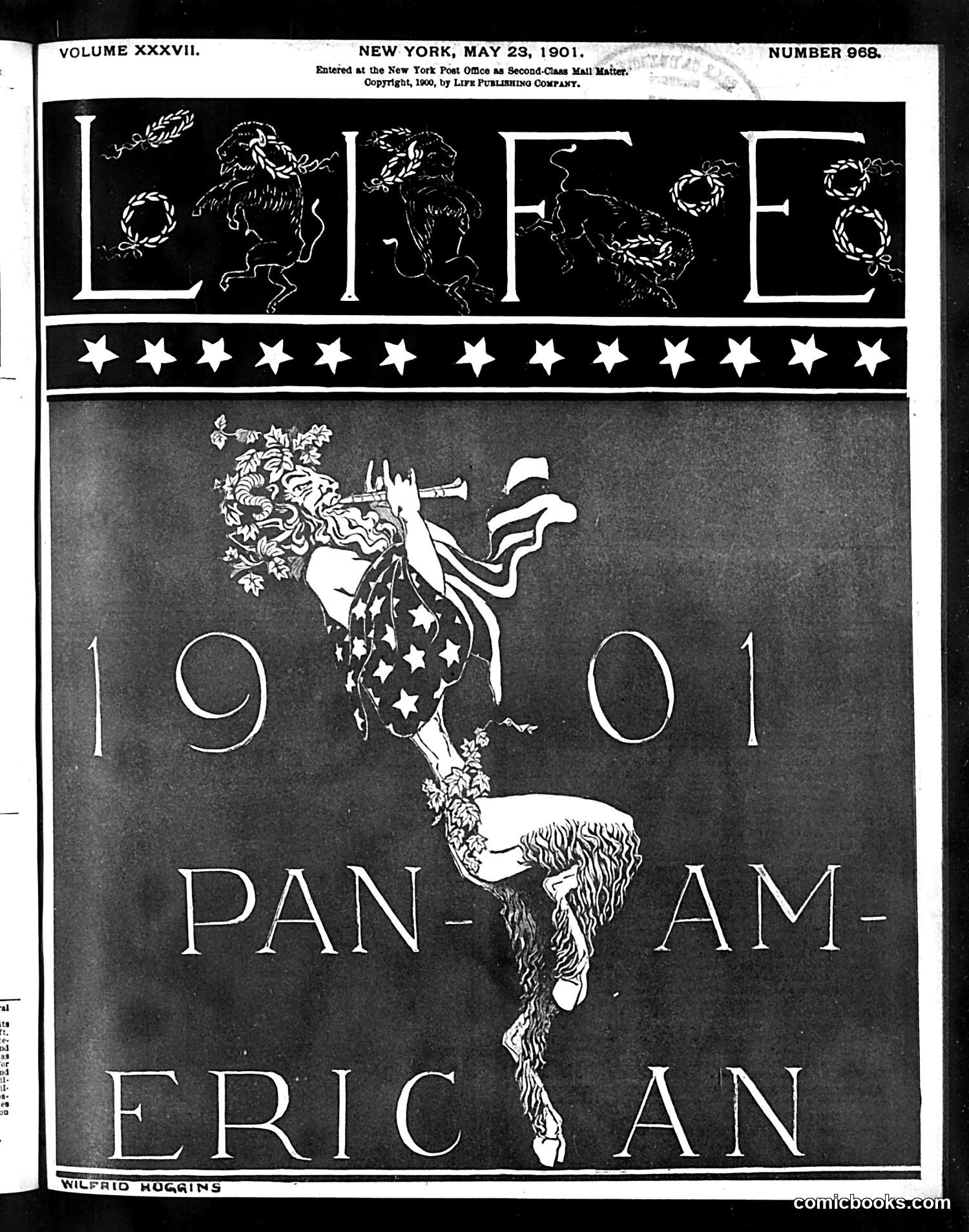
This cover celebrates the **1901 Pan-American Exposition** held in Buffalo, New York—a major world's fair showcasing American industrial and cultural achievements. The central figure is **Uncle Sam** (identifiable by his star-spangled outfit and top hat), depicted as Pan (the mythological goat-legged god), energetically playing a trumpet. This conflation represents American vitality and leadership on the world stage. The "1901 PAN-AMERICAN" text and decorative wreaths frame the allegorical image, emphasizing national pride during the exposition period. The artistic style employs classical mythology to elevate American accomplishment, a common satirical strategy of the era for commenting on national self-promotion and imperial aspirations. The artist is credited as "Wilfred Roggins" at bottom.
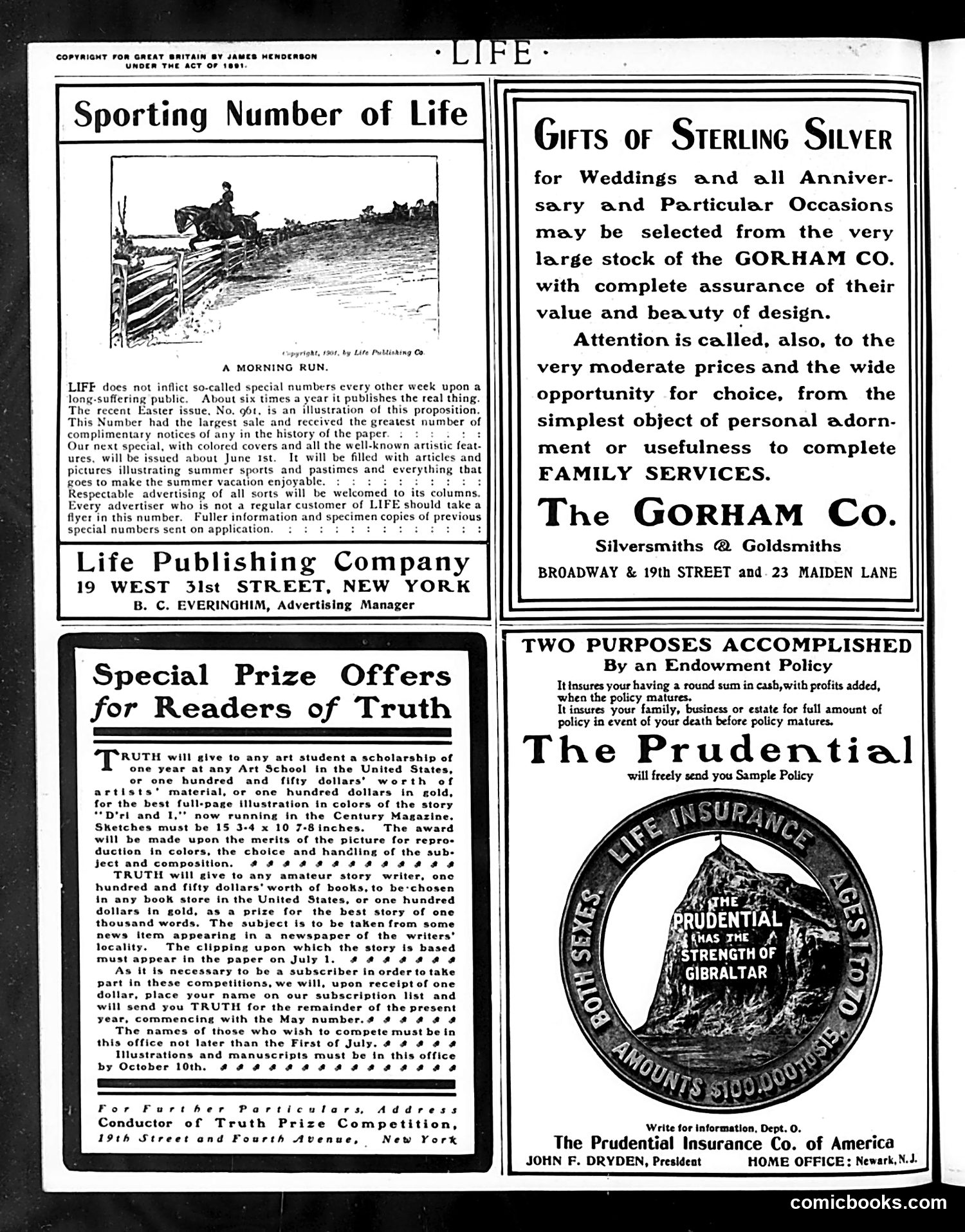
This page contains primarily **advertisements rather than satirical content**. The main visual element is a sporting illustration titled "A Morning Run," showing a horseman jumping a fence—likely celebrating fox hunting or recreational riding, popular pastimes among the wealthy leisure class that Life magazine targeted. The advertisements promote: - Life Publishing Company's upcoming special issue - The Gorham Company's sterling silver gifts for weddings - The Prudential Insurance Company's endowment policies The "Special Prize Offers for Readers of Truth" advertises contests for art students and amateur writers in competing publications. There is **no political satire or social commentary evident** on this page. It appears to be a standard commercial advertising section from an early 20th-century magazine.
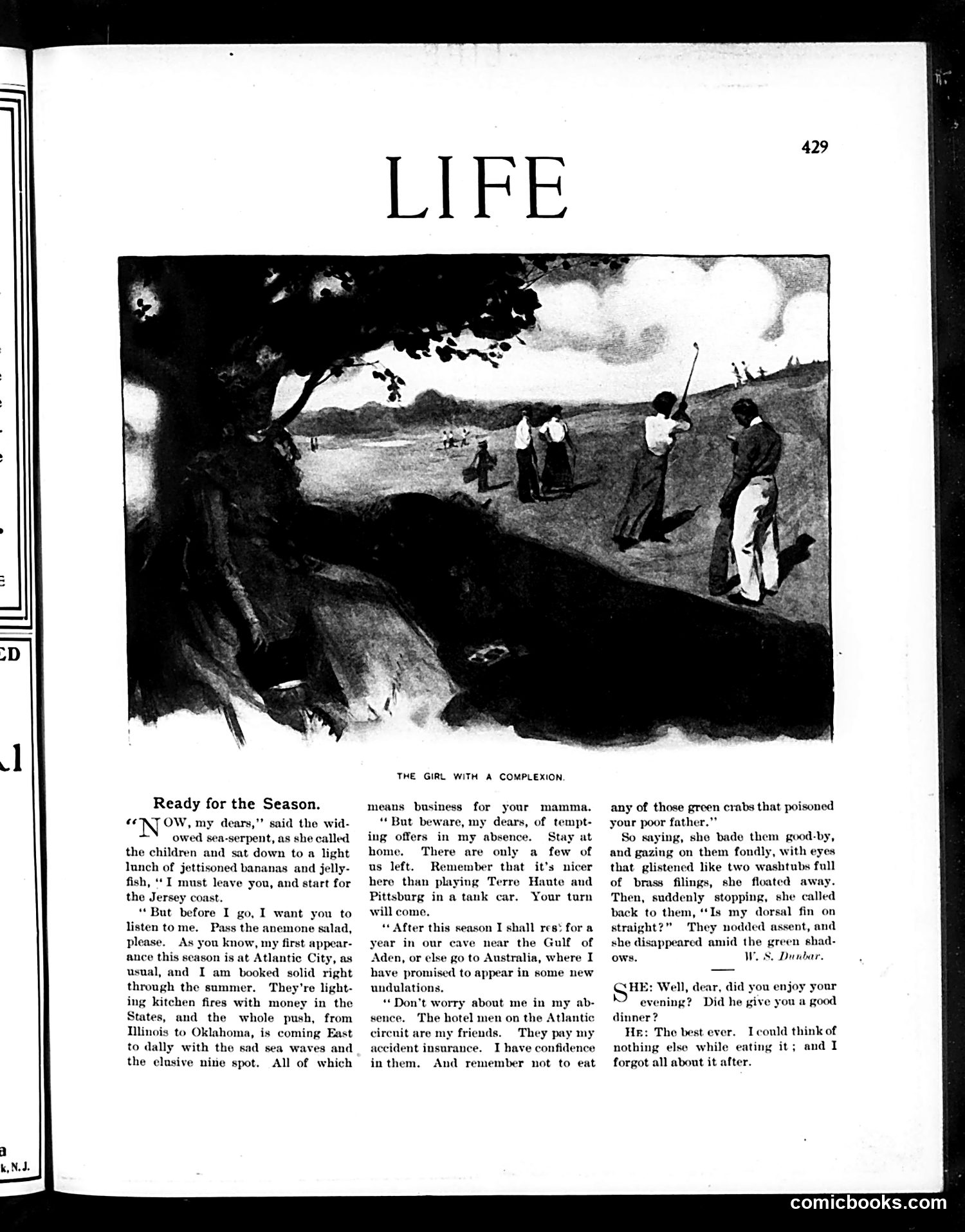
This page from *Life* magazine contains a short story titled "The Girl with a Complexion" rather than a political cartoon. The illustration shows a seaside scene with figures gathered near water and trees. The story itself is a lighthearted domestic narrative about a sea-serpent character advising children about summer activities—mentioning locations like Atlantic City, the Jersey coast, and Australia. The dialogue includes warnings about avoiding "green crabs" and references to hotel men on Atlantic circuits providing accident insurance. The "joke" appears to be the whimsical premise of a sea-serpent offering maternal advice about proper summer leisure activities. This reflects early 20th-century middle-class American concerns about appropriate vacation destinations and behaviors during the summer season. The humor relies on the absurdity of the sea-creature as maternal figure rather than on political satire.
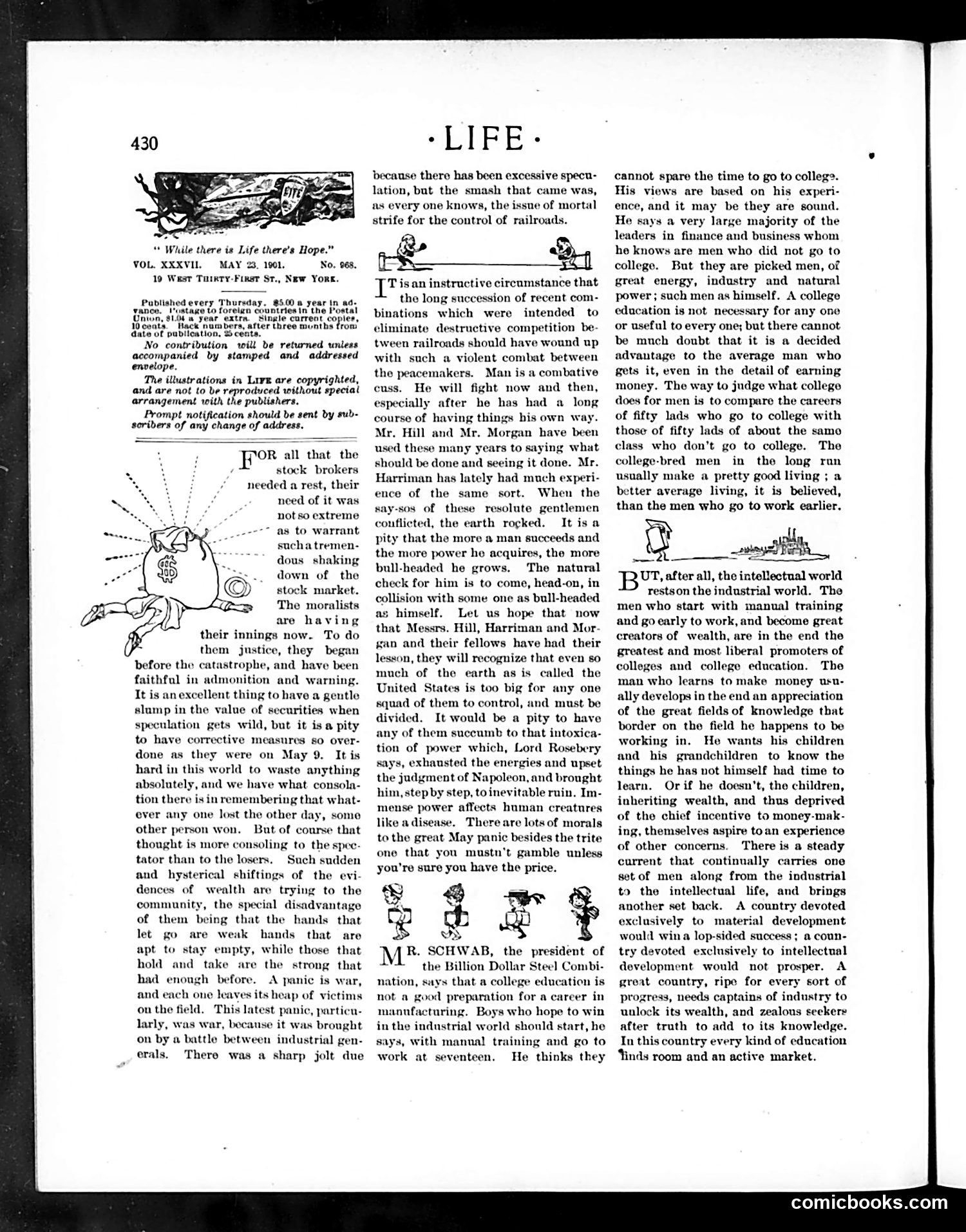
This Life magazine page from May 23, 1901, contains editorial commentary on railroad competition and college education debates. **Main Cartoon (left):** A money bag with legs illustrates the "stock market" panic referenced in the text—depicting how financial speculation can personify greed and instability. **Central Theme:** The article debates whether college education is necessary for business success. It argues that some successful industrialists (Hill, Harriman, Morgan) never attended college, yet acquired immense wealth and power. The satire suggests that excessive financial competition and market manipulation ("bull-headed" behavior) are more characteristic of the wealthy than intellectual training. **Social Context:** This reflects early-1900s tensions between inherited industrial power and emerging educational meritocracy—questioning whether formal education or practical business acumen matters more for American economic leadership.
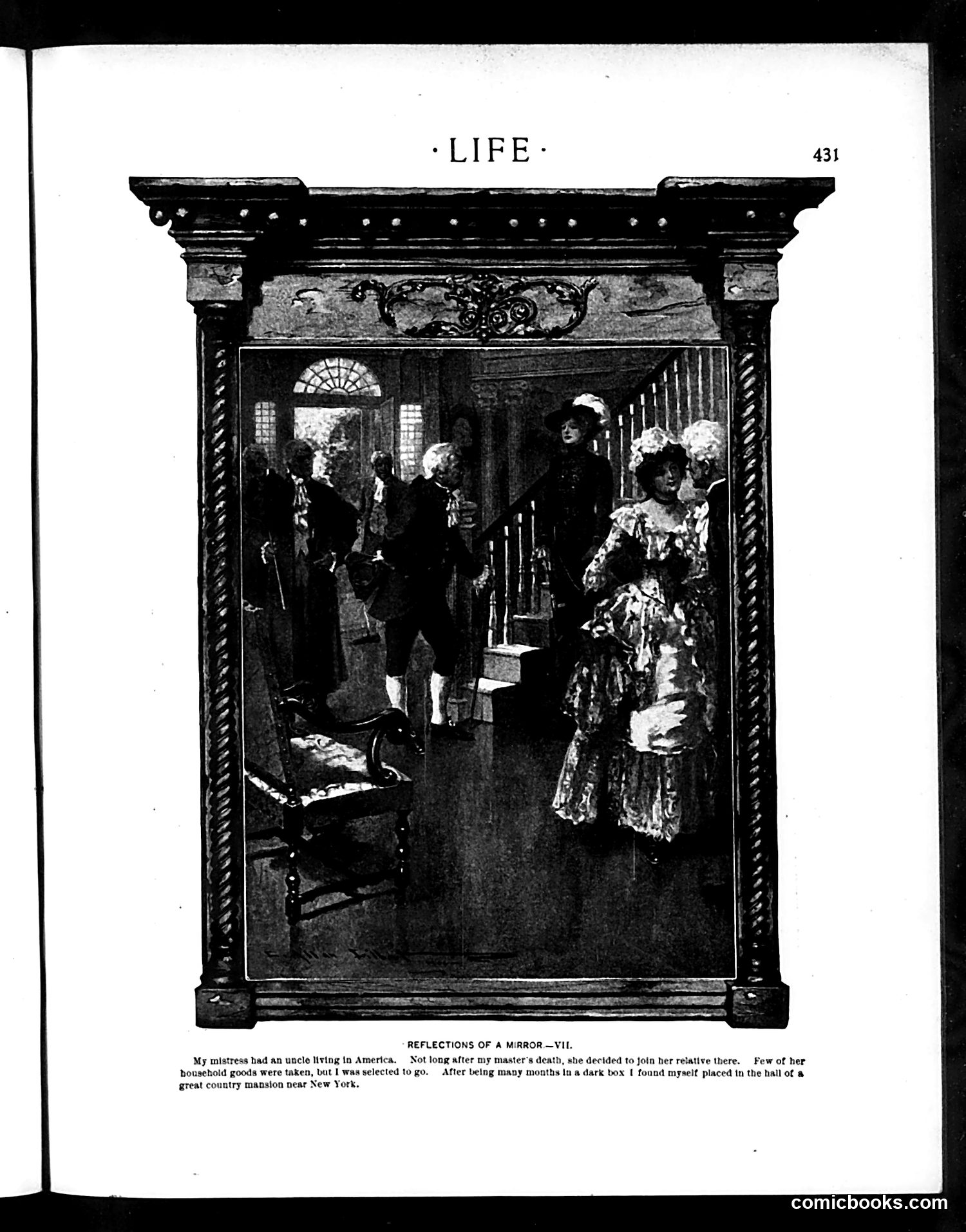
This illustrated narrative appears to be part of a serialized story in *Life* magazine. The image depicts an interior scene with well-dressed figures in what appears to be a formal setting, possibly a mansion's hall or drawing room. The accompanying text explains the narrator's backstory: a servant (likely) whose mistress had an American uncle. Following the mistress's death, the narrator was sent to America but eventually placed in service at "a great country mansion near New York." This appears to be a class-conscious narrative exploring the experiences of household staff—a common *Life* magazine theme satirizing American social hierarchies and the servant class's observations of wealthy households. The "mirror" title suggests the servant provides a reflective commentary on their employers' lives.
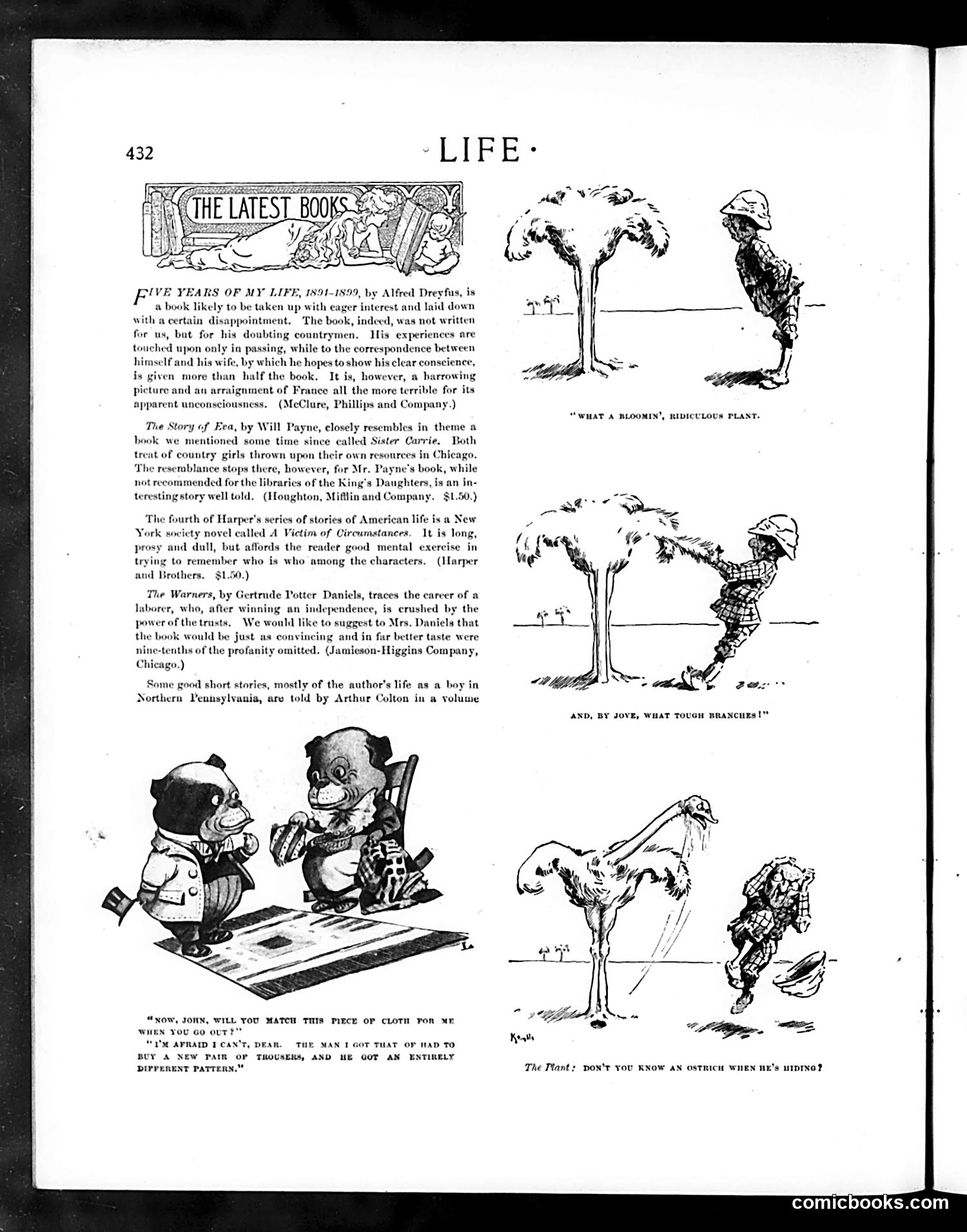
This page contains **book reviews** rather than political cartoons. The main content discusses five recent novels, including works by Alfred Dreyfus and Gertrude Potter Daniels. The illustrations are **humorous domestic scenes** unrelated to the book reviews. The bottom-left shows two caricatured figures (appearing to be minstrel-style characters) discussing fabric patterns for trousers—a joke about fashion disagreement. The right-side drawings depict a person interacting with an ostrich in various comedic situations, with the caption "don't you know an ostrich when he's hiding?" This appears to be a visual gag about the ostrich's famously long neck being obvious despite attempts at concealment. These illustrations are likely filler humor typical of Life's satirical format, not commentary on current events.
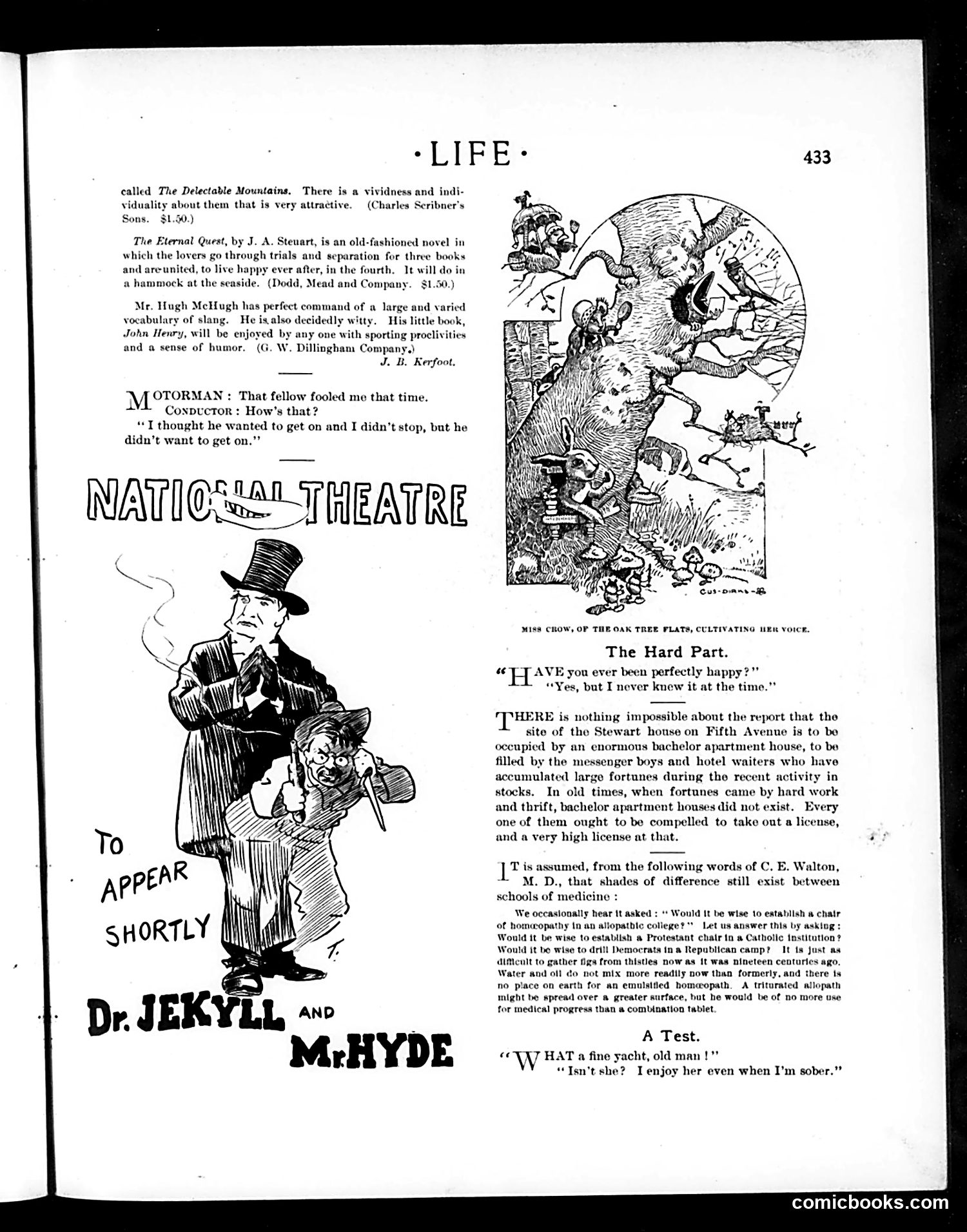
This page combines book reviews, theatrical advertising, and humorous dialogue. The main content includes: **Book Reviews** (top): Brief notices of novels like *The Delectable Mountains* and *The Eternal Quest*, typical of period literary criticism. **"National Theatre" Advertisement** (left): Promotes an upcoming production of *Dr. Jekyll and Mr. Hyde*, using a caricatured figure in top hat with a demonic creature—visual shorthand for the novella's dual-nature theme. The "To Appear Shortly" framing suggests this was an advance promotion. **"The Hard Part" and "A Test"** (right): Satirical sketches about daily life—one mocking bachelor apartments on Fifth Avenue allegedly occupied by young men who've made fortunes in recent stock activity; another making a joke about yacht ownership and sobriety. The page reflects *Life* magazine's mix of literary commentary, theatrical promotion, and social satire aimed at educated urban readers.
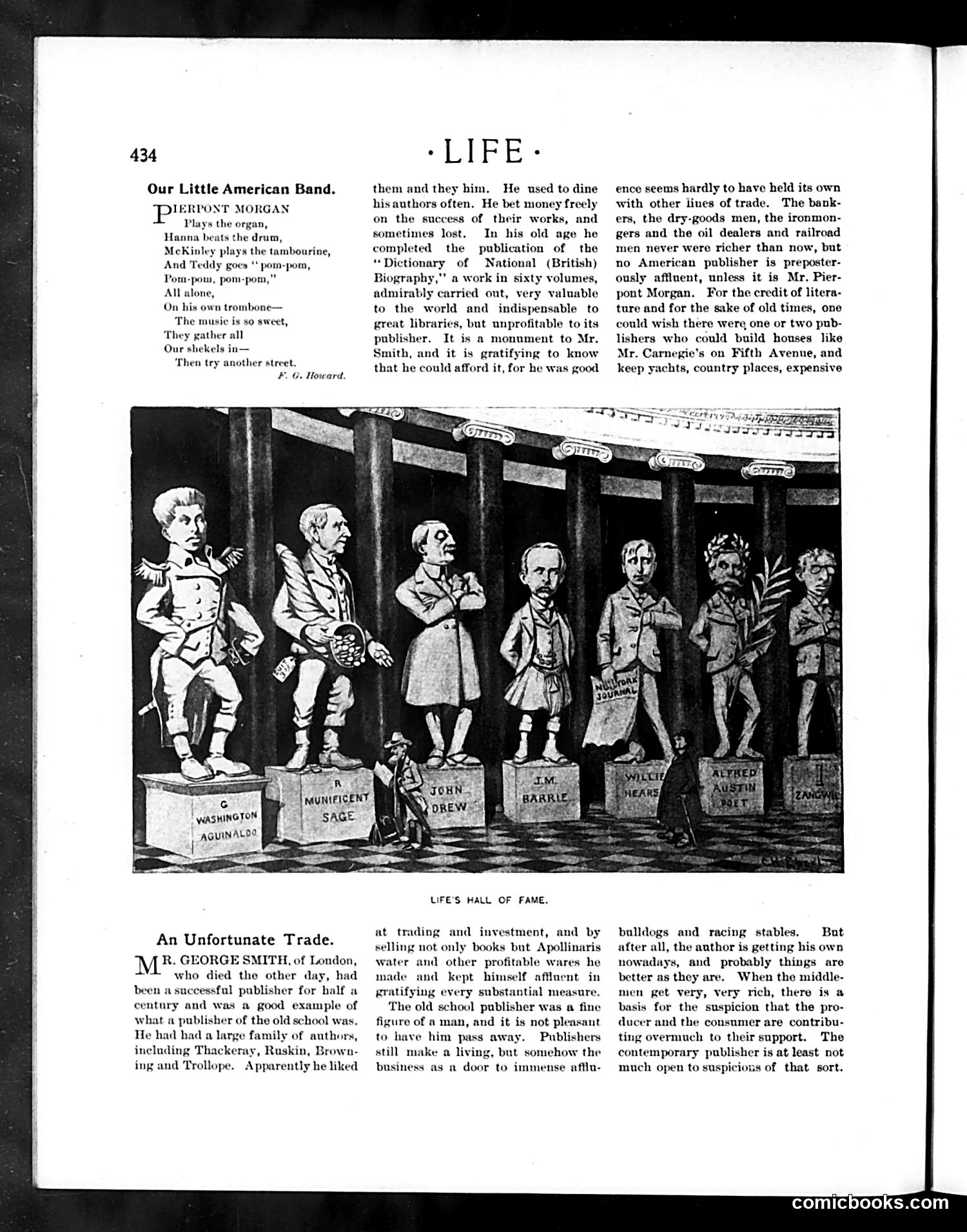
This satirical illustration depicts seven famous figures standing on pedestals, identified by name plates below: G. Washington Aguinaldo, Munificent Sage, John Drew, Barrie, Willie Hearst, Alfred Austin Dutt, and Zangwill. The cartoon appears to mock the concept of "fame" by presenting these men—likely celebrities, politicians, and cultural figures from the early 1900s—as statues in a hall of fame. A small figure examines them, suggesting ironic reverence for men whose actual merit is questionable. The facing article, "An Unfortunate Trade," discusses George Smith, a London publisher, satirizing the publishing business as undignified work despite its prominence. The cartoon likely reinforces this critique by treating famous men as inflated monuments to commercial success rather than genuine achievement.
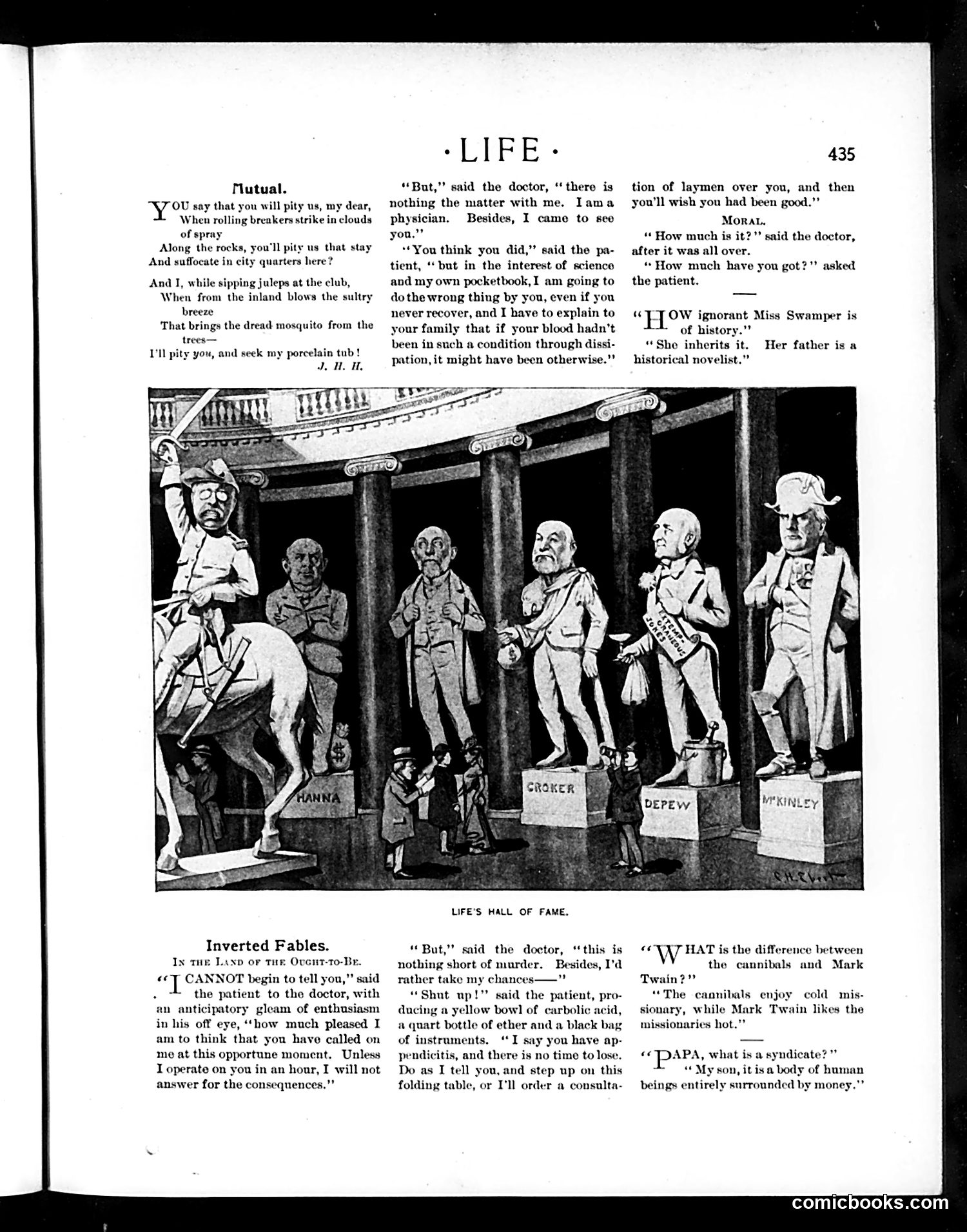
This satirical cartoon depicts a museum-style display of five statues on pedestals labeled (left to right): **Hanna, Croker, Depew, and McKinley**. A tour guide points to them while children observe. The satire targets prominent late-19th-century political figures—likely **Mark Hanna** (McKinley's campaign manager), **Richard Croker** (Tammany Hall boss), **Chauncey Depew** (railroad executive/politician), and President **William McKinley**. The "Hall of Fame" framing mockingly elevates these figures as monuments, suggesting they're treated as heroic despite questionable practices. The accompanying text critiques their corruption and self-interest, presenting them as specimens worthy of satirical examination rather than genuine admiration. The cartoon ridicules American political leadership of the Gilded Age era.
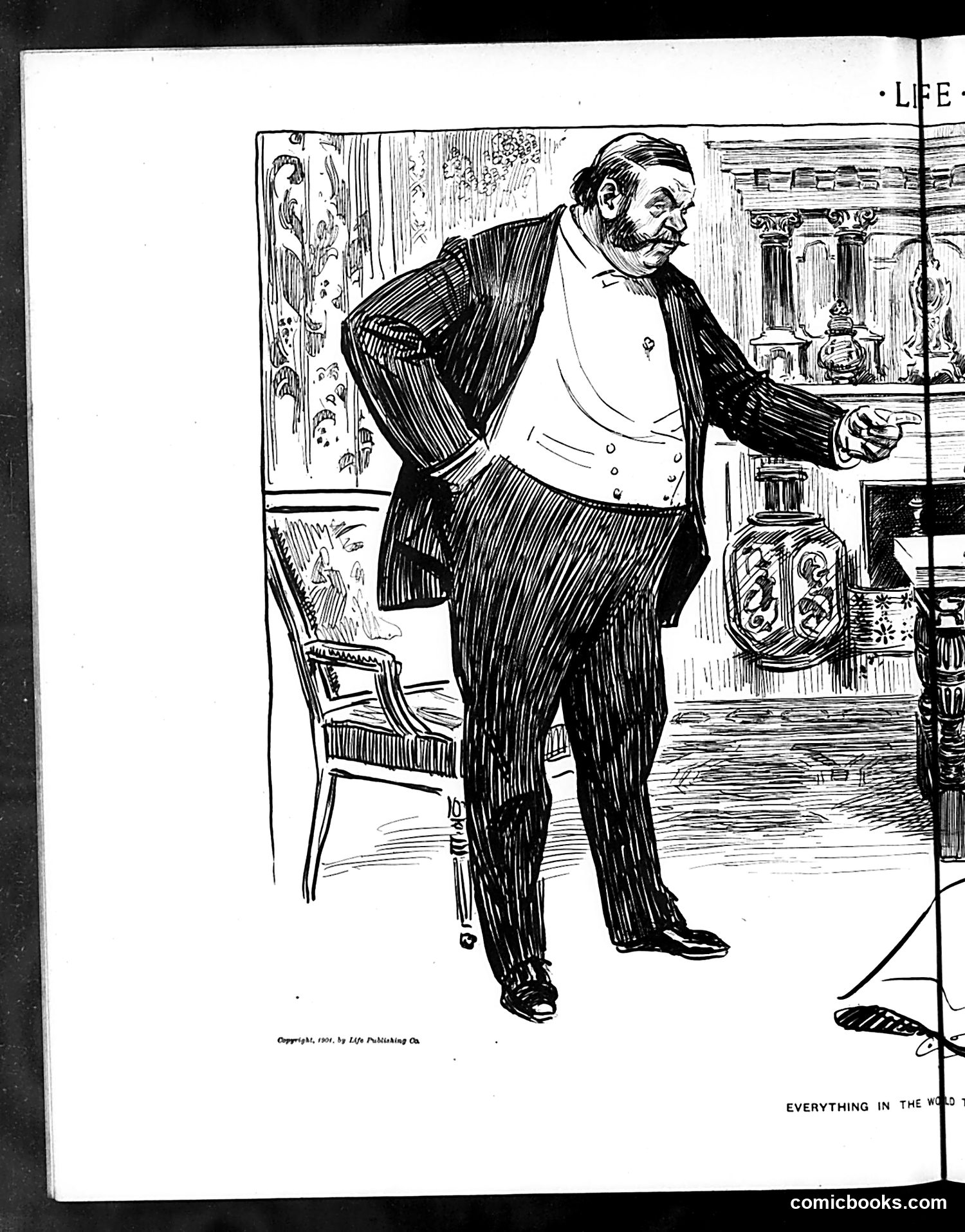
This is a single satirical illustration from *Life* magazine (copyright 1901, by Life Publishing Co.). The cartoon depicts a portly, well-dressed gentleman in formal attire—striped trousers, white vest, dark jacket—standing in an ornate interior with decorative furniture and shelving visible behind him. The figure appears to be a caricature of a wealthy, self-satisfied man of the Gilded Age, though the specific identity is unclear from visible text. His posture and exaggerated facial features suggest mockery of aristocratic pretension or nouveau riche affectation. The luxurious setting emphasizes his material wealth, which the artist seems to critique through unflattering physical caricature. Without additional caption text visible, the exact satirical point remains somewhat ambiguous, though it likely comments on class, vanity, or conspicuous consumption typical of *Life*'s social commentary.
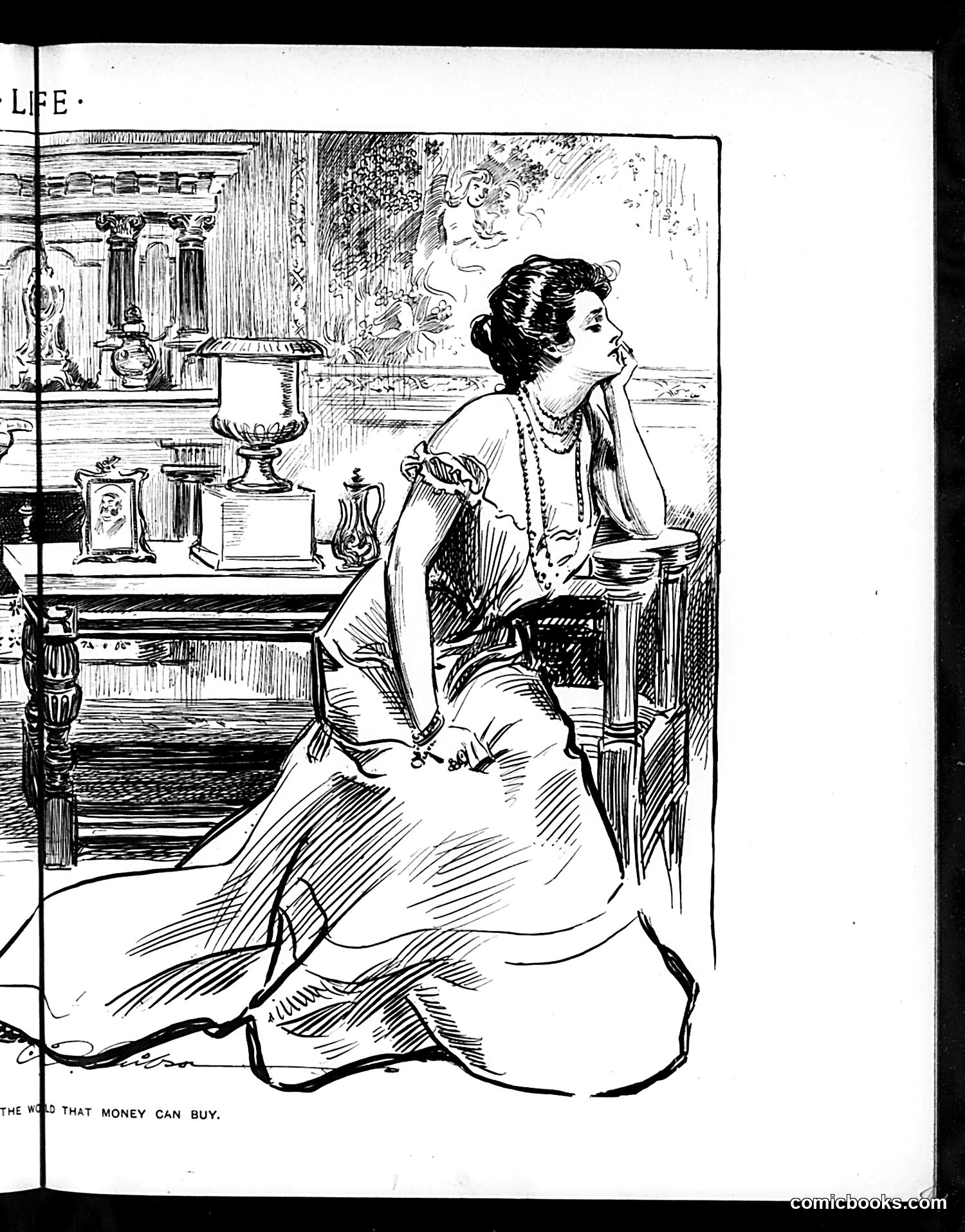
This appears to be a satirical illustration from Life magazine, an early 20th-century American humor publication. The image shows an elegantly dressed woman in an opulent interior, seated at what appears to be a vanity or dressing table surrounded by luxury items—decorative objects, ornaments, and grooming supplies. The caption reads: "THE GOLD THAT MONEY CAN BUY." This is social satire critiquing wealth and consumerism. The joke appears to be that despite having money to purchase material luxuries and refinements, genuine taste or authenticity cannot be simply bought—the accumulated objects don't necessarily convey true elegance or value. The woman's composed posture amid her possessions suggests both comfort in wealth and perhaps a subtle commentary on superficiality.
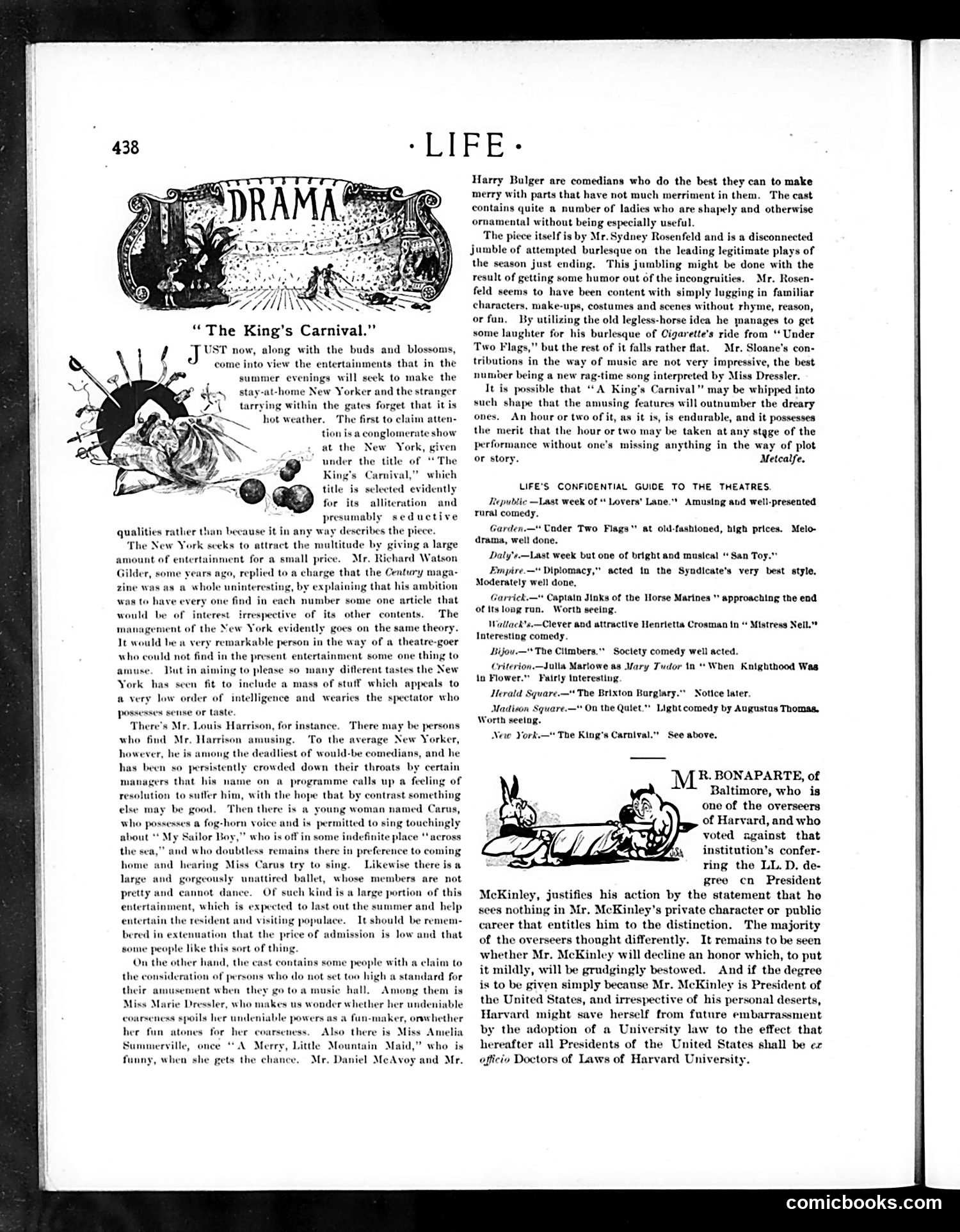
This page contains theater reviews and drama criticism from *Life* magazine. The main cartoon shows a theatrical scene with exaggerated figures and dramatic poses, illustrating "The King's Carnival" — a play being reviewed. The text discusses various Broadway productions and their merits. Below the reviews is a political note about **Mr. Bonaparte of Baltimore**, an overseer of Harvard who voted against conferring an LL.D. degree on President McKinley. The satire suggests this was an inappropriate act of institutional presumption — implying that Harvard might need a university law requiring all future Presidents receive automatic doctorates, mocking Bonaparte's perceived overreach in blocking McKinley's honor. The piece satirizes academic pretension and partisan institutional politics of the McKinley era.
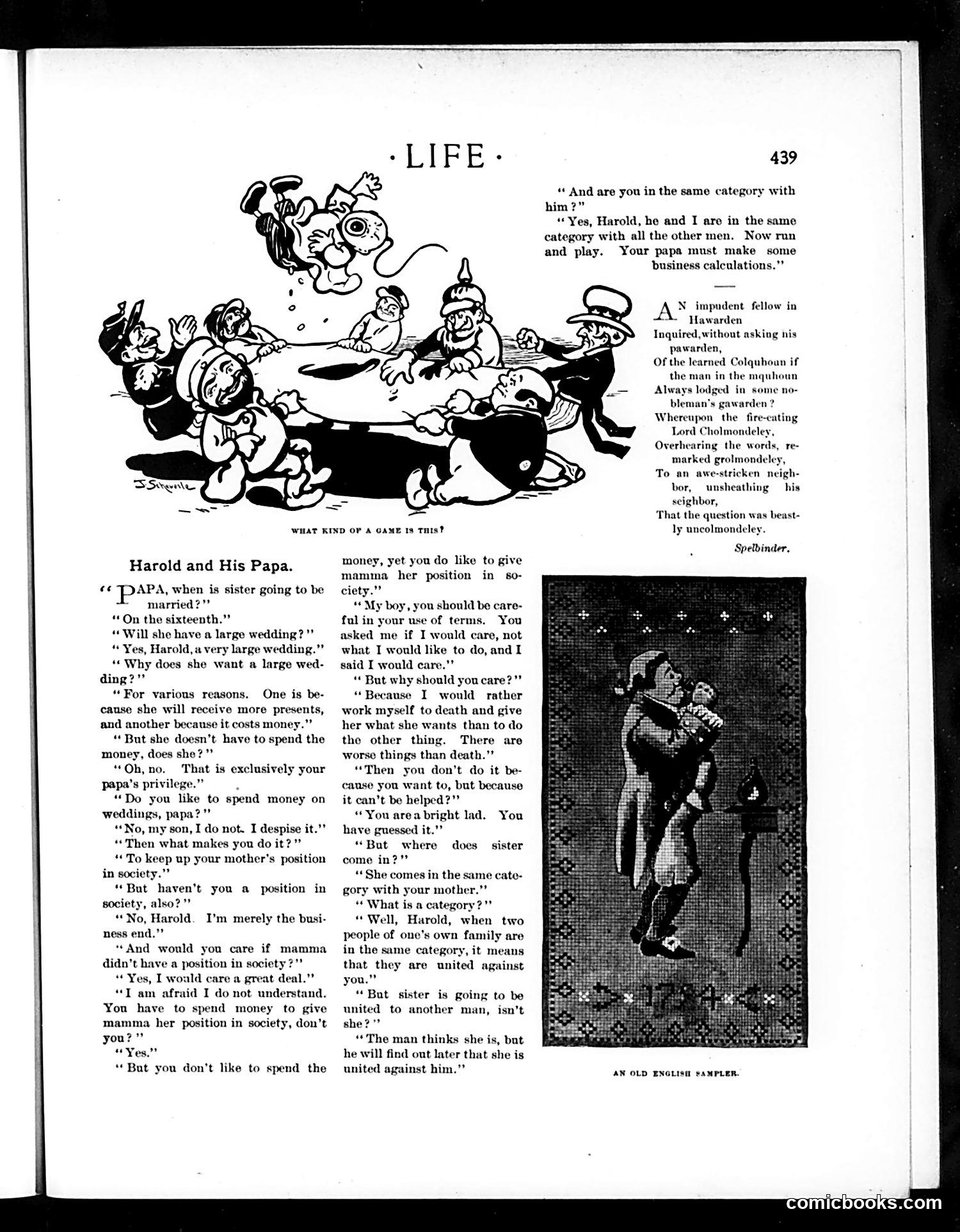
The main cartoon "Harold and His Papa" satirizes marriage economics and gender dynamics in early 20th-century society. A precocious boy (Harold) interrogates his father about why he's financing an expensive wedding for Harold's sister despite hating to spend money. Through childlike logic, Harold exposes the contradiction: Papa must spend lavishly to maintain Mama's social position, yet claims he *cares* rather than *wants* to do so. The punchline reveals the satirist's cynical view of matrimony—the father implies that Harold's sister, while appearing to marry a man, will actually be "united against him" alongside the women of her family. The humor targets Victorian marriage as a financial obligation masking female solidarity and manipulation. The accompanying illustration and poem about "Hawarden" appear unrelated filler content.
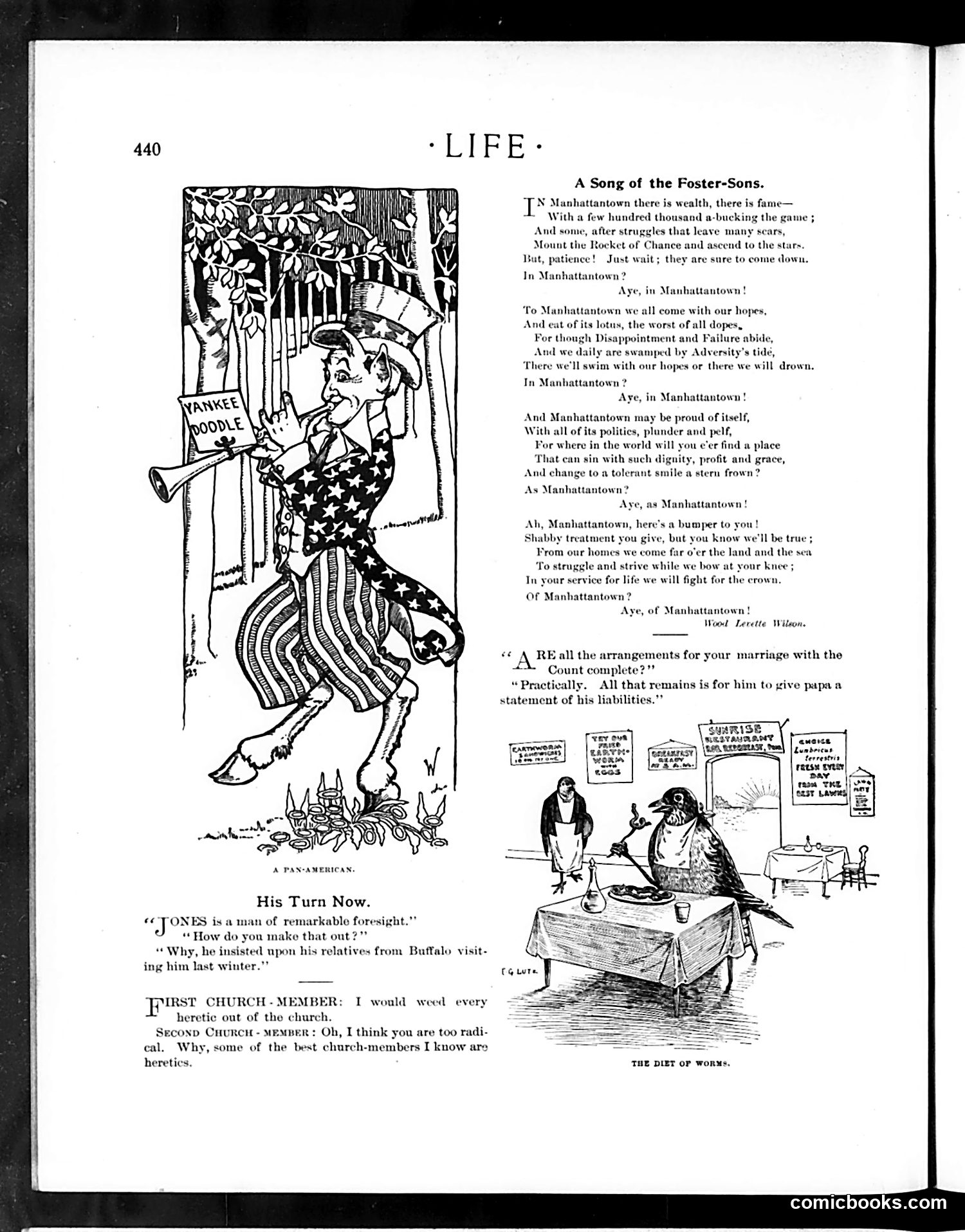
This page contains three satirical pieces mocking American social pretensions and New York's allure. **"A Song of the Foster-Sons"** is a poem about Manhattan's seductive false promise—wealth appears achievable but most strivers fail and "come down." The accompanying cartoon shows Uncle Sam (identified by stars and stripes) being lured by a "Yankee Doodle" trumpet into a trap, suggesting how New York seduces ambitious Americans. **"His Turn Now"** mocks European nobility marrying American heiresses for money: a woman jokes that her fiancé (a Count) merely needs to provide "a statement of his liabilities"—exposing that these marriages are financial transactions disguised as romance. **"A Pan-American"** and the church-members dialogue are lighter jokes about family visits and religious hypocrisy. **"The Diet of Worms"** (bottom illustration) appears to reference the historical Diet of Worms, here repurposed as visual wordplay about actual worms, though the context is unclear from this page. The overall theme: satire of American wealth-chasing and social climbing in the Gilded Age.
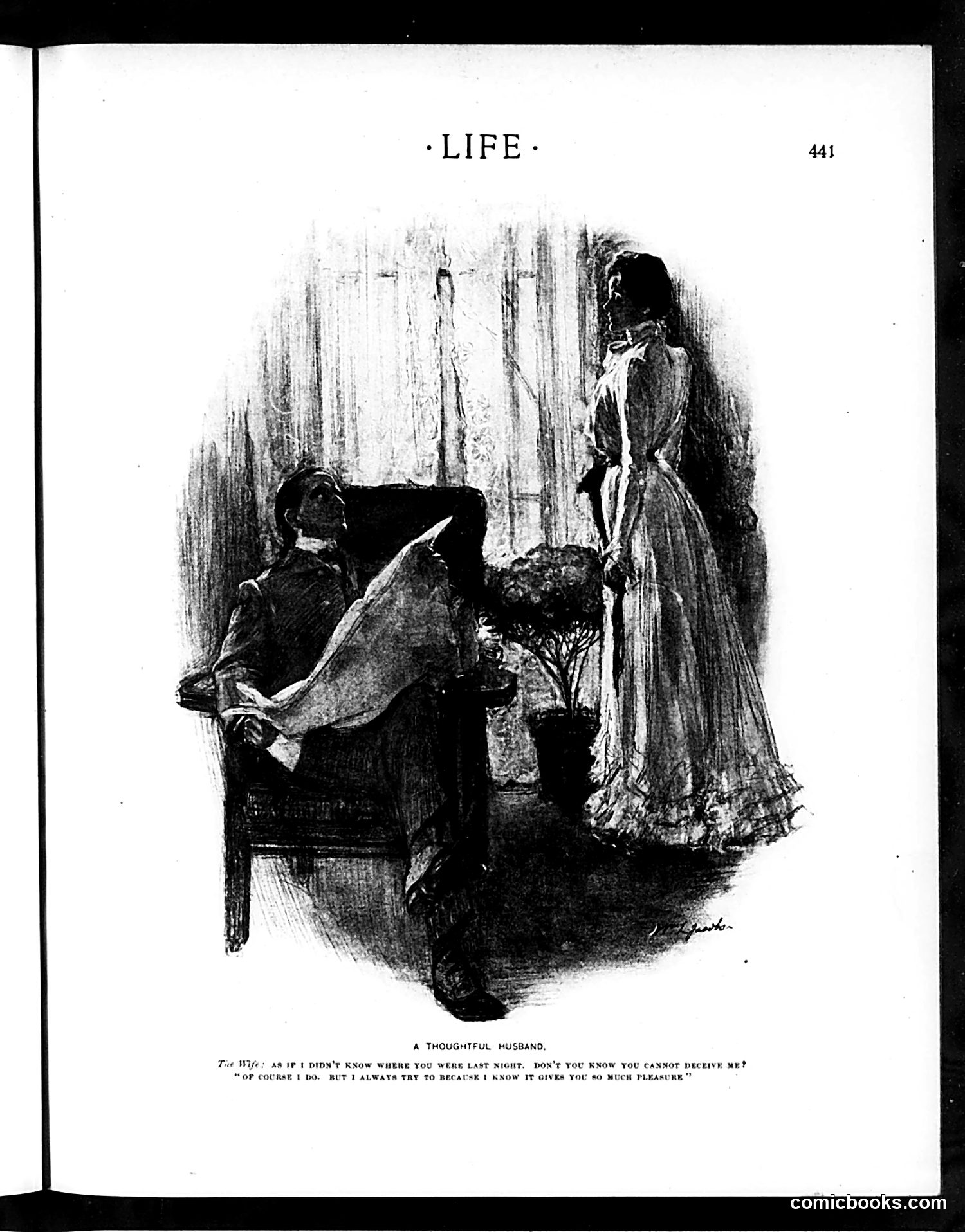
This is a satirical domestic cartoon from *Life* magazine depicting marital deception as a form of husbandly devotion. The husband, caught out about his whereabouts the previous night, reframes his dishonesty as an act of consideration—claiming he lies *because* his wife enjoys being deceived, as it brings her pleasure. The satire targets both spousal infidelity and the absurd logic men used to justify it in early 20th-century culture. The "thoughtful husband" pretends his deception is actually a gift to her, inverting moral responsibility. The cartoon mocks both the husband's transparent rationalization and, implicitly, the social acceptance of such behavior among married men of the era.
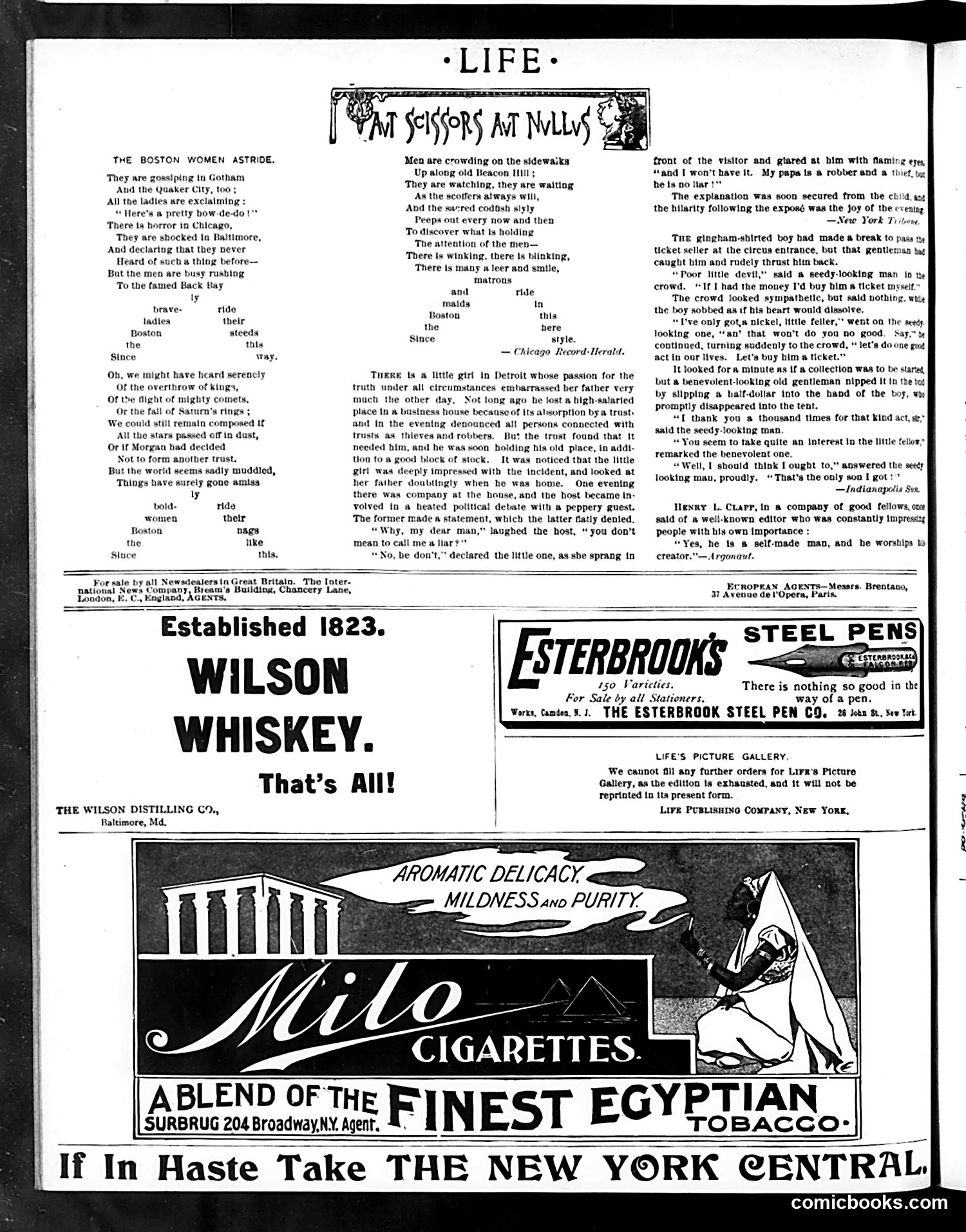
This page from Life magazine (circa early 1900s) contains three distinct satirical pieces: **"The Boston Women Astride"** is the main cartoon, a humorous poem mocking Boston society women's shock and disapproval over something scandalous (the specific incident isn't stated, but the joke centers on their prudish outrage contrasted with men's eager curiosity and public interest). The poem uses repetitive "ride" refrains for comic effect. **The prose pieces below** are separate humor columns: one about a Detroit girl's honest but embarrassing observation of her father's hypocrisy (calling trust employees "thieves and robbers" while accepting their money), another about a beggar boy at the circus, and a brief anecdote about a self-made man. The page is primarily **satirical social commentary** targeting Victorian-era propriety, business corruption, and class hypocrisy—typical Life magazine content. The surrounding **advertisements** (Wilson Whiskey, Esterbrook Steel Pens, Milo Cigarettes) were standard revenue sources.
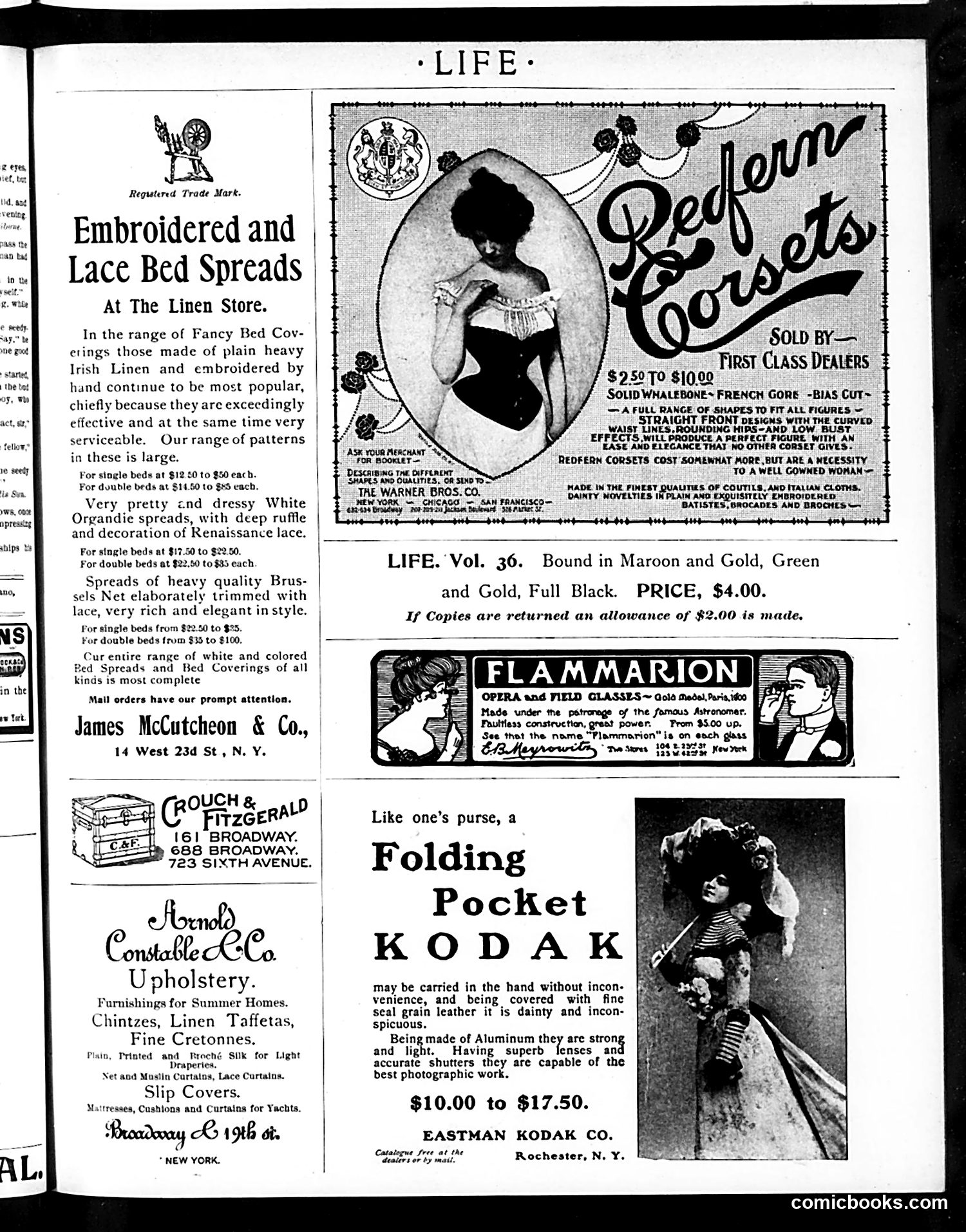
This page is primarily **advertising**, not satirical content. It showcases luxury consumer goods from the early 1900s aimed at affluent readers. Key advertisements include: - **Embroidered bed spreads and linens** from James McCutcheon & Co., emphasizing Irish linen and handwork - **Redfern corsets** ($2.50–$10.99), marketed with language about "perfect figures" and "well-gowned women"—reflecting period obsessions with corseted silhouettes - **Folding Pocket Kodak cameras** ($10–$17.50), positioned as portable luxury goods - **Flammarion opera glasses**, trading on the prestige of the famous French astronomer's name The **Redfern corset ad** is most revealing of period attitudes: it promises to shape the body into an "ideal" form through "straight front designs" and "curved" construction—reflecting Edwardian beauty standards that valued extremely corseted figures. No political cartoon or satire appears on this page—it's a straightforward commercial document showing what wealthy Americans purchased and how advertisers marketed femininity, domesticity, and technological novelty.
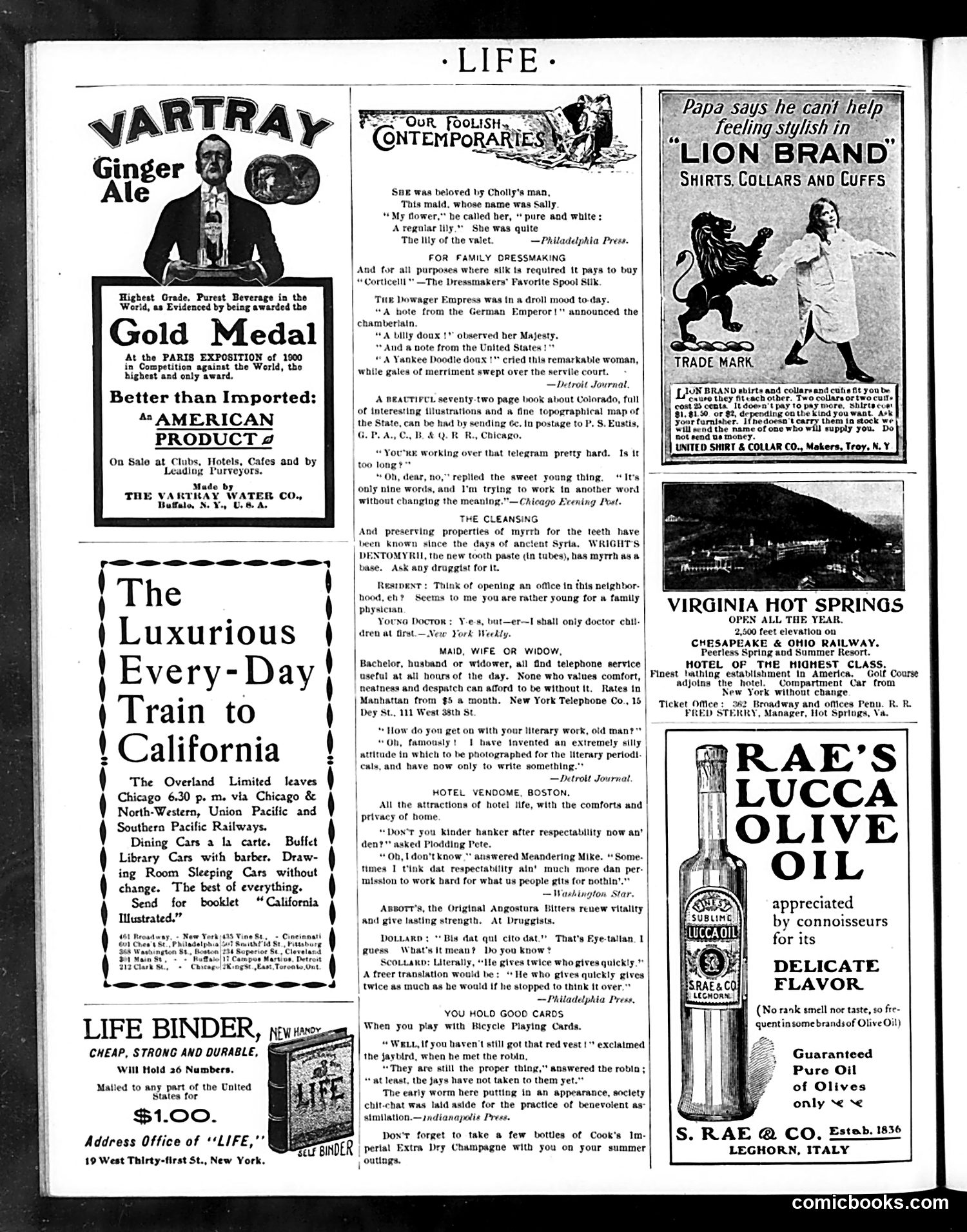
This page features **Life magazine's humor section** mocking contemporary absurdities. The central cartoon titled "Our Foolish Contemporaries" collects brief satirical jokes from various newspapers. Key examples visible: 1. **The Dowager Empress anecdote** (Detroit Journal): Mocks royalty's pretentious wordplay—a European empress makes forced puns ("billy doax," "Yankee Doodle doux") on diplomatic correspondence, satirizing aristocratic affectation. 2. **The young woman's telegram**: Ridicules female vanity—a girl laboriously rewrites a nine-word telegram to squeeze in unnecessary words, suggesting women's obsession with appearing sophisticated. 3. **The young doctor**: Jokes about medical inexperience—a fresh physician claims he'll only treat children initially, implying he's too incompetent for adult patients. The page also includes period **advertisements** (Vartrax Ginger Ale, California train service, olive oil) typical of early 1900s magazines. The overall tone reflects *Life's* satirical mission: gently mocking the era's social pretensions, gender roles, and human follies through observational humor.
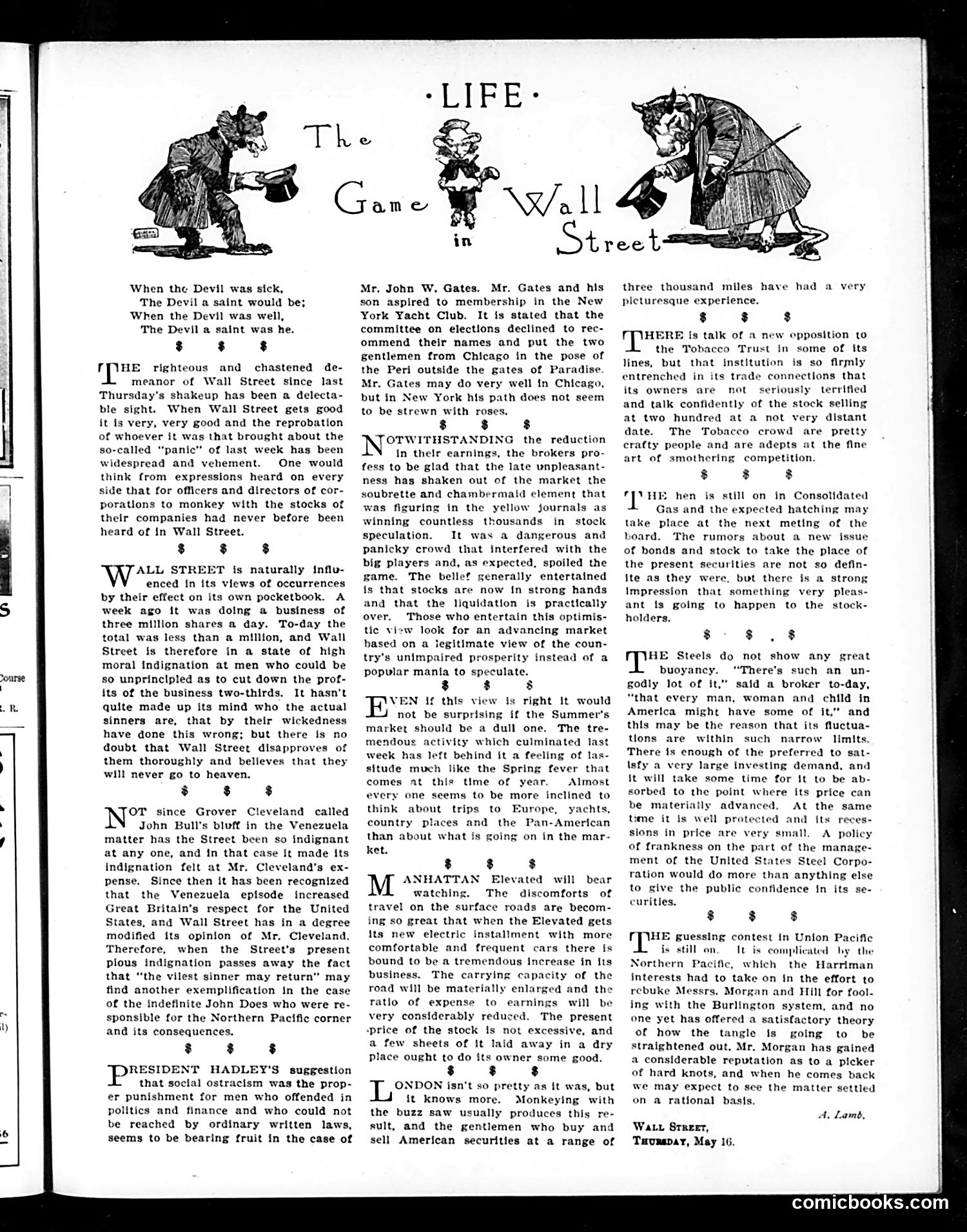
This page satirizes Wall Street's hypocrisy following a recent stock market panic (likely the 1901 Northern Pacific corner). **The main cartoon** (top) depicts Wall Street as a devil figure—respectable when sick (after the crash), but reverting to wickedness when well. The satire mocks how brokers suddenly denounce stock manipulation and profiteering after losses hit their own pocketbooks, despite such practices being routine. **Key targets include:** - **John W. Gates**: A Chicago businessman denied membership to the New York Yacht Club as social punishment for financial misconduct—illustrating President Hadley's theory that ostracism could police behavior better than laws - Wall Street's selective morality: condemning the "soubrette and chambermaid element" (small retail speculators) while ignoring insider manipulation by major players - The expectation that once markets recover, Wall Street will forget its temporary righteousness The satire suggests Wall Street's moral indignation is performative and temporary, driven entirely by profit margins rather than principle.
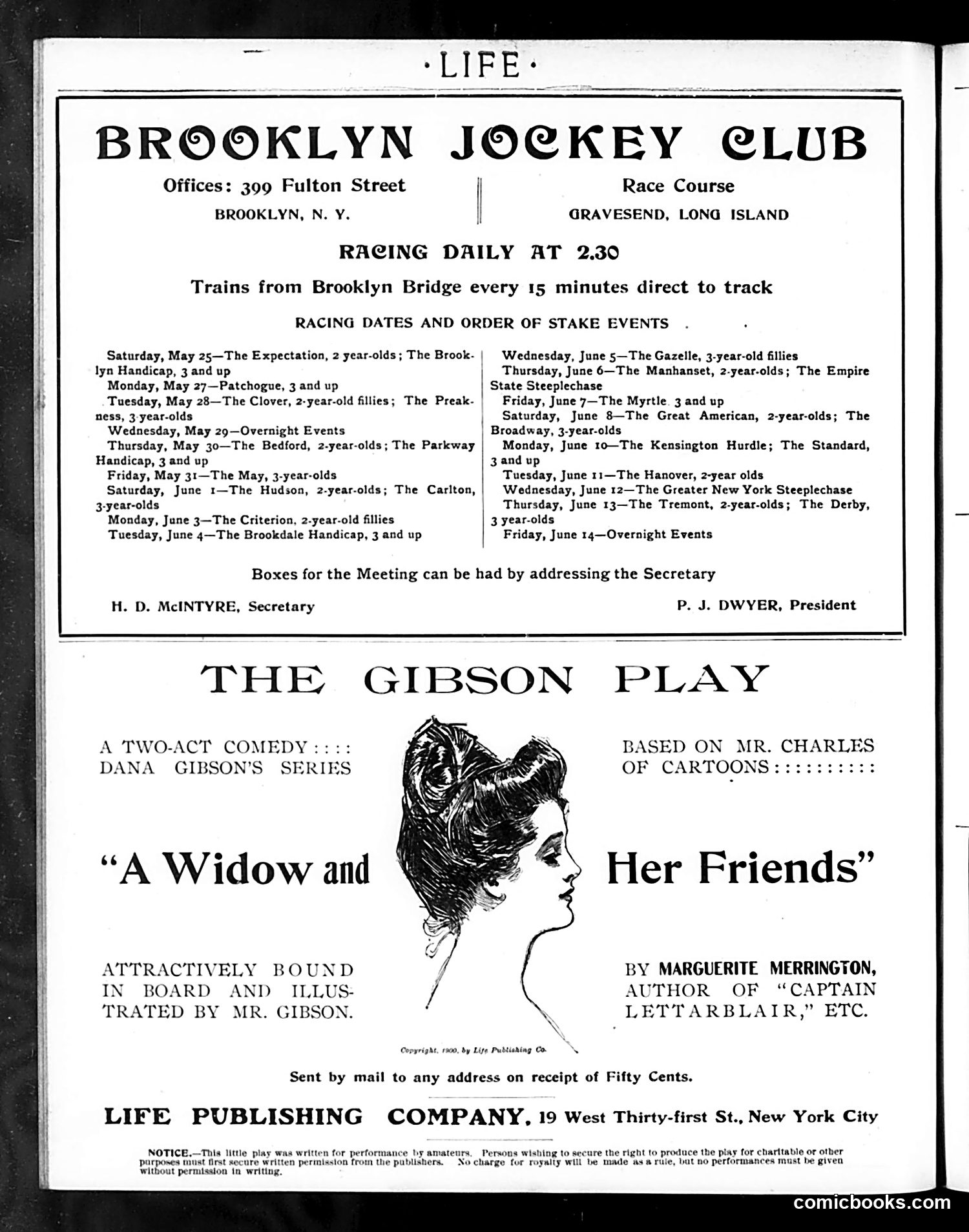
This page is primarily **advertising**, not satire or editorial content. The top half advertises the Brooklyn Jockey Club's racing schedule at Gravesend, Long Island, promoting daily horse racing with convenient train service from Brooklyn Bridge. The lower half advertises **"A Widow and Her Friends,"** a two-act comedy play based on Charles Dana Gibson's cartoon series. Gibson was famous for his "Gibson Girl" illustrations—idealized images of fashionable American women that defined early 1900s aesthetics. The play was adapted by Marguerite Merrington and illustrated by Gibson himself. It could be purchased by mail for fifty cents. The sketch shows a fashionable woman's profile in Gibson's recognizable style. The page targets genteel audiences interested in both horse racing and theatrical entertainment based on popular illustrated humor.
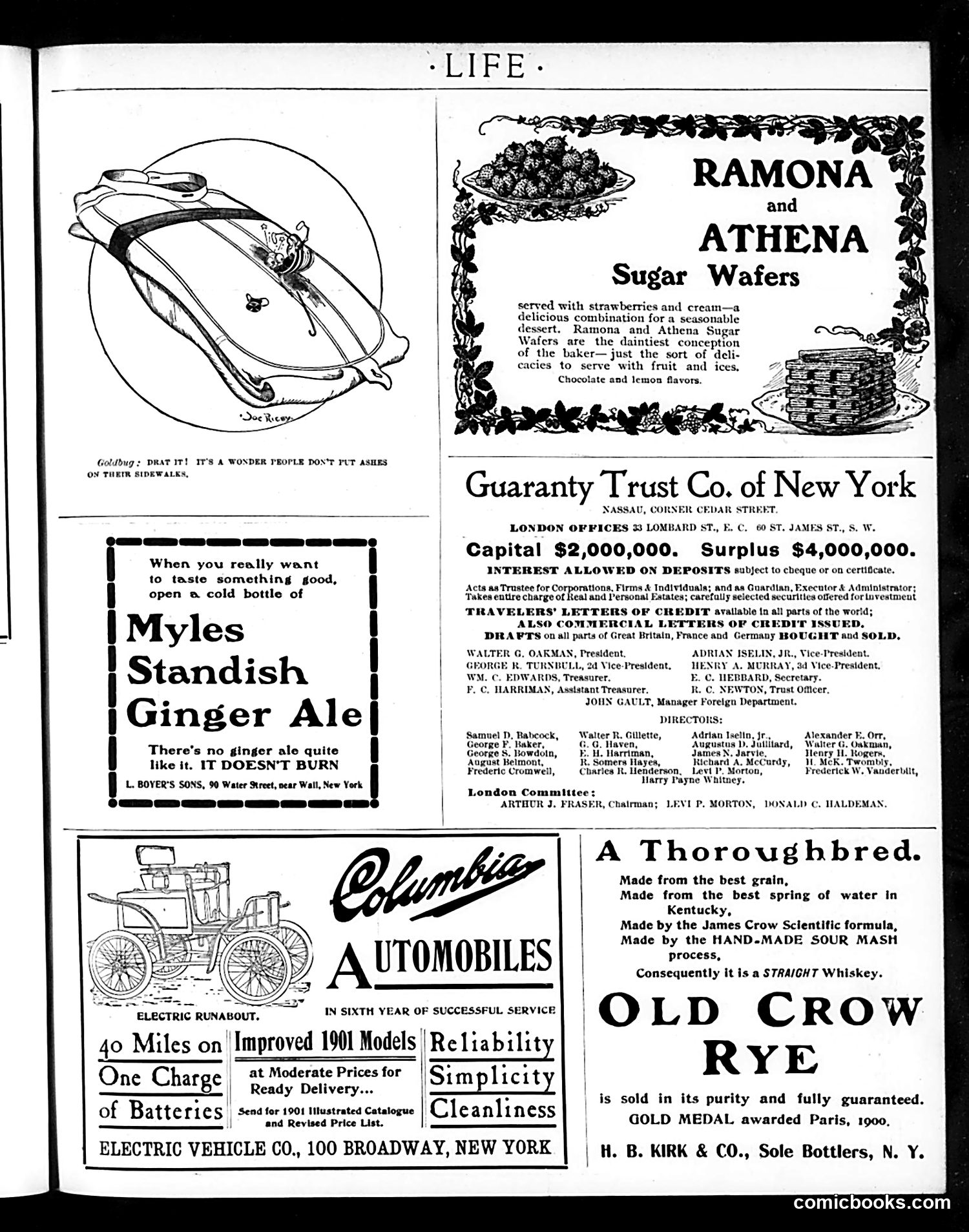
This page is primarily **advertising**, not political satire. The single cartoon at top-left depicts a figure labeled "Goldbug" complaining about sidewalk conditions ("It's a wonder people don't put ashes on their sidewalks"). The "Goldbug" reference likely alludes to the **1896 presidential election's monetary debate**—William Jennings Bryan's "Free Silver" campaign versus the Republican "Gold Standard" position. However, this cartoon appears disconnected from the advertisements surrounding it and its specific satirical point is unclear from the image alone. The page consists primarily of product advertisements: Ramona and Athena Sugar Wafers, Myles Standish Ginger Ale, Guaranty Trust Co. of New York, Columbia electric automobiles, and Old Crow whiskey. These ads reflect early 1900s consumer goods and financial services aimed at wealthy readers.
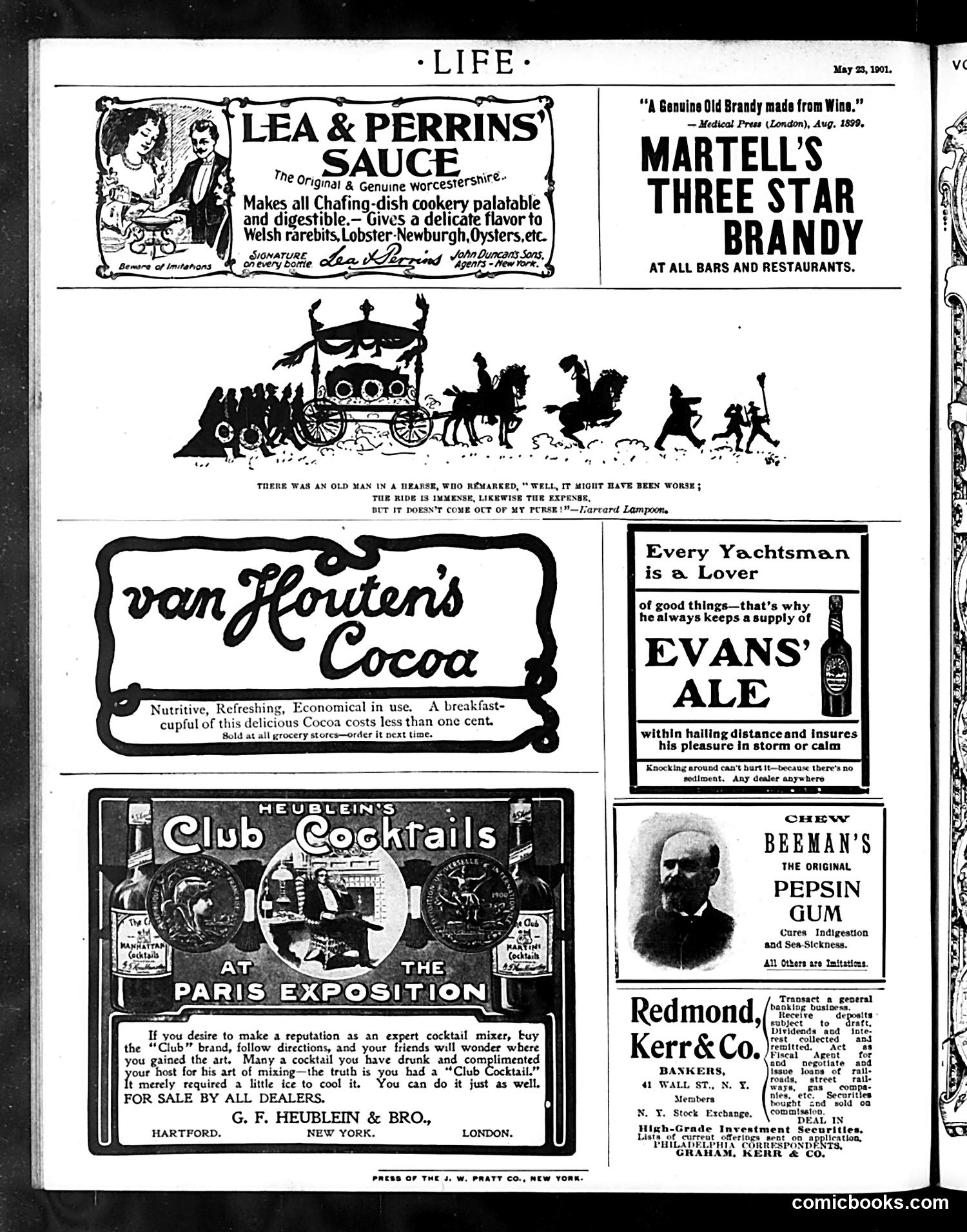
This page is primarily **advertisements** with one small cartoon. The main visual joke appears in the center: a silhouette showing a hearse (funeral carriage) surrounded by running figures, accompanying a quote attributed to "Zozoard Lampoon" (likely a pseudonym). The caption presents an old man in a hearse remarking that while the ride is "immense" and the expense significant, at least "it doesn't come out of my purse"—a dark humor joke about death and funeral costs. The surrounding ads promote period products: Lea & Perrins sauce, Martell's brandy, Van Houten's cocoa, Heublein's Club Cocktails, Evans' Ale, Beeman's Pepsin Gum, and banking services from Redmond, Kerr & Co. These ads reflect early-1900s consumer goods and leisure culture targeted at affluent readers.