
Life, 1901-05-23 · page 12 of 22
Life — May 23, 1901 — page 12: what you’re looking at
What you’re looking at
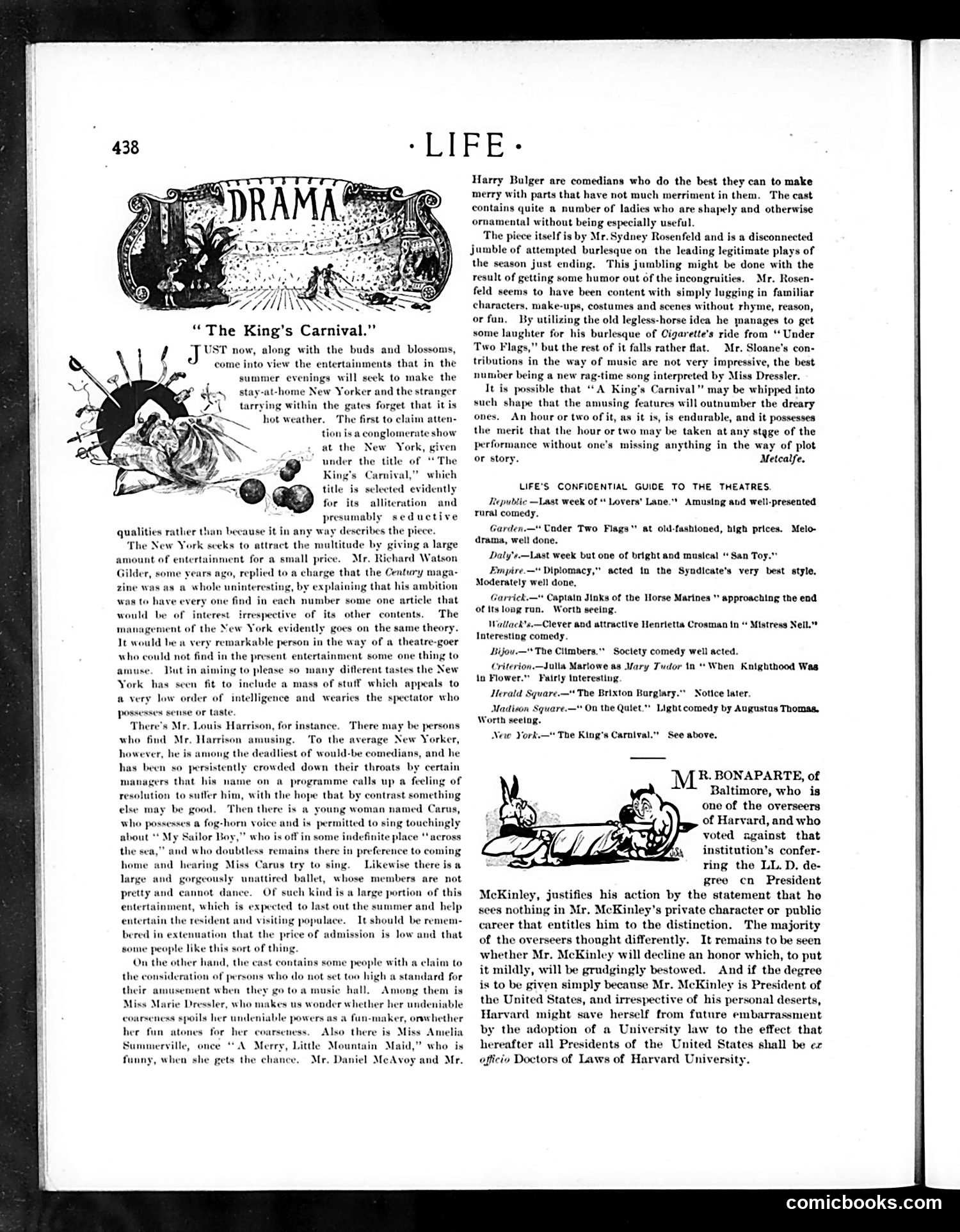
This page contains theater reviews and drama criticism from *Life* magazine. The main cartoon shows a theatrical scene with exaggerated figures and dramatic poses, illustrating "The King's Carnival" — a play being reviewed. The text discusses various Broadway productions and their merits. Below the reviews is a political note about **Mr. Bonaparte of Baltimore**, an overseer of Harvard who voted against conferring an LL.D. degree on President McKinley. The satire suggests this was an inappropriate act of institutional presumption — implying that Harvard might need a university law requiring all future Presidents receive automatic doctorates, mocking Bonaparte's perceived overreach in blocking McKinley's honor. The piece satirizes academic pretension and partisan institutional politics of the McKinley era.
📄 Transcribed text from this page (OCR, searchable)
Machine-transcribed from the original scan — historical spelling and the odd misread are preserved.
EERE “The King’s Carnival.” UST now, along with the buds and blossoms, come into view the entertainments that in the summer evenings will seek to make the stay-at-home New Yorker and the stranger ‘ tarrying hin the gates forget that it is I~ hot weather. The first to claim atten- SS : tion is a conglomerate show Y at the New York, “under the title of King's Carni title is selected evidently for its alliteration and presumably seductive qualities rather than because it in any way describes the piece. The York seeks to attract the multitude by giving a large amount of entertainment for a small price. Mr. Richard Watson Gilder, some years ago, replied to a charge that the Century mag: zine was as a whole uninteresting, by explaining that his ambitic « find in each number some one article that would be of interest irrespective of its other contents, The management of the New York evidently goes on the same theory. It would be a very remarkable person in the way of a theatre-goer who could not find in the present entertainment some one thing to amuse. But in aiming to please so many diflerent tastes the New York has seen fit to include a mass of stuff which appeals to a very low order of intelligence and wearies the spectator who possesses sense oF Laste. There's Mr. Louis Harrison, was to have every instance. There may be persons who find Mr. Harrison amusing. To the average New Yorker, however, he mong the deadliest of would-be comedians, and he has been so persistently crowded down their throats by certain managers that his name on a programme calls up a feeling of resolution to suffer him, with the hope that by contrast something else may be good. Then there is a young woman named Carus, who possesses a fog-horn voice and is permitted to sing touchingly about “ My Sailor Boy,” who is off adefinite place “across the s nd who doubtless tins there in preference to coming home and hearing Miss Carus try to sing. Likewise there is a large and gorgeously unattired ballet, whose members are not pretty and cannot da Of such kind is a large portion of this rtainment, which is expected to last out the summer and help rain the resident and visiting populace. It should be remem- bered in extenuation that the price of admission is low and that ple like this sort of thing. her hand, the cast contains s¢ leration ¢ some pe On the the ¢ their amusement wh © people with a claim to persons who do not set too high a standard for they goto a music hall. Among them is Miss Marie Dressler, who makes us wonder whether her undeniable coarseness spoils her undeniable powers as a fun-maker, onwhether hee fun atones for her coarseness. Also there is Miss Ame A Merry, Little Mountain Maid,” who is she gets the el Mr. Daniel MeAvoy and Mr. amerville, once funny, wher Harry Bulger are comedians who do the best they can to make merry with parts that have not much merriment in them. The cast contains quite a number of ladies who are shapely and otherwise ornamental without being especially useful. The picce itself is by Mr. Sydney Rosenfeld and is a disconnected jumble of attempted burlesque on the leading legitimate plays of the season just ending. This jumbling might be done with the result of getting some humor out of the incongruities. Mr. Rosen- feld seems to have been content with simply lugging in familiar characters, make-ups, costumes and scenes without rhyme, reason, or fun, By utilizing the old legless-horse idea he jnanages to get some laughter for his burlesque of Cigarette’s ride from “Under Two Flags,” but the rest of it falls rather flat. Mr. Sloane's con- tributions in the way of music are not very impressive, the best number being a new rag-time song interpreted by Miss Dressler. It is possible that ‘A King’s Carnival” may be whipped into such shape that the amusing features will outnumber the dreary ones. An hour or two of it, as it is, is endurable, and it possesses the merit that the hour or two may be taken at any stage of the performance without one’s missing anything in the way of plot or story. Metcalfe. LIFE'S CONFIDENTIAL GUICE TO THE THEATRES. Kepublic —Last week of “ Lovers’ Lane.” Amusing and well-presented rural comedy. Gare Under Two Flags at old-fashioned, high prices. Melo- drama, well done. Daly's.—Last week but one of bright and musical “San Toy." Emyire.—" Diplomacy," acted tn the Syndicate’s very best style, Moderately well done, Garrick. Captain Jinks of the Horse Marines * approaching the end of Its long run. Worth seeing. Waltack"s.—Clever and attractive Henrietta Crosman in “ Mistress Netl.!* Interesting comedy. Bijou.—* The Climbers." Criterio tn Flower. Soclety comedy well acted. —Julla Marlowe as Mary Tudor in “When Knighthood Was Fairly tnteresting. Herald Square." The Brixton Bargiary."” Notice later. Madison Square.—" On the Quiet." Lightcomedy by Augustus Thomas, Worth seeing. New York.— The King’s Carnival.” See above. R. BONAPARTE, of M Baltimore, who is one of the overseers of Harvard, and who voted against that institution's confer- ring the LL. D. de- gree cn President McKinley, justifies his action by the statement that ho sees nothing in Mr, McKinley's private character or public career that entitles him to the distinction. The majority of the overseers thonght differently. It remains to be seen whether Mr. McKinley will decline an honor which, to put it mildly, will be grudgingly bestowed. And if the degree is to be given simply because Mr. McKinley is President of the United States, and irrespective of his personal deserts, Harvard might save herself from future embarrassment by the adoption of a University law to the effect that hereafter all Presidents of the United States shall be ez officio Doctors of Laws of Harvard University. comicbooks.com