
Life, 1901-05-23 · page 4 of 22
Life — May 23, 1901 — page 4: what you’re looking at
What you’re looking at
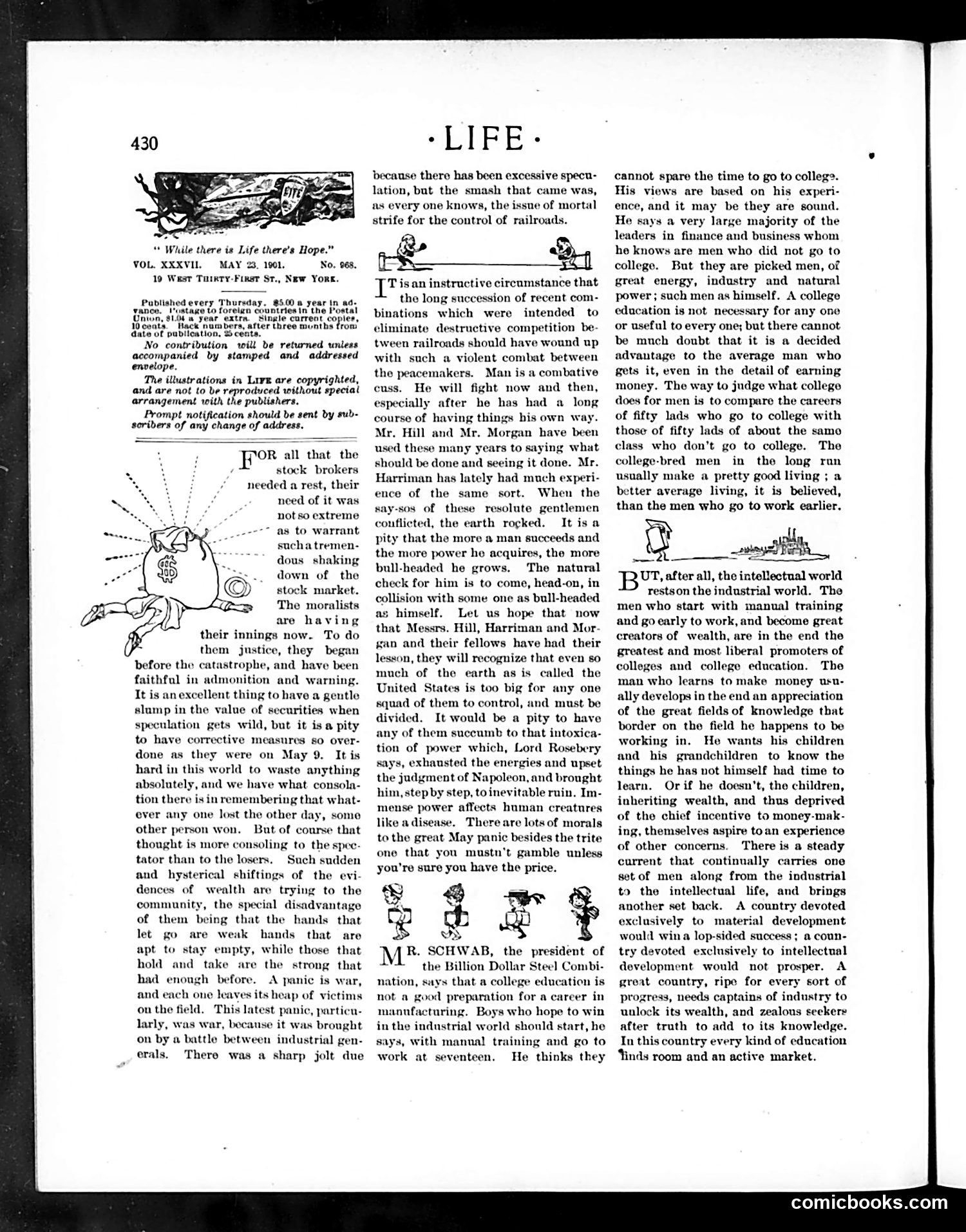
This Life magazine page from May 23, 1901, contains editorial commentary on railroad competition and college education debates. **Main Cartoon (left):** A money bag with legs illustrates the "stock market" panic referenced in the text—depicting how financial speculation can personify greed and instability. **Central Theme:** The article debates whether college education is necessary for business success. It argues that some successful industrialists (Hill, Harriman, Morgan) never attended college, yet acquired immense wealth and power. The satire suggests that excessive financial competition and market manipulation ("bull-headed" behavior) are more characteristic of the wealthy than intellectual training. **Social Context:** This reflects early-1900s tensions between inherited industrial power and emerging educational meritocracy—questioning whether formal education or practical business acumen matters more for American economic leadership.
📄 Transcribed text from this page (OCR, searchable)
Machine-transcribed from the original scan — historical spelling and the odd misread are preserved.
“ While there is Life there’s Hope.” VOL. XXXVI. MAY 23, 1901, No. 968. 19 West Taikty-Fixst St., New Yore. Published every Thursday. $5.00 a year tn ad. ance. Hostage to foreign countries in Union, s1ot a year extra 6 Postal copies, Weeats. “Hack numbers, after three munths from date of publication, % cents, No contribution will be returned unless accompanied by stamped and addressed envelope. The illustrations in Lurk are copyrighted, and are not to be reproduced without speciat arrangement with the publishers. Prompt notification should be sent by sub- soribers of any change of address. Single curr OR all that the stock brokers needed a rest, their need of it was not so extreme as to warrant sucha tremen- dous shaking down of the stock market. The moralists are having their innings now. To do them justice, they began before the catastrophe, and have been faithful in admonition and warning. It is an excellent thing to have a gentle slump in the value of securities when speculation gets wild, but it is a pity to have corrective measures so over- done as they were on May 9. It is hard in this world to waste anything absolutely, and we have what consola- tion there is in remembering that what- ever any one lost the other day, somo other person won. But of course that thought is more consoling to the spec- tator than to the losers. Such sudden and hysterical shiftings of the evi- dences of wealth are trying to the community, the special disadvantage of them being that the hands that let go are weak hands that apt to stay empty, while those hold and take are the strong that had enough before. A panic is war, and each one leaves its heap of victims on the field. This latest panic, particn- larly, was war, because it was brought on by a battle between industrial gen- erals. There was a sharp jolt due are that LIFE because there has been excessive specu- lation, but the smash that came was, as every one knows, the issue of mortal strife for the control of railroads. I* isan instructive circumstance that the long succession of recent com- binations which were intended to eliminate destructive competition be- tween railroads should have wound up with such a violent combat between the peacemakers. Man is a combative cuss. He will fight now and then, especially after he has had a long course of having things his own way. Mr. Hill and Mr. Morgan have been used these many years to saying what should be done and seeing it done. Mr. Harriman has lately had much experi- ence of the same sort. When the say-sos of these resolute gentlemen conflicted, the earth rocked. It is a pity that the more a man succeeds and the more power he acquires, the more bull-headed he grows. The natural check for him is to come, head-on, in collision with some one as bull-headed as himself. Let us hope that now that Messrs. Hill, Harriman and Mor- gan and their fellows have had their lesson, they will recognize that even so much of the earth as is called the United States is too big for any one squad of them to control, and must be divided. It would be a pity to have any of them succumb to that intoxica- tion of power which, Lord Rosebery says, exhausted the energies and upset the judgment of Napoleon, and brought him, step by step, toinevitable ruin. Im- mense power affects human creatures like adisease. There are lots of morals to the great May panic besides the trite one that you mustn't gamble unless you're sure Ps have the price. R. SCHWAB, the president of the Billion Dollar Steel Combi- nation, 's that a college education is not a good preparation for a career in manufacturing. Boys who hope to win in the industrial world should start, he says, with manual training and go to work at seventeen. He thinks they cannot spare the time to go to collegs. His views are based on his experi- ence, and it may be they are sound. He says a very large majority of the leaders in finance and business whom he knows are men who did not go to college. But they are picked men, o? great energy, industry and natural power ; such men as himself. A college education is not necessary for any one or useful to every one; but there cannot be much doubt that it is a decided advantage to the average man who gets it, even in the detail of earning money. The way to judge what college does for men is to compare the careers of fifty lads who go to college with those of fifty lads of about the samo class who don’t go to college. The college-bred men in the long ran usually make a pretty good living ; a better average living, it is believed, than the men who go to work earlier. sna UT, after all, the intellectual world restson the industrial world. The men who start with manual training and go early to work, and become great creators of wealth, are in the end the greatest and most liberal promoters of colleges and college education. The man who learns to make money usu- ally develops in the end an appreciation of the great fields of knowledge that border on the field he happens to be working in. He wants his children and his grandchildren to know the things he has not himself had time to learn. Orif he doesn't, the children, inheriting wealth, and thus deprived of the chief incentive to money-mak- ing, themselves aspire toan experience of other concerns. There is a steady current that continually carries one set of men along from the industrial to the intellectual life, and brings another set back. A country devoted exclusively to material development would wina lop-sided success ; a coun- try devoted exclusively to intellectual development would not prosper. A great country, ripe for every sort of progress, needs captains of industry to unlock its wealth, and zealous seekere after truth to add to its knowledge. In this country every kind of education ‘inds room and an active market. comicbooks.com