
A complete issue · 20 pages · 1901
Life — May 9, 1901
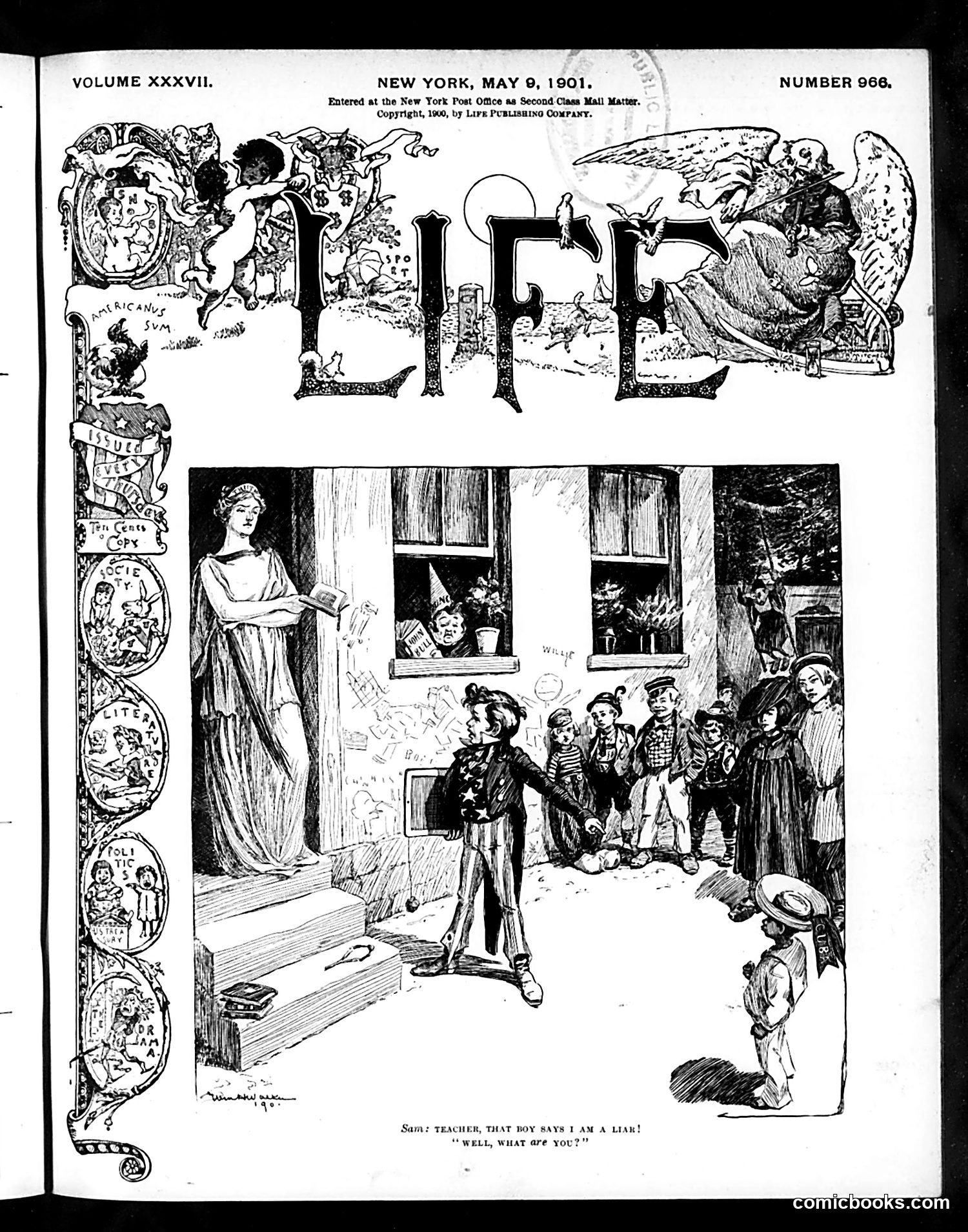
This page features a single illustrated scene with the caption: "Said: TEACHER, THAT BOY SAYS I AM A LIAR! 'WELL, WHAT ARE YOU?'" The cartoon depicts a schoolroom confrontation. A teacher (represented as a classical female figure on the left) presides over a dispute between two boys and gathered schoolchildren. The humor is a logical trap: when a student accuses another of lying, the teacher's response—"Well, what are you?"—implies the accuser is also a liar. It's a classic children's joke about the absurdity of tattling and playground conflicts, suggesting that those who complain about dishonesty may themselves be dishonest. The ornate border contains various classical and mythological imagery typical of Life's decorative style. This appears to be gentle satirical humor about childhood behavior rather than political commentary.
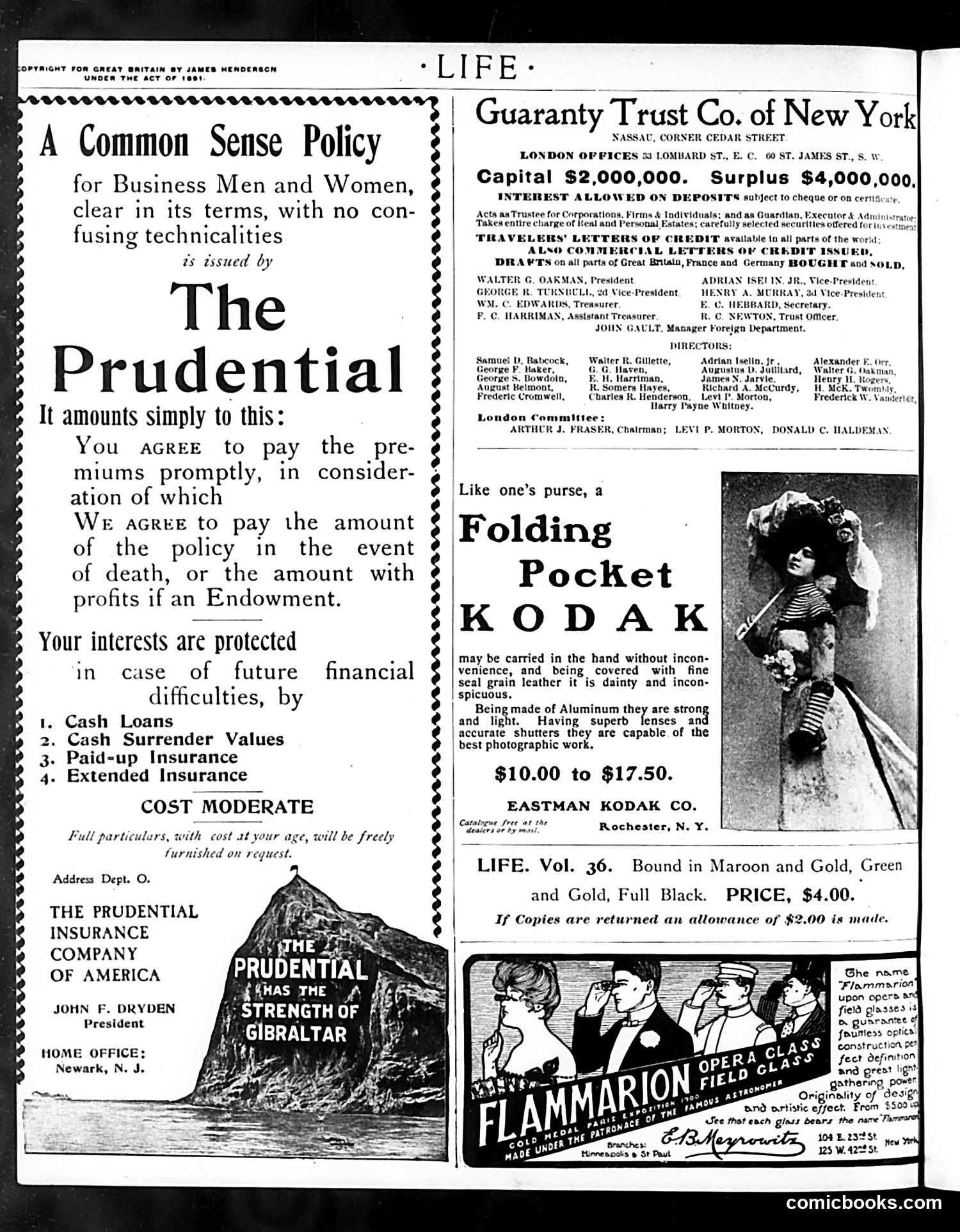
This page is primarily **advertising** rather than editorial content or cartoons. The left side features a Prudential Insurance Company ad explaining their "Common Sense Policy" in simple terms—customers pay premiums, Prudential pays death benefits or endowment amounts. The ad emphasizes financial protection through cash loans, surrender values, and paid-up insurance. The right side contains unrelated advertisements: Guaranty Trust Co. of New York (banking services), a Folding Pocket Kodak camera ($10-$17.50), LIFE magazine's bound Vol. 36, and Flammarion opera glasses. There are **no political cartoons or satirical commentary** visible on this page. It's a straightforward commercial advertising section typical of early 20th-century magazine layouts.
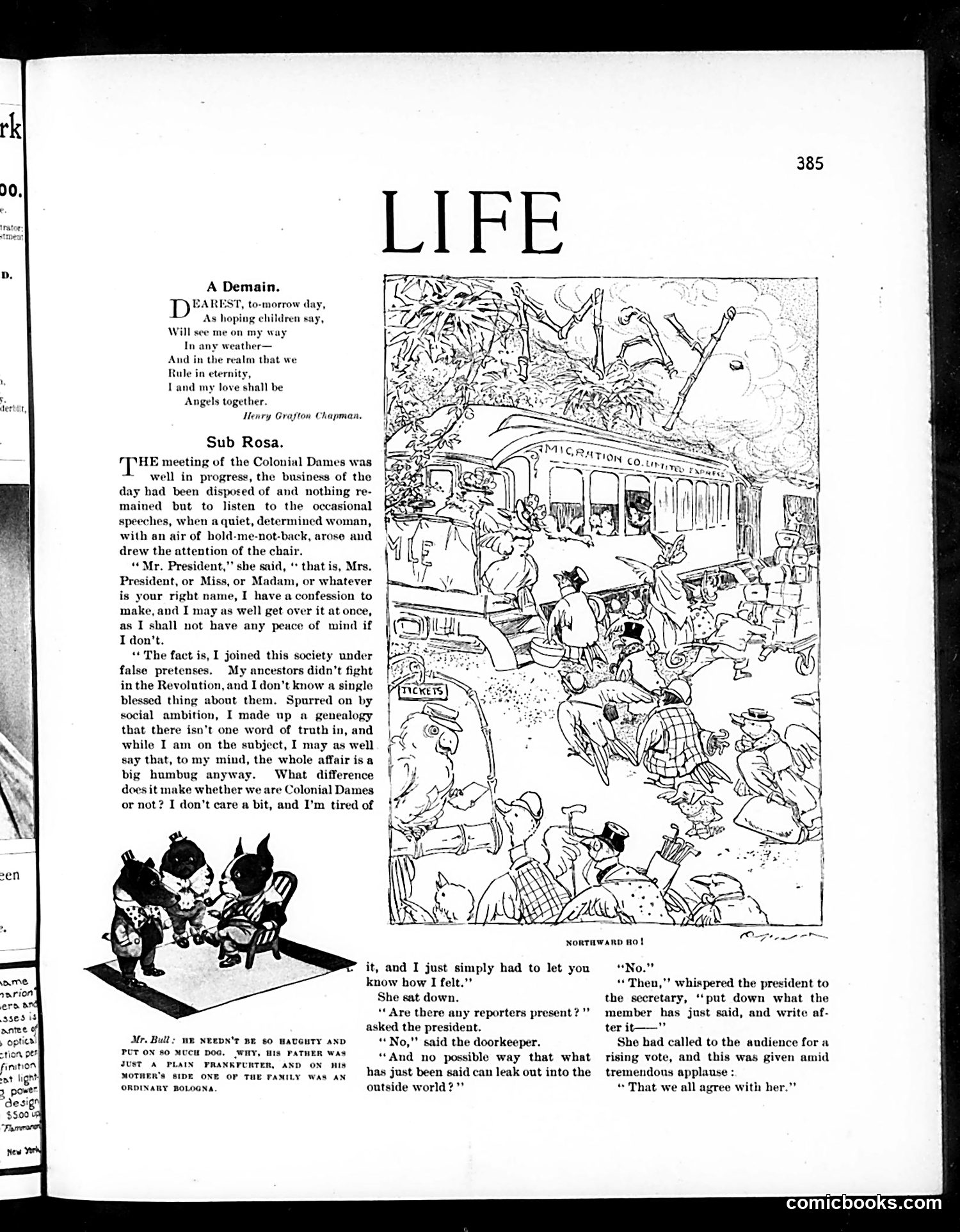
This page satirizes the **Colonial Dames society**, a women's organization claiming ancestral Revolutionary War connections. A woman interrupts a Colonial Dames meeting to confess she joined under "false pretenses"—her ancestors didn't actually fight in the Revolution. She protests the organization's pretentious obsession with genealogy, calling the whole affair "a big humbug anyway." The large cartoon depicts an immigration office or processing center, labeled "Immigration Co.," crowded with diverse immigrants and their belongings, titled "Northward Ho!" The satire targets two things: (1) the snobbish gatekeeping of exclusive women's societies based on dubious ancestry claims, and (2) contemporary debates about immigration and national identity. The juxtaposition suggests irony about who truly belongs in America.
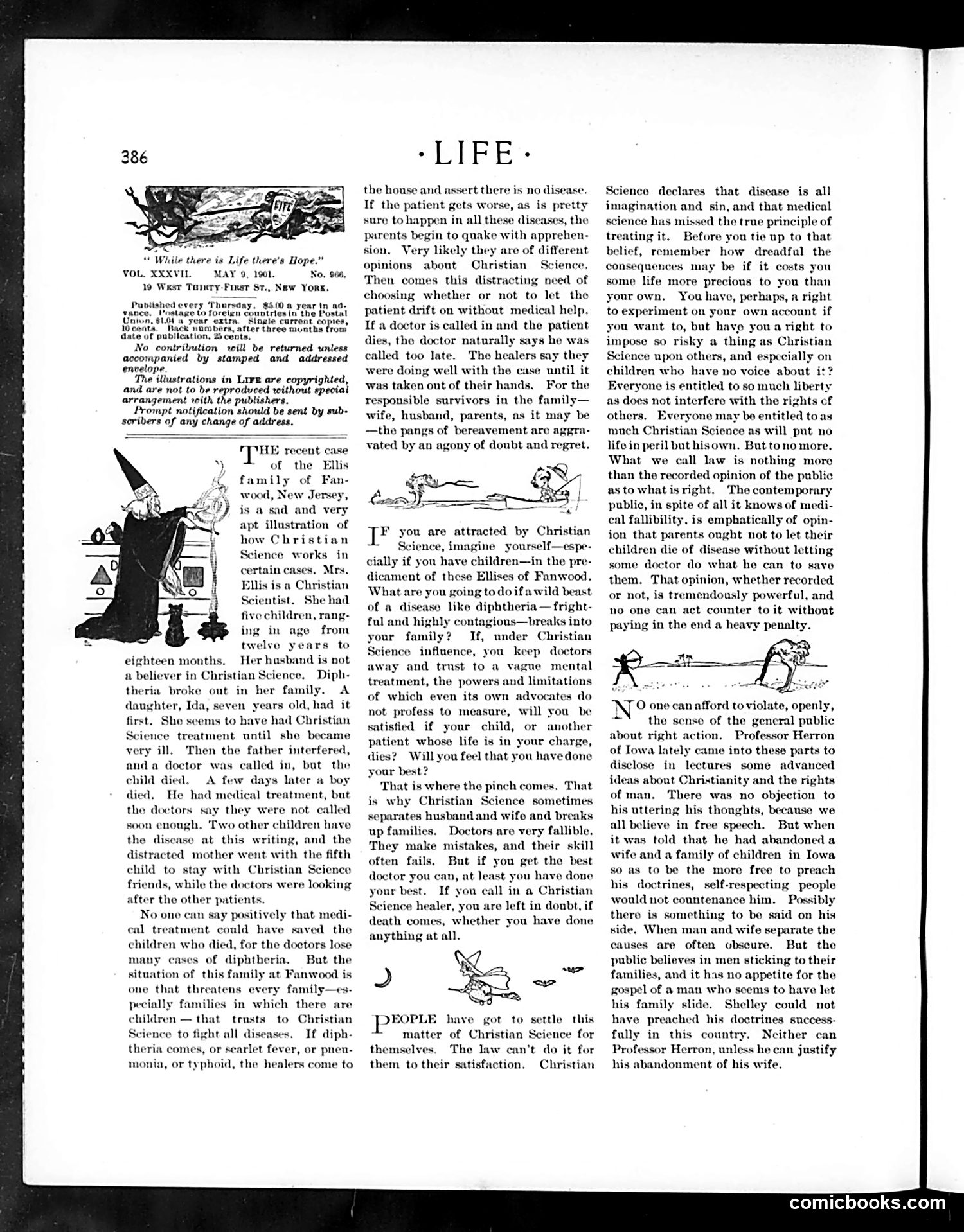
This page satirizes Christian Science's approach to medical treatment. The main illustration shows a figure (likely a Christian Science practitioner) gesturing dismissively while a sick child lies in bed nearby, suggesting the movement's rejection of conventional medicine. The text critiques Christian Science families who avoid doctors for serious diseases like diphtheria, leaving children at risk. The satire highlights the movement's dangerous practice of relying solely on mental treatment rather than medical intervention. A secondary illustration depicts figures engaged in some form of physical struggle or conflict, though its specific meaning is unclear without additional context. The overall message: Life magazine argues that Christian Science's anti-medicine stance endangers children's lives and violates parental responsibility, despite the movement's philosophical appeal.
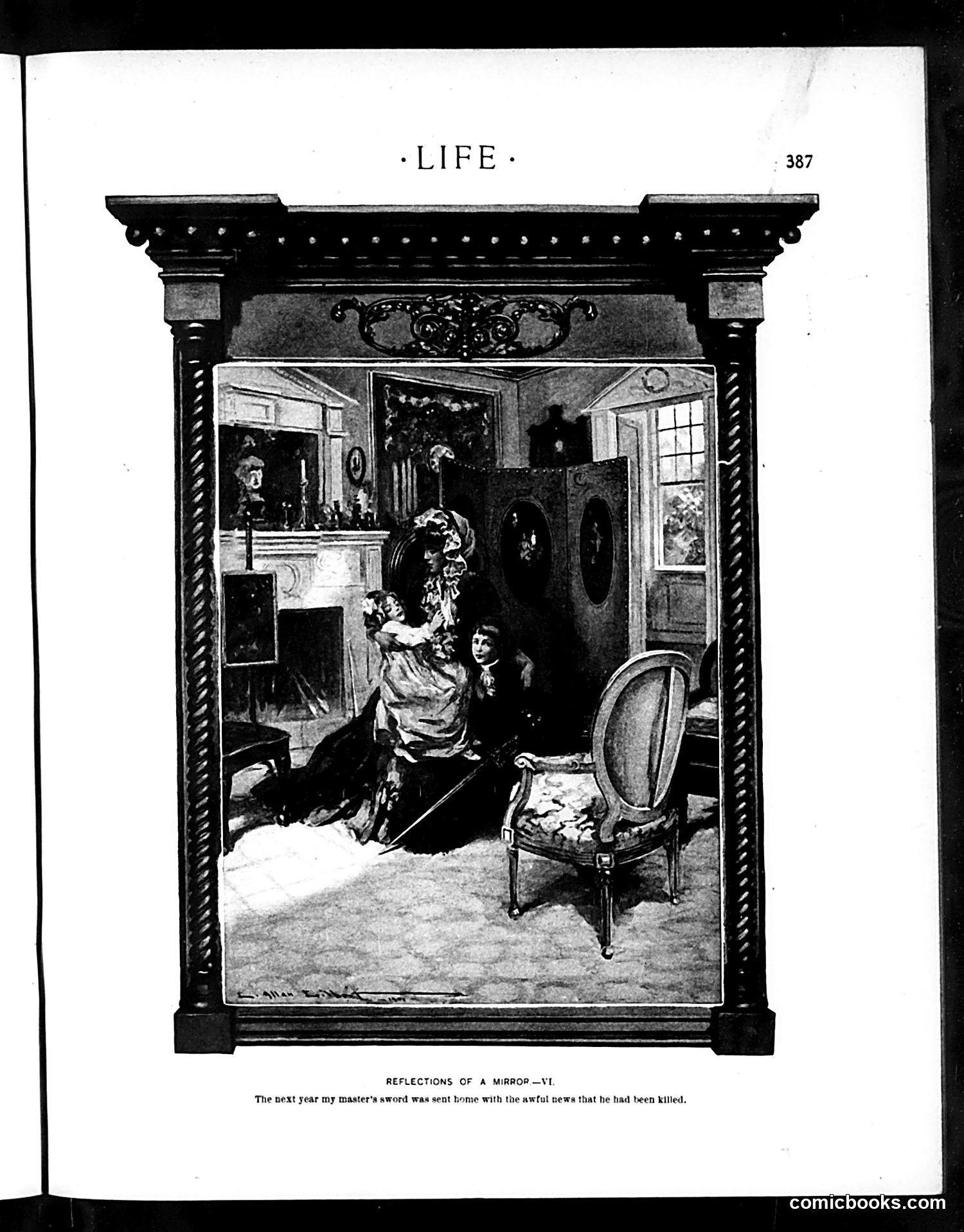
This illustration depicts a domestic interior scene framed as a mirror reflection. The caption reads: "The next year my master's sword was sent home with the awful news that he had been killed." This appears to be part of a serialized narrative ("VI" indicates the sixth installment). The scene shows a woman with children receiving tragic news of a man's death, suggested by the sword being returned. The composition emphasizes domestic grief and the impact of war on families left behind. Without additional context about the specific war or time period this references, the exact historical event remains unclear. However, the imagery reflects how Life magazine used domestic narratives to explore broader themes of loss and sacrifice during wartime.
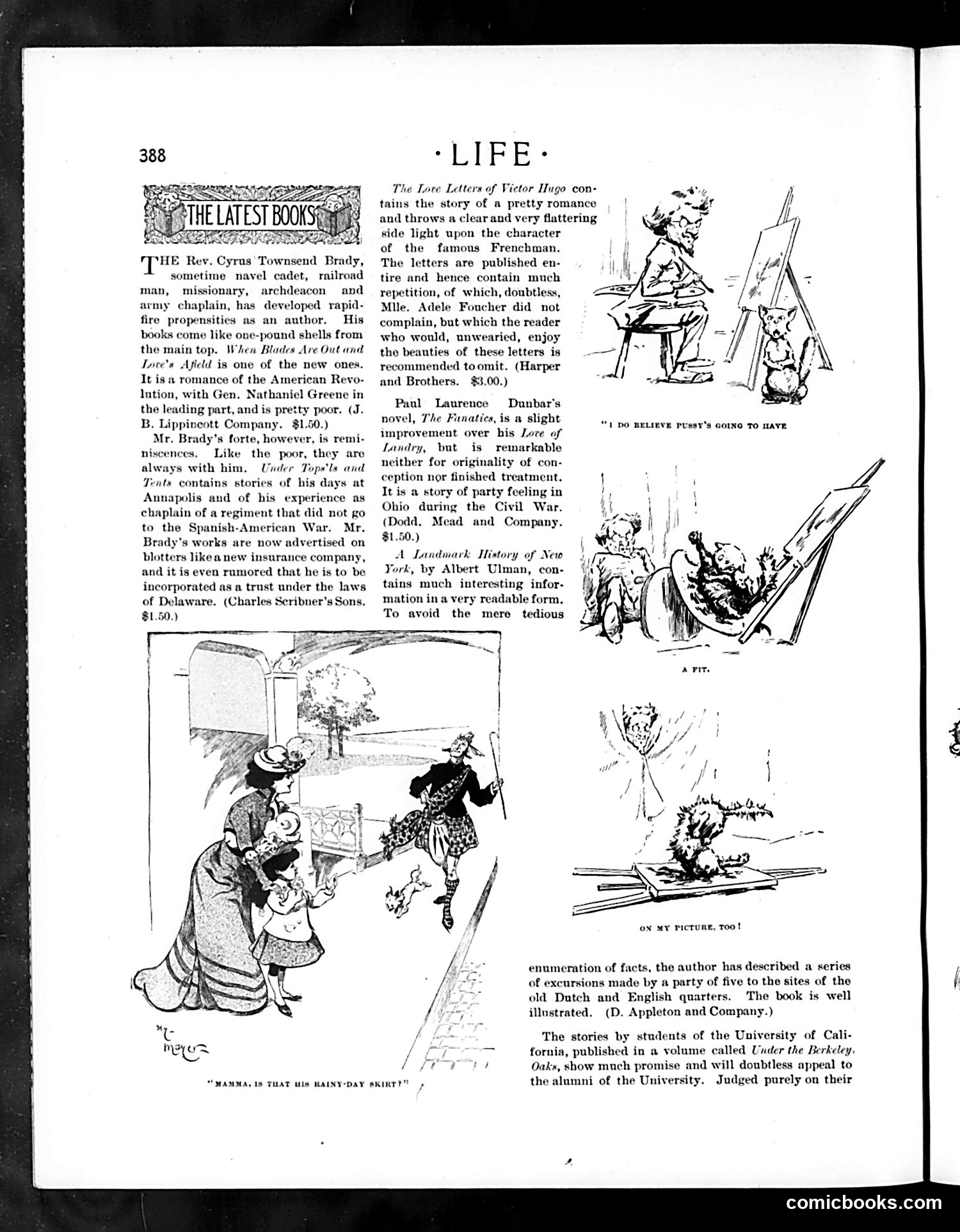
This page primarily reviews recent books rather than presenting political cartoons. The three illustrated vignettes appear to be humorous drawings accompanying literary reviews: 1. **Top illustration**: Shows figures with an easel, captioned "I DO BELIEVE PUSSY'S GOING TO HAVE A FIT" — likely a domestic comedy scene. 2. **Middle illustration**: Depicts a woman with a child, captioned "MAMMA, IS THAT HIS RAINY-DAY SKIRT?" — satirizing Victorian-era gender norms or children's innocent observations about clothing. 3. **Bottom illustration**: Shows a figure on skis, captioned "ON MY PICTURE, TOO!" — appears to be winter sports humor. The cartoons illustrate books being reviewed, including works by Rev. Cyrus Townsend Brady and Paul Laurence Dunbar. These are gentle domestic humor pieces rather than pointed political satire.
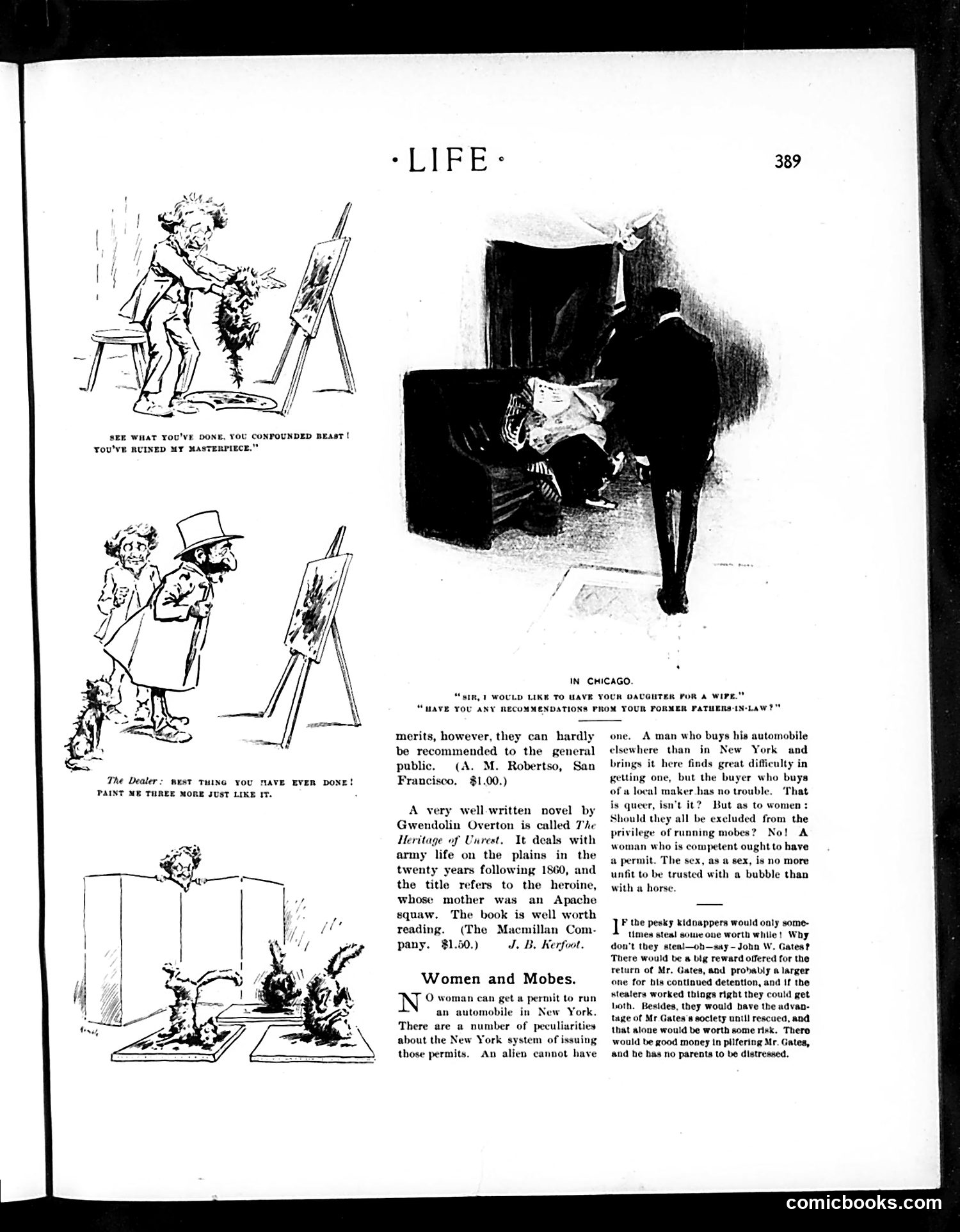
This page contains **cartoons satirizing amateur portrait painting** and **women's autonomy in early 20th century America**. The left-side cartoons mock incompetent artists: one shows a painter destroying a subject's appearance ("confounded beast"), another depicts a dealer trying to sell terrible work ("paint we three more just like it"). The right side addresses **women obtaining automobile permits in New York City**. The caption "In Chicago" suggests gender-based restrictions on driving licenses. The article critiques New York's permit system as needlessly complicated, while mocking the broader resistance to women's independence—particularly marriage prospects. The text sarcastically questions whether women should be "excluded from the privilege of running autos," exposing how social control of women masked itself as concern for their welfare. This reflects early automotive-era anxiety about female autonomy.
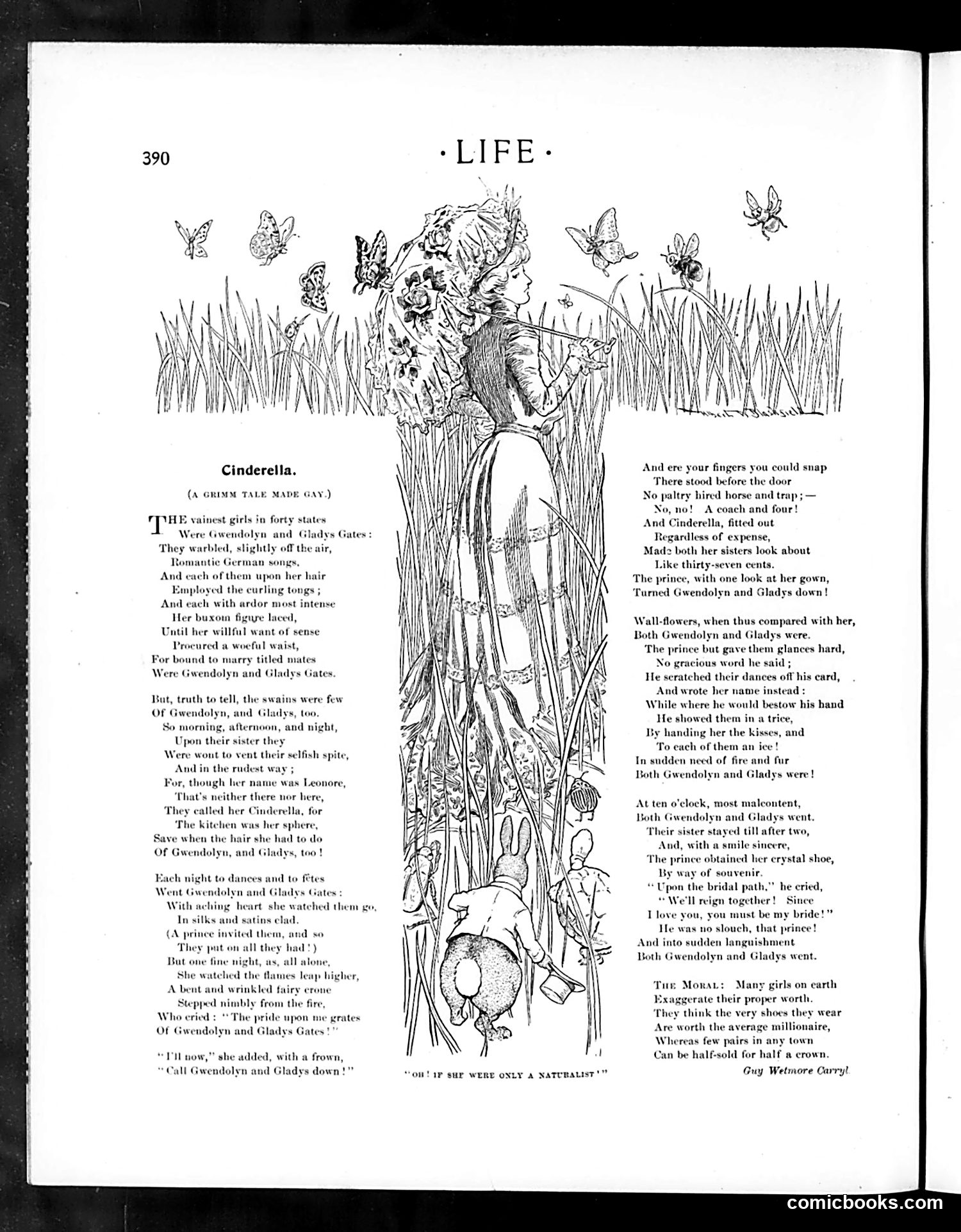
This is a humorous poem retelling of Cinderella that satirizes late-19th-century American materialism and social climbing. The illustrated central figure shows Cinderella surrounded by wealth—butterflies, fine dress, and luxury goods—rather than humble circumstances. The satire mocks how Gwendolyn and Gladys (the stepsisters) value shoes worth "half a crown" as status symbols, suggesting that average millionaires consider such prices astronomical. The moral at the end explicitly critiques how girls "exaggerate their proper worth" and judge themselves by material possessions rather than character. The poem uses the fairy tale framework to gently satirize contemporary consumer culture and the vanity of the Gilded Age wealthy class.
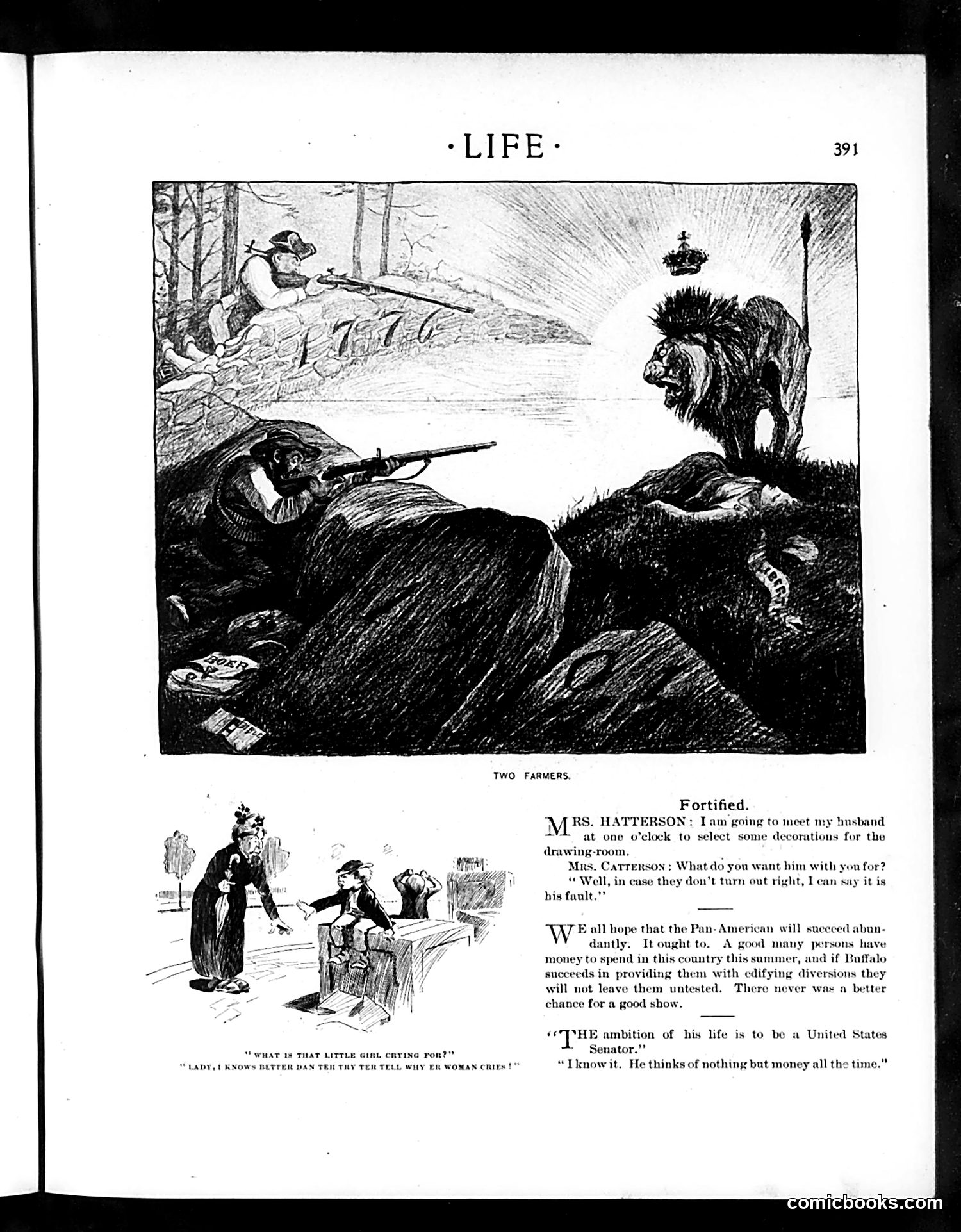
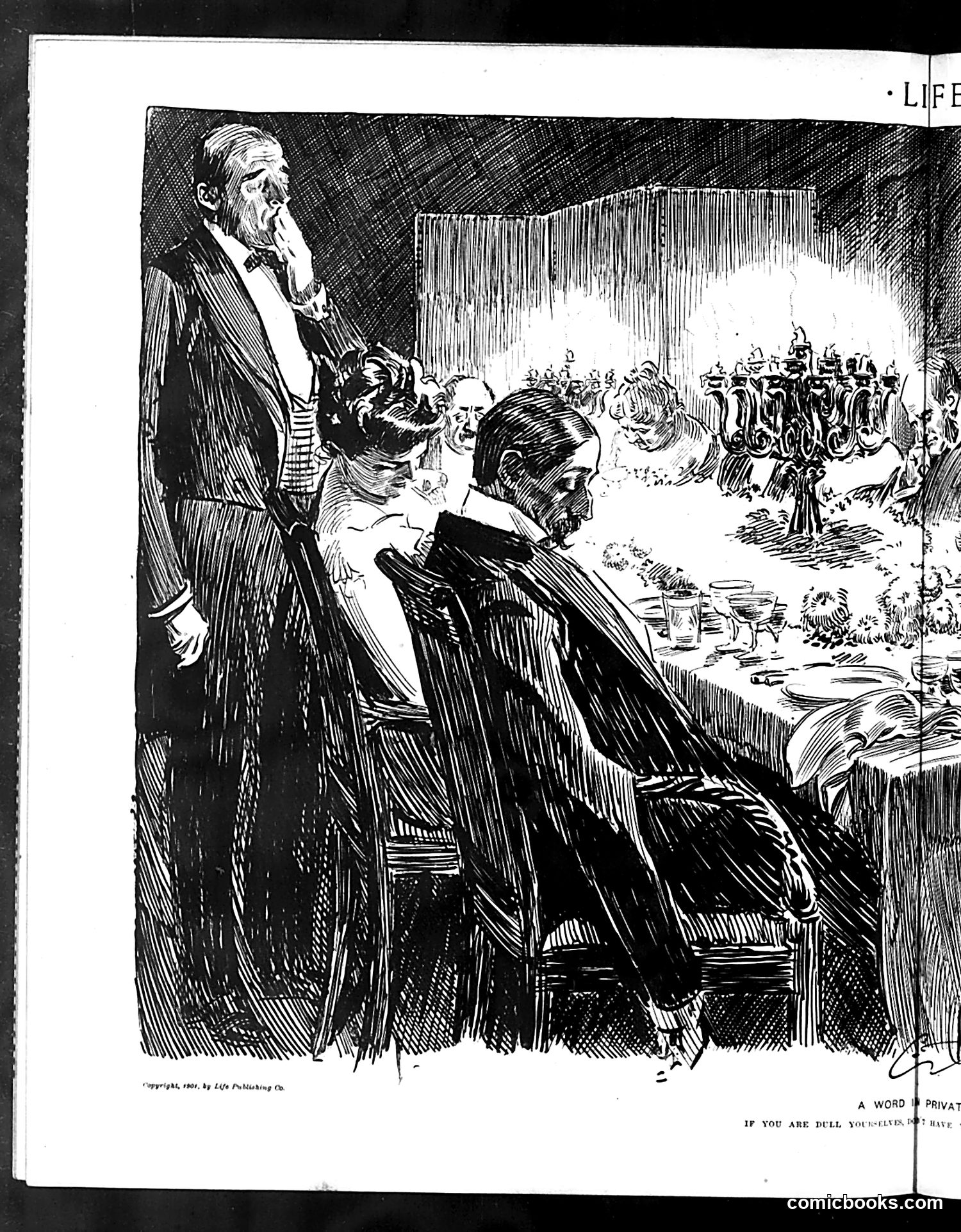
This is a satirical cartoon from Life magazine (copyright 1902, per visible text). The image shows a formal dinner scene where an older bearded gentleman stands behind a seated man, appearing to whisper advice to him. The caption reads: "A WORD PRIVAT[E]... IF YOU ARE DULL, YOU'LL [unclear text]" The satire appears to mock social etiquette or business advice—specifically, the notion of unsolicited coaching at formal gatherings. The standing figure's conspiratorial posture and the seated man's attentive posture suggest someone offering "helpful" guidance, likely on how to succeed in society or business. The humor lies in the awkwardness of giving such instruction publicly at a dinner, and the implied desperation of needing such assistance to avoid appearing "dull." The background shows other dinner guests, establishing this as a high-society event.
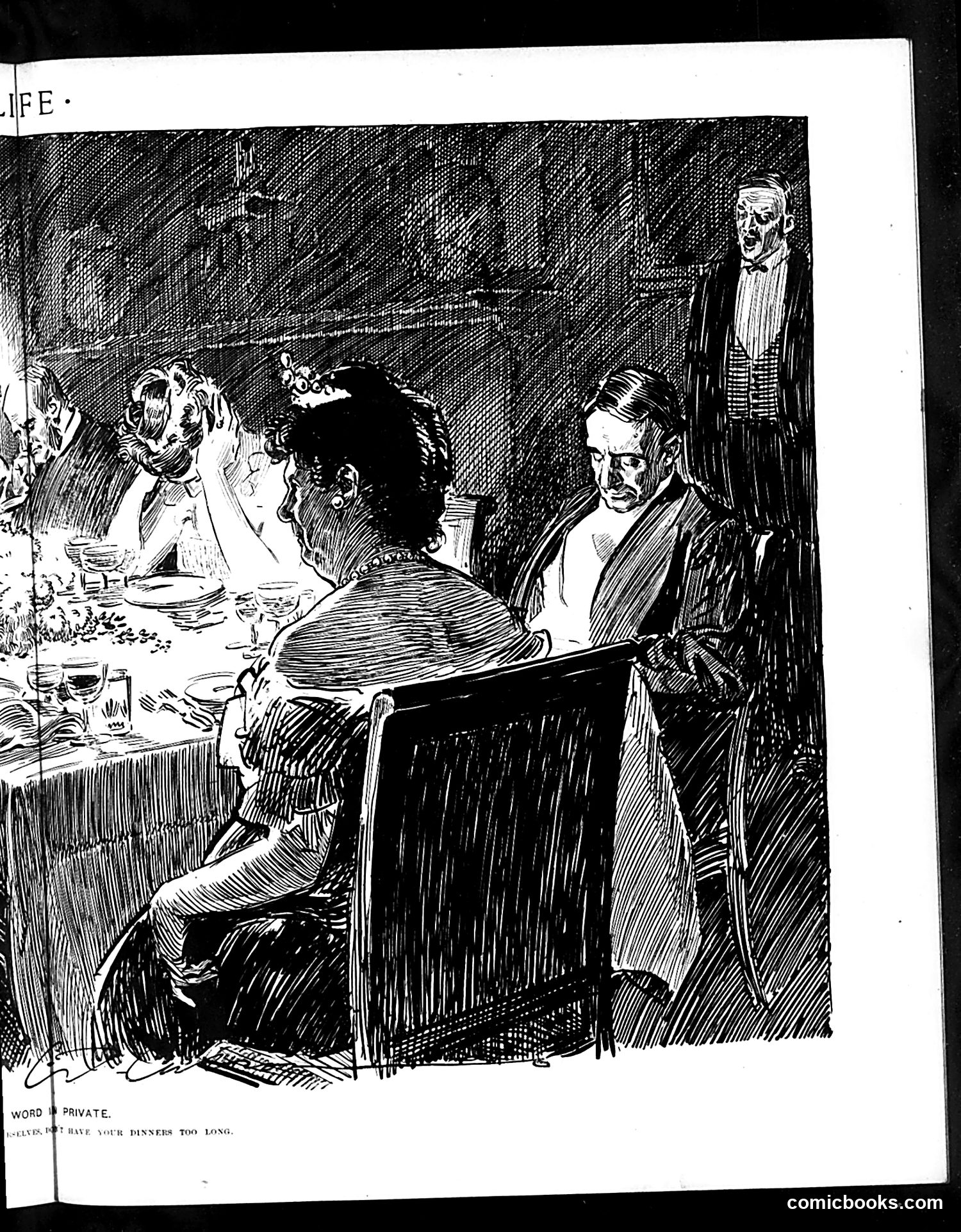
This appears to be a satirical cartoon from Life magazine depicting a formal dinner scene. The visible caption reads "WORD TO PRIVATE" and "LISTEN, DON'T HAVE YOUR DINNERS TOO LONG," suggesting criticism of excessive dinner length among the wealthy or elite. The sketch shows well-dressed diners at a table with glasses and place settings, while a man stands nearby (possibly a servant or host). The artistic style—cross-hatched ink work typical of early 20th-century illustration—and the social setting suggest satire targeting upper-class dining habits or etiquette. Without additional context about the specific publication date or political moment, I cannot identify the particular individuals depicted or confirm the precise social critique intended. The humor appears aimed at formal dinner culture among the affluent.
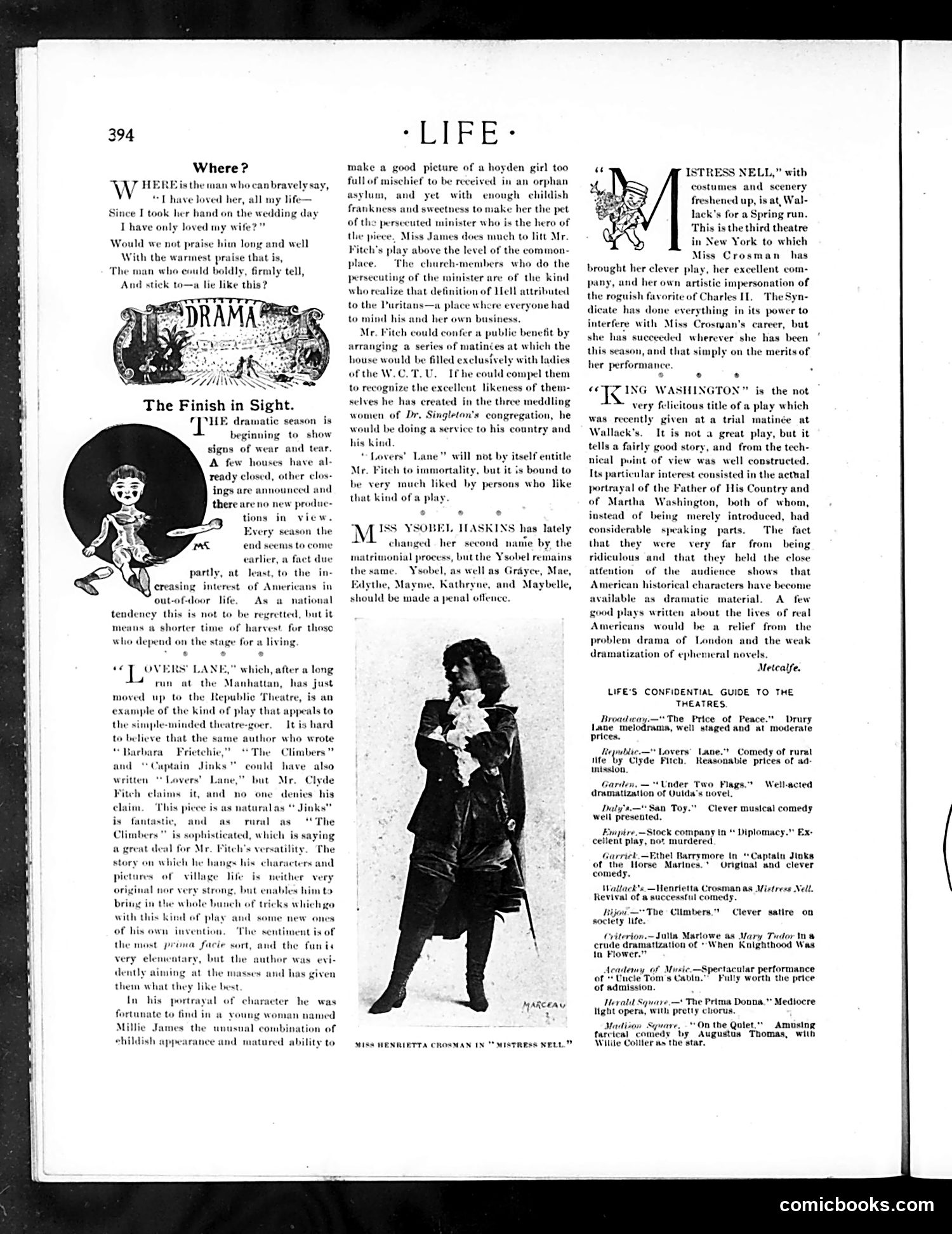
This page contains theatrical reviews and commentary rather than political satire. The main content discusses Broadway plays including "Lovers' Lane," "Mistress Nell," and "King Washington." The page critiques contemporary American drama, noting that while "Lovers' Lane" may achieve commercial success, serious theatrical material about American life remains scarce. The reviewer laments that quality dramatic work is undervalued compared to lighter fare. A photograph shows actress **Henrietta Crosman** in the role of "Mistress Nell." The reviews emphasize that American audiences would benefit from better historical drama and serious plays rather than relying heavily on British dramatic imports. The "Confidential Guide to the Theatres" at bottom provides theater recommendations and admission prices for various New York venues.
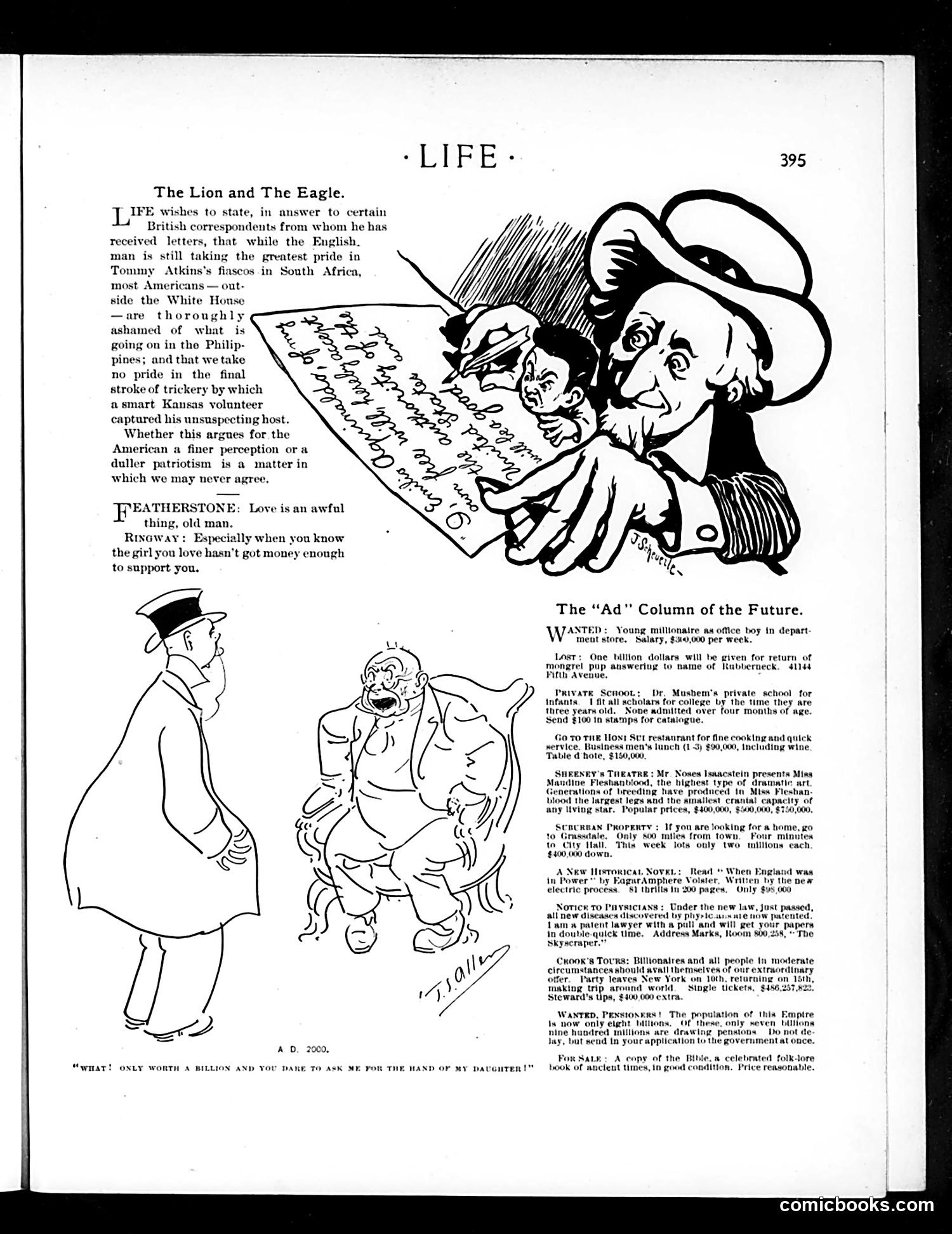
**"The Lion and The Eagle"** compares British and American imperialism. Life states that while British take pride in military victories in South Africa (the Boer War), Americans should be ashamed of conduct in the Philippines—specifically referencing a "Kansas volunteer" who used "trickery" to capture an enemy. This likely refers to the Philippine-American War and colonial tactics Americans employed there. The piece argues Americans show "finer perception" by recognizing such conduct as dishonorable, though this is debatable. **"The Ad Column of the Future"** is satirical advertising imagining extreme economic inflation—jobs paying millions, restaurant meals costing $90,000, real estate in billions. This mocks either unchecked capitalist excess or projects economic collapse/hyperinflation. The final ad—a father demanding a billion dollars for his daughter's hand—represents society's complete monetization. Both pieces critique American imperialism and economic excess contemporary to Life's publication era (early 1900s).
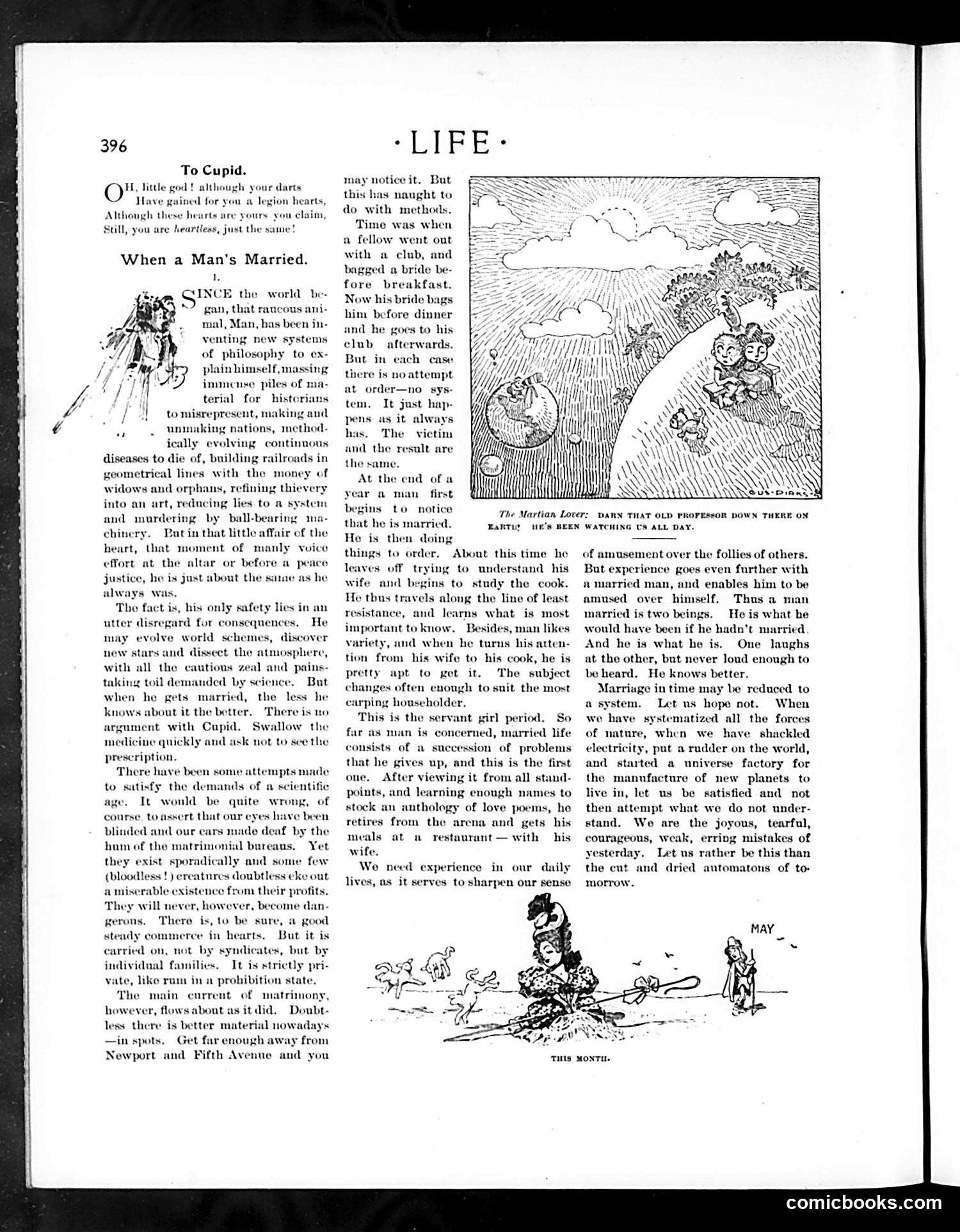
This page contains two distinct pieces of social satire typical of Life magazine's humor: **"When a Man's Married"** is a lengthy essay-cartoon mocking the supposed foolishness of married men. The satire argues that men who can accomplish great intellectual feats become helpless once married, reduced to taking orders about domestic matters (particularly from servants and cooks). The piece suggests married life consists of men retreating from problems—ultimately eating at restaurants with their wives rather than solving household issues. The joke is that marriage transforms supposedly rational beings into compliant, bewildered creatures. **"The Martian Lover"** (bottom illustration) shows an alien couple observing Earth, with one complaining about "that old professor down there on Earth" watching them. This is a brief joke about astronomical observation, likely referencing contemporary telescope technology or amateur astronomers. Both pieces reflect turn-of-the-century attitudes toward marriage as inherently absurd and emasculating for men, while poking fun at scientific pretension.
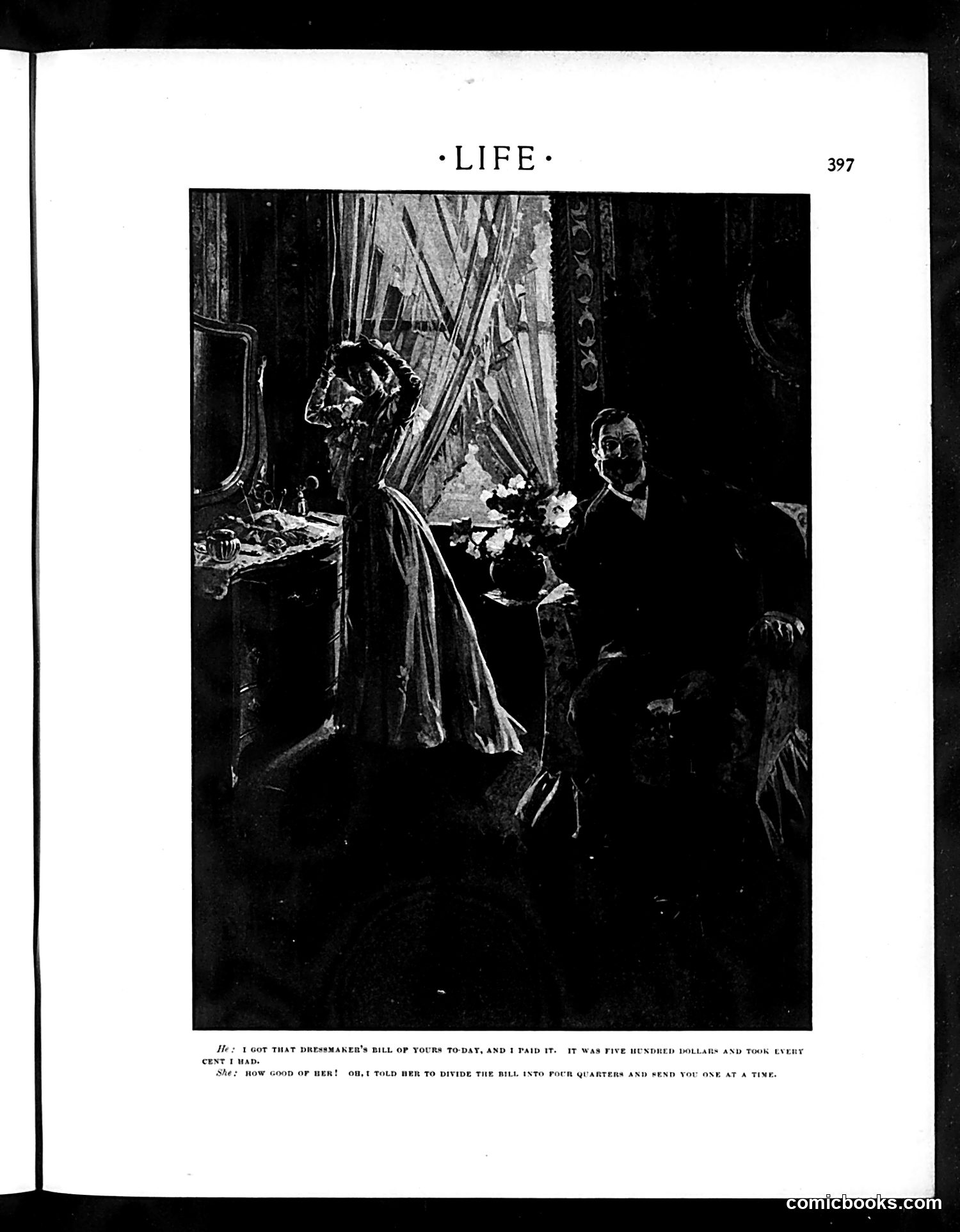
This appears to be a satirical illustration from *Life* magazine depicting a domestic financial dispute. The scene shows a well-dressed man confronting a woman (likely his wife) about a dressmaker's bill of five hundred dollars—a substantial sum for the era. The humor centers on the man's complaint about the expense and his proposed "solution": dividing the bill into quarterly payments and sending her one at a time, implying she should manage the debt herself rather than he absorbing the full cost. The satire targets both marital financial tensions and the perceived extravagance of women's fashion expenses, which was a recurring comedic theme in early 20th-century satirical magazines. The ornate interior setting emphasizes the household's apparent wealth, heightening the irony of the dispute.
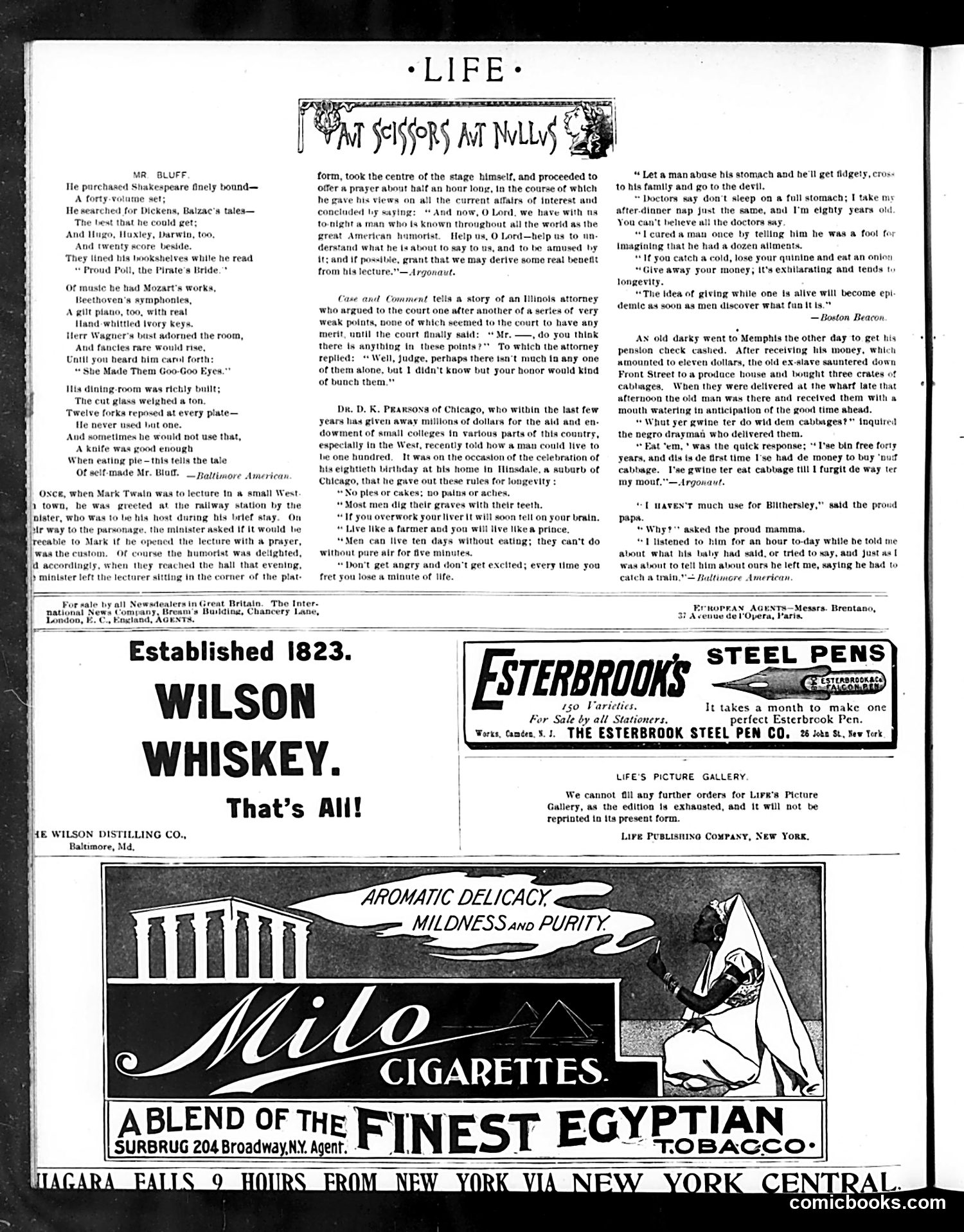
This page is primarily **advertising and miscellaneous content** rather than political satire. The main elements are: **"Mr. Bluff" Poem**: A satirical character sketch mocking social pretension. Mr. Bluff purchases expensive, prestigious books (Shakespeare, Dickens) and fine musical instruments to appear cultured, yet actually reads cheap dime novels ("Proud Poll, the Pirate's Bride") and sings vulgar songs ("She Made Them Goo-Goo Eyes"). The joke critiques wealthy Americans who buy culture as status symbols without genuine appreciation—they own twelve forks but use only one knife. **Anecdotes**: The page includes humorous stories about Mark Twain and courtroom arguments, typical of Life's humor section. **Advertisements**: Multiple product ads (Wilson Whiskey, Esterbrook Steel Pens, Milo Cigarettes) occupy substantial space, reflecting the magazine's revenue model. The satire targets **American nouveau riche hypocrisy**—acquiring trappings of refinement while lacking actual cultivation or taste.
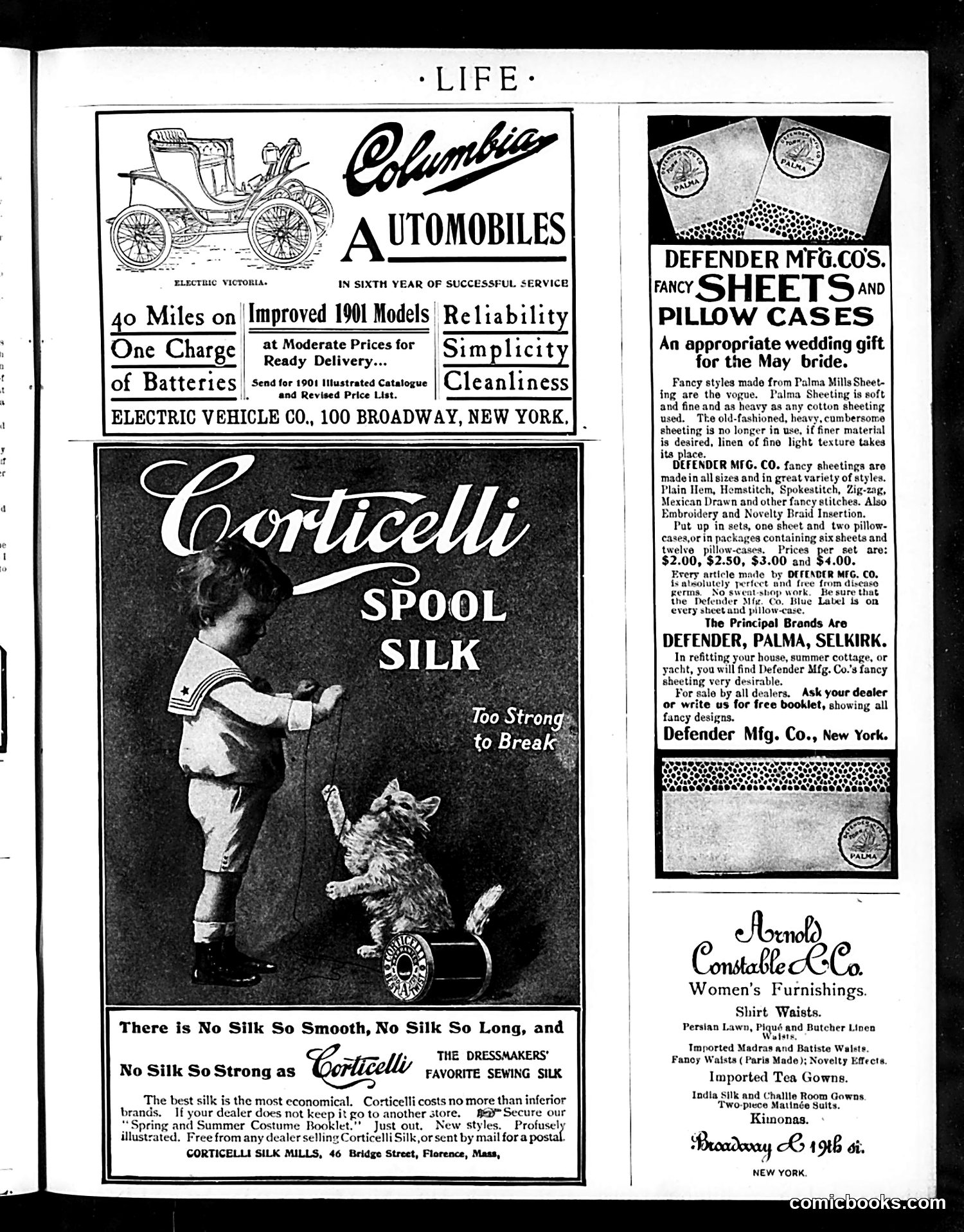
This page consists primarily of **advertisements**, not political cartoons or satire. It's a commercial advertisement page from an early 1900s issue of *Life* magazine. The content includes ads for: 1. **Columbia Automobiles** and **Electric Vehicles** (representing early auto technology) 2. **Corticelli Spool Silk** — the main image shows a spool of thread being tugged by a small dog, with the tagline "Too Strong to Break," emphasizing the product's durability 3. **Defender Manufacturing** sheets and pillowcases (marketed as wedding gifts) 4. **Arnold Constable & Co.** women's clothing There is no political satire here. The page reflects turn-of-the-century consumer culture, showcasing goods aimed at middle and upper-class consumers, particularly women. The only visual "joke" is the dog-and-thread demonstration emphasizing product strength—a straightforward advertising technique rather than commentary.
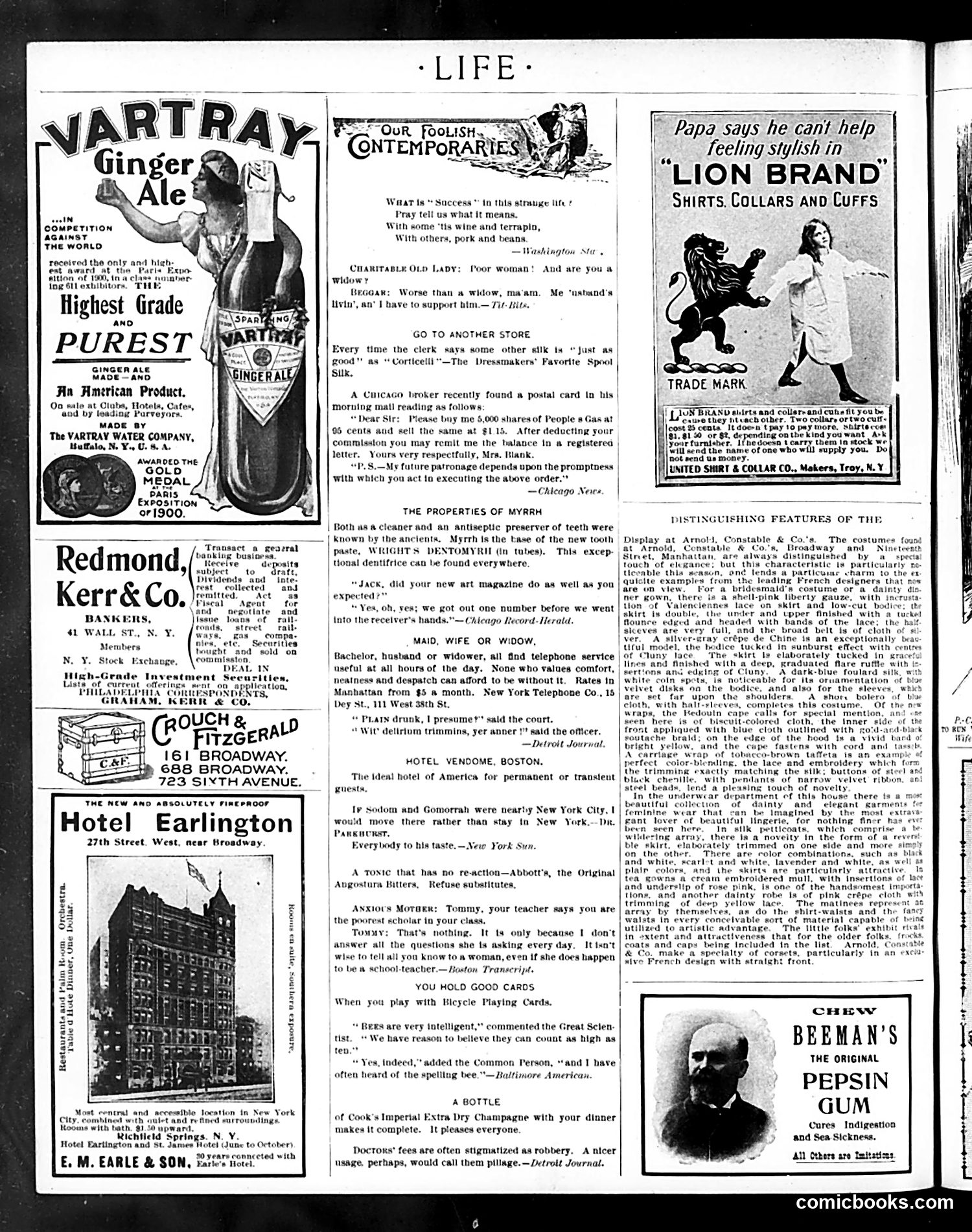
This page is primarily **advertisements and filler humor** rather than political satire. The content includes: **"Our Foolish Contemporaries"** section presents brief jokes mocking everyday absurdities: - A charitable lady's complaint about supporting her unemployed husband - A humorous anecdote about a Chicago woman attempting stock trading by mail - Jokes about drunk behavior, teacher-student dynamics, and personal taste **The advertisements** dominate (Vartray Ginger Ale, hotels, banks, Lion Brand shirts) and represent typical early-1900s commercial promotions, including the "Lion Brand" depicting a lion chasing a woman—a common advertising trope of the era. There is **no significant political commentary** on this page. Rather, it reflects Life magazine's satirical approach: gentle, domestic humor targeting middle-class foibles—poor business decisions, marital dynamics, and social pretension—rather than serious political critique. The tone is lighthearted rather than biting.
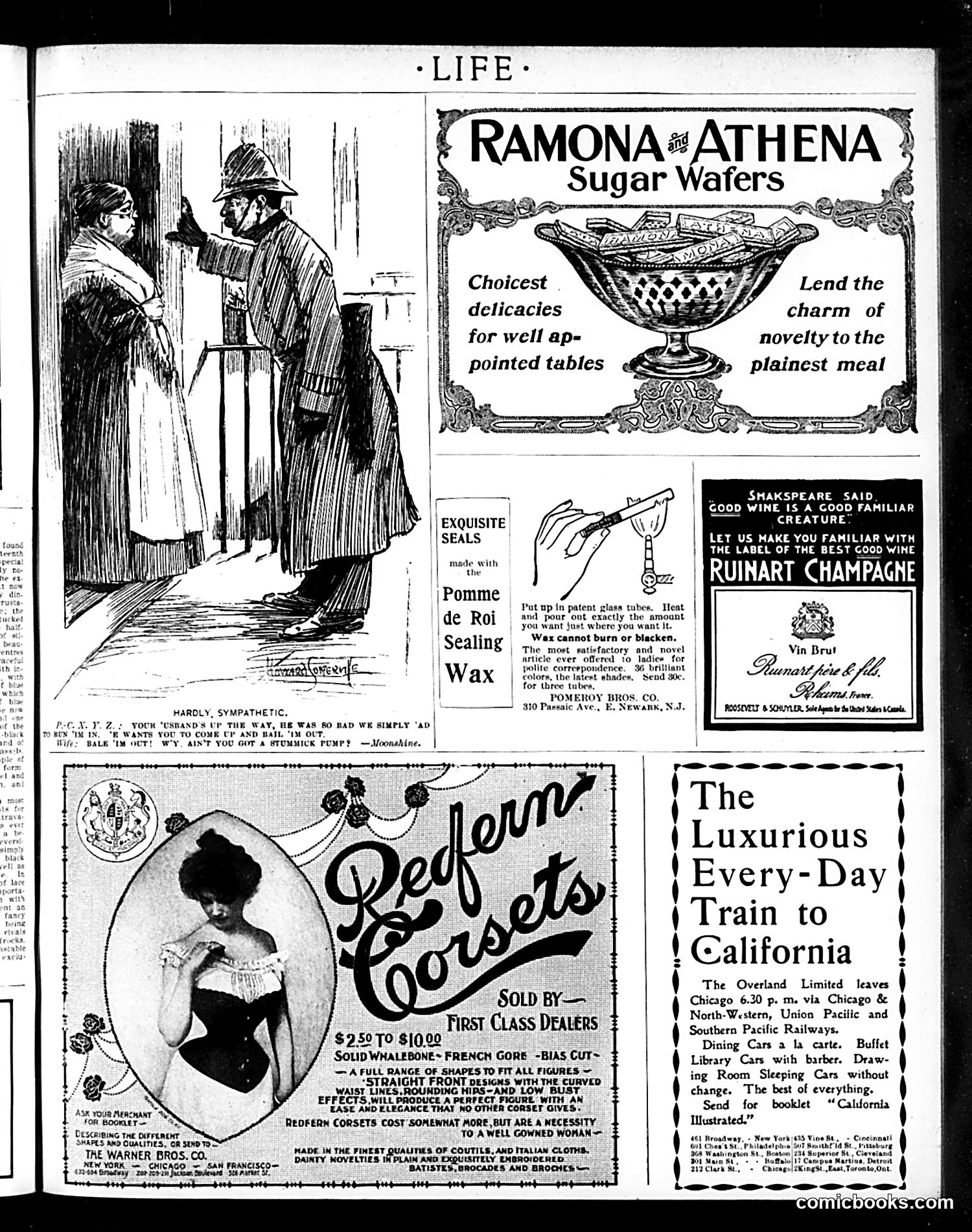
This page is primarily **advertising** from an early 20th-century *Life* magazine, with one small cartoon. **The Cartoon ("Hardly, Sympathetic"):** A man in a hat confronts a woman, apparently about her husband's drunkenness. The caption quotes her saying he was so badly behaved she had to bail him out of jail, and jokes that he wants her to come retrieve him again—she responds incredulously that she doesn't have a "stomach pump" (implying he's a hopeless drunk). This is gentle domestic humor mocking both male alcoholism and female exasperation. **The Advertisements:** The bulk of the page sells luxury goods—Ramona and Athena sugar wafers, Ruinart champagne, Redfern corsets (women's undergarments), and a California train service. These ads reflect period concerns: refined table presentation, wine as sophistication, women's fashion/figure control, and leisure travel. The champagne ad even invokes Shakespeare to associate the product with culture and gentility.
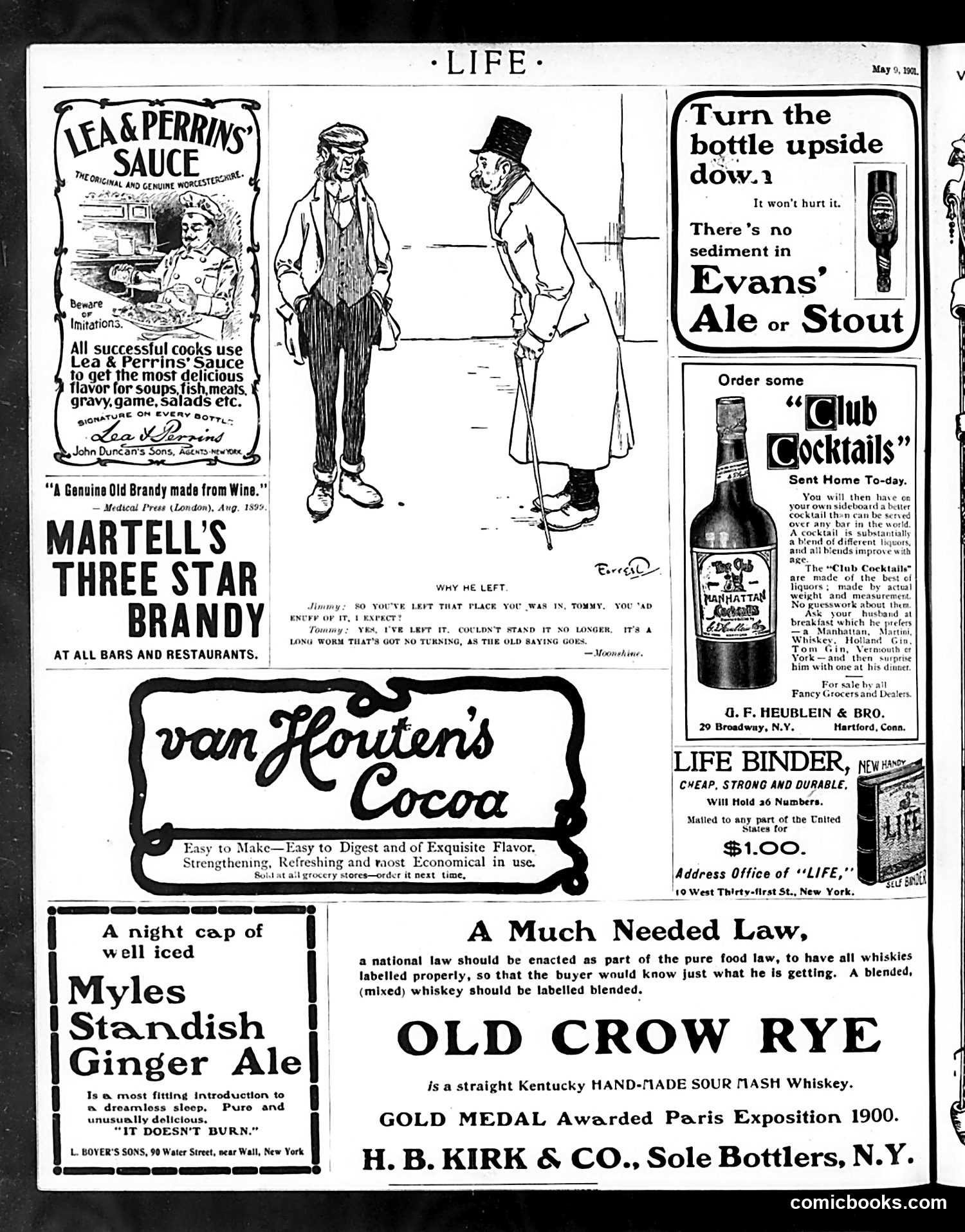
This page is primarily **advertising content** with one embedded cartoon. The main visual humor appears in the center: a dialogue between two working-class men ("Jimmy" and "Tommy") discussing why Tommy left his job. The cartoon satirizes poor working conditions—Tommy's workplace had "a long worm that's got no turning," referencing the biblical saying "the worm that doth not die," implying the job was unbearable and exploitative. The surrounding advertisements reflect early 1900s consumer culture: Lea & Perrins Sauce, Martell's Brandy, Evans' Ale, Club Cocktails, van Houten's Cocoa, and Old Crow Rye whiskey. Notably, one ad advocates for "A Much Needed Law" requiring whiskey labeling to distinguish blended from straight whiskey—addressing **pure food law concerns** of the Progressive Era, when food/beverage adulteration was a major consumer protection issue.