
Life, 1901-05-09 · page 4 of 20
Life — May 9, 1901 — page 4: what you’re looking at
What you’re looking at
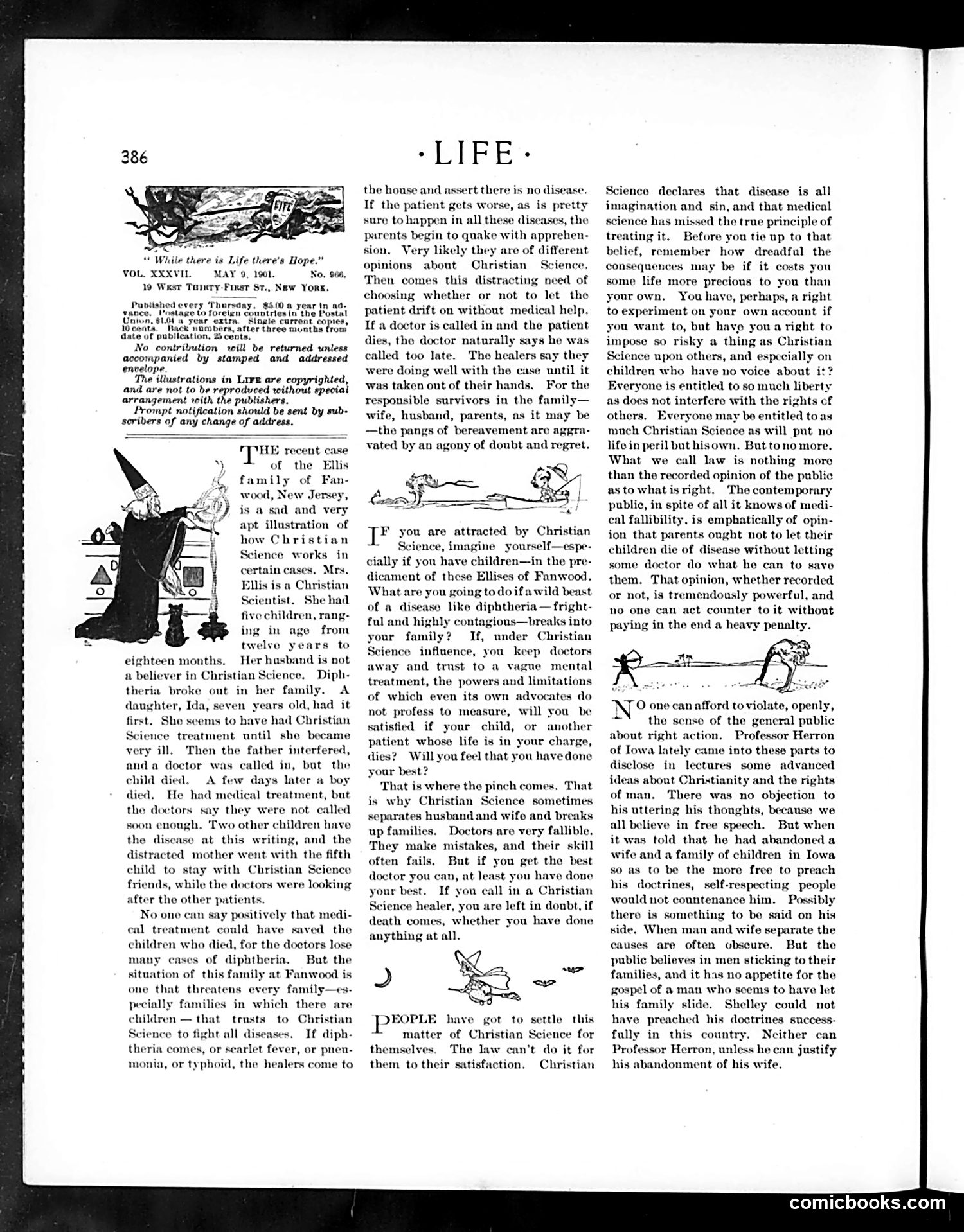
This page satirizes Christian Science's approach to medical treatment. The main illustration shows a figure (likely a Christian Science practitioner) gesturing dismissively while a sick child lies in bed nearby, suggesting the movement's rejection of conventional medicine. The text critiques Christian Science families who avoid doctors for serious diseases like diphtheria, leaving children at risk. The satire highlights the movement's dangerous practice of relying solely on mental treatment rather than medical intervention. A secondary illustration depicts figures engaged in some form of physical struggle or conflict, though its specific meaning is unclear without additional context. The overall message: Life magazine argues that Christian Science's anti-medicine stance endangers children's lives and violates parental responsibility, despite the movement's philosophical appeal.
📄 Transcribed text from this page (OCR, searchable)
Machine-transcribed from the original scan — historical spelling and the odd misread are preserved.
While there is Life there's Hope.” VOL. XXXVI MAY 9, 1901. No. 986, 19 Wast Turery-Finst St., New Yorr. Published every Thursday, $5.00 a year in ad- vance, Mostage to foreign countries tn the Postal Union, $1.00 a year exten. single current copies, lceats. “ack numbers, after three tmunths trom date of publication, 3 cents. No contribution will be returned unless accompanied by stamped and addressed envelope. ‘The illustrations in Lire are copyrighted, and are not to be reproduced without special arrangement with the publishers, Prompt notification should be sent by sub- soribers of any change of address. HE recent case of the Ellis family of Fan- wood, New Jersey is a sad and very apt illustration of how Christian Science works in certain ci Mrs. Ellis is a Christian entist. She had five children, rang- ing in from twelv ars to eighteen months. Her hasband is not a believer in Christian Science. Diph- theria broke out in her family. A daughter, Ida, seven years old, had it first. She seems to have had Christian Science treatment until she became very ill, Then the father interfered, anda doctor was called in, but the child died. A few days later a boy died. He had medi treatment, but the doctors say they were not called soon enough, ‘Two other children have the disease at this writing, and the distracted mother went with the fifth child to stay with Christian Science friends, while the doctors were looking after the other patients. No one can say positively that medi- cal treatment could have saved the children who died, for the doctors lose many cases of diphtheria, But the situation of this family nwood is one that threatens every family—es- pecially families in which there are children — that trusts to Christian nee to fight all di If diph- theria comes, or scarlet fever, or pneu- monia, or typhoid, the healers come to ases, *LIPE’ the house and assert there is no disease. If the patient gets worse, as is pretty sure to happen in all these diseases, the parents begin to quake with apprehen- sion, Very likely they are of different opinions about Christian Science. Then comes this distracting need of choosing whether or not to let the patient drift on without medical help. If a doctor is called in and the patient dies, the doctor naturally says he was called too late. The healers say they were doing well with the case until it was taken out of their hands. For the responsible survivors in the family— wife, husband, parents, as it may be —the pangs of bereavement are aggra- vated by an agony of doubt and regret. * you are attracted by Christian ience, imagine yourself—espe- cially if you have children—in the pre- dicament of these Ellises of Fanwood. What are you going to do if awild beast s ® like diphtheria —fright- ful and highly contagious—breaks into your family? If, under Christian Science influence, you keep doctors away and trust to a vague mental treatment, the powers and limitations of which even its own advocates do not profess to measure, will you be satistied if your child, or another patient whose life is in your charge, dies? Will you feel that you havedone your best? That is where the pinch comes. That is why Christian Science sometimes separates husband and wife and breaks up families. Doctors are very fallible. They make mistakes, and their skill often fail But if you get the best doctor you can, at least you have done your best. If you call in a Christian Science healer, you are left in doubt, if death comes, whether you have done anything at all. > ¥a-7 QEOPLE have got to settle this matter of Christian Science for themsel ve The law can’t do it for them to their satisfaction. Christian Science declares that disease is all gination and sin, and that medical science has missed the true principle of treating it. Before you tie up to that belief, remember how dreadful the consequences may be if it costs you some life more precious to you than your own, You have, perhaps, a right to experiment on your own account if you want to, but have you a right to impose so risky a thing as Christian Science upon others, and especially on children who have no voice about it? Everyone is entitled to so much liberty as does not interfere with the rights of others. Everyone may be entitled toas much Christian Science as will put no lifo in peril but hisown. But tono more, What we call law nothing more than the recorded opinion of the public as to what is right. The contemporary public, in spite of all it knows of medi- cal fallibility, is emphatically of opin- ion that parents ought not to let their children die of disease without letting some doctor do what he can to save them. That opinion, whether recorded or not, is tremendously powerful, and no one can act counter to it without paying in the end a heavy penalty. NT O one can afford to violate, openly, — the sense of the general public about right action. Professor Herron of Iowa lately came into these parts to disclose in lectures some advanced ideas about Christianity and the rights of man. There was no objection to his uttering his thoughts, because we all believe in free speech. But when it was told that he had abandoned a wife and a family of children in Iowa so as to be the more free to preach his doctrines, self-respecting people would not countenance him. Possibly there is something to be said on his side, When man and wife separate the causes are often obscure. But tho public believes in men sticking to their families, and it has no appetite for the gospel of a man who seems to havo let his family slide. Shelley could not have preached his doctrines success- fully in this country. Neither can Professor Herron, unle his abandonment of his w comicbooks.com