
A complete issue · 20 pages · 1901
Life — February 21, 1901
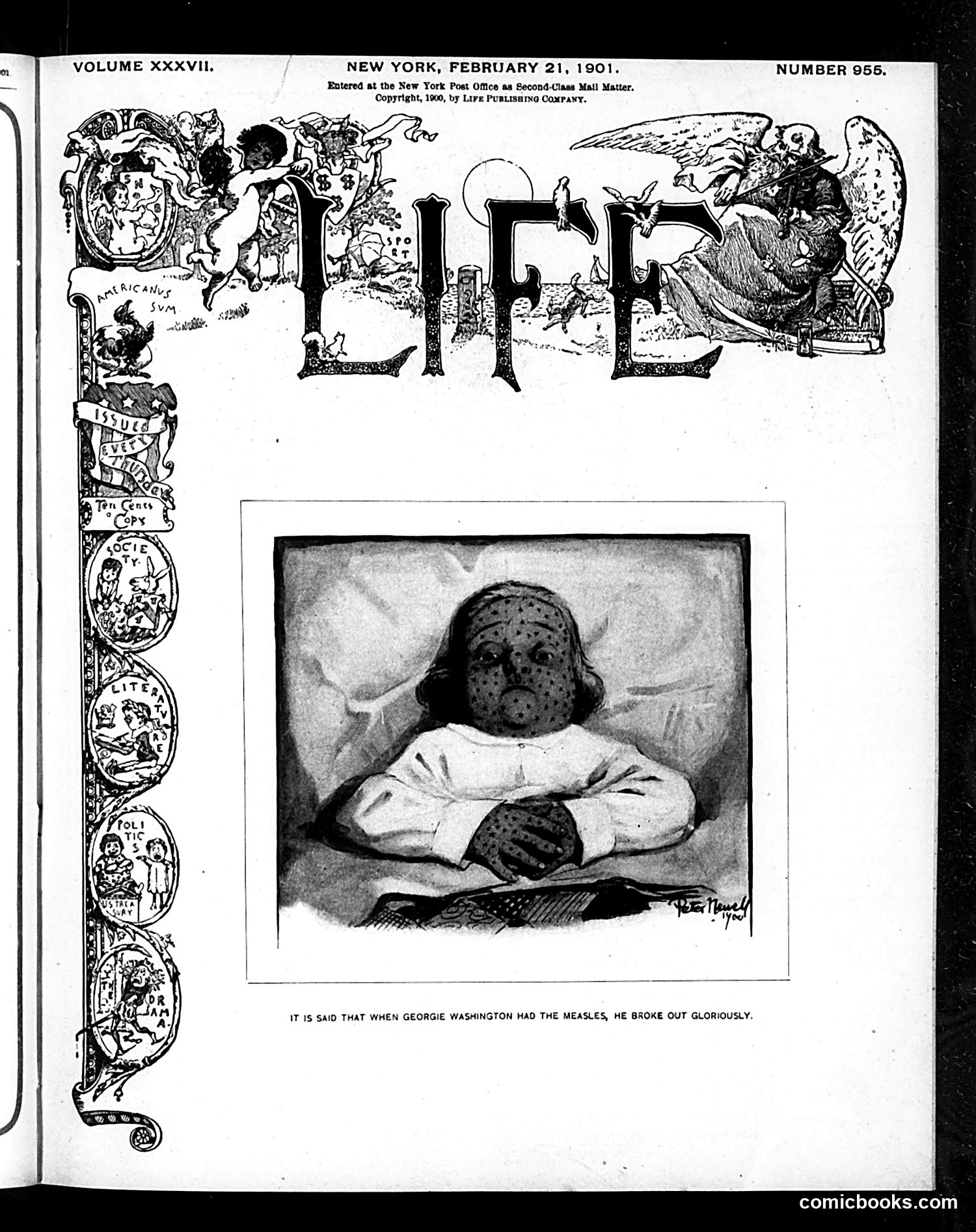
This page features a satirical illustration with the caption: "It is said that when George Washington had the measles, he broke out gloriously." The image shows a baby or infant covered in measles spots, lying in bed. The joke is a pun playing on the phrase "broke out gloriously"—which normally means to succeed spectacularly—but here applies literally to the visible skin eruption of measles. The reference to George Washington suggests this is commentary on American patriotism or national pride, using the founding father as a historical touchstone. The humor relies on the crude visual of a spotted infant combined with the double meaning of "broke out," typical of Life magazine's wordplay-based satire from this era.
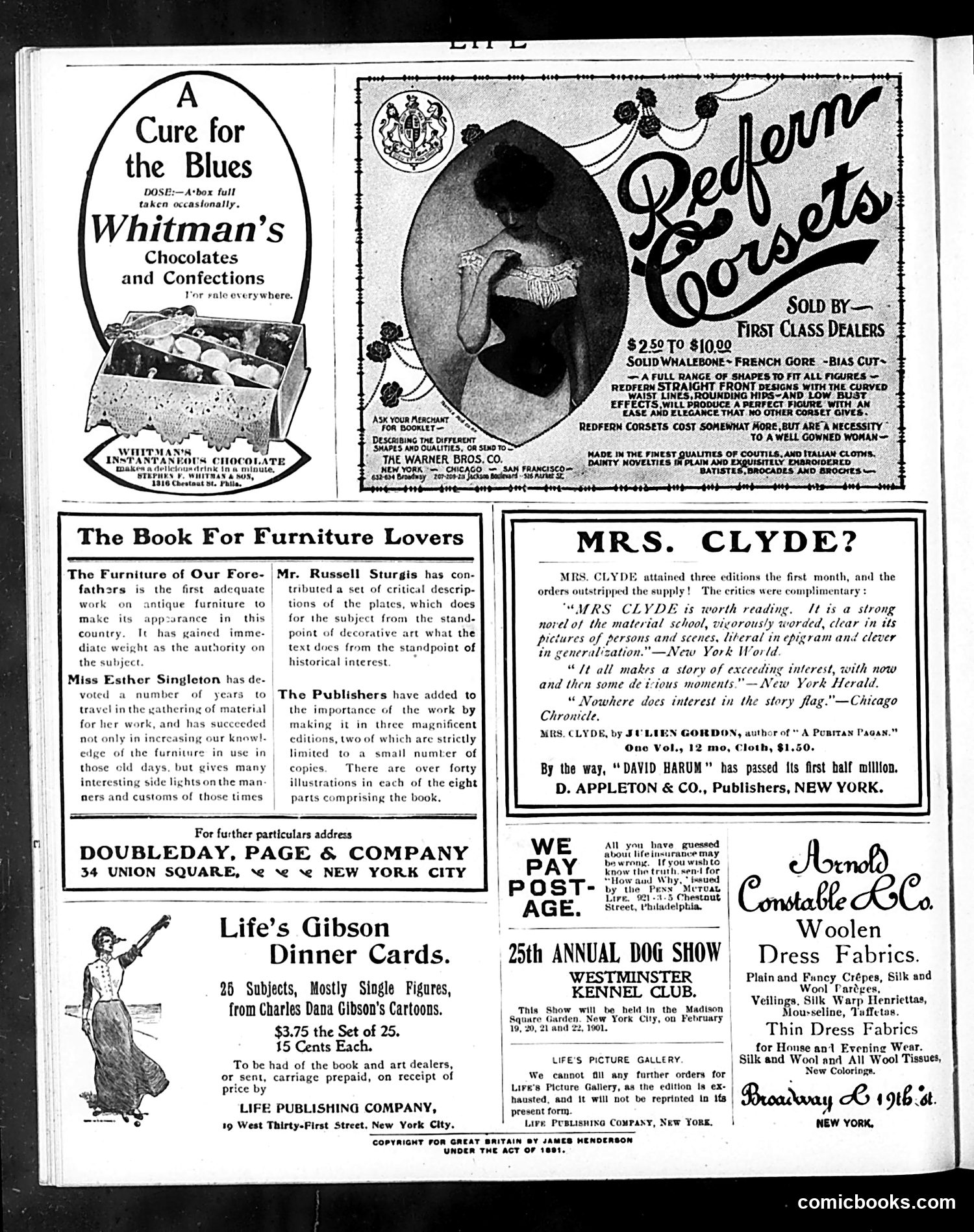
This page is **primarily advertising** with no political cartoons or satirical content. The ads include: - **Whitman's Chocolates** ("A Cure for the Blues") - **Redfern Corsets** (women's fashion) - **Furniture book** by Miss Esther Singleton - **Mrs. Clyde novel** review (a book advertisement) - **Life's Gibson Dinner Cards** (Charles Dana Gibson cartoons—decorative, not satirical) - **25th Annual Dog Show** at Westminster Kennel Club - **Arnold Constable & Co.** woolens and dress fabrics The page reflects early 20th-century consumer culture, with ads targeting middle/upper-class readers. Gibson's work referenced here was popular illustrative art rather than political commentary. This is a typical Life magazine page mixing literary reviews, social announcements, and luxury product advertising.
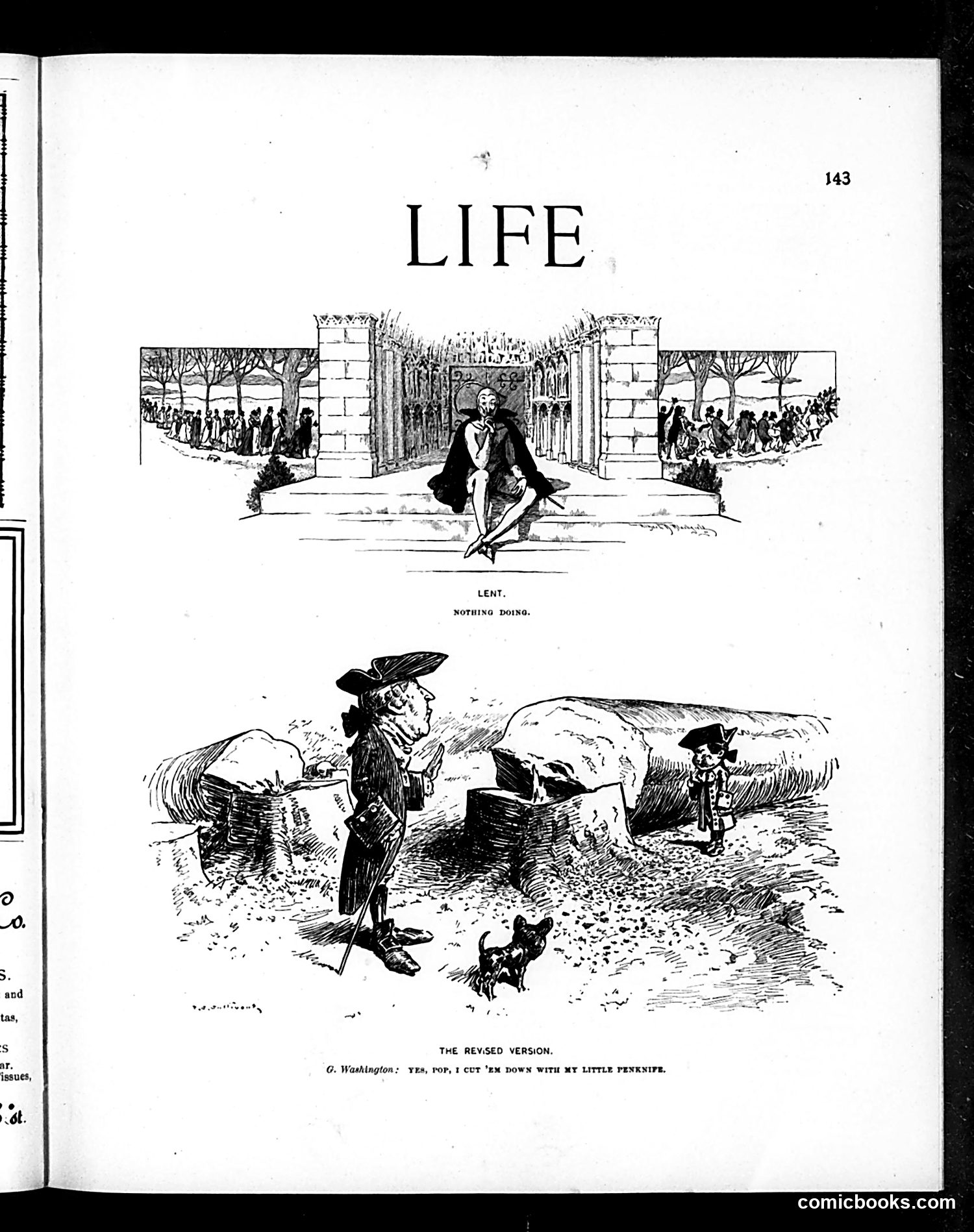
This page presents two contrasting images under the heading "LIFE": **Top image ("Lent. Nothing Doing"):** Shows a formally dressed figure sitting idle outside an ornate gate, with crowds of people visible on either side. This illustrates the Christian observance of Lent—a period of abstinence and reduced activity. **Bottom image ("The Revised Version"):** Depicts a man in 18th-century clothing (possibly representing George Washington, given the caption mentions "G. Washington") actively digging/working alongside others. The caption reads: "YES, POP, I CUT 'EM DOWN WITH MY LITTLE PENKNIFE." The satire contrasts religious Lent observance with American industriousness. The "revised version" suggests Americans replace idle religious contemplation with productive labor—a commentary on American pragmatism versus Old World piety. The specific historical reference remains unclear without additional context.
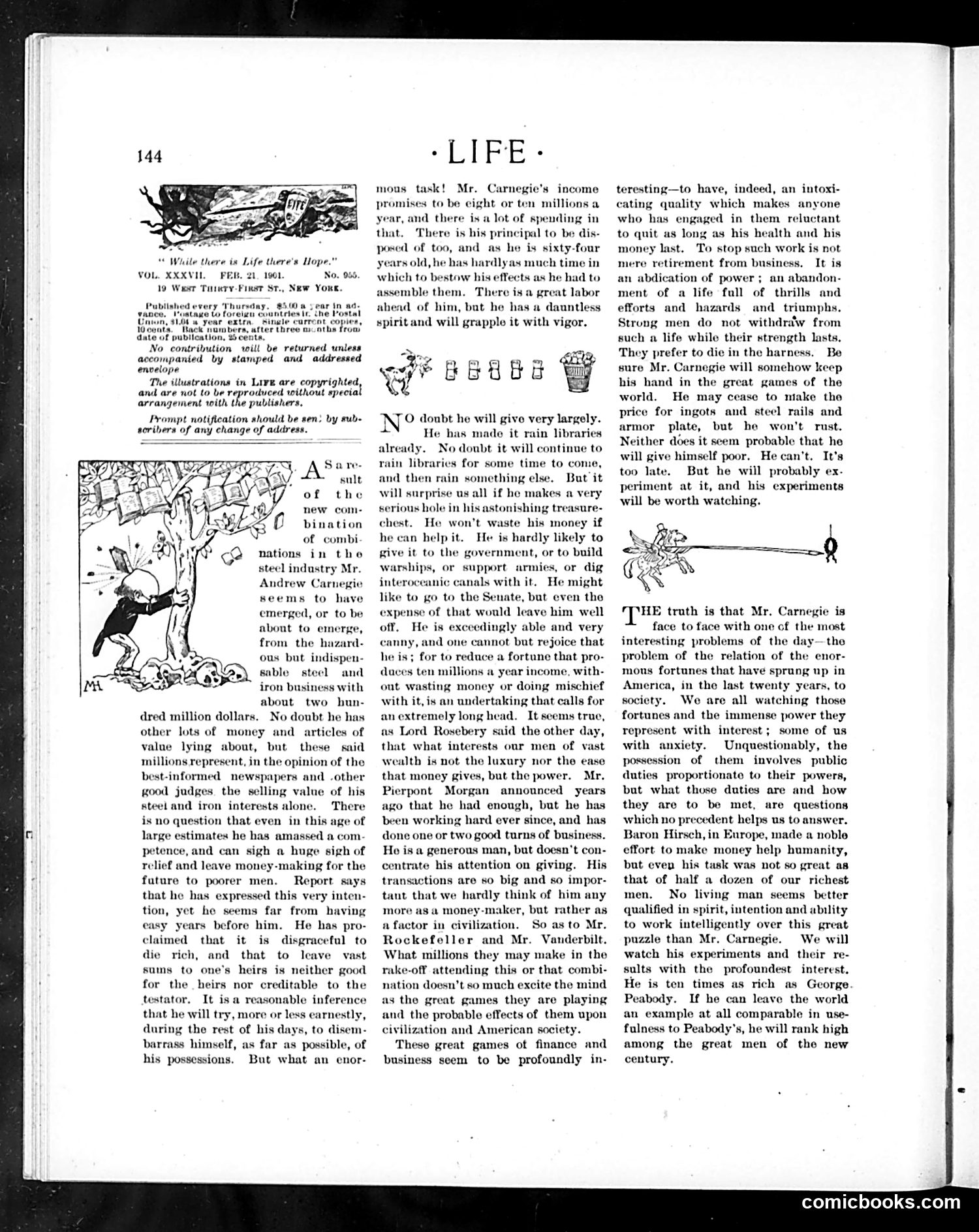
This page satirizes **Andrew Carnegie**, the steel magnate, and his massive wealth accumulation. The text debates what Carnegie should do with his fortune—estimated at "eight or ten millions a year." The cartoons (though small and somewhat unclear) appear to depict Carnegie in various scenarios related to his wealth and philanthropy. The article discusses whether he'll donate to libraries (which he famously did), support the government, or invest in industry. The satire centers on the tension between Carnegie's power as an industrial titan and society's expectation that such extreme wealth carries social obligation. The piece questions whether his charitable impulses will genuinely benefit civilization or merely serve his own interests—a debate about robber barons' responsibility that remains relevant today.
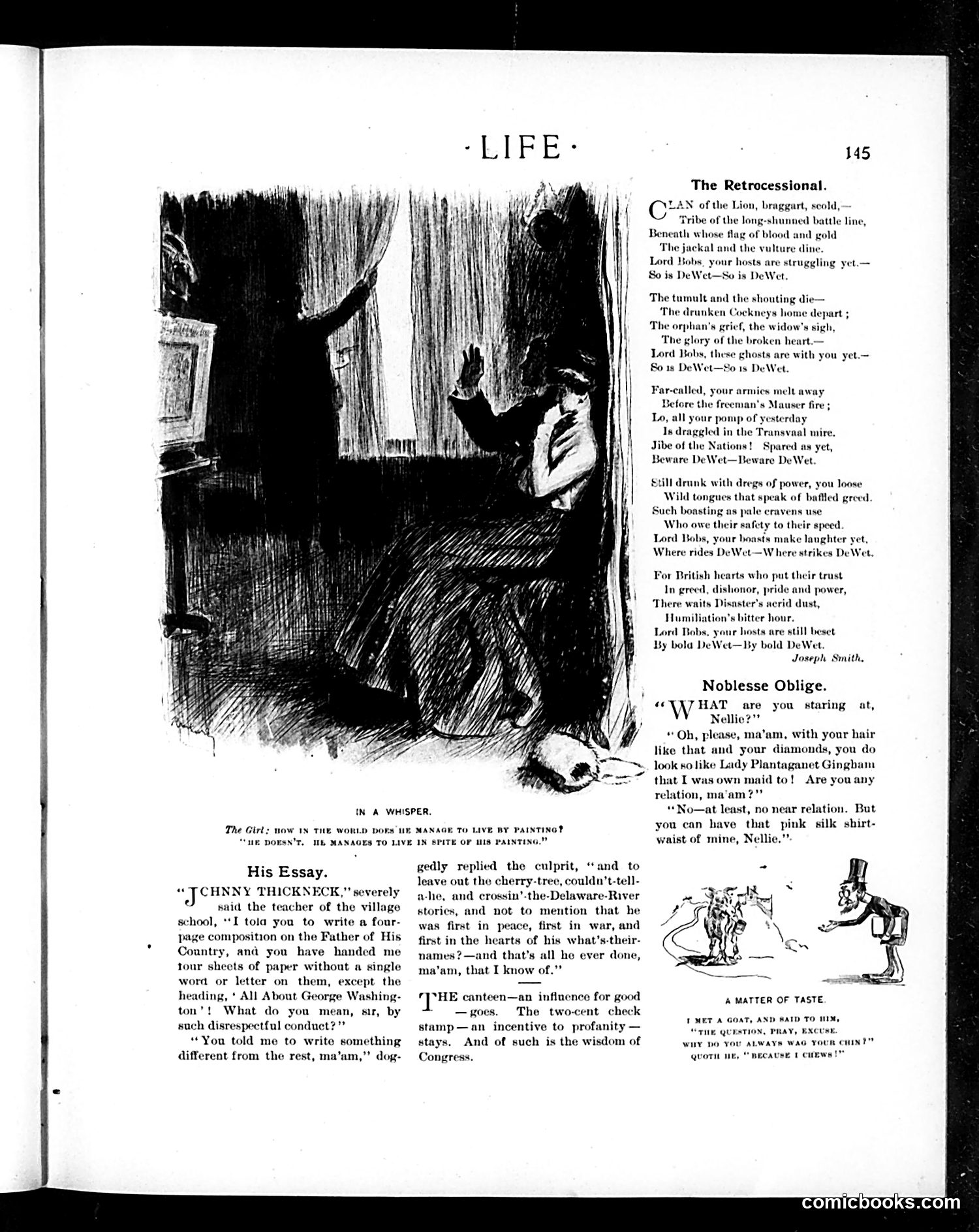
The page contains three distinct sections: 1. **"The Recessional"** — A poem by Joseph Smith addressing British military forces, referencing "Lord Hobs" (likely Lord Roberts, a British general). It mocks soldiers for celebrating despite military setbacks, repeatedly stating "So is DeWet—So is DeWet," referencing Boer general Christiaan De Wet. The poem appears satirical commentary on the ongoing Boer War. 2. **"His Essay"** — A humorous dialogue where a teacher criticizes a student ("Johnny Thickskull") for writing about George Washington instead of assigned topics, mocking the student's resistance to instruction. 3. **"Noblesse Oblige"** — A brief satirical exchange about social pretension and wealth. The illustrations are period sketches. This page satirizes both military overconfidence during the Boer War and educational pomposity, typical of Life's turn-of-century humor.
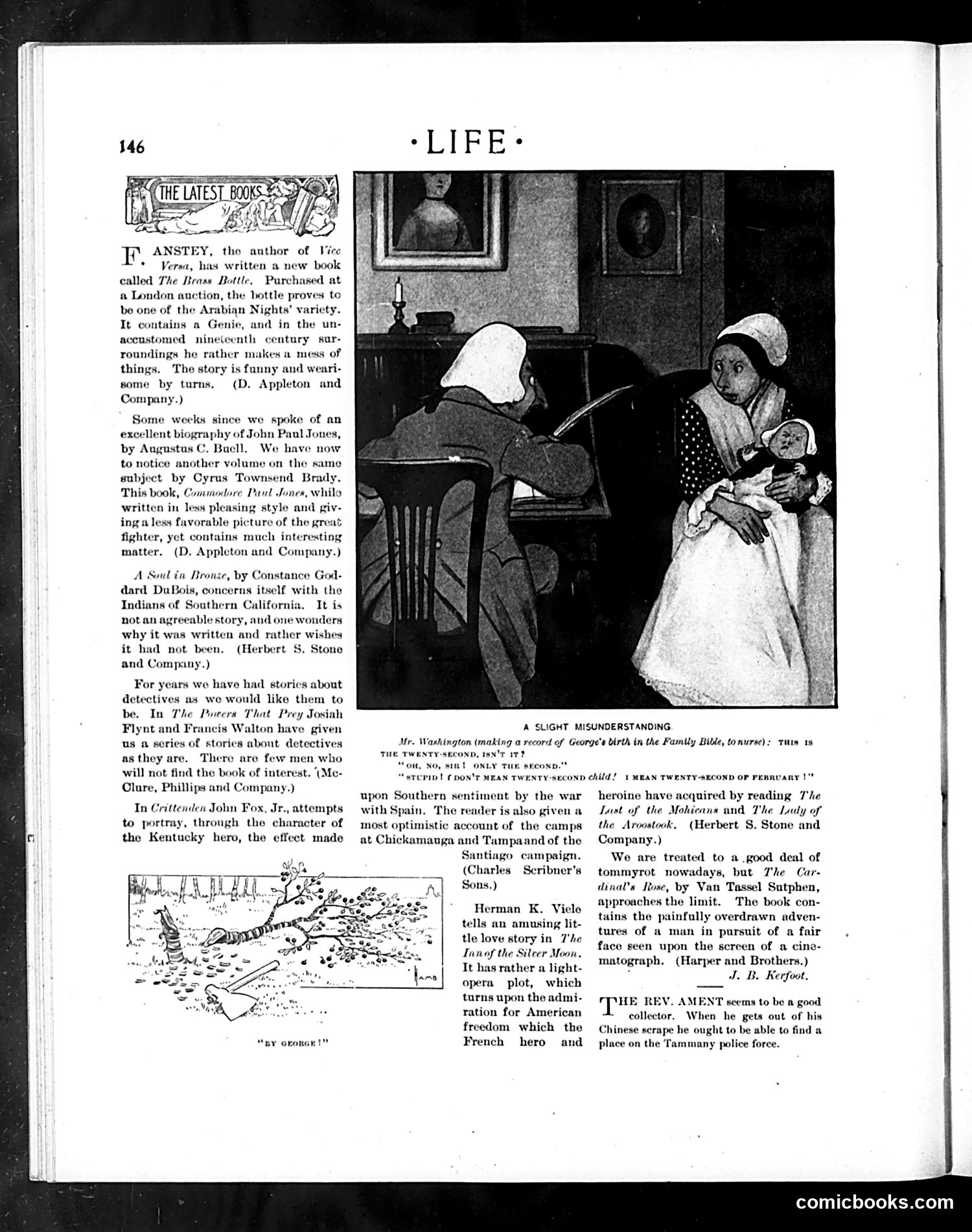
This page reviews new books, featuring a domestic scene cartoon titled "A Slight Misunderstanding." The image shows a woman at a desk recording information while a man holds a baby, with the caption referencing "George's birth in the Family Bible" and a dialogue about whether this is the "twenty-second child" or only the "second." The satire targets rapid population growth and large families, likely referencing early 20th-century concerns about birth rates. The humor derives from the couple's apparent confusion over whether they have 2 or 22 children—exaggerating anxieties about uncontrolled family size during an era of significant demographic change in America. The accompanying illustration at bottom left, labeled "By George!!" appears unrelated to this narrative.
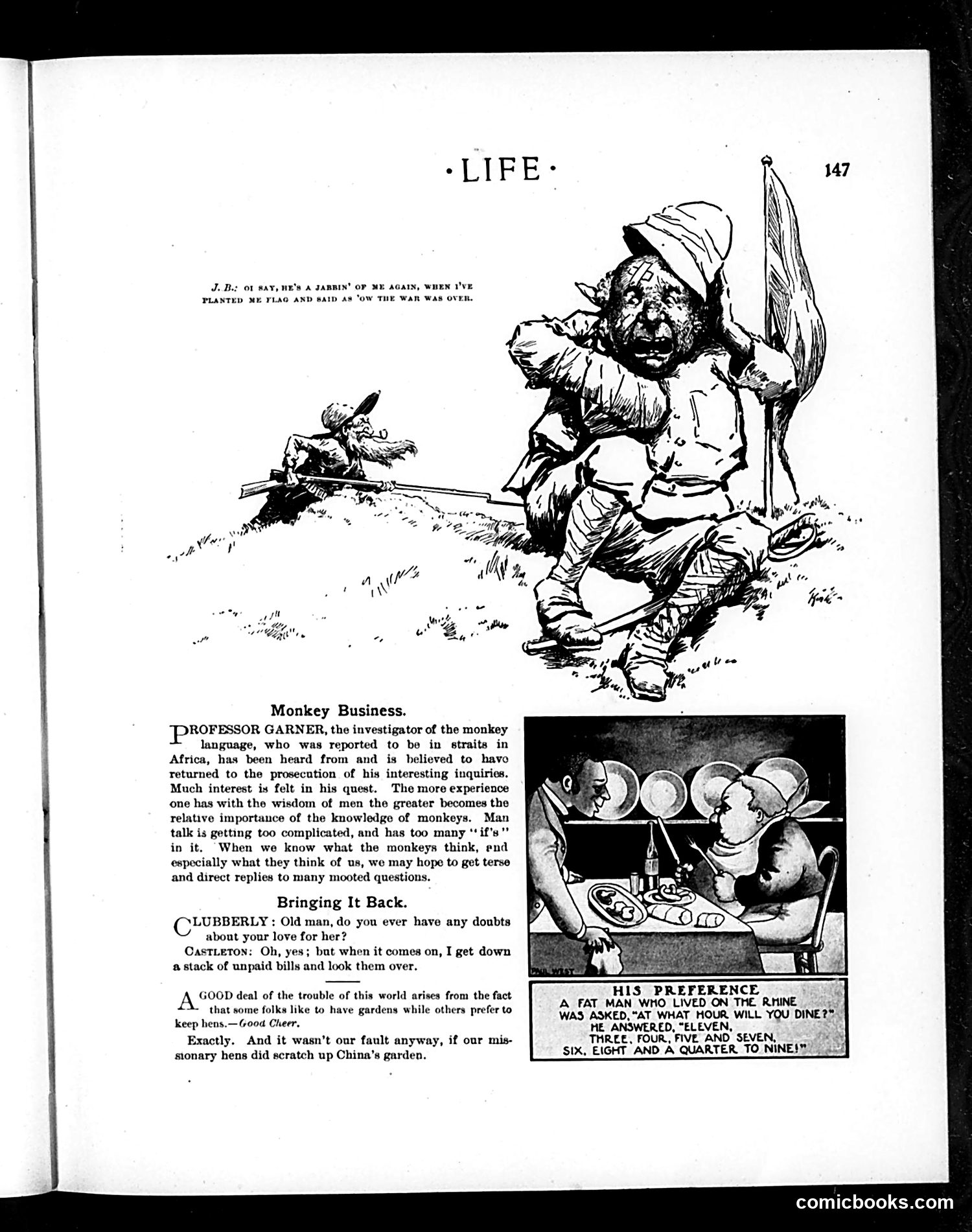
This page contains satirical commentary on early 20th-century social topics: **Top Cartoon**: A soldier with a flag confronts a smaller figure (likely a politician or military official), with text about planting flags after war's end—satirizing post-war territorial claims or political opportunism. **"Monkey Business" Section**: Reports on Professor Garner's research into monkey language in Africa, with commentary suggesting humans should learn from animals' simpler communication to avoid complicated discourse. **"Bringing It Back" Dialogue**: A humorous exchange between "Clubbery" and "Castletons" about garden damage, satirizing wealthy class disputes over property damage—likely referencing real social tensions between estates. **"His Preference" Comic**: A joke about dining preferences, showing class-based humor about eating schedules. The page uses satire to mock post-war politics, scientific pretension, and upper-class concerns.
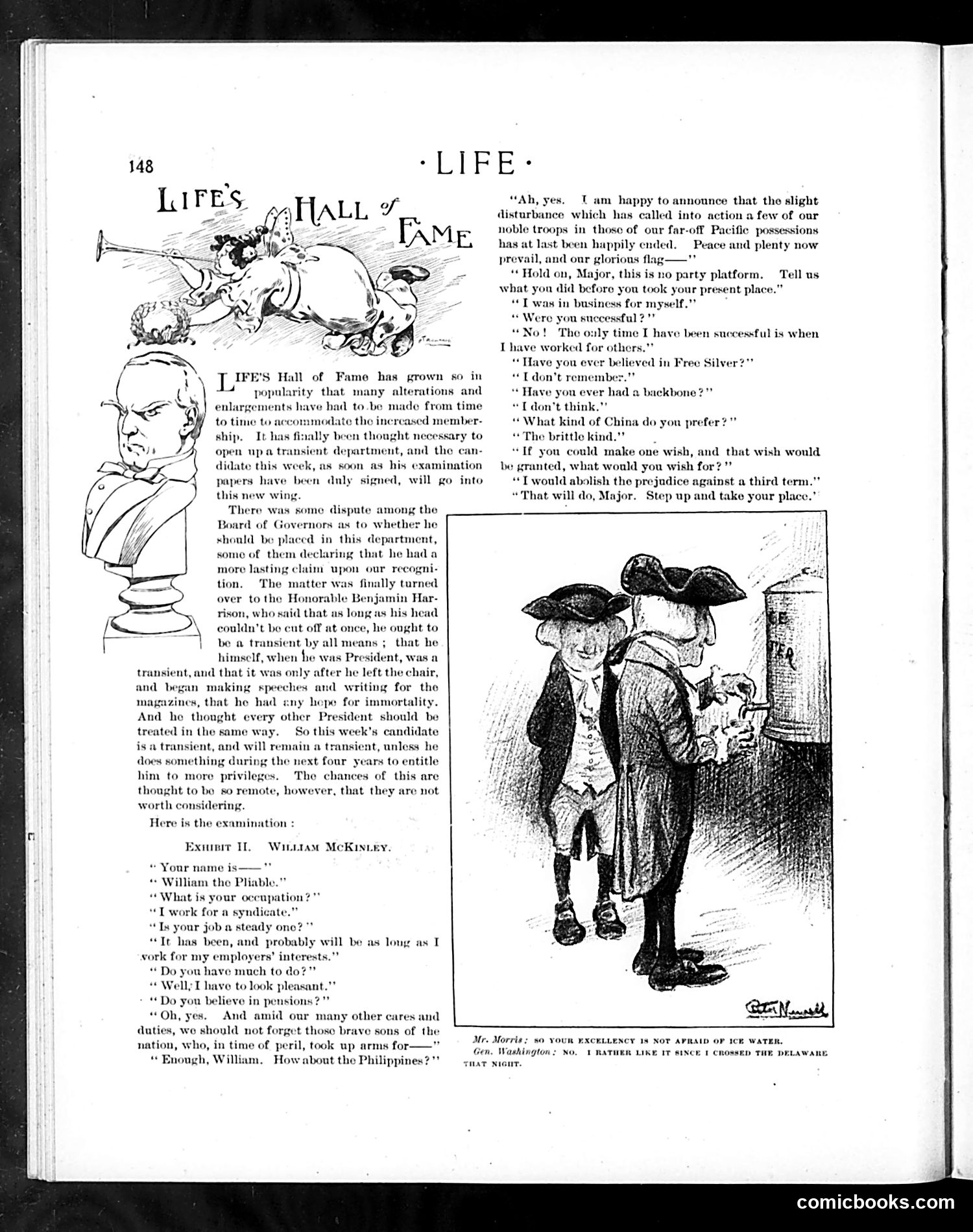
This satirical page features William McKinley's examination for entry into Life's "Hall of Fame." The bust portrait on the left represents McKinley, the sitting U.S. President (suggesting this dates to his administration, 1897-1901). The accompanying dialogue mocks McKinley through questions about his work for "syndicates" and his appearance ("I have to look pleasant"). The satire suggests his devotion to business interests over presidential duties. The right-side cartoon depicts two figures (appearing to be politicians or diplomats) discussing the Philippines—referencing American imperial expansion following the Spanish-American War. The caption's joke about "crossing the Delaware" invokes George Washington, implying McKinley's actions lack patriotic legitimacy. Overall, the page critiques McKinley's presidency as serving corporate interests rather than national principles.
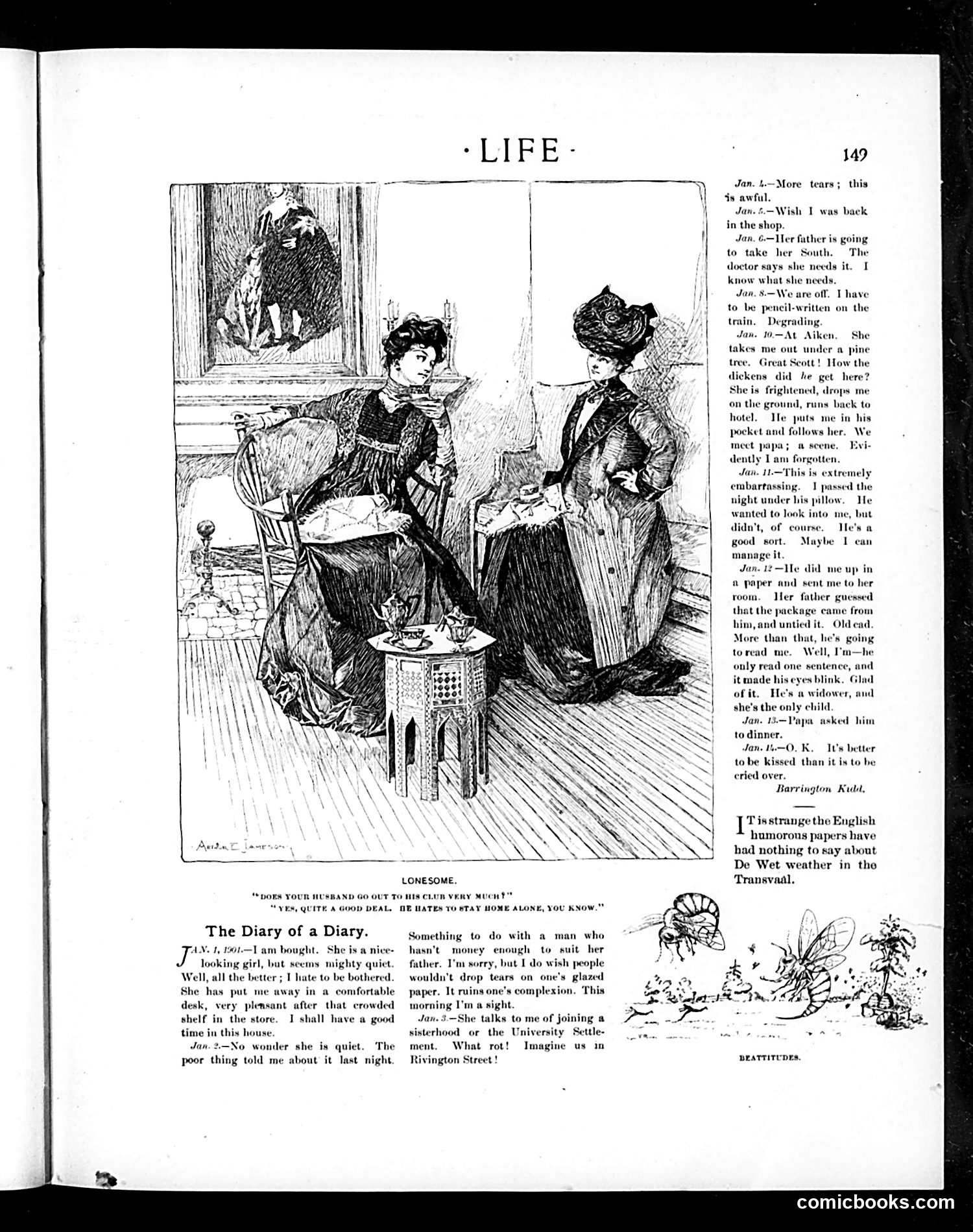
This page contains two distinct pieces: **"Lonesome" Cartoon:** The main illustration depicts two fashionably dressed women in an interior setting. The caption reads: "Does your husband go out to his club very much?" with response "Very often a day. He always comes home along, you know." This satirizes the social convention of men frequenting clubs while leaving wives at home—a commentary on marital separation and gender-based social segregation among the upper class. **"The Diary of a Diary":** A short humor piece criticizing a "nice-looking girl" who complains excessively in her diary. The satire mocks both the diary-writing habit and women's perceived tendency toward melancholy introspection—typical period humor targeting women's emotional expression as tedious. Both pieces reflect early-20th-century gender dynamics and social class attitudes.
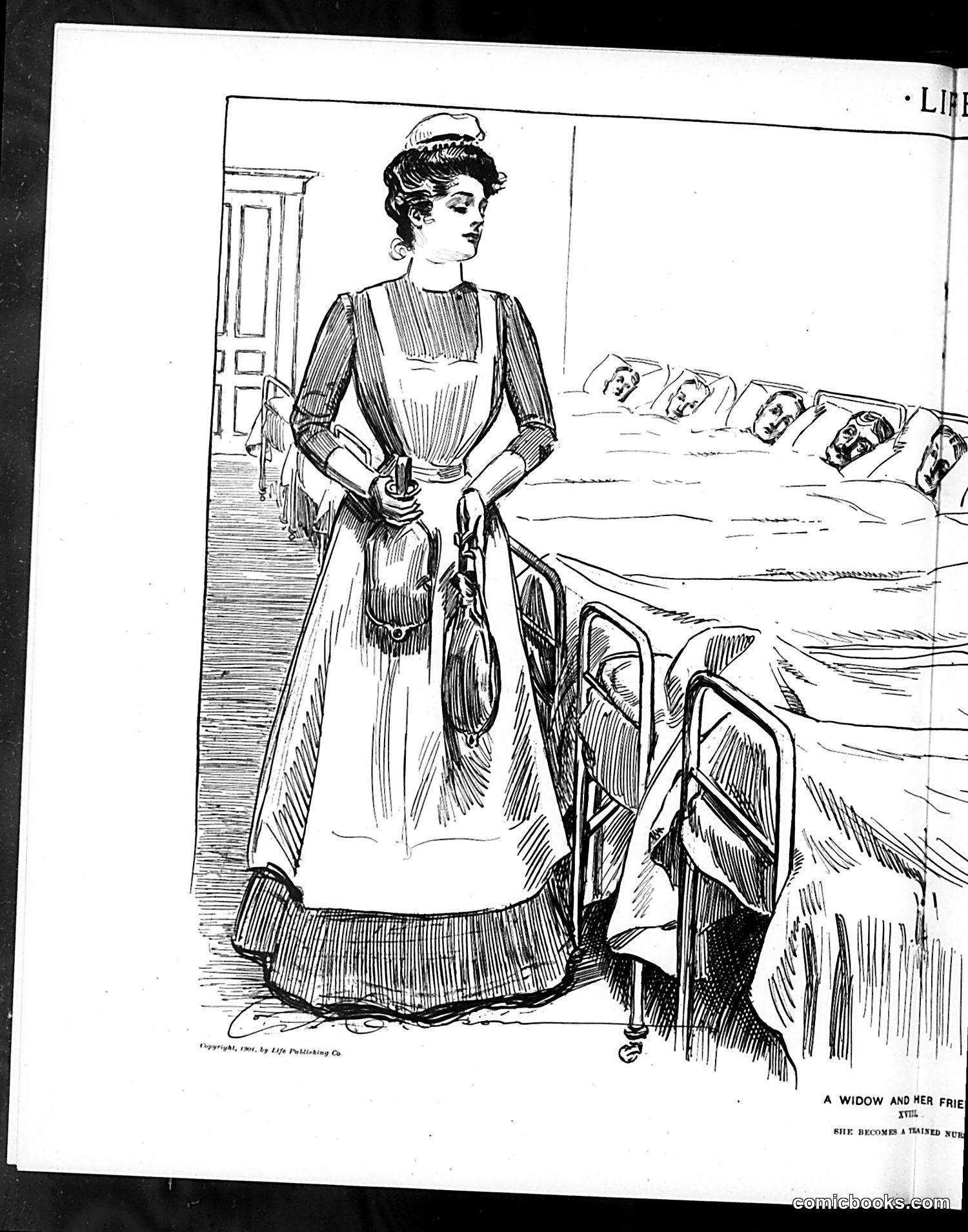
This illustration depicts a woman in Edwardian-era dress standing in a bedroom beside multiple beds. The caption indicates this relates to "A Widow and Her Friends" with subtitle text mentioning "She Becomes a Trained Nurse." The satire appears to target the profession of nursing or perhaps women's roles during this period. The widow, dressed formally with an apron, stands among numerous beds—likely a commentary on either the demands of nursing work or possibly a critique of women entering the profession. The cartoon likely satirizes either the challenges nurses faced, the social awkwardness of the transition, or public attitudes about respectable widows taking employment as trained nurses—a relatively new profession for women at the time. The copyright shows "1901, by Life Publishing Co."
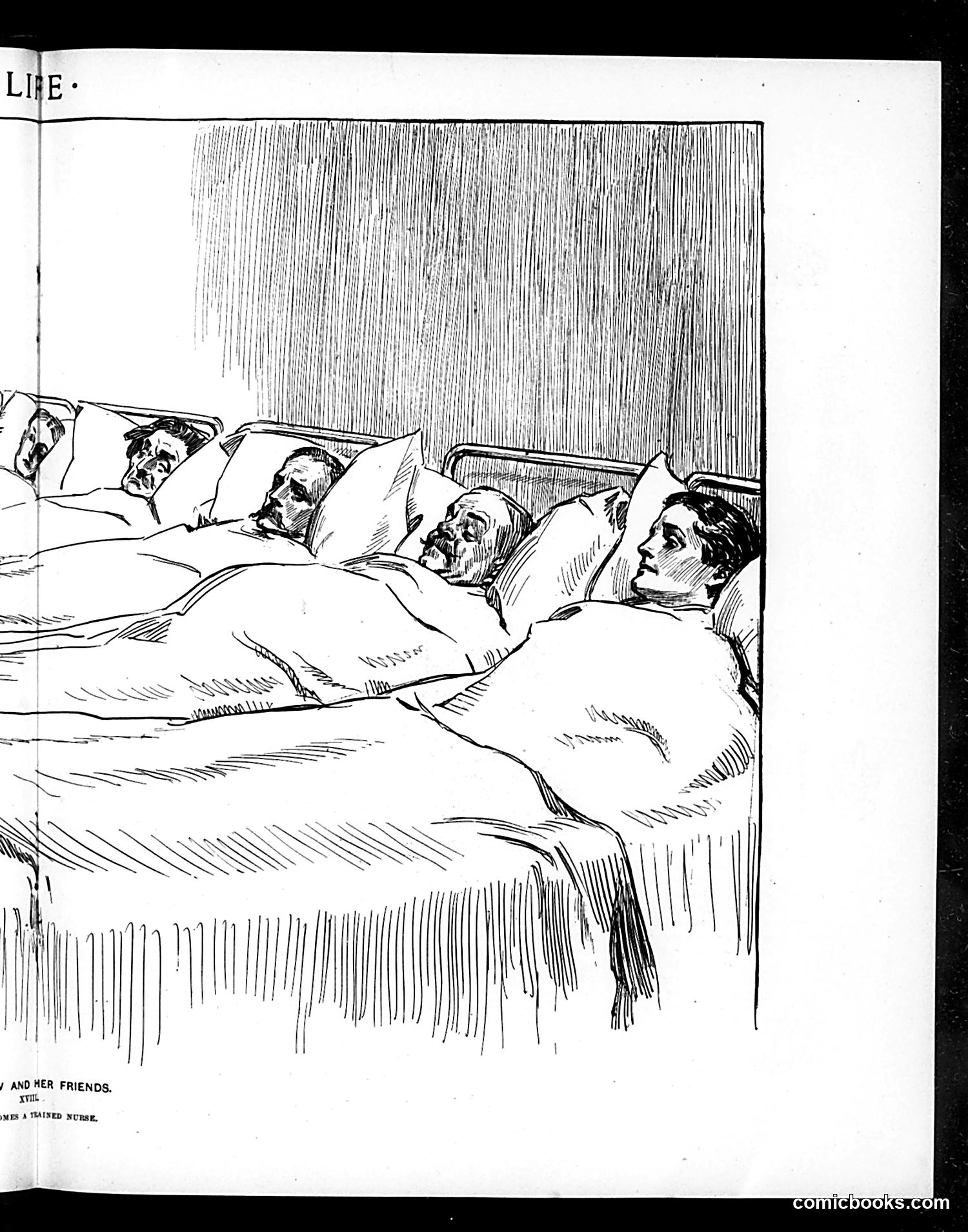
This appears to be a satirical illustration depicting multiple men lying in bed together, likely from an early 20th-century issue of Life magazine. The visible text fragment references "AND HER FRIENDS" and mentions "A TRAINED NURSE," suggesting this may be social commentary about a medical or domestic situation. The cartoon likely satirizes either: - Hospital conditions or crowded medical facilities - Boarding house or communal living arrangements - Possibly commenting on public health or housing issues of the era The exaggerated facial expressions and caricatured features are typical of Life's satirical style. However, **without clearer text or caption visible in the image, I cannot definitively identify the specific figures, political figures being mocked, or the precise social/political reference intended**. The full context is obscured by the page's partial reproduction.
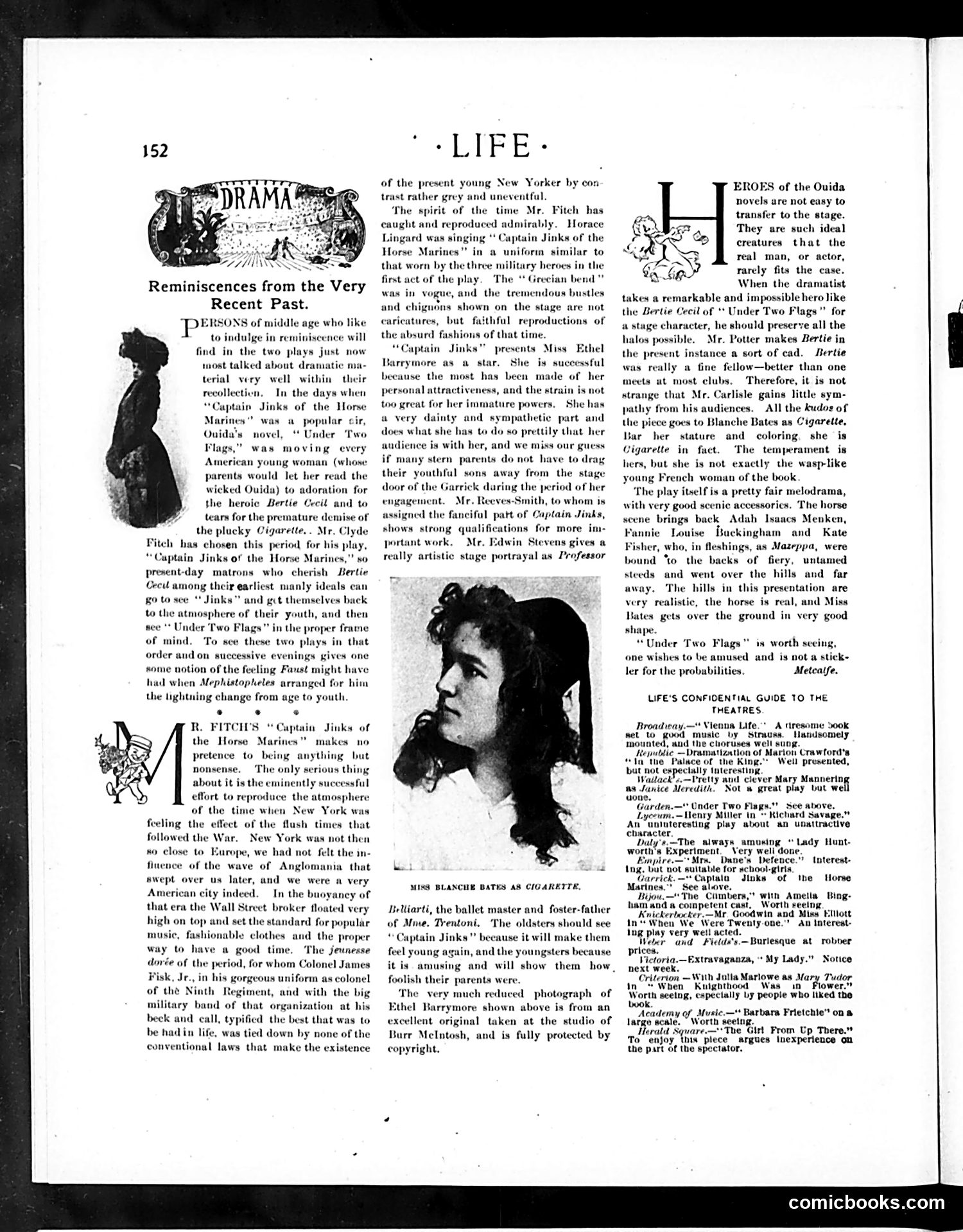
This page contains theatrical reviews rather than political cartoons. The left column discusses "Captain Jinks of the Horse Marines," noting it as a popular Ouida novel adapted for stage. The review praises the production's fidelity to source material while critiquing certain performances. The center features a photograph labeled "Miss Blanche Bates as Cigarette," an actress in character costume. The right column reviews "Under Two Flags," another stage adaptation, praising its scenic realism and horse work while noting the lead actress's performance. The "Life's Conspectus of the Theatres" section provides brief notices of various productions. This appears to be standard theatrical criticism from a late 19th-century publication, without obvious political satire.
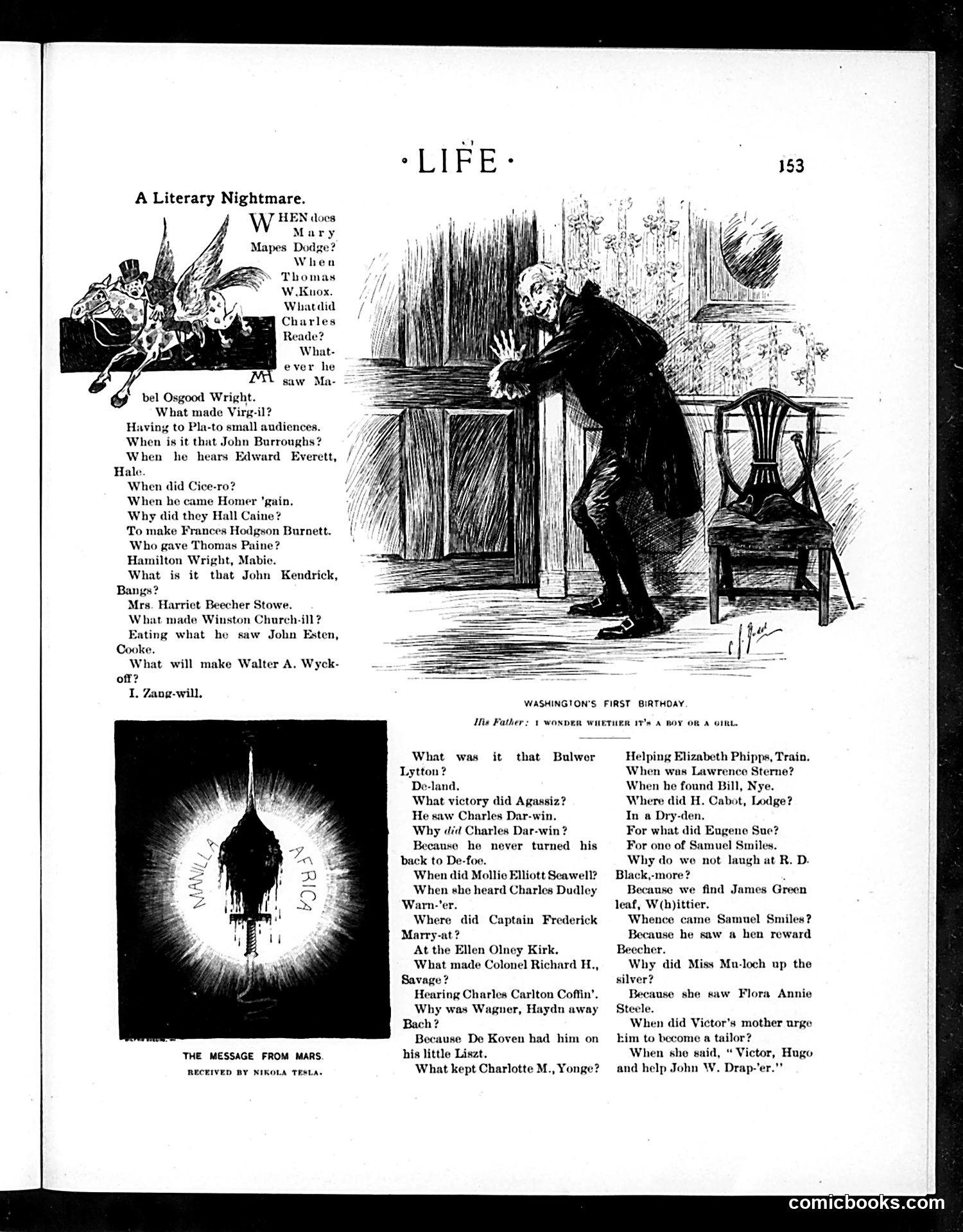
This page presents **literary wordplay riddles** mocking famous 19th-century authors by punning their names with common words and phrases. The joke format: "What made [Author Name]?" answered by homophones or near-homophones. Examples: "What made Winston Church-ill? Eating what he saw John Esten, Cooke" (Churchill/Church + ill; Cooke sounds like "cook"). "When did Cice-ro? When he came Homer 'gain" (Cicero/ice-ro; Homer/come-er). The two illustrations—**"A Literary Nightmare"** (showing winged creatures) and **"The Message from Mars"** (Nikola Tesla receiving signals)—are unrelated to the wordplay section, appearing to be separate satirical content. The page's title references **George Washington's birthday**, suggesting 1880s-1890s publication. The satire targets Victorian-era literary pretension by reducing celebrated authors to cheap puns, mocking both the writers and readers who took them seriously.
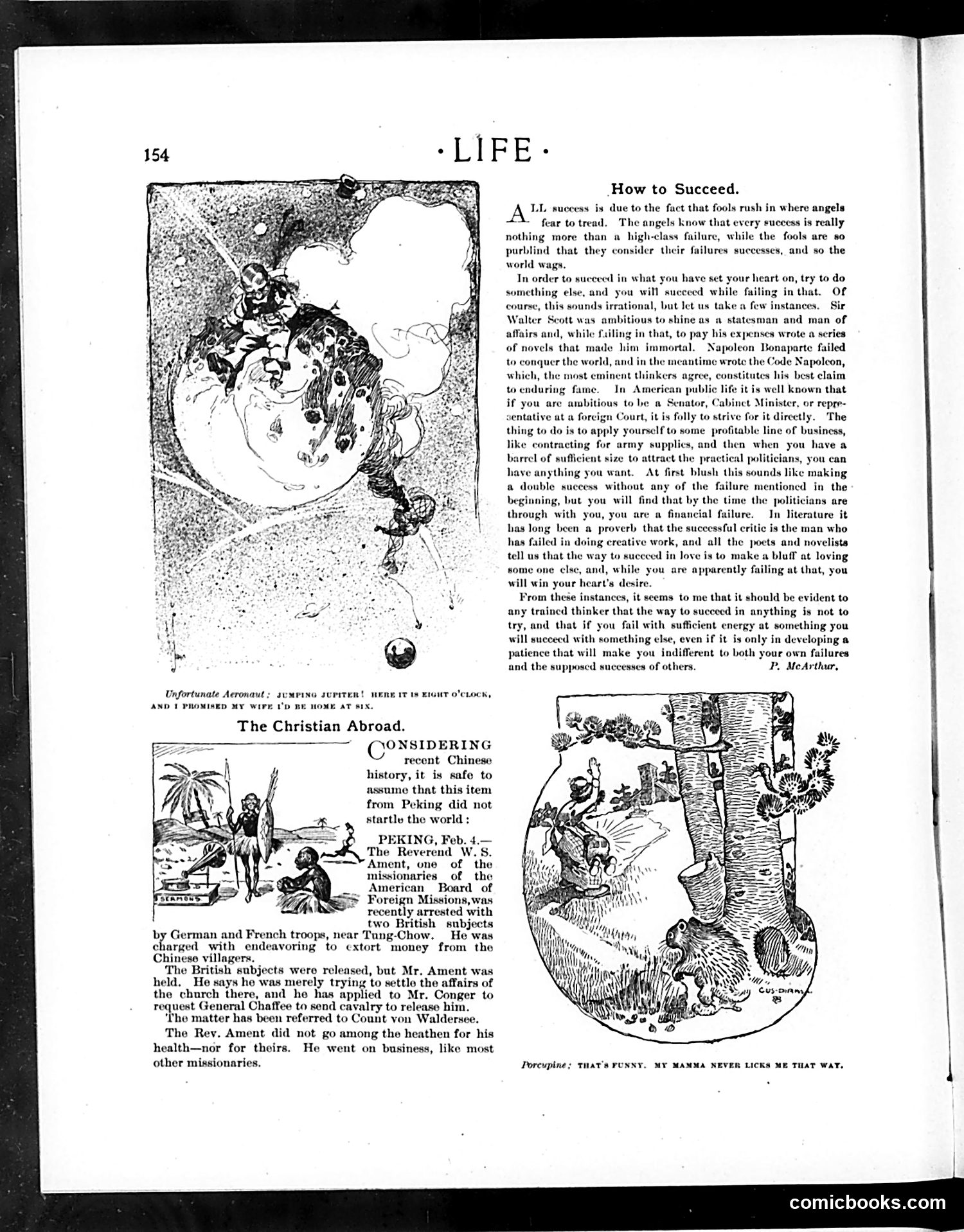
**Top Section ("How to Succeed"):** This is satirical advice essay by P. McArthur. The accompanying illustration shows an aeronaut (hot air balloon operator) who promised his wife he'd be home at six but it's already eight o'clock—he's literally succeeding at flying while failing at keeping his word. The essay's point: success often comes through pursuing *something else* than your stated goal. Examples include Sir Walter Scott becoming famous as a novelist while failing as a statesman, and Napoleon's legal Code outlasting his military conquests. The satire targets American politics specifically: ambitious politicians must first make money through "profitable" ventures (contracts, presumably corrupt) before they can achieve office—thus becoming "financial failures" in the process. **Bottom Section ("The Christian Abroad"):** A brief satirical news item from Peking (Beijing) about Reverend W.S. Ament, arrested for extorting money from Chinese villagers under the guise of missionary work. Life's commentary—"He went on business, like most other missionaries"—sarcastically suggests missionary work was primarily a money-making scheme. The accompanying cartoon shows children being disciplined, with the caption implying the missionary's methods were unnaturally harsh even by contemporary standards.
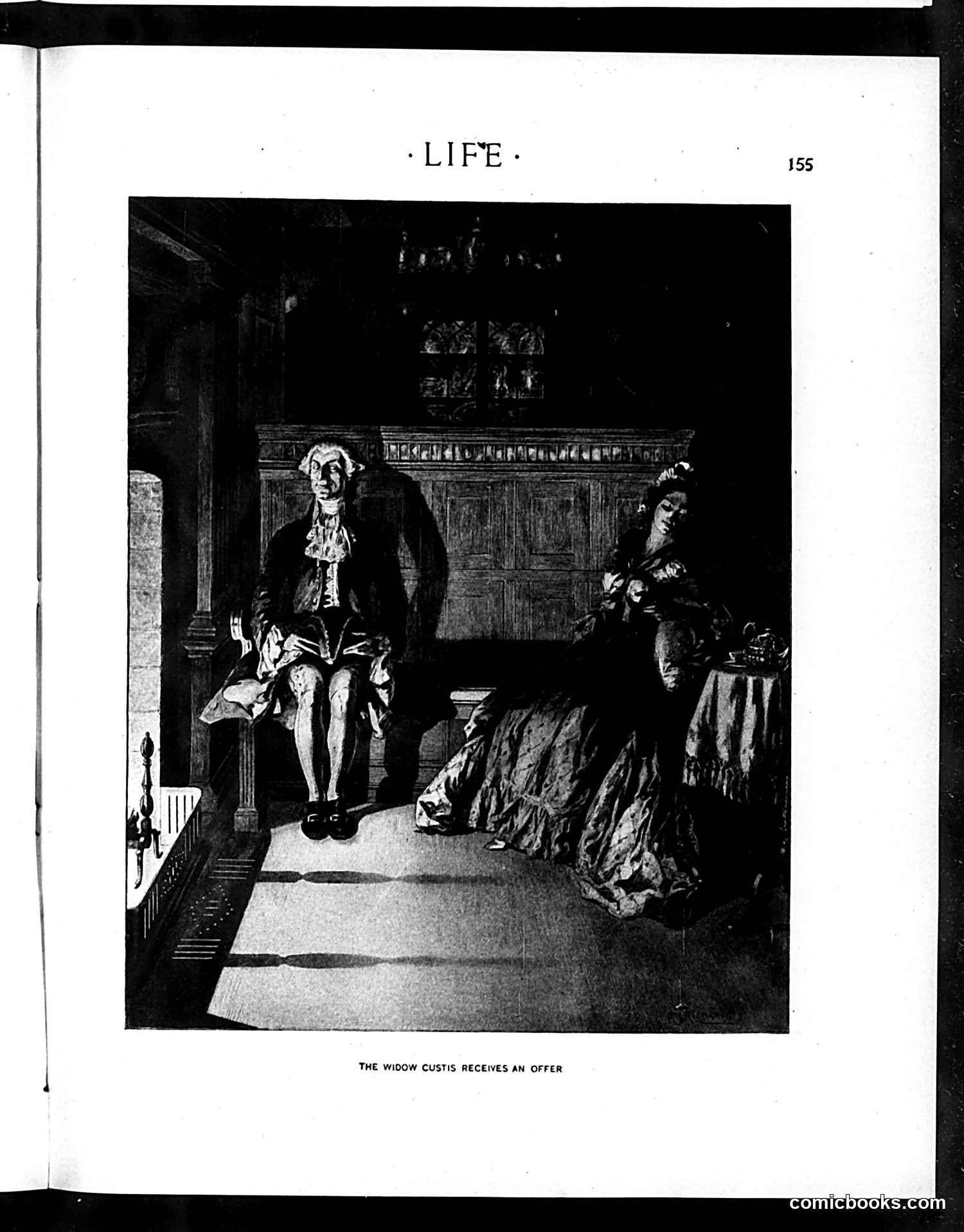
This illustration depicts a scene titled "The Widow Custis Receives an Offer." The image shows a formal 18th-century interior with a well-dressed gentleman making what appears to be a marriage proposal to a widow, while other figures (likely family members or chaperones) observe from the right side of the room. The "Widow Custis" likely refers to Martha Dandridge Custis, who later married George Washington. The cartoon appears to satirize courtship customs of the colonial era, depicting the formal, somewhat stiff social rituals surrounding marriage proposals among the gentry class. The humor likely derives from the theatrical nature of the scene and the social conventions governing such intimate matters in polite society.
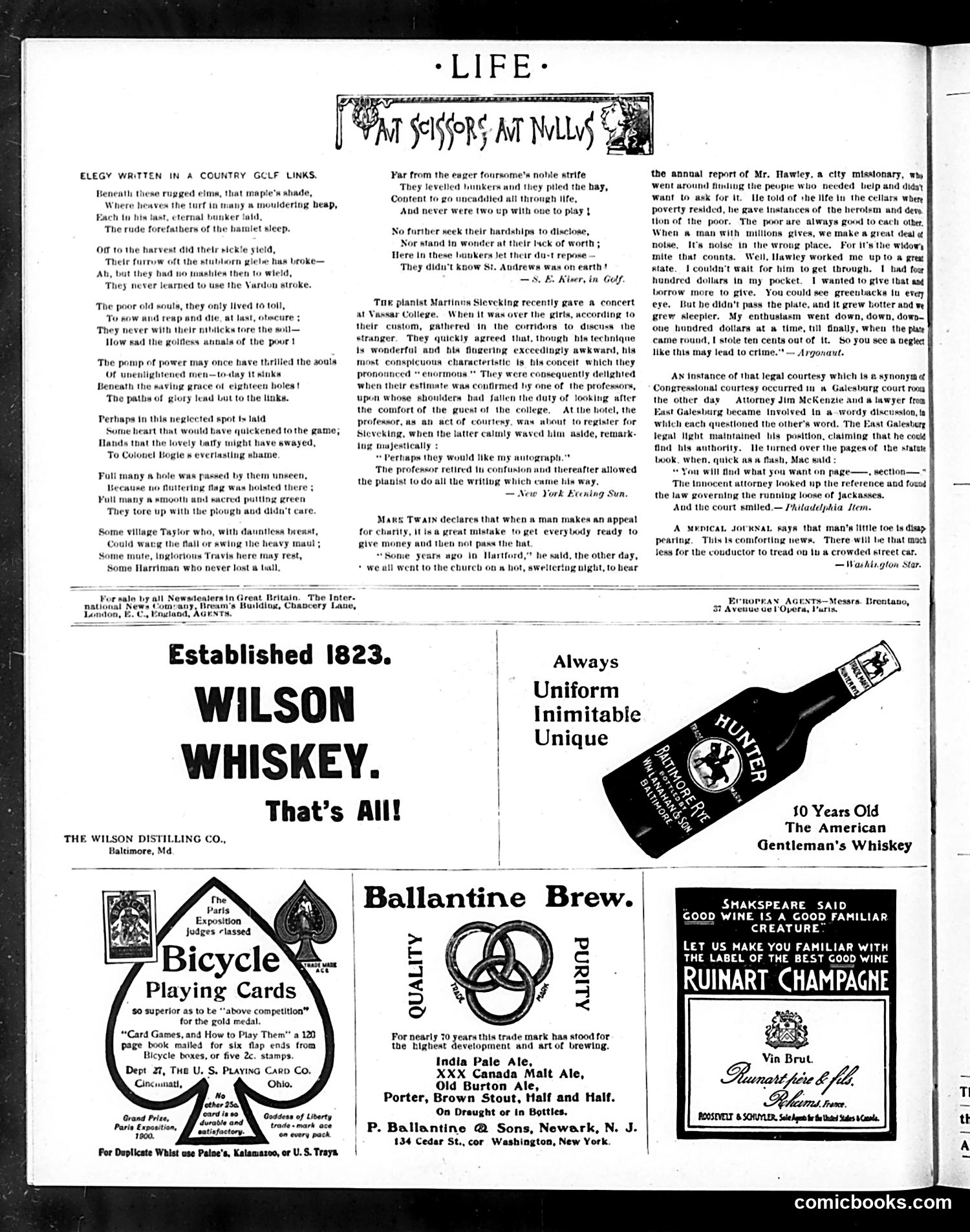
This page is primarily **advertisements and literary content** rather than political cartoons. The main feature is **"Elegy Written in a Country Golf Links,"** a poem satirizing modern golf obsession by contrasting it with rural laborers' historical ignorance of the sport. The satire suggests that peasants who worked the land—who might have excelled at golf—never had the opportunity because golf didn't exist in their time. It's mockery of golf's elevated social status and the era's class divisions. Below that are humorous anecdotes: one about a conceited pianist at Vassar College, and **Mark Twain's story** about a charity appeal where a preacher's emotional sermon motivated the speaker to donate $100, but the delay in passing the collection plate caused his enthusiasm to cool—by the time the hat came around, he contributed only a dime, then stole it back. The joke critiques the impulsiveness of charitable giving. The remainder consists of period **advertisements** for Wilson Whiskey, Bicycle Playing Cards, Ballantine Brew, Hunter Champagne, and other products typical of early 20th-century Life magazine.
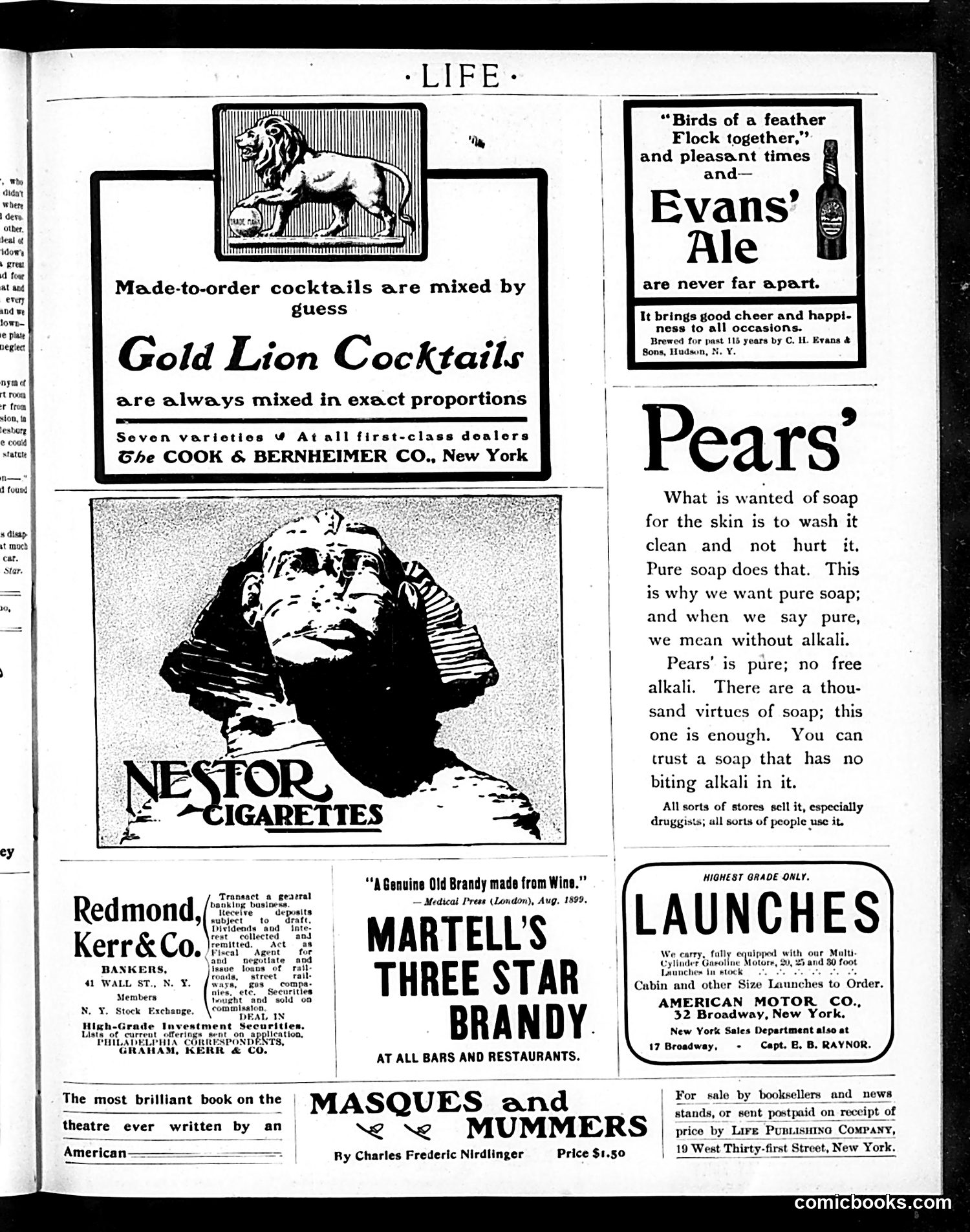
This is primarily an **advertising page** with no political cartoon or satire. It contains period product advertisements from approximately the early 1900s. The page features ads for luxury goods and services: Gold Lion Cocktails (emphasizing consistency), Nestor Cigarettes (with an Egyptian pharaoh image), Evans' Ale, Martell's Three Star Brandy, Pears' Soap, and American Motor Company launches. There's also a banking firm (Redmond, Kerr & Co.) and an advertisement for a theater book by Charles Frederic Nirdlinger. The **Pears' Soap ad** is notable for addressing consumer concerns about alkaline soap damaging skin—a genuine health worry of the era. The Nestor Cigarettes image uses an Egyptian aesthetic, likely appealing to early-1900s fascination with Egyptology. Rather than satire, this page demonstrates Life's business model: selling advertising space to affluent brands targeting the magazine's upscale readership. The ads reflect the consumer goods and leisure interests of wealthy Americans in this period.
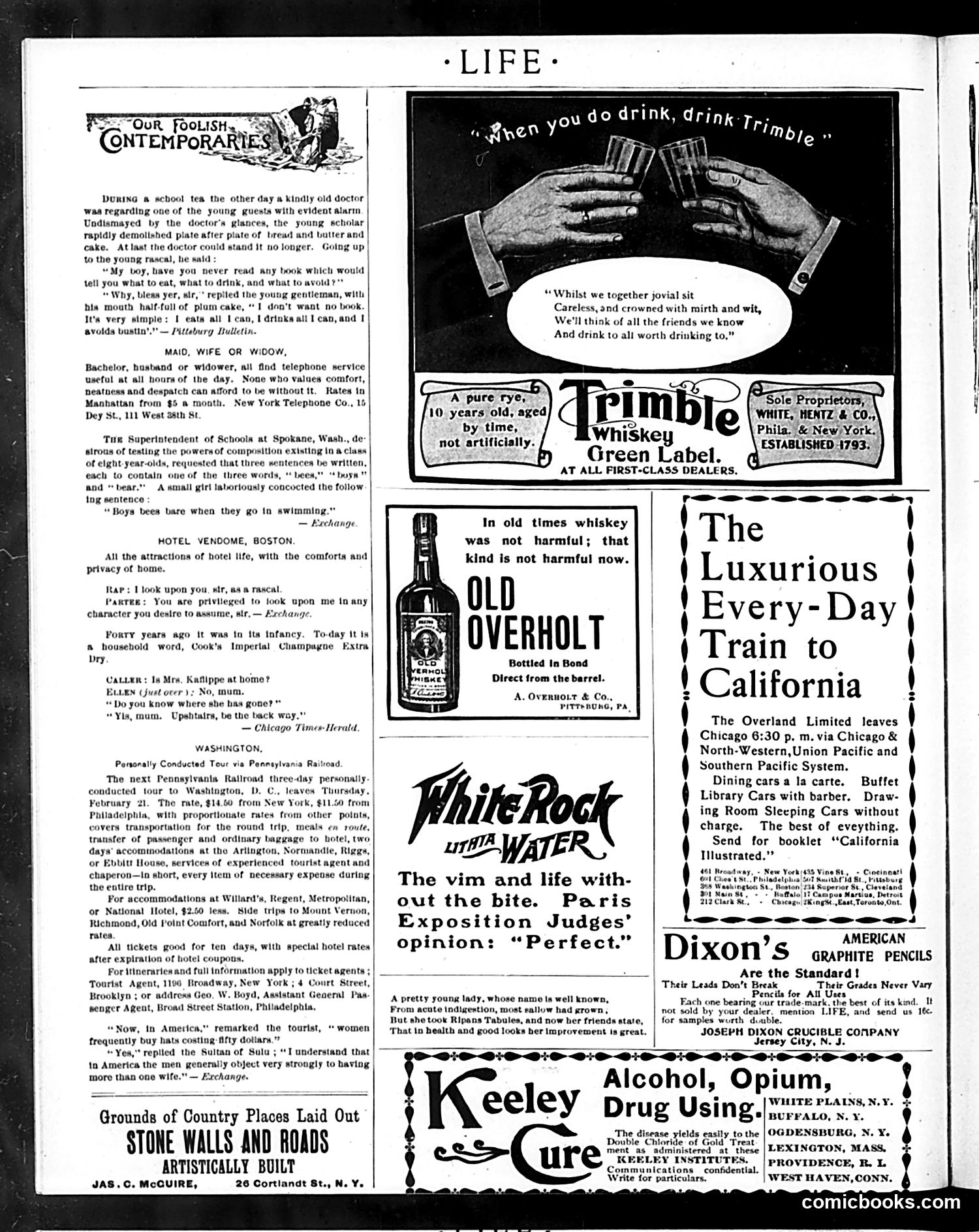
This page mixes humorous anecdotes with period advertisements. The cartoons and text ridicule human folly: **"Our Foolish Contemporaries"** column contains three brief jokes: A schoolboy's crude philosophy ("I eats all I can, drinks all I can"), confused classroom composition ("Boys bees bare"), and a maid's evasive response about her mistress's whereabouts. These lampoon human absurdity and malapropism. **Advertisements dominate the page**, promoting **whiskey products** (Trimble's, Old Overholt), with one claiming whiskey "was not harmful" in "old times" and "is not harmful now"—a transparent rationalization. Dixon's pencils and White Rock water also appear. The **social commentary** reveals early-20th-century attitudes: casual gender stereotyping (bachelor/widow services), elite leisure (Washington tours), and—most notably—**alcohol advertising appearing casually in a satirical magazine**, with manufacturers directly addressing health concerns about drinking. This reflects the pre-Prohibition era (page predates 1920), when such ads faced no restrictions.
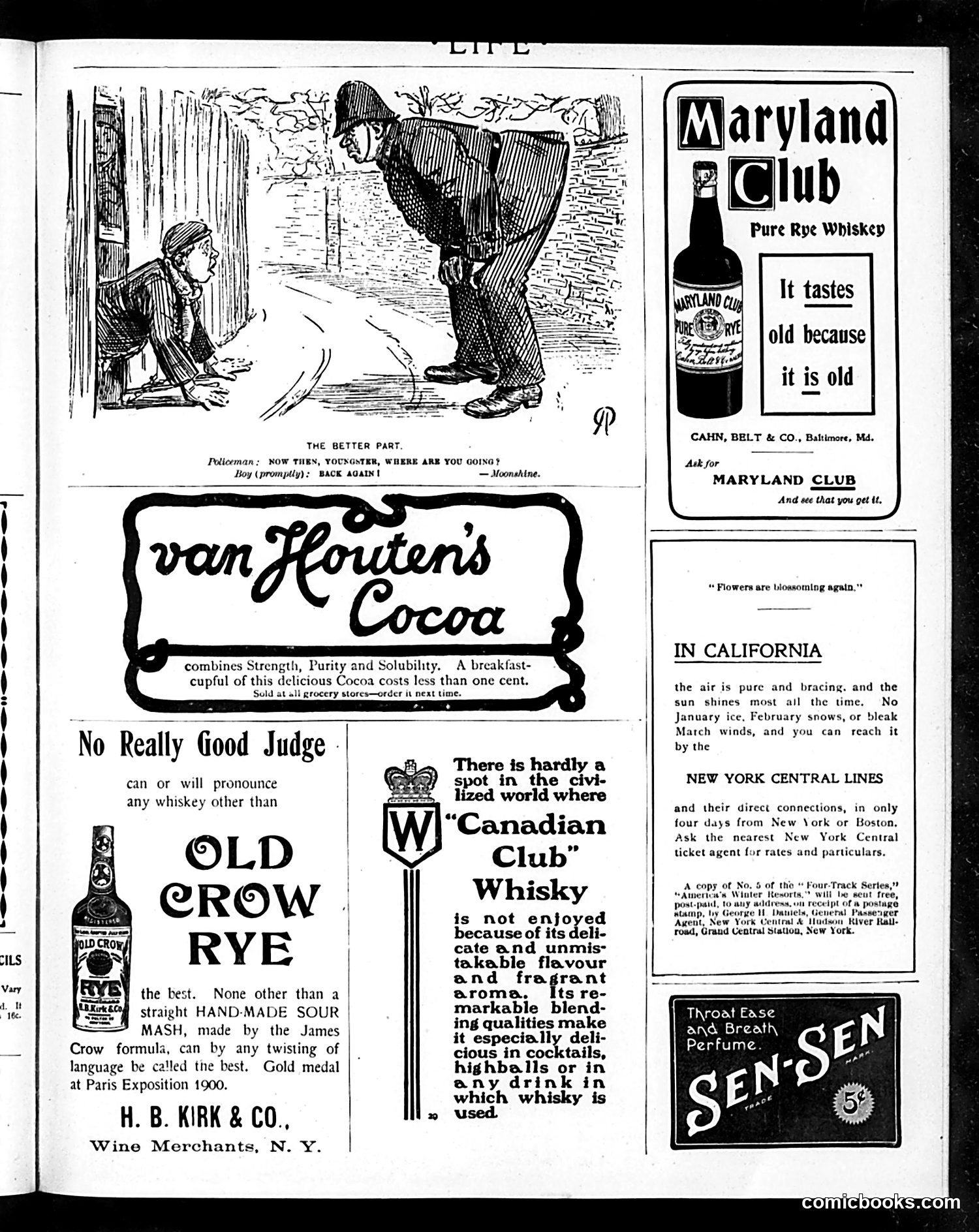
The main cartoon depicts a policeman questioning a young street boy about his whereabouts. The boy promptly replies he's "going back again"—suggesting he's been apprehended before and expects to be arrested again soon. The caption credits "Moonshine" as the cartoonist. This is social satire about juvenile delinquency and recidivism in urban America. The joke's dark humor lies in the boy's resigned acceptance of his criminal fate—he doesn't deny wrongdoing or protest innocence, but matter-of-factly acknowledges the cycle of arrest and return. It reflects Progressive Era anxieties about urban poverty, street children, and the criminal justice system's apparent inability to reform offenders, particularly among the poor. The surrounding page is primarily period advertising for whiskey, cocoa, and railroad travel—typical Life magazine commercial content from this era.
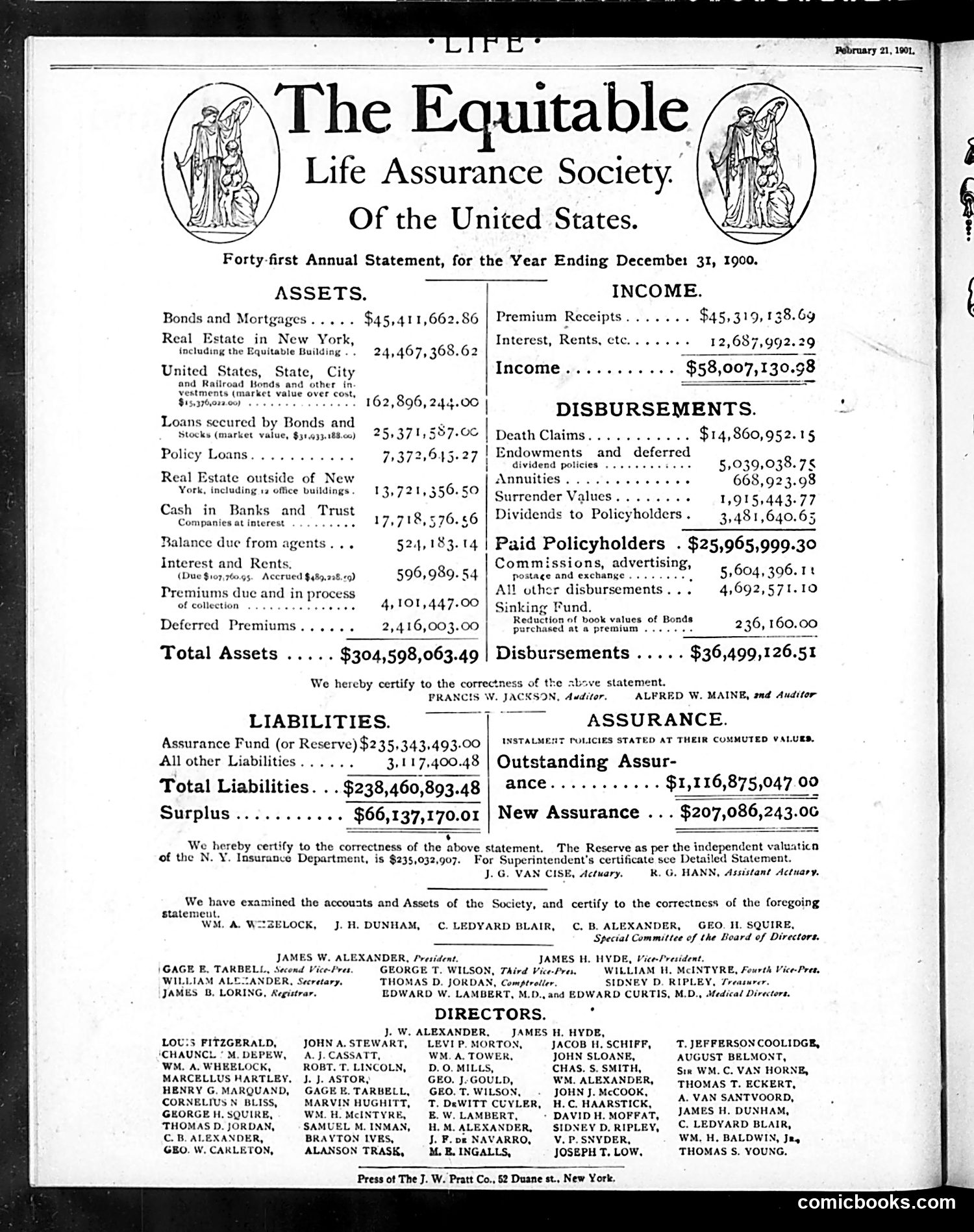
This is not a cartoon page—it's a formal financial document. The page reproduces the Equitable Life Assurance Society's forty-first annual statement, displaying assets of approximately $304 million and listing the company's directors and officers. The document appears in *Life* magazine, likely as both advertisement and public credibility-building. The company was prominent enough (its New York headquarters, the Equitable Building, is listed among assets) that *Life* published its financial statements. What's notable historically: this was published during the Progressive Era, when insurance companies faced increasing scrutiny over reserve practices and investment management. The detailed public disclosure shown here reflects growing demands for corporate transparency, though specific reserve valuations remained contested between state regulators and insurers.