
Life, 1901-02-21 · page 6 of 20
Life — February 21, 1901 — page 6: what you’re looking at
What you’re looking at
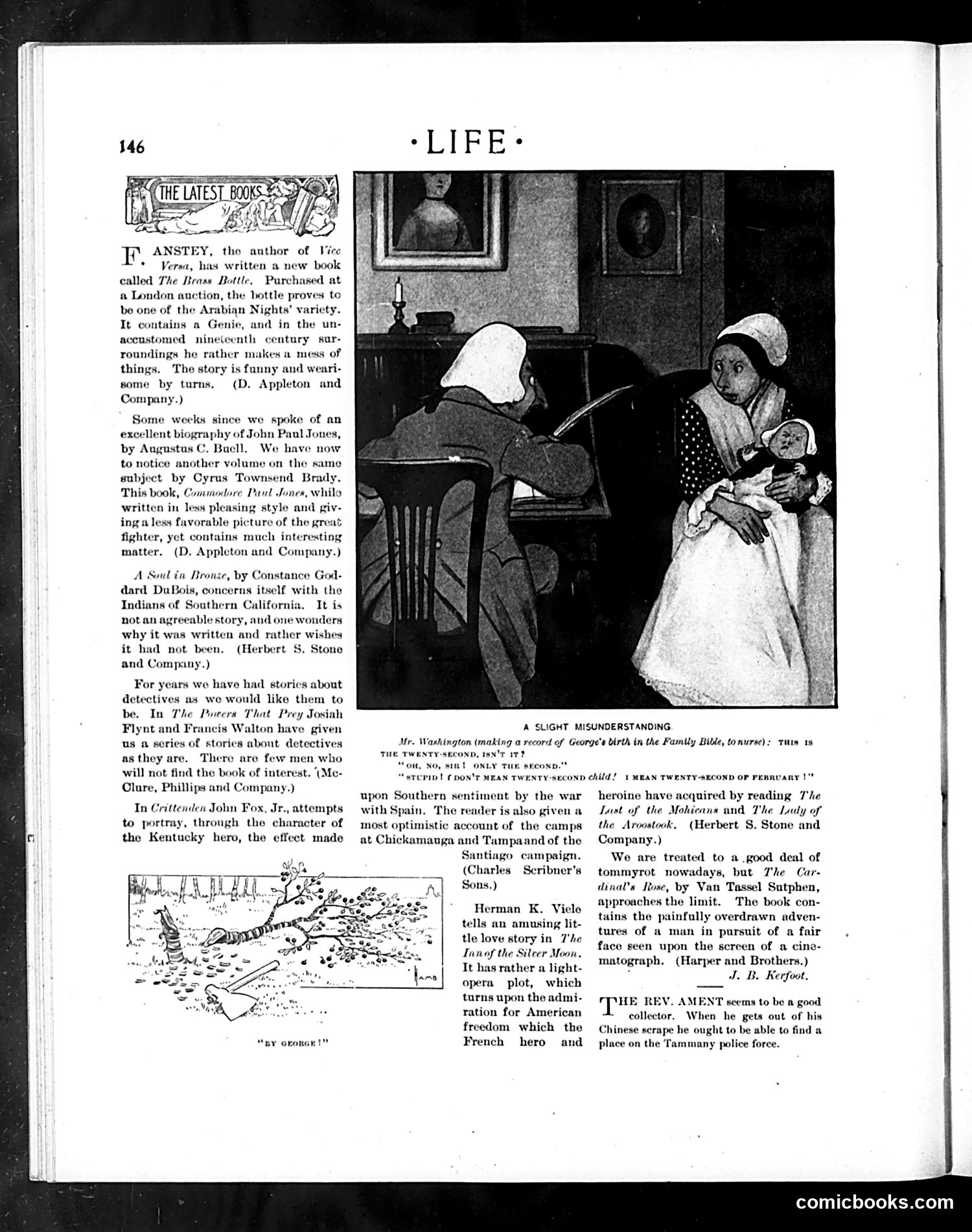
This page reviews new books, featuring a domestic scene cartoon titled "A Slight Misunderstanding." The image shows a woman at a desk recording information while a man holds a baby, with the caption referencing "George's birth in the Family Bible" and a dialogue about whether this is the "twenty-second child" or only the "second." The satire targets rapid population growth and large families, likely referencing early 20th-century concerns about birth rates. The humor derives from the couple's apparent confusion over whether they have 2 or 22 children—exaggerating anxieties about uncontrolled family size during an era of significant demographic change in America. The accompanying illustration at bottom left, labeled "By George!!" appears unrelated to this narrative.
📄 Transcribed text from this page (OCR, searchable)
Machine-transcribed from the original scan — historical spelling and the odd misread are preserved.
EF ANSTEY, the author of Vice * Versa, has written a new book called The Brass Bottle, Purchased at a London auction, the bottle proves to be one of the Arabian Nights’ variety. It contains a Genie, and in the un- accustomed nineteenth century sar- roundings he rather makes a mess of things. The story is fanny and weari- some by turns. (D. Appleton and Company.) Some weeks since we spoke of an excellent biography of John Paul Jones, by Augustus C. Buell, We have now to notice another volume on the same subject by Cyrus Townsend Brady. This book, Commodore Paul Jones, whilo written in less pleasing style and giv- ing a less favorable picture of the g1 fighter, yet contains much interesting matter. (D. Appleton and Company.) A Smlin Bronze, by Constance God- dard DuBois, concerns itself with the Indians of Southern California. It is not an agreeable story, and one wonders why it was written and rather wishes it had not been. (Herbert S. Stone and Company.) For years we have had stories about detectives as wo would like them to be. In The Powers That Prey Josiah Flynt and Francis Walton have given us a series of stories about detectives as they are. There are few men who will not find the book of interest. ‘(Mc- Clure, Phillips and Company.) In Crittenden John Fox, Jr., attempts to portray, through the character of the Kentucky hero, the effect made ‘A SLIGHT MISUNDERSTANDING Mr. Washington (making a record of George's birth in the Family Bible, tomurse): Tun 18 THE TWENTY-SECOND, ISN'T IT? “Ou, No, sin! ONLY THE #RCOND.” “STUPID | (DON'T MEAN TWENTY-SECOND child! 1 MBAN TWENTY-SECOND OP FEBRUARY !* upon Southern sentiment by the war with Spain. The reader is also given a most optimistic account of the camps at Chickamauga and Tampaand of the Santiago mpaign. (Charles Scribner's “py oroncr!” Sons.) Herman K. Viele tells an amusing lit- tle love story in The Tnnof the Sitcer Moon, It has rather a light- opera plot, which turns upon the admi- ration for American freedom which the French hero and heroine have acquired by reading The Last of the Mohicans and The Lady of the Aroostook, (Herbert 8. Stone and Company.) We are treated to a good deal of tommyrot nowadays, but The Car- dinal’s Rose, by Van Tassel Sutphen, approaches the limit. The book con- tains the painfully overdrawn adven- tures of a man in pursuit of a fair face seen upon the sercen of a cine- matograph. (Harper and Brothers.) : J. B. Kerfoot. HE REV. AMENT seems to be a good collector, When he gets out of his Chinese scrape he ought to be able to find a place on the Tammany police force. comicbooks.com