
Life, 1901-02-21 · page 4 of 20
Life — February 21, 1901 — page 4: what you’re looking at
What you’re looking at
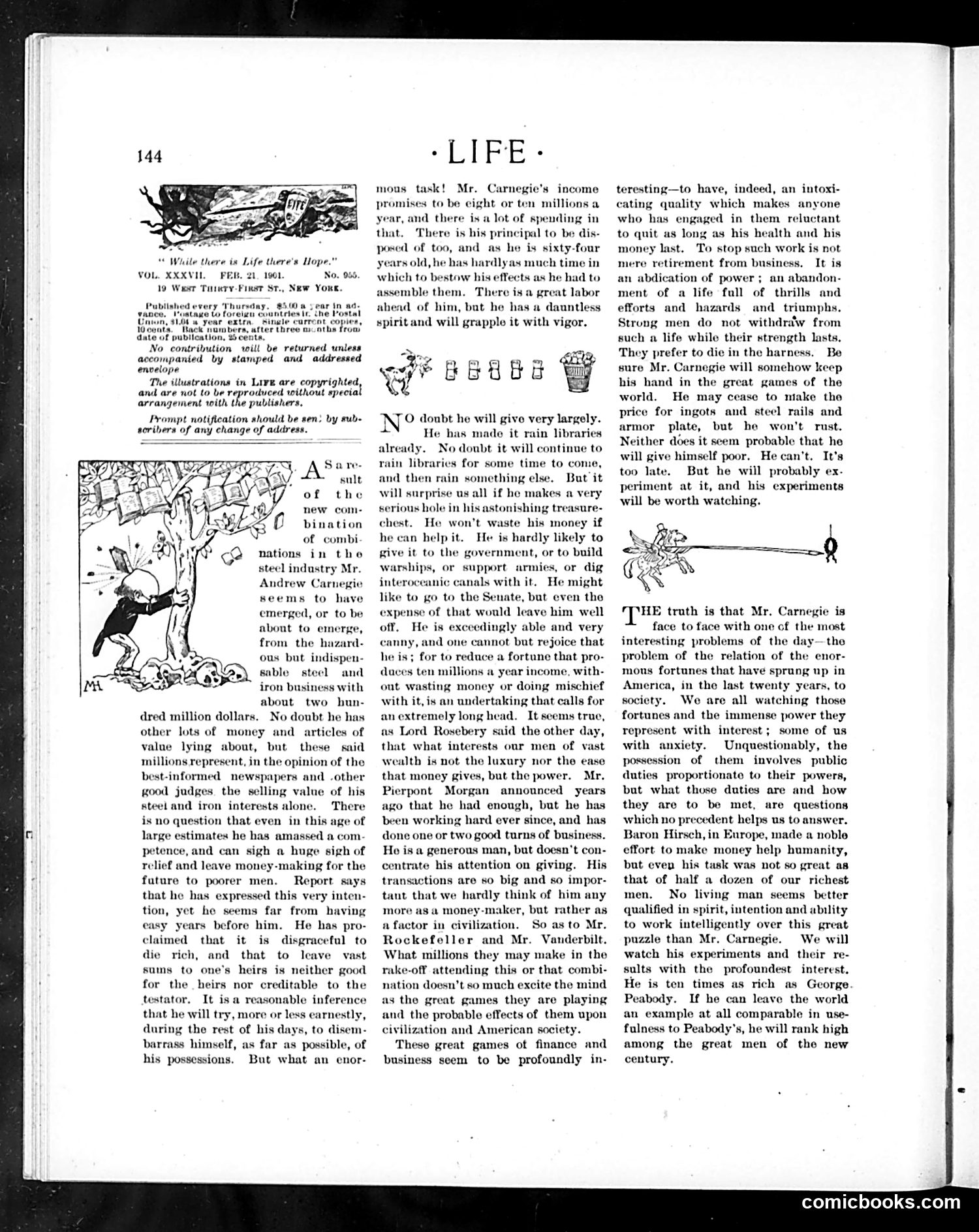
This page satirizes **Andrew Carnegie**, the steel magnate, and his massive wealth accumulation. The text debates what Carnegie should do with his fortune—estimated at "eight or ten millions a year." The cartoons (though small and somewhat unclear) appear to depict Carnegie in various scenarios related to his wealth and philanthropy. The article discusses whether he'll donate to libraries (which he famously did), support the government, or invest in industry. The satire centers on the tension between Carnegie's power as an industrial titan and society's expectation that such extreme wealth carries social obligation. The piece questions whether his charitable impulses will genuinely benefit civilization or merely serve his own interests—a debate about robber barons' responsibility that remains relevant today.
📄 Transcribed text from this page (OCR, searchable)
Machine-transcribed from the original scan — historical spelling and the odd misread are preserved.
VOL. XXXVI PEG. 21. 1901. 19 West Tuiury-Finst St., New Yous. ory Thursday, & » foreign count No contribution will be returned unless accompanted by stamped and addressed envelope The illustrations in Live are copyrighted, anil are not to be reproduced without special arrangement with the publishers. Prompt notification should be xen: by sub- soribers of any change of address. 7, Sare- sult of the new com- bination of combi nations in tho steel industry Mr. Andrew Carnegi seems to hav emerged, or to be about to emerg: from the hazard- ous but indispen- sable steel and iron business with about two hun- dred million dollars. No doubt he has other lots of money and articles of value lying about, but these said millions represent, in the opinion of the best-informed newspapers and .other good judges. the selling value of his steel and iron interests alone. There is no question that even in this age of large estimates he has amassed a com- petence, and can sigh a huge sigh of relief and leave money-making for the future to poorer men. Report says that he has expressed this very inten- tion, yet he seems far from having easy years before him. He has pro- claimed that it is disgraceful to die rich, and that to leave vast sums to one’s heirs is neither good for the heirs nor creditable to the testator. It isa reasonable inference that he will try, more or less earnestly, during the rest of his days, to disem- barrass himself, far as possible, of his possessions. But what an enor- ox Vey. -LIFE- mous task! Mr. promises to be ¢ Carnegi income ight or ten millions a year, and there isa lot of spending in that. There is his principal to be dis- posed of too, and as he is sixty-four ars old, he has hardlyas much time in which to bestow his effects as he had to assemble them. There is a great labor ahead of him, but he a dauntless spiritand will grapple it with vigor. 2 Bz a Sy wre NJ O doubt he will give very largely. = He has made it rain libraries already. No doubt it will continue to rain libraries for some time to come, and then rain something else. But it surprise us all if he makes a very serious hole in his astonishing treasure- chest. He won’t waste his money if he can help it. He is hardly likely to give it to the government, or to build rships, or support armies, or dig interoc “anals with it. He might like to go to the Senate, but even the expense of that would leave him well off. He is exceedingly able and very ny, and one cannot but rejoice that he is; for to reduce a fortune that pro- daves ten millions a year income, with- out wasting money or doing mischief with it, is an undertaking that calls for an extremely long head. It seems true, asx Lord Rosebery said the other day, that what interests our men of vast wealth is not the luxury nor the ease that money gives, but the power. Mr. Pierpont Morgan announced years ago that he had enough, but he has been working hard ever since, and has done one or two good turns of business. Ho is a generous man, but doesn't con- centrate his attention on giving. His transactions are so big and so impor- tant that we hardly think of him any more as a money-maker, but rather as a factor in civilization. So as to Mr. Rockefeller and Mr. Vanderbilt. What millions they may make in the rake-off attending this or that combi- nation doesn’t so much excite the mind as the great games they are playing and the probable effects of them upon civilization and American society. These great games of finance and business seem to be profoundly in- teresting—to have, indeed, an intoxi- cating quality which makes anyone who has engaged in them reluctant to quit as long as his health and his money last. To stop such work is not mere retirement from business. It is an abdication of power ; an abandon- ment of a life fall of thrills and efforts and hazards and triumphs. Strong men do not withdraw from such a life while their strength lasts, They prefer to die in the harness. Be sure Mr. Carnegie will somehow keep his hand in the great games of the world. He may cease to make the price for ingots and steel rails and armor plate, but he won't rust. Neither does it seem probable that he will » himself poor, He can't. It’s too late. But he will probably ex- periment at it, and his experiments will be worth watching, HE truth is that Mr. Carnegie is face to face with one of the most interesting problems of the day—the problem of the relation of the enor- mons fortunes that have sprung up in America, in the last twenty years, to We are all watching those fortunes and the immense power they represent with interest; some of us with anxiety. Unquestionably, the ion of them involves public duties proportionate to their powers, but what those duties are and how they are to be met, are questions which no precedent helps us to answer. Baron Hirsch, in Europe, made a noble effort to make money help humanity, but even his task was not so great as that of half a dozen of our richest men. No living man seems better qualified in spirit, intention and ability to work intelligently over this great. puzzle than Mr. Carnegie. We will watch his experiments and their re- sults with the profoundest interest. He is ten times as rich as George Peabody. If he can leave the world an example at all comparable in use- fulness to Peabody's, he will rank high among the great men of the new century. comicbooks.com