
A complete issue · 20 pages · 1901
Life — February 14, 1901
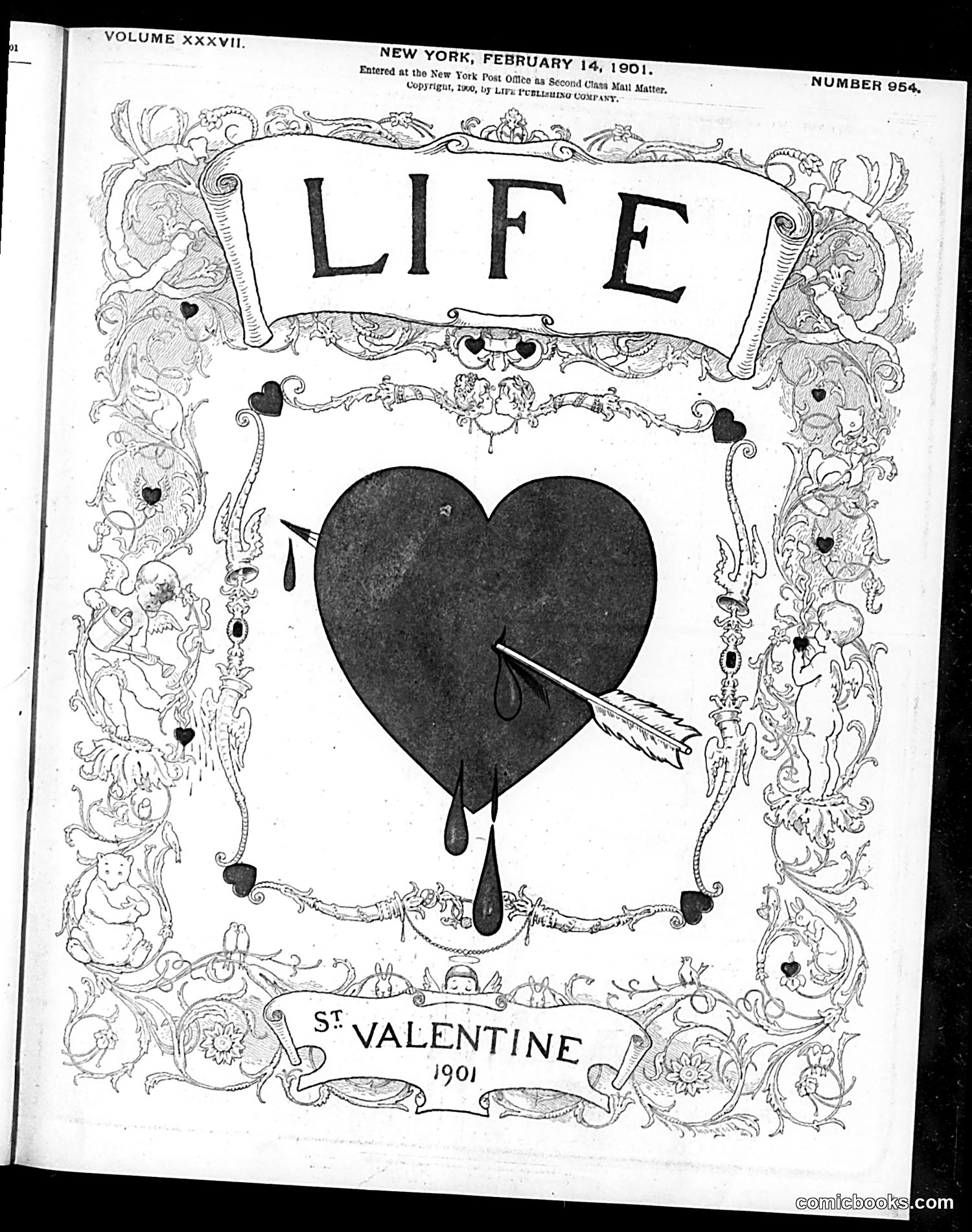
This is a Valentine's Day-themed cover from Life magazine's February 14, 1901 issue. The central image depicts a heart pierced by Cupid's arrow, with blood dripping below—a romantic but morbid visual pun on the classical imagery of love and desire. The ornate decorative border contains cherubs and romantic flourishes typical of Valentine's Day aesthetics. The overall design plays on the traditional association between Valentine's Day, Cupid, hearts, and romantic love, while the stark black heart and exaggerated bleeding effect add a darkly humorous edge characteristic of Life magazine's satirical sensibility. This appears to be primarily a thematic cover rather than political commentary.
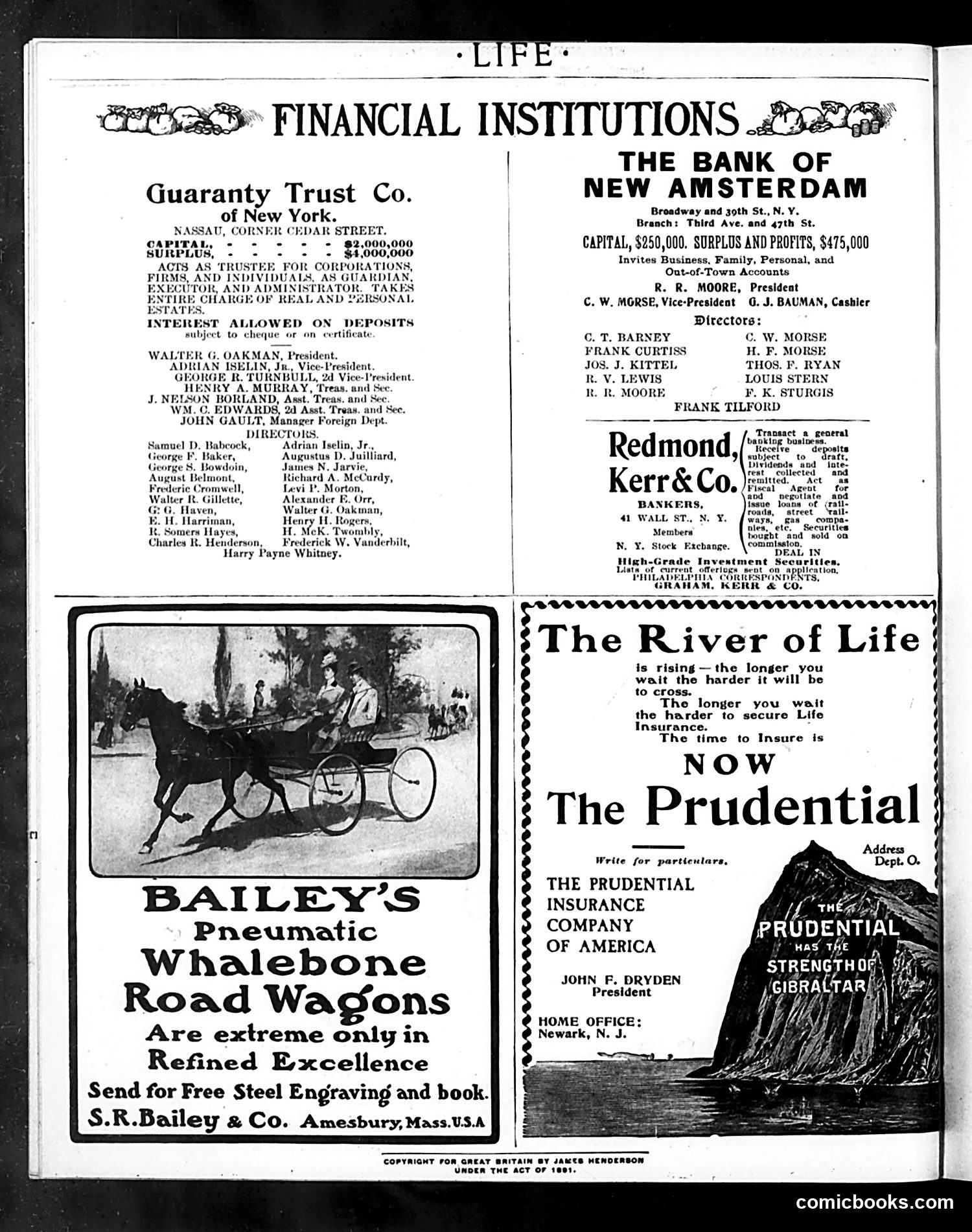
This page is primarily **advertising**, not satire or political commentary. It contains advertisements for three financial institutions and services: 1. **Guaranty Trust Co.** and **Bank of New Amsterdam** — Manhattan banks offering standard financial services 2. **Redmond, Kerr & Co.** — investment securities dealers 3. **Bailey's Pneumatic Whalebone Road Wagons** — a transportation product ad featuring a horse-drawn carriage 4. **The Prudential Insurance Company** — life insurance, using the Rock of Gibraltar as its symbolic "Strength of Gibraltar" The only image with potential narrative interest is Bailey's wagon advertisement, but it's simply a product endorsement showing the wagon in use, not political satire. There are no identifiable caricatures or social commentary visible. The page reflects early 20th-century American financial and commercial advertising.
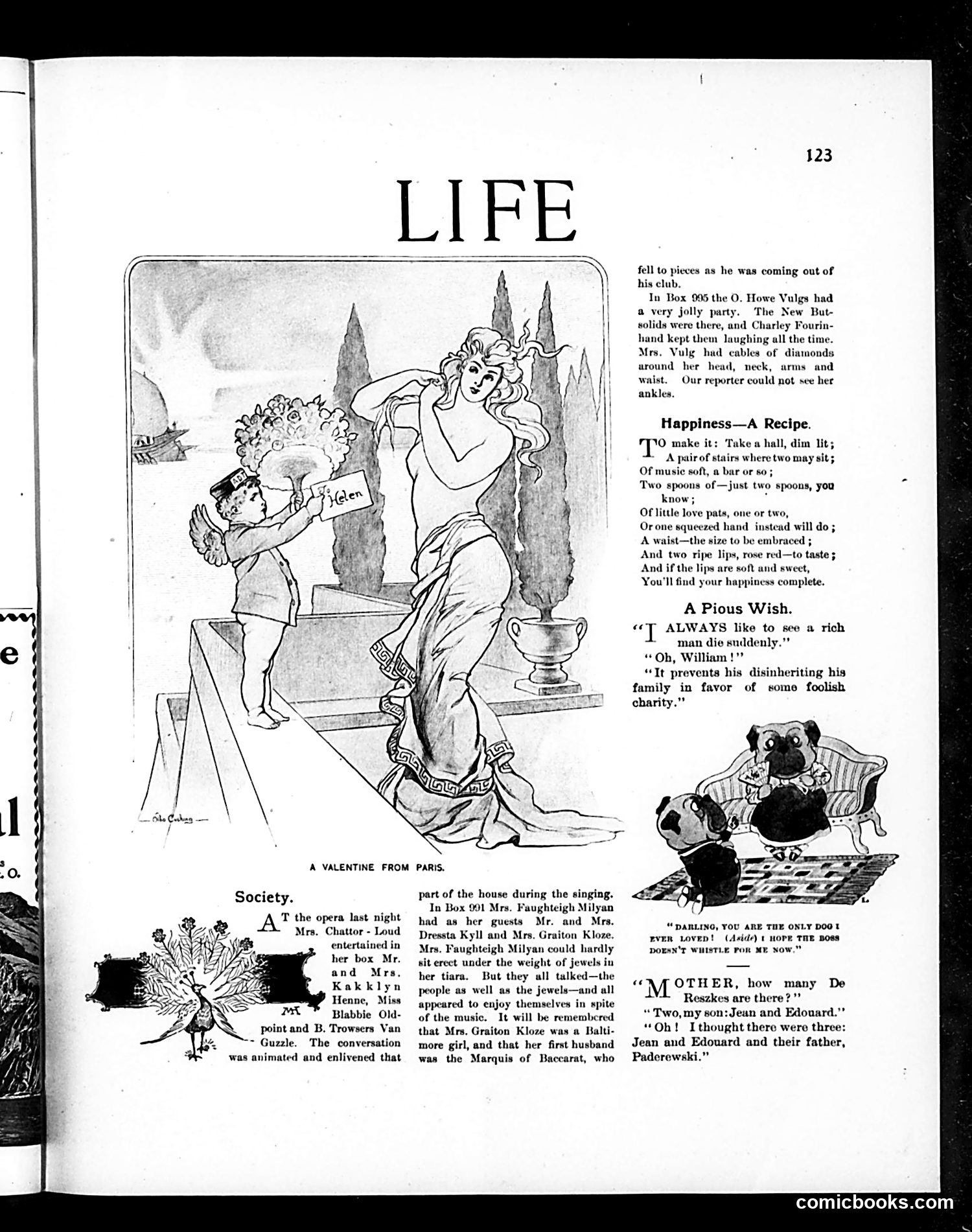
This page contains social commentary and humor rather than political satire. The main illustration, "A Valentine from Paris," shows a classical female statue being embraced by a Cupid figure, likely satirizing romantic idealization of European culture among wealthy Americans. The text sections—"Happiness—A Recipe" and "A Pious Wish"—are humorous observations on courtship and wealth. The recipe mocks sentimentalized romance advice, while "A Pious Wish" jokes about William's hope that a rich man dies suddenly to prevent his family's charity obligations. The "Society" section reports on an opera event featuring prominent attendees (Mrs. Chatter, Mrs. Kaklyn Heme, etc.), typical of Life's coverage of upper-class social gatherings. The cartoon featuring a dog addresses canine ethics humorously. Overall, the page reflects early 20th-century American magazine content mixing social observation with gentle satire of the wealthy class.
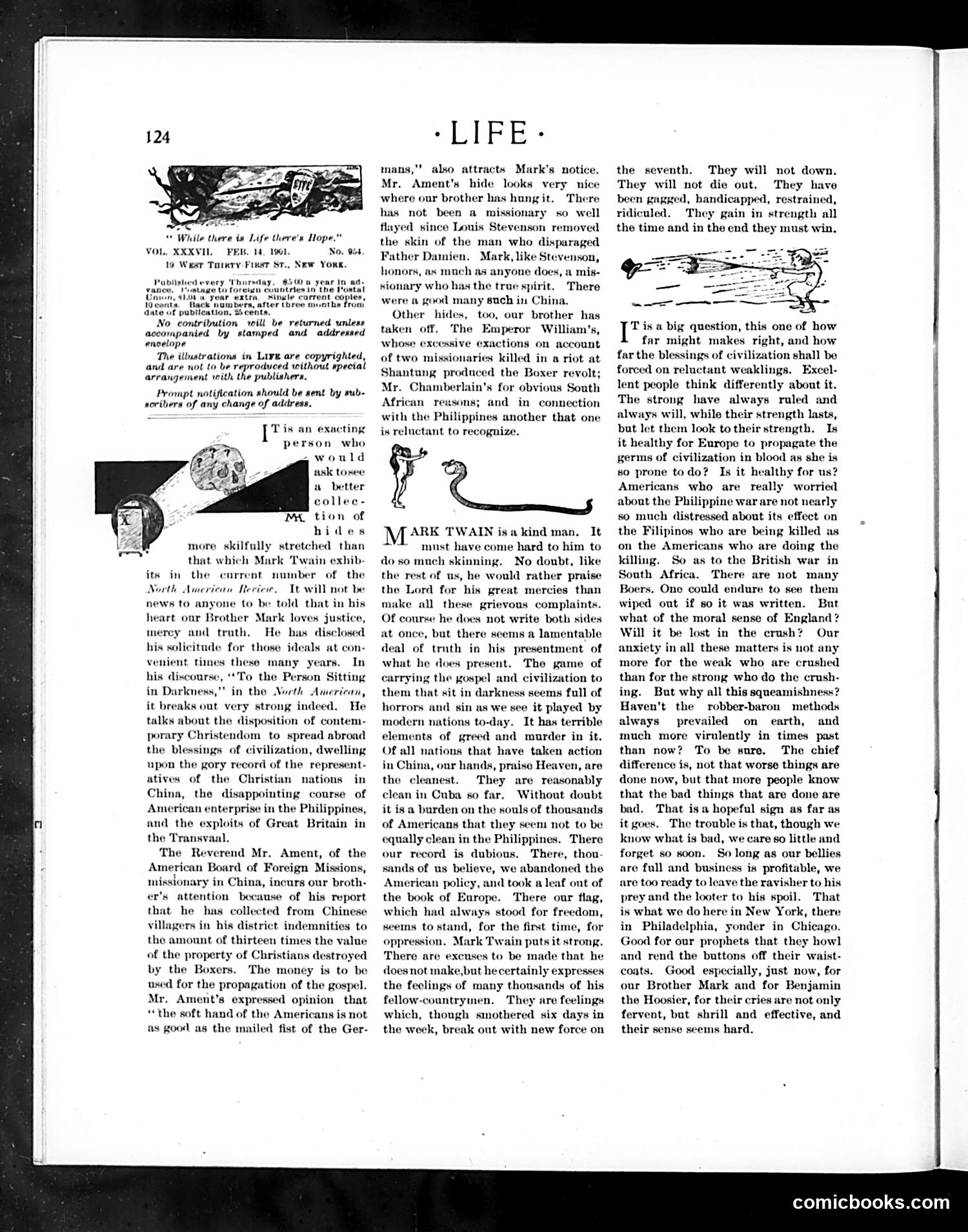
This page from Life magazine (Vol. XXXVII, Feb. 14, 1901) contains editorial commentary on Mark Twain's writings about missionary work and colonialism in China and the Philippines. The illustrations depict Twain's critique of Western imperialism. The text discusses how Twain, like missionary Henry Stevenson, advocates for Christian values while criticizing the exploitative practices of colonial powers—specifically mentioning American actions in the Philippines and British conduct in South Africa during the Boer War. The editorial defends Twain's moral position, arguing that exposure of colonial atrocities and greed should prompt reflection rather than dismissal. It emphasizes that pointing out moral failures in civilization's spread is patriotic, not unpatriotic, especially regarding the Philippines conflict where American soldiers were killing Filipino civilians.
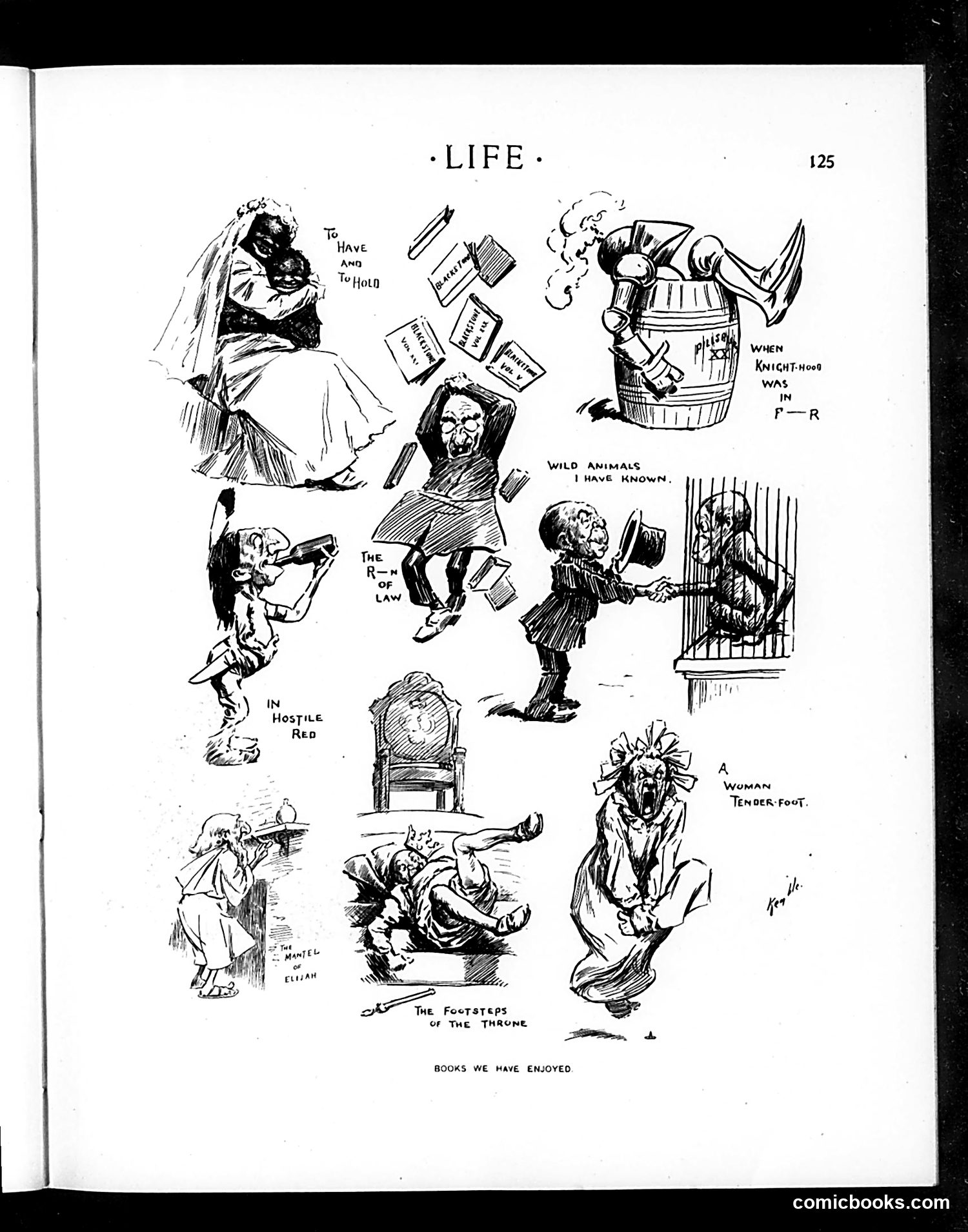
This page satirizes literary characters and narratives through exaggerated ink sketches. The title "Books We Have Enjoyed" suggests these are memorable fictional figures. Notable references include: - **"To Have and to Hold"** (top left) - a bride, likely referencing the 1900 novel - **"The Rise of Silas Lapham"** - apparently shown as a social climber - **"In Hostile Red"** and **"Wild Animals I Have Known"** - adventure/nature stories - **"The Footsteps of the Throne"** - a dramatic political or royal narrative - **"A Woman Tender Foot"** - possibly referencing frontier/Western fiction The cartoons mock these popular literary works through grotesque, exaggerated character drawings, poking fun at their plots, tropes, and the reading public's appetite for such stories. The satire targets both the literature and contemporary tastes in entertainment.
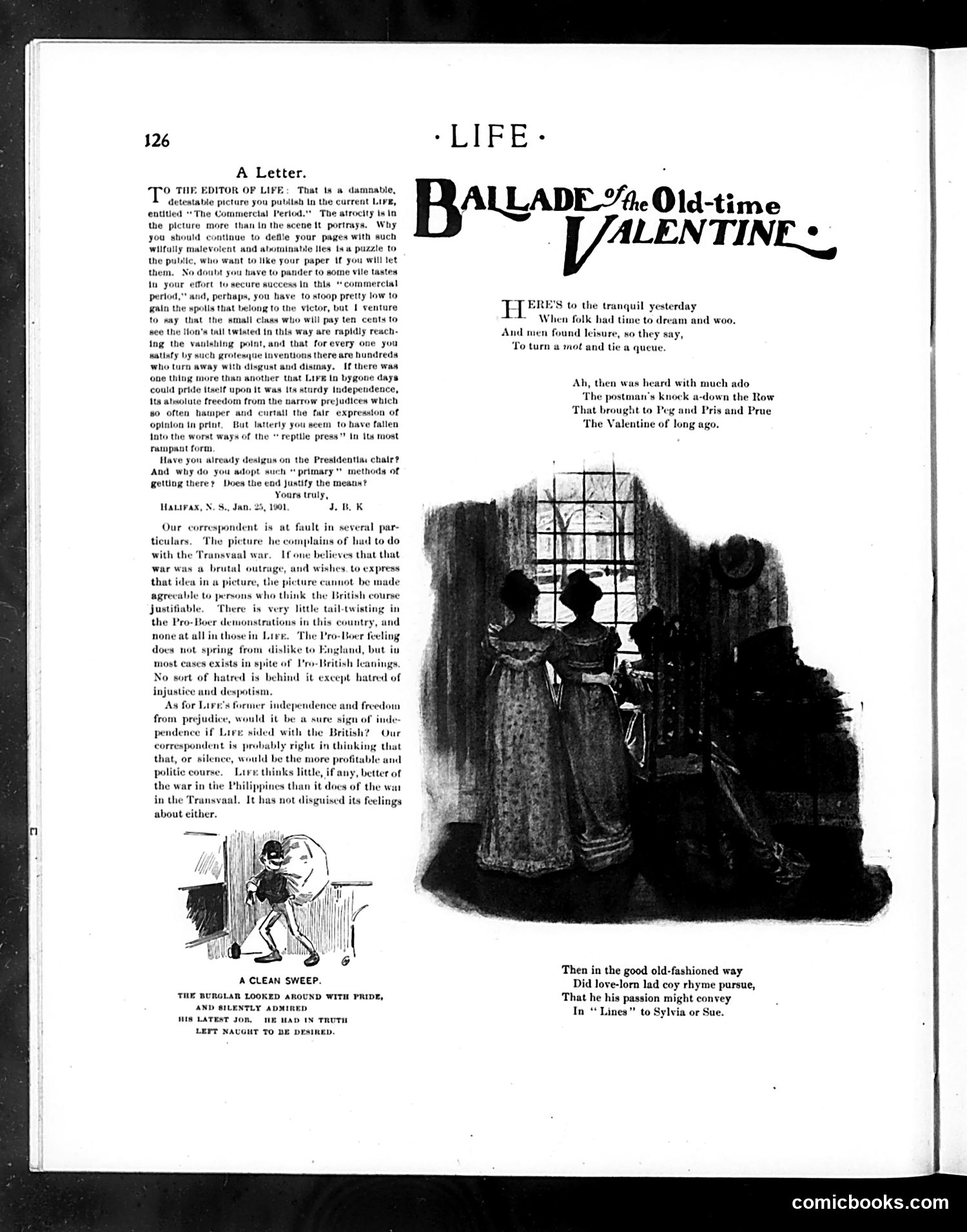
This page contains two distinct pieces: **"A Letter"** is an editor's response criticizing a previous Life illustration about the Transvaal War (the Boer War). The correspondent defends the British course as justified, arguing Life shouldn't adopt "primary methods" to gain readership. The editor counters that Life's independence means it doesn't need to align with British positions, and suggests the publication has maintained fair reporting on both the Transvaal and Philippine conflicts. **"Ballade of the Old-time Valentine"** is a humorous poem with accompanying illustration depicting old-fashioned courtship customs—a postman delivering a love note, and a couple exchanging verses. The piece gently satirizes outdated romantic conventions through nostalgic verse about "Lines" to sweethearts. The small cartoon "A Clean Sweep" shows a burglar, labeled as taking pride in his criminal work.
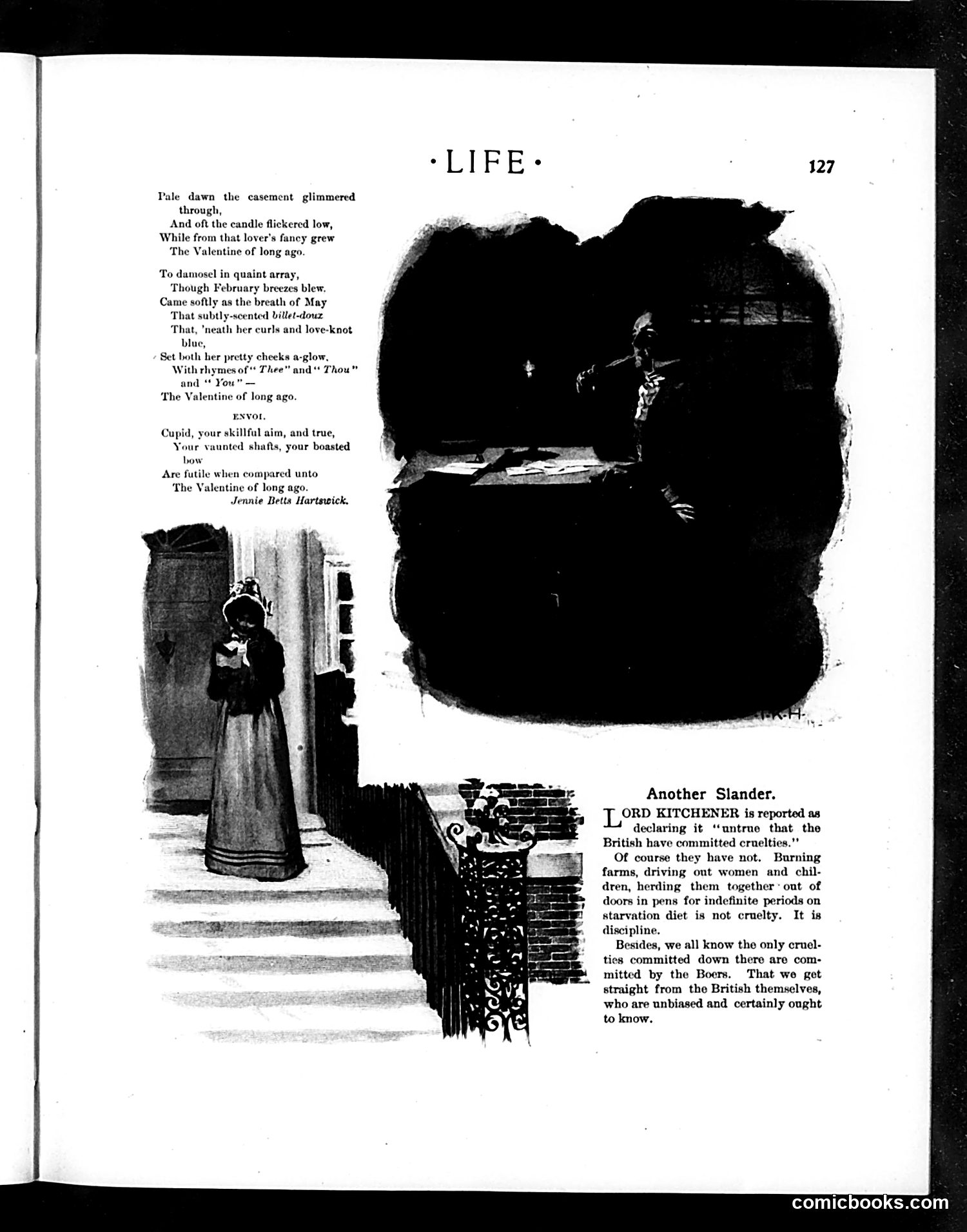
This page defends Britain against accusations of cruelty during the Boer War (likely early 1900s). The accompanying illustration shows a woman in distress, apparently referencing British conduct toward civilians. The text argues that Lord Kitchener denies committing "atrocities," claiming British farms' conduct isn't cruelty but "discipline." The author counters that herding women and children into enclosed pens on starvation rations *is* cruel, regardless of intent. The piece sarcastically suggests that only atrocities "committed by the Boers" are known publicly, while British actions go unexamined. The satire critiques British hypocrisy: defining their own harsh military tactics as justified discipline while condemning enemy actions as barbaric cruelty.
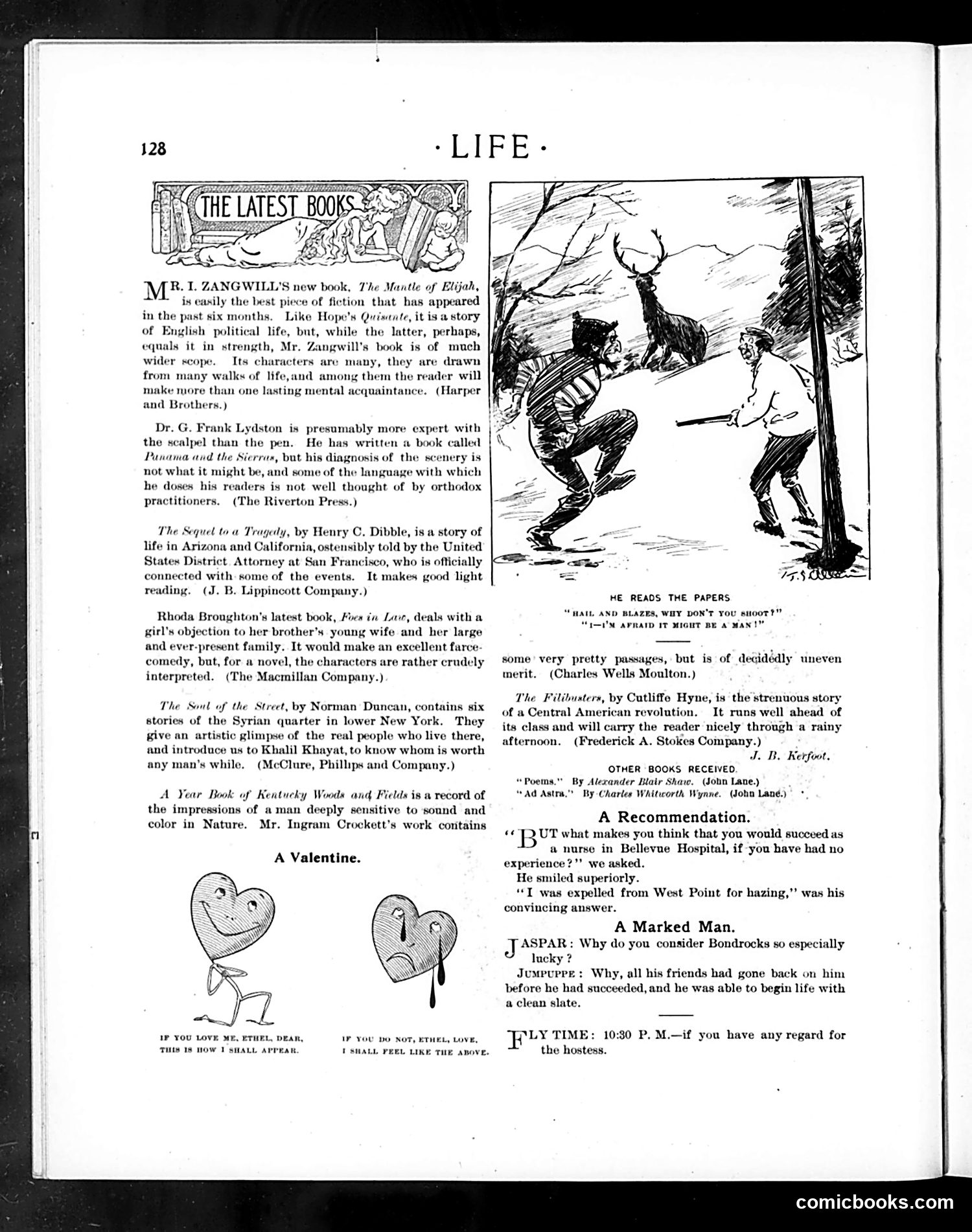
This page contains **book reviews and humorous short pieces** rather than political cartoons. The main visual content includes: 1. **"He Reads the Papers"** — A sketch showing a man reading newspapers while deer approach, captioned with dialogue about being afraid it might be "a man." This appears to be a gentle satire on how fearful or distracted readers become when absorbed in news. 2. **"A Valentine"** — Two whimsical heart-shaped figures with the captions "If you love me, Ethel, dear, / This is how I shall appear" and "If you do not, Ethel, love, / I shall feel like the above." This is a humorous romantic jest about emotional response to rejection. The page otherwise reviews contemporary books, making this primarily a **literary page rather than political satire**.
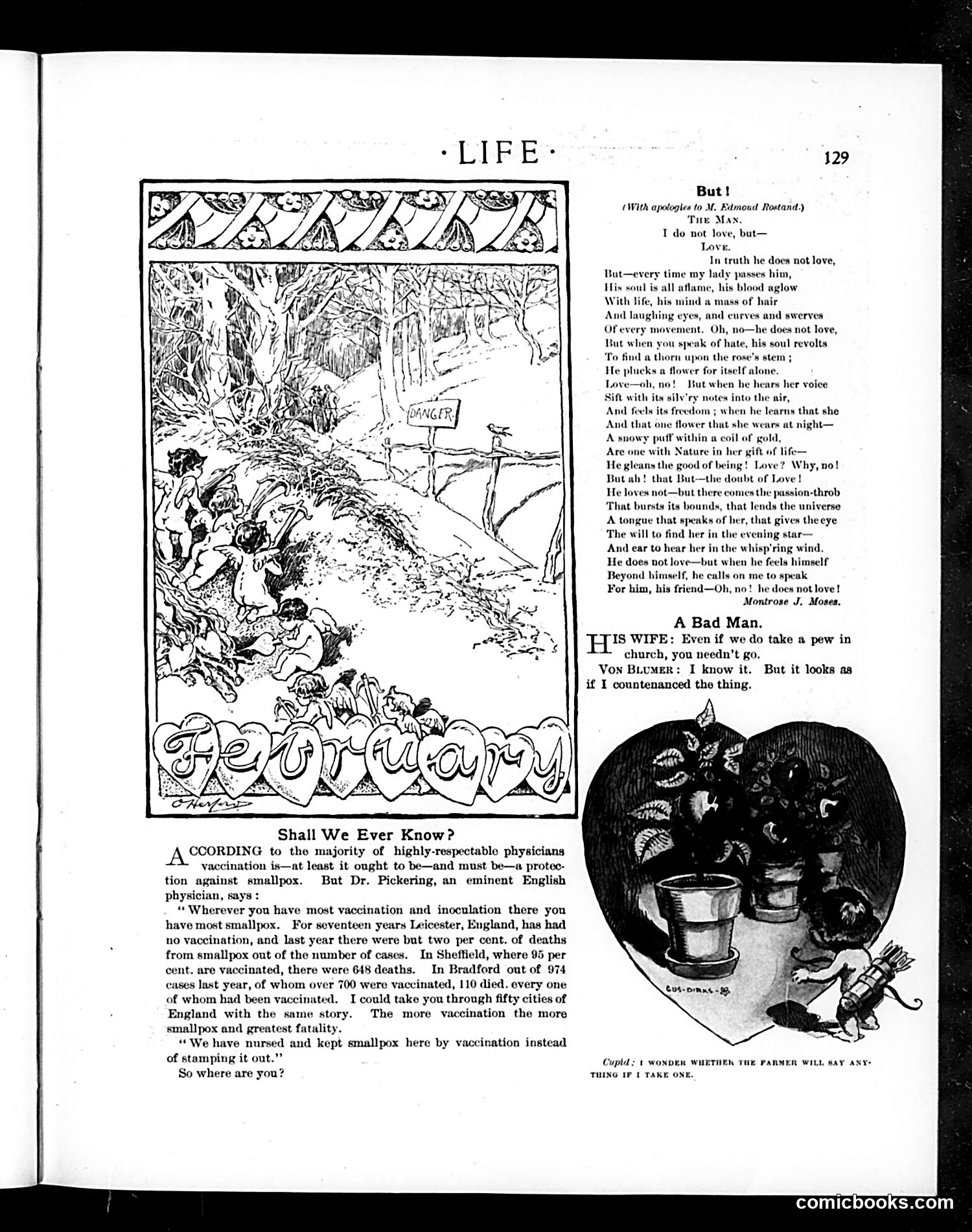
This page contains three distinct pieces: 1. **"February" illustration** (left): A decorative seasonal artwork showing forest undergrowth and animals, labeled with the month. 2. **"But I" poem** (upper right): A romantic verse with apologies to M. Edmund Rostand, exploring the theme of love and human connection through nature imagery. 3. **"A Bad Man" anecdote and "Shall We Ever Know?" article** (lower right): Satirical pieces. The first is a brief dialogue joke about church attendance. The second discusses vaccination debates, citing Dr. Pickering's arguments that vaccination—contrary to medical consensus—actually increases smallpox mortality, using English cities as examples to question the practice's efficacy. The accompanying illustration shows a rat near food, captioned with skepticism about the parson's advice.
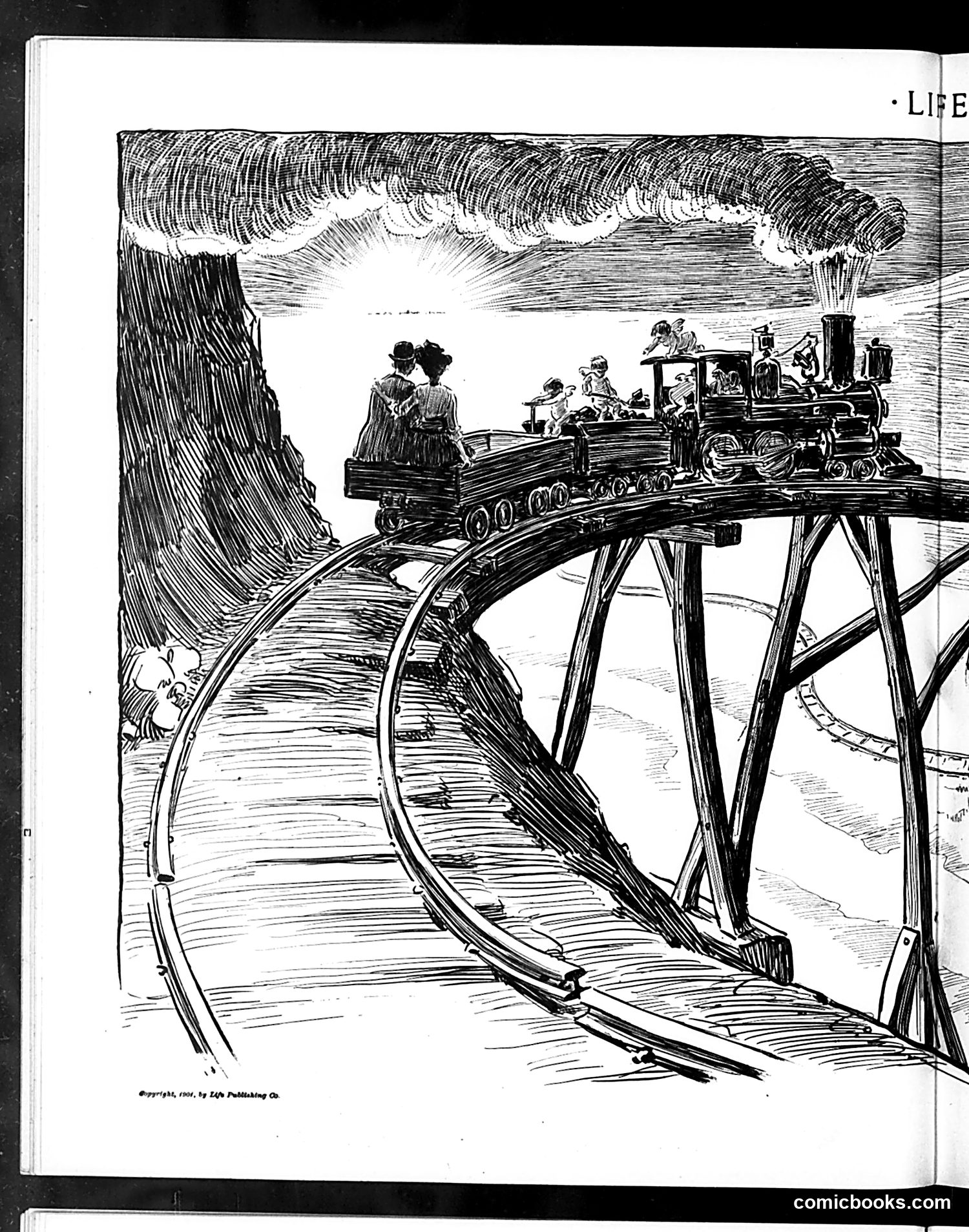
This is a fantastical illustration showing a steam locomotive traveling across an elevated trestle bridge over a dramatic landscape with cliffs and water. The artistic style uses heavy cross-hatching typical of early 20th-century satirical engravings. The image appears to be a straightforward illustration of technological advancement and industrial progress rather than political satire. The locomotive carries multiple passengers, and the engineering feat of the elevated track suggests wonder at modern transportation capabilities. Without visible caricatures, labeled figures, or clear satirical elements, this appears to be either a general illustration of technological optimism or possibly commentary on railroad expansion. The specific satirical intent—if present—is unclear from the visual alone, and the OCR text provided contains no readable content to clarify meaning.
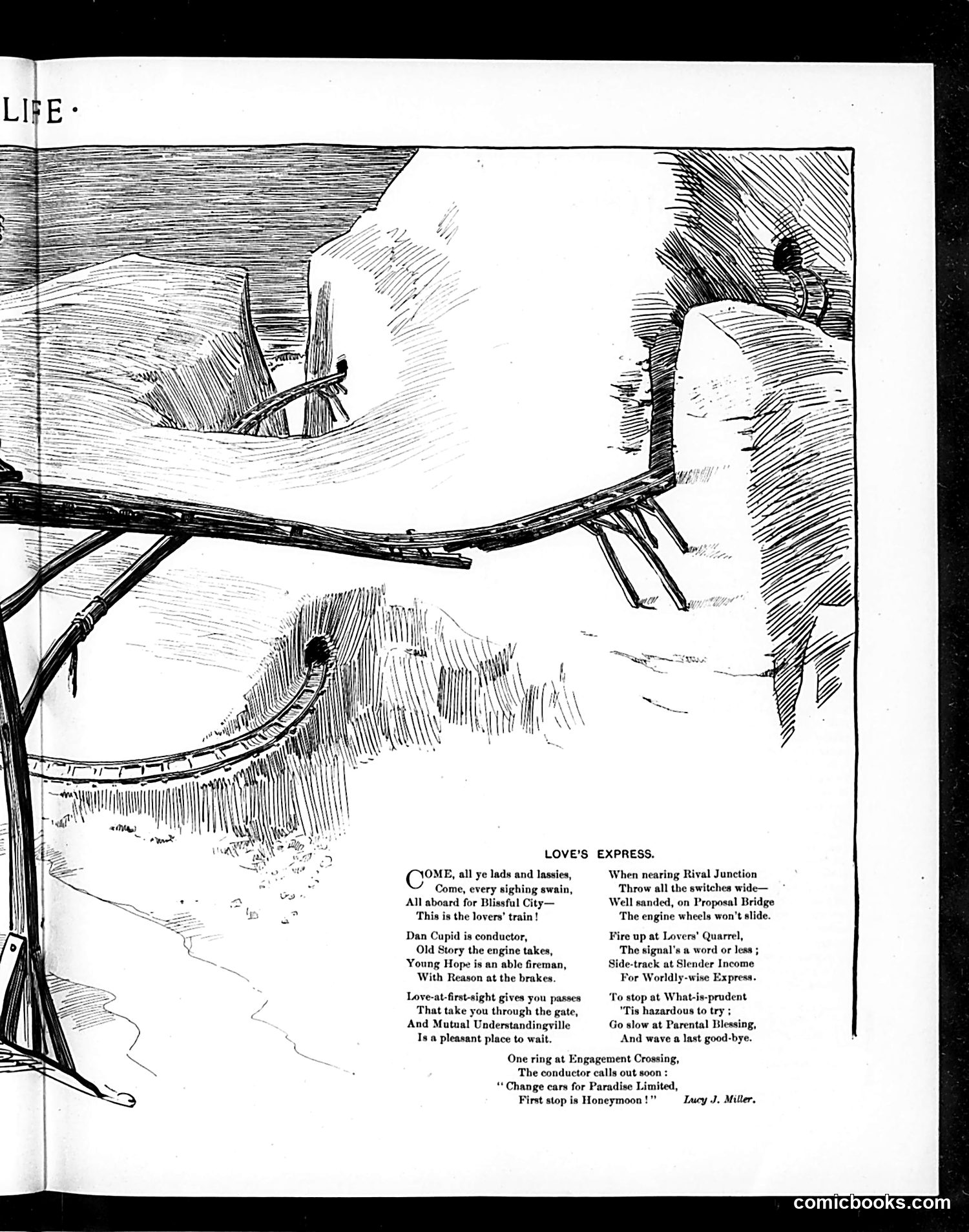
This page features a whimsical poem by Lucy J. Miller titled "Love's Express," illustrated with an ink drawing of a romantic train journey. The illustrated train carries lovers through various stations with comedic stops: "Engagement Crossing," "Proposal Bridge," and ultimately "Honeymoon" as the final destination. The satire gently mocks courtship rituals by treating romantic progression like a railroad timetable, with named locations representing relationship milestones. Characters include "Dan Cupid" as conductor and passengers with names like "Young Hope" and "Reason"—personified emotions guiding the journey. The humor derives from presenting love's conventional narrative arc as mechanical and predictable as train travel, complete with standardized stops and a predetermined route to matrimony.
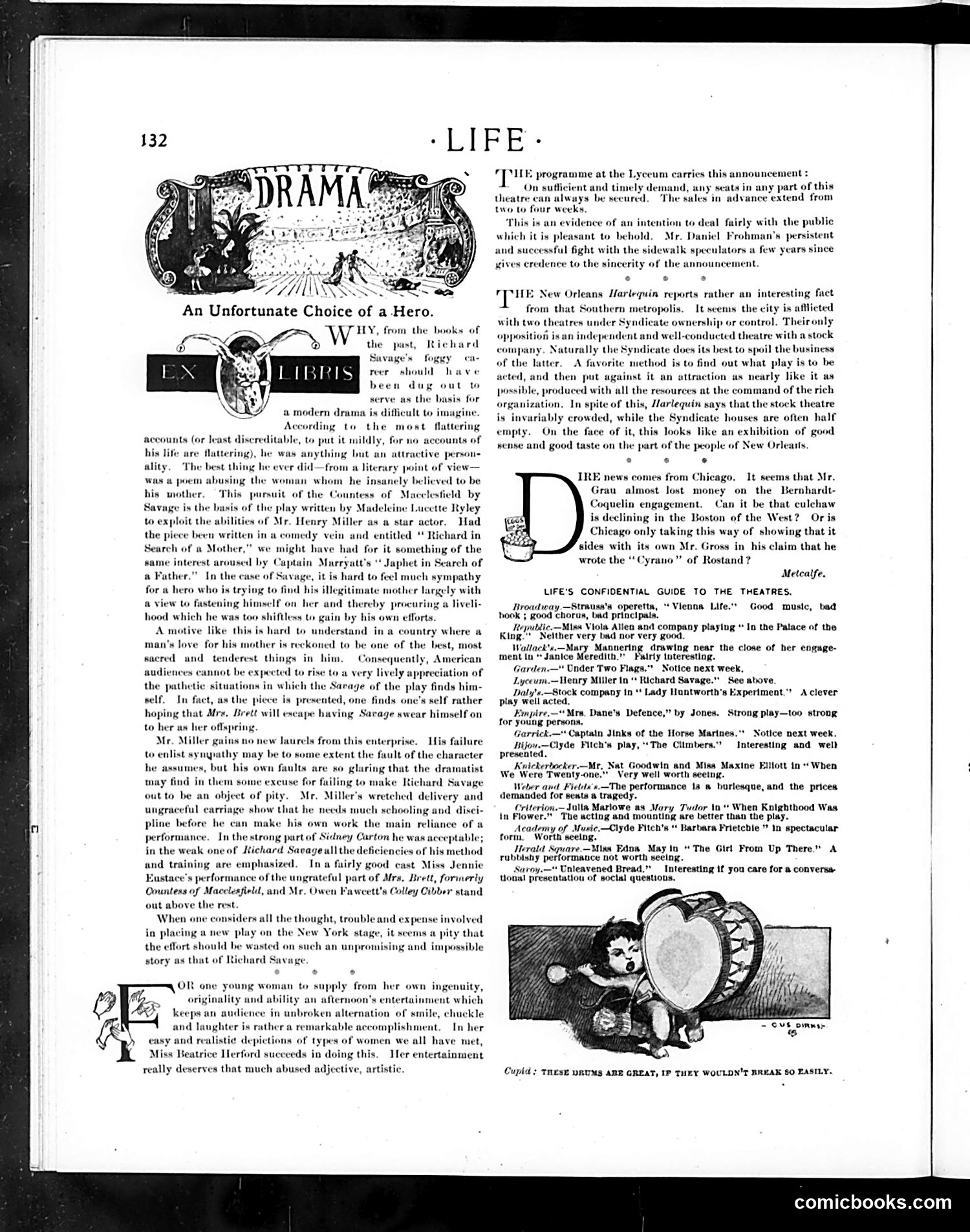
This page contains a drama critique titled "An Unfortunate Choice of a Hero," reviewing a play based on Richard Savage's life, written by Madeleine Lucette Ryley and starring Henry Miller. The main cartoon depicts **Cupid** (winged cherub figure) with a large drum or barrel, captioned: "THESE DRUMS ARE GREAT, IF THEY WOULDN'T BREAK SO EASILY." The satire criticizes the play's protagonist as an unappealing character—Savage is described as possessing "little attractive personality" and being "anything but an attractive person." The reviewer argues that despite Savage's dramatic potential as a sympathetic figure, the play fails because the character himself lacks the qualities needed to engage audiences emotionally. The Cupid cartoon appears to mock romantic/sentimental theater, suggesting such emotional appeals are fragile and easily broken.
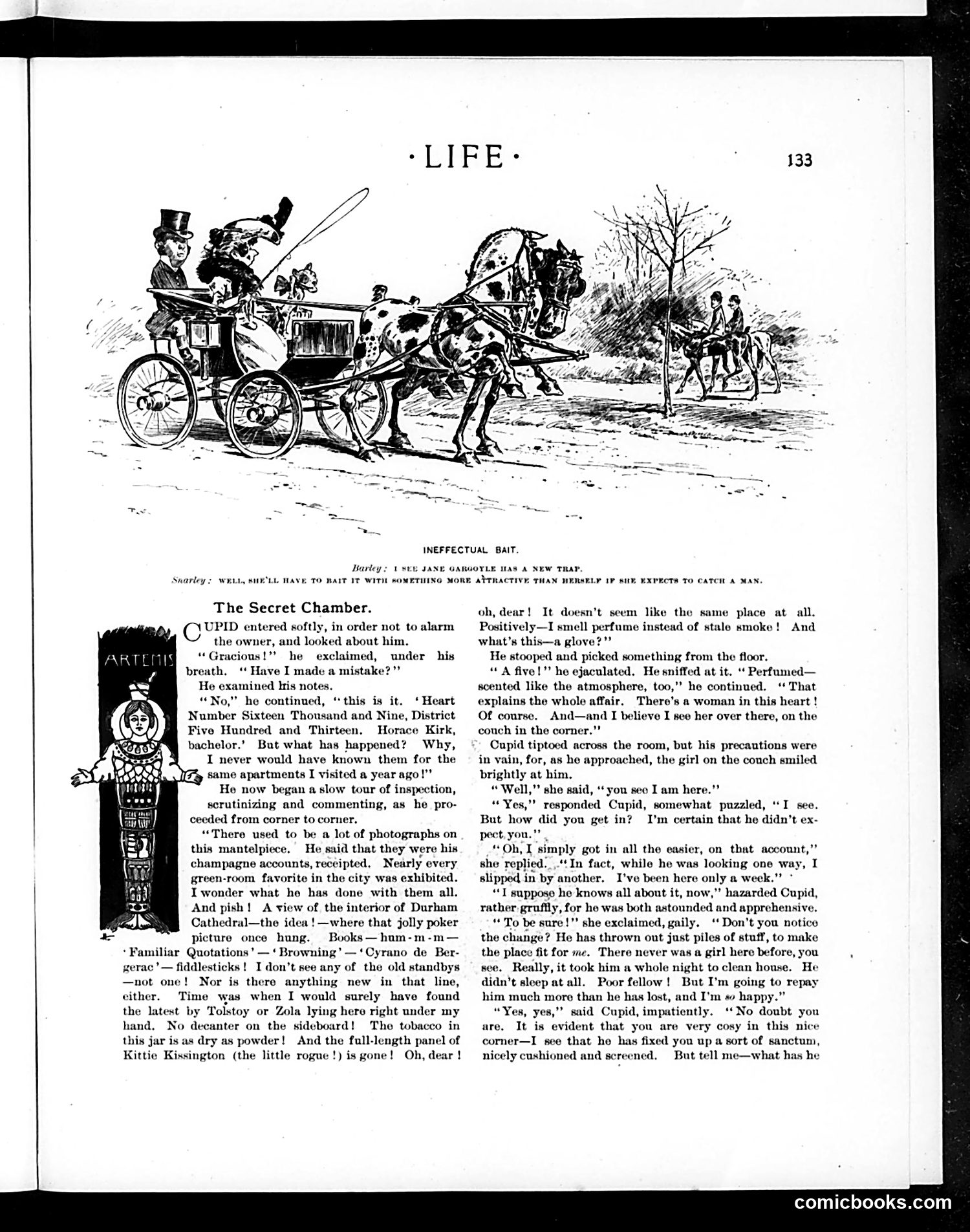
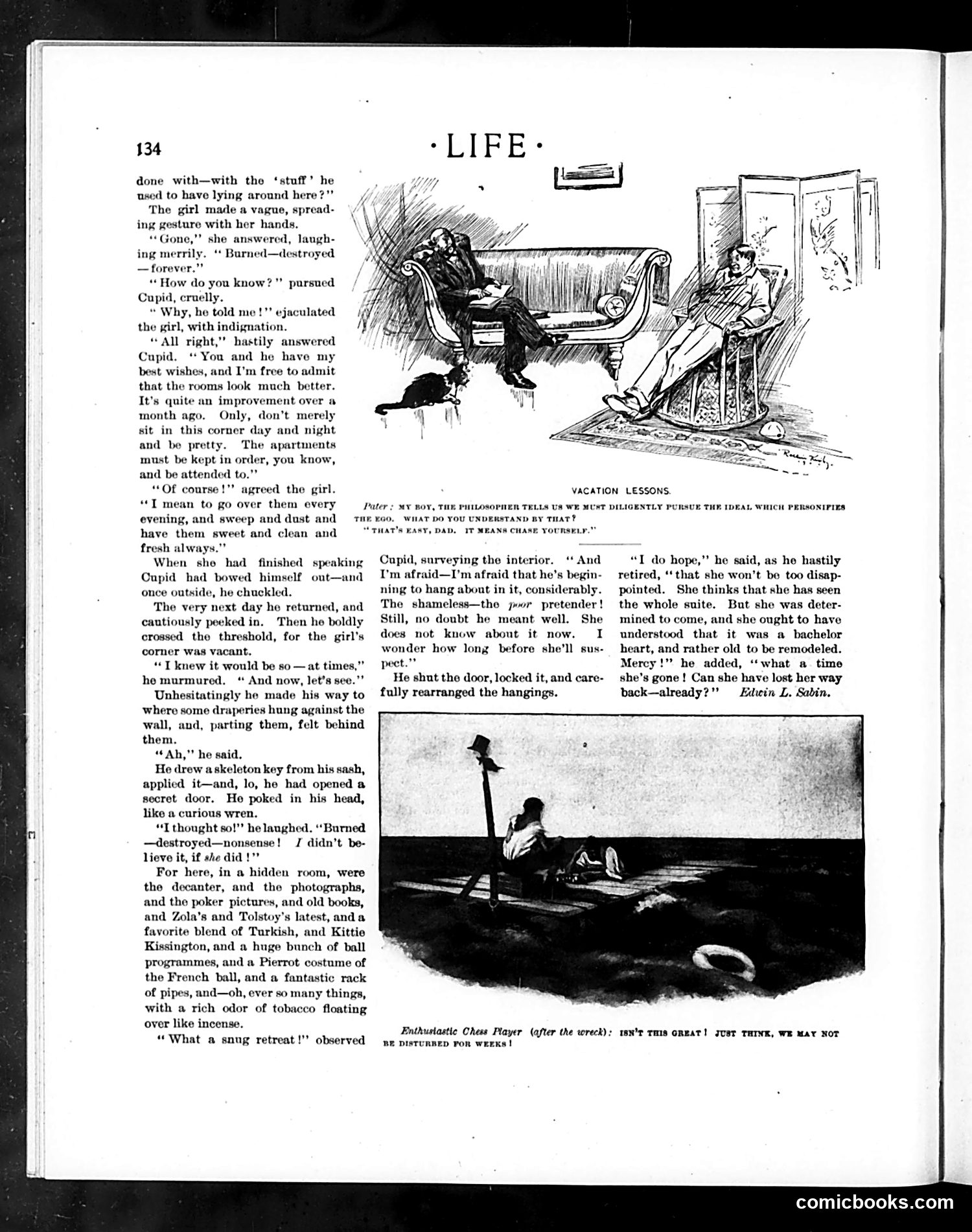
This page contains two related satirical pieces about courtship and domesticity. The top cartoon, "Ineffectual Bait," mocks a woman (Jane Gargoyle) attempting to attract a man through superficial means—her appearance alone won't work; she needs "something more attractive." The longer story below, "The Secret Chamber," uses Cupid (the Roman god of love) as narrator to satirize a bachelor's transformation upon acquiring a girlfriend. The satire lies in documenting how a confirmed bachelor—whose apartment displayed "champagne accounts" (photographs of showgirls), racy French literature (Zola, Tolmoy), decanters, and a portrait of "Kittie Kissington"—has completely domesticated himself within a week. He's discarded bachelor indulgences, cleaned obsessively, and redecorated to accommodate his new romantic interest. The piece gently mocks both male weakness to romantic attachment and the transformative power of female presence—themes common to early-20th-century humor about changing gender dynamics.
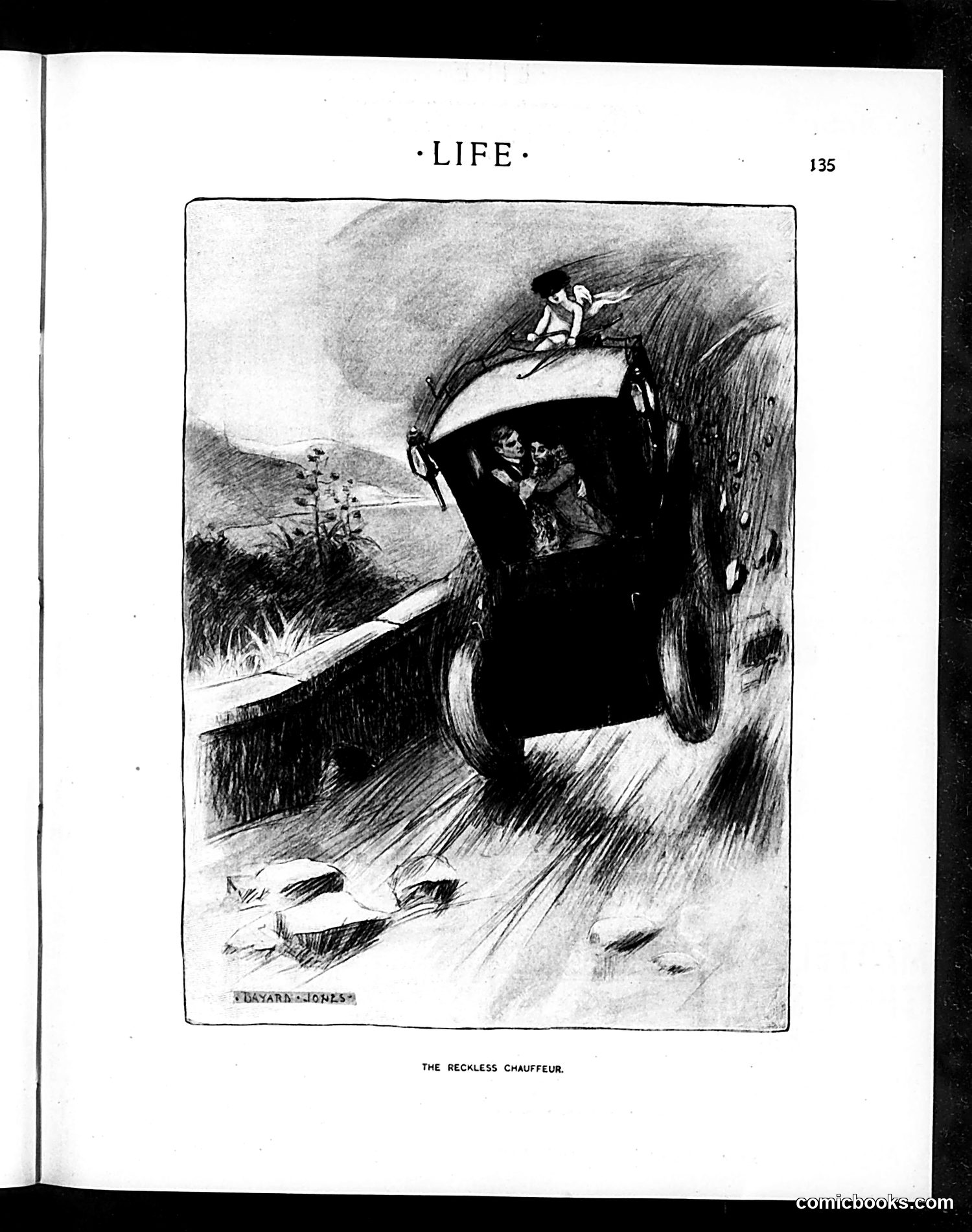
This editorial cartoon depicts a reckless automobile driver causing chaos. A car careens wildly down a road, with the driver barely in control of the vehicle. A small figure appears to be clinging to the top of the car, while debris and stones scatter across the roadway below. The title "The Reckless Chauffeur" suggests social commentary on dangerous driving practices, likely reflecting early automobile-era concerns about speed and safety. The chauffeur (a professional driver) is portrayed as negligent and destructive. The cartoon satirizes either specific incidents of dangerous driving or broader concerns about irresponsible motorists endangering the public. The artist is credited as "T. Brayarn Siones" (or similar—OCR unclear).
This page is primarily **advertising and miscellaneous content** rather than focused political satire. However, it contains several pieces of social commentary: **"The Shyster Lawyer" piece**: A satirical sketch mocking unscrupulous immigrant lawyers operating in urban ghettos. The character speaks in exaggerated Yiddish-inflected English ("chudge" for judge, "vill" for will) and uses theatrical telephone antics to extract inflated fees from desperate clients—a common turn-of-century complaint about predatory legal practitioners targeting poor immigrants. **"Alderman Swelhed" interview**: Mocks an uneducated politician who hasn't heard the word "curriculum" yet confidently claims expertise after reading a newspaper report about his own interview. It satirizes political ignorance and how politicians craft respectable public personas. Both sketches target **urban immigrant communities and corrupt officials exploiting them**—typical Life magazine social criticism of the early 1900s. The page also advertises Wilson Whiskey, Martell Brandy, and Esterbrook Steel Pens—standard period advertising.
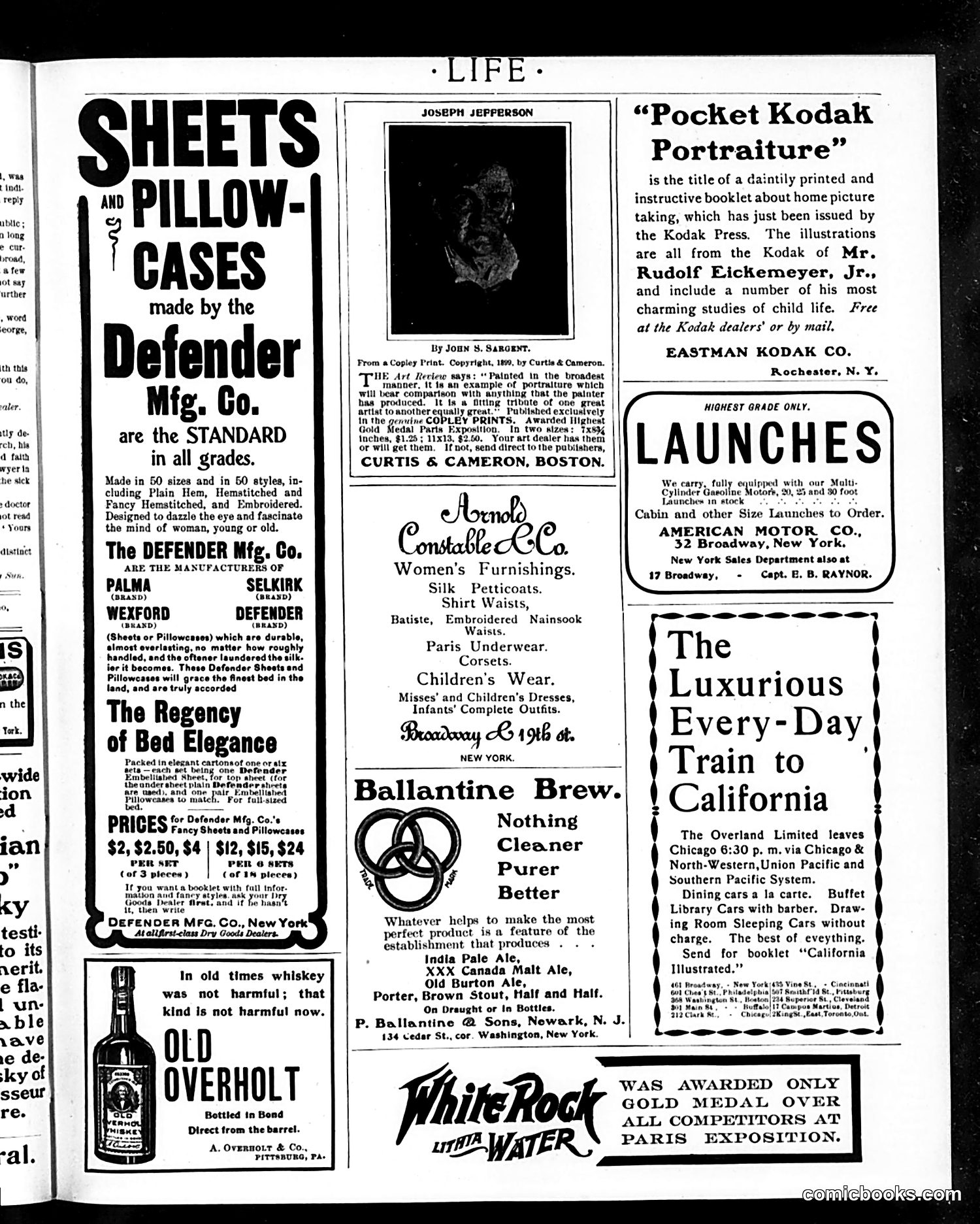
This is primarily an **advertising page** from *Life* magazine, not a political cartoon or satirical piece. The page contains approximately a dozen advertisements for various consumer products and services typical of the early 1900s. The only non-advertising content is a **portrait of Joseph Jefferson**, a famous 19th-century American actor, painted by John S. Sargent. The caption notes it's from a "Copley Print" and quotes *The Art Review* praising it as a fitting tribute between two great artists. The advertisements themselves reveal period consumer culture: bed linens, women's clothing, locomotives, motor launches, whiskey ("Old Overholt"), beer, and train service to California. One ad notably claims Old Overholt whiskey was harmless historically and remains so—a defensive statement reflecting contemporary alcohol debates. There is **no satire or political commentary** evident on this page; it represents straightforward commercial advertising and art reproduction typical of *Life*'s revenue model during this era.
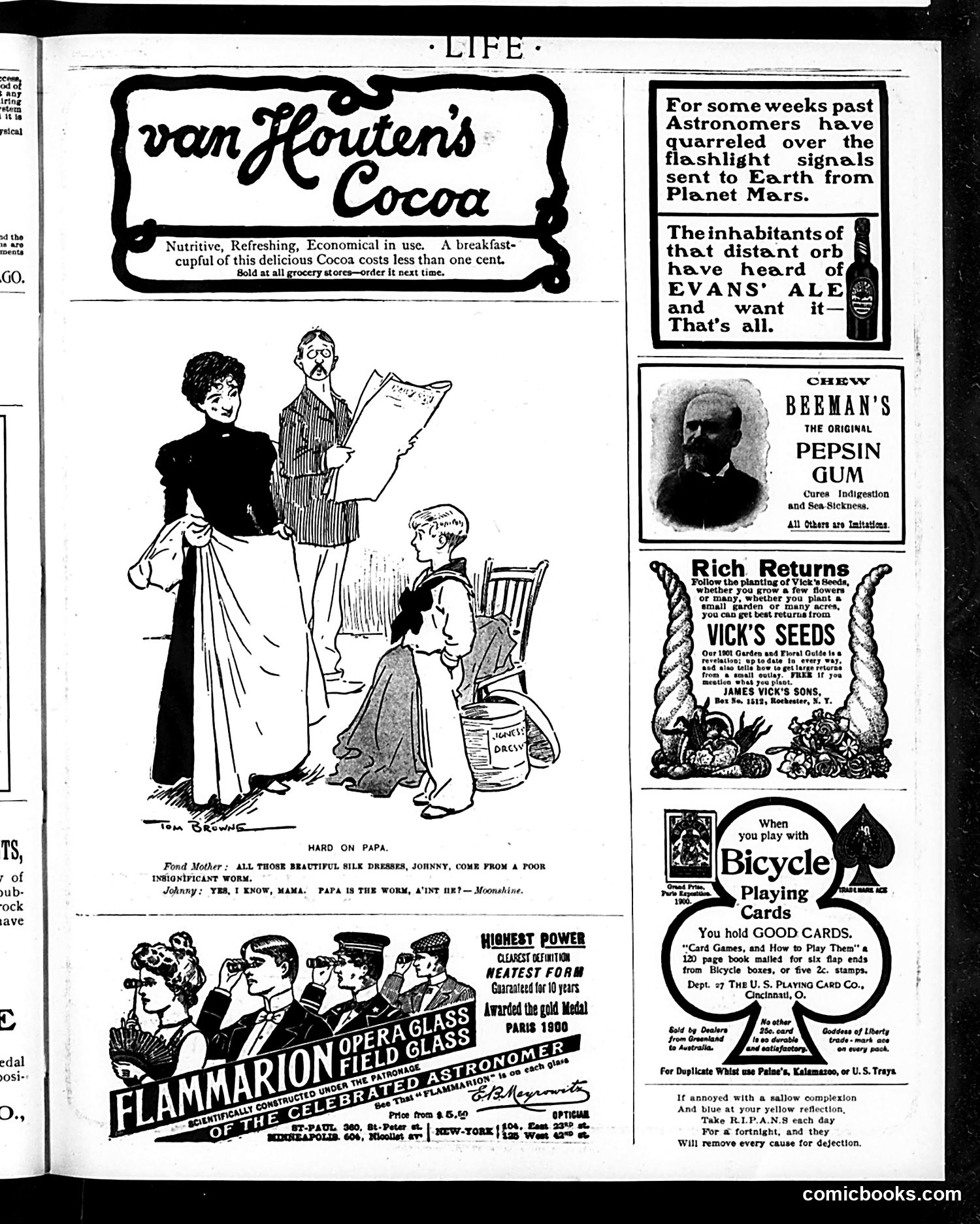
The main cartoon depicts a mother explaining to her son Johnny that his beautiful silk dresses come from silkworms. Johnny's punchline—"Papa is the worm"—is a satirical jab at the father as the exploited laborer whose work produces the family's luxury goods. This reflects early 20th-century class consciousness: the "worm" metaphor suggests the father works himself to exhaustion for minimal reward while his family enjoys the fruits of his labor. The surrounding advertisements (cocoa, opera glasses, playing cards, seeds) are typical period marketing. The Mars/Evans' Ale ad is whimsical science fiction satire—Martians supposedly requesting Earth beer. The page demonstrates *Life* magazine's dual purpose: mixing social commentary with commercial appeals to an educated, middle-class readership concerned with both satirizing labor exploitation and consuming genteel products.
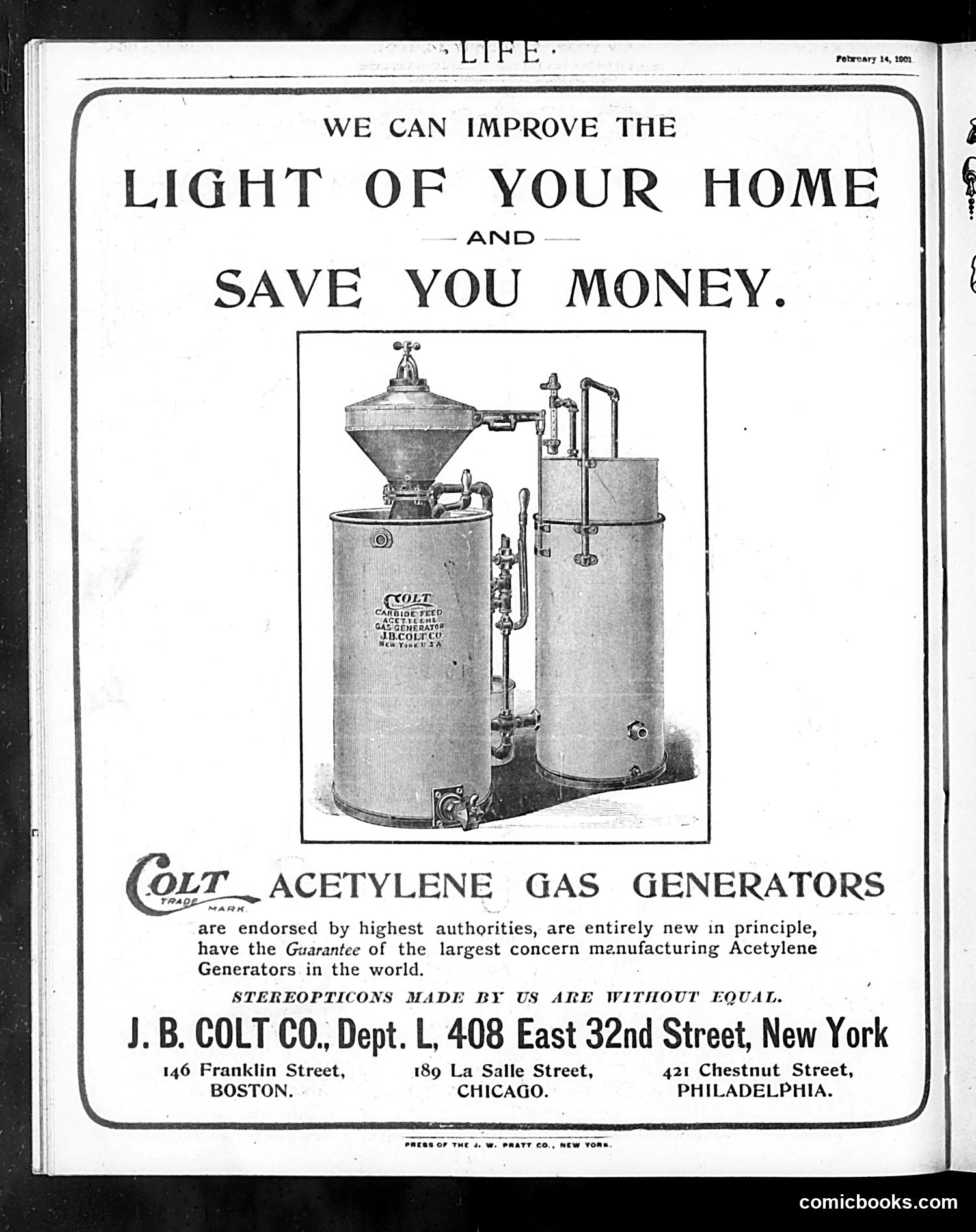
This is **not a cartoon or satire**—it's a straightforward advertisement from the February 14, 1901 issue of *Life* magazine. The page promotes **Colt Acetylene Gas Generators**, early lighting technology for homes. The technical diagram shows the generator apparatus used to produce acetylene gas, which provided artificial light before widespread electric service. The ad emphasizes that these generators are "entirely new in principle," endorsed by authorities, and manufactured by "the largest concern" in the field. It also mentions the company makes "stereopticons" (early projection devices). The J.B. Colt Company lists headquarters in New York with branch offices in Boston, Chicago, and Philadelphia—typical for early-1900s industrial manufacturers. This represents the pre-electric era when acetylene gas was a cutting-edge home lighting solution competing with other technologies.