
Life, 1901-02-14 · page 12 of 20
Life — February 14, 1901 — page 12: what you’re looking at
What you’re looking at
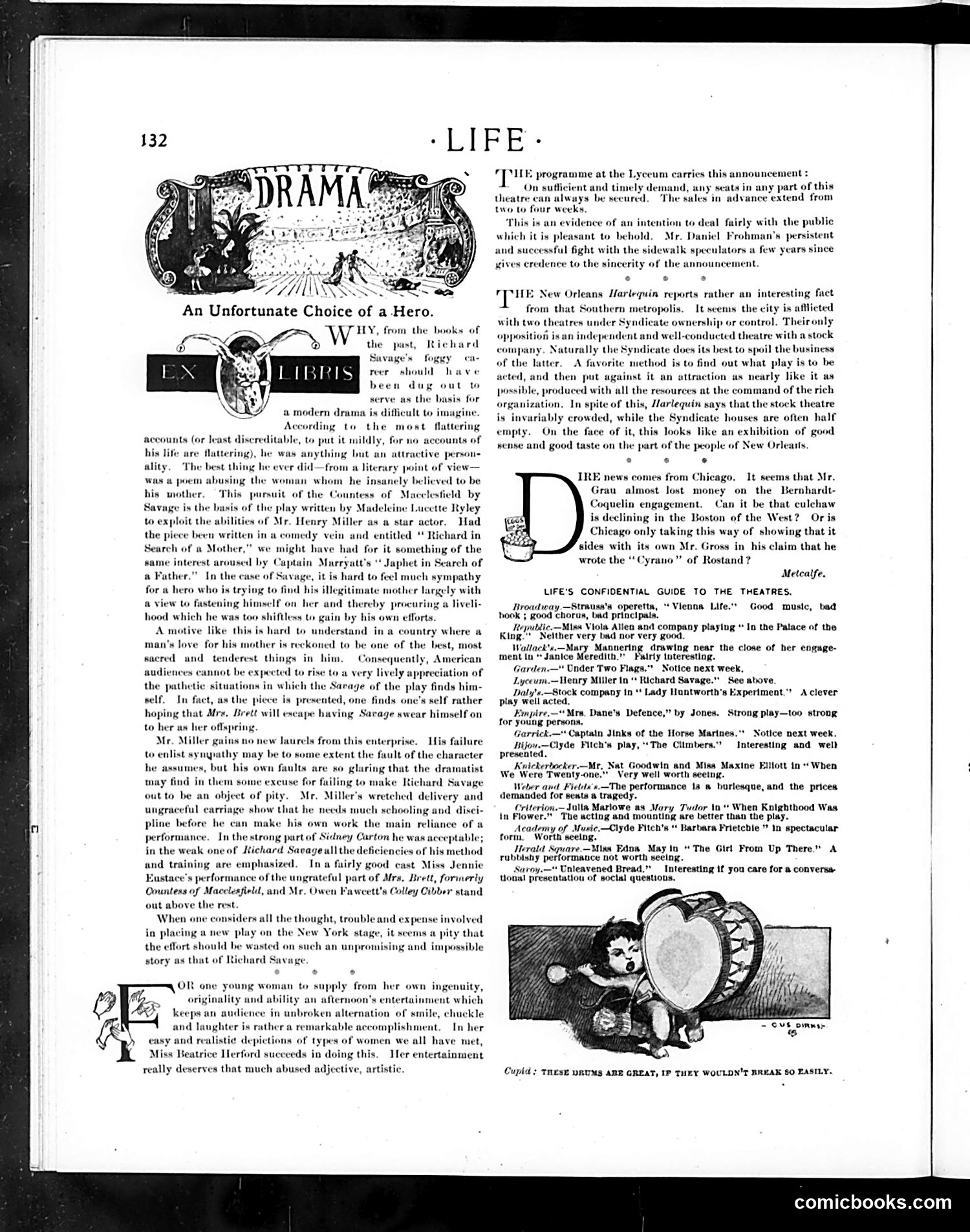
This page contains a drama critique titled "An Unfortunate Choice of a Hero," reviewing a play based on Richard Savage's life, written by Madeleine Lucette Ryley and starring Henry Miller. The main cartoon depicts **Cupid** (winged cherub figure) with a large drum or barrel, captioned: "THESE DRUMS ARE GREAT, IF THEY WOULDN'T BREAK SO EASILY." The satire criticizes the play's protagonist as an unappealing character—Savage is described as possessing "little attractive personality" and being "anything but an attractive person." The reviewer argues that despite Savage's dramatic potential as a sympathetic figure, the play fails because the character himself lacks the qualities needed to engage audiences emotionally. The Cupid cartoon appears to mock romantic/sentimental theater, suggesting such emotional appeals are fragile and easily broken.
📄 Transcribed text from this page (OCR, searchable)
Machine-transcribed from the original scan — historical spelling and the odd misread are preserved.
An Unfortunate Choice of a-Hero. WEY. from tt books of the past, Richard Savage's f reer should dug out to serve as the basis for a modern drama is difficult to agin Ace to the most flattering iscreditable, to put it mildly, for no accounts of his life are flattering), he was anything but an attra ality. ever did was a poem woman whom he insa his um been accounts (or least ive person= The best thing from 1 lite using th This pursuit « ary point of view— ved to be field by Lucette Ryley asa star actor. Had y be her. f the Countess of Macek Savage is the basis of the play written by Madelei it the abilities of Mr, Henry Mill en written in a comedy vein and entitled “ Richard in of a Mother, ave had for it something of the same interest aroused by Captain Murryatt's “ Japhet in Search of a Father.” In th . it is hard to feel much sympathy for « hero who is trying to find his illeg’ urgely with a view to fastening himself on her and thereby procuring a liveli- hood which he was too shiftless to gain by his own efforts. A like this is hard to understand ina country where a man’s love for his mother ix reckoned to be one of the best, most sacred est things in him. quently, American audiences cannot be expected to rise to a very lively appreciation of the pathetic situations in which the Sarage of the play finds him- self. In fact, ast is py 's self rather hoping that Afrs. Brett will escape having Savage swear himself on to her as her offspring Mr. Miller gains no new laurels from this enterprise. His failure to enlist synyathy may be to some extent the fault of the character he assumes, but his own faults are so glaring that the dramatist may find in them some excuse for failing to make Richard Savage out to be an object of pity. Mr. Miller's wretched delivery and ungraceful carriage show that he needs much schooling and disei- pline before he ke his own work the main reliance of a performance. In the strong part of Sidney Carton he was ac in the weak oneof Kichard Savage ull the deficiencies of his method and training are emphasized. Ina fairly good cast Miss Jennie Eustace’s performance of the ungrateful part of Mfrs, Brett, formerly Countess of Macclesfield, and Mr. Owen Faweett's Colley Cibber stand out above the rest. When one considers all the thought, trouble and expen: in placing a new play on the New York stage, it seems a pity that the effort should be wasted « unpromising and impossible story as that of Richard Savage we might “ase of Saviay pate mother oti and te wented, one finds ptable: involved such a one young woman to supply from her own originality and abil keeps an audience in and laughter is rather a remarkable a easy and realisti¢ depictions of types of women we all have met, Miss Beatrice Herford succeeds in doing this. Mer entertainment really deserves that much abused adjective, artistic. ngenuity, 1 afternoon's entertainment which n of smile, chuckle mplishment. In her unbroken alternati: * LIFE * T ILE programme at the Lyceum carrics this announcement : On suflicient and timely demand, any seats in any part of this theatre can always be secured. ‘The sales in advance extend from two to four weeks. ‘This isa evidence of an intention to deal fairly with the public which it is pleasant to behold. Mr. Daniel Frohman’s persistent and successful fight with the sidewalk speculators a few years since dence to the sincerity of the ai puncement, e ° ° ‘ys. New Orleans Harlequin reports rather an interesting fact from that Southern metropolis. It seems the city is afl with two theatres under Syndicate ownership or control. Theire of isan independent and well-conducted theatre with a stock »mpany. Naturally the Syndicate does its best to spoil the business A favorite method is to find out what play is to be J then put against it an attraction as nearly like it as produced with all the resources at the command of the rich n. In spite of this, Harlequin says that the stock theatre bly crowded, while the Syndicate houses are often half On the face of it, this looks like an exhibition of good the part of the people of New Orleauts. e . . empty. nense and good taste IRE news comes from Chicago. It seems that Mr. Grau almost lost money on the Bernhardt- Coquelin engagement. Can it be that culchaw is declining in the Boston of the West? Oris Chicago only taking this way of showing that it sides with its own Mr. Gross in his claim that he wrote the “Cyrano” of Rostand ? Metcalfe. LIFE’S CONFIDENTIAL GUIDE TO THE THEATRES. Broadway —Strauss's operetta, “ Vienna Life." Good music, bad hook ; good chorus, bad principals. Republic.—Misa Viola Alien and company playing “In the Palace of the King." Nelther very bad nor very good Waltack's.—Mary Munnering drawing near the close of her engage- ment in “Janice Meredith.” Patrly tnteresting. Garden.— Under Two Flags.” Notice next week, Lyceum.—Wenry Miller in“ Richard Savage." See above, Daly's.—Stock company in“ Lady Hantworth’s Experiment.’ A clever play well acted. Empire.—“"Mrra, Dane's Defence,” by Jones. Strong play—too strong for young persona. Garrick.—" Captain Jinks of the Horse Marines.” Notice next week. Bijou.—Clyde Fitch's play, The Climbers.” Interesting and well presented. Knickertocker-—Mr, Nat Goodwin and Misa Maxine Elliott in“ When We Were Twenty-one.” Very well worth seeing. Weber and Fieldts’s.—The performance 14 & burlesque, and the prices demanded for seats a tragedy. Criterion. Julia Marlowe a Mary Tudor \n“ When Knighthood Was in Flower.” The ucting and mounting are better than the play. lcademy of Musie—Clyde Fitch's * Barbara Frietchle in spectacular mm, Worth seeing. Herat Square —Misa Fana May tn “The Girt From Up There." A rubbishy performance not worth seeing. aroy.—* Unleavened Bread.” Interesting if you care for a conversa al presentation of social questions. f Cupid ; THESE DRUMS ABE GREAT, IP THEY WOULDN'T BREAK $0 EASILY. comicbooks.com