
Life, 1901-02-14 · page 4 of 20
Life — February 14, 1901 — page 4: what you’re looking at
What you’re looking at
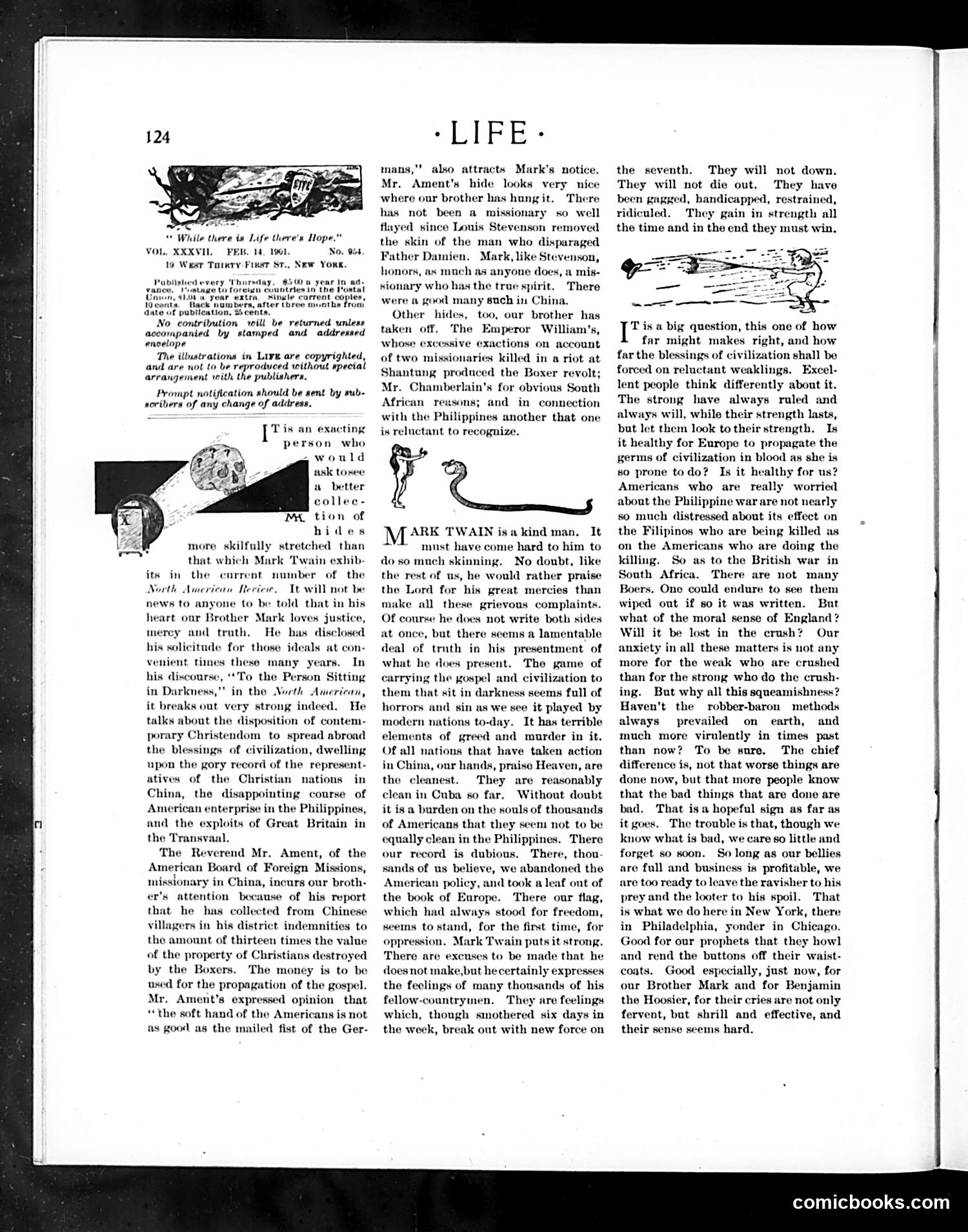
This page from Life magazine (Vol. XXXVII, Feb. 14, 1901) contains editorial commentary on Mark Twain's writings about missionary work and colonialism in China and the Philippines. The illustrations depict Twain's critique of Western imperialism. The text discusses how Twain, like missionary Henry Stevenson, advocates for Christian values while criticizing the exploitative practices of colonial powers—specifically mentioning American actions in the Philippines and British conduct in South Africa during the Boer War. The editorial defends Twain's moral position, arguing that exposure of colonial atrocities and greed should prompt reflection rather than dismissal. It emphasizes that pointing out moral failures in civilization's spread is patriotic, not unpatriotic, especially regarding the Philippines conflict where American soldiers were killing Filipino civilians.
📄 Transcribed text from this page (OCR, searchable)
Machine-transcribed from the original scan — historical spelling and the odd misread are preserved.
* While there is Life there's Hope.” XXXVI FEB. 14, 1901. 1. 964. 19 West Tarkry-Finst St., New York. vou. every Thursday, #5000 year in ad- the Postal coples, he from! date of publication, % cents, No contribution will be returned unless accompanied by stamped and addressed envelope The illustrations in Live are copyrighted, and are not to be reproduced without special arrangement with the publishers, Prompt notification should be sent by sub- soribers of any change of address. [Tis an exacting person who awould ask toxee a better collec- tion of hides more skilfully stretched than that which Mark Twain exhib- its in the current number of the North American Reciew. Ttewill not be news to anyone to be told that in his heart our Brother Mark loves justice, mercy and truth. He has disclosed his solicitude for those ideals at con- venient times these many years. In his discourse, ‘To the Person Sitting in Darkness," in the North American, it breaks out very strong indeed. He talks about the disposition of contem- porary Christendom to spread abroad the blessings of civilization, dwelling upon the gory record of the represent- atives of the Christian nations in China, the disappointing course of American enterprise in the Philippines, and the exploits of Great Britain in the Transvaal. The Reverend Mr. Ament, of the American Board of Foreign Missions, missionary in China, incurs our broth- er’s attention because of his report that he has collected from Chinese rs in his district indemnities to nount of thirteen times the value of the property of Christians destroyed by the Boxers. The money is to be used for the propagation of the gospel. Mr. Ament’s expressed opinion that “the soft hand of the Americans is not as good as the mailed fist of the Ger- mans,” also attracts Mark's notic Mr. Ament’s hide looks very where our brother has hung it. has not been a missiot flayed since Lonis Stevenson removed the skin of the man who disparaged Father Damien. Mark, like Stevenson, honors, ax much as anyone does, a mis- sionary who has the true spirit. There were a good many such in China. Other hides, too, our brother has taken off. The Emperor William's, whose excessive exactions on account of two missionaries killed in a riot at Shantung produced the Boxer revolt; Mr. Chamberlain's for obvious South African reasons; and in connection with the Philippines another that one is reluctant to recognize. ARK TWAIN isakind man, It must have come hard to him to do so much skinning. No doubt, like the rest of us, he would rather praise the Lord for his great mercies than make all these grievous complaints. Of course he does not write both sides at once, but there seems a lamentable deal of truth in his presentment of what he does present. The game of carrying the gospel and civilization to them that sit in darkness seems full of horrors and sin as we see it played by modern nations to-day. It has terrible elements of greed and murder in it. Of all nations that have taken action in China, our hands, praise Heaven, are the cleanest. They are reasonably clean in Cuba so far, Without doubt it is a burden on the souls of thousands of Americans that they seem not to be equally clean in the Philippines. There our record is dubious, There, thou sands of us believe, we abandoned the American policy, and took a leaf out of the book of Europe. There our flag, which had always stood for freedom, seems to stand, for the first time, for oppression. Mark Twain puts it strong. There are excuses to be made that he does not make, but he certainly expresses the feelings of many thousands of his fellow-countrymen. ‘They are feelings which, though smothered six days in the week, break out with new force on the seventh. They will not down. They will not die out. They have been gagged, handicapped, restrained, ridiculed. They gain in strength all the time and in the end they must win. T is a big question, this one of how far might makes right, and how far the blessings of civilization shall be forced on reluctant weaklings. Excel- lent people think differently about it. The strong have always ruled and always will, while their strength lasts, but let them look to their strength. Is it healthy for Europe to propagate the germs of civilization in blood as she is so prone todo? Is it healthy for us? Americans who are really worried about the Philippine war are not nearly so much distressed about its effect on the Filipinos who are being killed as on the Americans who are doing the killing. So as to the British war in South Africa. There are not many Boers. One could endure to see them wiped out if so it was written. Bunt what of the moral sense of England? Will it be lost in the crush? Our anxiety in all these matters is not any more for the weak who are crushed than for the strong who do the crush- ing. But why all this squeamishness? Haven’t the robber-baron methods always prevailed on earth, and much more virulently in times past than now? To be sure. The chief difference is, not that worse things are done now, but that more people know that the bad things that are done are bad. That isa hopeful sign as far as it goes. The trouble is that, though we know what is bad, we care so little and forget so soon. So long as our bellies are full and business is profitable, we are too ready to leave the ravisher to his prey and the looter to his spoil. That is what we do here in New York, there in Philadelphia, yonder in Chicago. Good for our prophets that they howl and rend the buttons off their waist- coats. Good especially, just now, for our Brother Mark and for Benjamin the Hoosier, for their cries are not only fervent, but shrill and effective, and their sense seems hard. comicbooks.com