
A complete issue · 20 pages · 1900
Life — December 13, 1900
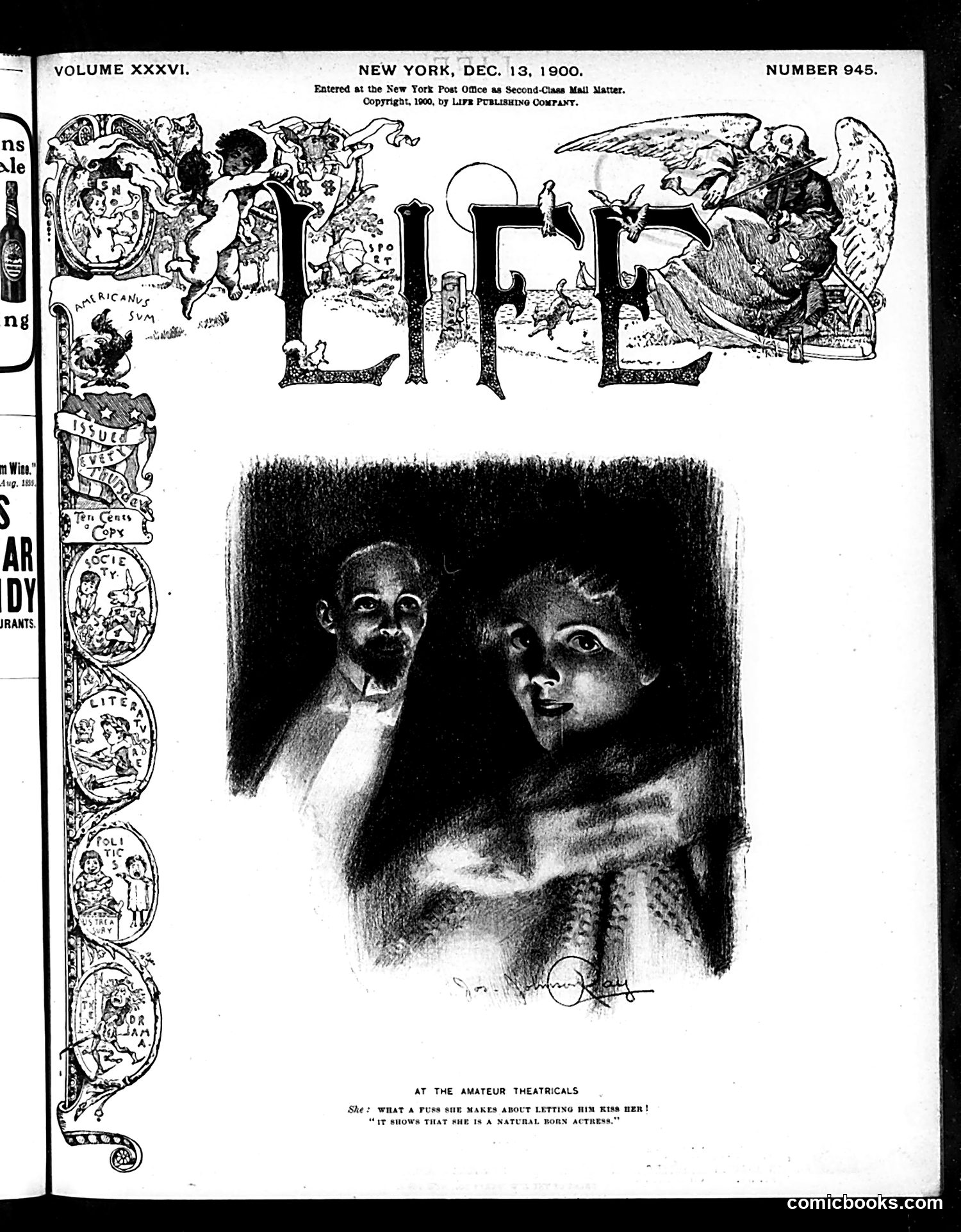
This page features a satirical sketch titled "At the Amateur Theatricals" with the caption: "She: What a fuss she makes about letting him kiss her! 'It shows that she is a natural born actress.'" The cartoon depicts two figures in an intimate moment, using theatrical performance as a metaphor for courtship behavior. The satire suggests that a woman's dramatic resistance to a man's romantic advances—her theatrical "fussing"—actually demonstrates genuine acting talent rather than sincere reluctance. The joke satirizes both amateur theatricals (community theater productions popular in the era) and social conventions around courtship, implying that romantic resistance itself is performative rather than authentic. The ornate decorative border and elaborate masthead design are typical of Life's elegant 1900s presentation.
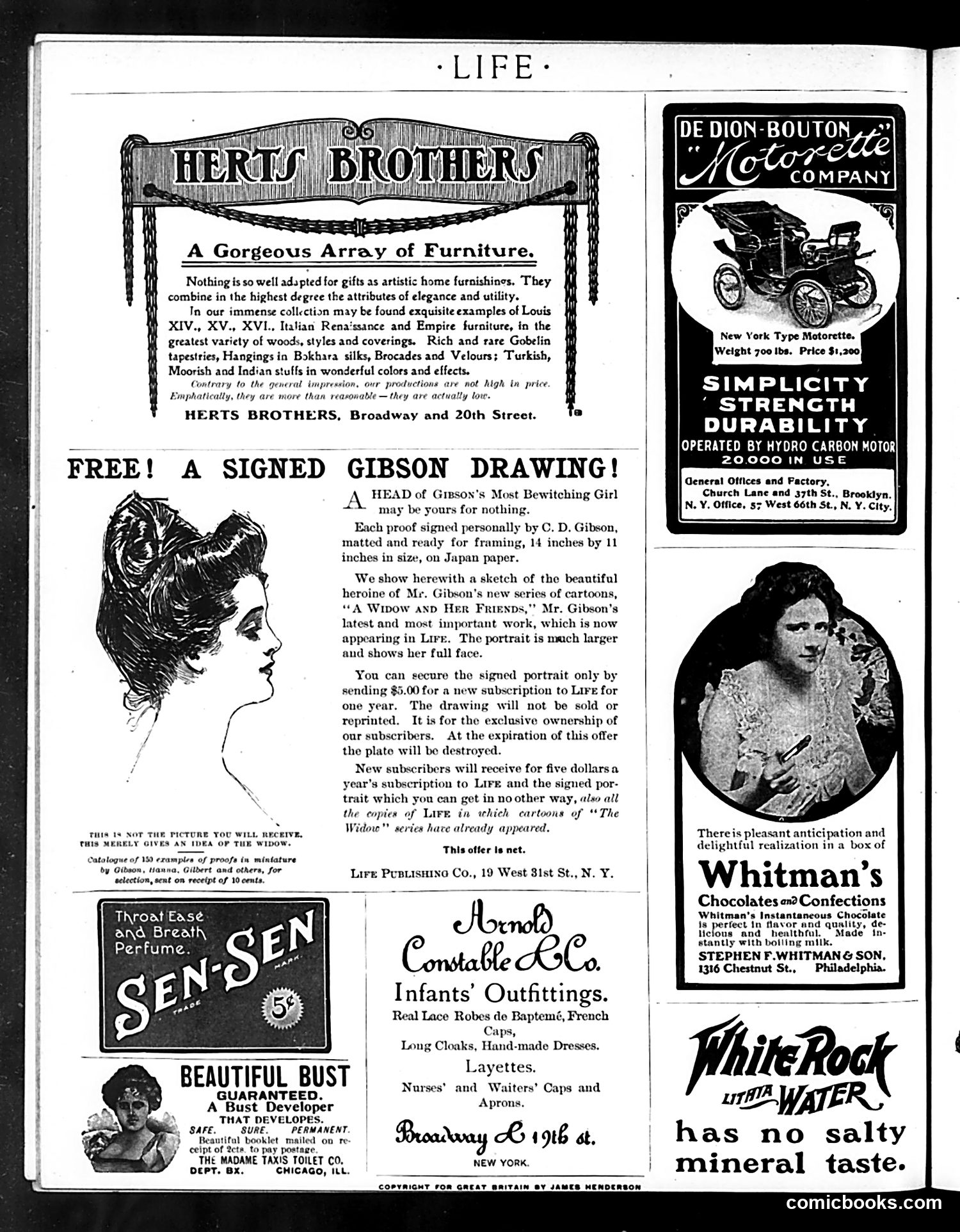
This page is primarily **advertising** rather than political satire or comics. The main advertisements include: - **Hertz Brothers Furniture**: A luxury goods vendor highlighting high-end home furnishings - **Gibson Drawing Promotion**: Life magazine offers a free signed C.D. Gibson portrait (a famous illustrator) to new subscribers - **De Dion-Bouton Motorette**: An early automobile advertisement - **Arnold Constable & Co.**: Infants' clothing retailer - **Whitman's Chocolates**, **Sen-Sen Perfume**, and **White Rock Water**: Consumer product ads The Gibson portrait offer is the most noteworthy content—it's a subscription incentive featuring one of his recognizable stylized female portraits ("The Widow"), presented as valuable exclusive content for subscribers. This reflects early 1900s magazine marketing practices rather than satirical commentary.
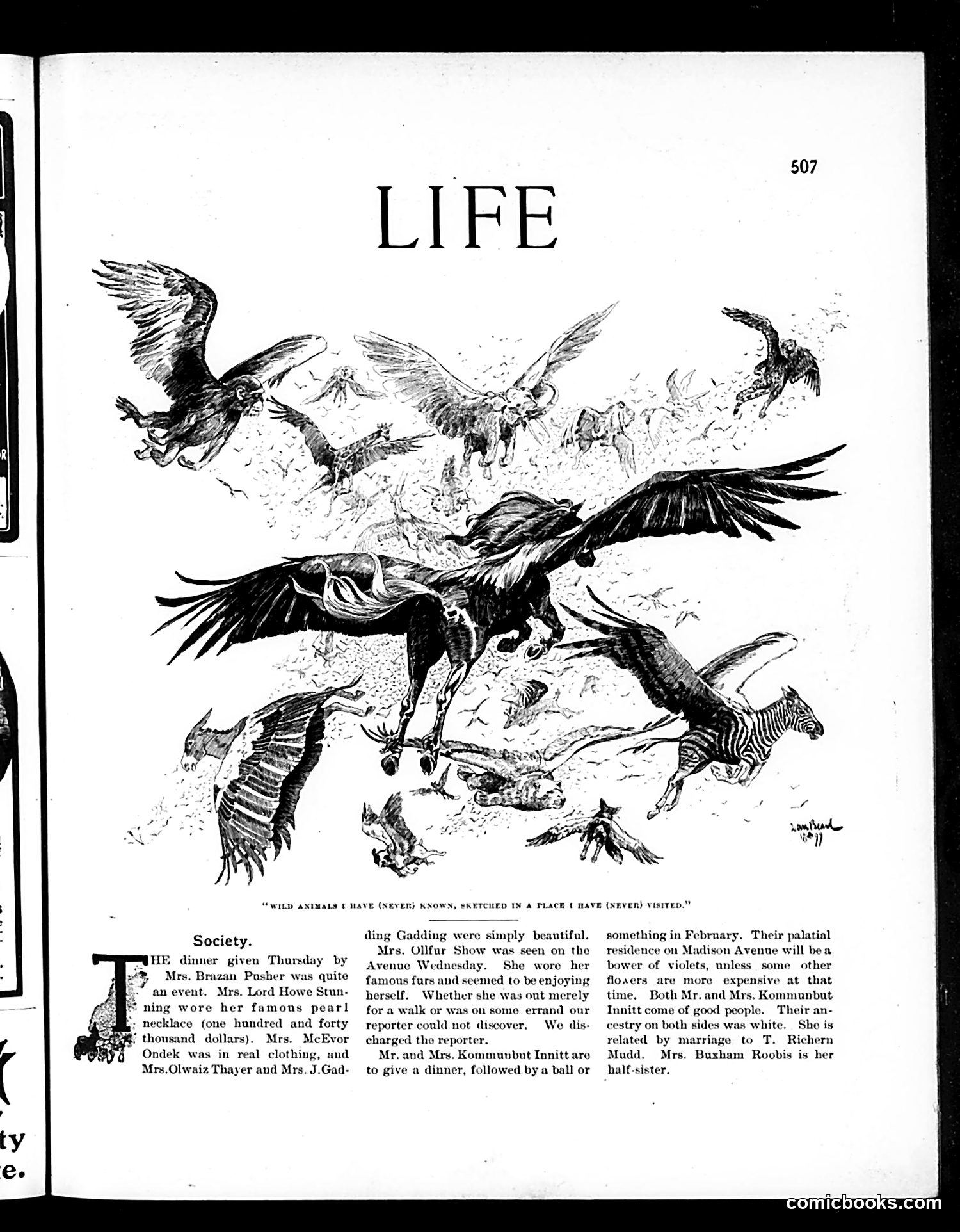
The main illustration depicts various winged creatures—eagles, birds, and a zebra—in dynamic motion, captioned "Wild animals I have [never] known, sketched in a place I have [never] visited." This appears to be satirical commentary on **fantastical or exaggerated travel writing** popular in the era. The joke suggests the artist is mocking travelers or writers who describe exotic animals they claim to have encountered in places they've never actually visited—implying fabrication or tall tales. The "Society" section below discusses upper-class social events (dinners, balls) among New York's wealthy, including mentions of Mrs. Lord Howe Sunning's famous pearl necklace and various high-society figures. This juxtaposes the frivolous society column with the cartoon's mockery of fabrication, possibly suggesting similar dishonesty in social reporting.
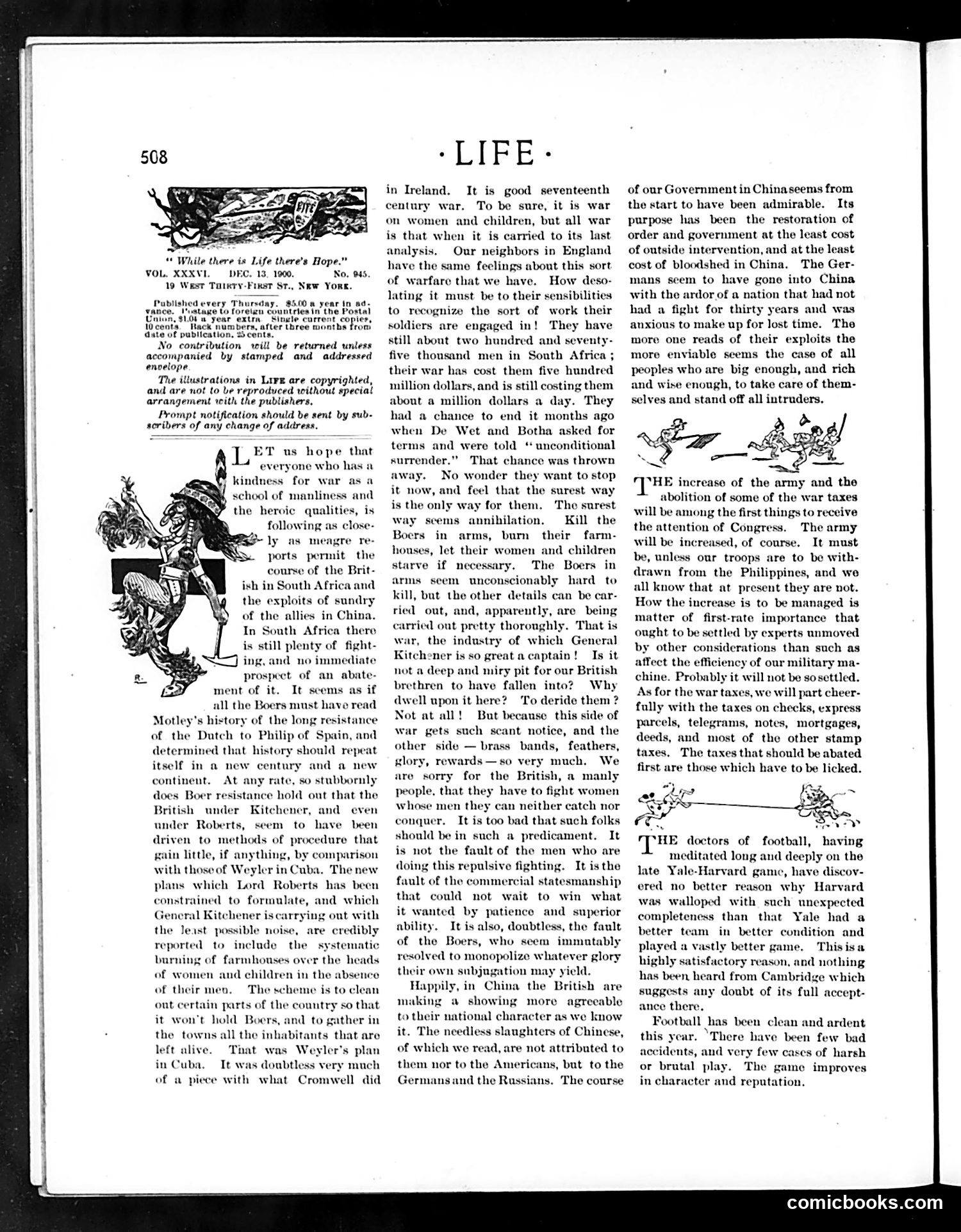
This page contains editorial commentary on the Boer War in South Africa (referenced explicitly in the text). The illustrated decorative letters and small vignettes critique British military conduct during the conflict. The text discusses how British forces under Kitchener are fighting Boer resistance, noting the war's brutality toward civilians—burning farmhouses and causing starvation. The author argues this harsh strategy, while debated, reflects commercial rivalry rather than soldier misconduct. The page also praises recent improvements in football (soccer), noting fewer injuries and better sportsmanship that season. The decorative initial letters and small illustrations appear to be typical *Life* magazine embellishments rather than specific political caricatures requiring identification. The satire targets British war methods indirectly through earnest analysis rather than direct mockery.
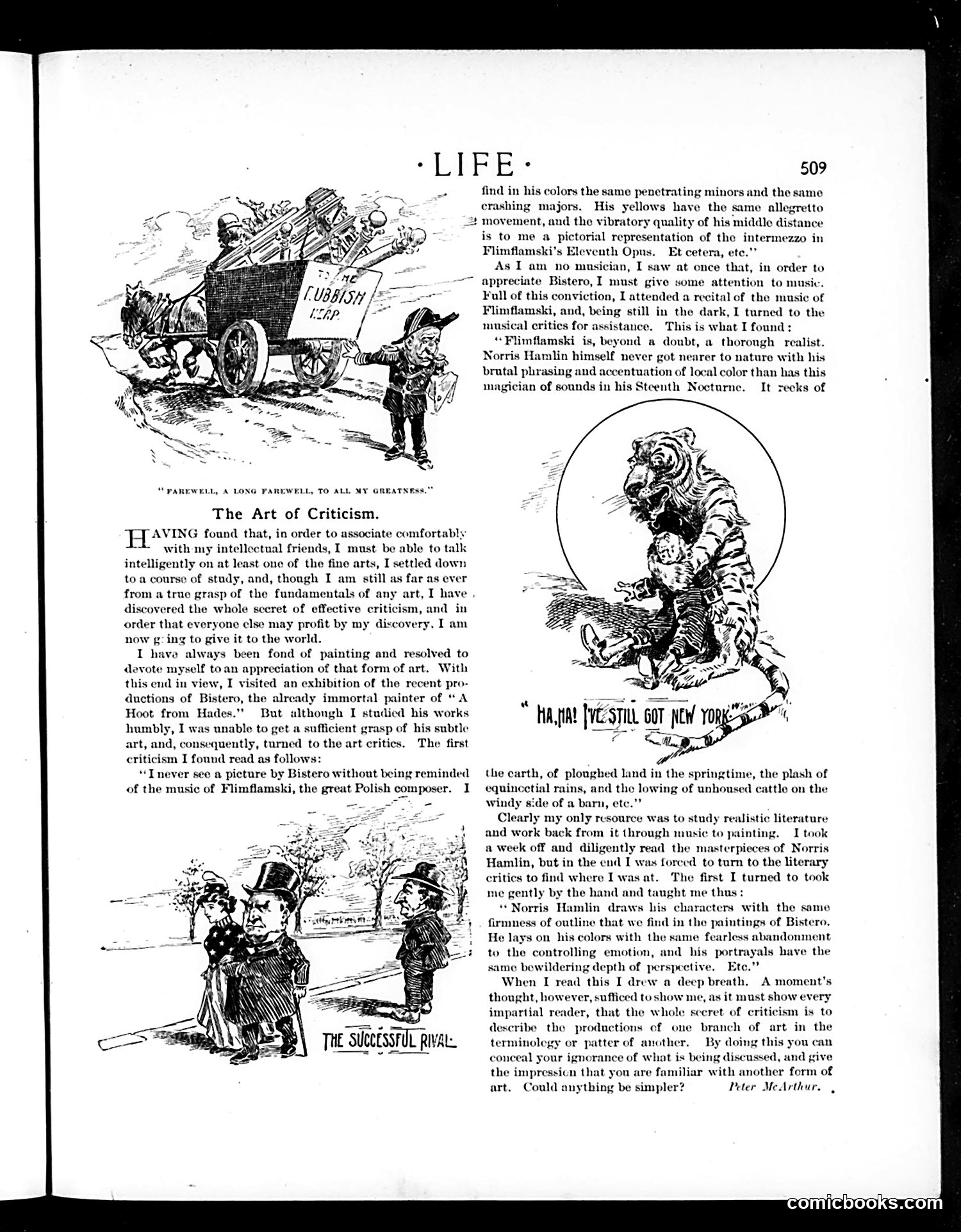
This page satirizes art criticism through Peter McArthur's essay about learning to critique paintings. The cartoons illustrate his argument that critics often use pretentious language to mask ignorance. The top cartoon labeled "Farewell, a long farewell, to all my greatness" depicts a trash cart, likely mocking how harsh criticism can destroy an artist's reputation. The middle image shows what appears to be a caricatured figure (possibly representing a specific critic or artist, though unclear from context alone). The bottom cartoon titled "The Successful Rival" shows three figures in period dress, apparently depicting competitive dynamics in the art world. McArthur's point: effective criticism requires understanding art's fundamentals, not merely adopting the terminology of established critics like the painter Bistero or composer Flimllamski to appear knowledgeable.
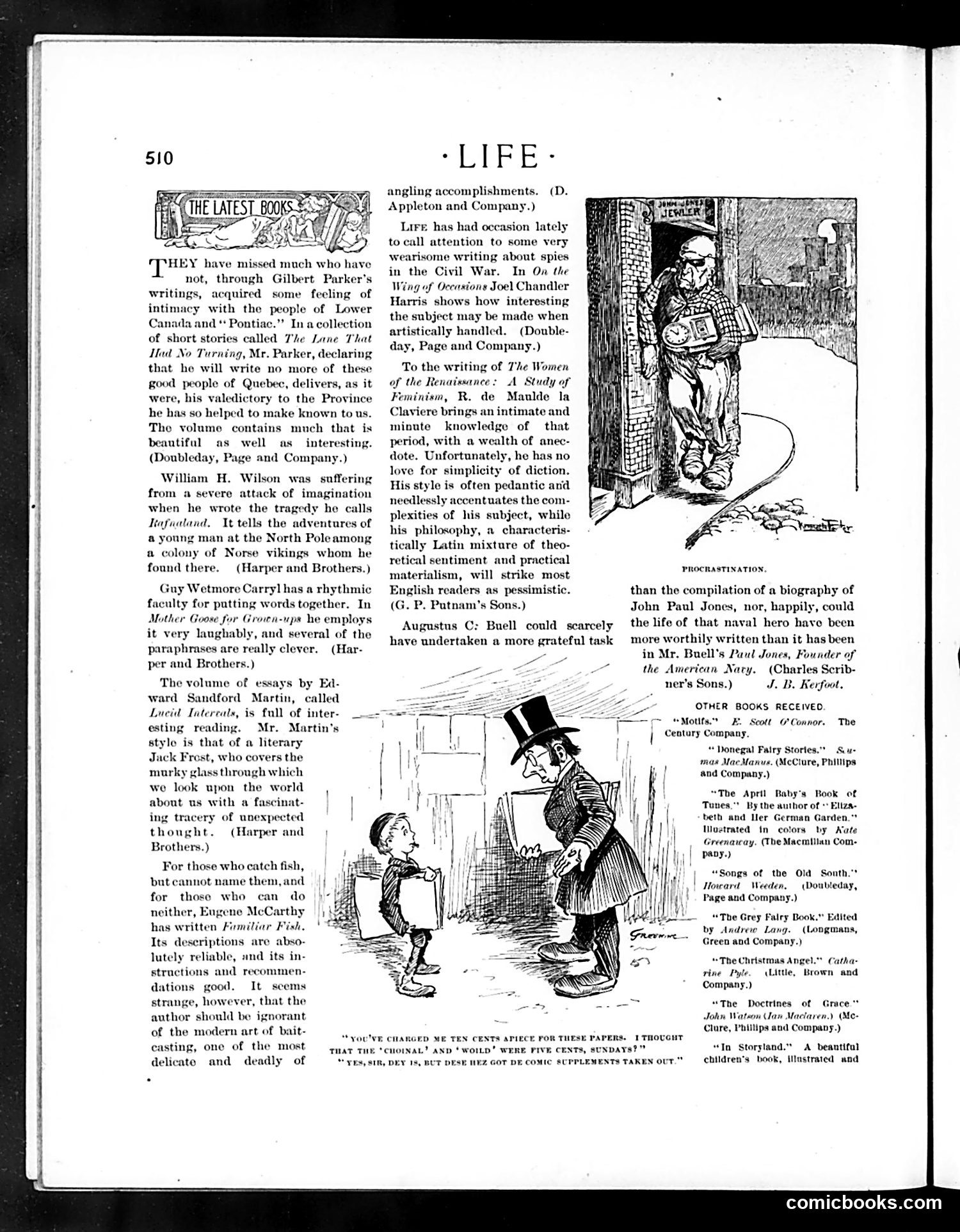
This page is primarily a book review section titled "The Latest Books," with one cartoon illustration. The cartoon depicts a well-dressed gentleman in a top hat speaking to a ragged street child. The caption reads: "You've charged me ten cents apiece for these papers. I thought that the 'original' and 'world' were five cents, Sundays?" The child responds: "Yes, sir, they is, but dese here got de comic supplements takes up." The satire targets newspaper pricing practices of the era—specifically, publishers charging premium prices when comic supplements were included, despite no actual increase in production cost. The joke mocks both the deceptive pricing strategy and the child vendor's acceptance of this practice as normal business.
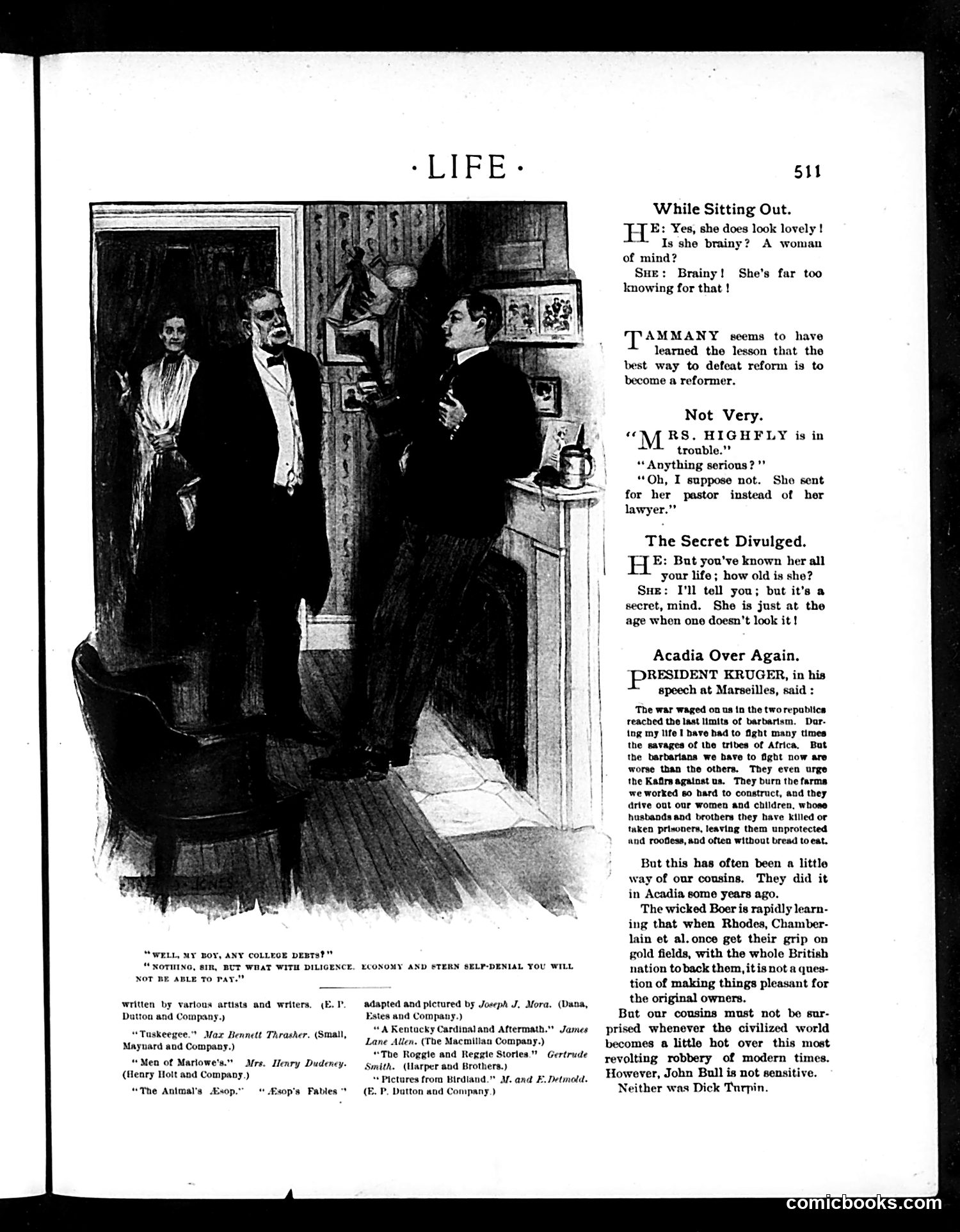
The main illustration depicts a domestic scene with social commentary. The caption "Well, My Boy, Any College Debts?" followed by "Humph, His Wife with Diligence, Economy and Stern Self-Denial You Will Not Be Able To Pay" suggests satirical commentary on financial responsibility and marriage. The right-side text sections include jokes about women's appearance and intelligence ("While Sitting Out"), a quip about reformers ("Tammany"), and commentary on Mrs. Highfly's troubles. The longer "Acadia Over Again" section references President Kruger's speech about colonial conflicts in Africa, comparing European colonial behavior to historical injustices in Acadia, with commentary on British actions and the Boer conflict. The overall page blends domestic humor with international political satire typical of early 20th-century Life magazine.
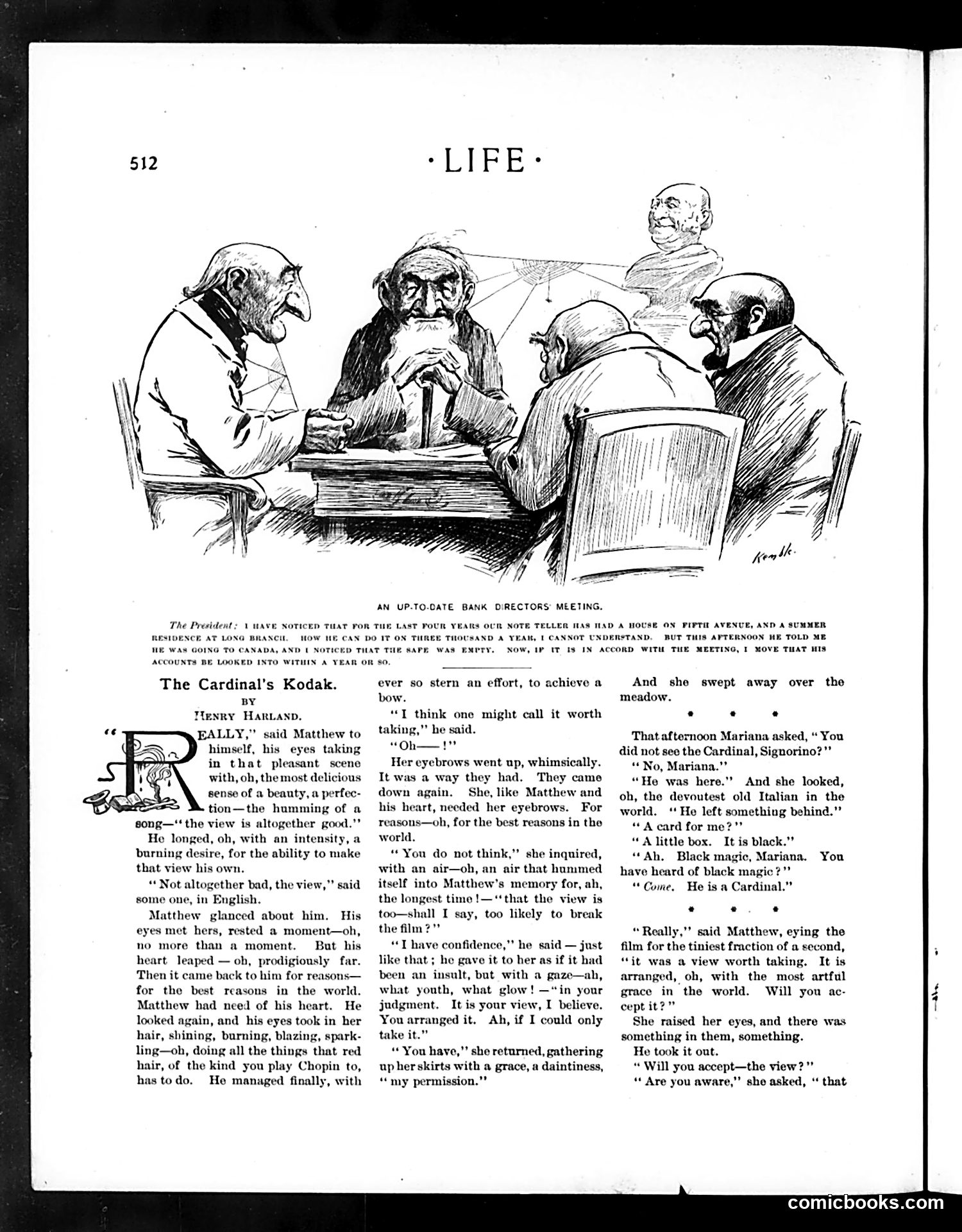
**The Cartoon:** "An Up-to-Date Bank Directors' Meeting" depicts five elderly men in discussion, with one figure depicted as a bust or sculpture in the background—suggesting a figurehead or absent authority. **The Satire:** The president's speech (quoted below the cartoon) complaints that a note teller maintained a house on Fifth Avenue and a rubber business on Long Branch, earning $3,000 yearly but cannot explain his wealth. He asks if accounts were "lowered into within a year or so." **The Point:** This mocks bank leadership's blindness to employee fraud or embezzlement. The "up-to-date" bank directors are apparently oblivious to obvious financial misconduct—a critique of corporate governance and negligent oversight among the wealthy during the Gilded Age. **"The Cardinal's Kodak"** is a separate short story beginning below.
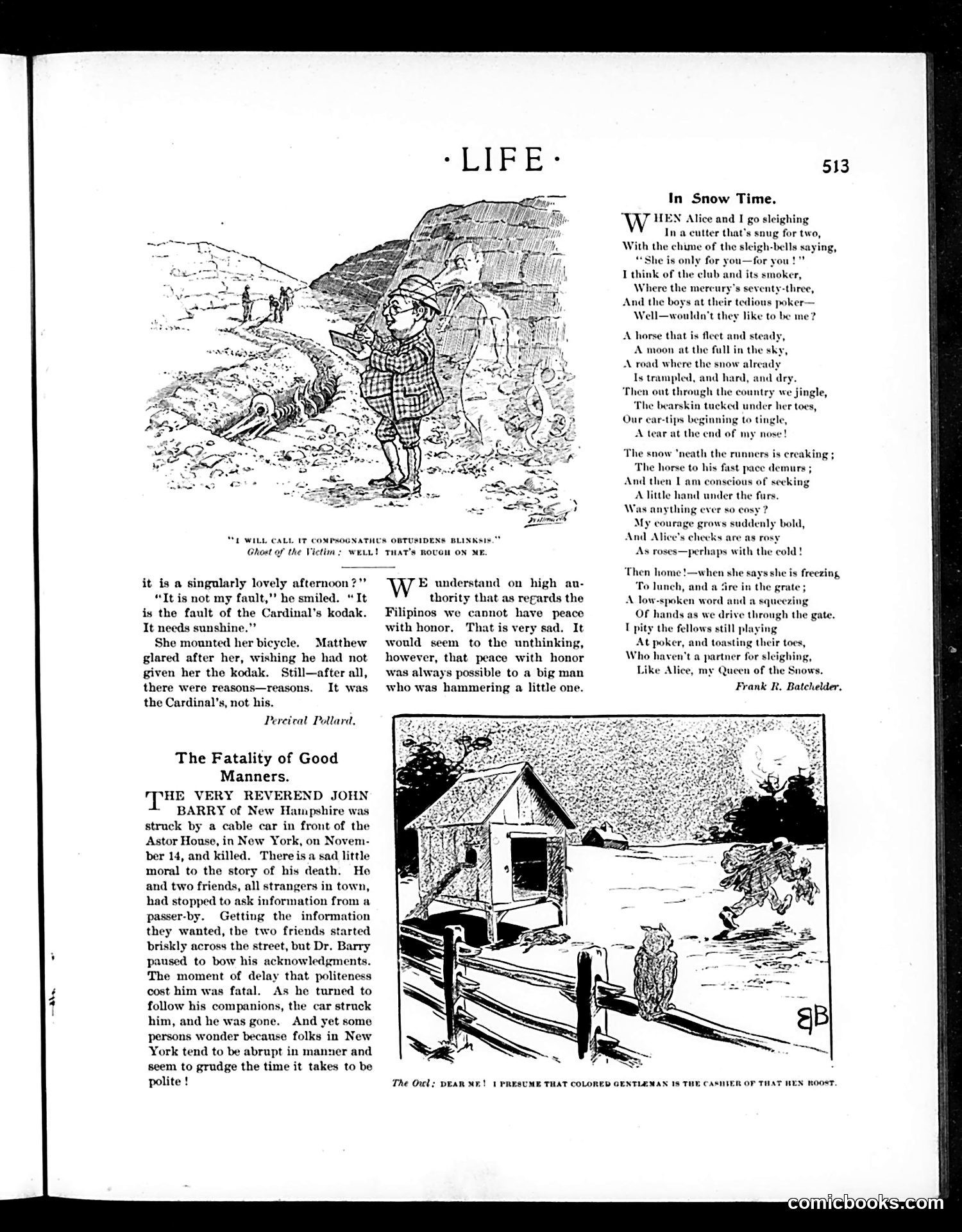
This page contains two distinct pieces: **"In Snow Time"** (top right): A poem by Frank Batchelder about winter romance and coziness, illustrated with a snowy landscape scene. It's sentimental Victorian-era verse celebrating the comfort of being with a loved one during cold weather—straightforward romantic content with no satirical intent. **"The Fatality of Good Manners"** (bottom): A brief anecdote mocking New York social conventions. It describes how Reverend John Barry of New Hampshire was fatally struck by a cable car while politely bowing to acknowledge friends' greetings. The satire criticizes excessive politeness as potentially dangerous—a commentary on rigid social etiquette that prioritizes formality over practical safety. The accompanying cartoon illustrates this absurdist scenario. The page juxtaposes sentimental romance with social satire typical of *Life* magazine's approach.
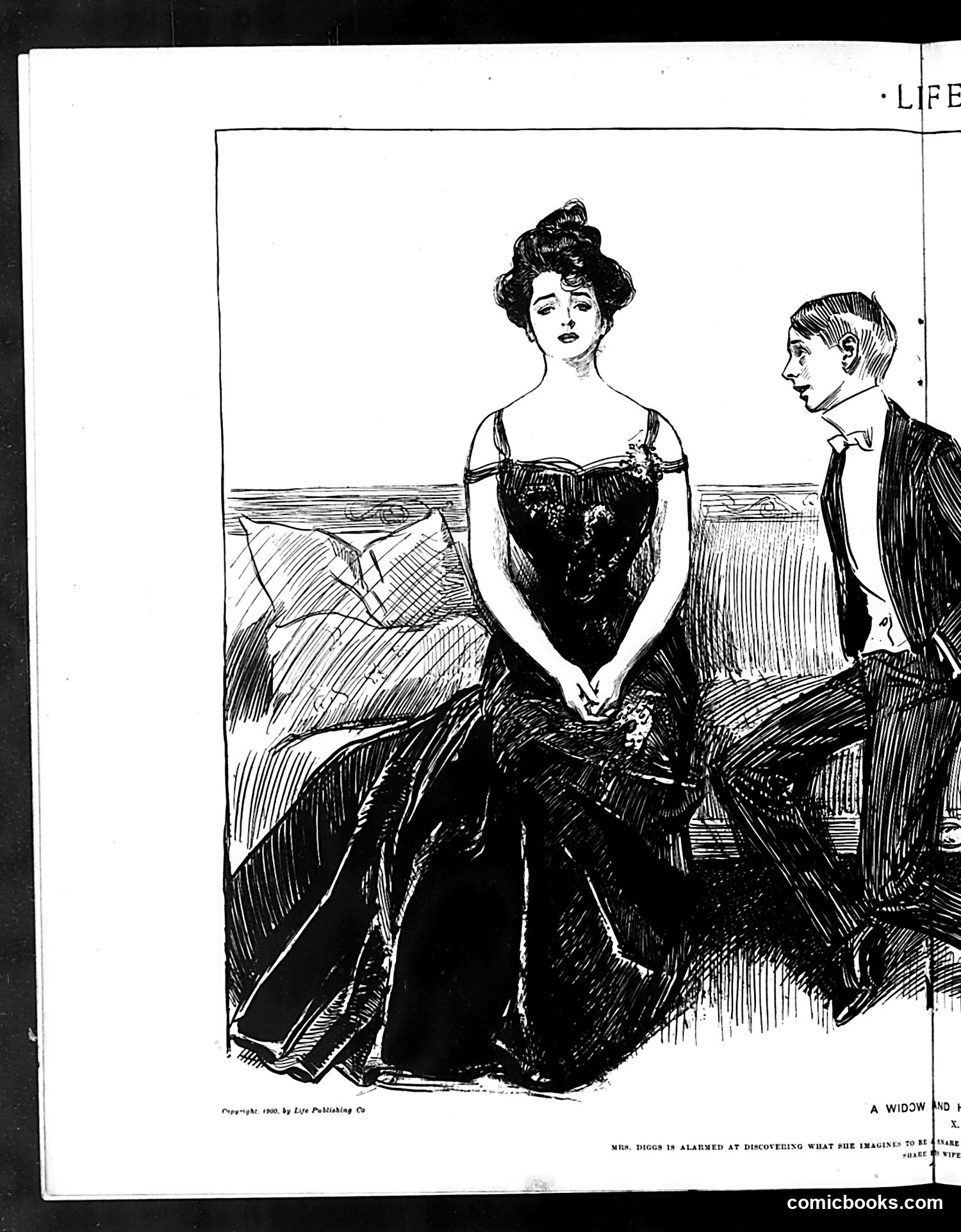
This appears to be a satirical illustration from Life magazine (copyright 1908) titled "A Widow and..." (the full title is cut off). The image shows a well-dressed woman in an elegant black evening gown seated on a couch, with a man in formal attire seated beside her. The partially visible caption at bottom reads: "MRS. DIGGS IS ALARMED AT DISCOVERING WHAT SHE IMAGINES TO BE A STAIN ON HER HUSBAND'S WIFE" (text is unclear/cut off). The satire appears to target marital anxiety or jealousy—specifically a widow's suspicious concern about evidence (real or imagined) relating to her husband. The drawing style and subject matter reflect early 20th-century social commentary on middle-class domestic relations and women's concerns about infidelity. Without the complete caption and context, the specific historical reference remains unclear.
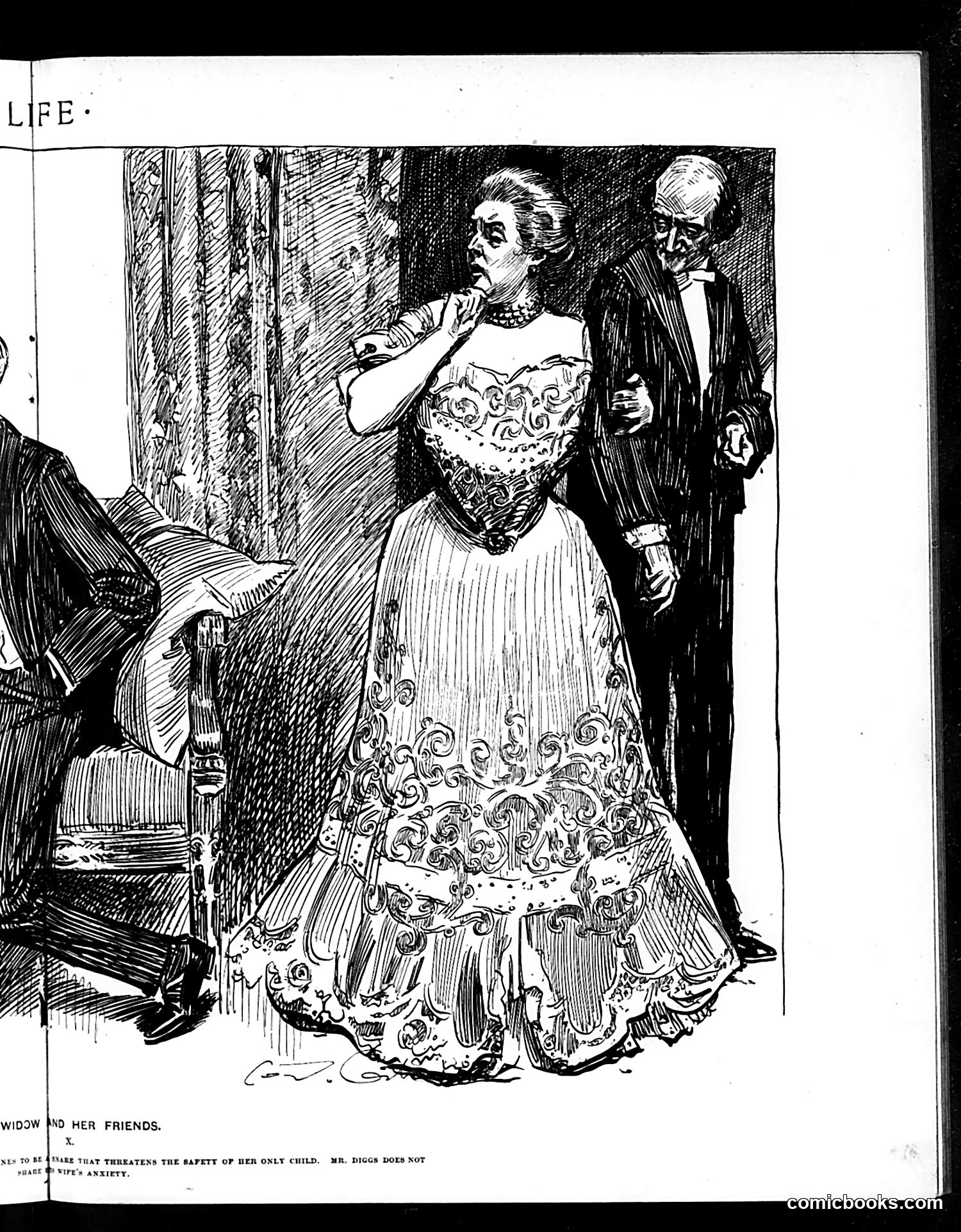
This Life magazine illustration depicts a wealthy widow in an ornate, elaborate dress surrounded by gentlemen callers. The caption references "Mr. Diggs" and mentions concern about "the safety of her only child" and "wife's anxiety." The satire appears to target a wealthy widow's romantic social life and the anxieties it creates for her family. The ostentatious dress and the gathering of male suitors suggest mockery of either her extravagant spending or her remarriage prospects. The caption's reference to Mr. Diggs not sharing his wife's concerns implies conflicting views within families about the widow's behavior or financial decisions. The cartoon likely satirizes Gilded Age social dynamics—specifically the remarriage market for wealthy widows and family tensions over inheritance and propriety.
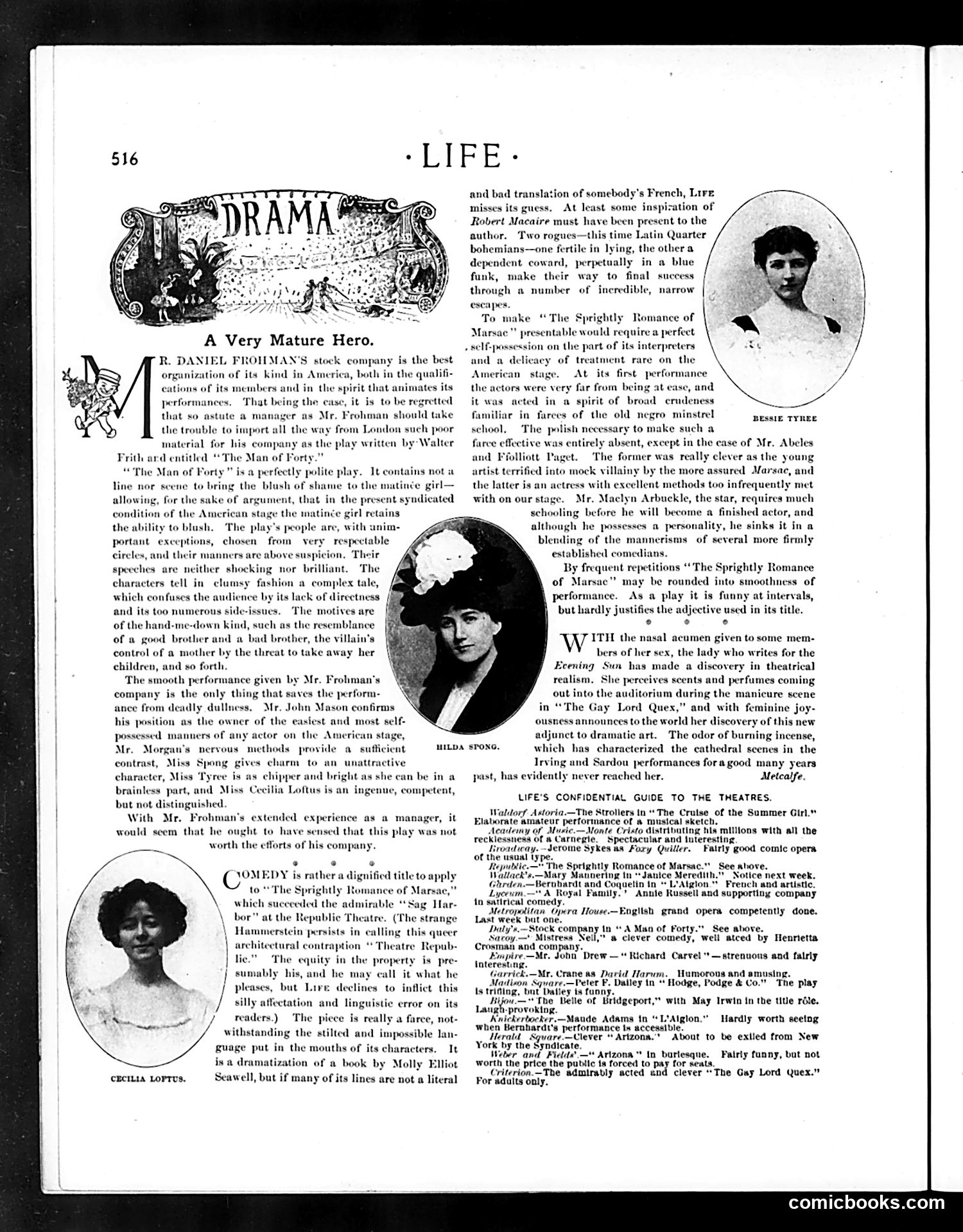
This page reviews theatrical productions, not political cartoons. The "Drama" header frames theater criticism rather than satire. The section critiques "The Sprigtly Romance of Marsac," praising Mr. Frolman's company while noting the play itself lacks originality and contains "not a line not vexed to bring the blush of shame." The review praises individual actors (Hilda Spong, Cecilia Loftus) for their charm and skill, despite the weak material. The accompanying photographs show performers in the production. The "Life's Confidential Guide to the Theatres" box lists current New York productions with brief reviews. This represents standard theater criticism from the early 1900s, focusing on performance quality and dramatic merit rather than political or social satire.
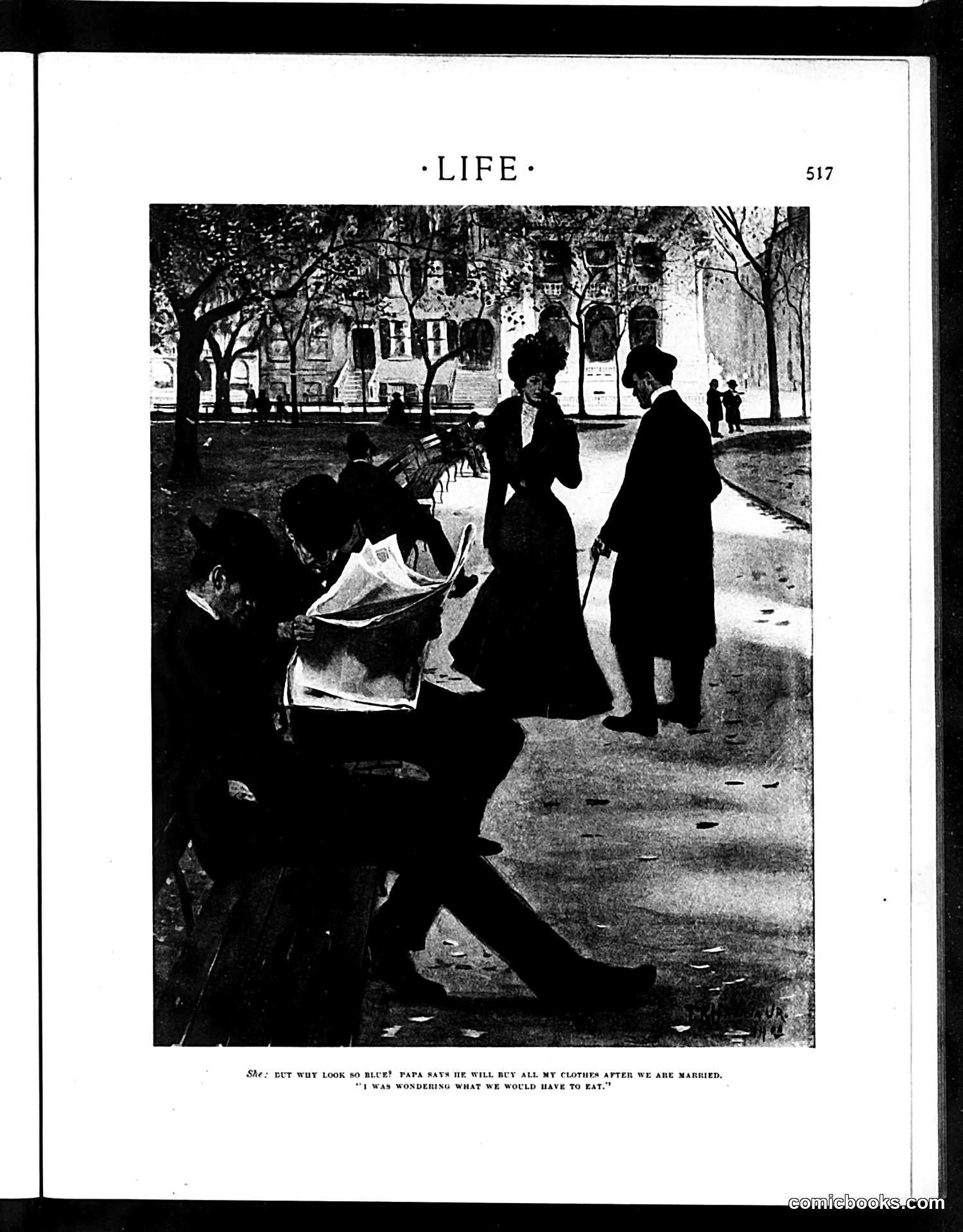
This Life magazine illustration satirizes anxieties about marriage and financial security. A young woman in an urban park setting expresses concern about basic necessities—specifically food—after marriage. Her male companion appears dejected, likely because her comment implies he cannot provide adequately for her. The satire targets the economic pressures on young men and the transactional nature of courtship in this era. The woman's mention that "papa says he will buy all my clothes" suggests her father will subsidize her wardrobe, yet she worries about her fiancé's ability to feed her. The joke highlights the gap between romantic expectations and harsh financial realities facing working-class or modest-income couples considering marriage. Her blunt concern about food—a fundamental need—undercuts any romantic sentiment.
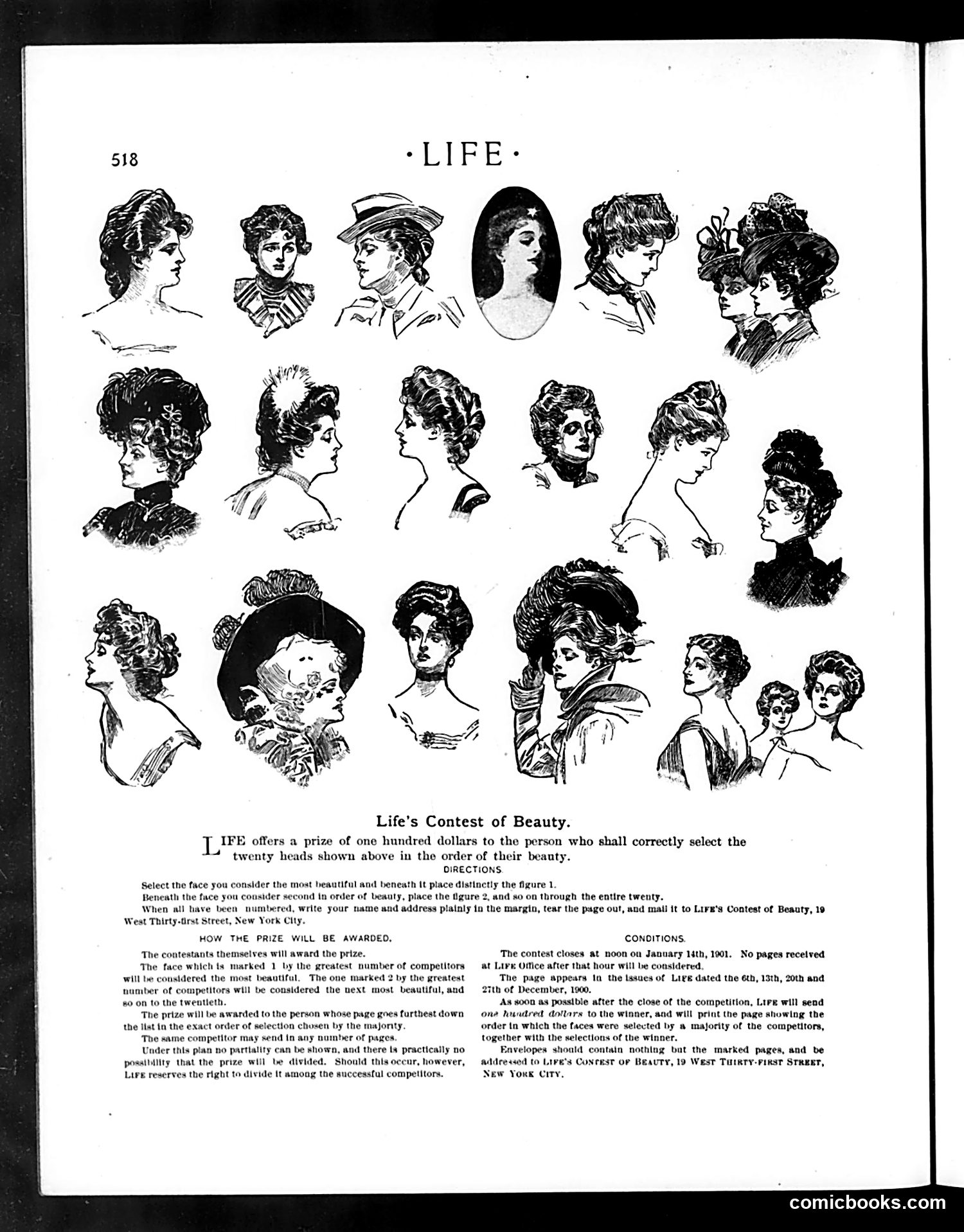
This is a participatory contest, not political satire. Life magazine published twenty female head sketches and invited readers to rank them by beauty, offering a $100 prize to whoever's ranking matched the majority vote. The appeal exploited contemporary fascination with objective standards of beauty—a popular pseudo-scientific concern of the era. Readers were asked to mail in their ranked selections, making it a democratic "beauty pageant" determined by popular consensus rather than expert judges. The contest reflects early 1900s values: the focus on women's appearance as entertainment, the assumption that beauty could be systematically measured and ranked, and Life's confidence that thousands of readers would participate in this frivolous but engaging exercise. The drawings show varied hairstyles and dress typical of the period, suggesting different "types" of feminine beauty for comparison.
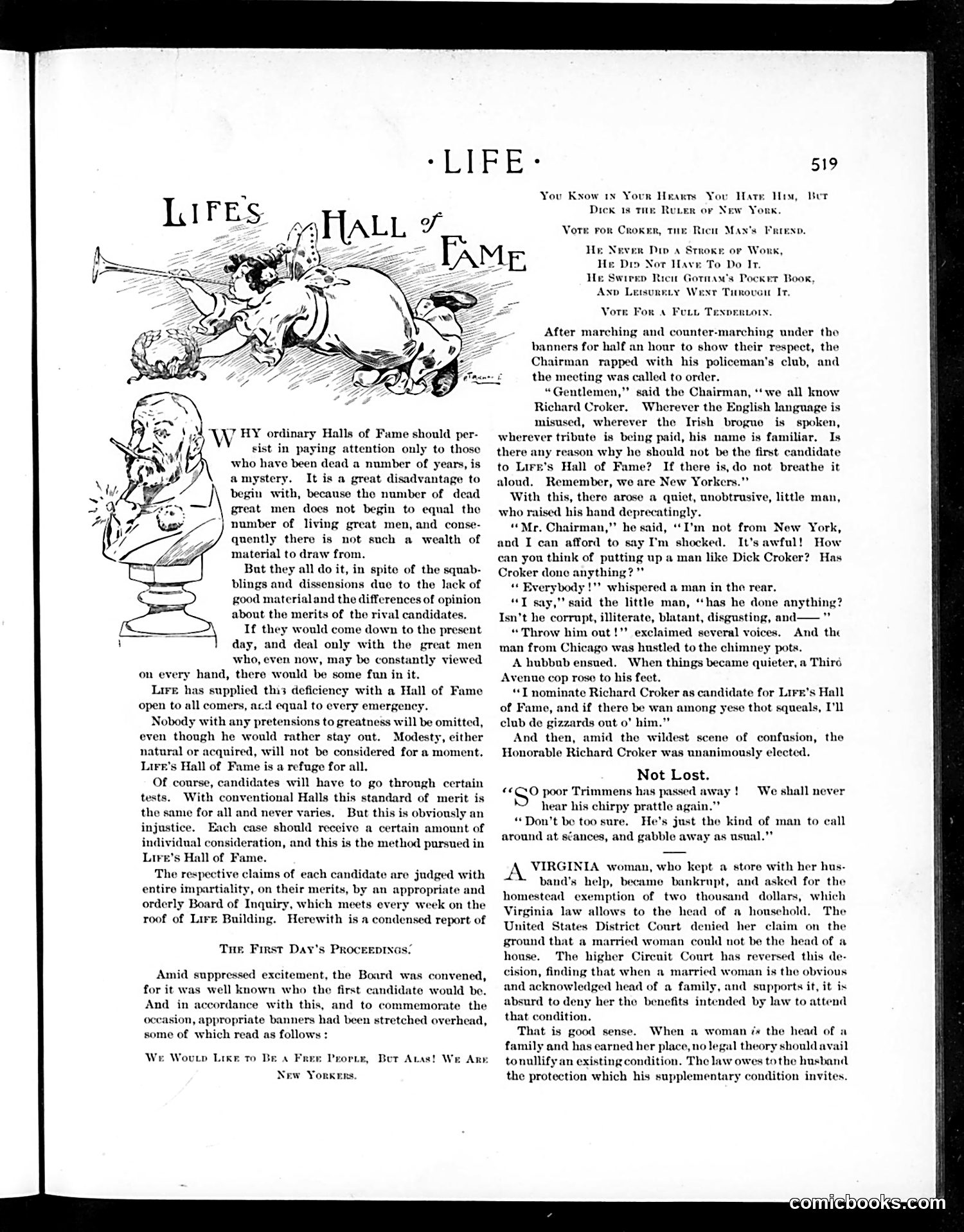
This satirical piece mocks the selection of **Richard Croker**—New York's corrupt Democratic political boss—as the inaugural candidate for *Life*'s new "Hall of Fame" for living (not dead) great men. The joke: Croker, a notorious Tammany Hall figure associated with graft and malfeasance, is being "honored" through obviously sarcastic banners celebrating his control over New York politics. When a visiting outsider protests that Croker is "corrupt, illiterate, blatant, disgusting," he's literally thrown out by a Tammany-connected cop who threatens violence. The satire exposes how political machines like Tammany Hall operated: through intimidation, corruption, and the silencing of dissent. By having Croker unanimously "elected" via coercion rather than merit, *Life* ridicules both the boss system's brazenness and New York voters' apparent powerlessness against it. The piece targets Croker's domination of New York politics in the late 1880s-1890s.
This page contains primarily **text content and advertisements** rather than political cartoons. The main items are: 1. **"In Lapland"** — A light romantic poem about a couple in Lapland, with a pun on "lap-land" (playing on the girl sitting in the man's lap). This is gentle humor, not political satire. 2. **Two anecdotes** illustrating how imagination affects health and how misread letters cause unnecessary worry — humorous stories about human nature, not social commentary. 3. **Social humor snippets** (bottom half): Brief jokes about a woman buying a black dress as a "bargain" (for hunting), and a pompous Parliament member claiming importance to a working-class cockney who dismisses him — mild class satire showing the working man unimpressed by official status. The page is mainly **filler content** between advertisements for Wilson Whiskey and Hunter Baltimore Rye, with promotional copy for the Christmas "LIFE" number at the bottom. **No significant political cartoon or satire** is present. This appears to be a typical page from the magazine's lighter, humorous content.
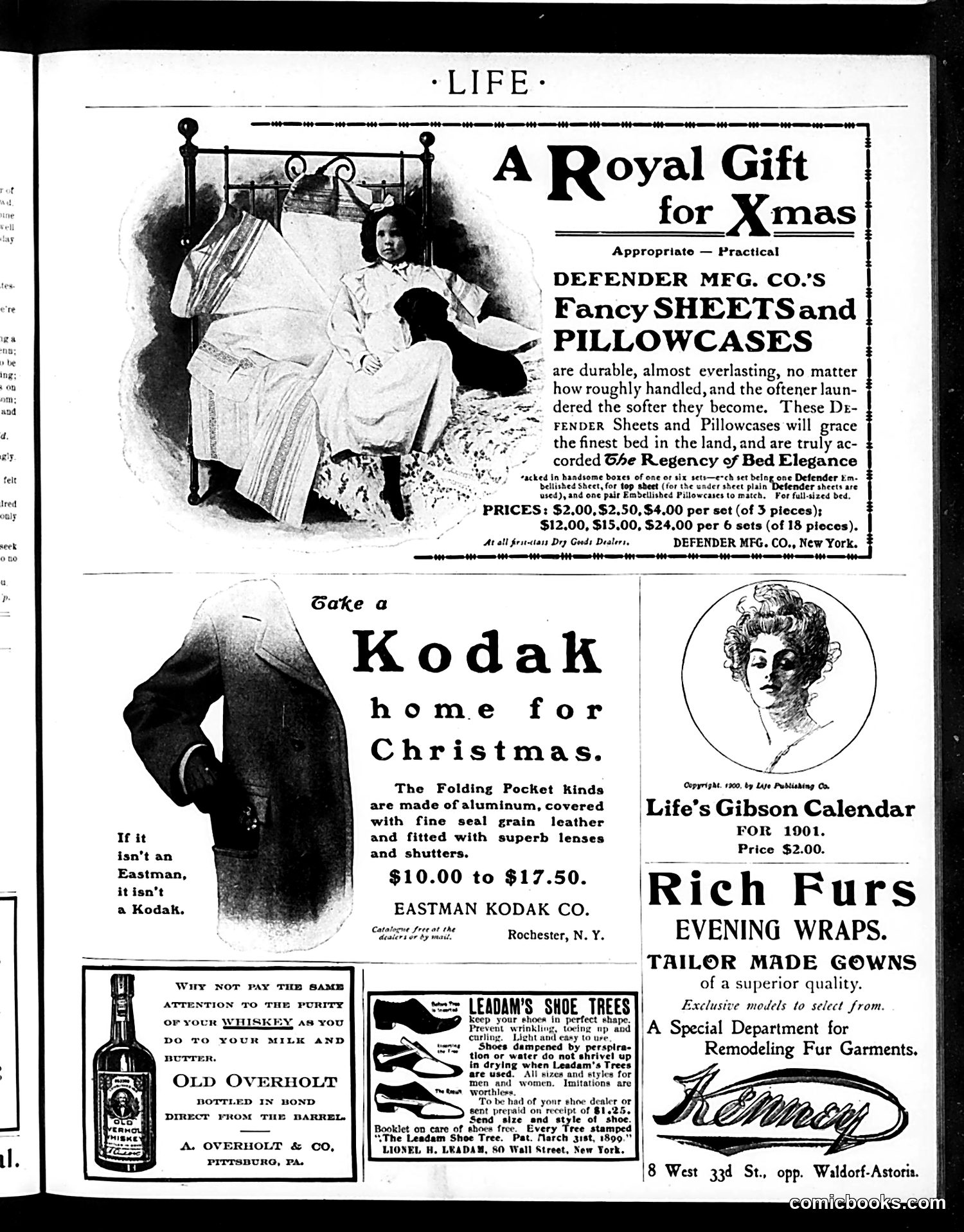
This is primarily an **advertisement page** from Life magazine (circa 1900), not a political cartoon. It contains six separate luxury gift advertisements aimed at wealthy Christmas shoppers: 1. **Defender sheets/pillowcases** — marketed as durable, elegant bed linens 2. **Kodak cameras** — "If it isn't an Eastman, it isn't a Kodak" (brand-protection slogan) 3. **Old Overholt whiskey** — plays on era's concern for product purity, comparing liquor quality to milk safety 4. **Leadam shoe trees** — devices to maintain shoe shape during storage 5. **Life's Gibson Calendar** — featuring Charles Dana Gibson's iconic illustrations of idealized women 6. **Fur wraps and tailored gowns** — high-end women's fashion The page's tone and products reflect **early 1900s upper-class consumer culture**—expensive goods marketed as status symbols and appropriate holiday gifts. The implicit message: purchasing quality branded products demonstrates refinement and respectability. No satire or political commentary is evident.
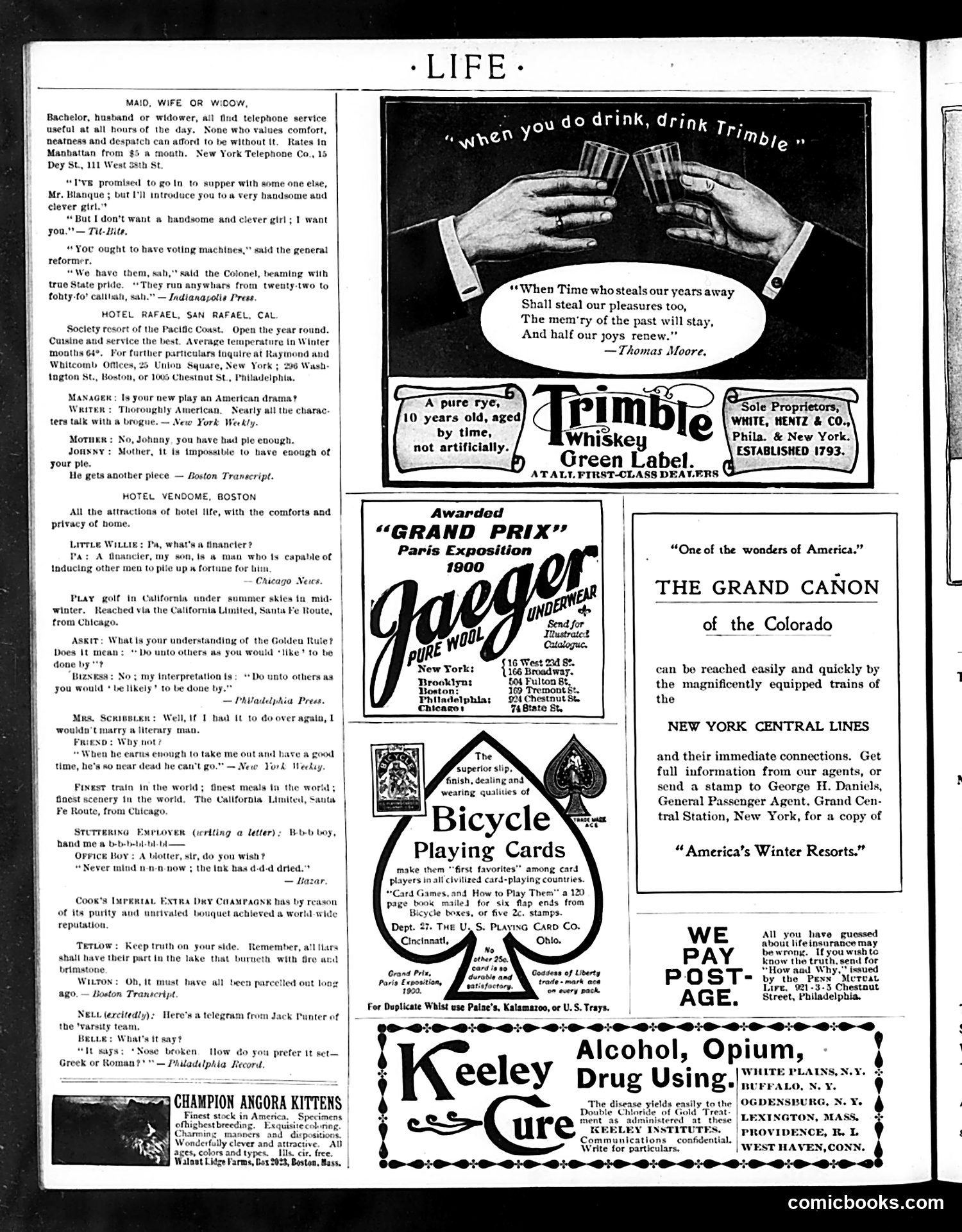
This page is primarily **advertising and humorous anecdotes** rather than political cartoons. The content reflects early 1900s American social attitudes: **Main Advertisements:** - **Trimble Whiskey**: Promotes aged rye whiskey with period poetry about memory and pleasure - **Jaeger Underwear**: Won "Grand Prix" at 1900 Paris Exposition - **Bicycle Playing Cards**: Marketed as "first favorites" among card players - **Keeley Cure**: Advertises treatment for "Alcohol, Opium, Drug Using"—notably, the same page advertising whiskey also promotes addiction treatment, reflecting contemporary attitudes toward substance abuse **Humor Section**: Brief jokes about dating, voting machines, theater, and family life—typical genteel humor of the era, featuring stereotyped Irish accents and light domestic situations. **Social Context**: The juxtaposition of whiskey ads with addiction-cure advertising reveals how early 1900s Americans simultaneously promoted and acknowledged alcohol's dangers without apparent contradiction.
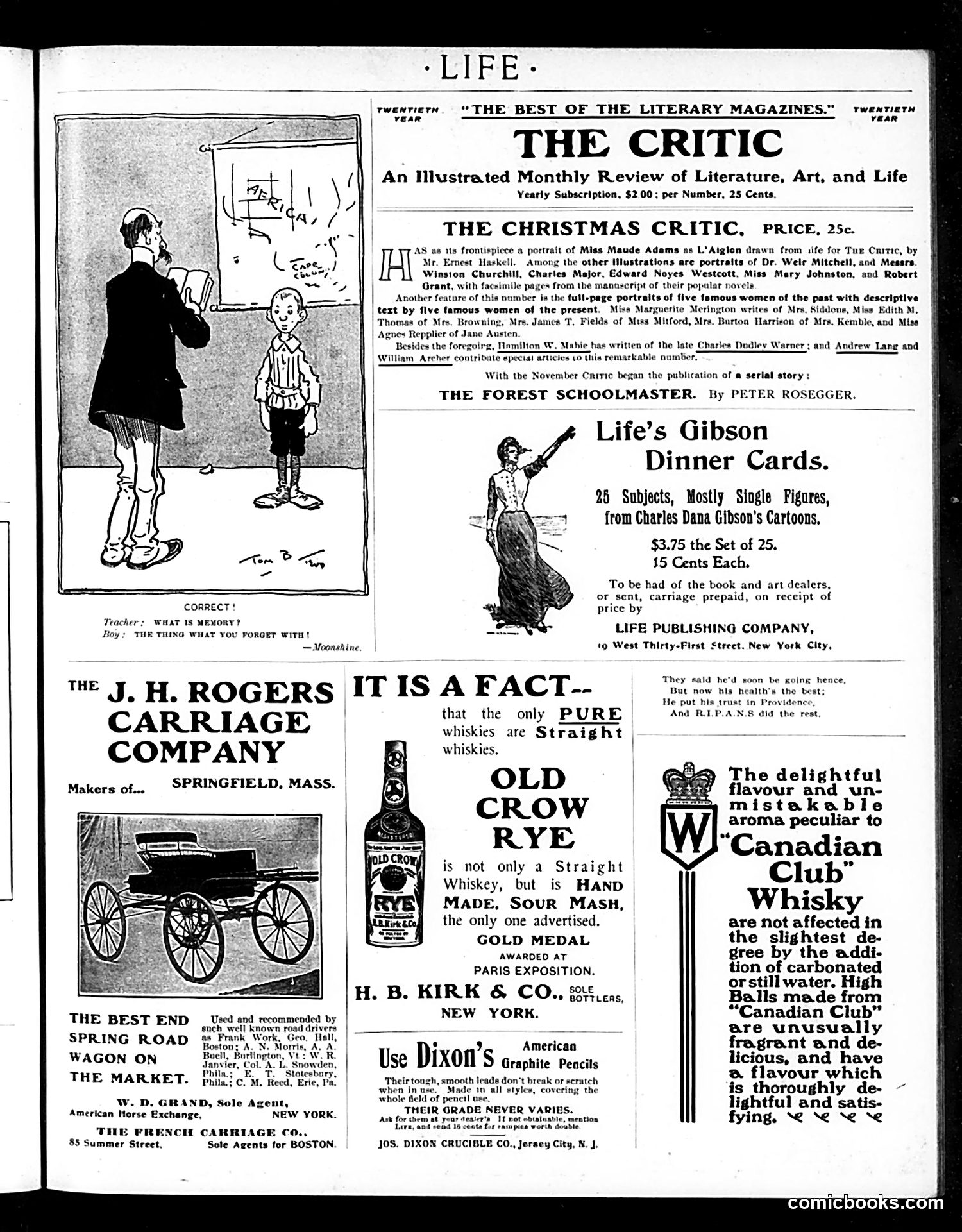
**The Main Cartoon:** The small illustrated joke at upper left shows a teacher asking a boy "What is memory?" The boy replies "The thing what you forget with!" — a simple play on children's mangled grammar and logic. It's labeled "Correct!" making the joke that the boy's definition, while grammatically wrong, is actually philosophically accurate about how memory works in practice. **Page Content:** This is primarily a **table of contents and advertising page** for *The Critic*, a companion literary review magazine. It announces the Christmas issue featuring portraits of famous writers (Churchill, Edward Noyes Westcott, Robert Grant) and essays by notable critics and authors (Andrew Lang, William Archer). The bulk of the page contains period advertisements for carriages, whiskey ("Old Crow Rye"), pencils, and dinner cards featuring Charles Dana Gibson's cartoons—reflecting early 1900s upper-class consumer goods. **Satirical Element:** Minimal satire appears here; the page functions mainly as editorial/advertising content typical of Life's era.
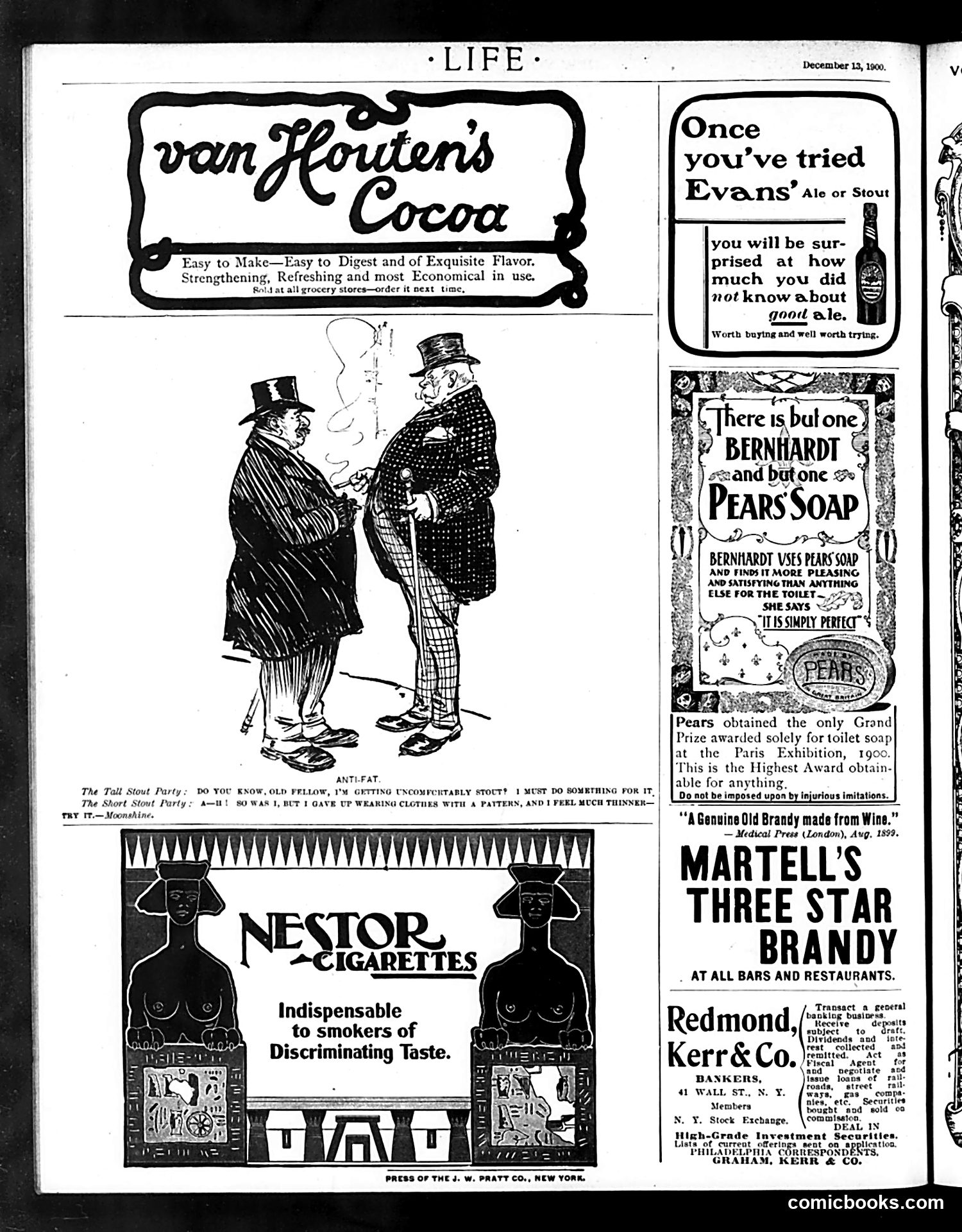
The main cartoon, titled "Anti-Fat," satirizes Victorian-era weight concerns and fashion solutions. Two portly gentlemen discuss their obesity: the tall one says he's becoming "uncomfortably stout" and needs a remedy, while the short one claims he solved his problem by abandoning patterned clothing—making himself *appear* thinner through fashion tricks rather than actual weight loss. The joke mocks both men's vanity and the era's absurd "solutions" to obesity: merely wearing solid colors instead of patterns creates an optical illusion of slimness. It's social satire about male vanity, body image anxiety, and the gap between appearance and reality. The page is otherwise filled with period advertisements (cocoa, cigarettes, soap, brandy, banking services), typical of Life's format blending editorial content with commercial messaging.