
Life, 1900-12-13 · page 6 of 20
Life — December 13, 1900 — page 6: what you’re looking at
What you’re looking at
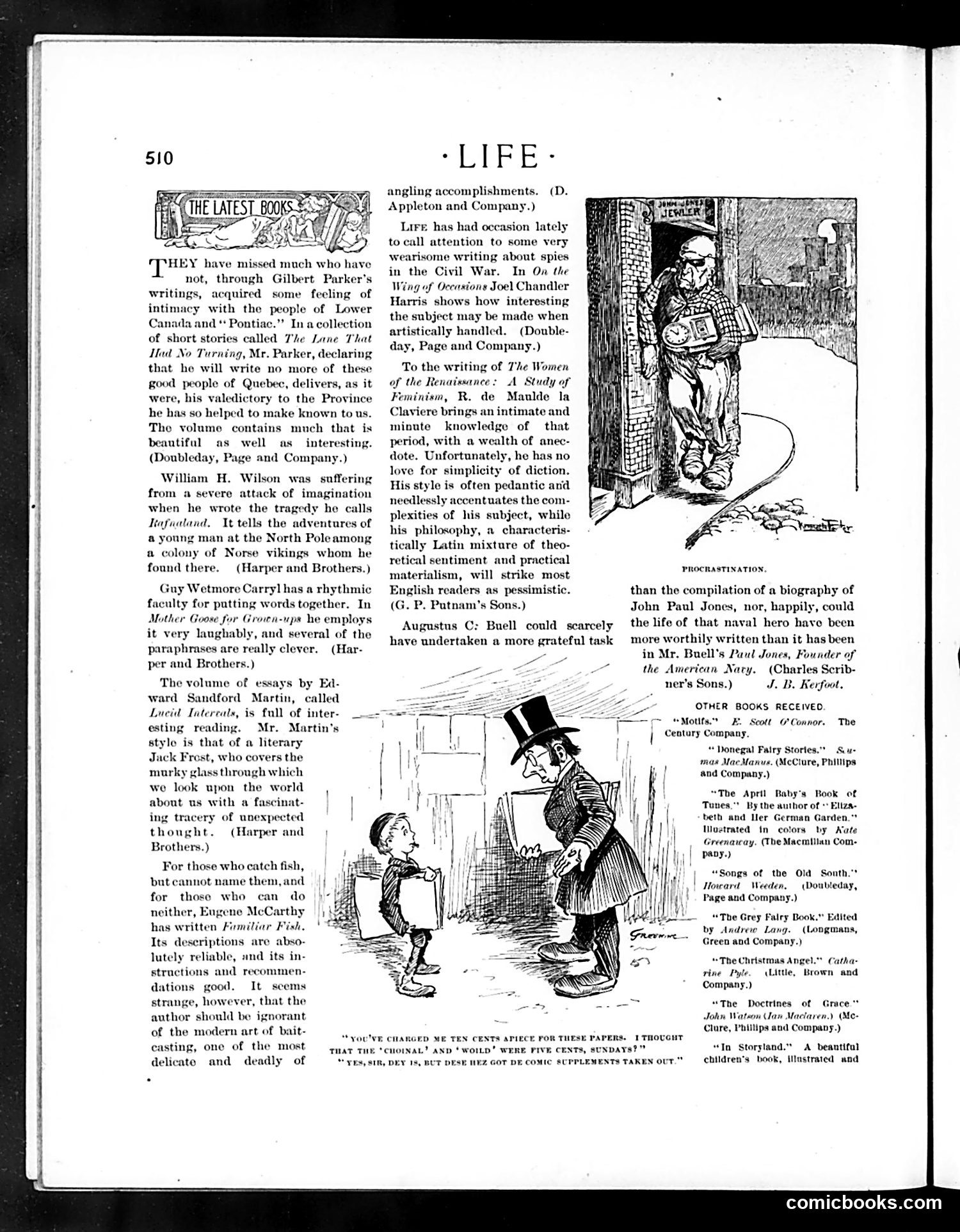
This page is primarily a book review section titled "The Latest Books," with one cartoon illustration. The cartoon depicts a well-dressed gentleman in a top hat speaking to a ragged street child. The caption reads: "You've charged me ten cents apiece for these papers. I thought that the 'original' and 'world' were five cents, Sundays?" The child responds: "Yes, sir, they is, but dese here got de comic supplements takes up." The satire targets newspaper pricing practices of the era—specifically, publishers charging premium prices when comic supplements were included, despite no actual increase in production cost. The joke mocks both the deceptive pricing strategy and the child vendor's acceptance of this practice as normal business.
📄 Transcribed text from this page (OCR, searchable)
Machine-transcribed from the original scan — historical spelling and the odd misread are preserved.
HEY have missed much who have not, through Gilbert Parker's writings, acquired some feeling of intimacy with the people of Lower Canada and * Pontiac.” Ina collection of short stories called The Lane That Id No Turning, Mr. Parker, declaring that he will write no more of these good people of Quebec, delivers, as it were, his valedictory to the Province he has so helped to make known to us. The volume contains much that is beautiful as well as interesting. (Doubleday, Page and Company.) William H. Wilson was suffering from a severe attack of imagination when he wrote the tragedy he calls Kafualand. It tells the adventures of a young man at the North Poleamong a colony of Norse vikings whom he found there. (Harper and Brothers.) Guy Wetmore Carry] has a rhythmic faculty for putting words together. In Mother Goose for Grown-ups he employs it very laughably, and several of the paraphrases are really clever. (Har: per and Brothers.) The volume of essays by Ed- ward Sandford Martin, called Lucid Intercals, is fall of inter- esting reading. Mr. Martin's stylo is that of a literary Jack Frost, who covers the murky glass through which we look upon the world about us with a fascinat- ing tracery of unexpected thought. (Harper and Brothers.) For those who catch fish, but cannot name them,and for those who n do neither, Eugene McCarthy has written Firmiliar Fish. Its descriptions are abso- y reliable, and its in- and recommen- dations good. It scems strange, however, that the author should be ignorant of the modern art of bait- casting, one of the most delicate and deadly of “YES, SIR, DEY 18, BUT DI > LIFE - angling accomplishments. (D. Appleton and Company.) Lire has had occasion lately to call attention to some very wearisome writing about spies in the Civil War. In On the Wing of Occasions Joe) Chandler Harris shows how interesting the subject may be made when artistically handled. (Double- day, Page and Company.) To the writing of The Women of the Renaissance: A Study of R. de Manulde la Claviere brings an intimate and minute knowledge of that. period, with a wealth of anec- dote. Unfortunately, he has no love for simplicity of diction. His style is often pedantic and needlessly accentuates the com- plexities of his subject, while philosophy, a characteris- lly Latin mixture of theo- retical sentiment and practical materialism, will strike most English readers as pessimistic. (G. P. Putnam's Sons.) Augustus C: Buell could scarcely have undertaken a more grateful task SCENTS APIECE POR THESE PAM THAT THE *CHOINAL? AND ‘WOILD? WERE FIVE CENTS, SUN HEZ GOT DE COMIC SUPPLEMENTS TAKEN OUT.” PROCRASTINATION, than the compilation of a biography of John Paul Jones, nor, happily, could the life of that naval hero have been more worthily written than it has been in Mr. Buell's Paul Jones, Founder of the American Nary. (Charles Scrib- ner’s Sons.) J. B. Kerfoot. OTHER BOOKS RECEIVED. ~ “Motifs. 2. Scott O'Connor. The Century Company. “Donegal Fairy Stortes.”” Sus mas MacManus. (McClure, Phillips and Company.) “The April Baby's Book of Tunes.” By the author of = Eliza- beth and Her German Garden." Ulvatrated in colors by Nate Greenaray, (The Macmillan Com- pany.) “Songs of the Old Sonth."* Howard Weeden, (Doubleday, Page and Company.) “The Grey Fairy Book.” Edited by Andrew Lang. (Longmans, Green and Company.) +The Christmas Angel.” Catha- rine Pyle. «Little, Brown and Company.) “The Doctrines of Grace" John Watson (Ian Maclaren.) (Me- Clure, Phillips and Company.) 1 Tnovent “In Storsland.* A. beautiful children’s book, Illustrated and comicbooks.com