
Life, 1900-12-13 · page 5 of 20
Life — December 13, 1900 — page 5: what you’re looking at
What you’re looking at
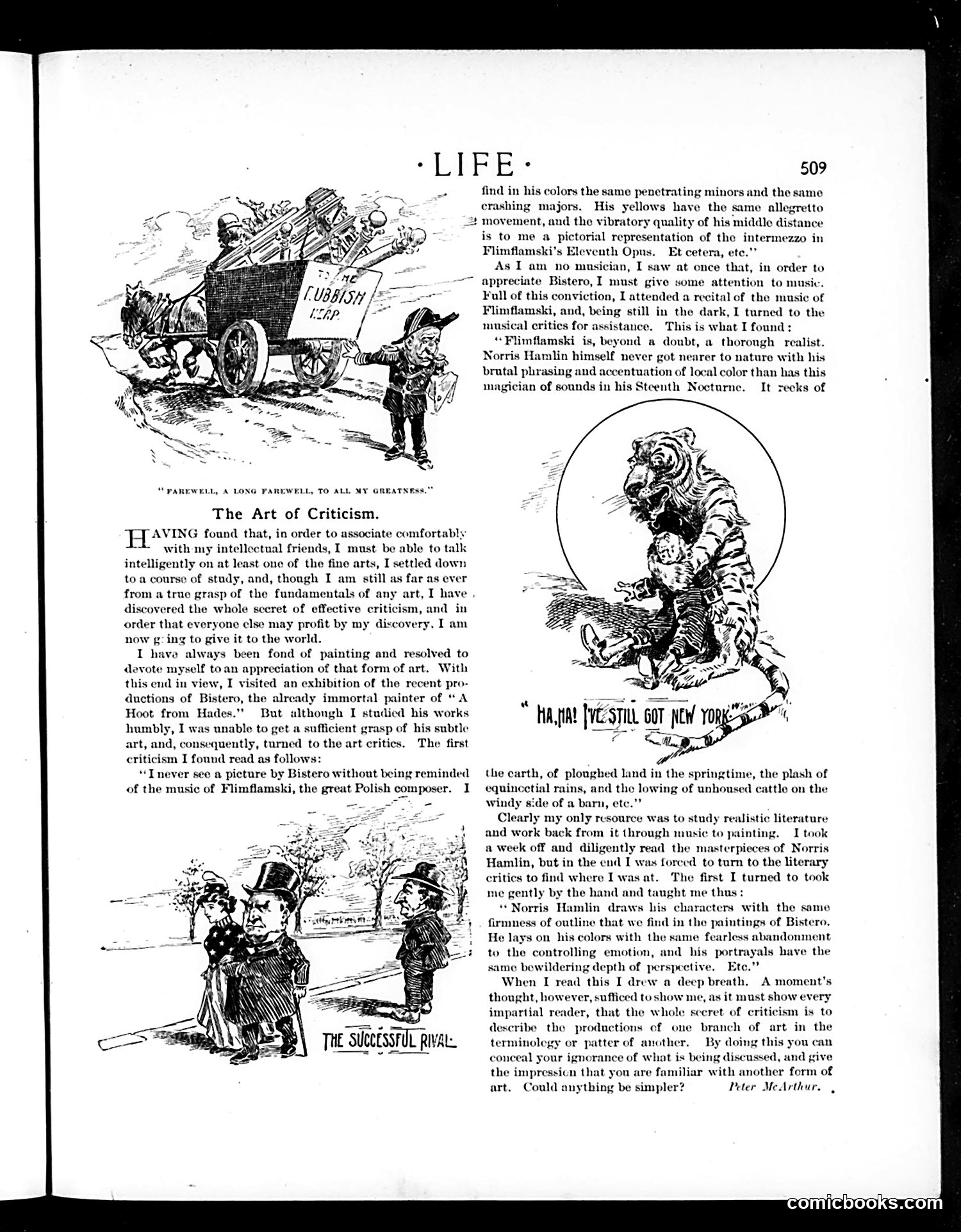
This page satirizes art criticism through Peter McArthur's essay about learning to critique paintings. The cartoons illustrate his argument that critics often use pretentious language to mask ignorance. The top cartoon labeled "Farewell, a long farewell, to all my greatness" depicts a trash cart, likely mocking how harsh criticism can destroy an artist's reputation. The middle image shows what appears to be a caricatured figure (possibly representing a specific critic or artist, though unclear from context alone). The bottom cartoon titled "The Successful Rival" shows three figures in period dress, apparently depicting competitive dynamics in the art world. McArthur's point: effective criticism requires understanding art's fundamentals, not merely adopting the terminology of established critics like the painter Bistero or composer Flimllamski to appear knowledgeable.
📄 Transcribed text from this page (OCR, searchable)
Machine-transcribed from the original scan — historical spelling and the odd misread are preserved.
| _24 movement, and tho vibratory quality of his middle dis “PAREWELL, A LONG FAREWELL, TO ALL MY GREATNESS." The Art of Criticism. HAVING found that, in order to associate comfortably with my intellectual friends, I must be able to talk intelligently on at least one of the fine arts, I settled down toa course of study, and, though I am still as far as ever from a true gr: of the fundamentals of any art, I have discovered the whole sccret of effective criticism, and in order that everyone clse may profit by my discovery, Iam now g:ing to give it to the world. I have always been fond of painting and resolved to davote myself toan appreciation of that form of art. With this end in view, I visited an exhibition of the recent pro- Auctions of Bistero, the already immortal painter of “ A Hoot from Hades.’’ But althongh I studied his works humbly, I was unable to get a sufficient grasp of his subtle art, and, consequently, turned to the art critics. The first criticism I found read as follows: “Tnever see a picture by Bistero without being reminded of the music of Flimflamski, the great Polish composer. I FE: 509 find in his colors the same penctrating minors and the same crashing majors. His yellows have the same allegretto ; ce is to me a pictorial representation of the intermezzo in Flimflamski’s Eleventh Opus. Et cetera, etc." As I am no musician, I saw at once that, in order to appreciate Bistero, I must give some attention to music. Full of this conviction, I attended a recital of the music of lamski, and, being still in the dark, I turned to the i This is what I found: Flimflamski is, beyond a doubt, a thorough reali: Norris Hamlin himself never got nearer to nature with his brutal phrasing and accentuation of local color than has this magician of sounds in his Steenth Nocturne. It recks of the earth, of ploughed land in the springtime, the plash of i ial rains, and the lowing of unhoused cattle on the windy side of a barn, etc.” Clearly my only resource was to study realistic literature and work back from it through music to painting. I took a week off and diligently read the masterpieces of Norris Hamlin, but in the end I was forced to turn to the literary critics to find where Iwas at. The first I turned to took me gently by the hand and taught me thus : “Norris Hamlin draws his characters with the same firmness of outline that we find in the paintings of He 1. istero, on his colors with the same fearless abandonment to the controlling emotion, and his portrayals have the same bewildering depth of perspective. Ete.’” When I read this I drew a deep breath, A moment's thought, however, sufficed to show me, as it must show every tial reader, that the whole sccret of criticism is to ribe tho productions cf one branch of art in the terminology or patter of another. By doing this you can conceal your ignorance of what is being the impression thi art. discussed, and give ‘ou are familiar with another form of Could anything be simpler? Peter MeArthur,