
Life, 1900-12-13 · page 15 of 20
Life — December 13, 1900 — page 15: what you’re looking at
What you’re looking at
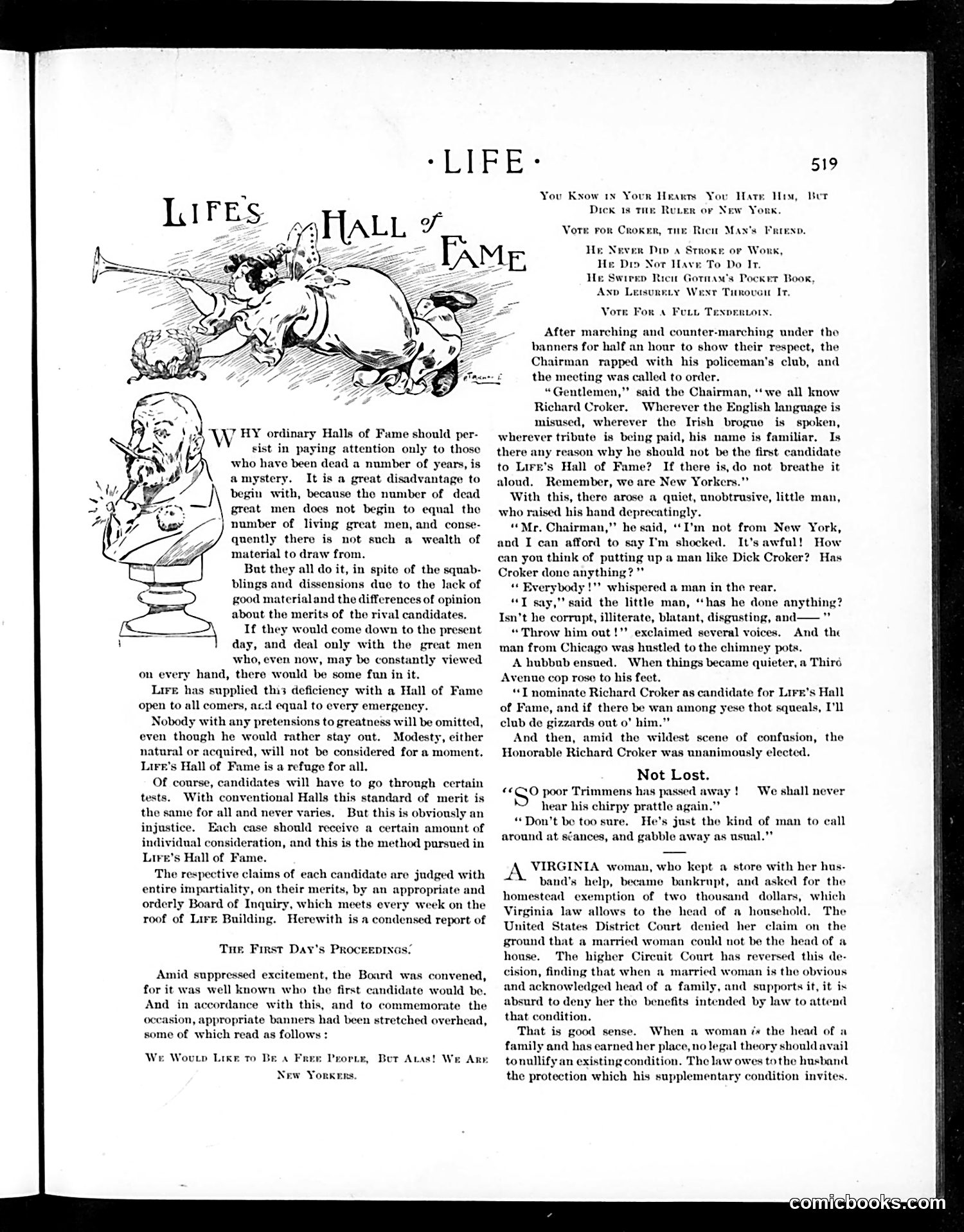
This satirical piece mocks the selection of **Richard Croker**—New York's corrupt Democratic political boss—as the inaugural candidate for *Life*'s new "Hall of Fame" for living (not dead) great men. The joke: Croker, a notorious Tammany Hall figure associated with graft and malfeasance, is being "honored" through obviously sarcastic banners celebrating his control over New York politics. When a visiting outsider protests that Croker is "corrupt, illiterate, blatant, disgusting," he's literally thrown out by a Tammany-connected cop who threatens violence. The satire exposes how political machines like Tammany Hall operated: through intimidation, corruption, and the silencing of dissent. By having Croker unanimously "elected" via coercion rather than merit, *Life* ridicules both the boss system's brazenness and New York voters' apparent powerlessness against it. The piece targets Croker's domination of New York politics in the late 1880s-1890s.
📄 Transcribed text from this page (OCR, searchable)
Machine-transcribed from the original scan — historical spelling and the odd misread are preserved.
“BRIE V 7 HY ordinary Halls of Fame should per- sist in paying attention only to those who have been dead a number of years, is amystery. It is a great disadvantage to begin with, because the number of dead great men does not begin to equal the number of living great men, and conse- quently there is not such a wealth of material to draw from. Bat they all do it, in spite of the squab- blings and dissensions due to the lack of good matcrialand the differences of opinion about the merits of the rival candidates. If they would come down to the present day, and deal only with the great men who, even now, may be constantly viewed on every hand, there would be some fun in it. Lire has supplied thi3 deficiency with a Hall of Fame open to all comers, acd equal to every emergency. Nobody with any pretensions to greatness will be omitted, even though he would rather stay out. Modesty, either natural or acquired, will not be considered for a moment. Lire’s Hall of Fame is a refuge for all. Of course, candidates will have to go through certain tests. With conventional Halls this standard of merit is the same for all and never varies, But this is obviously an injustice. Each case should receive a certain amount of individual consideration, and this is the method pursued in Lire’s Hall of Fame. The respecti ims of each candidate are judged with entiro impartiality, on their merits, by an appropriate and orderly Board of Inquiry, which meets every week on the roof of Lire Building. Herewith is a condensed report of Tur First Day's PROCEEDINGS. Amid suppressed excitement, the Board was convened, for it was well known who the first candidate would be. And in accordance with this, and to commemorate the occasion, appropriate banners had been stretched overhead, some of which read as follows : We Wovuvp Like to Be a Free Peorie, Bet Aras! We Arr New Yorke 519 You Kyow iy Your Hearts You Hate His, Bet Dick 18 THe RuLer or New York. Votre ror Croker, the Rice Max's Frrexp. : To Do Ir. THAM's Pocket Book, Ayp Letsurrty Went Turove It, Votre For « Fein Texperrory, After marching and counter-marching under tho banners for half an hour to show their respect, the Chairman rapped with his policeman’s club, and the meeting was called to order. “Gentlemen,” said the Chairman, ‘we all know Richard Croker, Wherever the English language is misused, wherever the Irish broguo is spoken, wherever tribute is being paid, his name is familiar. Is there any reason why he should not be the first candidate to Lire’s Hall of Fame? If there is,do not breathe it aloud. Remember, we are New Yorkers.” With this, there arose a quiet, unobtrusive, little man, who raised his hand deprecatingly. “Mr. Chairman,” he said, “I’m not from New York, and I can afford to say I'm shocked. It’s awful! How can you think of putting up a man like Dick Croker? Has Croker done anything?” “ Everybody !"? whispered a man in tho rear. “T say," said the little man, “has he done anything? Isn't he corrupt, illiterate, blatant, disgusting, and—— ” “Throw him out !’’ exclaimed several voices. And the man from Chicago was hustled to the chimney pots. A hubbub ensued. When things became quieter, a Thiré Avenue cop rose to his feet. “I nominate Richard Croker as candidate for Lire’s Hall of Fame, and if there be wan among yese thot squeals, I'L club de gizzards out o’ him.” And then, amid the wildest scene of confusion, the Honorable Richard Croker was unanimously elected. Not Lost. “So poor Trimmens has passed away ! hear his chirpy prattle again “Don’t be too sure, He's just the kind of man to call around at scances, and gabble away as usual.” We shall never Z VIRGINIA woman, who kept a store with her hus- band’s help, became bankrupt, and asked for the homestead exemption of two thousand dollars, which Virginia law allows to the head of a household, The United States District Court denied her claim on the ground that a married woman could not be the head of a house. The higher Circuit Court has reversed this de- cision, finding that when a married woman is the obvious and acknowledged head of a family, and supports it, it ix absurd to deny her the benefits intended by law to attend that condition. That is good sense. When a woman ¢« the head of a family and has earned her place, no legal theory should avail tonullify an existing condition. The law owes tothe husband. the protection which his supplementary condition invites.