
A complete issue · 20 pages · 1900
Life — November 22, 1900
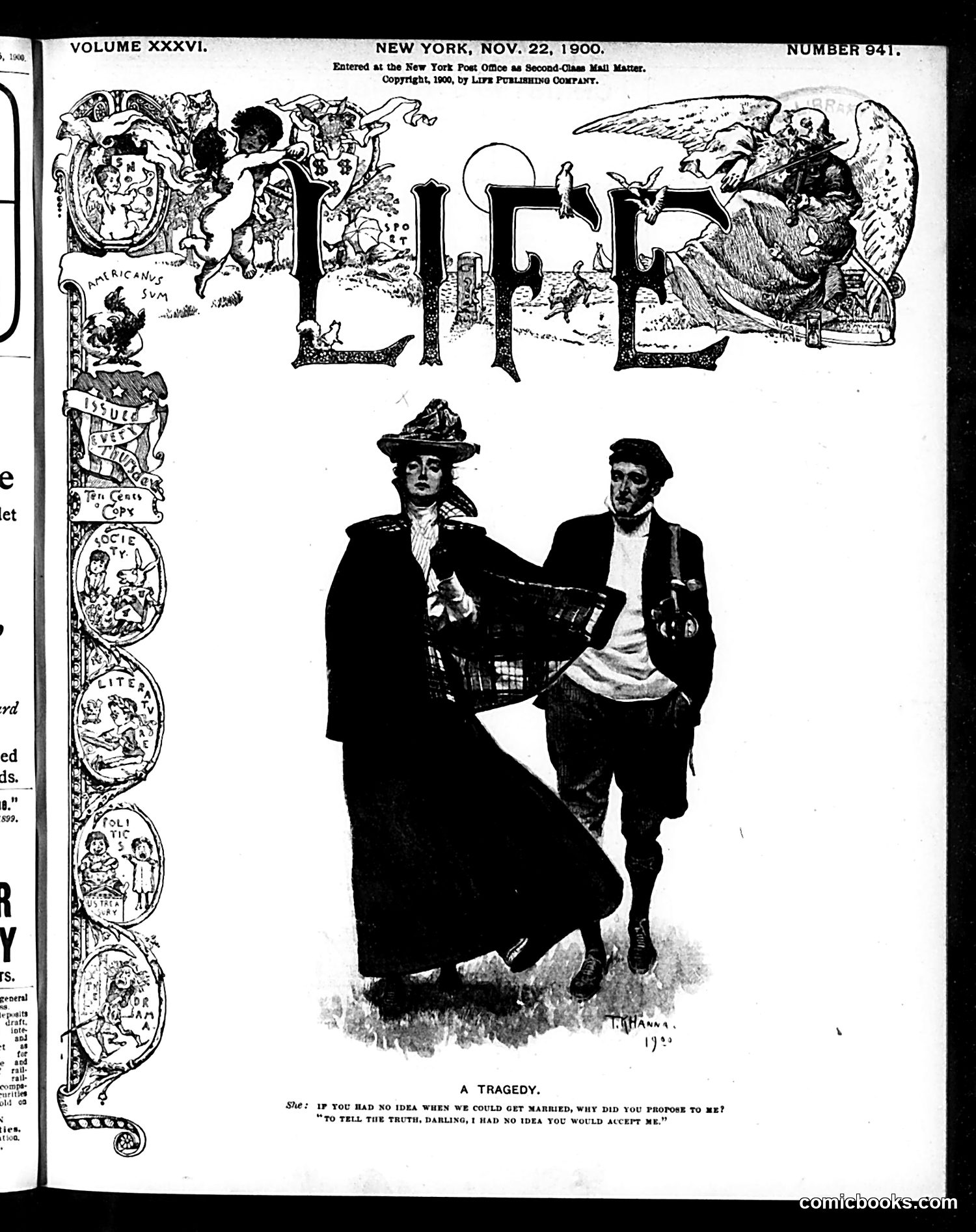
This cartoon satirizes a marriage proposal dilemma. The illustration shows a man presenting a marriage proposal to a woman, who appears dismayed. The caption reads: "She: If you had no idea when we could get married, why did you propose to me? He: To tell the truth, darling, I had no idea you would accept me." The joke mocks the man's presumption—he proposed without seriously expecting acceptance, perhaps assuming rejection would spare him from commitment. The woman's disappointment stems from his lack of genuine intention. This satirizes both courtship customs of the era and male attitudes toward marriage proposals, suggesting some men proposed carelessly without true commitment or understanding of consequences.
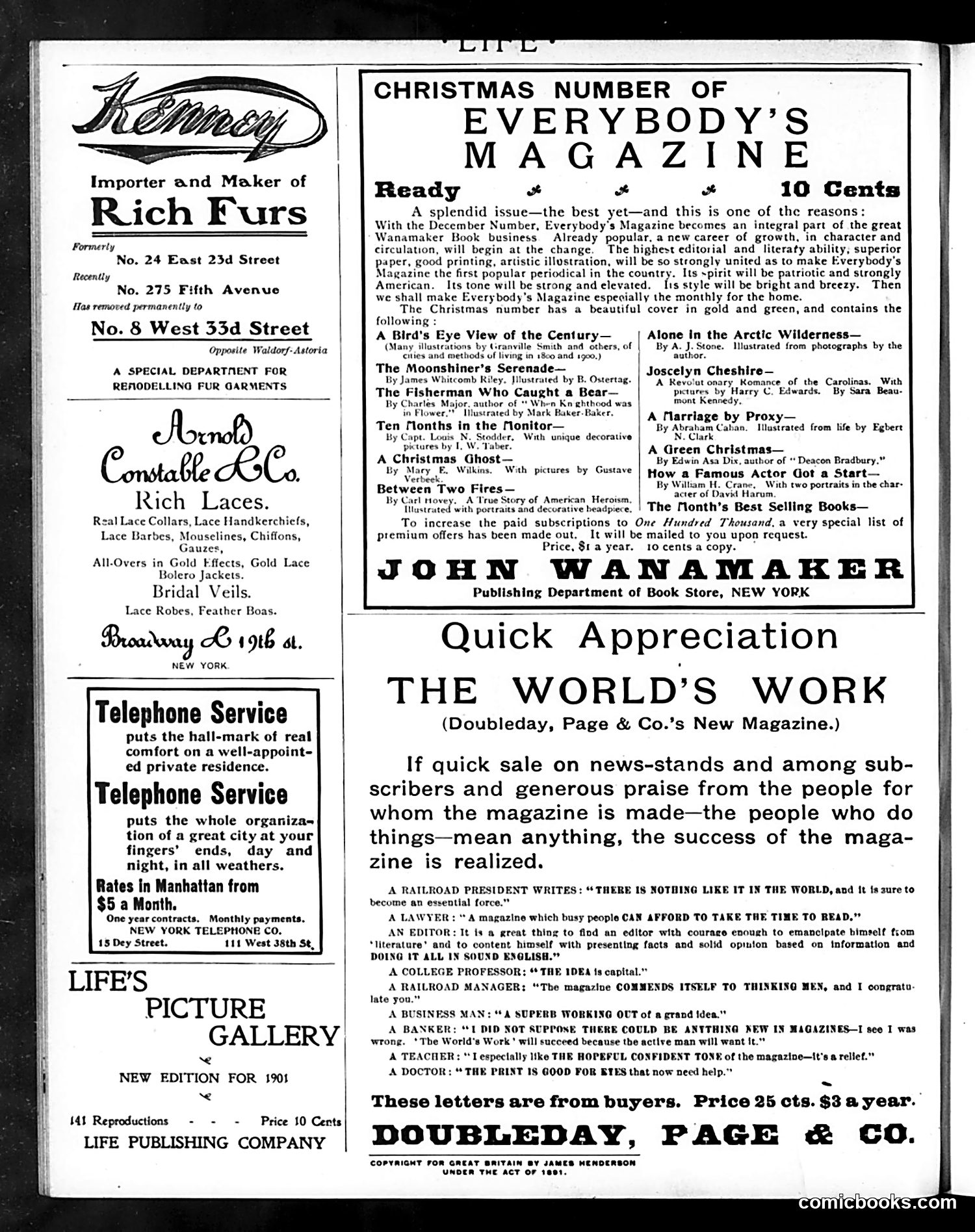
This page is primarily **advertising and promotional content**, not political satire or comics. The main content includes: - **Department store advertisements** (Henrooz furs, Arnold Constable laces, bridal veils) - **Telephone Service ad** promoting residential connectivity - **Life's Picture Gallery** promoting reproductions - **Magazine promotions** for *Everybody's Magazine* (Christmas issue) and *The World's Work* (Doubleday, Page & Co.) The *World's Work* section quotes various professionals—railroad presidents, teachers, doctors, business managers—praising the magazine's quality and usefulness. This appears designed to build credibility and circulation. There is **no political cartoon or satire visible** on this page. It reflects early-1900s consumer culture and magazine marketing strategies rather than commentary on current events or social issues.
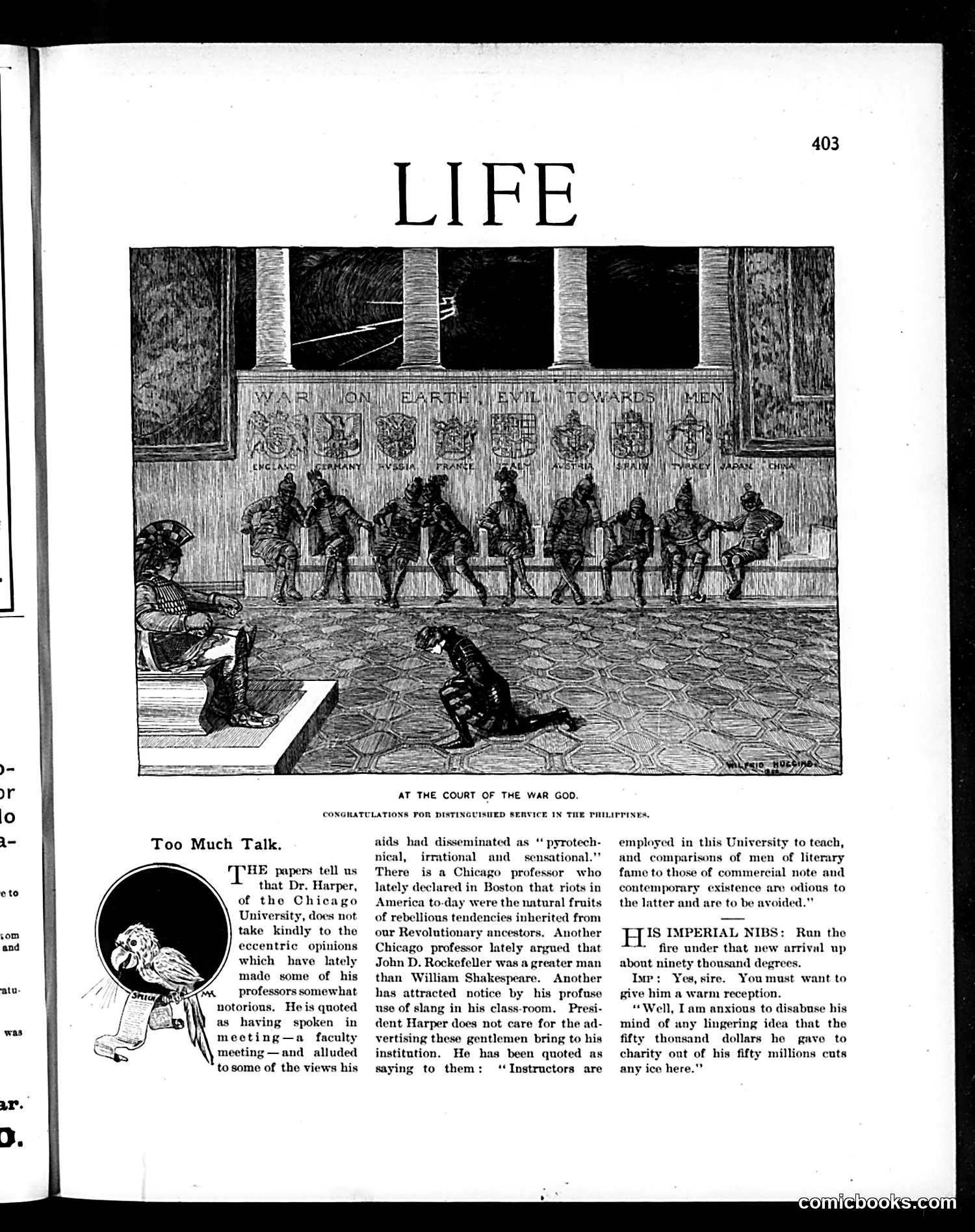
This page satirizes a University of Chicago president (likely Harper, mentioned in text) for making controversial public statements. The cartoon criticizes him for speaking carelessly about sensitive topics—including comparing American rebels to Revolutionary ancestors and making offensive comments about professors' use of slang. The main illustration depicts "At the Court of the War God," showing what appears to be military or formal proceedings with figures seated along a decorated wall, likely commentary on institutional authority and hierarchical judgment. The satire's point: academic leaders should exercise restraint in public speech, as their inflammatory remarks damage their institution's reputation. The text ironically notes he's "quoted as having spoken in meeting" and suggests his words reveal poor judgment unfit for university leadership.
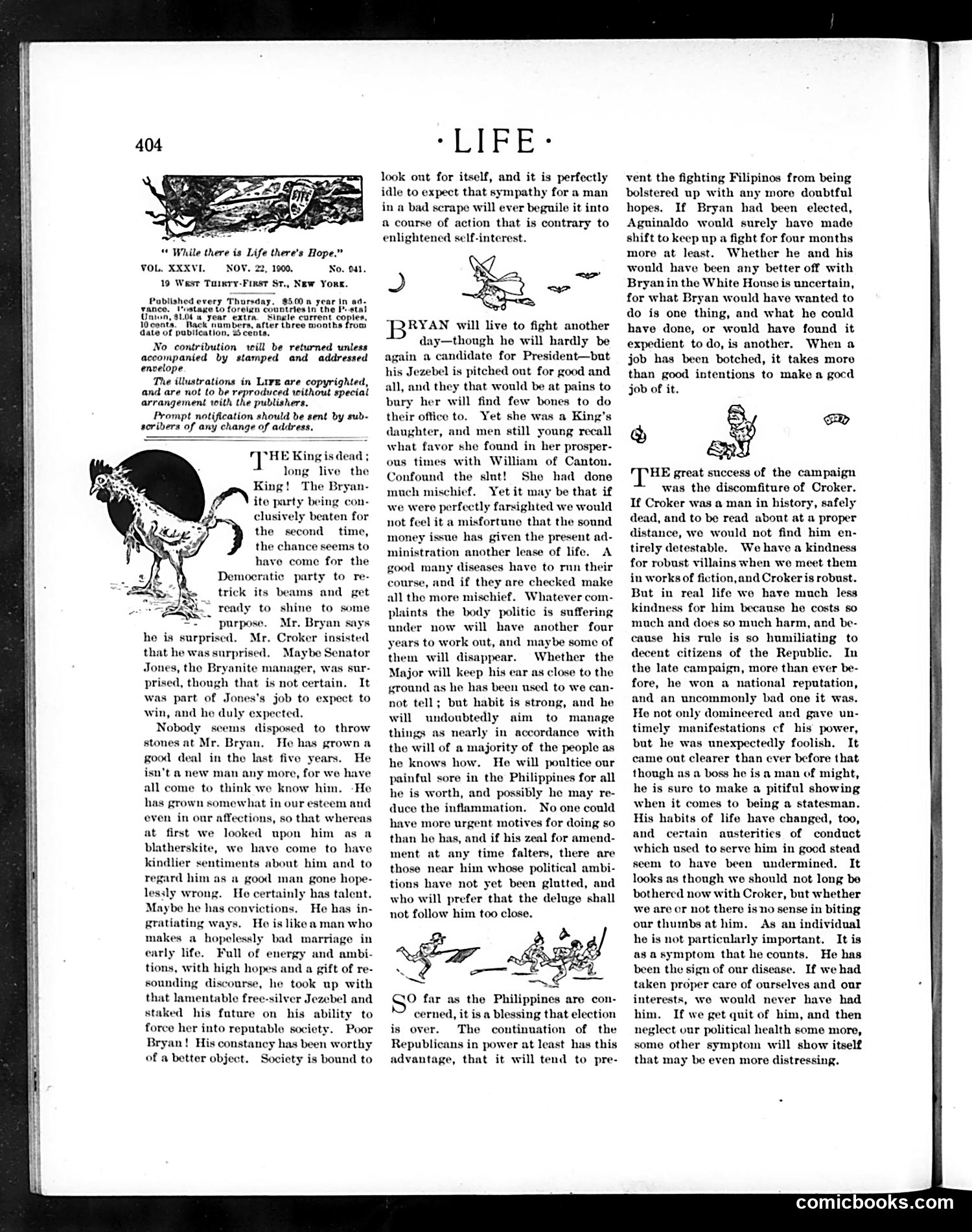
This page contains political commentary on William Jennings Bryan's continued political ambitions following a electoral defeat. The text discusses Bryan's potential future candidacy and criticizes his political judgment, particularly regarding the Philippines policy and the money issue that had dominated recent campaigns. The cartoon depicts a rooster (likely symbolizing Bryan or his political faction) being struck down or defeated. The rooster was a common symbol of Democratic politics in this era. The article argues that while Bryan has talent, his political misjudgments—particularly on currency and foreign policy—make him an unreliable leader. It contrasts him unfavorably with a figure called Croker, suggesting Bryan lacks the practical political acumen needed for effective governance. The overall tone is dismissive of Bryan's political viability.
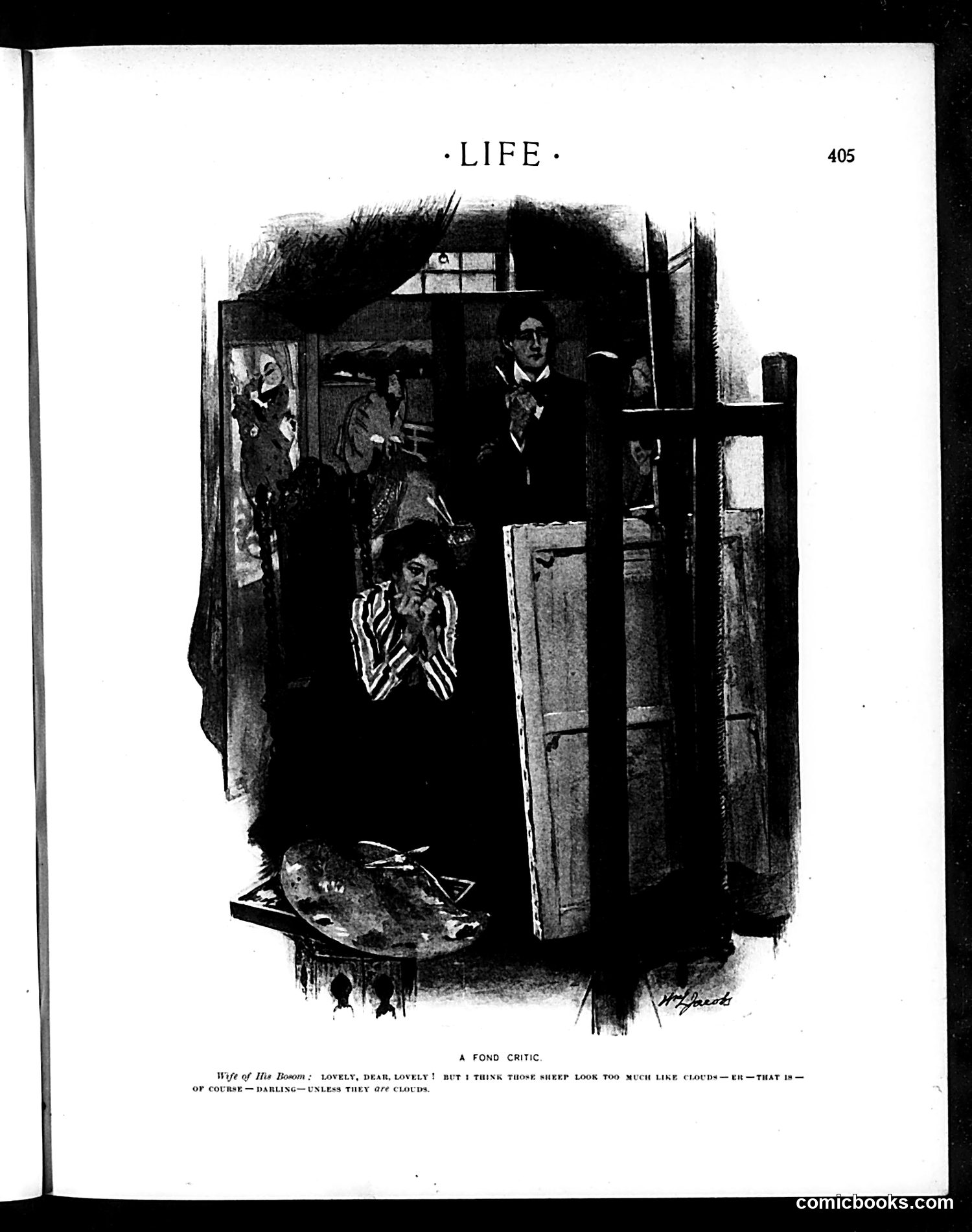
This cartoon depicts a domestic scene where a wife critiques her husband's artistic work. The title "A Fond Critic" and accompanying caption—"Wife of His Bosom: 'Lovely, dear, lovely! But I think those sheep look too much like clouds—er, that is—of course, darling—unless they are clouds'"—reveals the humor: the wife cannot discern whether the painted figures are sheep or clouds, yet she attempts flattering praise while awkwardly masking her confusion. The joke satirizes amateur art criticism and spousal diplomacy. The wife wants to be supportive ("lovely, dear, lovely") but her inability to identify basic elements of the artwork exposes either the artist's poor execution or her own lack of judgment. This pokes fun at both well-meaning but uninformed art appreciation and the social awkwardness of criticizing a loved one's work.
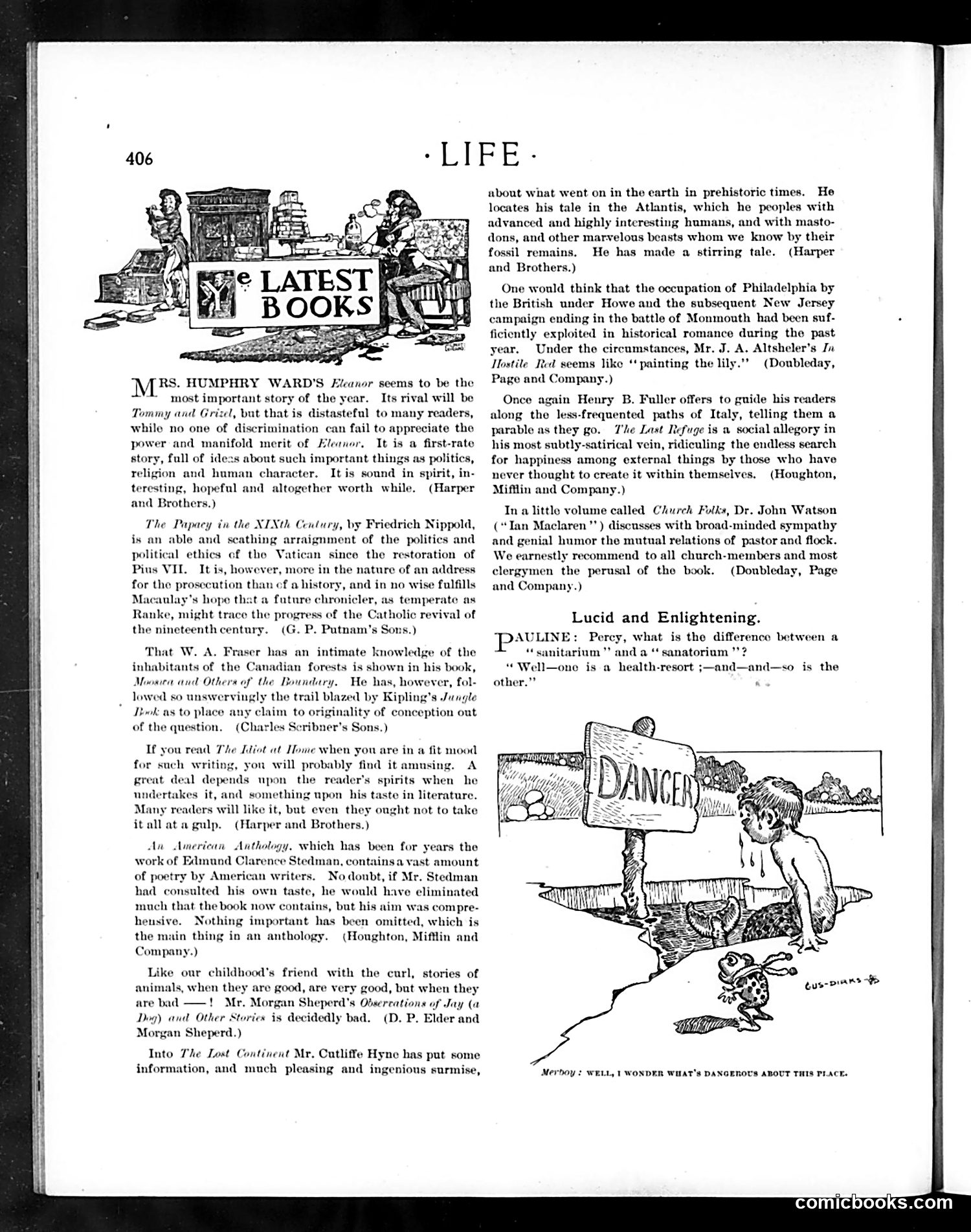
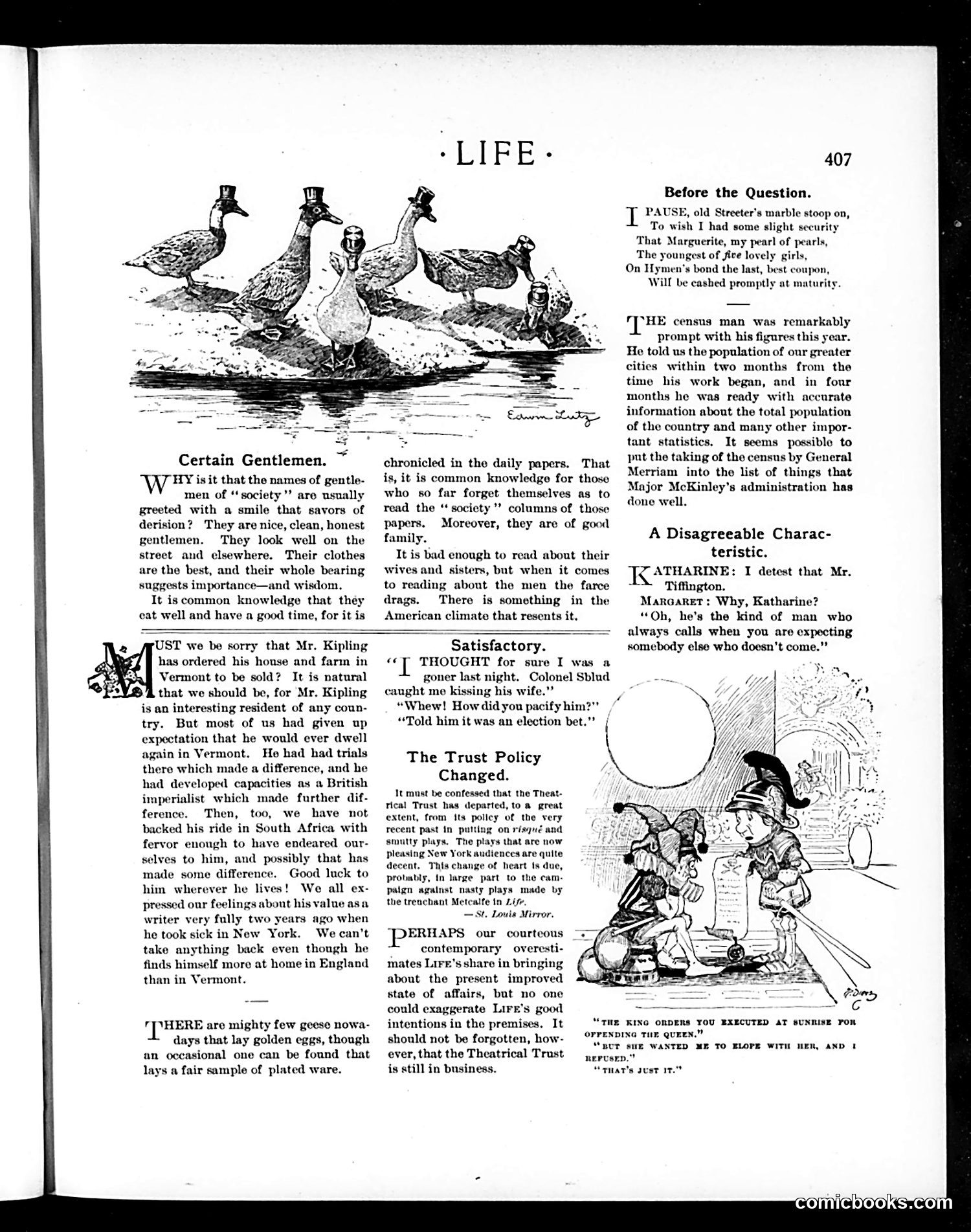
This satirical page contains several distinct pieces: **"Certain Gentlemen"** mocks society men who read society columns in newspapers—they're described as well-dressed but superficial, forgetting their own names while following high society gossip. **"A Disagreeable Characteristic"** presents a brief dialogue joke about Mr. Tiffington, a man who only calls when expecting someone else to answer—a commentary on insincere social behavior. **The illustrated cartoon** (bottom right) depicts a romantic scene where a woman demands her lover elope with her, but he refuses, saying "That's just it"—likely satirizing men's reluctance toward commitment despite romantic gestures. The page also includes brief humorous notes about Mr. Kipling, the census, and theatrical trust policies. Overall, the page satirizes upper-class social pretension and romantic hypocrisy typical of early 20th-century Life magazine humor.
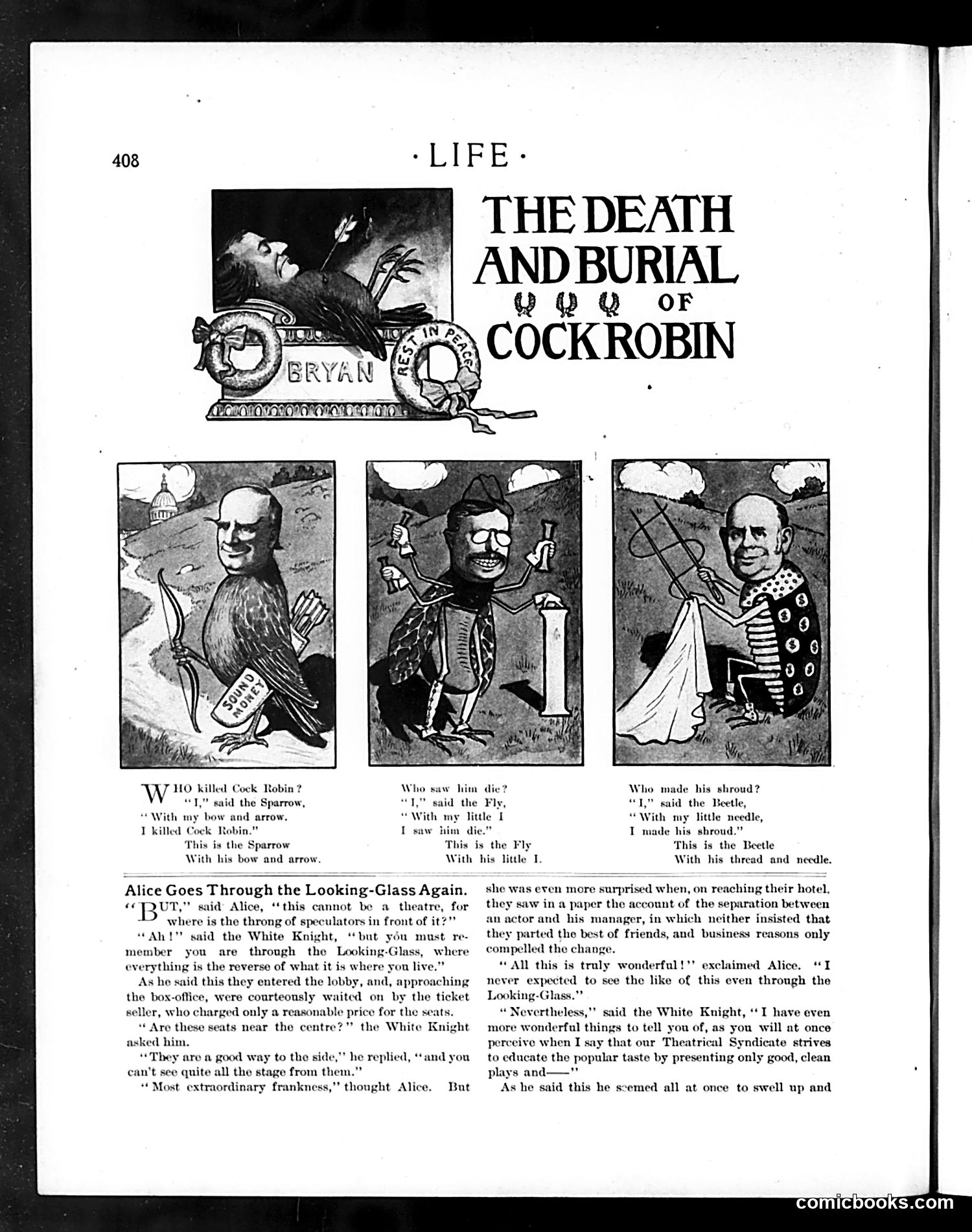
The top section presents "The Death and Burial of Cockrobin," a satirical nursery-rhyme parody. Three panels show caricatured figures as birds: 1. **Left panel**: A sparrow, labeled with a weapon 2. **Middle panel**: A fly 3. **Right panel**: A beetle with a needle The rhyme identifies who "killed Cock Robin," who "saw him die," and who "made his shroud"—following the traditional children's verse format but applying it to political/social figures of the time (likely early 20th century). The bottom section begins "Alice Goes Through the Looking-Glass Again," referencing Lewis Carroll's work to satirize contemporary theater and society. Alice discusses theatrical experiences with the White Knight, critiquing theatrical management and artistic integrity through the fantastical framework. Without knowing the specific publication date, the exact figures remain unclear, but the page uses familiar literary references as vehicles for social commentary.
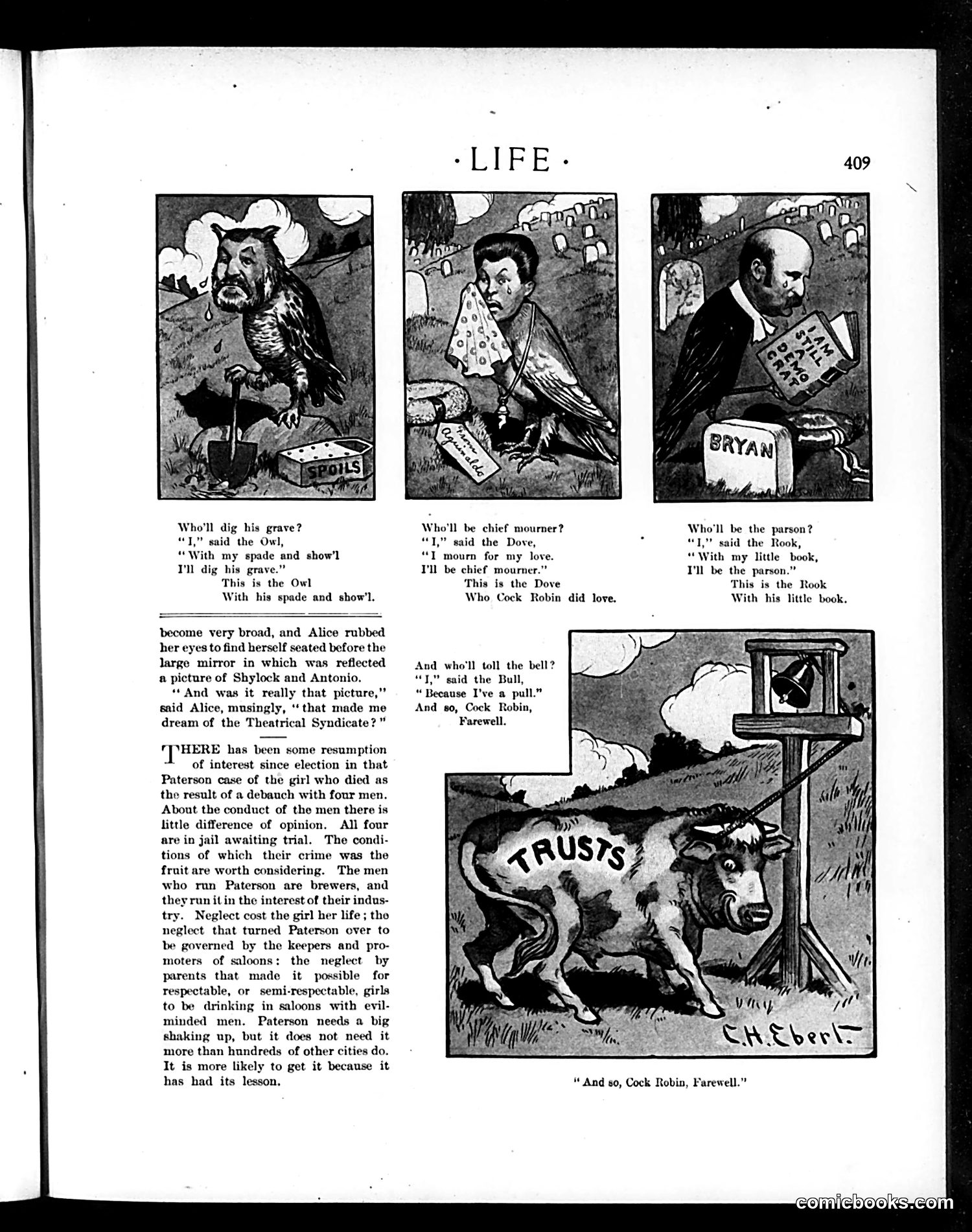
This page contains a parody of "The Cock Robin" nursery rhyme, repurposed as political satire about Paterson, New Jersey. The three panels show an Owl, Dove, and Rook claiming roles in Cock Robin's death—paralleling how different figures might claim responsibility for events in Paterson. The lower section discusses local political issues: election fraud, jail conditions, and industrial mismanagement. It references Paterson's brewery industry and criticizes saloon culture and corrupt governance. "Trusts" (monopolistic corporations) are depicted as a predatory dog in the main cartoon. The satire suggests Paterson's problems stem from industrial neglect, corrupt leadership, and moral decay—issues the magazine frames as systemic rather than individual failures. The Cock Robin parody obscures specific culprits intentionally, mirroring actual political evasion of responsibility.
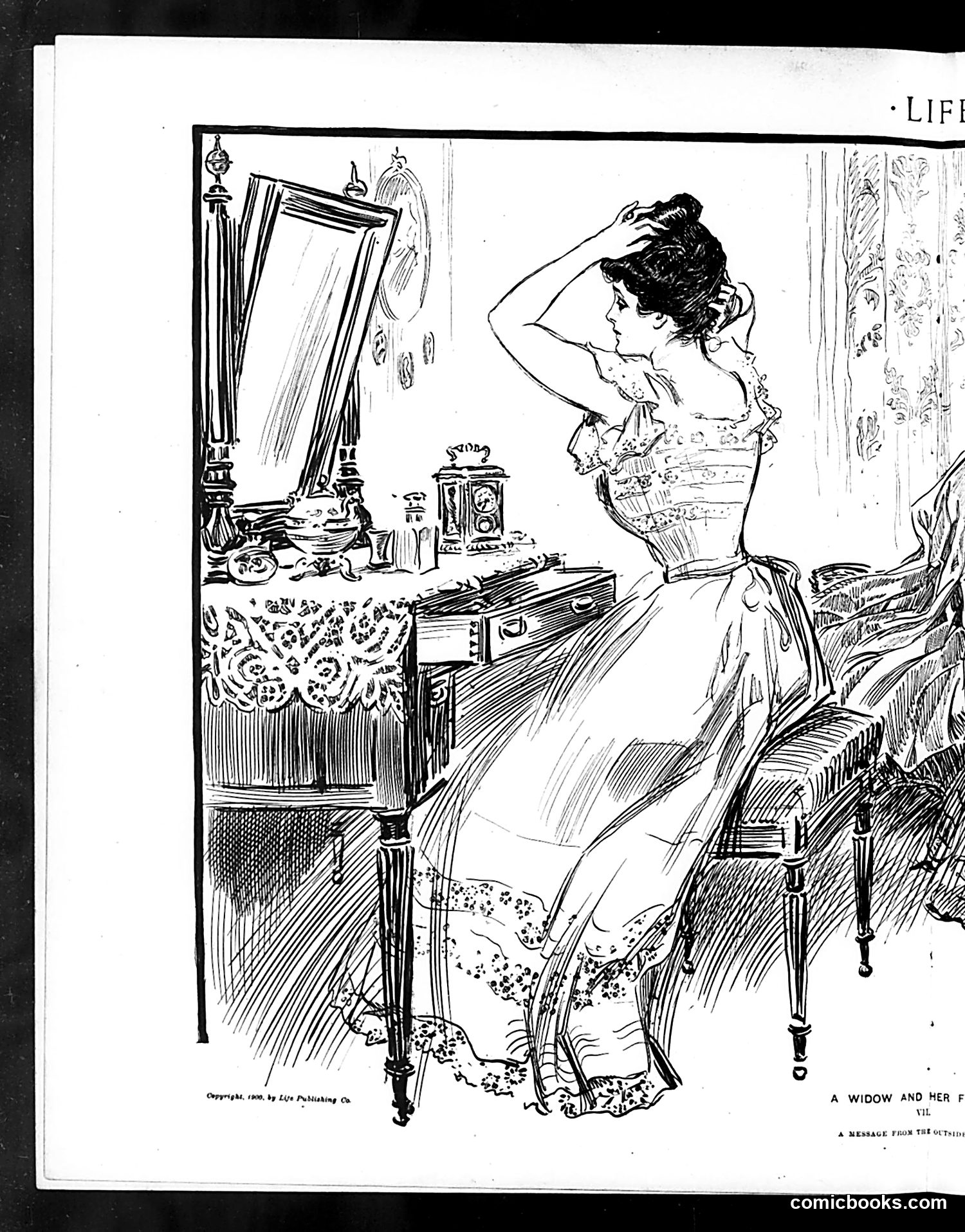
This appears to be an illustration from *Life* magazine depicting a woman at her vanity table arranging her hair. The caption reads "A WIDOW AND HER F[?]" with additional text mentioning "A MESSAGE FROM THE OUTSIDE." The drawing is a straightforward domestic scene showing early 20th-century women's grooming practices and interior decoration. The detailed line work emphasizes the ornate vanity setup with mirror, toiletries, and elaborate furnishings typical of the period. Without the complete caption text visible, the specific satirical point is unclear. However, the image likely comments on widows' social roles, domestic life, or vanity—common subjects for satirical magazines of this era. The reference to "a message from the outside" suggests social commentary about isolation or expectations placed on widows.
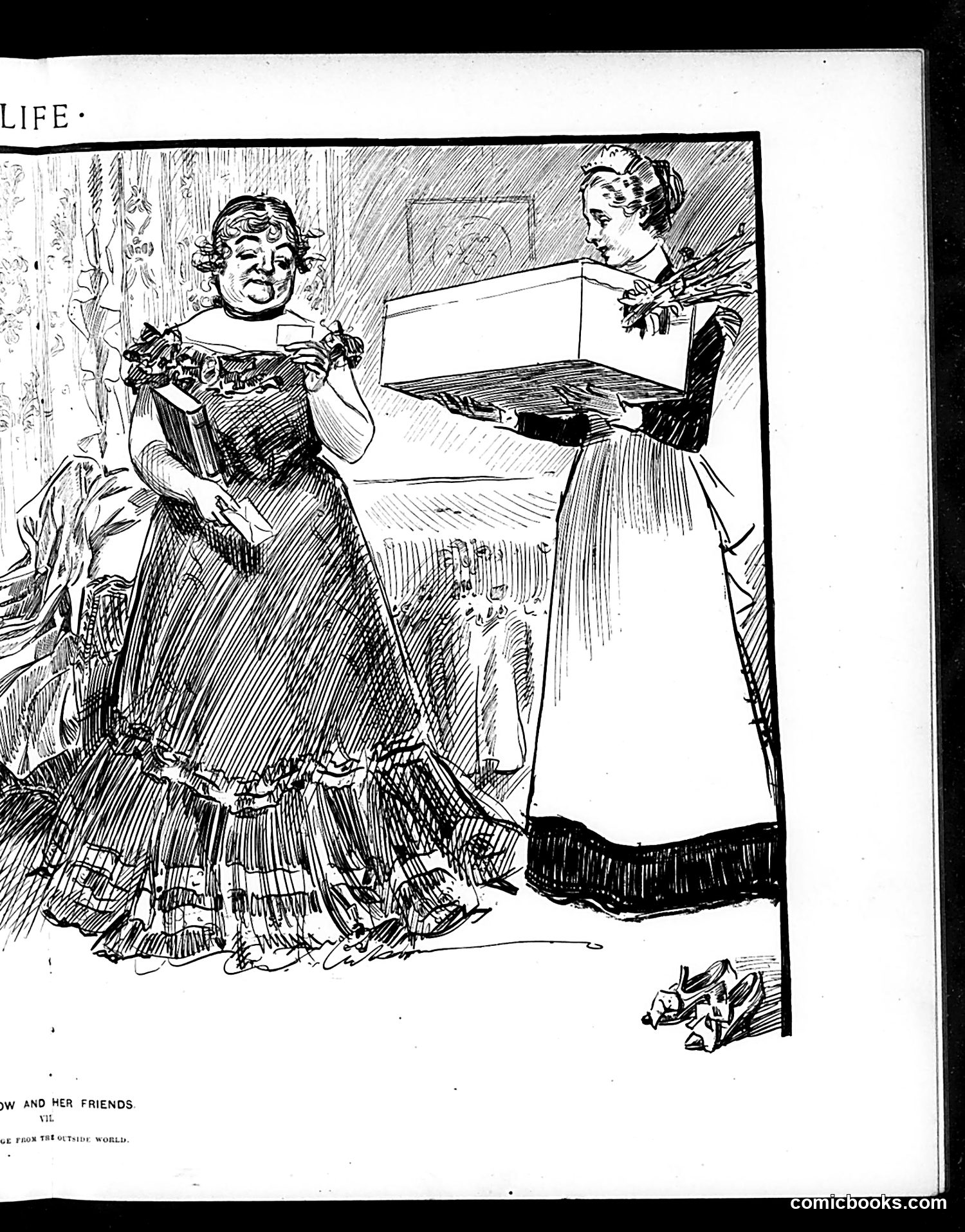
This appears to be a satirical illustration from Life magazine showing two women in early 20th-century dress. The woman on the left is heavyset and dressed elaborately with flowers and ornate clothing, while the thinner woman on the right holds up what appears to be a large blank canvas or frame. The satire likely comments on **fashion, body image, or artistic representation** of women during this era. The contrast between the two figures—one abundantly ornamented, one severe—may mock either excessive fashion consumption or evolving standards of female beauty and presentation. The visible caption fragment mentions "friends," suggesting this illustrates social dynamics or vanity among women. Without more text visible, the specific target of satire remains unclear, though it reflects Life's typical commentary on contemporary social attitudes.
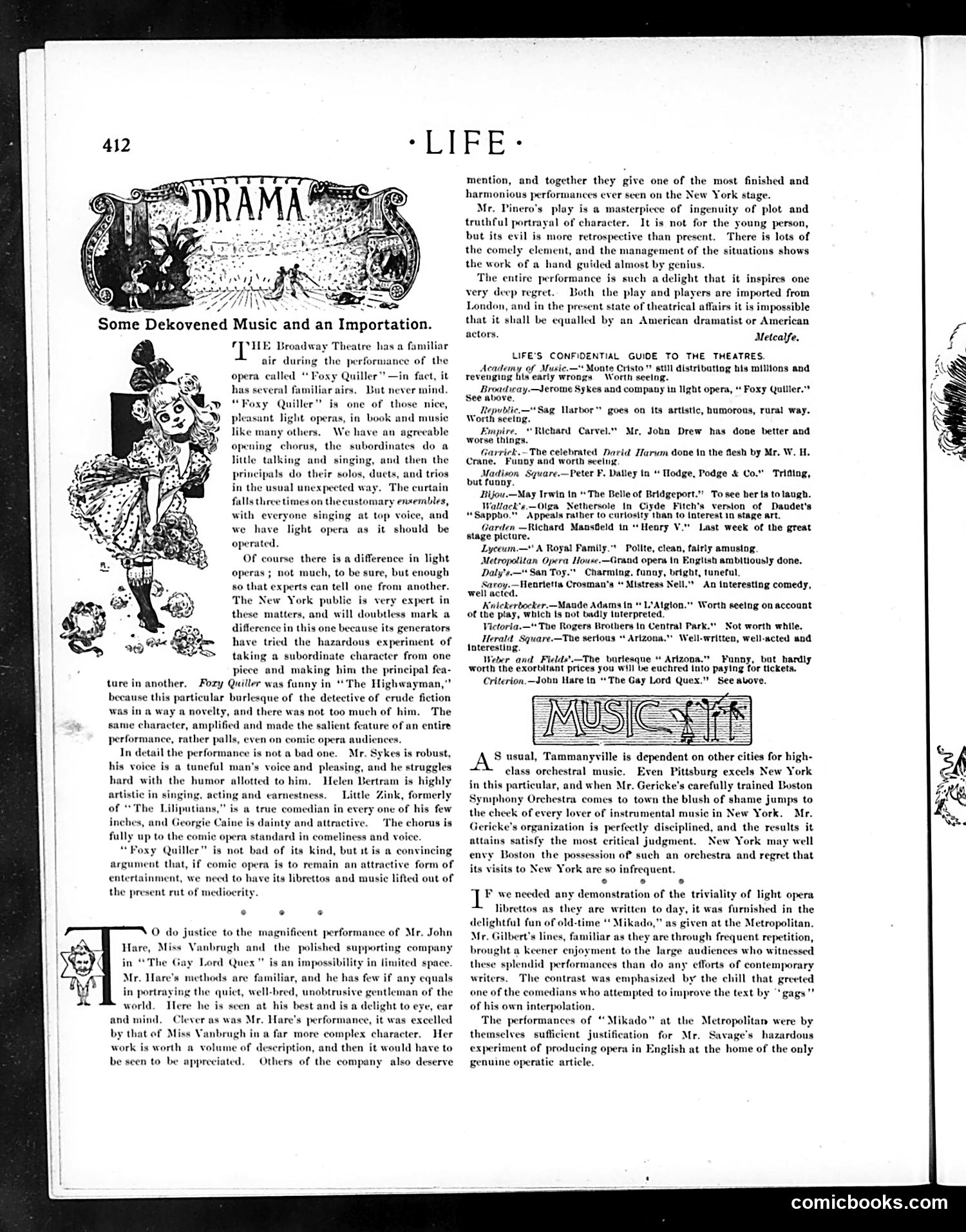
This page contains two sections: a "Drama" review and a "Music" section, with accompanying illustrations rather than political cartoons. The **Drama section** discusses "Foxy Quiller," a light opera at the Broadway Theatre. The illustration shows a woman in an elaborate costume typical of operetta performance. The review critiques the production's quality and the performers' abilities. The **Music section** discusses orchestral performances, specifically mentioning Mr. Gericke's Boston Symphony Orchestra visiting New York and performances of "Mikado" at the Metropolitan Opera House. This appears to be **arts criticism and entertainment reporting** rather than political satire. The page reflects early 1900s theatrical culture and the importance of opera and symphony orchestras in American entertainment discourse.
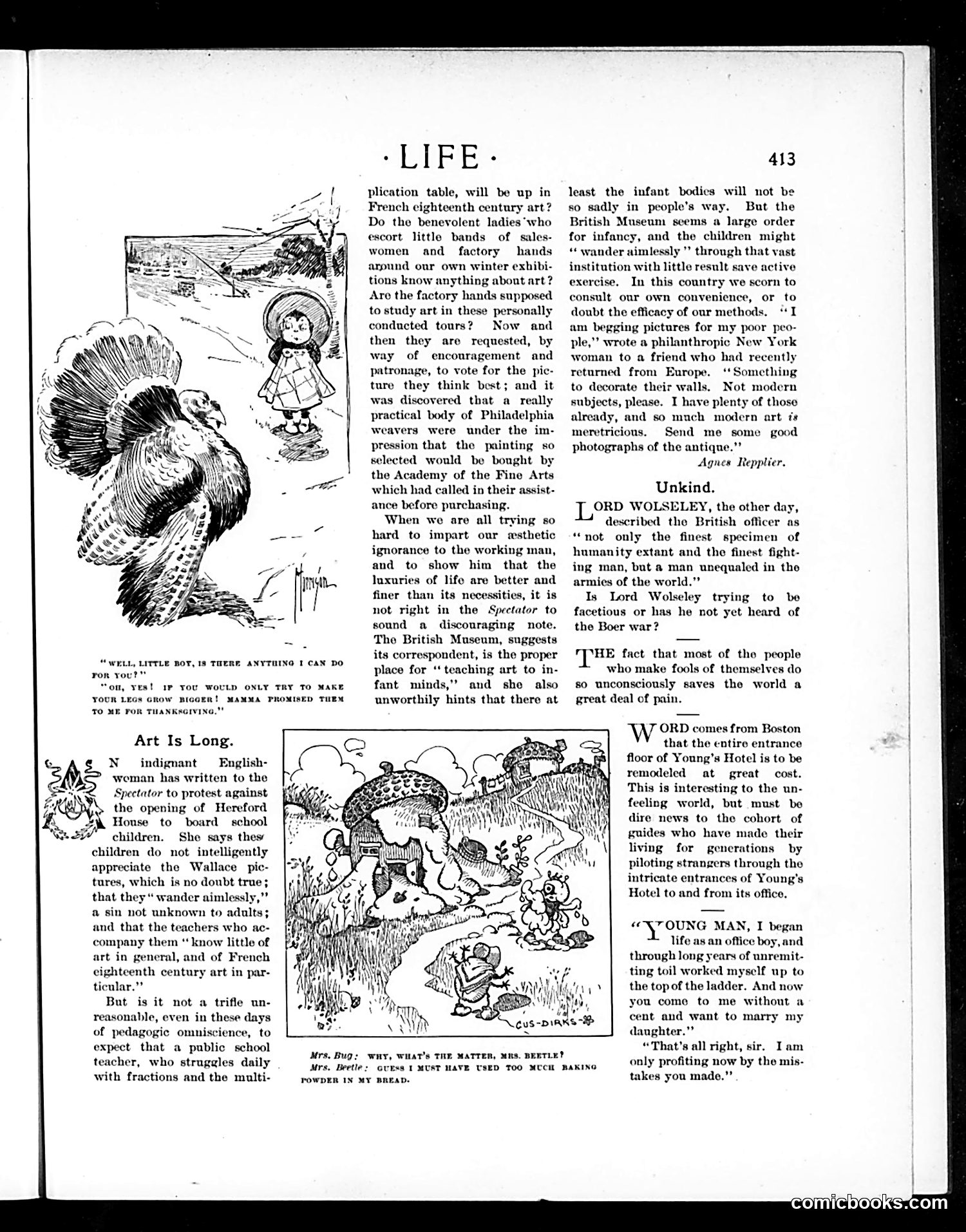
This page contains three distinct satirical pieces: **"Art Is Long"** critiques class pretensions in art education. An indignant British woman complained that boarding school children touring Hereford House lack appreciation for Wallace paintings and "wander aimlessly." The article mocks this snobbery, asking whether factory workers or saleswomen who vote on paintings at exhibitions truly understand art either. It satirizes the hypocrisy of the wealthy attempting to impose "aesthetic ignorance" on working people while claiming moral superiority. **"Unkind"** is a brief jab at British General Lord Wolseley, who recently praised British officers as "the finest specimen of humanity" and "unequaled in the armies of the world." The satire points out Wolseley apparently hasn't "yet heard of the Boer war"—implying British military performance there contradicted such grandiose claims. The page includes two cartoon illustrations: one showing a child asking for longer legs for Thanksgiving, and another depicting insects (Mrs. Bug and Mrs. Beetle) discussing baking powder in bread—likely a consumer product joke.
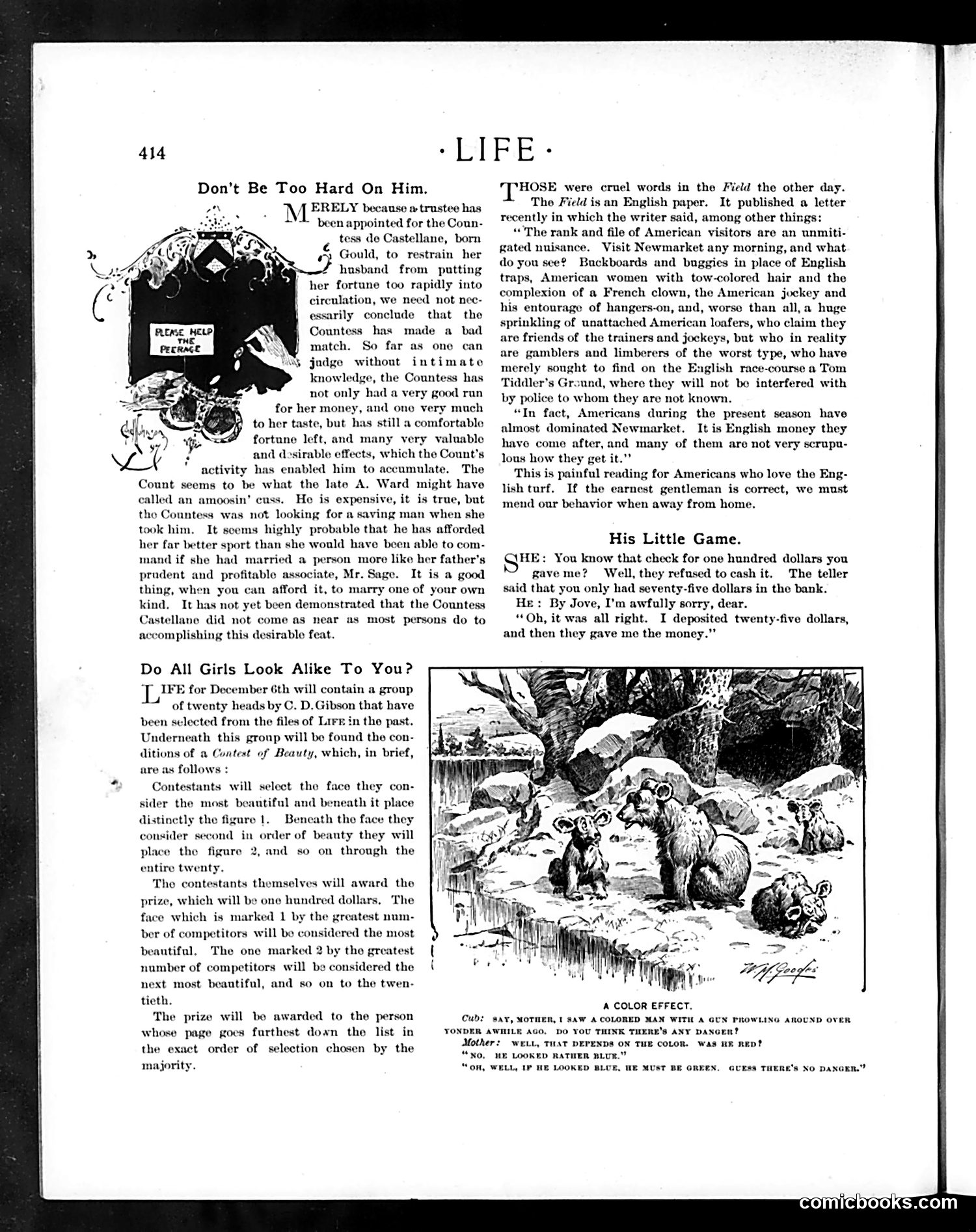
This page contains three distinct pieces of social commentary: **"Don't Be Too Hard On Him"** defends the Count de Castellane (husband of American heiress Anna Gould) against criticism for spending his wife's fortune. The article argues he's been entertaining company and that marrying someone of one's own "kind"—even an expensive one—is preferable to a prudent match. **"Do All Girls Look Alike To You?"** announces an upcoming beauty contest where readers rank twenty C.D. Gibson illustrations. The winner is whoever's rankings most closely match the majority vote—a commentary on whether objective beauty standards exist. **The editorial excerpt and cartoon** criticize English newspaper *The Field* for calling American visitors to Newmarket racecourse "unmitigated nuisances"—describing them as crude, loud, and morally suspect gamblers exploiting English racing for profit. The cartoon illustrates the stereotype through a crude joke about mistaking skin color. Together, these pieces address American wealth, social pretension, and Anglo-American relations in the Gilded Age.
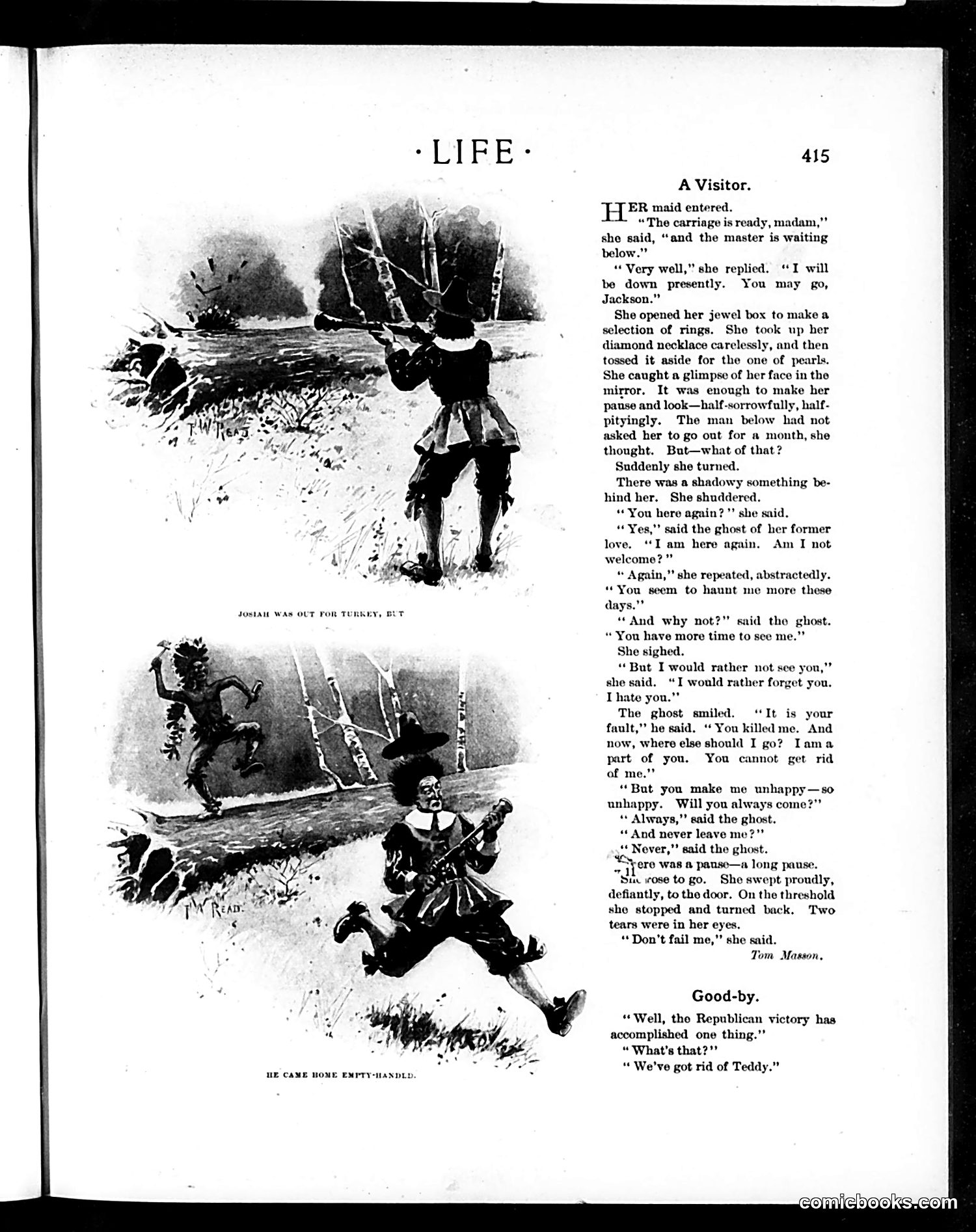
This page contains two separate pieces from Life magazine: **The Illustrated Story "A Visitor"** depicts a woman confronted by the ghost of her former lover, whom she killed. The narrative explores guilt and haunting—both literal and emotional. She's preparing to leave for an evening out, trying to move on with her life (implied by her indifference to her current husband), yet cannot escape her past. The ghost represents inescapable consequences of her actions. The story's final image shows her torn between rejection and inability to let go ("Don't fail me"). **The "Good-by" Cartoon** is a brief political joke referencing a recent Republican electoral victory. The speakers celebrate having "got rid of Teddy"—clearly Theodore Roosevelt. This references Roosevelt's political career, likely alluding to his departure from office or a specific election. The joke's tone suggests Roosevelt was viewed as troublesome by these Republicans, making his removal a point of celebration. Both pieces use darker, more complex humor typical of Life's satirical approach.
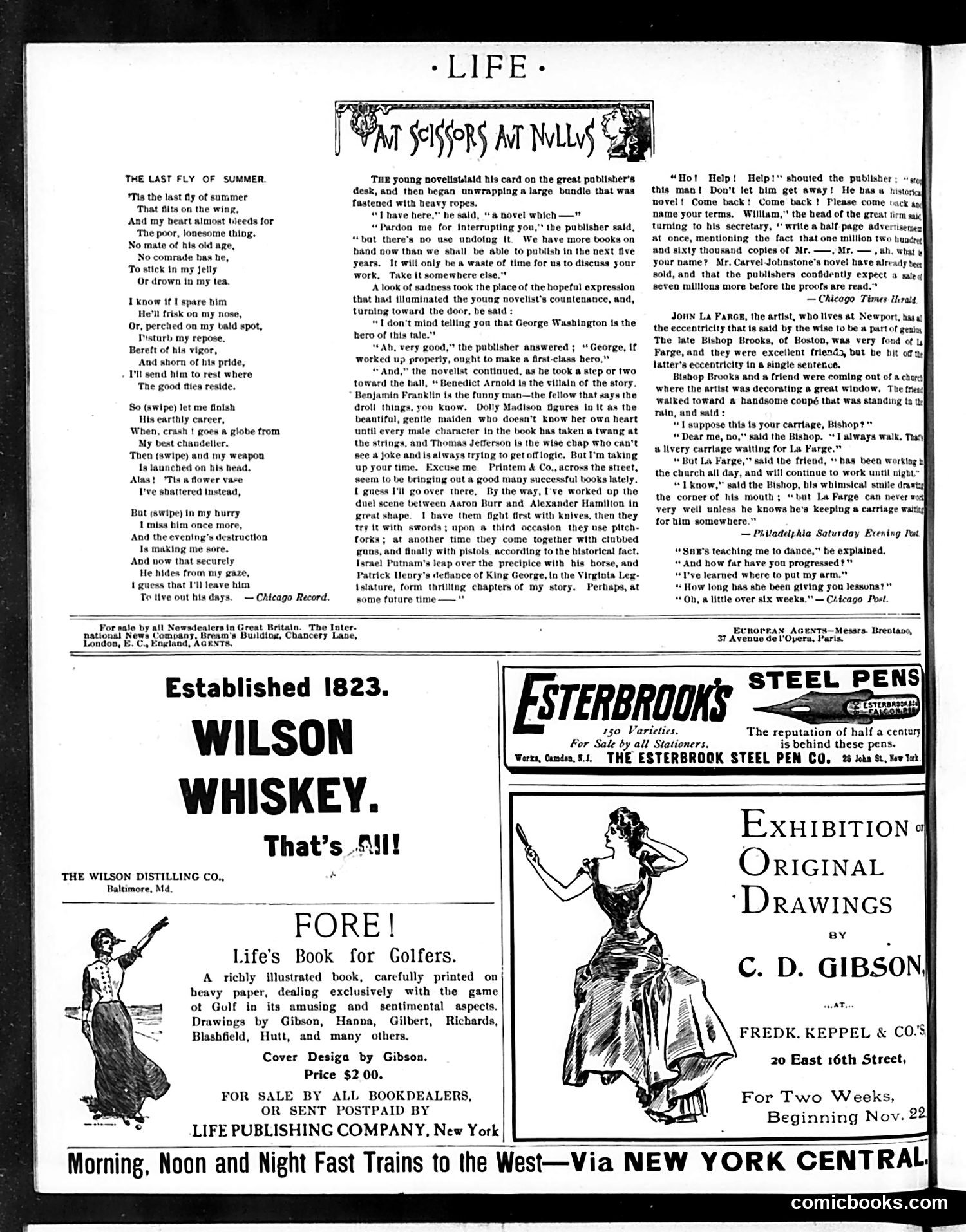
This page contains two satirical pieces mocking literary and publishing conventions of the era: **"The Last Fly of Summer"** (left column) is a humorous poem parodying sentimental Romantic verse. It sarcastically elevates a common housefly to tragic subject matter, mimicking the overwrought emotional tone of period poetry while describing mundane domestic annoyances—swatting a fly, breaking a chandelier, spilling tea. **The Publisher Cartoon** (center) satirizes the American publishing industry's obsession with historical fiction. A young novelist pitches a Revolutionary War novel featuring George Washington, Benedict Arnold, Benjamin Franklin, and other founding figures. The publisher dismisses him—until learning his manuscript contains these celebrated names. He then frantically offers publication, revealing that publishers cared less about literary merit than marketable historical names and mass sales potential. The satire critiques both the formulaic nature of popular historical fiction and publishers' cynical commercial calculations rather than genuine editorial judgment. The page also contains period advertisements for Wilson Whiskey, Esterbrook Steel Pens, and a C.D. Gibson art exhibition.
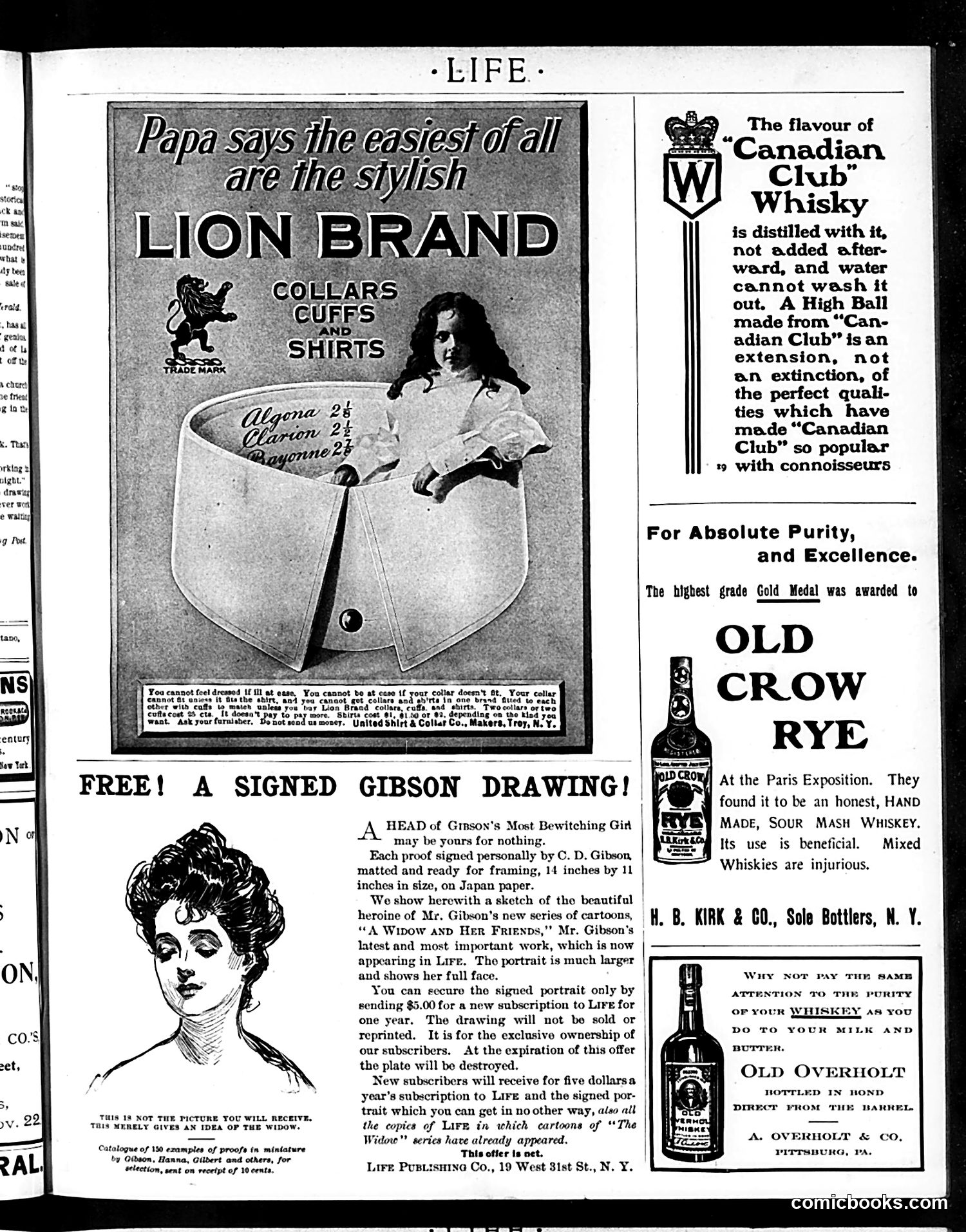
This page from *Life* magazine contains primarily **advertising** rather than political satire. The main elements are: **Left side:** A Lion Brand collar advertisement featuring a stylized woman's portrait, promising ease and style. Below it is a promotional offer for a signed C.D. Gibson drawing—Gibson was *Life's* famous illustrator, and his "Widow and Her Friends" cartoon series was apparently a popular feature in the magazine. **Right side:** Three whiskey advertisements (Canadian Club, Old Crow Rye, and Old Overholt), typical of early 20th-century magazines. The satire, if present, is indirect: the obsessive concern with perfect-fitting collars and the breathless celebrity of Gibson's drawings reveal period anxieties about appearance and status. The whiskey ads' competing claims about "purity" and production methods suggest a crowded, competitive market. **Historical context:** This reflects pre-Prohibition American consumer culture, where illustrated magazines doubled as advertising vehicles and celebrity artists like Gibson could command premium subscription rates.
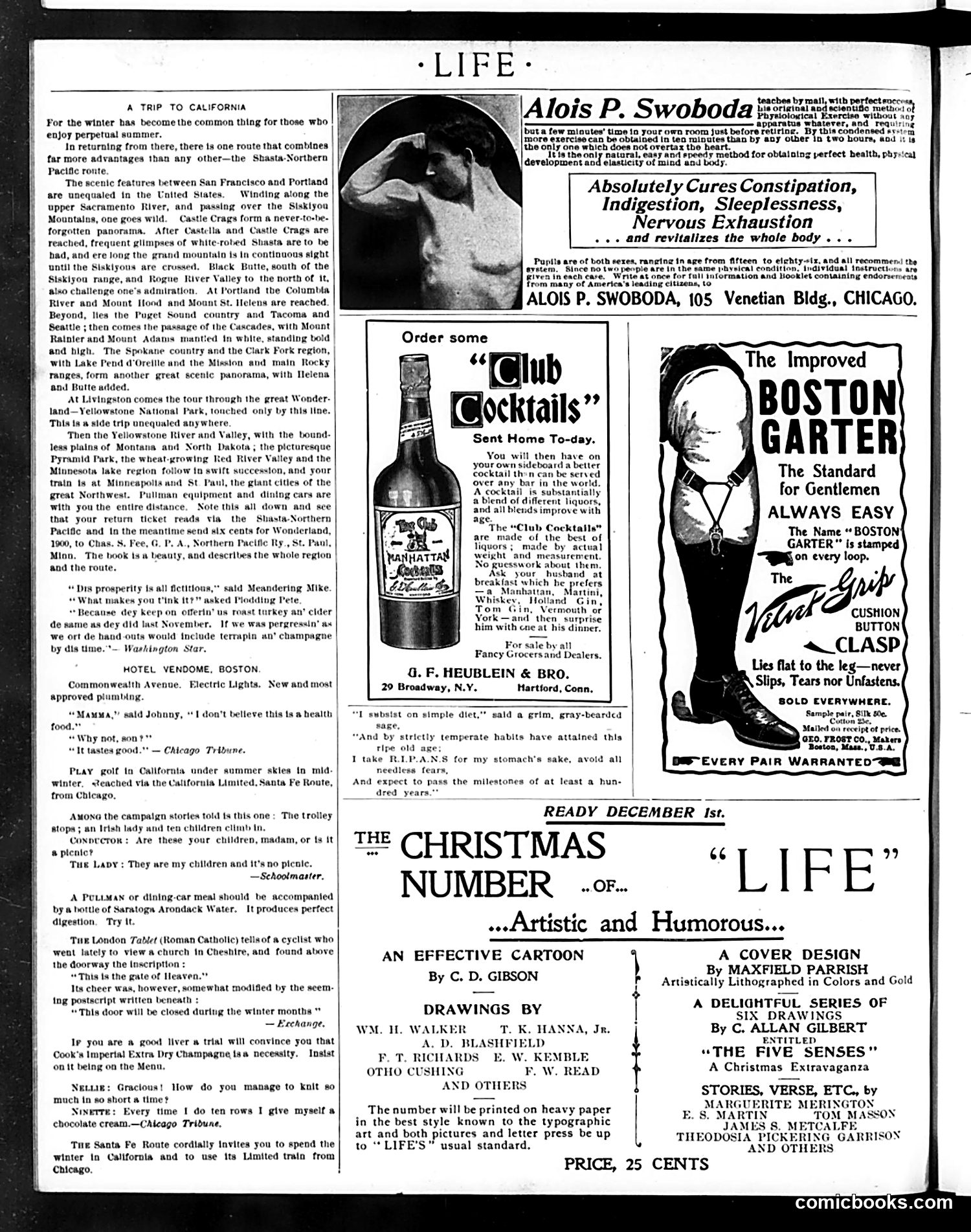
This page is primarily **travel advertising and humor**, not political satire. The dominant content promotes California tourism via the Shasta-Northern Pacific railway route, describing scenic landmarks (Mount Shasta, Yellowstone, etc.) and offering travel guides. The page includes several **brief humorous anecdotes** typical of Life's satirical style: - A joke about a tramp criticizing "prosperity" because charity hasn't upgraded from turkey to terrapin - A exchange about Irish immigration (an Irish woman with ten children on a trolley—likely playing on period stereotypes about large immigrant families) - Small jokes about food and digestion - A church sign joke about a "closed" gate of heaven **No identified political figures or cartoons appear.** The humor relies on class commentary, mild ethnic stereotyping, and everyday absurdities rather than political critique. This reflects early 1900s Life magazine content: promotional material interspersed with light social observation and advertising for luxury goods (champagne, water, garters). The ads for patent medicines and gentlemen's fashion suggest the target audience was middle-to-upper-class male readers.
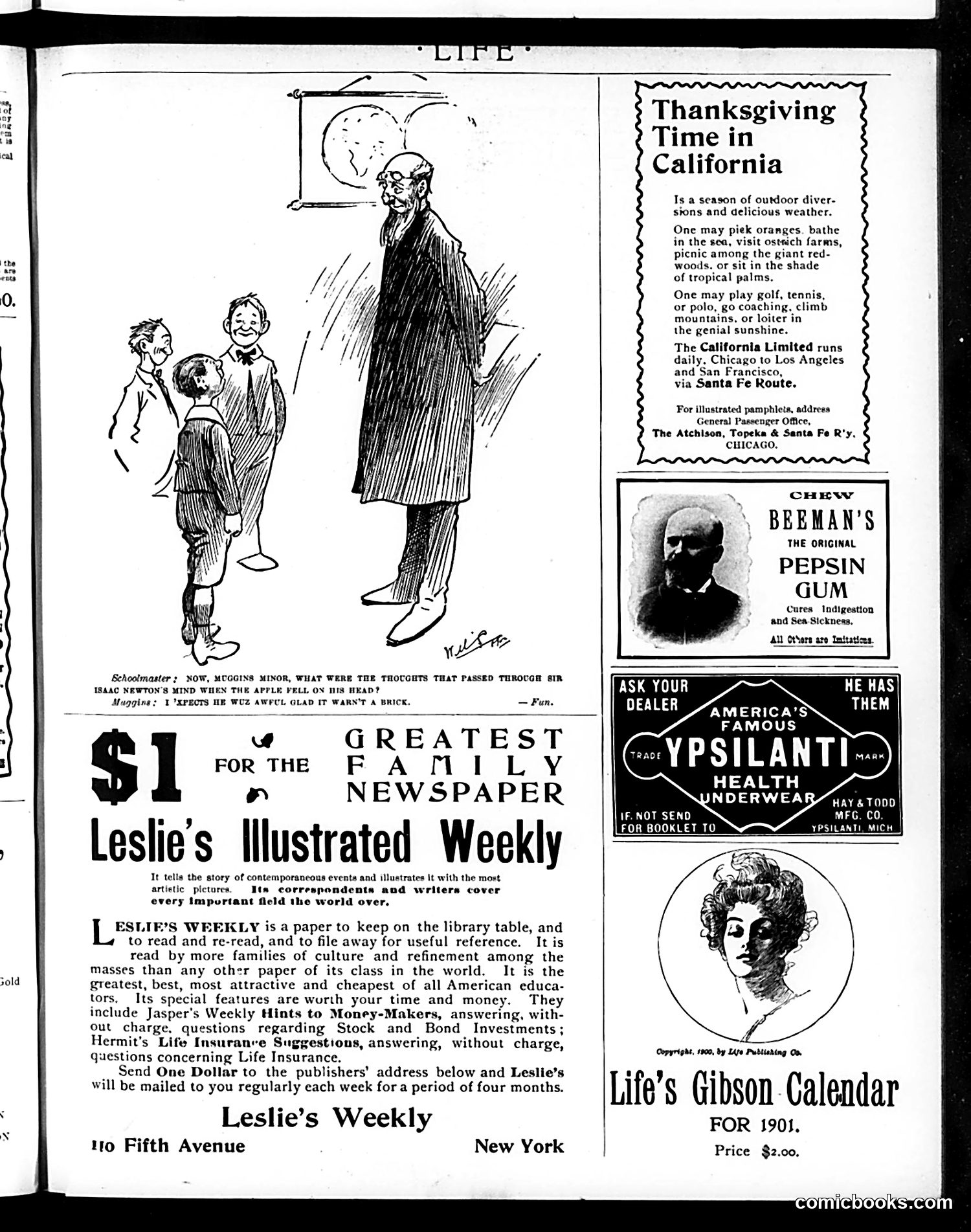
The main cartoon depicts a schoolmaster questioning a student (Muggins Minor) about Isaac Newton's thoughts when an apple fell on his head—the famous scientific anecdote. The student's response (shown in the caption) is "I 'spects he wuz awful glad it warn't a brick," a deliberately obtuse and comedic answer that misses the point entirely. The humor is a common educational satire: a dull student answers literally rather than thoughtfully. The point mocks lazy thinking and lack of intellectual curiosity. A bright student would discuss Newton's insights into gravity; this one only jokes about avoiding injury. The rest of the page is primarily **advertising**—promoting Leslie's Weekly itself, California tourism via the Santa Fe railway, Beeman's Pepsin Gum, Ypsilanti Health Underwear, and Life's Gibson Calendar. These ads reflect early 1900s consumer culture and product marketing to middle-class readers.
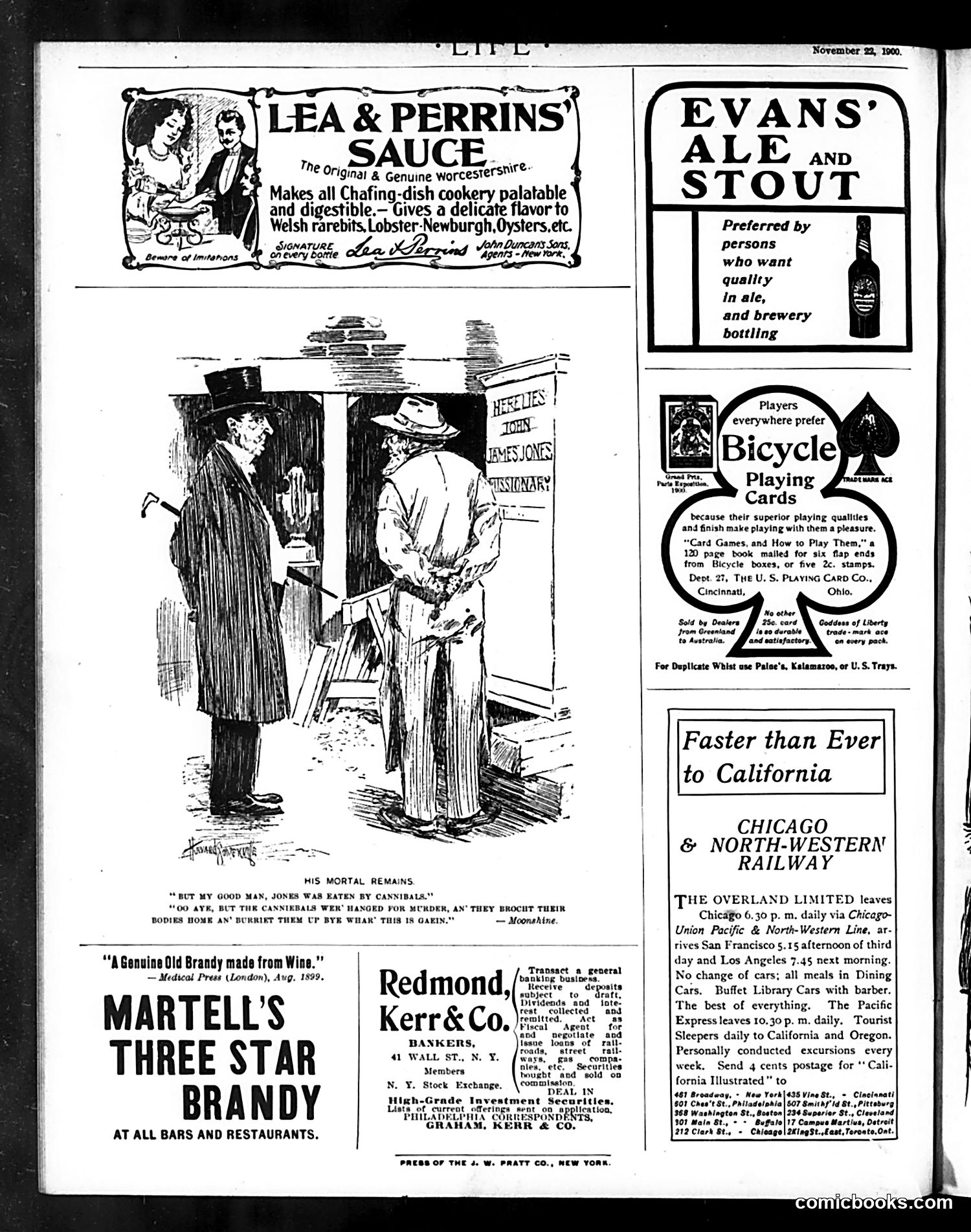
The cartoon depicts two men discussing a deceased missionary named Jones. One man (appearing to be from a colonial setting) explains that while Jones was eaten by cannibals, those cannibals were subsequently hanged for murder and buried "up bye war' this is garin'" (by where this is garden). The satire targets Victorian attitudes toward colonialism and justice. The dark humor lies in the ironic outcome: the cannibals faced execution and "proper" Christian burial for their crime, while the victim received none of these dignities. This mocks the hypocrisy of colonial powers claiming moral and legal superiority while often inflicting their own brutalities on indigenous peoples. The earnest tone of the explanation makes the absurdity sharper—treating the bureaucratic justice system as somehow redemptive despite the fundamentally tragic and grotesque situation. The attribution to "Moonshine" (Life's humor column) confirms this is satirical commentary on colonial imperialism and Western righteousness.