
Life, 1900-11-22 · page 12 of 20
Life — November 22, 1900 — page 12: what you’re looking at
What you’re looking at
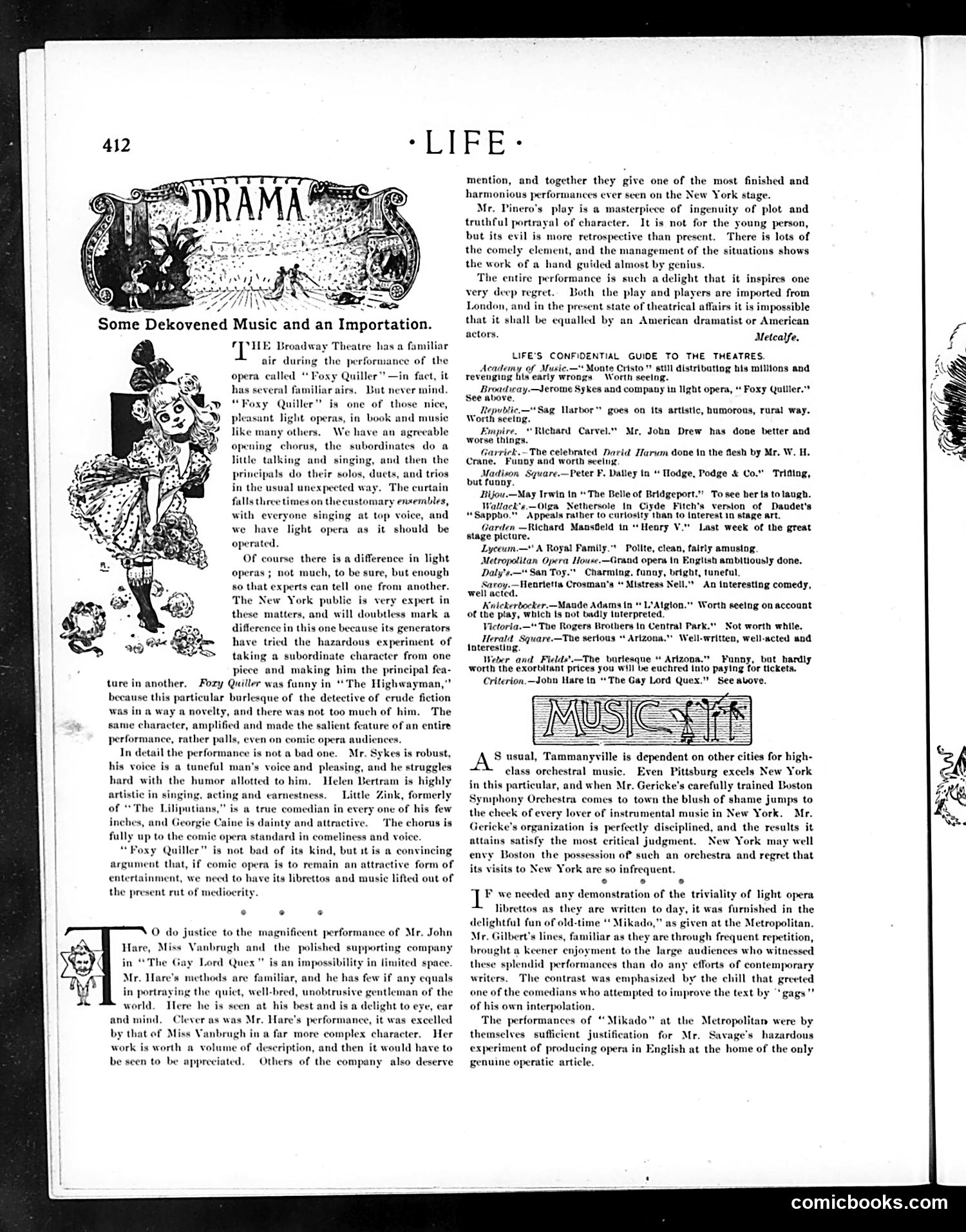
This page contains two sections: a "Drama" review and a "Music" section, with accompanying illustrations rather than political cartoons. The **Drama section** discusses "Foxy Quiller," a light opera at the Broadway Theatre. The illustration shows a woman in an elaborate costume typical of operetta performance. The review critiques the production's quality and the performers' abilities. The **Music section** discusses orchestral performances, specifically mentioning Mr. Gericke's Boston Symphony Orchestra visiting New York and performances of "Mikado" at the Metropolitan Opera House. This appears to be **arts criticism and entertainment reporting** rather than political satire. The page reflects early 1900s theatrical culture and the importance of opera and symphony orchestras in American entertainment discourse.
📄 Transcribed text from this page (OCR, searchable)
Machine-transcribed from the original scan — historical spelling and the odd misread are preserved.
“LRP E* pu air during the performance of the opera called “ Foxy Quiller” —in fact, it everal familiar airs. But never mind. xy Quiller” is one of those nice, ant light operas, in book and mus others, We have an agreeable opening chorus, the subordinates do a little talking and singing, and then the principals do their solos, duets, and trios in the usual unexpected way, The curtain falls thre customary ensembles, with everyone singing at top voice, and we have light opera as it should be operated. times on th Of course there is a difference in light operas ; not much, to be sure, but enough so that experts can tell one from another. The New York public is very expert in these matters, and will doubtless mark a difference in this one because its generators have tried the hazardous experiment of taking a subordinate character from one piece and making him the principal fea- ture in another. Fory Quiller was funny in The Highwayman, because this particular burlesque of the detective of crude fiction was in a way a novelty, and there was not too much of him. ‘The same character, amplified and made the salient feature of an entire performance, rather palls, even on comic opera audiences. In detail the performance is not a bad one. Mr. Sykes is robust, his voice is a tuneful man’s voice and pleasing, and he struggles hard with the humor allotted to him. Helen Bertram is highly artistic in singing, acting and earn ttle Zink, formerly of “The Liliputians,” is a true comedian in every one of his few inches, and orgie Caine is dainty and attract! ‘The chorus is fully up to the comic opera standard in comeliness and voicé “Foxy Quiller” is not bad of its kind, but st is a convincing argument that, if comic opera is to remain an attractive form of entertainment, we necd to have its librettos and music lifted out of the present rut of mediocrity. tness. ° ° e O do justice to the magnificent performance of Mr. John Hare, Miss Vanbrugh and the polished supporting company in “The G: Mr. Hare's methods are familiar, and he has few if any equals in portraying the quiet, well-bred, unobtrusive gentleman of the world. Here he is seen at his best and is a delight to eye, ear and mii ‘lever as was Mr. Hare's performance, it was excelled by that of Miss Vanbrugh in a far more complex character. Her work is worth a volume of description, and then it would have to be seen to be appreciated. Others of the company also deserve y Lord Quex” is an impossibility in limited space. mention, and together they give one of the most finished and harmonious performances ever seen on the New York stage. Mr. Pinero’s play is a masterpiece of ingenuity of plot and truthful portrayal of character. It is not for the young person, but its evil is more retrospective than present. There is lots of the comely clement, and the management of the situations shows the work of a hand guided almost by genius. The entire performance is such a delight that it inspires one very deep regret. Both the play and players are imported from London, and in the present state of theatrical affairs it is impossible that it shall be equalled by an American dramatist or American actors. Metcalfe, LIFE'S CONFIDENTIAL GUIDE TO THE THEATRES. Academy of Music.—* Monte Cristo” still distribating his militons and revenging his early wrongs Worth seeing. Broadway.—serome Sykes and company tn ght opera, “ Foxy Quilter. See above. Republic.—" Sag Marbor goes on its artistic, humorous, rural way. Worth seeing. Empire. worse things. rrick.—The celebrated Parid Harum done tn the flesh by Mr. W. H. Crane, Funny and worth seeing Madison Square.—Peter F, Dalley in “ Hodge, Podge & Co. but funny. Bijou.—May Irwin in “The Belle of Bridgeport.”” To see her Is to laugh. Watlack's.—Olga Nethersole in Ciyde Fitch's version of Daudet's “Sappto.” Appeals rather to curlosity than to Loterest in stage art. Garden —Richard Mansfeld tn “Henry V." Last week of the great stage picture. Lyceum.—" A Royal Family. Polite, clean, fairly amusing. Metropolitan Opera House.—Grand opera in Engltsh ambitiously done, Daty's.—"* San Toy." Charming, funny, bright, tuneful Saroy.—Henrietta Crosman’s “ Mistress Nell," An Interesting comedy, well acted. Knickerbocker.—Maude Adams in L'Aigion." Worth seeing on account of the play, Which 1s not badly tuterpreted Victoria.—" Toe Rogers Brothers tn Central Park." Not worth while, Herald Square.—The serious “ Arizona." Well-written, well-acted and toteresting. Weber and Fields'.—The bariesque “ Arizona.” Funny, bat hardly worth the exorbitant prices you will Le euchred {nto paying for tickets. Criterion.—Jobu Hare in “The Gay Lord Quex."” See above. Richard Carvel." Mr, John Drew has done better and ‘Triding, S usual, Tammanyville is dependent on other cities for high- class orchestral music. Even Pittsburg excels New York in this particular, and when Mr. Gericke’s carefully trained Boston Symphony Orchestra comes to town the blush of shame jumps to the cheek of every lover of instrumental music in New York. Mr. Gericke’s organization is perfectly disciplined, and the results it attains satisfy the most critical judgment. New York may well envy Boston the possession of such an orchestra and regret that its visits to New York are so infrequent. ° ° ° we needed any demonstration of the triviality of light opera librettos as they are written to day, it was furnished in the htful fun of old-time ‘ Mikado,” as given at the Metropolitan, Mr. Gilbert's lines, familiar as they are through frequent repetition, brought a keener enjoyment to the large audiences who witnessed these splendid performances than do any efforts of contemporary writers. The contrast was emphasized by the chill that greeted one of the comedians who attempted to improve the text by “ gags’? of his own interpolation, The performances of “Mikado” at the Metropolitan were by themselves sufficient justification for Mr. Savage's hazardous experiment of producing opera in English at the home of the only genuine operatic article. comicbooks.com