
A complete issue · 20 pages · 1900
Life — August 2, 1900
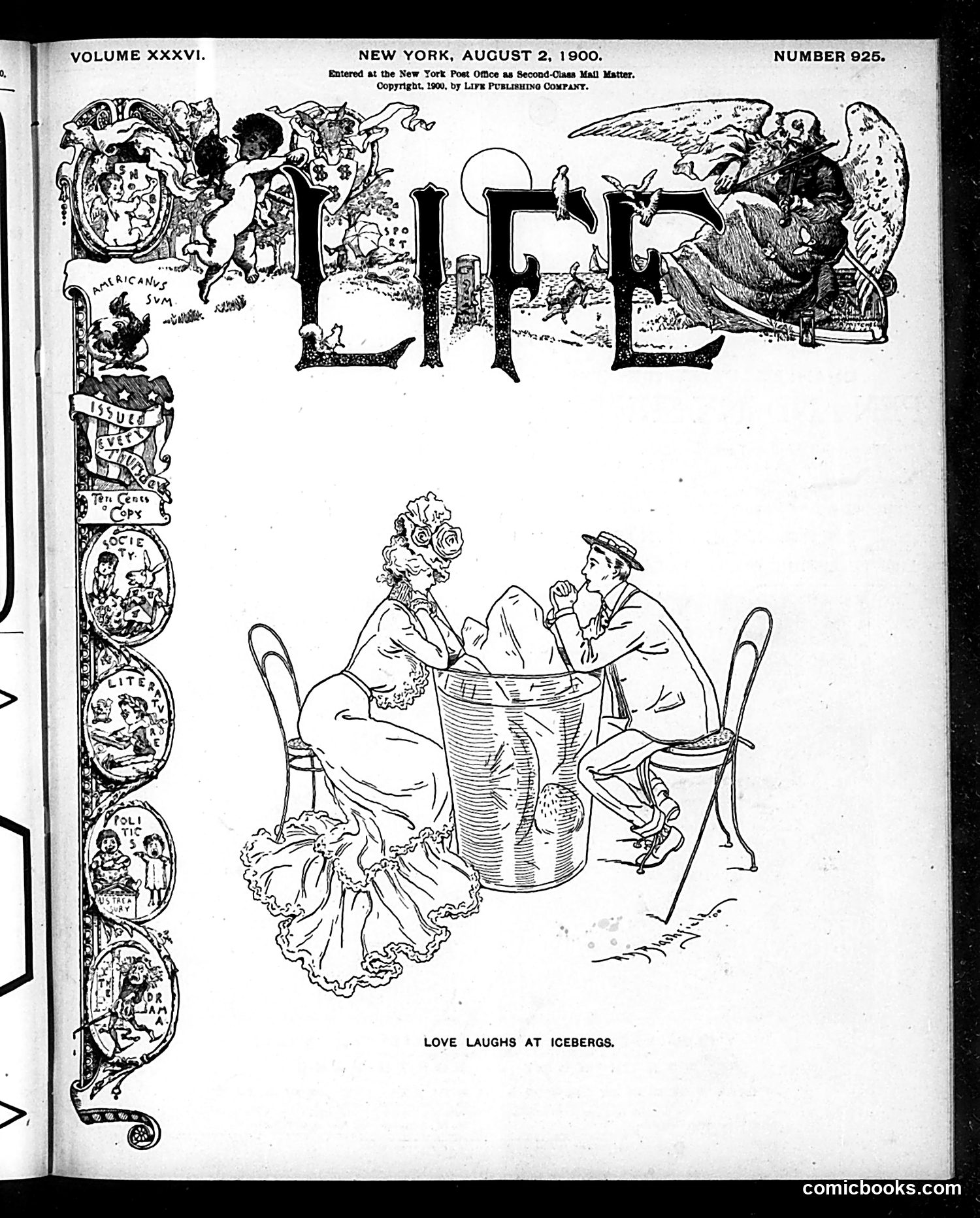
This Life magazine cover from August 2, 1900 features a humorous romantic scene titled "Love Laughs at Icebergs." Two figures sit at a small table in what appears to be an icy or frozen setting, suggesting a cold environment. The caption's phrase "love laughs at" implies that romantic affection transcends practical hardship or discomfort. The joke appears to be satirical commentary on romantic idealization—couples in love ignore or dismiss real dangers and discomforts (represented by the "icebergs" and cold). This reflects period attitudes about romance overriding common sense. The ornate decorative borders and period-specific illustration style are characteristic of Life's satirical design.
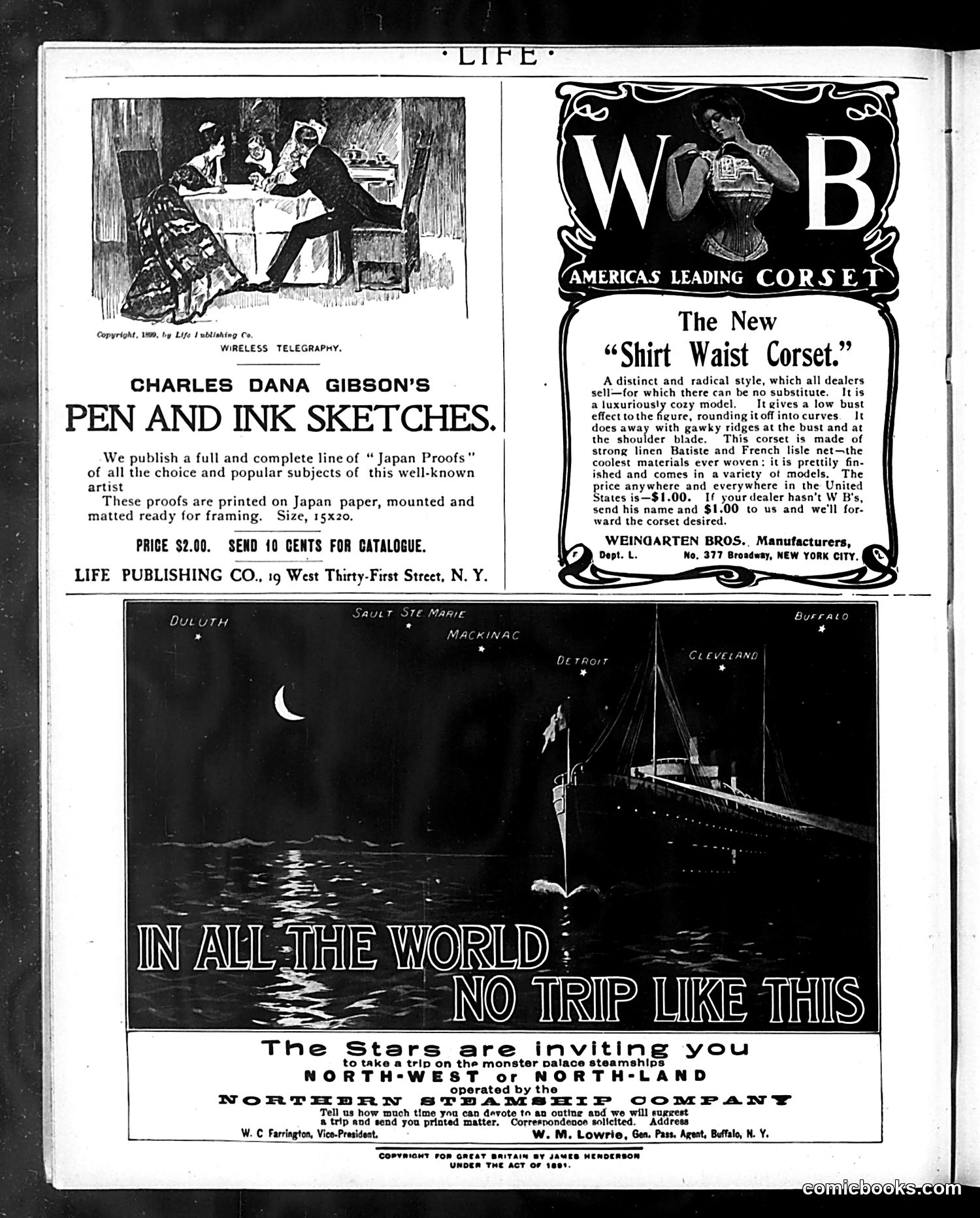
This page is primarily **advertising**, not political satire. It contains three distinct ads: 1. **Top left**: An advertisement for Charles Dana Gibson's pen and ink sketches, promoting "Japan Proofs" printed on Japan paper, priced at $2.00. 2. **Top right**: A W.B. corset advertisement for "America's Leading Corset," promoting their new "Shirt Waist Corset" for $1.00. 3. **Bottom**: A large advertisement for the Northern Steamship Company, promoting luxury travel on their "monster palace steamship" the *Northwest of North-Land*, with the tagline "In All the World No Trip Like This." The small sketch at top left depicting a social dinner scene appears to be illustrative material accompanying the Gibson advertisement rather than political commentary. No clear satirical intent is evident on this page.
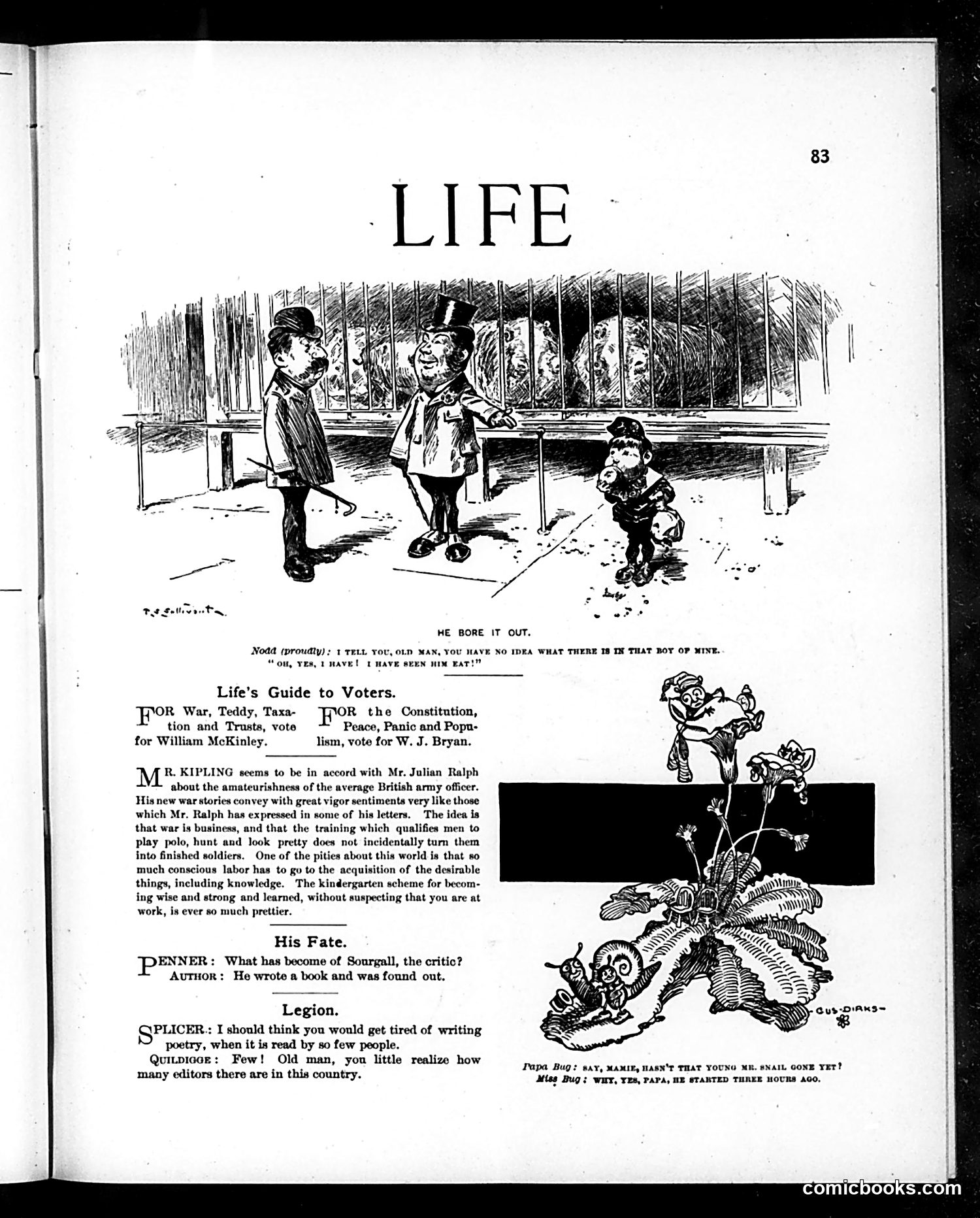
**Main Cartoon ("He Bore It Out"):** A man in a top hat confronts another man while a small child stands nearby. The caption suggests the child is the speaker's son, and the man in the hat claims ignorance about the boy's parentage—a joke about paternity or legitimacy. **"Life's Guide to Voters":** Two brief voting recommendations: McKinley for War/Taxation/Trusts, and Bryan for Constitution/Peace/Populism. This references the 1896 or 1900 presidential election between Republican William McKinley and Democrat William Jennings Bryan. **Remaining Items:** Brief humorous exchanges about an unsuccessful critic ("Sourgall"), poetry editors, and a snail—typical satirical filler content. The page mixes political commentary with general humor typical of Life magazine's format.
This page discusses the ongoing Boxer Rebellion outbreak in China (six weeks old at publication). The left illustration appears to be a globe or map emphasizing China's geography and scale. The main text critiques American policy toward China, specifically defending military intervention in the Philippines while opposing similar action in China proper. It references Colonel Roosevelt's recent speech arguing that the Boxer Revolt demonstrated the wisdom of America's Philippine policy—that supporting local strongmen (like Aguinaldo) was preferable to direct territorial control. The satire targets inconsistent imperial logic: America sends 65,000 troops to China to suppress the Boxer uprising while simultaneously maintaining troops in the Philippines on similar grounds. The piece sarcastically notes the contradiction isn't lost on observers, questioning the coherence of American expansionist policy across East Asia.
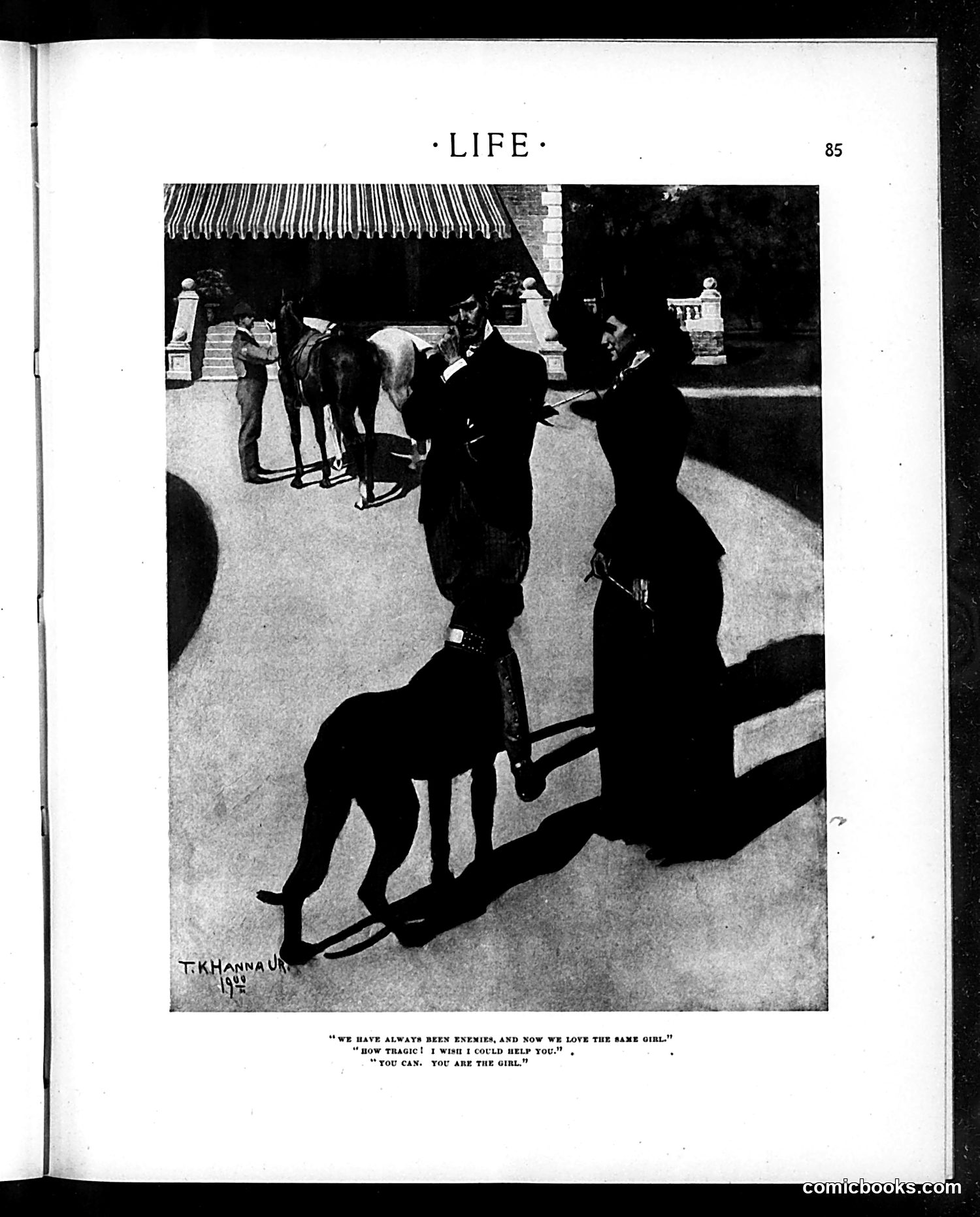
This photograph by T.K. Hanna (dated 1944) depicts a romantic or dramatic scene at what appears to be an elegant venue—possibly a country club or estate, given the striped awning and formal setting. The caption presents dialogue suggesting romantic tension: "We have always been enemies, and now we love the same girl. How tragic! I wish I could help you. You can. You are the girl." The image shows figures in formal attire with horses present, suggesting either a social gathering or sporting event. The satirical point appears to be about romantic rivalry and the ironic position of the woman as the object of competing affections. Without additional context about the specific publication date and surrounding articles, the precise historical or political reference remains unclear, though it likely satirizes contemporary social dynamics or relationship conventions.
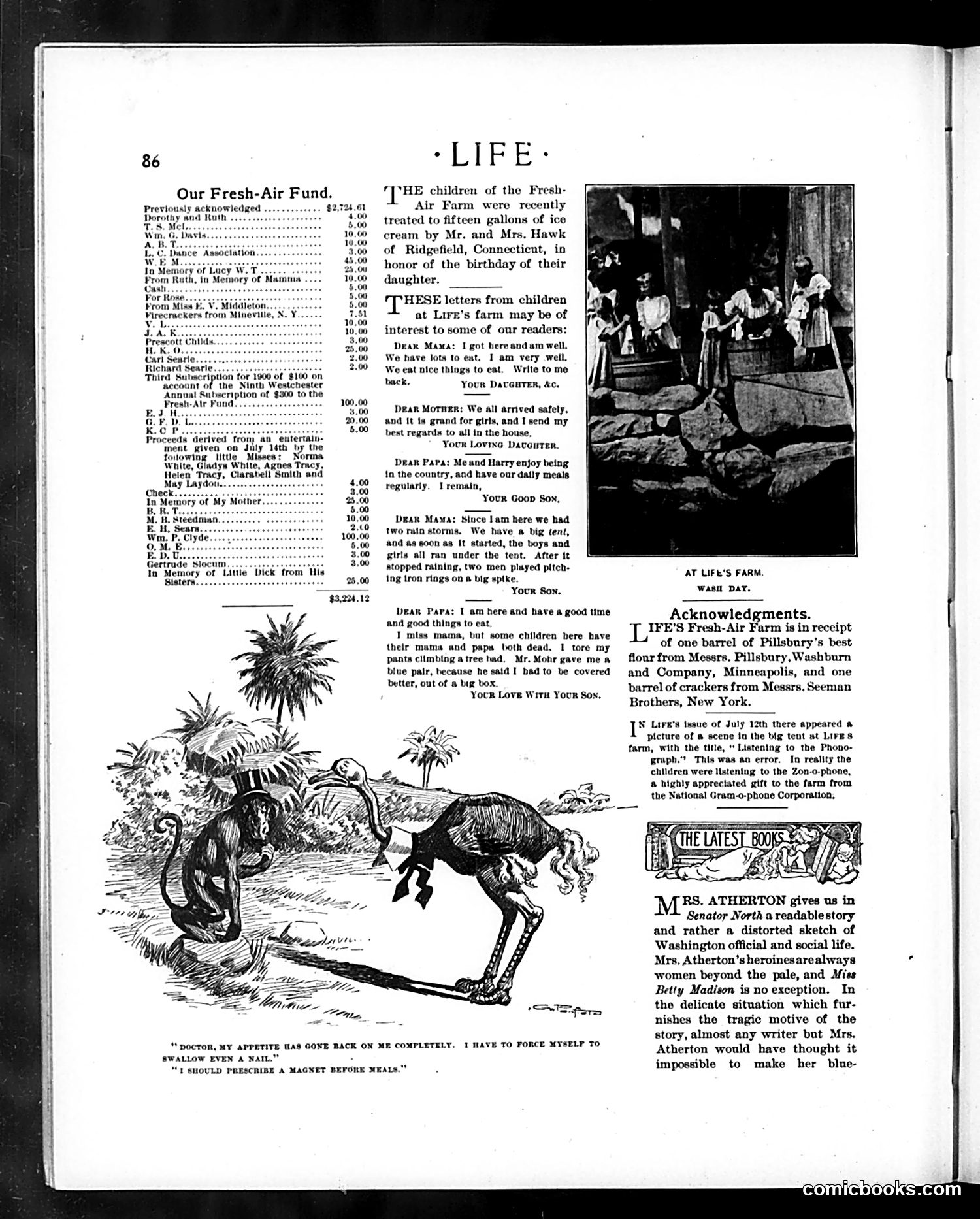
The main cartoon depicts a skeletal figure (Death personified) forcing a reluctant man to swallow a nail. The caption reads: "DOCTOR, MY APPETITE HAS GONE BACK ON ME COMPLETELY. I HAVE TO FORCE MYSELF TO SWALLOW EVEN A NAIL" and "I SHOULD PRESCRIBE A MAGNET BEFORE MEALS." This is a dark humor joke about severe digestive problems—the man claims he must force himself to eat even metal objects, implying his appetite is completely destroyed. The doctor's suggestion of a magnet "before meals" is absurd wordplay, implying the magnet would extract the nail he's swallowed. The page also features heartwarming letters from children at Life's Fresh-Air Farm (a charitable program providing rural experiences to poor urban children), with acknowledgments of donations supporting this welfare initiative.
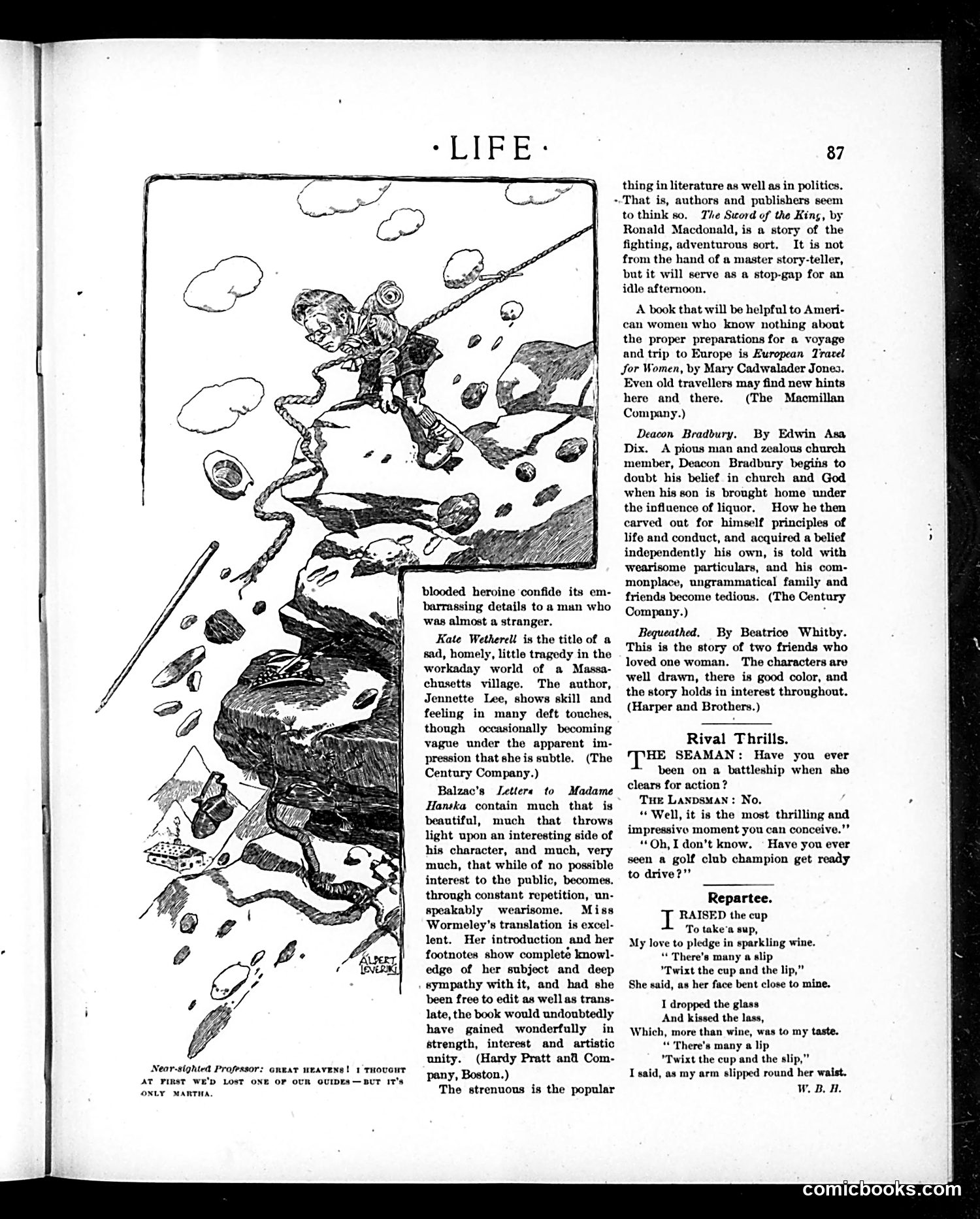
The main illustration depicts a figure falling or tumbling through space with clouds above and rocks below—a classical "fall from grace" scenario. The caption reads: "Near-sighted Professor: Great heavens! I thought at first we'd lost one of our guides—but it's only Martha." This is a visual pun playing on the double meaning of "lost." The professor, being nearsighted, initially feared a human companion was missing during what appears to be a mountain expedition. Instead, he's relieved to discover it's merely "Martha"—likely a pack animal or servant. The joke satirizes absent-mindedness and class attitudes: the professor's relief that it's not a "guide" but someone/something of lesser importance. The page also contains book reviews and comic verse ("Rival Thrills," "Repartee").
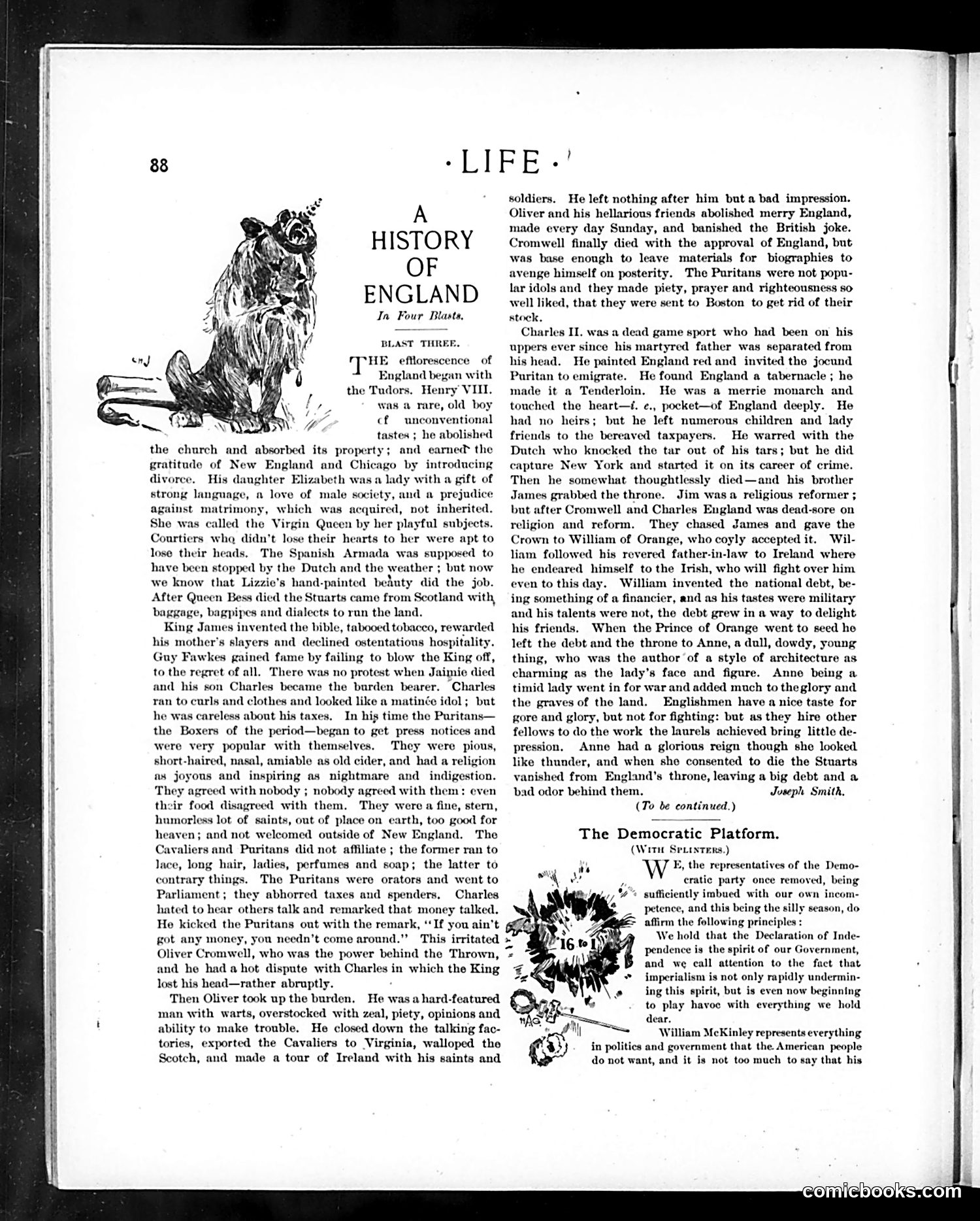
This page contains two distinct sections: 1. **"A History of England in Four Blasts"** - A satirical historical narrative (by Joseph Smith, per the byline) mocking English history from the Tudors onward. The accompanying illustration shows a grotesque face, likely caricaturing a historical figure. The text ridicules various English monarchs and religious factions—Puritans vs. Cavaliers, Charles I, Cromwell—for their hypocrisy and destructive behavior. 2. **"The Democratic Platform"** - A separate article beginning below, with a decorative illustration featuring what appears to be political imagery (unclear which specific figures). The visible text discusses American democratic principles and references William McKinley, suggesting this addresses late-19th or early-20th century politics. The page blends historical satire with contemporary political commentary, though the specific satirical targets of the second piece require more context to fully interpret.
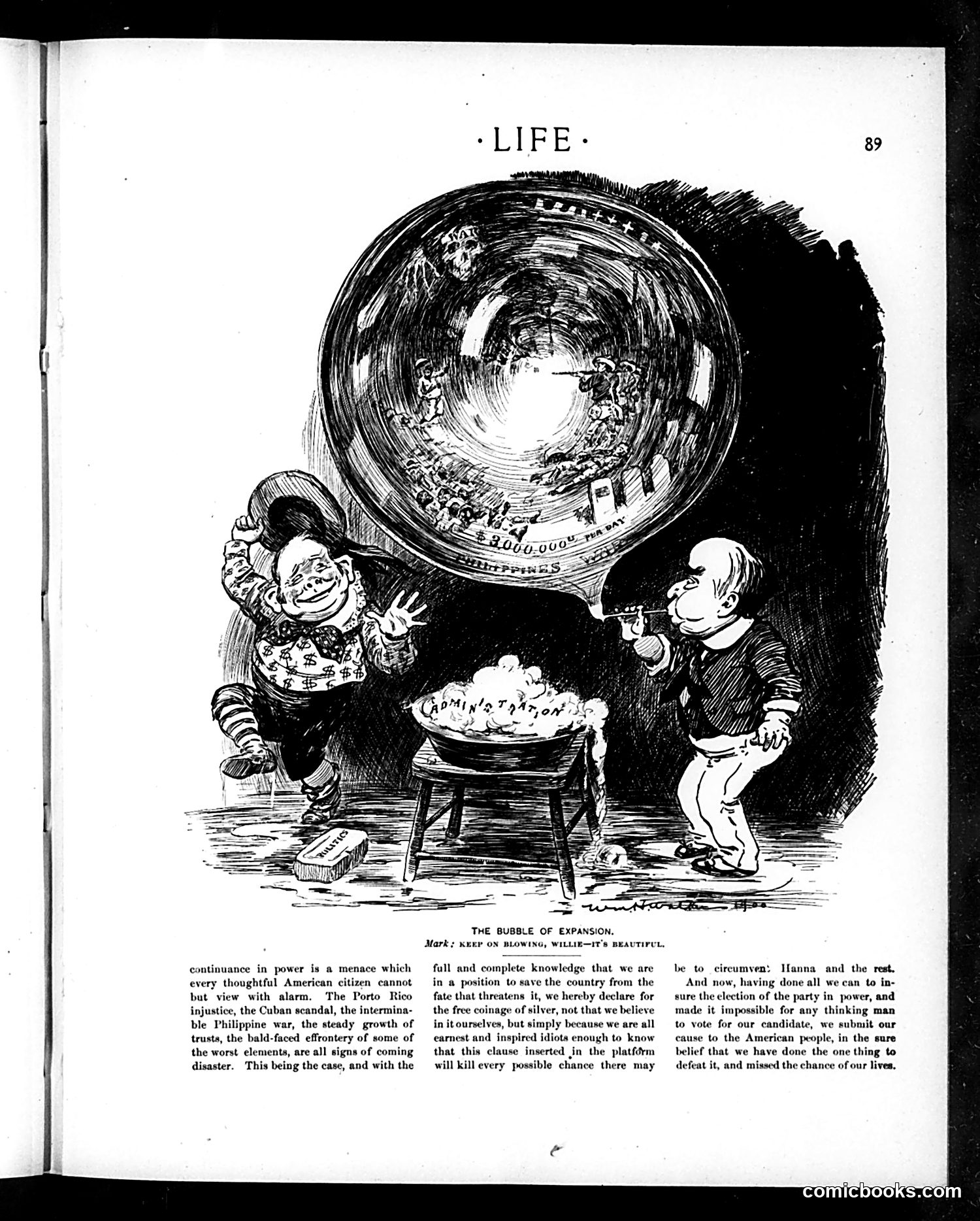
This political cartoon depicts two caricatured figures (likely political opponents) examining a large, fragile soap bubble labeled with text referencing expansion and the Philippines. One figure blows the bubble while the other watches skeptically. The satire concerns American imperialism and territorial expansion, specifically regarding the Philippine-American War and debates over whether the U.S. should maintain colonial control of the Philippines. The "bubble" metaphor suggests that expansionist policies are unstable and destined to burst—an unsustainable economic and political endeavor. The accompanying text warns that continued imperial expansion threatens the nation, citing "the Cuban scandal, the intermittable Philippine war, the steady growth of trusts" as warning signs of disaster. The cartoon argues against what it views as dangerous overreach in American foreign policy.
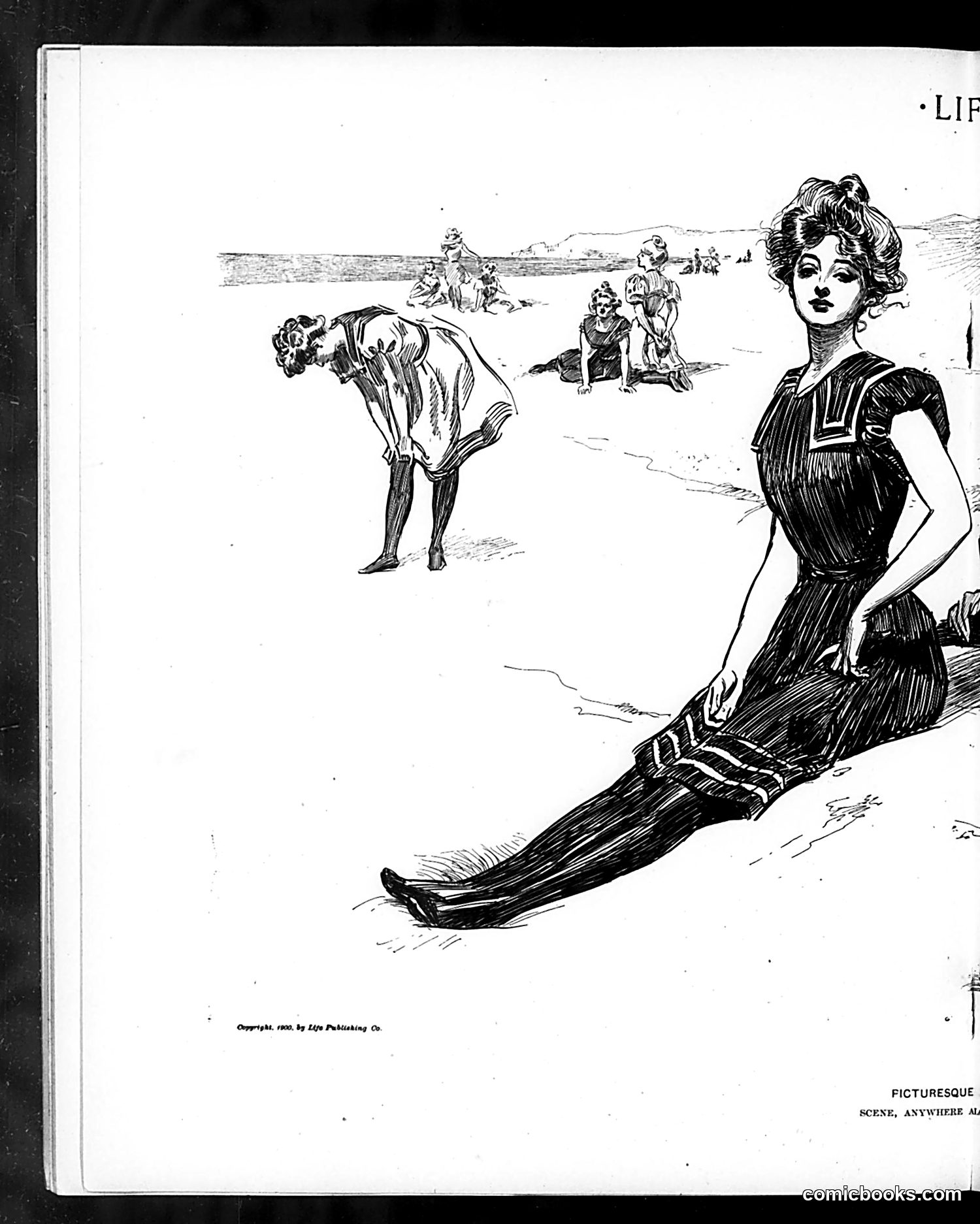
This appears to be a beach or seaside scene from Life magazine (copyright 1908, Life Publishing Co.). The illustration shows a fashionably dressed woman in the foreground wearing a dark bathing costume with decorative details, sitting on the beach. In the background, other beachgoers are visible. The caption reads "PICTURESQUE SCENE, ANYWHERE AT" (text cut off). This likely satirizes early-1900s beach fashion and social conventions. The woman's elaborate, form-fitting bathing dress—with its decorative elements and elegant styling—contrasts with the practical needs of swimming. The satire appears directed at how women's beachwear prioritized appearance and fashion over functionality, reflecting broader social tensions about women's public display and the constraints of Edwardian-era dress codes even in recreational settings.
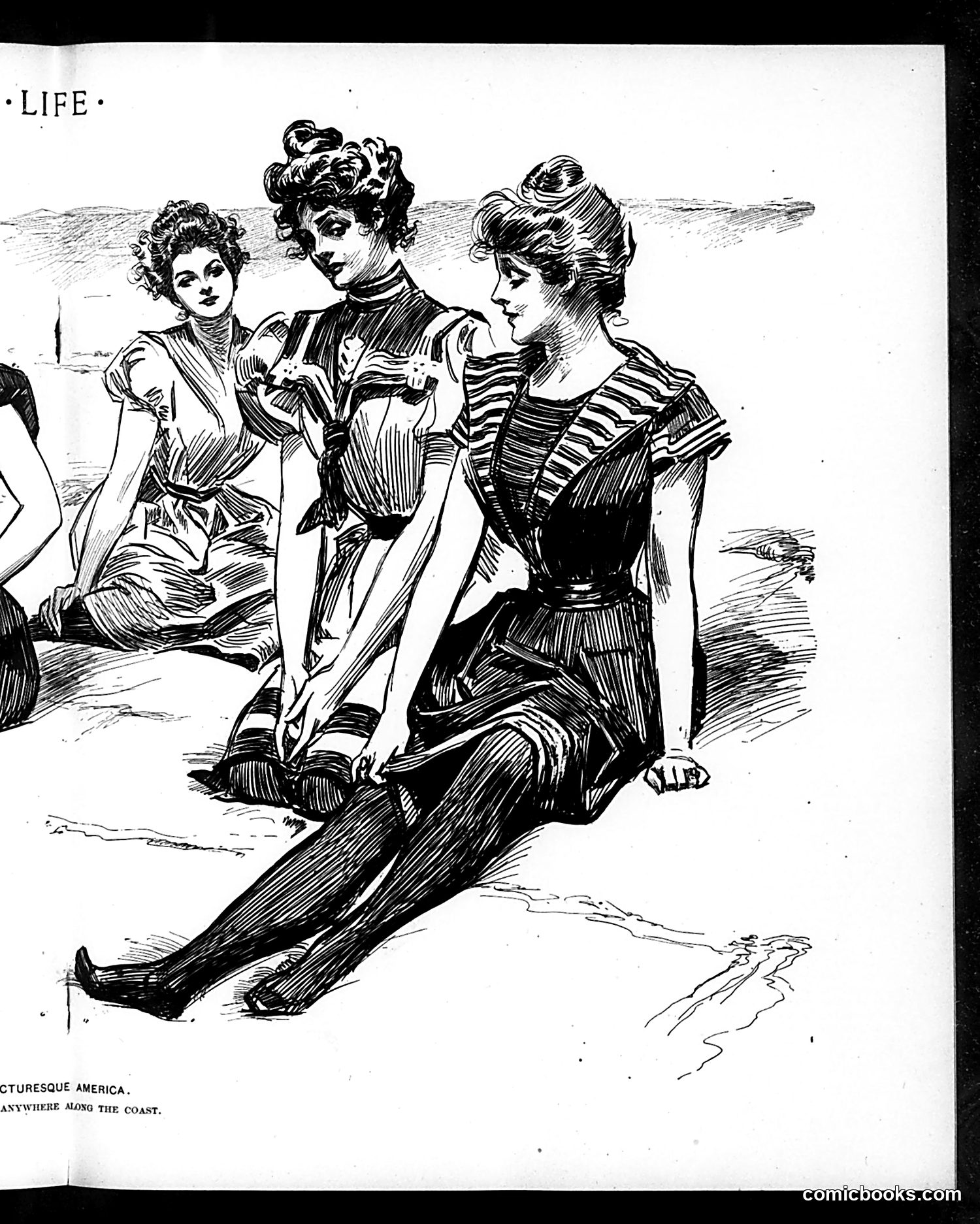
This page from *Life* magazine shows three women in bathing attire seated together by the shore, titled "Picturesque America—Anywhere Along the Coast." The satire likely targets **early 1900s beach culture and women's fashion**. The exaggerated, somewhat ungainly postures and the emphasis on their varied body types and swimming costumes suggests mockery of how women actually looked in bathing dress, contrasting with idealized beauty standards of the era. The caption's vagueness ("anywhere along the coast") implies this is a universal, unremarkable scene—yet the illustration's deliberate awkwardness makes these ordinary beachgoers appear ridiculous. This reflects *Life*'s editorial approach: gentle social satire of contemporary leisure activities and changing gender roles, particularly women's increasing public presence in recreational spaces.
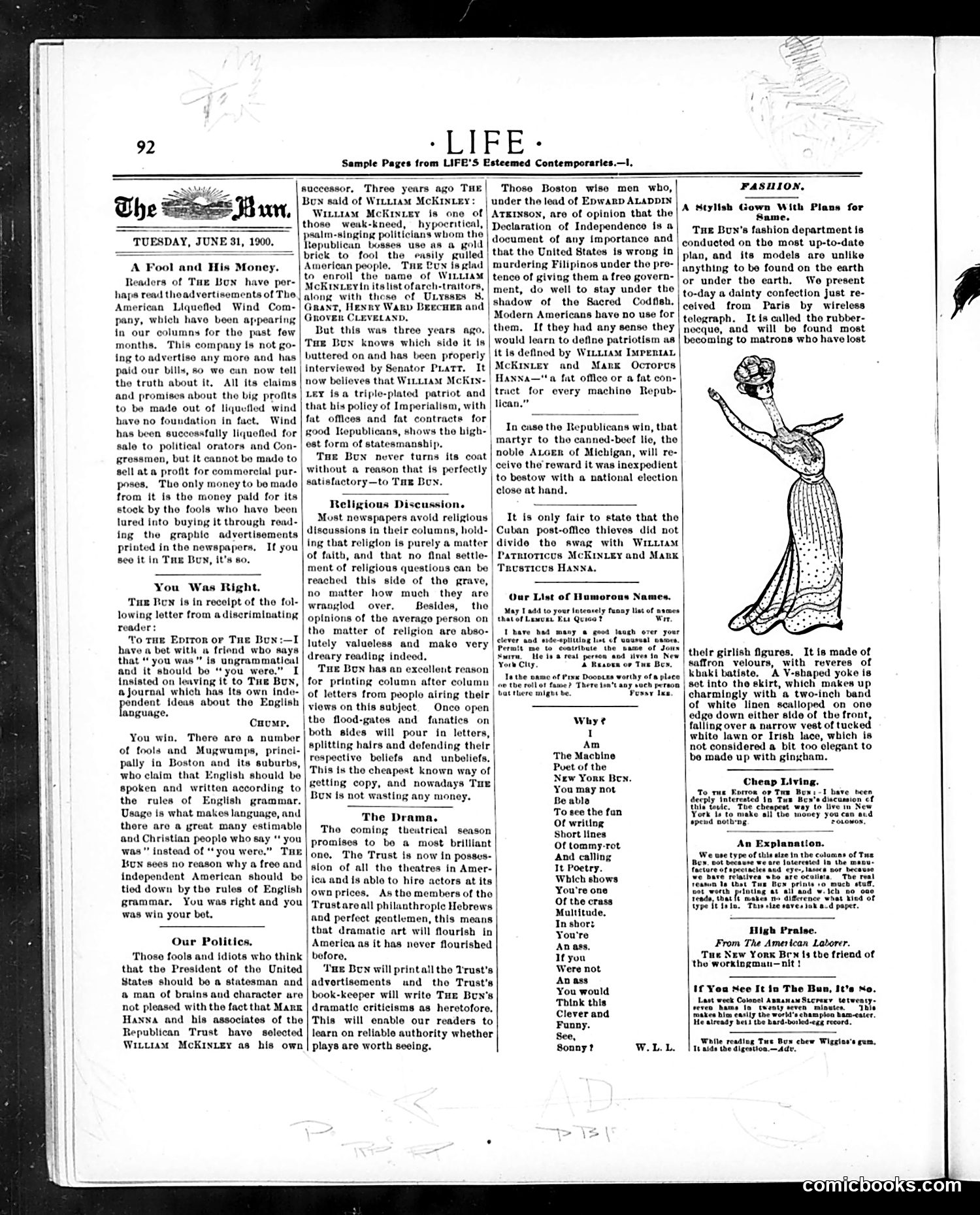
This page contains editorial commentary mocking Republican politics and the "Trust" question (monopolistic corporations). **Key targets:** - **William McKinley**: The sitting Republican president, criticized for supporting big business interests over common citizens - **Mark Hanna**: McKinley's political operative, portrayed as complicit in exploiting workers - **Populist/Democratic critique**: The articles attack Republicans for enabling corporate monopolies that exploit labor while claiming patriotism **The satire's point:** Republicans claim to be patriots defending America, but actually serve wealthy industrialists. The "Religious Discussion" section mocks newspapers avoiding criticism of these power structures. **The fashion illustration** (right side) appears unrelated—typical magazine filler showing a woman's gown design. The overall message: Republican leadership prioritizes corporate profits over worker welfare and democratic values.
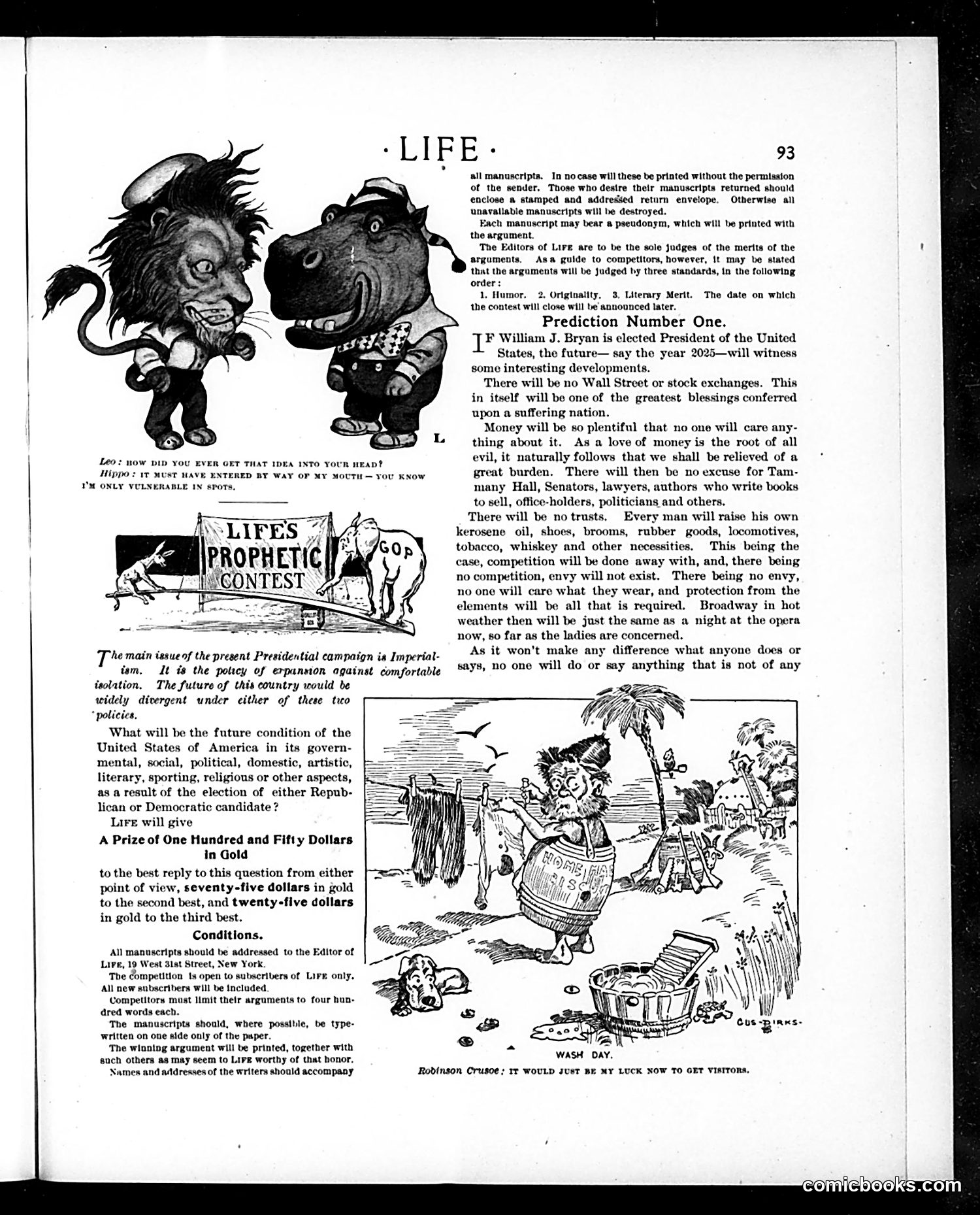
This page presents **Life's Prophetic Contest** on the 1900 presidential election, centered on **Imperialism vs. Isolationism**—the era's dominant political debate. **Top cartoon**: A Leo (Republican) and Hippo (Democrat) exchange witty insults about each other's intellect, satirizing the heated campaign rhetoric. **Main contest**: Life solicits predictions about America's future under either Republican or Democratic leadership, offering $150 in gold prizes. **"Prediction Number One"** sarcastically imagines William J. Bryan (the Democratic candidate) winning and eliminating capitalism entirely by 2025. The satire mocks Bryan's anti-monopoly platform by extending it absurdly: no Wall Street, no trusts, no competition, money becomes worthless, everyone manufactures their own goods. The joke culminates in suggesting this utopia renders all human effort meaningless. **Bottom cartoon** (Robinson Crusoe reference) is unrelated filler humor. The page lampoons both Bryan's economic radicalism and the magazine's elite readership's anxieties about wealth redistribution and social change.
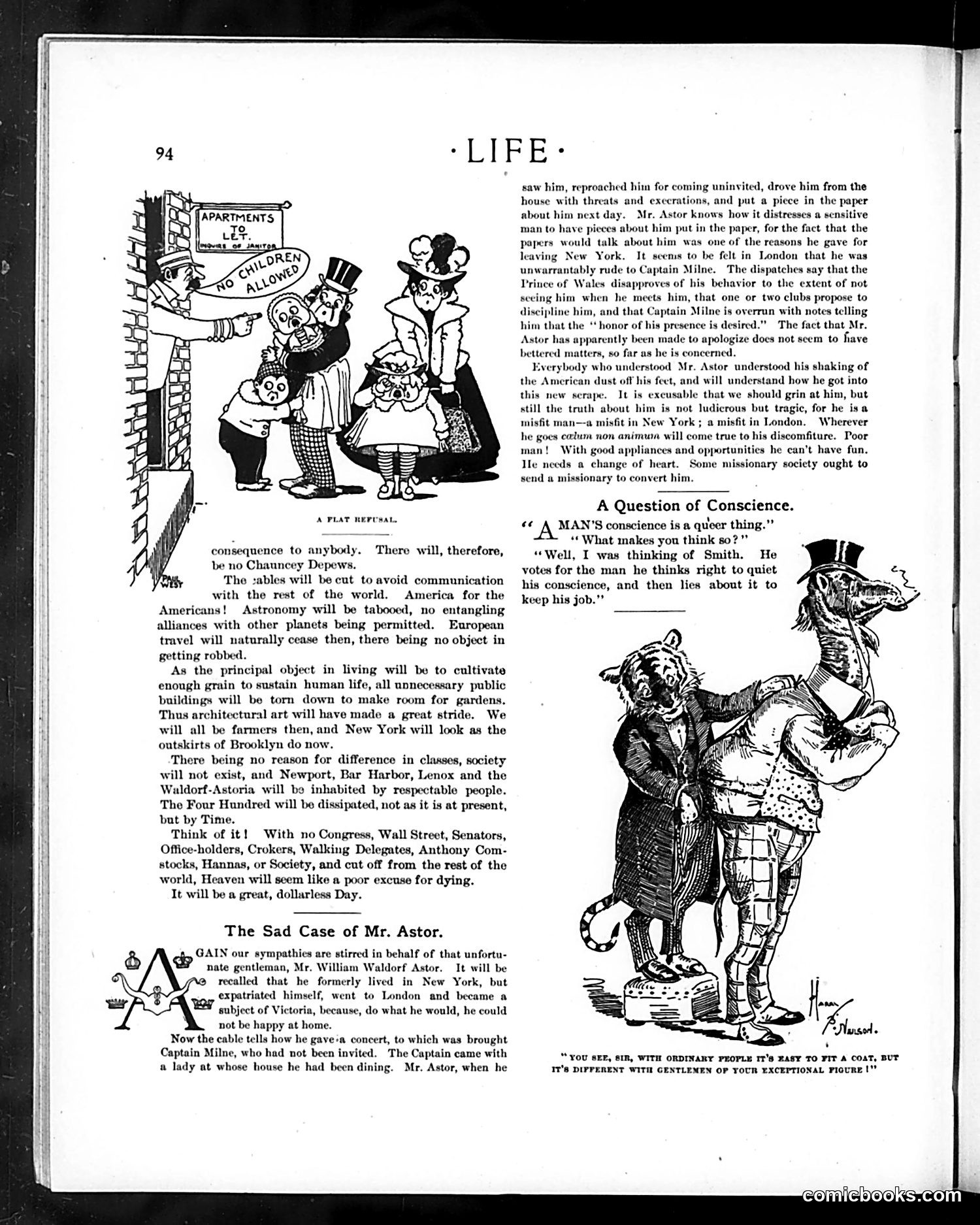
**Main Content: "The Sad Case of Mr. Astor"** This satirizes William Waldorf Astor, a wealthy American who emigrated to London seeking happiness but found only scandal. The piece describes his rudeness to Captain Milne at a concert (inviting himself uninvited), causing embarrassment to the Prince of Wales and leading to social discipline. The satire's point: Astor is a "misfit" everywhere—his wealth and status cannot buy him contentment or social grace. **"A Question of Conscience" Vignette** A brief joke about moral compromise: a man votes for the "right" candidate but lies about it to keep his job, exposing the gap between public principle and private self-interest. **"A Flat Refusal" Cartoon** The left illustration shows a landlord refusing entry to an apartment, citing "No Children Allowed"—reflecting real housing discrimination practices of the era. **Bottom Cartoon** A tailor struggling to fit an exceptionally large gentleman, joking that wealthy eccentrics are harder to accommodate than ordinary people—visual commentary on Astor's exceptional but problematic status.
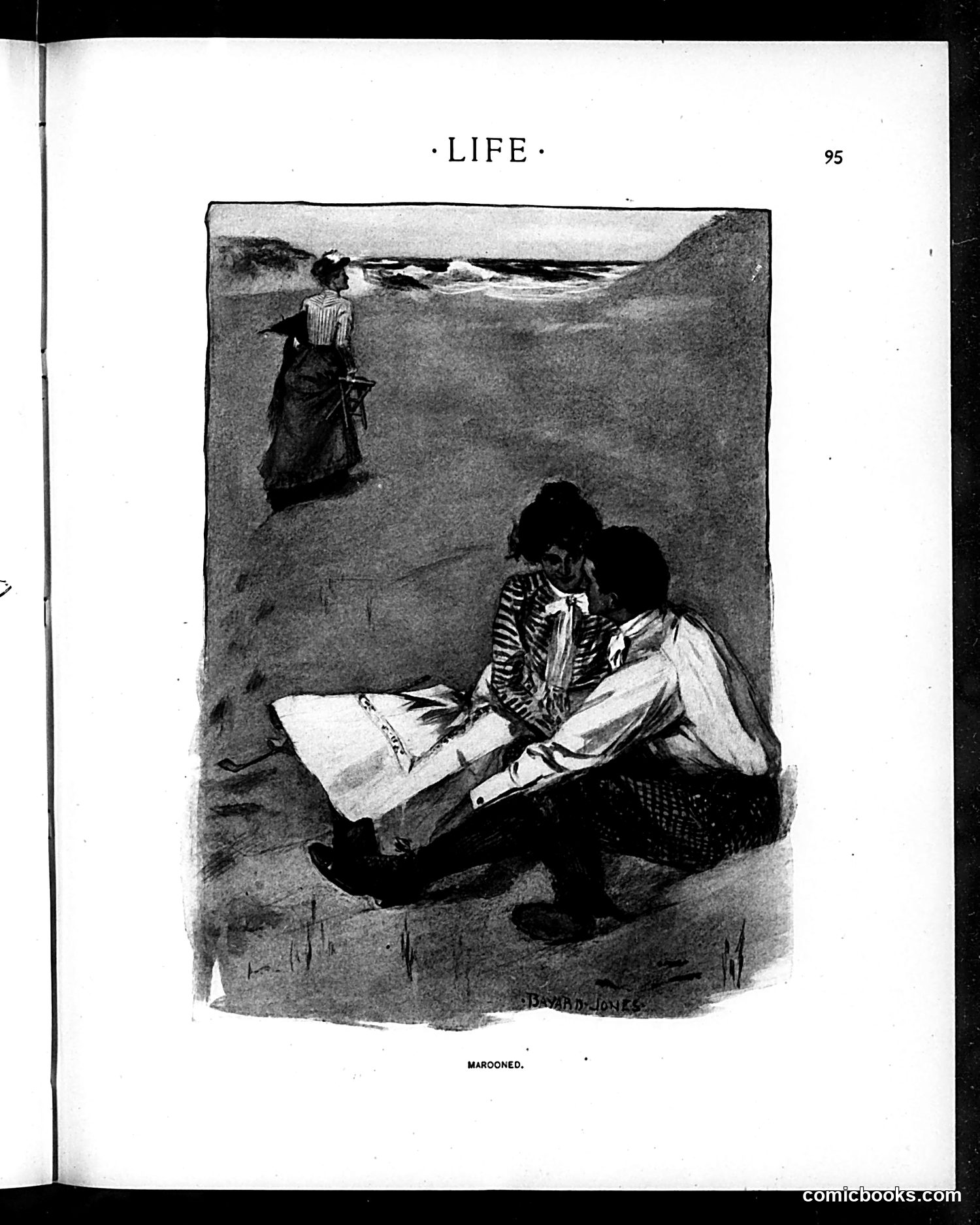
This illustration depicts two figures sitting on a beach examining what appears to be a map or document, while a third figure stands alone in the distance on elevated terrain, gazing toward the horizon. The title "Marooned" suggests abandonment or isolation. The composition contrasts the two seated figures (appearing to consult together) with the solitary standing figure, implying separation or exclusion from a group. Without additional context about the publication date or surrounding articles, the specific political or social reference remains unclear. The satire likely comments on abandonment, isolation, or division among a group—possibly with romantic or social implications given the figure's posture and period clothing. The exact targets of this commentary cannot be determined from the image alone.
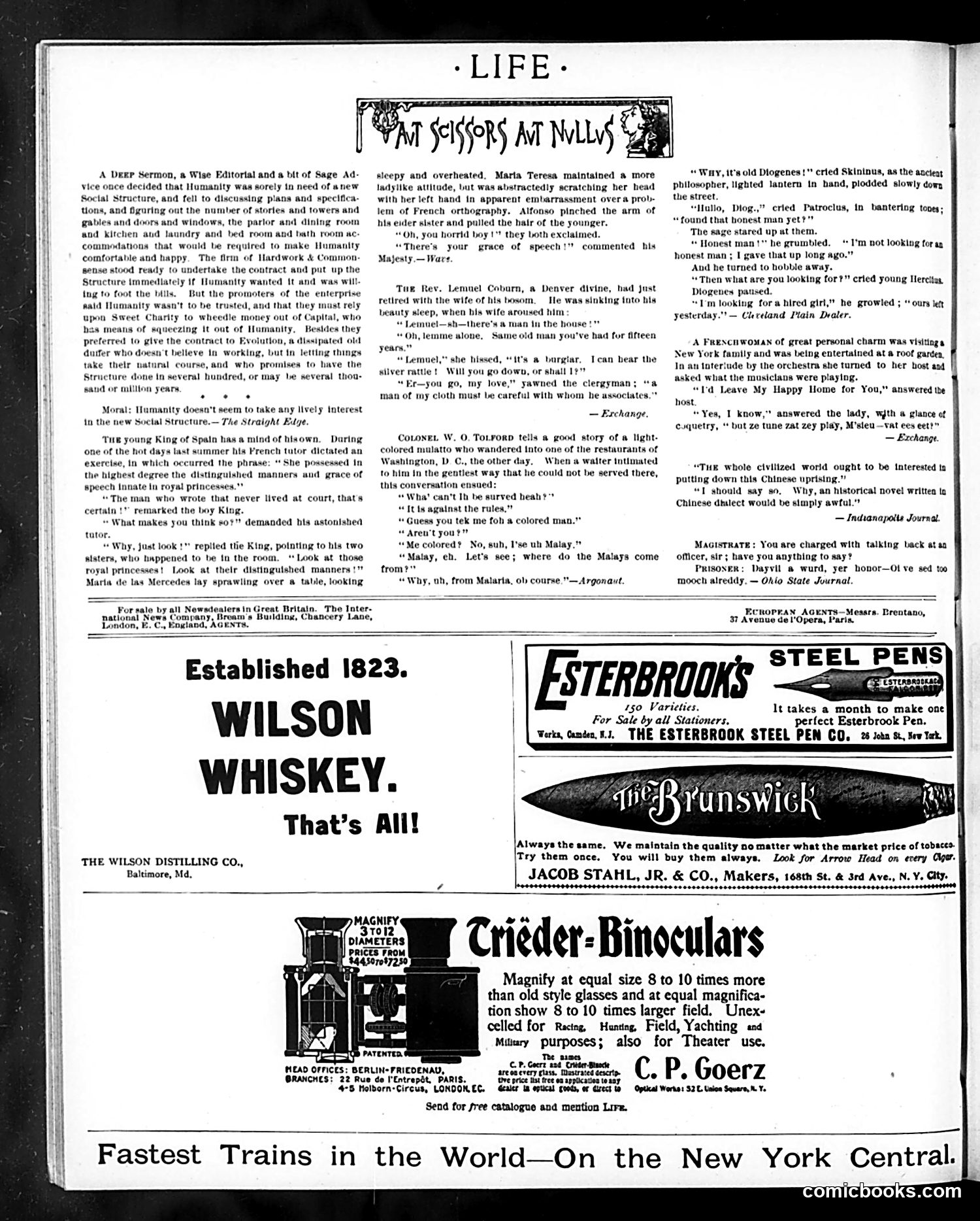
This page contains three satirical anecdotes rather than visual cartoons: 1. **"The Straight Edge"**: Allegorical critique of social reform—personified as a Sermon, Editorial, and Sage proposing a new "Social Structure" for humanity. The joke: reformers plan grandly but expect others (particularly the wealthy) to fund implementation, while relying on "Evolution" (lazy, unreliable) rather than actual work. **Point**: social reformers lack practical commitment. 2. **Young King of Spain**: Mocks the pretensions of royalty. The boy king (Alfonso XIII) exposes the absurdity of flowery descriptions of "distinguished manners" by pointing to his sisters behaving unladylike—slouching, scratching their heads. **Point**: reality contradicts courtly ideals. 3. **The Burglar and the Clergyman**: A minister refuses to confront a burglar, claiming men of cloth "must be careful with whom he associates." **Point**: hypocritical moral cowardice disguised as principle. The page is primarily text-based satire with period advertisements, not illustrated comics.
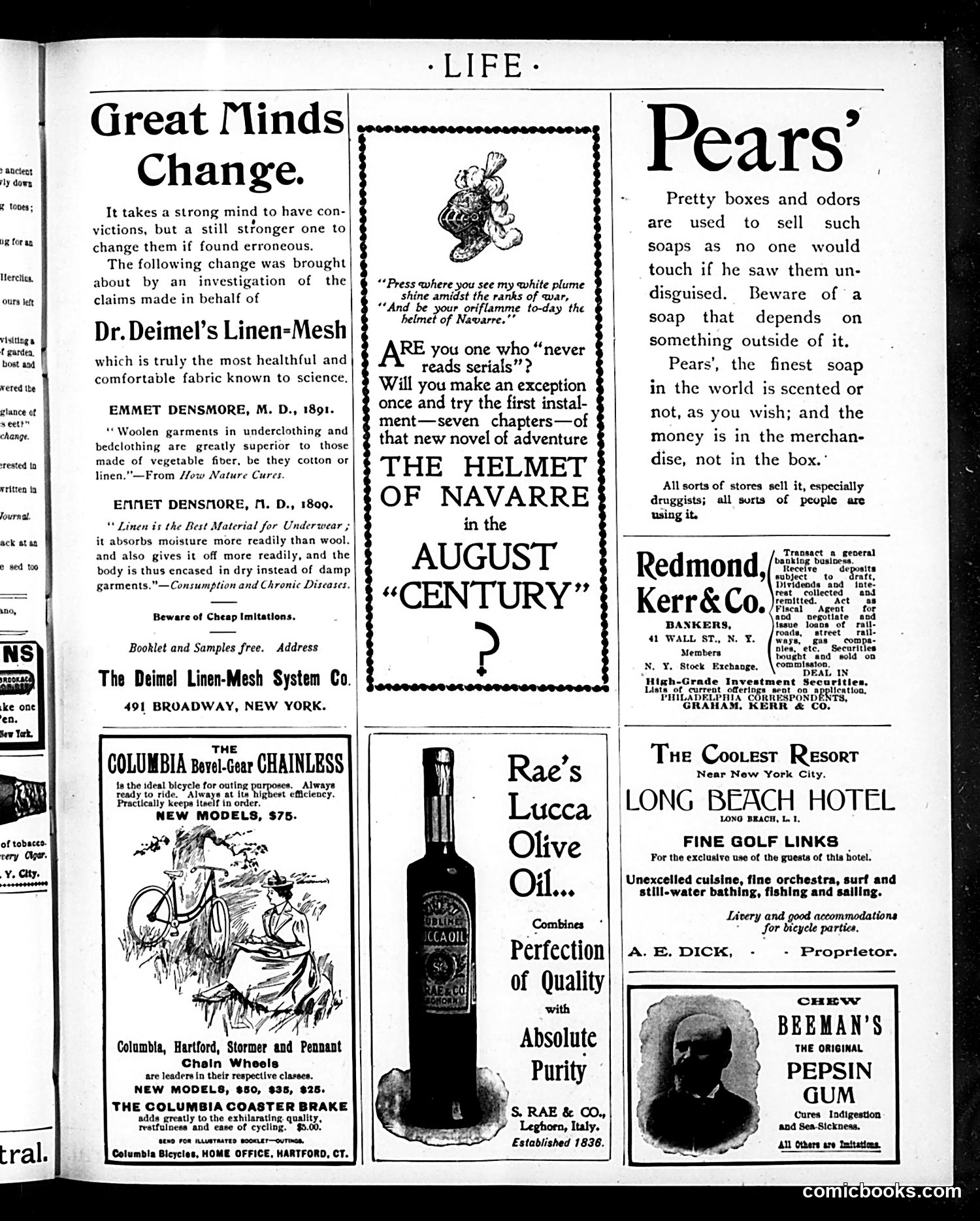
This page is primarily **advertising**, not political satire. The only editorial content is a brief testimonial titled "Great Minds Change," promoting Dr. Deimel's Linen-Mesh fabric by quoting a doctor (Emmet Densmore) who allegedly reversed his earlier medical opinion—initially preferring wool undergarments (1891), then changing to linen (1869, though the dates seem confused). This format satirizes the common advertising tactic of using expert endorsements and "before-and-after" conversions to sell products. The page also features a serial novel advertisement for *The Helmet of Navarre* in *Century* magazine, which appears unrelated to satire. The remaining content consists entirely of commercial advertisements for various products: Pears' soap (emphasizing quality over packaging), Columbia bicycles, Rae's olive oil, banking services, a resort hotel, and Beeman's gum. No political figures or events are referenced.
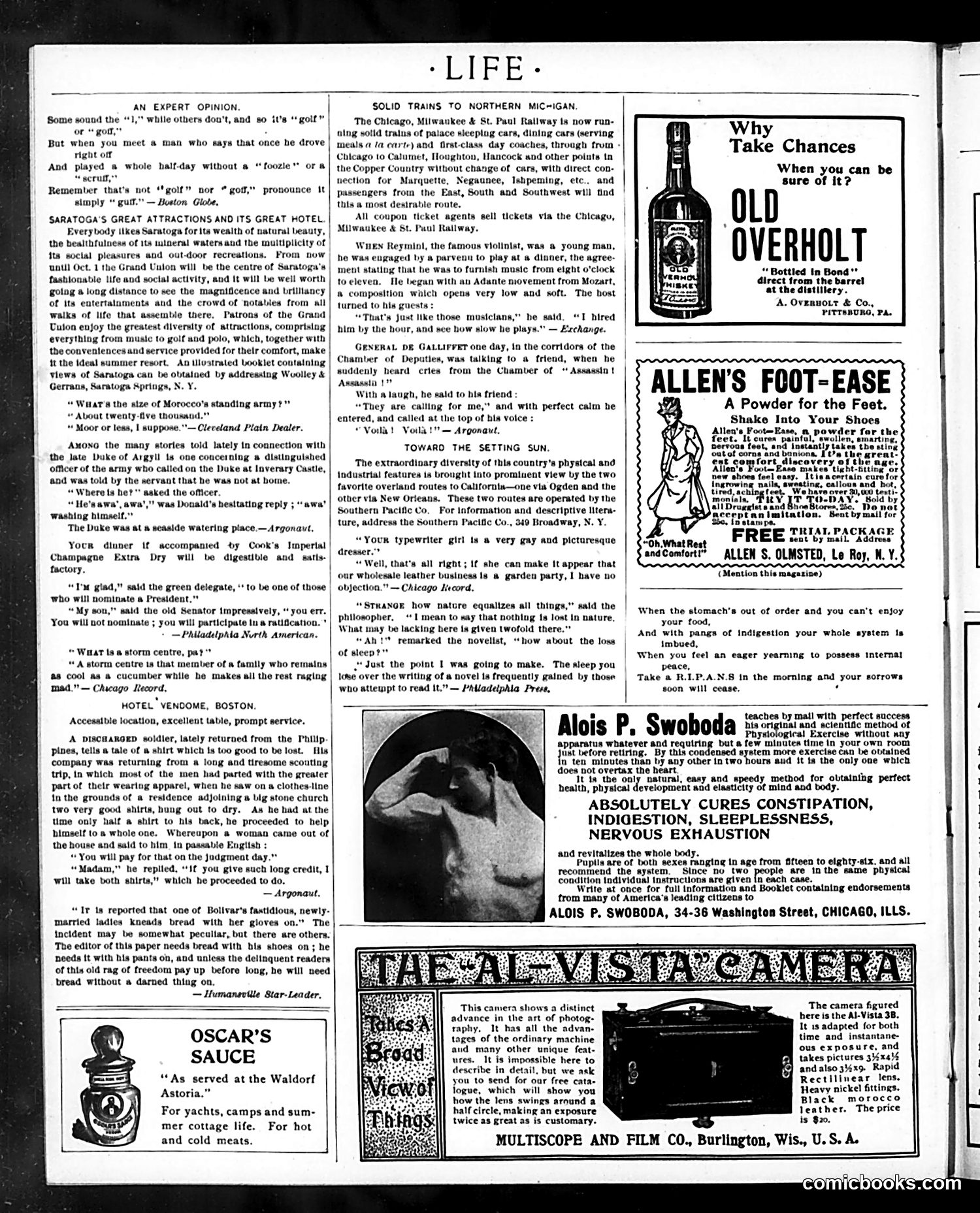
This page is primarily **advertisements and humorous anecdotes** rather than political cartoons. The content reflects early 1900s American satire through brief jokes and stories: **Key Humor:** - Golf terminology confusion ("guff" vs. "golf") - Morocco's army size joke playing on "Moor or less" - Political satire: A naive delegate doesn't understand that convention delegates don't actually "nominate"—they merely ratify decisions already made - A discharged soldier from the Philippines steals shirts, joking about deferred payment until "Judgment Day" **Social Context:** References to the Philippines campaign suggest this is post-Spanish American War (around 1900s). The humor relies on wordplay and gentle mockery of pretension, political naïveté, and military adventures. **Advertisements dominate:** Old Overholt whiskey, Allen's Foot-Ease powder, Alois P. Swoboda's physiological exercise system, and Oscar's Sauce occupy significant space. The page reflects *Life* magazine's formula: lightweight satirical commentary mixed with commercial promotion.
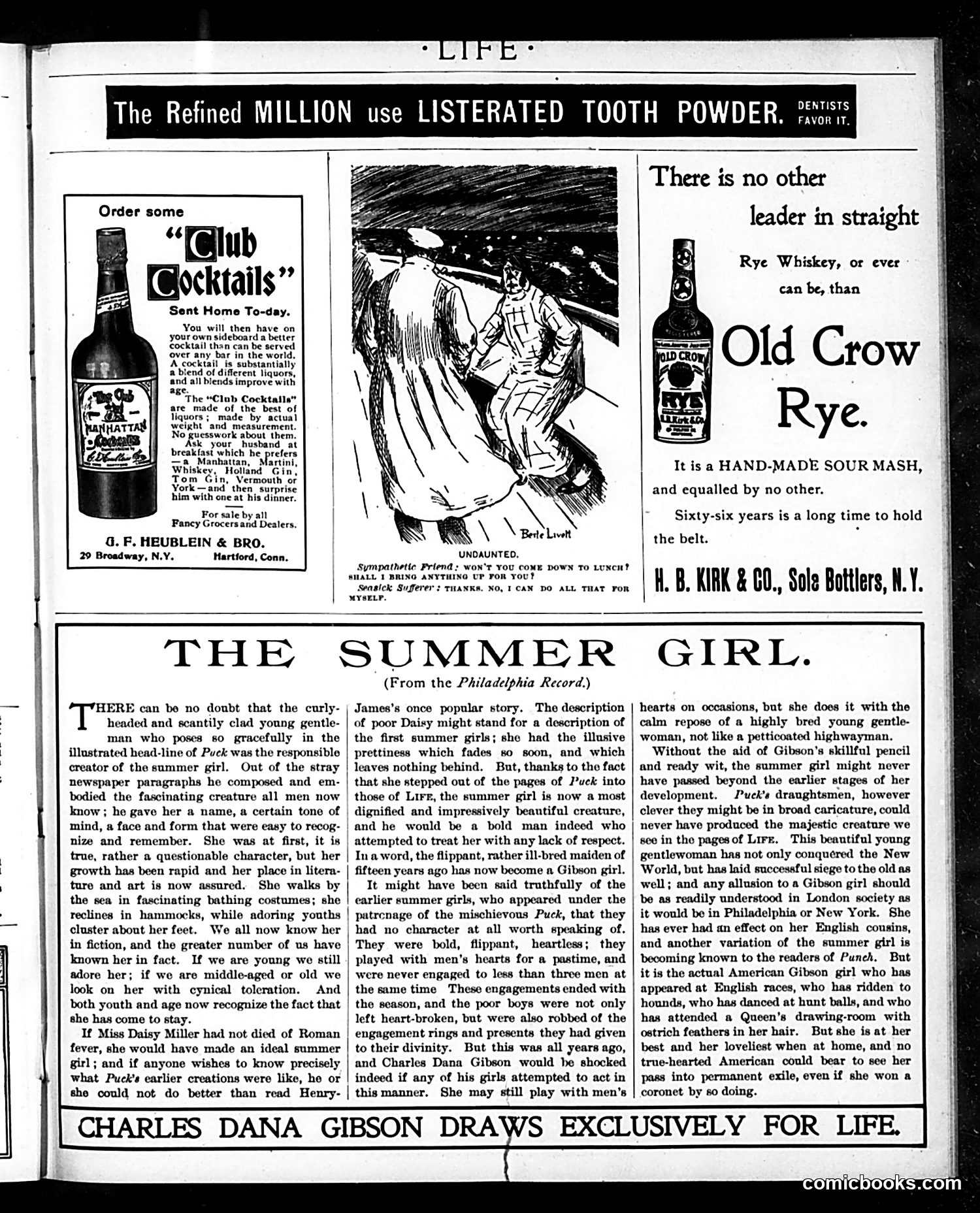
This page is primarily **advertising** interspersed with a brief article. The main content is "The Summer Girl," a commentary on how the "Summer Girl" archetype evolved from Puck magazine's early satirical creation into Charles Dana Gibson's more refined artistic vision in Life magazine. The article credits Puck (a rival satirical magazine) with inventing the Summer Girl character—initially a flippant, heartless young woman who toyed with men. However, Gibson's illustrations in Life have transformed her into a dignified, beautiful "Gibson Girl," the respectable ideal woman of the era. The piece humorously notes that what was once a scandalous character type has become socially acceptable through artistic refinement. The cartoon titled "UNDAUNTED" shows a seasick woman refusing help, claiming she can manage her own nausea—a mild joke about female independence, typical of the period's humor about changing gender roles. The advertisements promote cocktails, tooth powder, and whiskey to upper-class consumers.
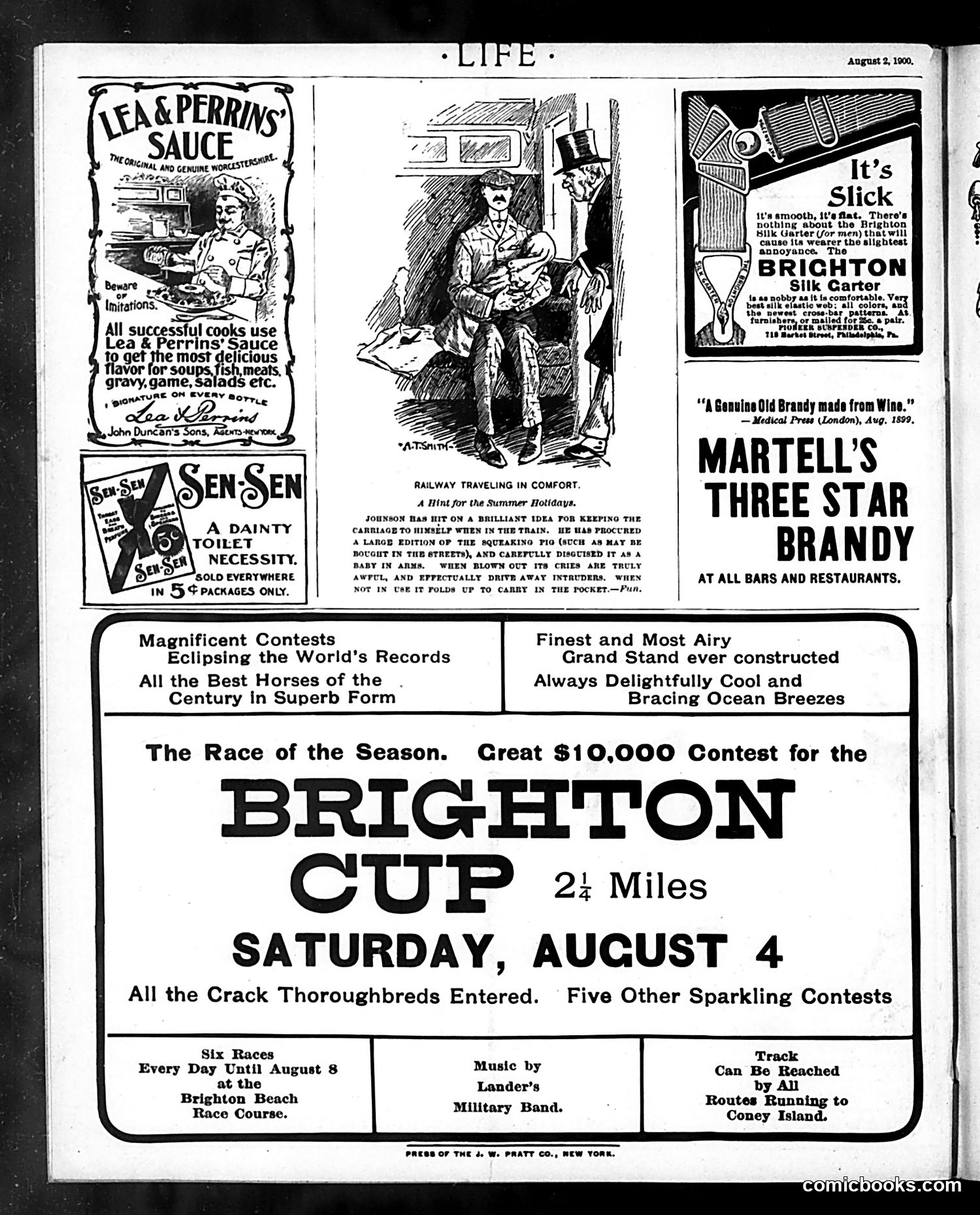
This is primarily an **advertising page** rather than a satirical cartoon page. The dominant feature is a large advertisement for the Brighton Cup horse race (Saturday, August 4), a $10,000 thoroughbred racing event at Brighton Beach Race Course with music by a military band. The single cartoon—titled "Railway Traveling in Comfort"—depicts a humorous practical joke: a man named Johnson brings a toy squeaking pig disguised as a baby into a train carriage to discourage other passengers from entering. The joke plays on Victorian-era train etiquette and the annoyance of shared compartments. When "blown out," the pig's cries supposedly drive away intruders, yet the device remains portable enough to fold up in a pocket. The page also includes period advertisements for Lea & Perrins' Sauce, Sen-Sen mints, Brighton Silk Garters, and Martell's Three Star Brandy—typical consumer goods marketed to early 1900s readers.