
Life, 1900-08-02 · page 8 of 20
Life — August 2, 1900 — page 8: what you’re looking at
What you’re looking at
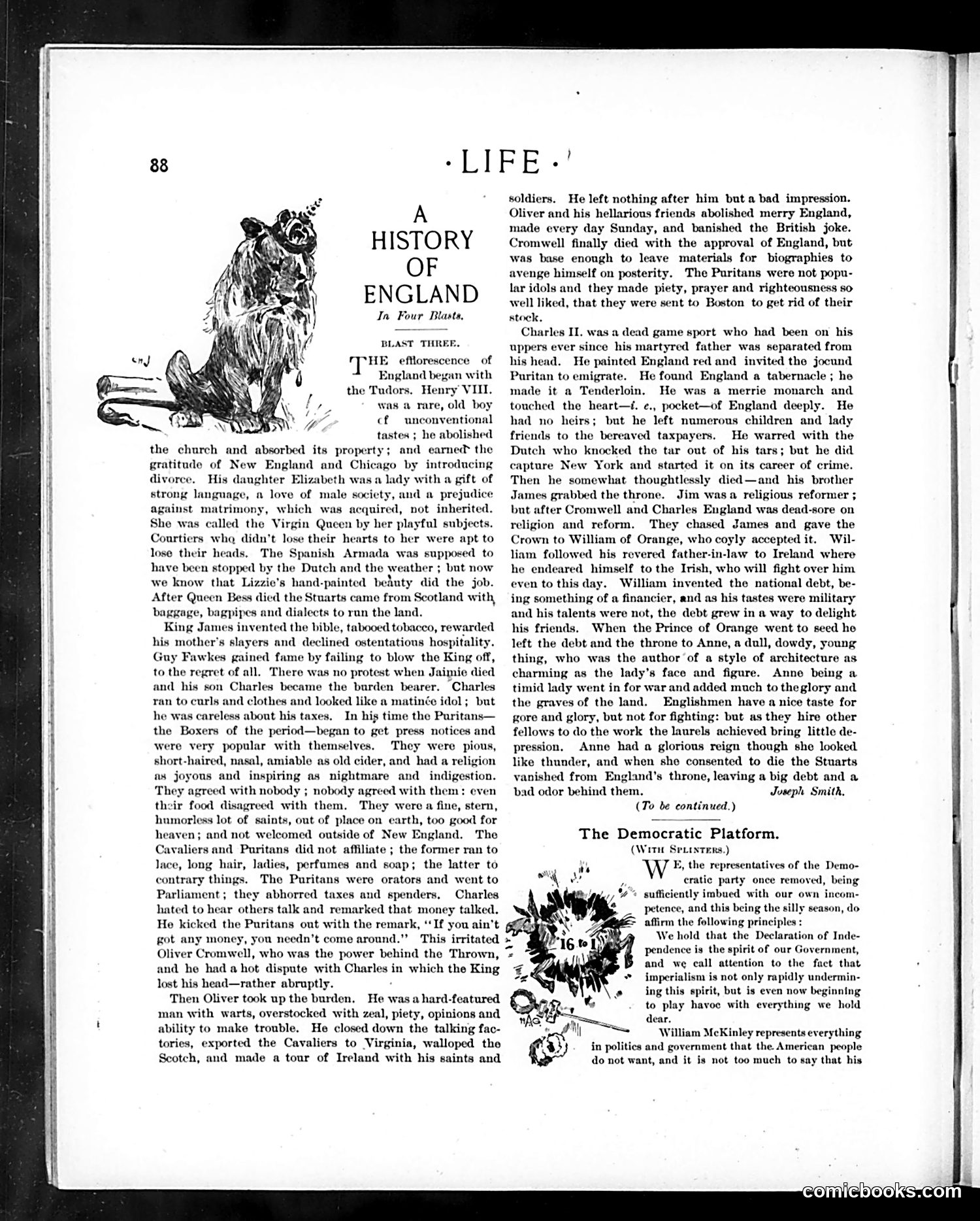
This page contains two distinct sections: 1. **"A History of England in Four Blasts"** - A satirical historical narrative (by Joseph Smith, per the byline) mocking English history from the Tudors onward. The accompanying illustration shows a grotesque face, likely caricaturing a historical figure. The text ridicules various English monarchs and religious factions—Puritans vs. Cavaliers, Charles I, Cromwell—for their hypocrisy and destructive behavior. 2. **"The Democratic Platform"** - A separate article beginning below, with a decorative illustration featuring what appears to be political imagery (unclear which specific figures). The visible text discusses American democratic principles and references William McKinley, suggesting this addresses late-19th or early-20th century politics. The page blends historical satire with contemporary political commentary, though the specific satirical targets of the second piece require more context to fully interpret.
📄 Transcribed text from this page (OCR, searchable)
Machine-transcribed from the original scan — historical spelling and the odd misread are preserved.
-LIFE-’ A HISTORY OF ENGLAND In Four Blasts, BLAST THREE, HE efflorescence of England began with the Tudors. Henry’ VIII. was a rare, old boy cf unconventional tastes ; he abolished the church and absorbed its property; and earned the gratitude of New England and Chicago by introducing divorce. His daughter Elizabeth was a lady with a gift of strong language, a love of male society, and a prejudice against matrimony, which was acquired, not inherited. She was called the Virgin Queen by her playful subjects. Conrtiers wha didn’t lose their hearts to her were apt to lose their heads, The Spanish Armada was supposed to have been stopped by the Dutch and the weather ; but now we know that Lizzie’s hand-painted behuty did the job. After Queen Bess died the Stuarts came from Scotland with, baggage, bagpipes and dialects to run the land. King James invented the bible, tabooed tobacco, rewarded his mother’s slayers and declined ostentatious hospitality. Guy Fawkes gained fame by failing to blow the King off, to the regret of all. There was no protest when Jaimie died and his son Charles became the burden bearer. Charles ran to curls and clothes and looked like a matinée idol; but he was careless about his taxes. In his time the Puritans— the Boxers of the period—began to get press notices and were very popular with themselves. They were pious, short-haired, nasal, amiable as old cider, and had a religion ms and inspiring as nightmare and indigestion. y agreed with nobody ; nobody agreed with them: even their food disagreed with them. They were a fine, stern, humorless lot of saints, out of place on earth, too good for heaven; and not welcomed outside of New England. The Cavaliers and Puritans did not affiliate ; the former ran to lace, long hair, ladies, perfumes and soap; the latter to contrary things. The Puritans were orators and went to Parliament; they abhorred taxes and spenders, Charles hated to hear others talk and remarked that money talked. He kicked the Puritans out with the remark, ‘If you ain't got any money, you needn't come around.” This irritated Oliver Cromwell, who was the power behind the Thrown, 7 and he had a hot dispute with Charles in which the King lost his head—rather abraptly. Then Oliver took up the burden. He was a hard-featured man with warts, overstocked with zeal, piety, opinions and ability to make trouble. He closed down the talking fac- tories, exported the Cavaliers to Virginia, walloped tho Scotch, and made a tour of Ireland with his saints and soldiers. He left nothing after him but a bad impression. Oliver and his hellarious friends abolished merry England, made every day Sunday, and banished the British joke. Cromwell finally died with the approval of England, but was base enough to leave materials for biographies to avenge himself on posterity. The Puritans were not popu- lar idols and they made piety, prayer and righteousness so well liked, that they were sent to Boston to get rid of their stock, Charles II. was a dead game sport who had been on his uppers ever since his martyred father was separated from his head. He painted England red and invited the jocund Puritan to emigrate. He found England a tabernacle ; he made it a Tenderloin, He was a merrie monarch and touched the heart—i. ¢., pocket—of England deeply. He had no heirs; but he left numerous children and lady friends to the bereaved taxpayers. He warred with the Dutch who knocked the tur out of his tars; but he did capture New York and started it on its career of crime. Then he somewhat thoughtlessly died—and his brother James grabbed the throne. Jim was a religious reformer ; but after Cromwell and Charles England was dead-sore on religion and reform. They chased James and gave the Crown to William of Orange, who coyly accepted it. Wil- liam followed his revered father-in-law to Ireland where he endeared himself to the Irish, who will fight over him n to this day. William invented the national debt, be- ing something of a financier, and as his tastes were military and his talents were not, the debt grew in a way to delight his friends. When the Prince of Orange went to seed he left the debt and the throne to Anne, a dull, dowdy, young thing, who was the author of a style of architecture as charming as the lady's face and figure. Anne being a timid lady went in for war and added much to theglory and the graves of the land, Englishmen have a nice taste for gore and glory, but not for fighting: but as they hire other fellows to do the work the laurels achieved bring little de- pression, Anne had a glorious reign though she looked like thunder, and when she consented to die the Stuarts vanished from England's throne, leaving a big debt and a bad odor behind them, Toseph Smith, (To be continued.) The Democratic Platform. (Witt Seiisters.) V FE, the representatives of the Demo- cratic party once removed, being sufficiently imbued with our own incom- petence, and this being the silly season, do affirm the following principles: We hold that the Declaration of Inde- pendence is the spirit of our Government, and we call attention to the fact that imperialism is not only rapidly undermin- ing this spirit, but is even now beginning to play havoc with everything we hold dear, William McKinley represents everything in politics and government that the. American people do not want, and it is not too much to say that his 7