
A complete issue · 20 pages · 1900
Life — May 3, 1900
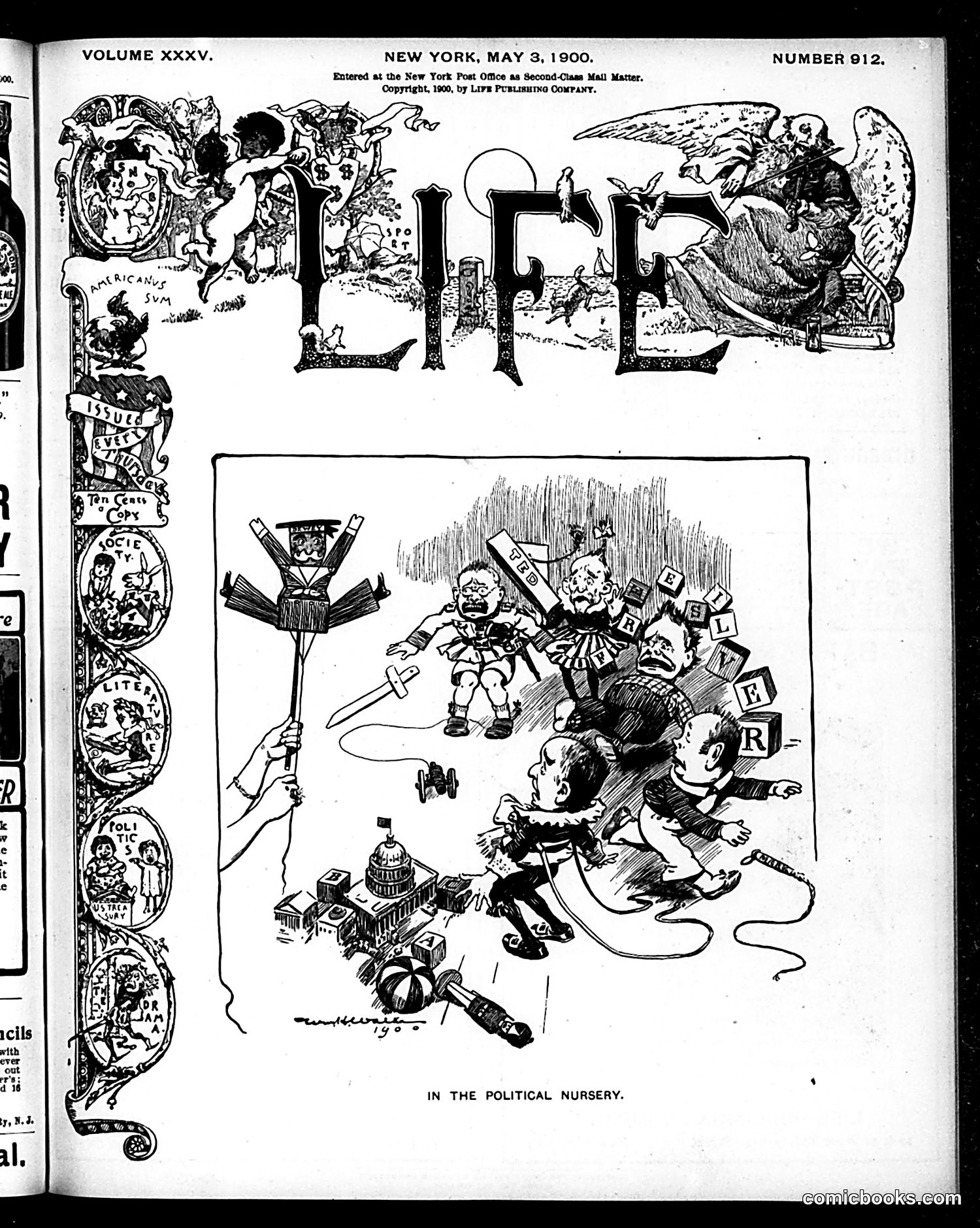
This cartoon satirizes Republican political leadership as childish nursemaids tending to infant politicians. The figures appear to be prominent GOP party members playing with building blocks labeled with letters and political terms, while one holds a rattle-like object overhead. The satire mocks the Republican Party's internal management and political maneuvering as amateurish and immature—comparable to child's play in a nursery rather than serious governance. The Capitol building visible in the background emphasizes the contrast between these "nursery" activities and actual political responsibility. The specific identities of individual caricatures are unclear without additional context, but the overall message criticizes Republican leadership as undisciplined and childlike in their approach to politics during this election year.
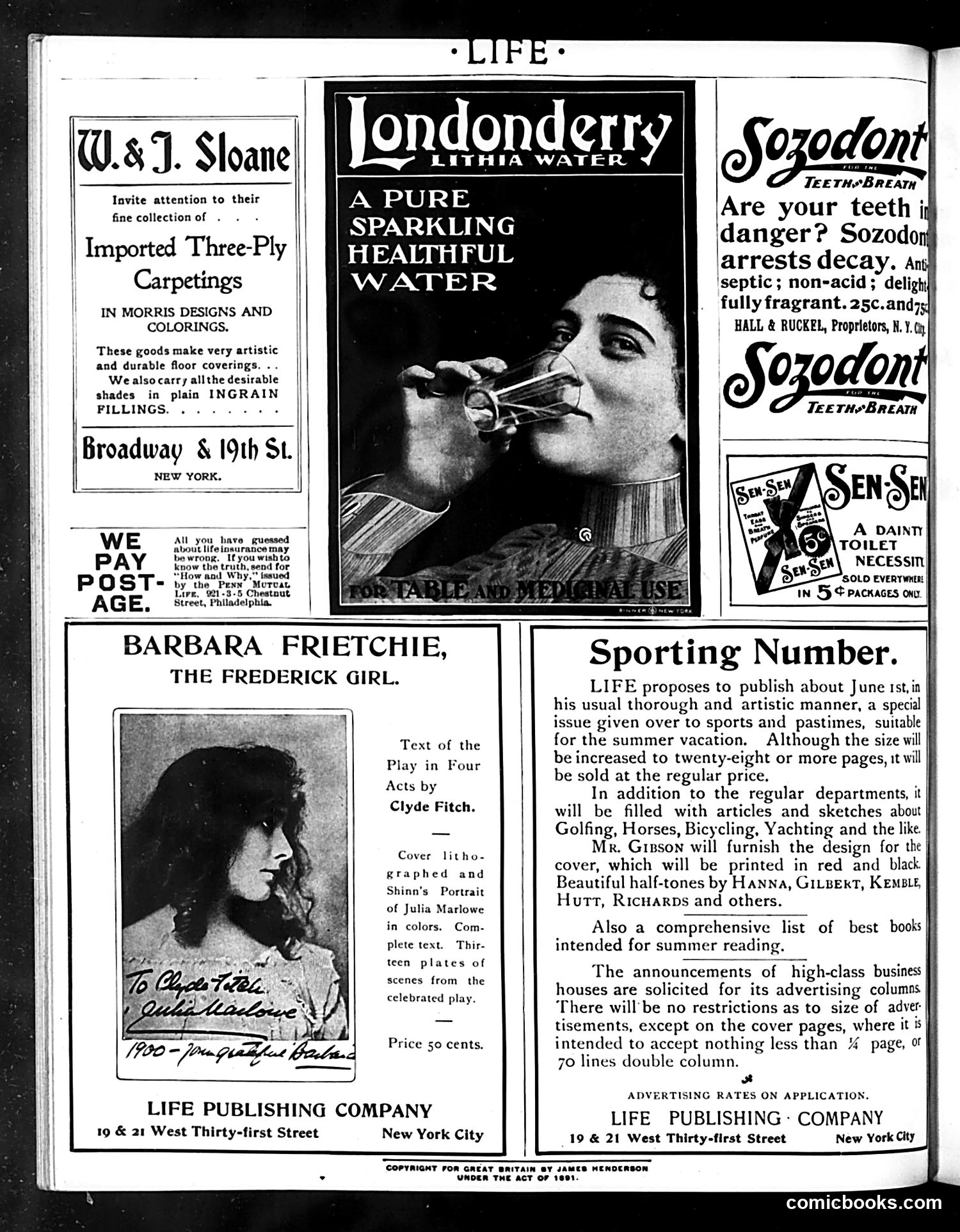
This page is primarily **advertising and announcements**, not satire or political commentary. The dominant central image advertises **Londonderry Lithia Water**, showing a man drinking from a bottle. The ad emphasizes the water's purity and healthfulness—typical marketing for mineral waters, which were popular patent medicines of the era. Surrounding ads promote **Sozodont toothpaste**, **Sen-Sen mints**, and **W&J Sloane carpetings**. The lower section announces **Barbara Frietchie**, described as "The Frederick Girl"—a theatrical play by Clyde Fitch. An autographed portrait of Julia Marlowe (the star) is included. The "Sporting Number" announcement describes an upcoming special June issue of *Life* magazine focused on sports and summer recreation. No political satire is evident on this page.
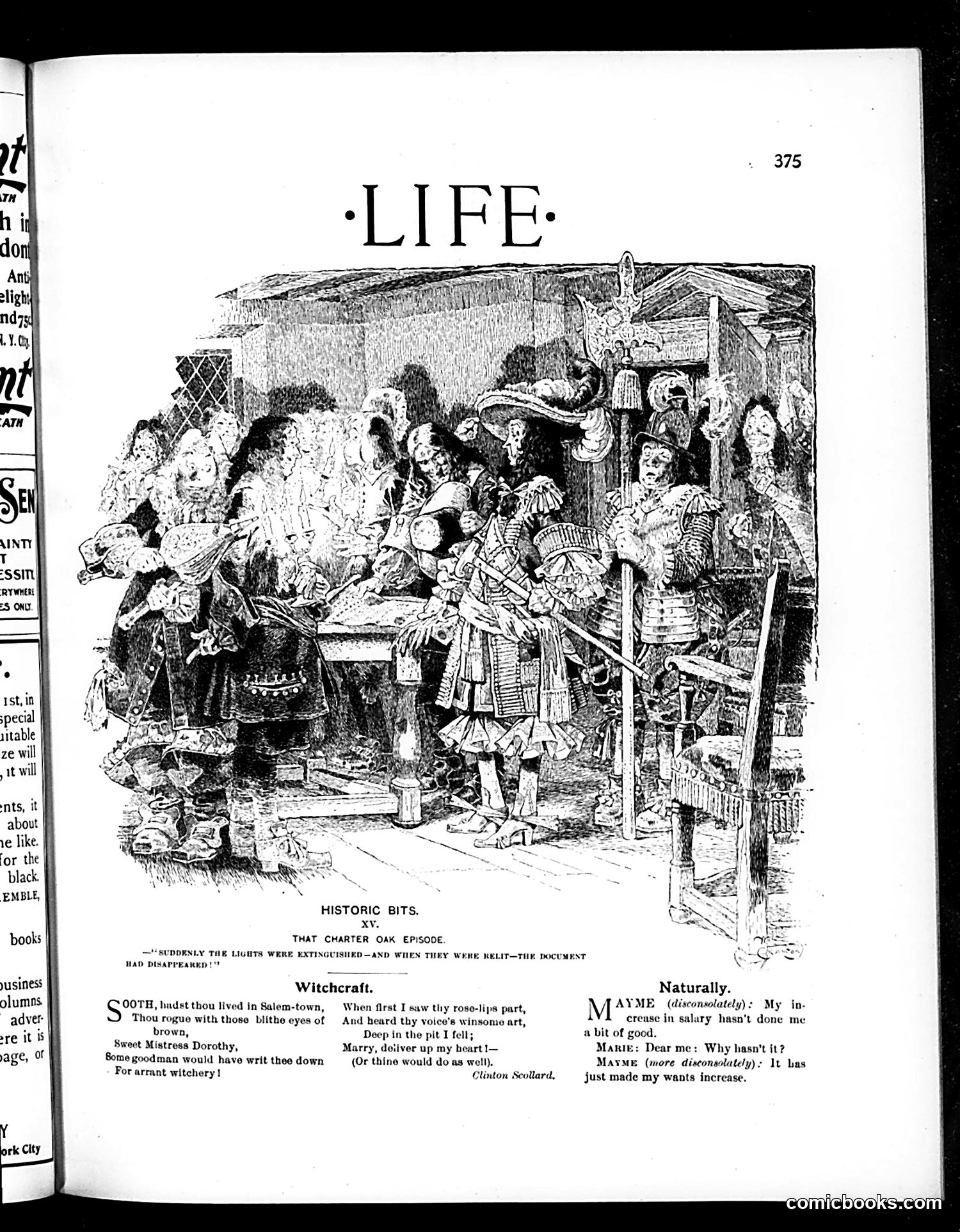
This page presents "Historic Bits: XV—That Charter Oak Episode," a satirical dialogue about witchcraft accusations. The illustration depicts a colonial-era scene with figures in period dress gathered around what appears to be a formal proceeding or confrontation. The text includes two poems: "Witchcraft" (addressing a Salem resident accused of witchcraft) and "Naturally" (a brief comedic exchange about salary increases). The "Witchcraft" poem references Salem-town and invokes historical witch-trial persecution, while mocking the era's superstitious hysteria. The satire appears to criticize both colonial-era witch hunts and, more broadly, how public suspicion and accusations can destroy reputations. The juxtaposition with the mundane salary discussion in "Naturally" creates ironic contrast between serious historical injustice and everyday workplace concerns.
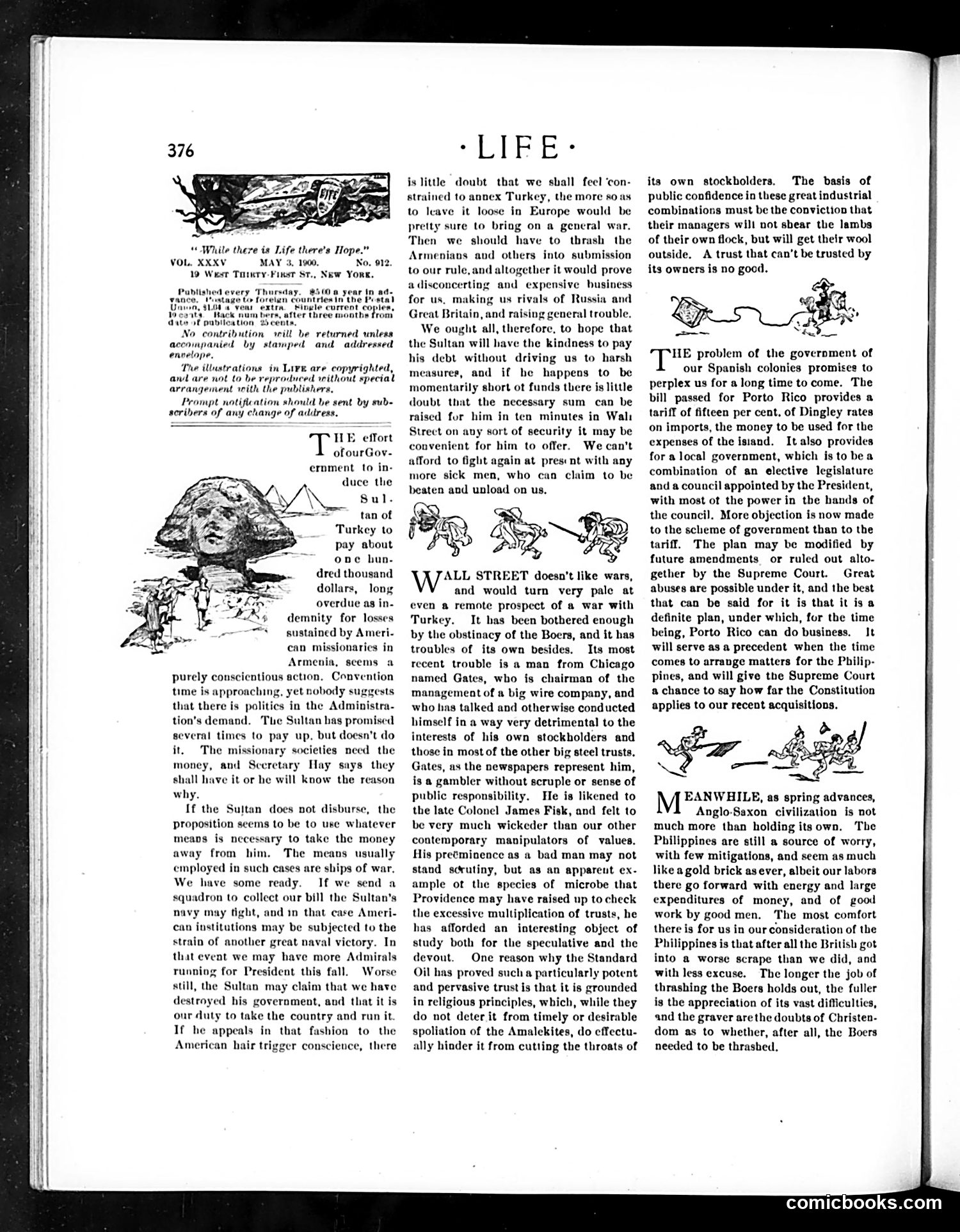
This page contains editorial commentary on Turkey's financial debt and American business interests. The left illustrations satirize the Sultan of Turkey, depicted in exaggerated caricature, discussing efforts to collect unpaid debts. The text criticizes both Turkey's financial mismanagement and American Wall Street's indifference to potential war consequences. The commentary also targets a Chicago businessman (likely J.P. Morgan associate) who allegedly manipulated stock values through trusts while claiming religious principles. The satire attacks the hypocrisy of industrial magnates using moral justifications while pursuing profit. The final section addresses Spanish colonial governance in the Philippines—likely Porto Rico policy—and critiques ongoing American imperial expansion as damaging. Overall, the page reflects Progressive Era skepticism toward both foreign entanglements and domestic corporate power.
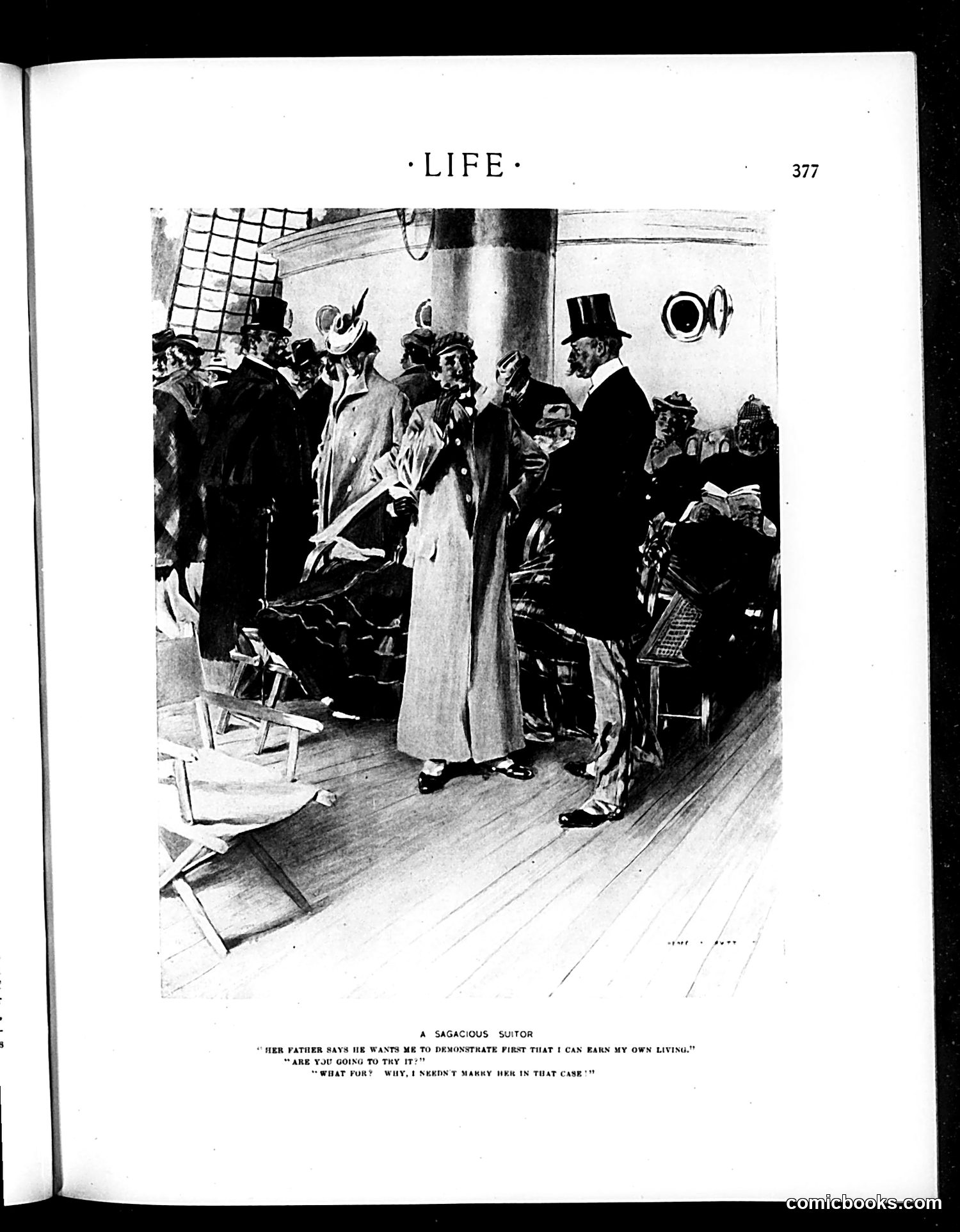
This cartoon satirizes a young man's mercenary approach to courtship. The scene depicts what appears to be a ship's cabin or confined space with several onlookers. The suitor tells the father: "Her father says he wants me to demonstrate first that I can earn my own living." The father responds skeptically: "Are you going to try it?" The suitor replies: "What? Why, I needn't marry her in that case!!!" The joke mocks the suitor's logic—he's willing to court the daughter *only* if he doesn't have to prove financial independence. His "sagacious" (wise) reasoning is actually foolish: he views marriage as an escape from responsibility rather than a legitimate partnership. The satire critiques both fortune-hunting suitors and their exposed priorities.
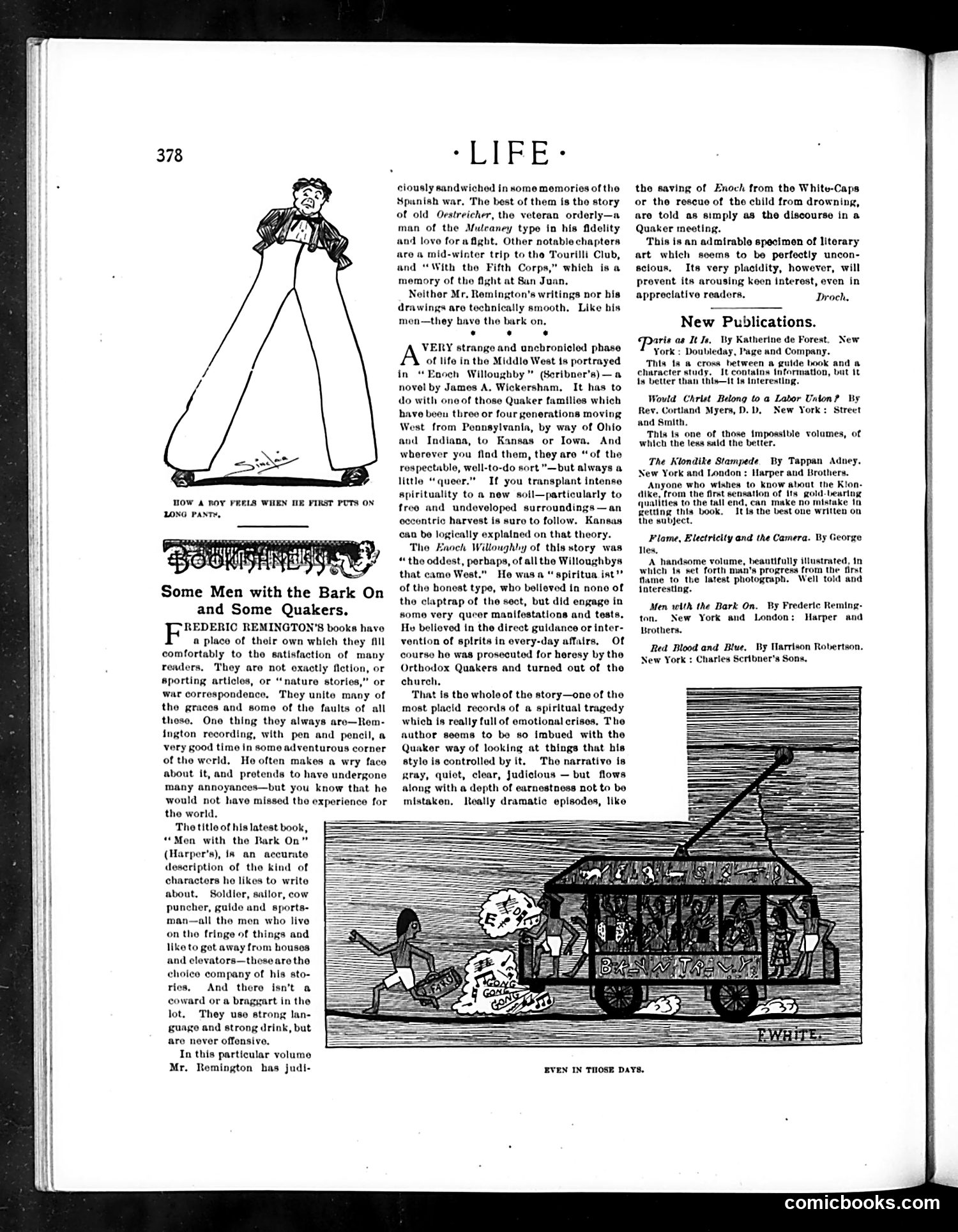
This page from *Life* magazine contains a book review section titled "Some Men with the Bark On and Some Quakers." The review discusses Frederic Remington's latest book, *Men with the Bark On* (Harper's), which depicts frontier and Western characters—men living on society's margins: prospectors, drifters, and those "on the fringe of things." The two illustrations shown are woodcuts by E.W. Hine. The top cartoon depicts a man in exaggerated pose, illustrating the book's characterizations. The lower illustration, titled "Even in Those Days," shows a frontier scene with a covered wagon, appearing to depict the rugged Western life Remington documents. The review praises Hemingway's ability to capture authentic character types while noting his occasionally strong language and controversial subject matter.
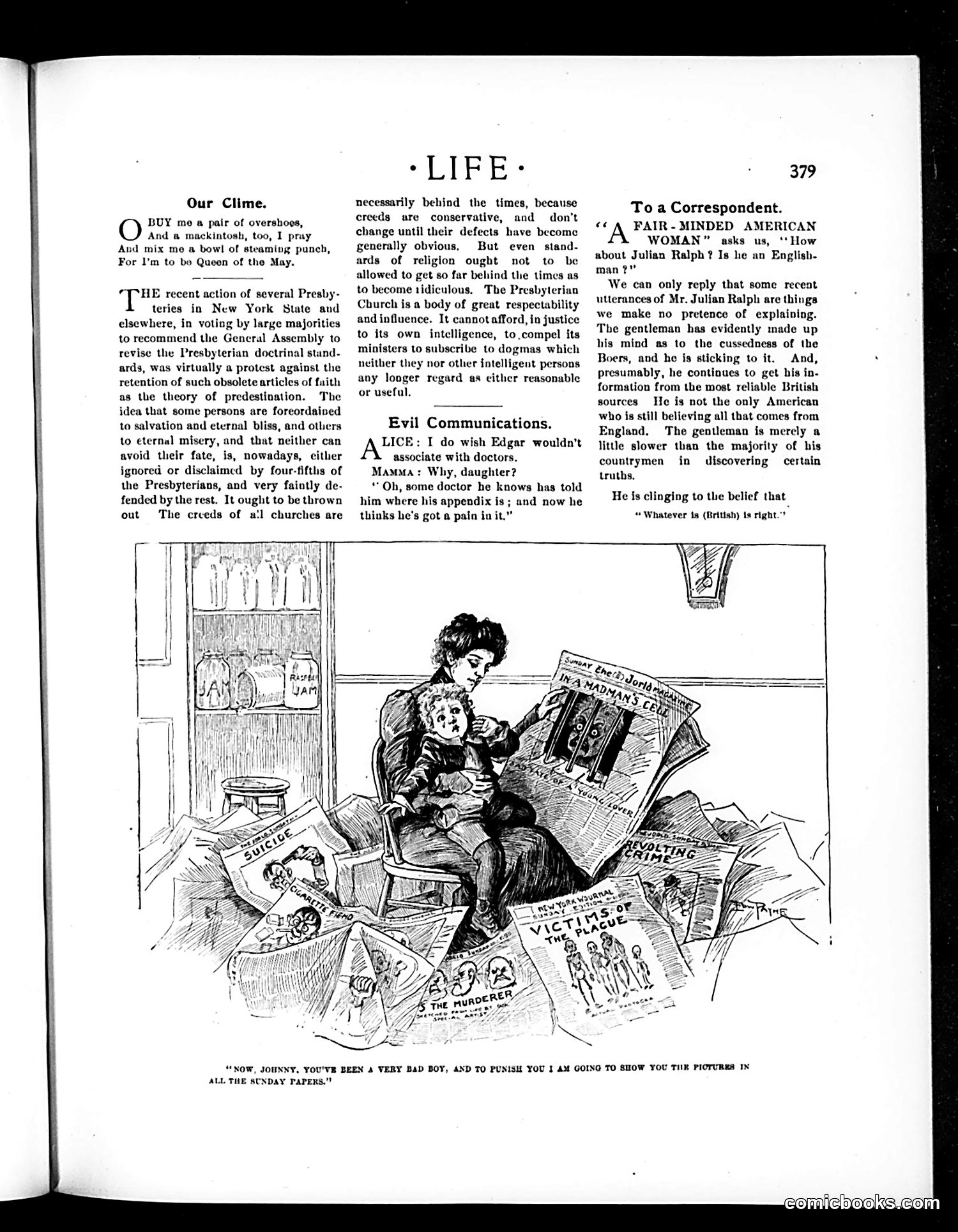
This cartoon satirizes parental concern about sensational newspaper content corrupting children. A mother discovers her son ("Johnny") reading lurid Sunday newspaper supplements featuring crime and scandal stories—visible titles include "Suicide," "The Murderer," and "Victims of a Vague League." The mother's punishment is deliberately ironic: she threatens to show him *more* of these pictures in the papers as punishment for his misbehavior. The satire critiques both the sensational content newspapers sold to the public and parents' ineffective (even counterproductive) disciplinary responses. This reflects early 20th-century anxiety about mass media's influence on youth—a recurring concern in *Life* magazine's social commentary.
This page contains three literary pieces rather than political cartoons. At the top are two poems—"Spring in a Hired Hansom" and "May" by Kate Masterson and Anna M. Pratt, celebrating springtime in urban and natural settings. Below is a story excerpt titled "One of the Best Stories I Ever Heard" by Nikola Tesla. The story concerns a bishop visiting a school who makes a theological statement that "God is everywhere." A boy then challenges this, asking if God exists in the cellar—a joke playing on the literalism of children and period anxieties about religious doctrine. The humor derives from the boy's innocent but logically sound questioning of the bishop's absolute claim, exposing potential inconsistencies in religious teaching.
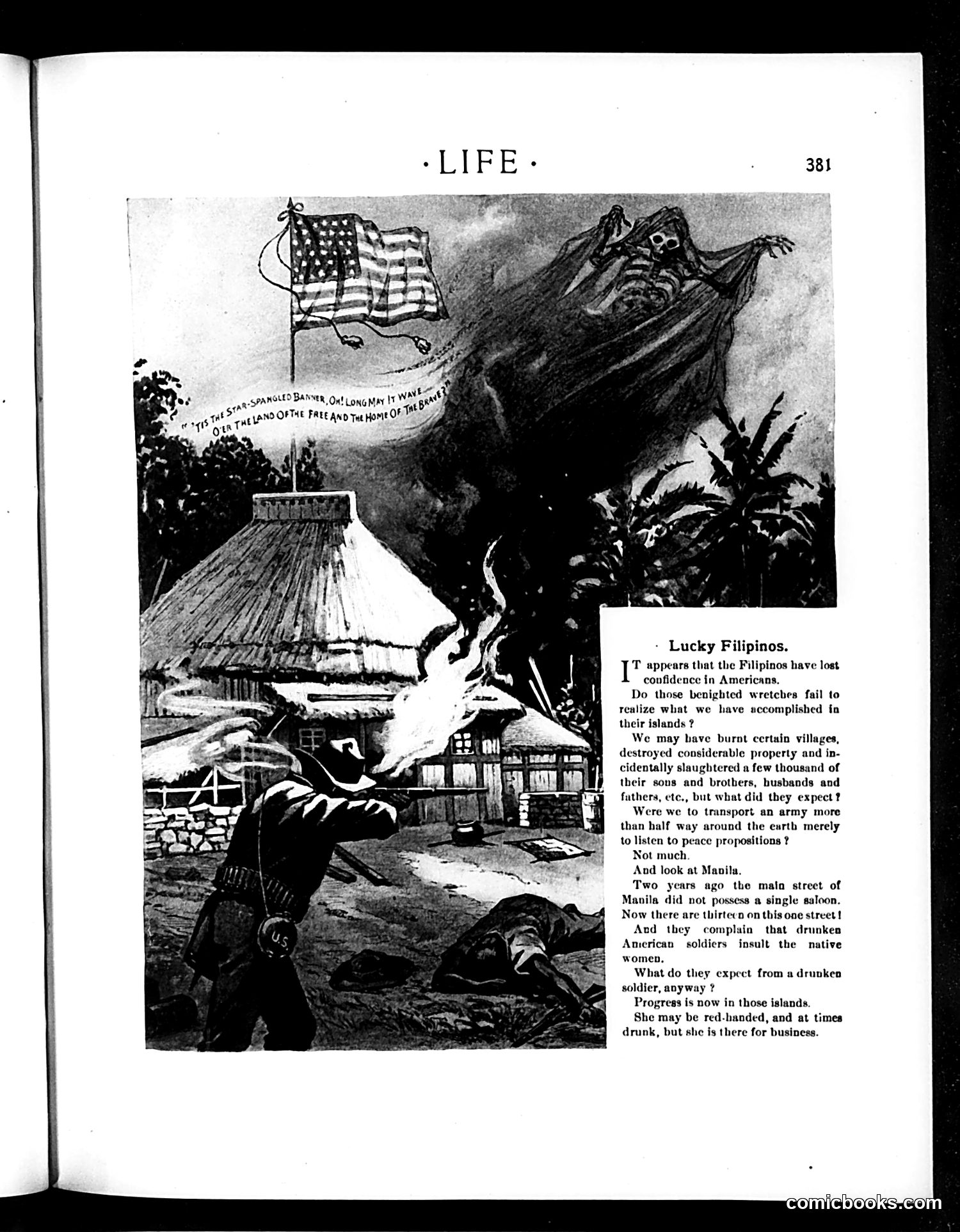
This is a satirical piece about American conduct during the Philippine-American War (early 1900s). The cartoon depicts destruction in the Philippines—burned villages, dead bodies, and an American flag—while a demonic or skeletal figure looms overhead, representing death and violence. The accompanying text sarcastically claims Filipinos are "lucky" despite American military actions causing widespread casualties and destruction. It addresses Filipino loss of confidence in Americans, noting Manila now has saloons (implying moral corruption), and defends American soldiers against accusations of insulting native women. The satire critiques American imperialism and the human cost of the war while ironically framing American occupation as "progress." It reflects anti-imperialist sentiment within American media itself.
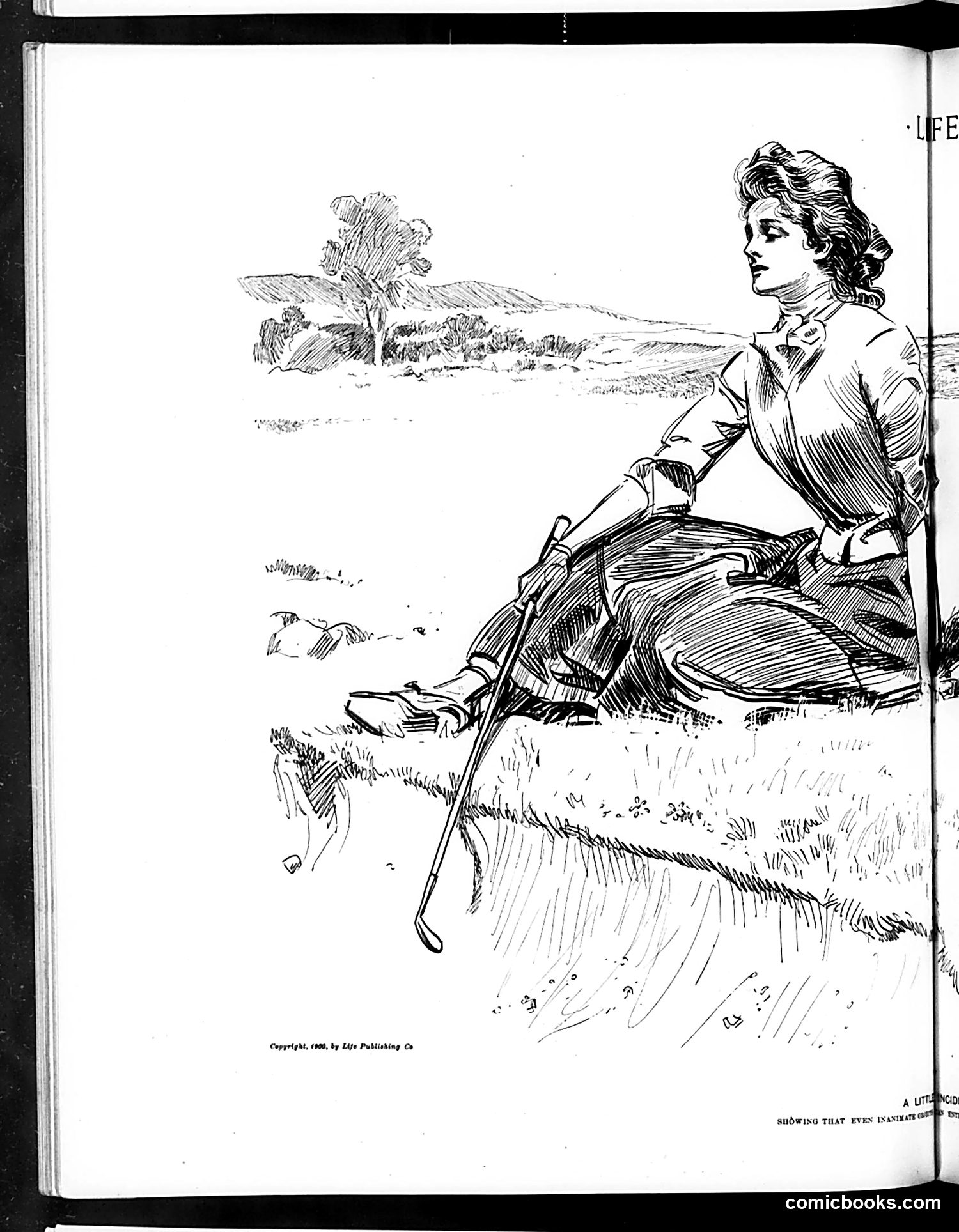
This page features a pen-and-ink illustration of a fashionably dressed woman reclining outdoors in an early 1900s setting. She wears period clothing with puffed sleeves and holds a golf club, gazing toward a distant landscape with a lone tree. The caption reads: "A LITTLE INDISCREET—SHOWING THAT EVEN INANE—" (text appears cut off). The satire likely comments on the emerging "New Woman" of the era—specifically women engaging in leisure activities and sports like golf, previously male-dominated pursuits. The word "indiscreet" suggests social commentary about women's changing roles and behaviors being viewed as improper or scandalous by conservative society. The illustration's romanticized style contrasts with the critical caption's tone.
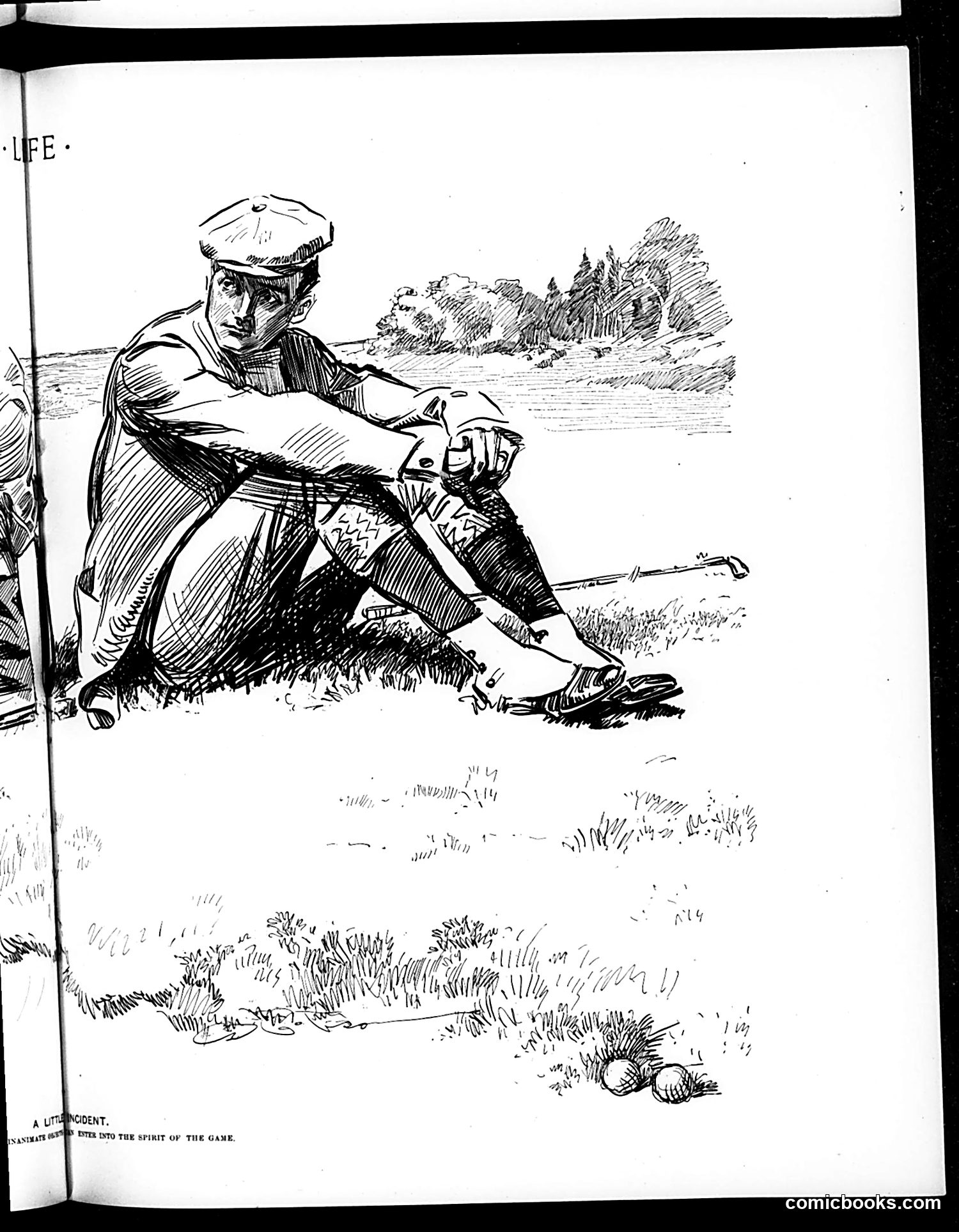
This appears to be a satirical cartoon from *Life* magazine showing a golfer in early 20th-century attire (flat cap, knickers) enthusiastically swinging a golf club on a riverbank landscape. The caption reads "A LITTLE INCIDENT—A NASTY STAB ENTERED INTO THE SPIRIT OF THE GAME." The satire likely targets the obsessive dedication of golfers to their sport, even in absurd circumstances. The humor seems to derive from the golfer's apparent indifference to some "nasty stab" or unpleasant interruption—perhaps a caddie or fellow player has been injured or insulted, yet the golfer remains focused on his swing and the game itself. This reflects period satire mocking golf's rapid popularization among the leisure class and the somewhat ridiculous seriousness with which players approached the sport.
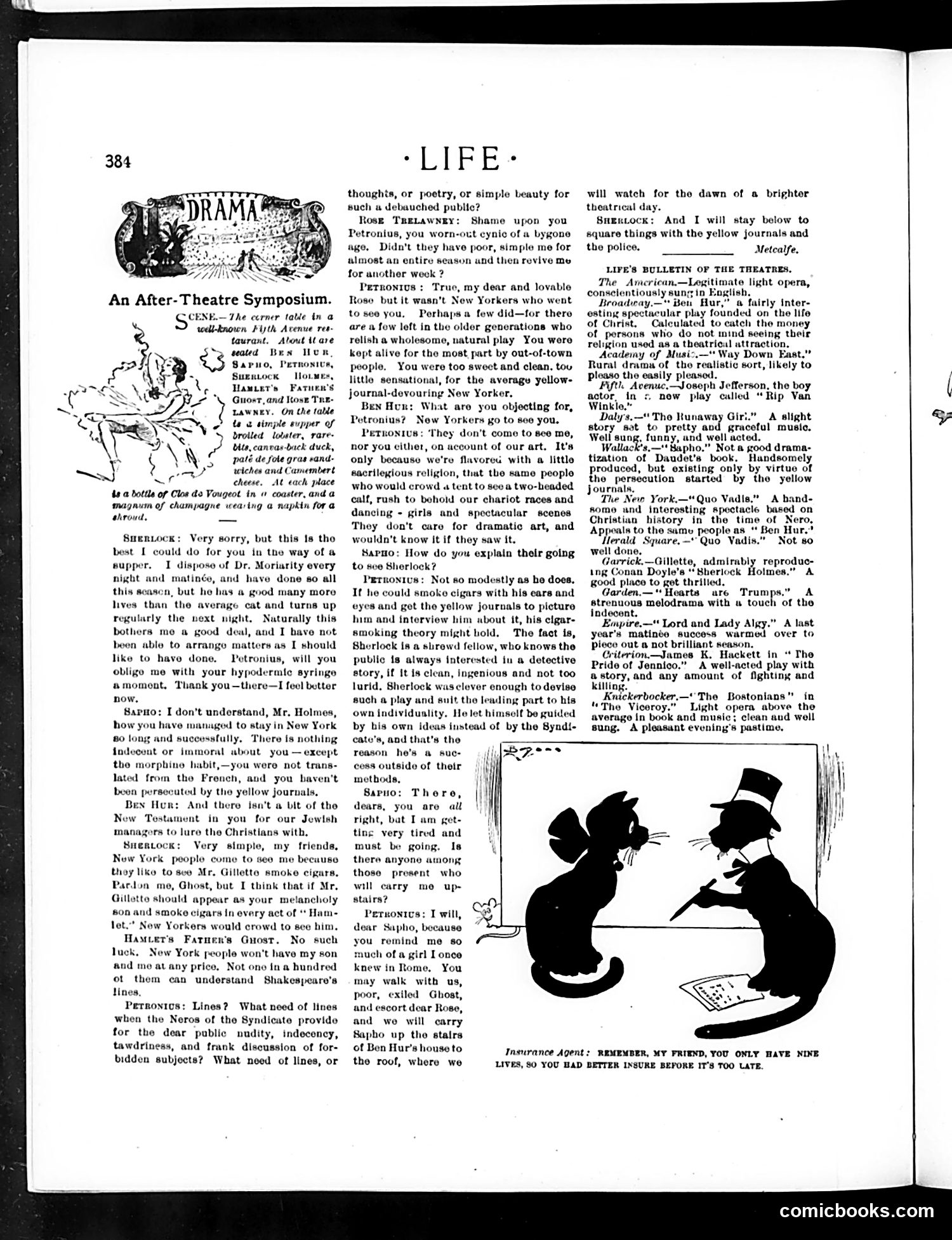
This page features a satirical dialogue between theatrical characters debating New York's theatrical tastes and practices. The characters—Petronius, Sarpo, Sherlock, and others—argue about whether New Yorkers appreciate sophisticated drama or prefer sensational spectacle. The accompanying cartoon (lower right) shows two figures in top hats—one labeled as an "Insurance Agent"—in conversation, with a caption warning someone that with "only nine lives" remaining, they should "insure before it's too late." This appears to reference the common literary trope of cats having nine lives, likely making a joke about theatrical risk or mortality metaphorically. The satire criticizes New York audiences for preferring flashy productions over meaningful drama, reflecting turn-of-the-century debates about artistic merit versus commercial entertainment.
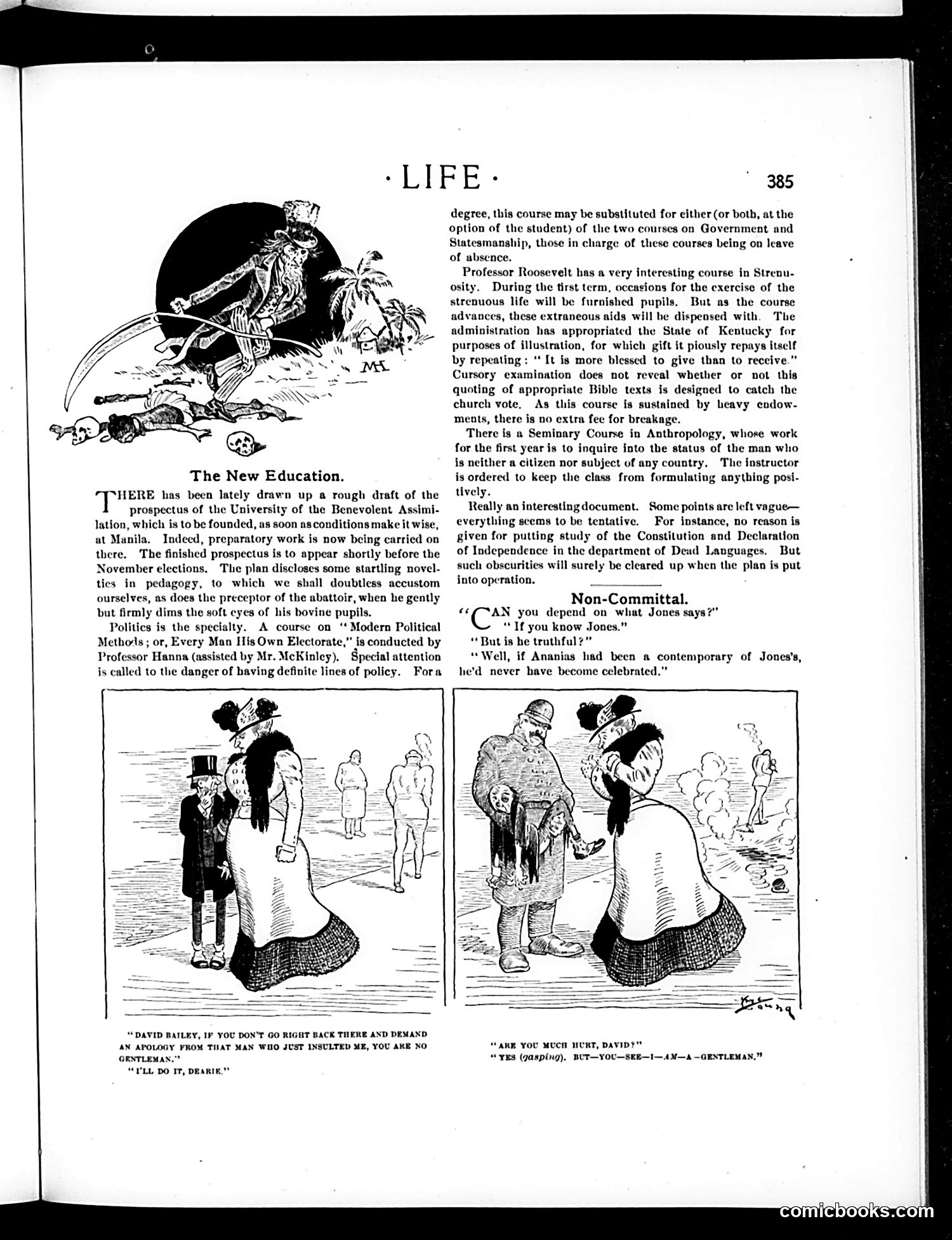
This page satirizes American imperialism and Republican politics circa 1900. The main article mocks a proposed "University of Benevolent Assimilation" in Manila (the Philippines, recently acquired by the U.S. after the Spanish-American War). The satire targets: - **McKinley and Hanna** (Republican leaders): teaching "Modern Political Methods" with deliberately vague policy - **Theodore Roosevelt**: his "Strenuous Life" philosophy, mocked as needlessly aggressive - **American imperialism**: the crude euphemism of "benevolent assimilation" (forcing American control while claiming to help Filipinos) The cartoon below satirizes masculine honor codes—a man agrees to demand an apology to prove he's a "gentleman," despite being hurt. It mocks performative masculinity divorced from actual courage or sense. The overall message: Life magazine views Republican imperialist policy and its rhetorical justifications as hypocritical, vague, and absurdly destructive.
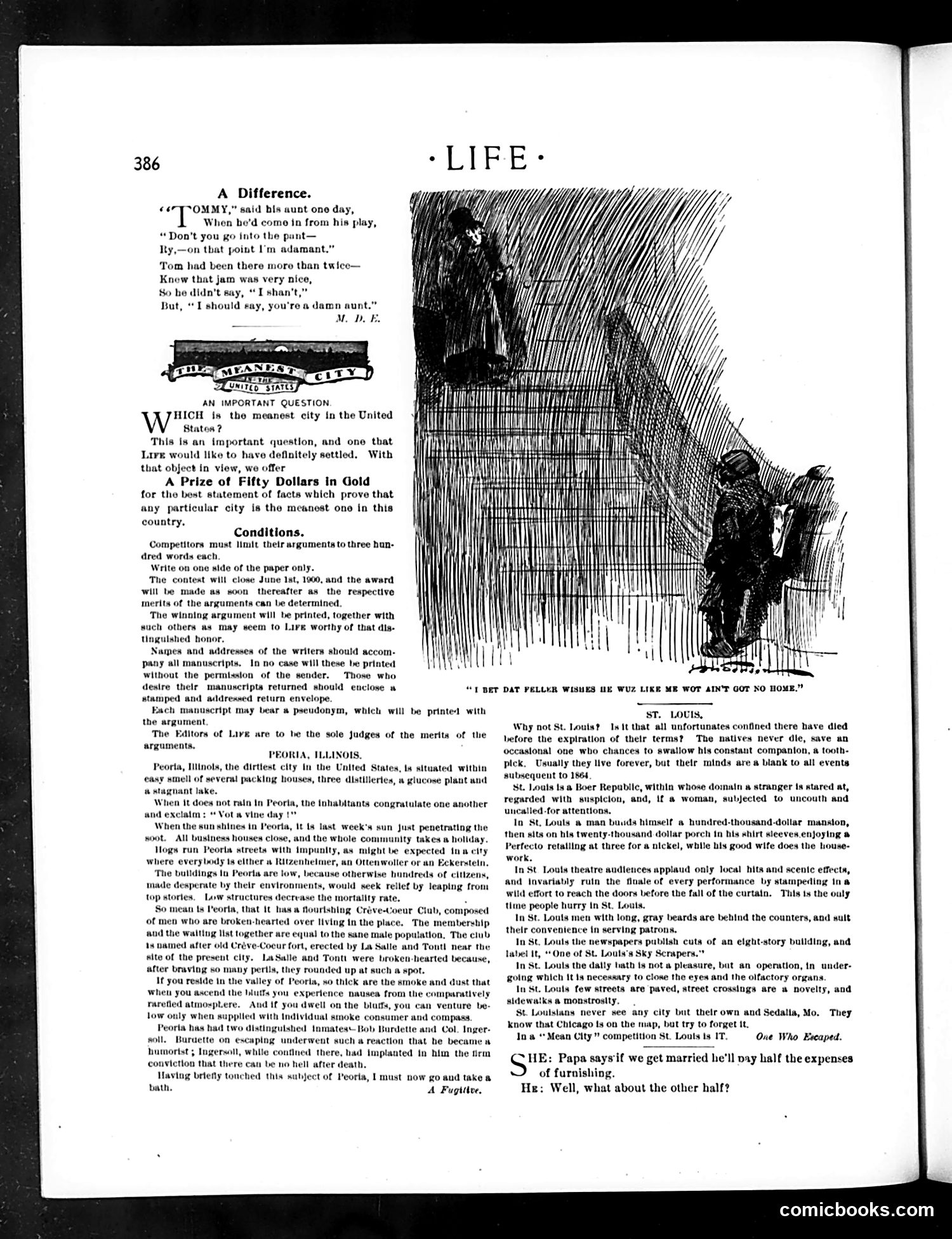
This page combines satirical content critiquing American cities with a humorous poem and a contest announcement. **"A Difference"** is a brief poem about a boy named Tommy who, caught sneaking into the pantry for jam, responds to his aunt's scolding by calling her a "damn aunt"—the joke being his crude honesty rather than outright defiance. **The Main Content**: Life announces a $50 gold prize contest asking "Which is the meanest city in the United States?" The page then features an extended satirical submission about **Peoria, Illinois**, viciously mocking it as filthy, depressing, and miserable. The author describes constant soot, smoke, stagnant water, and hogs in streets. Notable residents (Bob Burdette and Colonel Ingersoll) supposedly became either comedians or atheists from despair at living there. **The cartoon** shows a ragged, homeless figure with the caption "I BET DAT FELLER WISHES HE WUZ LIKE ME WOT AIN'T GOT NO HOME"—dark satire suggesting even homelessness beats living in places like St. Louis or Peoria. The satire targets industrial American cities' squalor and pollution during the Gilded Age.
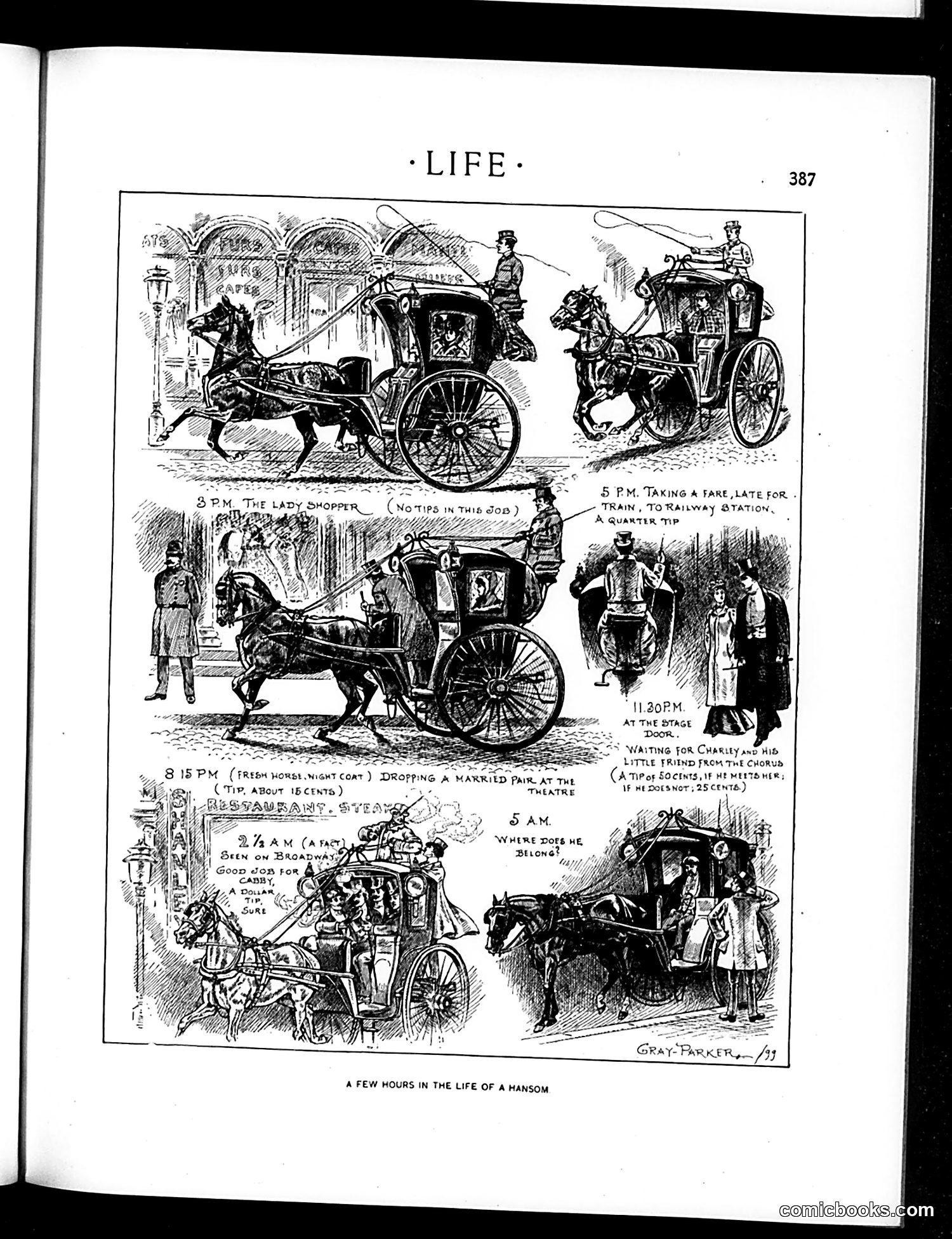
This satirical cartoon by Gray Parker depicts the daily financial exploitation of a hansom cab (horse-drawn taxi) driver in early 20th-century urban life. Each panel shows different passengers and their tipping practices throughout a 24-hour period. The joke targets the economic precarity of working-class cabmen: a lady shopper gives "no tips," a man rushing to catch a train offers only "a quarter tip," a wealthy theater-goer expects the driver to wait unpaid for his companion, and a drunk passenger at 8:15 PM provides minimal compensation ("about 15 cents"). By 5 AM, the exhausted driver—after a full night of work—is questioned "Where does he belong?"—suggesting he barely exists within society despite his labor. The satire critiques how tipping culture and passenger indifference forced cab drivers into poverty despite constant work.
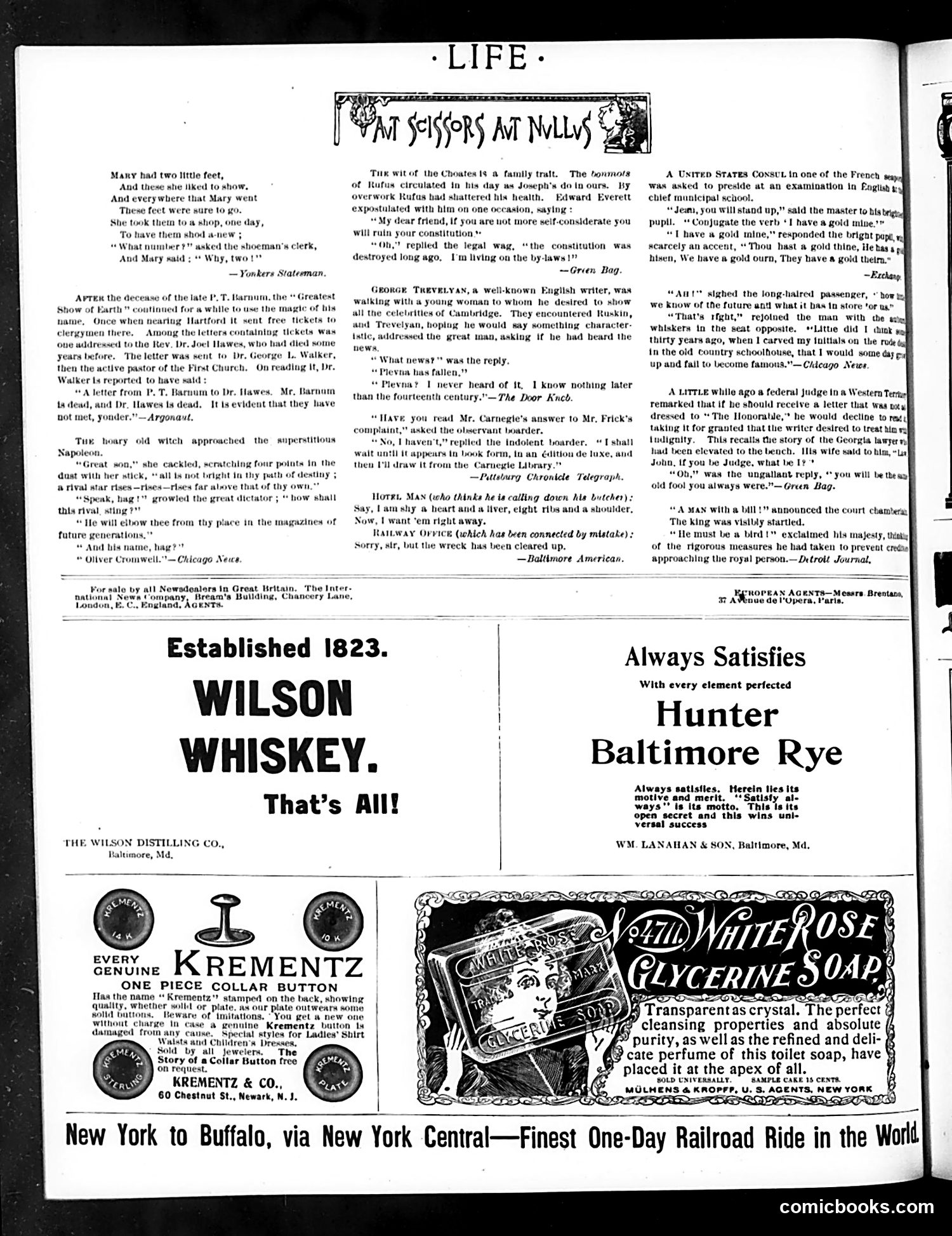
This page contains multiple short humorous anecdotes rather than a single political cartoon. The title "Wit Scissors at Nulls" appears to reference witty verbal exchanges. The jokes include: - A clerical anecdote: After P.T. Barnum's death, Dr. Walker receives a ticket invitation addressed to deceased Rev. Hawes, sarcastically noting both men are dead and "have not met yonder"—mocking Barnum's famous spectacles. - A Napoleon joke: A witch prophesies his downfall to the superstitious dictator, playing on his paranoia. - Various other brief witticisms about social absurdities and misunderstandings. The page is primarily **advertising**—Wilson Whiskey, Krementz collar buttons, Hunter Baltimore Rye, and White Rose soap dominate the lower half. The humor targets Victorian-era pretension and the gullibility of prominent figures.
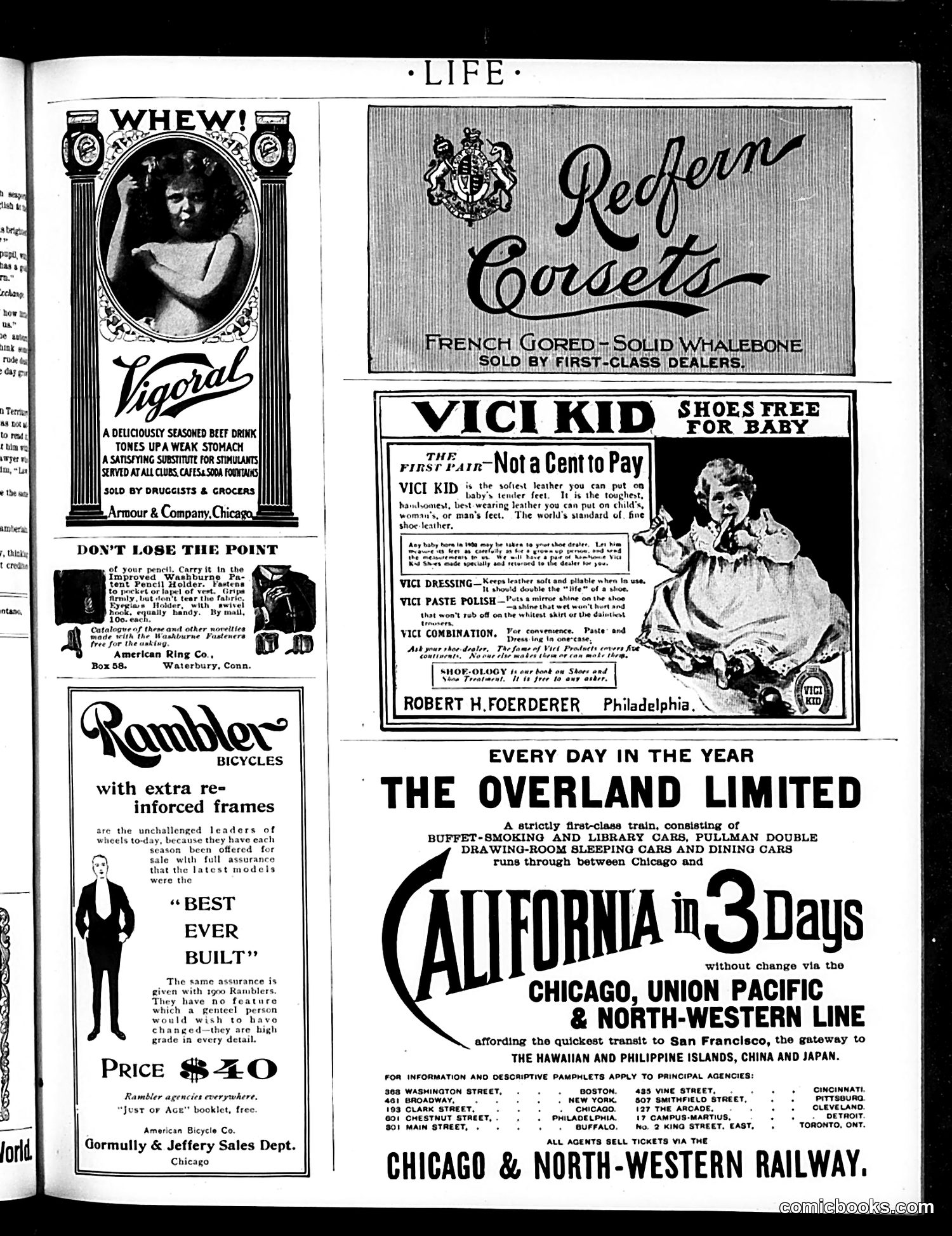
This page is primarily **advertising**, not political satire. It contains five vintage product advertisements from what appears to be an early 20th-century issue of Life magazine: 1. **Vigoral** - a beef-based tonic drink claimed to stimulate weak stomachs 2. **Redfern Corsets** - French whalebone corsets for women 3. **Vici Kid** - children's leather shoes, advertised as "not a cent to pay" (likely a promotional gimmick) 4. **Rambler Bicycles** - priced at $40, marketed as the "best ever built" 5. **The Overland Limited** - a Chicago & North-Western Railway train offering three-day service to California There are no political cartoons on this page. The small illustrations are product endorsements typical of the era, showing a woman's face for Vigoral, a baby for Vici Kid shoes, and a businessman for Rambler Bicycles—standard advertising imagery of the period.
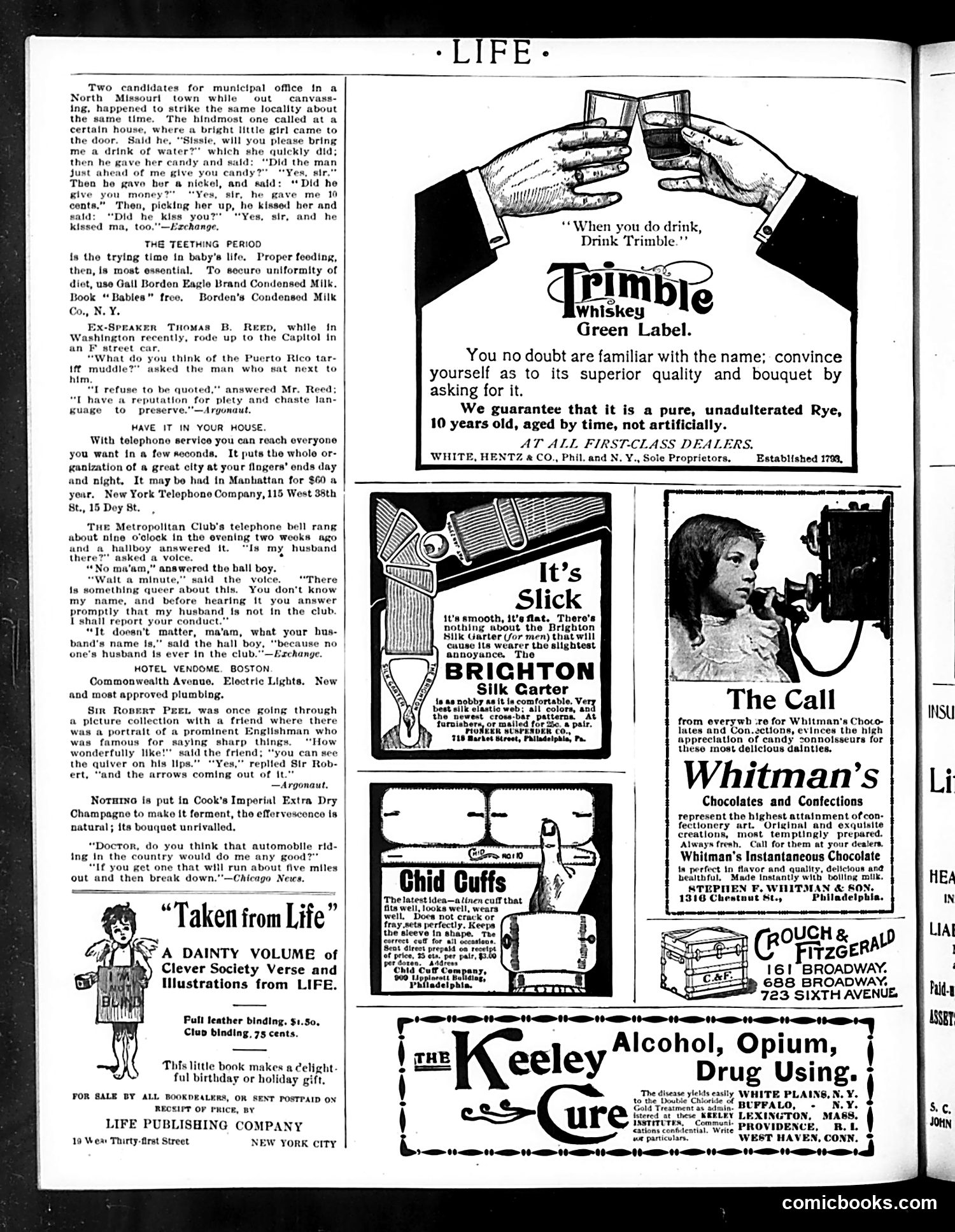
This page mixes satirical anecdotes with period advertisements. The humor relies on social observations familiar to early 20th-century readers: **The Stories:** - A politician loses an election because a rival candidate outmaneuvers him by charming a voter's child with candy and kisses—satirizing campaign tactics and political desperation. - A telephone operator assumes all husbands are absent from the Metropolitan Club, implying infidelity among wealthy members—social commentary on elite behavior. - Ex-Speaker Thomas B. Reed refuses to comment on Puerto Rico tariff politics, claiming he values his "reputation for piety"—ironic since he's known for sharp wit, suggesting politicians hide behind fake virtue. **The Advertisements:** The ads reveal period concerns: baby formula, whiskey purity guarantees, silk garters, and a treatment for "Alcohol, Opium, Drug Using"—reflecting anxieties about addiction and quality control in an unregulated market. The satire targets political dishonesty, social hypocrisy among the wealthy, and changing consumer culture.
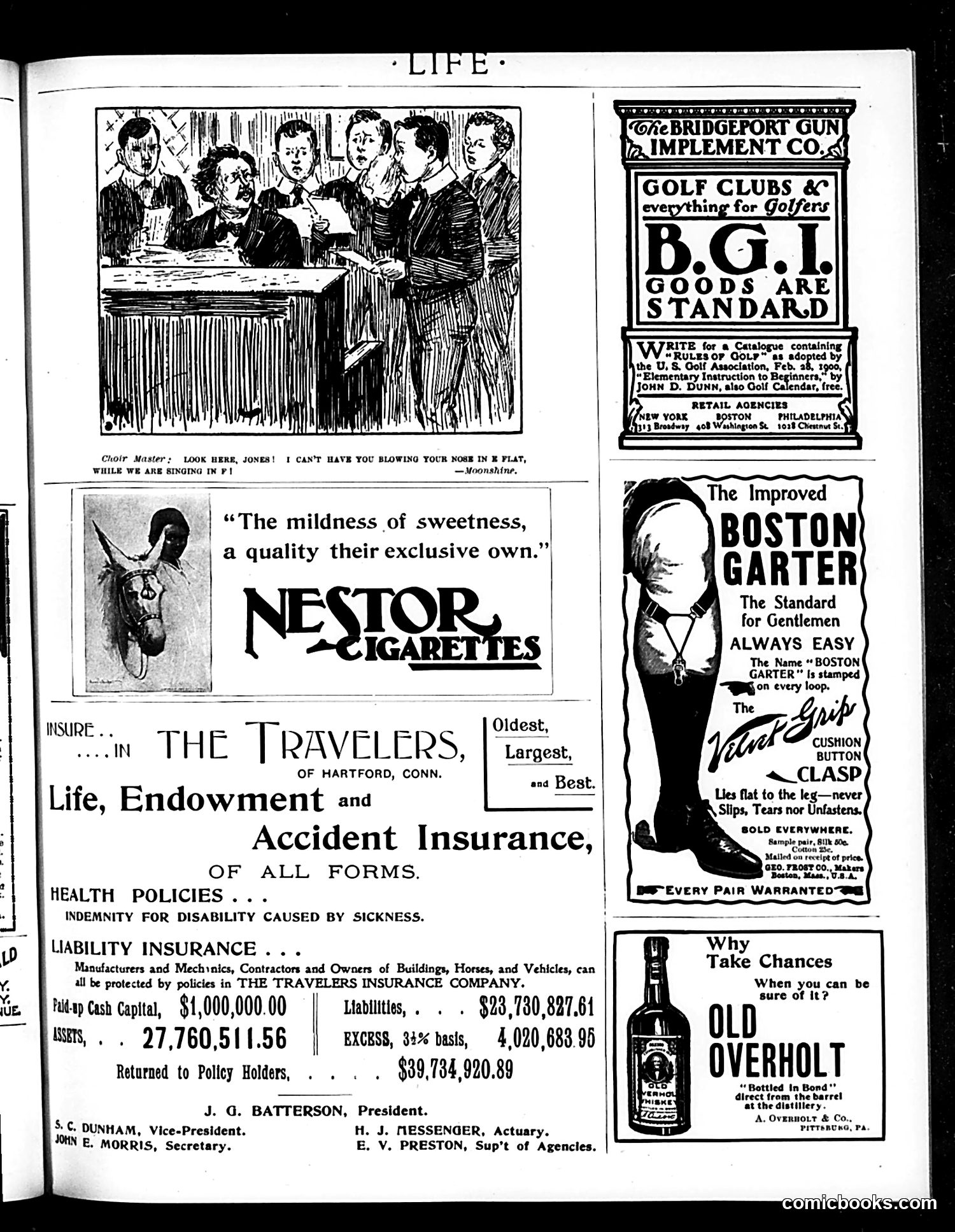
This page is primarily **advertisements interspersed with one cartoon joke**. The main cartoon depicts a choir rehearsal where the conductor scolds "Jones" for blowing his nose in the "wrong key" (K flat instead of F). The humor is a pun: it treats a mundane, involuntary bodily function as if it were a musical performance requiring pitch-perfect execution. This is absurdist comedy typical of early 20th-century satirical magazines. The page otherwise features ads for insurance (The Travelers Insurance Company), golf equipment (B.G.I. Golf Clubs), garters, cigarettes (Nestor), and whiskey (Old Overholt). These advertisements suggest the magazine's affluent male readership—the products target businessmen, sportsmen, and gentlemen of leisure. No clear political satire appears on this page; it's primarily entertainment and commercial content.
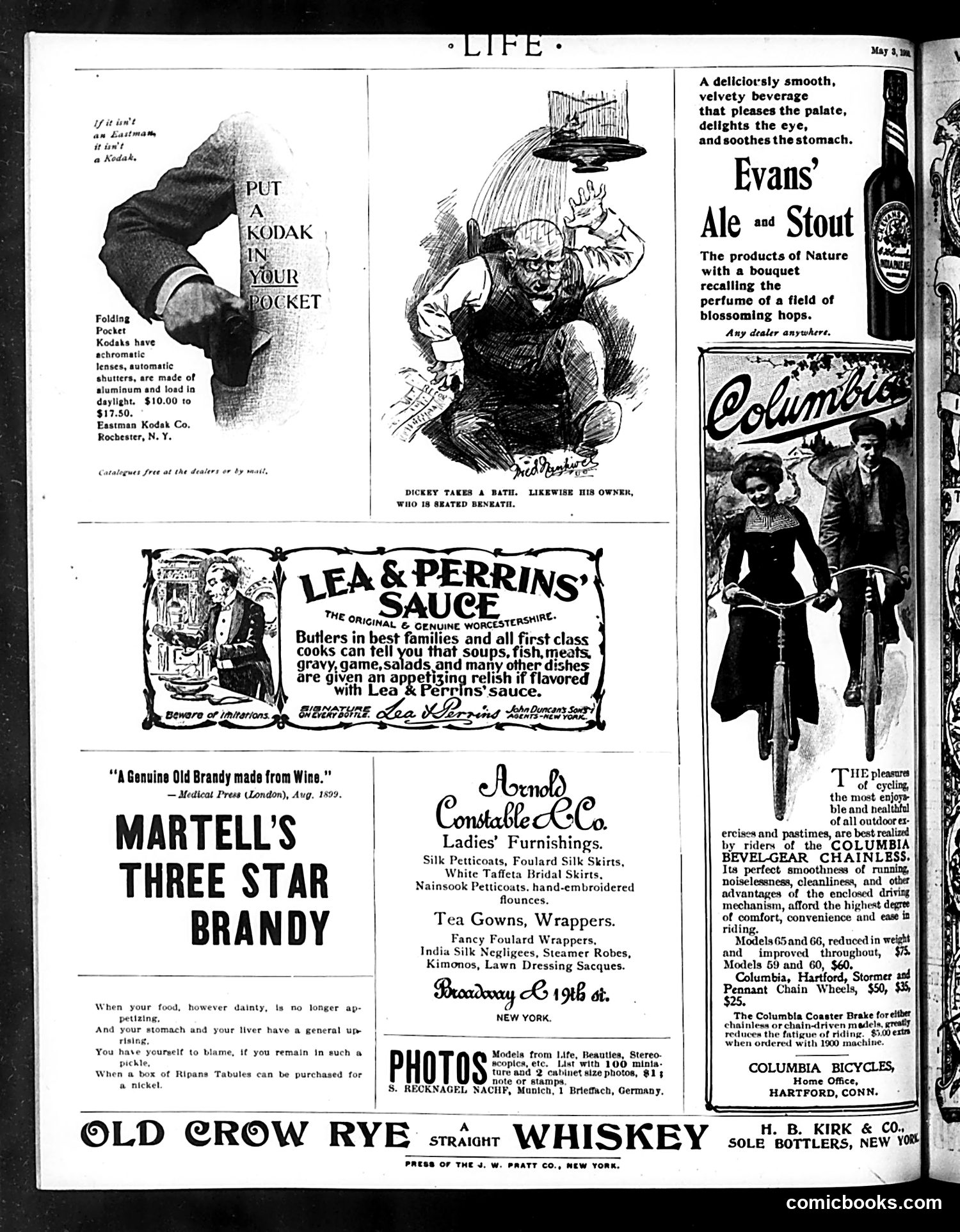
This page is primarily **advertising**, not political satire. It contains roughly a dozen product advertisements typical of early 1900s American magazines. The single cartoon—"Dickey Takes a Bath. Likewise His Owner, Who Is Seated Beneath"—appears to be a humorous domestic scene showing a dog being bathed while the owner sits under the tub receiving water, illustrating shared misery. The joke relies on visual comedy rather than political commentary. The advertisements promote consumer goods: Kodak cameras, Evans' Ale and Stout, Lea & Perrins' Sauce, Martell's Brandy, Columbia bicycles, Ripans Tabules (patent medicine), Arnold Constable ladies' clothing, and Old Crow Rye whiskey. These ads emphasize product quality and lifestyle benefits—typical marketing of the era. There is **no political or social satire** on this page. It represents Life magazine functioning as a commercial publication carrying general-interest humor alongside paid advertising.