
Life, 1900-05-03 · page 6 of 20
Life — May 3, 1900 — page 6: what you’re looking at
What you’re looking at
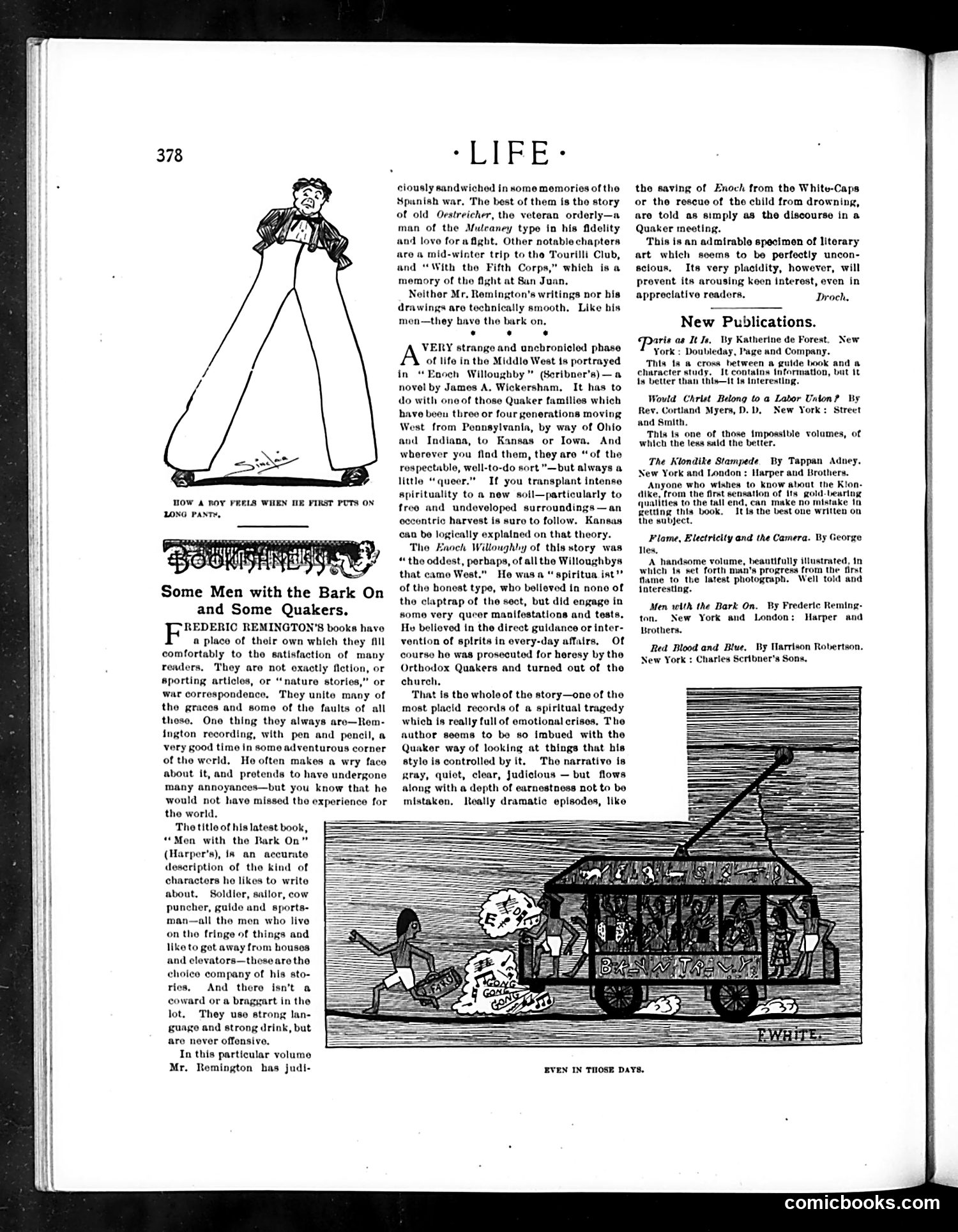
This page from *Life* magazine contains a book review section titled "Some Men with the Bark On and Some Quakers." The review discusses Frederic Remington's latest book, *Men with the Bark On* (Harper's), which depicts frontier and Western characters—men living on society's margins: prospectors, drifters, and those "on the fringe of things." The two illustrations shown are woodcuts by E.W. Hine. The top cartoon depicts a man in exaggerated pose, illustrating the book's characterizations. The lower illustration, titled "Even in Those Days," shows a frontier scene with a covered wagon, appearing to depict the rugged Western life Remington documents. The review praises Hemingway's ability to capture authentic character types while noting his occasionally strong language and controversial subject matter.
📄 Transcribed text from this page (OCR, searchable)
Machine-transcribed from the original scan — historical spelling and the odd misread are preserved.
HOW A ROY FEELS WHEN IE FIRST PUTS ON LONG PANTY, Some Men with the Bark On and Some Quakers, REDERIC REMINGTON’S books havo a place of their own which they fill comfortably to tho satisfaction of many readers. They aro not oxactly fiction, or Sporting articlos, or “nature stories,” or war correspondence. They unite many of the graces and somo of the faults of all those. One thing they always aro—Rem- ington recording, with pen and pencil, a very good time In some adventurous corner of the werld, Ho often makes a wry faco about it, and pretends to have undergone many annoyances—but you know that he would not have missed the experience for the world. *LIFE- ciously sandwiched in some memories of the Spanish war, The best of them is tho story of old Orstreicher, the veteran orderly—a man of the Muleaney type in his fidelity and love fora fight, Other notabiechapters are a mid-winter trip to the Tourilli Club, and “With the Fifth Corps,” which is a memory of the fight at San Juan, Neither Mr, Remington's writings nor bis drawings are technically smooth, Like bis mon—they have the bark on, . . . VERY strange and ancbronicled phase of life in the Middle West is portrayed in “Enoch Willoughby ” (Scribner's) —o novel by James A, Wickersham, It has to do with one of those Quaker families which have been three or four generations moving West from Pennsylvania, by way of Ohio and Indiana, to Kansas or Iowa, And wherever you flad them, they aro “of the respectable, well-to-do sort "—but always a little “queer.” If you transplant intense spirituality to a new soll—particularly to freo and undeveloped surroundings —an eccentric harvest is suro to follow. Kansas can be logically explained on that theory. The Enoch Willoughhy of this story was “ the oddest, perbaps, of all the Willoaghbys that camo West." He was a “ spiritua ist” of the honest type, who believed in nono of tho claptrap of the sect, but did engage in some very queer manifestations and tests. Hv believed in the direct guidance or inter- vention of spirits in every-day affairs, Of course he was prosecuted for heresy by the Orthodox Quakers and turned out of the church, That is tho whole of the story—one of tho most placid records of a spiritual tragedy which is really full of emotional crises, The author seems to be so imbued with the Quaker way of looking at things that his style is controlled by it. Tho narrativo is gray, quiet, clear, Judicious — but flows along with a depth of earnestness not to bo mistaken, Really dramatic episodes, like Tho title of his latest book, “Men with the Rark On” (Harper's), 18 an accurate description of the kind of charactors he likes to write about. Soldier, sallor, cow puncher, guide and sports- man—all the men who live on tho fringe of things and like to got away from houses and clevators—theseare the choice company of his sto- ries, And thero isn’t a coward or a braggart in the lot. They use strong lan- guage and strong drink, but the saving of Enoch from the White-Caps or the rescue of the child from drowning, are told as simply as the discourse in a Quaker meeting. This is an admirable specimen of literary art which scems to be perfectly uncon- scious, Its very placidity, however, will prevent its arousing keen interest, even in appreciative readers, Droch. New Publications. ris as It Js, By Katherine de Forest. York : Doubleday, Page and Company. This ta @ croxa between a guide book and a character study. It contains tnformation, but tt Is Detter than thts—it ts Interesting. Would Christ Belong to a Labor Unton? Rev. Cortland Myers, D.D, New York : and Smith. This ts one of those Impossible volumes, of which the less sald the better. The Klondike Stampede By Tappan Adney. New York and London : Harper and Brothers. Anyone who wishes to know about the Klon- dike, from the first sensation of Its gold-bearing ities to the tall end, can make no mistake In ting this book, subject. New hy Street Fe It is the best one written on the Plame, Electricity and the Camera. By George Hes, ‘A handsome volume, beautifully illustrated, in which 1s set forth man's progress from the first flame to the latest photograph. Well told and lnteresting. Men with the Bark On. By Frederic Reming- ton, New York and London: Harper and Brothers. Red Blood and Blue, By Marrison Robertson. New York : Charles Scribner's Sons, aro never offensive. In this particular volume Mr. Remington bas judi- EVEN IN THOSE DAYS. comicbooks.com