
A complete issue · 21 pages · 1899
Life — December 28, 1899
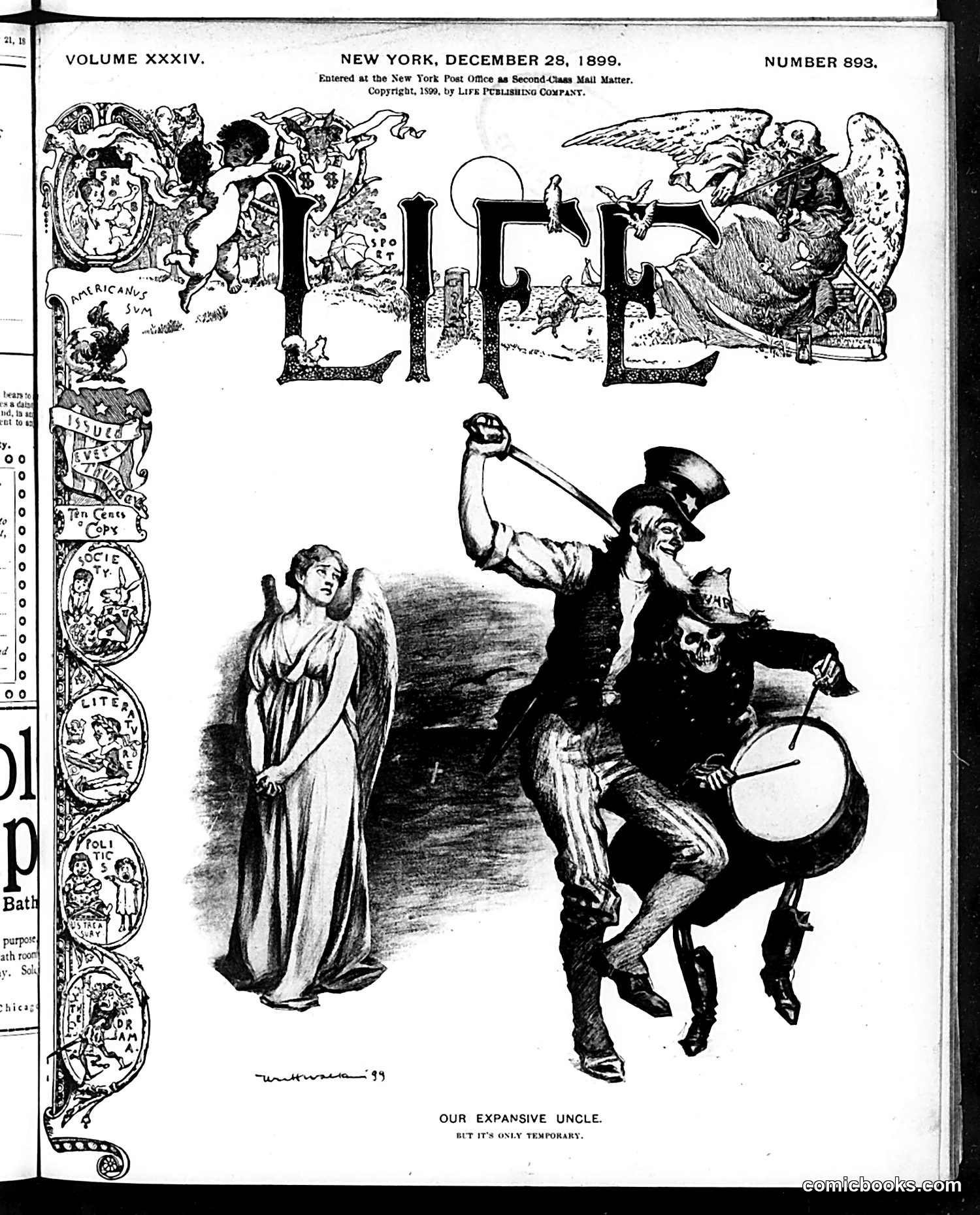
This political cartoon satirizes American imperial expansion at the turn of the 20th century. The caption reads "OUR EXPANSIVE UNCLE" with the subtitle "BUT IT'S ONLY TEMPORARY." The central figure is Uncle Sam (personified America), depicted as a wildly dancing, manic character wielding a club and drum. He appears drunk or delirious with power. On the left stands a winged female figure (likely Liberty or Columbia), looking concerned and dismayed at Uncle Sam's behavior. The satire criticizes America's aggressive foreign expansion—likely referencing recent acquisitions following the Spanish-American War (1898), including territorial gains in the Pacific and Caribbean. The "temporary" subtitle suggests skepticism about whether these expansionist policies would prove sustainable or wise. The cartoon mocks both the enthusiasm and recklessness of American imperial ambitions.
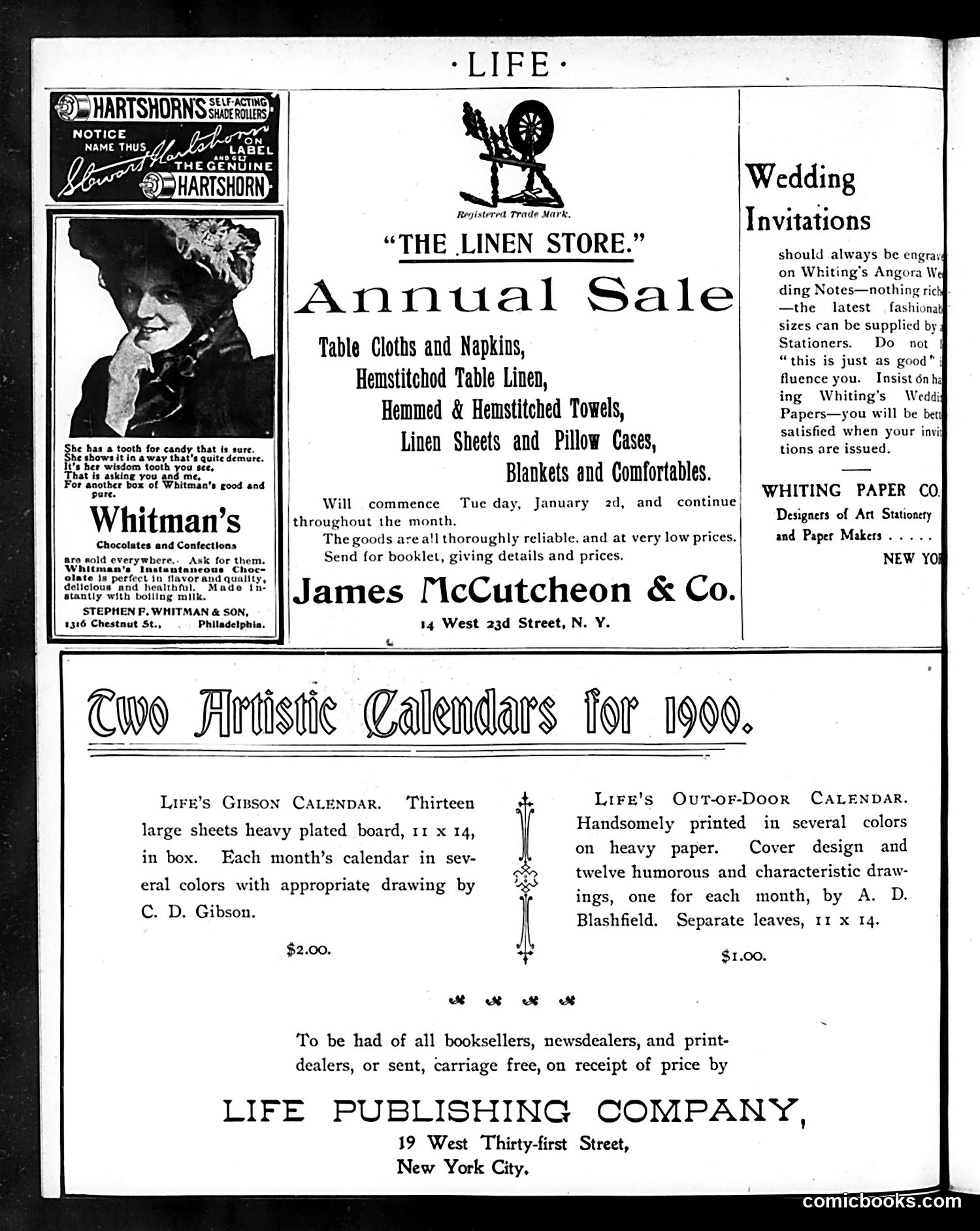
This page is primarily **advertising**, not political satire. The content includes: 1. **Hartshorn's product ad** (top left): Features a woman's photograph with text claiming the product is "a sure winner" and "her wisdom knows no bounds." This appears to be a household cleaning product using endorsement-style marketing typical of the era. 2. **Whitman's Chocolates ad** (left): Standard product advertisement emphasizing quality and flavor. 3. **The Linen Store announcement** (center): James McCutcheon & Co. advertising an annual sale of table linens and related goods. 4. **Whiting Paper Co.** (right): Advertisement for wedding invitations and stationery services. 5. **Two Artistic Calendars for 1900** (bottom): Life Publishing Company promoting decorative calendars featuring artwork by C.D. Gibson and A.D. Blashfield. The page represents typical turn-of-the-century magazine advertising rather than editorial satire.
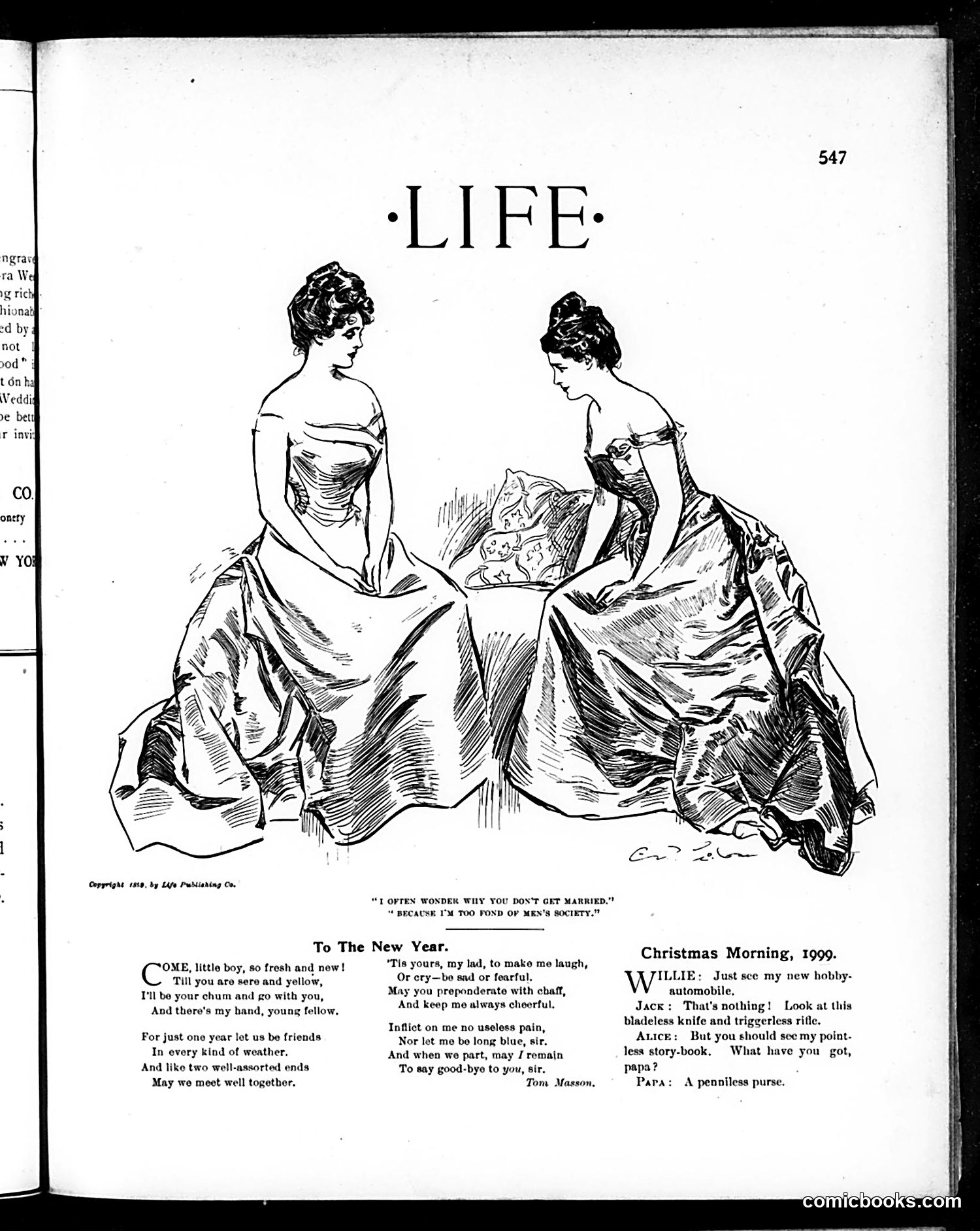
This page features a sketch of two elegantly dressed women examining what appears to be a fashionable garment or fabric. The caption reads: "I OFTEN WONDER WHY YOU DON'T GET MARRIED. BECAUSE I'M TOO FOND OF MEN'S SOCIETY." The cartoon satirizes the tension between women's independence and marriage expectations in 1899. The woman on the right is rejecting matrimony, claiming she prefers the social company of men—a witty reversal suggesting that marriage would actually limit her access to male social circles. The joke targets contemporary assumptions that all unmarried women should desire marriage, while highlighting the social benefits single women enjoyed in the era's gender-segregated society. The accompanying poetry and domestic dialogue about New Year's resolutions reinforces themes of social expectations and personal choice.
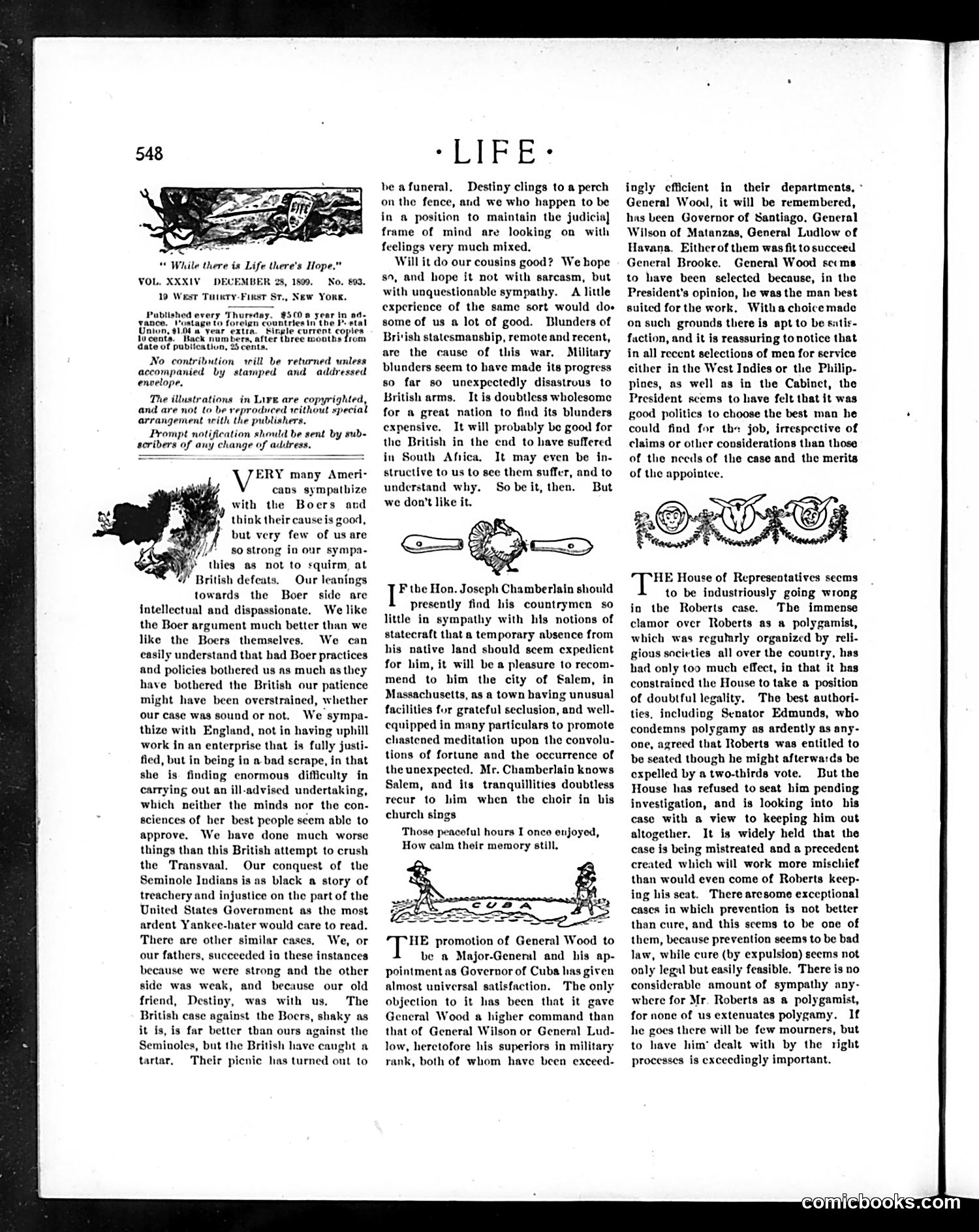
The page contains editorial commentary rather than traditional political cartoons. The text criticizes American sympathy for the Boers in the recent South African War, arguing Americans poorly understand the conflict while maintaining double standards about military conduct. The article also discusses General Wood's promotion to Major-General and appointment as Governor of Cuba, noting satisfaction with this decision. Finally, it addresses controversy over Representative Roberts, a polygamist, remaining in Congress—arguing the House should expel him despite precedent concerns. The small decorative illustrations are ornamental rather than satirical. The content reflects turn-of-century debates about American foreign policy, military leadership, and congressional ethics, presented through serious editorial argument rather than visual satire.
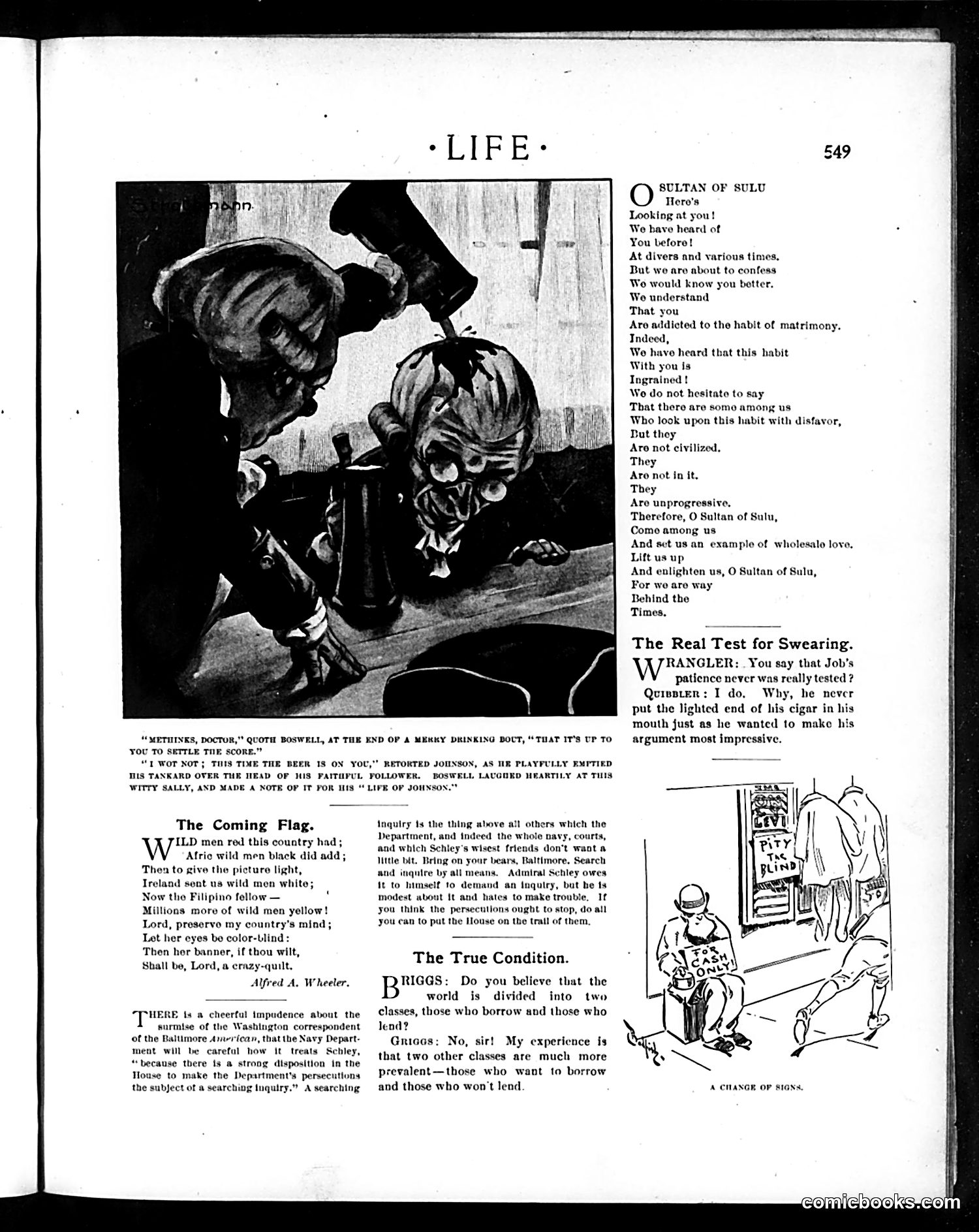
The main illustration depicts two figures in what appears to be a casual drinking scene, captioned as "Sentinels, Doctor," with dialogue about beer and witty remarks. This illustrates "The Real Test for Swearing"—a humorous piece about testing patience through cigar smoking etiquette. "The Coming Flag" is a poem by Alfred A. Wheeler addressing wild men and the Filipino conflict, referencing naval and military concerns of the era (likely early 1900s Philippine-American War period). "The True Condition" features a dialogue between Briggs and Gideon debating whether the world divides into borrowers and lenders, or instead into those who want to borrow versus those unwilling to lend—satirizing human nature and social economics. The right panel cartoon "A Change of Signs" shows a figure at what appears to be a storefront, likely commentary on commercial or social shifts.
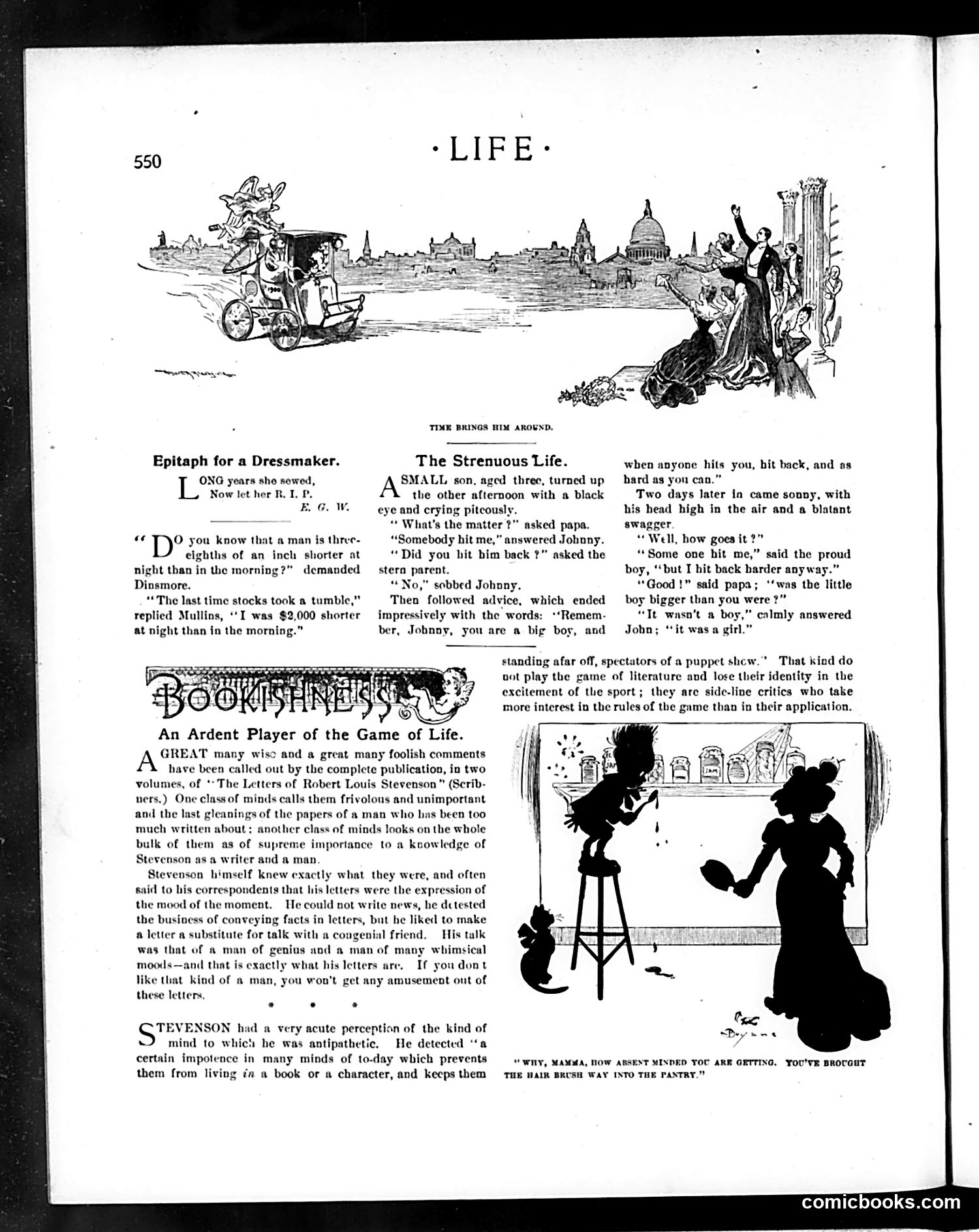
This page contains literary commentary and humorous anecdotes rather than political cartoons. The main article, "An Ardent Player of the Game of Life," discusses Robert Louis Stevenson's letters, praising his wit and conversational skill. The sidebar items include brief jokes: "Epitaph for a Dressmaker" mocks a woman's financial losses, while "The Strenuous Life" presents a child-discipline anecdote where a boy receives harsh parental correction, likely satirizing Theodore Roosevelt's contemporary "strenuous life" philosophy. The silhouette illustration shows a domestic scene with a woman scolding a child about a hairbrush. The humor relies on recognizable middle-class domestic conflict rather than political satire—accessible comedy for Life's general readership circa early 1900s.
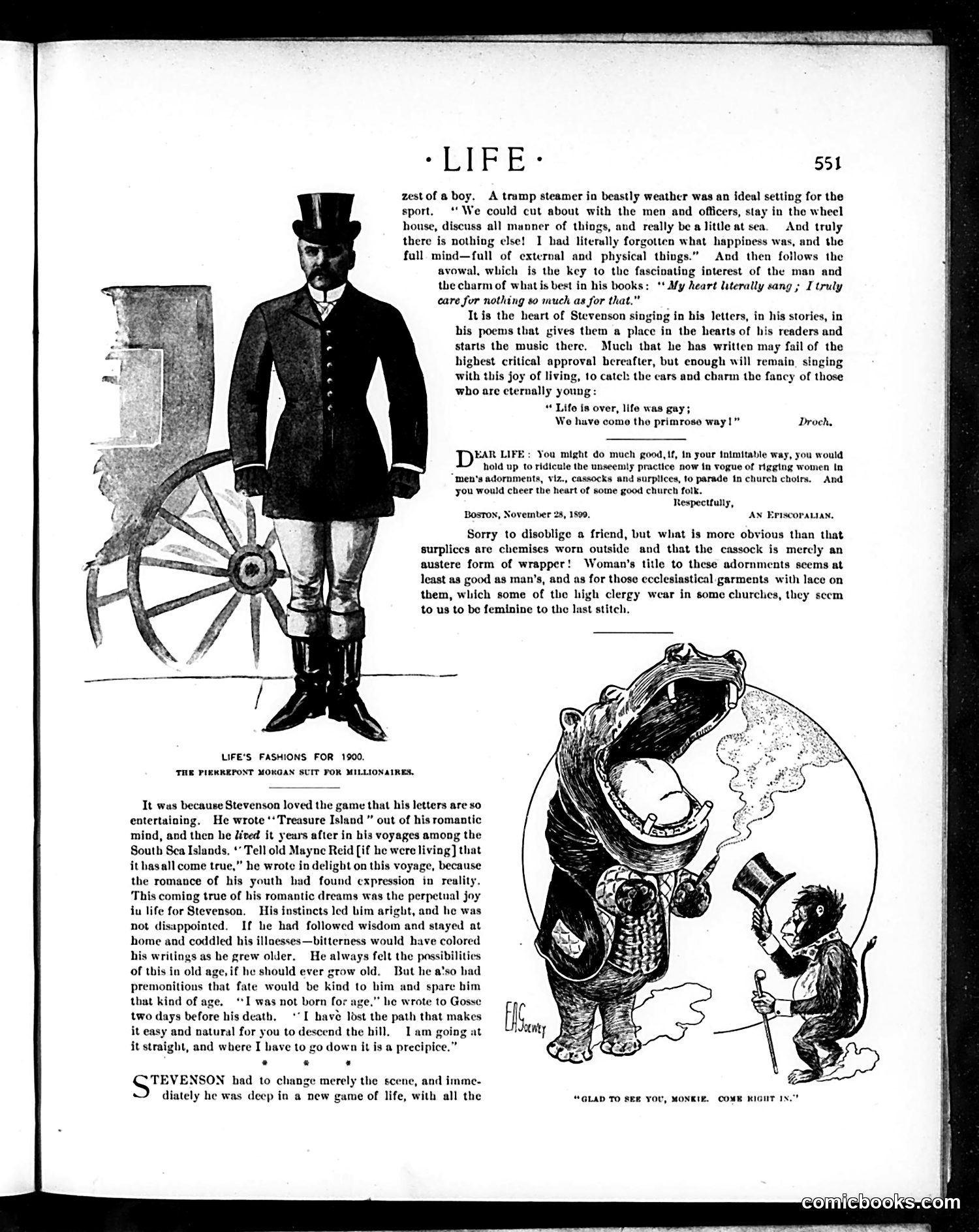
This page primarily discusses Robert Louis Stevenson, the Scottish author, celebrating his romantic spirit and adventurous life philosophy. The top illustration depicts "Life's Fashions for 1900" — a Victorian gentleman in formal dress standing beside a ship's wheel, satirizing the era's fashions. The main cartoon at bottom shows an elephant greeting a small human figure with "Glad to see you, Monkie. Come right in!" — this appears to be a whimsical illustration unrelated to the text, possibly from a children's story or fable. The letter from "An Episcopalian" critiques women wearing men's garments (cassocks, surplices) in church choirs, arguing such ecclesiastical dress is inappropriate for women. The page celebrates Stevenson's adventurous spirit while simultaneously addressing contemporary debates about gender roles and religious decorum in early 1900s society.
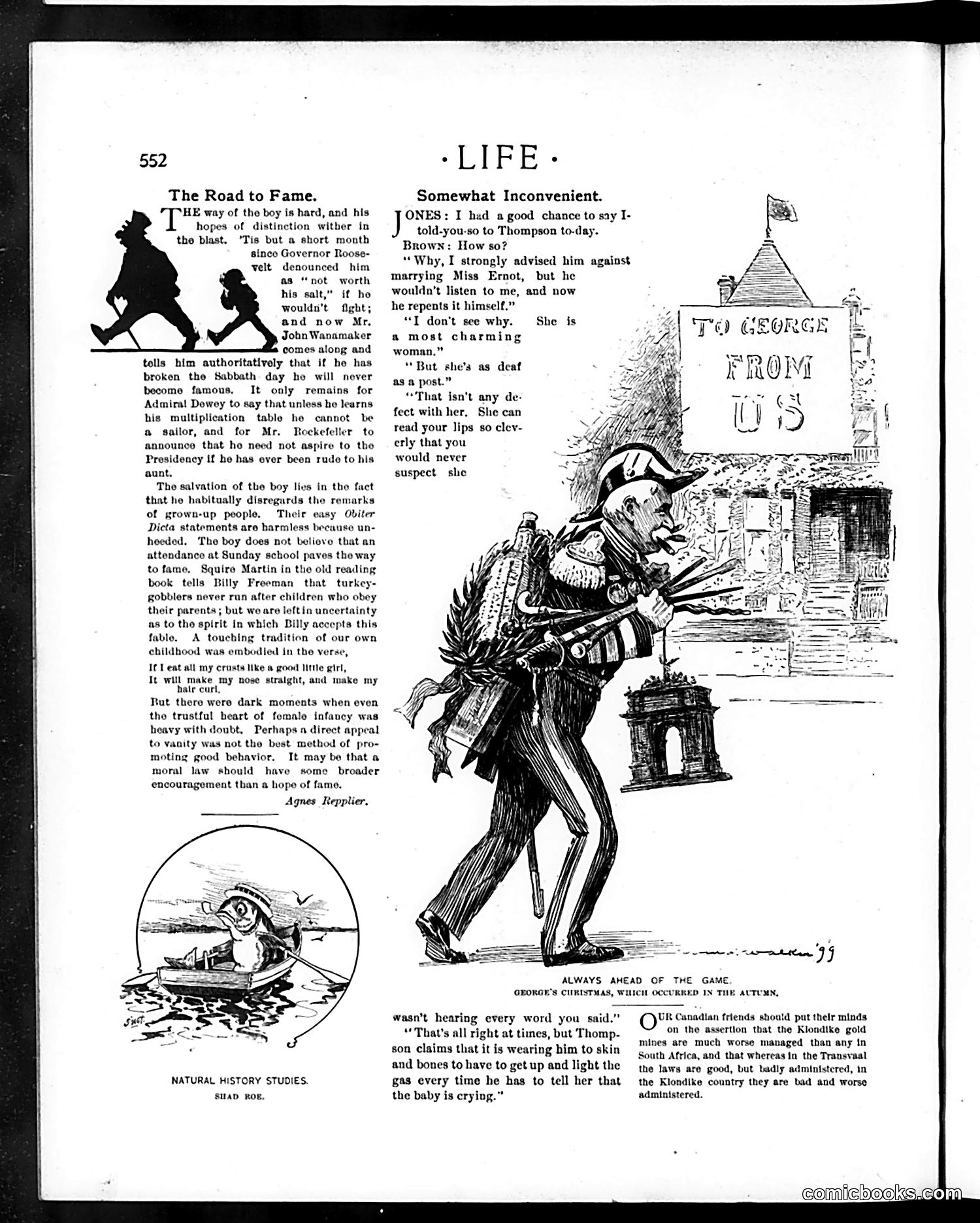
This page contains three distinct pieces: 1. **"The Road to Fame"** (left column): An editorial essay by Agnes Repplier criticizing the notion that children should aspire to fame. It argues against using fame as a motivator for good behavior, suggesting instead that moral laws should encourage virtue directly. 2. **"Somewhat Inconvenient"** (center): A dialogue between Jones and Brown about Thompson's ill-advised marriage to Miss Frost, who is deaf. The joke hinges on her deafness making her an "inconvenient" wife—she cannot hear his complaints. 3. **"T'is George From U.S."** (right): An illustration showing a camel carrying supplies, captioned "Always Ahead of the Game." The accompanying text discusses Canadian gold mines and the Transvaal, suggesting this references colonial military logistics. The page reflects early 20th-century attitudes toward disability and empire.
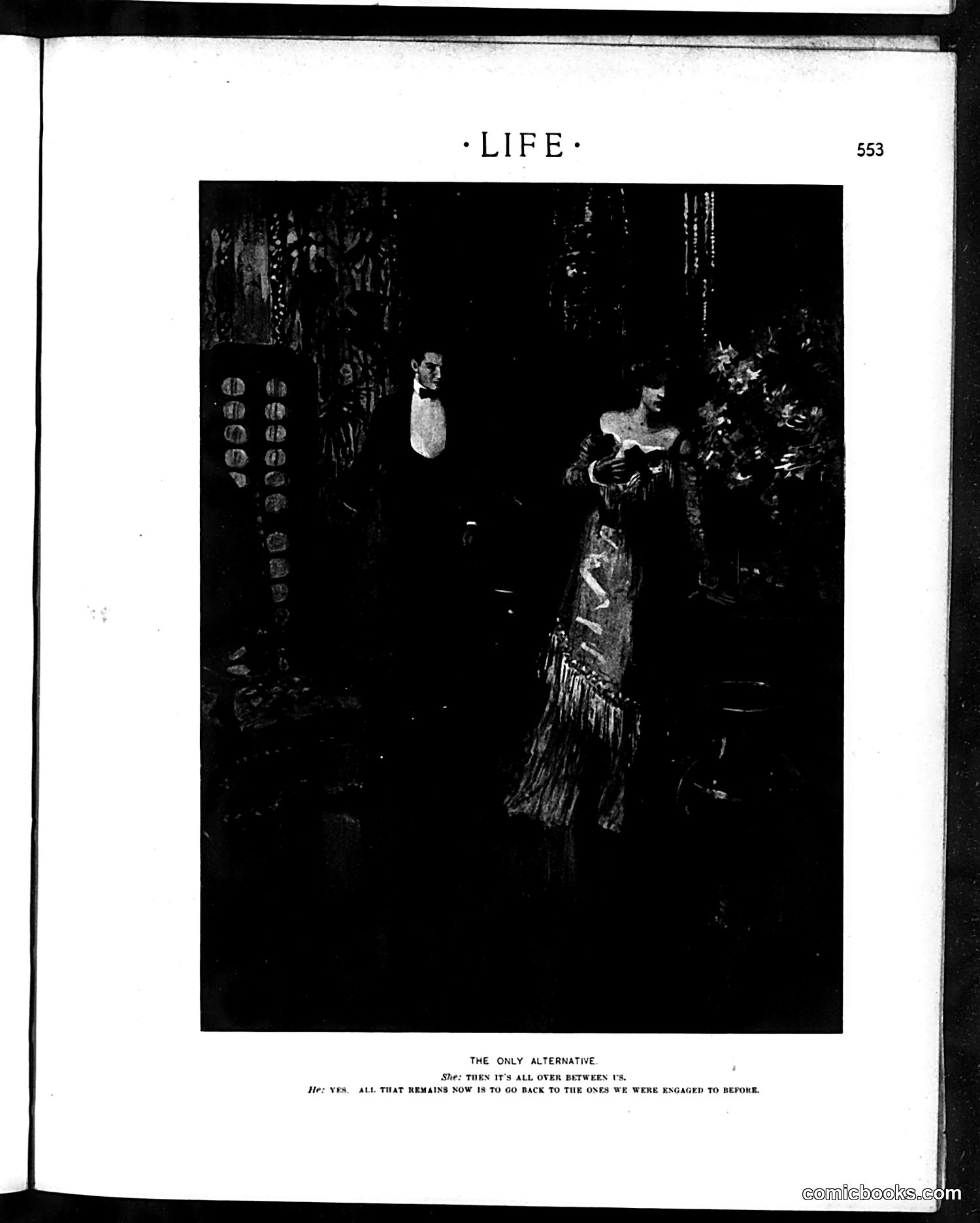
This appears to be a satirical illustration from *Life* magazine depicting a dramatic social scene. The image shows a formally-dressed man in a tuxedo observing a woman in an elegant, fringed gown in what appears to be a luxurious interior setting with ornate details. The dialogue caption reads: "She: Then it's all over between us. / He: Yes. All that remains now is to go back to the ones we were engaged to before." The satire mocks the superficiality of upper-class romantic entanglements—suggesting that wealthy individuals casually break engagements and shift between partners without genuine emotional investment. The "only alternative" to ending a relationship is simply reverting to a previous engagement, implying these relationships lack substance or sincere commitment.
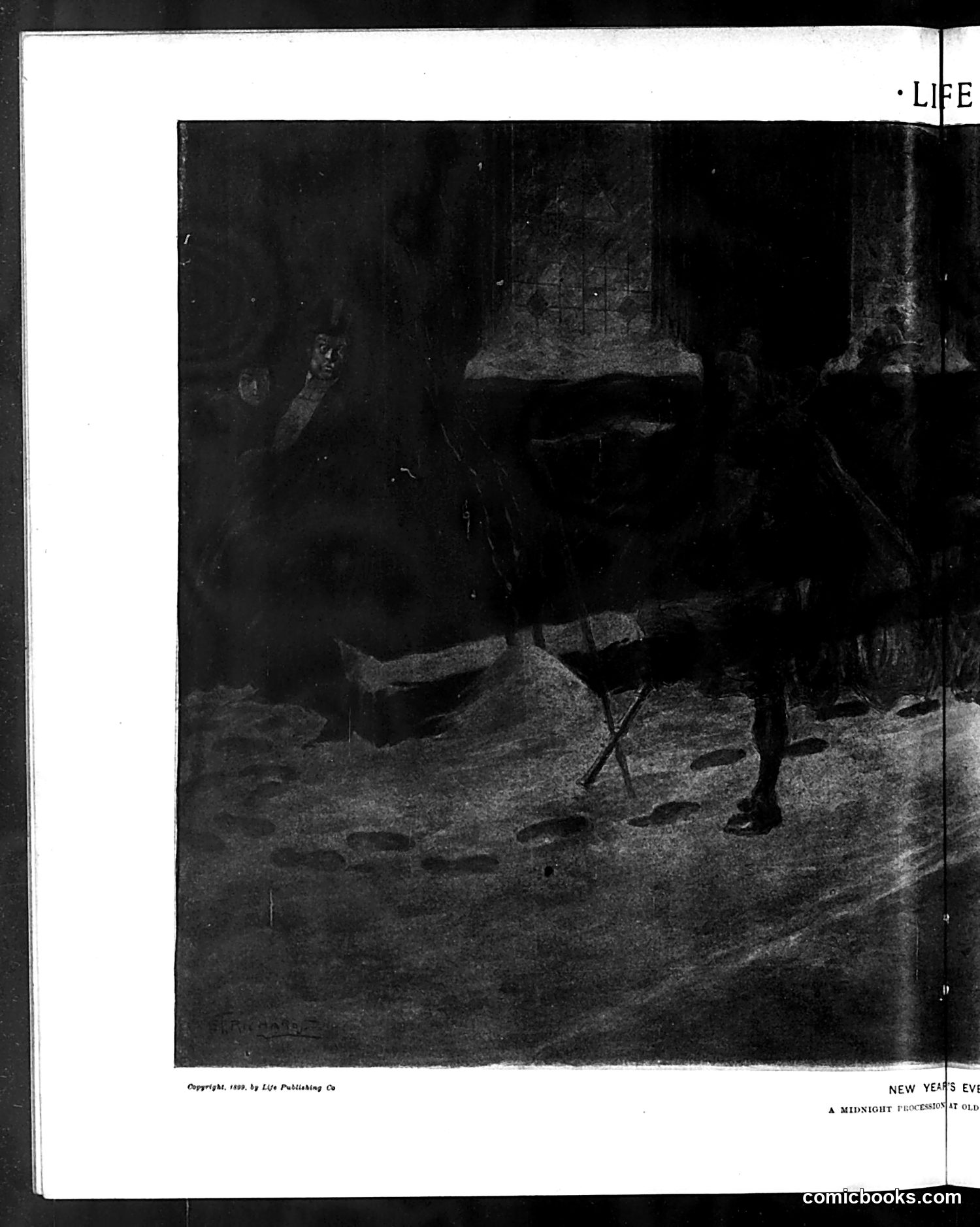
This is a darkly atmospheric black and white photograph or illustration rather than a traditional cartoon. The visible text at bottom reads "NEW YEAR'S EVE" and "A MIDNIGHT FROLIC AT OLD..." (text cut off). The image shows shadowy figures in what appears to be an indoor setting, possibly depicting a New Year's Eve celebration or gathering. The heavy darkness and unclear forms suggest either a theatrical scene, a candlelit event, or intentionally obscured photography meant to convey mystery or mood. Without clearer text or identifying details, I cannot confidently name specific figures or explain particular political satire. The 1909 copyright indicates this is early 20th-century content, but the actual subject and satirical point remain unclear from this page alone.
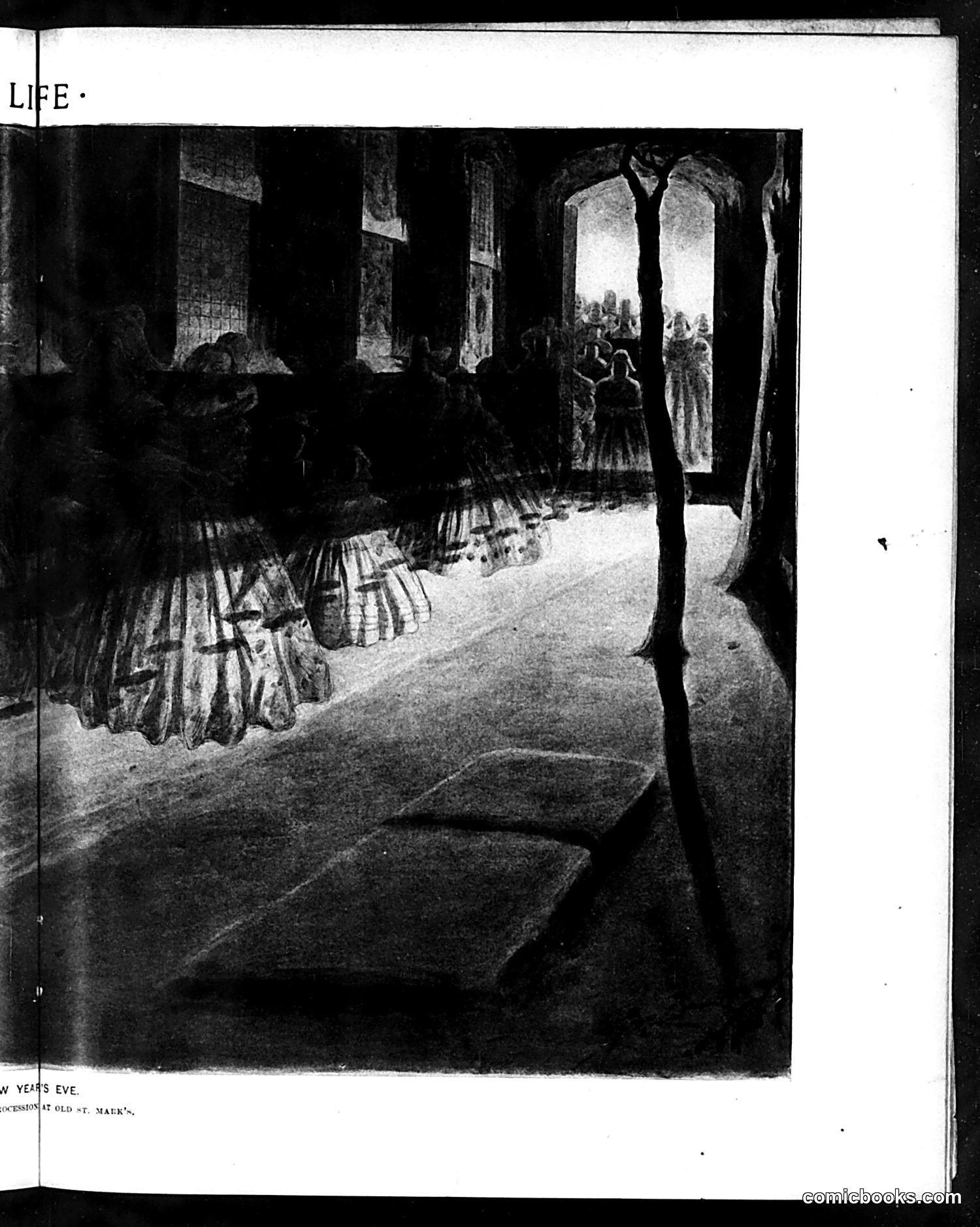
This appears to be an illustration titled "NEW YEAR'S EVE" from *Life* magazine, likely depicting a scene at "Old St. Mark's" (based on partially visible text at bottom). The image shows an interior architectural space—possibly a church or historic building—with dramatic lighting from arched openings. Silhouetted figures in period dress (appearing to wear long skirts/dresses) are gathered inside, while additional figures are visible through the archways outside. Without clearer text or additional context, the specific satirical point remains unclear. It may reference a New Year's celebration, a historical event, or social commentary about gathering spaces or tradition. The dramatic lighting and composition suggest romantic or atmospheric intent rather than sharp political satire. More context about the publication date would clarify the reference.
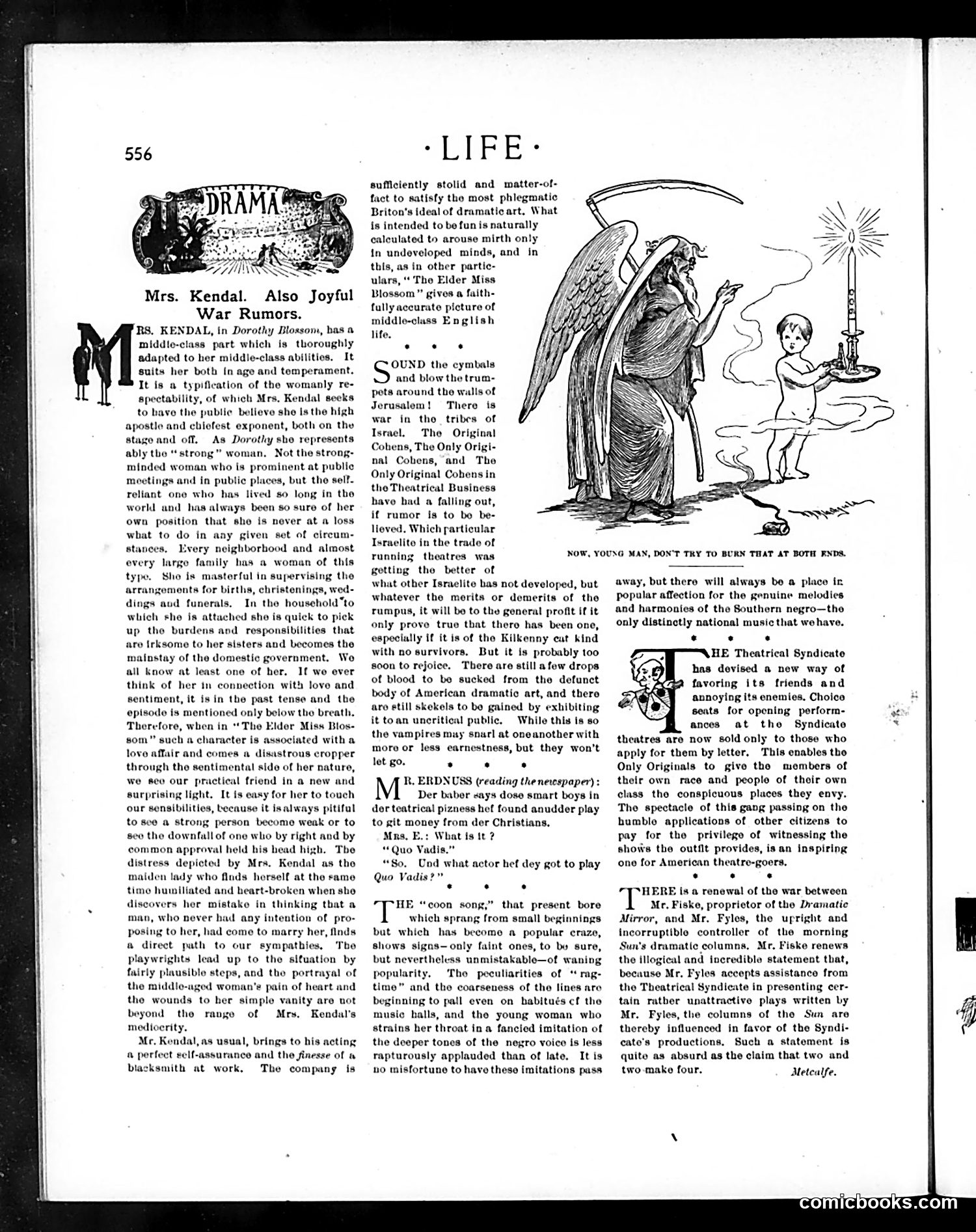
This page contains theatrical criticism and reviews rather than political cartoons. The main illustration shows a winged figure (likely representing artistic inspiration or drama) with a cherub/cupid, captioned "Now, young man, don't try to burn that at both ends." The text discusses Mrs. Kendal, a prominent British actress, praising her as a "strong woman" and skilled performer. The article also critiques contemporary theater trends, particularly discussing popular "coon songs" and ragtime music gaining popularity in musical theater. The writer expresses concern about lowered artistic standards, suggesting audiences prefer crude entertainment over sophisticated drama. The page reflects Edwardian-era theatrical snobbery—elite critics dismissing popular entertainment as artistically inferior while celebrating classically-trained performers like Mrs. Kendal.
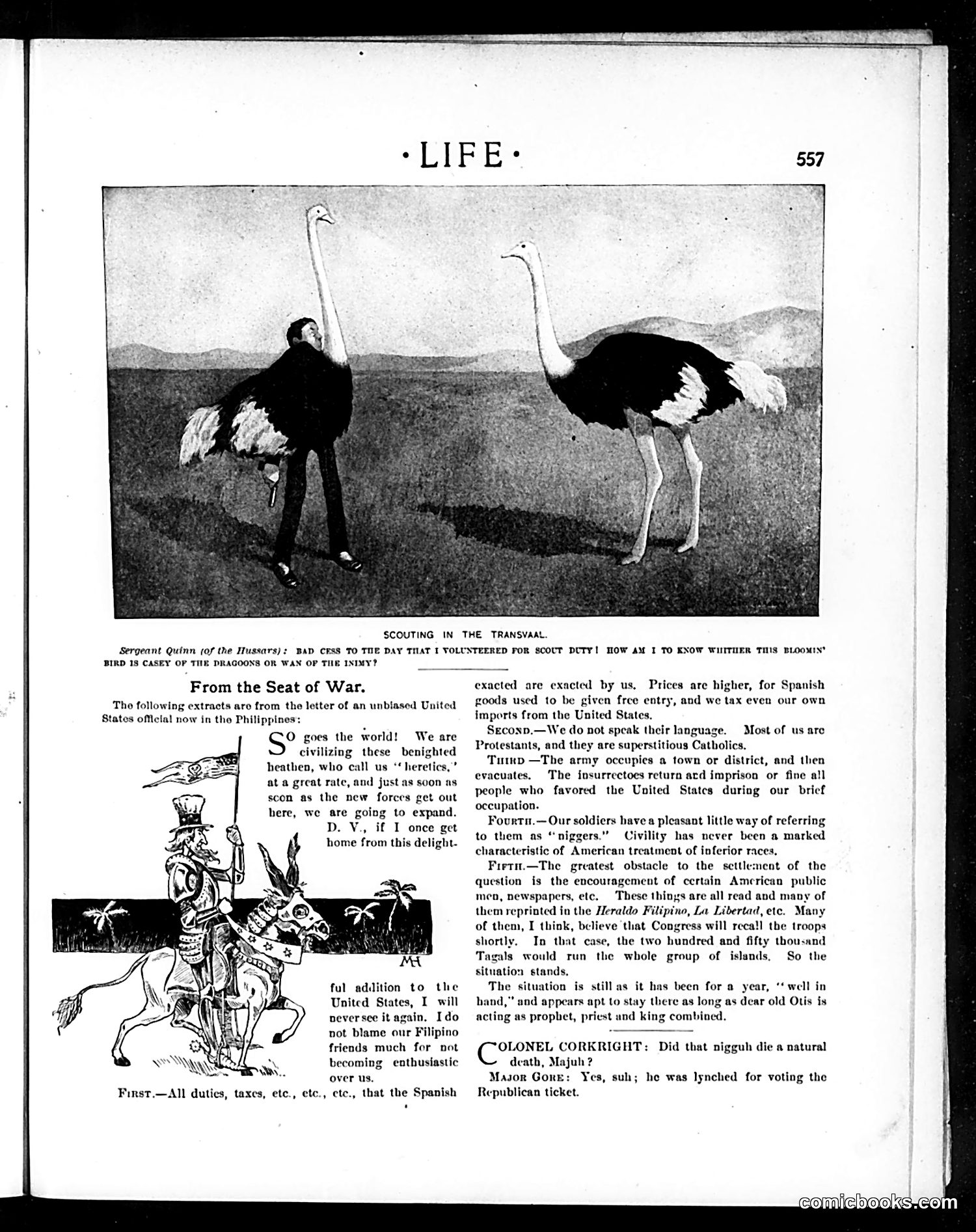
This page satirizes American imperialism in the Philippines and the Boer War era (early 1900s). **Top image**: A British soldier scouts in South Africa's Transvaal region during the Boer War, unable to distinguish between friendly and enemy forces—mocking the confusion of colonial warfare. **Main article**: An unnamed U.S. official in the Philippines candidly describes why American "civilization" efforts are failing. The five-point critique exposes hypocrisy: Americans impose the same taxes Spain did, don't speak Filipino, are Protestant among Catholics, call Filipinos racial slurs, and American newspapers encourage resistance by suggesting troops might withdraw. The final jab states 250,000 Tagalogs would control the islands if Americans left. **Bottom dialogue**: A colonel asks if a Black man died naturally; a major replies he was "lynched for voting Republican"—darkly satirizing American racial violence at home while claiming to civilize abroad. The satire's point: America's imperial project abroad contradicts its democratic values and racial attitudes at home, while generating resentment rather than progress.
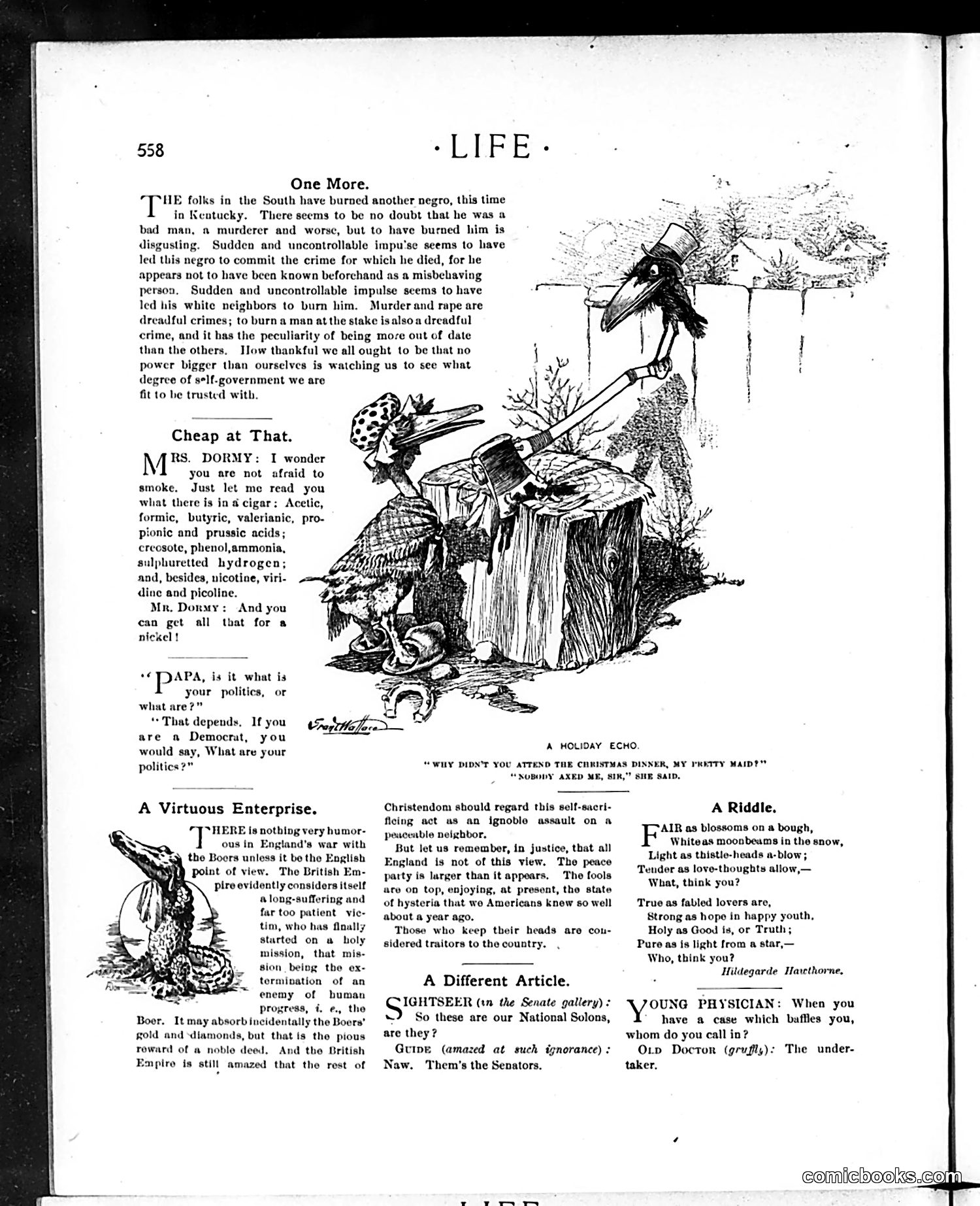
This page contains several satirical pieces typical of Life magazine's social criticism: **"One More"** addresses the lynching of a Black man in Kentucky. The editorial condemns both his alleged crimes and the mob burning as equally dreadful, arguing that lynch mobs act with the same "sudden and uncontrollable impulse" they attribute to the accused—questioning Americans' fitness for self-governance. **"Cheap at That"** mocks health concerns about smoking through a dialogue where Mrs. Dormy lists dangerous chemical compounds in cigars, and Mr. Dormy dismisses them as acceptable at a nickel's price. **"A Virtuous Enterprise"** satirizes British justifications for the Boer War as a noble "civilizing mission," suggesting the Empire merely disguises imperial conquest as moral duty. The remaining pieces are humorous riddles and brief jokes unrelated to politics. The page reflects Life's role as a publication critiquing American hypocrisy, racial violence, and British imperialism circa the Boer War era.
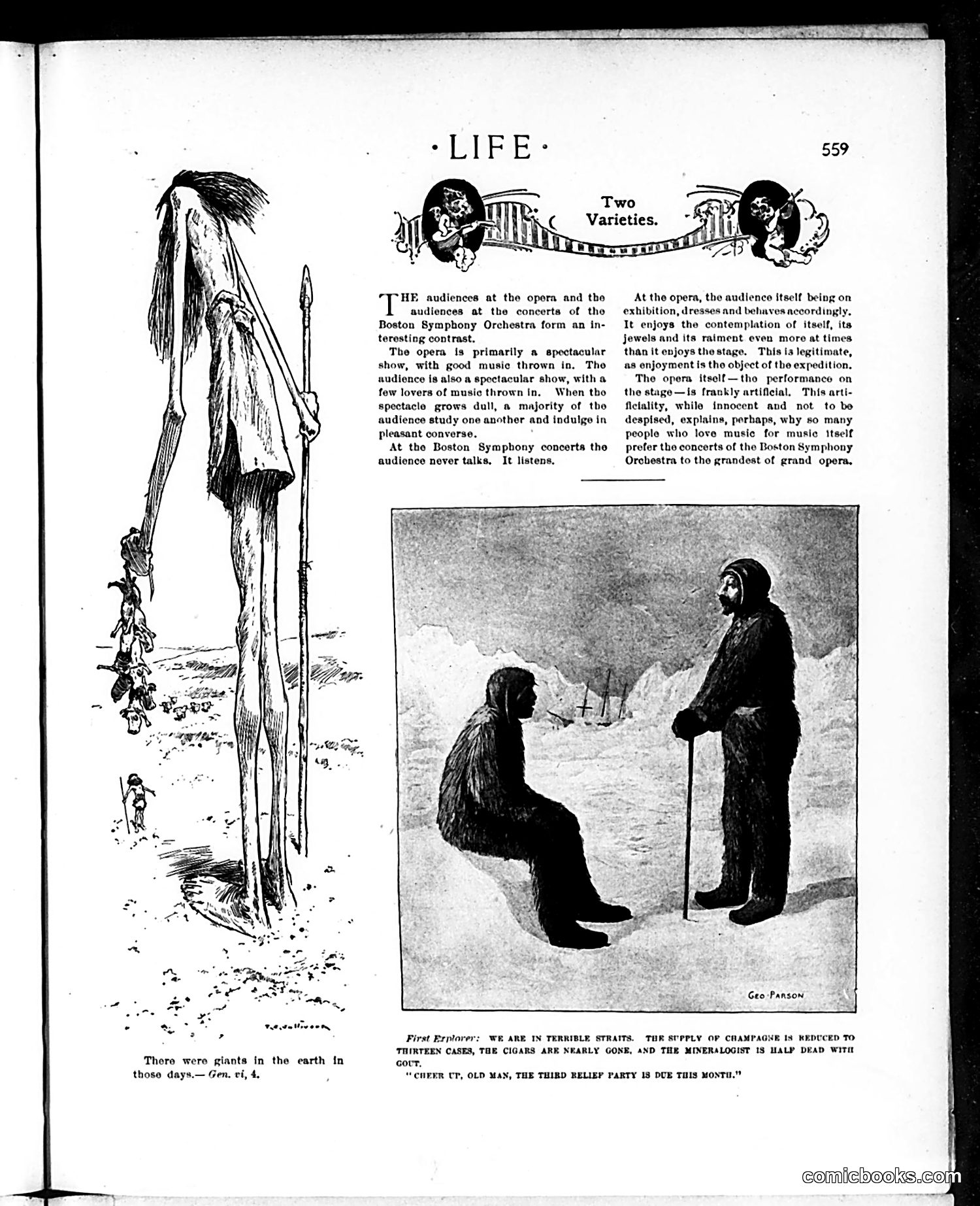
This page contains two distinct pieces of satire: **"Two Varieties" (Main Article):** A comparison of opera versus Boston Symphony Orchestra audiences. The text satirizes opera-goers as primarily interested in displaying themselves—their jewels and clothing—rather than genuinely appreciating music. By contrast, Symphony audiences "never talk" and actually listen. The satire suggests opera is superficial spectacle masquerading as high culture, while the Symphony represents authentic musical appreciation. This reflects early 20th-century class anxieties about what constitutes "real" culture. **"First Explorer" Cartoon (Bottom):** Depicts two explorers in Arctic conditions. One expresses concern about dwindling champagne and cigars, while his companion reassures him a relief party arrives soon. The joke satirizes wealthy explorers' priorities—they're more worried about luxury provisions than actual survival. This mocks both the frivolousness of wealthy expeditions and the absurd notion that even in extreme hardship, the privileged maintain their comforts.
This page is primarily **advertising and book announcements** rather than political satire. The main content is "**Scissors at Nullus**" — a humorous piece presenting the Biblical Adam and Eve story in exaggerated French dialect. The joke relies on ethnic stereotyping: a Frenchman narrates Genesis with heavy accent ("Votla," "ze," "valk") and adds a risqué twist where the serpent flatters Eve as a "goddess" superior to her current self, persuading her to eat the apple. The humor targets both the French (through caricatured speech) and plays on period attitudes about feminine vanity and seduction. Below are unrelated brief jokes (about a reverend's sermon, a farmer choosing a cow over a bicycle, an Irish judge and jury) that showcase typical early-1900s magazine humor. The page concludes with advertisements for **Wilson Whiskey** (established 1823) and promotion of **Life's Christmas issue**, priced at twenty-five cents, featuring cartoons by C.D. Gibson and illustrations by F.G. Atwood.
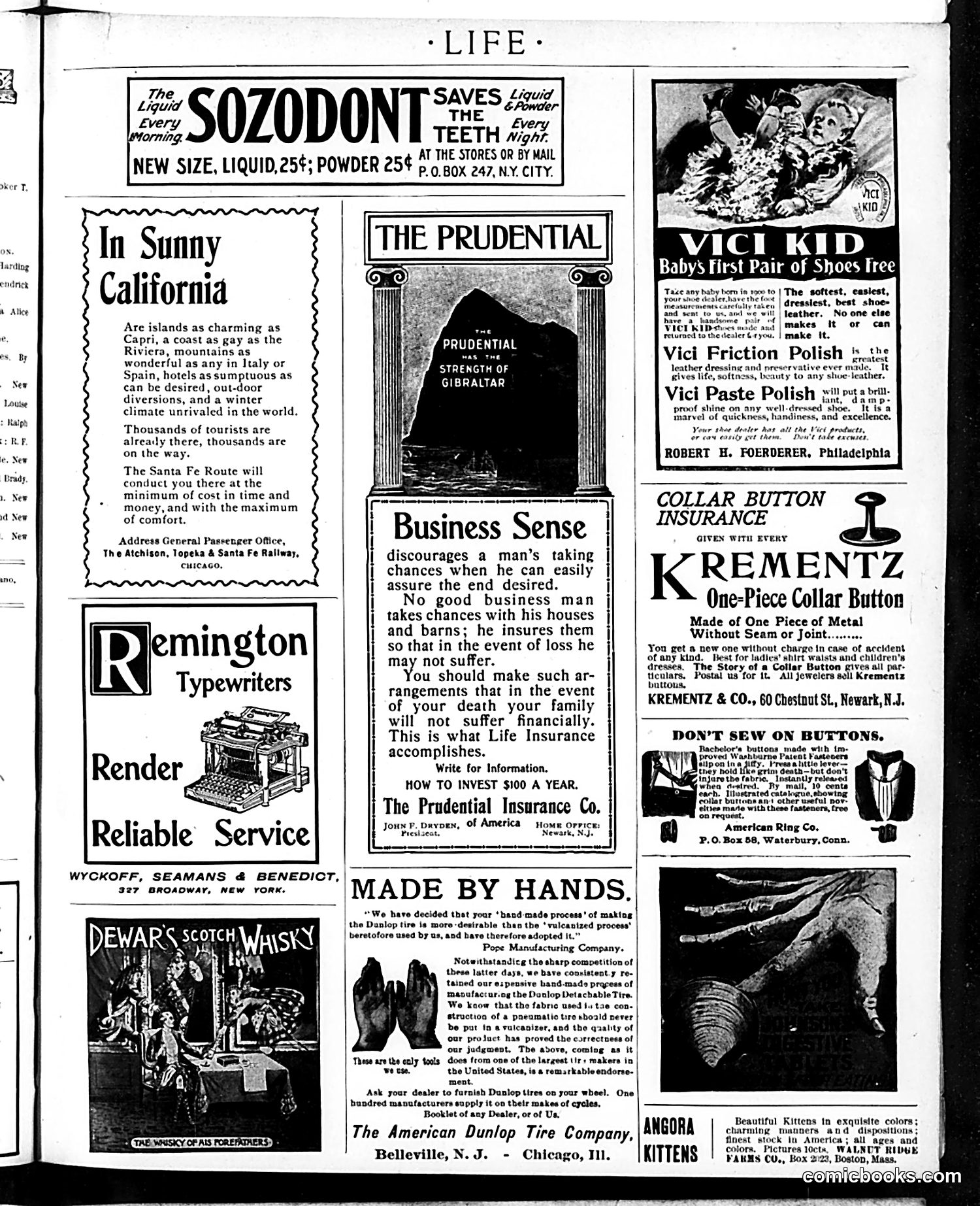
This page is primarily **advertisements**, not political satire. It's a vintage Life magazine page showcasing consumer products from the early 1900s. The ads include: - **Sozodont** toothpaste and powder - **Remington typewriters** - **Prudential Insurance** (emphasizing life insurance as financial security) - **Vici shoe products** (polish and dressing) - **Krementz collar buttons** (one-piece metal fasteners) - **Dunlop tires** (highlighting hand-made manufacturing vs. vulcanization) - Travel promotion for California via Santa Fe Railway - **Dewar's Scotch Whisky** - Various other consumer goods The only substantive editorial content is the Prudential ad's "Business Sense" section, which argues that just as prudent businessmen insure property against loss, families should secure life insurance to protect dependents financially. This reflects early-1900s anxieties about economic security and the emerging life insurance industry.
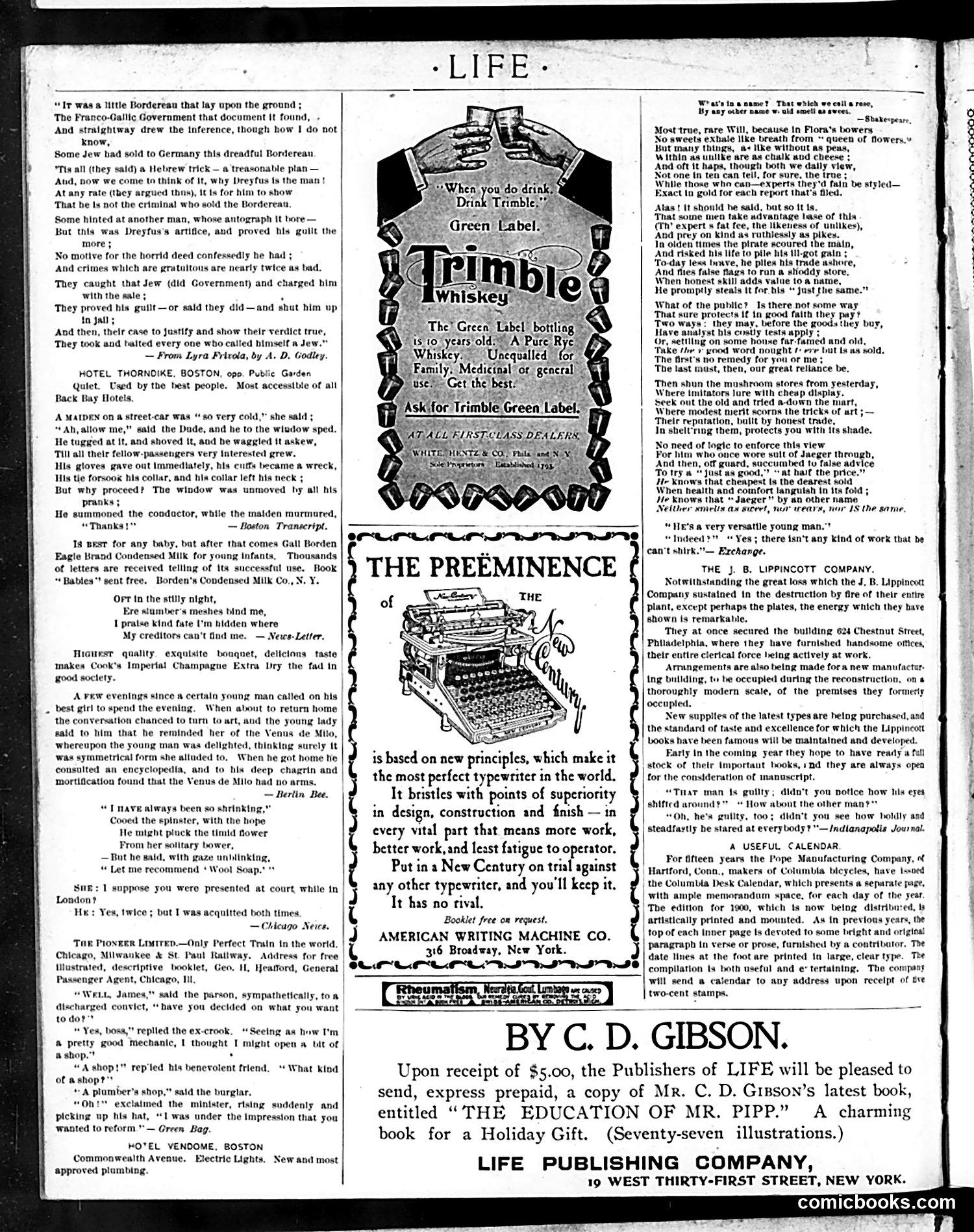
This page contains **satirical poetry and advertisements** rather than traditional political cartoons. The main literary content is a poem about the **Dreyfus Affair**—a major French scandal where Jewish military officer Alfred Dreyfus was falsely accused of treason (selling military secrets to Germany). The poem satirizes the anti-Semitic logic used against him: French authorities found a suspicious document (the "Bordereau"), assumed a Jew must have sold it, therefore Dreyfus was guilty. The satire highlights the circular reasoning: when evidence was lacking, his Jewishness itself became "proof." The poem concludes by mocking how authorities then persecuted all Jews to justify their verdict. The page also contains humorous short anecdotes (a man struggling to open a train window, a spinster's failed flirtation) and period advertisements for whiskey, typewriters, champagne, and hotels. **For modern readers:** This reflects 1890s-1900s European anti-Semitism and demonstrates how Life magazine used humor to critique prejudice and faulty logic.
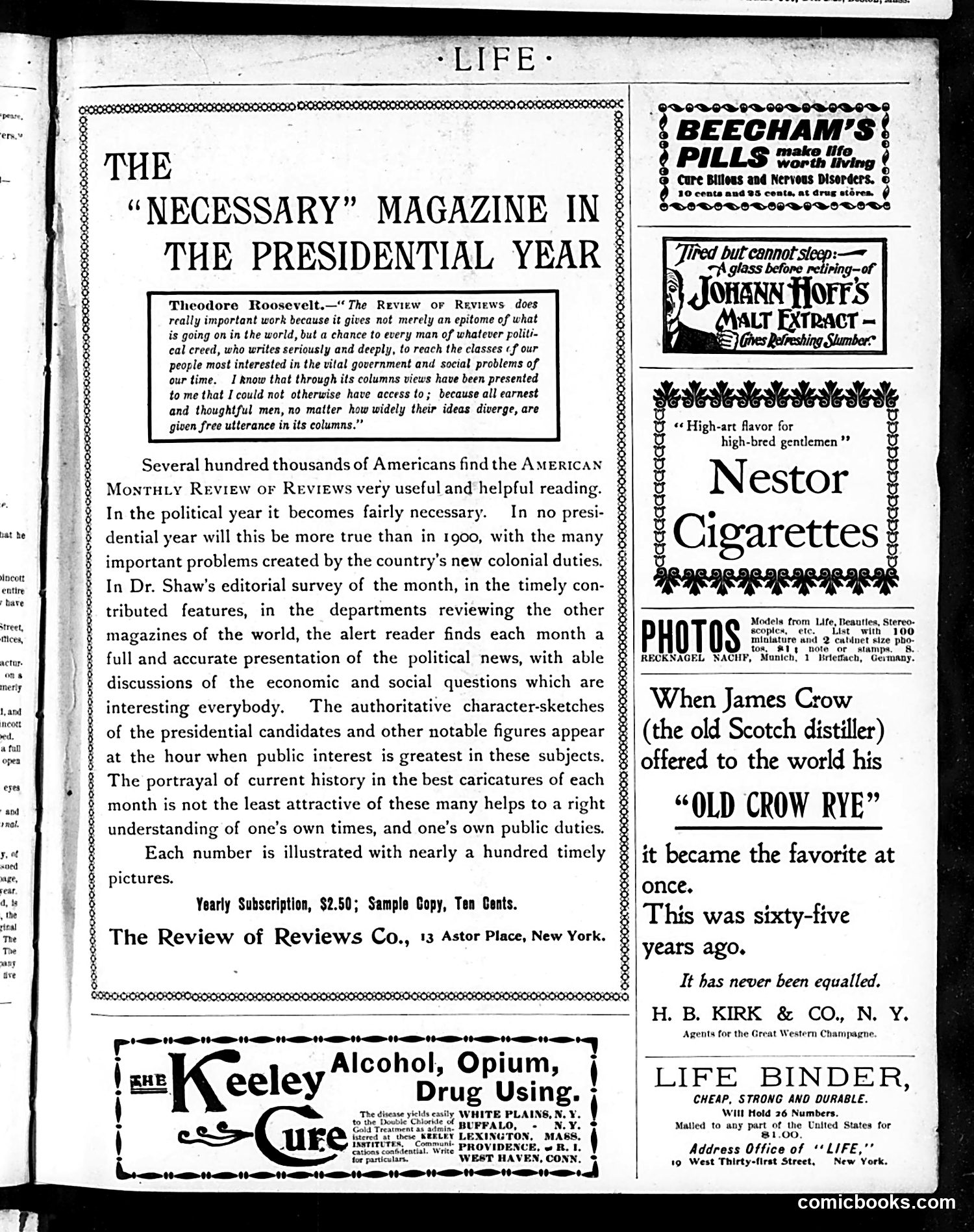
This page is primarily **advertising and editorial promotion**, not political satire or cartooning. The main content advertises *The Review of Reviews* magazine, featuring a Theodore Roosevelt endorsement praising its coverage of political and social issues during the 1900 presidential year. The page emphasizes the magazine's importance for understanding America's "new colonial duties"—likely referencing U.S. imperial expansion following the Spanish-American War (1898), particularly regarding the Philippines and Cuba. The surrounding advertisements are typical period remedies and consumer goods: Beecham's Pills, Johann Hoff's Malt Extract, Nestor Cigarettes, Old Crow Rye whiskey, and "The Keeley Cure" for alcohol and drug addiction. These ads reveal contemporary attitudes toward patent medicines and alcohol as acceptable commercial products. **No political cartoon is visible on this page.** It functions as a magazine promotion piece aimed at educated, affluent readers interested in current events during a presidential election year.
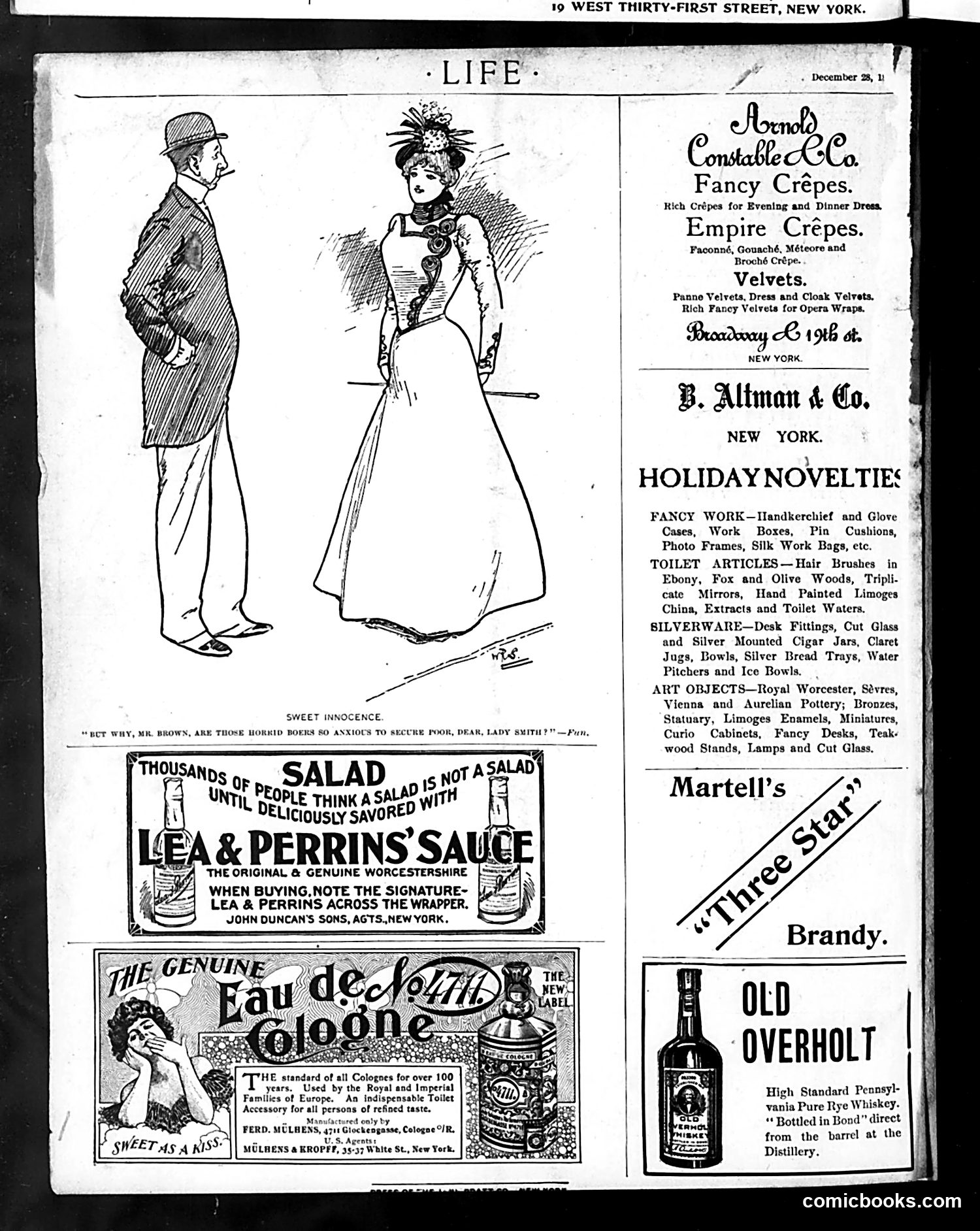
The cartoon depicts a fashionable woman in an elaborate evening gown speaking with a man in a bowler hat. The caption quotes her asking "Mr. Brown" why "those horrid Boers" are so anxious to "secure poor, dear, Lady Smith." This satirizes the Second Boer War (1899-1902) through the perspective of an upper-class woman who treats a serious military conflict as trivial drawing-room gossip. "Lady Smith" refers to Ladysmith, a besieged British garrison town in South Africa that became a symbol of British resistance. The cartoon mocks how wealthy society women reduced complex geopolitical violence to sentimental concern, displaying ignorance of actual military stakes while maintaining fashionable concern for "poor" places and people. The satire critiques both the Boer War itself and the superficiality of polite society's engagement with serious events.

I cannot reliably analyze this image because it appears to be almost entirely black or severely degraded, making the cartoon(s), figures, text, and details unreadable. While there is a "comicbooks.com" watermark visible at the bottom right and what appears to be a page number or marking at the top, the actual content of the page—whether cartoons, illustrations, or satirical commentary—is not discernible from this reproduction. To provide accurate historical context about the satire, political references, and figures depicted, I would need a clearer, higher-contrast version of this Life magazine page.